Category: Faith

  • The Death of Abraham

    Abraham lived a live that is an example to us all. This devotional reading looks at the end of his life.

    Nuggets

    • Abraham took Keturah as a wife, with whom he had several sons.
    • As (considered) firstborn, Isaac was entitled to a double portion of Abraham’s wealth.
    • The half-brothers were probably ticked off that they just got gifts of Abraham’s estate, not a portion of it.
    • Abraham died at the age of 175.
    the-death-of-abraham

    From the day he was called until the day he died, Abraham lived a life that gained him the distinction of being called righteous. “And Abram believed the Lord, and the Lord counted him as righteous because of his faith” (Gen. 15: 6 NLT).

    One thing Abraham did not escape was physical death. Let’s take a look at the end of his life.

    Let’s Put It into Context #1

    To read devotions in the Creating Everything theme, click the button below.

    Devotions in the Abraham the Patriarch series

    Let’s Put It into Context #2

    Let’s start this discussion by doing some background information on marriage.

    I like Hampshire’s purpose for marriage. He wrote, “God gave us marriage to enjoy and display the gospel.”

    Resource

    Yes, Jehovah was the Creator of marriage – as a covenant relationship. It is a visual of our relationship with Jehovah and His relationship with us. It is a display of His power and character.

    We see this as Yeshua is identified as the Bridegroom, and the Church is identified as the Bride.

    Woman was created so that man would not be alone (Gen. 2: 18). “This explains why a man leaves his father and mother and is joined to his wife, and the two are united into one” (Gen. 2: 24 NLT).

    Human marriage, according to Hampshire, is to have the following elements:

    • Unending love
    • Mutual submission
    • Forgiveness
    • Compassion
    • Self-sacrifice

    Because of sin, marriage was distorted. In the Old Testament, this included taking concubines. Concubines (pilegesh) – while they were generally servants – were secondary wives, typically chosen to bear children when the primary wife was barren.

    I had always considered the wife to have the legal status and the concubine to be more of a mistress in today’s terminology. I was wrong.

    Women who had the legal status of concubines, though, did not have the full privileges of the primary wife. In other words, according to Lyons, the terms were not used interchangeably.

    Resource

    But they were treated well and held in high regard.

    There would have been no betrothal, no marriage ceremony. There would have just been a statement.

    The status of concubine, according to Got Answers, was permanent. Rushmore said that meant the slave could not be sold if the owner was no longer satisfied with her.

    Resources

    Because they were considered wives, they were part of the family.

    Even though God’s Word tells us that Abraham, Jacob, David, Solomon, and others had more than one wife, we should not read that as Jehovah giving His blessing to do that. His idea of the institution is that it is one man and one woman until death do them part.

    One reason given by Got Questions for God tolerating this practice was that it fulfills the go-forth-and-multiply blessing (Gen. 1: 28). That was a way to populate the earth.

    Abraham Married Another Wife

    “Abraham married another wife, whose name was Keturah. She gave birth to Zimran, Jokshan, Medan, Midian, Ishbak, and Shuah. Jokshan was the father of Sheba and Dedan. Dedan’s descendants were the Asshurites, Letushites, and Leummites. Midian’s sons were Ephah, Epher, Hanoch, Abida, and Eldaah. These were all descendants of Abraham through Keturah” (Gen. 25: 1-4 NLT)

    Keturah

    Abraham took Keturah as a wife, with whom he had several sons.

    Keturah is mentioned twice in God’s Word. But her positions is described differently in the two references.

    Remember, concubines had legal status but did not have the full privileges of the primary wife. To me, this is why Keturah could be called an isha in Genesis 25: 1 and a pilegesh in I Chronicles 1: 32. She was a secondary isha because she was a pilegesh.

    This is different than how Hagar is described. True, Hagar was given the title isha (wife), not philegesh (concubine) in Genesis 16: 2. After that, she is always referred to as a shifchah [female slave of the lowers rank] (Gen. 16: 5, 6, and 8).

    But then concubines (pilegesh) generally were slaves/servants.

    I had always been under the impression that Abraham married Keturah after Sarah had died. Got Questions and Lyons didn’t think this was the case. Got Questions thought Keturah was more of a concubine while Sarah was alive who then was elevated to (probably) primary wife after Sarah’s death.

    Resource

    Bradford gave us a good explanation of why Abraham would have had to be married to Keturah before Sarah died, giving us a big caution about believing God’s Word is given in a chronological manner. If the marriage happened after Sarah’s death, the birth of Keturah’s sons would have been miraculous conceptions also.

    Resource

    This could have occurred during the 13 years between Ishmael’s birth and Isaac’s birth. They may not have been mentioned because they did not further the spiritual narrative.

    The mention of Ishmael may have been representative of the others. Plus, it may have been more of a story because of the demand of Sarah and the flight of Hagar.

    Did Abraham have more wives? We aren’t told.

    Abraham may have had more wives because there were a lot of things about his life that we weren’t told. I would say that he probably didn’t.

    We are told that Abraham had concubines, but we aren’t told if two was it or if or how many sons the others had.

    I did read an article that said Eliezer was Abraham’s son. I don’t think so.

    Resource

    Lindsey based her opinion (probably in part) on the Septuagint. “And Abram said, Master Lord, what wilt thou give me? whereas I am departing without a child, but the son of Masek my home-born female slave, this Eliezer of Damascus” (Gen. 15: 2 SEP emphasis added).

    Just because Masek was a female slave born in Abraham’s house didn’t make Abraham  the father of her child. According to Got Questions, it was a common practice in Abraham’s time to adopt a servant as an heir. But I don’t think our adopt had the meaning Abraham was going for.

    Resource

    Abraham wouldn’t have been lamenting he was childless – meaning in Hebrew destitute of children – if Eliezer was his biological child. “… since I go childless …” (Gen. 15: 2 OJB). (To me, this means he couldn’t have been married to Keturah at this point and had children with her.)

    Abraham had no problem with suggesting Ishmael as a substitute. Why wouldn’t he have offered the older son, who was more in line with the character Jehovah wanted?

    Midian

    A fun fact is that Abraham’s son Midian was the ancestor of the Midianites, who were spice traders who traveled in caravans. These were the people to whom Moses fled after killing the Egyptian.

    Bradford told us where the Midianites’ territory was. He wrote, “Their territory was located on the Arabian Peninsula, bordered by the eastern edge of finger of the Red Sea today called the Gulf of Aqaba.” This is modern Saudi Arabia and Jordan.

    Resource

    We read of Midianite merchants purchasing Joseph and taking him to Egypt (Genesis 37: 25–28). Eventually, the Midianites became an adversary because they led Israel into idolatry (Num. 25: 6-18). The Midianites were some of the people ruining the Israelite’s crops during the time of Gideon (Jdgs. 6: 3-6).

    At times, the Midianites were referred to as Ishmaelites. While the shared a heritage with the descendants of Ishmael and were in goose proximity to them, this was a mistaken identification.

    The Distribution of Abraham’s Estate

    “Abraham gave everything he owned to his son Isaac. But before he died, he gave gifts to the sons of his concubines and sent them off to a land in the east, away from Isaac” (Gen. 25: 5-6 NLT)

    Everything He Owned to Isaac

    As (considered) firstborn, Isaac was entitled to a double portion of Abraham’s wealth.

    Rather than meaning position in the lineup of sons, firstborn signified special status, preeminence, leadership, and inheritance. (Notice worldly inheritance is last on the list.)

    That is because the designation firstborn meant that son was being set apart. In general terms, being designated firstborn had to do with birthright and inheritance.

    The birthright meant who was going to take over authority and leadership of the clan. Because of this distinction, he got a double portion of the inheritance. He was given the worldly status associated with his position.

    But we cannot overlook the fact that the firstborn was consecrated to Jehovah. “Dedicate to me every firstborn among the Israelites. The first offspring to be born, of both humans and animals, belongs to me” (Ex. 13: 2 NLT).

    Yeah, it does say birth order there. “… whatsoever openeth the rechem (womb) …” (Ex. 13: 2 OJB). But we know Jehovah didn’t always – in fact, usually so far – call the first son to be born.

    • Jehovah called Abel. He did not call Cain, the firstborn. When Cain killed Abel, God called Seth.
    • Jehovah called Abraham. He did not call Nahor, the firstborn.
    • Jehovah called Isaac. He did not call Ishmael, the firstborn.
    • Jehovah called Jacob. He did not call Esau, the firstborn.
    • Jehovah called Judah. He did not call Reuben, the firstborn.
    • Jehovah called Ephraim. He did not call Manasseh, the firstborn.
    • Jehovah called David. He did not call Eliab, Abinadab, Shimea, — or any of his other four brothers.

    Let’s think this through. We know Ishmael was 13 years older than Isaac. All of Keturah’s children were probably older than Isaac.

    We have to keep in mind that Abraham was not just giving Isaac all of his worldly possessions here. He was giving him all the blessings of the covenant.

    Gave Gifts to the Sons of his Concubines

    The half-brothers were probably ticked off that they just got gifts of Abraham’s estate, not a portion of it.

    Abraham presented gifts to each and sent them away from Isaac. This was a common practice in Abraham’s time. It was totally up to the father whether sons from concubines got anything at all.

    Why did the sons from concubines not get a portion of the inheritance and be sent away? This was so they could not contest the inheritance, eliminating family conflicts. We mentioned how Abraham didn’t like conflicts.

    This practice preserved the estate for the heir. In this case, it was preserving the covenant promises.

    But giving them a gift instead of a portion could have escalated any hostilities instead of eliminating them. The gifts could have been anywhere from stingy to substantial.

    Whatever the case, Isaac was made a very wealthy man.

    Bradford reminded us that this was just another example of dividing and separating. It goes hand in hand with electing.

    Resource

    We get that Abraham sent his other sons off to secure the Promised Land for Isaac. But why east?

    Abraham wanted to establish a distance among the siblings. He may have thought about Jehovah’s promise to bless all nations through him, so he was dispersing them to do just that. This also allowed them to grow independently and develop their own identities.

    We also know there was probably spiritual reason. Abraham may have been sending them east to the Land of Nod. “So Cain left the LORD’s presence and settled in the land of Nod, east of Eden” (Gen. 4: 16 NLT).

    The Land of Nod was where the Land of Eden was not. Nod is a Hebrew word. It means wanderer, exile, or fugitive.

    We said back in Genesis 4 with Cain’s exile that his journey would bring him first into what we know today as Arab nations. Those nations were being established here.

    The Death of Abraham

    “Abraham lived for 175 years, and he died at a ripe old age, having lived a long and satisfying life. He breathed his last and joined his ancestors in death. His sons Isaac and Ishmael buried him in the cave of Machpelah, near Mamre, in the field of Ephron son of Zohar the Hittite. This was the field Abraham had purchased from the Hittites and where he had buried his wife Sarah” (Gen. 25: 7-10 NLT)

    Abraham died at the age of 175.

    The wording of verse 8 indicated that he had a good life. They didn’t have any concept of eternity, so living a long life was what was prized.

    Maclaren agreed that a long and satisfying life was not based on a numeric standard. He wrote, “The words point to a calm close, with all desires granted, with hot wishes stilled, and a willingness to let life go, because all which it could give had been attained. We have two main things to consider.”

    Resource

    Abraham’s death happened as it was foretold by Sovereign God. “(As for you, you will die in peace and be buried at a ripe old age.)” (Gen. 15: 15 NLT).

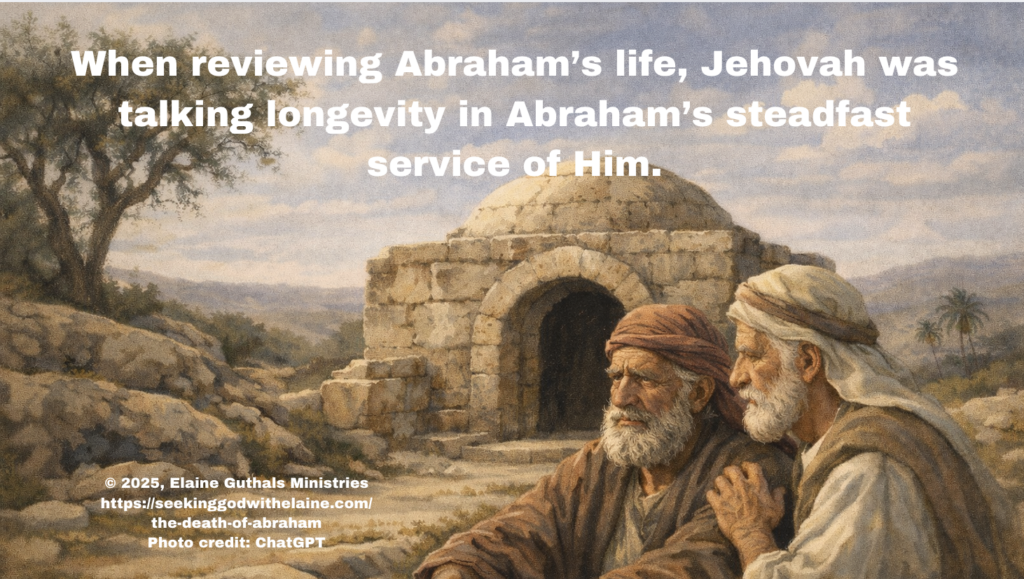
    No, Jehovah wasn’t talking about a number and a feeling. When reviewing Abraham’s life, Jehovah was talking longevity in Abraham’s steadfast service of Him.
    The New Living Translation called it joined with his ancestors. I’m used to hearing it said as gathered to his people.

    Gathered to his people means more than Abraham was buried in the cave alongside Sarah. It meant that Abraham would be reunited with his ancestors who had died before him — Terah, Noah, Shem, and Seth.

    Bradford said that this was different from the phrase went down to Sheol. It was not intimating an end.

    Resource

    Still there was no mention of Heaven. Bradford that the afterlife, while hinted at, was not addressed in depth. The existence of eternal life with Jehovah did not considered until the end of the Old Testament around 400 BC.

    Maclaren had an interesting thought. How many times have we said that the bricks in Abraham’s Sanctification Road was built on bricks of his separation from things here in this life?

    • Left his country and kin (Gen. 11: 31).
    • Father died (Gen. 11: 32).
    • Left Haran (Gen. 12: 1)
    • Left Canaan for Egypt (Gen. 12: 10).
    • Left Egypt (Gen. 12:  20).
    • Separated from Lot (Gen. 13: 13).
    • Separated from Ishmael (Gen. 21:  14).
    • Almost separated from Isaac (Gen. 22: 10).
    • Separated from Sarah (Gen. 23:  1-2).
    • Separated from worldly possessions (Gen. 25: 5).
    • Separated from life (Gen. 25:  7-8).

    Now, Abraham was being gathered to his people. More importantly, he was being gathered to his Heavenly Father.

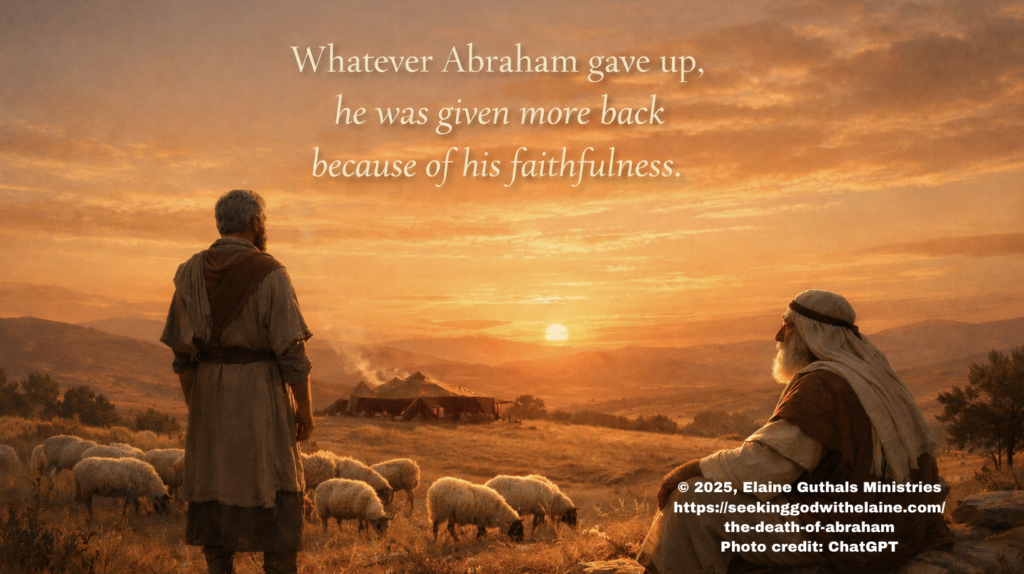
    Whatever Abraham gave up, he was given more back because of his faithfulness.
    While it didn’t mention any of the other sons, Isaac and Ishmael were both present at Abraham’s burial. Leale called it a time of peace.

    Resource

    We know the illness and death of loved ones can tear families apart. Whatever animosity Isaac felt because of Ishmael’s treatment of him in life, he could stand side by side with him at the death of their father.

    Making the Connections #1

    Abraham had a rich life in his 175 years. He went from a nobody who worshiped false gods to the spiritual leader of a new nation.

    • Abraham taught to remain faithful to Jehovah.
    • He taught us to always be obedient even in the difficult missions.
    • He taught us to remain pure even if it meant giving up that — especially those — who we dearly love.
    • He taught us to build our relationship with Jehovah while we walk with Him.
    • He taught us to honor Jehovah as He controls our lives.
    • He taught us to wait on Jehovah no matter how long it takes for Him to fulfill His promises.

    Making the Connections #2

    Regardless of what sins Abraham committed in his life, he has been shown to us as a model of faithfulness.

    • “It was by faith that Abraham obeyed when God called him to leave home and go to another land that God would give him as his inheritance. He went without knowing where he was going. And even when he reached the land God promised him, he lived there by faith — for he was like a foreigner, living in tents. And so did Isaac and Jacob, who inherited the same promise. Abraham was confidently looking forward to a city with eternal foundations, a city designed and built by God” (Heb. 11: 8-10 NLT).
    • “It was by faith that Abraham offered Isaac as a sacrifice when God was testing him. Abraham, who had received God’s promises, was ready to sacrifice his only son, Isaac, even though God had told him, ‘Isaac is the son through whom your descendants will be counted.’ Abraham reasoned that if Isaac died, God was able to bring him back to life again. And in a sense, Abraham did receive his son back from the dead” (Heb. 11: 17-19 NLT).
    • “Circumcision was a sign that Abraham already had faith and that God had already accepted him and declared him to be righteous — even before he was circumcised. So Abraham is the spiritual father of those who have faith but have not been circumcised. They are counted as righteous because of their faith. And Abraham is also the spiritual father of those who have been circumcised, but only if they have the same kind of faith Abraham had before he was circumcised” (Rom. 4: 11-12 NLT).
    • “Abraham never wavered in believing God’s promise. In fact, his faith grew stronger, and in this he brought glory to God. He was fully convinced that God is able to do whatever he promises. And because of Abraham’s faith, God counted him as righteous. And when God counted him as righteous, it wasn’t just for Abraham’s benefit. It was recorded for our benefit, too, assuring us that God will also count us as righteous if we believe in him, the one who raised Jesus our Lord from the dead. He was handed over to die because of our sins, and he was raised to life to make us right with God” (Rom. 4: 20-25 NLT).
    • “In the same way, ‘Abraham believed God, and God counted him as righteous because of his faith.’ The real children of Abraham, then, are those who put their faith in God” (Gal. 3: 6-7 NLT).

    How Do We Apply This?

    • Remain faithful to Jehovah.
    • Be sanctified to have His character.
    • Understand that we cannot altar Jehovah’s plan.

    Resource

    Father God. Thank You for the example of Abraham. Thank You for showing us what faith and obedience look like. Thank You for showing us we are rewarded for that even when we falter, sin, and repent. Amen.

    If you don’t understand something and would like further clarification, please contact me.

    If you have not signed up for the email providing the link to the devotions and the newsletter, do so below.

    If God has used this devotion to speak with you, consider sharing it on social media.
  • The Marriage of Isaac and Rebekah

    As the caravan returned to Canaan, Isaac and Rebekah met for the first time. This devotional reading looks at the true success of the mission Abraham gave Eliezer.

    Nuggets

    • Isaac must have been visiting Abraham.
    • We are told that Isaac was out walking and meditating.
    • Then off in the distance, a caravan appeared.
    • Rebekah got her first look at her soon-to-be husband.
    • We are also told that Isaac loved Rebekah deeply.
    the-marriage-of-isaac-and-rebekah

    Abraham had sent Eliezer to Paddan-Aram on a specific mission – get Isaac a wife from his family. Eliezer got there and had a successful mission. Rebekah came back with him.

    But was the mission a success? Getting Rebekah to come back was only the beginning. What would Isaac think? What would she think when she met Isaac?

    Let’s Put It into Context

    To read devotions in the Creating Everything theme, click the button below.

    Devotions in the Abraham the Patriarch series

    Where Isaac Lived

    “Meanwhile, Isaac, whose home was in the Negev, had returned from Beer-lahai-roi” (Gen. 24: 62 NLT)

    Isaac must have been visiting Abraham.

    Isaac lived in the Negev, where Beer-lahai-roi was located. Since Moses said he returned from there, we can assume that here was Hebron, where Abraham lived.

    The Negev was a triangular shaped region in the southern part of Israel. Its boundaries are the Sinai Peninsula on the west and the Jordan River on the east. The northern boundary is harder to define.

    Be’er-Lahai Roi was the well by which Hagar’s journey ended.

    Isaac Took a Walk

    “One evening as he was walking and meditating in the fields, he looked up and saw the camels coming” (Gen. 24: 63 NLT)

    Walking and Meditating

    We are told that Isaac was out walking and meditating.

    Isaac went out to a spot where he could be by himself. Gray said he was walking in the open country. Pearse called it a field.

    Resources

    Since Isaac was walking, he was doing this during leisure time. He wasn’t working.

    Moses said this occurred in the evening. I can see that. That time makes it a good time to review the day and get Sovereign God’s insight as to the condition of our hearts.

    Isaac was alone with his thoughts. Being alone to meditate is very important. The leisure times gives us the opportunity for meditation while the solitude helps to keep our focus on our Father God.

    Life is rough. Sometimes, we need to get off by ourselves and think things through.

    That is what meditating is. It is think through what Jehovah has said in His Word and what he has revealed to us through the Holy Spirit. We determine what is in our hearts.

    Leckie had a wonderful insight on meditation. He said that meditations stem from who we are. By definition, it gets our thoughts down to our core — our center. In Elaine-speak, that means it is the way to get it to the heart level. That means we should not fear losing ourselves in meditation. In fact, losing ourselves makes it better.

    Look how Leckie described the process. He wrote,

    “It is letting the mind seethe and work and play about a subject, guided by conscience or emotion or desire or strong resolution, till it gets impressed with the subject, till the sap and taste of it flow into the soul. Nothing, however great, is yours till you get the substance of it into you by meditation. It remains entirely outside of you.”

    Resources

    That makes sense to me. We can only find Jehovah when we spend time with just the two of us. We have to work out what He is telling us — work out our salvation (Phil. 2: 12-13).

    Meditation promotes faith, godliness, and holiness. Manton called it a duty and exercise of our relationship with Jehovah. It gives us a better understanding of what the Holy Spirit is revealing to us.

    Resource

    I know. Solitude is hard to find. Leisure time can get spent in other ways.

    We have to make sure we focus on spiritual matters. We need to do this to ensure that we have a sincere, true relationship with Jehovah.

    Hopefully, Isaac was meditating on spiritual matters. He more than likely knew about the mission to get him a wife. He may have been praying about that.

    Isaac may also have been mourning his mother. We are told that he was still struggling three years later, and Rebekah comforted him.

    Saw the Camels Coming

    Then off in the distance, a caravan appeared.

    We aren’t told if Isaac was in Hebron when the caravan left. Still, he probably would have recognized it when it returned.

    Rebekah’s Reaction

    “When Rebekah looked up and saw Isaac, she quickly dismounted from her camel. ‘Who is that man walking through the fields to meet us?’ she asked the servant. And he replied, ‘It is my master.’ So Rebekah covered her face with her veil. Then the servant told Isaac everything he had done” (Gen. 24: 62-66 NLT)

    Rebekah got her first look at her soon-to-be husband.

    Bradford didn’t know where the veil came from. He said, contrary to popular thinking, Mesopotamian women — and Hebrew woman in particular— did not cover their faces in the presence of men.

    However, Bradford went on to say that veils were part of the betrothal and wedding procedures. The veil was put on some amount of time before the wedding and removed after the vows were complete.

    Resource

    Well, Rebekah was going to be married to Isaac. She might have been considering that period the betrothal.

    Isaac and Rebekah Marry

    And Isaac brought Rebekah into his mother Sarah’s tent, and she became his wife. He loved her deeply, and she was a special comfort to him after the death of his mother (Gen. 24: 62-67 NLT)

    We are also told that Isaac loved Rebekah deeply.

    We aren’t told whether Isaac took another wife. He probably didn’t, but then, we are only told what is critical to God’s story of the Gospel.

    What we are told is Isaac took Rebekah into Sarah’s tent. Part of me wondered if that was because Rebekah would be the matriarch of the family.

    Was it just a logistical point? Abraham had his tent. Sarah had her tent. Isaac had his tent.

    Where was Rebekah going to go? Sarah’s tent was vacant.

    No, Bibleverseexplained.com indicated that it was more than that. It says, “The act of bringing Rebekah into his mother Sarah’s tent symbolizes the continuation of the family legacy and the fulfillment of God’s promise to Abraham regarding the future of his descendants.”

    Resource

    From start to finish, this story has been about obedience, promise, love, and provision. Abraham, Isaac, and Eliezer provided the obedience. God provided promise, love, and provision.

    Making the Connections #1

    Leckie said something I like. He wrote, “The meditation of a devout spirit on almost anything will soon run into prayer. … The Hebrew word here rendered ‘meditate’ means also to pray.”

    Resource

    Let’s look at some verses.

    • “But they delight in the law of the Lord, meditating on it day and night” (Ps. 1: 2 NLT).
    • “Study this Book of Instruction continually. Meditate on it day and night so you will be sure to obey everything written in it. Only then will you prosper and succeed in all you do” (Josh. 1:8 NLT).
    • “Oh, how I love your instructions! I think about them all day long” (Ps. 119: 97 NLT).
    • “I will study your commandments and reflect on your ways” (Ps. 119: 15 NLT).
    • “I remember the days of old. I ponder all your great works and think about what you have done” (Ps. 143: 5 NLT).
    • “They are constantly in my thoughts. I cannot stop thinking about your mighty works” (Ps. 77: 12 NLT).

    Let’s look at some verses on prayer.

    • “Always be joyful. Never stop praying. Be thankful in all circumstances, for this is God’s will for you who belong to Christ Jesus” (I Thess. 5: 16-18 NLT).
    • “Rejoice in our confident hope. Be patient in trouble, and keep on praying” (Rom. 12: 12 NLT).
    • “You can pray for anything, and if you have faith, you will receive it” (Mt. 21: 22 NLT).
    • “Don’t worry about anything; instead, pray about everything. Tell God what you need, and thank him for all he has done. Then you will experience God’s peace, which exceeds anything we can understand. His peace will guard your hearts and minds as you live in Christ Jesus” (Phil. 4: 6-7 NLT).

    Think about it. What does that tell us?

    • We are to never stop thinking about Jehovah’s commandments/instructions (Ps. 1: 2) — and never stop praying (I Thess. 5: 17).
    • We are to think in order to assure obedience (Josh. 1: 8), and pray to assure obedience in times of trouble (Rom. 12: 12 NLT).
    • We must think about what we study (Ps. 119: 15), and pray that the study increases our faith (Mt. 21: 22).
    • We are to think about what Jehovah has done for us and others (Ps. 143: 5); so that when circumstances bring anxiety, we will continue to pray to our Father God (Phil. 4: 6-7, I Thess. 5: 17, Rom. 12: 12).

    When we meditate, we end up knowing we need to pray to Jehovah for His control of our lives.

    Making the Connections #2

    I liked what Manton’s said. The purpose of meditation should be to revere Jehovah, not to gain knowledge.

    Resource

    The only thing we should be trying to do when we meditate is to grow our faith, not solve all the mysteries of God’s Word.

    Meditation should grow our sincerity.

    Our motivation should play an important role in how we meditate. The why should always be to strengthen our relationship with Sovereign God.

    Making the Connections #3

    We get a lot of information about Abraham and how he basically did thing right. Then we get even more about Jacob — and how he did things wrong.

    In between these Hall of Famers is Isaac. We don’t get much about him. What we do focuses a lot on wells.

    But this is a great picture of Isaac. He is walking with His Sovereign God.

    How comforting is that!

    Making the Connections #4

    I love, love, love what Dods had to say. He wrote, “God may keep us longer waiting than the world does, but He gives us never the wrong thing.”

    Resource

    We generally say that Jehovah is never early or late but right on time. We need to amend that.

    Jehovah is never early or late but right on time with just the right thing. To put it into action format is to say wait for Jehovah to supply the right thing at the right time.

    Making the Connections #5

    Part of us may look at Isaac and Rebekah as ask, “How in the world did they fit together?”

    Dods explained. He wrote,

    “One cannot read of her lively, bustling, almost forward, but obliging and generous conduct at the well, nor of her prompt, impulsive departure to an unknown land, without seeing, as no doubt Eliezer very quickly saw, that this was exactly the woman for Isaac. In this eager, ardent, active, enterprising spirit, his own retiring and contemplative, if not sombre disposition, found its appropriate relief and stimulus. Hers was a spirit which might indeed, with so mild a lord, take more of the management of affairs than was befitting; and when the wear and tear of life had tamed down the girlish vivacity with which she spoke to Eliezer at the well, and leapt from the camel to meet her lord, her active-mindedness does appear in the disagreeable shape of the clever scheming of the mother of a family. In her sons you see her qualities exaggerated: from her, Esau derived his activity and open-handedness; and in Jacob, you find that her self-reliant and unscrupulous management has become a self-asserting craft which leads him into much trouble, if it also sometimes gets him out of difficulties. But such as Rebekah was, she was quite the woman to attract Isaac and supplement his character.”

    Resource

    We may look at their family of four and say it is a dysfunctional family — and it is for all the reasons Dods listed. But Rebekah was the right wife for Isaac.

    How Do We Apply This?

    • Pray in everything.
    • Listen to Jehovah’s direction — even if we have to wait.
    • Praise Sovereign God.
    • Apply that on which we meditate.
    • Meditate so that we can retain what we hear.
    • Wait for Jehovah to supply the right thing at the right time.

    Resources

    Father God. Thank You for showing us the reward for obedience. Thank You for showing us how You love us and provide what You promise. Amen.

    If you don’t understand something and would like further clarification, please contact me.

    If you have not signed up for the email providing the link to the devotions and the newsletter, do so below.

    If God has used this devotion to speak with you, consider sharing it on social media.

  • The Marriage Treaty between Isaac and Rebekah

    Jehovah had answered Eliezer’s prayer to show His choice for Isaac’s wife. This devotional reading looks at the negotiation process for securing Rebekah’s hand in marriage.

    Nuggets

    • Even with the successful mission he had so far, Eliezer didn’t want to socialize until the mission was completed.
    • Laban and Bethuel — as well as Rebekah — chose to follow Jehovah’s direction.
    • When his mission was completed, Eliezer wanted to immediately go home.
    • Where Laban and Bethuel hadn’t asked Rebekah if she would agree to marry Isaac, they did ask her when she was prepared to leave right away — another sign of maturity.
    the-marriage-treaty-between-isaac-and-rebekah

    Eliezer had done everything right in carrying out his mission. He had asked Jehovah to show him who He wanted to be Isaac’s wife.

    But Eliezer’s mission wasn’t a success yet. The marriage treaty wasn’t official. He had to talk to the future bride’s family.

    Let’s Put It into Context

    To read devotions in the Creating Everything theme, click the button below.

    Devotions in the Abraham the Patriarch series

    The Marriage Treaty

    “So the man went home with Laban, and Laban unloaded the camels, gave him straw for their bedding, fed them, and provided water for the man and the camel drivers to wash their feet. Then food was served. But Abraham’s servant said, ‘I don’t want to eat until I have told you why I have come.’ ‘All right,’ Laban said, ‘tell us.’ ‘I am Abraham’s servant,’ he explained. ‘And the Lord has greatly blessed my master; he has become a wealthy man. The Lord has given him flocks of sheep and goats, herds of cattle, a fortune in silver and gold, and many male and female servants and camels and donkeys. When Sarah, my master’s wife, was very old, she gave birth to my master’s son, and my master has given him everything he owns. And my master made me take an oath. He said, “Do not allow my son to marry one of these local Canaanite women. Go instead to my father’s house, to my relatives, and find a wife there for my son.” But I said to my master, “What if I can’t find a young woman who is willing to go back with me?” He responded, “The Lord, in whose presence I have lived, will send his angel with you and will make your mission successful. Yes, you must find a wife for my son from among my relatives, from my father’s family. Then you will have fulfilled your obligation. But if you go to my relatives and they refuse to let her go with you, you will be free from my oath.” So today when I came to the spring, I prayed this prayer: “O Lord, God of my master, Abraham, please give me success on this mission.  See, I am standing here beside this spring. This is my request. When a young woman comes to draw water, I will say to her, ‘Please give me a little drink of water from your jug. If she says, ‘Yes, have a drink, and I will draw water for your camels, too,” let her be the one you have selected to be the wife of my master’s son.’” Before I had finished praying in my heart, I saw Rebekah coming out with her water jug on her shoulder. She went down to the spring and drew water. So I said to her, ‘Please give me a drink.’  She quickly lowered her jug from her shoulder and said, ‘Yes, have a drink, and I will water your camels, too!’ So I drank, and then she watered the camels. Then I asked, ‘Whose daughter are you?’ She replied, ‘I am the daughter of Bethuel, and my grandparents are Nahor and Milcah.’ So I put the ring on her nose, and the bracelets on her wrists. Then I bowed low and worshiped the Lord. I praised the Lord, the God of my master, Abraham, because he had led me straight to my master’s niece to be his son’s wife.  So tell me — will you or won’t you show unfailing love and faithfulness to my master? Please tell me yes or no, and then I’ll know what to do next.’ Then Laban and Bethuel replied, ‘The Lord has obviously brought you here, so there is nothing we can say.  Here is Rebekah; take her and go. Yes, let her be the wife of your master’s son, as the Lord has directed.’ When Abraham’s servant heard their answer, he bowed down to the ground and worshiped the Lord. Then he brought out silver and gold jewelry and clothing and presented them to Rebekah. He also gave expensive presents to her brother and mother.  Then they ate their meal, and the servant and the men with him stayed there overnight …” (Gen. 24: 32-54 NLT)

    Why I Have Come

    Even with the successful mission he had so far, Eliezer didn’t want to socialize until the mission was completed.

    Eliezer went to stay with Abraham’s family. Laban did everything a hospitable host would do, including preparing a meal and providing water to wash his feet.

    But Eliezer didn’t want the focus taken off the mission. It was a mission from Jehovah, and he didn’t want to mess around.

    We, like Eliezer, have to be a trusted servant of Jehovah, giving faithful service. We have to see Him controlling our lives — guiding us to acknowledge Him. “In all your ways acknowledge him, and he will make straight your paths” (Prob. 3: 6 NLT).

    Like Eliezer, we have to acknowledge Jehovah’s plans for our lives are bigger than us.

    I like how Leale put it. He wrote, “It is the mark of a pious mind when we esteem the commandments of God more than our necessary food.”

    Resource

    Besides, Eliezer needed to know if the mission would be a success. Even though Jehovah had gotten him to the right house, no commitments had been made yet.

    We know Abraham had gotten at least one update on his family (Gen. 22 20-26). It would be easy to assume that he had sent back updates.

    In case Abraham hadn’t, or the messenger didn’t get it delivered, Eliezer started from the beginning. They would have known that Abraham, Sarah, and Lot set out on their journey because of Sovereign God’s calling. They may or may not have known the blessings they received for the obedience.

    Eliezer stressed the fact that all the blessings had come from Sovereign God — position, wealth, and a son. This son was going to inherit everything.

    Rebekah’s parents would have needed to know that, when their daughter went hundred of miles away, she would have a husband who could take care of her.

    While he was doing this, Eliezer was showing that his interactions with Rebekah had been appropriate.

    Then Eliezer gave Laban and Bethuel (see, he’s alive — but maybe feeble) a basically verbatim account of the mission’s plan and execution. I believe that he wanted Rebekah’s family to know that this was a God-ordained mission.

    Barnes had an interesting addition to the Bethuel/Laban conundrum. He wrote, “Bethuel now appears as a concurring party. Laban, as the full brother of Rebekah, has a voice in the disposal of her hand; but the father only has the power to ratify the contract.” The contract would have to be ratified. Candlish called it a treaty rather than a contract.

    Resource

    While Eliezer was not only showing Abraham’s — as well as Isaac’s — ability to provide for a wife, but he was also showing how Jehovah’s plan had been fulfilled up to this point. He was showing that Sovereign God was in control and rewarded obedience.

    Eliezer showed that Jehovah was now calling Rebekah to be a member of the covenant. All that God had promised Abraham would be fulfilled through her.

    The Lord Has Obviously Brought You Here

    Laban and Bethuel chose to follow Jehovah’s direction.

    Moses didn’t straight out say that Bethuel’s family followed Jehovah. We assume he did, or Rebekah wouldn’t have been chosen by Jehovah to be Isaac’s bride.

    Laban did do one “praise God.” But that might have been lip service.

    What we know they did do was, upon hearing this was Jehovah’s plan, was to say, “Do that then.” They didn’t try to negotiate. They accepted.

    No Delay

    “… But early the next morning, Abraham’s servant said, ‘Send me back to my master.’ ‘But we want Rebekah to stay with us at least ten days,’ her brother and mother said. ‘Then she can go.’ But he said, ‘Don’t delay me. The Lord has made my mission successful; now send me back so I can return to my master.’ ‘Well,’ they said, ‘we’ll call Rebekah and ask her what she thinks.’  So they called Rebekah. ‘Are you willing to go with this man?’ they asked her. And she replied, ‘Yes, I will go.’ So they said good-bye to Rebekah and sent her away with Abraham’s servant and his men. The woman who had been Rebekah’s childhood nurse went along with her.  They gave her this blessing as she parted: ‘Our sister, may you become the mother of many millions! May your descendants be strong and conquer the cities of their enemies.’ Then Rebekah and her servant girls mounted the camels and followed the man. So Abraham’s servant took Rebekah and went on his way” (Gen. 24: 54-61 NLT).

    Send Me Back

    When his mission was completed, Eliezer wanted to immediately go home.

    Eliezer didn’t want any grass to grow under his feet. The next morning, he was up and raring to make the return journey.

    I can see Laban and Rebekah’s mom — especially mom — wanting to spend ten days with her before sending her off. What is ten days, anyway?

    Just think how jarring it would be to wake up one day with a single daughter with no prospect in sight (at least not that we are told) and wake up the next day to her leaving your life probably to never be seen again.

    Gray also noted this verified Rebekah’s character. Also, it may have spoken to her value in the household.

    Resource

    Oh, I can see mom wanting more time. (It is interesting dad didn’t say one way or the other.) It is hard to let go of close relationships.

    Of course, Laban probably thought he might get some more wealth out of Eliezer. But then Laban was probably following along with how Spurgeon said Satan works — delaying instead of opposing the Gospel.

    Resource

    Satan wants us to put off making a decision to believe in the Savior until it is too late for us. But then we lose out on an eternity with Jehovah.

    No, Eliezer wasn’t being thoughtless. He was doing more than thinking of his long journey and the provisions he had. He was thinking to get back to Abraham to relieve his anxiety and, possibly, before something happened to him.

    More than that, Eliezer was thinking of Jehovah’s mission. He didn’t want the lay to keep him from fully completing his mission.

    I know, he had the girl. Why couldn’t they take ten more days before they left?

    Why would Eliezer drag it out when Jehovah had answered his prayer even before he finished talking? Why would he take more time when He worked everything out right away?

    Ask Rebekah

    Where Laban and Bethuel hadn’t asked Rebekah if she would agree to marry Isaac, they did ask her when she was prepared to leave right away — another sign of maturity.

    In their defense, arranged marriages of that time probably frequently did occur without the bride’s wishes being considered. But Rebekah was ready.

    Gray looked at it this way. Rebekah had been a faithful daughter. She was ready to be a faithful wife.

    Resource

    Rebekah may have been stepping out into the unknown, but it was only partially unknown. She would have known about Abraham, even if she had never heard Isaac’s name before.

    Rebekah chose Isaac.

    That was what Eliezer wanted to hear. He immediately worshiped Sovereign God.

    Also making the journey was Rebekah’s childhood nurse, whom we later learn is named Deborah (Gen. 35: 8). This was probably her wet nurse when she was an infant and toddler. In later years, she would have become Rebekah’s loyal personal attendant and confidant.

    More, though, than just Rebekah and Deborah made the trip. Verse 61 says servants — plural.

    Bradford was surprised at the blessing pronounced over Rebekah. It held more prophecy than what her family was probably aware.

    The wording is interesting to me. “They gave her this blessing as she parted: ‘Our sister, may you become the mother of many millions! May your descendants be strong and conquer the cities of their enemies” (Gen. 24: 60 NLT).

    They called Rebekah sister because, even though she be miles away, she would be close in their hearts. She would always be their near kinsman.

    Making the Connections #1

    Let’s take a look at Eliezer a second. Birch called him an excellent servant.

    Let’s get a little backstory. In Exodus 21, it says that Hebrew slaves could only serve their masters for six years. They were to be set free during the seventh year.

    If a slave didn’t want to be freed — because of love for his master or the family that the master gave him — they pierced his ear. “If he does this [tells his master he doesn’t want to go free], his master must present him before God. Then his master must take him to the door or doorpost and publicly pierce his ear with an awl. After that, the slave will serve his master for life” (Ex. 21: 6 NLT).

    This was a voluntary choice to go through the public ceremony. The piercing represents a permanent bond. It was submission on the slave’s part.

    Had Eliezer gone through this ceremony? We don’t know.

    Birch applied this to some of our current ordinances. Partakers of the Lord’s supper and those seeking baptism are not saved by these outward ceremonies. We only gain salvation when we truly have an inward transformation.

    “O my son, give me your heart. May your eyes take delight in following my ways” (Prov. 23: 26 NLT).

    Birch described it this way. He wrote, “The Christian is a servant of the Lord, and, as such, gives up himself, body, spirit, and soul, to do the will of his Heavenly Father. He is a consecrated vessel filled with the Spirit of the Almighty.”

    Resource

    Yes, we are servants of Jehovah. He is our Master. We are followers.

    Making the Connections #2

    Gray noted the frankness and the piety with which Eliezer and Rebekah’s family interacted. Both sides showed a respect for Jehovah.

    Resource

    Jehovah would have been very happy with this interaction.

    Making the Connections #3

    Davison made a great point that some who feel women are trashed in God’s Word seem to miss. He wrote,

    “The importance of strong-minded, strong-hearted, pious mothers in the kingdom of God. The great men of the Bible were all endowed with the greatness of their mothers. They owed to them what was best and brightest in their heart and lives. It was through them they achieved their successes.

    Resource

    No, Jehovah doesn’t expect women to be submissive to the point they have no choice or freedom on their own.

    Making the Connections #4

    Leckie said something I like. He wrote, “The meditation of a devout spirit on almost anything will soon run into prayer. … The Hebrew word here rendered ‘meditate’ means also to pray.”

    Resource

    Let’s look at some verses.

    • “But they delight in the law of the Lord, meditating on it day and night” (Ps. 1: 2 NLT).
    • “Study this Book of Instruction continually. Meditate on it day and night so you will be sure to obey everything written in it. Only then will you prosper and succeed in all you do” (Josh. 1:8 NLT).
    • “Oh, how I love your instructions! I think about them all day long” (Ps. 119: 97 NLT).
    • “I will study your commandments and reflect on your ways” (Ps. 119: 15 NLT).
    • “I remember the days of old. I ponder all your great works and think about what you have done” (Ps. 143: 5 NLT).
    • “They are constantly in my thoughts. I cannot stop thinking about your mighty works” (Ps. 77: 12 NLT).

    Let’s look at some verses on prayer.

    • “Always be joyful. Never stop praying. Be thankful in all circumstances, for this is God’s will for you who belong to Christ Jesus” (I Thess. 5: 16-18 NLT).
    • “Rejoice in our confident hope. Be patient in trouble, and keep on praying” (Rom. 12: 12 NLT).
    • “You can pray for anything, and if you have faith, you will receive it” (Mt. 21: 22 NLT).
    • “Don’t worry about anything; instead, pray about everything. Tell God what you need, and thank him for all he has done. Then you will experience God’s peace, which exceeds anything we can understand. His peace will guard your hearts and minds as you live in Christ Jesus” (Phil. 4: 6-7 NLT).

    Think about it. What does that tell us?

    • We are to never stop thinking about Jehovah’s commandments/instructions (Ps. 1: 2) — and never stop praying (I Thess. 5: 17).
    • We are to think in order to assure obedience (Josh. 1: 8), and pray to assure obedience in times of trouble (Rom. 12: 12 NLT).
    • We must think about what we study (Ps. 119: 15), and pray that the study increases our faith (Mt. 21: 22).
    • We are to think about what Jehovah has done for us and others (Ps. 143: 5); so that when circumstances bring anxiety, we will continue to pray to our Father God (Phil. 4: 6-7, I Thess. 5: 17, Rom. 12: 12).

    When we meditate, we end up knowing we need to pray to Jehovah for His control of our lives.

    How Do We Apply This?

    • Pray in everything.
    • Listen to Jehovah’s direction — even if we have to wait.
    • Praise Sovereign God.

    Resource

    Father God. We know that You are in control of everything. You allow us to make our own decisions – but You already know what those decisions will be. Thank You for rewarding us when we choose to follow You. Amen.

    If you don’t understand something and would like further clarification, please contact me.

    If you have not signed up for the email providing the link to the devotions and the newsletter, do so below.

    If God has used this devotion to speak with you, consider sharing it on social media.

  • The Journey to Find a Wife for Isaac

    Abraham had asked his trusted servant Eliezer to take a journey to find a wife for his son. This devotional reading looks at that journey and what he finds when he gets where he is going.

    Nuggets

    • Eliezer agreed to carry out the mission Abraham gave him.
    • Eliezer prayed a sincere, humble prayer for a sign showing the success of his mission — a success that only Jehovah could give.
    • Eliezer asked that Jehovah show to him who the wife for Isaac was in a specific way.
    • Eliezer’s prayer was answered in the way he asked even before he finished praying because
    • God was directing the events.   
    • Eliezer started passing out the gifts right away. He rewarded Rebekah for her kindness.
    • Eliezer started passing out the gifts right away.
    • Rebekah told her family of the encounter at the well.
    • It seemed like Laban was performing the duties of the firstborn son.
    the-journey-to-find-a-wife-for-isaac

    Abraham had grown old, and his mind turned to grandchildren. But before he could get grandchildren, Isaac had to find a wife.

    To find that wife, Abraham asked his trusted servant to go back to his family and find a wife.

    Let’s Put It into Context #1

    To read devotions in the Creating Everything theme, click the button below.

    Devotions in the Abraham the Patriarch series

    Let’s Put It into Context #2

    Let’s get timing established again.

    1890 BC — Terah, Abram, Sarai, and Lot moved from Ur to Haran (Gen. 11: 31)
    1885 BC — Abram called at age 75 (Gen. 12: 1-3)
    1823 BC – Sarah died (Gen. 23: 1)
    c. 1823–1820 BC – Abraham sends Eliezer to Paddan-Aram to find a wife for Isaac (Gen. 24)
    1820 BC – Isaac, at age 40, marries Rebekah (Gen. 25: 20)

    Based on Timeline from

    Good to Go

    “So the servant took an oath by putting his hand under the thigh of his master, Abraham. He swore to follow Abraham’s instructions. Then he loaded ten of Abraham’s camels with all kinds of expensive gifts from his master, and he traveled to distant Aram-naharaim. There he went to the town where Abraham’s brother Nahor had settled. He made the camels kneel beside a well just outside the town. It was evening, and the women were coming out to draw water” (Gen. 24: 9-11 NLT)

    Eliezer agreed to carry out the mission Abraham gave him.

    Moses didn’t say Eliezer set off immediately, but it sounds like they started preparing right away. It would take time to get the provisions for that kind of trip in those days. It does sound like he set off at the first possible opportunity.

    Gray reminded us that Eliezer did not go alone. No, he probably couldn’t wrangle ten camels on his own.

    Security personnel would also have been needed. The camels were carrying a lot of expensive gifts. Someone might have thought they could take those off Eliezer’s hands.

    Resource

    We have to remember it would have been a long journey. They would be crossing land owned by warlike tribes.

    So, Eliezer got to where he was going. Got Questions said it was a trip of some 450 miles.

    Resource

    When Sovereign God gives us a mission, that is how we are to approach it. We have to see it is from Him.

    We can question but not in doubt or disobedience. We have to obey immediately.

    We can and are supposed to depend on Jehovah. There are times we have to understand that He has given us others as a means to dispense that provision.

    Carrying Out the Mission

    “‘O Lord, God of my master, Abraham,’ he prayed. ‘Please give me success today, and show unfailing love to my master, Abraham. See, I am standing here beside this spring, and the young women of the town are coming out to draw water. This is my request. I will ask one of them, “Please give me a drink from your jug.” If she says, “Yes, have a drink, and I will water your camels, too!” — let her be the one you have selected as Isaac’s wife. This is how I will know that you have shown unfailing love to my master’” (Gen. 24: 12-14 NLT).

    O Lord, God of My Master, Abraham

    Eliezer prayed a sincere, humble prayer for a sign showing the success of his mission — a success that only Jehovah could give.

    I don’t see Eliezer’s choice of words “‘O Lord, God of my master, Abraham,’…” (Gen. 24: 12 NLT) as indication that Eliezer didn’t have his own belief.

    Eliezer had been circumcised; but unless he had circumcision of the heart, that didn’t mean anything. Still, he believed enough that he prayed for the success of his mission.

    But let’s look at this in the Hebrew. “… Hashem Elohei adoni Avraham …” (Gen. 24: 12 OJB).

    Hashem means The Name, Elohim refers to God, and Adonai translates to Lord. Yeah. Eliezer called on the Name of the Lord.

    The whole purpose of the mission was to advance Jehvoah’s covenant with Abraham. God made the covenant with Abraham, not Eliezer. He was just reminding Sovereign God of that promise – not that He needed the reminder.

    Eliezer was removing himself from the equation. He was a humble man of integrity who wanted his mission to succeed.

    To me, it shows Eliezer had faith and was a man of integrity. He not only prayed for the success of his mission, but he also prayed that it would come to fruition quickly.

    The Complete Jewish Bible backs that up with better wording. “He said, ‘Adonai, God of my master Avraham, please let me succeed today; and show your grace to my master Avraham’” (Gen. 24: 12 CJB emphasis added).

    Today. Right now.

    No, the man who used to be Abraham’s heir didn’t try to drag things out. He wanted success soon.

    Was Eliezer putting limits on Sovereign God? No. He was plugging into His mercies and grace for that day.

    Give Me a Drink

    Eliezer asked that Jehovah show to him who the wife for Isaac was in a specific way.

    No, Sovereign God didn’t mind the fleece that Eliezer threw out. It wasn’t like Gideon’s fleece, that convinced him He really was talking to him (Jdg. 6: 36-40).

    Bradford thought this showed that Eliezer was worrying. I don’t think so – at least not anything overly unusual.

    Resource

    Eliezer wasn’t doubting that Jehovah could and would do what He said. He was counting on Him to give him direction.

    This was more of a you-show-me-whom-You-have-picked deal. Eliezer didn’t want any mistake on his part. To him, this was too important a decision to be made on his own.

    Wasn’t that the whole purpose of the prayer? “I don’t know these people. You do. Not only that, but You already know whom You have picked out. Just clue me in.”

    It was even more than that. It was, “I only see the outside. You see the heart” — the most important quality Isaac’s bride can have.

    When God sends us out on a mission, He has already prepared the field. He goes before us, with us, and behind us.

    It isn’t us working. It is God working through us.

    I can see where Eliezer might have been feeling the weight of his responsibilities. If he could have chosen any woman from Paddan-Aram, that would have been one thing. He specifically had to go back to Abraham’s family and get a niece.

    Remember the correspondence Abraham got at the end of Genesis 22? That would have helped Eliezer’s mission. He at least knew some of the players.

    The prayer Eliezer prayed was genuine and sincere. He wanted the best wife for Isaac — and he wanted Jehovah to pick her.

    Yes, Sovereign God was answering Abraham’s prayers, but Eliezer was the one saying these words. He had to have faith to remove the obstacles of sin his prayer life.

    Establishing Contact

    “Before he had finished praying, he saw a young woman named Rebekah coming out with her water jug on her shoulder. She was the daughter of Bethuel, who was the son of Abraham’s brother Nahor and his wife, Milcah. Rebekah was very beautiful and old enough to be married, but she was still a virgin. She went down to the spring, filled her jug, and came up again. Running over to her, the servant said, ‘Please give me a little drink of water from your jug.’ ‘Yes, my lord,’ she answered, ‘have a drink.’ And she quickly lowered her jug from her shoulder and gave him a drink. When she had given him a drink, she said, ‘I’ll draw water for your camels, too, until they have had enough to drink.’  So she quickly emptied her jug into the watering trough and ran back to the well to draw water for all his camels. The servant watched her in silence, wondering whether or not the Lord had given him success in his mission” (Gen. 24: 15-21 NLT)

    Eliezer’s prayer was answered in the way he asked even before he finished praying because God was directing the events.   

    Enter Rebekah. Her name is interesting, Davison said that it means winning in character and fast in friendship.

    Resource

    Look at Davison’s list of Rebekah’s character traits.

    • Religious
    • Calm
    • Self-controlled
    • Courteous
    • Modest
    • Obliging
    • Strong
    • Decisive

    That is a good list to have.

    On that day at the well, Rebekah was just going about her day. She would have gone to the well as part of her household duties.

    According to CrossTalk, she was probably in her mid-teens, the normal age for a girl to marry in that society.

    To me, this is logical. If betrothal occurred when the woman was as young as three, a younger person would not have been going to the well or asked to make her own decisions.

    Resource

    Besides, nothing was ever said about a betrothal.

    Bradford explained why it was smart for Eliezer to go to the well. He wrote,

    “And, here we see something we’ll encounter often in the Bible: a woman, or women, coming to the well to fetch water. This is not a romantic notion or some literary device; women of the Middle East in that era stayed separate from men for the most part. There were certain times of the day when it was understood that women would go to the water well, or to a spring or a river, to draw water…..a standard task for women…..and usually men would not be around. This was all about traditional modesty. And, in particular this applied to unmarried girls and young women. Therefore, often when we get a narrative about a male Bible character encountering a woman at the well or spring, there is this sense of surprise…..the girl is startled….at the site or voice of a man.”

    Resource

    In other words, if you wanted to find a girl, go the well.

    But remember, not just any girl would do. And Jehovah answered Eliezer’s prayer even before he was done praying it.

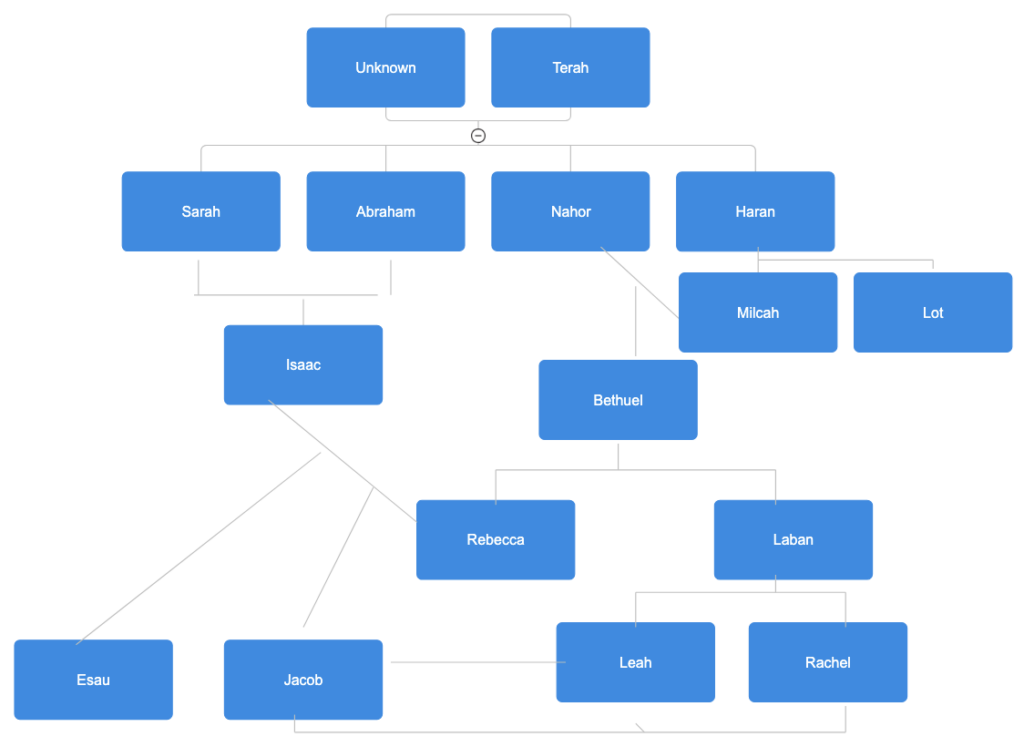
    Let’s take a look at the family chart again.

    Look what Eliezer did. “Running over to her …” (Gen. 24: 17 NLT). I thought Jewish men didn’t run.

    Eliezer was smart. If he asked for a drink for only himself, the lady he asked might just get a drink for him.

    But if she got water for his camels without being asked, it showed her industry, kindness, compassion, and hospitality — along with it being a clear sign that this lady was the one.

    Rebekah got enough water for the camels until they had satisfied their thirst.

    So, Eliezer thought his mission was complete? No.

    Rebekah getting the water for his camels was the satisfaction of his prayer. Abraham, though, has another requirement for Isaac’s wife. She had to be from his clan.

    Eliezer watched Rebekah, not forging on ahead but waiting on Jehovah.

    Making Himself Known

    “Then at last, when the camels had finished drinking, he took out a gold ring for her nose and two large gold bracelets for her wrists.  ‘Whose daughter are you?’ he asked. ‘And please tell me, would your father have any room to put us up for the night?’ ‘I am the daughter of Bethuel,’ she replied. ‘My grandparents are Nahor and Milcah. Yes, we have plenty of straw and feed for the camels, and we have room for guests.’ The man bowed low and worshiped the Lord. ‘Praise the Lord, the God of my master, Abraham,’ he said. ‘The Lord has shown unfailing love and faithfulness to my master, for he has led me straight to my master’s relatives’” (Gen. 24: 22-27 NLT)

    Eliezer started passing out the gifts right away.

    Remember, Eliezer brought camels bearing gifts. “Then he loaded ten of Abraham’s camels with all kinds of expensive gifts from his master …” (Gen. 24: 10 NLT). He rewarded Rebekah for her kindness.

    This was a normal custom in that period, according to Malisch. He wrote a lengthy description on what was in the camel’s load. He wrote,

    “Golden trinkets were abundantly used among most of the Asiatic nations from early times; and those which Abraham’s servant offered to Rebekah (ver. 22) belong to the most common ornaments. The nose-ring, chiefly, though not exclusively, worn by men, and applied by American tribes also, is inserted in the cartilage of the nose, either in the middle or in one side; it is often of considerable size, reaches generally beneath the mouth, and not always contributes to enhance the beauty of the face.”

    Resource

    The sermon went on to describe other trinkets worn by men. Yeah, I thought they would be do for Rebekah, too.

    The gifts Eliezer gave to Rebekah was a symbol of commitment. I don’t know how many girls Rebekah knew that were chosen from marriage about five minutes after they met the guy negotiating the deal. She probably needed – maybe consciously, maybe unconsciously – to have some reassurance this guy was trustworthy.

    These gifts would have been expected. They constituted a dowry, which was custom in those days. These gifts would have shown Rebekah what kind of family she would be marrying into.

    All in all, these gifts would have been the invitation to welcome Rebekah into the family.

    Eliezer found out that the second requirement was met. Rebekah was a part of Abraham’s family.

    Hospitality kicked in then. Eliezer may have been asking about lodging for the evening, but he also knew he had to talk to her father.

    Eliezer gave praise where praise was due. Jehovah took him straight to Abraham’s family.

    Success of the Mission

    “The young woman ran home to tell her family everything that had happened. Now Rebekah had a brother named Laban, who ran out to meet the man at the spring. He had seen the nose-ring and the bracelets on his sister’s wrists, and had heard Rebekah tell what the man had said. So he rushed out to the spring, where the man was still standing beside his camels. Laban said to him, ‘Come and stay with us, you who are blessed by the Lord! Why are you standing here outside the town when I have a room all ready for you and a place prepared for the camels?’” (Gen. 24: 28-31 NLT).

    Ran Home

    Rebekah told her family of the encounter at the well.

    Another indication of Rebekah’s age is in Genesis 24: 28 in the Hebrew. “And the na’arah [a girl from infancy to adolescence] ran, and told them of her bais em these things” (Gen. 24: 28 OJB emphasis added).

    Gray wondered whether Rebekah was late getting home. Were they concerned?

    Resource

    Then Rebekah got home, showing presents. What did they think then?

    Brother Named Laban

    It seemed like Laban was performing the duties of the firstborn son.

    Why did Laban go to greet Eliezer? He was Rebekah’s brother, not father.

    I had assumed that Bethuel was dead, and Laban was the firstborn.

    Bradford observed that Laban served as if he were the guardian responsible for overseeing the unmarried women of the clan.

    Also, Bradford noted how much of a big deal meeting a stranger was at that time. If he had known Eliezer before, many years had passed since they had seen each other — over 60 years. Both looked much differently now.

    Resource

    Is it significant that Moses or the writer of Genesis said that Laban saw the gifts before he heard the story of who the man was? Maybe. We’ll find out what kind of a man he became in a few chapters.

    For now, we’ll just say that Laban thought Eliezer was blessed, not necessarily Abraham. Schmoozing? Probably.

    Laban probably thought — if he worked it right — he could get some of that wealth for himself.

    I thought Laban’s greeting was interesting. “Laban said to him, ‘Come and stay with us, you who are blessed by the Lord! …’” (Gen. 24: 31 NLT). In the Hebrew it was Baruch Hashem. That means bless the Lord or praise the Lord.

    At least Laban knew of Jehovah. I am sure Laban grew up with stories about how great grandpa took off, and great-uncle was called.

    Making the Connections #1

    One thing that runs through this chapter is the prayerful way in which a wife for Isaac was chosen.

    The only stipulation Abraham put on the choosing process was that it had to be someone from his family. He didn’t say, “Jehovah told me who exactly it is going to be.”

    Eliezer prayed, “Jehovah, You choose. Let me know by water from the well.” (Well, we do know we are to go to the well for living water.)

    We’ll find out that Isaac prayed as he walked and meditated (Gen. 24: 55). “I don’t know where they are in the process. So, I don’t know when I am going to get to meet her. But I know You are in control and working it out.”

    Bottom line is Isaac got what he wanted because he loved Rebekah deeply (Gen. 24: 67).

    Making the Connections #2

    Eliezer knew this was not some small piece of Isaac’s life — even though Jehovah wants to be God of the small things. He knew that this was the continuation of Abraham’s line — all the way down to the Messiah.

    That was a huge thing. Thankfully, He is God of the big things, too.

    How Do We Apply This?

    • Always go to Sovereign God in prayer in all things.
    • Don’t limit Jehovah.
    • Wait on Him.
    • Communicate with Jehovah through grace.
    • Remember He may answer prayers immediately or He may wait.

    Resource

    Father God. You have the perfect spouse for us. Please let our husbands be as prayerful as Isaac. Let our wives be as obedient to You as Rachel. Bless our unions as You did theirs. Amen.

    If you don’t understand something and would like further clarification, please contact me.

    If you have not signed up for the email providing the link to the devotions and the newsletter, do so below.

    If God has used this devotion to speak with you, consider sharing it on social media.
  • A Wife for Isaac

    Abraham was getting on in years, and Isaac had yet to marry. This devotional reading looks at the mission Abraham devised for his servant to find a wife for Isaac.

    Nuggets

    • We aren’t told how old Abraham was, but we can pretty much figure it out.
    • Abraham sent his trusted servant to find a wife for Isaac.
    • Abraham and Eliezer both knew the importance of a continuation of the covenant and showed their support by making an oath.
    • The choice of Isaac’s wife was important for covenant purposes.
    • So, Abraham sent Eliezer back to his family.
    • Eliezer wanted to know what would happen if his mission failed and Abraham wasn’t around to give instructions.
    a-wife-for-isaac

    Jehovah promised Abraham that he would have many descendants. Problem is, Isaac is pushing 40; and he not only doesn’t have children, but he also doesn’t have a wife.

    Abraham was fixing to change that.

    Let’s Put It into Context

    To read devotions in the Creating Everything theme, click the button below.

    Devotions in the Abraham the Patriarch series

    The Charge

    Abraham was now a very old man, and the Lord had blessed him in every way” (Gen. 24: 1 NLT).

    We aren’t told how old Abraham was, but we can pretty much figure it out.

    We are told how old Isaac was when he married (Gen. 25: 20 NLT). That means Isaac married in 1820 BC. Since we don’t know how long before the marriage the arranging took place, that is the high side.

    Abraham would have been 140 years old when Isaac got married.

    To round this out, we know Sarah was already dead. “And Isaac brought Rebekah into his mother Sarah’s tent, and she became his wife. He loved her deeply, and she was a special comfort to him after the death of his mother” (Gen. 24: 67 NLT).

    If Sarah was 10 years younger than Abraham – and she was 127 when she died – Abraham would have been 137. That would put the date 1823 BC when Sarah died.

    That would have put this discussion where Abraham was between 137 and 140.

    Yes, that would make Abraham old. However, he lived another 35 years after that.

    God had blessed Abraham in everything. That was because he had believed and been obedient. He had become a righteous man (Gen. 15: 6).

    Now it was time for Abraham to take action for the next phase of the covenant.

    The Mission

    “One day Abraham said to his oldest servant, the man in charge of his household, ‘Take an oath by putting your hand under my thigh. Swear by the Lord, the God of heaven and earth, that you will not allow my son to marry one of these local Canaanite women” (Gen. 24: 2-3 NLT).

    One Day

    Abraham sent his trusted servant to find a wife for Isaac.

    Was Abraham taking things into his own hands again in trying to find Isaac a wife? I don’t think so.

    Jehovah doesn’t want us to just sit around waiting for Him to take care of us. Hughes said it in this way. He wrote, “After praying to God, there must be acting by man to find God’s answer.”

    Resource

    We have our duties to perform for His purposes.

    We just have to make sure we are listening to Jehovah’s voice. That is what Abraham – and Isaac – were doing: trusting in God.

    So, if Isaac was pushing 40, why was Abraham the one arranging his marriage? Well, that was the custom in Abraham’s society.

    Marriages were commonly arranged, according to CrossTalk. It says, “In ancient Israelite society, marriage was often arranged and served various purposes, including the consolidation of family alliances, economic stability, and the continuation of lineage.”

    Resource

    Abraham and Isaac both knew that it would be Jehovah providing the wife. Leale gave us three reasons for this faith in Him.

    • Sovereign God’s previous provision
    • Sovereign God’s control over all aspects of our lives
    • Sovereign God’s plan for our lives

    Resource

    They had seen Jehovah follow through on His promises before. Both men also knew that they must follow Sovereign God in all things – especially those covenant related.

    His Oldest Servant

    Abraham asked his trusted servant to accomplish the mission.

    Here, we aren’t given the name of the servant. But we are given enough to give his name a good guess.

    “And Avraham said unto his eved zekan of his bais, hamoshel (that ruled) over all that he had …” (Gen. 24: 2 OJB).

    We’ve talked about eved and zekan before. Let’s start with eved.

    We looked at the explanation of slavery according to biblical law from The Jewish Virtual Library. It says, “The Hebrew term for slave, ‘eved (pl. ‘avadim), is a direct derivation from the verb ʿbd, ‘to work’; thus, the ‘slave’ is only a worker or servant.”

    Resource

    We talked about zekan back when all the men in Sodom was surrounding Lot’s house. They were described as “… surrounded the bais [house], from na’ar [boy] to zeken [beard] …” (Gen. 19: 4 OJB).

    In Judaism, beards represented maturity. This is not only in wisdom but also in spirituality. It denoted age.

    Let’s see who that would be. “And Avram said, Adonoi Hashem, what wilt Thou give me, since I go childless, and the Ben Meshek of my Bais [son of possession, steward of my house] is this Eliezer of Dameshek (Damascus)?” (Gen. 15: 2 OJB).

    The servant entrusted with the mission is probably Eliezer, the one who would have inherited if Abraham didn’t have an heir. He would have been Abraham’s oldest servant.

    Ooo, baby. That took gumption for Abraham to ask Eliezer to find a wife for Isaac when he had already lost the wealth that would have come to him when Isaac was born!

    Eliezer, though, had long proven his trustworthiness. He wouldn’t be in the position he was if he hadn’t. He certainly wouldn’t have been given this important mission.

    Take an Oath

    Abraham and Eliezer both knew the importance of a continuation of the covenant and showed their support by making an oath.

    Abraham asked Eliezer to swear an oath, which was allowed in Judaism. Now, the way he swore sounds kind of yuck to us, but it is logical when we put it in Jewish culture.

    Both men would have been circumcised on the same day. “On that very day Abraham took his son, Ishmael, and every male in his household, including those born there and those he had bought. Then he circumcised them, cutting off their foreskins, just as God had told him” (Gen. 17: 23 NLT).

    We know Eliezer was already in Abraham’s household. That was how he was going to be heir (Gen. 15: 2). He would have been circumcised under the every male in his household provision.

    Both were compliant with the covenant of God.

    Eliezer putting a hand under Abraham’s thigh would have been putting it close to the circumcised part. It is like our putting our hand over our heart to show our sincerity of our promise.

    Fun fact. There is only one other time in God’s Word that this type of gesture is added to an oath. That is when Jacob was asking Joseph to swear that he would be buried in the same tomb as Abraham, Sarah, Isaac, Rebecca, and Leah (Gen. 47: 29 NLT).

    Back to Abraham and Eliezer.

    Abraham was asking Eliezer to perform a mission to keep his end of the covenant – have descendants.

    Maybe that was Abraham’s way of saying, “You have been a faithful servant lo these many years, and you would have been a worthy heir. But God had different plans. We both want to be obedient to God.”

    Think about this. Abraham was giving Eliezer permission to choose Isaac’s bride.

    True, it probably was because he was sending him on a long journey that he didn’t feel he could make himself. Otherwise, I think he would have gone himself.

    But Abraham also didn’t know how long this journey would take or if it would be successful. He was giving Eliezer this mission until it had a successful ending – even if Abraham was no longer alive.

    So, Abraham sent his most trust servant – with very specific instructions.

    You Will not Allow My Son to Marry a Canaanite Woman

    The choice of Isaac’s wife was important for covenant purposes.

    Abraham knew God didn’t want Isaac to take a wife from the local women. There was a couple of considerations for this.

    Abraham knew of their idol worship. Their lifestyle was full of sin and depravity.

    There was no way that Abraham wanted a woman of Canaanite religions raising the covenant sons.

    Does that make a contradiction to what we saw in Genesis 23? I think not.

    Remember, we have to be in the world but not of the world. In means it is okay to buy a field for burial, but not of, which means compromising with their belief system and taking their daughters in marriage. Compromise has to happen a lot in a marriage.

    Jehovah expressed this sentiment in a later book. “You must not intermarry with them. Do not let your daughters and sons marry their sons and daughters, for they will lead your children away from me to worship other gods. Then the anger of the Lord will burn against you, and he will quickly destroy you” (Deut. 7: 3-4 NLT).

    If Jehovah wants the eventual overthrow of idolatry, He would not allow it in His covenant line. Plus, He would not dilute the purity in that way.

    Another consideration was that Abraham had been promised the land of Canaan for his descendants. He knew Jehovah was not going to have him make alliances with the current occupants to get it.

    What that meant was the land would be taken from the current inhabitants. Abraham just didn’t know when or how. But he probably knew that they would have a hard-fought battle at the least or the Canaanites destroyed at the worst.

    But what would it have done to Isaac’s marriage – and his safety – when ownership was switched if he had married a Canaanite woman? That wouldn’t have been a happy household.

    Go Instead to My Homeland, to My Relatives

    “Go instead to my homeland, to my relatives, and find a wife there for my son Isaac” (Gen. 24: 4 NLT).

    So, Abraham sent Eliezer back to his family.

    Okay. I have to work through some things that are still a bit mushy in my mind.

    We know Terah, Abraham and Nahor were living in Ur. We know they worshiped false gods.

    “Joshua said to the people, “This is what the Lord, the God of Israel, says: Long ago your ancestors, including Terah, the father of Abraham and Nahor, lived beyond the Euphrates River, and they worshiped other gods. But I took your ancestor Abraham from the land beyond the Euphrates and led him into the land of Canaan. I gave him many descendants through his son Isaac” (Josh. 24: 2-3 NLT emphasis added).

    Genesis 11: 31 says only part of the family came with Terah. “One day Terah took his son Abram, his daughter-in-law Sarai (his son Abram’s wife), and his grandson Lot (his son Haran’s child) and moved away from Ur of the Chaldeans. He was headed for the land of Canaan, but they stopped at Haran and settled there” (Gen. 11: 31 NLT).

    Even though they are not listed, many, such as the Biblestudy.org’s Old Testament Timeline we have been using, believe that Nahor and Milcah should have been included in the list.

    Resource

    Maybe. Maybe not.

    I can see Moses not including them in the list as — at that point — they weren’t main players in the story. Moses only put what was absolutely necessary.

    But a lot of things in God’s Word have to be taken literally. Maybe Nahor came later.

    It would be logical to believe that, if Nahor and Milcah didn’t go in 1890, they came sometime before Terah’s death in 1885. Nahor, as some believe he was the oldest son, would have become the patriarch upon his death.

    When Abraham received an update from Milcah in Genesis 22: 20-26, Moses did not include where they were living. So, either Abraham already knew where that was, or it wasn’t an item Moses included.

    Whatever, Abraham knew where to send Eliezer then. More importantly, he knew that they believed in Jehovah as Sovereign God.

    Marrying within the clan was acceptable in those day, even encouraged. Remember, Abraham had married his sister, Sarah (Gen. 20: 12). It provided economic stability.

    Family is an ongoing theme within God’s Word.

    What If?

    “The servant asked, ‘But what if I can’t find a young woman who is willing to travel so far from home? Should I then take Isaac there to live among your relatives in the land you came from?’ ‘No!’ Abraham responded. ‘Be careful never to take my son there. For the Lord, the God of heaven, who took me from my father’s house and my native land, solemnly promised to give this land to my descendants. He will send his angel ahead of you, and he will see to it that you find a wife there for my son. If she is unwilling to come back with you, then you are free from this oath of mine. But under no circumstances are you to take my son there’” (Gen. 24: 5-8 NLT)

    Eliezer wanted to know what would happen if his mission failed and Abraham wasn’t around to give instructions.

    In Eliezer’s mind, even being family didn’t necessarily guarantee the success of the mission. He wanted to make sure he knew what to do if it was a failure.

    Oaths were taken very seriously in Abraham’s culture as they were binding and sacred. It showed the importance of the integrity to fulfill one’s promise.

    Eliezer didn’t want to make a promise that he couldn’t keep.

    Therefore, it was a big deal to be released from the oath. In effect, it was saying Eliezer had faithfully tried to comply with the oath and was innocent of not breaking the oath.

    Remember, Eliezer was swearing to the oath before Sovereign God. He wanted to be right before Him.

    Abraham was thinking of the covenant when he answered Eliezer. Don’t take Isaac back on any condition.

    No, it wasn’t that Abraham doubted that God wouldn’t hold up his end of the bargain. It is just that – other than Sarah’s burial place – we aren’t told he had acquired any more land. He would have felt his status in the region as tenuous at best.

    Making the Connections #1

    Abraham did exactly right. He did not compromise with the pagans surrounding him. He held out for another believer for Isaac’s wife.

    That is Jehovah’s preference. He does not want us united with a non-believer.

    • “Do not be unequally yoked with unbelievers. For what partnership has righteousness with lawlessness? Or what fellowship has light with darkness?” (II Cor. 6: 14 NLT).
    • “Judah has been faithless, and abomination has been committed in Israel and in Jerusalem. For Judah has profaned the sanctuary of the Lord, which he loves, and has married the daughter of a foreign god” (Mal. 2: 11 NLT).

    But then there are some verses that discuss being married to a non-believer.

    • “In the same way, you wives must accept the authority of your husbands. Then, even if some refuse to obey the Good News, your godly lives will speak to them without any words. They will be won over by observing your pure and reverent lives.” (I Pet. 3: 1-2 NLT).
    • “Live wisely among those who are not believers, and make the most of every opportunity” (Col. 4: 5 NLT).

    Are these contradictory? I don’t think so.

    But this is the covenant line. It had to be made up of not only believers but also righteous believers.

    Making the Connections #2

    Bradford made a great observation. We don’t hear Abraham say another thing.

    Resource

    The very last words we hear from Abraham are “… But under no circumstances are you to take my son there” (Gen. 24: 8 NLT).

    Oh, yes. Abraham wasn’t struck mute for 35 years. His words just weren’t recorded.

    What would you have wanted Abraham to say? Rebecca was a good choice???? Jacob was clearly the better choice than Esau for continuation of the covenant??????

    No, it was time to pass the covenant on to Isaac – even though he had 35 good years to go.

    Remember, this isn’t about Abraham. It is about Sovereign God, Creator and Ruler of the universe.

    But let’s go at it another way. What are Abraham’s first recorded spoken words?

    “As he was approaching the border of Egypt, Abram said to his wife, Sarai, ‘Look, you are a very beautiful woman. When the Egyptians see you, they will say, ‘This is his wife. Let’s kill him; then we can have her!’ So please tell them you are my sister. Then they will spare my life and treat me well because of their interest in you’” (Gen. 12: 11-13 NLT).

    Ouch. Abraham’s first recorded words were a lie and a deception.

    But the last recorded words showed how much Abraham’s faith had grown.

    It doesn’t matter where we start. It is where we end that matters. We have to end with Jehovah’s character.

    Making the Connections #3

    How much would Eliezer have known about Abraham’s covenant with Sovereign God? I’d say probably all there was to know. If he didn’t know before, he did now.

    Did Eliezer leave Ur with Abraham? I’d say that was a distinct possibility.

    I’d say when the caravan pulled out of Haran — or even Ur — Eliezer had been Abraham’s heir for a while. As much as we think Abraham didn’t like confrontation, even considering he was a servant, I think they would have had this discussion when Isaac was born.

    How could Eliezer run Abraham’s house if Abraham was keeping this big secret from him?

    So, I agree with Fuller. Eliezer knew about the covenant and it’s promises.

    Resource

    I see it as a component of that trust.

    How Do We Apply This?

    • Be a faithful servant to Jehovah.
    • Rely on Sovereign God in all things.
    • Praise God when our missions are successful.
    • Approach Jehovah as a God in covenant.
    • Kindness can be no more than giving someone water.

    Resources

    Father God. You have plans for us, and You share those plans with us. At times, You will do everything needed. Other times, You expect us to do our part. Help us know when You expect what. Amen.

    If you don’t understand something and would like further clarification, please contact me.

    If you have not signed up for the email providing the link to the devotions and the newsletter, do so below.

    If God has used this devotion to speak with you, consider sharing it on social media.
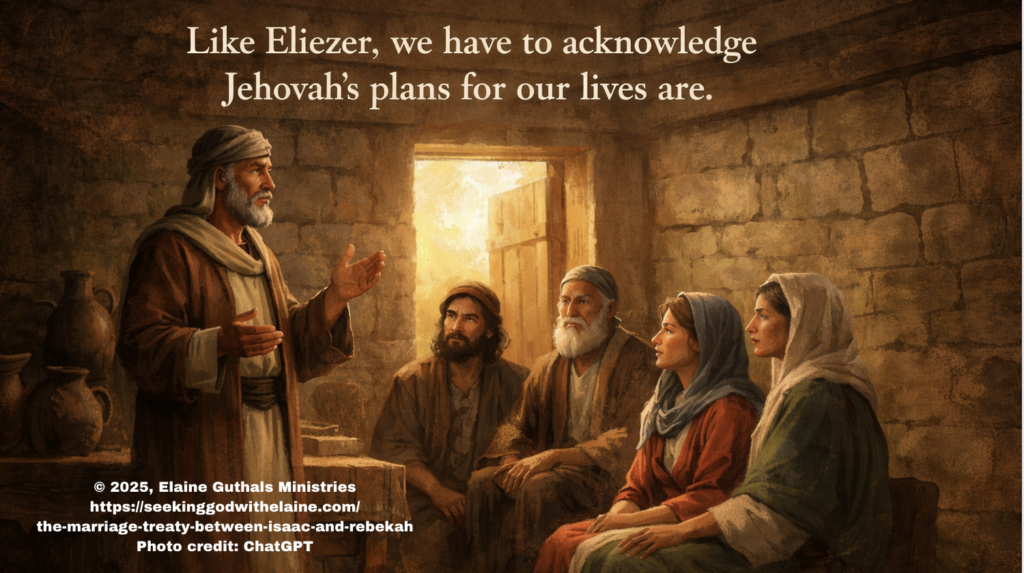
  • The Birth of Isaac

    It is finally time for the covenant sign to be accomplished. This devotional reading looks at the birth of Isaac.

    Nuggets

    • Jehovah will always keep His promise.
    • The promise had taken a quarter of a century or more to be fulfilled.
    • The promise was fulfilled with the birth of Isaac
    • In accordance with the covenant, Abraham had Isaac circumcised on the eighth day after his birth.
    the-birth-of-isaac

    Ooo, baby. The long awaited day was finally here. Abraham and Sarah’s promised son was to be born.

    Jehovah was going to fulfill His promise.

    Let’s Put It into Context

    To read devotions in the Creating Everything theme, click the button below.

    Devotions in the Abraham the Patriarch series

    The Lord Kept His Word

    “The Lord kept his word and did for Sarah exactly what he had promised. She became pregnant, and she gave birth to a son for Abraham in his old age ….” (Gen. 21: 1-2 NLT)

    Jehovah will always keep His promise.

    Way back when Jehovah called Abraham — age 75 — He made him an extra-special promise. You will have a son.

    “I will make you into a great nation. I will bless you and make you famous, and you will be a blessing to others. I will bless those who bless you and curse those who treat you with contempt. All the families on earth will be blessed through you” (Gen. 12: 2-3 NLT).

    No, it doesn’t specifically say the word son. The Hebrew sorta does. “And I will make of thee a goy gadol (great nation) …” (Gen. 12: 2 OJB).

    Jehovah would make of Abraham a great nation. To me, this goes back a couple of chapters. “… This is now etzem (bone, essence, self, substance) of my etzem, and basar (flesh, meat) of my basar …” (Gen. 2: 23 OJB).

    That makes it clearer that Jehovah is going to use a descendant. “I will make you into a great nation …” (Gen. 12: 2 NLT emphasis added) is a lot less ambiguous in my mind. Who’s to say that can’t be interpreted as Abraham defeating a king and becoming ruler of an established nation— which is not what Jehovah had in mind.

    Clarification was made in Genesis 15. “Then the Lord said to him, ‘No, your servant will not be your heir, for you will have a son of your own who will be your heir’” (Gen. 15: 4 NLT).

    It was just one son Abraham was being promised. He was being promised many sons. “I will confirm my covenant with you and your descendants after you, from generation to generation. This is the everlasting covenant: I will always be your God and the God of your descendants after you” (Gen. 17: 7 NLT).

    But it wasn’t just any son — like Ishmael Abraham’s son through Hagar. It was Sarah’s son. “Then one of them said, ‘I will return to you about this time next year, and your wife, Sarah, will have a son!’” (Gen. 18: 10 NLT).

    Yes, it seemed impossible to both Abraham and Sarah that they would have a son together. But nothing is impossible for Jehovah (Lk. 1: 37).

    Bradford made a great comment. He taught,

    “This list of prophetic promises of God to Abraham compels me to relate to you something the Lord has shown me over the years: as concerns the understanding of God’s people about His prophecies, the mistakes men make are not that they cannot find a way relate the eventual fulfillment to the original pronouncement; the mistake is that we do not take God’s prophecies literally enough. All of Yahweh’s promises to Abraham were literal, and they were literally fulfilled.”

    Resource

    Some people want to take God’s Word to be symbolic — especially in Revelation. I don’t think so. Jehovah doesn’t hide His meaning from those who truly believe.

    How many times does Jehovah’s promises to us seem impossible? I’ve told you before about the time Jehovah said to me, “I want you to be a preacher’s wife,” and I said, “Okay, but I’ll give You time if You want to rethink that.”

    Jehovah was giving me a minute to wrap my head around that. That was permissible as long as I went forward in belief.

    On the other hand, Jehovah was also working things out so it would happen. I didn’t know of any single preachers on my radar. Plus, I had this little thing going with seizures.

    But Jehovah visited me and did exactly what He promised. Enter Pastor Steve.

    We have to grab onto Jehovah’s promises with belief and obedience. He is faithful to deliver.

    Now it was time — when Abraham was 100 — to fulfill that promise.

    At Just the Time

    “… This happened at just the time God had said it would” (Gen. 21: 2 NLT)

    The promise had taken a quarter of a century or more to be fulfilled.

    It is described several ways. Sometimes, it is written that it is in God’s set times. Sometimes, it reads gods appointed times. Many times, it says in the fullness of God’s time.

    • “But when the right time came, God sent his Son, born of a woman, subject to the law. God sent him to buy freedom for us who were slaves to the law, so that he could adopt us as his very own children. And because we are his children, God has sent the Spirit of his Son into our hearts, prompting us to call out, ‘Abba, Father.’  Now you are no longer a slave but God’s own child. And since you are his child, God has made you his heir” (Gal. 4: 4-7 NLT).
    • “And this is the plan: At the right time he will bring everything together under the authority of Christ—everything in heaven and on earth” (Eph. 1: 10 NLT).

    Bradford said that the fulfillment of the promise is just as important as the promise itself.

    Resource

    Think about it. At a specific and perfect time, a specific event would occur.

    That means more than just Jehovah knows about events — specific interventions —  and timing. He controls events and timing. He controls our lives.

    That means it is Jehovah’s plan. He meticulously prepared it, all things great and small. He knows what will happen and the precise predetermined point the promise will fully be realized.

    But it also gives us a good illustration of Jehovah’s power.

    Look at the result. Jehovah is interested in what personally interests us. What a benevolent and faithful God!

    Named Their Son Isaac

    ” And Abraham named their son Isaac” (Gen. 21: 3 NLT_

    The promise was fulfilled with the birth of Isaac.

    At the specific time planned, a son was born to Abraham  and Sarah. Abraham was 100 years old, and Sarah was 90 years old.

    Yeah, that was a miracle. Bradford said that it was not only a miracle barren Sarah could get pregnant, but it was also  a miracle she could even survive the birthing process.

    Resource

    The Hebrews/Israelites/Jews were very specific in naming their children. However, that name could be chosen for a variety of reasons.

    • Adam meant man.
    • Eve meant isha (woman, wife).
    • Methuselah meant when he dies, it will come.
    • Benjamin was first named Ben-oni, which means son of my sorrow. Jacob, however, renamed him Benjamin, which means son of my right hand.
    • Yeshua means to deliver, save, or rescue.

    Abraham and Sarah named their son Yitzchak. “And she said, Elohim hath brought me tzechok (laughter), so that all that hear yitzchak (will laugh) with me” (Gen. 21: 6 NLT).

    That name was fitting since both parents laughed.

    • “Then Abraham bowed down to the ground, but he laughed to himself in disbelief” (Gen. 17: 17 NLT).
    • “Abraham and Sarah were both very old by this time, and Sarah was long past the age of having children. So she laughed silently to herself and said, ‘How could a worn-out woman like me enjoy such pleasure, especially when my master — my husband — is also so old?’” (Gen. 18: 11-12 NLT).

    It turned from laughter of incredulity to laughter of joy. Best of all, they knew the laughter came from Jehovah. “And Sarah declared, ‘God has brought me laughter …’” (Gen. 21: 6 NLT).

    Jehovah wants to wow us. He wants us to rejoice in what He does for us.

    Abraham Circumcised Him

    “Eight days after Isaac was born, Abraham circumcised him as God had commanded. Abraham was 100 years old when Isaac was born. And Sarah declared, “God has brought me laughter. All who hear about this will laugh with me. Who would have said to Abraham that Sarah would nurse a baby? Yet I have given Abraham a son in his old age!’” (Gen. 4-7 NLT).

    In accordance with the covenant, Abraham had Isaac circumcised on the eighth day after his birth.

    Though circumcision did not originate with the Hebrews, it was the sign of the covenant with Abraham (Gen. 17: 9-14). Yet where those were probably a medical procedure to prevent incurable diseases and disorders, this was an act of acceptance of the covenant.

    Circumcision was required of all males in Israel. This included those who were born as slaves into the household or bought into it. Circumcision was required, but humans have free will to chose to do it or not. The consequences of choosing not to be circumcised was being cut off from Jehovah.

    Leale said this practice was to show the need for purification and its resulting in regeneration. By this act, others would know they were Jehovah’s people as they were dedicated to Jehovah.

    Resource

    Just as he was obedient when the sign was given, Abraham was obedient when his covenant son was born.

    Making the Connections #1

    Why was Abraham given a son in his old age. I think Leale said it best. He wrote, “It was a practical faith. All the time he was waiting, Abraham was obedient to the word of the Lord.”

    Resource

    Faith without obedience isn’t saving faith. Faith without obedience is just head knowledge.

    Remember what James said. “You say you have faith, for you believe that there is one God. Good for you! Even the demons believe this, and they tremble in terror” (Jas. 2: 19 NLT).

    Abraham showed us how to wait in faith. Did he struggle with it? Well, yeah. Remember Genesis 15: 2-3?

    “But Abram replied, ‘O Sovereign Lord, what good are all your blessings when I don’t even have a son? Since you’ve given me no children, Eliezer of Damascus, a servant in my household, will inherit all my wealth. You have given me no descendants of my own, so one of my servants will be my heir’” (Gen. 15: 2-3 NLT).

    Abraham was getting impatient. He questioned Jehovah.

    No, Abraham wasn’t saying Jehovah wasn’t going to give him a son. He was saying He hadn’t given him one yet.

    All the promises Jehovah gave Abraham in his call were incumbent on him having a son.

    And now that son was there.

    Making the Connections #2

    If Jehovah calls us to something, He is going to give us the strength to bear it when we have faith and obedience.

    Yeah, it may take 25 years. It may take 430 years. It may take 2,000+ years.

    We have to endure to the end. “But the one who endures to the end will be saved” (Mt. 24: 13 NLT).

    How Do We Apply This?

    • Wait for Jehovah to fulfill His promises.
    • Live in faith and obedience until that time.
    • React with joyous laughter when it is fulfilled.

    Father God. We thank You for Your promises to us. We thank You when they come to fruition. Help us to wait patiently and endure until they are fulfilled. Amen.

    If you don’t understand something and would like further clarification, please contact me.

    If you have not signed up for the email providing the link to the devotions and the newsletter, do so below.

    If God has used this devotion to speak with you, consider sharing it on social media.
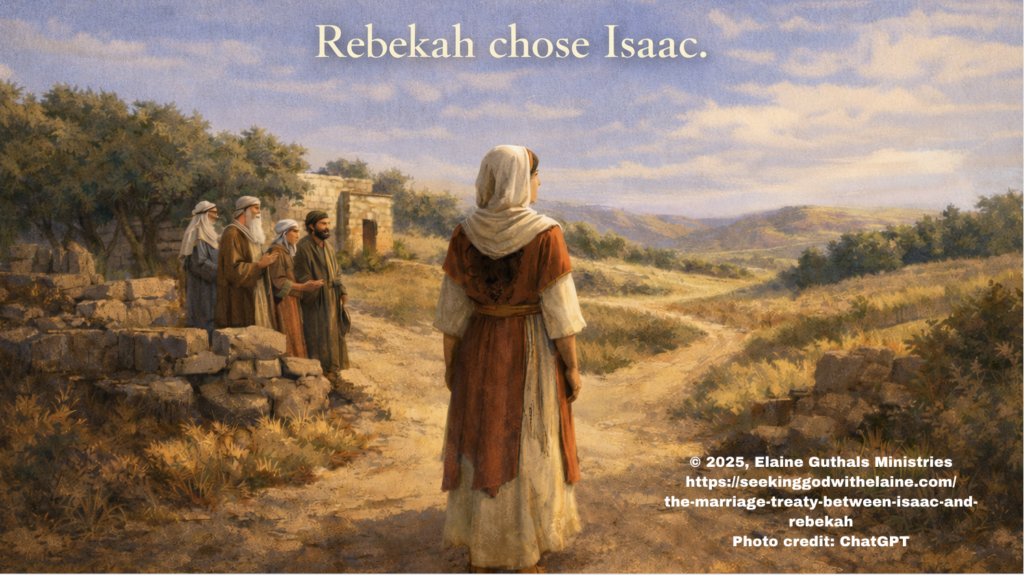
  • Preparing for Sodom and Gomorrah

    God went to visit Abraham one day. This devotional reading looks at Abraham playing host to His Creator.

    Nuggets

    • Three Heavenly Beings visited Abraham one day.
    • We have to meet God in a quiet place.
    • God frequently reminds us in His Word to be watchful.
    • Middle Eastern culture in Abraham’s time – and God – put great emphasis on hospitality.
    • Abraham showed how deep his faith was by running to God.
    • God gives us perfect rest.
    • When family, friends, neighbors, and travelers came to visit, it was their duty to show hospitality to them.
    • Abraham prepared a feast for his visitors.
    • Yep, God and the angels performed human actions.
    preparing-for-sodom-and-gomorrah

    God has finished setting up the covenant with Abraham. Now, it was growing closer to the time of the sign of the covenant to be given.

    But something had to be cleaned up first. Well, somewhere – Sodom and Gomorrah.

    To start this process, God goes personally to meet with Abraham.

    Let’s Put It into Context

    To read devotions in the Creating Everything theme, click the button below.

    Devotions in the Abraham the Patriarch series

    Let’s Put It into Context #2

    Let’s keep adding to the Biblestudy.org’s timeline.

    1960 BC — Abram born (Gen. 25: 7)
    1890 BC — Terah, Abram, Sarai, and Lot move from Ur to Haran (Gen. 11: 31)
    1885 BC — Abram called at age 75 (Gen. 12: 1-3)
    c. 1880 – 1875 BC — Abram defeats King Chedorkiamer to rescue Lot (Gen. 14)
    1875 BC — God promises an 85-year-old Abram that he will have a son (Gen. 15)
    1874 BC — Ishmael born (Gen. 16: 15)
    1861 BC — God reestablished His covenant with Abram; and Abraham, Ishmael, and males are circumcised (Gen 17)
    1861 BC — Sodom and Gomorrah are destroyed one year before the birth of Isaac (Genesis 18 – 19).
    1860 BC — Isaac born (Genesis 35: 28).

    Resource

    Heavenly Visitors

    “The Lord appeared again to Abraham near the oak grove belonging to Mamre. One day Abraham was sitting at the entrance to his tent during the hottest part of the day. He looked up and noticed three men standing nearby …” (Gen. 18: 1-2 NLT)

    The Lord Appeared/Three Men Standing Nearby

    Three Heavenly Beings visited Abraham one day.

    Let’s take a look at the beginning and ending of this passage. Both are talking about the visitors.

    One of the visitors is initially identified. Our version translate the word as Lord. The Hebrew word is Hashem. The part of speech is a proper masculine name.

    I really wish I could find something that translated the Dead Sea scrolls. Bradford has said somewhere in his lessons that I’ve seen online that God’s name has been changed to the title the Lord.

    Resource

    I wonder if this is one of those instances.

    It is God that appeared as a man. We may scratch our heads on that one. Never in a million years would we even think we would entertain angels, let alone God Himself.

    Some, thought, this was Jesus. Yes, this is before He came down to earth as a baby.

    Meyer had an interesting take. He wrote,

    “It was thus that the Son of God anticipated His Incarnation; and was found in fashion as a man before He became flesh. He loved to come incognito into the homes of those He cherished as His friends, even before He came across the slopes of Olivet to make His home in the [favored] cottage, where His spirit rested from the din of the great city, and girded itself for the cross and the tomb.”

    Resource

    I don’t know if I would go that far. But something just popped into my head.

    We have other verses where it may be attributed to it that the angel was Jesus. One such time is in the fiery furnace.

    “So Shadrach, Meshach, and Abednego, securely tied, fell into the roaring flames. But suddenly, Nebuchadnezzar jumped up in amazement and exclaimed to his advisers, “Didn’t we tie up three men and throw them into the furnace?’ ‘Yes, Your Majesty, we certainly did,’ they replied. ‘Look!’ Nebuchadnezzar shouted. ‘I see four men, unbound, walking around in the fire unharmed! And the fourth looks like a god’!” (Dan. 3: 23-25 NLT).

    We talked about whether the mighty angel in Revelation 10: 1-3 was Jesus.  To me, that one does seem logical.

    “Then I saw another mighty angel coming down from heaven, surrounded by a cloud, with a rainbow over his head. His face shone like the sun, and his feet were like pillars of fire. And in his hand was a small scroll that had been opened. He stood with his right foot on the sea and his left foot on the land. And he gave a great shout like the roar of a lion. And when he shouted, the seven thunders answered” (Rev. 10: 1-3 NLT).

    In Daniel and Revelation, it was Jesus. Here in Genesis, to me, I see this as God. I see God as the One coming down in the burning bush to call Moses and coming to Patmos to give John the Revelation of Jesus.

    In verse 2, it does call them men. The Hebrew is Shloshah (three masculine) Anashim (people). The Heavenly Beings were in human form.

    I can see why some would think it would be three angels/messengers here, and not God/Jesus Himself. I don’t think that. It was God.

    Edwards had an interesting take on this that I don’t remember ever hearing before. What if this was the Trinity?  At a minimum, maybe it was meant to be a foreshadowing of It.

    Resource

    But let’s come back to this discussion in a little bit. Let’s just end this part of the discussion by saying God visits His children. It can be in human form, and it can be we don’t recognize Him.

    God comes to us when we need Him and blesses us.

    The Oak Grove Belonging to Mamre

    We have to meet God in a quiet place.

    Hmmm. The Hebrew word used here was terebinth. When I googled it, it didn’t say oak tree.

    The tree described by the Hebrew word was part of the pistacia tree family. It was known for its resilience and medicinal properties, probably using the resin.

    We’ve heard about Mamre before. Mamre was one of the allies that went with Abram to rescue Lot (Gen. 14: 13).

    A grove of fruit trees is a peaceful place. It would be a wonderful place to meet with God.

    Abraham Was Sitting and Looked

    God frequently reminds us in His Word to be watchful.

    This is interesting. It was the heat of the day. Instead of seeking relief inside the tent, Abraham was sitting at the entrance.

    Go back to verse 1. Here were these three “men” standing near the grove. God was inviting Abraham into the shade with Him.

    But Abraham did more than just sit there. He looked up and saw the visitors.

    I love what Edwards said. He wrote, “… the presence of God cannot be realized, unless the soul of man directs its gaze above the objects of the sensual, earthly life.”

    Resource

    God is right there, calling us to Him. We just have to hear His still, small voice.

    In other words, we can’t focus on our earthly interests. We have to pray to Him and set our minds on this above (Col. 3: 1).

    We, like Abraham, have to get out of our tent and go toward the Heavenly Father. But that is the next section.

    Meeting with God

    “… When he saw them, he ran to meet them and welcomed them, bowing low to the ground.  ‘My lord,’ he said, ‘if it pleases you, stop here for a while. Rest in the shade of this tree while water is brought to wash your feet. And since you’ve honored your servant with this visit, let me prepare some food to refresh you before you continue on your journey.’ ‘All right,’ they said. ‘Do as you have said.’ So Abraham ran back to the tent and said to Sarah, ‘Hurry! Get three large measures of your best flour, knead it into dough, and bake some bread.’ Then Abraham ran out to the herd and chose a tender calf and gave it to his servant, who quickly prepared it. When the food was ready, Abraham took some yogurt and milk and the roasted meat, and he served it to the men. As they ate, Abraham waited on them in the shade of the trees” (Gen. 18: 2-8 NLT)

    Middle Eastern culture in Abraham’s time – and God – put great emphasis on hospitality.

    Ran to Meet and Welcomed Them

    Abraham showed how deep his faith was by running to God.

    I hadn’t put two and two together before. I had heard that Jewish men never ran. That was what made the father in the Prodigal Son parable so interesting, He ran to meet his kid when the son was far off. (Lk. 15: 20).

    But here, Abraham ran to meet God. We know he recognized Him right off because he called Him “‘My lord,’ …” (Gen.. 15: 3 NLT).

    Our faith should be deep enough that we recognize God right off if He pops up before us. We need to want to get into His close presence as soon as we can get there.

    When we are running toward God, we are proactively looking to Him for His help in our spiritual matters. We put that much importance on our relationship with Him.

    It is an act of submission and obedience. It shows our commitment to Him.

    Stop and Rest

    God gives us perfect rest.

    One of the ways we search for and seek God is to meditate on our walk with God. “Oh, the joys of those who do not follow the advice of the wicked, or stand around with sinners, or join in with mockers. But they delight in the law of the Lord, meditating on it day and night” (Ps. 1: 1-2).

    This is where we think about what we have heard and read and apply it to our lives. But it is more than that.

    This is where we just enjoy God’s presence.

    How does Edwards say we do that? He wrote, “The hours taken from the world and spent in Divine worship, in the calm peace of the church; the hours in which the soul enters into the closet, shuts the door, and prays to the Father which is in secret, are the hours in which man rises into the realization of the eternal life.”

    Resource

    We must worship God, listen to Him, talk to Him, and love Him. We have to make Him a large part of our lives.

    We have to abide with Him.

    Normal Hospitality Practices

    When family, friends, neighbors, and travelers came to visit, it was their duty to show hospitality to them.

    There weren’t any inns around. Abraham wasn’t going to take Them out to the nearest Texas Roadhouse restaurant.

    Even if the visitor came from across town, their feet would have been duty in their sandals. Remember, we weren’t talking paved roads here.

    It was up to Abraham to be the host. There were several things that a good host would do in that culture. By doing these action for people – whether they knew them or not – showed kindness, generosity, and reverence for God.

    Feet washing was important because sandals were the type of shoes worn. These open shoes allowed the dust – depending on how far they had traveled – to cake on people’s feet. When they got where they were going, they needed a good wash.

    At a minimum, the host would offer water. If the host had servants or slaves, they would be given the task to perform.

    There are several instances in God’s Word in the Old Testament where it talks about washing of feet.

    • “‘My lords,’ he said, ‘come to my home to wash your feet, and be my guests for the night. You may then get up early in the morning and be on your way again’” (Gen. 19: 2 NLT).
    • “So the man went home with Laban, and Laban unloaded the camels, gave him straw for their bedding, fed them, and provided water for the man and the camel drivers to wash their feet” (Gen. 24: 32 NLT).
    • “The manager then led the men into Joseph’s palace. He gave them water to wash their feet and provided food for their donkeys” (Gen. 43: 24 NLT).
    • “So he [an old man] took them home with him and fed the donkeys. After they washed their feet, they ate and drank together” (Jdgs. 19: 21 NLT).
    • “She [Abigail] bowed low to the ground and responded, ‘I, your servant, would be happy to marry David. I would even be willing to become a slave, washing the feet of his servants!’” (I Sam. 25: 41 NLT).

    Of course, food was involved. This showed Abraham’s generosity and care.

    Also, a host may provide shelter for the night. If the travelers could spend the night there. Like I said, no inns.

    Yeah, Abraham treated them as he would other travelers. He may not have pulled (but probably did pull) out the fatted calf for others, but the rest was standard operating procedure.

    Look how quickly the meal was put together. They had probably done this many times before. This time, they had special visitors.

    But look at verse 8. Abraham didn’t even eat with them!

    It doesn’t say that Abraham went on about his business and let them eat by themselves. It says he was taking the role of a servant, standing ready to refill drink glasses and get Them whatever They would ask.

    The writer of Hebrews spoke to the importance of hospitality, “Don’t forget to show hospitality to strangers, for some who have done this have entertained angels without realizing it!” (Heb. 13: 2 NLT).

    Abraham Said to Sarah

    Abraham prepared a feast for his visitors.

    Ummm. Something isn’t adding up here.

    The New Living Translation says, “… let me prepare some food …” (Gen. 18: 5 NLT). The Orthodox Jewish Bible says, “And I will bring a morsel of bread …” (Gen. 18: 5 OJB).

    Some food is more in line with what Abraham spread before his Visitors than just a morsel of bread. From the list of food in verses 6-8, Abraham had a feast prepared,

    I never caught before that Abraham gave Sarah instructions for the meal. Then, he started the servant on preparing the calf. But put it all together himself.

    It is interesting that, when Abraham gave Sarah the menu, he asked for cakes, not bread (Gen. 18: 6 OJB).

    Rittenbaugh made a fantastic observation. He wrote,

    “How long do you think that it took Abraham to do all of that? How long did it to take him to run, order a calf killed, have someone slaughter the calf, bleed the calf, skin the calf, butcher the calf, roast the meat, and then serve it to Him?”

    Resource

    Here’s God and He’s running the whole universe. Do you ever feel rushed at times because you have too many things to do? I mean, here is the busiest.

    As They Ate

    Yep, God and the angels performed human actions.

    God and the angels ate the meal Abraham prepared. Well, if hospitality was so important to Him, how could He refuse it?

    While He conversed with Abraham, God also spoke to and heard him.

    Making the Connections #1

    Does it seem strange to us that God Himself would have appeared to Abraham? We know Abraham was noted for his righteousness.

    • “And Abram believed the Lord, and the Lord counted him as righteous because of his faith” (Gen. 15: 6 NLT).
    • “For the Scriptures tell us, ‘Abraham believed God, and God counted him as righteous because of his faith’” (Rom. 4: 3 NLT).
    • “In the same way, ‘Abraham believed God, and God counted him as righteous because of his faith’” (Gal. 3: 6 NLT).
    • “And so it happened just as the Scriptures say: ‘Abraham believed God, and God counted him as righteous because of his faith.’ He was even called the friend of God” (Jas. 2: 23 NLT).
    • “It was by faith that Abraham obeyed when God called him to leave home and go to another land that God would give him as his inheritance. He went without knowing where he was going. And even when he reached the land God promised him, he lived there by faith — for he was like a foreigner, living in tents. And so did Isaac and Jacob, who inherited the same promise. Abraham was confidently looking forward to a city with eternal foundations, a city designed and built by God” (Heb. 11: 8-10 NLT).

    We think God can’t even be “in the same room” with sin. We get this from Habakkuk. “But you are pure and cannot stand the sight of evil …” (Hab. 1: 13 NLT).

    Stand the sight of doesn’t necessary mean can’t be in the proximity of.

    We know God takes us residence in our sinful hearts (Jer. 17: 9). But that doesn’t stop God.

    “Jesus replied, ‘All who love me will do what I say. My Father will love them, and we will come and make our home with each of them’” (Jn. 14: 23 NLT).

    Well, that doesn’t necessarily mean They will physically be in our hearts, does it? He was probably thinking They would be with us in spirit and in truth.

    Making the Connections #2

    How did Abraham know that it was God standing out under the trees? The verses imply that Abraham never flinched. He knew that this was God, and he needed Him.

    We need to run to God.

    Edwards said that we are not in control as to when – or if – God appears to us. He wrote,

    “Man cannot by his own will cause God to be either present or absent from His sanctuary and throne of grace. ‘His tabernacle is with men.’ But man can neglect to fulfil those conditions upon which God’s presence can be realized by his own soul. By sloth, prayerlessness, and apathy, he can remain beneath the shadow of his earthly tent, and lose the vision of God, because he will neither lift up his eyes, nor go forth to meet Him.”

    Resource

    We are not in control – God is. We don’t call the shots – God does.

    Abraham was visited by God because he was righteous. No, not self-righteous. He had been given God’s righteousness. He had found favor in God.

    Making the Connections #3

    Hospitality was given to create community. People in Abraham’s day wanted everyone to feel welcome.

    Olitzky said hospitality wasn’t just for the home. It was for the synagogue and community institutions.

    Resource

    I like the remark of Jonathan Roumie’s Jesus in Season 2 Episode 1. You don’t have to have a home to show hospitality. In that episode, hospitality was planting a field. In other episodes, it was making sure firewood was cut for the next traveler.

    Hospitality is about meeting the needs of others. It is about making sure they are satisfied. It’s about a welcoming environment.

    How Do We Apply This?

    • Be kind to strangers.
    • Have faith in what God has promised.
    • Draw aside to meet with God, running to Him.

    Resource

    Father God. We want to be in Your presence. Help us to obediently serve You as we should. Amen.

    If you don’t understand something and would like further clarification, please contact me.

    If you have not signed up for the email providing the link to the devotions and the newsletter, do so below.

    If God has used this devotion to speak with you, consider sharing it on social media.
  • Sarai’s and Isaac’s Parts in the Covenant

    The end of Genesis 17 is the last discussion between God and Abraham about the covenant. devotional reading looks at Sarai’s and Isaac’s parts in the covenant.

    Nuggets

    • Sarai not only got a name change, but she also go the promise of a son.
    • This was the first time Sarah is directly included in the covenant.
    • Abraham’s laughter showed the thought of his heart.
    • Since Abraham didn’t believe deep down to his core that God was the God of the impossible, he offered the son he had.
    • When God tells us to do something, we need to do it.
    sarais-and-isaacs-parts-in-the-covenant

    Abraham had gotten his name change. Now, it was time for Sarai to get hers.

    I wonder which one was harder to deal with. Did they struggle more over their new names or having a son when they were or were about a century old?

    But then, Ishmael was also still around. Abraham didn’t want him to be forgotten.

    Let’s Put It into Context

    To read devotions in the Creating Everything theme, click the button below.

    Devotions in the Abraham the Patriarch series

    Sarah’s Name Change and Role

    “Then God said to Abraham, ‘Regarding Sarai, your wife — her name will no longer be Sarai. From now on her name will be Sarah. And I will bless her and give you a son from her! Yes, I will bless her richly, and she will become the mother of many nations. Kings of nations will be among her descendants’” (Gen. 17: 9 NLT)

    New Name

    Sarai not only got a name change, but she also go the promise of a son.

    I bet Abram wasn’t the only one who was laughing. If he told anyone else other than Sarai, they would have seen it as an unachievable statement.

    We’re getting ahead of ourselves, but we know that Sarah did laugh when Abraham was told this a second time and she overheard. “So she laughed silently to herself and said, ‘How could a worn-out woman like me enjoy such pleasure, especially when my master — my husband — is also so old?’” (Gen. 18: 12 NLT).

    What is the significance of Sarai’s name changes? It means princess. Remember, “… Your descendants will become many nations, and kings will be among them!’” (Gen. 17: 6 NLT).

    When we are called to be God’s children, we become new creations. “So we have stopped evaluating others from a human point of view. At one time we thought of Christ merely from a human point of view. How differently we know him now! This means that anyone who belongs to Christ has become a new person. The old life is gone; a new life has begun!” (II Cor. 5: 16-17 NLT).

    Isn’t a name change logical? Abram’s and Sarai’s names were changed to reflect their new duties in God’s kingdom.

    Give You a Son from Her!

    This was the first time Sarah is directly included in the covenant.

    When God and Abraham had talked covenant dealings before, Abraham hadn’t really talked about Sarah’s part of it. There is no talk of who will be the mother of the descendants.

    • “I will make a covenant with you, by which I will guarantee to give you countless descendants” (Gen. 17: 2 NLT).
    • “This is my covenant with you: I will make you the father of a multitude of nations!” (Gen. 17: 4 NLT).
    • “I will make you extremely fruitful. Your descendants will become many nations, and kings will be among them!” (Gen. 17: 6 NLT).

    We know that God believes in the sanctity of marriage. He constituted this divine institution way back in the Garden of Eden. “This explains why a man leaves his father and mother and is joined to his wife, and the two are united into one” (Gen. 2: 24 NLT).

    God made marriage to be a lifelong commitment between a man and a woman. They are to remain faithful to each other. “You must not commit adultery” (Ex. 20: 24 NLT).

    Jesus confirmed this when He talked about how mankind has perverted marriage. “Jesus replied, ‘Moses permitted divorce only as a concession to your hard hearts, but it was not what God had originally intended’” (Mt. 19: 6 NLT).

    Moses really didn’t say anything about Sarah’s faith. Davidson thought she had a strong and loving affection for God. But we do see her arrogance in the way she treated Hagar.

    Resource

    Still, Sarah had to believe in the promise as much as Abraham did, or I doubt the couple would have been chosen.

    Isaac’s Birth Promised

    “Then Abraham bowed down to the ground, but he laughed to himself in disbelief. ‘How could I become a father at the age of 100?’ he thought. ‘And how can Sarah have a baby when she is ninety years old?’ So Abraham said to God, ‘May Ishmael live under your special blessing!’ But God replied, ‘No — Sarah, your wife, will give birth to a son for you. You will name him Isaac, and I will confirm my covenant with him and his descendants as an everlasting covenant. As for Ishmael, I will bless him also, just as you have asked. I will make him extremely fruitful and multiply his descendants. He will become the father of twelve princes, and I will make him a great nation. But my covenant will be confirmed with Isaac, who will be born to you and Sarah about this time next year.’ When God had finished speaking, he left Abraham” (Gen. 17: 16-22 NLT)

    Laughed to Himself

    Abraham’s laughter showed the thought of his heart.

    Abraham and Sarah were both old. They were way past the childbearing years.

    The men weren’t living the 900 years that Adam did or even the 600 years that Noah and Shem did. Abraham’s grandfather Nahor (Gen. 11: 24-25) lived 148 years, and his father Terah lived 275 years (Gen. 11: 26-32).

    But still, Abraham was well into middle age. More importantly, he and Sarah were both past childbearing age.

    Abraham had a good chuckle over the thought that this old couple was going to have a baby. He couldn’t see it happening.

    Neither could Zechariah when Gabriel told him that he and Elizabeth would be the parents of John the Baptist. They had the same issue. He paid for his unbelief.

    Mary questioned it when Gabriel told her she would be the mother of Jesus. But she believed and accepted God’s plan for her.

    God is the God of the impossible (Lk. 1: 37). We can’t limit Him by our human limitations. We have to let Him work in our lives.

    So, we have to watch our reactions to God’s Will. Abraham laughed.

    Yeah, it was probably a knee-jerk reaction. It probably did, as Leale said, have the elements of adoration and joy in it.

    I remember my reactions when God said that I was going to be a pastor’s wife. My question was, “Do you really think that I would be okay at that?”

    We have to be careful and not let God’s revelations — no matter how far outfield they sound — paralyze us. We shouldn’t let fear or doubt have any part of our reaction. Our reaction should be obedience.

    We can’t have a heart-level doubt of God’s word or His power.

    When we do, we run the risk of asserting our way of doing things. That won’t end well.

    May Ishmael Live under Your Blessing

    Since Abraham didn’t believe deep down to his core that God was the God of the impossible, he offered the son he had.

    The laughter was just the outward expression of Abraham’s lack of faith that he and Sarah would have a child. That is the main reason he offered Ishmael as the covenant son.

    We can’t lose track of the fact that, the last time God and Abraham had a covenant discussion, Abraham was 85 years old. Now, he was 99. In his estimation, time wasn’t only a-wasting, but it was already gone.

    The other reason Ishmael was offered as a substitute was that, regardless of Abraham’s relationship with Hagar — slave, concubine, or wife — he probably saw Ishmael as his firstborn. It was common practice in the culture that the firstborn was the one to inherit. Plus, we know that Abraham probably loved him (Gen. 21: 11).

    In that culture, children whose mother was a slave was also a slave. If Isaac hadn’t been born or died before Abraham, according to Dykes, Ishmael could have inherited. This would be along the same lines as Abraham’s servant inheriting (Gen. 15: 2).

    Resource

    Abraham could have been praying that God not take out his and Sarah’s unbelief on Ishmael. He may have thought that God would end Ishmael’s life when Isaac was born.

    At a minimum, Abraham may have thought Ishmael would be banished as Cain was.

    Fuller didn’t think any of Abraham’s fears for Ishmael’s life or banishment was out of line. In fact, he thought acceptance of the definition of live before thee would mean it was a distinct possibility. God is in the business of separating and dividing — even to what we would consider extreme measures.

    Resource

    But I hadn’t thought off it the way the writer in The Congregational Pulpit’s sermon did. Abraham may have been praying for Ishmael’s spiritual condition. It was written,

    “WHAT THE CHRISTIAN PARENT SEEKS FOR HIS OFFSPRING. What is meant by living before God? It means to enjoy His forgiving grace, that we be not consumed by His wrath; and to receive His fostering protection and blessing, without which life would be a calamity, and existence a burden. We would not have our children go forth through life neglected of God; still less, contending against Him as an enemy.”

    Resource

    At the core, Abraham knew that walking with God was how we needed to live. He was asking that Ishmael walk as God had told Abraham to: “… Walk in my presence and be pure-hearted” (Gen. 17: 1 CJB).

    We know this by going back to the Hebrew. “And Avraham said unto HaElohim, O that Yishmael might live before Thee!” (Gen. 17: 18 OJB emphasis added).

    Abraham wanted Ishmael to have a relationship with God. He not only wanted Ishmael to be living and breathing but also obediently walk with God and worshiping Him.

    But God’s refusal to choose Ishmael most assuredly stemmed from one fact. That fact was Isaac was the chosen son.

    God assured Abraham that Ishmael — even if he was rejected — would be blessed.

    I wonder how much of the blessing came because of Hagar’s obedience. Since Ishmael was to be “… a wild man, as untamed as a wild donkey!” (Gen. 16: 12 NLT), we can see why the covenant wasn’t to come through him.

    Acomb reminded us that God had a plan for Ishmael that, unfortunately, didn’t include his walking with God. God wants His children to be self-controlled.

    Resource

    Leale had a good reminder. When we respond to God’s revelations with patience of faith, we are rewarded with discernment. We get to the knowledge through obedience.

    Resource

    What had Abraham not done? He hadn’t waited for God to work on His timetable. So, Isaac had a half-brother.

    But now, Abraham was waiting for God to work.

    Yeah, Abraham probably had been humbled in the process. That’s okay.

    Abraham couldn’t — just as we can’t — figure everything out. Our reasoning process isn’t on the same level of God’s.

    That is where faith comes in. “Faith shows the reality of what we hope for; it is the evidence of things we cannot see” (Heb. 11: 1 NLT).

    Covenant with Isaac

    The bottom line was God’s covenant was through Isaac, a type of Christ.

    Regardless of what Ishmael was or wasn’t, Isaac was born only through the grace of God in a distinctive action. Without God giving Abraham and Sarah this child by promised, he would not have been born. This is like Jesus.

    Isaac was born free — his mother wasn’t a slave. Biblical Illustrator told us how that compared to Jesus. It was written, “Christ makes men free when they are born into the kingdom of God by His spirit, and thus belong to that holy nation whose children walk in perfect liberty.”

    Resource

    As promised to Abraham, all nations were blessed through Isaac. Jesus does bless us by giving us life.

    Isaac was born within the bounds of matrimony. God is all about working through families.

    Immediate Obedience

    “On that very day Abraham took his son, Ishmael, and every male in his household, including those born there and those he had bought. Then he circumcised them, cutting off their foreskins, just as God had told him. Abraham was ninety-nine years old when he was circumcised, and Ishmael, his son, was thirteen. Both Abraham and his son, Ishmael, were circumcised on that same day, along with all the other men and boys of the household, whether they were born there or bought as servants. All were circumcised with him” (Gen. 17: 23-27 NLT)

    When God tells us to do something, we need to do it.

    Abraham was prompt in getting himself, Ishmael, and all other makes in his household circumcised. He didn’t put it off.

    Think about it. Abraham was diligent and circumcised Ishmael even though he knew Ishmael would not be a Hebrew. Maybe he was keeping him as a spare just in case. Maybe he thought God would change His mind.

    But Abraham took God at His word. “… Each male among you must be circumcised” (Gen. 17: 10 NLT). He was ultra careful and scrupulous.

    Look at it this way. Ishmael was not the chosen son, but he was allowed into the covenant process. He could have chosen to follow God.

    Ishmael chose not to follow God.

    This wasn’t just a works-based faith. Yes, the circumcision was outward, but it had to be fostered by an inward faith.

    No, Abraham didn’t say that he was old, so he wasn’t going to change the way he worshiped God. He didn’t shy away from the pain and blood.

    Abraham circumcised his heart. “Therefore, circumcise your hearts and don’t be stiff-necked any longer” (Deut. 10: 16 CSB).

    Outward circumcision means nothing without the circumcision of the heart.

    Making the Connections #1

    I think we need to delve into Leale’s sermon a little farther. What he really was talking about is discernment.

    Why does God do what He does? Well, He is Sovereign God.

    God doesn’t need us to accomplish His Will. He doesn’t need our advice any more than He needs our help feeble attempts to complete the tasks.

    Remember, God is the One Who can do the impossible, not us. “For nothing will be impossible with God” (Lk. 1: 37 NLT).

    God even hides His purpose from us sometimes. We don’t need to know the why’s until He is ready for us to.

    Leale put it this way. He wrote,

    “This concealment must tend to His glory, for it is rendered necessary by His infinite superiority to us. We who are but of yesterday cannot scan the designs of Him who is from everlasting to everlasting. The great deep of God’s judgments is to us unfathomable.”

    Resource

    God is sovereign and immutable. How can we even think that we know better than Him how things should or shouldn’t happen?


    This dependence on God makes faith necessary. He will deal with us in His Will.

    But that means we have to figure out what His Will for us is. That is called discernment.

    We know that, above all else, God wants salvation for us. “And it shall come to pass that everyone who calls upon the name of the Lord shall be saved” (Ac.. 2: 21 NLT).

    Our walk with God can’t be undermined by us trying to figure everything out for ourselves. Our processing of things has to be done through pondering things in our heart.

    We aren’t trying to figure out the how of things but rather the why of things.

    Making the Connections #2

    James brought up a good point. He wrote, “In the distribution of His [favors] to the human race, God generally connects His bounty with our exertions.”

    Resource

    The way we’d say it is that God’s blessings are proportionate to our obedience.

    God does bless non-believers. He gives them life, a semblance of happiness, and some success (maybe by the worldview standard).

    God blesses believers more.

    Making the Connections #3

    Besides being the chosen son because he came from both Abraham and Sarah, why was Isaac chosen? It had to do with his character.

    We aren’t really told a whole lot about Isaac’s faith. What we are told is that he was a peaceful man.

    • Ishmael wasn’t nice to Isaac (it couldn’t be a one-and-off thing), but we are never told he retaliated (Gen. 21: 9).
    • Isaac submitted to Abraham’s interpretation of God’s Will, even though he was to have been the sacrifice (Gen. 22: 10).
    • Isaac didn’t fight back in the quarrels about the wells. He gave credit to God for the peaceful resolution of the quarrel (Gen. 26).
    • When Abraham said he was going to find Isaac a wife from his homeland, Isaac made no objections (Gen. 24: 10).
    • When the servant returned with Rebekah, she first saw him when he was walking in the field meditating (Gen. 24: 63).
    • When the Philistine king Abimelech offered a peace treaty, Isaac accepted (Gen. 26: 28-29).
    • Isaac didn’t retaliate against either Rebekah or Jacob when he was deceived out of Esau’s blessing (Gen. 27: 6-7).

    Sounds like Isaac had a fairly strong faith.

    Making the Connections #4

    It isn’t always easy to just accept God’s promise as given, as grace would have us do. That is especially true when the promise involves our children.

    But we need to do so.

    Making the Connections #5

    Dix brought up an important point. Ishmael was born after the flesh, but Ishmael was still a gift of God.

    God still had a purpose for him, even if it wasn’t the covenant purpose. Dix took a stab at what that purpose was. He wrote,

    “Ishmael, therefore, stands for the promise of this earth, of the world, and of this present life. I do not mean that he represents our sin, nor those evil passions which haunt and afflict us, nor the low, gross life of carnal men: for Abraham, his father, was a man of faith and a servant of righteousness before Ishmael was born; but he stands for the fair good promise of this earth, before a better thing is born in the soul.”

    Resource

    Yeah, that is our blessings.

    How Do We Apply This?

    • Renew our covenant when we have sinned.
    • Renew our covenant when we’ve been publicly humiliated.
    • Renew our covenant in time of social upheaval.
    • Renew our covenant to give a testimony to God’s mercy.
    • Renew our covenant at the onset of temptation.
    • Renew our covenant before we take the Lord’s Supper.

    Resource

    Father God. Your plan is always what is best for us. Forgive us when we fail to believe that You are the God of the impossible. Help us to walk with You and to teach that to our children. Amen.

    If you don’t understand something and would like further clarification, please contact me.

    If you have not signed up for the email providing the link to the devotions and the newsletter, do so below.

    If God has used this devotion to speak with you, consider sharing it on social media.

  • The Everlasting Covenant

    We continue our discussion of the last recorded conversation between God and Abraham regarding their covenant. This devotional reading looks at how it is an everlasting covenant and what Abraham’s responsibilities were to fulfill it.

    Nuggets

    • God promises that the covenant with Abram will remain in effect throughout eternity.
    • God’s making a covenant with Abraham was a sure thing, but Abraham had responsibilities that he had to perform.
    the-everlasting-covenant

    In the last devotion, we started talking about the final component of the covenant between God and Abraham. This was when Abram got his name changed to Abraham.

    The bulk of the verses though, in the last devotion and this one, focus on the covenant itself. Let’s see where the conversation went next.

    Let’s Put It into Context

    To read devotions in the Creating Everything theme, click the button below.

    Devotions in the Abraham the Patriarch series

    Everlasting Covenant, Including the Land

    “I will confirm my covenant with you and your descendants after you, from generation to generation. This is the everlasting covenant: I will always be your God and the God of your descendants after you. And I will give the entire land of Canaan, where you now live as a foreigner, to you and your descendants. It will be their possession forever, and I will be their God’” (Gen. 17: 7-8 NLT)

    God promises that the covenant with Abram will remain in effect throughout eternity.

    In this passage, God was confirming the covenant He made with Abram. God promised the land of Canaan to Abram four times.

    • “Then the Lord appeared to Abram and said, ‘I will give this land to your descendants’” (Gen. 12: 7 NLT)
    • “I am giving all this land, as far as you can see, to you and your descendants as a permanent possession” (Gen. 13: 15 NLT)
    • “Then the Lord told him, ‘I am the Lord who brought you out of Ur of the Chaldeans to give you this land as your possession’” (Gen. 15: 7 NLT).
    • “And I will give the entire land of Canaan, where you now live as a foreigner, to you and your descendants. It will be their possession forever, and I will be their God” (Gen. 17: 8 NLT).

    We like to say third time is the charm. God went even one more.

    God told Abram that the covenant would stand the test of time.

    This covenant was for Abraham and his descendants. (Yeah, we get that with it being an everlasting covenant.) But does that mean they have no choice in the matter?

    Abraham’s children still had free will. They had to choose to serve God.

    But it also shows an important fact. “Understand, therefore, that the Lord your God is indeed God. He is the faithful God who keeps his covenant for a thousand generations and lavishes his unfailing love on those who love him and obey his commands” (Deut. 7: 9 NLT emphasis added).

    We can take God’s promises to the bank.

    • “It is God who enables us, along with you, to stand firm for Christ. He has commissioned us, and he has identified us as his own by placing the Holy Spirit in our hearts as the first installment that guarantees everything he has promised us” (II Cor. 1: 21-22 NLT).
    • “God himself has prepared us for this, and as a guarantee he has given us his Holy Spirit” (II Cor. 5: 5 NLT).
    • “The Spirit is God’s guarantee that he will give us the inheritance he promised and that he has purchased us to be his own people. He did this so we would praise and glorify him” (Eph. 1: 14 NLT).

    I see you jumping up and down over there. No, the only land Abraham actually owned was the cave in which he and his family were buried.

    I never thought of it this way before, but Ness was right. It is the same way with us and Heaven. We have the promise, but it is a promise for the future.

    Resource

    • “But don’t rejoice because evil spirits obey you; rejoice because your names are registered in heaven” (Lk. 10: 20 NLT).
    • “Since everything around us is going to be destroyed like this, what holy and godly lives you should live, looking forward to the day of God and hurrying it along. On that day, he will set the heavens on fire, and the elements will melt away in the flames. But we are looking forward to the new heavens and new earth he has promised, a world filled with God’s righteousness” (II Pet. 3: 11-13 NLT).

    If the promise to Abraham that the land would be his someday came true, it will for us, too.

    In the last two verses of this passage, three times God says in three different ways that the covenant with be eternal.

    • generation to generation (Gen. 17: 7)
    • everlasting covenant (Gen. 17: 7)
    • possession forever (Gen. 17: 8)

    Sibbes noted that this was the first covenant of works. I don’t know if I agree with that. Adam and Noah both had to obey if they didn’t eat or did build an ark.

    Okay. I get that. Noah had already built the ark and taken a ride when God made the covenant with him. Plus, God not flooding the earth again didn’t have anything to do with human’s obedience.

    Sibbes made a great observation. He wrote, “… for we cannot fulfil the law that requireth personal obedience, perfect obedience, and exact obedience.”

    Resource

    We can’t fulfill the law. That was the whole reason why Jesus had to be our Savior. Even after we make a profession of faith and become children of God, we still break God’s laws and commandments.

    But all the way from Adam until now – and what will continue until the end of the age – is that we obey God and walk with Him.

    True, some will break the covenant and never return to it. Their fate is eternal punishment and separation from God.

    There will be those who keep the covenant. They will live eternally on the Promised Land – Heaven or wherever we end up.

    The Promised Land is a dwelling place with God. “There is more than enough room in my Father’s home [dwelling place]. If this were not so, would I have told you that I am going to prepare a place for you?” (Jn. 14: 2 NLT).

    The Mark of the Covenant

    “Then God said to Abraham, ‘Your responsibility is to obey the terms of the covenant. You and all your descendants have this continual responsibility. This is the covenant that you and your descendants must keep: Each male among you must be circumcised. You must cut off the flesh of your foreskin as a sign of the covenant between me and you. From generation to generation, every male child must be circumcised on the eighth day after his birth. This applies not only to members of your family but also to the servants born in your household and the foreign-born servants whom you have purchased. All must be circumcised. Your bodies will bear the mark of my everlasting covenant. Any male who fails to be circumcised will be cut off from the covenant family for breaking the covenant’” (Gen. 17: 9-14 NLT)

    God’s making a covenant with Abraham was a sure thing, but Abraham had responsibilities that he had to perform.

    We continue our discussion on Abraham’s part of the covenant. His part was simple.

    • Walk in God’s presence (Gen. 17: 2)
    • Be pure-hearted (Gen. 17: 2)
    • Practice circumcision (Gen. 17: 10)

    Bottom line is we have to be obedient to what God says.

    That is logical. The original sin was all about humans’ disobedience to God. It goes to figure that any other dealings would have to include our willingness to be obedient.

    It also makes sense that our responsibilities would be written out. Abraham is called the father of the faithful. If they weren’t written out, faithful to what?

    Sibbes noted this was an important part of a covenant. He wrote, “A covenant is something to be done.”

    Resource

    It is easy to think that circumcisions began with Abraham, that this was a new and singular practice of the Hebrews/Israelites/Jews. Wrong.

    Kalisch reported that it actually was first used by the Ethiopians and other Southern African nations. They would have used a stone knife.

    Resource

    That circumcision wouldn’t have been a religious ceremony. It probably started as a medical procedure to prevent incurable diseases and disorders. It may have addressed the physical benefits of the practice, one of them being cleanliness.

    It seems a little odd to an outside observer that they would wait until puberty to perform the procedure. But they did.

    The practice spread northward through Egypt. Other people groups performing this practice were the Arabians, Edomites, Ammonites, Moabites, Phoeniians, and Syrians.

    So, did worship of God incorporate another pagan practice?

    Kalisch thought not. He wrote,

    “In no other institution, perhaps, do we see with greater force and distinctness that fundamental principle which pervades the whole legislative part of the Old Testament, and without regard to which it will ever be impossible to comprehend its full spiritual meaning, and to balance its exact historical value…By connecting the rite of circumcision with the purest ideas of resignation and piety, Mosaism laid a sure foundation for moral conduct; licentiousness, stimulated by the fiery temperament of the Oriental, was checked; the passions were restrained; and if sinful ideas or vicious imaginations arose within him, he was reminded by the covenant sealed on his flesh that he had promised holiness of life and innocence of the heart.”

    Resource

    Circumcision was required of all males in Israel. This included those who were born as slaves into the household or bought into it. No, God didn’t make it about a tight knit group.

    “And he that is eight days old shall be circumcised among you, every zachar [male] in your dorot [generations], he that is born in the bais [house], or bought with kesef [money] of any foreigner, which is not of thy zera [descendants]” (Gen. 17: 12 OJB).

    Does it seem strange that everyone connected either socially or domestically to Abraham had to be circumcised? Well, not if we think about it.

    What did God keep telling the Wilderness Wanderers when they were ready to take over the Promised Land? “When the Lord your God hands these nations over to you and you conquer them, you must completely destroy them. Make no treaties with them and show them no mercy. You must not intermarry with them. Do not let your daughters and sons marry their sons and daughters, for they will lead your children away from me to worship other gods. Then the anger of the Lord will burn against you, and he will quickly destroy you” (Deut. 7: 2-4 NLT).

    God knew having worldview people around would lead us to drawing away from Him. He didn’t want to put us in that predicament.

    True, babies don’t have a choice, but their parents did, according to Kalisch. Yeah, circumcision was required but again, humans have free will.

    Anyone who was not circumcised was cut off. “And the arel (uncircumcised) zachar [male] whose basar [meat] of his arelah (foreskin) is not circumcised, that nefesh [soul] shall be cut off from his people; My Brit hefer (he broke)” (Gen. 17: 14 NLT).

    We are accountable for the company that we keep.

    Remember, God is in the business of separating and dividing. He wants His children to have obvious differences from those around them.

    There is another aspect to this. God works through families. This practice was to be handed down through the generations.

    We can’t think the act of circumcision was just about the physical act, even though the stone knife used certainly made it that. We need to know the spiritual meaning of it.

    Leale said this practice was to show the need for purification and its resulting in regeneration. By this act, others would know they were God’s people as they were dedicated to God.

    Resource

    We have to remember that blood is shed in this practice. That made it a personal covenant.

    We know that only through the blood are our sins forgiven. Some may say that Jesus did away with the circumcision requirement. Oh, no.

    Remember, Jesus said He wasn’t abolishing any laws. “Don’t misunderstand why I have come. I did not come to abolish the law of Moses or the writings of the prophets. No, I came to accomplish their purpose” (Mt. 5: 17 NLT).

    Jesus never said that He was the law of Moses, but we can connect the dots to that.

    • The laws reveal God’s character.
    • God and Jesus have the same nature — They are one (Jn. 10: 30).
    • f God is the law, then Jesus is the law.

    Moses included circumcision of the heart. “The Lord your God will change your heart and the hearts of all your descendants, so that you will love him with all your heart and soul and so you may live!” (Deut. 30. 6 NLT).

    Paul expanded on it. “No, a true Jew is one hose heart is right with God. And true circumcision is not merely obeying the letter of the law; rather, it is a change of heart produced by the Spirit. And a person with a changed heart seeks praise from God, not from people” (Rom. 2: 29 NLT).

    Here was the ground of circumcision in the Jewish Church. It does transfer to the Church.

    “Peter replied [to the question, ‘What must we do to be saved?’], ‘Each of you must repent of your sins and turn to God, and be baptized in the name of Jesus Christ for the forgiveness of your sins. Then you will receive the gift of the Holy Spirit. This promise is to you, to your children, and to those far away — all who have been called by the Lord our God’” (Ac. 2: 38-39 NLT).

    Candlish said this because it is a covenant of grace. He wrote, “To a spiritually-minded Jew — to one who was an Israelite indeed — it was still the token of the better covenant, and the seal of the righteousness that is by faith.”

    Resource

    Then, as now, it is all about faith. It acknowledges God as our Creator. It praises Him for the gift of new life. More than this, it consecrates us to a holy life.

    Making the Connections #1

    Strong brought up a great point. If covenants are everlasting, why do they need to be renewed? He said that we need to

    • Identify our unbelief
    • Identify our lack of faith
    • Ensure the sincerity of our hearts regardless of failed duty
    • Exercise falseness in our hearts
    • Grow our commitment to the covenant
    • Combat any forgetfulness we may have
    • Counteract our ignorance and blindness

    Resource

    This is important because we know that we are going to break our covenant with God. Covenant renewal helps us to fix our relationship with God.

    That means we have to be fully versed in the covenant to know how it is broken and how we fix it. It is our decision to do both break and fix.

    Does that mean we bind ourselves to God, as Strong said? You betcha.

    If we can’t bind ourselves to our Creator Who has our best interest in mind, with whom can we bind ourselves?

    Making the Connections #2

    True, some choose not to accept the covenant. What happens to them?

    When Abraham’s descendants choose not to accept the covenant, their sins were more readily identified. That led to being disinherited.

    Those that do choose to accept the covenant form God’s Church. I know. Some today think church isn’t important or relevant.

    They would be wrong.

    Making the Connections #3

    Leale argued that the act of circumcision showed the doctrine of salvation.

    • The need for being restored to God.
    • The controlling of the flesh
    • The need for repentance
    • The need for a Savior.

    Resource

    That is especially true in the circumcision of the heart. Circumcision has to get to the heart level.

    Making the Connections #4

    In some countries, it is now a standard practice for male children to be circumcised regardless of religious belief. Does this mean — today — that every male who is circumcised has his ticket punched for Heaven?

    No. We must each make our own decision to follow Jesus.

    Making the Connections #5

    We do have a different ordnance that we adhere to. It is called baptism.

    “When you came to Christ, you were ‘circumcised’ but not by a physical procedure. Christ performed a spiritual circumcision — the cutting away of your sinful nature. For you were buried with Christ when you were baptized. And with him you were raised to new life because you trusted the mighty power of God, who raised Christ from the dead” (Col. 2: 11-12 NLT).

    Some believe in baptizing babies. Some allow it to be their choice after salvation.

    Either way, instruction is to be given to train them to perform the duties required by the covenant.

    Making the Connections #6

    Candlish reminded us about the timing. In approximately one year, Abraham would become a father to the son of the covenant. The last time (Ishmael) was in a worldly act. This time, God would be exercising His Will.

    Resource

    I wouldn’t call this a redo, as we did with Noah. To me, this looks more like a reset.

    It foresees another birth that occurs solely through God’s Will. It highlights the circumcision of the heart.

    Making the Connections #7

    Did we ever think about why the son wasn’t named until he was circumcised? It may be because that was when Abram’s name was changed to Abraham.

    How Do We Apply This?

    • Renew our covenant when we have sinned.
    • Renew our covenant when we’ve been publicly humiliated.
    • Renew our covenant in time of social upheaval.
    • Renew our covenant to give a testimony to God’s mercy.
    • Renew our covenant at the onset of temptation.
    • Renew our covenant before we take the Lord’s Supper.
    • View circumcision as a hope and encouragement.
    • Allow God to circumcise our hearts.

    Resources

    Father God. We give You our hearts. We know that they are wicked (Jer. 17: 9), but we choose Jesus as our Savior. We choose to walk with You daily and ask you to circumcise our hearts. Amen.

    What do you think?

    Leave me a comment below (about this or anything else) or head over to my Facebook group for some interactive discussion.

    If you don’t understand something and would like further clarification, please contact me.

    If you have not signed up for the email providing the link to the devotions and the newsletter, do so below.

    If God has used this devotion to speak with you, consider sharing it on social media.

  • Revisiting the Covenant God Made with Abram

    For the last recorded time, God approaches Abram about the covenant He established with him back in Genesis 12. This devotional reading looks at the responsibilities given to Abram.

    Nuggets

    • Abram’s covenant responsibility was to walk with God
    • Abram was 99 years old when God came to Abram the final recorded time regarding the covenant.
    • Abram knew that God was all-sufficient and almighty.
    • For the first time, God told Abram what his responsibilities were in fulfilling the covenant.
    • Abram was again promised a son to provide him with descendants.
    • Abram’s name was changed to Abraham.
    revisiting-the-covenant-god-made-with-abram

    After 14 years, God again approaches Abram about the covenant that He made with him 24 years before. It was time to set the stage for the beginning promise to be fulfilled.

    Let’s see how God handled it.

    Let’s Put It into Context

    To read devotions in the Creating Everything theme, click the button below.

    Devotions in the Abraham the Patriarch series

    Let’s Put It into Context #2

    It was with Abram the covenant that made the Israelites God’s people was established. We may think it is three different covenants, but it really is all part of one.

    • Covenant established (Gen. 12: 1-3)
    • Blessings of the covenant (Gen. 12: 7; Gen.13: 14-17)
    • Sign of the covenant (Gen. 15: 1-21)
    • Acceptance of the responsibilities of the covenant 17: 1-27)
    • Promise of the covenant (Gen. 18: 9-15)

    Covenants are agreements, contracts, or promises between two parties to perform the responsibilities listed in the covenant. When parties had unequal footing, the one in the king position would outline the protection offered through the agreement, and the subjects would pledge their loyalty to the king.

    There were several elements in covenants. Many included a time of fellowship centered around a meal.

    Others included shedding of blood, usually an animal given as a sacrifice. A sacrifice was especially appropriate as a penance when one of the parties was offended. It was to precede a reconciliation.

    There would be provisions for rewards and punishments when the agreement was kept or broken. These blessings and cursings show that God will bless obedience and punish disobedience.

    God’s Covenant with Abram

    “When Abram was ninety-nine years old, the Lord appeared to him and said, ‘I am El-Shaddai — “God Almighty.” Serve me faithfully and live a blameless life’” (Gen. 17: 1 NLT)

    Abram’s covenant responsibility was to walk with God.

    Ninety-Nine

    Abram was 99 years old when God came to Abram the final time regarding the covenant.

    1960 BC — Abram born (Gen. 25: 7)
    1890 BC — Terah, Abram, Sarai, and Lot move from Ur to Haran (Gen. 11: 31)
    1885 BC — Abram called at age 75 (Gen. 12: 1-3)
    c. 1880 – 1875 BC — Abram defeats King Chedorkiamer to rescue Lot (Gen. 14)
    1875 BC — God promises an 85-year-old Abram that he will have a son (Gen. 15)
    1876 BC — Ishmael born (Gen. 16: 15)
    1861 BC — God reestablished His covenant with Abram (Gen 17)
1861 BC — Sodom and Gomorrah are destroyed one year before the birth of Isaac (Genesis 18 – 19).
    1860 BC — Isaac born (Genesis 35: 28).

    Resource

    All we are told here is Abram is 99. But if Isaac was born when he was 100, it had to have been some time in the year before Isaac was born and before Sodom and Gomorrah were destroyed.

    I Am

    Abram knew that God was all-sufficient and almighty.

    Why did Abram know this? He had the faith to believe.

    Spurgeon said that is what a strong faith does. It believes that God is the secret of our strength.

    Resource

    In knowing God as the almighty God, we see His glory.

    Serve Me Faithfully and Live Blamelessly

    For the first time, God told Abram what his responsibilities were in fulfilling the covenant.

    I love how the Complete Jewish Bible put it. “… Walk in my presence and be pure-hearted” (Gen. 17: 1 CJB).

    Isn’t that what we are to do on the Sanctification Road? We are to walk with God.

    We know from Enoch (Gen. 5: 21-24) that God wants us to walk with Him. There are several things that we do in order to make that a reality.

    • Love God
    • Reconcile with God
    • Please and obey God
    • Constantly walk with God
    • Spend Time with God in Meditation, Prayer, and Praise
    • Have a Pleasing Testimony
    • Walk in Truth, Justice, and Love
    • Put into practice in our everyday lives

    Abram’s whole walk was to be patterned after God’s command, not just certain instances of his life. He would have had another great example.

    Noah was also called blameless. “… Noah was a righteous man, the only blameless person living on earth at the time, and he walked in close fellowship with God” (Gen. 6: 9) NLT).

    As a descendant of Noah, Abram would have heard all about his ancestor. Shem would have ensured that those coming after him would remember how God wanted them to live their lives.

    Our salvation has to be based on how we live our lives to be in a relationship with God. God can only make a covenant with us and multiply us when we are blameless — without sin.

    We become blameless when we accept God’s Plan of Salvation – our sins are forgiven. We aren’t a true disciple if we don’t walk in righteousness before God.

    What God is looking for is that connection with our minds. We are to have the mind of Christ — display the same attitude in which He had.

    We show this in our service to God. Inward religion shows itself in outward religion. The two cannot be separated.

    We have to show with our actions what our motivations are.

    Benson told us how to do this. He wrote, “Think, act, speak, under a sense of God’s omnipresence.”

    Resource

    The Hebrew word tamin used would have been familiar to Abram. It means morally pure. “And when Avram was ninety and nine shanah, Hashem appeared to Avram, and said unto him, I am El Shaddai; walk before Me, and be thou tamim (blameless)” (Gen. 17: 1 OJB).

    Translators do us a disservice when they translate the word as perfect. Candlish tried to help us grasp what was meant. He wrote,

    “Now, this word ‘perfect,’ or ‘upright,’ when applied to man, in the Bible, is not absolute, but relative. It relates, for the most part, not to the whole character of a man, but to some one particular feature of his character, some individual grace or virtue specified, in respect of which he is said to be complete or entire, consistent and sincere.”

    Resource

    I’ve heard perfect been said to mean mature. I could see that as consistent or sincere.

    How do we apply that to walking with God? We realize His presence and providence as we feel His watch care over us.

    We know we aren’t going to be perfect in being sinless. We do have to serve God wholeheartedly. We have to be habitual and consistent so that our attitude of surrender to God can be nurtured.

    Above all, our submission to God must be sincere.

    Countless Descendants

    “I will make a covenant with you, by which I will guarantee to give you countless descendants.’ At this, Abram fell face down on the ground …” (Gen. 17: 2-3 NLT)

    Abram was again promised a son to provide him with descendants.

    When God came to Abram the last time to talk covenant with him, He had to give him a bolstering session. Abram was fearful and despondent.

    It had the intended effect on Abram. “And Abram believed the Lord, and the Lord counted him as righteous because of his faith” (Gen. 15: 8 NLT).

    We might could say that Abram was different from others. Who else would answer a call to an unseen God to go to an unknown place?

    The thing is we all need to have a faith like Abram’s. That is the way in which we will be blessed through the covenant.

    This had to happen before the rest of what God was going to talk to Abram about this time could be brought up.

    Look at all the “I will” combinations in this passage.

    • “I will make a covenant with you, by which I will guarantee to give you countless descendants” (Gen. 17: 2 NLT).
    • “This is my covenant with you: I will make you the father of a multitude of nations!” (Gen. 17: 4 NLT).
    • “I will make you extremely fruitful. Your descendants will become many nations, and kings will be among them! I will confirm my covenant with you and your descendants after you, from generation to generation. This is the everlasting covenant: I will always be your God and the God of your descendants after you. And I will give the entire land of Canaan, where you now live as a foreigner, to you and your descendants …” (Gen. 17: 6-8 NLT).

    Seven “I will” statements in eight verses. God was committed to this covenant. We know He followed through on His part!

    We also need to react as Abram did. We need to fall on our face before God. Yeah, this may me literally down on the ground. It definitely means figuratively.

    Father of Many Nations

    “… Then God said to him, ‘This is my covenant with you: I will make you the father of a multitude of nations! … I will make you extremely fruitful. Your descendants will become many nations, and kings will be among them!’” (Gen. 17: 3-4, 6 NLT)

    Abraham would be the father of many nations and faiths.

    It is interesting what Genesis 17: 4 says in the Orthodox Jewish Bible. “As for Me, hinei, My brit (covenant) is with thee, and thou shalt be an Av of many Goyim [see 18:18] [Gentiles]” (Gen. 17: 4 OJB).

    We just talked about the translation for the word hinei. It has a deeper meaning than behold or here I am. The word delivered a much deeper commitment — a total commitment— to fulfilling this covenant.

    That brought with it another aspect. Readiness must be maintained. That could only be achieved by keeping our hearts open to God’s call.

    Maybe I am just being picky, but it seems like the New Living Translation has rewritten verse 5 “…. I will make you the father of a multitude of nations!” (Gen. 17: 5 NLT).

    Look what the Hebrew says. “… Av hamon Goyim (Father of a multitude of Goyim) have I made thee. [T.N. Ga 3:29 says “And if you belong to Moshiach [Messiah] (YESHAYAH 53:10), then you are of the ZERAH [shining, brightness, dawning] of Avraham Avinu, [our father] you are yoreshim (heirs) according to the havtachah (promise).]” (Gen. 17: 5 OJB).

    Hmmm. In Elaine-speak, it looks like the rabbis added a gloss, notes put in the margins by translators that eventually made their way into our translations. But this one was spot on.

    Name Change (Avraham)

    “What’s more, I am changing your name. It will no longer be Abram. Instead, you will be called Abraham, for you will be the father of many nations” (Gen. 17: 5 NLT)

    Abram’s name was changed to Abraham.

    Abram only had one son — and one he was told isn’t the right one — yet God said he was changing his name because he was going to be “… the father of many nations” (Gen. 17: 5 NLT).

    It may seem like a small thing, but in reality, it wasn’t. Abram’s name change showed the changes that would be coming in his life.

    Both Abram and Abraham showcase aspects of fatherhood. Abram means exalted father. Abraham, on the other hand, means father of many nations.

    Funny. That is what verse 5 says. “What’s more, I am changing your name. It will no longer be Abram. Instead, you will be called Abraham, for you will be the father of many nations” (Gen. 17: 5 NLT emphasis added).

    We also know that Abraham is the patriarch of Judaism, Christianity, and Islam. That would probably make the name change based on a change of character also. Abraham would now be father of the faithful, also.

    The name change came as part of God’s covenant with Abram. It shows how the covenant was going to expand as it was carried out.

    Spurgeon thought it was a little more than that. He wrote – talking about consecration –

    “… they who are consecrated to God are regarded as new men. The new manhood is indicated by the change of name — he is called no longer Abram, but Abraham, and his wife no longer Sarai, but Sarah. Ye are new creatures in Christ Jesus.”

    Resource

    Abram believed that, through his descendants, humans would be reconciled to God. He may not have known that Jesus was the One to do it, but he knew the Messiah would be His descendant. “And I will make thee exceeding fruitful, and I will make Goyim of thee, and Melechim [kings] shall come out of thee” (Gen. 17: 6 OJB).

    Making the Connections #1

    Walking with God is all about being in His presence. This consciousness takes place in our minds.

    No, it doesn’t take over our minds so that they can’t function on other things. Our minds still operate on physical things.

    Goulburn liked it to being a speaker in front of an audience. We focus on what we are saying, but we also know the audience is watching us.

    Resource

    To me, that is a great analogy. God is the One to Whom we want to focus our actions on.

    Making the Connections #2

    “… Walk in my presence and be pure-hearted” (Gen. 17: 1 CJB)

    “… Serve me faithfully and live a blameless life” (Gen. 17: 1 NLT)

    Is it just me, or do those two translations seem 180 degrees apart?

    Walk in my presence does and doesn’t have anything to do with serving God. Yes, we serve Him by our actions, but that makes salvation more about what we do rather than what God does for us.

    Serve me faithfully is important because we have to be consistent in doing what God asks. But salvation doesn’t come by works. It comes by faith and obedience.

    If we think a blameless life means perfect, we are in for a colossal letdown. We aren’t going to be sinless in these bodies.

    Leale had an interesting take on being perfect. In Elaine-speak, he said that completeness of our spiritual character means that we have reverence for all of God’s laws and commandments.

    Resource

    But we can be pure-hearted. That means we have a single-minded focus on God and freedom from deceit, hypocrisy, and selfish motives.

    Making the Connections #3

    I like what Spurgeon said. He wrote, “Inward tribulations are frequently more severe than temporal trials; the man of God knows this full well.”

    Resource

    Spiritual trials verses physical trials.

    Oh, yeah. We think physical trials are hard. They definitely are painful sometimes.

    Spiritual trials can be difficult – very difficult.  There is a lot more at stake.

    Spiritual trials have much more significant consequences.

    Making the Connections #4

    What do we do when we walk before God?

    • Follow God in our thoughts, actions, and speech.
    • Be sincere in our walk with God.
    • Be holy.
    • Be happy.
    • Gain knowledge about God.
    • Put all our concerns in God’s hand.
    • Be truthful with God.
    • Have unwavering faith.
    • Live in God’s presence.
    • Experience the dignity of a spiritual life.
    • Feel God’s love.

    Resources

    How Do We Apply This?

    • Realize God’s presence.
    • Walk with Him consistently and sincerely.

    Resource

    Father God.Thank You for being our Father with a life-long covenant. Help us to not grow weary while we wait for Your time. We pledge to walk with You daily. Amen.

    What do you think?

    Leave me a comment below (about this or anything else) or head over to my Facebook group for some interactive discussion.

    If you don’t understand something and would like further clarification, please contact me.

    If you have not signed up for the email providing the link to the devotions and the newsletter, do so below.

    If God has used this devotion to speak with you, consider sharing it on social media.