Category: Conflict

  • Abram Rescued Lot

    Lot may have been out of sight, but he was not out of Abram’s mind and heart. This devotional reading looks at Abram’s response to Lot being carried off after a suppression of a rebellion.

    Nuggets

    • Kedorlaomer (Cherdorlaomer) was King of Elam.
    • The Cities of the Plains had been under the rule of King Kedorlaomer (Cherdorlaomer).
    • In the 13th year, five kings, most descendants of Canaan, rebelled against Kedorlaomer.
    • Those not in the fight also feel the effects of war.
    • Uncle Abram went to the rescue.
    • Abram didn’t let past history affect his desire to rescue Lot.

    abram-rescued-lot

    We aren’t told when Lot and Abram separated, but sometime between 1880 and 1875 BC the events of Genesis 14 take place. Rebellion takes place that spews over onto Lot and then Abram.

    Let’s Put It into Context

    To read devotions in the Creating Everything theme, click the button below.

    Devotions in the Abraham the Emigrant series

    War

    “About this time war broke out in the region. King Amraphel of Babylonia, King Arioch of Ellasar, King Kedorlaomer of Elam, and King Tidal of Goiim fought against King Bera of Sodom, King Birsha of Gomorrah, King Shinab of Admah, King Shemeber of Zeboiim, and the king of Bela (also called Zoar). This second group of kings joined forces in Siddim Valley (that is, the valley of the Dead Sea). For twelve years they had been subject to King Kedorlaomer, but in the thirteenth year they rebelled against him” (Gen. 14: 1-4 NLT)

    Kedorlaomer (Cherdorlaomer) was King of Elam.

    Before we talk about the situation discussed in the beginning of Genesis 14, we need to talk about the kingdom of Elam. It was located in what is currently southwestern Iran from 2700 BC to 539 BC.

    We know cities and kingdoms are named for individual people. This is no different.

    Elam was the son of Shem. “The descendants of Shem were Elam, Asshur, Arphaxad, Lud, and Aram” (Gen. 10: 22 NLT).

    War Broke Out

    The Cities of the Plains had been under the rule of Kedorlaomer (Cherdorlaomer), King of Elam.

    We don’t know why the Cities of the Plains were invaded in the first place. We just know that 12 years earlier, the five city came to be under the room of the King of Elam. (We don’t know how long Kedorlaomer had been ruling.)

    Gray made an interesting observation. He said that the marauding chieftains came from the Plain of Shinar. Yep. That was where they tried to build the Tower of Babel.

    Resource

    I know. The Tower of Babel was tied to Ham’s descendants, not Shem’s and Japheth’s.

    But remember what we said in Genesis 11. All of Ham’s descendants, including Nimrod, were supposed to go to Africa, but they didn’t. Since the territory was supposed to be allotted to Shem, they probably did a hostile takeover.

    When they were dispersed after the Tower of Babel fiasco, God probably allowed Shem’s line to stay in that area with Japeth’s descendants around Mt. Ararat.

    Since Elam was Shem’s descendant, they would have remained in the area.

    Let’s see who the rest of the players were.

    A close ally would have been the king of Goiim. It is interesting that, in the Complete Jewish Bible, Tidal is the king of Goyim. That is the word used for Gentiles. “… K’dorla‘omer king of ‘Elam and Tid‘al king of Goyim” (Gen. 14: 1 CJB).

    We talked about the Goyim – Gentiles – before. Japheth, Seth’s brother, was the forefather of the Gentiles.

    “From these the coastland peoples of the Gentiles were separated into their lands, everyone according to his language, according to their families, into their nations” (Gen. 10: 5 NKJV).

    We have to try to figure out what we are talking about when we talk about Babylon. Babylon was the capital of the ancient region of Babylonia. However, the term Babylonia also refers to the entire culture.

    The region of Babylonia was developed in around 4000 BC. It rose to political prominence around 1850 BC,

    It was located in southeastern Mesopotamia between the Tigirs and Euphrates Rivers. This is currently from Bagdad in southern Iraq to the Persian Gulf.

    At one point, Babylonia was divided into two countries. They were Sumer and Akkad. That time was filled with constant fighting.

    Still, many things came out of Sumer. The Sumerians were responsible for the first system of writing, called cuneiform. The Akkadians were responsible for inventing the potter’s wheel, sailboat, plow, and codes of law.

    I couldn’t make heads or tails about Ellasar. I also couldn’t find anything beyond Zoar being a city. So, were the four other rebels descendants of Canaan?

    Joined Forces in the Siddim Valley

    In the 13th year, five kings, most descendants of Canaan, rebelled against Kedorlaomer.
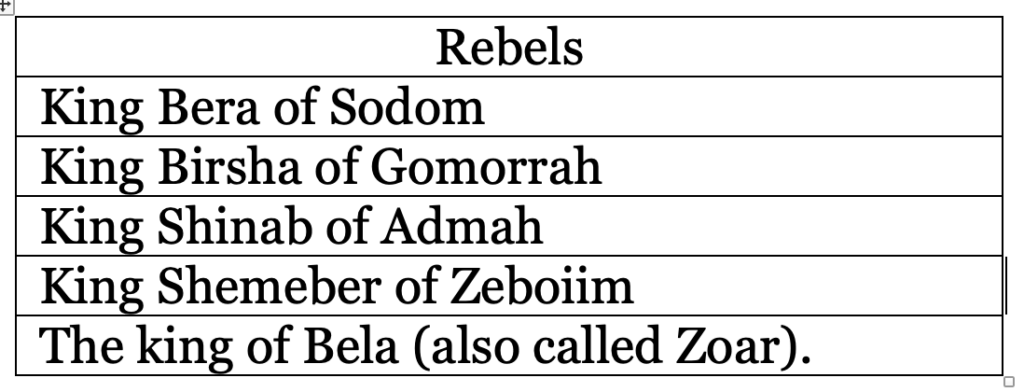
    Yep, four of them were. “… The Canaanite clans eventually spread out, and the territory of Canaan extended from Sidon in the north to Gerar and Gaza in the south, and east as far as Sodom, Gomorrah, Admah, and Zeboiim, near Lasha” (Gen. 10: 18-19 NLT emphasis added).

    Biblestudy.org’s Life of Abraham timeline notes that this incident happens around 1880 to 1875.

    Resource

    Think about this. How many times have we championed the freedom to govern ourselves? That is exactly what the rebels were trying to do.

    Wilson agreed that it is par for the course. He wrote, “It is a reminder that there are moments in our lives when we must challenge the powers that oppress us, whether they be external forces or internal fears.”

    Resource

    But we can see Kedorlaomer’s desire to keep the territory that he would see as his. Ooo, baby. We don’t want to give up our stuff, do we?

    Moses called the sea in the Siddim Valley the Yam HaMelach or Salt Sea. Regardless of bringing in a significant amount of fresh water each year, Williston told us that it remains the same level all year long.

    Resource

    We call it the Dead Sea. This is because the salt makes it so no fish can live within it.

    The problem with the Siddim Valley was it was littered with tar pits. It was like a minefield. Those traversing it would have to pay attention.

    Rebellion

    “One year later Kedorlaomer and his allies arrived and defeated the Rephaites at Ashteroth-karnaim, the Zuzites at Ham, the Emites at Shaveh-kiriathaim, and the Horites at Mount Seir, as far as El-paran at the edge of the wilderness. Then they turned back and came to En-mishpat (now called Kadesh) and conquered all the territory of the Amalekites, and also the Amorites living in Hazazon-tamar. Then the rebel kings of Sodom, Gomorrah, Admah, Zeboiim, and Bela (also called Zoar) prepared for battle in the valley of the Dead Sea. They fought against King Kedorlaomer of Elam, King Tidal of Goiim, King Amraphel of Babylonia, and King Arioch of Ellasar — four kings against five. 10 As it happened, the valley of the Dead Sea was filled with tar pits. And as the army of the kings of Sodom and Gomorrah fled, some fell into the tar pits, while the rest escaped into the mountains. The victorious invaders then plundered Sodom and Gomorrah and headed for home, taking with them all the spoils of war and the food supplies. They also captured Lot — Abram’s nephew who lived in Sodom — and carried off everything he owned” (Gen. 14: 5-12 NLT)

    Those not in the fight also feel the effects of war.

    Kedorlaomer was on a roll. The fighting was going his way.

    The fighting took place with the surrounding tribes first. I don’t know if this was an initial conquer or a preemptive conquer.

    Whichever, they were then ready to take on the rebellious kings.

    Again, Kedorlaomer and his coalition were victorious.

    The last we heard, Lot left Abram and moved near Sodom. “… Lot moved his tents to a place near Sodom and settled among the cities of the plain” (Gen. 13: 12 NLT). Gray thought Lot had moved into Sodom by now.

    That would be a bite. He wanted wealth and possessions, but here he was a captive stripped of his possessions.

    Leale said that was the way things go. He wrote, “That men often suffer who take no part in the quarrel.”

    Resource

    I don’t think Jerdan agreed with Leale. He noted that, when Lot settled in the Jordan valley, the kings of the Pentapolis recognized Chedorlaomer, king of Elam, as their suzerain and paid him a yearly tribute. By moving there, Lot was saying that he was good with that and accepted it on his behalf.

    Resource

    True, the rulers in authority made the decision to rebel. But the underlings would have had to go along with the idea because — well — they were underlings. They didn’t always get a say in the matter.

    Abram the Hebrew

    “But one of Lot’s men escaped and reported everything to Abram the Hebrew, who was living near the oak grove belonging to Mamre the Amorite. Mamre and his relatives, Eshcol and Aner, were Abram’s allies” (Gen. 14: 13 NLT)

    Uncle Abram went to the rescue.

    It seems Abram had found a place to settle down. Abram is still living by this grove in Genesis 18: 1.

    This is the first time that Abraham is called a Hebrew. Let’s look at in the Hebrew.

    “And there came one that had escaped, and told Avram HaIvri …” (Gen. 14: 13 OJB).

    It means to cross over. More literally, it means from the other side of the river.

    This is true. Abram had to cross over from the other side of the Euphrates River to enter Canaan.

    It is interesting that Moses listed three allies. It is nice to know Abram had allies in the area. God will put helpers in our path to accomplish His Will.

    Abram the Warrior

    “When Abram heard that his nephew Lot had been captured, he mobilized the 318 trained men who had been born into his household. Then he pursued Kedorlaomer’s army until he caught up with them at Dan. There he divided his men and attacked during the night. Kedorlaomer’s army fled, but Abram chased them as far as Hobah, north of Damascus. Abram recovered all the goods that had been taken, and he brought back his nephew Lot with his possessions and all the women and other captives.” (Gen. 14: 14-16 NLT)

    Abram didn’t let past history affect his desire to rescue Lot.

    Abram and Lot had parted ways because of a conflict. We think they parted on decent terms, but there may have been some residual resentment.

    That didn’t stop Abram. He and his 318 fighting men took off to rescue Lot.

    Abram didn’t need the numbers. He had God fighting with Him and for Him.

    Up to this point, we haven’t seen Abram as a warrior. We’ve seen him as a worshiper.

    But in that era, Abram had to have been at least a fighter. I doubt he would have survived if he didn’t know how to defend himself. Here, he was described more as a policeman.

    Resource

    But this was Kedorlaomer — the ruling power in those parts at the time. Abram as a private citizen had no right to wage war against a king.

    Walking with God does not mean Abram was turned into a doormat. He wasn’t a conscientious objector.

    God expects us to defend ourselves and our loved ones but also to submit to earthly authority.

    Now, whoever wrote this said that Abram caught whom he was pursuing at Dan. (Jerden thought that was Damascus.) This would have had to have been put into the account by someone other than Moses.

    Not only had the Promised Land not been divided by the 12 tribes as they weren’t born yet, but also Moses didn’t go into the Promised Land. How would he know?
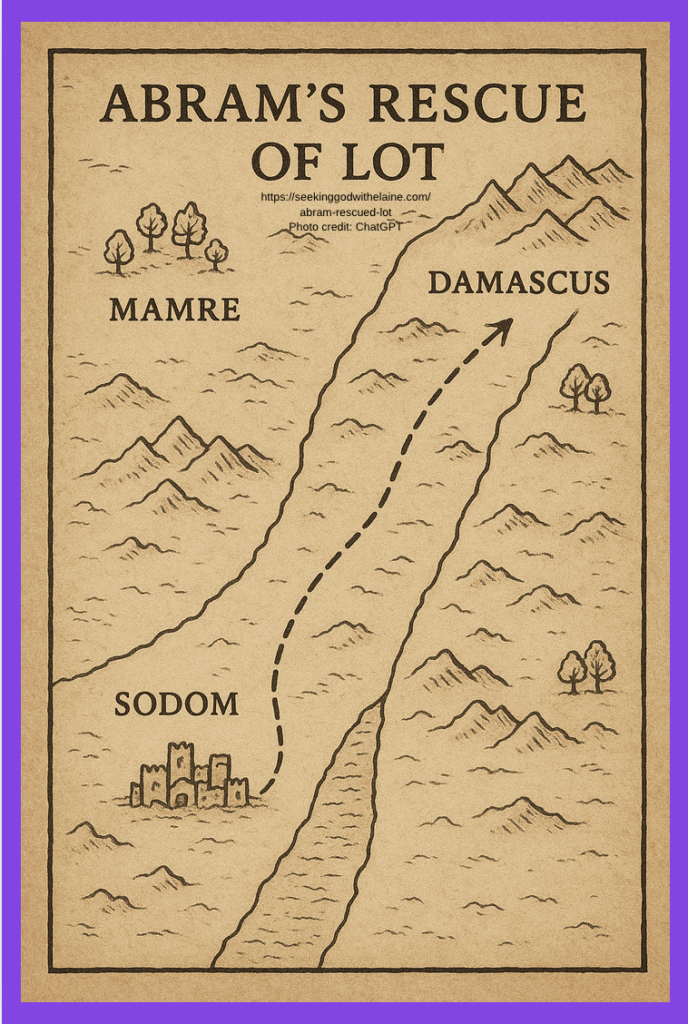
    Abram did become a general in this instance. He knew enough about fighting to see the benefit of a nighttime offensive.

    This tells me that, even though it sounds like they picked up and went after Lot without much notice, they were ready. They already had the training. They may have had a generic contingency plan for being attacked, defending themselves, etc.

    Abram and his soldiers were ready.

    Gray seemed to think that Abram killed the kings. We aren’t really told that here. Yes, it would make sure that it didn’t happen again.

    But I wonder if Abram knew they were family.

    That is a kicker, isn’t it? Abram was going to save family from family.

    How many of us would have said Lot got his just deserts? Some of us may have left him to his fate.

    Abram said, “Nope. I’m going after him.”

    Making the Connections #1

    There is a huge contrast between Kedorlaomer and Abram. Kedorlaomer probably did all his fighting with the motivation of greed, covetousness, and pride.

    Abram on the other hand, went into this fight because of love. He loved his nephew, and he didn’t like to see how he and other innocent people were taken hostage.

    So, Abram did something about it.

    Making the Connections #2

    I like what Gilfillan had to say. He wrote,

    “Sometimes it is the Christian’s part to stay at home; and at other times to go far hence among the heathen. Sometimes it is his duty to sit under his family oak and attend to his family exercises; and at another time, like Abraham, to choose some post of peril, and do some good deed of daring.”

    Sometimes, God calls us to stay put. Sometimes, He calls us to move. We have to do what we are called to do.

    Making the Connections #3

    Taylor pointed our that, though Abram was in the world, he wasn’t of it. He wrote, “In all this we have another illustration of the strength of Abraham’s faith. It kept him equally removed from ascetic seclusion on the one hand, and worldly conformity on the other.”

    Resource

    We are in the world. We can’t refuse all interaction with worldview people.

    But we must not compromise our beliefs in order to get along with them. We have to say what God calls a sin remains a sin.

    Does that mean we don’t fight the battles that are clearly worldly? Not when they are impacting someone who shares our faith. We must ride to the rescue immediately when God calls us to do so.

    Making the Connections #4

    Sometimes, valleys can be figurative in God’s Word. It may symbolize going through a trial. It can also remind us of a place of shelter and security, symbolizing God’s protection and provision.

    How Do We Apply This?

    • Watch so that ambition does not look to meet its own ends instead of God’s.
    • Remember the wicked will persecute the faithful as well as other wicked people.
    • Be ready when God calls.
    • Be ready to come to another’s aid.
    • Understand sin is a captivity and be prepared to rescue someone chained to it.
    • Teach our children in God’s ways so they are ready to fight.
    • Stand up to those oppressing our faith.

    Resources

    Father God. You have put us in a world that does not follow You. Because of that, Your children are many times in danger. Help us to keep our focus on You. Send loved ones to rescue us. Let us rescue our loved ones. Bring us home to You. Amen.

    What do you think?

    Leave me a comment below (about this or anything else) or head over to my Facebook group for some interactive discussion.

    If you don’t understand something and would like further clarification, please contact me.

    If you have not signed up for the email providing the link to the devotions and the newsletter, do so below.

    If God has used this devotion to speak with you, consider sharing it on social media.

  • Abram and Lot Separate

    Abram and Lot both had large herds that were vying for limited resources. This devotional reading looks at how uncle and nephew separated to restore peace in the family.

    Nuggets

    • Abram and Lot both being wealthy caused problems.
    • Abram imitated the graciousness of God.
    • Lot chose wrong.
    abram-and-lot-separate

    Right when we think things are looking up, they go off the rails. Trouble in the family is a frequent reason.

    We said that Lot provided some of the troubles for Abram. This is one example.

    Let’s Put It into Context

    To read devotions in the Creating Everything theme, click the button below.

    Devotions in the Abraham the Emigrant series

    Disputes

    “But the land could not support both Abram and Lot with all their flocks and herds living so close together. So disputes broke out between the herdsmen of Abram and Lot. (At that time Canaanites and Perizzites were also living in the land.)” (Gen. 6-7 NLT)

    Disputes

    Abram and Lot both being wealthy caused problems.

    Some would say that Abram and Lot had a good problem. They were both prospering.

    We talked in the last devotion that we haven’t heard much about Lot. We just know he was Abram’s nephew and traveled with them from Ur to Canaan.

    The Essex Remembrancer called Lot a good man. He may have been when he left Ur. He would have had a good example in Abram.

    Resource

    Maybe Lot had started out from Ur following God’s call. Like salvation, our initial acceptance of God at conversion is only the beginning. We must then walk with God daily as we are sanctified.

    We just talked about the impact the wealth and opulence of Egypt had on Lot. Being dazzled by the country may have turned him away from God if he had called upon God previously.

    Pearse described Lot’s religion as being second-hand. It was Abram’s religion and only rubbed off on Lot because of association with Abram, not with God.

    Resource

    It appears that Abram was looking at the distant future — “I’ll give this land to you and your descendants.” Lot was focused on the here and then.

    Lot’s problem, we will find, is that he was amassing a worldly prosperity. His ambition did not seem to lead to growing a closer relationship with God.

    We can’t get to God by hanging onto someone else’s coattails.

    We’ve talked a couple of times about the altars that Abram built. Yeah, Abram. Not Abram and Lot.

    In the last devotion, we talked about the altars being a gathering place as well as a place of worship. We aren’t told that Lot gathered.

    Regardless of Lot’s relationship with Abram and God, the herdsmen were fighting.

    True, the herdsmen could be seen as doing their jobs — providing for and protecting their herd. They were surely frustrated that there was not enough resources for both.

    Why was resources so limited? Remember, Abram didn’t own the land. Neither did Lot.

    The Canaanites and Perizzites did. That would have limited the land to which Abram and Lot had access.

    The herdsmen were probably taking cues from their employers.

    Adamson had some great words to describe the disputes between the herdsmen: “unseemly, untimely, and unnecessary.”

    Resource

    We can’t really tell from verse 7 how far the disputes had progressed. Maybe the herdsman had gone to either Abram or Lot and discussed the problem. Maybe they didn’t until the matter got out of hand.

    However far it had progressed, the dispute doesn’t seem to have alienated Abram and Lot. They did come to a solution between themselves.

    But I don’t see Abram letting it get too bad. He knew that being family carries obligations with it. They should work through issues that arise between them.

    Major problems in families can lead to hurt feelings, anger, bitter dissension, and separation. God doesn’t want us to go there.

    Canaanites (Kena‘ani)

    We have to be careful to realize who the word Canaanites mean. It could mean the descendants of Ham’s son, Canaan. Or it could also be used to refer to to the seven nations of the region as a group. Those seven nations are the Canaanites, Hittites, Hivites, Perizzites, Girgashites, Amorites, and Jebusites.

    The Canaanites were known as being motivated by greed and lust. Their goal was acquire worldly wealth, shown by their advanced trade networks.

    Perizzites (P’rizi)

    The Perizzites were an undisciplined group of people. They separated themselves from by living in the hill country (Josh. 11: 3).

    Example

    “So, Abram said to Lot, ‘Let’s not have any quarreling between you and me, or between your herders and mine, for we are close relatives. Is not the whole land before you? Let’s part company. If you go to the left, I’ll go to the right; if you go to the right, I’ll go to the left’” (Gen. 13: 8-9 NIV)

    Abram imitated the graciousness of God.

    What Abram didn’t have to do was give Lot the first choice on the land as he was the elder, not Lot. Not only was he older, he also was now the head of the family.

    We talked about this a little bit in the last devotion. Abram was disinterested. Disinterestedness means a willingness to give up something for a greater good.

    Abram could have said he was top dog and taken whatever land he wanted. He was the elder in this instance. He probably had the bigger herd than Lot.

    Taylor reminded us that Abram was the one called. That would have made Lot tagging along with Abram, not the other way around.

    Resource

    But the herdsmen were already quarreling. Abram didn’t want to conflict to flood to include him and Lot.

    Abram showed us that pulling rank is not always the answer. Neither is always being right.

    So, Abram’s gentle, generous answer was, “Lot, you mean more to me than having the best land. I want to see you settled, happy, and thriving. Where do you want to live?”

    Abram showed us that God meant all to him. God meant more to him than his worldly interests.

    Is it because Abram was so unworldly, as Pearse said?

    Resource

    Maybe to a degree. But I have trouble with totally believing that.

    Abram’s life would have been hard. This was BC. Life was hard. Remember, they are living in tents.

    Think back to their time in Egypt. We said Abram may have told the Pharaoh Sarai was his sister because he didn’t want a confrontation. Abram was a peaceable man with a big heart.

    What Abram was doing was extending to Lot the type of grace that God extended to him. He didn’t have to treat Lot this way, just as we’ve done nothing to deserve the favor God gives us.

    It is easy to say that, regardless of where Abram ended up, God would bless him. And maybe Lot thought that in part, too.

    And yes, God will bless us in not-so-good circumstances when we are being obedient to Him. It wasn’t — and shouldn’t be — a test for Him to do that.

    Lot Made His Choice  

    “Lot took a long look at the fertile plains of the Jordan Valley in the direction of Zoar. The whole area was well watered everywhere, like the garden of the Lord or the beautiful land of Egypt. (This was before the Lord destroyed Sodom and Gomorrah.) Lot chose for himself the whole Jordan Valley to the east of them. He went there with his flocks and servants and parted company with his uncle Abram. So Abram settled in the land of Canaan, and Lot moved his tents to a place near Sodom and settled among the cities of the plain. But the people of this area were extremely wicked and constantly sinned against the Lord” (Gen. 13: 10-13 NLT)

    Lot chose wrong.

    This was a defining moment in Lot’s life. His choice here set in motion the rest of his story.

    Many of us wonder how Lot could have been so insensitive to his Uncle Abram. Abram was being generous while Lot was being selfish.

    Go back up to verse 7.

    The Canaanites were still living in the land. They had been cursed when Ham had seen Noah’s nakedness when he was drunk and told everyone about it (Gen. 9: 25).

    Lot didn’t choose – without consulting God – to stay away from them. In fact, he chose the city life to live among them.

    Wait! What? A shepherd chose to live in the city????

    Cain went to the city. Nimrod went to the city.
    
And that didn’t end well.

    Smith thought that this was just an example of making a hasty choice. He didn’t think things through.

    Resource

    Hmmm. I don’t really think so. I think he had become too worldly to pass up this opportunity.

    It is easy for us to say that Lot chose to live among the idolators. Horton said wait a minute. He reminded us that there were isolators all around Abram. He had to have been taking a big risk to worship God as he was the minority.

    Resource

    But Lot probably had been dazzled by the wealth and opulence he saw in Egypt. Ooo, baby. Pearse thought so. He wrote,

    “That sojourn in Egypt was damaging to Abraham; but it was fatal to Lot. He had seen a land that had kindled his greed; the possibility of his growing rich had seized him and mastered him. That which attracted him in Sodom was that it was like the land of Egypt, well-watered everywhere. The heathenism of Egypt had prepared him for the grosser wickedness of Sodom. His wife and daughters had seen the glitter and gaiety of a company that made the quiet of Abraham’s encampment seem very dull. And worst of all, they had seen a good man without his altar and his God; why then need they be so particular? So when the opportunity came, Lot was quite prepared to avail himself of it.”

    Resource

    Lot wanted to see a path that led to material wealth. He wanted to be able to make his own decisions without censure from anyone — human or divine.

    I would hope Lot didn’t think Abram had enough, and now it was his turn to prosper. Or maybe – worse yet – Abram is old and washed out. Let someone younger have his chance.

    Still worse yet, I hope Lot wasn’t laughing at Abram because of his generosity. He should have been humbled that he was loved so much.

    Hopefully – I guess in a way – Lot was enjoying his choice rather than smirking at Abram. There is probably little doubt that he was already counting his gain.

    Each of us probably know about three or four modern-day people who could be named Lot, don’t we?

    Our choices may seem inconsequential at the time. They do lead to the next decision — if not in relation to it, at least in mindset ousted to make the decision.

    Lot’s decision was based on selfishness. “Lot chose for himself the whole Jordan Valley to the east of them …” (Gen. 13: 11 NLT).

    We need to always choose God things rather than world things. We have to choose for the good of the family.

    Making the Connections #1

    Doesn’t it seem as though, when we are having a mountaintop experience, we get slammed with a trial? Hughes said it this way. He wrote, “Great straits may befall the saints of God in their greatest abundance.”

    Resource

    Yeah, it looks like this is about an over-abundance of wealth. But it wasn’t.

    It could have been about the squabbles. I wonder if it was – at least on Lot’s side – the as yet unfulfilled promise of land.

    True, the promise was to Abram. Lot was just tagging along without making a true commitment to God.

    Satan may have been puffing Lot up. I wonder if he thought he was putting his bid in for land when the promise was fulfilled.

    We know Satan certainly was trying to distract Abram. Satan is going to do all he can to take our focus off God. Utopia would be if he gets us to deny God.

    It feels like — sometimes — that Satan or his agent are just watching for us to get to a place where we are ripe for temptation. That is the time we have to double down on our focus of God.

    Making the Connections #2

    Wealth does cause problems, sometimes— even in families. Too much can be as bad as not enough.

    We have to make sure we don’t make money our god. Sovereign God is to have that honor.

    Making the Connections #3

    We talked about this a couple devotions back. We have to be willing to separate from family if that is what God is calling us to do.

    Hughes said that is grace. He wrote, “Grace is willing to part with its own, and all too, in some cases, to brethren.”

    Resource

    We must always put God first and be loving about it.

    Making the Connections #4

    I know. It’s hard not to get ahead of ourselves – especially if we know the rest of the story.

    Many would say that Abram got the short end of the stick. I’ve always thought that the land that Lot left for Abram was more desert. Abram would obviously have a harder time making a living on the land that Lot left for him.

    Ker said that Lot chose the richest area. All God’s Word says is that “Lot took a long look at the fertile plains of the Jordan Valley in the direction of Zoar. The whole area was well watered everywhere, like the garden of the Lord or the beautiful land of Egypt …” (Gen. 13: 10 NLT).

    Resource

    Lot chose the fertile ground compared to the Garden of Eden to live among the idolators – and lost everything.

    Abram took what was left – regardless of how good or bad the land was – went with God and gained everything.

    I like what Pearse had to say about it. He wrote,

    “This is the great lesson of this Book — that whilst we think of making a living, God is thinking of what our living makes us. That the man is more than all gain. This is the idea of life which runs through the New Testament — it is faith, the service of God, the utter surrender of all to Him. This alone can make life worth living. Choose anything, everything else; live for it, grasp it — and what then but die?”

    Resource

    We have to get our priorities straight. This world and all its shiny, garden wonders should not be our priority.

    Our priority should be our relationship with God.

    Making the Connections #5

    Abram walked with God in faith and obedience. Sure, he still sinned.

    But Abram clung to the promise. “You and your seed will possess this land. Forever.”

    Robinson had an interesting take on Abram and Lot’s quarrel. He called it a scandal of which even the Canaanites and Perizzites knew.

    Resource

    Ooo, baby. Abram wouldn’t have wanted that to wreck his witness.

    Making the Connections #6

    Sometimes, I think it is good to think about the What-Ifs that could have happened. That way, we know how God has protected us.

    What if the Canaanites and Perizzites learned of the quarreling? What if they had chosen to attack Abram and Lot.

    There could have been much blood shed. Satan would have loved it if Abram had been killed.

    No, it didn’t happen. That wasn’t in God’s plan. Thank You, God, that it wasn’t – that Abram’s Descendant became our Savior.

    Making the Connections #7

    It may look like we are prospering when we leave God out of our lives. We aren’t – at least not for long.

    True, we may not get full judgment until we stand in front of the Judgment Seat. God does judge us at times in this life.

    But we can’t have true success if we aren’t living within God’s Will. Worldly success is not godly success.

    Making the Connections #8

    I only have about four more pages of research to read through, and I come across where Robinson talked about Lot having Christian worldliness.

    Wait! What????

    Robinson argued that, however we may judge Lot here, by the time he left Sodom, he was a righteous man. He was sick of the culture in which he lived.

    “But God also rescued Lot out of Sodom because he was a righteous man who was sick of the shameful immorality of the wicked people around him. Yes, Lot was a righteous man who was tormented in his soul by the wickedness he saw and heard day after day” (II Pet. 2: 7-8 NLT emphasis added).

    That stops us, doesn’t it? As much as we want to bite on Lot here, he didn’t end this way.

    It sounds like Lot started good, got lost it in the middle, but came back to God before the end.

    Robinson reminded us of a word I read over. “… Lot moved his tents to a place near Sodom and settled among the cities of the plain” (Gen. 13: 12 NLT). Lot didn’t go directly to Sodom.

    Like us, Lot didn’t instantaneously choose evil. He inched toward it.

    Doesn’t that give us some comfort for when we turn away from God and backslide? We can be redeemed.

    But doesn’t that break our hearts? Abram’s nephew, though he ends up a righteous man, is an ineffective disciple. He is has a Christian worldliness.

    Talk about a lukewarm disciple.

    Robinson interpreted Peter’s verses for us. He wrote,

    “This shows, not only that Lot was saved, but that his salvation, so graciously achieved, was of so narrow a sort that it could be given as one of the extreme examples of Divine mercy towards the undeserving; and that it must be taken in connection with the fact that all the inhabitants of the wicked city, out of which he was so hurriedly rushed, were ‘turned into ashes.’”

    Resource

    We’d call it Lot being saved by the skin of his teeth.

    How many disciples only want to do enough to be saved and not be seen as righteous?

    God will show grace and mercy to those He chooses.

    How Do We Apply This?

    • Accept that some separations are for good – and others are for God’s good (Rom. 8: 28).
    • At all times – whether in fellowship or in separation – be unstinting, kind, and constant.
    • Look for ways to promote agreement, not quarrels.
    • Be honorable in our interactions with others, especially family.
    • Be peacemakers.
    • Don’t judge only from appearances.
    • Honor God.
    • Listen to God’s repeated warnings as He guides us to remain in His Will.
    • Be a friend of God’s and humans.

    Resource

    Father God. Thank You for giving us families in which to belong. Forgive us when worldly matters strain our relationships. Help us, as Abram, to resolve any issues generously and morally. Amen.

    What do you think?

    Leave me a comment below (about this or anything else) or head over to my Facebook group for some interactive discussion.

    If you don’t understand something and would like further clarification, please contact me.

    If you have not signed up for the email providing the link to the devotions and the newsletter, do so below.

    If God has used this devotion to speak with you, consider sharing it on social media.

  • Agreement in the Body of Christ

    We commit to grow our habits when we live in agreement with other disciples. This devotional reading, written by Pastor Steve, looks at committing to be in agreement with like-minded believers in the church.

    Nuggets

    • We aren’t sinning when we disagree with each other, necessarily.
    • Paul knew that it was imperative for success in any ministry for us to have and be of like minds.
    • There are many different church denominations. 
    • To be fruitful for God, we must be operating from the same mindedness and agree with each other and COMMIT to doing so.
    • For us to be godly in all that we are doing for Him, we must commit to follow him in all that we do. 
    • The only way that we can possibly do all for the glory of God and mean it is to abide in Christ through the power of the Holy Spirit.

    In our walk with our Lord Jesus, it is necessary for us to commit to being or doing things, for us to be fruitful in our ministries together.

    That is not to say that we are not allowed to disagree. That is not possible, because we are all humans who have different thoughts about certain things. 

    How something should be done; the color of the new carpet for the sanctuary in our church and lots of other things. 

    Let’s Put It into Context

    Devotions in the Pastor Steve’s Sermons series

    Be Careful When You Disagree

    “for the anger of man does not produce the righteousness of God” (Jas. 1: 20 ESV)

    We aren’t sinning when we disagree with each other, necessarily.

    That is unless we allow the disagreement to build into discontent, causing anger to flare and causing church splits, friend splits and so on. Then we must be careful how we react and keep the disagreement to a Godly context. 

    The Book of James tells us: “for the anger of man does not produce the righteousness of God” (Jas. 1: 20 ESV). When we have our minds set on being angry for one reason or another, we cannot possibly accomplish what God has for us to do.

    This is why, I believe, that the Apostle Paul asked this of the Philippians in his Epistle to them when he said:

    ‘So if there is any encouragement in Christ, any comfort from love, any participation in the Spirit, any affection and sympathy, complete my joy by being of the same mind, having the same love, being in full accord and of one mind. Do nothing from selfish ambition or conceit, but in humility count others more significant than yourselves. Let each of you look not only to his own interests, but also to the interests of others. Have this mind among yourselves, which is yours in Christ Jesus’ (Phil. 2: 1-5 ESV).

    There Is a Reason Paul Said This

    Paul knew that it was imperative for success in any ministry for us to have and be of like minds.

    Like-mindedness means having similar or same opinions. In the sense of Christian spirituality, it means that we agree about interpretations of the Bible, ways of worship, and so on. 

    For us to be of like-mindedness, as a group of individuals, we must commit ourselves to it.

    Too Many Differences of Opinion Is not Good

    There are many different church denominations. 

    In many cases, one denomination started because they split off another due to a disagreement about Biblical interpretation or some other aspect of what they believe makes one church more correct than the one they split off from.

    On one hand, it makes sense to do that. When a church has a disagreement of some sort that cannot be settled, they should split and form another group of believers, for the sake of harmony and being fruitful to God’s calling. I could go into the matter of whether the split resulted from sinful accusations, etc., but for the purpose of this post, I am going to assume that the split was decided amicably and proceeded with doing so.

    That said, however, there are roughly 200 different denominations in the United States alone and roughly 45,000 different denominations in the entire world. Perhaps there are smarter people than me who know the answers to this, but I find it very hard to believe that there are 45,000 different opinions on aspects of Bible interpretation, worship, and so on.  Most likely, these differences are man-made opinions that are not at all in agreement with what God wants to have.  For me, that’s much easier to believe.

    What It Takes to be Fruitful

    To be fruitful for God, we must be operating from the same mindedness and agree with each other and COMMIT to doing so.

    There is usually at least one person within any given congregation that does not agree with anything the church of which that this person is a member. This person will often cause a great deal of discontent and try to get other members of the church to also follow with what they disagree.

    It makes more sense that if a person cannot agree to be a part of what a church is doing, then they should go find a church that they can be in like-mindedness with and commit to being a part of that church. Instead, however, they choose to stay where they are and be a willing instrument of the devil by causing discontent with that body of believers and allow him to attempt to thwart what God is doing in that church. 

    Why We Must Commit to Him

    For us to be godly in all that we are doing for Him, we must commit to follow him in all that we do. 

    One of the first things that we need to keep in mind is that when we are doing ministry, we are not doing it for ourselves.  We are doing it for God’s glory.

    First Corinthians 10:31 tells us, “So, whether you eat or drink, or whatever you do, do all to the glory of God” (ESV).

    We Must Abide in Christ

    The only way that we can possibly do all for the glory of God and mean it is to abide in Christ through the power of the Holy Spirit.

    Jesus said, “Abide in me, and I in you. As the branch cannot bear fruit by itself, unless it abides in the vine, neither can you, unless you abide in me” (Jn. 15: 4 ESV).

    The Biblical definition of abide means to remain or to stay.  For us to get what we need from Jesus to serve Him, we must STAY in Him. 

    How do we do that?  We commit our lives and everything we do it Him.  That is a part of our purpose in this life.

    • “Commit your way to the Lord; trust in him, and he will act” (Ps. 37: 5  ESV).
    • “Commit your work to the Lord, and your plans will be established” (Prov. 16: 3 ESV).

    Jesus had so much to say about abiding in Him in John 15.  I highly recommend you take the time to study this chapter of John … meditate on it, chew on it and pray about it. You will be amazed at what Jesus has to say about abiding. 

    I do want to point out one more verse from John 15  to make a point. 

    Jesus said, “I am the vine; you are the branches. Whoever abides in me and I in him, he it is that bears much fruit, for apart from me you can do nothing” (Jn. 15: 5 ESV).

    This is one of my favorite passages of Scripture, and I quote this more often than I realize, I’m sure. But there is a lot of truth here. 

    We literally cannot do anything apart from Jesus.  You may be wondering what I mean.  Well, here’s why I believe it is a very literal verse.

    In the book of Acts, when Paul was speaking to the Aeropagus, he quoted a Greek poem that says, “… ‘In him we live and move and have our being’ …” (Ac. 17: 28  ESV). The Biblical truth to that is so amazing. 

    If God took His hand off us and this world for even one second, we would literally fall apart.

    The book of Philippians says, “for it is God who works in you, both to will and to work for his good pleasure” (Phil. 2: 13 ESV). Everything we can do is because God allows us to do so, according to His will, because it gives God pleasure to do so.

    What Does This Have to Do with Agreement?

    You may be thinking at this point, “great, but what does any of this have to do with agreement?” One of the definitions of agree is “to consent to do something that has been suggested by another person.” 

    It’s true that God doesn’t call His commandments “suggestions,” though many people tend to follow them as if they were. And He does give us a freewill to do whatever we want.

    However, for a person to finally decide to surrender their life to God and do things His way is indeed an agreement that has been made. 

    We say, “I surrender my life to you Lord and will let you have control of my life.”  This surrender that we do is a willful agreement with God to accept His Will for us, and we follow Him accordingly.

    When we accept Jesus as our Lord and Savior, it is all too often that we end up thinking that is it. That is all we must do, and we are good.

    The thing we tend to overlook or ignore is what Jesus said in Matthew 16: 24. He said, “If any of you wants to be my follower, you must give up your own way, take up your cross, and follow me” (Mt. 16: 24 NLT).

    You see, when we surrender our lives to God, we give up the right to do everything we want to do with our lives. We give our lives up to our own ways and follow God’s ways. 

    That’s what it means to be faithful and devoted to our God. When we say, “Yes, Lord!” we cannot only mean, yes when it is in our own way. 

    To do so is to be out of God’s Will for our lives; and in being there, we will never be truly happy without being submitted to His will.

    In a very real sense, when we give our lives to the Lord, we agree with Him, that His way is better than ours. We agree with all that He wants to do with us, even if we don’t have any idea what’s next.

    We are surrendering ourselves by being obedient to His call. Let us be ever mindful about this in all we that.

    Lord, help us all be obedient to Your Will for our lives and agree with You in all that You want for us. Amen.

    agreement-in-the-body-of-christFB

    What do you think?

    Leave me a comment below (about this or anything else) or head over to my Facebook group for some interactive discussion.

    If you don’t understand something and would like further clarification, please contact me.

    If you have not signed up for the email providing the link to the devotions and the newsletter, do so below.

    If God has used this devotion to speak with you, consider sharing it on social media.

  • The Law of Unity

    Disciples are still people. We have challenges interacting with others. This daily devotional begins looking at how strong disciples interact with weak disciples.

    Nuggets

    • A disciple strong in faith has a good grasp of spiritual knowledge.
    • We are not to give rise to contentious feelings among disciples.
    • We are not to judge those we consider are spiritually weaker than us.
    • A disciple weak in faith is separated from Jesus.
    • Sometimes, it is just as easy for the weak to judge the strong.
    • God wants all of His children to be unified.
    • We can’t force someone to think our way.
    • A uniting factor should be our sincerity.

    To read devotions in the Redo for Godliness series, click the appropriate button below.

    Devotions in the Transformed to Perfection series

    If we look at the Sanctification Road as a continuum, we could be anywhere on our continuum. That means we could be either strong in our faith or weak.

    But others could be anywhere on their continuum, too. When we are at differing ends, it can be challenging at times.

    Paul addressed that in the beginning of Romans 14. We know he was all about unity.

    We are going to structure the discussion by using Lyth’s Strong and Weak sermon. The purple and the blue headings are his words.

    Resource

    The name of this section in my Bible is Law of Liberty. That is why I picked that for the series name.

    Transparency here. I am not real sure how this is going to shake out.

    Let’s Put It into Context #1

    Here is a running list of what we’ve discussed previously.

    For Those Who Are Strong in the Faith

    “Welcome anyone who is weak in faith, but don’t argue about disputed matters. One person believes he may eat anything, while one who is weak eats only vegetables” (Rom. 14: 1-2 CSB)

    A disciple strong in faith has a good grasp of spiritual knowledge.

    Faith is the conviction that the doctrines revealed in God’s Word are true, even if we do not understand all aspects of them, a belief which impacts our lives. Here, Paul was talking about how strong or weak that faith is.

    Tyson defined who someone strong in their faith is. He wrote, “The question was, did Christianity or did it not require abstinence from certain meats, and observance of certain fasts and festivals? The man who maintained that it did is here held to be weak in the faith. He had but faintly grasped the breadth of Christ’s redeeming work; while he who had attained superior light, and had been set free from all such scruples, was therefore strong in the faith.”

    Resource

    The problem is that people interpret Scriptures to mean different things. Some say abstinence is the way to go. Some say faith allows us to do whatever we want.

    Tyson said some believed that disciples have to strictly observe certain fasts and festivals. He contended that wasn’t what Paul said. “Therefore do not let anyone judge you by what you eat or drink, or with regard to a religious festival, a New Moon celebration or a Sabbath day” (Col. 2: 16 NIV).

    Wait! What?

    We can hit every service — and not be worshiping. We can be singing — and not praising God.

    It isn’t what we do. It is having God’s character. It is being.

    Perfection is about being. It is about obtaining the character of God.

    Not to Provoke

    We are not to give rise to contentious feelings among disciples.

    Woodcock is right when he wrote that “opposition breads opposition.” Stirring the pot does not promote peace within the ranks.

    Resource

    We can’t force someone to believe the same way that we do. What Tyson was taking the long way to say was that we shouldn’t judge someone because of their opinions. We shouldn’t make our opinion of the law.

    This is especially true if it is over something trivial. We shouldn’t break our unity over something that, in comparison, is not important.

    Lyth said that, many times, the difference of opinion comes from ignorance. My Ladies and I were talking today about Job’s hymn of wisdom. None of us is going to know everything. We shouldn’t force our opinion on someone else when we can be wrong.

    Resource

    To read a related devotion, click the button below.

    Only God has full wisdom and knows exactly how everything is and should be. He only tells us a part.

    Nor Despise Those Who Are Weak

    We are not to judge those we consider are spiritually weaker than us.

    Henry made a good point. Though they are weak, they are still disciples. They are still spiritually alive.

    Resource

    Paul talks time and time again about being unified. I know. We still struggle with that one, don’t we?

    We are brothers and sisters in Christ. (That is all Paul is talking about here. He isn’t talking about worldview people.)

    We are to support each other. What did Jesus tell Peter? “Feed my sheep …” (Jn. 21: 18 CSB). He wants us to take care of each other, not be divided.

    We need to love each other. That is what we are commanded to do.

    LoveOneAnother

    For Those Who Are Weak

    A disciple weak in faith is separated from Jesus.

    Woodcock used several verses to describe who the weak disciples are.

    • “He doesn’t hold on to the head, from whom the whole body, nourished and held together by its ligaments and tendons, grows with growth from God” (Col. 2: 19 CSB).
    • “There were indeed false prophets among the people, just as there will be false teachers among you. They will bring in destructive heresies, even denying the Master who bought them, and will bring swift destruction on themselves” (II Pet. 2: 1 CSB).
    • “At the same time, they also learn to be idle, going from house to house; they are not only idle, but are also gossips and busybodies, saying things they shouldn’t say” (I Tim. 5: 13 CSB).

    Resource

    Not to Judge Their Stronger Brethren

    Sometimes, it is just as easy for the weak to judge the strong.

    A weak disciple can judge a stronger disciple for what they believe in, also. They may perceive that the stronger disciple is judging them when they really aren’t.

    They shouldn’t do that, either.

    For Both

    God wants all of His children to be unified.

    Disciples should be patient with each other.

    We have to remember we are all still capable of sinning. We can still sin — and we will sin.

    We also have to remember that we are still growing. We are working out our salvation and determining what that really means.

    We are each seeking God’s Will in our lives.

    To Think and Let Think

    We can’t force someone to think our way. We are all individual persons. We have had differing experiences.

    I like what Beecher said. He wrote, “We are not to attempt to shape men to that which we think they ought to be in a hard and systematic manner.”

    Resource

    We see God differently — and that probably changes by what trial we are facing. But that is okay.

    God is everything to everyone. He is what we need when we need it.

    To Give Each Other Credit for Sincerity

    A uniting factor should be our sincerity.

    Oh, wow. Lyth was the only one who mentioned giving each other credit for sincerity.

    Wouldn’t that be a great way to bridge the gap between strong and weak disciples? Surely, we can find one thing on which to compliment others.

    The one thing should be our sincerity. We should each be genuine in our being a disciple of Christ. It should be our goal to do the do’s and not do the don’ts in order to grow our character to be like God’s.

    That alone should be a tie that binds us together.

    TheLawOfUnityPin

    Making the Connections

    Ooo, baby. Beecher called it — and he didn’t pull any punches. He wrote,

    “This chapter is written to dissuade men from acting the part of religious critics. It cannot be said that men are indifferent to religion in other folks. It is only to religion in themselves that they are comparatively indifferent. Men are so accustomed to criticise (sic) each other’s church service, etc., that they lose the very spirit of religion. The apostle dissuades everybody from it.”

    Resource

    Isn’t that so true? We want to hold everyone else to a standard — but don’t you dare try to hold us to it!

    But the problem is so many see religion only as acting a certain way. They see it as doing the do’s and not doing the don’ts.

    In reality, being a disciple is about being in a relationship with the Creator. Having a two-way communication with the One true Sovereign God.

    It is about us getting right with Him. Everyone else has to worry about their relationships.

    How Do We Apply This?

    • Build a relationship that removes prejudices.
    • Lead with humility, meekness, and kindness rather than dictatorial actions.

    Resource

    God doesn’t want His children divided. He doesn’t want us to think we are better than others.

    God wants us to be all following Him.

    Father God. We want to have Your character. We want to be loving and accepting of all Your children. Help us to be humble and meek when we interact with others. Amen.

    What do you think?

    Leave me a comment below (about this or anything else) or head over to my Facebook group for some interactive discussion.

    If you don’t understand something and would like further clarification, please contact me.

    If you have not signed up for the email daily or weekly providing the link to the devotions and the newsletter, do so below.

    If God has used this devotion to speak with you, consider sharing it on social media.

  • Godliness: The Parent of Contentment

    There is a benefit of becoming godly. We gain contentment. This daily devotional looks at how giving God priority in our lives and following His laws and commandments makes us godly, which brings contentment.

    Nuggets

    • When we become godly and gain contentment because we have the character we were intended to have.
    • In order to accomplish our redo, we have to give God the priority in every area of our lives.
    • Godliness, along with contentment, comes from being obedient to God’s laws and commandments.

    Devotions in the Review 101: Godliness series

    We are executing a redo this year because we want a better result. We want to be more like God, which will bring us contentment.

    Ooo, baby! The year has just begun, and we already know we will need lots of contentment this year!!!

    Let’s Put It into Context

    Godliness, equated with the Old Testament term fear of the Lord, is an attitude of reverence that is promoted by walking in His Spirit. The fear of the Lord means awe, reverence and love, not terror.

    We spent a whole series looking at contentment. Some of the things were learned were the following:

    • God has commanded all disciples be content in our situations.
    • Knowing God and being like God will be us contentment.
    • We like to think that godliness and holiness are synonymous, but sometimes, we like to think those are just a short distance from sin.
    • We know what makes us content and what doesn’t.
    • It matters whether we are content or not.
    • We have to look at our employment as it — whatever we are doing — is ordained by God.
    • God wants us to be working toward what He wants us to be working toward.

    To read a devotion in the Contentment Leads to Tranquility series, click on the appropriate button below.

    How Is Godliness Related to Contentment?

    “Now there is great gain in godliness with contentment” (I Tim. 6: 6 ESV)

    When we become godly, we gain contentment. This is because we have the character we were intended to have.

    Godliness fosters contentment because we become like God. When God originally created us, He made us this way. However, we changed after Adam and Eve committed the original sin.

    Becoming godly takes us back to the way we were originally created. It means we possess spiritual life, not spiritual death. Spiritual death is the separation from God that occurred as a consequence of Adam and Eve’s original sin. The spiritually alive are those who have ABCDed, so they are no longer separated from God.

    However, godliness can produce contentment in this life. Sibthorp listed one of the benefits as “… the improvement of his judgment, his discrimination, his mental faculties.” Our lives have more contentment because of this improvement.

    Resource

    Beattie explained how that can be. Leading godly lives eliminates sorrows in life. Yes, there will be sorrow, but godliness brings joy to life. “Restore to me the joy of your salvation, and uphold me with a willing spirit” (Ps. 51: 12 ESV).

    Resource

    Godliness Obtained through the Gospel

    In order to accomplish our redo, we have to give God the priority in every area of our lives. It also means growing in the three sides of godliness.

    We want to be like God. In order to do that, we follow the gospel, “… because the object of the revelation of Christ in the gospel is to show us the character of God in the person of a man, and thereby set us a pattern for us to copy — and by offering grace to all, by which they may be able to copy that pattern, to make them Godlike by making them like Christ.” That means we have to seek God

    Resource

    It will take hearing His Word, reading it, studying it, meditating on it, and memorizing it. All through that, we need to be in prayer, asking God to provide the meaning.

    Searching for and Seeking God

    Hearing His Word (Rom. 10: 17).
    Reading His Word (Rev. 1: 3).
    Praying to Him (Heb. 4: 16).
    Studying His Word (Ac. 17: 11).
    Meditating on His Word (Ps. 1: 1-2).
    Memorizing His Word (Ps. 119: 11).

    Godliness Obtained through Obedience to the Laws and Commandments

    Godliness, along with contentment, comes from being obedient to God’s laws and commandments. That is because the laws and commandments show us God’s character.

    As we follow them, our character changes to be like Him. It becomes second nature to us.

    Look at it this way. Our three sides of godliness follow the greatest commandments.

    “‘Teacher, which is the great commandment in the Law?” And he said to him, ‘You shall love the Lord your God with all your heart and with all your soul and with all your mind. This is the great and first commandment. And a second is like it: You shall love your neighbor as yourself’” (Mt. 22: 36-39 ESV).

    • If we love God, we will build our relationships with Him.
    • If we love God, we will obey His laws and commandments.
    • If we love others, we will reflect Him to others
    GodlinessFollowsGreatestCommandments

    In How Does Dedication Help Consistency?, we said that this is how Christian perfection is achieved. Our character is changed to be like His.

    Godliness breeds contentment because our relationships with God is where they should be. Becoming more like God brings us peace that allows us to be satisfied.

    Newton must have thought the same way because he had an interesting definition of godliness. He said godliness is “… real, vital, experimental, practical religion — genuine Christianity — a religion concerning God, the great, the wise, the blessed God.”

    Resource

    We can understand the vital part. It has to be a 24/7/365 relationship.

    Experimental? When something is experimental, it is untested. That means it isn’t the final product.

    Well, doesn’t that fit? We are still a work in progress. We are being tested.

    No, we won’t be a finished product until we are perfected. The perfected state indicates the combination of the graces which, when all are present, form spiritual wholeness or completeness.

    Glossary

    We are not going to be perfect until we are called home. Until then, we will get things right sometimes.

    Sometimes, we will not. That’s why it is experimental.

    GodlinessTheParentOfGodlinessPin

    Making the Connections

    “But he said to me, ‘My grace is sufficient for you, for my power is made perfect in weakness.’ Therefore I will boast all the more gladly of my weaknesses, so that the power of Christ may rest upon me” (II Cor. 12: 9 ESV)

    Smith had an interesting sermon. Its title was Enough. He wrote, “The godly man hath found that which all the world doth seek, that is, enough.”

    Resource

    We are content with what God has given us. Why?

    It isn’t about what He has given us. It is about being in a relationship with Him.

    Some of us may find perfection in the next year. One thing brought home to Adam and I this year — as with so many others — we aren’t guaranteed next year — or even tomorrow.

    Unless Jesus comes to call us home, the majority will still be here this time next year. We have to find enough.

    Enough is going to be different this year, just like it was the year before — and every year before that.

    Each year has its own enough. We have to see what God’s plan says enough is for us this year.

    How Do We Apply This?

    We work to know God as Maclaren said: “… His character, His heart, His relations to us, His thoughts of good concerning us sufficiently for all intellectual and for all practical purposes.”

    Resource

    Berry said that we have to do this by being in Christ. Our evaluations of ourselves need the framework of God is calling us to be saints. Saint means holy one who has been set apart.

    Resource

    So, if we are in a redo year, what is God going to think about that?

    Lewis gave us an idea. He wrote, “The Saviour sees, not merely what we are, but what we may become, and as fidelity is the highest element of moral worth, He estimates the value of men, not by what they do, but by their fidelity — by the proportion which exists between their power and their performance. The lisping prayer of a little child may thus be of greater value in God’s estimation, than the highest song which ever rose from an angel’s heart.”

    Resource

    Oh, don’t get me wrong. God is not delusional about us. He sees us exactly as we are.

    But what isn’t all. God sees us bought by the blood and changed into someone like His Son.

    So, this year we are not going to focus on how we have messed up in the past. (He has forgiven us of those sins when we asked.)

    We aren’t going to focus on what is wrong with us now.

    We are going to focus on what God wants us to be. Like Him.

    Father God. We are humbled that You give us second chances. In fact, You forgive us again and again when we ask. Lord, we want to grow to be more like You. We want to follow Your laws and commandments because we have Your character. We can only do that through You changing us. Amen.

    What do you think?

    Leave me a comment below (about this or anything else) or head over to my Facebook group for some interactive discussion.

    If you don’t understand something and would like further clarification, please contact me.

    If you have not signed up for the email daily or weekly providing the link to the devotions and the newsletter, do so below.

    If God has used this devotion to speak with you, consider sharing it on social media.

  • Losing Jesus

    Mary and Joseph took Jesus with them to the Passover festival. Unfortunately, they lost Him. This daily devotional looks at how that happened and how we lose Him.

    Nuggets

    • Mary and Joseph were devout in their faith, and they were raising Jesus to be the same way.
    • Jesus stayed in Jerusalem when the caravan, including Mary and Joseph, left.

    Devotions in the Passover Trip to Jerusalem series

    Losing Jesus

    We don’t know much about Jesus’ childhood. We know He grew up in Nazareth in a family unit with brothers and sisters.

    The only snapshot we get of Jesus’ childhood is when the family went to Jerusalem for Passover. It started out well and ended well.

    But the middle was really rocky. Mary and Joseph lost Jesus. Let’s take a look.

    Program note: This devotion got long, so it has been split into two posts.

    Let’s Put It into Context

    God instituted the Passover festival. It was the oldest festival observed by the Jewish people. Instituted in Exodus 12, the Jews celebrated it the night before their exodus from Egypt.

    Glossary

    The Road Trip Begins

    “Every year his parents traveled to Jerusalem for the Passover Festival. When he was twelve years old, they went up according to the custom of the festival” (Lk. 2: 41-42 CSB)

    We talked in The Child Was Born that Mary and Joseph were obedient to God in all they did. Twelve years later, and they were still being obedient.

    To read a related devotion, click the button below.

    I think their going to the Passover Festival was more than just being-there-when-the-church-doors-are-open obedience. I think they looked forward to the observance. They pondered all that had transpired and all that it meant.

    Jerusalem was five to ten miles north of Bethlehem. That would have made it an 80-ish mile trip from Nazareth. Grimley said they would have walked it.

    Resource

    This was more than just a religious festival to Mary and Joseph. It was going to the temple to be in the Presence of the Sovereign God.

    Grimley read “When he was twelve years old, they went up according to the custom of the festival” (Lk 2: 42 CSB) to mean that this was Jesus’ first time at Passover.

    What I didn’t know is that, if they did things then they way they did when this sermon was written, Jesus may have had a role. The Biblical Things not Generally Known sermon gave us a snapshot of the ceremony.

    • At the age of 12, boys are admitted to the synagogue as members.
    • After ceremonies and readings, the boy read a psalm.
    • The boy was told he had reached the age of discretion since he knew right from wrong.
    • Instructions were given to live his life following good rather than evil and how to interact with others.
    • It ended with a prayer.

    Resource

    I don’t know. For one thing, I don’t know enough about Jewish customs to say if it was Jesus’ first observance or not. Just because this is the first trip listed in Scriptures doesn’t mean He hadn’t gone to previous festivals.

    If pilgrims on the journey didn’t take kids younger than 12 (of which all of Jesus’ siblings would have been), with whom did they stay? Since the traveling party was made up of relatives because they thought Jesus was with another group in the party (Lk. 2: 44), who was minding the kids at home? I doubt they would have entrusted their supervision to just anyone.

    Goulburn made an interesting connection. He pondered whether the place where the Holy Family stayed on this trip was the same house in which Jesus and the disciples held the Last Supper. Who knows?

    Going on, Goulburn questioned whether they would have allowed Jesus to be visible. They would have remembered Herod trying to kill Him (Mt. 2: 7-17).

    Resource

    A Crisis Occurs on the Journey Home

    “After those days were over, as they were returning, the boy Jesus stayed behind in Jerusalem, but his parents did not know it. Assuming he was in the traveling party, they went a day’s journey. Then they began looking for him among their relatives and friends. When they did not find him, they returned to Jerusalem to search for him” (Lk. 2: 43-45 CSB)

    Jesus stayed in Jerusalem when the caravan, including Mary and Joseph, left. They returned to the city to look for Jesus.

    “After those days were over …” (Lk. 2: 43 CSB) just doesn’t do it justice. The King James Version says, “And when they had fulfilled the days …” (Lk. 2: 43 KJV).

    Mary and Joseph didn’t just put in the time until the party was over. They stayed the whole eight days to attend the Feast of Unleavened Bread.

    They could have gone home sooner, according to Goulburn. They stayed and worshiped.

    Resource

    If Mary was to be the model mother, we shake our heads as to how she could have gone a day’s journey and not miss the Boy. Still, I can see things from her viewpoint.

    Mary was trying to tie up all the loose ends before they left. If they had stayed with family and friends — especially for eight days — you don’t just pick up and leave without goodbyes.

    If the rest of the kids were with them, Mary was probably running herd on them. At 12, Jesus was old enough to take care of Himself. The other four plus siblings may not have been. If they were a year apart, the youngest could have been up to seven years old.

    Mary and Joseph may have already started thinking about all they had seen, done, and heard while they were in the big city. Remember, Mary was one to process things.

    Goulburn noted how the traveling party was segregated. He wrote, “Moreover, we are told by some writers that it was the custom in these pilgrimages for all the men to travel in one company by themselves, and all the women in another, the boys travelling, as it might happen, either with their father or their mother. If this was the case, it is easy to understand how neither our Lord’s mother nor her husband were made uneasy by missing Him.”

    Resource

    It is also easy to see how they would have thought Jesus was with family. Who wants to walk with Mom and Dad when You can walk with the cousins?

    Add into this, it would have been a mass exodus. Everyone would have been heading home, not just the Nazareth group. Think holidays in an airport any year but this year.

    But the caravan did leave without Jesus. They went up to 20 miles without missing Him.

    That would mean a whole day’s journey back. We don’t know if the travel time is counted in the three days, or if that was the time spent looking in Jerusalem.

    LosingJesusPin

    Making the Connections

    Mary and Joseph had to have had a sinking feeling deep down when they realized Jesus was gone. Any parent would.

    We also need that sinking feeling when we realize we have turned away from God. We have to backtrack and diligently search for Him.

    Solomon pointed that that Jesus was lost in the city, one that was filled to the brim at the time because of the Festival. We might could say that He was lost in a crowd.

    Resource

    Don’t we feel that way sometimes? There are all these people around, but they mean nothing to us. The One person we need isn’t around.

    Mary and Joseph started back immediately after they realized that Jesus was gone. Unfortunately, when we have turned away from God, we don’t always recognize it. Worse yet, there are times we don’t care that we have turned away.

    Let’s face it. There are times when it is really easy to turn away. We have to be diligent in keeping our relationship right with God.

    How Do We Apply This?

    Wordsworth contended that this passage taught us the importance of quietness and modesty in youth. Really, if we think about it, that is what God is calling disciples to be regardless of age.

    Resource

    God instructs us to be meek and humble.

    Glossary

    To read a related devotion, click the button below.

    We have to watch to see what turns us away from God. We don’t want to put more stock in the worldview perspective than the Godview perspective.

    We want to seek God every day.

    Searching for and Seeking God

    Hearing His Word (Rom. 10: 17).
    Reading His Word (Rev. 1: 3).
    Praying to Him (Heb. 4: 16).
    Studying His Word (Ac. 17: 11).
    Meditating on His Word (Ps. 1: 1-2).
    Memorizing His Word (Ps. 119: 11).

    As Wray and Spurgeon said, we can’t suppose our relationship with God is in good standing. We have to make sure.

    Resource

    One way we can do that is to take stock. We had a fairly comprehensive worksheet back when we were talking about losing our first love.

    Run through this and see where you stand. If you did it before, compare your answers to see if you have improved.

    Related Links

    Click on the button below to access the worksheet discussed above.

    We don’t want to lose Jesus. Luke would have equated that with getting sick.

    When we do, we want to be able to find Him – we want healed. That is for the next devotion.

    Father God. We never want to lose Jesus. We want our relationship with You intact. Help us to be obedient so that we are always where we should be. Amen.

    What do you think?

    Leave me a comment below (about this or anything else) or head over to my Facebook group for some interactive discussion.

    If you don’t understand something and would like further clarification, please contact me.

    If you have not signed up for the email daily or weekly providing the link to the devotions and the newsletter, do so below.

    If God has used this devotion to speak with you, consider sharing it on social media.

  • Worldview: How Disciples Interact with the Worldview

    In the previous two devotionals, we have been looking at what the worldview is and how worldview people get it wrong. In this daily devotional, we look at how we should deal with worldview issues.

    Devotions in the Self-Discipline Review series

    All year, we’ve been looking at self-discipline. We looked at self-discipline as the operational plan for self-control because it talked about improvement.

    We are reviewing everything and hopefully putting all of the building blocks together. What I am doing is going through all of the devotions for the year and pulling out the nuggets.

    I am formatting this as a glossary page. If I already have one, I will combine them later.

    Our Response to the Worldview

    • We are called to live differently from worldview people. That will put us in direct opposition to what is considered norm by possibly the majority of those with whom we come into contact (How Do Disciples Escape Persecution?).

    • I think it all boils down to the fact that Balaam was a typical human. Unfortunately, there can be times we have a touch piety along with a touch apostasy. There are times that we all are lured away from God by the worldview (Who Was Balaam?).

    • Every day, we have to depend on the Spirit. We can’t do it on our own. God doesn’t want us to, anyway. He wants us to come to Him in the big things and the little things. This has to be a daily dependence. We don’t take care of the little things and run to Him with the big ones. This is a total dependence. I know. That goes against the worldview, which says we are supposed to be independent (Characteristics of Disciples’ Lives).

    • God doesn’t give us just one chance. He gives us multiple chances. He will forgive us when we don’t perform perfectly. That doesn’t give us license to not do the job description. We have to tell others about Him and make disciples. We have to love others His way (not according to the worldview) (When We Settle for Less than God’s Promises).

    The Disciple’s Job Description

    Complete Job Description

    • The church at Ephesus lost their first love. Were they compromising with the worldview in their hearts by questioning God’s laws and commandments? The Ephesians could have been doing things for the wrong reasons. They could have been sliding toward the worldview. Oh, look at we are doing. We don’t need God to do this (How Do We Lose Our First Love?).

    • Worldview people sometimes believe that disciples are sticking our noses into their business to force them to be like us (How Are Disciples Merciful?).

    • Worldview people are quick to bite on us for pointing out their need for a Savior. That being said, disciples shouldn’t compromise our beliefs (How Are Disciples Peacemakers?).

    • Peacemakers work to foster peace and reconciliation. I think most of the worldview people think this means no conflict. I don’t think it does. Oh, yes. I don’t think disciples should be confrontational. I think this means reconciliation with God and spreading His peace to those who need it (How Are Disciples Peacemakers?).

    • We know Satan is going to bite on us because we are no longer following the worldview (Patience as a Virtue).

    SatanBiteWhenNotWorldview
    • Children can be the exact opposite of their parents. Children raised in a horrible situation can use that situation as a catapult to a better life in adulthood. Children raised in a Christian household can follow the worldview, instead (Getting Obedience to the Heart Level).

    • God wants us to imitate His character. That is totally different than worldview (The Ministry of Reconciliation).

    • The perfect church is not focusing on our needs and desires. We don’t look to our biases and opinions. We focus on God. We need to focus on our spiritual life, not our physical life. That includes working to ensure the church is functioning as God intends. It is showing worldview people what life as a disciple of God really is like (The Perfection of the Church).

    • All we do should promote unity, not division. Unfortunately, human nature is in us, so the divisions do come. We have to watch how we handle those times because the worldview people are watching (Asking for Prayers).

    • Unfortunately, we may start to compromise our beliefs when we try to please people. Yes, we do want to build relationships with worldview people so that we can witness to them. No, we cannot change God’s laws and commandments to make them more palatable to worldview people. We have to follow God’s laws and commandments to His standards (The Rewards of Faithfulness).

    • Sometimes, we are going to lose our allegiance to God because we do start compromising with worldview people. We let the bright shiny sins tempt us until we give in and sin. When that happens, we need to ask God to forgive us. We need to work on getting ourselves more in line with imitating Him (The Rewards of Faithfulness).

    • We can’t be following the worldview fad of the moment (Are We Proactive or Reactive?).

    • We also have to be careful because the ability to govern ourselves is not always based on wisdom. We have to make sure that we govern ourselves through God given abilities, not through the worldview. That is one reason why worldview people think they don’t need God (How Is wisdom Righteousness?).

    • We have to be careful – even as disciples that we fully believe in God’s sovereignty. We can’t be lured into apostasy by the worldview. Apostasy isn’t just the unpardonable sin (Sometimes, War Is Judgment).

    • If we know God’s will and don’t do it, we earn the punishment we get. The worldview people have a problem with this. This flies right in the face of their ability to make their own choices. Oh, God lets them make their own choice. They are just going to suffer the consequences for making wrong choices. As we are all God’s creation, we will all be judged (Expectations of a Steward).

    • We have to keep ourselves disciplined when we are in between assignments to use our gifts. We can’t let them go — unless God is moving us to use a different gift. How does all of this tie in with witnessing? We may have difficulty convincing a worldview person that God also presents us with the secular one (Are Spiritual Gifts Different?).

    • I see two reasons God wants us to look within ourselves. The first reason is we are taking our focus off the worldview. The second reason is because within is where Jesus and the Holy Spirit reside. We focus on Him instead of conflicting desires (What Does Delight in the Lord Mean?).

    • Disciples impact the world when we exhibit the purity God wants. We need to witness through words, too; but worldview people have to see how we are different. Words aren’t going to mean anything if our actions are consistent (What Is Chastity to a Disciple of Christ?).

    • We don’t need works to be saved. We need works to prove our salvation. This faith is on promises from God’s Holy Word. It isn’t based on worldview promises or knowledge. It is solely based on the Creator of the universe (Faith of the Unseen).

    • Disciples have to look different than worldview people. Yeah, that is difficult in society right now, which tries to browbeat us into thinking their way (Does God Really Call Us to Give Up Everything?).

    • Religion and its rituals are not what God wants. God didn’t want the circumcision without the holiness. He doesn’t want baptism without the holiness. There is no purity in the artificial or that which is designed to impress the worldview people (The Nominal Disciple).

    See Also

    Divine Intervention and the Worldview

    • Some worldview people may think that because God is love and they are made in His image, that is enough to gain them salvation in the end. It isn’t. Salvation only comes through Jesus (Forever Worshiping Our Lord).

    • Jesus’ love is different from the worldview’s love (How Is the World’s Love Different from Jesus’ Love?).

    • We will face persecution if the worldview people see evidence of our faith in God. Luckily, we won’t be fighting the persecution alone. God will fight for us. He will go before us, with us, and behind us (How Do We Escape Persecution?).

    • God wants to bless His disciples, and He wants worldview people to become His disciples so He can bless them (Who Is God?).

    See Also

    Worldview and the Churchy Words

    • The Bible is a vital book, but worldview people may see it as that — just a book. We have to think about how we are going to show them that this book is a guidebook for eternity (The Scriptures Last Forever).

    • Remember, good isn’t the worldview definition of good. Good, in the biblical sense, is the workings of God within His people (Who Can Learn God’s Truth?).

    Good, in the biblical sense, is the workings of God within His people.
    • We can have the purity without the holiness. But it won’t get us anywhere. Well, that shoots down the worldview people’s assumption that they can just be good and get to heaven. There is no purity in the artificial or that which is designed to impress the worldview people (How Are Disciples Pure in Heart?).

    • It is sometimes believed that the Holy Spirit is our conscience. He is not because worldview people also have consciences (What Does Made in His Image Mean?).

    • Worldview people today don’t want the boundaries associated with God’s laws and commandments. They want the freedom to do whatever they want. What worldview people don’t recognize is that God’s laws and commandments bring the goodness out of us — and give us a peace (Goodness as a Virtue).

    • Whatever peace the worldview thinkers believe they have, it is a false peace (Peace Starts with Getting Right with God).

    • We have to show the worldview people how we are different than they are. We do that by showing them the peace and joy we find in God (Salvation in a Nutshell).

    • Only disciples are going to be willing to navigate down Sanctification Road. Worldview people are going to steer way clear of that route (How Does Predestination Fit In?).

    • When we are sanctified, there is evidence of the Holy Spirit working within our lives. It is shown in our desire to do God’s Will. Those around us can tell we are not following the worldview. Instead, we are obeying God’s laws and commandments. We aren’t just giving lip service. We are following God’s call for our lives (What Is the Relationship between Righteousness and Sanctification?).

    Worldview people think that things would be so much better if they were just allowed to have their way. Basically, God is allowing them to do that now. God is going to allow Satan to have free reign — for a while. And things will get really bad. What is the saying — be careful what you wish for (What Happens in the Middle of the Tribulation?).

    It may be okay for now to just be a worldview person. It won’t be once this earth has passed away and eternity is commencing. Worldview people may think that they will live forever — and they will. It just won’t be in this body on this planet as they may want to believe (How Else Are We Made in His Image?).

    There are a lot of worldview people who are going to be in for a rude awakening. One day, hell is going to be their reality (Sins Against God).

    All of mankind is going to live for eternity. However, worldview people who are spiritually dead will live in hell; disciples who are spiritually alive will live in heaven (How Else Are We Made in His Image?).

    Those holding the worldview are not going to be blessed. Oh, they may do okay in this world. They are not going to be rewarded in the end (Are Disciples to be Docile?).

    Gracious Heavenly Father. We choose to be blessed. That means we choose You. We admit that we are separated from You, believe that Jesus is the way to close that separation, and confess You as Sovereign Lord. We submit to You. Help us as we interact with worldview people, so that we may show them You. Amen.


    WorldviewHowDisciplesInteractWithTheWorldviewPin

    What do you think?

    Leave me a comment below (about this or anything else) or head over to my Facebook group for some interactive discussion.

    If you don’t understand something and would like further clarification, please contact me.

    If you have not signed up for the email daily or weekly providing the link to the devotions and the newsletter, do so below.

    If God has used this devotion to speak with you, consider sharing it on social media.

  • Worldview: What They Get Wrong

    Even though some would argue that worldview people outnumber disciples, that does not make what they believe right. This daily devotional reviews what the worldview gets wrong.

    Devotions in the Self-Discipline Review series

    All year, we’ve been looking at self-discipline. We looked at self-discipline as the operational plan for self-control because it talked about improvement.

    We are reviewing everything and hopefully putting all of the building blocks together. What I am doing is going through all of the devotions for the year and pulling out the nuggets.

    I am formatting this as a glossary page. If I already have one, I will combine them later.

    As much as worldview people think they know, there aree some things that the worldview gets wrong. Let’s take a look.

    What the Worldview Gets Wrong

    • Worldview people are very quick to point out when disciples don’t do the do’s and do the don’ts. They think it is about execution. It isn’t. The do’s and don’ts are about building character. It is about making the decisions, not necessarily what decision we make. I think it is really about growing in grace through the situations in which He calls us (Being Content with What We Have).

    • God loves us and cares for us on this earth. The life in this world will never be His priority. God’s priority will always be His kingdom and our spiritual condition. So, what does this tell us? It is not the random acts of kindness in and of itself. It is our character. But the character has to imitate God and want to further His kingdom (How Are Disciples Merciful?).

    • Sometimes, worldview people – and even disciples – think that disciples should be perfect. They shouldn’t break any of God’s laws and commandments. While that should be our goal, unfortunately, the church can’t be perfect here in this life (The Perfection of the Church).

    • What we are facing, though, is worldview people think they can keep the moral laws without making a profession of faith. That isn’t enough. Yes, keeping the moral laws are helping to give us a character like God’s. That is a good thing. There are two problems with that. The first problem is moral laws alone cannot save us. God’s law required 100% obedience. That is never going to happen. Our sinful nature would not let that happen. Almost isn’t good enough. That was part of the issue with the law. It could only give us the model of how we are supposed to behave. It did not tell us how to rectify it if we broke a law. The second problem is that keeping the moral laws do nothing about our being spiritually dead. We needed Jesus to pay the penalty for our sins. The law prepared us for His arrival (Discerning the Voice of God between the Law and the Gospel).

    Moral laws cannot save us.
    • We have to get over this worldview notion that we can earn our way into Heaven. We can’t. It is all based on what Jesus did for us and have we accepted Him as our Savior (Who is the Greatest in the Kingdom of Heaven?).

    • Worldview people accuse disciples of being less moral than they are. Worldview people can still be moral people because they are still creations of God. Being moral, however, does not make us children of God. We are not children of God unless we ABCD (What Does Made in His Image Mean?).

    • Unfortunately, this misinterpretation of Matthew 7: 12 leads worldview people to think disciples are hypocrites. They further skew this to read that disciples are supposed to let them treat people as they want to be treated, i.e. let them think and do whatever they want. That definitely isn’t what Jesus said. Jesus expects us to follow God’s laws and commandments. One of His commandments is to “go, therefore, and make disciples of all nations, baptizing them in the name of the Father and of the Son and of the Holy Spirit, teaching them to observe everything I have commanded you …” (Mt. 28: 19-20 CSB). God does not commanded us to let people disobey Him — we are to try to help them see His love for them. Our disciple’s job description says that our duties are to proclaim His gospel and make disciples. What does this mean?

      • How we want others to treat us — We want them to treat us based on God’s laws and commandments, not by the worldview.
      • We treat them that way — We treat them based on God’s laws and commandments, not by the worldview.
      • How this manifests itself — We treat them with love.
      • What this fulfills — We are obedient to the law (How Are Disciples Supposed to Treat People?).
    • While the worldview wants to give the illusion that it is inclusive, it isn’t. Instead, we are so good at judging, aren’t we, when we are following a worldview perspective? Take a good look at comments on social media to figure out that answer. Jesus truly is inclusive (What Does Made in His Image Mean?; The Ministry of Reconciliation).
    • Mankind are creatures who feel, especially love. However, the worldview definition of love is not as pure as God’s definition of love (How Else Are We Made in His Image?).
    • Worldview people say we don’t love people because we don’t tolerate their desire to sin. So sometimes, they try to tell us we really aren’t disciples of God. Don’t listen to them! They don’t know God. They are trying to get us to love as they do, not as God does (Aren’t We All Children of God?).
    • Worldview people want disciples to believe that we can’t point out that their actions are sins. They tell us we should not judge (Mt. 7: 1) — which is true. However, how we do or do not approach the non-believer does not change the fact that God has determined what is sin and what isn’t. God will judge them on His timetable. We have to show kindness and compassion as we witness to them (What Is Expected of Disciples?).
    • It isn’t just being tolerant like worldview people think. It is sincerity in doing things God’s way. We must be keeping His laws and His commandments His way (What Do You Mean All Disciples Won’t Get into Heaven?).
    • Oh, doesn’t Romans 14: 7 contradict what worldview people think? Some don’t think their actions affect anyone but themselves. Some think that there should be no consequences. They think wrong (Honoring the Lord through Worship).
    • Part of the worldview people’s problem is they think they can figure things out. They think they know how the universe was created. They think they know how or when it will end. They don’t (What Does Omniscience Mean?).
    • Some worldview people expect disciples are supposed to be doormats — someone they can run over — especially since we are supposed to be peacemakers. Disciples aren’t meant to be mice. God doesn’t want us to be timid. He wants us to be able to stand up for that in which we believe — Him (Faith as a Virtue).
    Society today will not be unified by the worldview.
    • Society today will not be unified by the worldview. It can’t. Its leader is Satan, the master at causing division. We must choose God to unify us. God is the God of love, peace, and unity (Rebuilding Together under Difficult Conditions).
    • Justice is the central theme in the Old Testament. Ooo, baby. The biblical definition is totally different than the worldview definition. God is all about giving us an orderly life based on His ways. The worldview just wants to make sure everyone gets the good things they think should be coming to them. What worldview people haven’t figured out yet is that God’s way is the best way. He only deals with us through love (Spiritual Wisdom Leads to Righteousness).
    • Unfortunately, Satan has convinced worldview people that simple means stupid. That is just one of the lies Satan has forced on us. Let’s look at it this way. Another “characteristic” of a simple person according to the worldview is that anything will be believed. Not true. Read those verses again. “… consider his way …” (Prov. 14: 8 CSB) and “… watches his steps” (Prov. 14: 15 CSB). When we consider something, we are looking at all sides before we make our decision. That isn’t blindly believing something. If God wanted us to blindly believe Him, why would He want us to grow in knowledge? Rather, He wants us to make a conscious decision to follow Him (Spiritual Wisdom Leads Us to be Sensible People).
    • Worldview followers do not have a circumcised heart, which could be interpreted as heartless. That, too, is understandable when they refuse to acknowledge God as Sovereign Lord (The Nominal Disciple).
    Telling someone to “sin no more” is not judging them. It is the ultimate expression of love
    • People believing the worldview equate disciples saying “sin no more” as judging. Isn’t it more that we are concerned for the spiritual condition of your hearts and lives? Telling someone to “sin no more” is not judging them. It is the ultimate expression of love (The Lenient Judgment of Others).
    • The worldview is wrong when it argues that we are trading one bondage for another. God’s spirit of bondage — which is really adoption — bears good fruit (What Else Is Spiritual Freedom?).
    • Worldview people get that being moral is knowing the difference between right and wrong. They just miss that it means God’s right and God’s wrong (What Is Religious Freedom?).
    • Many worldview people give the argument that disciples have to give up most of the good things of life. They see this as self-denial. Instead, God has promised us prosperity when we follow Him. (No, it isn’t going to be the world’s definition of prosperity.) He will prosper us through our relationships with Him. He will give us peace (What Does Delight in the Lord Mean?).
    • The thing I am not sure the worldview people understand is that evil is equated with sin because it is that which goes against God and His purposes. Worldview people think we need more laws and more love to combat evil. No. We need God (God Is the Only Peace for Man).
    Evil is equated with sin because it is that which goes against God and His purposes.
    • Worldview people think that the outward morality alone will turn us into mountain-climbing disciples (What Is Purity to a Disciple?).
    • The Ephesians were trying to understand the gospel from the foundation of worldview philosophy. The problem with that is the philosophy was a heathen philosophy (What Is Purity to a Disciple?).
    • The worldview will never unite us because it is from Satan. Satan is all about chaos and division (Comprehending Christ’s Purpose).
    • We can’t take this to mean that worldview people who have not ABCDed will get a pass. They have to be blessed to get a pass according to Matthew 25: 34. We are only blessed when we ABCD (The Nominal Disciple).
    • Worldview people argue that, if God is love, there would be no consequences. Seriously? We really think we would want to submit to a God Who didn’t care what we did? That is just a smokescreen (Can We Really Identify God’s Wrath?).
    • Some worldview people like to think that God is not judging us now and won’t until the end times — if then. We talked about this before. Do not take that to mean God will not judge. He will — if not today, He will in the end (Can We Really Identify God’s Wrath?).
    • Our lives being led by the Spirit are totally different than what the worldview pushes. But a life lived under the worldview does not bring us happiness. The world, controlled by Satan, reflects his chaos. He promotes division and divisiveness. He promotes isolation (Characteristics of Disciples’ Lives).
    WorldviewWhatTheyGetWrongPin

    Gracious Heavenly Father. There are those that still rebel against You. They want religion to be their way. Lord, You are Sovereign God. Our relationship with You must be on Your terms. Father, we submit to Your Will. Amen.

    What do you think?

    Leave me a comment below (about this or anything else) or head over to my Facebook group for some interactive discussion.

    If you don’t understand something and would like further clarification, please contact me.

    If you have not signed up for the email daily or weekly providing the link to the devotions and the newsletter, do so below.

    If God has used this devotion to speak with you, consider sharing it on social media.
  • Worldview: Satan Leading this World

    God wants us to follow Him, not Satan. When we follow Satan, we are said to have a worldview. This daily devotional reviews what the worldview is.

    Devotions in the Self-Discipline Review series

    All year, we’ve been looking at self-discipline. We looked at self-discipline as the operational plan for self-control because it talked about improvement.

    We are reviewing everything and hopefully putting all of the building blocks together. What I am doing is going through all of the devotions for the year and pulling out the nuggets.

    I am formatting this as a glossary page. If I already have one, I will combine them later.

    We are called to acknowledge Who God is. God is in all because He created everything; therefore, He has control over all. He wants to bless His disciples, and He wants worldview people to become His disciples so He can bless them.

    We need to give up the worldview idea that we don’t need God. We can’t use our understanding as a crutch.

    We need to totally focus and depend on God. As we walk in the Spirit imitating Jesus, we find the way to godliness. But the only way we do that is humbly (Rewards for Focusing on God).

    Witnessing isn’t going to be easy. We will be challenging the worldview (How Is the Mission to be Inclusive?).

    What Is the Worldview?

    • The desire to not follow God has just increased since Adam and Eve’s time. The worldview today tells us that we do not have to follow anyone but ourselves – our own desires, our own goals, our own morals (Sins Against God).
    • Sin deceives by making the worldview people believe that, “if it brings you pleasure, you need not feel guilty about it.” Increased sin and increased deception makes us question whether it really is a sin at all. This line of thinking is turning to question God and His authority over us (What Is Sin?).
    • God doesn’t want us to flirt on the edge on sin. He doesn’t want us to figure out how close we can get without falling. That is the opposite of what our physical nature tells us. It says, “Give in and have fun.” Worldview people would think that is too harsh and use it as one of the major cons for submitting to God. They think we should have the love without giving up the evil (Focus on Love, not Evil).
    • A life of sin does not lead to contentment. Worldview people may think so because they think they are calling their own shots. Instead, they are slaves to Satan (Being Content Because We Are Godly).
    • Many worldview people do not see their actions as sin. If they do, they do not feel they have suffered the consequences for those sins. Instead, they see indications that there is no judgement for their beliefs and actions. Satan likes it better when worldview people are caught up in sensual and temporary pleasures. In that way, God doesn’t even enter their minds. They think they are good to go. Whatever peace the worldview thinkers believe they have, it is a false peace (Peace Starts with Getting Right with God).
    • The worldview tells us that we don’t need God. If we are doing so much for ourselves anyway, why are we messing with a higher power? (Does God Help Those Who Help Themselves?).
    The worldview tells us that we don’t need God.
    • Worldview people think they can be good without God. How do worldview followers appear godly? Many people today care about others. The problem is their motivation. They don’t realize that their actions are, in reality, empty because they lack God’s perfection. Their efforts extend from their sinful nature. Their actions come from the evil in the world today. That is because Satan is controlling this world. If they have not submitted to God, they are controlled by Satan. Good cannot come from evil (Goodness as a Virtue; How Are Disciples Humble?).
    • The worldview way is to accumulate knowledge so that we can explain creation and predict the future. They think we should have all the knowledge that God knows. The worldview standard is we — or someone we respect like a scientist — have to understand what is being presented. For example, they think they should know which occurred — creation or evolution (preferably evolution). One reason sceptic people do this is so that they can diminish God’s omniscience. How could God be all-knowing if they know something, too? But we do that to show we don’t need God. Better yet, doesn’t that make them god? Not. Going. To. Happen. God’s level of understanding is way above our pay grade (Watch the Company We Keep; Walking in the Ways of Righteousness; Learning to be a New Creation; Why God Calls Us to Give Up Everything).
    • People who hold the worldview do not understand giving the Sovereign God control of our lives. They think it is foolish to worship a God that we do not see. It is not foolish. It is very wise, as one day the Sovereign God is going to judge this world for its unbelief (How Did Moses Say Goodbye?).
    • Submission to God creates in us a clean heart (Ps. 51: 10). This is needed because humility goes against what the worldview teaches. The worldview advocates that we value our knowledge and abilities (What Is Piety?).
    • Many worldview followers fight for the right to choose how they are going to live, regardless of what God’s laws and commandments say. Refusing to acknowledge God as Sovereign Lord and not living the way He decrees is not going to end well for them (How Are Disciples Humble?).
    • If we know God’s will and don’t do it, we earn the punishment we get. The worldview people have a problem with this. This flies right in the face of their ability to make their own choices. Oh, God lets them make their own choice. They are just going to suffer the consequences for making wrong choices. As we are all God’s creation, we will all be judged (Faithful and Unfaithful Stewards).
    • The worldview tells our kids to question most — if not all — of their parents’ beliefs. Why is that? It isn’t just because we are given free will. It seems like, a lot of times, that is what our kids are told. Worldview logic says if we are given free will, we should use it – not just believe our parents (Instructing Our Children).
    • If we are following the worldview, we get division and chaos. When we take a good look at recent history, we can see the condition of the world has gone downhill since we have moved away from God (How Did Moses Say Goodbye?)
    59AAD12A-A4E3-4AAC-A74A-B856DF694649
    • The worldview wants disciples to compromise — both for ourselves and for them. God does not give us that option (The Battle between Flesh and Spirit).
    • I believe that worldview believers insist that disciples are much more critical of others than they are. To me, many worldview people just want to do whatever they want to do (i.e. whatever sin they want to commit) and not be held responsible for it. They are fighting against submitting to the One true God. Many who hold their worldview believe that, if we do not agree with them, we hate them. To me, that is being much more critical of others than disciples are (Are Disciples to be Docile?).
    • Worldview followers probably don’t mind being called lovers of self and money. They are perfectly fine with being called disobedient to God (therefore, unholy). Ooo, baby. How many of us want to be called abusive, ungrateful, and heartless? Yep, worldview followers would take issue with that (How Are Disciples Humble?).
    • The worldview notion is that we have to fight for our success. God’s notion is that purity comes from the heart. It is more who we are — our character — than what we do. It is where Jesus and the Holy Spirit live within us (How Are Disciples Pure in Heart?).
    The worldview notion is that we have to fight for our success.
    • We are to walk the path of the righteous. Instead of accessing this wisdom, worldview people walk the path of darkness. The problem is that it is a moral darkness. Oh, I bet worldview people would hotly contest that. They would list all the save the kids, save the animals, save the planet groups with which they are associated. We can’t work our way into salvation. It isn’t about what we can do. It is about what Jesus has already done for us — which we couldn’t do ourselves (The Way of Wisdom).
    • The worldview has its own code of honor. But it isn’t God’s honor. We are to honor God because of His character. His honor comes from Him being Him. We show this honor by trusting Him (What Is Honor to a Disciple of Christ?).
    • When we are following the worldview, it is easy to get caught up in the fads and trends that characterizes it. If we are wanting world acceptance, we can feel like we are tossed from one fad to another. That can easily happen when our focus is wrong. But what is that really saying about us when we flail around like that? It means we are being inconsistent (How Does Perseverance Help Consistency?).

    Father God. We do not want to follow Satan and his worldview. We submit our will and our lives to You. Amen.

    See Also

    What do you think?

    Leave me a comment below (about this or anything else) or head over to my Facebook group for some interactive discussion.

    If you don’t understand something and would like further clarification, please contact me.

    If you have not signed up for the email daily or weekly providing the link to the devotions and the newsletter, do so below.

    If God has used this devotion to speak with you, consider sharing it on social media.

  • How Do Mature Disciples Control Their Envy?

    We know that envy is one of the seven deadly sins. This daily devotional looks at how mature disciples of Christ can control envy.

    Nuggets

    • We tend to look out for ourselves first.
    • Sometimes, rivalry can be for a noble purpose.
    • Envy is one of those things that can slip up on us – and then engulf us.

    Devotions in the Maturity Is Composure series

    Flowers with title How Do Mature Disciples Control Envy?

    Listed as one of the seven deadly sins, envy is an emotion that can be very destructive. Delany wrote that envy is “… the most malignant and hateful passion in human nature, the worst weed of the worst soil.”

    However, envy is very common in the world today. Let’s take a look at it.

    Let’s Put It into Context

    Composure is a mental steadiness, keeping a even temper under stress.

    We each have a spirit that encompasses thoughts, passions, and emotions. Our spirit is that core of us that houses our character. It is, essentially, the us in us.

    We need to control that spirit — not have it control us. If our spirit controls us, Satan is controlling us.

    Delany defined envy as “… a pain or uneasiness, arising from an apprehension of the prosperity and good fortune of others; not because we suffer for their welfare, but merely because their condition is bettered.”


    Resource

    Ooo, baby. Isn’t it easy to read envy is because someone’s condition is better than ours. But if you look at this, it reads, “… their condition is bettered.”

    They moved up in the world somehow, and we didn’t in ours. That fits more in line with Blagrave’s definition of envy. He saw the discontentment coming from our acknowledgment of someone else’s prosperity, which causes our hatred and vindictiveness to surface.

    Resource

    What Is Envy?

    “A stone is heavy, and sand a burden, but aggravation from a fool outweighs them both. Fury is cruel, and anger a flood, but who can withstand jealousy?” (Prov. 27: 3-4 CSB)

    Ooo, baby. I started reading the research for this post and hit a doozy two paragraphs in.

    Delaney wrote, “That all mankind in reality consult their own interest best, when they contribute to the good of the whole.”

    Resource

    We tend to look out for ourselves first. Oh, yes. We may be contributing to society as a whole — and it may be for society’s good.

    But it is for our good first. We may be wanting to save the kids — but first, we want to feel like we are contributing. We want to experience the pleasure we get from our actions. Sometimes, we just want to tell ourselves that we have an excess to share.

    You are probably saying, “Well, okay, Chick. But what does that have to do with envy?”

    Envy puts the whole kibosh to the pleasure we get from serving others. That is bad news.

    Service is an act based on belief in God that comes from a response of worship by acknowledging His power through our submission. Envy means we are focusing on ourselves and the worldview notion of competition rather than this coming out of a worship experience.

    It boils down to what really is the trigger. Are we saving the kids because the kids need saving. Or is it because someone famous is getting recognition for being in this organization, and we want a piece of that recognition?

    Another word we use for envy is jealousy. Jealousy focuses on the rivalry. That makes it more of a competition.

    I thought it was interesting that Blagrave’s pointed out that envy comes when the status of those perceived as inferior or equal to us changes. He did not mention those we perceive as superior to us in whatever circumstance.

    Resource

    How I read that is we can be resigned to the fact that those who we see as “better off” than we are are in that position, even if that gap is widening. We don’t like thinking someone we see as inferior or equal are leap frogging over us.

    We can work on overtaking those who we see are better off than us. If someone passes us up, we’ve “lost” whatever race we are running.

    Maclaren addressed what fool meant in these verses. He said a fool is someone who concentrates in the insignificant while ignoring the significant. We know we want to focus on the most significant and the most urgent things.

    Resource

    We just have to keep in mind that we have to use God’s definition of most significant and most urgent. We can’t just focus on our priorities or the world’s.

    When Is Envy a Good Thing?

    But then Delany threw in another kicker. He wrote, “There is a strong jealousy of preeminence and superiority implanted in our nature by Almighty God, for wise and noble purposes.”

    Wait! What? God is the One Who made us jealous??? It didn’t come as a result of the original sin??????

    Glossary

    I have to process this. Sometimes, rivalry can be for a noble purpose.

    Delany called this emulation. In other words, we are wanting to imitate someone else because we want what they have.

    Oh, yeah. Like we are supposed to emulation Jesus. We want His character because His character is like God’s character.

    Blagrave throws out a big caution, though. We have to make sure we know the difference between what is emulation and what is envy.

    Resource

    Satan twists things around until we are envying world things that others have. That makes envy a sin.

    What Are the Signs of Envy?

    Envy is one of those things that can slip up on us – and then engulf us. The thought may slip into my head that Sally is prettier than I am.

    The thought itself isn’t necessarily a sin. It is what we do with it.

    If we say, “I am so glad for Sally,” it’s all good. If we say, “I hate Sally because she is prettier than me,” we’ve just tipped into sin.

    Resource

    Then Sally gets into an accident, and she has to have stitches all over her face. We are talking major scars.

    If we say, “What can we do for Sally to ease her recuperation?,” we’re good. If we say, “Serves her right. Now, her beauty is taken away,” we’ve not only tipped but we’ve dived headfirst into sin.

    Maybe Tom is the one who is trying to ease her recuperation. If we try to help him, we’re good. If we tell him, “Oh, but Sally isn’t appreciative of your efforts” — especially when she is — we have sinned.

    We can get really cantankerous the more envy we feel. Not good, people.

    Lawson cautioned us that it is harder to see envious behavior. We can be fairly adept at masking it.

    Resource

    So, what are the signs that envy is creeping up within us?

    • We cut ourselves down when comparing us to others.
    • We increasingly become mean-spirited to other people.
    • We begin to interfere with their relationships with others.

    Making the Connections

    But how does all of this hook to composure? Remember back in How Do Mature Disciples Control Our Dispositions?, we said that God is looking for us to be even keeled.

    God isn’t look for us to go to an extreme – which envy is. It is extreme anger or extreme jealousy.

    Oh, yes. Envy can lead quickly to anger. Ann felt that we need God to help us keep anger and envy in balance. He doesn’t think we can do this by ourselves.

    Resource

    I thought it was interesting that Blagrave stated that “envy is its own punishment.” I think that is true. Once we get on the I-want-what-they-have kick, it will be hard to stop it.

    When will what we have be enough?

    If we are never satisfied, that leads us to even more dissatisfaction. That lets the anger step in and sabotage it even more.

    Then, we are anything but composed.

    We also have to think about how envy is caused by vanity. When we have an inflated image of ourselves — either who we are or what we deserve — that makes us envious of those we see who have it.

    Making the Connections to Self-Discipline

    We have to watch the effects of envy by utilizing self-discipline. If we are evaluating ourselves so that we can improve, envy is a biggy for which we will have to keep alert.

    How Do We Apply This?

    • Change our attitude. We have to set our minds on following God’s laws and commandments.
    • Watch our attitude to keep it in check so that we are content with what He gives us.
    • Choose what is right in God’s eyes over what we want.
    • Continually evaluate where we are on the sanctification road.
    • Work on being humble.
    • Work on truly being submissive to God.
    • Work on our love for others.

    Resource

    Glossary

    This is setting us up for where we are going in the next series. We are going to be looking at contentment. Before we do that, I am going to throw in a couple of Sunday Morning Bible Study devotions.

    Father God. We don’t want to be envious of other people. We don’t want to think we are better than them or in a competition with them. We want to emulate Jesus. We want to strive to have His character. When we do, we will respond in love to our neighbors. Help us to succeed in becoming like Jesus. Amen.

    What do you think?

    Leave me a comment below (about this or anything else) or head over to my Facebook group for some interactive discussion.

    If you don’t understand something and would like further clarification, please contact me.

    If you have not signed up for the email daily or weekly providing the link to the devotions and the newsletter, do so below.

    If God has used this devotion to speak with you, consider sharing it on social media.