Author: admin

  • Patience as a Fruit of the Spirit

    Patience is the first fruit of the Spirit that impacts our relationships with others. This daily devotional looks at different identifiers of that and its elements.

    Nuggets

    • Patience presents itself as a fruit of the Spirit by being applied to our character.
    • We choose to have patience in trials.
    • Patience has components of meekness and humility in it.
    • We have to have patience when we wait and watch.

    To read devotions in the Redo for Godliness series, click the appropriate button below.

    Devotions in the Fruit of the Spirit from the Inside Out series

    The problem with this fruit of the Spirit is it goes by a lot of different names. We know it mostly by patience. Long-suffering is another name, which implies endurance. Forbearance is a more obscure name, but it is out there. Then, patience is tied to other words.

    Let’s see what we can dig out here.

    Let’s Put It into Context #1

    Here is a running list of what we’ve discussed previously.

    Let’s Put It into Context #2

    Manning did a long introduction to patience. He wrote, “Then there are the fruits which have relation to our neighbour; and the first is patience. Do we bear with our neighbours? Are we irritable, revengeful, resentful, malicious? If so, the fruits of the Holy Ghost are not in us, because the benignity of God is not in us. Long-suffering is another name for patience. Just as equity is the most delicate form of justice, long-suffering is the most perfect form of charity, the perpetual radiance of a loving heart, which, in its dealings with all around, looks kindly upon them and judges kindly of their faults. It means also perseverance, the not being wearied in well-doing, not throwing up and saying, “I have tried to do good for such a one, I have tried to correct his faults. I have tried to win him; but he is ungrateful, incorrigible, and I will have no more to do with him.” Our Lord does not so deal with us. Long-suffering means an unwearied perseverance in doing good.”

    Resource

    Patience as a Fruit of the Spirit

    “Be still before the Lord and wait patiently for him; fret not yourself over the one who prospers in his way, over the man who carries out evil devices! Refrain from anger, and forsake wrath! Fret not yourself; it tends only to evil. For the evildoers shall be cut off, but those who wait for the Lord shall inherit the land” (Ps. 37: 7-9 ESV)

    Patience presents itself as a fruit of the Spirit by being applied to our character.

    Thornton talked about patience being a self-possession. Without it, we can be adrift during times of trial. In fact, Thornton stressed its importance by stating that it must be present to help us govern our own minds.

    What is this patience that Thornton was talking about? He wrote, “That patience which is the fruit of the Spirit stands opposed to irritability of temper, undue eagerness of expectation, fretfulness under sufferings, and weariness in well-doing. Christian patience must he distinguished from constitutional fortitude and stoical apathy.”

    Resource

    I kind of see patience as a product of peace. If we don’t have the calmness of peace, we will have the temper and fretfulness. That means we don’t have the patience.

    When we think about this as a fruit of the Spirit in regards to our relationships with others, Thornton is correct that we have to possess feelings for others. If we don’t care for their spiritual condition, we aren’t going to build the relationships with them.

    To take that to the next level, if we don’t want the relationship, we aren’t going to have the patience when we interact with others. When we don’t have patience for others, that shows we do not have God’s character within us.

    That is what we are going for in our redo for godliness. We want to be like God.

    Thornton called it the grace of patience. Grace is a free and unmerited gift of love from the Heavenly Father, given through His Son, Jesus Christ, that enables salvation and spiritual healing to believers by the work of the Holy Spirit.

    How do we translate that to patience? “And let us not grow weary of doing good, for in due season we will reap, if we do not give up” (Gal. 6: 9 ESV).

    To read a related devotion, click the button below.

    Patience as Long-Suffering

    “Rejoice in hope, be patient in tribulation, be constant in prayer” (Rom. 12: 12 ESV)

    We choose to have patience in trials.

    I equate long-suffering with endurance. Well, long is self-explanatory, as is suffering. If we handle something a long time, we are enduring it.

    Murray used all of that in his definition of long-suffering. He wrote, “It means the power to bear up under a burden — a power to endure — a power to resist pressure — the capacity to stand a tremendous strain. The idea of endurance is that which gives emphasis to the word.”

    Resource

    Reeve added the concept that it is a frame of mind. Frame of mind is an emotional state that effects our attitude or behavior.

    We said in the last devotion that means it is a choice. We choose to endure with patience.

    Reeve noted that, sometimes, we will have to be firm, in our enduring. Sometimes, we will just have to swallow our protests.

    Resource

    Newbolt added the benefits that come from long-suffering. He wrote, “And long-suffering is perhaps that power which enables us to suffer on, which will not let us become ruffled, or put back, or paralyzed, or overwhelmed by difficulties as they come upon us.”

    Resource

    Unfortunately, we don’t want to endure things. Thornton wrote, “We are naturally impetuous and self-willed. We wish to wear the crown without bearing the cross; and to find some shorter and smoother road to the heavenly kingdom than that which leads us through the perilous and tedious wilderness.”

    Resource

    Thornton didn’t really talk about our impatience — our desire for instant gratification — as the reason for our impetuousness. We are programmed these days to not want to wait for things.

    But how does that impact our spiritual lives?

    We don’t always understand that this is the way we get our submissive spirit. We just see it as a way to build strength.

    Don’t get me wrong. We do get the strength from enduring the trials. There are so many disappointments and so much loss that we go through.

    Murray said we need to be taught the value of things. That is a job for the Holy Spirit.

    Newbolt said that we need to remember that God is growing us through the Sanctification Road. We don’t become strong overnight. We grow as we get to know Him better.

    Sometimes, Newbolt said, God has something special in store for us. However, something within us may need to heal first.

    I hate to say it, but there is another advantage to us having trials. Have you ever noticed how we band together when someone is having a rough go, especially an illness? The trials grow our patience as it grows our cohesiveness.

    This is because the sympathy and encouragement pop out.

    Components of Patience

    “With all humility and gentleness, with patience, bearing with one another in love” (Eph. 4: 2 ESV)

    Patience has components of meekness and humility in it.

    Reeve noted that long-suffering has a component of meekness in it. Meekness is a personality trait exhibiting a mild or moderate disposition that places dependence on God.

    Meekness is often used synonymously with humility. Humility is a character trait that diminishes pride and places dependence on God while holding a modest view of our importance with respect to others.
    They both are traits that put our dependence on God. When we diminish our pride, we exhibit a mild or moderate disposition. When we do that, we enhance our view of others.

    Reeve reminded us of some very good verses that support this.

    • “And he said, ‘Naked I came from my mother’s womb, and naked shall I return. The LORD gave, and the LORD has taken away; blessed be the name of the LORD’” (Job 1: 21 ESV).
    • “And Abraham’s faith did not weaken, even though, at about 100 years of age, he figured his body was as good as dead—and so was Sarah’s womb” (Rom. 4: 19 NLT).
    • “We who are strong have an obligation to bear with the failings of the weak, and not to please ourselves” (Rom. 15: 1 ESV).

    What are these verses saying?

    • We have to depend on the Lord because He has given us everything that we have.
    • God has made many promises to us and will fulfill those promises, even if they seem impossible.
    • God wants us to be a community where the strong in faith help the weak in faith.

    To read a related devotion, click the button below.

    This is how we show that we have God’s patience.

    Making the Connections

    “But if we hope for what we do not see, we wait for it with patience” (Rom. 8: 25 ESV)

    We have to have patience when we wait and watch.

    Watchfulness is a continual conscious examination of ourselves and all events so that we may follow God in all things. We’ve used several words to portray the actions of being watchful:

    • Watch
    • Be alert
    • Be on guard
    • Focus

    All of these mean that we are not only looking outside of ourselves, but we are also looking up to God to help us in whatever we are facing.

    It isn’t all just watching for the bad stuff. It is watching for God. Sometimes, we have to really pay attention, or we will miss opportunities — to serve and for God’s blessings.

    It isn’t just watching the outside. We have to watch the inside. We’ve been calling it evaluating — but same thing.

    PatienceAsAFruitOfTheSpiritPin

    To read a related devotion, click the button below.

    We like to think resting and waiting means doing nothing — there are no actions required of us. Resting and waiting are actions. They are conscious decisions.

    To read a related devotion, click the button below.

    Watching and waiting have to have an element of patience. Waiting has to have the patience to not rush. Watching has to have patience when what we are watching for doesn’t seem to be coming any time soon.

    How Do We Apply This?

    • Listen more closely to the Holy Spirit’s promptings to grow our patience.
    • Evaluate the trials we are in to put them into a correct perspective in regard to God’s hand guiding us through them.
    • Cultivate patience before the trials start, so we are ready when they do.
    • Find examples of God’s grace and meditate on that.
    • Find God within our souls and spirits.
    • Always remember that we have a Mediator interceding for us.
    • Honor God through the suffering by following God’s Will because He is Sovereign God.

    Resource

    Patience is the reward for enduring the trials and standing form without sinning. It is also a major component needed in our relationships with others.

    Father God. We praise You as Sovereign God. We thank You for guiding us through the trials. Please give us more patience as we are successful in enduring all we face. Amen.

    The ABCDs of Salvation

    If you have not become a believer in Christ, please read through the
    Plan of Salvation and prayerfully consider what God is asking you to do.

    A – admit our sins
    B – believe His Son Jesus is our Redeemer
    C – confess God as Sovereign Lord

    D – demonstrate that commitment by making any changes needed in our lives to
    live the way in which God has called us

    The Disciple’s Job Description

    What do you think?

    Leave me a comment below (about this or anything else) or head over to my Facebook group for some interactive discussion.

    If you don’t understand something and would like further clarification, please contact me.

    If you have not signed up for the email daily or weekly providing the link to the devotions and the newsletter, do so below.

    If God has used this devotion to speak with you, consider sharing it on social media.

  • Peace as a Fruit of the Spirit

    Peace, as a fruit of the Spirit, shows us that our relationship with God is where He wants it to be. This daily devotional looks at how the treasure of God’s peace give us tranquility with God, ourselves, and others.

    Nuggets

    • Peace is a treasure that we must choose to embrace.
    • Peace with God shows us our relationship with God is in the right place.
    • Peace as a fruit of the Spirit should be tied with joy and contentment.
    • How we interact with others shows the peace we feel in our hearts.
    • Peace is part of the armor of God, so that it can secure our faith in God.

    To read devotions in the Redo for Godliness series, click the appropriate button below.

    Devotions in the Fruit of the Spirit from the Inside Out series

    We’ve talked about peace before, but not as a fruit of the Spirit.

    Glossary

    Peace, as a fruit of the Spirit, is a validation of our salvation. Let’s take a look.

    Let’s Put It into Context #1

    Here is a running list of what we’ve discussed previously.

    Let’s Put It into Context #2

    Peace is a fruit of righteousness, manifested in an inward tranquility resulting from a balanced life with spiritual order, equity, and truth that implies cooperation, humility, integrity, communication, and cohesiveness.

    Manning described it this way as a fruit of the Spirit. He wrote, “… peace, whereby we are at rest with God, and in ourselves, and with all mankind.”

    Resource

    Newbolt called it a “… tranquility of order …” It blankets us as we work out our salvation steadily and harmoniously.

    Resource

    Peace is a fruit of the Spirit that translates as a rest of the soul when we are working out our salvation to find tranquility with God, ourselves, and others.

    Peace, Our Greatest Treasure

    “The mind governed by the flesh is death, but the mind governed by the Spirit is life and peace” (Rom. 8: 6 NIV)

    Peace is a treasure that we must choose to embrace.

    Krummacher called peace our greatest treasure. It is, when it means we are at harmony with God, ourselves, and others.

    Resource

    Thornton told us that peace is a balm to our conscience. Our conscience is the part of our nature that impacts our moral decisions as it points us to what is right and gives us pain or pleasure depending on the choice. It grows out of our genuine salvation.

    • Salvation is the gift of life through the deliverance from condemnation and sin to acceptance and holiness and changes us from being spiritually dead to spiritually alive.
    • Sins are actions by humans that disobey God and break one of His reasonable, holy, and righteous laws and commandments, goes against a purpose He has for us, or follows Satan’s promptings.
    • Holiness is the transcendent excellence of His nature that includes elements of purity, dedication, and commitment that lead to being set apart. Purity means possessing God’s moral character, having eliminated the stain of sin.
    • Spiritual death is the spiritual separation from God that occurred as a consequence of Adam and Eve’s original sin. The spiritually alive are those who have ABCDed, so they are no longer separated from God.

    The ABCDs of Salvation

    If you have not become a believer in Christ, please read through the
    Plan of Salvation and prayerfully consider what God is asking you to do.

    A – admit our sins
    B – believe His Son Jesus is our Redeemer
    C – confess God as Sovereign Lord

    D – demonstrate that commitment by making any changes needed in our lives to
    live the way in which God has called us

    The Disciple’s Job Description

    Glossary

    Thornton went on to say that peace is incorporated in a frame of mind. Frame of mind is an emotional state that effects our attitude or behavior.

    Hmmm. Does that mean it is our choice to be peaceful? We know we choose our attitude. We also choose our behavior.

    I would say yes. We choose to be peaceful by focusing on God and His omnipotence. Omnipotent means God is all-powerful.

    To read a related devotion, click the button below.

    Tranquility with God

    “And the peace of God, which surpasses all understanding, will guard your hearts and minds in Christ Jesus” (Phil. 4: 7 CSB)

    Peace with God shows us our relationship with God is in the right place.

    Thornton reminded us that the peace comes from knowing God’s Will and trusting Him for our lives. That brings peace to our conscience.

    But it goes beyond that. We can know Him and trust what He wants to do in our lives — and still not obey. We’ve got to get the obedience to the heart level. Obedience means to hear, conform to, and carry out the instructions that God gives us.

    Tranquility with Ourselves

    “And a harvest of righteousness is sown in peace by those who make peace” (Jas. 3: 18 ESV)

    Peace as a fruit of the Spirit should be tied with joy and contentment.

    We talked around peace a couple of devotions ago when we talked about joy and contentment.

    • Joy, a fruit of the Spirit given to us by the Holy Spirit, is an outward expression of an inward feeling of thanksgiving and the consciousness of God’s infinite goodness that enlivens and comforts us.
    • Contentment is being satisfied regardless of the circumstances of our lives.

    If a part of peace is living in harmony with ourselves, that means we are content with that life and it brings us joy. That goes back to our discussion of being content regardless of the circumstances.

    To read a related devotion, click the button below.

    The peace in our hearts is an indication that godliness is there, also. Newbolt reminded us how godlessness is a plague to our peace.

    Tranquility with Others

    “And let the peace of Christ rule in your hearts, to which indeed you were called in one body. And be thankful” (Col. 3: 15 ESV)

    How we interact with others shows the peace we feel in our hearts.

    Thornton wrote that peace “… is called the fruit of the Spirit, in opposition to hatred, variance, emulations, wraths, strifes, etc., which are reckoned among the works of the flesh.” What Thornton was saying was we should not sin against others.

    Resource

    Peace is also tied with unity. Unity is an inward, spiritual feeling of harmony found through Christ that manifests itself in outward actions that foster the spread of the gospel.

    What does peace foster among others? Thornton wrote, “To promote peace among Christian brethren, cultivate a charitable and forbearing temper.”

    Resource

    We know charity is an old-fashioned word for loving. Forbearance is a word we know as patience.

    To read a related devotion, click the button below.

    Devotions in the What Is Charity? series

    It is all about the family of God living and working together in harmony. Yes, there are going to be squabbles.

    But we have to work them out to glorify God. We should never let it impede the mission of the church.

    Let’s refocus the lens. Why doesn’t God want to give this peace to non-believers?

    Murray wrote, “There is in the universe a Spirit of right, a Spirit of goodness, a Spirit of love, and this we call God. This Spirit is an energetic Spirit. Its object is to have everybody to do right — to have everybody good, and to establish the reign of universal love — love towards Himself as the beautiful embodiment of these sweet and sublime principles, and love to all lesser ones whose nature and condition make them the object of benevolent designs and the recipient of benevolent efforts. … It is the Father’s Spirit lovingly contending with the child’s spirit, striving to bring it into sympathetic alliance with that which is good.”

    Resource

    God does want everyone to be recipients of His peace. He does, however, make a condition on who receives His peace that passes all understanding (Phil. 4: 7 CSB). He saves that peace for those who will submit to Him.

    Tranquility Because of Armor

    “and having shod your feet with the equipment of the gospel of peace” (Eph. 6: 15 RSV)

    Peace is part of the armor of God, so that it can secure our faith in God.

    Newbolt called the peace of God our armed escort. That makes sense when we know that it is part of the armor of God. We’ve talked about this before.

    Resource

    To read a related devotion, click the button below.

    We can only find peace through faith in Jesus. Disciples get this contentment through the assurance that our sins have been forgiven. We no longer have to pay the price for our sins.

    Yes, we will still be subjected to the consequences of sins while we are on this earth. But we are no longer spiritually dead once we admit our sins, believe on Jesus as Savior and Redeemer, confess God as Sovereign Lord, and demonstrate that commitment by following our job description.

    The Disciple’s Job Description

    Complete Job Description

    Once we become disciples, we have the peace of God because we know we are no longer alone in facing the trials and temptations of this life. We know we can “cast [our] burden on the Lord, and He will support [us]; He will never allow the righteous to be shaken” (Ps. 55: 22 CSB).

    Peace comes when we know what we believe and why we believe it. When we live that out consistently, it is accompanied by peace. That will make us ready when the trials and temptations come.

    We are more confident that we can withstand the darts. We are ready for anything. We know that, with God fighting, the darts will be extinguished.

    How does God give us peace? We know we can depend on God because He knows the past, present, and future (I Jn. 3: 20). This calms our fears and should shape our desires.

    PeaceAsAFruitOfTheSpiritPin

    Making the Connections

    I loved this. Thornton wrote, “None but the paths of wisdom are the paths of peace; and the blind cannot pursue, because they cannot discern them.”

    Resource

    • Wisdom is an enlightened acceptance of God’s principles that leads to knowledge, discernment, and good sense that is put into practice through salvation, increasing our goodness and virtue.
    • Discernment means we can evaluate the situation and recognize right from wrong. 
    • God’s goodness is His holy, pure, and righteous behavior.
      • Holy means to be set apart, perfect, and morally pure while possessing all virtues.
      • Pure means not being sinful or having the stain of sin.
      • Righteous means we are free from sin because we are following God’s moral laws.
    • Virtues are standards of moral excellence.

    Can you tell that I liked Thornton’s sermon? He said something else. He wrote, “Never conclude that all must be fatally wrong, who do not think just as you think. We cannot find two faces exactly alike; why then should we expect to meet many minds that in every respect correspond with our own? If you really love and pursue peace, you must judge favourably and speak candidly of others. When a breach is made, you must try to close, rather than widen it.”

    Resource

    We would be wrong if we thought everyone has to think the way we do — even about interpretations of Scriptures. We look at things based on what God is telling us individually and corporately. We hook this to past experiences and our values.

    No one else shares these. My sister and I may have been raised the same way, but once we stepped foot off the farm — even to get on the bus to go to school — we had different experiences.

    We put different importance on moral things. We are who God made us to be.

    We are “… fearfully and wonderfully made” (Ps. 139: 14 ESV). But we are made differently.

    That means it is going to take some work to live in peace.

    How Do We Apply This?

    Thornton wrote that, to achieve peace, we should “keep in the sphere where Providence has placed us.” I read that to mean we should stay in God’s Will.

    Resource

    • Strive to do good for others.
    • Pray for those who threaten our peace.

    Resource

    We said that love and joy define our relationship with the Father. I see peace being so, too.

    True, it does make a good segue to the fruits that define our relationships with others. But that is a discussion for the next devotion.

    Father God. You give us the fruits of love, joy, and peace to define our relationship with You. Those make the relationship so sweet. We pray that these fruits are evident in us because that means we are exactly where we should be in You. Amen.

    What do you think?

    Leave me a comment below (about this or anything else) or head over to my Facebook group for some interactive discussion.

    If you don’t understand something and would like further clarification, please contact me.

    If you have not signed up for the email daily or weekly providing the link to the devotions and the newsletter, do so below.

    If God has used this devotion to speak with you, consider sharing it on social media.

  • If My People Will Pray

    Today is a music day. To read and hear the song, click here.

    One thing I am very thankful for is that Adam and I belong to a praying church. We have prayer breakfast every Tuesday morning.

    For years, we had prayer meeting every Wednesday night. Starting last night, we switched prayer meeting to Sunday night.

    I am sure the decision could have been made to end it. There was no talk of doing that here.

    Sunday Night Bible Study was switched to Wednesday night, and prayer meeting was switched to Sunday night.

    Second Chronicles 7: 14 says, “If My people, which are called by My name …” God’s people. Those who have accepted Jesus as their Savior.

    Not the ones who are needing salvation. Those who already have it.

    We need to pray. We need to commune with God.

    Whether we finish out the verse or not, we need to spend time with our God. We shouldn’t have to want the good stuff as reward. We should want to spend time with God.

    If My People Will Pray
    Vocalist: Elaine Guthals
    Keyboard: Louise Guthals Weiss

    IfMyPeopleWillPray2Pin

    What do you think?

    Leave me a comment below (about this or anything else) or head over to my Facebook group for some interactive discussion.

    If you don’t understand something and would like further clarification, please contact me.

    If you have not signed up for the email daily or weekly providing the link to the devotions and the newsletter, do so below.

    If God has used this devotion to speak with you, consider sharing it on social media.

  • Joy in God

    In closing his letter to the Philippians, Paul told them they focus on God in all circumstances. This daily devotional looks at how we can find joy in God as He supplies our needs.

    Nuggets

    • We should give glory to God because He supplies all our needs.
    • The only limit that God puts on who can be His saints is that they just have ABCDed.

    Devotions in the Joy in the Gospel series

    Paul was in prison and didn’t know the outcome of his sentencing. He was writing to his dear brothers and sisters, the Philippians. He didn’t know if these were going to be the last words he said to them.

    I am sure Paul wanted to make them count. He did.

    Philippians 4: 19 is a favorite verse to many. It shows us how our joy comes from God.

    Let’s Put It into Context

    Here is a running list of what we’ve discussed previously.

    God Provides Joy

    “And my God will supply all your needs according to his riches in glory in Christ Jesus. Now to our God and Father be glory forever and ever. Amen” (Phil. 4: 19-20 CSB)

    We should give glory to God because He supplies all our needs.

    Paul had just been telling the Philippians that they had provided him support when he needed it. At the moment, though, he had all he needed.

    Paul went on to tell them why he was full up. God was supplying everything he needed.

    Why? “And my God will supply all your needs according to his riches in glory in Christ Jesus” (Phil. 4: 19 CSB).

    All Our Needs

    Stacey reminded us of God’s promises scattered in Scripture.

    • “The lions may grow weak and hungry, but those who seek the LORD lack no good thing” (Ps. 34: 10 NIV).
    • “For the LORD God is a sun and shield; the LORD bestows favor and honor. No good thing does he withhold from those who walk uprightly” (Ps. 84: 11 ESV).

    Stacey noted that these are broad promises. They include physical as well as spiritual promises. He will supply all of our constant needs.

    But look what else Stacey said. He wrote, “We are not to make it the ground of foolish expectations. God will not do for us what we can do for ourselves, nor gratify our whims. The promise has a just and obvious limit. God will supply our need. … He does more, but does not engage to do so; and He is the final and righteous Judge of what our needs are.”

    Resource

    God expects us to pray in His Will. He isn’t looking for us to ask for wild things. He is not looking for providing us a Lamborghini and a three-story house in a gated community.

    God will provide for us, but He doesn’t want us to feel entitled. I like to say He isn’t a gum ball machine. We don’t put our prayer quarter in and get the gum ball of our dreams.

    Then God expects us to partner with Him.

    According to His Glory

    God will always be more concerned about our spiritual condition than our physical condition. He made us to worship Him.

    God priority is our spiritual condition, not our physical condition.

    Adam and Eve put a kabosh to that. The Plan of Salvation restores our relationship with God.

    Still, God’s glory is, in part, the product of the adoration created when we praise God and give Him honor.

    To read a related devotion, click the button below.

    We took the scenic route to get to glory.

    • Glorify: to make glorious by bestowing honor, praise, or admiration
    • Glorious: possessing or deserving glory
    • Glory: worshipful praise, honor, and thanksgiving

    To read a related devotion, click the button below.

    Stanley looked at it this way. Christ is a mediator for us. “Who is the one who condemns? Christ Jesus is the one who died, but even more, has been raised; he also is at the right hand of God and intercedes for us” (Rom. 8: 34 CSB).

    In Philippians 4: 13, Paul told us that we can be certain about God and His provision. We have this certainty because of Who God is.

    • God is a Spirit Who transcends time and space.
    • God is mysterious and incomprehensible.
    • God is omnipotent.
    • God is omniscient.
    • God is omnipresent means there is no place that God is not.
    • God is eternal.
    • God is self-existent.
    • God is unchangeable.
    • God is sovereign.
    • God is pure.
    • God has one indivisible Divine nature.
    • God is jealous and wrathful.
    • God is glorious.
    • God is beautiful.
    • God is perfect.
    • God is holy.
    • God is just.
    • God is righteous.
    • God is faithful.
    • God is true.
    • God is love.
    • God is grace.
    • God is mercy.
    • God is forgiving.
    • God’s Providence is caring.
    • God is good.

    In Christ Jesus

    But did you catch what it says in Psalm 84: 11? “… No good thing does he withhold from those who walk uprightly” (Ps. 84: 11 ESV).

    We have to seek the Lord. “… those who seek the LORD lack no good thing” (Ps. 34: 10 NIV).

    Searching for and Seeking God

    Hearing His Word (Rom. 10: 17).
    Reading His Word (Rev. 1: 3).
    Praying to Him (Heb. 4: 16).
    Studying His Word (Ac. 17: 11).
    Meditating on His Word (Ps. 1: 1-2).
    Memorizing His Word (Ps. 119: 11).

    God doesn’t give all the good stuff to those who don’t obey Him. Yes, God loves and takes care of all His creation. Yes, He allows good stuff to happen to them.

    The very best, however, is reserved for those who have ABCDed.

    The ABCDs of Salvation

    If you have not become a believer in Christ, please read through the
    Plan of Salvation and prayerfully consider what God is asking you to do.

    A – admit our sins
    B – believe His Son Jesus is our Redeemer
    C – confess God as Sovereign Lord

    D – demonstrate that commitment by making any changes needed in our lives to
    live the way in which God has called us

    The Disciple’s Job Description

    God does have expectations from us. He expects us to commit ourselves to Him. He expects us to follow His laws and commandments when we do.

    Isn’t it great that, even though God is the one who is supplying the needs, He uses us as an intermediary? We are the link between God and others.

    Glory to God

    Because of that, we need to give God the glory. Yes, He is Sovereign God, Creator of the universe. But He is also our Heavenly Father.

    I loved what the Homiletic Monthly said grace was. They wrote, “Grace is the love of God as displayed in Christ, whereby we receive all those unmerited favours which are included in the gospel plan of salvation.”

    Resource

    Paul’s Closing Thoughts

    “Greet every saint in Christ Jesus. The brothers who are with me send you greetings. All the saints send you greetings, especially those who belong to Caesar’s household. The grace of the Lord Jesus Christ be with your spirit” (Phil. 4: 21-23 CSB)

    The only limit that God puts on who can be His saints is that they just have ABCDed.

    Saint means holy one who has been set apart. To be a saint, we have to be in Christ. Since He is our center, we should greet everyone else who shares the center with us.

    We are more than just saints. We are brothers and sisters. All who have ABCDed are one family of God.

    Melvill described how the family worked. He wrote, “The earlier ages of the Church were marked by a spirit of love; so that Christians actually regarded themselves as all members of one family. The moment a man embraced Christianity, he was regarded as a brother by the whole Christian body: a thousand hearts at once beat kindly towards him; and multitudes, who were never likely to see him in the flesh, were instantly one with him in spirit.”

    Resource

    Paul didn’t give us an idea of who the team members were with him like he did in Romans. I think that was because the Romans letter was more of a procedural textbook than the Philippian letter was.

    The letter to the church at Philippi was a personal letter to Paul’s brothers and sisters. He was showing them his heart.

    Melvill brought up a good point. Even though disciples are considered part of the family of God, in Paul’s time, there was not much communication between churches. They were separated by distances as well as situations.

    They had one thing in common: they loved God.

    Verse 22 means more when we remember Paul is in prison in Rome. The leader of those who held him was called Caesar. That would be Nero, who doesn’t have a good reputation in his dealings with Christians.

    We may be surprised that there would be Christians in Nero’s household. We may be surprised they would have the courage to be identified as such.

    Walters said that shows God’s love and salvation is available to anyone. He wrote, “It knows nothing of the distinctions of rich and poor, noble and ignoble, learned and ignorant, bond and free. It knows them only as sinners, and offers salvation to all on equal terms. Hence in the early Churches we find slaves like Onesimus, fishermen like Peter, physicians like Luke, lawyers like Zenas, soldiers like Cornelius, and saints in Caesar’s household.”

    Resource

    God doesn’t put a limit on those to whom He gives redemption. That lets us love Him back.

    God doesn’t put a limit on those to whom He gives redemption.

    But it also tells us that God won’t limit where He will use us. We can’t think it will always be an easy mission.

    How many missionaries are working in countries where they can’t broadcast that they are missionaries? I’ve heard question how many people left behind when our troops left Afghanistan are missionaries?

    God will put us in sticky situations to preach His gospel. Sometimes, it is to test our faith. It is also to show who we are ministering to that God provides and we should have joy in all circumstances.

    Walters said it this way, “It illustrates the sovereignty of Divine grace that out of these circumstances there should arise witnesses for the gospel. It must have required great courage; but the grace that called them sustained them.”

    Resource

    Melvill was right. We can have joy in serving God in a variety of instances. The workers in Caesar’s household surely met opposition. That would have given them times of temptation to make the opposition go away.

    They still focused on God, not this world. Even though they stayed with Caesar’s household after giving their lives to God, they lived their lives in His service.

    In other words, we can have joy in God, not circumstances.

    That was really important for the Philippians to know. They would need “The grace of the Lord Jesus Christ [to] be with [their] spirit” (Phil. 4: 23 CSB). Persecution was coming. They would have to keep their eyes off their circumstances and fully trained on God.

    JoyInGodPin

    Making the Connections

    Melvill felt that some may think Paul’s usefulness to God was over when he landed in prison. That was far from the case.

    Resource

    Ephesians, Philippians, Colossians, and Philemon were written while Paul was in prison. Hmmm. Stopped his mouth, but didn’t stop his pen.

    Let’s expand that. I thought I was right where God wanted me to be, until it wasn’t. What He wanted was these devotions. Hmmm. Broadened the scope of the reach of my/His words.

    Think you are done when you retire? Think you are done when you stay home to take care of the kids? Think you are done when you contract some illness are have a disability?

    Maybe not. It is up to God.

    How Do We Apply This?

    • Grow in adversity.
    • Listen to God when He is telling us to what He is calling us.
    • Keep our eyes focused on him in all circumstances.

    Resource

    Christ’s disciples can rely on God to fulfill our needs. He will always be more concerned with our spiritual condition, but He will provide for our physical needs.

    Father God. You love us so much, even though we disobey You. Show us where we sin so that we may confess them to You. Forgive us when we focus on this world and feel You should supply our wants as well as our needs. Amen.

    What do you think?

    Leave me a comment below (about this or anything else) or head over to my Facebook group for some interactive discussion.

    If you don’t understand something and would like further clarification, please contact me.

    If you have not signed up for the email daily or weekly providing the link to the devotions and the newsletter, do so below.

    If God has used this devotion to speak with you, consider sharing it on social media.

  • Joy of Certainty

    Paul wanted the Philippians to know beyond a shadow of a doubt that they could depend on God in all circumstances. This daily devotional looks at how God strengthens us so that we can do His work.

    Nuggets

    • We can be certain that God will be with us when we are in Christ and strengthen our relationship with Him.
    • We need to acknowledge the generosity of others.
    • We need to allow them to receive their blessing.

    Devotions in the Joy in the Gospel series

    Paul knew firsthand that he could depend on God for everything. He wanted to make sure that the Philippians — and we — know it, too.

    Let’s Put It into Context

    Here is a running list of what we’ve discussed previously.

    Certain of His Control

    “I am able to do all things through him who strengthens me” (Phil. 4: 13 CSB)

    We can be certain that God will be with us when we are in Christ and strengthen our relationship with Him.

    Cadman told us what we can do when we are in Christ.

    1. “He can suffer the will of God.
    2. “He can vanquish his spiritual foes.
    3. “He can fulfil (sic) all his duties to God and man.”

    Resource

    Sometimes, we think that, if we are the Will of God, we shouldn’t have to suffer. But that is when we are going by feelings.

    What happens when we don’t feel like everything is unicorns and rainbows? We think God doesn’t want us to be at that place.

    That really isn’t the way it works. God never promised us smooth sailing. Jesus kept telling us that His disciples would be persecuted.

    But that is when we are focusing on circumstances. We need to focus on God.

    God is never going to change, even while everything is in chaos in our lives. He has promised that He will never leave us.

    GodNeverLeave1
    GodNeverLeave2

    Watkinson expanded that. He wrote, “We think our discontents are circumstantial, but really their origin is to be sought in the anarchy of the soul.”

    Resource

    Well, isn’t that like us? We think that everything has to be about us and this life. Really, God’s priority is the condition of our souls.

    God priority is our spiritual condition, not our physical condition.

    We know that Satan is a spiritual foe. He wants us to completely ignore God.

    If we have read Revelation, we know how this story is going to end. Satan will be defeated by God.

    Sometimes, we are our worst enemy. We think there is no way that God is going to fix us.

    We sell God short. We forget “…With man this is impossible, but with God all things are possible” (Mt. 19: 26 CSB).

    God is in the business of making us pure again. No, while we are in these physical bodies, we aren’t going to have 100% success on that.

    While that doesn’t give us license to sin, that gives us the certainty of God’s love for us.

    While that doesn’t give us license to sin, that gives us the certainty of God’s love for us.

    In order to fulfill our duty to God and man, we need to find peace within our hearts. God is the God of Peace (I Cor. 14: 33) and Jesus is the Prince of Peace (Isa. 9: 6).

    Watkinson noted that we humans can be so contradictory. However, “… it is the work of Christ to attune the subtle chords of our reasonable and immortal nature, and bring forth in our heart the music of heaven.”

    Resource

    This peace brings us contentment in all aspects of our lives. Jesus doesn’t do this by narrowing our horizon. He refocuses and expands it.

    I see this as Jesus working on two levels. He is refocusing our attention on eternity. By doing that, He is expanding our human nature by working on our character.

    I have to process what Watkinson said. Jesus doesn’t come in and just lay waste to everything we are and have been — even though that has been sinful and it probably would be easier if He did.

    Did Paul forget everything he had learned at Gamaliel’s feet? No, he contrasted that with what he learned at Jesus’ feet. Then, he used it to draw his countrymen to Christ.

    But it wouldn’t be easier because we would feel incapacitated and miserable. We wouldn’t be able to move forward because we would be mourning the past.

    Instead, Jesus leaves us to be us. Our personality is intact. We still possess all the knowledge we had. We still have our goals and aspirations.

    What Jesus does is start us on the Sanctification Road. He shows us how we can depend on Him and find our satisfaction in Him.

    Well, it is important, you know. What happens in this life is going to impact our life throughout eternity.

    If we don’t praise and worship God now, are we going to want to in the next life?

    Eternity is not going to be an extension of this life — even the good parts. it’s is going to be all spiritual.

    Let’s look at the “… strengthens me” (Phil. 4: 13 CSB) part for a second. We don’t like to think we are weak, do we?

    We are programmed by the worldview that we need to be strong and depend only on ourselves. We see weakness as a fault.

    God doesn’t.

    • “But he said to me, ‘My grace is sufficient for you, for my power is made perfect in weakness.” Therefore I will boast all the more gladly of my weaknesses, so that the power of Christ may rest upon me’” (II Cor. 12: 9 ESV).
    • Likewise the Spirit helps us in our weakness. For we do not know what to pray for as we ought, but the Spirit himself intercedes for us with groanings too deep for words” (Rom. 8: 26 ESV).

    God made us to be dependent on Him. “For in him we live and move and have our being …” (Ac. 17: 28 NIV). Have our being means we exist. We were born for this.

    Forsyth reminded us Paul was in prison. His Joy definitely did not depend on the situation in which he found himself.

    Resource

    Acknowledgment of Partnership

    “Still, you did well by partnering with me in my hardship. And you Philippians know that in the early days of the gospel, when I left Macedonia, no church shared with me in the matter of giving and receiving except you alone. For even in Thessalonica you sent gifts for my need several times” (Phil. 4: 14-16 CSB)

    We need to acknowledge the generosity of others.

    There was only one sermon for these verses. It was entitled Liberality to the Minister by Lyth.

    We’ve talked about liberality before. Liberality means generosity

    Resource

    To read a related devotion, click the button below.

    We honor God by using what He has given us to expand His kingdom. It is about generously giving God our best to serve others. 

    We have to purposefully use what has been given to us to show others how God provides. God will reward those who are generous, including a good conscience and the gratitude of those served.

    Again, Paul acknowledged the partnership he has with the Philippians. He made sure they knew how much their contributions meant to him.

    God wants us to support those He has called to preach. It may mean money. At times, it will mean keeping the unity. It definitely means praying for them.

    Full Up

    “Not that I seek the gift, but I seek the profit that is increasing to your account. But I have received everything in full, and I have an abundance. I am fully supplied, having received from Epaphroditus what you provided — a fragrant offering, an acceptable sacrifice, pleasing to God” (Phil. 4: 17-18 CSB)

    We need to allow others to receive their blessing.

    Paul wanted the Philippians to understand that he was not a money-grabbing televangelist. He didn’t ask for money.

    Not only was Paul thankful the Philippians has shared with him, but God was also pleased. God would reward them for their generosity.

    Paul wanted to assure the Philippians that he was good for now. He had everything he needed.

    We do have a duty to give back to God. He has provided us with sufficient amount to meet our needs. He expects us to acknowledge that and give some back.

    I know. There are times we feel that God isn’t providing enough. It is those times that we have to look and see how we are using the money He has given us.

    Are we buying into the worldview and looking to our own needs and wants? Are we looking to expand His kingdom with what He has made is stewards over?

    Evans reminds us that we are called to support other disciples first. This is polar opposite of the worldview thinking we are to support everyone.

    Resource

    JoyOfCertaintyPin

    Making the Connections

    I basically always have two series of devotions going at the same time. These are the Sunday Morning Bible Study lessons my Ladies and I look at each week.

    (Don’t worry. I go more in-depth here. We only have an hour to talk.)

    The other series I have going right now is the Redo for Godliness series that we have been looking at all year.

    It always amazes me when they intersect. God is truly in control when one series informs the other.

    Vaughan has a great sermon about fruit. Since we are doing the Fruit of the Spirit from the Inside Out series right now, it is perfect timeline.

    Resource

    • “Produce fruit in keeping with repentance. And do not begin to say to yourselves, ‘We have Abraham as our father.’ For I tell you that out of these stones God can raise up children for Abraham” (Lk. 3: 8 NIV).
    • Thus you will recognize them by their fruits” (Mt. 7: 20 ESV)
    • “Therefore I tell you that the kingdom of God will be taken away from you and given to a people who will produce its fruit” (Mt. 21: 43 NIV).
    • “He cuts off every branch in me that bears no fruit, while every branch that does bear fruit he prunes so that it will be even more fruitful” (Jn. 15: 2 NIV).

    Vaughan reiterates that we aren’t supposed to only hear God’s Word. We aren’t supposed to only make a profession of faith and keep it to ourselves.

    We have to produce fruit. We have to lead others to Christ.

    This was what Paul wanted for the Philippians.

    How Do We Apply This?

    • Be certain that God is working in our lives.
    • Be certain that He will never leave us.
    • Be certain to bear fruit.

    Bottom line is we have to do God’s work.

    Father God. We praise You for allowing us to do Your work. Help us to support others and allow them to support us. Amen.

    What do you think?

    Leave me a comment below (about this or anything else) or head over to my Facebook group for some interactive discussion.

    If you don’t understand something and would like further clarification, please contact me.

    If you have not signed up for the email daily or weekly providing the link to the devotions and the newsletter, do so below.

    If God has used this devotion to speak with you, consider sharing it on social media.

  • Joy and Contentment

    Paul made the connection between joy and contentment. This daily devotional looks at that connection and how the choices we make affect that.

    Nuggets

    • Paul was one to show genuine gratitude.
    • Paul’s joy was not found in worldly circumstances, so he could be content in all circumstances.
    • Adapting to circumstances knowing God is in control brings contentment.

    Devotions in the Joy in the Gospel series

    Paul knew that where there is joy in the Lord, there is contentment. He wanted the Philippians to experience this.

    Let’s Put It into Context #1

    Here is a running list of what we’ve discussed previously.

    Let’s Put It into Context #2

    Joy, given to us by the Holy Spirit, is an outward expression of an inward feeling of thanksgiving and the consciousness of God’s infinite goodness that enlivens and comforts us.

    Contentment is being satisfied regardless of the circumstances of our lives.

    Devotions in the Contentment Leads to Tranquility series

    A Deserved Thank You

    “I rejoiced in the Lord greatly because once again you renewed your care for me. You were, in fact, concerned about me but lacked the opportunity to show it” (Phil. 4: 10 CSB)

    Paul was one to show genuine gratitude.

    When we were doing Romans Part II, we looked at Paul’s team. He may have been the one hefting the pen and standing up giving the sermon, but he had a group that was helping him and supporting him.

    To read a related devotion, click the button below.

    Paul considered the Philippians part of the team. In fact, they were partners (Phil. 1: 5).

    God doesn’t want us to do everything alone. Yes, He does give us individual tasks to do.

    But God has made us a community so that we can work together. This allows us to work to our talents that He has given us. We can encourage each other.

    Paul considered what they did a gift. We say sometimes that it isn’t the gift but the thought behind it. Lyth said that he acknowledged the motivation behind the gift — the Spirit.

    Resource

    Let’s look at the verse this way.

    “I rejoiced in the Lord greatly …” (Phil. 4: 10 CSB)

    Paul saw this as a gift from the Lord. God used to the Philippians to provide for Him.

    I think so many times we are so used to doing for ourselves that, when someone tries to do something for us, we don’t see it as God providing for us. We don’t see His hand in it.

    Mom took it another way. After she got her cancer, she said that it was hard letting other people do something for her. However, if she didn’t, they wouldn’t get their blessing.

    The moral of this story is we have to see how God is using the situation. We have to follow His cues in letting it play out. Then we let our gratitude be front and center.

    “… because once again you renewed your care for me …” (Phil. 4: 10 CSB)

    Paul used this moment to thank them for the past support. A one-time gift is great. Multiple gifts are greater.

    But Paul also made it personal here. The Philippians were supporting God’s work, but they were also supporting Paul.

    It does make supporting God’s work easier when we agree with and like the messenger, doesn’t it? Sometimes, we could be called to support God’s work even if we don’t.

    The important words are God’s work.

    “… You were, in fact, concerned about me but lacked the opportunity to show it” (Phil. 4: 10 CSB)

    It seems Paul did a little backpedal here. It sounds like there had been a break in the support.

    I read this as Paul was reassuring the Philippians that the break was okay. He knew they had kept praying for him — they were partners.

    There was something that prevented them from sending support. Vaughan said that Paul didn’t want the Philippians to feel there was any reproach in his statements.

    Resource

    The inward support was there even if the outward verification wasn’t.

    This goes back to opportunity. We just talked about opportunity as being the set amount of time in which we can attend to the spiritual needs of others.

    To read a related devotion, click the button below.

    Really, that applies to us, also. When God calls, we have to answer. That is our opportunity.

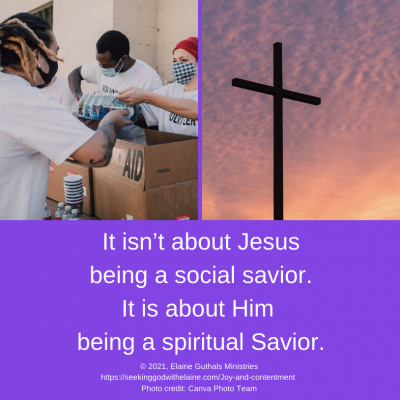
    Being a disciple is all about caring for others. It isn’t about Jesus being a social savior. It is about Him being a spiritual Savior.

    JesusSpiritualSavior

    When we do the work God has for us, He will abundantly supply our needs.

    Contentment in All Things

    “I don’t say this out of need, for I have learned to be content in whatever circumstances I find myself.” (Phil. 4: 11: CSB)

    Paul’s joy was not found in worldly circumstances, so he could be content in all circumstances.

    Paul also didn’t want to let the Philippians think that he had been sorely lacking their support when they took the break. He was content with whatever situation in which God put him.

    When Saul became Paul, he may know have had this contentment. Elsewhere, Paul told us he was covetous. Covetousness is an inordinate greed for wealth and possessions.

    Paul said this was something he learned. “… I have learned to be content in whatever circumstances I find myself.” (Phil. 4: 11: CSB).

    Where did Paul learn it? Cooper wrote, “Paul learned it at the feet of Jesus, in the school of Christian experience, where we may learn it too.

    Resource

    Think about it. Paul had been in some pretty rough circumstances. Second Corinthians 11: 24-27 gives a good rundown of everything Paul faced.

    Watkinson said that this did not mean that we should expect to be homeless or hungry for being a disciple of Christ’s. It didn’t mean we shouldn’t work to improve our situation.

    Resource

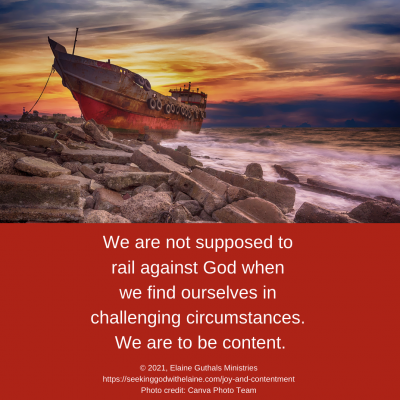
    It meant we are not supposed to rail against God when we find ourselves in challenging circumstances. We are to be content.

    DontRailAgainstGod

    Beecher explained it this way. He wrote, “He had learned to be content because he carried about with him that which made any circumstances blessed.”

    Resource

    We shouldn’t let the challenging circumstances of our lives steal the joy. If we don’t have the joy, our salvation is suspect.

    To read a related devotion, click the button below.

    Look what else Paul said. “… in whatever circumstances I find myself.” (Phil. 4: 11: CSB).

    Beecher said that what Paul was really saying was in all circumstances. He was content even if he bounced back and forth between the two extremes of good and bad circumstances.

    Paul could do that because he was focused on God and His plan for his life. He was also focused on the prize of the next life.

    It is easier to focus on God because, being a disciple, we don’t have some of the worldly pulls that make us lose our contentment. Cooper gave us a list.

    • Pride
    • Self-centeredness
    • Covetousness

    We know that God is the God of the impossible (Mt. 19: 26). Being content, Spencer said, doesn’t hold that up as our goal.

    Resource

    On the other hand, we aren’t to be anxious about our lives. Paul had just told the Philippians “Do not be anxious about anything …” (Phil. 4: 6 NIV). Instead, we are to cast “… all your cares on him …” (I Pet. 5: 7 CSB).

    Neither are we to feel ambivalent about things. If we are, we won’t feel the desire to witness to help people escape the sin of this world.

    Spencer said that Paul addressed his trials with the attitude “Thy will be done.” When we do that, we show that our hope is in God.

    Related Links

    Hillary Scott

    Barrow said that our contentment shows that God is in control. We know everything is happening because He allows it.

    Anderson made a great comment. He said that we aren’t  supposed to be content with our spiritual condition. This contentment should be with our worldly portion.

    Resource

    There is always room for improvement in our relationship with God. We always sin — yes, even disciples (I Jn. 1: 8).

    Adapting to Circumstances

    “I know how to make do with little, and I know how to make do with a lot. In any and all circumstances I have learned the secret of being content — whether well fed or hungry, whether in abundance or in need” (Phil. 4: 12 CSB)

    Adapting to circumstances knowing God is in control brings contentment.

    Lyth read this as we should expect changes on our lives. I get that. We are on a transformation on the Sanctification Road. He said we need to adapt as we are instructed by the Holy Spirit.

    Resource

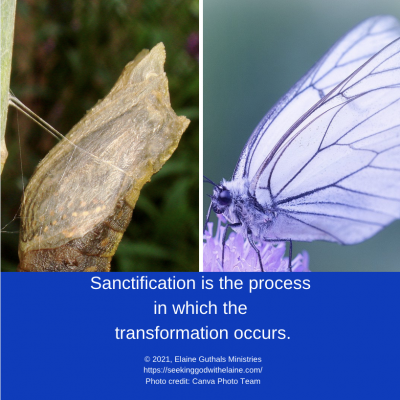
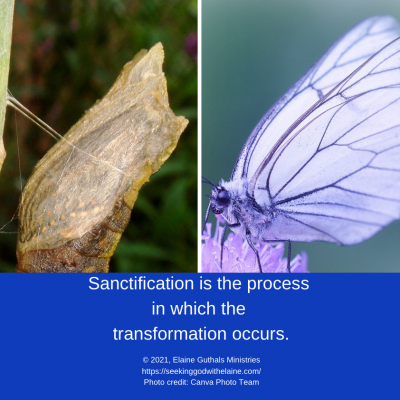
    Sanctification is the process in which the transformation occurs.

    Brooks said Paul had double knowledge. Think about it a second. Let’s apply this to money.

    Resource

    Paul knew how to be rich as well as how to be poor.

    Paul knew how to keep grounded when all this money started flying into his bank account. He didn’t get a big head. He didn’t turn snobbish to those he felt were beneath him. He didn’t expected the churches to be on a set schedule giving him donations.

    But Paul also knew how to keep grounded when he was poor. He knew how to work when the churches didn’t send him money. He knew how to stretch things. He knew how to do without.

    Paul was grounded in God.

    Once again, Paul said it was something he had to learn. He didn’t learn that in Pharisee school.

    Paul learned that as he lived II Corinthians 11: 24-27. We would call it the school of hard knocks.

    We also have the school of Christ. Remember Cooper talked about learning at the feet of Jesus?

    Cadman said we can learn to weather the changes in our lives. We learn humility — and usually have that lesson repeated several times. We learn how to focus on Heaven during this lifetime.

    Resource

    JoyAndContentmentPin

    Making the Connections

    A joy of faith is based on Christ. Much of our joy comes from our salvation. Our joy should mirror the quality of God’s.

    We choose to be content. We choose whether we will be satisfied or dissatisfied.

    When we allow the joy to show through, we have contentment.

    How Do We Apply This?

    • Live as closely as we can to God so that we have reason to be content.
    • Being focused on God has a learning curve.
    • Walk in the Spirit.
    • Know God has a plan for our lives, and He will work the plan.
    • Know God loves us. Know Jesus loves us.
    • Follow what Spencer said Paul’s game plan was: work, plan, and pray.
    • Not give voice to our displeasure with our lives.
    • Shout our pleasure with how God deals with our lives.
    • Meet our needs through ways of which God approves.
    • Not be content with our spiritual condition.

    To read a related devotion, click the button below.

    Resource

    Father God. We look to You for joy. When we actively seek Your joy, we will find contentment. Help us to focus on You. Amen.

    The ABCDs of Salvation

    If you have not become a believer in Christ, please read through the
    Plan of Salvation and prayerfully consider what God is asking you to do.

    A – admit our sins
    B – believe His Son Jesus is our Redeemer
    C – confess God as Sovereign Lord

    D – demonstrate that commitment by making any changes needed in our lives to
    live the way in which God has called us

    The Disciple’s Job Description

    What do you think?

    Leave me a comment below (about this or anything else) or head over to my Facebook group for some interactive discussion.

    If you don’t understand something and would like further clarification, please contact me.

    If you have not signed up for the email daily or weekly providing the link to the devotions and the newsletter, do so below.

    If God has used this devotion to speak with you, consider sharing it on social media.

  • Joy as a Fruit of the Spirit

    We all search for joy. This daily devotional looks at how true joy only comes from Jesus.

    Nuggets

    • A joy of faith is based on Christ.
    • Much of our joy comes from our salvation.
    • When our joy mirrors the quality of God’s,
    • He provides us many benefits.

    To read devotions in the Redo for Godliness series, click the appropriate button below.

    Devotions in the Fruit of the Spirit from the Inside Out series

    Many people today are searching for joy. They may call it happiness, but they are looking for the some pleasant feeling.

    We can only truly find it from God through Jesus and the Holy Spirit. Let’s look at what Paul tells us in Galatians about it being a fruit of the Spirit.

    Let’s Put It into Context

    “But the fruit of the Spirit is love, joy, peace, patience, kindness, goodness, faithfulness, gentleness, and self-control. The law is not against such things” (Gal. 5: 22-23 CSB)

    Here is a running list of what we’ve discussed previously.

    What Is Joy?

    “Though you have not seen him, you love him; and even though you do not see him now, you believe in him and are filled with an inexpressible and glorious joy” (I Pet. 1: 8 NIV).

    A joy of faith is based on Christ.

    Joy is about as hard to define as love. Manning wrote, “… joy, which means the thanksgiving and the consciousness of God’s infinite goodness, in which we live and mote …” He noted that it is given to us by the Holy Spirit.

    Resource

    When we put together people’s attempts at defining it, we get that joy, given to us by the Holy Spirit, is an outward expression of an inward feeling of thanksgiving and the consciousness of God’s infinite goodness that enlivens and comforts us.

    Murray thought some people might not identify joy as being a fruit of the Spirit. He explained that, too many times, we can simply focus on His job in salvation and sanctification.

    • Salvation is the gift of life through the deliverance from condemnation and sin to acceptance and holiness and changes us from being spiritually dead to spiritually alive.
    • Sins are actions by humans that disobey God and break one of His reasonable, holy, and righteous laws and commandments, goes against a purpose He has for us, or follows Satan’s promptings.
    • Holiness is the transcendent excellence of His nature that includes elements of purity, dedication, and commitment that lead to being set apart. Purity means possessing God’s moral character, having eliminated the stain of sin.
    • Spiritual death is the spiritual separation from God that occurred as a consequence of Adam and Eve’s original sin. The spiritually alive are those who have ABCDed, so they are no longer separated from God.
    • Sanctification is the transformation of mind, body, and soul, which begins with regeneration, gradually changes our nature and morals through the promptings of the Holy Spirit, and ends with perfected state of spiritual wholeness or completeness.
    • Regeneration is being changed from spiritually dead to spiritually alive and the internal requickening in us that God brings about through the work of the Holy Spirit to give us new character.
    • The perfected state indicates the combination of the spiritual graces which, when all are present, form spiritual wholeness or completeness.
    • Spiritual graces are worldly morals that have been submitted to God to further His kingdom instead of enhancing this world.

    The ABCDs of Salvation

    If you have not become a believer in Christ, please read through the
    Plan of Salvation and prayerfully consider what God is asking you to do.

    A – admit our sins
    B – believe His Son Jesus is our Redeemer
    C – confess God as Sovereign Lord

    D – demonstrate that commitment by making any changes needed in our lives to
    live the way in which God has called us

    The Disciple’s Job Description

    Glossary

    Murray also believed that we could see the Holy Spirit as a nomad, coming and going as necessary. It is believed that He usually comes when we need punishment or brought back into obedience.

    Wrong. Joy is listed as a fruit of the Spirit. Murray wrote that means “that the work of the Spirit is to make a person happy — actually and positively light-hearted: — that His aim is to add to the laughter of the world, to its pleasures and its enjoyments, has never occurred to these people as among the possibilities.”

    Resource

    Oh, yeah. God is expecting us to keep His laws and commandments and not compromise with the worldview.

    But God does not see that to be a chore. He wants that to be who we are.

    The laws and commandments show us God’s character. If we are to imitate Him — and we are — that means we are to have His character by keeping His laws and commandments.

    We are to obey joyfully. We aren’t to have the attitude that God is forcing us into obedience. God isn’t a dictator.

    Instead, God allows us our free will so that we can decide ourselves to submit and obey Him. Free will is the ability within us to make decisions, which determine actions that produce character.

    It is our choice, a choice we should joyfully make.

    We know that joy comes from God. “I have told you these things so that my joy may be in you and your joy may be complete” (Jn. 15: 11 CSB).

    Inside Out Joy

    “But I have trusted in your steadfast love; my heart shall rejoice in your salvation” (Ps. 13: 5 ESV)

    Much of our joy comes from our salvation.

    Let’s go back to salvation for a second. Well, yes, we are forgiven of our sins. We enter the Sanctification Road, which ends in perfection and Heaven.

    Those are just some of the blessings we receive. Psalm 16: 11 says, “You make known to me the path of life; you will fill me with joy in your presence, with eternal pleasures at your right hand” (NIV).

    It isn’t just about our eternal life — even though that is pretty important. That is about our spiritual condition.

    It is also about this life. God is with us every step of the way. That is really important as we navigate this life!

    Thornton talked about claiming God. It is only through the Holy Spirit that we can claim Him.

    Resource

    We become sons and daughters of Sovereign God. “But to all who did receive him, he gave them the right to be children of God, to those who believe in his name” (Jn. 1: 12 CSB).

    Glossary

    Did you catch that? Being a child of God is only a title given to those who have ABCDed. Not everyone is a child of God.

    That gives God the title of Father. “And because you are sons, God has sent the Spirit of his Son into our hearts, crying, ‘Abba! Father!’” (Gal. 4: 6 ESV).

    This all takes place within our hearts and minds. It starts inside.

    But it has to be shown through our actions. “You will go out in joy and be led forth in peace; the mountains and hills will burst into song before you, and all the trees of the field will clap their hands” (Isa. 55: 12 NIV).

    Qualities and Benefits of Joy

    “Nehemiah said, ‘Go and enjoy choice food and sweet drinks, and send some to those who have nothing prepared. This day is holy to our Lord. Do not grieve, for the joy of the LORD is your strength’ (Neh. 8: 10 NIV)

    When our joy mirrors the quality of God’s, He provides us many benefits.

    Thornton gave us the qualities that joy possesses.

    •  “… sincere and refined.”
    • “… refreshing and invigorating.”
    • “… solid and lasting.”

    Resource

    Newbolt added the quality of hopefulness to the list. Hope is the expectation, also called a living hope, based on the confidence that, because of our relationship with God, our names will be found in the book of life.

    Resource

    The joy has to shine through us. Newbolt called it brightness. Either way, God has to be evident in our lives.

    To read a related devotion, click the button below.

    Newbolt also tied the joy to being sober. The even-keeled environment that we live in fosters joy.

    When we compare God’s joy with worldly joy, we see the worldly joy is temporary. Thornton called it illusive.

    Watson said something interesting. He said, “Spiritual joys help to make us better, worldly joys do often make us worse …”

    Resource

    Hmmm. I bet worldview people would take exception to that.

    But I can see it. Worldly joy can be based on circumstances. Circumstances do not always happen as we think they should.

    The joy that the Holy Spirit gives us brings us comfort, even in the trials. We know how the story ends — maybe not our individual story, but the overall story.

    God’s joy does refresh and invigorate us. “Truly I tell you, you will weep and mourn, but the world will rejoice. You will become sorrowful, but your sorrow will turn to joy” (Jn. 16: 20 CSB).

    We know the joy will be lasting. It is God’s character, and God is eternal. That isn’t going to change.

    This takes it back to, if we are children of a joyful God, why do we think we need to be sourpusses?

    God gives us strength through His joy. He gives us support through all our trials.

    Related Links

    Rend Collective

    JoyAsAFruitOfTheSpiritPin

    Making the Connections

    Have you ever wondered why God created us, knowing that we would sin? He created us for His joy.

    Murray wrote, “that the aim and object of all God’s creation is for His own happiness, through the happiness of the creatures He has made. And this makes His own happiness self-receiving indeed, but most royally unselfish. For he who labours for self only in labours for others, treads that broad mosaic of right-doing, or righteousness, whose pavement is finer than if inlaid with stars; and which stretches in beauty through the eternity of things as to their extent, and the eternity of time as to its duration.”

    Resource

    Watson said joy, like God, is self-existent. We know that is an attribute of God.

    To read a related devotion, click the button below.

    How Do We Apply This?

    • Daily, have a mindset of joy, Thornton said to both God and mankind.
    • Joyfully perform the tasks that God calls us to do.
    • Frequently renew our resolve to follow Him.
    • Shine, so that non-believers will want what we have.
    • Find our joy within, not out in the world.
    • Look at our relationship with God through the lens of joy, not obligation.
    • Diligently guard our hearts to remain completely in God’s grace.
    • Don’t let sin steal our joy.
    • Don’t grieve the Holy Spirit.

    Resource

    Father God. You are an awesome God that gives us Your joy. Help us to have that joy flow through us so others can see You. Amen.

    What do you think?

    Leave me a comment below (about this or anything else) or head over to my Facebook group for some interactive discussion.

    If you don’t understand something and would like further clarification, please contact me.

    If you have not signed up for the email daily or weekly providing the link to the devotions and the newsletter, do so below.

    If God has used this devotion to speak with you, consider sharing it on social media.

  • Love as a Fruit of the Spirit

    Fruits of the Spirit show the healthiness of our relationship with God. This daily devotional looks at how that relationship must be built on love.

    Nuggets

    • The fruits of the Spirit help us sanctify our character.
    • Since God is love (I Jn, 4: 8) and the Holy Spirit is also love, love should be a distinguishing characteristic to show we are children of God.

    To read devotions in the Redo for Godliness series, click the appropriate button below.

    Devotions in the Fruit of the Spirit from the Inside Out series

    The fruits of the Spirit, sometimes, may seem like a mystery. Oh, we all know about the emotions of them.

    But the fruit part may throw us some. We know more about sins of the flesh.

    The fruits of the Spirit, not so much. That is because, as Bayley said, “… the life of God in the soul is a hidden life: still it is a real life, producing genuine fruit; cherish therefore and cultivate it.”

    Resource

    Let’s see what God will reveal to us about the hidden life.

    Let’s Put It into Context

    “But the fruit of the Spirit is love, joy, peace, patience, kindness, goodness, faithfulness, gentleness, and self-control. The law is not against such things” (Gal. 5: 22-23 CSB)

    Here is a running list of what we’ve discussed previously.

    Fruit of the Spirit

    “But the fruit of the Spirit …” (Gal. 5: 22 CSB)

    The fruits of the Spirit help us sanctify our character.

    I never thought of this as being anything but an exhaustive list. Bayley said it isn’t.

    I don’t know why I thought that. I guess maybe because it hits the biggies.

    Manning agreed. He noted the first two — love and joy — defined our relationship to God. The rest — peace, patience, kindness, goodness, faithfulness, gentleness, and self-control — defined our relationship with others. I think I would put peace on the God list as it is an inside job from Him.

    Resource

    Washburn said the faith, gentleness, and self-control are more our conduct. I see that. The list reflects the two greatest commandments and what we are going to do about them.

    Resource

    Glossary

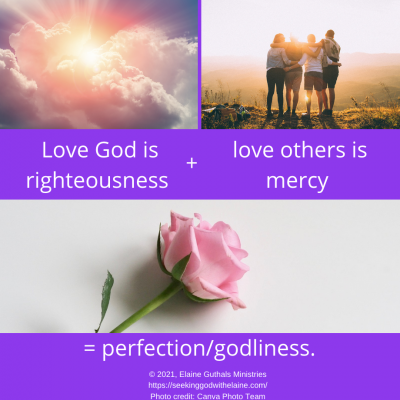
    Love God is righteousness + Love people is mercy = perfection/godliness

    Bayley also said that it can be classified different ways.

    • State of the Christian mind
    • State of our interaction with others
    • Principles to live by

    But what makes it a list? How and why do they go together? Bayley told us that, too.

    • They come from God.
    • They all fall under God’s law.
    • Children of God must possess them all.

    Whoa! Wait!

    We are human. How are we really going to do that?

    Bayley basically said we have to. He wrote, “Grace in the soul is the reflection of Christ’s glory (2 Corinthians 3:19); but that can be no true reflection which lacks any leading features of the moral glory of the Saviour.”

    Resource

    They should be part of our character. They promote the unity Paul kept telling us we should have.

    That being said, fruits of the spirit will present themselves differently in different people. It was written in the American Homeletic Review that “grace works on very different natures, and is subject to an endless variety of conditions and modifying influences; so that while the great change has been wrought, the seeds of the new life have taken root in the heart, the form and degree of development will greatly vary in different persons, and different conditions and surroundings. In one, faith predominates, in another, love, in another, charity, etc.”

    Resource

    Beecher, however, took a different track. He described producing fruit as our goal. If we have a peach tree that doesn’t produce peaches, we aren’t going to get a pie.

    No, Beecher didn’t say it that way. He said that fruit show the highest level of development — the perfect level.

    Resource

    That says to me that we will be working on the fruits of the Spirit all along the Sanctification Road. But we won’t reach perfection until Heaven.

    Manning made an interesting observation. He talked about the lack of things before Jesus came. There were no hospitals or orphanages. There were no Save Them from This Disease organizations.

    There was no organized charity at all.

    Resource

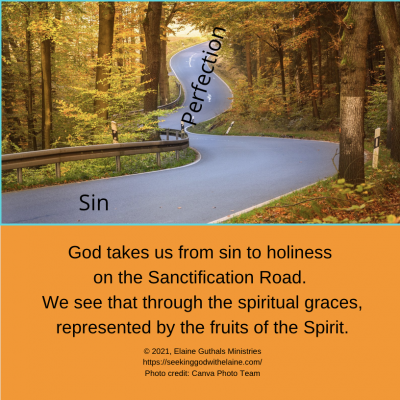
    God takes us from sin to holiness on the Sanctification Road. We see that through the spiritual graces, represented by the fruits of the Spirit.

    Okay. I have to work through what Washburn is saying.

    • God takes us from sin to holiness on the Sanctification Road. We see that through the spiritual graces, represented by the fruits of the Spirit. That is how the hidden life of God in our souls is shown.
    • That is shown through how our character changes.
    • Having a peace of conscience come over us or a feeling of forgiveness at conversion isn’t enough to identify salvation. We are really good at seeing what we expect to see. It isn’t just about feeling it.
    • Others have to see the permanent change in us.
    • Our character has to match His; when we do, we will know Him.
    • We get the character change down to the heart level.

    Resource

    Inside Out Love

    “But the fruit of the Spirit is love …” (Gal. 5: 22 CSB)

    Since God is love (I Jn, 4: 8) and the Holy Spirit is also love, love should be a distinguishing characteristic to show we are children of God.

    Manning wrote “Love is that which unites us with God …” I would take that further and say love is the only thing that unites us with God.

    Resource

    Thornton’s description of love is wonderful. He wrote, “It is by the eyes of the understanding being enlightened to see the perfections of God, the excellencies of Christ, and the unspeakable value of eternal realities, that Divine love is kindled in the soul.”

    Resource

    Love has a component of obedience to God in it. If we don’t love God, we won’t seek Him. We won’t follow His laws and commandments.

    How is love an inside to the outside emotion. Bertram helped us out there. We have to get it to heart level in order to

    • Eliminate fear and anxiety.
    • Cut out sin because is opposite to what God is.
    • Leads us toward holiness.
    • Makes obedience less challenging.
    • Helps us to be living sacrifices.
    • Makes our souls more pleasing to God.

    Resource

    We’ve said that sanctification is a process. Murray contended that love as a fruit of the Spirit isn’t. It is what we reach at the end of many processes.

    Sanctification is the process in which the transformation occurs.

    So, let’s break down what Murray said.

    • Love doesn’t happen by accident.
    • Even though human nature is sinful, it is forceful.
    • The actions of the Holy Spirit are not solely a result of our actions.
    • Punishment can be instantaneous, where our growth takes our lifetime.
    • The Holy Spirit uses our abilities to grow us.

    Murray reminded us that we cannot think of God only as up in Heaven. We have to remember He is inside us, too.

    I was agreeing with Murray until he got to talking about power. He wrote “But, friends, he who exalteth his own power exalteth God; for is not God the maker of his power?”

    Resource

    I think I see what Murray is trying to get at. When we use our talents and strength, we are glorifying God because He made us to be able to do what we do.

    I am just tripping over “… he who exalteth his own power exalteth God …” But we only exalt Him when we do what He has called us to do His way.

    Plus, we don’t want to get big heads. We can’t think we are doing it on our own. We are nothing without God.

    To me that strikes too close to what Paul warned us about. “What should we say then? Should we continue in sin so that grace may multiply? Absolutely not! How can we who died to sin still live in it?” (Rom 6: 1-2 CSB).

    We can’t do something self-focused and think that will glorify God. That isn’t loving God.

    We can’t do something self-focused and think that will glorify God. That isn’t loving God.

    What the Holy Spirit is trying to do is to get us back to where Adam and Eve were before the original sin. Murray wrote, “The work of the Spirit is to bring back and reinstate in its original regnancy the Divine characteristic of loving.”

    Resource

    God wants us back to the level of love we had. Emmons contended that happened in regeneration.

    • Regeneration is being changed from spiritually dead to spiritually alive and the internal requickening in us that God brings about through the work of the Holy Spirit to give us new character.
    • Spiritual death is the separation from God that occurred as a consequence of Adam and Eve’s original sin. The spiritually alive are those who have ABCDed, so they are no longer separated from God.

    Glossary

    Emmons argued that Paul did not identify love as a new love. Remember, he keeps saying that we are new creations. We are changed at regeneration from our old self to our new self.

    Glossary

    There is no previous foundation on which to build this love. Emmons argued that love is the foundation, not regeneration.

    I can see that. Regeneration is the process God does to change us from spiritually dead to spiritually alive.

    Regeneration can’t happen if the love isn’t there.

    Regeneration can’t happen if the love isn’t there.

    I’ve got to process what Emmons said. He wrote, “If the Spirit of God produces nothing but love in regeneration, then there is no ground for the distinction which is often made between regeneration, conversion, and sanctification. They are, in nature and kind, precisely the same fruits of the Spirit.”

    Resource

    I can get the question about how are all these terms different. That is one reason I turned into Dictionary Chick. I needed to make the distinction among everything.

    If we look at it a certain way, I can see no difference between regeneration and sanctification. If we think regeneration is one of the three-level words, they are similar.

    We were regenerated and switched from spiritually dead to spiritually alive at conversion. That makes conversion and regeneration the same.

    If we think we are in the process of being regenerated as we live our lives, that is sanctification. Sanctification is the process by which we are regenerated.

    Regeneration/sanctification is not going to be complete until we are perfected when we reach Heaven.

    I guess, I look at conversion as the decision we make to ask Jesus to be our Savior and Redeemer and God to be Sovereign Lord of our lives. Regeneration is the result of that decision.

    Regeneration is what happens to change us to have God’s character. Sanctification is the process to do that.

    Worldview people can believe that their definition of love is God’s definition. They believe in what Thornton called a love of benevolence. In Elaine-speak, that is loving the sinner even if we don’t love the sin.

    If worldview people left it there, that would be what God wants. However, worldview people want their sin to be loved, too — or at least tolerated.

    God wants us to have a love of compliance. That means we love God and Who He is. It also means we love what looks like Him.

    Resource

    If we don’t love God, our service won’t be acceptable. Nothing we do can earn us His salvation and love.

    Nothing we do can earn us His salvation and love.

    Connecting Love to the Other Fruits

    If we don’t have the faith, the love is a secular love. That makes it useless in applying it to eternity.

    Faith is the only way to salvation. Love is not going to cover a lack of faith.

    Don’t believe me? Murray wrote this, “By faith we perceive the loveliness of this principle; by faith we are made appreciative of it and are filled with longing that we may overflow with it; by faith we are thus quickened into this new life of concord and amiability and good-will toward men, and hearty affection toward God.”

    We are quickened into the new life.

    Regeneration is being changed from spiritually dead to spiritually alive and the internal requickening in us that God brings about through the work of the Holy Spirit to give us new character.

    This quickening comes through regeneration. Regeneration comes through conversion.

    Resource

    And it all starts with love.

    love-as-a-fruit-of-the-spiritPin

    Making the Connections

    We cannot discount the influence of the Holy Spirit on our minds. We won’t be able to understand God’s love until the Holy Spirit stirs our desire to know Him.

    We are going to need help to subdue our sinful nature. We will only do that through God’s love.

    How Do We Apply This?

    • Walk with the Spirit.
    • Pray for grace.
    • Seek God to transform our character to His.

    Resource

    Searching for and Seeking God

    Hearing His Word (Rom. 10: 17).
    Reading His Word (Rev. 1: 3).
    Praying to Him (Heb. 4: 16).
    Studying His Word (Ac. 17: 11).
    Meditating on His Word (Ps. 1: 1-2).
    Memorizing His Word (Ps. 119: 11).

    To read a related devotion, click the button below.

    Father God. Love is the foundation of our salvation because You are love. Help us to grow to love You more each passing day. May we have Your character of love so that we love You and others. Amen.

    What do you think?

    Leave me a comment below (about this or anything else) or head over to my Facebook group for some interactive discussion.

    If you don’t understand something and would like further clarification, please contact me.

    If you have not signed up for the email daily or weekly providing the link to the devotions and the newsletter, do so below.

    If God has used this devotion to speak with you, consider sharing it on social media.

  • The Foundation for the Fruits of the Spirit

    Jesus said that we will be known by the fruits of the Spirit. This daily devotional looks at outward fruit and bearing the right fruit at the right time.

    Nuggets

    • The fruits of righteousness are rewards for following God’s Will.
    • Our words and works should honor God.
    • Our fruit should expand the kingdom of God.
    • We should seize every opportunity to witness to others.
    • Since the command is to bear fruit, there are consequences when we do not bear fruit.

    To read devotions in the Redo for Godliness series, click the appropriate button below.

    Devotions in the Fruit of the Spirit series

    When I decided to do a redo for godliness this year, I started throwing sermons into a folder so I could come back and write on them. I don’t feel like I have gotten through many of them.

    One thing I really wanted to do is a series on the fruits of the Spirit. I found an interesting sermon back in October 2020 that should give us a good foundation for the rest of the devotions.

    Watson’s sermon will give us a good base of what a fruit actually is. Let’s take a look.

    Let’s Put It into Context

    Watson wrote that the fruit of the Spirit comes from the Tree of Righteousness. Righteousness is the indwelling goodness that is the result of a solid relationship with God built by a sincere life of conscientious obedience to God’s laws and commandments and from which all virtues flow.

    Resource

    Fruit of Righteousness

    “Filled with the fruit of righteousness that comes through Jesus Christ, to the glory and praise of God” (Phil. 1: 11 ESV)

    The fruits of righteousness are rewards for following God’s Will.

    We just looked at fruits of righteousness in the Joy of Relationships devotion.

    To read a related devotion, click the button below.

    The fruits of righteousness are the rewards given at perfection for doing God’s Will and growing closer to Him. The rewards are eternal life, peace, access to Him, and hope.

    Glossary

    Yes, they are given at perfection. No, we don’t have to wait until we get to Heaven to get smaller versions of this. We can have this now.

    When we talk about fruit, we also talk about the products of correctly discerning God’s voice. It is the rewards of discernment. “And the fruit of righteousness is sown in peace by those who cultivate peace” (Jas. 3: 18 CSB)

    When we discern the wisdom of God, it produces fruits of righteousness. It is the fruit that is grown as we grow closer to God.

    That is the whole point of being able to discern God’s voice. We want to be able to use what He tells us to strengthen our relationship with Him, to help us imitate Him better.

    “He is like a tree planted by streams of water that yields its fruit in its season, and its leaf does not wither. In all that he does, he prospers” (Ps. 1: 3 ESV)

    The sermon entitled The Way of the Righteous by the Monday Club Sermons talked about having different classes of good and evil. It is more our motivation rather than a hierarchy of righteousness and sin. They wrote, “It is needful to discriminate with respect to the kind of delight the righteous man takes in the law.”

    Resource

    The tree takes most of its nourishments in through the roots. The Monday Club Sermons equated the roots to the inward us. We prosper when we follow God’s Will, which He shows us when we meditate in seeking for Him.

    That is logical. God wants us to get it to the heart level. That is where He is always going to meet us. He is going to abundantly provide.

    It produces an inward fruit. Hmmm. What?

    I thought the fruits were what we see. They are the visual representation of God in us.

    Okay. Let’s look at it this way. One of the ladies in my church gave me this huge poinsettia plant.

    It had been outside at her house, but at this time of the year it needs a lot of darkness. At my house, that means to the basement it goes.

    So, we are not only going through separation anxiety of Pointy being thrust into a new environment, but we are also probably messing up her routine.

    The stress on the plant has withered a couple of leaves.

    Is the plant dead or dying? No.

    What we see isn’t a complete indication of what is happening on the inside. The love, joy, peace, long suffering, gentleness, goodness, faith, meekness, and temperance have to come from the inside out.

    What if we were loving someone against our will? What if we were only doing it for show? What we see may not be a clear indication of the condition of the heart.

    I know. Jesus said, “You will recognize them by their fruits” (Mt. 7: 16 ESV). What I am saying is the outward walk without the inward faith means nothing.

    Screen Shot 2021-05-13 at 9.37.42 PM

    That makes sense, doesn’t it? If we don’t have the faith behind the love, it is just a worldview love. We aren’t loving in God’s name.

    (And yes, I named my plant.)

    Outward Fruit

    “Let your speech always be gracious, seasoned with salt, so that you may know how you ought to answer each person” (Col 4: 6 ESV)

    Our words and works should honor God.

    What we are going to talk about in the succeeding devotions is the inward fruit that people see: love, joy, peace, long suffering, gentleness, goodness, faith, meekness, and temperance.

    Watson said the outward fruit is good discourse and good works.

    Good Discourse

    Our words should reflect the righteousness that God has placed within us. “Our words ought to proceed from some grace of God in the heart, as from knowledge, faith, joy, love, sorrow, fear, etc., and in this sense, when on the tongue, they carry the name of the fountain whence they flow.

    Resource

    Hmmm. Several of the fruits were listed in that.

    We are to use our words to build up each other. I keep thinking of Hawk Nelson’s song.

    Related Links

    Hawk Nelson

    Good Works

    Airay felt the good works were what we do that came from our being righteous as God is. We glorify God by the good works performed through His righteousness in us.

    Resource

    To read a related devotion, click the button below.

    We know God calls us to do good works. Good works means that we give God our best to complete whatever tasks He assigns for us to do. “For we are his workmanship, created in Christ Jesus for good works, which God prepared ahead of time for us to do” (Eph. 2: 10 CSB).

    Verse Commentary

    It is through performing those works that we learn Who God is. So many times, we learn by doing. When we do those works, we are exhibiting His character.

    Kindly Fruit

    “A good tree cannot bring forth evil fruit, neither can a corrupt tree bring forth good fruit” (Mt. 7: 18 KJV)

    Our fruit should expand the kingdom of God.

    Most of the other versions translated this as good and bad fruit. I went with the King James Version as I use that as the standard. They were the only one that translated it good and evil.

    To me, there is a distinct difference.

    • Good, in the biblical sense, is the workings of God within His people.
    • Evil is equated with sin because it is that which goes against God and His purposes.

    Watson said that we have to bear the fruit that is meant for us to bear. I read this as God has given each of us tasks to perform. We have to do the work.

    That work means bringing people to Jesus. We’ve got to do our part.

    Pastor Joey asked a very good question. He said, “Are we endeavoring to bring people to Christ or just playing church?”

    Resource

    Think about it. Why are you going to church? Is it just to get fed — spiritually, not physically?

    Bringing people to Christ isn’t a play to up the numbers in our congregation. This is keeping people out of hell.

    Bringing people to Christ isn’t a play to up the numbers in our congregation. This is keeping people out of hell.

    The fruit we produce has to be suitable and proper. Do you know a Dr. Jekyll and Mr. Hyde disciple? The person is one way when inside the church doors, but the opposite outside of them? We have to be a child of God wherever we are.

    God has given us specific gifts to be used for specific tasks that He has given us. If I tried to run the Hospitality Committee, that wouldn’t end well. My gift is singing. I have to use my gift properly.

    Seasonable Fruit

    “So then, as we have opportunity, let us do good to everyone, and especially to those who are of the household of faith” (Gal. 6: 10 ESV)

    We should seize every opportunity to witness to others.

    Solomon said in Ecclesiastes, “For everything there is a season, and a time for every matter under heaven” (Ecc. 3: 1 ESV). We know everything happens in the fullness of God’s time.

    I love Martin’s definition of opportunity. He wrote, “‘Opportunity’ is that season in which we can minister to the benefit of others.”

    Resource

    We may only have the opportunity to witness to someone for a short time. Maybe we’ve just met them at the health club — but then their spouse gets transferred out of state, so they are gone.

    We may see an opening in a conversation to bring up how God is working in our lives. We don’t take it because we don’t feel comfortable sharing about ourselves. Then the person is killed in an auto accident.

    Fruit is fine hanging on a tree. We aren’t going to get a pie if it stays there.

    Being a disciple is great for us. Our faith doesn’t help others if we don’t share it.

    Why Is It Important?

    “Every branch in me that does not bear fruit he takes away, and every branch that does bear fruit he prunes, that it may bear more fruit” (Jn. 15: 2 ESV)

    Since the command is to bear fruit, there are consequences when we do not bear fruit.

    God expects us to expand His kingdom. Every one of us — not just the Pastor Joey-types.

    Watson wrote, “The righteousness of faith is always accompanied with the fruits of righteousness.” He also said we should never think that we have enough.

    Resource

    Read that verse one more time. “Every branch in me that does not bear fruit he takes away, and every branch that does bear fruit he prunes, that it may bear more fruit” (Jn. 15: 2 ESV).

    Every branch in me. Every branch in Christ.

    Who are in Christ? Children of God. Disciples. We are.

    Glossary

    Jesus will cut off and throw away those who do not bear fruit.

    the-foundation-for-the-fruits-of-the-spiritPin

    Making the Connections

    God wants to reward us. He wants us to be fruitful.

    God is exacting about what He requires of us.

    How Do We Apply This?

    • Make sure we are bearing fruit.
    • Cut out all of the things that are obstructing us from bearing bruit.
    • Abhor evil.
    • Hold onto God’s promises.
    • Be humble.
    • Join a witnessing program at our church.
    • Bury ourselves in the Word of God.

    Resource

    Father God. We praise You for Your love for us. We want to serve You in every opportunity that You give to us. Help us to live in Your Will. Amen.

    What do you think?

    Leave me a comment below (about this or anything else) or head over to my Facebook group for some interactive discussion.

    If you don’t understand something and would like further clarification, please contact me.

    If you have not signed up for the email daily or weekly providing the link to the devotions and the newsletter, do so below.

    If God has used this devotion to speak with you, consider sharing it on social media.

  • Joy of Moral Excellence

    When we talk of moral excellence, we are talking of God’s character. This daily devotional looks at the joy we receive in imitating His character.

    Nuggets

    • We find joy in having the character of God.
    • God knew we needed role models, so He provided Jesus and Paul.

    Devotions in the Joy in the Gospel series

    Disciples of Christ are called to navigate the Sanctification Road so that their character changes to be that of God’s. Paul talked to the Philippians about this.

    Let’s Put It into Context

    Here is a running list of what we’ve discussed previously.

    Moralities in the Gospel

    “Finally brothers and sisters, whatever is true, whatever is honorable, whatever is just, whatever is pure, whatever is lovely, whatever is commendable — if there is any moral excellence and if there is anything praiseworthy — dwell on these things” (Phil. 4: 8 CSB)

    We find joy in having the character of God.

    We used this verse earlier this year as the basis of our moralities. By the end of the series, we decided that we have to kick the earthly morals up to spiritual graces. Later, we added that is what leads to holiness.

    If our morals don't come through submission to God, they are just worldly morals, not spiritual graces. But then we have to grow the spiritual graces to holiness.

    To read a devotion in the Moralities Lead to Godliness series, click on the button below.

    Verse Commentary

    This is a great verse. It reminds us of the different elements that make up our character.

    • We have to have God’s truth in us.
    • We have to be people of integrity.
    • We can’t still be slaves of sin.
    • Our behavior has to be praiseworthy.

    Our gaining spiritual perfection comes down to moral excellence. Our character has to be right — it has to be like God’s character.

    GodsCharacter

    Oh, yeah. That is going to be a battle to change us to imitate God.

    Not only are we fighting our own sinful nature, but we are also fighting Satan.

    Well, God is fighting for us.

    But that doesn’t mean we don’t have to put on the armor. We still do.

    To read devotions in the Armor of God series, click the appropriate button below.

    Satan isn’t going to let us sit on the sidelines. He is going to try to get us in the thick of battle whenever he can.

    God doesn’t want to in the thick of the battle, but He wants us to be doing more than just sitting on the sidelines. He wants us cheering Him on through our prayers.

    Paul had spent the last chapter or so showing us how we couldn’t rely on what we consider our good works. Now, he is showing us that we must live godly lives.

    Pope said that God wants us to think about perfection. But it goes beyond just thinking about it.

    We have to strongly appreciate and rightly determine, as Pope said, “… the place morality holds in the gospel.”

    Resource

    Hmmm. I wonder if worldview people would read that as the place morality holds and stop there. That would be another way for them to cut God out of the equation.

    We just talked about God hears our prayers when we are living godly lives. Pope contended that was also how we received all of God’s grace.

    We just used this verse when we were discussing how we could have good thoughts. Paul believed whole heartedly that we can train our minds to change from focusing on sinful thoughts to focusing on God.

    To read a related devotion, click the button below.

    Paul called the thought process renewing our minds. We can’t gain perfection unless we think about gaining it.

    The Disciple’s Job Description

    Complete Job Description

    Individual Description

    Job Duty #1
    Be a Living Sacrifice (Romans 12: 1-2)

    Thinking about it is meditating on it. It isn’t going to just happen to us.

    We must pursue sanctification. That makes it a conscious choice that we have to think about and make a decision.

    Renewing our minds brings with it a variety of obligations. It doesn’t end when the Spirit of God show us what God teaches. We have to apply that teaching to our lives.

    We can’t just think perfection is a goal with a single action plan. It is too complex to just say we are working on being perfect.

    We have to have God sanctify our thoughts, our speech, our feelings, our priorities … all the different elements that keep us from being perfect. Isn’t that a comforting thought? We’ll do it right when we make the right choices.

    What we don’t want to miss in this long sentence is the last part — “… dwell on these things” (Phil. 4: 8 CSB). We don’t get to pick and choose.

    No, Paul didn’t say dwell on all these things. He didn’t think he had to with the Philippians. They knew what he meant.

    Paul also recognized the enormity of what he was telling the Philippians to do. We could study God’s truth daily and just barely scratch the surface.

    Same with the pure. Same with the lovely. Same with the moral excellence.

    Paul knew he was giving them a lifetime assignment.

    When Pope wrote about “… intent contemplation of perfection …”, he was probably talking about our endurance “… which feeds the soul’s regenerate longing to attain it.”

    What flew around in my mind was intentionality. We have to choose to put in the work to go gain perfection. We have to choose to look at each separately as well as being a whole.

    We have to look at them as the means to gain holiness and righteousness. We can’t say, “Well, this is another one of God’s laws and commandments.

    No. This end goal is attainment of moral perfection.

    Let’s put it this way. We are to meditate on gaining spiritual perfection. We are to think about all the elements.

    But we can’t stop there. We have to put them into practice. We have to get them out of head knowledge and into heart knowledge.

    That is how we change our characters.

    Pope wanted to make one thing clear. Our obtaining perfection was not a gift from God, like grace and faith are. He said it more of a seal that rewards our efforts.

    That reminded me of the seal that Paul talks about in Ephesians.

    • “In him you also were sealed with the promised Holy Spirit when you heard the word of truth, the gospel of your salvation, and when you believed” (Eph. 1: 13 CSB).
    • “And don’t grieve God’s Holy Spirit. You were sealed by him for the day of redemption” (Eph. 4: 30 CSB).

    Glossary

    I read that as God gives us His stamp of approval when we are successfully navigating the Sanctification Road to gain His perfection.

    This is how we work out our salvation. We navigate the Sanctification Road to gain His perfection. We live our lives by these standards.

    But let’s look at it this way. Paul uses words like whatsoever and if anything. He wasn’t placing limits. Stewart said he wasn’t making distinctions among the elements. He saw them linked together.

    Resource

    Stewart made a great point. Our goal is not just to have an absence of evil. It is to have the presence of God.

    Our goal is not just to have an absence of evil. It is to have the presence of God.

    That is why just being a good person doesn’t cut it. We may not be a murderer, but do we love God? We may be members of all the Save the Kids, Save the Animals, Save the Planet organizations we can fit in, but are we doing that in God’s Name?

    The most important element is God.

    We don’t get salvation just so we have fire insurance. If our objective isn’t sanctification, we’ll still be introduced to the fire.

    • “Not everyone who says to me, ‘Lord, Lord,’ will enter the kingdom of heaven, but the one who does the will of my Father who is in heave” (Mt. 7: 21 ESV).
    • “Anyone whose name was not found written in the book of life was thrown into the lake of fire” (Rev. 20: 15 NIV).

    We must make sure our relationship is right with God.

    Joy of Imitating an Appropriate Role Model

    “Do what you have learned and received and heard from me, and seen in me, and the God of peace will be with you” (Phil. 4: 9 CSB)

    God knew we needed role models, so He provided Jesus and Paul.

    For some, God’s standards may be something new. They may not understand what is being asked of them.

    God knows some of us learn better by seeing than reading. We have to be shown how things play out in real life.

    Jesus not only came to earth to be the sacrifice for our sins, but He also came to show us how to live according to God’s Will. He showed us what God was expecting and what was acceptable.

    Paul was also a good role model. Lyth said from him we learned “… faith, zeal, self-consecration, [and] purity.”

    Resource

    Others can be good role models, too. We just have to pick them wisely.

    JoyOfMoralEscellencePin

    Making the Connections

    In verse eight, Paul gave a good snapshot of the character of God. Isn’t that great?

    This is a good start to knowing the character of God. He will reveal more of Himself to us as we seek to know Him better.

    How Do We Apply This?

    • Seek God to know His character
    • Exhibit the character of God in our lives.

    Searching for and Seeking God

    Hearing His Word (Rom. 10: 17).
    Reading His Word (Rev. 1: 3).
    Praying to Him (Heb. 4: 16).
    Studying His Word (Ac. 17: 11).
    Meditating on His Word (Ps. 1: 1-2).
    Memorizing His Word (Ps. 119: 11).

    It is imperative that we change to have God’s character. That is how we gain perfection.

    Father God. You are perfect. We want to be. Help up to gain Your character. Amen.

    What do you think?

    Leave me a comment below (about this or anything else) or head over to my Facebook group for some interactive discussion.

    If you don’t understand something and would like further clarification, please contact me.

    If you have not signed up for the email daily or weekly providing the link to the devotions and the newsletter, do so below.

    If God has used this devotion to speak with you, consider sharing it on social media.