Author: admin

  • Love Your Neighbor by Honoring Them

    We love our neighbors by respecting them. This daily devotional looks at how Paul instructed us to do that.

    Nuggets

    • Our love for our neighbors must be real.
    • Our love for our neighbors should be accepting but nurturing them as disciples.
    • Loving our neighbors means we live up to God’s standards.

    Devotions in How to Love Our Neighbors series

    We have to the opportunity to interact with others throughout the day. Some may have a personality similar to ours. Others may not.

    God calls us to honor others. What instructions did Paul give us to do that?

    Let’s Put It into Context #1

    Here is a running list of nuggets for the series.

    Let’s Put It into Context #2

    Honor means to esteem and respect another because of a good reputation.

    A Love That Is Real

    “Let love be genuine. Abhor what is evil; hold fast to what is good. Love one another with brotherly affection. Outdo one another in showing honor. Do not be slothful in zeal, be fervent in spirit, serve the Lord. Rejoice in hope, be patient in tribulation, be constant in prayer. Contribute to the needs of the saints and seek to show hospitality” (Rom. 12: 9-13 ESV)

    Our love for our neighbors must be real.

    If we consider honor as respect, it takes it more to our treatment of others rather than our feelings for them. But then we sometimes have another problem with that.

    There is this whole controversy as to whether respect is given or earned. I think I fall somewhere in the middle.

    When Adam was going through the public school system, I respected his teachers as having authority over him. They had the preparation needed to do the job.

    But when they were placing more triggers in his day rather than accommodations, this Helicopter Mom lost respect for them. Yes, they were still in a position of authority, but I did not blindly follow their recommendations.

    What about when someone moves in next door? How did Paul want us to interact with them?

    Paul instructed us to not be hypocrites. We are to actually love others, not just play that we do. We are to accept them.

    We are all the same. Regardless of our race and ethnicity, we are all children of Adam. We are one big family.

    Jesus accepts us as siblings when we ask forgiveness for our sins. He asks us to accept others the same way. “By this all people will know that you are my disciples, if you have love for one another” (Jn. 13: 35 ESV).

    Don’t take Jesus’ acceptance of us as license to continue to sin. Does He say, “Keep on doing what we are doing?” No, He says, “Go and sin no more” (Jn. 8: 11).

    That is what it means to hate evil.

    We are to love others like family. Our motivation for loving them must be to love them as Christ would.

    Paul told us that we need to enthusiastically serve others. We express our love by doing.

    That will require our diligence. And passion. And patience. And compassion. And humility.

    Need I go on?

    We aren’t going to have those unless we are focused on God. Our love has to come from God.

    That goes back to motivation. We have to be motivated by the desire to follow God’s Will to love others as they are to win them to God’s kingdom.

    To read a related devotion, click on the appropriate button below.

    A Love That Is Accepting

    “Bless those who persecute you; bless and do not curse them. Rejoice with those who rejoice, weep with those who weep. Live in harmony with one another. Do not be haughty, but associate with the lowly. Never be wise in your own sight” (Rom. 12: 14-16 ESV)

    Our love for our neighbors should be accepting but nurturing them as disciples.

    Disciples should deal with conflict in a way to honor God and each other.

    It is easy to let our emotions explode when conflict arises between neighbors. That isn’t how God want us to respond.

    Jesus told us that we would suffer from persecution. “Then they will hand you over to be persecuted, and they will kill you. You will be hated by all nations because of my name” (Mt. 24: 9 CSB).

    When we know people are really rejecting Jesus rather than us, that changes how we view the persecution. Our hearts break knowing the judgment they are scheduled to receive unless they accept Jesus as Savior and Redeemer.

    For being a connected society, in reality we really aren’t. We are connected on the surface.

    God wants us to truly connect. He wants us to not only be sympathetic for others, but He also wants us to involved in each others’ lives.

    We are to rejoice with others in their joy and encourage them in their hardships.

    We are to pray for each other. The best way to do that is to know some specifics as to what we are asking God to do.

    In order to do that, we have to know the person and the situation for whom we are praying. We have to truly connect.

    That goes back to what we said in the first devotion in this series. Love is all about meeting the needs of someone else.

    Yes, we meet the needs of this world that we can. But most of all, we meet their needs by introducing them to Jesus.

    God has instructions on how we are to interact with people. Loving our neighbors means that we do not feel that we are better than them.

    Many of us probably see where we fail to love others in certain ways. We may not feel sympathetic or empathetic. We may feel arrogance and superiority.

    The good news for us is this is where God will help us grow.

    Being haughty talks about our opinion of ourselves. Lyth said this presents itself several ways: in our opinions, our judgments, and our plans.

    Resource

    We love our neighbors by interacting with them in an accepting manner but as Jesus does. We can come to Him as we are. However, being a disciple of Jesus does not mean we can remain in our sins.

    We are to love others regardless whether they are disciples or not. However, we are not to condone their sinning ways. We are to lead them to Jesus.

    To read a related devotion, click the button below.

    A Love That Follows God

    “Repay no one evil for evil, but give thought to do what is honorable in the sight of all. If possible, so far as it depends on you, live peaceably with all. Beloved, never avenge yourselves, but leave it to the wrath of God, for it is written, ‘Vengeance is mine, I will repay, says the Lord.’ To the contrary, ‘if your enemy is hungry, feed him; if he is thirsty, give him something to drink; for by so doing you will heap burning coals on his head.’.. Do not be overcome by evil, but overcome evil with good” (Rom. 12: 17-21 ESV)

    Loving our neighbors means we live up to God’s standards.

    We make a choice to follow God. Every day, we make many choices when we try to live that out.

    Yes, there are going to be times when Satan throws us into situations where we get into conflict with others. Our reaction to situations must be godly.

    When we are wronged, we must love those who wrong us. Yes, it will not be easy to do that, but that is what God calls us to do.

    Instead, we are to show God’s love to others. That is how we show we are God’s children.

    Glossary

    “Then the King will say to those on his right, ‘Come, you who are blessed by my Father, inherit the kingdom prepared for you from the foundation of the world. For I was hungry and you gave me food, I was thirsty and you gave me drink, I was a stranger and you welcomed me, I was naked and you clothed me, I was sick and you visited me, I was in prison and you came to me’” (Mt. 25: 34-36 ESV).

    No, this isn’t how we earn our way into Heaven. Jesus was talking to those “… who are blessed by my Father …” (Mt. 35: 34 ESV).

    This is how we are to treat others to show we are saved.

    To read a related devotion, click the button below.

    love-your-neighbor-by-honoring-themFB

    Making the Connections

    Honoring our neighbors is showing respect to them. We love them the way God does.

    How Do We Apply This?

    • Don’t try to compromise with sin. We can’t control it.
    • Be kind and courteous to others.
    • Surrender ourselves to God.
    • Have a prayerful mindset.
    • Live in unity with others.

    Father God. You have given us a big responsibility. You call us to show others You through us. Help us to love them as You do. Give us patience and compassion in our interactions with them. In all we do, let us reflect You. Amen.

    What do you think?

    Leave me a comment below (about this or anything else) or head over to my Facebook group for some interactive discussion.

    If you don’t understand something and would like further clarification, please contact me.

    If you have not signed up for the email daily or weekly providing the link to the devotions and the newsletter, do so below.

    If God has used this devotion to speak with you, consider sharing it on social media.

  • Pergamum, The Compromising Church

    Pergamum was the third church in Revelation to receive a letter from Jesus. This daily devotional looks at how the church compromised with the worldview and the issues Jesus had with that.

    Devotions in the Pastor Steve Sermon Series 

    “And to the angel of the church in Pergamum write: ‘The words of him who has the sharp two-edged sword. I know where you dwell, where Satan’s throne is. Yet you hold fast my name, and you did not deny my faith even in the days of Antipas my faithful witness, who was killed among you, where Satan dwells. But I have a few things against you: you have some there who hold the teaching of Balaam, who taught Balak to put a stumbling block before the sons of Israel, so that they might eat food sacrificed to idols and practice sexual immorality. So also you have some who hold the teaching of the Nicolaitans. Therefore repent. If not, I will come to you soon and war against them with the sword of my mouth. He who has an ear, let him hear what the Spirit says to the churches. To the one who conquers I will give some of the hidden manna, and I will give him a white stone, with a new name written on the stone that no one knows except the one who receives it’” (Rev. 2: 12-17 ESV)

    In this devotion, we are continuing our study of the Seven Churches in Revelation with the Church in Pergamum, The Compromising Church. The letter to the church in Pergamum portrays Christians who are tempted to compromise their morality and their loyalty to God.

    The city of Pergamum was the earliest capital of the Roman province of Asia.  It contained a famous library, and its citizens developed the use of animal skins as writing materials.

    Sharp Two-Edged Sword?

    At the start of this letter, Jesus told John to write “the words of him who has the sharp two-edge sword.” The two-edge sword was a sword of choice for many warriors ever since it was conceived. It had a tactical advantage from a single-edged sword because it did not need for the sword to be turned over for it to cut in another direction. A two-edge sword will cut both ways that it is slicing. 

    It is very likely, however, that Jesus was not referring to a literal sword, but the sword of God’s Word.

    Hebrews 4:12 says, “For the word of God is living and active, sharper than any two-edged sword, piercing to the division of soul and of spirit, of joints and of marrow, and discerning the thoughts and intentions of the heart” (ESV).

    So, Jesus was saying to the church in Pergamum that He with the sharp two-edge sword (God’s word) was speaking to them. Christ’s “sharp two-edged sword” indicates that these Christians would receive the Lord’s most severe judgment.

    A Fun Fact …

    The two-edged sword was the Roman symbol of authority. Since Pergamum was the capital of the Asian province, it was the place of Roman authority in Asia.

    If the church failed, the true governor of the city (Christ) would turn his authority against them.

    The Throne of Satan?

    In Revelation 2: 13, Jesus tells the church that He knows where they dwell – where Satan’s throne is.  Now, where a ruler’s throne is indicates where his capital is – where he lives himself. 

    There were several different temples in Pergamum that were for the worship of pagan gods, such as Athena, the Roman Emperor Augustus, and various other pagan deities. So, the referral to Satan’s throne may well refer to that. The fact that there were so many different temples for pagan gods clearly shows that Pergamum was not the main place for worshiping Jesus.

    What Did Jesus Have Against This Church?

    In Revelation 2: 14-15, Jesus points out that He had a few things against them. The worst was allowing the teaching of Balaam to members of this church. 

    In Numbers 25: 1-3, we read about what Balaam did to Israel. Long story short, he taught Balak what to do to cause the Israelite men to defile themselves. He told Balak that he could trip up the Israeli men by enticing them to have relations with the Moabite women, which led them into sexual immorality (against God’s law). The Moabite women also invited them to attend sacrifices to their gods, which caused them to eat food sacrificed to idols (against God’s law) and the Israelites feasted with them and worshiped the gods along with them.

    How Does This Affect the Church in Pergamum?

    Having the people in the church who were teaching people in the church that it was OK to sin in this way was a great lie. The church allowed this teaching, which caused this sin to enter into the church and thus compromised their witness of the Lord.

    Sinning against the Lord is never a good thing. This compromise affected their ability to serve the Lord in power, because it broke their fellowship with God. No one can habitually sin and expect that God will bless their efforts. He will not condone sin in His churches. They will not flourish as He would have them to.

    Because the church at Pergamum allowed the Nicolaitans into the church, Jesus had that against them. The Nicolaitans where much like the Moabites. 

    First John 3:9 says, “No one born of God makes a practice of sinning, for God’s seed abides in him; and he cannot keep on sinning, because he has been born of God” (ESV).

    We cannot be truly saved and keep practicing sin. God will not allow us to continue to get away with that. 

    First John 3:4 also says, “Everyone who makes a practice of sinning also practices lawlessness; sin is lawlessness” (ESV).

    What Was the Church Supposed to Do Then?

    In Revelation 2: 16, Jesus stated very clearly what they are to do, “Therefore repent.” The word therefore is there for a reason. It’s referring to all the things that Jesus had listed that He had against the church at Pergamum and flat out said, “REPENT!”

    Repent means to turn, turn away from their wicked and sinful ways and go back to the way they were supposed to be living. This means following God’s commands and doing what He says to do. Jesus gave them no other option.

    Repentance is acknowledging our separation from God and expressing sorrow for breaking God’s laws and commandments by making the commitment to change our sinful ways to ways of righteousness through obedience.

    • Sin is not believing that Jesus is our Savior to save us from our actions by humans that disobey God and break one of His reasonable, holy, and righteous laws and commandments, goes against a purpose He has for us, or follows Satan’s promptings.
    • Holy means to be set apart — because of our devotion to God — to become perfect, and morally pure while possessing all virtues.
      • Perfectionmeans we reach a state of maturity because the combination of the spiritual graces form, when all are present, spiritual wholeness or completeness — holy, sanctified, and righteous.
        • Spiritual graces are worldly morals that have been submitted to God to further His kingdom instead of enhancing this world.
        • Sanctified means to be set free from sin.
        • Righteous means we are free from sin because we are following God’s moral laws.
      • Pure means not being sinful or having the stain of sin.
      • Virtues are standards of moral excellence.
    • Righteousness is the indwelling goodness that is the result of a solid relationship with God built by a sincere life of conscientious obedience to God’s laws and commandments and from which all virtues flow.
    • Obedience means submitting ourselves to the will of God as it is presented to us and living our lives accordingly.

    Glossary

    Many of us these days are living our lives as if we have an option. Many of us are sinning and sinning and sinning and thinking that, because of God’s grace, we are ok and will make it through.

    Those people need to realize that the people in the church of Pergamum were living under God’s grace, too. They were still warned to repent, and today, we are too.

    Don’t let anyone tell you that, because Jesus loves them, it’s all ok. You can live however you want to and Jesus will still let you into heaven. 

    That’s a lie straight out of the pit of hell. Jesus is the same today as He ever has been.

    Remember the study on the church of Smyrna. Jesus is the beginning and the end. He doesn’t change. 

    So, no, you cannot go on living the way you want and expect to get into heaven because Jesus loves you.  You will be one of the ones who he will say at the judgement seat, “go away, I never knew you” (Mt. 7: 21). Don’t accept this lie from hell.

    War Against Them with the Sword?

    This is the warning that Jesus gave them for what was going to happen if they did not repent and did not stop what they were doing.  He was going to go to war against them with the sword of his mouth.  As we saw above, the sword is the word of God.  Jesus was going to war against them with the word of God if they did not repent.  That’s exactly what he will do today as well. 

    That two-edge sword of the word of God will be what guides us or destroys us for our constant sinning.  Which would you rather having, the word that guides and directs us, or the two-edge sword of the word that judges us?

    He Who Has an Ear to Hear?

    One thing that Jesus always said when He said something that people needed to hear and heed was “He who has an ear to hear, let him hear!” This passage is just like that.

    Revelation 2:17 says, “He who has an ear, let him hear what the Spirit says to the churches …” (ESV).
    Jesus was speaking about spiritual hearing. To hear the importance of what He said requires the spiritual regeneration that comes from knowing him as Lord and Savior. To have “ears to hear,” we must be born again.

    The Bible says, “The natural person does not accept the things of the Spirit of God, for they are folly to him, and he is not able to understand them because they are spiritually discerned” (I Cor. 2: 14 ESV).

    The “natural person” here refers to those who live according to the flesh and not the spirit. Anyone who is not saved is a natural person because they do not have the regeneration of their spirit through salvation in Jesus. 

    Regeneration is being changed from spiritually dead to spiritually alive and the internal new birth and requickening that God brings about through the work of the Holy Spirit.

    • Spiritual death is the separation from God that occurred as a consequence of Adam and Eve’s original sin.
      • The spiritually alive are those who have ABCDed, so they are no longer separated from God.

    Salvation is the gift of life through the deliverance from condemnation and sin to acceptance and holiness and changes us from being spiritually dead to spiritually alive.

    • Holiness is the transcendent excellence of His nature that includes elements of purity, dedication, and commitment that lead to being set apart.
      • Purity means possessing God’s moral character, having eliminated the stain of sin.

    Glossary

    The natural person can also refer to a Christian who is living a carnal life and not a spiritual one.
    “For to set the mind on the flesh is death, but to set the mind on the Spirit is life and peace” (Rom. 8: 6 ESV).

    Jesus also said, “That which is born of the flesh is flesh, and that which is born of the Spirit is spirit” (Jn. 3: 6 ESV).

    So, it is very important that we seek to gain the ear to hear when Jesus speaks. We cannot come to understand spiritual things without it.

    What Is This Manna Thing?

    “… To the one who conquers I will give some of the hidden manna, and I will give him a white stone, with a new name written on the stone that no one knows except the one who receives it” (Rev. 2: 17 ESV).

    The hidden manna Jesus speaks of – this manna from heaven – refers back to the Exodus of Israel from Egypt. During the exodus, God had initially given Israel manna to eat. A jar of manna was placed in the Ark of the Covenant. According to Jewish tradition, it was said that at the coming of the Messiah, the Ark would reappear, and manna would be eaten at the Messianic banquet. 

    “Jesus then said to them, ‘Truly, truly, I say to you, it was not Moses who gave you the bread from heaven, but my Father gives you the true bread from heaven. For the bread of God is he who comes down from heaven and gives life to the world.’ They said to him, ‘Sir, give us this bread always.’ Jesus said to them, ‘I am the bread of life; whoever comes to me shall not hunger, and whoever believes in me shall never thirst’” (Jn. 6: 32-35 ESV).

    Jesus is the bread from heaven and the bread of life.

    What about This White Stone Thing?

    In Roman times, a white stone was often given to victors at the games. It was also common for special banquets or festivities to use a white stone for admission. 

    It therefore suggests acceptance and victory. Symbolically speaking, Jesus is proclaiming the sign of victory to those who endure and are victorious over the persecution that they will endure.

    A New Name?

    The new name probably refers to the recipient’s transformed nature in Christ. “He brought him to Jesus. Jesus looked at him and said, ‘You are Simon the son of John. You shall be called Cephas” (which means Peter)’” (Jn. 1: 42 ESV).

    When we are saved and our sins have been forgiven, we become new creations.  No longer are we known as thief, drunkard, prostitute or whatever the sin is for which we are “known.”  Our forgiveness brings about a new name, new life, and a new future than what we would have if we were not saved.

    pergamum-the-compromising-churchFB

    How Do We Apply This?

    What is your new name?  Do you know it?  How are you different than you were before you got saved?  If you don’t know, pray to God and ask Him to tell you what your new name is; what your new purpose is and what He is calling you to do.

    Gracious heavenly Father, help me to understand what you were saying to the church in Pergamum.  Forgive me for when I have failed you by compromising my faith and followed the wrong path.  Please place me back on the path you have for me and help me walk it faithfully. In Jesus’ Name, Amen.

    The ABCDs of Salvation

    If you have not become a believer in Christ, please read through the
    Plan of Salvation and prayerfully consider what God is asking you to do.

    A – admit our sins
    B – believe His Son Jesus is our Redeemer
    C – confess God as Sovereign Lord

    D – demonstrate that commitment by making any changes needed in our lives to live the way in which God has called us

    The Disciple’s Job Description

    What do you think?

    Leave me a comment below (about this or anything else) or head over to my Facebook group for some interactive discussion.

    If you don’t understand something and would like further clarification, please contact me.

    If you have not signed up for the email daily or weekly providing the link to the devotions and the newsletter, do so below.

    If God has used this devotion to speak with you, consider sharing it on social media.

  • Smyrna, The Persecuted Church

    The second church to receive a letter in Revelation was Smyrna. This daily devotional looks at how Jesus encouraged them to prepare them for persecution.

    Devotions in the Pastor Steve Sermon Series 

    “And to the angel of the church in Smyrna write: ‘The words of the first and the last, who died and came to life. “‘I know your tribulation and your poverty (but you are rich) and the slander of those who say that they are Jews and are not, but are a synagogue of Satan. Do not fear what you are about to suffer. Behold, the devil is about to throw some of you into prison, that you may be tested, and for ten days you will have tribulation. Be faithful unto death, and I will give you the crown of life. He who has an ear, let him hear what the Spirit says to the churches. The one who conquers will not be hurt by the second death’” (Rev. 2: 8-11 ESV)

    In this devotion, we begin our study on the Church of Smyrna. In an effort to lay some foundation on our study, I am going to give you some historical background regarding Smyrna.

    Smyrna, an ancient city now surrounded by the modern city of Izmir, was originally established around 1000 BC by Aeolian Greek settlers in “Old Smyrna” (Bayraklı Höyüğü) on a small peninsula jutting out from Asia Minor into the Aegean Sea, similar to Old Tyre.

    It was in this Old Smyrna that the famous Greek poet Homer, author of the epics the Iliad and the Odyssey, was probably born around 850 BC. A shrine to Homer stood in the Roman period (Herodotus, Histories; Strabo, Geography; coins of Smyrna).

    Then, just after the time of Alexander the Great in the late 4th century BC, a “new” Smyrna was built by the Seleucids along the coast and up the slopes of Mount Pagos/Kadifekale (Strabo, Geography). This region eventually became part of Asia Province during the Roman period. Smyrna, between Ephesus and Pergamum, developed into a wealthy port city and one of the most important cities of the province, with a population of nearly 100,000 residents (Yamauchi, New Testament Cities in Western Asia Minor).

    During the Roman period, Smyrna was apparently a city of great beauty and impressive architecture that circled Mount Pagus like a “crown” (Philostratus, Apollonius of Tyana; Strabo, Geography; cf. Revelation 2:10 “crown of life”). Walking through the city, one would a see many things.

    • the Ephesian gate
    • a gymnasium
    • a stadium
    • a theater (holding 20,000)
    • temples to Zeus (including a large altar), Cybele (the Mother Goddess), Aphrodite, Dionysius, and the Emperors (probably Tiberius in 26 AD and Domitian before 96 AD),
    • the harbor
    • a library, and
    • a massive agora with a bema on the west and a basilica on the north (McRay, Archaeology and the New Testament; Strabo, Geography; Vitruvius; Jones, “Heracles at Smyrna”; Hasluck, “Dionysos at Smyrna”).

    As Smyrna was severely damaged by an earthquake in 178 AD, the Roman period city was repaired or rebuilt in the 2nd century AD, but most of the structures and layout are probably substantially the same as in the 1st century (Strabo, Geography).

    With a long history of ties to Rome, Smyrna was an obvious choice for an imperial temple in Asia (Cicero, Pro Flacco). Along with the other cities of Asia Province, Smyrna competed for the honor of building a temple to Tiberius in 26 AD, winning the honor and becoming the “temple warden” of the imperial cult (Tacitus, Annals; Lewis, “Sulla and Smyrna”).

    In the 2nd century AD, Smyrna built another imperial temple to Hadrian. Along with inscriptions honoring the emperors and statues of Domitian and Trajan, coins issued by the city often depicted emperors and even the imperial temples, so it is obvious that Smyrna was dedicated to the worship of the emperor and the imperial cult.

    Letter to Smyrna

    In the book of Revelation, John addressed his second letter to Smyrna, as it was located just north of Ephesus and next on the semicircular route of the seven churches of Asia Province (Revelation 1:11; McRay, Archaeology and the New Testament). The reference to Jesus as the one “who was dead and has come to life” may have been used in the letter for this particular city due to its rebuilding and resurgence (Revelation 2:8).

    In the letter to Smyrna, John remarked that the Christians in Smyrna had experienced oppression and that they were “poor” but also rich, alluding to the reputation of the city as pagan and wealthy (Rev. 2: 8-9). The letter then goes on to mention blasphemy by Jews who are actually part of a “synagogue of Satan,” and in the future that some of the Christians will be thrown into prison, but that they must be faithful until death (Rev. 2: 9-10).

    Written during the time of Domitian and Christian persecution, the church at Smyrna faced even more opposition than most. This was due to the strong influence of emperor worship in the city, which at that time was required by law and punishable by imprisonment or death.

    An interpretation of the reference to the “synagogue of Satan” is tentative, but it may refer to Jews who not only opposed Christianity, but also participated in the imperial cult. Like many other cities of Asia Minor, there was a significant community of Jews, including at least one synagogue (Rev. 2: 9; Josephus, Antiquities).

    Unfortunately, many of these Jews were fiercely opposed to Christianity. Just as Paul and his friends had been opposed and attacked by Jews in other cities, the Christians in Smyrna also faced persecution from not only the pagans, but the Jews. Polycarp, who had known and been taught by John the Apostle, was martyred in Smyrna at the instigation of Jews in about 156 AD (Martyrdom of Polycarp; Eusebius, Ecclesiastical History). The 2nd century Church bishop and apologist Irenaeus was born in Smyrna, and knew Polycarp in his youth, although he relocated to Lyon in Gaul to lead the local church there.

    Why is all this important?

    For us to have a better understanding of what Jesus is talking about to the Church in Smyrna, we must understand the times that they were living in, as well as the environment that they lived in. Thus, we can have a better idea of what Jesus was speaking to them about.

    Ephesus Compared to Smyrna

    Let’s begin our study …

    In verse 8 of Revelation 2, notice the difference in how Jesus describes Himself here compared to the letter to the Church of Ephesus. He goes from “… The words of him who holds the seven stars in his right hand, who walks among the seven golden lampstands” in Revelation 2: 1 (ESV) to “… The words of the first and the last, who died and came to life” (Rev. 2: 8 ESV) in the letter to Smyrna .

    I think Jesus had a reason for that. You see, the Ephesian church thought they had it all going just right, but they had lost their first love. So, Jesus needed to remind them what they had lost. It important to remember that in Ephesus, the believed that they were doing ok in all things God. But the reality is, they weren’t doing much of anything right, because they were doing things out of their flesh instead of out of their spirits. This is counter to what God wants us to do.

    The Smyrna church was very persecuted and needed to know that Jesus was going to be with them until the very end. If you have ever had times in your life where nothing ever seemed to go right, no matter what you did and you ended up feeling discouraged because of it, you may have some idea of what the church in Smyrna needed. The encouragement that Christ gave them was true and hopefully gave them faith to go on.

    Jesus says in Revelation 22: 13 that “I am the Alpha and the Omega, the first and the last, the beginning and the end” (ESV). That means He was here in the beginning, and He will be here in the end.

    In the Greek alphabet, Alpha is the first letter and Omega is the last letter. It would be very much the same thing if Jesus said he is the A and the Z. That doesn’t sound nearly as cool as alpha and omega, but it has the same idea behind it.

    The Suffering of Smyrna

    Did Jesus even care that they were suffering?

    Jesus assures them that He is aware of their suffering and poverty in which they found themselves. As I said above, it’s very easy to get into a mindset that makes us become discouraged and feel that God doesn’t even care about what’s going on it our lives. Jesus wanted to address that.

    The people of Smyrna believed that they were poor, apparently, suffering very much. We don’t know for certain if that is poor financially, poor in spirit, poor in faith, or whatever. We aren’t told that. We are only told that they thought that they were poor.

    Jesus encouraged them by telling them that they think that they are poor, but they are actually rich. No doubt, the sound of that probably made them think, “What you talkin’ about Jesus?” But the reality was that they were much richer than they realized.

    Rich, not Poor

    Why were they rich instead of poor as they thought?

    The people of Smyrna were very rich in spiritual things! While it is true God cares about every facet of our lives, He cares far more about our spiritual lives than He does about how much money we have.

    The Apostle Paul said in Philippians 4:12, “I know how to be brought low, and I know how to abound. In any and every circumstance, I have learned the secret of facing plenty and hunger, abundance and need” (ESV).

    Paul had known the best in life and the worst in life. When he wrote this letter to the Philippians, he was under house arrest in Rome; chained to at least four different guards throughout the day. He was also waiting for his sentencing, not knowing if he was going to die at any moment or not.

    And yet through all that Paul experienced in his life before and even in his arrest in Rome, he found himself able to experience joy and contentment through Jesus.

    So, given that, how much more could the church in Smyrna be rich in spiritual things? Certainly no worse off than Paul was. Jesus was saying, “you are much richer than you realize.” What’s more, he was indirectly praising them for their great spiritual being.

    OK, sounds good. What’s next?

    In verse 10 of Revelation 2, Jesus continued to encourage them to be faithful, even during the time where what He was warning them would take place. They were about to be persecuted even more.

    There were certain Jews in Smyrna who claimed to be something that they were not. They were from a ”… synagogue of Satan” (Rev. 2: 9 NKJV), as Jesus called them. They were working for the devil, not God. So, they would be persecuting the people of Smyrna even more.

    But Jesus is saying here, “don’t be afraid!”
    I believe that it is no accident that “Don’t be afraid” occurs 365 times in the Bible. That’s one for every day of the year.

    Clearly, God does not want us to be afraid when certain circumstances come about to be afraid of. He desires that we have faith that he will see us through.

    How do I know this?

    God promises to see us through the trying times. For example, in Isaiah 43:2 he said,” When you pass through the waters, I will be with you; and through the rivers, they shall not overwhelm you; when you walk through fire you shall not be burned, and the flame shall not consume you” (ESV).

    God also said in Jeremiah 32:40 “I will make with them an everlasting covenant, that I will not turn away from doing good to them. And I will put the fear of me in their hearts, that they may not turn from me” (ESV).

    While there are more places to see this in sort of faith-building verses, here’s one last one for good measure. In Matthew 28:20 he said,” teaching them to observe all that I have commanded you. And behold, I am with you always, to the end of the age” (ESV)

    God will always be with me?

    Absolutely. He will be with you, me, and every other believer in Christ, until the very end. What more can we need to not fear.

    smyrna-the-persecuted-churchFB

    How Do We Apply This?

    OK, that’s great for those in the Biblical times, but what about now?

    We can count on these promises for ourselves today! To the end of the age pretty much means until the end of time.

    Is that encouraging enough? I know, it’s hard to grab onto such things as this. I still struggle with fear myself more than I want to admit.

    But there comes a point in our life of faith that we must decide if God was lying to us or not. If He is, He isn’t the one true God. If He isn’t, then we need to believe in Him. Our faith counts on it.

    When we strive to live a Christian life, we will have trials and tribulations. We can count on it. The Bible says in 2 Timothy 3:12, “Indeed, all who desire to live a godly life in Christ Jesus will be persecuted” (ESV).

    You must ask yourself, what are you going to do when that happens, knowing that it will happen.

    OK, we’ve decided, now what?

    God promises to reward us due to our obedience of Him. Here is no exception. Jesus told the church in Smyrna in Revelation 2: 10 that they would be tested for a little while, but those who are faithful to the end would receive the Crown of Life. The ultimate promise/reward from God is to those who endure to the end: the crown of life.

    Some pastors teach that the crown of life is eternal life. If that was the case, then salvation wouldn’t be a free gift from God. The crown of life is a special reward for a special act of service and dedication to the King. We are rewarded with the crown of life for being faithful until the end.

    What would you do if you knew you were likely to be killed for your faith soon? How would you react? Would it cause you to lose you faith and run away? Or would it cause you to draw closer to grow closer to God.

    I encourage to read the Book of Philippians and understand where Paul was at in his joy of the Lord. He was in jail; knowing he could die at any time; yet he said he had joy.

    Heavenly Father, help us to understand what you are saying to the church in Smyrna and help us to apply that to our faith walk with you. Let us see and experience the joy in our hearts that the Apostle Paul had, so that we can walk without fear as he did. Amen!

    What do you think?

    Leave me a comment below (about this or anything else) or head over to my Facebook group for some interactive discussion.

    If you don’t understand something and would like further clarification, please contact me.

    If you have not signed up for the email daily or weekly providing the link to the devotions and the newsletter, do so below.

    If God has used this devotion to speak with you, consider sharing it on social media.

  • The Ultimate Conflict with Grace

    Previously, we talked about how the Spirit battles the flesh. This daily devotional looks more at the nature of the conflict.

    Nuggets

    • We struggle with sin even after conversion.

    To read devotions in the At the Heart Level theme, click the button below.

    Devotions in The Goodness of Grace series

    We are continuing to look at the struggle between the Spirit and our flesh. We move now to looking at the conflict between good and evil.

    Let’s Put It into Context

    Here is a running list of nuggets for the series.

    For this series, we are looking at Griffith’s sermon entitled Grace, the Only Source of Goodness.

    • In the first two devotions, we looked at our lives without God.
    • In the next two devotions, we looked at how our new lives with God created a renewed, inner life in our spirits and minds.

    Resource

    Good v. Evil

    “For I know that nothing good dwells in me, that is, in my flesh. For I have the desire to do what is right, but not the ability to carry it out. For I do not do the good I want, but the evil I do not want is what I keep on doing” (Rom. 7: 18-19 ESV)

    We struggle with sin even after conversion.

    Worldview people like to think that they can be good people without God. True, they might do good deeds, but that does not make them good people. They are still slaves of evil.

    • Good, in the biblical sense, is the workings of God within His people through His holy, pure, and righteous behavior.
      • Holy means to be set apart — because of our devotion to God — to become perfect, and morally pure while possessing all virtues.
        • Perfection means we reach a state of maturity because the combination of the spiritual graces form, when all are present, spiritual wholeness or completeness — holy, sanctified, and righteous.
          • Spiritual graces are worldly morals that have been submitted to God to further His kingdom instead of enhancing this world.
          • Sanctified means to be set free from sin.
          • Righteous means we are free from sin because we are following God’s moral laws.
        • Pure means not being sinful or having the stain of sin. 
        • Virtues are standards of moral excellence.

    Evil is equated with sin because it is that which goes against God and His purposes.

    Glossary

    Good has a much larger definition than worldview people think. It is based on God’s character.

    Therefore, we can’t be good without God.

    We can’t be good without God.

    Because we know of God’s good, we know there is no good in our flesh.

    There is a consequence of this conflict. Stanford reminded us that, though we may want to do good for God, we won’t fulfill our desires.

    Resource

    Does that mean God is going to punish us? Not necessarily.

    1. God knows we are not perfected. He is not expecting perfection on earth.
    2. But God will punish unrepented sin. If we don’t ask for forgiveness for breaking God’s laws and commandments, we will have to suffer the consequences.

    Grace doesn’t give us a license to sin. It calls us to have the right attitude — the desire to obey God’s laws and commandments.

    God knows that of which we are capable. Tozer wrote, “God does not expect more from us than we are capable of being and doing.”

    Resource

    It comes down to attitude. Are we trying to work out our salvation and follow God? Or are we trying to compromise with the worldview or, worse, no trying at all? Are we going to try to be?

    We have to have the singleness of mind that Paul talked about in Philippians. “Only let your manner of life be worthy of the gospel of Christ, so that whether I come and see you or am absent, I may hear of you that you are standing firm in one spirit, with one mind striving side by side for the faith of the gospel, and not frightened in anything by your opponents …” (Phil. 1: 27-28 ESV emphasis added).

    Unfortunately, we often fail at this. Tozer called the “… desire to do what is right, but not the ability to carry it out” (Rom. 7: 18 ESV) willing inability. That is very descriptive!

    We have the inability for several reasons. We may have the talent, but we don’t hone it to be usable. But then again, we may have the usable talent but be refusing to use it. Or we may not be given the opportunity to use it because of means or distractions.

    We have to want to do good. We have to choose God’s way each time.

    It does go back to focus and attitude. We have to not only desire to do good, but we also have to work toward that end.

    Yeah, a lot of that is tied up in motivation. Why do we want to follow God’s Will? What drives us?

    Is it because we want fire insurance? Not enough.

    Is it because we want to spend eternity in Heaven with God? Not enough.

    Is it because we love God? Bingo.

    Our motivation has to be about God’s character, not His blessings.

    Watson made some interesting observations. He noted that we will never live up to our expectations.

    When we attempt to conform and see how far apart the where-we-are and the where-we-are-supposed-to-be is, total depression sometimes hits. We know there is no way we are going to come around.

    Also noted was that we can be growing even when we think we aren’t. We may be looking for growth in another area and don’t see the areas in which we are growing. We may not see the growth because it is an inward growth, not outward growth.

    Resource

    We know God doesn’t expect us to go from sinful to perfect in a couple of hours. He knows it is going to take our lifetimes.

    He is okay with that.

    We have to take heart. Beecher encouraged us. He wrote, “The way upward is easier than the way downward.”

    Resource

    Ooo, baby. I think sometimes we think the opposite is true. We think it is so hard to weather the trials that sanctify us.

    But it does get easier as faith grows. Hope grows along with it.

    The Ultimate Conflict with GraceFB

    Making the Connections

    “Therefore, since we are surrounded by so great a cloud of witnesses, let us also lay aside every weight, and sin which clings so closely, and let us run with endurance the race that is set before us, looking to Jesus, the founder and perfecter of our faith, who for the joy that was set before him endured the cross, despising the shame, and is seated at the right hand of the throne of God” (Heb. 12: 1-2 ESV)

    There is this huge struggle going on within us. We would rather have a peaceful life without the conflict of sin and self.

    Not going to happen.

    Read what Newman said. He wrote, “True faith is not shown here below in peace, but rather in conflict; and it is no proof that a man is not in a state of grace that he continually sins, provided such sins do not remain on him as permanent results, but are ever passing on into something beyond and unlike themselves, into truth and righteousness[.]”

    Resource

    Read that last part again. Our continuing to sin does not prove that we haven’t gained salvation.

    Worldview people want to believe that we really aren’t God’s children because we continue to sin. Doesn’t work that way.

    We continue to sin, and we are God’s children after conversion.

    We aren’t God’s children before conversion.

    We become holy as we are sanctified and work out our salvation.

    How Do We Apply This?

    Binney said it really is a choice. He wrote, “Throw your moral power and affections upon one side, walk in the spirit, yield to the spirit, hold to the spirit, and then you will not fulfil the lusts of the flesh.”

    Resource

    Two problems. We can’t limit this to a moral issue. We have to hold fast to the greatest commandment. “And you shall love the Lord your God with all your heart and with all your soul and with all your mind and with all your strength” (Mk. 12: 30 ESV).

    Glossary

    Many times, that we don’t recognize that we have moral power. We think Satan is too strong.

    Yes, Satan is strong — stronger than us many times. But he is not stronger than God. God has defeated him.

    • Hold on tightly to God’s promises.
    • Don’t stop praying or remaining in the attitude of prayer.
    • Work out our salvation.
    • Trust that God will keep His promises.
    • Seek God
    • Grow our prayer life, faith, and hope.
    • Be intentional instead of reactional.
    • Choose well through discernment.
    • Pray, pray, pray.
    • Ask forgiveness when we fail and strive to follow His Will more completely the next time.
    • Have a willing mind.
    • Recognize and make the best of our opportunities.
    • Make sure our motives are right.
    • Position ourselves to be surrounded by people and circumstances that provide us with incentives to follow God.
    • Watch so we can escape temptation.
    • Mortify our sin.
    • Experiment with different ways to mortify our sin to see what works.
    • Corral our thoughts and desires.
    • Evaluate the hold that sin has on us.

    Searching for and Seeking God

    Hearing His Word (Rom. 10: 17).
    Reading His Word (Rev. 1: 3).
    Praying to Him (Heb. 4: 16).
    Studying His Word (Ac. 17: 11).
    Meditating on His Word (Ps. 1: 1-2).
    Memorizing His Word (Ps. 119: 11).

    Resource

    Father God. We constantly feel the tug of the conflict within us. We understand that Satan continues to fight for us to make us turn from our commitment to You. Give us strength to withstand Him. Help us to endure the conflict and persevere. Amen.

    What do you think?

    Leave me a comment below (about this or anything else) or head over to my Facebook group for some interactive discussion.

    If you don’t understand something and would like further clarification, please contact me.

    If you have not signed up for the email daily or weekly providing the link to the devotions and the newsletter, do so below.

    If God has used this devotion to speak with you, consider sharing it on social media.

  • In Conflict with Grace

    Previously, we talked about how the Spirit battles the flesh. This daily devotional looks more at the nature of the conflict.

    Nuggets

    • We must pursue the desires of the Spirit instead of compromising with the desires of the world.
    • Death – especially spiritual death – causes us much grief.

    To read devotions in the At the Heart Level theme, click the button below.

    Devotions in The Goodness of Grace series

    We describe the struggle we face in many different ways.

    • Spirit v. flesh
    • Old nature v. new nature
    • God’s view v. worldview

    Whatever label we put on it, one thing is for sure. It is a difficult struggle.

    Whatever set of terms we use, this struggle is waged within us. Both seem formidable.

    The Holy Spirit is — Satan isn’t really. He has already been defeated.

    Programming note: This devotion ran long, so I will be breaking it into two. I had to rearrange after I wrote it to do that, so I hope it still flows for you. We are going to leave the connections and the application for the next devotion.

    Let’s Put It into Context

    Here is a running list of nuggets for the series.

    For this series, we are looking at Griffith’s sermon entitled Grace, the Only Source of Goodness.

    • In the first two devotions, we looked at our lives without God.
    • In the next two devotions, we looked at how our new lives with God created a renewed, inner life in our spirits and minds.

    Resource

    Grace v. Desires

    “For the desires of the flesh are against the Spirit, and the desires of the Spirit are against the flesh, for these are opposed to each other, to keep you from doing the things you want to do” (Gal. 5: 17 ESV)

    We must pursue the desires of the Spirit instead of compromising with the desires of the world.

    We try to compromise, sometimes, because we are called to live in both worlds. We can’t take the constant battle of our spiritual nature against our physical nature.

    Binney gave us a great description of what goes on there. He wrote, “Here are two integral powers, standing on each side of the personality, and each of them is watching the action of the other as it may be, operating upon the human volition; when the spirit with its elevating thoughts, its intense desire, its strong aspirations, is operating upon the feeling and the soul, and when a man would act under that influence, then the flesh, watching its opportunity, comes with all its force and power, and endeavours (sic) to prevent it, so that ‘the flesh lusteth against the spirit, and the spirit against the flesh, that the man may not do the things he would.’”

    Resource

    We want it to be said of us that we are after God’s own heart. However, “The heart is more deceitful than anything else, and incurable—who can understand it?” (Jer. 17: 9 CSB).

    Yes, we are children of God, but He continues to give us free will. Free will is the ability within us to make decisions, which determine actions that produce character.

    But think of it this way. How many times have we said that we grow through the struggles. That is how God cuts the sin out of us and brings us closer to Him.

    It gets even more understandable when we realize that this process is all about what sanctification is. Sanctification is the transformation of mind, body, and soul, which begins with regeneration; gradually changes our nature and morals through the promptings of the Holy Spirit; and ends with perfected state of spiritual wholeness or completeness.

    • Regeneration is being changed from spiritually dead to spiritually alive and the internal new birth and requickening that God brings about through the work of the Holy Spirit to give us new character.
      • Spiritual death is the separation from God that occurred as a consequence of Adam and Eve’s original sin.
        • The spiritually alive are those who have ABCDed, so they are no longer separated from God.
      • Perfection means we reach a state of maturity because the combination of the spiritual graces form, when all are present, spiritual wholeness or completeness — holy, sanctified, and righteous.
        • Spiritual graces are worldly morals that have been submitted to God to further His kingdom instead of enhancing this world.
        • Sanctified means to be set free from sin.
        • Righteous means we are free from sin because we are following God’s moral laws.

    The ABCDs of Salvation

    If you have not become a believer in Christ, please read through the
    Plan of Salvation and prayerfully consider what God is asking you to do.

    A – admit our sins
    B – believe His Son Jesus is our Redeemer
    C – confess God as Sovereign Lord

    D – demonstrate that commitment by making any changes needed in our lives to live the way in which God has called us

    The Disciple’s Job Description

    Glossary

    How told us that there are four stages of the struggle.

    • Pre-struggle
    • In the struggle
    • Winning the struggle
    • Post-struggle

    Resource

    Ooo, baby. We substitute the word trials for struggles, and we think it is our day-to-day problems that How was discussing.

    Instead, How was looking at this pre-conversion and post-conversion. Post-struggle is eternity in his sermon.

    I can see both ways as being applicable. One way to look at it is our lives are made up of many struggles that have a beginning and an end.

    The other way is that we will continue to struggle until this life ends. We may be in a lull in between struggles, but another struggle is coming.

    Why doesn’t God shut down sin at conversion so that we don’t have to continue to struggle? He has commanded us to watch. Watchfulness is a continual conscious examination of ourselves and all events so that we may follow God in all things.

    Glossary

    We have to be in this world but not of it. That will cause conflict. Will we stay firm in our faith or compromise with the worldview?

    Live v. Death

    “Wretched man that I am! Who will deliver me from this body of death?” (Rom. 7: 24 ESV)

    Death – especially spiritual death – causes us much grief.

    Death causes much conflict in our lives. We tend to think this only means our physical death.

    Our spiritual death is much more important. The thought of that should cause us anguish!

    Let’s start at the back of this verse to check it out. What is body of death?

    Kirkwood helps us out with that definition. He wrote, “Indwelling sin is called the body of this death, as it is the effect and remains of that spiritual death to which all men are subject in unregeneracy. The remains of sin in the believer is called the body of this death, on account of the deadness and dulness of spirit in the service of God, which it so often produces.”

    Resource

    We are born sinful in a sinful world. That is the consequence of the original sin. We are separated from God.

    Let me process what Thomas said. He wrote, “The body, intended to be an instrument and servant of the soul, has become its sovereign, and keeps all its power of intellect and conscience in subjection.”

    Resource

    • Our soul is our spiritual part that is immortal. Because the soul is eternal, it continues to think and feel.
    • God originally intended us to be able to control our bodies.
    • When sin entered into the picture, we lost control of our bodies.
    • So, instead of God being Sovereign of our intellect and conscience, our sinful nature is.

    Luckily, since we are made in God’s image, deep down we know things are not as they are supposed to be. That leads us to search for God.

    Searching for and Seeking God

    Hearing His Word (Rom. 10: 17).
    Reading His Word (Rev. 1: 3).
    Praying to Him (Heb. 4: 16).
    Studying His Word (Ac. 17: 11).
    Meditating on His Word (Ps. 1: 1-2).
    Memorizing His Word (Ps. 119: 11).

    We can only be restored from our wretchedness by believing that Jesus sacrificed Himself to pay the penalty for our sins. No, we can’t deliver ourselves. We have to be delivered by Him.

    Father God. We understand the importance of the conflict. You must remove the sin from within us. Help us to be victorious in the struggle so that we may become more and more like You. May we conquer sinful desires so that we may live with You eternally. Amen.

    in-conflict-with-graceFB

    What do you think?

    Leave me a comment below (about this or anything else) or head over to my Facebook group for some interactive discussion.

    If you don’t understand something and would like further clarification, please contact me.

    If you have not signed up for the email daily or weekly providing the link to the devotions and the newsletter, do so below.

    If God has used this devotion to speak with you, consider sharing it on social media.

  • So, What Are the Foundations of Salvation? (1.1)

    It is important to understand the foundations of salvation, regardless if you are someone searching to know God or seeking to grow your relationship with Him. Paul throws out several words in two verses that are crucial for understanding salvation – grace, faith, and works. This devotion ties all of those concepts together.

    Nuggets

    • Faith isn’t just knowledge and acceptance of that knowledge.
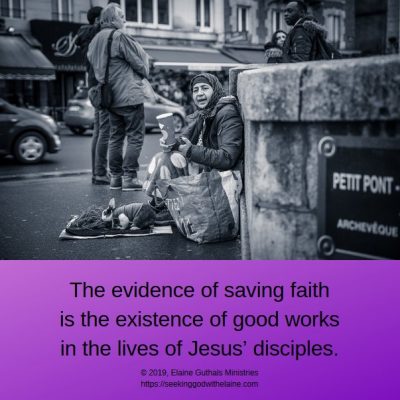
    • The evidence of saving faith is the existence of good works in the lives of Jesus’ disciples.
    • We have to have the outward and inward profession of faith.
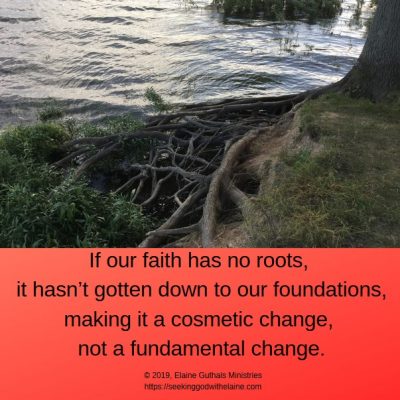
    • If our faith has no roots, it hasn’t gotten down to our foundations, making it a cosmetic change, not a fundamental change.
    • Jesus called His disciples to be laborers.

    Devotions in the The Letter of Paul to the Ephesians series

    In the first devotion in the series, we began discussing the foundations of salvation. We saw where Paul said that grace was the foundation on which salvation was built. In the previous devotion, we looked at faith and works.

    Paul says that “… by grace you have been saved through faith … not because of works …” (Eph. 2: 8-9 RSV). Is this telling us that we just have to say we believe and do nothing else?

    Let’s Put It into Context

    Here is a running list of nuggets for the series.

    So, We Have Faith and Do Nothing?

    “For by grace you have been saved through faith. And this is not your own doing; it is the gift of God, not a result of works, so that no one may boast” (Eph. 2: 8-9 ESV)

    Faith isn’t just knowledge and acceptance of that knowledge.

    What we do or don’t do with the do’s and don’ts is important after God has forgiven us and restored our relationship. The evidence of saving faith is the existence of good works in the lives of Jesus’ disciples: “so as to walk in a manner worthy of the Lord, fully pleasing to him: bearing fruit in every good work and increasing in the knowledge of God” (Col. 1: 10 ESV).

    We have to show that the salvation has changed us. We have to utilize the framework God has given us as our guiding principles as a cause-and-effect in our lives. That requires obedience.

    Homeless woman

    No Works = Dead Faith

    Remember what James said. “What good is it, my brothers, if someone says he has faith but does not have works? Can that faith save him?” (Jas. 2: 14 ESV emphasis added).

    Yes, we have to have the outward profession. But we can’t just say the words, call it faith, and give it lip service.

    We also need to have the inward profession. We aren’t just supposed to sit on the porch swing and drink lemonade.

    We have to invest in our faith. We have to grow and then put it into practice. If we don’t do that, our faith really isn’t genuine.

    I think what James meant here was like the parable Jesus taught about the seeds. “Other seeds fell on rocky ground, where they did not have much soil, and immediately they sprang up, since they had no depth of soil, but when the sun rose they were scorched. And since they had no root, they withered away” (Mt. 13: 5-6 ESV).

    We generally think that is referring to trials. When the going gets tough, some get a one-way ticket out of here.

    Gotta Grow Our Roots

    Jesus explained it this way. “As for what was sown on rocky ground, this is the one who hears the word and immediately receives it with joy, yet he has no root in himself, but endures for a while, and when tribulation or persecution arises on account of the word, immediately he falls away” (Mt. 13: 20-21 ESV).

    To me, the key words are it has no root. It hasn’t gotten down to our foundations. It is just a cosmetic change; it isn’t a fundamental change.

    Tree roots

    But what happens to those who maybe had an agenda when they made a profession of faith? What about those who find they don’t want to give up their sins?

    They don’t grow their root for whatever reason. So, they don’t have works to show for their faith — even though they weren’t undergoing trials.

    Because, let’s face it. It takes time to read the Bible, pray, worship, meditate …. And we’re supposed to do this for the long haul. If we don’t do it, we don’t grow our roots.

    Then James goes on to talk about no-root people. “Do you want to be shown, you foolish person, that faith apart from works is useless? Was not Abraham our father justified by works when he offered up his son Isaac on the altar? You see that faith was active along with his works, and faith was completed by his works; and the Scripture was fulfilled that says, ‘Abraham believed God, and it was counted to him as righteousness’ — and he was called a friend of God. You see that a person is justified by works and not by faith alone” (Jas. 2: 20-24 ESV). Our works are doing whatever God has called us to do.

    We Are Laborers

    James knew that Jesus had called on His disciples to be laborers. “Then he said to his disciples, ‘The harvest is plentiful, but the laborers are few’” (Mt. 9: 37 ESV). Laborers – workers – the ones who actually went out into the fields and cut the wheat, picked the corn, and gathered in the beans — or whatever the crop was..

    Let’s take this agricultural discussion one step further. “You can identify them by their fruit, that is, by the way they act …” (Mt. 7: 16 NLT). Yes, Jesus was talking about false teachers here.

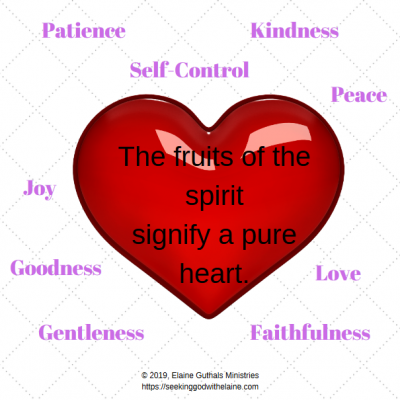
    But can’t this be applied to false disciples, also? Let’s look again at the fruits of the spirit. We said before that the fruits of the spirit show a pure heart: “… love, joy, peace, patience, kindness, goodness, faithfulness, gentleness, self-control; against such things there is no law.” (Gal. 5: 22-23 ESV).

    Heart with Fruits of the Spirit

    Okay, faith is a fruit. Self-control is also an internal fruit. Peace and joy have dual expression. But look at all the rest. If you don’t show love, patience, kindness, goodness, and gentleness externally, do you really have them? Jesus said those are our identifiers.

    To read a related devotion, click the button below.

    We can do works because we think it needs to be done and that it will improve someone else’s lives. Works through faith are done because this is what God has called us to do to further His kingdom. God wants us to have a living, breathing faith.

    The way I see it is, what is our motivation? Are we doing something in response to God’s directions — either laws and commandments or through His promptings? Or are we going lone wolf and doing something of our own volition?

    I like the term that Stark used: holiness of heart and life. As James said, we can’t just say we have faith (Jas. 2: 14). We have to live it. We live it by our works.

    Resource

    Paul was looking at the foundation. James was looking at how we use what we have built. Jesus never meant to allow us to keep on living our lives as we had been. He wants His disciples to change their lifestyles to better align with God’s laws and commandments. That takes work – internally and externally.

    so-what-are-the-foundations-of-salvation-1.1FB

    Making the Connections

    So, what does all we have talked about in the last three devotions mean?

    The riches of grace are salvation and faith. That makes a strong foundation for our relationship with God.

    Grace is the foundation for salvation, and faith is the foundation for works. We show our salvation through the works we do in faith.

    Jesus taught about building on foundations. The house built upon the rock stood firm while the house built upon the sand fell (Mt. 7: 24-27).

    But look at this. When talking about the Wilderness Wanderers, Paul said, “For I do not want you to be unaware, brothers, that our fathers were all under the cloud, and all passed through the sea, and all were baptized into Moses in the cloud and in the sea, and all ate the same spiritual food, and all drank the same spiritual drink. For they drank from the spiritual Rock that followed them, and the Rock was Christ” (I Cor. 10: 1-4 ESV emphasis added).

    Paul also said, “For no one can lay a foundation other than that which is laid, which is Jesus Christ” (I Cor. 3: 11 ESV emphasis added).

    Our foundation is supposed to be built on the Rock, Jesus Christ, our Lord and Savior. All we believe, all we trust, all we do is to glorify Christ, who in turn glorifies God.

    Let’s go back to Zechariah 7: 9 from the first devotion in the series. It says, This is what the LORD Almighty said: ‘Administer true justice …’” (NIV). Today’s worldview does not believe kindness has any room to include justice in it.

    Disciples of Jesus have to submit to the correcting hand of God. That is what is preparing us for our eternal life.

    How Do We Apply This?

    We have to make a choice. Are we going to step out in faith and accept God’s gift of salvation or are we going to follow the worldview?

    Once we choose to accept God’s gift of salvation, we have to choose to do that every day.

    We have to grow in our knowledge of Him (II Pet. 3: 18). God will be right there to guide us in doing that.

    Father God. We accept Your gift of salvation. Help us to grow in knowledge of You. Strengthen our faith in You as we read, study, and meditate on Your Word. Help us to hear You when we pray — and any time You speak to us. Help us to perform the tasks to which You have called us. Amen.

    What do you think?

    Leave me a comment below (about this or anything else) or head over to my Facebook group for some interactive discussion.

    If you don’t understand something and would like further clarification, please contact me.

    If you have not signed up for the email daily or weekly providing the link to the devotions and the newsletter, do so below.

    If God has used this devotion to speak with you, consider sharing it on social media.

  • Which Is Foundational: Faith or Works? (1.1)

    In the last devotion, we began discussing the foundations of salvation. We saw where Paul said that grace was the foundation on which salvation was built. In this daily devotional, we look at how faith and works accompany salvation.

    Nuggets

    • We make the choice to believe what God says is true.
    • Choosing faith is the first step; the second step is choosing His laws.
    • As faith is a gift, it isn’t because of us, either.
    • Works can’t fix us.
    • Doing good works is not enough for salvation because it doesn’t make us holy.

    Devotions in the The Letter of Paul to the Ephesians series

    To read devotions in the Foundations of Salvation series, click the appropriate button below.

    Just a heads up. This one got too long, so it had to be split and rearranged. The two-part series turned into a three-part series.

    We said in the last devotion that grace was the foundation, and salvation was what was built on it. Grace alone doesn’t secure our salvation. We have to choose it through faith. How it is built is through faith. But what is faith?

    Let’s Put It into Context #1

    Here is a running list of nuggets for the series.

    What Is Faith?

    “Now faith is the assurance of things hoped for, the conviction of things not seen” (Heb. 11: 1 ESV).

    We make the choice to believe what God says is true.

    Faith is a gift from God and a work of the Spirit that enhances the conviction that the doctrines revealed in God’s Word are true, even if we do not understand all aspects of them, a belief which impacts our lives and distinguishes us from others.

    Glossary

    We have to have a knowledge of God and Jesus and believe things are true. Then we have to trust enough to commit ourselves to Him.

    That means that, if we don’t understand how God did something, that is okay. We can believe that God created the world by speaking, but we don’t understand what happened next.

    We just take it on faith that God did it the way He did it. We believe even if we can’t see Him.

    To read devotions in the Seeking God series, click the appropriate button below.

    We’ve talked before that faith is a choice. God doesn’t force us to love and obey Him.

    God allows us free will. Free will is the ability within us to make decisions, which determine actions that produce character.

    To read a related devotion, click the button below.

    We have to be the one to say, “I have chosen the way of faithfulness; I have set my heart on your laws” (Ps. 119: 30 NIV).

    Did you see that? Yes, it is choice — but that is the first step.

    The second step is choosing His laws (Ps. 119: 30). Oooo, baby. That is the hard part — submitting to His authority.

    We have to give up our but-it-should-really-work-this-way notions. It is challenging when the worldview is polar opposite of what God is telling us.

    Church

    But go on with verse 8. “… and this is not your own doing; it is the gift of God” (Eph. 2: 8 ESV). Our faith is His doing, too.

    Faith, as well as salvation, is a gift. The gift is His calling us to salvation.

    Salvation is the gift of life through the deliverance from condemnation and sin to acceptance and holiness and changes us from being spiritually dead to spiritually alive.

    • Sin is not believing that Jesus is our Savior to save us from our actions by humans that disobey God and break one of His reasonable, holy, and righteous laws and commandments, goes against a purpose He has for us, or follows Satan’s promptings.
      • Holy means to be set apart — because of our devotion to God — to become perfect, and morally pure while possessing all virtues.
        • Perfection means we reach a state of maturity because the combination of the spiritual graces form, when all are present, spiritual wholeness or completeness — holy, sanctified, and righteous.
          • Spiritual graces are worldly morals that have been submitted to God to further His kingdom instead of enhancing this world.
          • Sanctified means to be set free from sin.
          • Righteous means we are free from sin because we are following God’s moral laws.
        • Pure means not being sinful or having the stain of sin. 
    • Virtues are standards of moral excellence.
    • Holiness is the transcendent excellence of His nature that includes elements of purity, dedication, and commitment that lead to being set apart.
      • Purity means possessing God’s moral character, having eliminated the stain of sin.
    • Spiritual death is the spiritual separation from God that occurred as a consequence of Adam and Eve’s original sin.
      • The spiritually alive are those who have ABCDed, so they are no longer separated from God.

    The ABCDs of Salvation

    If you have not become a believer in Christ, please read through the
    Plan of Salvation and prayerfully consider what God is asking you to do.

    A – admit our sins
    B – believe His Son Jesus is our Redeemer
    C – confess God as Sovereign Lord

    D – demonstrate that commitment by making any changes needed in our lives to live the way in which God has called us

    The Disciple’s Job Description

    Glossary

    It is Him through the Holy Spirit convicting us to step out in faith. It is Him revealing Himself to us.

    And do you know the greatest thing? Salvation happens instantaneously for everyone who takes that genuine step of faith. As soon as we say, “God, we believe; forgive us of our sins,” He forgives us and restores the relationship. We become reunited with God and Jesus.

    So, our faith isn’t because of us, either. (Remember, grace is because of His love for us.) Our salvation is totally about God. So why do we think we can earn it?

    What Is Works?

    “For by grace you have been saved through faith. And this is not your own doing; it is the gift of God, not a result of works, so that no one may boast” (Eph. 2: 8-9 ESV)

    We’ve talked about works before. The problem is that we are flawed. We have a flawed foundation.

    To read What Is a Definition of Works?, click the button below.

    Works can’t fix us. Only God can do that.

    The worldview is that, if we join any of the save the children, save the animals, and save the world organizations, that makes a good person — and that is good enough.

    It isn’t.

    To read a related devotion, click the button below.

    Think of it this way. We are to be saints.

    We have been called to be set apart. If we follow the worldview to be a good person, that does not make us holy.

    Remember, we said faith is a gift from God. There is nothing we can do to earn it. Nothing.

    Not by doing good things for others. Not even by following all the do’s and the don’ts of the Bible. That really doesn’t matter either for salvation. We don’t gain salvation by keeping a list and checking off what we have or haven’t done.

    What Is Boasting?

    “… so that no one may boast” (Eph. 2: 9 ESV).

    If we did have a checklist, we would probably be patting ourselves on the back for doing a good job with it. God doesn’t want us to boast that we are so important.

    When I was going through my spiritual tornado, it seemed like every devotion I wrote ended with, “It isn’t about us; it’s about Him.” God doesn’t want us to boast about ourselves. He wants us to boast about Him.

    Why? We said we couldn’t fix ourselves. So, we don’t have the foundation on which to boast.

    God can fix us. He has the unfailing love; He has the grace; He developed and executed the plan. All we did was accept. And we think we can boast because we were smart enough to do that? No.

    which-is-foundaitonal-faith-or-works-1.1FB

    Making the Connections

    So, the focus needs to firmly stay on God. He doesn’t need us; He wants to have a relationship with us.

    God wants to lavish His gifts on us. We just have to put our own understanding aside and take a step out in faith.

    How Do We Apply This?

    If you have not admitted that your relationship is not right with God,

    have not asked Jesus to be your Lord and Savior,

    and have not confessed your sins,

    please read through the Plan of Salvation and prayerfully consider what God is asking you to do.

    In the next devotion, we will tie all of this together.

    Loving Father. We want our faith to change us internally and externally. We want to live the lives You have called us to live. May we always complete the works that You have tasked us to do. May You always get the praise. Amen.

    What do you think?

    Leave me a comment below (about this or anything else) or head over to my Facebook group for some interactive discussion.

    If you don’t understand something and would like further clarification, please contact me.

    If you have not signed up for the email daily or weekly providing the link to the devotions and the newsletter, do so below.

    If God has used this devotion to speak with you, consider sharing it on social media.

  • What Is the Foundation of Salvation? (1.1)

    Paul gives us the foundations of salvation in Ephesians 2: 8-9. In this daily devotional, the first in the Foundations of Salvation series, we look at what salvation and grace are. Grace is the foundation of salvation.

    Nuggets

    • Salvation means we are not only saved from our sins by redemption, but we are also delivered from spiritual death.
    • If we admit our sins, believe Jesus is our Redeemer, and confess God as our Sovereign Lord, God will forgive us of our sins and grant us salvation.
    • Grace is a free and unmerited gift from our Heavenly Father given through His Son Jesus Christ that enables salvation and spiritual healing to believers.
    • Through God’s kindness, He shows mercy and compassion to us.
    • The foundation of God’s actions is His unfailing love for us.

    Devotions in the The Letter of Paul to the Ephesians series

    If you look back at Ephesians 2: 7 in the What Are Heavenly Places (1.1) devotion, we see that Paul gave a quick glimpse of Ephesians 2: 8-9. “For by grace you have been saved through faith. And this is not your own doing; it is the gift of God, not a result of works, so that no one may boast” (ESV). To him, everything regarding salvation was built on grace.

    To read a related devotion, click the button below.

    We talked about immeasurable meaning God will kick it to the next level. It is talking about kicking up the riches of His grace here.

    Then Paul kicked it up in verses 8 and 9. These are oft-quoted verses because this is the foundation of salvation.

    We’ve talked before about grace, faith, and works, but separately.

    To read a related devotion, click the button below.

    Let’s tie them all together. Since we will be discussing the foundation of salvation, there are so many pieces. We are going to break this up into two devotions.

    Let’s Put It into Context #1

    Here is a running list of nuggets for the series.

    Let’s Put It into Context #2

    “Consequently, he [Jesus] is able to save to the uttermost those who draw near to God through him, since he always lives to make intercession for them” (Heb. 7: 25 HCSB).

    If you’ve read previous devotions of mine, you are probably asking, “What is this Chick — a walking dictionary?” I like to start out with definitions. I feel that gives a good foundation and makes sure we start out on the same page.

    Salvation is the gift of life through the deliverance from condemnation and sin to acceptance and holiness and changes us from being spiritually dead to spiritually alive.

    • Sin is not believing that Jesus is our Savior to save us from our actions by humans that disobey God and break one of His reasonable, holy, and righteous laws and commandments, goes against a purpose He has for us, or follows Satan’s promptings.
      • Holy means to be set apart — because of our devotion to God — to become perfect, and morally pure while possessing all virtues.
        • Perfection means we reach a state of maturity because the combination of the spiritual graces form, when all are present, spiritual wholeness or completeness — holy, sanctified, and righteous.
          • Spiritual graces are worldly morals that have been submitted to God to further His kingdom instead of enhancing this world.
          • Sanctified means to be set free from sin.
          • Righteous means we are free from sin because we are following God’s moral laws.
        • Pure means not being sinful or having the stain of sin. 
    • Virtues are standards of moral excellence.
    • Holiness is the transcendent excellence of His nature that includes elements of purity, dedication, and commitment that lead to being set apart.
      • Purity means possessing God’s moral character, having eliminated the stain of sin.
    • Spiritual death is the spiritual separation from God that occurred as a consequence of Adam and Eve’s original sin.
      • The spiritually alive are those who have ABCDed, so they are no longer separated from God.

    The ABCDs of Salvation

    If you have not become a believer in Christ, please read through the
    Plan of Salvation and prayerfully consider what God is asking you to do.

    A – admit our sins
    B – believe His Son Jesus is our Redeemer
    C – confess God as Sovereign Lord

    D – demonstrate that commitment by making any changes needed in our lives to live the way in which God has called us

    The Disciple’s Job Description

    Glossary

    To read a related devotion, click the button below.

    If we do not admit our sins, do not believe on Jesus as our Redeemer, and do not confess God as Sovereign Lord, we will experience eternal spiritual death.

    If we admit our sins, Jesus becomes our Redeemer. 

    Redemption is where God bestows His gift of grace on us in order to deliver us from sin.

    • Grace is a free and unmerited gift of love from the Heavenly Father, given through His Son, Jesus Christ, that enables salvation and spiritual healing to believers by the work of the Holy Spirit.

    Jesus is our Redeemer because

    • He was born of a virgin, making Him 100% God and 100% man;
    • He gave His life on the cross for us so that His blood could pay the price for our sins; and
    • because of God’s great might and power, He rose from the grave, conquering death and paying the price for our sins.

    If we ABCD, God will forgive us of our sins and grant us salvation.

    Forgiveness is, when we ask, the act of God pardoning us because we have shown repentance for breaking His laws and commandments, which allows us to become holy as He is.

    • Repentance is acknowledging our separation from God and expressing sorrow for breaking God’s laws and commandments by making the commitment to changing ourselves through obedience so that we no longer do the wrong things.

    Glossary

    Is this all we have to do? Well, yes and no. Yes, ABCing does mean we have been forgiven of our sins and have been given eternal life.

    To read What Does It Mean to Come After Him?, click the button below.

    But then comes the D part. We have to demonstrate that commitment. We have to change our lives so they more closely align with how God would have us live. We have to follow Jesus and imitate Him.

    To read a related devotion, click the button below.

    You see, our salvation is a three-parter. God initially forgives us of our sins and restores our relationship with Him. He makes us a spiritual being.

    Then comes the hard part. That salvation changes us, but we are still in this earthly body. We have a long way to go to learn about who God wants us to be and make those changes. That makes us a work in progress.

    We won’t “arrive” at where God wants us to be until we get to heaven either after we die or when we are called home. We will be changed into a spiritual body then (I Cor. 15: 52).

    Sunset

    Grace

    “For by grace you have been saved through faith. And this is not your own doing; it is the gift of God, not a result of works, so that no one may boast” (Eph. 2: 8-9 ESV)

    The foundation of salvation is grace. Again, grace is a free and unmerited gift of love from the Heavenly Father, given through His Son, Jesus Christ, that enables salvation and spiritual healing to believers by the work of the Holy Spirit.

    God didn’t have to extend grace to us. When Adam and Eve first disobeyed Him, He could have said, “I’m done here.” But He didn’t.

    God didn’t give up on us because of “… the immeasurable riches of his grace in kindness toward us in Christ Jesus” (Eph. 2: 7 ESV). Kindness permeates the grace. Zechariah 7: 9 says, “This is what the LORD Almighty said: ‘Administer true justice; show mercy and compassion to one another’” (NIV).

    Through God’s kindness, He shows mercy and compassion to us. We’ve said that mercy is where God doesn’t judge us to the extent He could have. Even though we deserve bad things as punishment, He doesn’t give them to us.

    To read a related devotion, click the button below.

    The foundation of God’s actions is His unfailing love for us. “but God shows his love for us in that while we were still sinners, Christ died for us” (Rom. 5: 8 ESV).

    Why did God offer us salvation through His grace? He did it so His name could be praised. He did it for us to clearly see His glory.

    Churchy word alert. What is God’s glory?

    Glory expresses the essence of God — His majesty, splendor, and beauty — representing the attributes of God resulting from the authority and holiness of God. It is how we see who God really is.

    Let’s think about that a second. At first glance, we may have said, “Oh, God is doing all of this to get recognition. Isn’t that self-serving? At the very least, isn’t that arrogance?”

    No. It is God introducing Himself to us. It is God revealing to us Who He is and explaining why He does what He does.

    Sovereign God — Creator of all the universe — is doing all of this to restore our relationship with Him. He wants us back.

    Yes, God does this so we can love Him and sing His praises. In return, we get this wonderful gift of salvation. We get something that we could never do ourselves.

    We come out so on top. We will never be able to out-give God. By giving us everything He wants to give us, we should gladly and sincerely sing His praises.

    Church

    Making the Connections

    Grace is the foundation. Salvation is what is built on the foundation.

    God does it all out of His love for us. Think of how much love it took to send His Son to die for us.

    In most religions, the people sacrificed humans to their gods. Here God the Father sacrificed God the Son for the people.

    what-is-the-foundation-of-salvation-1.1FB

    How Do We Apply This?

    If you have not admitted that your relationship is not right with God,

    have not asked Jesus to be your Lord and Savior,

    and have not confessed your sins,

    please read through the Plan of Salvation and prayerfully consider what God is asking you to do.

    Loving Heavenly Father. I admit that I am a sinner. Up to now, I have followed the call of this world. I believe that You sent Your Son Jesus to live on this earth, die on the cross, and be raised to life again so that my spiritual death could be changed to everlasting life. I don’t understand how You did it all, but I have faith that You did it. I want a relationship with You. Fill me now with Your love and Your mercy. Equip me to live my life to be the person You would have me be. Help me find like-minded believers to learn more of You. Most of all, help me find You through Your Word and communication with You. Thank You, Lord, for saving me. Amen.

    What do you think?

    Leave me a comment below (about this or anything else) or head over to my Facebook group for some interactive discussion.

    If you don’t understand something and would like further clarification, please contact me.

    If you have not signed up for the email daily or weekly providing the link to the devotions and the newsletter, do so below.

    If God has used this devotion to speak with you, consider sharing it on social media.

  • Ephesus, the Loveless Church

    Jesus’ first letter to the churches was to the church at Ephesus. This daily devotional looks at the importance of remaining in love with Christ.

    Devotions in the Pastor Steve Sermon Series 

    In Revelation, Jesus gave John instructions to write letters to seven churches of the first century. Pastor Steve begins a series looking at the letter to the first church.

    An Overview

    In this devotion, we are starting to look at the first of the seven churches in Revelation. Perhaps it was because they were on the Trade Routes that were used back then. Perhaps it was because they were in big cities.

    Although, I suspect that it was something to do with the fact that the cities they were in they all were in the Asian province of the Roman Empire. That’s simply my presupposition, and I can’t prove it one way or another.

    Whatever the case may be, we don’t really know.

    One thing that we do know however, is that it is evident by the letters that John writes to each church, that Jesus had a reason for them to repent from what He had against them. He was giving them a chance to repent and carry on serving Him in the right way.

    The First Church

    “To the angel of the church in Ephesus write: ‘The words of him who holds the seven stars in his right hand, who walks among the seven golden lampstands. I know your works, your toil and your patient endurance, and how you cannot bear with those who are evil, but have tested those who call themselves apostles and are not, and found them to be false. I know you are enduring patiently and bearing up for my name’s sake, and you have not grown weary. But I have this against you, that you have abandoned the love you had at first. Remember therefore from where you have fallen; repent, and do the works you did at first. If not, I will come to you and remove your lampstand from its place, unless you repent. Yet this you have: you hate the works of the Nicolaitans, which I also hate. He who has an ear, let him hear what the Spirit says to the churches. To the one who conquers I will grant to eat of the tree of life, which is in the paradise of God’” (Rev. 2: 1-7 ESV).

    The first church is the church in Ephesus. Did you noticed the name as being the same as the book? It is the church that the Apostle Paul wrote the Epistle to the Ephesians.

    Jesus lets the Ephesians know that He is aware of their works, their labor, and their patience (Rev. 2: 2). Since He is an all-knowing, all-seeing God, it makes sense that He would be aware of that which they were doing. “for the Lord knows the way of the righteous, but the way of the wicked will perish” (Ps. 1: 6 ESV).

    The Lord is aware of everything. He is all knowing, all seeing, everywhere present. He is aware of everything.

    Determining False Prophets

    Jesus praises the church for testing people.

    The last part of Revelation 2: 2, shows that Jesus was also aware of them testing people who came along claiming to be apostles and proving them to be false. He was aware that they could not bear these liars and would not stand for their attempts to misguide the church.

    How did they do that? Another of John’s writing answer that question for us. “Beloved, do not believe every spirit, but test the spirits to see whether they are from God, for many false prophets have gone out into the world. By this you know the Spirit of God: every spirit that confesses that Jesus Christ has come in the flesh is from God, and every spirit that does not confess Jesus is not from God. This is the spirit of the antichrist, which you heard was coming and now is in the world already” (I Jn. 4: 1-3 ESV).

    This is the same way we can determine false teachers today. The more we get into the end times, however, the desire to test the spirits grows less and less. I would expound on that more, but that’s for another sermon series.

    Jesus also provides us with another way to determine the false prophets. “Beware of false prophets, who come to you in sheep’s clothing but inwardly are ravenous wolves. You will recognize them by their fruits. Are grapes gathered from thornbushes, or figs from thistles? So, every healthy tree bears good fruit, but the diseased tree bears bad fruit. A healthy tree cannot bear bad fruit, nor can a diseased tree bear good fruit. Every tree that does not bear good fruit is cut down and thrown into the fire. Thus you will recognize them by their fruits” (Mt. 7: 15-20 ESV).

    The “fruit” that is being spoken of here, refers to the manner of how people act towards others. It also has a sense of what these people cause to happen by their actions. The fruit of their actions is indicative of who they are inside.

    Even the way they talk can be an indication of this. Jesus also said, “The good person out of the good treasure of his heart produces good, and the evil person out of his evil treasure produces evil, for out of the abundance of the heart his mouth speaks” (Lk. 6: 45 ESV).

    One of the main things for us to keep in mind is that these same things are available today to those who know Jesus as Lord and Savior.

    Jesus praised the church at Ephesus for enduring patiently the trying times like they have done and for not having grown weary because of them (Rev. 2: 3).

    What Was Wrong?

    What did the Ephesians do wrong?

    Despite all these good things that they had done, though, Jesus had things against them.

    One thing was that they had abandoned their first love. Some versions of the Bible says that they left their first love.

    What is their first love? For the Christian, the first love is when one first falls in love with the truth that is found in Jesus.

    Jesus said, “And you shall know the truth, and the truth shall make you free” (Jn. 8:32 ESV). This “knowing” comes only through Him. So, knowing Him as our Lord and Savior is to know the truth.

    Let’s look at another verse. “Jesus said to him, ‘I am the way, and the truth, and the life. No one comes to the Father except through me’” (Jn. 14: 6 ESV). To know Him as Lord and Savior is to know the truth and be made free by him.

    Why is leaving their first love such a terrible thing?

    “I am the vine; you are the branches. Whoever abides in me and I in him, he it is that bears much fruit, for apart from me you can do nothing” (Jn. 15: 5 ESV).

    To do anything that’s of value to God, that is true and real for God, we must abide in him. Without keeping our first love of Him, we are not doing the things He as called us to do by the spirit.

    Instead, we are doing it by our flesh. Nothing good has ever come from our flesh.

    Doing from Our Flesh

    “Who is wise and understanding among you? By his good conduct let him show his works in the meekness of wisdom. But if you have bitter jealousy and selfish ambition in your hearts, do not boast and be false to the truth. This is not the wisdom that comes down from above, but is earthly, unspiritual, demonic. For where jealousy and selfish ambition exist, there will be disorder and every vile practice. But the wisdom from above is first pure, then peaceable, gentle, open to reason, full of mercy and good fruits, impartial and sincere. And a harvest of righteousness is sown in peace by those who make peace.” (Jas. 3: 13-18 ESV).

    Let’s look at these verses. The reality is anything we do from our flesh (earthly wisdom) is unspiritual and demonic.

    Many of us probably have never thought about it before, but to be doing anything that is not of the spirit is to be against God. If you are doing things from the flesh and not the spirit, it is truly working against God and working through the demonic influences in the world.

    Jesus also talked about the flesh in John 3:6. “That which is born of the flesh is flesh, and that which is born of the Spirit is spirit” (Jn. 3: 6 ESV). It should be plain to see here that if we are doing things through our flesh, it is of the flesh. And if we are doing things through our Spirit, it is of the spirit.

    When this are done through our spirit, they are operating out of love, which is the greatest thing we should be doing. The Apostle Paul wrote so vividly when he said in I Corinthians 13:1-8a – “If I speak in the tongues of men and of angels, but have not love, I am a noisy gong or a clanging cymbal. And if I have prophetic powers, and understand all mysteries and all knowledge, and if I have all faith, so as to remove mountains, but have not love, I am nothing. If I give away all I have, and if I deliver up my body to be burned, but have not love, I gain nothing. Love is patient and kind; love does not envy or boast; it is not arrogant or rude. It does not insist on its own way; it is not irritable or resentful; it does not rejoice at wrongdoing, but rejoices with the truth. Love bears all things, believes all things, hopes all things, endures all things. Love never ends …” (I Cor. 13: 1-8).

    Why is this so important?

    This was serious enough to Jesus that He called for them to repent. (vs. 5) Jesus never calls us to repent of anything but sin. He does not call us to repent because we did something good. Only when we’ve sinned.

    This should surely indicate to us that to do anything that is not out of love — making it out of the spirit — is a sin. The one thing the church of Ephesus did that was such a sin was that they stopped loving people. They stopped operating out of the spirit, which means that they could have only have been operating out of the flesh, which means that they were operating from demonic influences and not out of love. To be operating from demonic influences is to be operating against God.

    It can be said that the Pharisees were operating from this same mode. They we not doing anything of the spirit as they had been called to do. Jesus referred to them as hypocrites because they acted like they were all that they should be, but they really weren’t. They were operating out of their flesh, not of love.

    So what happened?

    Jesus called the church at Ephesus to repent of what they had been doing. If they did not, he said that he would remove their lampstand. If you read the first part of Revelation 1, you will see Jesus referring to being the keeper of the seven golden lampstands.

    I believe that the lampstands signify the Holy Spirit that is in each church. I truly believe that even today that each church has a lampstand.

    I also truly believe that every church that has died has had their lampstand removed because they stopped doing what God wanted them to do.

    Jesus said here that if the church did not repent their lampstand would be removed. And to have their lampstand removed is to have the Holy Spirit leave and not cover the church. This is a very important thing to consider about the churches we attend today.

    The Nico-whos-its?

    The Nicolaitans mentioned in verse 6 were not true Christians. They held to a lot of unbiblical practices that led a lot of people away from God. Therefore, Jesus hated their works.

    Whenever we see it says in the Bible, “The who has an ear, let him hear …”, as it does in Revelation 2: 7 (ESV), this is Jesus impressing the importance of what He just said. This phrase was meant to get our attention and effectively says, “Hey! Pay attention to this! It’s important!”

    Next time, we will be looking at what Jesus had to say to the church in Smyrna.

    Father God. Help us to see what You’d have us see in these studies of the churches in Revelation. Help us to understand why it was important enough to You to have John write individual letters to these churches and help us to apply what we’ve learned to our own lives. In Jesus’ Name, Amen.

    ephesus-the-loveless-churchFB

    What do you think?

    Leave me a comment below (about this or anything else) or head over to my Facebook group for some interactive discussion.

    If you don’t understand something and would like further clarification, please contact me.

    If you have not signed up for the email daily or weekly providing the link to the devotions and the newsletter, do so below.

    If God has used this devotion to speak with you, consider sharing it on social media.

  • Greeting To The Seven Churches

    In Revelation, Jesus gave John letters to seven churches of the day. In this daily devotional, Pastor Steve starts with an overview on those letters.

    Devotions in the Pastor Steve Sermon Series 

    In this devotion, I (Pastor Steve) am beginning a series of sermons on the Seven Churches in the book of Revelation. It is based on a series of sermons I recently did at our church, and I wanted to write is in a more detailed format to post on my wonderful wife Elaine’s blog.

    Today’s sermon is intended to serve as an introduction, of sorts. The main text for the seven churches occurs in Revelation chapter two and three. I am going to be writing from Revelation 1: 1-8 in this post.

    Let’s Put It into Context

    Here is some interesting background to help us get our minds situated to how this all fits together. The book of Revelation was written down by the Apostle John. This would be the same John that whose Mother Salome had approached Jesus on behalf of her two sons, James, and John, asking that her sons be allowed to sit one on his left and the other on his right when he came into his kingdom (Mt. 20:21).

    The other disciples weren’t thrilled with them asking for such a thing. And if you think about it, how many grown guys would want their mommy coming up to their boss to ask such a thing?

    That said, Salome properly approached Jesus when she asked and gave Him the respect He is due, so she knew full well what she was doing.  I’ve always found it interesting that she felt comfortable enough to approach Jesus with that kind of a request.

    Let’s Put It into Context #2

    I thought it would be interesting to provide some “fun facts” about John to make this study a bit more interesting: 

    1. John the Apostle is traditionally believed to be one of two disciples (the other being Andrew) recounted in John 1:35-39, who upon hearing the Baptist point out Jesus as the “Lamb of God,” followed Jesus and spent the day with him. Thus, some traditions believe that he was first a disciple of John the Baptist, even though he is not named in this episode. 
    2. James and John are listed among the Twelve Apostles. Jesus referred to the pair as “Boanerges” (translated “sons of thunder”). A Gospel story relates how the brothers wanted to call down heavenly fire on an unhospitable Samaritan town, but Jesus rebuked them. John lived on for another generation after the martyrdom of James, who was the first Apostle to die a martyr’s death. 
    3. According to a Roman Historian (in The Prescription of Heretics), John was banished (presumably to Patmos) after being plunged into boiling oil in Rome and suffering nothing from it. It is said that all in the audience of Colosseum were converted to Christianity upon witnessing this miracle. This event would have occurred in the late 1st century, during the reign of the Emperor Domitian, who was known for his persecution of Christians. 
    4. John was also the only Apostle to die of natural causes.  All the others of the 12 were killed in some way. 

    So, let’s begin by reading at Revelation 1:1-3.

    The Revelation

    “The revelation of Jesus Christ, which God gave him to show to his servants the things that must soon take place. He made it known by sending his angel to his servant John, who bore witness to the word of God and to the testimony of Jesus Christ, even to all that he saw. Blessed is the one who reads aloud the words of this prophecy, and blessed are those who hear, and who keep what is written in it, for the time is near” (Rev. 1: 1-3 ESV)

    We are told in this passage of Scripture, the reason that Revelation was written: 

    1. He wanted to show us, his servants, the things that must soon take place. (vs 1-2)
    2. Those who read it aloud and hear and keep the words of this prophecy are blessed. 
    3. There must be something to that “read aloud” part. The Bible says in Romans 10:17:  “So faith comes from hearing, and hearing through the word of Christ” (ESV).
    4. Not only are those who read it aloud blessed, but also are those who hear, and keep what is written in it, for the time is near. 

    Have you ever thought about being blessed simply because you heard something? Now, that doesn’t include gossip, of course, because the Bible is plain about not gossiping.  

    Take another look at number 3 above. It says that faith comes from hearing.

    Whenever we hear something that God intends us to hear, it is a blessing because we are building up our faith. This is especially true when we keep what we have heard.

    James told us what is needed. “But be doers of the word, and not hearers only, deceiving yourselves (Jas 1: 22 ESV).

    It’s not enough for us to hear the Word of God and do nothing with it. It is no accident that you are given understanding of God’s Word when you hear it. 

    No, it’s meant for you to apply it to your life and grow in your faith. It’s also meant for you to share it with others. God has never intended for us to do nothing with what we’ve heard. Now, back to Revelation.  

    Who Is Writing the Letter?

    “John to the seven churches that are in Asia: Grace to you and peace from him who is and who was and who is to come, and from the seven spirits who are before his throne, and from Jesus Christ the faithful witness, the firstborn of the dead, and the ruler of kings on earth. To him who loves us and has freed us from our sins by his blood and made us a kingdom, priests to his God and Father, to him be glory and dominion forever and ever. Amen. Behold, he is coming with the clouds, and every eye will see him, even those who pierced him, and all tribes of the earth will wail on account of him. Even so. Amen. ‘I am the Alpha and the Omega,’ says the Lord God, ‘who is and who was and who is to come, the Almighty'” (Rev. 1: 4-8 ESV)

    From verse 4 on, we see John greeting the seven churches that are referred to in this prophecy. There must have been something special about these churches for Jesus to take the time to have the Apostle John write this Book of Revelation to them specifically.

    We don’t know what that reason is because we aren’t told. One thing I recognize though, and we will see this as we go through this series: there are many churches in existence today who have the same problems that are addressed about to each of these churches. I believe that we have much to learn from them all. 

    John starts out with a greeting from Jesus and the seven spirits. This greeting is addressed to all seven of the churches that he will be writing to. It is interesting how Jesus had John write this mass greeting to start off the letters to the churches, but later, He has him write an individual letter to each of the seven churches.

    I think the significance of that, however, is that the greeting is giving Jesus all of the glory and praise due him, well before any of the pronouncements that Jesus gives to the seven churches are even made.

    You see, He announces himself as “The Alpha and The Omega.” Alpha is the first letter of the Greek alphabet and Omega is the last letter of the Greek alphabet. Him saying that would be likened to if He were to have said, “I am the A and the Z.”  He literally means here that He is the beginning and the end of all things.

    greeting-to-the-seven-churchesFB

    Making the Connections

    If you read in the Gospel of John chapter one, you will see that it says:  ‘”In the beginning was the Word, and the Word was with God, and the Word was God. He was in the beginning with God. All things were made through him, and without him was not anything made that was made” (Jn. 1: 1-3 ESV).

    Jesus was here at the beginning, and He will be here at the end. Indeed, He is, “… the Lord God Almighty, who was, and is, and is to come” (Rev. 4: 8 NIV).

    So, as we delve into this study of the seven churches in Revelation, we are going to see what Jesus had to say to them and why He said it.  We are going to cover one of the churches individually, until all of them are covered and we harvest all that we can from them.

    How Do We Apply This?

    It is my prayer that you grow and learn from what we study here and strive to be all that God is calling you to be.

    Father, may Your Will be done in all that we strive to do for you, because we love You. May this study accomplish that which You will have it do and thank You for loving us so much. In Jesus’ name we pray.  Amen. 

    What do you think?

    Leave me a comment below (about this or anything else) or head over to my Facebook group for some interactive discussion.

    If you don’t understand something and would like further clarification, please contact me.

    If you have not signed up for the email daily or weekly providing the link to the devotions and the newsletter, do so below.

    If God has used this devotion to speak with you, consider sharing it on social media.