Author: admin

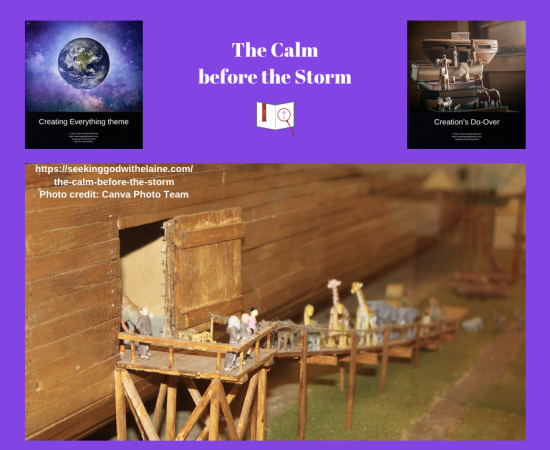
  • The Calm before the Storm

    In the last devotion, we talked about Noah getting the call to enter the ark. This devotional reading finishes up that conversation by God filling Noah in a little more about His plan.

    Nuggets

    • The other purpose of building the ark, besides saving the people, was to save the animals.
    • God provided Noah and his family with advanced notice of when the rain was going to start.
    • I wonder how long it took the wicked to admit that Noah wasn’t a fool.
    • God intended to totally annihilate the population – except for those riding in the ark.
    • Noah had come this far; he wasn’t going to start being disobedient then.
    the-calm-before-the-storm

    As I start out writing this, I am not sure how things are going to go. I found, reading ahead, that it seems like verses are repeated, maybe adding little nuggets at a time.

    So, I am not going to go in a straight verse order. I am going to group the like verses together.

    But that means this will probably get long, so bear with me.

    Let’s Put It into Context

    To read devotions in the Creating Everything theme, click the button below.

    Devotions in the Creation’s Do-Over series

    Taking Pairs of Animals

    “Take with you seven pairs — male and female — of each animal I have approved for eating and for sacrifice, and take one pair of each of the others. Also take seven pairs of every kind of bird. There must be a male and a female in each pair to ensure that all life will survive on the earth after the flood” (Gen. 7: 2-3 NLT)

    “With them were all the various kinds of animals — those approved for eating and for sacrifice and those that were not — along with all the birds and the small animals that scurry along the ground. They entered the boat in pairs, male and female, just as God had commanded Noah” (Gen. 7: 8-9 NLT)

    “With them in the boat were pairs of every kind of animal — domestic and wild, large and small — along with birds of every kind. Two by two they came into the boat, representing every living thing that breathes. A male and female of each kind entered, just as God had commanded Noah …” (Gen. 7: 14-16 NLT)

    The other purpose of building the ark, besides saving the people, was to save the animals.

    God didn’t want to just save the people to repopulate the earth. He wanted to save the animals, too.

    We’ve already briefly touched on the other occupants in the ark. “Bring a pair of every kind of animal — a male and a female — into the boat with you to keep them alive during the flood. Pairs of every kind of bird, and every kind of animal, and every kind of small animal that scurries along the ground, will come to you to be kept alive” (Gen. 6: 19-20 NLT).

    We mentioned in passing that verse 19 talks about a pair – singular – where verse 20 talks about pairs – plural.

    Usually, I think, in our minds — and definitely in pictures and songs — we think about a two-by-two line patiently waiting to get into the ark. And I think that is significant.

    Just as God was planning Noah and his family repopulating the earth through the family unit, He was planning the same thing through the animals. That connection was important to Him. He puts a lot of emphasis on us bring the family of God.

    But God also has Noah bring seven pairs of a lot of animals. Seven is also a significant number. It means completion. On the seventh day of creation God rested.

    There were two specific reason God wanted more of these animals. The first was they were to provide food for the humans.

    We remember God told Noah to pack enough food for the float trip. “And be sure to take on board enough food for your family and for all the animals” (Gen. 6: 21 NLT).

    I keep trying to think what kind of food that might have been. Probably there were some vegetables. God would have made sure they stayed fresh (unlike my refrigerator lately where they have gone to die).

    Mrs. Noah probably included some spices. They didn’t want week after week of bland food.

    But just as God did later in the wilderness, God provided the meat. “Then Moses added, ‘The Lord will give you meat to eat in the evening and bread to satisfy you in the morning, for he has heard all your complaints against him. What have we done? Yes, your complaints are against the Lord, not against us’” (Ex. 16: 8 NLT).

    God provided animals for them to eat. Yeah, they’d have had to build a kitchen, so I would think they would also build a butcher room.

    The second reason seven pairs were needed was because these were the animals for sacrifice to God.

    Did they perform sacrifices on ark? It doesn’t say one way or the other. We know they did prior to entry into the ark, and they would once they got off.

    But think about it. Noah didn’t have to go round up the animals. They came to him.

    What did all the scoffers think when they came walking up? Maybe some of these they had never seen before. (God only knows how long some of them had to travel to get there.)

    Gilfillan reminded us of the parade of animals before Adam to receive a name (Gen. 2: 19-20). This spectacle would rival that.

    Resource

    That doesn’t take into consideration the birds. There would be seven pairs of every species — all the way from cardinals to turkey vultures — winging its way to do some flyovers before they settled into their room.

    And think of the creepy-crawly things. Tarantulas, termites, slugs, bedbugs — yeah probably some that would have asked God to leave them off this trip.

    When I was on Facebook tonight, there was an advertisement for a live-action play called Noah. I actually had the sound on for once and heard I believe the stage manager say, “Cue the goats. Cue the pigs. Cue the skunks.”

    That would have been God calling the animal actors to the stage on the ark. Only He could get the wild animals there in a timely, safe fashion.

    Did the wicked have such hardened hearts even that wouldn’t have convinced them what God said was going to happen? Did their hearts feel God trying to chip at the ice but just didn’t decide to believe?

    The Game Plan Revealed

    “Seven days from now I will make the rains pour down on the earth. And it will rain for forty days and forty nights, until I have wiped from the earth all the living things I have created” (Gen. 7: 4 NLT)

    Seven Day Forecast

    God provided Noah and his family with advanced notice of when the rain was going to start.

    Talk about vindication for Noah! For 120 years, others had been laughing at him for building a boat nowhere close to water.

    But everyone — Noah included — was going to find out what rain was. But God gave them a seven-day reprieve before He started the rain.

    I like what Fuller had to say about that. He wrote, “He who in well-doing commits himself into the hands of a faithful Creator, needs not fear being overtaken by surprise. What have we to fear, when He whom we serve hath the keys of hell and of death?”

    Resource

    I know. At times, it feels like God hits us out of the blue with something. But regardless of the amount — or lack — of warning, we should be content in what Go has for us.

    God knew the outcome, but He was still offering the wicked mercy.

    It probably took longer than the seven days that Noah and family were given to get themselves and the animals situated for the wicked to decide they had chosen wrong. The door wasn’t shut yet, so if any of the wicked would have repented, they may have gotten in.

    But part of me doubts that.

    What we do know is that God gave Noah time to get things situated within the ark before the rocking started. The eight people had a lot of work to get done to get ready for launch.

    Rain for Forty Days and Forty Nights

    I wonder how long it took the wicked to admit that Noah wasn’t a fool.

    Did they see the error of their ways when Noah and his family entered the ark? No, what was really different about that? Nothing.

    Did it finally dawn on them when the rain started to fall? Maybe, maybe not. It depends on how hard it rained.

    They wouldn’t have been afraid of puddles. They may not have been too concerned about knee deep.

    Adults probably would have started getting alarmed when it got waist high. But then small children would have been washed away by then.

    Devastation Voiced

    God intended to totally annihilate the population – except for those riding in the ark.

    God had told Noah before what He was going to do and the extent to which it would go. “So God said to Noah, ‘I have decided to destroy all living creatures, for they have filled the earth with violence. Yes, I will wipe them all out along with the earth!’” (Gen. 6: 13 NLT).

    I guess it just hit me this time how much God was to the point this time. “… until I have wiped from the earth all the living things I have created” (Gen. 7: 4 NLT).

    Maybe it had to more with last time was a one-day type notification. This was was an the-time-has-come type notification.

    That makes it way more important.

    • It came when it was predicted to come (after the death of Methuselah).
    • It came the way it was predicted – a whole lot of rain.
    • The extent of the result (which we will get to) that was predicted happened (every breathing thing annihilated).

    Talk about survivor guilt.

    Noah Still Obedient

    “So Noah did everything as the Lord commanded him. Noah was 600 years old when the flood covered the earth. He went on board the boat to escape the flood — he and his wife and his sons and their wives” (Gen. 7: 5-7 NLT)

    Noah had come this far; he wasn’t going to start being disobedient then.

    If we look back to Genesis 5, the menfolk listed generally lasted around 900 years. That would mean Noah would have lived two-thirds of his life.

    Noah didn’t bring up that he was pushing retirement age. He — again like it said in Genesis 6: 22 — did what God commanded him to do.

    There had been 120 years of probably back breaking labor. On top of that would have been 120 years of mocking and disdain.

    No more. Even if it wasn’t starting to cloud up, no one could have — should have — discounted the animals.

    And here was Noah — still in the business of obeying.

    Making the Connections

    I love what Gray said. He wrote, “The world comes to look, and wonder, and laugh. Science and selfishness have furnished their arguments, and begin to launch them. On a huge platform of timber stands the ark.”

    Resource

    One thing they didn’t acknowledge until it was too late — if even then — that God can and will do the impossible.

    How Do We Apply This?

    • Pay attention to God’s warnings and invitations.
    • Work out our salvation (Phil. 2: 10) by following the Sanctification Road.
    • Know where our refuge is — in the arms of Jesus.

    Resource

    Father God. You make us so many wonderful promises. We are humbled when those promises comes to fruition. Thank You for preserving the story of Noah so that we can see Your provision for us. Amen.

    What do you think?

    Leave me a comment below (about this or anything else) or head over to my Facebook group for some interactive discussion.

    If you don’t understand something and would like further clarification, please contact me.

    If you have not signed up for the email providing the link to the devotions and the newsletter, do so below.

    If God has used this devotion to speak with you, consider sharing it on social media.
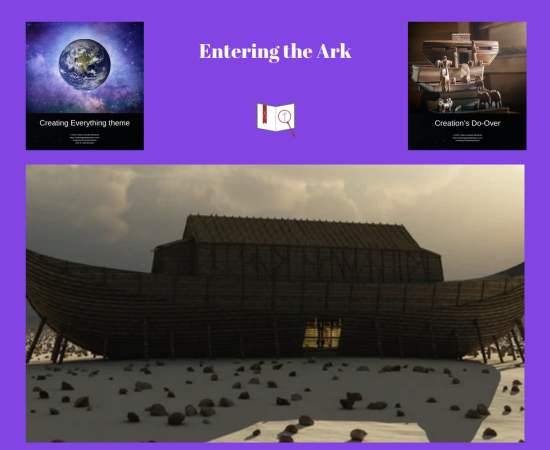
  • Entering the Ark

    The time of building and preparation were done. This devotional reading looks at the command to enter the ark.

    Nuggets

    • Things happen in the fullness of God’s time.
    • God invited Noah and his family to enter the ark.
    • Personally, I think the translators have it wrong when they say only Noah was righteous.
    entering-the-ark

    We always hear about how Noah was ridiculed by his neighbors for building the ark.

    It would be logical. Noah was living his life counterculture to everyone else. Now, he was visibly — and verbally — telling people they will be held accountable for their lifestyles.

    When Sodom and Gomorrah were destroyed because of their sinfulness, the townspeople came and harassed Lot. And that was just a couple of hours.

    But it doesn’t say that about Noah’s time in God’s Word. It skips 120 years. It goes from build it to get in.

    When God was ready, He got the show on the road — or water, in this case.

    Let’s Put It into Context

    To read devotions in the Creating Everything theme, click the button below.

    Devotions in the Creation’s Do-Over series

    When Everything Was Ready

    “When everything was ready, the Lord said to Noah, ‘Go into the boat with all your family, for among all the people of the earth, I can see that you alone are righteous” (Gen. 7: 1 NLT)

    Things happen in the fullness of God’s time.

    God had a plan. He wanted a redo for the creation He had made. It had become corrupted, and God wanted to cleanse and liberate it.

    But it wasn’t something that could happen right then. Oh, it could if God had just gone and done it all.

    God doesn’t work that way. He allows things to happen when it is the best time for them to happen.

    Time is also allowed to pass to allow God to call us to do His work. In this instance, Noah had to prove his obedience by building (which he may or may not have known what to do) this huge ark (which he may have had no concept of what it was) to withstand a flood (when he had never seen rain).

    Noah’s faith stood the test of time and service.

    Go into the Ark with Your Family

    God invited Noah and his family to enter the ark.

    God told Noah when it was time to get into the ark. He didn’t leave Noah to figure it out on his own.

    Yes, God calls us to do His work. He then doesn’t turn around and walk off then. He stays with us and leads us.

    I am sure, when the ark was completed — and probably several times in between — Noah looked at God’s directions on how to build it (Gen. 6: 14-16). He most definitely did when God said it was time.

    Had Noah obediently followed every direction God had given him? Yes, he had, so he could confidently enter the ark.

    I wonder what Noah was feeling. He was probably glad that the labor of building the ark was over. The mocking was over, too.

    Oh, but I bet Noah’s heart was breaking. He had to have family that was on the outside. Even if he didn’t, he had friends and neighbors.

    Tears of Noah’s heart if not tears of his eyes were probably falling like rain.

    I like the way Exell put it. He wrote,

    “This termination [of building the ark] would inspire a sad but holy pride within his heart. And so Christian service often reviews its work, its calm faith, its patient energy, and its palpable result, with sacred joy, but when it is associated with the judgments of heaven upon the ungodly, the joy merges into grief and prayer. The best moral workman cannot stand unmoved by his ark, when he contemplates the deluge soon to overtake the degenerate crowds around, whom he would fain persuade to participate in the refuge he has built.”

    Resource

    When God calls us to witness to others as our marching orders say, our success doesn’t hinge on our message being accepted. We just have to be obedient.

    It is up to the wicked to choose whether nor not to accept God’s love for us. Just as in the Days of Noah, those who choose against God will suffer the consequences.

    Only Noah

    We talked about Noah being the only one called righteous. His wife, the triplets, and their wives got to enter the ark, too.

    That is logical. The earth would need to be repopulated. God would do that through the family, as He had the first time.

    Ever since we talked about this in Genesis 6: 9, I have been mulling around what the rest of the family not being righteous really means. I am not sure I have this figured out, so let’s think it through.

    “These are the toldot [accounts] of Noach; Noach was an ish [man] tzaddik (righteous or just] and tamim [complete, wholehearted, blameless] among those of his time, and Noach’s halachah [way to behave or way of walking] was with HaElohim [God]” (Gen. 6: 9 OJB).

    That doesn’t say anything about Noah being the only righteous person. It just comments on his spiritual condition, no one else’s.

    We talk about it here, too. “And Hashem [God] said unto Noach, Come thou and all thy bais into the tevah (ark); for thee have I found tzaddik [a righteous person or saint] before Me in dor hazeh [this generation]” (Gen. 7: 1 OJB).

    Interestingly, if those are put together, Tzaddik Ha-Dor refers to the most righteous of this generation — with the potential of becoming the Messiah.

    Back to this generation. Noah was considered a righteous person in this generation but not necessarily the most righteous.

    That makes sense to me. Methuselah would have died the year the rain came. He was righteous. When I googled it, AI said that he even helped Noah witness to the wicked about the flood.

    But then, it doesn’t evaluate his family’s spiritual condition at all. It doesn’t call them Tzaddikim — righteous ones (plural). (This would be the Hebrew word for Christians.)

    The rest of the family may have been righteous; they may not have been. We could say that – whatever they believed of God – they believed in Noah.

    But I think they were righteous. God only talked to Noah. To me, that is why the you are righteous is singular, but doesn’t mean only.

    If the were not righteous, why were they saved, and others weren’t? Most agree they got the ark ticket because it was Noah’s reward.

    I agree and disagree. He hadn’t said it yet, but I would think God blessed those who blessed Noah. “I will bless those who bless you and curse those who treat you with contempt. All the families on earth will be blessed through you” (Gen. 12: 3 NLT).

    In other words, God would bestow His divine favor on them. One purpose of building the ark was to save Noah and his family.

    I don’t think this would extend to spiritual salvation.

    • “But blessed are those who trust in the LORD and have made the LORD their hope and confidence” (Jer. 17: 7 NLT).
    • “Then Jesus told him, ‘You believe because you have seen me. Blessed are those who believe without seeing me’” (Jn. 20: 29 NLT).
    • “You are blessed because you believed that the Lord would do what he said” (Lk. 1: 45 NLT).

    Believing leads to salvation.

    • “If you openly declare that Jesus is Lord and believe in your heart that God raised him from the dead, you will be saved” (Rom. 10: 9 NLT).
    • “They replied, ‘Believe in the Lord Jesus and you will be saved, along with everyone in your household’” (Ac. 16: 31 NLT).

    Now, that last verse brings us back full circle. Could Noah’s family have gained salvation because Noah did?

    Acts 11: 14 talks about the household coming to salvation. “He will tell you how you and everyone in your household can be saved!” (Ac. 11: 14 NLT).

    Well, that doesn’t sound like it is a household pardon. Peter would have told everyone in Cornelius’ household the one way to be saved: through believing in Jesus. Believing in Jesus as our Savior and Redeemer is an individual decision.

    • “For this is how God loved the world: He gave his one and only Son, so that everyone who believes in him will not perish but have eternal life. God sent his Son into the world not to judge the world, but to save the world through him. There is no judgment against anyone who believes in him. But anyone who does not believe in him has already been judged for not believing in God’s one and only Son” (Jn. 3: 16-18 NLT emphasis added).
    • “Look! I stand at the door and knock. If you hear my voice and open the door, I will come in, and we will share a meal together as friends” (Rev. 3: 20 NLT emphasis added).
    • “For it is by believing in your heart that you are made right with God, and it is by openly declaring your faith that you are saved” (Rom. 10: 10 NLT emphasis added).
    • “If you look for me wholeheartedly, you will find me” (Jer. 29: 13 NLT emphasis added).

    Probably the most appropriate verse for this discussion is Ezekiel 14: 20. “As surely as I live, says the Sovereign LORD, even if Noah, Daniel, and Job were there, they wouldn’t be able to save their own sons or daughters. They alone would be saved by their righteousness” (Ezek. 14: 20).

    That verse was talking about the certainty of judgment in Ezekiel’s time. If Noah couldn’t even do it in his time, how can anyone else?

    Anyone and everyone who believes. And it isn’t just believing, it is believing wholeheartedly and openly declaring that belief. That’s what leads to salvation.

    I don’t really like how the New Living Translation translates John 3: 18. It isn’t that we will be judged, and a sentence be passed. It is we will be judged and condemned if we do not believe in Jesus Christ as our Lord and wholeheartedly, openly declared that.

    So, I think the family’s spiritual condition was right with God. That allowed them to go forth and multiply is done through the family unit.

    Whatever the case, the family’s spiritual condition didn’t reflect on Noah and his success in carrying out the marching orders. Like Enoch, Noah pleased God and walked with Him.

    Making the Connections #1

    Noah was obedient in building the ark. It took him 120 years, and he never wavered.

    But now was D day. The time had come to make the final decision.

    Noah and his family still had a choice after all that time. They could get into the ark, or they could stay home and die.

    They had until the door was shut on the ark to make their decision.

    Look what Spurgeon said about that. He wrote,

    “Now it would have been of no use for Noah to have gone on making preparations for his dwelling in the ark: that he had done long enough. Neither would it have done for Noah to go round the ark to survey it again. No longer look at Christ externally, nor survey Him even with a grateful eye for what He has done for others, but come now and commit yourself to Him. There stands the door, and you have to go through it, and enter into the inner chambers, or you will find no safety. Neither would it have been of any use for Noah to go up to the ark and stand against the door and say, “I do not say that I am not going in, and I do not even say that I am not in already; I have got one foot in, but I am a moderate man, and like to be friendly with both sides. I am in and yet not in. If the door was shut I do not know but that it would cut me in halves; but, anyhow, I do not want to be altogether out, and I do not want to be quite in. I should like to stand where I could hurry in as soon as I saw the water coming up; but, still, while there is another opportunity of taking a walk on the dry land I may as well avail myself of it. There is no hurry about it, is there? You see, if a man keeps his finger on the latch of the door he can pop in as soon as ever he sees the first drop of rain descending, or the water coming up anywhere near him; but is there any reason for being so decided all at once? No, that would not do for Noah.”

    Resource

    That shouldn’t do for us, either.

    How many many books have I started to put together of these devotions (8), and how many have I gotten published (0)? What am I waiting for — Christmas?

    How many times do we keep one foot in the ark and one foot on the (for now) dry land? But that is just compromising with the worldview.

    How many times do we let the water get to our knees before we decide for God? Do we let it get waist high? Head high?

    How many times do we keep a hand on the latch so we can flip it when the going gets tough? We want it to be a prosperity gospel, not a relationship in which we are tested and tried.

    There’s the door. Use it as a door.

    Making the Connections #2

    Fuller made a good point. He wrote,

    “The righteousness of Noah is repeated, as the reason of the difference put between him and the world. This does not imply that the [favor] shown to him is to be ascribed to his own merit; for whatever he was, he was by grace, and all his righteousness was rewardable only out of respect to Him in whom he believed; but being accepted for His sake, his works also were accepted and [honored].”

    Resource

    We find favor with God when we have faith and obey Him. The righteousness is tied more to the faith than the obedience.

    There is no way we earn anything from God. Everything — grace, mercy, faith, salvation— is all a gift from God. Obedience is how we express we have that. Faith is the first greatest commandment; obedience, the second.

    How Do We Apply This?

    • Don’t let time run out on you to choose to obey God.
    • Evaluate the work you do for God.
    • Serve God completely in the way He calls you.
    • Hear, believe, and obey.
    • Understand we are called to be righteous even in the difficult, sin-filled times.

    Resources

    Father God. Lord, just as You called Noah into the ark, You call us to You. Help us to heed your call and come as righteous, blameless, and obedient children of Sovereign God.

    What do you think?

    Leave me a comment below (about this or anything else) or head over to my Facebook group for some interactive discussion.

    If you don’t understand something and would like further clarification, please contact me.

    If you have not signed up for the email providing the link to the devotions and the newsletter, do so below.

    If God has used this devotion to speak with you, consider sharing it on social media.
  • Redeemed

    Today is a music day. To read and hear the song, click here.

    The past couple of days have been a challenge for the three of us in my household. Part of the problem is an elevated pollen count.

    So, I am going to do a music day today. For Sunday’s service, I asked my sister to record the piano part for what I wanted to sing for the offertory. Then I told her to add an alto part.

    As part of my practicing, I recorded my part as well so that I could share it with you.

    Enjoy.

    Redeemed
    Vocalists: Elaine Guthals and Louise Guthals Weiss
    Keyboard: Louise Guthals Weiss

    creating-everything-theme

    What do you think?

    Leave me a comment below (about this or anything else) or head over to my Facebook group for some interactive discussion.

    If you don’t understand something and would like further clarification, please contact me.

    If you have not signed up for the email daily or weekly providing the link to the devotions and the newsletter, do so below.

    If God has used this devotion to speak with you, consider sharing it on social media.

  • The Obedience of Noah

    The theme that flows through Genesis 6 is that Noah was obedient to God in all he was and did. This devotional reading looks at Noah getting the notification of the impending flood and his response to God’s commands.

    Nuggets

    • God had made up His mind that He would punish the wicked by destroying everything that breathes – and nothing was going to change His mind.
    • God passed judgment on the wicked, but He rewarded Noah because of his faithfulness and obedience.
    • Noah was completely devoted to being obedient to God.
    • God wanted enough provisions on board to feed His people, knowing it would just be the eight in Noah’s family.
    • Noah was completely devoted to being obedient to God.
    the-obedience-of-noah

    Up to this point, Noah probably had a normal life. Sure he probably had highs and lows.

    But now, Noah was going to get hit with a major life change. How was he going to react when the going got tough?

    Let’s Put It into Context

    To read devotions in the Creating Everything theme, click the button below.

    Devotions in the Creation’s Do-Over series

    Impending Flood

    “Look! I am about to cover the earth with a flood that will destroy every living thing that breathes. Everything on earth will die” (Gen. 6: 17 NLT)

    God had made up His mind that He would punish the wicked by destroying everything that breathes – and nothing was going to change His mind.

    God shared His plans for destroying the earth with the one that He was closest to – Noah.  The world was wicked, and every living thing would be destroyed.

    True, Noah already knew he and his family were going to be saved because he already had the dimensions of the ark. He knew he was safe.

    But I bet Noah’s heart still hurt. All those cousins, maybe even some brothers and sisters – they would be gone.

    It also is amazing that Noah didn’t question what rain was. Some believe that it hadn’t rained yet. “… For the Lord God had not yet sent rain to water the earth…” (Gen. 2: 5 NLT).

    It is believed that God had encased the earth in a canopy. The resulting greenhouse effect would have provided dew.

    Maybe. Who knows? That is one for the UNR book – understanding not required.

    Browne thought it was the perfect image to show the wicked where they were in their spiritual walk. They were perishing in the waves and depths of their sin.

    Resource

    Too many people think they are going to escape the consequences of their actions. Unfortunately for them, they think it is only their physical actions that will be judged – if any judgment at all is going to take place.

    News flash. Judgment for their spiritual condition is coming.

    God will hold off punishment for sin only for so long.

    Just as the wicked did not escape the flood waters, they did not escape the consequences of their sins. They were cut off from God and spiritually dead.

    They only way they would have escaped was to join Noah in his faith. Only that would secure a ticket on the ark.

    God sent the flood because of the spiritual condition of the people. Wicked is a term that is used interchangeably with sinner.

    It seemed like it was a huge ark for eight people. That doesn’t seem like many for animal care.

    But then, Noah wasn’t like Abraham and tried to bargain for the salvation of those around him. He accepted their fate as punishment for their lifestyle of sin.

    Noah didn’t talk back — at least not what is recorded. He built.

    Fuller made a great observation. Instead of building the ark, why didn’t God just take Noah as He did Enoch?

    Instead, Noah was singled out from everyone else. Fuller told us why. He wrote,

    “If he had been destroyed with the world, God could have taken him to Himself, and all would have been well with him; but then there had been no public expression of what he loved, as well as of what he hated.”

    Resource

    Gray added a nice little tidbit. The warning didn’t come directly to the others. It was only given to Noah.

    Resource

    True, the wicked may have not known what a flood or rain was any more than Noah did. But Noah took the warning as an absolute truth. They didn’t when Noah told them.

    No one else bought a ticket for the ark.

    Is that the same as those who won’t believe Jesus is God’s Son because He didn’t physically come to them personally? Not everyone believed when He did.

    God’s Covenant with Noah

    “But I will confirm my covenant with you. So enter the boat — you and your wife and your sons and their wives” (Gen. 6: 18)

    God passed judgment on the wicked, but He rewarded Noah because of his faithfulness and obedience.

    We talked about this already. “But Noah found favor with the Lord. This is the account of Noah and his family. Noah was a righteous man, the only blameless person living on earth at the time, and he walked in close fellowship with God” (Gen. 6: 8-9 NLT).

    We also talked about the fact that Noah was the only righteous man God found. That means the triplets didn’t get the same classification.

    But they – and their wives and mother – were given an ark ride because of the righteousness of Noah. This was part of Noah’s reward here on earth.

    No, I don’t think it means that we can grab onto someone’s coat tails for salvation. That has to be a personal confession.

    But for this time, they were safe.

    I like how Browne described it. He wrote,

    “The eight souls saved from the deluge are types of that little flock which rides safely and triumphantly, though the floods lift up their waves and the billows break over them. And their safety is assured to them, because they are in Christ.”

    Resource

    Since we know the rest of the story, we know that Shem and Japheth were obedient to God. We know Ham wasn’t.

    But here, they were described as being in Christ.

    In the midst of judgment, God showed Noah and his family mercy. God is in the business of being merciful.

    God made a covenant with Noah because he was the one righteous man on earth. As part of that covenant, He gave Noah a blessing.

    Fuller explained what God was telling Noah. He wrote, “To say, ‘With thee will I establish My covenant,’ was saying in effect, ‘I will not treat with thy ungodly posterity: whatever [favor] I show them, it shall be for thy sake.”

    Resource

    Yes, God loves everyone unconditionally, but love isn’t enough. We have to be obedient in order to be blessed. He will bless us for His sake, not ours.

    Animal Travelers

    “Bring a pair of every kind of animal — a male and a female — into the boat with you to keep them alive during the flood. Pairs of every kind of bird, and every kind of animal, and every kind of small animal that scurries along the ground, will come to you to be kept alive” (Gen. 6: 19-20 NLT)

    God made provision for the animals.

    We’re going to talk about the animals two more times, so I am going to focus just on what it says here.

    Verse 19 talks about a pair – singular – where verse 20 talks about pairs – plural. That gets addressed later when Noah gets more specific instruction.

    Let’s just say that God made sure every animal species would be represented on the ark, and every animals species would have the means by which to repopulate the world. He didn’t want them to come off the ark and not be able to go forth and multiply because there were two males or two females.

    That would have killed the species.

    The animals came to Noah. He didn’t have to round them up.

    That was probably a good thing. He didn’t have to take time out of building the ark to be animal wrangler.

    Food for the Ark Occupants

    “And be sure to take on board enough food for your family and for all the animals” (Gen. 6: 21 NLT)

    God wanted enough provisions on board to feed His people, knowing it would just be the eight in Noah’s family.

    Verse 21 stopped me. We are so quick to say that Noah was witnessing during the 120 years that it took to build the ark.

    That is our marching orders. Those orders will not change until Jesus returns.

    • “And then he told them, ‘Go into all the world and preach the Good News to everyone’” (Mk. 16: 15 NLT).
    • “Therefore, go and make disciples of all the nations, baptizing them in the name of the Father and the Son and the Holy Spirit. Teach these new disciples to obey all the commands I have given you. And be sure of this: I am with you always, even to the end of the age” (Mt. 28: 19-20 NLT).

    But even before the first board was sawed for the ark, God didn’t tell Noah to prepare for anyone else but his family.

    God was done with the wicked, even before the rain came down and the floods came up – even before one nail was cast into the ark.

    This makes it obvious. God will shut off our opportunity for salvation.

    He had already condemned the rest of the population. He was no longer drawing near to them.

    But still, as Noah was building the ark, he was preaching. If the wicked people weren’t his audience, who was?

    Remember, we said the triplets weren’t born when Noah started building the ark. Noah had to raise them in the way of the Lord.

    The triplets were his audience.

    So, I would say Burns was wrong. Noah was a successful preacher. His three sons and their wives got tickets on the ark. Shem, in fact, was the ancestor of Jesus.

    Resource

    Noah’s Total Obedience

    “Noah did this; he did all that God commanded him” (Gen. 6: 22 ESV)

    Noah was completely devoted to being obedient to God.

    Look at Noah. God knew what was coming when Noah didn’t. Noah probably had no clue as to what a flood was — because rain was a new concept. He may not have any idea what a boat was.

    Ooo, baby. We’re the circumstances sounding dire or what?!?

    Didn’t matter what Noah did or didn’t know. Didn’t matter how things looked. One day, God said to him. “Height, width, and depth. Do it.”

    Noah’s response was, “Good plan.”

    Noah could have started strong but fail to persevere. With all the mocking going on alongside the strenuous labor, he could have easily thrown up his hands and quit.

    Noah didn’t.

    God wanted to save him, but Noah still had a choice. He could have said, “Bad plan.”

    But then Noah would have been deep sea diving without the wet suit – just like everyone else.

    The whole purpose of the ark was to save lives. That is the business God is in — salvation. He sent His Son to die on a cross so that we could accept the gift of salvation.

    God always knows what is needed to save His creation — even if we don’t know or are too independent to follow His guidance.

    God will always provide for His saints. We just have to submit and obey — even when it is beyond our understanding.

    God already has our lives planned out before we are born. We still have the choice to do what He says or not, but He — as all-knowing God — already has those choices figured into the plan.

    So, when God says something, do we listen? Usually not.

    We decide we know what is best. We get scared about what God asks us to do. We tell ourselves He couldn’t possibly know what is best because He doesn’t know how we feel.

    We’re good at snow jobs, aren’t we?

    For some of us, it boils down to we don’t want anyone else making the decisions for us. We know how to get to where we are wanting to go.

    The control must remain in our hands at all times. We know what is best for us.

    The kicker is that God does know what is best for us. Remember, He has that plan for us.

    The things God is going to call us to are going to be hard. Persecution hard. Mockingly hard. We could lose lots.

    We have to obedient until the end. “But the one who endures to the end will be saved” (Mt. 24: 13 NLT).

    Noah taught us what to do.

    • Be righteous.
    • Be ready when God calls.
    • Don’t talk back.
    • Obey the first time.
    • Follow God’s directions to the letter.
    • Put in the work to get it done.
    • When the going gets tough — for whatever reason — keep on going.
    • Praise God at the beginning, during, and at the end.

    Ooo, baby. When God calls us to something we don’t like, obey. When God’s work takes longer than we think we signed up for, obey.

    God wants the ending to be a happy one. And if we do follow His specific instructions, we are much happier than if we go off on our own.

    Hasn’t that been proven that in the past?

    Making the Connections #1

    Have you ever been so fed up with the world that you wished a flood would engulf them? Or have you prayed for fire and brimstone to destroy them as it did Sodom and Gomorrah?

    We want an Act of God to take out everyone who is making our lives miserable in some way.

    Parker expanded on that. He wrote,

    “The idea may be put roughly thus: Bring together all prisoners, all idlers, drunkards, thieves, liars, and every known form of criminal; take them out into the middle of the Atlantic and sink them there, and at once society will be regenerated, and paradise will be regained.”

    Resource

    Well, sorry to say, that is probably a human way to think. But it doesn’t work that way.

    But Parker was talking about eliminating all wicked people again, not just the ones we think are harassing us. He estimated that within half a century, the wicked would be back on this earth.

    I don’t think it even took that long. It was somewhere in the 350 years that Noah lived after the flood.

    We do know that Ham – aka the father of Canaan – brought wickedness back into the world. His sin was great enough that Noah cursed him in his Last Will and Testament blessing.

    “Then he cursed Canaan, the son of Ham: ‘May Canaan be cursed! May he be the lowest of servants to his relatives.’  Then Noah said, ‘May the Lord, the God of Shem, be blessed, and may Canaan be his servant! May God expand the territory of Japheth!
    May Japheth share the prosperity of Shem, and may Canaan be his servant.” (Gen. 9: 25-27 NLT).

    Making the Connections #2

    Parker made a great point. He wrote, “Water cannot drown sin. Fire cannot burn out sin. Prisons cannot cure theft and cruelty. We must go deeper.”

    Resource

    It isn’t the water itself any more than it is the fire that destroys the I’m-going-to-get-you attitude of ungodliness.

    Baptism does not save us from our sins. It shows our obedience but doesn’t take away our sins.

    In other words, we can’t think that turning over a new leaf and doing good deeds will gain us salvation.

    Fire has no effect on sim. That is logical.

    Making the Connections #3

    Yes, God has absolute control over the natural world.

    • He made it.
    • He sent the ten plagues, all using the natural world as the foundation. He controlled rivers, animals, weather, and even death.
    • He caused famine, sometimes by holding off the rain.
    • He calmed the storms.

    I like the first two purposes Gilfillan listed. He wrote,

    • “It [the flood] swept away an effete and evil generation, which had become of no use, except to commit sin and thus deprave and weaken the general stock of humanity.
    • “The flood was calculated to overawe mankind, and to suggest the idea that other such interpositions might be expected when they were required.”

    Resource

    God didn’t destroy the earth and all living things without a purpose. That purpose was to further His kingdom of peace.

    Making the Connections #4

    God created us. He has retained control of us.

    Yes, we make our own decisions — and are punished for decisions that make us disobedient to God.

    God isn’t going to make His command unintelligible. He isn’t going to ask us to do something we can’t.

    Oh, we may think we can’t, but how do we grow if we keep doing the easy stuff?

    How Do We Apply This?

    • Accept Jesus as our Savior while we have the opportunity.
    • Obey God and do His work.
    • Keep working until God says we are done.
    • Keep working when the going gets tough.
    • Obey God and spread His message through our marching orders.
    • Witness to others by both what we say and do.
    • Pray for faith like Noah’s.
    • Don’t argue with God, just believe.
    • Show God our reverent fear.
    • Be obedient to gain the blessings.
    • Keep our courage.
    • Accept that our success is in our obedience, not the outcome.
    • Obey God because of love, not fear.
    • Obey all, not just some, of God’s commands.

    Resources

    Father God. Thank You for showing us how You punish those who are disobedient to You. We need to know that You will – in the fullness of Your time – crush sin. We commit to be obedient and walk with You. Amen.

    What do you think?

    Leave me a comment below (about this or anything else) or head over to my Facebook group for some interactive discussion.

    If you don’t understand something and would like further clarification, please contact me.

    If you have not signed up for the email providing the link to the devotions and the newsletter, do so below.

    If God has used this devotion to speak with you, consider sharing it on social media.
  • Noah’s Command to Build the Ark

    God had a plan to punish the wicked people that were inhabiting the earth, but He needed Noah’s cooperation to save humankind. This devotional reading looks at the command Noah received from God to build the ark.

    Nuggets

    • Humankind had the years it took Noah built the ark to turn back to God or be destroyed.
    • God gave Noah the specific dimensions of the ark.
    • We don’t know exactly how Noah got the ark built.
    • The ark, not Noah, was a type of Christ.
    • A different sermon from Jessop talked about the ark being a type of Church.
    noahs-command-to-build-the-ark

    While we are given the dimension of the ark, it doesn’t really give us a clue as to what it really looked like. But it brings up some interesting thoughts on the ark.

    Let’s Put It into Context

    To read devotions in the Creating Everything theme, click the button below.

    Devotions in the Creation’s Do-Over series

    Timing

    “Build a large boat from cypress wood and waterproof it with tar, inside and out. Then construct decks and stalls throughout its interior. Make the boat 450 feet long, 75 feet wide, and 45 feet high. Leave an 18-inch opening below the roof all the way around the boat. Put the door on the side, and build three decks inside the boat — lower, middle, and upper” (Gen. 6: 14-16 NLT)

    Humankind had the years it took Noah built the ark to turn back to God or be destroyed.

    Some feel it took 120 years to build the ark because of verse 3. “Then the Lord said, ‘My Spirit will not put up with humans for such a long time, for they are only mortal flesh. In the future, their normal lifespan will be no more than 120 years’” (Gen. 6: 3 NLT).

    Resources

    Yeah, we took it to be lifespan when we discussed verse 3. But which is it?

    Let’s go to the Orthodox Jewish Bible. I know I stumble on the Hebrew, but let’s see what we can see.

    “And Hashem [God] said, My Ruach [Hakodesh] [Holy Spirit] shall not always strive with Adam [man], for that he also is basar [mortal]: yet his yamim [lifespan] shall be a hundred and twenty shanah [year]” (Gen. 6: 3 OJB).

    It would be logical to think humans would no longer live around 900 years, but 120. God was wanting to cut down the opportunity to sin.

    But a 120-year lifespan isn’t the norm. Did God change it again and not tell us?

    Also, when I googled the meaning in Hebrew, words that referred to lifespan had another word in front of yamim.

    I can see where the 120 years would be limited to those alive at that time. Their lifespan was going to be cut short because of their disobedience.

    Maybe it is both to which the verse is referring. We aren’t really told how long it took Noah to build the ark.

    Dimensions of the Ark

    God gave Noah the specific dimensions of the ark.

    If you are like me, reading the dimensions of the ark mean nothing to you. Others who know a lot more than I do say that this is a massive ship.

    Part of the problem is we aren’t exactly sure how much a cubit was, which was the measurement back then. So, the figures given in verse 15 are estimates. (That is four and a half football fields for length.)

    Well, it would have to be big to hold enough to repopulate the earth of every kind of living creature.

    Building the Ark

    We don’t know exactly how Noah got the ark built.

    It amazes me how Noah would have been able to build the ark. We have no idea what Noah did for a living, but this wasn’t exactly by water.

    We have to remember Tubal-Cain created tools. “Lamech’s other wife, Zillah, gave birth to a son named Tubal-cain. He became an expert in forging tools of bronze and iron …” (Gen. 4: 22 NLT).

    True, Cain’s descendants were off in the Land of Nod – which one explanation says was anywhere Eden wasn’t. Someone somewhere down the line would have brought the bronze and iron tools – or even the knowhow to make them – back.

    When we look at the pyramids, we know ancient civilizations weren’t total dummies. They could build big things to last.

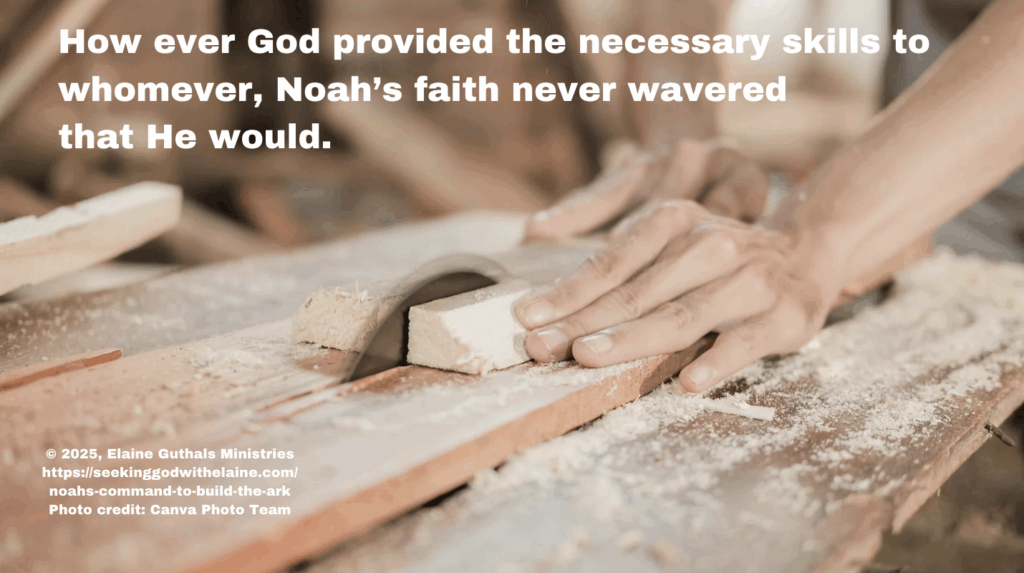
    Noah or even one of his sons may have had the tools or the knowhow to build the ark. What we do know is God gave that ability to someone in Noah’s family because the ark got built.

    Whether Noah had the skills or he knew that someone in his family did – even if none of them did – he knew that God would provide what was needed to get the ark built.

    We know that God provided skills later in building the tabernacle. “Then the LORD said to Moses, ‘Look, I have specifically chosen Bezalel son of Uri, grandson of Hur, of the tribe of Judah. I have filled him with the Spirit of God, giving him great wisdom, ability, and expertise in all kinds of crafts’” (Ex. 31: 1-3 NLT).

    How ever God provided the necessary skills to whomever, Noah’s faith never wavered that He would.

    The wood has been translated here as cypress wood. The Complete Jewish Bible stated that it was gofer-wood (usually translated as gopher wood). Since we are unsure what gopher wood is, cypress is a lot less confusing.

    But this may be another instance where our modern translations have changed things for our ease. We don’t want to rewrite God’s Word to make it say what we think it should say.

    The focus shouldn’t be on the how but on the why. God was blessing the obedient and punishing the disobedient.

    All we know is that it needed to be a strong, resilient wood to withstand all the water associated with the flood. The tar or pitch would help make it waterproof.

    The Ark and Christ

    The ark, not Noah, was a type of Christ. This came from a sermon by Jessop.

    Resource

    Mocked

    We talked about the wicked may have not known what a flood or rain was any more than Noah did. What happens when someone has a different viewpoint than ours — the wicked especially, but sometimes disciples, too?

    The mocking begins. “How can you believe what you believe? That is the stupidest thing I have ever heard. What other dumb thing can you believe?”

    Oh, yeah. I bet people in Noah’s time could say things just as cutting as those today can.

    Jesus was mocked, too. We aren’t told that Noah had to suffer the physical mocking that He did.

    “Some of the governor’s soldiers took Jesus into their headquarters and called out the entire regiment. They stripped him and put a scarlet robe on him. They wove thorn branches into a crown and put it on his head, and they placed a reed stick in his right hand as a scepter. Then they knelt before him in mockery and taunted, ‘Hail! King of the Jews!’ And they spit on him and grabbed the stick and struck him on the head with it. When they were finally tired of mocking him, they took off the robe and put his own clothes on him again. Then they led him away to be crucified” (Mt. 27: 27-31 NLT).

    Escape

    Once of the things that Noah was probably mocked for was building a boat. Did they even know what a boat was?

    If they didn’t know what a boat was,  and they didn’t know what a flood was (because it can’t flood if it hadn’t rained), how were they going to recognize the ark as a means of escape?

    How could a guy dying be our Savior? How could His death take away our sins? “He personally carried our sins in his body on the cross so that we can be dead to sin and live for what is right. By his wounds you are healed” (I Pet. 2: 24 NLT).

    How does that happen? Jesus’ blood covers our sins.

    • “But if we are living in the light, as God is in the light, then we have fellowship with each other, and the blood of Jesus, his Son, cleanses us from all sin” (I Jn. 1: 7 NLT).
    • “He is so rich in kindness and grace that he purchased our freedom with the blood of his Son and forgave our sins” (Eph. 1: 7 NLT).
    • “And since we have been made right in God’s sight by the blood of Christ, he will certainly save us from God’s condemnation” (Rom. 5: 9 NLT).
    • “In fact, according to the law of Moses, nearly everything was purified with blood. For without the shedding of blood, there is no forgiveness” (Heb. 9: 22 NLT).

    Because God loves us so much — even though we are sinful and disobey us — God did everything He could to restore our relationship with Him. This is really important.

    Some day — probably sooner rather than later — Jesus is going to come back, and this world will be judged again. The outcome is going to be the same. The wicked will die, and the righteous will escape that punishment.

    Which side are you on?

    Life Preserver

    The ark saved the physical lives of Noah and his family. Jesus saves our spiritual lives.

    It is important to save our spiritual lives. We just talked about the punishment. It is going to be a big one for those that don’t choose God.

    “And anyone whose name was not found recorded in the Book of Life was thrown into the lake of fire” (Rev. 20: 15 NLT).

    Door

    There was only one door into the ark. God let Noah and his family come in, and then He shut it.

    Jesus is the door to the sheep pen. “I am the door. If anyone enters by me, he will be saved and will go in and out and find pasture” (Jn. 10: 9 NLT).

    We can only enter Heaven through Jesus.

    • “Salvation is not a reward for the good things we have done, so none of us can boast about it” (Eph. 2: 9 NLT).
    • “There is salvation in no one else! God has given no other name under heaven by which we must be saved” (Ac. 4: 12 NLT).
    • “You must not have any other god but me. You must not make for yourself an idol of any kind or an image of anything in the heavens or on the earth or in the sea” (Ex. 20: 3-4 NLT).
    • “Jesus told him, ‘I am the way, the truth, and the life. No one can come to the Father except through me’” (Jn. 14: 6 NLT). ” (Rev. 20: 15 NLT).

    Window

    The ark had one window. “After another forty days, Noah opened the window he had made in the boat” (Gen. 8: 6 NLT).

    No, Jesus is specifically called a window. But windows are a way we can see inside. They open.

    Paul told us to open the eyes of our hearts. “having the eyes of your hearts enlightened, that you may know what is the hope to which he has called you, what are the riches of his glorious inheritance in the saints” (Eph. 1: 18 ESV).

    It is said that the eyes are the windows of the soul. Think about it.

    The eyes of the heart (faith) is the window the soul (the spiritual part of us that is immortal).

    Jesus is the foundation of our faith. We see God through Him.

    The Ark and the Church

    A different sermon from Jessop talked about the ark being a type of Church.

    Resource

    Built by Degrees

    It is said that it took 120 years to build the ark, even though that isn’t verified in God’s Word. It seems logical that it would take a long time.

    We talked about not knowing Noah’s occupation when he was called to build it. Even if he was a carpenter/builder of things, it is probably a safe bet to say he had never built anything to the scale that the ark was.

    Regardless, think about building a house. It has to be a process — by degrees. You have the foundation dug first. Then you shore it up.

    You have to put the frame of the house up next. You can’t put up the drywall if there are no walls on which to hang it.

    But you have to start on the outside before you start on the inside. Don’t want things to get wet or stolen.

    Besides, before you put the walls up, you have to run electrical, plumbing, central vac, and other things. You don’t want all that on the outside of the walls.

    You get the picture. A house isn’t built in a day.

    Christ wasn’t “built” in a day either. He was alive long before creation, and He knew the Plan of Salvation was in His future. “Even before he made the world, God loved us and chose us in Christ to be holy and without fault in his eyes” (Eph. 1: 4 NLT).

    When God said, “Let there be light,” I think He was putting Jesus in this world. No, it wasn’t His physical self. God enlightened the world with the presence and knowledge of Jesus.

    In the fullness of time — when God deemed the time was right — Jesus was born on earth. Jesus died and rose again to finish the Plan of Salvation.

    When the time is right, Jesus will come again. It is a process.

    • Jesus had to be introduced to the world.
    • A way had to be made to allow people to return to a relationship with God.
    • When everyone who is going to ABCD has, Jesus will call everyone home and fully defeat Satan and sin.

    Receptacle for All

    The ark was a big boat. It had to be to hold all those animals.

    There are going to be multitudes in Heaven. “After this I saw a vast crowd, too great to count, from every nation and tribe and people and language, standing in front of the throne and before the Lamb …” (Rev. 7: 9 NLT).

    Don’t think all means every person ever born from Adam on down. All means those who have ABCDed. We have to choose God.

    Allowed Free Will

    The animals came to Noah. He didn’t go out and round them up.

    We have to choose to obey God and turn our backs on Satan. God doesn’t force us to be obedient to Him.

    Deluged by God

    One thing we may or may not think about is that God had to hold off 120 years until the ark was built. He waited to destroy everything until the man who believed in Him was ready.

    God is going to wait until everyone who will ABCD has done so. Then He will totally destroy this earth that He created in Genesis 1.

    Making the Connections #1

    God can be very exacting at times. He know what He wants, and He knows exactly what we need.

    We shouldn’t feel restricted when God gets specific. We should be glad that we know what is right.

    Making the Connections #2

    “It was by faith that Noah built a large boat to save his family from the flood. He obeyed God, who warned him about things that had never happened before. By his faith Noah condemned the rest of the world, and he received the righteousness that comes by faith” (Heb. 11: 7 NLT)

    The whole purpose Noah built the ark was to save the family. He took it on faith that God was going to do as He said even if it was something new. “Faith shows the reality of what we hope for; it is the evidence of things we cannot see” (Heb. 11: 1 NLT).

    But this translation didn’t say what I was expecting it to say. Let’s try that again.

    “By trusting, Noach, after receiving divine warning about things as yet unseen, was filled with holy fear and built an ark to save his household. Through this trusting, he put the world under condemnation and received the righteousness that comes from trusting” (Heb. 11: 7 CJB).

    Well, that has the holy fear for which I was looking. It is about the why Noah did what he did.

    The focus isn’t on Noah built an ark. It is on God warned him, and he obeyed.

    Noah was moved by reverence to do what he was told and save his household.

    I surprised me that it said “… Noah condemned the rest of the world …” (Heb. 11:7 NLT). I question that Noah was given the authority to put others under condemnation.

    What I am thinking about is John 3: 18. “There is no judgment against anyone who believes in him. But anyone who does not believe in him has already been judged for not believing in God’s one and only Son” (Jn. 3: 18 NLT).

    Oh, no. This isn’t about showing up at the Judgment Seat for sentencing.

    “Whoever believes in him is not condemned, but whoever does not believe is condemned already, because he has not believed in the name of the only Son of God” (Jn. 3: 18 ESV).

    This is our destiny because of our choice.

    Making the Connections #3

    We know God will always find a way to save His children when it is in His Will. Yeah, we need saving a lot when we are surrounded by a corrupt world.

    There are probably sometimes that we don’t even realize God has saved us because He didn’t have a build an ark. Those saves may just be a prompting of the Holy Spirit.

    There are other time when we have to be completely involved. We have to give up on this world, accept that we may be mocked and hassled for our beliefs, and do our part.

    We, like Noah, have to put our faith and trust in God’s plan.

    Making the Connections #4

    Gray pulled out something that I had already figured out. He wrote, “480 years of age when he began, he toiled on for 120 years.”

    Resource

    When Noah started the ark, Shem, Ham, and Japheth weren’t even alive. They were born 20 years later.

    All they would have known was doom was coming to those who didn’t believe.

    How Do We Apply This?

    • Have the faith of Noah when God commands us to do the impossible, the unknown, the unpopular, and the seemingly unending.

    Father God. You don’t always ask us to do simple things. We can find a million reasons why we can’t do what You ask. Help us to have the faith of Noah to not talk back, but to obediently jump right in serving You. Amen.

    What do you think?

    Leave me a comment below (about this or anything else) or head over to my Facebook group for some interactive discussion.

    If you don’t understand something and would like further clarification, please contact me.

    If you have not signed up for the email providing the link to the devotions and the newsletter, do so below.

    If God has used this devotion to speak with you, consider sharing it on social media.

  • Corruption and Punishment

    The world that God created had been corrupted by sin. This devotional reading looks at how God decided He was going to punish the evil people and fix the corruption.

    Nuggets

    • The vast majority of the population on earth were filled with corruption that led to violence.
    • God will allow this corruption and violence in His world only so long before He will mete out punishment.
    corruption-and-punishment

    Moses was ping ponging here. He wrote four verses about how evil the world was. Then he wrote three verses about four of the eight people that were ark riders.

    Now, Moses was back on the evil in the world. But he was setting the stage for God’s action on the disobedience.

    Let’s Put It into Context

    To read devotions in the Creating Everything theme, click the button below.

    Devotions in the Creation’s Do-Over series

    Violence on the Earth

    “Now God saw that the earth had become corrupt and was filled with violence. God observed all this corruption in the world, for everyone on earth was corrupt” (Gen. 6: 11-12 NLT)

    The vast majority of the population on earth were filled with corruption that led to violence.

    There is one thing the New Living Translation doesn’t say. “Now the earth was corrupt in God’s sight, and the earth was filled with violence” (Gen. 6: 11 ESV emphasis added).

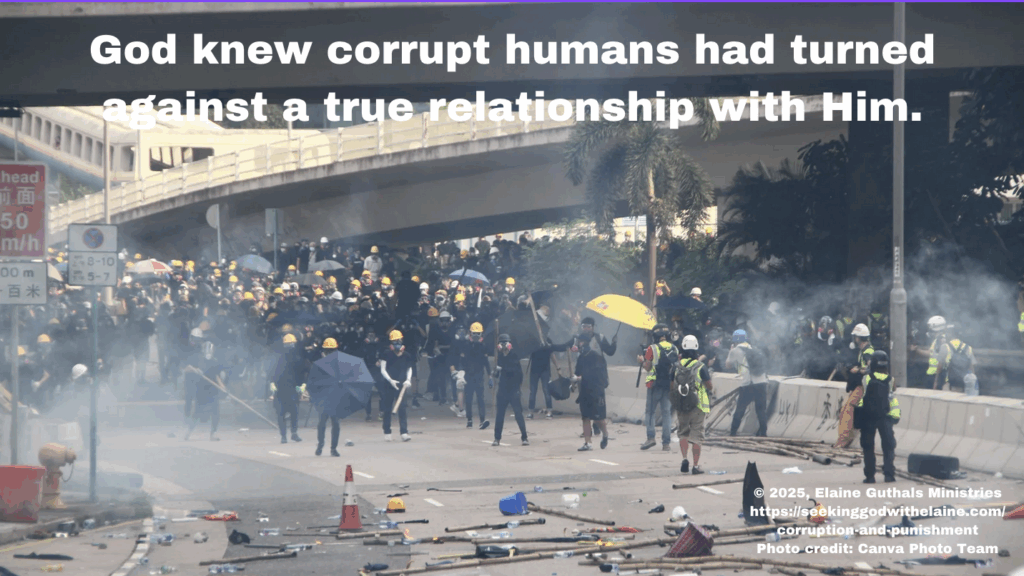
    God always sees what is happening — good or evil. He knew corrupt humans had turned against a true relationship with Him.

    But look at it another way. The way God sees it, anyone who breaks His laws and commandments is corrupt.

    Fuller said that this is a result of the marriages between sons of God and daughters of men (Gen. 6: 2). Satan’s influence corrupts humans.

    Resource

    In other words, compromising with the worldview corrupts disciples — which leads to the Church having corruption in it. We are still there today — maybe even worse than the Days of Noah.

    The perversion of God’s creation led to violence.

    Violence is an overarching terms for a lot of different acts. Smith gave us the list of oppression, tyranny, persecution of good men, injustice, and cruelty to expand on what those acts look like.

    Resource

    Worldview people want the power to keep doing whatever they want to do. Some try to repress any opposition to their way of thinking.

    They do this through mistreating those who think opposite of them. They do this through unfair treatment and being downright mean at times.

    Think how Noah would have been treated. He would have been laughed at, in the least. He probably was mocked and belittled.

    These are the actions people take. From where do they come?

    Some comes from selfishness. Those worldview people want what they want, and they don’t want anyone, especially God, to tell them what they can or can’t have and do.

    Maclaren expanded on that. He wrote, “When the bonds which knit society to God are relaxed, selfishness soon becomes furious, and forcibly seizes what it lusts after, regardless of others’ rights.”

    Resource

    The polar opposite of this corruption and violence is walking with God. The absence of God in our lives allows this corruption to enter us.

    Punishment for the Earth

    “So God said to Noah, ‘I have decided to destroy all living creatures, for they have filled the earth with violence. Yes, I will wipe them all out along with the earth!’” (Gen. 6: 13 NLT)

    God will allow this corruption and violence in His world only so long before He will mete out punishment.

    Ooo, baby. I bet Noah heard those words from God and went, “Wait! What????” Then he shook in his sandals.

    Maclaren explained what this sentence teaches us. He wrote, “A very profound truth, not only of the certain Divine retribution, but of the indissoluble connection of sin with destruction.”

    Resource

    God will pass judgment on our sin. It is in retribution for our disobedience. The ultimate judgment on sin is death and utter destruction.

    Yes, beginning at Adam and Eve’s disobedience in the Garden of Eden, death has always been a result of sin. Before Adam and Eve bit, there was no death.

    True, Adam’s physical death took 930 years to happen. God had already said that was going to change to 120 years (Gen. 6: 3).

    Spiritual death had already occurred. Faith and obedience reversed that.

    But we’ve already said that the corrupt world was not interested in following God. They wanted to continue on as they had been doing.

    God said, “No. I’m done.”

    What does the verse say? “Seek the Lord while you can find him. Call on him now while he is near” (Isa. 55: 6 NLT emphasis added).

    Look at this verse in Isaiah. “But the godless are like thorns to be thrown away, for they tear the hand that touches them. One must use iron tools to chop them down; they will be totally consumed by fire” (II Sam. 23: 6-7 NLT).

    Just as they did, we bring this punishment on ourselves.

    Time is going to run out. God isn’t always going to be near. Don’t be caught in an unsaved condition.

    But why did God punish all creation for the sins of humans? Kalisch reminded us that earth was what humans inhabited. He called it a witness, saying it wasn’t passive.

    Resource

    Earth is tied to humankind. It provided the building blocks for man. “Then the Lord God formed the man from the dust of the ground. He breathed the breath of life into the man’s nostrils, and the man became a living person” (Gen. 2: 7 NLT).

    But we have to remember that it was tied to humankind in the original sin. “And to the man he said, ‘Since you listened to your wife and ate from the tree whose fruit I commanded you not to eat, the ground is cursed because of you. All your life you will struggle to scratch a living from it. It will grow thorns and thistles for you, though you will eat of its grains’” (Gen. 3: 17-18 NLT).

    In other words, when humankind is punished for sin, the earth is, too.

    Making the Connections #1

    I love what Maclaren said. He wrote, “Sin is death in the making; death is sin finished.”

    Resource

    In the next couple of devotions, we are going to be talking about the fulfillment of a promise. God promised that, as soon as Noah was done building the ark, He would destroy the earth by flooding it. Everyone who and every animal that was not on the ark was going to die.

    That death was the result of sin.

    Punishment may be delayed (death in the making); but at some point, judgment will be passed. The sentence would be death (sin finished).

    God has promised never to destroy the world by a flood. But He has also promised to destroy this world. “And I saw a great white throne and the one sitting on it. The earth and sky fled from his presence, but they found no place to hide” (Rev. 20: 11 NLT).

    Right now, we are in the death-in-the-making stage. Soon, we are going to be in the sin-finished stage. The earth and sky will be destroyed.

    Those who have compromised with the worldview or flat out rejected God will be judged and sentenced to their punishment. “And anyone whose name was not found recorded in the Book of Life was thrown into the lake of fire” (Rev. 20: 15 NLT).

    Ooo, baby. This is a big threat (but it really is a promise). It is going to happen.

    At the same time, there is a promise of deliverance. Those who walk with God in faith and obedience will be delivered from this sentence. Anyone who has made a genuine profession of faith and lived for God will not face this punishment. They will be rewarded with eternal life.

    God has made a way to escape. It is called the Plan of Salvation.

    Making the Connections #2

    Let’s go back to what Kalisch was saying. He wrote,

    “The earth is, in the Bible, not considered as a mere passive object; it is the habitation of man; it beholds his deeds of virtue and of baseness; it is, therefore, like the eternal heavens, invoked as a witness in solemn exhortations; it cries up to heaven if it is soiled with blood; it ‘vomits out’ the wicked inhabitants.”

    Resource

    The blood cried up to God. That is what Abel’s did. “But the Lord said, ‘What have you done? Listen! Your brother’s blood cries out to me from the ground!’” (Gen. 4: 10 NLT).

    Do we think Abel’s was the only blood to do that? With the world so corrupt and violent as it was, it probably had a countless number of God’s children’s blood crying up to Him.

    I wonder if this is just martyrs or those killed. Or does all of His children’s blood call go up to Him upon our death?

    I know that the omnipotent God knows exactly when we are going to die. But I wonder if He waits to get the call of the blood before He sends the angels to pick us up.

    I can see our blood crying out to the Father to bring us home.

    How Do We Apply This?

    The ABCDs of Salvation

    If you have not become a believer in Christ, please read through the
    Plan of Salvation and prayerfully consider what God is asking you to do.

    A – admit our sins
    B – believe His Son Jesus is our Redeemer
    C – confess God as Sovereign Lord

    D – demonstrate that commitment by making any changes needed in our lives to live the way in which God has called us

    The Disciple’s Job Description

    Father God. The only way to counteract our sinful nature is to believe in and confess to You. Lord, help us to walk with You. Amen.

    What do you think?

    Leave me a comment below (about this or anything else) or head over to my Facebook group for some interactive discussion.

    If you don’t understand something and would like further clarification, please contact me.

    If you have not signed up for the email providing the link to the devotions and the newsletter, do so below.

    If God has used this devotion to speak with you, consider sharing it on social media.
  • The Story of Noah

    The story of Noah in the ark is interesting. This devotional reading looks at the most important element of the story — why Noah was the one in the ark.

    Nuggets

    • Only Noah had remained faithful to God.
    • Noah was “… a righteous man” (Gen. 6: 9 NLT).
    • We are “… [a] blameless person …” (Gen. 6: 9 NLT) when we seek God.
    • We “… [walk] in close fellowship with God” (Gen. 6: 9 NLT) when we submit our lives to Him.
    • While there were other passengers than Noah on the ark, they were not credited as being blameless as Noah was.
    the-story-of-noah

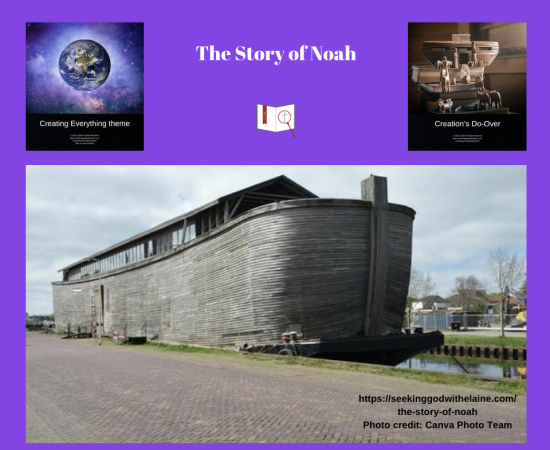
    We now get to one of the greatest Hall of Famers of the Old Testament – Noah. His story is familiar to many people, even if they don’t know much else about the Bible.

    I have to tell you. God has opened my eyes to several things that I hadn’t even thought to consider before.

    Let’s Put It into Context

    To read devotions in the Creating Everything theme, click the button below.

    Devotions in the Creation’s Do-Over series

    Noah

    “But Noah found favor with the Lord. This is the account of Noah and his family. Noah was a righteous man, the only blameless person living on earth at the time, and he walked in close fellowship with God” (Gen. 6: 8-9 NLT)

    Only Noah had remained faithful to God.

    There was a silver lining to the increasing corruption of the world. Noah remained a righteous man.

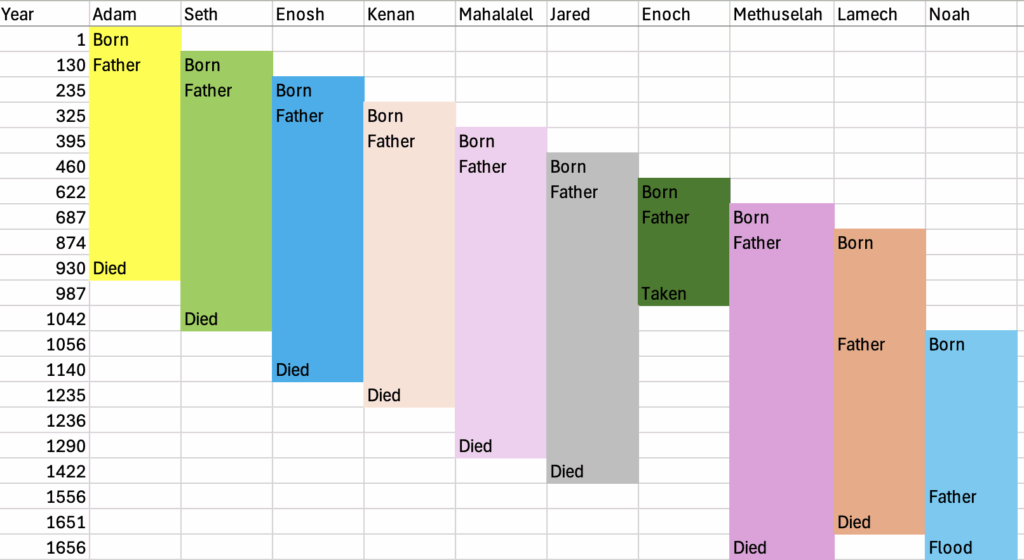
    We’ve talked a little about Noah before. He was the grandson of Methuselah and the great-grandson of Enoch.

    Remember, Methuselah meant when he dies, it will come. Well, Methuselah is dead.

    It was coming. It was the flood.

    But let’s not get ahead of ourselves. We need to learn a little more about Noah.

    We find favor with God when we have faith and obey Him.

    There are three different ways in which Moses, the writer of Genesis, indicated how Noah found favor with God.

    Righteous

    Noah was “… a righteous man” (Gen. 6: 9 NLT).

    Righteousness is one of those churchy words. It is a very important element in walking with God.

    But what does it mean? Let’s look how God’s Word to see what it says.

    “God blesses those who hunger and thirst for justice, for they will be satisfied” (Mt. 5: 6 NLT). Ooops.

    Well, that is sort of what we are trying to get. Justice is bringing order back to God’s creation so that all people receive the rewards He has for His children.

    Righteousness is a part of the order God is trying to restore.

    We want to come back to a relationship with God and be more like Him. But that is more the how and the what.

    What is righteousness? Righteousness is the comprehension of a kinship with God where we understand that we were not only made in His image but that we also have to have His character.

    Let’s try that verse again. “Blessed are those who hunger and thirst for righteousness, for they shall be satisfied” (Mt. 5: 6 ESV).

    What are some other verses?

    • “This Good News tells us how God makes us right in his sight. This is accomplished from start to finish by faith. As the Scriptures say, ‘It is through faith that a righteous person has life’” (Rom. 1: 17 NLT emphasis added).
    • “But now God has shown us a way to be made right with him without keeping the requirements of the law, as was promised in the writings of Moses and the prophets long ago. We are made right with God by placing our faith in Jesus Christ. And this is true for everyone who believes, no matter who we are” (Rom. 3: 21-22 NLT emphasis added).
    • “The Lord is more pleased when we do what is right and just than when we offer him sacrifices” (Prov. 21: 3 NLT emphasis added).
    • “The eyes of the Lord watch over those who do right, and his ears are open to their prayers. But the Lord turns his face against those who do evil” (I Pet. 3: 12 NLT emphasis added).
    • “There is joy for those who deal justly with others and always do what is right” (Ps. 106: 3 NLT emphasis added).
    • “Little children, let no one deceive you. Whoever practices righteousness is righteous, as he is righteous” (I Jn. 3: 7 NLT emphasis added).

    We have to remember this isn’t talking about right and wrong. This is talking about doing what and being who God is. It is having God in us.

    Kingsley explained it this way. He wrote,

    “Noah and Abraham believed God, and so became heirs of the righteousness which is by faith; not their own righteousness, not growing out of their own character, but given them by God, who puts His righteous Spirit into those who trust in Him.”

    Resource

    Righteousness doesn’t have anything to do with any human characteristic — being right. It doesn’t come from our actions — doing right.

    Righteousness comes to God’s children from Him through His Holy Spirit.

    Blameless

    We are “… [a] blameless person …” (Gen. 6: 9 NLT) when we seek God.

    The King James Version did us no favors when it translated blameless as perfect. He wasn’t just a man of flawless integrity.

    No, blameless doesn’t mean we will no longer sin. Blameless means we are aware we are sinners and look to God for salvation, asking Him for forgiveness that doesn’t hold us accountable for those sins. When we ABCD, our sins will be forgiven, and we will be held blameless.

    A blameless person displays the fruit of the Spirit in life. “But the Holy Spirit produces this kind of fruit in our lives: love, joy, peace, patience, kindness, goodness, faithfulness, gentleness, and self-control. There is no law against these things!” (Gal. 5: 22-23 NLT).

    A huge element of being blameless is being patient. We have to wait on God to show us His Will and to do His Will.

    We have to talk about something. Noah is said to be there only one who was found blameless.

    Where was the rest of Noah’s family? He had to have had brothers and sisters alive.

    Pastor Steve has been reading a book that estimated there were a million people alive then. Surely, he had a lot of cousins in there.

    With Methuselah around, you would think they all had a similar role model.

    Why wasn’t the rest of Noah’s family blameless?

    It goes back to our relationship with God is an individual decision. We can’t coast on our parents’ laurels. We have to decide — and live — for God on our own.

    But that also brings up another point. God will always have His remnant.

    • “No, God has not rejected his own people, whom he chose from the very beginning. Do you realize what the Scriptures say about this? Elijah the prophet complained to God about the people of Israel and said, ‘LORD, they have killed your prophets and torn down your altars. I am the only one left, and now they are trying to kill me, too.’ And do you remember God’s reply? He said, ‘No, I have 7,000 others who have never bowed down to Baal!’ It is the same today, for a few of the people of Israel have remained faithful because of God’s grace—his undeserved kindness in choosing them” (Rom. 11: 2-5 NLT).
    • “In that day the remnant left in Israel, the survivors in the house of Jacob, will no longer depend on allies who seek to destroy them. But they will faithfully trust the LORD, the Holy One of Israel. A remnant will return; yes, the remnant of Jacob will return to the Mighty God.But though the people of Israel are as numerous as the sand of the seashore, only a remnant of them will return. The LORD has rightly decided to destroy his people” (Isa. 10: 20-22 NLT).
    • “But I will gather together the remnant of my flock from the countries where I have driven them. I will bring them back to their own sheepfold, and they will be fruitful and increase in number. Then I will appoint responsible shepherds who will care for them, and they will never be afraid again. Not a single one will be lost or missing. I, the LORD, have spoken!” (Jer. 23: 3-4 NLT).

    It is easy to see this as God will always have His people. No, God will always have a group of righteous, blameless sons and daughters who are walking in close fellowship with Him.

    That would also create a lonely atmosphere for Noah. Sure, he had companionship, especially with other family members.

    But Noah wouldn’t have much in common with the men of violence (Gen. 6: 11).

    Walked in Close Fellowship

    We “… [walk] in close fellowship with God” (Gen. 6: 9 NLT) when we submit our lives to Him.

    Enoch walked in close fellowship with God for 300 years of his life. “After the birth of Methuselah, Enoch lived in close fellowship with God for another 300 years, and he had other sons and daughters” (Gen. 5: 22 NLT).

    Enoch would have taught Methuselah, and Methuselah would have taught Lamech and Noah.

    We had a long list of what it meant to walk with God. To summarize, it means we continually think about God, follow His laws and commandments, exhibit spiritual graces, and continue on the Sanctification Road.

    The focus isn’t on the outward walk — our actions. It is on our inward relationship with God.

    We do not have true righteousness if we do not communicate with God.

    If the inward is right, the outward follows suit. We are not pretentious or vain. We are sincere.

    Noah was a well-rounded person in his relationship with God. As Maclaren said, he continued to sin.

    Resource

    It means we are not perfected — yet. What perfect means is that we are maturing. That suggests our close fellowship with God is growing closer.

    Other Ark Passengers

    “Noah was the father of three sons: Shem, Ham, and Japheth” (Gen. 6: 10 NLT)

    While there were other passengers than Noah on the ark, they were not credited as being blameless as Noah was.

    We have heard a little about Noah’s sons. “After Noah was 500 years old, he became the father of Shem, Ham, and Japheth” (Gen. 5: 32 NLT).

    Yeah, it sounds like they were triples. It wasn’t written as it was for Lamech’s sons. “Adah gave birth to Jabal, who was the first of those who raise livestock and live in tents. His brother’s name was Jubal, the first of all who play the harp and flute. Lamech’s other wife, Zillah, gave birth to a son named Tubal-cain. He became an expert in forging tools of bronze and iron. Tubal-cain had a sister named Naamah” (Gen. 4: 20-22 NLT).

    If Jabal and Jabal would have been twins, I think Moses would have written it more in the line of how Noah’s sons were born.

    But let’s focus on Noah’s sons. Maclaren stated their importance. He wrote, “Learn, too, that the true place for the saint is ‘in his generations.’”

    Resource

    Disciples are charged to teach others. “Therefore, go and make disciples of all the nations, baptizing them in the name of the Father and the Son and the Holy Spirit. Teach these new disciples to obey all the commands I have given you. And be sure of this: I am with you always, even to the end of the age” (Mt. 28: 19-20 NLT).

    We must first and foremost testify to our families. It is their choice whether or not to submit to God, but it is our duty as disciples to try to make disciples of our sons and daughters.

    Burns called Noah an unsuccessful preacher. No.

    Resource

    Disciples are called to be obedient in all that God has for us to do. If we do as we are called, we are successful. The outcome isn’t on us.

    We aren’t the ones to save people. We witness; they listen and make their choice. But God is the only One to forgive and save them.

    Noah may have been the only one to be blameless, but his three sons and their wives along with Mrs. Noah benefited. Did they get an ark ride because of Noah or because they were maturing correctly on the Sanctification Road?

    Does this mean there are blameless sheep and saved sheep – two levels of those who are called God’s children?

    Did Noah have other kids? If he and Mrs. Noah did, they didn’t get the same ticket.

    Were the other kids goats masquerading in sheep’s clothing? Or were they just plain wicked?

    Hughes addressed this. He wrote, “The holiest parent cannot bring forth a holy seed; that is, born of grace. Noah could not. … In the visible Church may be such as are not saints, indeed; but far from it. … Mixtures in the Church not destructive to its being, were permitted not to divide, but to put them upon purging it.”

    Resource

    That is different from what I’ve always been taught. I am taught we are all saints.

    I know. I sure don’t feel like one – yet. We do still sin in this life.

    If Noah was 500 when the triplets were born and 600 when the flood came, the triplets were 100 years old. All three were married, but it doesn’t say kids came with them.

    Did they not have kids yet, or were the kids too wicked? Was God waiting until post-flood to give them kids so they would repopulate the earth?

    I know. I am throwing out questions again for which I don’t really have answers. But I do feel we should think about this.

    Making the Connections #1

    Kingsley gave a great observation contrasting the wicked world and righteous Noah. He wrote,

    “The Bible gives us a picture of the old world before the flood — a world of men mighty in body and mind, fierce and busy, conquering the world round them, in continual war and turmoil; with all the wild passions of youth, and yet all the cunning and experience of enormous old age; everyone guided only by self-will, having cast off God and conscience, and doing every man that which was right in the sight of his own eyes. And amidst all this Noah was steadfast; he at least knew his way; he ‘walked with God, a just man and perfect in his generations.’”

    Resource

    The world was guided by self-will, and Noah was guided by God.

    That is what God requires of us today. Disciples are to be in the world but not of the world. He wants us to be be different from them.

    We clearly see here that God has His eye on both — those who follow Him and those who don’t. God will offer salvation to those who have not totally rejected Him.

    Making the Connections #2

    Maclaren gave us some insight into what Matthew 7: 21-23 means to disciples. “Not everyone who calls out to me, ‘Lord! Lord!’ will enter the Kingdom of Heaven. Only those who actually do the will of my Father in heaven will enter. On judgment day many will say to me, ‘Lord! Lord! We prophesied in your name and cast out demons in your name and performed many miracles in your name.’ But I will reply, ‘I never knew you. Get away from me, you who break God’s laws.’” (Mt. 7: 21-23 NLT).

    We may think that applies only to Church leadership. No.

    Listen to what Maclaren said. He wrote,

    “He does not grudge commendation, but takes account of the deepest desires and main tendencies of a life, and sees the germ as a full-blown flower, and the bud as a fruit. Learn, too, that solitary goodness is possible. Noah stood uninfected by the universal contagion; and, as is always the case, the evil around, which he did not share, drove him to a more rigid abstinence from it.”

    Resource

    What is our focus? What are the priorities of our lives? Is it God?

    Or have we compromised with the worldview? Do we try to rewrite God’s laws? Do we say they do not apply to today’s society?

    Go back to what we said about a remnant. God will always have a group of righteous, blameless sons and daughters who are walking in close fellowship with Him.

    We don’t think the remnant will be within the Church itself. But it is going to be.

    How Do We Apply This?

    • Continue to walk with God so that we are righteous and blameless through Him.
    • Follow God — even when those around us don’t.
    • Keep in constant communication with God.
    • Perform the duties required of us by God.
    • Don’t compromise with the worldview.
    • Be sure of our inward transformation.
    • Resist and oppose sin.
    • Fulfill our marching orders.

    Resources

    Father God. Thank You that faith and obedience are rewarded. Let us have the faith and obedience that Noah did. Amen.

    What do you think?

    Leave me a comment below (about this or anything else) or head over to my Facebook group for some interactive discussion.

    If you don’t understand something and would like further clarification, please contact me.

    If you have not signed up for the email providing the link to the devotions and the newsletter, do so below.

    If God has used this devotion to speak with you, consider sharing it on social media.
  • Corruption Spread on Earth

    After discussing Cain and Seth’s lines separately, it is time to combine the discussion. This devotional reading begins to set up the state of the earth pre-flood.

    Nuggets

    • God sees everything, so He saw how sinful mankind had become.
    • The people in the days of Noah had made the choice and continued to choose wickedness — so they would suffer the consequences.
    corruption-spread-on-earth

    In discussing the righteousness of Seth’s line and the wickedness of Cain’s line, we really don’t get an idea of how many people that represented.

    We did discuss that, leaving Enoch out of the mix, the men lived 895 to 969 years. That would have left ample time to have many sons and daughters, especially if some were multiple births.

    Unfortunately, the world became really corrupted after the original sin.

    Let’s Put It into Context

    To read devotions in the Creating Everything theme, click the button below.

    Devotions in the Creation’s Do-Over series

    Increasing Corruption

    “The Lord observed the extent of human wickedness on the earth, and he saw that everything they thought or imagined was consistently and totally evil” (Gen. 6: 5 NLT )

    God sees everything, so He saw how sinful mankind had become.

    God may no longer have “physically” revealed Himself to humans pre-flood, but He saw them. That is part of His divine nature.

    How humankind had fallen since their days in the Garden of Eden! “When I look at the night sky and see the work of your fingers — the moon and the stars you set in place — what are mere mortals that you should think about them, human beings that you should care for them? Yet you made them only a little lower than God and crowned them with glory and honor” (Ps. 8: 3-5 NLT).

    The wickedness would have probably started out as neglecting the Sabbath and public worship. We remember in Genesis 4: 26, Seth and Enosh started worshiping God.

    I doubt that Seth and Enosh’s worship service looked anything at all like ours do. What theirs looked like is something that has to go into the UNR book – understanding not required.

    We said previously that the line of Seth chose righteousness while the line of Cain chose worldly things. Three of Cain’s descendants are credited with inventions. The only mention of Seth’s descendants other than numbers was Enoch’s walking with God.

    Cain’s descendants chose ambition while Seth’s descendants chose righteousness.

    But some of Seth’s descendants would have turned away from God, also. Had to have, but we’ll get into that in a couple of chapter

    Since Cain separated from God, he would not have been worshiping God. That allowed their rapid descent into wickedness.

    Sin had branched out from just disobeying God. Now it included, according to Gray, pride, sensuality, and idolatry.

    Resource

    Boston told us what happened. He wrote,

    “The will, that commanding faculty, which at first was faithful and ruled with God, is now turned traitor and rules with and for the devil. God planted it in man ‘wholly a right seed,’ but now it is ‘turned into the degenerate plant of a strange vine.’”

    Resource

    Wickedness was widespread on the earth. This was everyone – what would later be known as Jew and Gentile.

    Yep. Everyone has a sinful heart. “For from the heart come evil thoughts, murder, adultery, all sexual immorality, theft, lying, and slander” (Mt. 15: 19 NLT).

    Several passages in God’s Word address our sinful nature.

    • “As the Scriptures say, ‘No one is righteous — not even one. No one is truly wise; no one is seeking God. All have turned away; all have become useless. No one does good, not a single one’” (Rom. 3: 10-12 NLT).
    • “Only fools say in their hearts, ‘There is no God.’ They are corrupt, and their actions are evil; not one of them does good! God looks down from heaven on the entire human race; he looks to see if anyone is truly wise, if anyone seeks God. But no, all have turned away; all have become corrupt. No one does good, not a single one!” (Ps. 53: 1-3 NLT).
    • “Sin whispers to the wicked, deep within their hearts. They have no fear of God at all. In their blind conceit, they cannot see how wicked they really are” (Ps. 36: 1-2 NLT).
    • “Their feet run to do evil, and they rush to commit murder. They think only about sinning. Misery and destruction always follow them. They don’t know where to find peace or what it means to be just and good. They have mapped out crooked roads, and no one who follows them knows a moment’s peace” (Isa. 59: 7-8 NLT).

    Make no mistake about it. Sin only comes from one place – Satan.

    God didn’t like what He saw on the earth. Verse 6 says that “… It broke his heart” (Gen. 6: 6 NLT) that He had made humankind in the first place.

    People were living corrupt lives. They were not following God’s laws and commandments.

    Remember, Cain — the cursed son of Adam and Eve — built the first city. “… Then Cain founded a city, which he named Enoch, after his son” (Gen. 4: 17 NLT)Cities can be a breeding place for certain ideas to flourish. Good can flourish in some places; evil can flourish in others.

    We can look at this as a worldview society promotes the spread of evil. At a minimum, that society allows the evil to take hold. At maximum, that hold is encouraged and even fostered.

    Fuller argued that it was just a product of population expansion. Maybe.

    Resource

    How many times have we rationalized sin by saying it was the norm? “Everyone” was doing it.

    That isn’t right, though. Even if the majority of people commit the sin, that doesn’t make it any less a sin.

    We each make our own choice whether to follow God or follow Satan. If we aren’t doing it God’s way, we have chosen and are following Satan.

    God knew before the foundation of the world that mankind would sin. He created us anyway.

    But being godly is an individual choice that starts with the heart. Wickedness is an individual thing — our own choice. We can’t blame our ungodliness on society.

    Gray noted that, if it starts at the heart, it must be the whole package. He wrote, “the heart includes ‘conscience and consciousness, will and desire, intellect and emotion, understanding and affection.’”

    Resource

    So, when God says He want our hearts, He means all of us.

    Too often, pride and anger take up so much room in our hearts that there is no room for God.

    Instead of those emotions, we should focus on gratitude for all that God has done for us. We should humbly fear God. Remember, fear of the Lord is reverencing Him.

    The people in the days of Noah were not trying to please God and simply failing. They had chosen not to please Him.

    I Will Wipe this Race from the Earth

    “So the Lord was sorry he had ever made them and put them on the earth. It broke his heart. And the Lord said, ‘I will wipe this human race I have created from the face of the earth. Yes, and I will destroy every living thing — all the people, the large animals, the small animals that scurry along the ground, and even the birds of the sky. I am sorry I ever made them’” (Gen. 6: 6-7 NLT)

    The people in the days of Noah had made the choice and continued to choose wickedness — so they would suffer the consequences.

    Can God feel human emotion, or is this just us humanizing Him? No, He can’t so, we are.

    Then why does God’s Word say He gets angry, feels joy, and feels sorrow? Well, if those were His emotions, then God would change.

    God never changes.

    • “I am the Lord, and I do not change. That is why you descendants of Jacob are not already destroyed” (Mal. 3: 6 NLT).
    • “Jesus Christ is the same yesterday, today, and forever” (Heb. 13: 8 NLT).
    • “The grass withers and the flowers fade, but the word of our God stands forever” (Isa. 40: 8 NLT).
    • “God is not a man, so he does not lie. He is not human, so he does not change his mind. Has he ever spoken and failed to act? Has he ever promised and not carried it through?” (Num. 23: 19 NLT).
    • “Whatever is good and perfect is a gift coming down to us from God our Father, who created all the lights in the heavens. He never changes or casts a shifting shadow” (Jas. 1: 17 NLT).
    • “Your eternal word, O LORD, stands firm in heaven” (Ps. 119: 89 NLT).
    • “But you are always the same; you will live forever” (Ps. 102: 27 NLT).

    Not changing is just part of God’s nature.

    When we talked about the attributes of God, we said He has attributes of wrath, jealousy, immutability, love, grace, and mercy. I can see anger, joy, and sorrow being expressions of those attributes.

    We don’t want to humanize God. He is Sovereign Lord — divine, not human. He doesn’t have human emotions.

    God is not our favorite uncle. He does not look at things our way.

    “‘My thoughts are nothing like your thoughts,’ says the Lord. ‘And my ways are far beyond anything you could imagine. For just as the heavens are higher than the earth, so my ways are higher than your ways and my thoughts higher than your thoughts” (Isa. 55: 8-9 NLT).

    But what do we do when we bring God down to our level? We start to think humans are gods.

    That is logical. We need to worship something. If it isn’t God, it is other humans or even ourselves.

    Bottom line, when we do this, we are minimizing sin. We replace God’s laws and commandments with human standards.

    Did God know He would do a complete redo before the foundation of the world? Did He know how much it would grieve Him?

    Yes, and yes.

    God made us anyway. But then He was fixing to do something about it.

    Making the Connections

    Let’s go back to the heart being evil. Simeon addressed this. He wrote,

    “Every species of wickedness was committed in the most shameless manner. But more particularly, “the hearts” of men were evil; “the thoughts” of their hearts were evil; “the imaginations” of the thoughts were evil, and this too without exception, without mixture, without intermission; for every imagination was evil, and “only” evil, and that continually.”

    Resource

    Repeatedly Filed to Reach the Mark

    Since we have sin in us, we are not righteous. “But no, all have turned away; all have become corrupt. No one does good, not a single one!” (Ps. 14: 3 NLT).

    Even disciples continue to sin after conversion. “If we claim we have no sin, we are only fooling ourselves and not living in the truth. But if we confess our sins to him, he is faithful and just to forgive us our sins and to cleanse us from all wickedness. If we claim we have not sinned, we are calling God a liar and showing that his word has no place in our heart” (I Jn. 1: 8-10 NLT).

    That means we repeatedly sin.

    Wait! What???? How does that mesh with I John 3: 6?

    “Anyone who continues to live in him will not sin. But anyone who keeps on sinning does not know him or understand who he is” (I Jn. 3: 6 NLT).

    It comes down to whether the sin was intentional or unintentional. We have to stifle the desire of sin.

    • “So watch yourselves! If another believer sins, rebuke that person; then if there is repentance, forgive. Even if that person wrongs you seven times a day and each time turns again and asks forgiveness, you must forgive” (Lk. 17: 3-4 NLT).
    • “Sin is no longer your master, for you no longer live under the requirements of the law. Instead, you live under the freedom of God’s grace” (Rom. 6: 14 NLT).
    • “Dear friends, if we deliberately continue sinning after we have received knowledge of the truth, there is no longer any sacrifice that will cover these sins” (Heb. 10: 26 NLT).

    Every Part Permeated with Sin

    It is hard cutting out the desire to sin. Sin is in every part of us.

    • “So letting your sinful nature control your mind leads to death. But letting the Spirit control your mind leads to life and peace. For the sinful nature is always hostile to God. It never did obey God’s laws, and it never will. That’s why those who are still under the control of their sinful nature can never please Gody” (Rom. 8: 6-8 NLT).
    • “But I say, anyone who even looks at a woman with lust has already committed adultery it’s her in his heart” (Mt. 5: 28 NLT).
    • “A grip goes around telling secrets, so don’t hang around with chatterers” (Prov. 20: 19 NLT).
    • “There are six things the LORD hates — no, seven things he detests: haughty eyes, a lying tongue, hands that kill the innocent, a heart that plots evil, feet that race to do wrong, a false witness who pours out lies, a person who sows discord in a family” (Prov. 6: 16-19 NLT).
    • “You must not testify falsely against your neighbor” (Ex. 20: 16 NLT).”
    • “And I tell you this, you must give an account on judgment day for every idle word you speak” (Mt. 12: 36 NLT).
    • “Gentle words are a tree of life; a deceitful tongue crushes the spirit” (Prov. 15: 4 NLT).
    • “Too much talk leads to sin.  Be sensible and keep your mouth shut” (Prov. 10: 19 NLT).
    • “A truly wise person uses few words; a person with understanding is even-tempered” (Prov. 17: 27 NLT).
    • “And among all the parts of the body, the tongue is a flame of fire. It is a whole world of wickedness, corrupting your entire body. It can set your whole life on fire, for it is set on fire by hell itself” (Jas. 3: 6 NLT).
    • “You brood of snakes! How could evil men like you speak what is good and right? For whatever is in your heart determines what you say” (Mt. 12: 34 NLT).
    • “The tongue can bring death or life; those who love to talk will reap the consequences” (Prov. 18: 21 NLT).

    How do we combat that?

    “We destroy every proud obstacle that keeps people from knowing God. We capture their rebellious thoughts and teach them to obey Christ” (II Cor. 10: 5 NLT).

    Sin Produces Devastating Results

    We don’t want the consequences of sin.

    • “For the wages of sin is death, but the free gift of God is eternal life in Christ Jesus our Lord” (Rom. 6: 23 NLT).
    • “Don’t be misled — you cannot mock the justice of God. You will always harvest what you plant. Those who live only to satisfy their own sinful nature will harvest decay and death from that sinful nature. But those who live to please the Spirit will harvest everlasting life from the Spirit” (Gal. 6: 7-8 NLT).
    • “It’s your sins that have cut you off from God Because of your sins, he has turned away and will not listen anymore” (Isa. 59: 2 NLT).
    • “For God did not spare even the angels who sinned. He threw them into hell, in gloomy pits of darkness, where they are being held until the day of judgment. And God did not spare the ancient world—except for Noah and the seven others in his family. Noah warned the world of God’s righteous judgment. So God protected Noah when he destroyed the world of ungodly people with a vast flood. Later, God condemned the cities of Sodom and Gomorrah and turned them into heaps of ashes. He made them an example of what will happen to ungodly people. But God also rescued Lot out of Sodom because he was a righteous man who was sick of the shameful immorality of the wicked people around him. Yes, Lot was a righteous man who was tormented in his soul by the wickedness he saw and heard day after day. So you see, the Lord knows how to rescue godly people from their trials, even while keeping the wicked under punishment until the day of final judgment. He is especially hard on those who follow their own twisted sexual desire, and who despise authority” (II Pet. 2: 4-10 NLT).

    God’s Law Convicts Man of Sin

    Yes, we still have God’s laws and commandments. They have nothing to do about salvation.

    • “For by works of the law no human being will be justified in his sight, since through the law comes knowledge of sin” (Rom. 3: 20 NLT).
    • “Let me put it another way. The law was our guardian until Christ came; it protected us until we could be made right with God through faith” (Gal. 3: 24 NLT).
    • “The law of Moses was unable to save us because of the weakness of our sinful nature. So God did what the law could not do. He sent his own Son in a body like the bodies we sinners have. And in that body God declared an end to sin’s control over us by giving his Son as a sacrifice for our sins” (Rom. 8: 3 NLT).

    This solidifies the fact that we cannot gain salvation by being a good person and doing the do’s and not doing the don’ts. We only gain salvation through admitting we are sinners, believing in Jesus as our Savior and Redeemer, confessing God as Sovereign Lord, and demonstrating our commitment to God by being submitting and obedient to Him.

    How Do We Apply This?

    • Live a life of purity.
    • Watch with who we align ourselves.
    • Pay attention to the convictions of the Holy Spirit.
    • Humbly, show our gratitude and reverence to God.

    Resources

    Father God. You have told us exactly how we are to live our live. We are to walk with You, not as the corrupt world walks. Help us to do that. Amen.

    What do you think?

    Leave me a comment below (about this or anything else) or head over to my Facebook group for some interactive discussion.

    If you don’t understand something and would like further clarification, please contact me.

    If you have not signed up for the email providing the link to the devotions and the newsletter, do so below.

    If God has used this devotion to speak with you, consider sharing it on social media.
  • How Long Will God Put Up with Us?

    God had commanded that humans should multiply and fill the earth. This devotional reading looks at how that went even more astray.

    Nuggets

    • The earth was filled with those who walked with God and those who didn’t.
    • God’s spirit strives within us.
    how-long-will-god-put-up-with-us

    How did the people get from living and walking with God to mass wickedness? Let’s start looking into that.

    Let’s Put It into Context

    To read devotions in the Creating Everything theme, click the button below.

    Devotions in the Creation’s Do-Over series

    Go Forth and Multiply

    “Then the people began to multiply on the earth, and daughters were born to them. The sons of God saw the beautiful women and took any they wanted as their wives. Then the Lord said, ‘My Spirit will not put up with humans for such a long time, for they are only mortal flesh. In the future, their normal lifespan will be no more than 120 years.’ In those days, and for some time after, giant Nephilites lived on the earth, for whenever the sons of God had intercourse with women, they gave birth to children who became the heroes and famous warriors of ancient times” (Gen. 6: 1-4 NLT)

    The earth was filled with those who walked with God and those who didn’t.

    We’ve talked about how Cain and Seth both did their part in multiplying on the earth. While only one son is mentioned by name in both lines, I am sure that both had other sons and daughters — even though that is only documented in Seth’s line.

    In fact, we know that is true because of verse 2 — which we also have already talked about. We wondered whose daughter Mrs. Cain was.

    We also talked about who the sons of God and who the daughters of men are — their children being the Nephilim. The Anakim (descendants of Anak) were also the descendants of the Nephilim. So the way I see it, the Nephilim is like their race (mixed race giants) with the Anakim being a specific branch of the family tree.

    Geikie had another take. He thought it was intermarriage between those practicing idolatry and the chosen people. In other words, those of the line of Seth/sons of God (Godview) marrying those of the line of Cain/daughters of men (worldview).

    Resource

    The difference lies in the moral character. No, not being a good person but walking with God as someone made in His image. We have Enoch’s walk with God and Jesus’ life in which to model our lives.

    Not Put Up with Humans

    “Then the Lord said, ‘My Spirit will not put up with humans for such a long time, for they are only mortal flesh. In the future, their normal lifespan will be no more than 120 years’” (Gen. 6: 3 NLT)

    God’s spirit strives within us.

    God gave humankind the breath of life, creating a dual existence. “Then the LORD God formed the man from the dust of the ground. He breathed the breath of life into the man’s nostrils, and the man became a living person” (Gen. 2: 7 NLT).

    God created a lifeless body and animated it by breathing the spirit of life in us.

    I don’t see this as the Holy Spirit. It can’t be because the Holy Spirit because, in the Old Testament, the Holy Spirit was on but not in people.

    Only at Pentecost did the Holy Spirit enter us. “On the day of Pentecost all the believers were meeting together in one place. Suddenly, there was a sound from heaven like the roaring of a mighty windstorm, and it filled the house where they were sitting. Then, what looked like flames or tongues of fire appeared and settled on each of them. And everyone present was filled with the Holy Spirit and began speaking in other languages, as the Holy Spirit gave them this ability” (Ac. 2: 1-4 NLT).

    God putting up with us is an interesting translation. The Orthodox Jewish Bible translated it as striving. In other words, God wasn’t going to continue to fight us.

    It looks like God has done what He said.

    When we talk about the days of Noah, we see that as the lawlessness of the land. Instead, it was also God pulling His hand away.

    Think about it.

    • “When the Son of Man returns, it will be like it was in Noah’s day” (Mt. 24: 37 NLT).
    • “So he went and preached to the spirits in prison — those who disobeyed God long ago when God waited patiently while Noah was building his boat. Only eight people were saved from drowning in that terrible flood” (I Pet. 3: 19-20 NLT).

    When we think about the days of Noah, we like to think about God waiting patiently around a hundred years to get the ark built. But prior to that, God had been pulling back His hand.

    As we look back in our history, don’t we see God pulling back His hand? Don’t worldview people argue there is no God because He isn’t slapping them down?

    Finney told us what it looks like when God is striving in us.

    • We recognize unrest in our souls.
    • We know we have sinned.
    • We feel guilt for our sins.
    • We seek God only through salvation through Jesus.

    Resource

    What I disagreed with Finney was when he said God’s withdrawal would be individually, not from humankind as a whole. Wrong. We see that He has gradually been withdrawing from humankind.

    Isn’t that so sad? We will ignore sin, therefore ignore the guilt and unrest within us. We will refuse Jesus.

    Can we spell Day of the Lord?

    • “But when the Son of Man comes in his glory, and all the angels with him, then he will sit upon his glorious throne. All the nations will be gathered in his presence, and he will separate the people as a shepherd separates the sheep from the goats. He will place the sheep at his right hand and the goats at his left” (Mt. 25: 31-33 NLT).
    • “And anyone whose name was not found recorded in the Book of Life was thrown into the lake of fire” (Rev. 20: 15 NLT).
    • “Not everyone who calls out to me, ‘Lord! Lord!’ will enter the Kingdom of Heaven. Only those who actually do the will of my Father in heaven will enter. On judgment day many will say to me, ‘Lord! Lord! We prophesied in your name and cast out demons in your name and performed many miracles in your name.’ But I will reply, ‘I never knew you. Get away from me, you who break God’s laws” (Mt. 7: 21-23 NLT).

    But let’s say it is individual. Genesis 6: 3 speaks to whether God will always extend salvation to us, or whether there is a time when He will stop offering salvation.

    There seems to be conflicting verses about this. Some say God will never leave us. Others say we have a time limit to seek Him.

    • “It is the Lord who goes before you. He will be with you; he will not leave you or forsake you. Do not fear or be dismayed” (Deut. 31: 8 ESV).
    • “Keep your life free from love of money, and be content with what you have, for he has said, ‘I will never leave you nor forsake you’” (Heb. 13: 5 ESV).
    • “Be strong and courageous. Do not fear or be in dread of them, for it is the Lord your God who goes with you. He will not leave you or forsake you” (Deut. 31: 6 ESV).
    • “No man shall be able to stand before you all the days of your life. Just as I was with Moses, so I will be with you. I will not leave you or forsake you” (Josh. 1: 5 ESV).
    • “Fear not, for I am with you; be not dismayed, for I am your God; I will strengthen you, I will help you, I will uphold you with my righteous right hand” (Isa. 41: 10 ESV).
    • “Have I not commanded you? Be strong and courageous. Do not be frightened, and do not be dismayed, for the Lord your God is with you wherever you go” (Josh. 1: 9 ESV).
    • “Keep your life free from love of money, and be content with what you have, for he has said, ‘I will never leave you nor forsake you.’ So we can confidently say, ‘The Lord is my helper; I will not fear; what can man do to me?’” (Heb. 13: 5-6 ESV).
    • “Behold, I am with you and will keep you wherever you go, and will bring you back to this land. For I will not leave you until I have done what I have promised you” (Gen. 28: 15 ESV).
    • “Seek the LORD while you can find him. Call on him now while he is near” (Isa. 55: 6 NLT).
    • “Therefore, let all the godly pray to you while there is still time, that they may not drown in the floodwaters of judgment” (Ps. 32: 6 NLT).
    • “But as he came closer to Jerusalem and saw the city ahead, he began to weep. ‘How I wish today that you of all people would understand the way to peace. But now it is too late, and peace is hidden from your eyes’” (Lk. 19: 41-42 NLT).

    I think we do have a time limit to gain salvation. It is different for each individual, and it is one we set for ourselves.

    God will always allow us an opportunity to gain salvation — until we make the decision that we totally reject Him. Once we make our final decision, He is gone to those who reject Him or will never leave those who obey.

    There are two choices — obey God or obey Satan. The decision — as always — is up to us.

    An example of this is Esau. Ditto for King Saul.

    • “Make sure that no one is immoral or godless like Esau, who traded his birthright as the firstborn son for a single meal. You know that afterward, when he wanted his father’s blessing, he was rejected. It was too late for repentance, even though he begged with bitter tears” (Heb. 12: 16-17 NLT).
    • “Rebellion is as sinful as witchcraft, and stubbornness as bad as worshiping idols. So because you have rejected the command of the Lord, he has rejected you as king.

    Fenner saw that at God changing His mind. No, it isn’t His choice — it is ours.

    Resource

    God’s choice is He wants everyone saved. “This (living peaceful and quiet lives marked by godliness and dignity) is good and pleases God our Savior, who wants everyone to be saved and to understand the truth” (I Tim. 2: 3-4 NLT).

    But God is not going to force us to obey Him. It is our choice — called free will.

    What does God not offering salvation look like? Seiss helped us with that. He wrote, “There may be a loss of the external means and opportunities of salvation, or such a separation from them, as for ever to prevent our reaching it.”

    Resource

    It isn’t just someone coming to witness. It is the loss of the Holy Spirit convicting the non-believer. These non-believers, according to Spring and South, include

    • The skeptical
    • Those who flat out disobey the Holy Spirit and God’s Word.
    • Those whose character and habits are the opposite of what God requires, especially those who are destitute of moral character.
    • Those mocking God and spiritual things.
    • Those who compromise with the worldview.
    • Those who won’t change their hardened opinions about God.
    • Those who have outlived conviction.
    • Those who are hypocritical and deceitful.

    Resource

    They don’t want God and His grace and salvation. Their choice.

    The best thing going for them is God’s long suffering. We would call it patience.

    • “The Lord isn’t really being slow about his promise, as some people think. No, he is being patient for your sake. He does not want anyone to be destroyed, but wants everyone to repent” (II Pet. 3: 9 NLT).
    • “Don’t you see how wonderfully kind, tolerant, and patient God is with you? Does this mean nothing to you? Can’t you see that his kindness is intended to turn you from your sin?” (Rom. 2: 4 NLT).
    • “But you, O Lord, are a God of compassion and mercy, slow to get angry and filled with unfailing love and faithfulness” (Ps. 86: 15 NLT).
    • “The Lord is slow to anger and filled with unfailing love, forgiving every kind of sin and rebellion. But he does not excuse the guilty. He lays the sins of the parents upon their children; the entire family is affected — even children in the third and fourth generations” (Num. 14: 18 NLT).
    • “The Lord passed in front of Moses, calling out, ‘Yahweh! The Lord! The God of compassion and mercy! I am slow to anger and filled with unfailing love and faithfulness’” (Ex. 34: 6 NLT).
    • “The Lord is compassionate and merciful, slow to get angry and filled with unfailing love” (Ps. 103: 8 NLT).
    • “’Don’t tear your clothing in your grief, but tear your hearts instead.’ Return to the Lord your God, for he is merciful and compassionate, slow to get angry and filled with unfailing love. He is eager to relent and not punish” (Joel 2: 13 NLT).
    • “The Lord is slow to get angry, but his power is great, and he never lets the guilty go unpunished. He displays his power in the whirlwind and the storm. The billowing clouds are the dust beneath his feet” (Nah. 1: 3 NLT).

    Making the Connections #1

    Yes, God can influence us. He created us.

    More than that, as Lewis said, it is for our good that God influences us. Our moral character is so much better when it is like God’s.

    Oh, yeah. Our free will comes into play. We get to choose whether we are going to listen to that influence or not.

    Look at what Lewis said. He wrote, “That this spiritual influence is effective in proportion to the adaptation of the means by which it acts upon men’s minds.”

    Resource

    If we take the gospel into our hearts and minds, it must change our attitudes and actions.

    Making the Connections #2

    “But as he came closer to Jerusalem and saw the city ahead, he began to weep. ‘How I wish today that you of all people would understand the way to peace. But now it is too late, and peace is hidden from your eyes’” (Lk. 19: 41-42 NLT).

    Reading Luke 19: 41-42 sent my stomach for a flop. How could it be too late when the Plan of Salvation hadn’t even been completed yet?

    Part of me is grappling with that because — at that time — some of the Apostles were still struggling. That was made obvious to me by three verses.

    • “I have spoken of these matters in figures of speech, but soon I will stop speaking figuratively and will tell you plainly all about the Father” (Jn. 16: 25 NLT).
    • “Then his disciples said, ‘At last you are speaking plainly and not figuratively. Now we understand that you know everything, and there’s no need to question you. From this we believe that you came from God’” (Jn. 16: 29-30 NLT).

    How could the ones following Jesus for three years understand something that had never happened before but would happen in the future? The multitude of people in Jerusalem at that time may have had even less on which to base their decision.

    We have to figure out what Jesus was really talking about. Was He referencing His mission here on earth was almost complete, or their opportunity to accept Him as their Savior?

    Let’s put this in context. The Creator of the universe and everything in it was sorrowful about His creation’s rejection of Him.

    In my mind, I have a distinction. The Old Testament people are God’s people. The New Testament people are His Church.

    Liddon said I am wrong. He wrote,

    “The polity of Israel was not merely a state: it was a church as well. It was the kingdom of God among men. … It was as a theocratic kingdom — as we should say, a Church — that Jerusalem and the whole Jewish polity was so dear to the religious Jew; and this aspect of the sacred city underlies those words which Jesus spoke on the road from Bethany. Once more. Jerusalem was not merely a country or a church; it was a hive of men and women: it was a home of souls.”

    Resource

    To God, His people are His Church. You either obey Him and be His people/Church or you don’t so you aren’t — even in the Old Testament.

    That is why Jesus didn’t come to overthrow the Romans as many if not most — if not all — of the Jewish people wanted Him to do.

    We are the ones to say that the Israelites came out of Egypt as a nation. He brought them out as His Church – His kingdom.

    But that was just another separation. The Israelites v. everyone else. Those who choose God v. those who don’t.

    It has been interpreted that the tears are Jesus weeping over the 70 AD destruction of the temple. No, that is physical.

    Jesus was crying over their rejection of Him as the Temple. He is crying about the hopelessness of their hard hearts.

    Yes, Nicodemos and Joseph of Arimathea chose differently. They chose Jesus. It is an individual choice to belong to the kingdom we know as the Church.

    Jesus followed through with the Plan of Salvation even though He knew that many – really most – would reject Him.

    That is why we can say that eternity starts now. As soon as we join the Church, we join the eternal kingdom.

    Why do we think Jesus isn’t crying over us today? Why do we think God will not judge us in our lifetimes for not choosing to obey Him?

    How Do We Apply This?

    • Resist the flesh.
    • Obey God’s warnings to us.

    Resource

    Father God. We choose You daily. We know that choice has to change our hearts, minds, attitudes, and actions. We choose to serve You. Amen.

    What do you think?

    Leave me a comment below (about this or anything else) or head over to my Facebook group for some interactive discussion.

    If you don’t understand something and would like further clarification, please contact me.

    If you have not signed up for the email providing the link to the devotions and the newsletter, do so below.

    If God has used this devotion to speak with you, consider sharing it on social media.

  • Making the Connections of Practical Godliness

    When we walk with God, we exercise practical godliness. This devotional reading looks at making the connections after we discuss how Enoch was taken by God.

    Nuggets

    • God Omnipotent took Enoch off this earth to where He is because He loved him.
    • Enoch was Noah’s great-grandfather.
    making-the-connections-of-practical-godliness

    Enoch is credited with walking with God. Because of that, God had a special reward for him.

    God took Enoch. Let’s take a look.

    Let’s Put It into Context

    To read devotions in the Creating Everything theme, click the button below.

    Devotions in the The Influence of Sin series

    God Took Him

    Enoch walked with God, and he was not, for God took him” (Gen. 5: 23-24 NLT)

    God Omnipotent took Enoch off this earth to where He is because He loved him.

    This has always baffled me. We are told that God took Enoch. All it says was he was no more.

    Did God physically take Enoch as He did Elijah? “As they were walking along and talking, suddenly a chariot of fire appeared, drawn by horses of fire. It drove between the two men, separating them, and Elijah was carried by a whirlwind into heaven” (II Kgs. 2: 11 NLT).

    Or maybe God buried Enoch as he did Moses. “So Moses, the servant of the LORD, died there in the land of Moab, just as the LORD had said.  The LORD buried him in a valley near Beth-peor in Moab, but to this day no one knows the exact place” (Deut. 34: 5-6 NLT).

    Burns believed that God took Enoch’s body and all. He didn’t separate the body from the soul in this instance.

    Resource

    No, that is not normal. But that is what happened to Elijah.

    It sounds like it was sudden. More than that, it sounds miraculous.

    What we should focus on is two things. God loved Enoch, and He took him to where He is. We would say He took him to Heaven.

    We need to focus on the why, not the how.

    “So there is a special rest still waiting for the people of God. For all who have entered into God’s rest have rested from their labors, just as God did after creating the world” (Heb. 4: 9-10 NLT).

    Parker reminded us that it is God’s right to take Enoch — and us. He is Sovereign God.

    Resource

    One way we shouldn’t take this is that God does not have a hand in all of our deaths. Only God numbers our days. Only He allows or doesn’t what happens to us.

    The story of Enoch confirms that — even in the Old Testament — the faithful were taken to be with God.

    We can’t close this out without thinking how this affected Methusaleh, the rest of Enoch’s family, and his friends. We normally don’t call family interactions as fellowship, but they would have some of the same feelings.

    Aitken talked about fellowship. He wrote, “The life of fellowship must needs be the product of a state of consecration.”

    Resource

    The outcome of our walk with God has to be its effect on those around us. That is one of our marching orders.

    How many days are there in a year? 365. How many years did Enoch live? 365 years.

    Did God plan that for a reason? Probably.

    Methuselah to Noah

    “When Methuselah was 187 years old, he became the father of Lamech. After the birth of Lamech, Methuselah lived another 782 years, and he had other sons and daughters. Methuselah lived 969 years, and then he died. When Lamech was 182 years old, he became the father of a son. Lamech named his son Noah, for he said, ‘May he bring us relief from our work and the painful labor of farming this ground that the Lord has cursed.’ After the birth of Noah, Lamech lived another 595 years, and he had other sons and daughters. Lamech lived 777 years, and then he died. After Noah was 500 years old, he became the father of Shem, Ham, and Japheth.” (Gen. 5: 25-32 NLT)

    Enoch was Noah’s great-grandfather.

    The three big role models of practical godliness were Enoch, Methuselah, and Noah. It is important to note how close their generations are.

    No, Enoch was gone before Noah was born. But Methuselah died the same year as the flood happened. (He had to have died before the flood, or he would have been on the ark.)

    I am sure Enoch raised Methuselah right. Methuselah would have had a big influence on Noah.

    Look what Lamech said about Noah. “Lamech named his son Noah, for he said, ‘May he bring us relief from our work and the painful labor of farming this ground that the LORD has cursed’” (Gen. 5: 29 NLT).

    This is a little different than the Orthodox Jewish Bible says. “And he called shmo [name] Noach, saying, Zeh yenachamenu (this shall comfort us) in our work and toil of our hands, because of the adamah [ground] which Hashem [God] hath cursed” (Gen. 5: 29 OJB).

    This shall comfort us is not really relief. While relief is consolation and reassurance, it isn’t a cessation of the curse. The birth of Noah was not going to lift the curse on farming the land.

    In other words, the birth of Noah was to be a comfort.

    Raleigh talked about the significance of Lamech’s words. He wrote, “Lamech, ‘the powerful,’ is not ashamed to confess that he needs comfort; and when this child comes to him he accepts him as a Divine gift, as a commissioned, competent, and thrice-welcome messenger of comfort from God.”

    Resource

    We just said that humility was not a weakness. But it is so hard for us to ask for help, to ask for comfort.

    Children are a great comfort to us. There have been times when Adam and I have doubled over in laughter, giving both of us so much enjoyment. He is constantly asking if Pastor Steve and I are okay, or do we need something.

    It just seems interesting to me that Lamech made this big speech when Noah was born. Oh, we are used to the names meaning something. But he really isn’t talking about what the name means (rest).

    Okay, Pastor Steve just told me something interesting. He said that the name Methusaleh meant when he dies, it will come.

    Remember, Methuselah died the same year as the flood happened. That was prophesy.

    Methusaleh lived the longest at 969 years. They probably didn’t know that was going to happen.

    Let me tell you. I know how old my parents were when they died, and in six years, I will be my mom’s age when she died.

    If Lamech thought Noah was going to provide rest from grueling farming, he needed to think again.

    We have no idea if Lamech had been given a heads-up that it was the flood. Or maybe he just assumed that it would come in his son’s lifetime.

    Lamech talked about the curse of the ground. That refers back to Adam’s punishment for the original sin.

    “And to the man he said, ‘Since you listened to your wife and ate from the tree whose fruit I commanded you not to eat, the ground is cursed because of you. All your life you will struggle to scratch a living from it. It will grow thorns and thistles for you, though you will eat of its grains. By the sweat of your brow will you have food to eat until you return to the ground from which you were made. For you were made from dust, and to dust you will return’” (Gen. 3: 17-19 NLT).

    But wasn’t a flood a bigger curse on the ground? Well, yes and no. It allowed a huge do-over.

    But let’s look at this another way. Since they lived so long, who was alive when their great-grandfather and more was alive?

    The first way to look at it is that Adam’s grandson Enosh was still alive when Noah was born. He would have been Noah’s great-great-great-great-great-grandfather. Enoch was the only one who had died.That was a lot of family support.

    We also have to go back to the other sons and daughters. Adam was alive 900 years after Seth was born. Enoch was 65 when Methusaleh was born. Noah was 500 years old when Shem, Ham, and Japheth (who sound like triplets) were born.

    It seems that they were old before their kids started. Maybe these were not the firstborns. Times would have been hard. Some may have died. I know my father’s mother lost many of her siblings.

    But we do know that the purpose was to multiply. “… ‘Be fruitful and multiply. Fill the earth …’” (Gen. 1: 28 NLT).

    Let’s say they could have kids at 20. Assuming the wives were about the same age, they could have kids until they were — say — 800. That would be 780 kids plus any multiple births.

    We should keep that in mind as we slide into Genesis 6.

    Making the Connections #1

    Walking with God has some distinct benefits and advantages.

    • “Seek his will in all you do, and he will show you which path to take” (Prov. 3: 6 NLT).
    • “I will instruct you and teach you in the way you should go; I will counsel you with my eye upon you” (Ps. 32: 8 NLT).
    • “I know the LORD is always with me. I will not be shaken, for he is right beside me” (Ps. 16: 8 NLT).
    • “Don’t be afraid, for I am with you. Don’t be discouraged, for I am your God. I will strengthen you and help you. I will hold you up with my victorious right hand” (Isa. 41: 10 NLT).
    • “God is our refuge and strength, always ready to help in times of trouble” (Ps. 46: 1 NLT).
    • “The way of the righteous is like the first gleam of dawn, which shines ever brighter until the full light of day” (Prov. 4: 18 NLT).

    Making the Connections #2

    Morris had it right. He wrote, “True religion is, walking ‘with God.’”

    Resource

    All that we’ve talked about is necessary for a genuine relationship with God. Don’t do one with the right motivation, and our relationship isn’t secure.

    The interesting thing is doesn’t say Enoch walked with God until after Methuselah was born. “Enoch walked with God after he fathered Methuselah 300 years and had other sons and daughters” (Gen. 5: 22 NLT). It appears that he did not for the 65 years before the birth.

    Well, once we become parents, we can have a big change take place. We are no longer insulated as we have a life to take care of outside of ourselves.

    This shows us how God can be a Father to us. We see the love that can be felt between a parent and a child.

    But this shows us that we can come to God at any age. We don’t have to chronologically be a child. We have to think as one.

    “Then he said, ‘I tell you the truth, unless you turn from your sins and become like little children, you will never get into the Kingdom of Heaven’” (Mt. 18: 3 NLT).

    Making the Connections #3

    There were a lot of verses in the sermons that I didn’t get to look at when I was going through. Let’s check some of them out now.

    “I love all who love me. Those who search will surely find me” (Prov. 8: 17 NLT)

    Everything we do should be based on our love for God. It isn’t that we just love Jesus — the Guy Who died for us.

    We have to love God, too. Yeah, the One Who set up the laws and commandments and controls us. We have to search for and seek Him.

    Searching for and Seeking God

    Hearing His Word (Rom. 10: 17)
    Reading His Word (Rev. 1: 3)
    Praying to Him (Heb. 4: 16)
    Studying His Word (Ac. 17: 11)
    Meditating on His Word (Ps. 1: 1-2)
    Memorizing His Word (Ps. 119: 11)

    “So fear the LORD and serve him wholeheartedly. Put away forever the idols your ancestors worshiped when they lived beyond the Euphrates River and in Egypt. Serve the LORD alone. But if you refuse to serve the LORD, then choose today whom you will serve. Would you prefer the gods your ancestors served beyond the Euphrates? Or will it be the gods of the Amorites in whose land you now live? But as for me and my family, we will serve the LORD” (Josh. 24: 14-15 NLT)

    Walking with God has a big element of service in it. We have duties to perform.

    There are the marching orders. There is also the job description.

    The Disciple’s Job Description

    Complete Job Description

    Individual Description

    It can be summarized as growing closer and closer to God so that we can do His Will.

    “Restore to me the joy of your salvation, and make me willing to obey you” (Ps. 51: 12 NLT).

    God understands the difficulties we have in obeying Him. Of course, He does — He made us.

    Whether sin was created specifically by God (Isa. 45: 7) or it is the opposite choice of free will, God knows the cause of sin and its pull on us.

    That doesn’t give us a pass when we sin. We are still held accountable.

    God knows with what He is dealing. Only He can restore us when we sin. Only He can increase our desire to obey Him.

    “They passed on to the people the truth of the instructions they received from me. They did not lie or cheat; they walked with me, living good and righteous lives, and they turned many from lives of sin” (Mal. 2: 6 NLT)

    Part of our service is to tell others of God. Walking with God is a big component. When we do that, we live a righteous life, choosing His good over evil.

    A big component of repentance is turning from our sins. Two of those sins is lying and cheating.

    “You must not follow the crowd in doing wrong. When you are called to testify in a dispute, do not be swayed by the crowd to twist justice” (Ex. 23: 2 NLT)

    “Don’t copy the behavior and customs of this world, but let God transform you into a new person by changing the way you think. Then you will learn to know God’s will for you, which is good and pleasing and perfect” (Rom. 12: 2 NLT)

    “But my servant Caleb has a different attitude than the others have. He has remained loyal to me, so I will bring him into the land he explored. His descendants will possess their full share of that land” (Num. 14: 24 NLT)

    We talked about walking with God as being counterculture to the worldview. These verses give examples of compromising with the worldview.

    • Not standing up for the truth, but rather say what everyone else is saying.
    • Not changing our actions, even when we know they are wrong.
    • Not having a different attitude — the mind of Christ — but allowing the worldview dominate our point of view.

    We are to follow justice. We are to follow God’s way of thinking. We are to remain loyal to God.

    “Therefore, the LORD, the God of Israel, says: I promised that your branch of the tribe of Levi would always be my priests. But I will honor those who honor me, and I will despise those who think lightly of me” (I Sam. 2: 30 NLT)

    It is really easy to apply this to the Israelites. They were called to be God’s people — but they had/have to obey Him.

    Disciples are called to a holy priesthood. “But you are not like that, for you are a chosen people. You are royal priests, a holy nation, God’s very own possession. As a result, you can show others the goodness of God, for he called you out of the darkness into his wonderful light” (I Pet. 2: 9 NLT).

    We have to choose daily to honor God. “Then he said to the crowd, ‘If any of you wants to be my follower, you must give up your own way, take up your cross daily, and follow me’” (Lk. 9: 23 NLT).

    How are we one who “… think[s] lightly of me [God]” (I Sam. 2: 30 NLT)?

    • We make decisions to do what we want when we know God wants something else.
    • We face life — even the challenges and difficulties bringing hardship and suffering — with obedience and sacrifice.
    • We use Jesus as our role model to adopt His teachings, thereby living a life of faith, obedience, and love.

    If we start denying ourselves, taking up our crosses daily, and following Jesus but stop doing them, God will despise us.

    What happens then? “Other seeds fell on shallow soil with underlying rock. The seeds sprouted quickly because the soil was shallow. But the plants soon wilted under the hot sun, and since they didn’t have deep roots, they died. Other seeds fell among thorns that grew up and choked out the tender plants” (Mt. 13: 5-7 NLT).

    “Physical training is good, but training for godliness is much better, promising benefits in this life and in the life to come” (I Tim. 4: 8 NLT).

    No, walking with God isn’t going to be easy. We do have to train for godliness.

    Godliness is against our sinful nature, so we have to daily seek God. Let’s review the list from Baker that we talked about in the last devotion. He wrote that we walk with God

    “1. By studying the Scriptures.
    “2. By constant and earnest prayer.
    “3. By watching the dealings of God without.
    “4. The motions of God within.
    “5. Walking in ordinances.
    “6. Walking in providences.
    “7. In the communion of saints.
    “8. And by meditation.”

    Resource

    We do all of these under God’s watchful care.

    How Do We Apply This?

    • Walk humbly with God, giving Him glory and honor.
    • Do deep dives to study about God.
    • Seek to do God’s Will.

    Resource

    Father God. How or when You take us to be with You doesn’t matter. We want to walk with You until then. Then, we want to be with You for eternity. Amen.

    What do you think?

    Leave me a comment below (about this or anything else) or head over to my Facebook group for some interactive discussion.

    If you don’t understand something and would like further clarification, please contact me.

    If you have not signed up for the email providing the link to the devotions and the newsletter, do so below.

    If God has used this devotion to speak with you, consider sharing it on social media.