Author: admin

  • The Sign of the Covenant

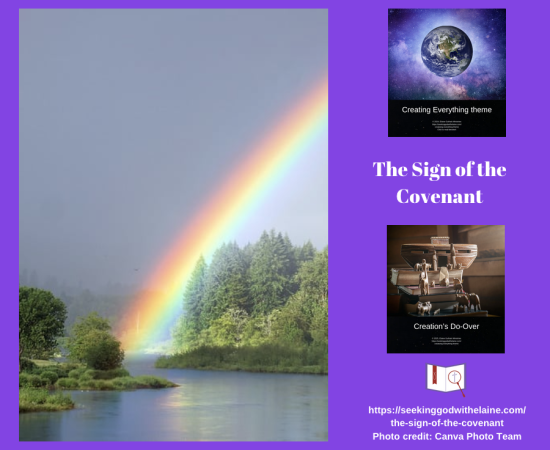
    The last part of the covenant between God and Noah was the sign. This devotional reading looks at the rainbow and its significance.

    Nuggets

    • The visual sign tells all that God’s care is everlasting.
    • For the first time ever, the rainbow graced the sky.
    • God says He will see the rainbow from Heaven.
    the-sign-of-the-covenant

    Almost everyone – even non-believers – can tell you that the rainbow is a sign that God will not destroy the earth again by flooding it.

    But what did God mean by it? How would that have been comforting to Noah?

    Let’s Put It into Context

    To read devotions in the Creating Everything theme, click the button below.

    Devotions in the Creation’s Do-Over series

    The Sign of the Everlasting Covenant

    “Then God said, ‘I am giving you a sign of my covenant with you and with all living creatures, for all generations to come” (Gen. 9: 12 NLT)

    The visual sign of the covenant tells us that God’s care is everlasting.

    In the last devotion, we talked about how Noah and his descendants probably had their stomachs flip every time a huge rain occurred. Was it starting again?

    God not only chose to tell them about His promise not to flood the earth again, but He also gave a visual sign. No, God didn’t need the sign. We did.

    The sign for this covenant has God continuing to use nature to teach us His spiritual truths through His power and wisdom. It is fitting that the rainbow is created by the sunlight returning after the rain.  In other words, the rainbow is the product of the sunshine and rain.

    Both the punishment for our disobedience and God’s grace and mercy are needed.

    Ooo, baby. It is sometimes hard for us to wait for the sunshine when the thunder is booming, and the lightening is flashing.

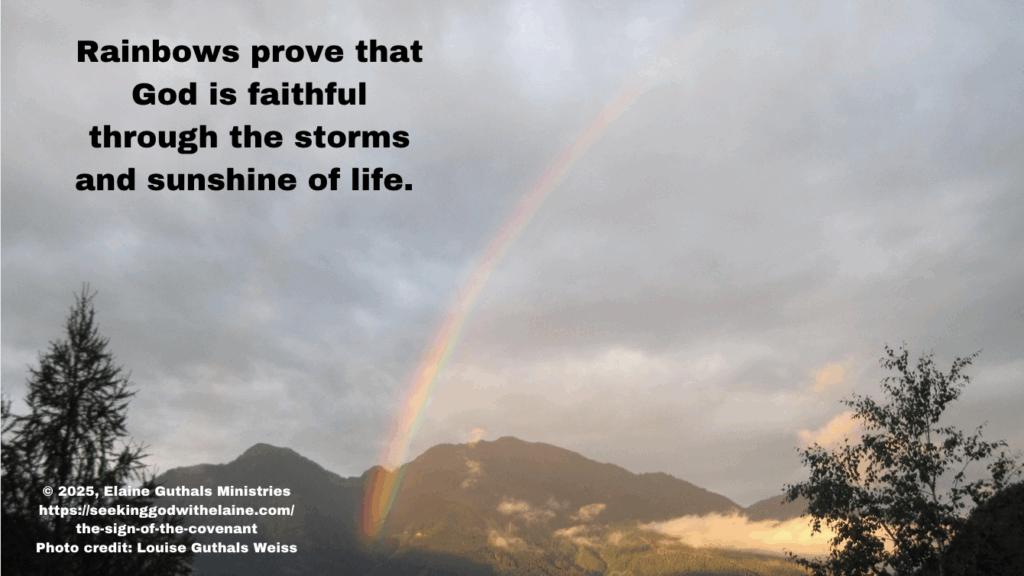
    Rainbows are an outward pledge and token that God will remember and hold dear the completion of the covenant. They prove that God is faithful through the storms and sunshine of life.
    Look what Fairbairn said. He wrote,

    “But in a matter like the present, when the specific object contemplated was to allay men’s fears of permanence of her existing order and constitution, one cannot perceive how a natural phenomenon, common alike to the antediluvian and the postdiluvian world, could have fitly served the purpose.”

    Resource

    An unseen God wanted to have something visible to sooth people’s fears about a reoccurring flood. But it wasn’t really about the sign.

    It was about the covenant. The promise was guaranteed by the covenant, not by the sign.

    God will never break His covenant because it was His decision to enter into it. He will not besmirch the honor of His government by breaking it. He has the power to keep it.

    The rainbow may come and go, but God pledged this covenant as an everlasting covenant.

    I have to process what Candlish said in Elaine-speak.

    • The covenant shows forbearance to humans while in this life.
    • But the covenant does not negate the need for salvation through Jesus.
    • God’s patience is of less importance — subordinate and subservient — than salvation.
    • Eternity is more important than this life.
    • This is a covenant of grace and redemption from sin, leading to eternity.
    • The rainbow is a visual of the spiritual and eternal blessings.

    Resource

    God sees our disobedience to Him, and He does not accept it. He will punish us for it.

    No, God doesn’t delight in punishing us. He delights in our being obedient. “Oh, the joys of those who do not follow the advice of the wicked, or stand around with sinners, or join in with mockers. But they delight in the law of the LORD, meditating on it day and night” (Ps. 1: 1-2 NLT).

    Quite the opposite. God wants our relationships with Him restored. He is looking forward to the Day of the Lord when sin is forever vanquished.

    God will never forget that He entered into this covenant with humans.

    The Bow

    “I have placed my rainbow in the clouds. It is the sign of my covenant with you and with all the earth. When I send clouds over the earth, the rainbow will appear in the clouds, and I will remember my covenant with you and with all living creatures. Never again will the floodwaters destroy all life” (Gen. 9: 13-15 NLT)

    For the first time ever, the rainbow graced the sky.

    Just as God sent the flood, God sent the rainbow as a sign of the covenant He was making with humankind. Make no mistake — God takes ownership of the bow. “I have set my bow in the cloud …” (Gen. 9: 13 NLT emphasis added).

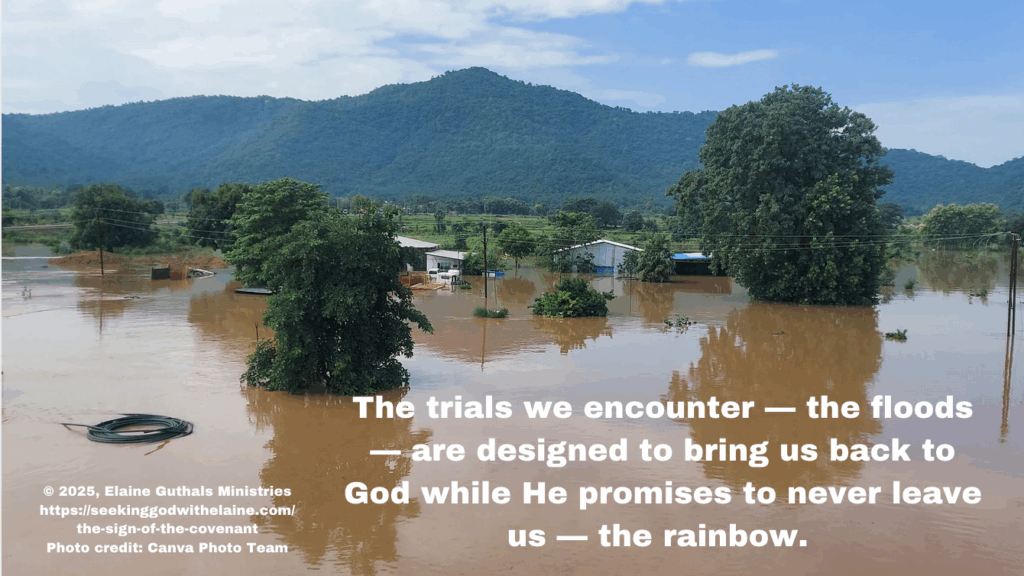
    The trials we encounter — the floods — are designed to bring us back to God while He promises to never leave us — the rainbow. Even in our darkest trials, God will be right there with us.
    That’s good because these clouds are going to be frequent. “He has led me into darkness, shutting out all light” (Lam. 3: 32 NLT).

    That means we should expect the clouds in our lives as they are in God’s plan for us. We need to follow His directions.

    God placed the rainbow in the sky to strengthen our faith and to show His love for us. The variety of colors remind us of the beauty of the glory of the Lord.

    God can and will forgive every sin except our sin of disobedience due to our refusal to accept His as Sovereign Lord.

    Hughes reminded us that, while both ends of the rainbow point to the earth, the apex flows through the sky. Marchant expanded on that to show us that, no matter how overwhelming the flood is, God stays true to us. In fact, Brown and Rainsford added that the rainbow embellishes and showcases the clouds while encompassing them, making the bow its crown.

    Resources

    Think about it. The rainbow signifies the wisdom and mercy that comes with the punishment.

    But when do we grow? It isn’t when the sun is out. It is through the floods.

    Most of the time, unfortunately, we can’t see that until the sun has come out again. Hence the rainbow.

    Think about how many floods and rainbows we need to perfect our faith. Those are the bricks on the Sanctification Road.

    Put this all together. We walk with God. Where? On the Sanctification Road that is paved with the bricks of trials.

    God never told us to come to Jesus and stay put so moss could grow all over us. He tells us to march. We are to follow Him daily (Lk. 9: 23).

    God uses the trials — the material — to perfect us. “And we know that God causes everything to work together for the good of those who love God and are called according to his purpose for them” (Rom. 8: 28 NLT).

    God is going to use our experiences to sanctify us.

    That makes the flood, in reality, more important than the rainbow, doesn’t it? The clouds more important than the sun?

    Kingsley put it this way. He wrote,

    “The flood and the rainbow were sent for a moral purpose: to punish sinners; to preserve the righteous; to teach Noah and his children after him a moral lesson concerning righteousness and sin concerning the wrath of God against sin — concerning God, that He governs the world and all in it, and does not leave the world or mankind to go on of themselves and by themselves.”

    Resource

    Ooo, baby. That is a fact that too many people have either forgotten or refuse to believe. God still governs this world.

    Authority over this world has been given to no one except Jesus. “Jesus came and told his disciples, ‘I have been given all authority in heaven and on earth’” (Mt. 28: 18 NLT).

    If we refuse to accept God’s authority, we will reject his moral lessons on righteousness and sin.
    God didn’t put His bow in the sky to show He would tolerate people’s sin.  It is to show His love and blessings to those who obey His Will.

    God Sees the Rainbow

    “‘When I see the rainbow in the clouds, I will remember the eternal covenant between God and every living creature on earth.’ Then God said to Noah, ‘Yes, this rainbow is the sign of the covenant I am confirming with all the creatures on earth’” (Gen. 9: 16-17 NLT)

    God says He will see the rainbow from Heaven.

    Of course, God is going to see the rainbow from Heaven. He is all-seeing.

    Gilfillan made a great point. He wrote, “While we are looking at the objects of nature, as well as at the events of Providence and the mysteries of grace, from below, God is looking at them from above.”

    Resource

    We may see the thunderstorms that we must weather to create the rainbow, but that storm doesn’t reach to Heaven. Still, God is faithful in sending His bow — regardless the size of the storm.

    Making the Connections #1

    Gilfillan had a sad take on today’s society. He wrote,

    “The common order of men see no beauty in the rainbow; the man of science thinks little of it except as a complete analysis of light; the poet sings its [splendor]; the Christian, even while admiring, seldom thinks of it as a God built bulwark against the return of the waters of Noah; but the Almighty never rears again its arch, or looks upon it when reared, without remembering His promise; it is to Him His original oath, cast in aerial architecture, transcribed in letters of gold. And so, too, with things of a moral kind.”

    Resource

    • The rainbow is right up there in they sky, and people can’t or won’t see it.
    • If they do see it, many feel its sole purpose is based on some worldview notion.
    • Even disciples do not remember its significance, but God does.
    • Rather than just be a physical sign, it is to be a reminder that our character must be that of God’s.

    Making the Connections #2

    Kingsley talked about God’s anger in sending the flood and the rainbow. He wrote,

    “They tell us that His anger is not a capricious, revengeful, proud, selfish anger, such as that of the heathen gods; but that it is an orderly anger, and therefore an anger which in its wrath can remember mercy. Out of God’s wrath shines love, as the rainbow out of the storm.

    Resource

    God is not a God of chaos. He did not snap and send punishment upon humans. This was all part of His plan for us.

    God couldn’t just “feel” love toward humans. When humans sinned, if God had done nothing — not showed His wrath — it would have diminished and corrupted His love.

    That is why we shouldn’t think God tolerates our sins. He may defer punishment, but it is coming — and coming for all eternity.

    Making the Connections #3

    We talked about needing both the rain and the sunshine to make the rainbow. Newton applied that to what it means spiritually — and noted there are three requirements. (Well, I count four.) He wrote,

    “And in the spiritual world, to which we are applying the subject, there must be that which answers to these three requirements. There must be cloud, a ground work of human guilt and sorrow, on which the bow can be projected. There must be a Sun of Righteousness — a Divine [Savior] causing the beams of His [favor] to shine forth; and there must be the descending showers of Divine grace to refract those glorious rays, and illumine with their brightness the dark horizon of man’s prospects.”

    Resource

    Cloud, sun, and showers with the person looking on. Guilt, redemption, and grace with the guilty heart as the recipient. That is how we are forgiven of our sins.

    If we don’t have guilt, it is not a genuine request for salvation. Salvation only comes through Jesus, our Savior and Redeemer. It is only through the gift of God’s grace that forgiveness can even happen.

    Brown called it the cloud of guilt meeting the bow of pardon. He reminded we can only see it when we look up.

    Resource

    Yes, we have to acknowledge that we are sinners. We have to admit what we are doing is wrong and against God’s laws and commandments. We have to turn from our sinful ways. We have to make the choice to focus on God.

    No, we can’t write it off as human nature. We can’t insist it isn’t a sin. We can’t hang on to it.

    We have to ask for forgiveness and submit to God.

    Making the Connections #4

    Ooo, baby. How did I miss this?

    There is not one spiritual promise contained in this covenant.

    Bradley had to point that out to me. He wrote,

    “It is remarkable that, though detailed in this chapter with much minuteness, it relates only to temporal blessings. Not one spiritual promise does it contain. All it stipulates is, that there shall never again be a general flood or famine on the earth.”

    Resource

    No mention is made of salvation. God doesn’t allude to the Messiah. He doesn’t promise to eliminate sin.

    Maybe I missed it because, as Bradley pointed out, it has so many elements resembling Jesus’ covenant.

    • It comes solely from God.
    • It shows us the heart and mind of God.
    • It involved a sacrifice.

    Here God gave us a visual sign for remembrance in the rainbow. There we are to remember through observation of the Lord’s Supper.

    Making the Connections #5

    Brown had some really, really good points in his sermon. He wrote, “… God accepts human worship when associated with Divinely appointed sacrifice.”

    Resource

    The Divinely appointed sacrifice is detailed in our disciples’ job description. “And so, dear brothers and sisters, I plead with you to give your bodies to God because of all he has done for you. Let them be a living and holy sacrifice — the kind he will find acceptable. This is truly the way to worship him” (Rom. 12: 1 NLT).

    The Disciple’s Job Description

    Complete Job Description

    Making the Connections #6

    I love this. Rainsford called the rainbow the gateway to Heaven — without the gates.

    Resource

    Revelation talks about New Jerusalem having gates. “The city wall was broad and high, with twelve gates guarded by twelve angels …” (Rev. 21: 12 NLT).

    We also know about the narrow gate. “You can enter God’s Kingdom only through the narrow gate. The highway to hell is broad, and its gate is wide for the many who choose that way. But the gateway to life is very narrow and the road is difficult, and only a few ever find it” (Mt. 7: 13-14 NLT).

    The New Jerusalem gates are after we have gotten to eternity. The narrow gate is how we get there.

    The rainbow non-gate is that all are offered the opportunity to repent of their sins, be cleansed, and enter through the narrow gate to get to the gated city.

    Making the Connections #7

    Of course, there is the question as to where the rainbow was before the flood. Well, it depends on what you believe.

    Was there rain before the flood but just wasn’t mentioned? Maybe. Moses couldn’t but everything on his scrolls.

    If there wasn’t rain, it wasn’t possible to have rainbows. There was the sunshine but not the rain needed to produce the rainbows.

    If we believe, unlike Parker, that the rain came the first time for the flood, we would say that the rainbow was made for the purpose of the covenant.

    Resource

    What I do agree with Parker is that old things can be used for new purposes. Isn’t that what salvation is all about? “Therefore, if anyone is in Christ, he is a new creation.bThe old has passed away; behold, the new has come” (II Cor. 5: 17 NLT).

    That was the whole focus of Jesus’ ministry. Repent of our sins, deny ourselves, and imitate Him. When we do that, we will be made holy and righteous.

    Elliott explained it this way. He wrote,

    “It is the Gospel of Christ Jesus alone which converts sorrow and suffering into instruments for the attainment of higher and more enduring blessings. In all God’s dealings with His people, when He brings a cloud upon the earth, He sets His bow in that cloud, insomuch that they cease to fear when they enter into it by reason of the presence of Him whose glory inhabits it (Isaiah 54:9, 10).”

    Resource

     “God has united you with Christ Jesus. For our benefit God made him to be wisdom itself. Christ made us right with God; he made us pure and holy, and he freed us from sin” (I Cor. 1: 30 NLT).

    How Do We Apply This?

    • Obey God.
    • Love each other in order to correct those practicing sin.
    • Learn from Jesus’ sacrifice.
    • Remember what the rainbow really symbolizes.

    Resource

    Father God. You have given us the rainbow as a promise to never destroy the earth by a flood again. It also shows You are with us in our trials. Thank You for loving us so much. Amen.

    What do you think?

    Leave me a comment below (about this or anything else) or head over to my Facebook group for some interactive discussion.

    If you don’t understand something and would like further clarification, please contact me.

    If you have not signed up for the email providing the link to the devotions and the newsletter, do so below.

    If God has used this devotion to speak with you, consider sharing it on social media.
  • Establishing the Covenant with Noah

    The covenant that God was establishing with Noah was coming to the big reveal. This devotional reading looks at the promise given to Noah by God.

    Nuggets

    • God chose to make a covenant with those who are made in His image, even though we had so angered Him.
    • God wanted to make sure we knew that He was the author of the covenant.
    • God’s promise to never flood the earth again was unconditional.
    • Even those who refuse to confess God as Sovereign Lord sometimes benefit from the blessing God gives to His children.
    establishing-the-covenant-with-noah

    God had already told Noah some of the terms of the covenant. “And the Lord was pleased with the aroma of the sacrifice and said to himself, ‘I will never again curse the ground because of the human race, even though everything they think or imagine is bent toward evil from childhood. I will never again destroy all living things. As long as the earth remains, there will be planting and harvest, cold and heat, summer and winter, day and night’” (Gen. 8: 21-22 NLT).

    • The earth wouldn’t be cursed again because of humans.
    • There would not be an event that would lead to total destruction of all living things.

    But now, God was going to tell Noah what that really entailed.

    Let’s Put It into Context

    To read devotions in the Creating Everything theme, click the button below.

    Devotions in the Creation’s Do-Over series

    Establishing the Covenant

    “Then God told Noah and his sons, ‘I hereby confirm my covenant with you and your descendants, and with all the animals that were on the boat with you — the birds, the livestock, and all the wild animals — every living creature on earth” (Gen. 9: 8-10 NLT)

    God chose to make a covenant with those who are made in His image, even though we had so angered Him.

    We can’t order God around It was His, and only His, right to offer a covenant with humans.

    God tried again. His covenant with Adam was broken. God’s Word doesn’t tell us He made another one with him, possibly because he was so associated with sin.

    After creation’s do-over, God wanted mankind to remain holy and pure. He wanted to make a covenant with the righteous man, Noah.

    I don’t think God had any concerns about Noah. It was his children that He knew would fall away.

    Still, God transmitted the covenant to include them. “Behold, I establish my covenant with you and your offspring after you” (Gen. 9: 9 NLT).

    We can’t gloss over the fact that God was binding Himself to humans. Not just His protection or blessings. He wanted the relationship that was lost in the Garden restored.

    No, even though Noah was deemed a righteous person, God was not obligated to make a covenant with him. Noah still had a sinful nature.

    Because God had forbearance, He did offer the covenant to Noah. “… People are made right with God when they believe that Jesus sacrificed his life, shedding his blood. This sacrifice shows that God was being fair when he held back and did not punish those who sinned in times past, for he was looking ahead and including them in what he would do in this present time. God did this to demonstrate his righteousness, for he himself is fair and just, and he makes sinners right in his sight when they believe in Jesus” (Rom. 3: 25-26 NLT).

    This forbearance is a product of God’s grace. It is unconditional.

    One thing we tend to forget – and non-believers refuse to see – is that sin has clouded our perception of spiritual things.

    If we think God is hiding things from us, this is partly the reason. Leale told us why. He wrote, “He [Humans] was not able to appreciate Divine truth in its pure and native form. God must speak to him by signs and symbols, and encourage him by promises of temporal blessing.”

    Resource

    In our vernacular, we would say that God had to dumb it down for us. “‘My thoughts are nothing like your thoughts,’ says the Lord. ‘And my ways are far beyond anything you could imagine. For just as the heavens are higher than the earth, so my ways are higher than your ways and my thoughts higher than your thoughts’” (Isa. 66: 8-9 NLT).

    Hold that thought until the next devotion.

    The timing of the covenant is important. It was after the punishment had been meted out. God was now instructing humans – yeah, again – what He expected of them.

    Even before God makes the promises of the covenant, Noah – and everyone since then – knows that He has the power and desire to keep those promises.

    Never Again by Water

    “Yes, I am confirming my covenant with you. Never again will floodwaters kill all living creatures; never again will a flood destroy the earth.” (Gen. 9: 11 NLT)

    God wanted to make sure we knew that He was the author of the covenant.

    “I establish my covenant with you …” (Gen. 9: 11 NLT). That makes sense.

    God is righteous. We aren’t. God should be the One to initiate the covenant.

    Remember what righteous means. It is we exhibit a moral uprightness that shows through just behavior, putting us in good standing with God.

    Righteousness isn’t something we earn by being a good person and doing the right things. We are actively striving to imitate God’s character. We are endeavoring to reflect God.

    This only happens through faith in Jesus. If we don’t have Jesus in our hearts and lives, being a good person who tries to be fair means nothing.

    By Water

    God’s promise to never flood the earth again was unconditional.

    When we think of God’s promise to never flood the earth again, these are the verses we call to mind. But these are just a restatement of His promise.

    “And the LORD was pleased with the aroma of the sacrifice and said to himself, ‘I will never again curse the ground because of the human race, even though everything they think or imagine is bent toward evil from childhood. I will never again destroy all living things” (Gen. 8: 21 NLT).

    Candlish saw two principles wrapped up in this.

    • Humans had been punished enough – for now – because they would just rebel more with further threat of flooding because humans are unable to be disciplined.
    • Noah’s sacrifice of “… some of every clean animal and some of every clean bird …” (Gen. 8: 20 NLT).

    Resource

    It goes back to we sin because of our nature. A flood isn’t going to change that – it didn’t for Noah.

    That was a great promise, but what if God had kept it to Himself? What if Noah didn’t know anything about it?

    It would be human nature for Noah and his family, as they were just closing the book to this terrifying chapter of their lives, would think it may happen again. Yeah, I bet they told their children about the time God unleashed the rain on the earth to show then what happens when they disobey God and are wicked.

    That is just parental nature.

    But Father God didn’t really want us to feel that. He wanted to assure us that a flood will never again destroy the earth.

    Even with the promises and whatever signs God gives us, don’t we sometimes think He isn’t going to keep them? We tie ourselves up thinking the promise isn’t going to be kept.

    God isn’t that way. What He promises, He holds Himself to it.

    Yes, God still allows flooding to happen – localized. Don’t ignore the “that never again shall all flesh be cut off by the waters of the flood, and never again shall there be a flood to destroy the earth” (Gen. 9: 8-11 NLT emphasis added) parts.

    Also, don’t read into this that God promised Noah that He wouldn’t destroy the earth in another way. He will. “… The earth and sky fled from his presence, but they found no place to hide” (Rev. 20: 11 NLT).

    But God put so much stock into this promise, He formalized it. put it in His covenant with Noah.

    Kingsley made an interesting point. He wrote, “They would have been likely to take to praying to the rain and thunder, the sun and the stars.”

    Resource

    You know, with the power of the flood, the noise of the thunder, and the scariness of lightening, we can kind of see how they saw the phenomena as “living.” In future years, they would give these phenomena names and call them gods, according to mythology.

    God wanted them to know that He alone causes the rain and thunder. They are to look to Him and pray to Him.

    With Every Living Creature

    Even those who refuse to confess God as Sovereign Lord sometimes benefit from the blessing God gives to His children.

    God does love non-believers. At times, the blessing He gives His children benefit them.

    • “In that way, you will be acting as true children of your Father in heaven. For he gives his sunlight to both the evil and the good, and he sends rain on the just and the unjust alike” (Mt. 5: 45 NLT).
    • “But God showed his great love for us by sending Christ to die for us while we were still sinners” (Rom. 5: 8 NLT).

    Making the Connections #1

    There are seven laws – called the Noachide Law – that come out of the God’s covenant with Noah (Noach in Hebrew). Some consider these the basis of civilized society. Let’s review what the Jewish Virtual Library said these seven laws, found in the Talmud, are.

    “The Noachide Laws are seven laws considered by rabbinic tradition as the minimal, moral duties required by the Bible on all men. … he [non-Jews] who accepts these obligations is considered a righteous person who is guaranteed a place in the world to come.

    The seven Noachide laws, as traditionally enumerated are:

    “1.        Do Not Deny God
    “2.       Do Not Blaspheme God
    “3.       Do Not Murder
    “4.       Do Not Engage in Incestuous, Adulterous or Homosexual Relationships.
    “5.       Do Not Steal
    “6.       Do Not Eat of a Live Animal
    “7.       Establish Courts/Legal System to Ensure Law Obedience”

    Resource

    Hmmm. When I thought, hey, I want to dig into this to see what it was all about, I thought it would come out of Genesis 9: 1-6.

    Two things were mentioned in those verses.

    When I looked up an article on the Got Questions website, it noted that – according to tradition – all but the last one were given to Adam in the Garden of Eden. (See, I keep saying Moses may not have written everything down.)

    Resource

    Jeremy wrote on the Noahide Life website that Adam was given these laws on the day he was created. We have nothing in God’s Word that would confirm or deny this. To me, the when wouldn’t be as important as he was given them.

    Resource

    The first law is talking about idolatry. We know that our idolatry today goes beyond a graven image someone has made.

    Whomever wrote the Got Questions article also brought up the fact that Adam didn’t eat meat. So why would #7 have been given to him?

    The Noahide Life article expanded each law to show what it was addressing. #2 included that prayer was required.

    But that is a pretty decent list of what we need to do to walk with God. Why were these laws needed if the Torah is available?

    The Torah was for Jews, the Noachide Laws, Gentiles. Christians would be considered Noachites.

    Making the Connections #2

    Fairbairn made an interesting observation. The climate was going to change. He wrote,

    “We incline, therefore, to the opinion that, in the announcement here made, intimation is given of a change in the physical relations or temperature of at least that portion of the earth where the original inhabitants had their abode; by reason of which the descent of moisture in showers of rain came to take the place of distillation by dew, or other modes of operation different from the present. The supposition is [favored] by the mention only of dew before in connection with the moistening of the ground (Genesis 2:6); and when rain does come to be mentioned, it is rain in such flowing torrents as seems rather to betoken the outpouring of a continuous stream, than the gentle dropping which we are wont to understand by the term, and to associate with the rainbow.

    Resource

    Think about it. Way back in Genesis 2, we were told why some of the vegetation was not yet growing. “When the Lord God made the earth and the heavens, neither wild plants nor grains were growing on the earth. For the Lord God had not yet sent rain to water the earth, and there were no people to cultivate the soil. Instead, springs came up from the ground and watered all the land.” (Gen. 2: 4-6 NLT).

    Okay, where did the mist come from to which Fairbairn referred? “But there went up a mist from ha’aretz, and watered the whole face of the Adamah” (Gen. 2: 6 OJB).

    The point is that God controls the climate. Nothing happens to it that He doesn’t allow.

    Any fluctuations in climate is either God’s plan for the earth to spin on or is because of the curse of sin.

    And we know, as we grow closer to the Day of the Lord, these fluctuations will occur.

    • “And there will be strange signs in the sun, moon, and stars. And here on earth the nations will be in turmoil, perplexed by the roaring seas and strange tides” (Lk. 21: 25 NLT).
    • “There will be great earthquakes, and there will be famines and plagues in many lands, and there will be terrifying things and great miraculous signs from heaven” (Lk. 21: 11 NLT).
    • “And I will cause wonders in the heavens and on the earth — blood and fire and columns of smoke” (Joel 2: 30 NLT).
    • “Immediately after the anguish of those days, the sun will be darkened, the moon will give no light, the stars will fall from the sky, and the powers in the heavens will be shaken” (Mt. 24: 29 NLT).
    • “I watched as the Lamb broke the sixth seal, and there was a great earthquake. The sun became as dark as black cloth, and the moon became as red as blood” (Rev. 6: 12 NLT).

    God is in control.

    How Do We Apply This?

    • Don’t think we have a right to spiritual things.
    • Fulfill responsibilities of covenants that God made with us so that we will be blessed with God’s goodness.
    • Watch for God to reveal His love to us.
    • Live a life of faith

    Resources

    Father God. Thank You for Your mercy when You do not give us the punishment that we deserve. Instead of giving us what we deserve, You give us what we don’t deserve – Your grace. Thank You for not flooding the world again to punish us for our sin. Amen.

    What do you think?

    Leave me a comment below (about this or anything else) or head over to my Facebook group for some interactive discussion.

    If you don’t understand something and would like further clarification, please contact me.

    If you have not signed up for the email providing the link to the devotions and the newsletter, do so below.

    If God has used this devotion to speak with you, consider sharing it on social media.
  • Expanding on the Covenant

    For the last two devotions, we have been working through God’s covenant with Noah. This devotional reading expands on His provision of animals for food and continues the blessing.

    Nuggets

    • Life – human and animal – is very precious to God.
    • God values life and will punish anyone who takes another’s life.
    • After the flood, God expanded the region in which Noah’s descendants could live.
    expanding-on-the-covenant

    The first two verses we will look at are tied closely with the last verse. “I have given them [the animals] to you for food, just as I have given you grain and vegetables” (Gen. 9: 3 NLT).

    God now allowed humans to eat the animals’ meat, but He had a very specific restriction that He put on it. Then He continued to bless Noah and his family – and all humans.

    Let’s Put It into Context

    To read devotions in the Creating Everything theme, click the button below.

    Devotions in the Creation’s Do-Over series

    God Values Life

    “And I will require the blood of anyone who takes another person’s life. If a wild animal kills a person, it must die. And anyone who murders a fellow human must die. If anyone takes a human life, that person’s life will also be taken by human hands. For God made human beings in his own image” (Gen. 9: 5-6 NLT)

    Lifeblood

    Life – human and animal – is very precious to God.

    While He was giving Noah the go-ahead to eat animals, He did put one restriction on it. No, it wasn’t necessarily geared to how the animal was killed.

    God just wanted to make sure the animal was dead before it was eaten. The best way to ensure the animal was dead was to drain its blood – its lifeblood.

    “And if any native Israelite or foreigner living among you eats or drinks blood in any form, I will turn against that person and cut him off from the community of your people, for the life of the body is in its blood. I have given you the blood on the altar to purify you, making you right with the Lord. It is the blood, given in exchange for a life, that makes purification possible” (Lev. 17: 10-11 NLT emphasis added).

    Disease would be in the blood because it carries waste products along with bacteria and viruses. It would make the person sick.

    Murder

    God values life and will punish anyone who takes another’s life.

    Don’t miss what it really says. “And I will require the blood of anyone who takes another person’s life. If a wild animal kills a person, it must die. And anyone who murders a fellow human must die” (Gen. 9: 5 NLT).

    It is an easier read in Exodus. “You must not murder” (Ex. 20: 13 NLT).

    Yes, God was the first One to call for capital punishment.

    I see you jumping up and down saying, “What about Cain? He didn’t forfeit his life for killing Abel.”

    Venables addressed that. He wrote,

    “The case of Cain — the strong case of the opposers of death for murder — is, when rightly understood, a strong case against them. Cain declared that the first person that met him would slay him. Who but God had written this in the tables of his heart? who save He could have engraven this on his conscience? It was a recognized principle from the beginning that the murderer should not live. But it is objected, ‘God interfered and saved his life.’ Quite true. But then, if God had not interfered, his life would have been justly taken in obedience to the general laws of God implanted in the consciences of all men; and therefore, unless God similarly interferes now by a special and marked revelation, the original rule holds good, and the murderer is put to death.”

    Resource

    If Sovereign God declared that murderers should be executed and placed that opinion in the hearts of humans, it is His call when and if to pardon the murderer.

    We cannot choose whether or not to follow only certain laws that God had instituted. We cannot substitute a more lenient – or in other cases, a harsher – punishment.

    We have to go with what God says.

    Why was the command that the murderer be executed in the first place?

    Venables tied it to being made in God’s image. God patterned humankind after Himself to be holy and pure.

    Adam and Even tarnished that with the original sin. Cain further corrupted human flesh when he offered and unacceptable sacrifice to God. He annihilated it when he murdered Abel.

    The murderer is no longer in God’s image because he has let sin rule his life. He is no longer holy and pure – he has a corrupted body.

    Venables disagreed that letting a murderer live in prison is more egregious to him than executing him. (How can he feel the consequences of his actions when he is dead?)

    Bottom line, though, is God commanded it so that sin could be destroyed.

    I know a lot of punishments listed in God’s Word are not followed in today’s society. We say that those punishments were ended when Jesus died on the cross. Some even call this just a prediction.

    Does God’s Word say that? It says He addressed the consequences of sin. When we ABCD, we no longer are spiritually dead and separated from God.

    It says nothing about the punishment for the behavior of sin. It talks about eradicating the spiritual consequences of sin.

    God can use a variety of punishments in this life to judge us for sin. He could allow us to get sick, lose a job, suffer a loss, etc.

    God is our Creator and Judge. It is all up to Him if, when, and how we are judged in this life.

    Our biggest takeaway here should be how much God values human life – even if we have tarnished being made in His image. Murder shatters our relationship as a family.

    Added to the Blessing

    “Now be fruitful and multiply, and repopulate the earth” (Gen. 9: 7 NLT)

    After the flood, God expanded the region in which Noah’s descendants could live.

    Fairbairn made an interesting observation that I hadn’t really thought through before. He wrote,

    “The first is the new condition of the earth itself, which immediately appears in the freedom allowed and [practiced] in regard to the external worship of God. This was no longer confined to any single region, as seems to have been the case in the age subsequent to the Fall.”

    Resource

    We know the Garden of Eden was off limits. The cherubim made certain of that.

    We know that Cain was exiled to the Land of Nod, which some believe to be anywhere but the Garden of Eden area.

    So, God was sending them off into the big, bad area ruled by Satan. No wonder the world went back to being wicked lickety-split.

    Think of it this way. The cherubim was guarding the gate. That showed that God was there.

    But now Noah’s family and descendants were going where God was not and (hopefully) taking Him there with their internal worship of God.

    That would make Noah the first missionary.

    It makes sense. Creation was getting a do-over. Hopefully, it would do a better job because it was a new creation.

    Sounds familiar, doesn’t it? “This means that anyone who belongs to Christ has become a new person. The old life is gone; a new life has begun!” (II Cor. 5: 17 NLT).

    Fairbairn made another point that God gave His children – children of faith – heirship of this world. Because of grace, God gave His children heirship and dominion of the earth.

    I can see why God gave that to Noah, and not Adam. Adam will forever be tied with the original sin. Noah will forever be tied to being righteous enough – if not the only righteous man – to be saved from the flood.

    Making the Connections #1

    We talked about this a long time ago in another devotion. All sin is directed at God.

    Calthrop agreed. He wrote, “Murder, in its essence, if you trace it far enough, is not merely an injury inflicted on our fellow — not merely an act by which pain and deprivation are caused to the individual, and loss to society. It is all this, of course; but it is also more than this — it is a striking at God in the person of him who was made in the image of God.”

    Resource

    We can substitute adultery is not merely an injury inflicted on our spouse. Theft is not merely inflicted on the owner. Gossip is not merely inflicted on the person of which we are discussing.

    It is all about God.

    Making the Connections #2

    Look what Fairbairn said when he was talking about the old things become new. He wrote,

    “But this again indicated that, in the estimation of Heaven, the earth had now assumed a new position; that by the action of God’s judgment upon it, it had become hallowed in His sight, and was in a condition to receive tokens of the Divine [favor], which had formerly been withheld from it.

    Resource

    We talked about the earth being cursed because of the sin of humans. Way back in Genesis 3, God cursed the ground because of humankind’s sin. “And to the man he said, ‘Since you listened to your wife and ate from the tree whose fruit I commanded you not to eat, the ground is cursed because of you …’” (Gen. 3: 17 NLT).

    God said that He would no longer curse the earth because of humans. “And when the Lord smelled the pleasing aroma, the Lord said in his heart, ‘I will never again curse the ground because of man, for the intention of man’s heart is evil from his youth. Neither will I ever again strike down every living creature as I have done’” (Gen. 8: 21 NLT).

    The earth got its own do-over.

    It became its own new creation. It was now blessed and sanctified again.

    How Do We Apply This?

    • Value life as God does.
    • Walk the Sanctification Road so that we can become the true new creation that God has made us.
       
      Father God. You value life because You are life. It is Satan that is death. Lord, may we follow Your laws and commandments so that we make have Your eternal  life in us. Amen.

    What do you think?

    Leave me a comment below (about this or anything else) or head over to my Facebook group for some interactive discussion.

    If you don’t understand something and would like further clarification, please contact me.

    If you have not signed up for the email providing the link to the devotions and the newsletter, do so below.

    If God has used this devotion to speak with you, consider sharing it on social media.
  • Relationships in the Covenant

    The flood occurred because most preflood people chose not to have a relationship with God. This devotional reading looks how God’s covenant with Noah changed – or didn’t change – the relationships among God, humans, and animals.

    Nuggets

    • Humankind’s purpose had not changed, so the blessing had not changed.
    • The relationships between humans and animals was going to change.
    • Humans could now eat animals.
    relationships-in-the-covenant

    In the last devotion, we talked about how God established a covenant with Noah – and how it was a process with several parts. We left Noah completing the required sacrifice and God accepting that sacrifice.

    We turn now to the blessings and responsibilities section of the covenant.

    Let’s Put It into Context

    To read devotions in the Creating Everything theme, click the button below.

    Devotions in the Creation’s Do-Over series

    Humankind’s Purpose Restated

    “Then God blessed Noah and his sons and told them, ‘Be fruitful and multiply. Fill the earth” (Gen. 9: 1 NLT)

    Humankind’s purpose had not changed, so the blessing had not changed.

    We remember in Genesis 1 that God had pressed the humans after he had created them.  “Then God blessed them and said, ‘Be fruitful and multiply. Fill the earth and govern it. Reign over the fish in the sea, the birds in the sky, and all the animals that scurry along the ground” (Gen. 1: 28 NLT).

    God wanted a whole race of humans, and He wanted us for a purpose.

    We have to think that God wanted to create humankind. Before He even created us, He knew we would disobey Him. He had just gotten finished with destroying those who had disobeyed Him.

    God created us for a purpose. He has a plan for our lives.

    • “For God saved us and called us to live a holy life. He did this, not because we deserved it, but because that was his plan from before the beginning of time—to show us his grace through Christ Jesus” (II Tim. 1: 9 NLT emphasis added).
    • “And we know that God causes everything to work together for the good of those who love God and are called according to his purpose for them” (Rom. 8: 28 NLT emphasis added).

    God’s purpose for creating humankind was so that we could worship Him. Arnold agreed. He wrote,

    “We were made for our Maker’s glory, after His own image, that we should make His will the rule of our lives, and His love and anger the great objects of our hope and fear; that we should live in Him, and for Him, and to Him, as our constant Guide and Master and Father.”

    Resource

    We have already seen confirmation that some pre flood did just that.

    • “When it was time for the harvest, Cain presented some of his crops as a gift to the Lord. Abel also brought a gift — the best portions of the firstborn lambs from his flock …” (Gen. 4: 3-4 NLT).
    • “When Seth grew up, he had a son and named him Enosh. At that time people first began to worship the Lord by name” (Gen. 4: 26 NLT).
    • “Enoch lived 365 years, walking in close fellowship with God …” (Gen. 5. 23-24 NLT).

    The whole purpose of the ark was to save lives. That is the business God is in — salvation. He sent His Son to die on a cross so that we could accept the gift of salvation.

    Even though God knew man was going to sin, He wanted us to multiply. Even though He did a major reset, He still wanted us to multiply.

    Many may look at the story of the flood and say God failed miserably in His plan for humankind. We can say that, but we’d be wrong.

    God showed us that He isn’t afraid of going big to get us back to worshiping Him. He showed us that, even as flawed as we are with a sinful nature, when we ABCD, He will protect us and provide for us.

    Even after the great destruction of the flood, God’s purpose for us is the same: worship Him and multiply so more will know His love for them.

    Renner had an interesting observation. He wrote, “Interestingly, He likely gave that commission in the place where life first began — in the region of the Garden of Eden, where it is believed the Ark came to rest.”

    Resource

    It doesn’t really surprise me. God doesn’t change. His purpose didn’t change. He is committed to that region. Jesus is coming back from where He left.

    All the Food

    “All the animals of the earth, all the birds of the sky, all the small animals that scurry along the ground, and all the fish in the sea will look on you with fear and terror. I have placed them in your power. I have given them to you for food, just as I have given you grain and vegetables” (Gen. 9: 2-3 NLT)

    Fear of upon Every Animal

    The relationships between humans and animals was going to change.

    The only difference between the Genesis 1 blessing and the Genesis 2 blessing was — now — we were not told to “… govern it. Reign over the fish in the sea, the birds in the sky, and all the animals that scurry along the ground” (Gen. 1: 28 NLT).

    We don’t want to put too much emphasis on our domination over the animals, but we do need to keep it in perspective. “You gave them charge of everything you made, putting all things under their authority — the flocks and the herds and all the wild animals, the birds in the sky, the fish in the sea, and everything that swims the ocean currents.” (Ps. 8: 6-8 NLT).

    For a year, I think it would be safe to say that there were no squabbles between natural predators and prey. On top of that, I doubt they gave Noah and his family much trouble.

    Oh, sure. There might have been a few squabbles. But I don’t see God locking them in there and making it a torment on the waves.

    Post flood, the animals were going to fear humans. Probably a good thing.

    Food for You

    Humans could now eat animals.

    That brings up the question as to whether the humans ate meat before the flood. Some verses seem contradictory.

    But there is Genesis 7: 8. “With them were all the various kinds of animals — those approved for eating and for sacrifice and those that were not — along with all the birds and the small animals that scurry along the ground” (Gen. 7: 8 NLT emphasis added).

    Wouldn’t Noah have scratched his head when God told him this if they hadn’t been eating meat?

    Let’s back up a second. Many think that, from Adam and Eve on down to then, were commanded to a specific diet. “Then God said, ‘Look! I have given you every seed-bearing plant throughout the earth and all the fruit trees for your food’” (Gen. 1: 29 NLT).

    That makes sense to me. If Adam and Eve had eaten the animals, that would mean death was already present when they committed the original sin.

    True, they knew what death was, Adam and Eve would have been more knowledgeable about what was at stake. “But the Lord God warned him, ‘You may freely eat the fruit of every tree in the garden — except the tree of the knowledge of good and evil. If you eat its fruit, you are sure to die’” (Gen. 2: 16-17 NLT).

    That would have made the consequence of breaking the law more understandable.

    Yes, if they had killed for food, that would make the killing of the animal for clothes less of a blood-covering-sin issue.

    I have a feeling Adam, Eve and their line were vegetarians. But what kind of food?

    Let’s looks at this in the Complete Jewish Bible.

    • “Every moving thing that lives will be food for you; just as I gave you green plants before, so now I give you everything” (Gen. 9: 3 CJB emphasis added).
    • Then God said, ‘Here! Throughout the whole earth I am giving you as food every seed-bearing plant and every tree with seed-bearing fruit. And to every wild animal, bird in the air and creature crawling on the earth, in which there is a living soul, I am giving as food every kind of green plant.’ And that is how it was” (Gen. 1: 29-30 emphasis added).

    God had previously given animals the green plants to eat, not humans.

    Did God come back later and say they could eat the green plants, and Moses didn’t record it? We know he didn’t record the directions on how to offer sacrifices – and Cain and Abel were doing that.

    We also know that when God gave Moses the law, He did put more restrictions on what kind of animal could be eaten or not.

    Plus, had God defined for Moses what clean and unclean meant? He may have. He may not have.

    That will have to go in the UNR book – understanding not required.

    God doesn’t spell out everything every time. Sometimes, He requires flat out obedience without any direction or rebuttal time.

    Whatever food restrictions God had in place in Noah’s time, Noah was following it. Otherwise, he wouldn’t have been considered righteous.

    Maybe one of the ways that the world was wicked was they ignored God’s command to be vegetarians, but Noah didn’t. This was now giving him permission – without restriction – to eat meat.

    Back to God giving the animals to Noah and his family to eat. He was providing for humankind’s continued presence on earth. He knew that, in order to fulfill the go-forth-and-multiply blessing, they would need the fuel that animals could provide.

    Making the Connections #1

    Adamson made a good point. He wrote,

    “At the successive periods of the unfolding of God’s great promise, we find one individual representing the history of the race, and foreshadowing in brief the essential character of large phases and long periods of human development. Hence it is that here Noah becomes the representative of the patriarchal families in covenant with God. He is the individual with whom God enters into covenant, in relation to the successive generations of the human race.”

    Resource

    It is easy to think of Adam that way. He is compared to Jesus. “Wherefore, as by one man sin entered into the world, and death by sin; and so death passed upon all men, for that all have sinned: (For until the law sin was in the world: but sin is not imputed when there is no law. Nevertheless death reigned from Adam to Moses, even over them that had not sinned after the similitude of Adam’s transgression, who is the figure of him that was to come” (Rom. 5: 12-14 NLT).

    Noah represented humans that have been redeemed. Yes, Moses represented God, so he is another one. Joseph, we’ll find out, was a type of Christ.

    Making the Connections #2

    We forget what Venables said. He wrote,

    “All nature, every physical law, and every revealed law of God on earth, is but a material image of the spiritual; ‘as we have borne the image of the earthly, we shall also bear the image of the heavenly.’ The heavenly laws are presented to us in our earthly state in an earthly form, and are images to us of the spiritual truths which we shall recognize in our heavenly condition.”

    Resource

    Earth mirrors Heaven in many ways. We mirror God in many ways, but we will become more like Him in Heaven.

    That is one reason we can view this life as preparation and practice for the next.

    How Do We Apply This?

    • Not only increase the population but also grow closer to God.
    • Witness to others so that they can see how much God loves them.
    • Follow God’s dietary restrictions.

    Father God. You have always wanted to have a relationship with humans. Forgive us because we let sin into the world that ended the relationship as you intended it. Help us to walk with You so that our relationships lead to a restoration of that original one. Amen.

    What do you think?

    Leave me a comment below (about this or anything else) or head over to my Facebook group for some interactive discussion.

    If you don’t understand something and would like further clarification, please contact me.

    If you have not signed up for the email providing the link to the devotions and the newsletter, do so below.

    If God has used this devotion to speak with you, consider sharing it on social media.
  • God’s Covenant with Noah

    The sacrifice that Noah offered when they disembarked from the ark was part of the covenant process. This devotional reading looks at the promise made by God.

    Nuggets

    • Noah immediately worshiped God after he disembarked from the ark.
    • The goal of the burnt offering was to create a pleasing aroma for God.
    • God promised to never again flood the earth.
    • When the Day of the Lord comes, the earth will pass away; but until then, it will remain.
    • God promised Noah as soon as he got off the ark that life will be sustained while the earth remains.
    gods-covenant-with-noah

    Noah was obedient in offering the sacrifice to God. It was now up to God to accept it or reject it. If He accepted it, it would lead into the responsibility part of the covenant.

    Let’s Put It into Context

    To read devotions in the Creating Everything theme, click the button below.

    Devotions in the Creation’s Do-Over series

    The Sacrifice Accepted

    “And the Lord was pleased with the aroma of the sacrifice and said to himself, ‘I will never again curse the ground because of the human race, even though everything they think or imagine is bent toward evil from childhood. I will never again destroy all living things’” (Gen. 8: 21 NLT)

    The Pleasing Aroma

    The goal of the burnt offering was to create a pleasing aroma for God.

    What is described here is the olah – or burnt – offering. Olah is one of those Hebrew words that doesn’t have a good translation. The functional definition tells us it means ascend, go up, or bring-near.

    The offering is burnt so that the smoke ascends to God to bring Him near to the one offering the sacrifice.

    We know that if we say that God smells the offering, we would be attributing to him human characteristics that He doesn’t have.

    Bradford took a stab at describing how the aroma affected God. He wrote, “It would not be incorrect to say that the smoke of the sacrifice soothed God and this allowed God to have a more favorable attitude toward that man who was making the ‘olah.’”

    Resource

    I can see that – a type of aromatherapy.

    God accepted Noah sacrifice and gave him a promise for the future. The promise was more than just verse 22. It was that He would accept the sacrifice of Jesus’ blood as atonement for our sins.

    Law talked about God’s truth also having an aroma. While the Gospel offers salvation, the sweet aroma, it will be a bitter aroma for those who choose not to accept the gift of salvation.

    Resource

    We want to be in a position where we have accepted His salvation.

    The Promise

    God promised to never again flood the earth.

    Way back in Genesis 3, God cursed the ground because of humankind’s sin. “And to the man he said, ‘Since you listened to your wife and ate from the tree whose fruit I commanded you not to eat, the ground is cursed because of you …’” (Gen. 3: 17 NLT).

    Here, God is saying that He will no longer curse it.

    Spurgeon also pointed out what seems like a contradiction.

    • “And the Lord said, ‘I will wipe this human race I have created from the face of the earth. Yes, and I will destroy every living thing—all the people, the large animals, the small animals that scurry along the ground, and even the birds of the sky. I am sorry I ever made them’” (Gen. 6: 7 NLT).
    • “And when the Lord smelled the pleasing aroma, the Lord said in his heart, ‘I will never again curse the ground because of man, for the intention of man’s heart is evil from his youth. Neither will I ever again strike down every living creature as I have done’” (Gen. 8: 21 NLT).

    Resource

    Yes or no? Is God going to destroy humankind or not?

    Well, not now because He smelled the aroma from Noah’s sacrifice and was soothed.

    Will that soothed spirit last forever? No. Eventually, God will destroy the earth and condemn non-believers to eternity in hell. That will happen when mankind becomes as wicked as they were then.

    • “And I saw a great white throne and the one sitting on it. The earth and sky fled from his presence, but they found no place to hide. … And anyone whose name was not found recorded in the Book of Life was thrown into the lake of fire” (Rev. 20: 11, 15 NLT).
    • “But when the Son of Man comes in his glory, and all the angels with him, then he will sit upon his glorious throne. All the nations will be gathered in his presence, and he will separate the people as a shepherd separates the sheep from the goats. He will place the sheep at his right hand and the goats at his left. … Then the King will turn to those on the left and say, ‘Away with you, you cursed ones, into the eternal fire prepared for the devil and his demons.’” (Mt. 25: 31-33, 41 NLT).
    • “When the Son of Man returns, it will be like it was in Noah’s day” (Mt. 24: 37 NLT).

    Man’s Evil Heart

    God knows us, our very hearts.

    Unfortunately, God knows our hearts are evil. Arnold had it right. He wrote,

    “There is so much more bad than good in us that we should certainly go wrong if left to ourselves, and the bias of our nature to evil is so strong that it can only be corrected by changing the very nature itself; or, in the words of Scripture, by being born again of the Spirit.”

    Resource

    This is why we can’t save ourselves. Bad moral character doesn’t change into good moral character without God’s intervention.

    We can’t enter Heaven unless we have been washed by the blood of the Lamb.

    God will meet us where we are, but we cannot stay there. We have to be sanctified so we become more like Him.

    Seasons Will Remain for a While

    “As long as the earth remains, there will be planting and harvest, cold and heat, summer and winter, day and night” (Gen. 8: 22 NLT)

    While the Earth Remains

    When the Day of the Lord comes, the earth will pass away; but until then, it will remain.

    Some might see verses 21 and 22 a promise that life as we know it will never end. They would be wrong.

    The determining factor is “While the earth remains …” (Gen. 8: 22 NLT). It doesn’t say how long the while is going to last.

    In a way, while has the same definition as soon – according to God’s Will.

    This is a definition statement, though, that the earth isn’t going to always remain. “And I saw a great white throne and the one sitting on it. The earth and sky fled from his presence, but they found no place to hide” (Rev. 20: 11 ESV).

    Noah got off the ark, and we think everything was back to Garden of Eden pristine.

    Wrong.

    Mankind is still made in Adam’s image (Gen. 5: 3). Noah and his family weren’t automatically cleansed by the flood.

    Blood cleanses us, not water.

    We do not get a free ride just because we are the creation of God. We are still held accountable for when we sin.

    Each person is accountable for individual behavior.

    There is a good reason why we aren’t told the exact time of the Day of the Lord. We are to put our faith and obedience in God. We are to watch.

    What are we to do while we watch?

    • “From that time Jesus began to preach, saying, “Repent, for the kingdom of heaven is at hand.” (Mt. 4: 17 ESV emphasis added).
    • “Now repent of your sins and turn to God, so that your sins may be wiped away” (Ac. 3: 19 NLT emphasis added).
    • “Peter replied, ‘Each of you must repent of your sins and turn to God, and be baptized in the name of Jesus Christ for the forgiveness of your sins. Then you will receive the gift of the Holy Spirit’” (Ac. 2: 38 NLT emphasis added).

    It is a progression, isn’t it? God sends the Holy Spirit to convict us. He regenerates us. “God saved you by his grace when you believed. And you can’t take credit for this; it is a gift from God. Salvation is not a reward for the good things we have done, so none of us can boast about it” (Eph. 2: 8-9 NLT).

    Pastor Steve put it this way. He said, “God gave us regeneration to give us a new spiritual life.”

    Resource

    God gives us regeneration so that we can approach Him so He can give us salvation. Yeah, it probably happens in a nanosecond and is all part of a mysterious process.

    We don’t need to figure it out. We need to believe in God.

    Once we believe, we are to turn from our sinful ways. One way we do that is follow His in obedience – symbolized first by baptism.

    No, there are many who will not repent. They may repent but won’t turn from their sins. They won’t be obedient.

    That in no way, shape, or form effects God’s promise. He will do what He has promised.

    Seasons Will Remain

    God promised Noah as soon as he got off the ark that life will be sustained while the earth remains.

    Spurgeon said it this way. He wrote, “It is a promise concerning temporal things, but yet it breathes a spiritual air, and hath about it the smell of a field that the Lord hath blessed.”

    Resource

    God is most concerned about our spiritual condition. He will, though, provide for our physical condition by providing temporal things.

    God has kept all His promises. Spurgeon made a good point. If non-believers can believe in the promise of the seasons, why can’t they believe His other promises?

    But Spurgeon makes another important observation. Things around us will change.

    No, God doesn’t change, but we change as He grows us. He grows us by revealing Himself to us slowly.

    God does things in an orderly fashion. As I am writing this, corn is beginning to tassel, which gives way to the ear being formed on the stalk.

    The ear can’t show up on a knee-high corn stalk. The stalk wouldn’t be able to support the growth. It has to show up after the stalk has matured.

    Sometimes, we have to go through the same testing to get to where God wants us to be. But there is order to that, also.

    Is that a blast of reassurance or what?!? We can hold fast to God and His promises.

    All that said, winter will come. It follows autumn every year.

    But doesn’t autumn have its own form of death? The corn stalk dies before the ear is harvested.

    Endings will come. Our trials will cease.

    Sometimes, good things cease when God calls us to a different mission field. I didn’t get to stay in Springfield and take care of my Springfield Mom like I always thought I would. God had different plans.

    We have to remember that Revelation talks about the harvest of the earth. “Then I saw a white cloud, and seated on the cloud was someone like the Son of Man. He had a gold crown on his head and a sharp sickle in his hand. Then another angel came from the Temple and shouted to the one sitting on the cloud, ‘Swing the sickle, for the time of harvest has come; the crop on earth is ripe.’ So the one sitting on the cloud swung his sickle over the earth, and the whole earth was harvested” (Rev. 14: 14-16 NLT).

    Isn’t harvest the culmination of the seasons? Isn’t it a time of joy and abundance?

    Making the Connections #1

    Ooo, baby. I need to process this.

    Mungeain was talking about God’s faithfulness. He wrote, “‘But,’ you will say perhaps, ‘it is not God’s faithfulness I question — I doubt His mercy.[’] The Word of the Lord, that shall stand; but ‘His mercy is in the heavens.’ It reacheth not to me.’” And why not? What but mercy, infinite mercy, so prevailed with the Almighty that He should promise ‘seed time and harvest’ so long as the earth endureth!”

    • We have to be very careful doubting God. He does allow us to question Him, but we cannot question His sovereignty.
    • We just tell ourselves that God’s mercy is only in Heaven. But then, our doubts can block God’s mercy from falling upon us.

    Look what David wrote. “Your unfailing love, O Lord, is as vast as the heavens; your faithfulness reaches beyond the clouds. Your righteousness is like the mighty mountains, your justice like the ocean depths. You care for people and animals alike, O Lord. How precious is your unfailing love, O God! All humanity finds shelter in the shadow of your wings” (Ps. 36: 5-7 NLT emphasis added).

    If God’s faithfulness reaches us, so does His mercy. It can because it reaches beyond the clouds. Plus, we are right there with God in the shadow of His wings.

    Clissold reminded us that God does not give judgment without mercy. He is not an unjust God.

    Resource

    We wouldn’t have the promise of seasons without God’s mercy and justice.

    Making the Connections #2

    Mackennal said something way cool. He wrote, “Spiritual winter is an ordination of God. The true spiritual analogue of winter is not spiritual death, not even feeble spiritual life. There is an orderly change in the soul.”

    Resource

    How many times do we bite on ourselves because we’re going through our spiritual seasons and come to spiritual winter? We think everything within us is dead.

    It may come after a time of intense testing. We may feel like God is nowhere to be found.

    But just as the soil is dormant in the winter, our souls need the respite. It doesn’t mean God has banished us to eternal damnation. It doesn’t mean we are weak.

    It hurts to be harvested, but that confirms and strengthens our faith.

    “He lets me rest in green meadows; he leads me beside peaceful streams” (Ps. 23: 2 NLT). In our winter, God is letting us rest.

    How Do We Apply This?

    • Hold fast to God and His promises.
    • Believe in God’s wise providence.
    • Know God has a purpose for us and fulfill that purpose.
    • Work knowing life is short.
    • Constantly walk with God to keep our souls focused on Him.
    • Remember what nature does in winter and allow God to do that in our hearts.

    Resource

    Father God. Thank You for allowing us to worship You. Lord, we want to worship You in the way You want. We want to always be obedient to Your covenant with us. Amen.

    What do you think?

    Leave me a comment below (about this or anything else) or head over to my Facebook group for some interactive discussion.

    If you don’t understand something and would like further clarification, please contact me.

    If you have not signed up for the email providing the link to the devotions and the newsletter, do so below.

    If God has used this devotion to speak with you, consider sharing it on social media.
  • Noah Worshiped God through Sacrifice

    Once off the ark, Noah built an altar and offered a sacrifice to God. This devotional reading looks at what that sacrifice was and why so many animals were sacrificed.

    Nuggets

    • Noah immediately worshiped God after he disembarked from the ark.
    • Every clean animal and bird were offered to God to restore their blessing.
    noah-worshiped-god-through-sacrifice

    I wonder what the earth looked like when Noah and his family stepped off the ark. Was it a flood-ravaged land? Or did it look pure, as the Garden of Eden had?

    Either way, Noah had to have been overwhelmed by gratitude that God was willing to let even a small remnant of humans remain.

    God not only allowed Noah and his family to continue living, but He also made a covenant with then.

    Let’s Put It into Context

    To read devotions in the Creating Everything theme, click the button below.

    Devotions in the Creation’s Do-Over series

    Let’s Put It into Context #2

    Covenants are agreements, contracts, or promises between two parties to perform the responsibilities listed in the covenant. The parties can either have equal standing or be between unequal parties, such as kings and subjects. When parties had unequal footing, the one in the king position would outline the protection offered through the agreement, and the subjects would pledge their loyalty to the king.

    God always initiated and designed the covenants made between He and humans. This is important because it solidifies our position as recipient, not contributor. We are to accept what God offers.

    While we do have free will to accept salvation and enter into a covenant with God, it is an all-inclusive covenant. Those who do not obey His covenant will be punished.

    Baker’s Evangelical Dictionary of Biblical Theology noted the frequency of covenants in both the Old and the New Testaments. They wrote, “The biblical words most often translated ‘covenant’ are berit [tyir.B] in the Old Testament (appearing about 280 times) and diatheke [diaqhvkh] in the New Testament (at least 33 times).”

    Resource

    Fun fact. Testament is a synonym for covenant. In other word, all of God’s Word is a covenant with us.

    A bond would be formed to mutually benefit both parties. Acceptance of the responsibilities of the covenant is shown by giving an oath.

    There were several elements in covenants. Many included a time of fellowship centered around a meal.

    Others included shedding of blood, usually an animal given as a sacrifice. A sacrifice was especially appropriate as a penance when one of the parties was offended. It was to precede a reconciliation.

    Some covenants were written on stone tablets to show it was a binding covenant. Such a covenant could not be amended. Breaking the tablets would have shown its termination.

    There would be provisions for rewards and punishments when the agreement was kept or broken. These blessings and cursings show that God will bless obedience and punish disobedience.


    Noah Built an Altar

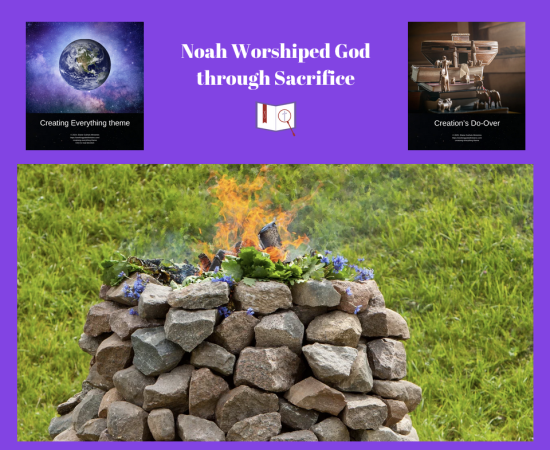
    “Then Noah built an altar to the Lord, and there he sacrificed as burnt offerings the animals and birds that had been approved for that purpose” (Gen. 8: 20 NLT)

    Noah immediately worshiped God after he disembarked from the ark.

    First things first. The way it was written, it sounds like Noah – immediately after disembarking – built an altar and sacrificed to God. God didn’t tell him to do that – he just did it.

    Noah was still being obedient.

    Noah didn’t build his house first. He didn’t build a temple – or even designate a garden.

    The burnt sacrifice Noah offered was to restore his relationship with God because of humankind’s sinful nature. (Daily animal sacrifices were need according to the Law of Moses because animal blood could not change our sinful nature. Only the blood of Jesus could do that.)

    We know humans had offered sacrifices to God previously. That was what got Cain in trouble (Gen. 4: 3-7).

    This was the first time that we are told the sacrifice was given on an altar. Even if Cain and Abel – along with Adam and Eve – didn’t have a physical structure for an altar, they certainly would have had a place of consecration at which to perform the sacrifice.

    But God being One Who never changes and works through patterns, I think we would be safe in assuming that there had always been an altar. They may not have been as defined as they were in the Law of Moses, but I see it as a progression – altar of common material to altar in the Tabernacle to altar in the Temple.

    God works through progressions, too.

    Look at it this way. Noah – if we take it one way – was the only righteous man before the flood. If that was the case, his family was saved because of him.

    During the long year on the ark, Noah could have thought about that and gotten prideful. He didn’t.

    Immediately after getting off the ark, Noah must have felt the weight of repopulating the earth. He must have thought he was not only representing his family – who probably were right there beside him – as the priest but also every person that would come after him – including you and me.

    Exell reminded us of one way in which Noah showed his righteousness. He wrote, “This sacrifice was the natural outcome of Noah’s gratitude.”

    Resource

    It was more than Noah was sincerely grateful to God for saving the lives of him and his family. He was acknowledging God’s sovereignty and his dependance. Noah was also pledging to continue to be obedient the rest of his life.

    This sacrifice was even more than that. It was a visual exhibition of Noah’s faith. It spoke of his future atonement.

    As our Creator, God has authority to determine acceptable and unacceptable relationships and behaviors and do something about it when they tip to unacceptable.

    Some of Every Clean Animal and Bird

    Every clean animal and bird were offered to God to restore their blessing.

    I guess I had always read over this part of verse 20. I hadn’t considered that more than one animal was sacrificed.

    But some of every clean animal and bird were sacrificed. That means not only on species, but also more than one of a species. (And I would say that Noah wouldn’t break up a pair, so it would be at least one or two pair.)

    We think of clean animals as bulls, sheep, goats, doves, and pigeons.

    • “The Lord called to Moses from the Tabernacle and said to him, ‘Give the following instructions to the people of Israel. When you present an animal as an offering to the Lord, you may take it from your herd of cattle or your flock of sheep and goats’” (Lev. 1: 1-2 NLT).
    •  Then the Lord said to Moses, ‘Dedicate to me every firstborn among the Israelites. The first offspring to be born, of both humans and animals, belongs to me’” (Ex. 13: 1-2 NLT).

    That isn’t all. Animals for eating had to be clean, also.

    • “Then the Lord said to Moses and Aaron, ‘Give the following instructions to the people of Israel. “Of all the land animals, these are the ones you may use for food. You may eat any animal that has completely split hooves and chews the cud”’” (Lev. 11: 2-3 NLT).
    • “These are the animals you may eat: the ox, the sheep, the goat, the deer, the gazelle, the roe deer, the wild goat, the addax, the antelope, and the mountain sheep” (Deut. 14: 4-5 NLT).
    • “Of all the marine animals, these are ones you may use for food. You may eat anything from the water if it has both fins and scales, whether taken from salt water or from streams” (Lev. 11: 9 NLT).
    • “You may, however, eat winged insects that walk along the ground and have jointed legs so they can jump. The insects you are permitted to eat include all kinds of locusts, bald locusts, crickets, and grasshoppers” (Lev. 11: 21-22 NLT).

    If you are interested, the Bible Study website has an extensive list on clean and unclean animals for food.

    Resource

    No, sacrifices didn’t always have to be to this extent. Usually, sacrifices were one per person, maybe family at the most.

    There were times when multiple sacrifices were offered.

    • “After the ordination ceremony, on the eighth day, Moses called together Aaron and his sons and the elders of Israel. He said to Aaron, ‘Take a young bull for a sin offering and a ram for a burnt offering, both without defects, and present them to the Lord. Then tell the Israelites, ‘Take a male goat for a sin offering, and take a calf and a lamb, both a year old and without defects, for a burnt offering. Also take a bull and a ram for a peace offering and flour moistened with olive oil for a grain offering. Present all these offerings to the Lord because the Lord will appear to you today”’” (Lev. 9: 1-4 NLT).
    • “King Solomon offered a sacrifice of 22,000 cattle and 120,000 sheep and goats. And so the king and all the people dedicated the Temple of God” (2 Chron. 7: 5 NLT).
    • “On the first day Nahshon son of Amminadab, leader of the tribe of Judah, presented his offering [for the dedication of the altar. His offering consisted of a silver platter weighing 3 1⁄4 pounds and a silver basin weighing 1 3⁄4 pounds (as measured by the weight of the sanctuary shekel). These were both filled with grain offerings of choice flour moistened with olive oil. He also brought a gold container weighing four ounces, which was filled with incense. He brought a young bull, a ram, and a one-year-old male lamb for a burnt offering, and a male goat for a sin offering. For a peace offering he brought two bulls, five rams, five male goats, and five one-year-old male lambs. This was the offering brought by Nahshon son of Amminadab” (Num. 7: 12-17 NLT). NOTE: Each tribe offered the exact same offering, so multiply this by 12 to get the entire offering.

    Each sacrifice – regardless of the number – had to be offered in faith and gratitude and had to consist of our best. Best means unblemished, pure, or first (as in first fruits).

    God had told Noah to bring seven pair of animals for sacrifice. “Take with you seven pairs — male and female — of each animal I have approved for eating and for sacrifice, and take one pair of each of the others. Also take seven pairs of every kind of bird. There must be a male and a female in each pair to ensure that all life will survive on the earth after the flood” (Gen. 7: 2-3 NLT).

    I can see that Noah had to offer each pair of animals and birds to God to restore their blessing. “Then God blessed them, saying, ‘Be fruitful and multiply. Let the fish fill the seas, and let the birds multiply on the earth’” (Gen 1: 22 NLT).

    But all that must not overshadow the significance of the blood. The blood of the sacrifices brought penance for humans. The sacrifice of Jesus’ blood brought salvation. God only accepts the covering of our sins by blood so that we can once again appear before Him.

    Making the Connections #1

    Okay. God doesn’t require us to sacrifice animals anymore. So, how are supposed to offer sacrifices?

    Jesus was the Sacrifice. Instead of a lamb, He was the Pascal Lamb that shed His blood to cover our sins.

    We are to come reverently before God, thanking Jesus for His sacrifice, and expressing guilt for our sins.

    No, we don’t transfer our sin to an animal anymore. They are transferred to Jesus.

    We do, however, have to acknowledge our sins and specifically ask forgiveness for them.

    Making the Connections #2

    Burton said something important.

    • We are more selfish in our sacrifices than Noah was.
    • We want our worship of God to be in the way that we want to give it, not necessarily as God says we should worship Him.
    • We want to worship God when it doesn’t cost us anything. God doesn’t promise that.

    Resource

    Noah didn’t count the cost. He sacrificed a significant amount of the animals to worship God. He did it voluntarily and promptly.

    Making the Connections #3

    I love what Arnold said. He wrote,

    “Everything is properly called good or evil according as it answers or defeats the purpose for which it was made. We were made for our Maker’s glory, after His own image, that we should make His will the rule of our lives, and His love and anger the great objects of our hope and fear; that we should live in Him, and for Him, and to Him, as our constant Guide and Master and Father. If we answer these ends, then we are good creatures; if we do not, we are bad creatures.”

    Resource

    We were made to worship and glorify God. Nothing else that we do makes up for not doing that.

    “A good tree produces good fruit, and a bad tree produces bad fruit. A good tree can’t produce bad fruit, and a bad tree can’t produce good fruit. So every tree that does not produce good fruit is chopped down and thrown into the fire. Yes, just as you can identify a tree by its fruit, so you can identify people by their actions” (Mt. 7: 17-20 NLT).

    How Do We Apply This?

    • Be sure to offer our praise, worship, and sacrifices to God before, during, and after His acts of deliverance.
    • Realize that we only serve God through our sacrifice.
    • Express feelings of thankfulness and guilt when we offer our sacrifice.
    • Worship God in the way He requires.
    • Worship God voluntarily and promptly.

    Resource

    Father God. We so often think that only one pair of animals were taken on the ark. But there were more that were of the ones that were designated to worship and honor You. Thank You for showing us how to worship You. Amen.

    What do you think?

    Leave me a comment below (about this or anything else) or head over to my Facebook group for some interactive discussion.

    If you don’t understand something and would like further clarification, please contact me.

    If you have not signed up for the email providing the link to the devotions and the newsletter, do so below.

    If God has used this devotion to speak with you, consider sharing it on social media.
  • The Flood Is Over!

    The day was finally here! This devotional reading looks at how the period of the flood ended.

    Nuggets

    • The rain had stopped, and the earth had dried out.
    • God told Noah when to exit the ark.
    the-flood-is-over

    The flood was a thing of the past. The rain had stopped, and the water had receded.

     It was now time to get off the ark and get on with life.

    Let’s Put It into Context

    To read devotions in the Creating Everything theme, click the button below.

    Devotions in the Creation’s Do-Over series

    The Flood Officially Over

    “Noah was now 601 years old. On the first day of the new year, ten and a half months after the flood began, the floodwaters had almost dried up from the earth. Noah lifted back the covering of the boat and saw that the surface of the ground was drying. Two more months went by, and at last the earth was dry!” (Gen. 8: 13-14 NLT)

    The rain had stopped, and the earth had dried out.

    It was over. The flood that God said would come had come and gone. Before, Noah may not have even known what rain was.

    Now, Noah would have heard the rain. There was most likely thunder and lightning associated with it. It may have even been a hurricane.

    No, I doubt that it was a gentle summer shower.

    It was a judgment. It would have been a catastrophe.

    Yes, part of Noah’s heart would be hurting because of people that died. He would be mourning relationships lost.

    But overall, Noah would have humbly bowed to an omnipotent God. He would have acknowledged God’s authority to judge those who refused to recognize Him as Sovereign Lord.

    Still, the Homilist noted that Noah had a futuristic understanding of this calamity. It was written, “That it was only a faint type of the final judgment.”

    Resource

    I really doubt that Noah had any concept of the Day of the Lord. It would be thousands of years before Revelation was written by John.

    But in the back of his mind, Noah had to be wondering what God would do the next time He judged the world.

    Oh, come on. You think that Noah didn’t know sin would still be in the world. Stay tuned. It didn’t take long.

    Sin is in human nature. If we are human, we have a sinful nature.

    The flood did not take away Noah’s sinful nature.

    “The law of Moses was unable to save us because of the weakness of our sinful nature. So God did what the law could not do. He sent his own Son in a body like the bodies we sinners have. And in that body God declared an end to sin’s control over us by giving his Son as a sacrifice for our sins. He did this so that the just requirement of the law would be fully satisfied for us, who no longer follow our sinful nature but instead follow the Spirit” (Rom. 8: 3-4 NLT).

    Even though Moses’ law was not given yet, we know that pieces of it had – if not all. I could see that Moses accomplished in getting it written down.

    Think about it. If Noah and his ancestors only had the one law that Adam got, it didn’t have any way to restore their relationship with God. “But the Lord God warned him, ‘You may freely eat the fruit of every tree in the garden — except the tree of the knowledge of good and evil. If you eat its fruit, you are sure to die’” (Gen. 2: 16-17 NLT).

    Remember, the fruit wasn’t the only issue here. The main issue was obedience — and still is. This was more than a Garden of Eden law.

    Still, Noah would have had to have felt God’s loving mercy. We have a saying, “There but by the grace of God go I.”

    Ooo, baby. Noah was feeling that big time.

    What is the difference between grace and mercy?

    • Grace is a free and unmerited gift of love from the Heavenly Father, given through His Son, Jesus Christ, that enables salvation and spiritual healing to believers by the work of the Holy Spirit.
    • Mercy is an act of sovereign will that produces an unexpected and undeserved response from God as He responds in love to our needs.

    In other words, God gives us what we don’t deserve (grace) and doesn’t give us what we do deserve (mercy).

    Noah would have felt both of those because he would have had the Old Testament salvation – faith and obedience.

    The Time in the Ark Is Completed

    “Then God said to Noah, ‘Leave the boat, all of you — you and your wife, and your sons and their wives. Release all the animals — the birds, the livestock, and the small animals that scurry along the ground — so they can be fruitful and multiply throughout the earth.’ So Noah, his wife, and his sons and their wives left the boat. And all of the large and small animals and birds came out of the boat, pair by pair” (Gen. 8: 15-19 NLT)

    God told Noah when to exit the ark.

    I bet Noah and his family were more than ready to exit the ark. They had to have been cramped in the enclosed space.

    It had to have been somewhat depressing. I don’t know how much sunshine – once the sun shown again – would have made its way into the ark. (It just says that there was one window – one that had to be opened. “After another forty days, Noah opened the window he had made in the boat” (Gen. 8: 6 NLT).

    It would have been a really neat experience to see all of the animals tamed for the moment. But I bet it was a lot of work for the eight people to feed all of them. That must have taken most of the day.

    They were probably ready to get back to whatever their occupations were preflood.

    But Noah waited for God to say, “It’s time to get out.” He didn’t want to get ahead of God.

    Ooo, baby. Don’t we do that at times? God is working too slowly for our liking, so we take things into our own hands and do what we want to do on our timetable.

    That usually doesn’t work out real well.

    We talked about God remembering the ark passengers. “But God remembered Noah and all the beasts and all the livestock that were with him in the ark …”  (Gen. 8: 1 NLT).

    Noah would have been remembering, too. He would have been remembering about how bad it was and humbled – and probably brooding – about thinking he and his family would be responsible for repopulating the earth.

    Did Noah wonder if he would ever lose his obedience to God? Did he ponder over how he could steer his family to not make the mistakes of disobedience that were made before? Did he wonder about people years after him remembering the flood and judgment that is given when we are disobedient to God?

    Ooo, baby. That first step onto dry land after a year would have been exciting and scary!

    Noah had to take comfort in the fact that he had his family with him. Look what Exell said. He wrote,

    “He [Noah] goes forth in company with the relatives of his own family. God permitted the family of Noah to be with him in the ark, to relieve his solitude, to aid his efforts, to show the protective influence of true piety; and now they are to join him in the possession of the regenerated earth, that they may enjoy its safety and aid its cultivation.”

    Resource

    We can’t be stymied by sin after we have experienced God’s judgment. He doesn’t judge us to drive us away.

    God judges us to correct us and bring us back to Him. We have to let Him and not let our doubts and guilt get in the way.

    Making the Connections

    I love what the Homilist wrote. It says, “Christianity, the great expedient for saving souls from the deluge of moral evil, is God’s plan.”

    Resource

    The Plan of Salvation has always been God’s plan. It was always in the plan to create the Church – a body of believers with Jesus as the Head. “God has put all things under the authority of Christ and has made him head over all things for the benefit of the church” (Eph. 1: 22 NLT).

    God had it in place before the foundation of the universe.

    • “God chose him as your ransom long before the world began, but now in these last days he has been revealed for your sake” (I Pet. 1: 20 NLT).
    • “Even before he made the world, God loved us and chose us in Christ to be holy and without fault in his eyes” (Eph. 1: 4 NLT).
    • “And all the people who belong to this world worshiped the beast. They are the ones whose names were not written in the Book of Life that belongs to the Lamb who was slaughtered before the world was made” (Rev. 13: 8 NLT).
    • “Father, I want these whom you have given me to be with me where I am. Then they can see all the glory you gave me because you loved me even before the world began!” (Jn. 17: 24 NLT).
    • “The beast you saw was once alive but isn’t now. And yet he will soon come up out of the bottomless pit and go to eternal destruction. And the people who belong to this world, whose names were not written in the Book of Life before the world was made, will be amazed at the reappearance of this beast who had died” (Rev. 17: 8 NLT).
    • “For God saved us and called us to live a holy life. He did this, not because we deserved it, but because that was his plan from before the beginning of time—to show us his grace through Christ Jesus” (II Tim. 1: 9 NLT).
    • “Then the King will say to those on his right, ‘Come, you who are blessed by my Father, inherit the Kingdom prepared for you from the creation of the world’” (Mt. 25: 34 NLT).
    • “If that had been necessary, Christ would have had to die again and again, ever since the world began. But now, once for all time, he has appeared at the end of the age to remove sin by his own death as a sacrifice” (Heb. 9: 26 NLT).

    We don’t know how much Noah really knew about this plan, but I bet he knew more was needed to fix our sinful nature.

    How Do We Apply This?

    • Wait for God’s mercy when we experience testings and trials.
    • Exercise patience during those times.
    • Seek mercy through patience.
    • Understand that mercy is sometimes shown through what is withheld from us.
    • Expect God’s providence in situations when we are following His Will.
    • Wait for the completion of the testings and trials.
    • Don’t turn away from God after He has judged and corrected us.

    Resources

    Father God. Thank You for always being with us – in the trials and during the smooth sailing. We know there is a day when the trials will end and that You have carried us through. Amen.

    What do you think?

    Leave me a comment below (about this or anything else) or head over to my Facebook group for some interactive discussion.

    If you don’t understand something and would like further clarification, please contact me.

    If you have not signed up for the email providing the link to the devotions and the newsletter, do so below.

    If God has used this devotion to speak with you, consider sharing it on social media.
  • Sending Out the Birds

    It was about time for the occupants of the ark to be able to disembark. This devotional reading looks at how Noah sent birds out to determine the status of the land.

    Nuggets

    • The first bird that Noah sent out was a raven, an unclean bird.
    • We aren’t told how long Noah waited on the raven before he sent out the dove.
    • The second dove sent out by Noah came back with an olive branch.
    • Noah knew their time in the ark was about over when the third dove didn’t come back.
    sending-out-the-birds

    In the last devotion, we talked about God being the One that steered the ark to Mt. Ararat. Noah was perfectly fine with that.

    Noah had to know that the time for the ark trip was coming to an end. Some may see Noah sending out the birds as an act of impatience. I don’t see it that way.

    I don’t think God was upset that Noah was checking out the status of the drying operation. He didn’t put us on this earth to just sit around waiting on Him.

    On the contrary. God has a role for us to plan in expanding His kingdom. He also expects us to be stewards of His creation.

    Let’s Put It into Context

    To read devotions in the Creating Everything theme, click the button below.

    Devotions in the Creation’s Do-Over series

    Raven

    “After another forty days, Noah opened the window he had made in the boat and released a raven. The bird flew back and forth until the floodwaters on the earth had dried up” (Gen. 8: 6-7 NLT)

    The first bird that Noah sent out was a raven, an unclean bird.

    “These are the birds that are detestable to you. You must never eat them: the griffon vulture, the bearded vulture, the black vulture, the kite, falcons of all kinds, ravens of all kinds, the eagle owl, the short-eared owl, the seagull, hawks of all kinds, the little owl, the cormorant, the great owl, the barn owl, the desert owl, the Egyptian vulture, the stork, herons of all kinds, the hoopoe, and the bat” (Lev. 11: 13-19 emphasis added).

    Why would Noah choose an unclean bird before he chose a clean one? Well, it was probably because, being unclean, it was more suited to what it would find.

    Ravens are scavengers. There would have been a lot of dead things on which it would be able to feed. It could fly long distances, which would have been a good reason to send it as a scout.

    Gray told us why a long-distance bird was needed. He wrote,

    “Doubtless he would often look forth on the waste of waters. The rapid evaporation, etc., would very much intercept a distant view. Fogs and mists, etc. Hence to know the state of things beyond the reach of his vision he would send forth messengers.”

    Resource

    The raven would have been a great choice.

    But then, the raven didn’t come back. It just kept flying back and forth until it found a spot to land. It could survive on its own.

    That sounds familiar. “‘Where have you come from?’ the Lord asked Satan. Satan answered the Lord, ‘I have been patrolling the earth, watching everything that’s going on’” (Job. 1: 7 NLT).

    Well, that is logical. The raven, being an unclean bird, was associated with death – aka sin.

    Creation just had a redo, and sin still wasn’t gone from the world. In fact, something unclean was the first thing that got out of the ark.

    And after 271 days if my math is right, (10th day of the 2nd month to the 11th day of the 11th month), sin still wanted to get away from God.

    Gray made another great point. The raven would have been able to see the ark. It wasn’t this small boat.

    Remember, by this time, the ark was parked on Mt. Ararat. It didn’t leave the area, stranding the raven.

    That rules out the raven not being able to find it.

    First Dove

    “He also released a dove to see if the water had receded and it could find dry ground. But the dove could find no place to land because the water still covered the ground. So it returned to the boat, and Noah held out his hand and drew the dove back inside” (Gen. 8: 8-9 NLT)

    Noah sent out the dove at the same time as the raven.

    Yeah, Noah sort of got a report from the raven by his not coming back, but he really didn’t know much more than he did before. So, he also sent a more reliable messenger.

    A dove was a clean bird. It could be used for the olah offering (the burnt offering) for those who could not afford a bull, sheep, or goat. “If you present a bird as a burnt offering to the Lord, choose either a turtledove or a young pigeon” (Lev. 1: 14 NLT).

    In other words, the dove was accessible to everyone. That resonates with me since the Holy Spirit, Who has been depicted as a dove, is available to everyone. “One day when the crowds were being baptized, Jesus himself was baptized. As he was praying, the heavens opened, and the Holy Spirit, in bodily form, descended on him like a dove. And a voice from heaven said, “You are my dearly loved Son, and you bring me great joy” (Lk. 3: 21-22 NLT).

    I can see the dove instinctively flying away from the ark. Prior to this trip, it probably had not been a tamed bird.

    But the dove came back. Maybe it had developed a relationship with Noah over its time in the ark. It knew who had been feeding it.

    Maybe God was guiding it to accomplish His plan. We remember Balaam and his donkey (Num. 22: 21-39). God used animals.

    Whatever, the dove came back.

    This poor little guy flew around for a while but didn’t find a landing spot. So, it came back – back to God in the ark. With God is the only place we find peace.

    Look at the reception the dove got. Noah reached out and lovingly pulled it back in.

    No, I don’t think Noah had made the ark a prison. True, the wild animals may have been normally comfortable with the arrangement, but I am sure that God gave them His peace.

    Second Dove

    “After waiting another seven days, Noah released the dove again. This time the dove returned to him in the evening with a fresh olive leaf in its beak. Then Noah knew that the floodwaters were almost gone” (Gen. 8: 10-11 NLT)

    The second dove sent out by Noah came back with an olive branch.

    The olive branch brought back by the second dove Noah sent out was very important. It meant that things were growing again in the earth. If the plants could grow, it would soon be inhabitable by the humans.

    Olive trees also have a spiritual meaning. They are symbolic of peace and forgiveness.

    • “Oh, the joys of those who do not follow the advice of the wicked, or stand around with sinners, or join in with mockers. But they delight in the law of the Lord, meditating on it day and night. They are like trees planted along the riverbank, bearing fruit each season. Their leaves never wither, and they prosper in all they do” (Ps. 1: 1-3 NLT).
    • “But I am like an olive tree, thriving in the house of God. I will always trust in God’s unfailing love” (Ps. 52: 8 NLT).
    • “But some of these branches from Abraham’s tree — some of the people of Israel — have been broken off. And you Gentiles, who were branches from a wild olive tree, have been grafted in. So now you also receive the blessing God has promised Abraham and his children, sharing in the rich nourishment from the root of God’s special olive tree” (Rom. 11: 17 NLT).

    That is just talking about the olive trees. The olives themselves are significant when made into olive oil.

    • “Then the Lord said to Moses, ‘Collect choice spices — 12 1⁄2 pounds of pure myrrh, 6 1⁄4 pounds of fragrant cinnamon, 6 1⁄4 pounds of fragrant calamus, and 12 1⁄2 pounds of cassia — as measured by the weight of the sanctuary shekel. Also get one gallon of olive oil. Like a skilled incense maker, blend these ingredients to make a holy anointing oil. Use this sacred oil to anoint the Tabernacle, the Ark of the Covenant, the table and all its utensils, the lampstand and all its accessories, the incense altar, the altar of burnt offering and all its utensils, and the washbasin with its stand. Consecrate them to make them absolutely holy. After this, whatever touches them will also become holy” (Ex. 30: 22-25 NLT).
    • “Command the people of Israel to bring you pure oil of pressed olives for the light, to keep the lamps burning continually” (Lev. 24: 2 NLT).
    • “You prepare a feast for me in the presence of my enemies. You honor me by anointing my head with oil. My cup overflows with blessings” (Ps. 23: 5 NLT).
    • “Are any of you sick? You should call for the elders of the church to come and pray over you, anointing you with oil in the name of the Lord” (Jas. 5: 14 NLT).
    • “And they cast out many demons and healed many sick people, anointing them with olive oil” (Mk. 6: 13 NLT).

    So, the fact that the dove – in which the Holy Spirit has been known to take bodily form – is offering Noah and his family peace, forgiveness, and blessings.

    Why was Noah offered peace, forgiveness, and blessing? He walked with God. He was faithful and obedient.

    God will use what we may think is common and ordinary for His holy purposes.

    Third Dove

    “He waited another seven days and then released the dove again. This time it did not come back” (Gen. 8: 12 NLT)

    Noah knew their time in the ark was about over when the third dove didn’t come back.

    The third dove was the charm. It didn’t come back, so Noah knew the earth was inhabitable again.

    Noah just had to wait for God’s directions.

    Making the Connections #1

    Yeah, Noah opened the window and let the birds out. He wasn’t impatient to get out of the ark.

    Noah was content in whatever situation in which God Him. “I am not saying this because I am in need, for I have learned to be content whatever the circumstances. I know what it is to be in need, and I know what it is to have plenty. I have learned the secret of being content in any and every situation, whether well fed or hungry, whether living in plenty or in want. I can do all this through him who gives me strength” (Phil. 4: 11-13 NLT).

    I can see Noah saying the same thing. He had just gone through a harrowing experience.

    We never once see any talk back – not like Moses did. All we see is faith and obedience.

    Everyone is going to have their own harrowing experience. Exell agreed and told us why. He wrote, “That when God does place men in unwelcome positions, it is that their own moral welfare may be enhanced.”

    Resource

    Yes, the trials are hard. But God is always with us. He always has a purpose for the trials – the core of which is to strengthen our faith and patience.

    Making the Connections #2

    We should learn from the doves. Cuyler told us how. Look what he said first.

    Cuyler wrote, “God has designed but one resting place for the soul, and that is the restoration of peace between it and Himself. On Jesus’ breast we may lay our weary heads.”

    Resource

    • We won’t be able to find rest until we come back to God.
    • We need to come back to God with a repentant soul, not making excuses or deflecting our guilt.
    • Jesus is the only way to gain salvation.

    How Do We Apply This?

    • Lean on God’s understanding, not our own.
    • Use the talents that God has given us.
    • Always follow where God leads.
    • Wait patiently on God to provide answers to prayers.

    Resources

    Father God. We want to have the faith and obedience of Noah. We want to have his patience and contentment, even in difficult trials. Help us to follow his example. Amen.

    What do you think?

    Leave me a comment below (about this or anything else) or head over to my Facebook group for some interactive discussion.

    If you don’t understand something and would like further clarification, please contact me.

    If you have not signed up for the email providing the link to the devotions and the newsletter, do so below.

    If God has used this devotion to speak with you, consider sharing it on social media.
  • And the Floods Came Up

    The occupants of the ark could only listen as the rain came down. This devotional reading looks at what happened when the rain came and what happened when the water started to subside.

    Nuggets

    • Everything that breathed died.
    • I don’t think God forgot about Noah and the other occupants.
    • God didn’t immediately dry out the land.
    and-the-floods-came-up

    The beginning voyage of the ark had to have been interesting. The occupants of the ark probably had a lot of questions about how this would go down.

    But we aren’t really told anything about life on the journey. We are told about the water.

    Let’s Put It into Context

    To read devotions in the Creating Everything theme, click the button below.

    Devotions in the Creation’s Do-Over series

    The Floodwaters Rose

    “For forty days the floodwaters grew deeper, covering the ground and lifting the boat high above the earth. As the waters rose higher and higher above the ground, the boat floated safely on the surface. Finally, the water covered even the highest mountains on the earth, rising more than twenty-two feet above the highest peaks. All the living things on earth died — birds, domestic animals, wild animals, small animals that scurry along the ground, and all the people. Everything that breathed and lived on dry land died.  God wiped out every living thing on the earth — people, livestock, small animals that scurry along the ground, and the birds of the sky. All were destroyed. The only people who survived were Noah and those with him in the boat.  And the floodwaters covered the earth for 150 days” (Gen. 7: 17-24 NLT)

    Everything that breathed died.

    It seems strange that the animals also had to die because of man’s wickedness. Geikie argued that even the fish died. I don’t think so.

    There has been some disagreement as to be the extent of the flood. “God wiped out every living thing on the earth — people, livestock, small animals that scurry along the ground, and the birds of the sky. All were destroyed. The only people who survived were Noah and those with him in the boat. And the floodwaters covered the earth for 150 days” (Gen. 7: 23-24 NLT).

    What is the definition of all? Was it every square inch of the planet Earth, or just the areas known at that time?

    Geikie argued that it was a local flood. He wrote, “There could certainly be no apparent reason for submerging the vast proportion of the world which was then uninhabited, or of raising the waters above the tops of mountains to which no living creature could approach.”

    Resource

    Yeah, the water would have added a lot of weight. It probably would have affected the plant. It may even have affected the heavenly motions.

    Still, there is physical evidence in many places that support a wide-spread flood. Location of fossils and the volume in some cases point to something happening. A wide distribution of sedimentary layers also back this up, especially when coupled with erosion patterns.

    I don’t agree that we can discount the occurrence of the flood because oceans impeded animals getting to the ark. Our seven continents once made up one continent, called Pangaea.

    There was no ocean to traverse at that time. We don’t know how spread out the population became.

    We don’t have to worry about the debate as to whether this was a local or global flood. Location isn’t the focus here.

    Results are.

    • “And all flesh died that moved on the earth…” (Gen. 7: 21 ESV). 
    • “Everything on the dry land in whose nostrils was the breath of life died” (Gen. 7: 22 ESV).
    • “… every living thing that was on the face of the ground, man and animals and creeping things and birds of the heavens …” (Gen. 7: 23 ESV).

    It didn’t matter their address. They died. The land and air animals couldn’t have survived under water for 150 days.

    Because of that, I think Geikie was wrong. Fish didn’t die.

    Calendar study. The preflood Hebrew calendar was a lunar calendar. Each of the 12 unnamed months would have had 30 days. That means a year would have been 360 days, not 365.

    God judged His creation and sentenced them to death for their transgressions.

    Only Noah, his family, and the animals with them survived because they were obedient and entered the ark.

    The Flood Subsides

    “But God remembered Noah and all the beasts and all the livestock that were with him in the ark. …”  (Gen. 8: 1 NLT).

    I don’t think God forgot about Noah and the other occupants.

    In order to remember someone, you need to forget them first. It is a human cognitive process.

    When we forget, it means we can’t recall something. Remembering is a process of retrieving and retaining what we’ve forgotten.

    In other words, it is a brain function. God doesn’t have a human brain.

    The way God’s Word describes Him is that He is a Spirit. “For God is Spirit, so those who worship him must worship in spirit and in truth” (Jn. 4: 24 NLT).

    Spirt. No body. No human processes, like forgetting and remembering. God is invisible and omnipresent.

    • “Christ is the visible image of the invisible God. He existed before anything was created and is supreme over all creation” (Col. 1: 15 NLT).
    • “All honor and glory to God forever and ever! He is the eternal King, the unseen one who never dies; he alone is God. Amen” (I Tim. 1: 17 NLT).

    Yes, Jesus came down and He was 100% human while He was 100% God.

    • “So the Word became human and made his home among us. He was full of unfailing love and faithfulness. And we have seen his glory, the glory of the Father’s one and only Son” (Jn. 1: 14 NLT).
    • “Instead, he gave up his divine privileges; he took the humble position of a slave and was born as a human being. When he appeared in human form” (Phil. 2: 7 NLT).
    • “For in Christ lives all the fullness of God in a human body” (Col. 2: 9 NLT).

    God never was — and never will be — human. “God is not a man, so he does not lie. He is not human, so he does not change his mind …” (Num. 23: 19 NLT).

    But to help us “understand” God, we give Him human characteristics.

    • “Listen! The Lord’s arm is not too weak to save you, nor is his ear too deaf to hear you call” (Isa. 59: 1 NLT).
    • “The eyes of the Lord search the whole earth in order to strengthen those whose hearts are fully committed to him. What a fool you have been! From now on you will be at war” (II Chron. 16: 9 NLT).
    • “The eternal God is your refuge, and his everlasting arms are under you. He drives out the enemy before you; he cries out, ‘Destroy them!” (Duet. 33: 27 NLT).

    Still, God is a living Being. “Today you will know that the living God is among you …” (Josh. 3: 10 NLT).

    The Waters Subsided

    “… and the waters subsided. The fountains of the deep and the windows of the heavens were closed, the rain from the heavens was restrained, and the waters receded from the earth continually. At the end of 150 days the waters had abated, and in the seventh month, on the seventeenth day of the month, the ark came to rest on the mountains of Ararat. And the waters continued to abate until the tenth month; in the tenth month, on the first day of the month, the tops of the mountains were seen” (Gen. 8: 1-5 NLT).

    God didn’t immediately dry out the land.

    As I am writing this, the news is all about the devastating flooding in Texas on Independence Day. The water came down rapidly, and the Guadalupe River has in one day — in some cases —already returned to its banks.

    The flood in Noah’s time was much more substantial. The flood even covered the mountaintops. There was more water to get rid of.

    Verse two added a new nugget. “The fountains of the deep and the windows of the heavens were closed, the rain from the heavens was restrained” (Gen. 8: 2 NLT).

    The underground waters that are discussed in Genesis 7: 11 are descriptively called the fountains of the deep here in Genesis 8: 2.

    I can just see that. We turn on some fountains, and our whole faces are going to get wet when we try to get a drink.

    Mountains of Ararat

    The ark had floated on the water for 150 days. Vaughan reminded us that Noah wasn’t steering the ark. He wrote, “There was an arm unseen directing it, there was strength unseen supporting it, and love unseen that was wafting it.”

    Resource

    God guided the ark. He had it land on Mount Ararat.

    Think about it. God had a remnant. It was only eight people – six more than the first two He started out with.

    But God had who He needed.

    Noah’s time in the ark was fixing to be over. The ground was beginning to dry out as the flood water receded.Verse two added a new nugget. “The fountains of the deep and the windows of the heavens were closed, the rain from the heavens was restrained” (Gen. 8: 2 NLT).

    The underground waters that are discussed in Genesis 7: 11 are descriptively called the fountains of the deep here in Genesis 8: 2.

    I can just see that. We turn on some fountains, and our whole faces are going to get wet when we try to get a drink.

    Making the Connections #1

    Griffin is way off. He called Noah a prisoner within the ark, especially because he had no communication with God.

    Resource

    Oh, no. Noah was not a prisoner. Yes, he couldn’t go out of the ark. He had to ride the waves for many days.

    But Noah was anything but a prisoner. He was free from the consequences – in his day – of sin.

    Ohhh, no. God did not shut the door and leave them there by themselves. Just because there is no documented record of those conversations, He didn’t leave them alone.

    God never leaves His children alone.

    Making the Connections #2

    Since God is a Spirit — therefore, invisible — so we have to worship Him in spirit and in truth. “For God is Spirit, so those who worship him must worship in spirit and in truth” (Jn. 4: 24 NLT).

    We can’t worship God face to face. We have to worship Him with our hearts and minds.

    How do we worship God in truth? We worship God as in revealed in His Word, not through tradition and rituals. “We’ve always done it that way” many not be God’s way.

    Making the Connections #3

    Vaughan talked about what it may have been like – and what it was like getting off the boat. He wrote, “It is natural to imagine, that this last seven months must have seemed to pass more slowly than all the time while they were lying on the waves. If the troubled time of life brings its trials, so also does its calms.”

    Resource

    It must have been a long 150 days – and they weren’t out of the boat yet. They probably had a routine. It probably focused on eating, sleeping, and animal care.

    But tough times come to an end. God leads us through them to where He wants us to end up.

    I doubt that Noah complained about the water voyage. No, it wasn’t his way.

    When we walk with God, we learn to be content whatever the situations around us.

    How Do We Apply This?

    • Take heed to listen to God’s warnings.
    • Understand that God will be patient for only so long.
    • Make sure you are on the right side of God.

    Resource

    Father God. You promised us that trials and persecution would come our way. At times, we feel like we are floating on our own arks, being tossed around by the waves of the rising trials. Thank You for never leaving us.

    What do you think?

    Leave me a comment below (about this or anything else) or head over to my Facebook group for some interactive discussion.

    If you don’t understand something and would like further clarification, please contact me.

    If you have not signed up for the email providing the link to the devotions and the newsletter, do so below.

    If God has used this devotion to speak with you, consider sharing it on social media.
  • The Rains Came Down

    Once Noah, his family, and the animals were in the ark, the rain could commence. This devotional reading looks at where the water came from and God’s control of every aspect of the judgment.

    Nuggets

    • As Creator of the universe, God retained control of the earth, opening the buried reservoirs.
    • Even if it had never rained before, it rained now.
    • It came to a day when God was done with evil.
    • God provided salvation for those who followed His Will.
    the-rains-came-down

    The flood began in 1656. We don’t know when the original sin occurred, but we figure that it was before Seth was born in 130.

    In those 1526 years that sin went unchecked, it got really bad. “The Lord observed the extent of human wickedness on the earth, and he saw that everything they thought or imagined was consistently and totally evil” (Gen. 6: 5 NLT).

    Nope, didn’t say anything about what they did, but we know what they did was violent (Gen. 6: 11).

    This wickedness was a moral wickedness. That means they didn’t have God’s character.

    Finally, God had enough. He started the creation do-over.

    Let’s Put It into Context

    To read devotions in the Creating Everything theme, click the button below.

    Devotions in the Creation’s Do-Over series

    From Where the Water Came

    “After seven days, the waters of the flood came and covered the earth. When Noah was 600 years old, on the seventeenth day of the second month, all the underground waters erupted from the earth, and the rain fell in mighty torrents from the sky. The rain continued to fall for forty days and forty nights” (Gen. 7: 10-12 NLT).

    All the Underground Waters Erupted

    As Creator of the universe, God retained control of the earth, opening the buried reservoirs.

    When we studied Genesis 1 and 2, we saw that God created the universe by speaking it into existence and raising His outstretched arm (Jer. 32: 17).

    It should not surprise us that God’s created world follows His and Jesus’ voices. “Jesus came and told his disciples, ‘I have been given all authority in heaven and on earth’” (MT. 28: 18 NLT).

    When did/does the earth obey Them?

    • “Pay attention to this, Job. Stop and consider the wonderful miracles of God! Do you know how God controls the storm and causes the lightning to flash from his clouds? Do you understand how he moves the clouds with wonderful perfection and skill? When you are sweltering in your clothes and the south wind dies down and everything is still, he makes the skies reflect the heat like a bronze mirror. Can you do that?” (Job 37: 14-18 NLT).
    • “When he speaks in the thunder, the heavens roar with rain. He causes the clouds to rise over the earth. He sends the lightning with the rain and releases the wind from his storehouses” (Jer. 10: 13 NLT).
    • “He calmed the storm to a whisper and stilled the waves.” (Ps. 107: 29 NLT).
    • “The Lord does whatever pleases him throughout all heaven and earth, and on the seas and in their depths. He causes the clouds to rise over the whole earth. He sends the lightning with the rain and releases the wind from his storehouses” (Ps. 135: 6-7 NLT).
    • “He covers the heavens with clouds, provides rain for the earth, and makes the grass grow in mountain pastures” (Ps. 147: 8 NLT).
    • “He sends his orders to the world — how swiftly his word flies! He sends the snow like white wool; he scatters frost upon the ground like ashes. He hurls the hail like stones. Who can stand against his freezing cold? Then, at his command, it all melts. He sends his winds, and the ice thaws” (Ps. 147: 15-18 NLT).
    • “As evening came, Jesus said to his disciples, ‘Let’s cross to the other side of the lake.’ So they took Jesus in the boat and started out, leaving the crowds behind (although other boats followed). But soon a fierce storm came up. High waves were breaking into the boat, and it began to fill with water. Jesus was sleeping at the back of the boat with his head on a cushion. The disciples woke him up, shouting, ‘Teacher, don’t you care that we’re going to drown?’ When Jesus woke up, he rebuked the wind and said to the waves, ‘Silence! Be still!’ Suddenly the wind stopped, and there was a great calm” (Mk. 4: 35-39 NLT).

    The universe still remembers God’s voice and still obeys its Maker.

    Rain Fell

    Even if it had never rained before, it rained now.

    If it hadn’t rained before, I wonder what the wicked thought when the sky went dark and the clouds turned black. They probably would have been uneasy.

    Down came the rain. Moses got descriptive here. He said that the rain came down in torrents.

    With the underground waters bursting forth from the earth and the rain coming down from the sky, it must have been terrifying for the wicked people seeing it coming.

    Gilfillan talked about the destruction to the earth. He wrote,

    “Rivers rush down in fury, overflowing their banks, sweeping away the crops, undermining the rocks, tearing up the woods, and rising above the lesser hills, till they meet with the streams which have swollen aloft from [neighboring] valleys, and embrace in foam and wild commotion on the summit. Oceans are stirred up from their depths, and distant seas on the top of aerial mountains, each bringing the ruin of whole lands for a dowry.”

    Resource

    That discusses the impact on the earth. It doesn’t say anything about what happened to the inhabitants.

    We aren’t told if the rain started during the day or during the evening. If it had been during the night, that would have been extremely scary.

    But I don’t see that God would have blindsided them at night. They would know what hit them.

    Whatever time the flood started, the wicked were going along with business as usual. They would have been practicing whatever evil things that earned them the judgment up until the water arrived.

    That Very Day

    “That very day Noah had gone into the boat with his wife and his sons — Shem, Ham, and Japheth — and their wives” (Gen. 7: 13 NLT).

    It came to a day when God was done with evil.

    Yes, evil existed for more than 1526 years. God gave them time and opportunity to repent, but it was only getting worse.

    The wicked heard the words that Noah and Methuselah spoke. They saw the ark taking shape before their eyes. They saw animals — maybe some they had never seen before — that were normally enemies lining up together to go inside a wooden structure and take a ride.

    They couldn’t say God didn’t warn them. They couldn’t say He didn’t give them a chance to repent.

    They didn’t want to repent. They wanted to keep doing what they were doing and not suffer any consequences.

    Until that very day occurred. Then there was no where to run to and nowhere to hide.

    God is going to do what He says He will do. He keeps His promises and doesn’t change His mind.

    The Lord Closed the Door

    “… Then the Lord closed the door behind them” (Gen. 7: 10-13, 16 NLT).

    God provided salvation for those who followed His Will.

    When God shut the door of the ark, He was showing that that part of the plan was completed. It was another way of saying God will finish what He starts.

    • “And on the seventh day God finished his work that he had done, and he rested on the seventh day from all his work that he had done” (Gen. 2: 2 NLT).
    • “Jesus said to them, ‘My food is to do the will of him who sent me and to accomplish his work’” (Jn. 4: 34 NLT).
    • “When Jesus had received the sour wine, he said, ‘It is finished,’ and he bowed his head and gave up his spirit” (Jn. 19: 30 NLT).
    • “And I am sure of this, that he who began a good work in you will bring it to completion at the day of Jesus Christ” (Phil. 1: 6 NLT).

    But then, I think it was more than that. “When everything was ready, the Lord said to Noah, ‘Go into the boat with all your family, for among all the people of the earth, I can see that you alone are righteous” (Gen. 7: 1 NLT).

    In a way, God asked Noah and his family into His house. He was already there when He invited them to enter.

    Countless thousands — maybe a million — died. But God kept those who believed in Him and lived for Him safe. “For he will conceal me there when troubles come; he will hide me in his sanctuary. He will place me out of reach on a high rock” (Ps. 27: 5 NLT).

    We’ve seen time and time again that Noah was obedient (Gen. 6: 8, 22; Gen. 7: 5). God rewarded that by saving his life.

    Griffin said something interesting. He wrote, “The Lord shut him in, so that he might not perpetrate any rash act. Had he possessed the power of opening the door, he might have jeopardized the safety of the whole family by bringing down the vengeance of God.”

    Resource

    We think that our decision to obey God sets off permanent rewards. Well, yes it can, but we have to be obedient every day. “And he said to all, ‘If anyone would come after me, let him deny himself and take up his cross daily and follow me’” (Lk. 9: 23 NLT).

    Gaining salvation doesn’t take away our free will. Because we have to take up our cross daily, that means we have daily choices. Do we choose God, or do we choose Satan?

    Did God shutting the door of the ark take away Noah’s free will?

    We’ve said that Noah probably had family in the flood waters. He may even have had sons and daughters.

    Would their screams have provided the temptation needed to open the door?

    When we think the wicked were the ones that Noah preached to and prayed for to turn their lives to God, we could see there was undoubtedly a conflict within him.

    Personally, I don’t think God was cutting off Noah’s free will. I think He was doing everything He could to keep His promise to keep Noah and his family – His creation – safe.

    Spurgeon thought maybe the door was too big for Noah to close himself. I can see that.

    Resource

    Did God close the door slowly or slam it shut? I can see an argument for both ways. It would just depend on when He made the “I’m done” decision.

    Only God knew when everything that had to be done was completed.

    Making the Connections #1

    There are, in non-Biblical accounts, differing accounts of the flood.

    One is from ancient Chaldea (yeah, that is Abraham’s birthplace). It is estimated that it was written 2,000-2,500 years prior to the birth of Christ. The narrative is given through the perspective of who is thought to be Nimrod, a descendant of Noah.

    The ancient Chaldean account was summarized as follows.

    “We sum up the results of this discovery in the words of Mr. Smith: “Not to pursue this parallel further, it will be perceived that when the Chaldean account is compared with the Biblical narrative, in their main features the two stories fairly agree; as to the wickedness of the antediluvian world, the Divine anger and command to build the ark, its stocking with birds and beasts, the coming of the deluge, the rain and storm, the ark resting on a mountain, trial being made by birds sent out to see if the waters had subsided, and the building of an altar after the flood.”

    Resource

    The differences between the two accounts had to do with specific details. The number of individuals who entered the ark, how long they had to stay there, and where they ended up is different. The birds being sent out was also different.

    An eastern Indian tradition spoke of a visitation that warned of a deluge to begin in seven days. All creatures – except those to be saved in a vessel – would be destroyed.

    There were more occupants of the hurriedly constructed ark. A longer time in the vessel was reported.

    Resource

    In the Greek account of the flood, Juniper decided to flood the earth. Deucalion and his wife Pyrrha alone were saved. No animals were saved with them, but animals were created post flood by the gods.

    In an expanded account, Deucalion brought his wives – plural – along with his children onto the chest he built. He didn’t know about the animals coming along with him until they showed up.

    Resource

    To me, it isn’t a concern that there are various versions of the story. The others weren’t divinely inspired.

    I can also see where the accounts were rewritten to change the location and culture to their own. We write God’s Word to fit our desire of how it should read.

    But God knows what happened. What isn’t all that important.

    The Who is.

    Making the Connections #2

    The sad part is that the wicked died, but that wasn’t the end of wickedness. Evil is right here with us today.

    Jesus talked about the condition of the world then and how it would repeat itself. “And the Good News about the Kingdom will be preached throughout the whole world, so that all nations[c] will hear it; and then the end will come” (Mt. 24: 14 NLT).

    Every generation since Jesus uttered those words that they thought they were living in the end of the age. Many probably said the same thing, “How can it get any worse than this?”

    Well, it keeps getting worse.

    Some day soon, the Day of the Lord will occur. Once again, it will be that day.

    I used to think this was the scariest verse in God’s Word. “And if anyone’s name was not found written in the book of life, he was thrown into the lake of fire” (Rev. 20: 15 NLT).

    Not anymore. These verses fill me with dread and sadness.

    “Not everyone who says to me, ‘Lord, Lord,’ will enter the kingdom of heaven, but the one who does the will of my Father who is in heaven. On that day many will say to me, ‘Lord, Lord, did we not prophesy in your name, and cast out demons in your name, and do many mighty works in your name?’ And then will I declare to them, ‘I never knew you; depart from me, you workers of lawlessness” (Mt. 7: 21-23 NLT).

    People even today are thinking they are doing God’s work. But they are compromising with the worldview.

    Can they be saved? Yes, if they repent and walk obediently with God.

    But we have to be careful because Paul warned us about them. “But I will continue doing what I have always done. This will undercut those who are looking for an opportunity to boast that their work is just like ours. These people are false apostles. They are deceitful workers who disguise themselves as apostles of Christ. But I am not surprised! Even Satan disguises himself as an angel of light. So it is no wonder that his servants also disguise themselves as servants of righteousness. In the end they will get the punishment their wicked deeds deserve” (II Cor. 11: 12-15 NLT).

    Making the Connections #3

    Noah had to wait for 120 years for God’s promised reward to be given to him – salvation in the ark. True, he had a lot of work to do before he could cash in the promise.

    But really, Noah really had to wait 600 years to be rewarded for his choice to walk with God.

    How Do We Apply This?

    The ABCDs of Salvation

    If you have not become a believer in Christ, please read through the
    Plan of Salvation and prayerfully consider what God is asking you to do.

    A – admit our sins
    B – believe His Son Jesus is our Redeemer
    C – confess God as Sovereign Lord

    D – demonstrate that commitment by making any changes needed in our lives to live the way in which God has called us

    The Disciple’s Job Description

    • Don’t ignore God’s predicted judgment.
    • Fear God’s wrath.
    • Don’t be fooled by worldview security.

    Resource

    Father God. Your Word says You correct those You love. We know You love all humans, even those who are not Your children. Part of Your love is judging those who break Your laws. Help us to be obedient to You. Amen.

    What do you think?

    Leave me a comment below (about this or anything else) or head over to my Facebook group for some interactive discussion.

    If you don’t understand something and would like further clarification, please contact me.

    If you have not signed up for the email providing the link to the devotions and the newsletter, do so below.

    If God has used this devotion to speak with you, consider sharing it on social media.