Author: admin

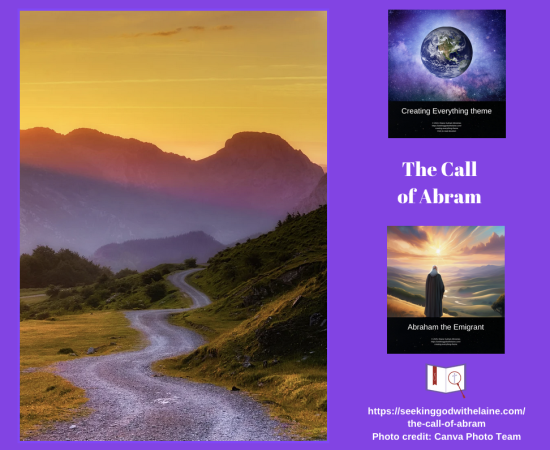
  • The Call of Abram

    When God called Abram, He established a covenant with him. This devotional reading looks at that call.

    Nuggets

    • God called Abram to follow Him into the unknown.
    • Abram was making this journey on faith.
    • Abram was going to be blessed by his descendants forming a nation as well as blessing others.
    the-call-of-abram

    This is the passage we believe begins Abram’s story. We forget about Genesis 11: 31-32.

    When Genesis 12 starts, Abram was not in Ur. He was in Haran.

    Abram was living there because his father, Terah, had been heading to Canaan. He stopped in Haran — and died.

    We pick up the story about five years after they got to Haran and right after Terah died. (The rest of the 28 chapters in Genesis are about Abram and his descendants.)

    God’s call to Abram is also His first covenant with him. It was given with no strings attached and promised that his descendants would make a great nation, making his name great.

    Program note: This went long, so I am saving one of the verses and the connections for the next devotion. Technology is sort of working tonight, but not fully. So bear with me.

    Let’s Put It into Context

    To read devotions in the Creating Everything theme, click the button below.

    Devotions in the Abraham the Emigrant series

    Get Going

    The Lord had said to Abram, ‘Leave your native country, your relatives, and your father’s family, and go to the land that I will show you” (Gen. 12: 1 NLT)

    God called Abram to follow Him into the unknown.

    It was with Abram the covenant that made the Israelites God’s people was established.  

    • Covenant established (Gen. 12: 1-3) 
    • Blessings of the covenant (Gen.13: 14-17)
    • Sign of the covenant (Gen. 15: 1-21)
    • Acceptance of the responsibilities of the covenant (Gen. 17: 1-27)
    • Promise of the covenant (Gen. 18: 9-15).

    Leave

    After five years, God called Abram, making a covenant with him.
     
    If God had talked to anyone between Noah and Abram, Moses didn’t tell us
    that. I can see that. Noah may or may not have been the only righteous
    one in his time.  Abram was the next righteous man of note.
     
    If we go with the biblestudy.org’s timetable, the year is 1885 BC. It has
    been five years since Terah died. Verse 4 tells us Abram is now 75 years
    old.

    Resource

    Abram was being called to start moving again. Verse 1 states that Abram was to “… ‘Go from your country and your kindred and your father’s house to the land that I will show you’” (Gen. 12: 1 ESV).
     
    This was the first time that terminology was used. It was a call. It wasn’t persecution, famine, poverty, or wanderlust that got Abram moving.
     
    It was God’s call.
     
    Why would God tell Abram to “… ‘Go from your country and your kindred and your father’s house …” (Gen. 12: 1 NLT) if they weren’t in Ur?
     
    Have you ever thought that it was strange that Terah stopped in a city named the same as his son? According to Altein, some think that Terah used to live in – and Abram was born in – Haran. We’ve seen others – Cain and Seth – who have named or possibly named cities after their sons.

    Resource

    At some point, they moved to Ur Kasdim and – five years ago – moved back. That could be the explanation for being called from his country.

    But not all of Abram’s kindred moved to Haran from Ur. Nahor and Milcah stayed in Ur. Only Terah, Abram, Sarai, and Lot moved to Haran (Gen. 11: 31). All but Terah journeyed on with Abram.

    Abram would have left his father’s household. According to the biblestudy.org, “Terah, after living in Haran for five years, dies at the age of 205.”

    Resource

    If Abram left Ur in 1890 BC at the age of 70, they would have had to get there within the year if Terah lived five years in Haron before he died and Abram was called to move in 1885 at 75 years old.

    So, Terah may have set up a household in Haran from which Abram left. He had to if Abram was to leave some – and possibly never see them again – since everyone else who came from Ur left with Abram.

    Doesn’t God have to get us off by ourselves sometimes so that He can grow us? We may not like the isolation, but it is the best for us sometimes. God has to separate us from others.

    It was hard to move off the farm from my parents. It was hard to move out of state away from my Springfield mom.

    God is still calling us to do just that. “If you love your father or mother more than you love me, you are not worthy of being mine; or if you love your son or daughter more than me, you are not worthy of being mine. If you refuse to take up your cross and follow me, you are not worthy of being mine. If you cling to your life, you will lose it; but if you give up your life for me, you will find it” (Mt. 10: 37-39 NLT).

    Another possible explanation is that God included both trips – the trip from Ur to Haran and the trip from Haran to Canaan. That would have been
    logical for two reasons.

    The first reason is God often does things in steps. First, God separated Abram from his homeland of Canaan and any relatives that remained there. Then He separated him from his father.

    The second reason is God would have included it to recognize Abram’s obedience. God will always recognize and reward obedience.

    Do you think Abram should have just gone ahead and left after Terah died? He knew he was called to go. He didn’t know where.
     
    But Abram didn’t just go. Just as Noah who waited until he was told to get on and off the ark, Abram was following God’s directions every step of the way.
     
    How many of us would be obedient and go?
     
    What does God’s call teach us?

    • God is intimately involved in our lives.
    • God rewards the faithful and obedient.
    • The reward of eternal life is based on submission in this life.

    To the Land that I Will Show You

    Abram was making this journey on faith.

    In the last devotion, we talked about whether Abram knew where he was going. There are contradictory verses.

    • “One day Terah took his son Abram, his daughter-in-law Sarai (his son Abram’s wife), and his grandson Lot (his son Haran’s child) and moved away from Ur of the Chaldeans. He was headed for the land of Canaan, but they stopped at Haran and settled there” (Gen. 11: 31 NLT).
    • “It was by faith that Abraham obeyed when God called him to leave home and go to another land that God would give him as his inheritance. He went without knowing where he was going. And even when he reached the land God promised him, he lived there by faith — for he was like a foreigner, living in tents” (Heb. 11: 8-9 NLT).

    We figured – for Paul to have been correct – Moses dropped the destination in “after the fact.” God didn’t tell Abram – or even Terah – but Moses told us.

    Look at it this way. The Promised Land has been described as one that was flowing with milk and honey. “Then the Lord said, “I have surely seen
    the affliction of my people who are in Egypt and have heard their cry because of their taskmasters. I know their sufferings, and I have come down to deliver them out of the hand of the Egyptians and to bring them up out of that land to a good and broad land, a land flowing with milk and honey, to the place of the Canaanites, the Hittites, the Amorites, the Perizzites, the Hivites, and the Jebusites” (Ex. 8: 7-8 NLT).

    God didn’t entice Abram to leave because He was offering this spectacular living place. The place could have been a desert for all Abram knew.

    Abram had to put his faith and trust solely in God.

    We don’t like it when God doesn’t tell us His plans for us. We want to know Plan A – and there better not be a need for Plans B C, and D.

    We hear people say, “Don’t do anything until you are absolutely sure.” How do we get anything done that way?

    If we are absolutely sure, we are not stepping out in faith. We are relying on ourselves to figure it out.

    We aren’t relying on God. We aren’t letting Him guide us.

    God calls us to put our trust in Him — in the big things and the little
    things. Even when we have the blinding terror, we can trust in His plan.

    Parker had a great reminder for us. He wrote, “God never calls men for the
    purpose of making them less than they are, except when they have been
    [dishonoring] themselves by sin. His calls are upward; towards fuller
    life, purer light, sweeter joy.”

    Resource

    No, it usually doesn’t turn out exactly how we have planned. It turns out exactly as He has planned.
     
    We have to do as Abram did – unconditionally trust God even when He doesn’t share the plan with us.
     
    Gilfillan estimated that God was calling Abram to a 300-mile trip. That isn’t much these days, but it was then.

    Resource

    Think about this. This is the first time God promised to give Canaan to Abram and his family. Abram got to Canaan. He didn’t get to stay there very
    long. Stay tuned for a couple of devotions from now.

    A Great Nation

    “I will make you into a great nation. I will bless you and make you famous, and you will be a blessing to others” (Gen. 12: 2 NLT)

    Abram was going to be blessed by his descendants forming a nation as well as blessing others.
     
    Right from the get-go, God told Abram that He was not only calling Abram but also calling his descendants. He was going to be the father of many.
     
    The Jews put a lot of stock in being descendants of Abraham and being a great nation. 
     
    It wasn’t until the Israelites were called out of Egypt that they could be considered a nation of God’s people. That made them very proud of their
    identify.
     
    But this pride was also a blessing and a warning. The topical encyclopedia at biblehub.com talks about this. The topic explains one element of the pride of Israel. It wrote, 
     
    “On one hand, it represents the unique relationship between God and Israel, a nation set apart to reflect God’s glory and righteousness. This pride is rooted in the covenantal promises made to the patriarchs — Abraham, Isaac, and Jacob — and the subsequent establishment of Israel as a nation under God’s law. On the other hand, the pride of Israel often
    becomes a source of downfall when it transforms into arrogance and self-reliance, leading the people away from their dependence on God.”

    Resource

    Part of that pride was shown in how the Israelites/Jews separated themselves from the world. Yes, even today, we are supposed to be in the word but not of the world.

    Still, we have our marching orders.

    • “And then he told them, ‘Go into all the world and preach the Good News to everyone’” (Mk. 16: 15 NLT).
    • “Therefore, go and make disciples of all the nations, baptizing them in the name of the Father and the Son and the Holy Spirit. Teach these new disciples to obey all the commands I have given you. And be sure of this: I am with you always, even to the end of the age” (Mt. 28: 19-20 NLT).
    • “… And you will be my witnesses, telling people about me everywhere—in Jerusalem, throughout Judea, in Samaria, and to the ends of the earth” (Ac. 1: 8 NLT).

     
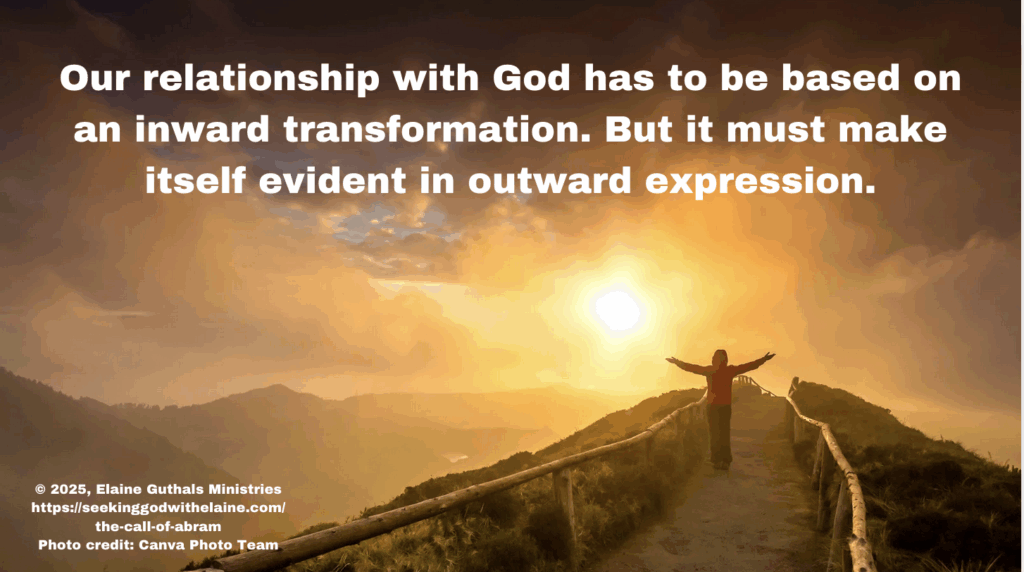
    Our relationship with God has to be based on an inward transformation. But it must make itself evident in outward expression.
    Father God. You come to us individually to call us to be Your child. Lord, may we always obey You with faith and obedience as Abram had. Whatever You call us to do, we will do. Amen.

    What do you think?

    Leave me a comment below (about this or anything else) or head over to my Facebook group for some interactive discussion.

    If you don’t understand something and would like further clarification, please contact me.

    If you have not signed up for the email providing the link to the devotions and the newsletter, do so below.

    If God has used this devotion to speak with you, consider sharing it on social media.
  • From Shem to Abraham

    At the end of Genesis 11, we find another genealogy list. This devotional reading looks at Shem’s line to Abraham.

    Nuggets

    • This is the second genealogy list given for the line of Shem.
    • We set up the story of Abraham by learning about his father and his early life.
    • We are told that Terah lived in Ur of the Chaldeans.
    • Terah’s either youngest or possibly middle son Haran, though his wife was not listed, had a son named Lot, who will figure greatly into the Genesis narrative.
    • We may or may not be familiar with who Abram was under that name, which means “father is exalted.”
    • We know little about Nahor.
    • God gives us enough direction about His plans for us to get us moving in the right direction.
    from-shem-to-abraham

    Shem’s line is the one who led to the Messiah. On its way there, we come to Abraham.

    Let’s Put It into Context

    To read devotions in the Creating Everything theme, click the button below.

    Devotions in the Abraham the Emigrant series

    Shem’s Descendants

    These are the generations of Shem. When Shem was 100 years old, he fathered Arpachshad two years after the flood. And Shem lived after he fathered Arpachshad 500 years and had other sons and daughters. When Arpachshad had lived 35 years, he fathered Shelah. And Arpachshad lived after he fathered Shelah 403 years and had other sons and daughters. When Shelah had lived 30 years, he fathered Eber. And Shelah lived after he fathered Eber 403 years and had other sons and daughters. When Eber had lived 34 years, he fathered Peleg. And Eber lived after he fathered Peleg 430 years and had other sons and daughters. When Peleg had lived 30 years, he fathered Reu. And Peleg lived after he fathered Reu 209 years and had other sons and daughters. When Reu had lived 32 years, he fathered Serug. And Reu lived after he fathered Serug 207 years and had other sons and daughters. When Serug had lived 30 years, he fathered Nahor. And Serug lived after he fathered Nahor 200 years and had other sons and daughters. When Nahor had lived 29 years, he fathered Terah. And Nahor lived after he fathered Terah 119 years and had other sons and daughters. When Terah had lived 70 years, he fathered Abram, Nahor, and Haran” (Gen. 11: 10-26 NLT)

    This is the second genealogy list given for the line of Shem.

    We did note in Genesis 10 that the list given there was a difference from the one given in Luke 3. The same issue is noted here. We aren’t really sure who Shelah’s father was. Not only that, but there are also different spellings for the names given for his father: Arphaxad or Arpachshad.

    How could there be this discrepancy? Well, it could be the translation process. This was probably written in Hebrew. It may or may not have been translated into Aramaic. Either the Hebrew or Aramaic was then translated into Greek. Then it was translated into Latin. Then it was translated into English.

    It is agreed that the Book of Luke was written in Greek. There would have been no translating until the Latin. As the birth of Jesus had to have been told to Luke by Mary, it is probably safe to assume that the genealogy — which is Mary’s — probably was handed down in her family.

    Wouldn’t Mary know? This was very important to Hebrew/Jewish people.

    Sometimes, we have to take these genealogy lists with a grain of salt. Father may mean he was the ancestor of someone. That means they skip generations.

    What we should focus on is Shem was the ancestor of Abraham.

    Pastor Steve and I talked about this the other day. God was in the habit of picking one man to do His Will: Adam, Noah, Abraham, Joseph, Moses, and Jesus. We’ve been calling it separating. Leale called it a narrowing.

    Resource

    I can see that. “You can enter God’s kingdom only through the narrow gate. The highway to hell is broad, and it’s gate is wide for the many who choose that way. But the gateway to life is very narrow and the road is difficult and only a few ever doing it” (Mt. 7: 13-14 NLT).

    We don’t know exactly what was divided in Peleg’s time. In Genesis 10, we wondered if that was when the Tower of Babel was built.

    Renner agreed with that. He also mentioned that some believe that this was when the one continent, called Pangaea, split apart.

    Resource

    Personally, I can see God doing both about the same time. Pastor Steve believes that God poofed them where they were going to go. He could have made the language split simultaneously with the scattering and separating.

    Terah’s Descendants

     “Now these are the generations of Terah. Terah fathered Abram, Nahor, and Haran; and Haran fathered Lot. Haran died in the presence of his father Terah in the land of his kindred, in Ur of the Chaldeans. And Abram and Nahor took wives. The name of Abram’s wife was Sarai, and the name of Nahor’s wife, Milcah, the daughter of Haran the father of Milcah and Iscah. Now Sarai was barren; she had no child. Terah took Abram his son and Lot the son of Haran, his grandson, and Sarai his daughter-in-law, his son Abram’s wife, and they went forth together from Ur of the Chaldeans to go into the land of Canaan, but when they came to Haran, they settled there. The days of Terah were 205 years, and Terah died in Haran” (Gen. 11: 26-32 NLT)

    We set up the story of Abraham by learning about his father and his early life.

    When

    We turn our focus on Terah and his family. This family is handled a little differently than the last ones had been. Altein listed Terah being born in the year 1878 from Creation (1883 BCE).

    Resource

    Once again, we look at three of Terah’s sons. (Again, we don’t know for sure that these were the only children he had. No, it doesn’t say he had other sons and daughters as the other ones did. But we get more about them than the others.)

    Ooo, baby. I think I got Noah’s kids wrong. The wording for Terah is what I read for Noah.

    • “After Noah was 500 years old, he became the father of Shem, Ham, and Japheth” (Gen. 5: 32 NLT emphasis added).
    • “When Terah had lived 70 years, he fathered Abram, Nahor, and Haran” (Gen. 11: 26 NLT emphasis added).

    All the others list the age of the father – when Dad was X number of years old, Son was born. Noah’s kids probably were single births.

    From the list of names, it looks like Abram was the firstborn. Some say that is correct. Altein took this route – and even listed Abram’s mom as Amathlai, daughter of Karnebo.

    But, according to biblestudy.org, Abram wasn’t firstborn. They wrote, “Abram (his birth name before God renamed him) was born in the city of Ur of the Chaldees to a family that included older brothers Haran and Nahor. Terah, his father, was 130 years old at his birth.”

    Resource

    Once again, God may have called the son who was not the firstborn in the family.

    Ur of the Chaldeans

    We are told that Terah lived in Ur of the Chaldeans.

    If we go with biblestudy.org’s timeine, Abram was born in Ur of the Chaldeans in 1960 BC and from where he left in 1890 BC when he was 70.

    Look what Joshua said. “Joshua said to the people, ‘This is what the Lord, the God of Israel, says: Long ago your ancestors, including Terah, the father of Abraham and Nahor, lived beyond the Euphrates River, and they worshiped other gods. But I took your ancestor Abraham from the land beyond the Euphrates and led him into the land of Canaan. I gave him many descendants through his son Isaac. To Isaac I gave Jacob and Esau. To Esau I gave the mountains of Seir, while Jacob and his children went down into Egypt’” (Josh. 24: 2-4 NLT).

    Altein agreed with Terah’s idol worship. In fact, he reported Terah sold idols as well, sometimes enlisting Abram as a salesman.

    Resource

    Go back to beyond the mention of the Euphrates. Ur of the Chaldeans (Ur Kasdim), a Sumerian city, was located in what is currently southern Iraq.

    If we go back to Cain being banished to the Land of Nod – which was anywhere but the Garden of Eden by the Euphrates River – Abraham was called back from the Land of Nod.

    Another interesting tidbit is that Terah supposably knew Nimrod. Altein reported that Nimrod appointed Terah as his Chief General of his armed forces.

    Nimrod was jealous of Abram and tried to kill him several times. He even was supposed to have thrown Abram in a fiery furnace, but that turned out the same way as it did in Daniel – Abram didn’t die. When this made Haran take his brother’s side over Nimrod’s, Haran was thrown into the furnace and died.

    I don’t know how much stock we can put into these stories Altein also said that Terah celebrated the weaning of Isaac with Abraham. How can that be when Terah would have been dead 30 years?

    But I put them in to say that Terah and possibly Abram had known Nimrod.

    Haran and Lot

    Terah’s either youngest or possibly middle son Haran, though his wife was not listed, had a son named Lot, who will figure greatly into the Genesis narrative.

    Unfortunately, Haran died before the family left Ur. We aren’t told his age or how he died. Like I said, you decide if you want to put any credence in the fiery furnace story.

    We can say that it is rough for parent to bury a son. We aren’t guaranteed that that won’t happen.

    We do know that Haran had two daughters, Milcah and Iscah (Gen. 11: 29).

    Abram and Sarai

    We may or may not be familiar with who Abram was under that name, which means “father is exalted.”

    We probably know what God changed His name to — Abraham. That means “father of a multitude.”

    Because of his faith, Abraham became the first Hebrew patriarch. That is why he is called “father of the Jews.”

    But with Sarai barren, Abram wasn’t becoming the father of anything. I know. With God’s command to “… ‘Be fruitful and multiply and fill the earth’” (Gen. 9: 1 NLT), how could this be?

    Not happening.

    We have to put ourselves back into that time period. The woman’s job was to reproduce and build the family.

    But here she was taking a road trip with her husband/brother, father-in-law/(maybe step-)father, and nephew.

    Nahor and Milcah

    We know little about Nahor.

    One thing we do know about Haran is that his daughter Milcah married his brother Nahor. I know. Today, we would go, “Ewwwww.”

    We discussed, with Cain, who did he or his descendants marry if not family.    

    It is probably safe to say that the physical defects weren’t as prevent as they were later. God’s hand was lovingly on them, so this didn’t rear its ugly head.

    Plus, the Levitical Laws weren’t in play yet.

    Moving

    God gives us enough direction about His plans for us to get us moving in the right direction.

    We credit Abraham for leaving Ur and going to some unknown land. But we read in the last part of Genesis 11 that Terah, Abraham’s father, left Ur to go to Canaan. “… He was headed for the land of Canaan, but they stopped at Haran and settled there” (Gen. 11: 31 NLT).

    Did God call Terah to go to Canaan? We aren’t told that. We really aren’t told in our translations if Terah worshiped God at all.

    So, let’s dig into what Laban told Jacob when Jacob was sent to Rebekah’s home to find a wife and find out. “I call on the God of our ancestors — the God of your grandfather Abraham and the God of my grandfather Nahor — to serve as a judge between us” (Gen. 31: 53 NLT).

    We now we have to go to the Hebrew, so hang on.

    “The Elohei Avraham [the God of Abraham], and Elohei Nachor [the God of Nahor], Elohei Avihem [the God of their Father] judge between us. And Ya’akov [Jacob] swore by the Pachad [fear] Aviv [spring] Yitzchak [Isaac]” (Gen. 31: 53 OJB).

    Okay. We know Elohim is God in the plural form – the Trinity. This comes from that and, according to AI, focuses on the personal relationship between God and the human.

    Maybe the reason Canaan is in these verses is that Moses knew where they were going, and he put it in where they didn’t know that yet. We know he did put current – to him – names of town so that readers would know where he was talking about.

    If God did call Terah before or after he and Abram converted to worshping God, he disobeyed because they stopped for some unknown reason at Haran. Maybe he stopped because of health concerns. Some believe they had lived there before.

    Or maybe if Abram was called first, Terah went with him because of those health issues, and he went as far as he could. But then why didn’t he stay behind with Nahor? Terah going home makes sense for the journey and the stopping

    It doesn’t seem that God held the stop against Abram. If Abram’s call had been made but he stopped because Terah had gone as far as he could, God knew Abram would keep going. Maybe Genesis 12: 1-3 is that restart.

    Whoever was called, it was a family move – grandpa, uncle, and nephew. God does work through families. We’ll see that especially in this family.   

    Yes, it is speculating, but both ways teaches us good lessons. It is the difference between obedience and disobedience.

    If Terah was called and he disobeyed by stopping in Haran, he wasn’t rewarded. Information on the biblestudy.org site said that Terah lived five years in Haran before he died.

    Whether or not Terah was the one originally called, he did leave his home to follow God’s call to Abram. Look what Tyng said. He wrote,

    “It exhibits an old man, after his many years spent in idolatry and ignorance, attempting in a late obedience to Divine commands to remove from his native condition and home, to the land of promise; but wasting in procrastination the time for his journey, and indolently staying upon the road over which he was required to pass to gain the end placed before his view; and finding all his efforts and plans to accomplish his purpose, to prove unavailing for his good. He never attained the inheritance for which he set out so late, and which he pursued so carelessly.”

    Resource

    Sad. If Genesis 31: 53 is correct, Terah was worshiping Jehovah but apparently not with full obedience.

    That is a significant contrast to Abram’s obedience. Procrastination v. complete, immediate obedience.

    We know the man who would become Abraham was obedient. “It was by faith that Abraham obeyed when God called him to leave home and go to another land that God would give him as his inheritance. He went without knowing where he was going. And even when he reached the land God promised him, he lived there by faith — for he was like a foreigner, living in tents” (Heb. 11: 8-9 NLT).

    God knows where He wants us to be and what He wants us to do — and every decision we will make about doing that.

    God worked out His plan for Abram’s life. Whatever part God had planned for Terah to play, He got Abram to Canaan, so He could make and fulfill His promises

    Making the Connections #1

    God has a plan for our lives, also. Sometimes we may not obey Him, but God already has that worked into the plan. He lets us have our own free will.

    God’s call to us can be like Abram’s. Sometimes we have no idea where He is calling us to go or what He is calling us to do. We just know He is calling.

    Sometimes we know where and what, we just can’t see how. There may be a learning curve or a location change. Many times, we can’t see how we are going to get to where God wants us to be because of the obstacles we see in the way.

    Bottom line – faith and obedience. Obedience is a product and a big part of faith.

    But God already knows what we are going to decide. He’s got that all written into the plan. His Will will be done. We have to have the faith to let Him work

    There is no need to be obedient if you don’t have the faith that God’s got this. The obedience alone won’t get you anywhere because works won’t get you to heaven. “he saved us, not because of the righteous things we had done, but because of his mercy. He washed away our sins, giving us a new birth and new life through the Holy Spirit” (Ti. 3: 5 NLT).

    Making the Connections #2

    I never thought about it like this.

    Pastor Steve and I had just been taking about God choosing one man, one family, to jump start His plan. He doesn’t pick many. He chooses the one faithful man.

    But humans had become wicked again. They may have been outnumbering the faithful when they built the Tower of Babel.

    Look what Vaughan had to say about it. He wrote,

    “It became necessary by this dispersion that God should select one family and one race which He should make a special and secure depository of His one truth. Otherwise probably the truth, split and scattered, would not have survived in the earth. And therefore the next fact in history is the call of Abraham.”

    Resource

    Why did God choose Abraham? We don’t know.

    We’ve talked a lot about Shem’s line being the chosen line. But Noah’s blessing didn’t really say anything about that.

    “Then Noah said, ‘May the Lord, the God of Shem, be blessed, and may Canaan be his servant!’” (Gen. 9: 26 NLT).

    Really, Noah was blessing God, not Shem.

    But isn’t that what we are supposed to do – bless/worship God?

    How Do We Apply This?

    • Understand that God separates and divides.
    • Remember that God calls us to be in the world but not of the world.
    • Don’t think these people were unnecessary — they were bringing us closer to Jesus.
    • Be willing to be called into the unknown.
    • Move immediately when called.
    • Put everything in God’s hands.
    • Keep our commitment to God’s plans.

    Resource

    Father God. You want us to study Your Word so that we know what it truly says. Only then can we know what You are really calling us to do. Help us to have the obedience of Abram, even when we don’t know the whole plan. Amen.

    What do you think?

    Leave me a comment below (about this or anything else) or head over to my Facebook group for some interactive discussion.

    If you don’t understand something and would like further clarification, please contact me.

    If you have not signed up for the email providing the link to the devotions and the newsletter, do so below.

    If God has used this devotion to speak with you, consider sharing it on social media.

  • Creation’s Do-Over: Genesis 9-11

    creation-do-over-genesis-911

    God’s Covenant with Noah

    God passed judgment on the wicked, but He rewarded Noah because of his faithfulness and obedience. Before the flood came and after it had ended, God told Noah that He would establish a covenant with him.

    God made a covenant with Noah because he was the one righteous man on earth. He wanted to make sure we knew that He was the author of the covenant. As part of that covenant, He gave Noah a blessing.

    Noah immediately worshiped God after he disembarked from the ark. The burnt sacrifice Noah offered was to restore his relationship with God because of humankind’s sinful nature. This was the first time that we are told the sacrifice was given on an altar.

    It was more than Noah was sincerely grateful to God for saving the lives of him and his family. He was acknowledging God’s sovereignty and his dependance. It was a visual exhibition of Noah’s faith. It spoke of his future atonement.

    Some of every clean animal and bird were offered to God to restore their blessing.
    That means not only on species, but also more than one of a species. (And I would say that Noah wouldn’t break up a pair, so it would be at least one or two pair.)

    Each sacrifice – regardless of the number – had to be offered in faith and gratitude and had to consist of our best. Best means unblemished, pure, or first (as in first fruits).

    The goal of the burnt offering was to create a pleasing aroma for God. The offering is burnt so that the smoke ascends to God to bring Him near to the one offering the sacrifice.

    God accepted Noah sacrifice and gave him a promise for the future. The promise was more than just verse 22. It was that He would accept the sacrifice of Jesus’ blood as atonement for our sins.

    God promised to never again flood the earth.

    God is saying that He will no longer curse the ground because of humankind’s sin. Some might see Genesis 8: 21-22 a promise that life as we know it will never end. They would be wrong.

    Eventually, God will destroy the earth and condemn non-believers to eternity in hell. That will happen when mankind becomes as wicked as they were then. God’s promise to never flood the earth again was unconditional.

    Yes, God still allows flooding to happen – localized. Don’t ignore the “that never again shall all flesh be cut off by the waters of the flood, and never again shall there be a flood to destroy the earth” (Gen. 9: 8-11 NLT emphasis added) parts.

    It would be human nature for Noah and his family, as they were just closing the book to this terrifying chapter of their lives, would think it may happen again. But Father God didn’t really want us to feel that. He wanted to assure us that a flood will never again destroy the earth.

    Also, don’t read into this that God promised Noah that He wouldn’t destroy the earth in another way. He will. “… The earth and sky fled from his presence, but they found no place to hide” (Rev. 20: 11 NLT).

    Noah got off the ark, and we think everything was back to Garden of Eden pristine. Wrong. Mankind is still made in Adam’s image (Gen. 5: 3).

    Noah and his family weren’t automatically cleansed by the flood. Blood cleanses us, not water.

    Humankind’s purpose had not changed, so the blessing had not changed.

    Even though God knew man was going to sin, He wanted us to multiply. Even though He did a major reset, He still wanted us to multiply.

    The whole purpose of the ark was to save lives. That is the business God is in — salvation. He sent His Son to die on a cross so that we could accept the gift of salvation.

    God showed us that He isn’t afraid of going big to get us back to worshiping Him. He showed us that, even as flawed as we are with a sinful nature, when we ABCD, He will protect us and provide for us.

    Humans could now eat animals.

    If Adam and Eve had eaten the animals, that would mean death was already present when they committed the original sin. If they had killed for food, that would make the killing of the animal for clothes less of a blood-covering-sin issue.

    Maybe one of the ways that the world was wicked was they ignored God’s command to be vegetarians, but Noah didn’t. This was now giving him permission – without restriction – to eat meat.

    Life – human and animal – is very precious to God. He will punish anyone who takes another’s life.

    If Sovereign God declared that murderers should be executed and placed that opinion in the hearts of humans, it is His call when and if to pardon the murderer.

    Our biggest takeaway here should be how much God values human life – even if we have tarnished being made in His image. Murder shatters our relationship as a family.

    The visual sign of the covenant tells us that God’s care is everlasting. God says He will see the rainbow from Heaven.

    It is fitting that the rainbow is the product of the sunshine and rain. Both the punishment for our disobedience and God’s grace and mercy are needed.

    An unseen God wanted to have something visible to allay people’s fears about a reoccurring flood. But it wasn’t really about the sign. It was about the covenant. The promise was guaranteed by the covenant, not by the sign.

    God placed the rainbow in the sky to strengthen our faith and to show His love for us. The variety of colors remind us of the beauty of the glory of the Lord.

    After the flood, God expanded the region in which Noah’s descendants could live.

    We know the Garden of Eden was off limits. We know that Cain was exiled to the Land of Nod, which some believe to be anywhere but the Garden of Eden area.

    So, God was sending them off into the big, bad area ruled by Satan. No wonder the world went back to being wicked lickety-split.

    Now Noah’s family and descendants were going where God was not and (hopefully) taking Him there with their internal worship of God.

    God chose to make a covenant with those who are made in His image, even though we had so angered Him.

    God tried again. His covenant with Adam was broken. God’s Word doesn’t tell us He made another one with him, possibly because he was so associated with sin.

    We can’t gloss over the fact that God was binding Himself to humans. Not just His protection or blessings. He wanted the relationship that was lost in the Garden restored.

    One thing we tend to forget – and non-believers refuse to see – is that sin has clouded our perception of spiritual things. If we think God is hiding things from us, this is partly the reason.

    The timing of the covenant is important. It was after the punishment had been meted out. God was now instructing humans – yeah, again – what He expected of them.

    Even before God makes the promises of the covenant, Noah – and everyone since then – knows that He has the power and desire to keep those promises.

    God didn’t put His bow in the sky to show He would tolerate people’s sin.  It is to show His love and blessings to those who obey His Will.

    Noah and His Descendants

    Because of the faithfulness of Noah’s family, the earth was repopulated by their descendants.

    Water doesn’t change our spiritual nature. (Nope, baptism doesn’t save is because it has nothing to do with blood.) Sin was very much still alive and well.

    We only get Noah’s occupation after the flood. He planted a vineyard.

    Even the most righteous human can — and all except Jesus — will sin.

    God had no problem with Noah becoming a grape farmer. He had no problem with him becoming a wine maker — and He even had no problem with him sampling his product.

    Drunkenness is a sin. It makes us lose self-control part. That means God isn’t in control of us.

    Was it Noah’s intention to get drunk? Maybe. Maybe not. Did he know of the effects of drinking too much? Maybe. Maybe not as it might have been the first time wine was ever made.

    But just as the serpent in the Garden of Eden was cursed for being used by Satan, Noah had to suffer the consequences of his actions whether the drunkenness was intentional or not.

    The holy line would come down through Shem. This is verified in Luke 3. The name signifies the name — in other words, the name of God.

    Shem is the older brother of Japheth. Ham is the second son. That means they are in age order when listed.

    It is interesting that it is mentioned that Eber had two sons, Peleg and Joktan. Peleg’s name means division. Was that another instance where God separated and divided siblings? We aren’t really told.

    Or was Peleg given this name because of the division caused from the punishment of the Tower of Babel? Did they know beforehand and name him as Methusaleh was given a prophetical name (when he dies, it will come)?

    Japheth would play a significant part in the repopulation of earth.

    Japheth’s descendants were considered to be Gentiles. Even from the beginning, God was separating Jew from Gentile.

    Shem and Japheth were righteous. They followed God.

    Ham maybe did, too. This may be his one big sin, just as Noah’s drunkenness seems like it was his one big sin.

    The triplets would have been brought up the same way. Their nurture was the same. But then so was their nature. All three, while made in the image of God, had a sinful nature. All three could have committed the sin Ham did. All three committed other sins.

    Then here came Ham. He knew right from wrong, but he had a little problem with that.

    Knowledge isn’t enough. It must lead to faith and obedience.

    Ham was the only one to choose to sin when Noah got drunk.

    Ham’s sin wasn’t the seeing part. It was the telling part. In other words, he gossiped.

    Temptation is not the sin — the sin is what we do with it that could be.

    We will be given blessings for walking with God and curses for sinning against Him.

    The curse of Ham – actually Canaan – was servitude. Ham – and especially Canaan – would have seen this as punishment.  Even if they turned back to walk with God, they would still know that their descendants would feel the bite of the curse.

    Ham modeled his behavior for his son Canaan. Canaan and then passed that viewpoint down the line to his descendants.

    We can tell from Ham’s genealogy that the Noah’s curse came to fruition.

    The sons of Cush are listed in verse 8. Somewhere down the line, Nimrod is a grandson of Cush’s. We aren’t told if or how many times great is put in front of it.

    We are given a windfall of information on Nimrod. He was a warrior and hunter. He is credited with founding the city of Babylon.

    Babylon and Assyria were founded by Nimrod. He also built the city of Ninevah, which we read about in the Book of Jonah.

    Look at all the nations that came out of the line of Nimrod: Hittites, Jebusites, Amorites, Hivites, and Philistines – plus Babylon and Assyria. In years to come, Joshua and David will be battling those nations.

    Starting in verse 13, it talks about Mizraim. He not only was an ancestor of the Philistines, but he also founded Egypt.

    It doesn’t tell us who built Sodom and Gomorrah, but those are cities that are infamous. We’ll read about those further on in the Book of Genesis.

    All of the nations that we mentioned will be at war with the nation of Israel in the future. That will be their punishment for a lifetime of disobedience to God.

    We don’t know how many generations it was until it was Nimrod’s generation. That was however long it took for the world to become thoroughly wicked again.

    The practice of worshiping false gods, called the Babylon Mystery Religions, started with Nimrod around the time of the Tower of Babel.

    Shem’s line — leading to the Church and the Messiah — would have remained focused on God. They would have been blessed. Ham’s focused on Satan. Satan’s followers will always be servants to God’s true followers.

    If God’s doctrine doesn’t bringing us closer to Him, they are of value to us.

    One Language

    Originally, all humans spoke the same language. But we aren’t give any hint what was the language on which others were developed.

    I’m sure part of the problem some had in believing that there was only one language was the sudden appearance of many languages. As complex as languages are, it is easier to think they evolved over time.

    Having only one language would promote unity within God’s Church. Everyone has the same opportunity to hear God’s Word. There are no barriers to their introduction to the Plan of Salvation.

    Populating the Earth

    Humans started out obeying God’s command to fill the earth.

    Nimrod was a descendant of Ham. Remember, Ham — specifically his son Canaan — was cursed for Ham’s sin that stemmed from Noah’s sin.

    Babylonians lived in Mesopotamia between 2100 and 538 BC. The city of Babylon was constructed on the Euphrates River.

    Yes, they had obeyed the command to populate the earth. No, they hadn’t gone too far at this point. Some did continue to walk with God as they populated the earth.

    The real issue here happened when they got settled on the plain of Shinar. They wanted something to “… keep [them] from being scattered all over the world” (Gen. 11: 4 NLT).

    It may have started with them deciding they liked the place and didn’t want to move on. But if that happened, they were choosing to disobey God’s directive.

    When God commands, we have to say, “Sir, yes sir!”

    A Great City with a Tower

    They built a tower for worldly purposes.

    We don’t know how long Nimrod and crew lived on the plain of Shinar until they got fed up with a patriarchal society. They wanted a monarch — an empire.

    Their problem was they forgot we are not independent of God.

    They were saying was they wanted a name that established their authority. They were going to take their world in a new direction: away from God.

    The “… with its top in the heavens…” (Gen. 11: 4 ESV) part speaks of idolatry, and we know that the worshiping of false gods came from here. The practice of worshiping false gods, called the Babylon Mystery Religions, started with Nimrod around the time of the Tower of Babel. They took the worship practices God required and changed them to worship false gods.

    They had to have an intelligence to build what they built. With that intelligence, they probably thought they had power. But the power was just a delusion brought upon by their scheming.

    Since the group had decided not to move on to repopulate the earth, they sought to build a tower. They thought that would ensure that they wouldn’t be forced to move again.

    Worldview people don’t want to be judged for disobedience to God’s laws and commandments.

    They were breaking both parts of God’s command. They were not only not going forth, but they were not also multiplying.

    God saw Nimrod and his crew doing bad. He let it go on until it was His time to shut it down.

    We don’t know what form God took when He came down. God coming down is probably just a way for us to say it in human-speak so we can understand.

    Nothing Will be Impossible

    God didn’t want humans who did not believe in Him to grow unchecked.

    God was talking about nothing is impossible for humans. We are made in God’s image.

    God made us to have abilities. He didn’t want to limit them. He wanted us to be the best for Him.

    But He didn’t want a Satan Junior. Satan wanted to depose God. It sounded like these just wanted to be their own god.

    God confused the languages so that people had to congregate together and move apart. He want to prevent a universal monarchy.

    One world, one people would be tyrannical and cruel with persecution for dissension. That means a world led by sin will be chaotic.

    God knew we can lead others astray with our plans.

    God may have separated humans, but He did not plan to leave us that way.

    To read devotions in the Creating Everything theme, click the button below.

    Devotions in the Creation’s Do-Over  series

  • Creation’s Do-Over: Genesis 5-8

    creation-do-over-genesis-58

    Populating the Earth

    Since creation started with one family, it is difficult to understand how the world was populated from them. There had to have been many unidentified people who were alive between creation and the flood.

    We know this because, in Genesis 5, we are told how old the man was when he had a son, how many years he lived after the birth, that he had other sons and daughters, and how old he was when he died. We are not told who his wife was or how many other children they had.

    Moses gave us even less information about on the genealogy list after the flood. We are just given the father’s name and the son’s name.

    There is some debate as to who the sons of God and who the daughters of men are — their children being the Nephilim. We know that they lived prior to the flood and after the flood.

    The main point is that Adam and his descendants obeyed the command to go forth and multiply (Gen. 1: 28; Gen. 9: 1).

    Enoch, Methuselah, and Noah

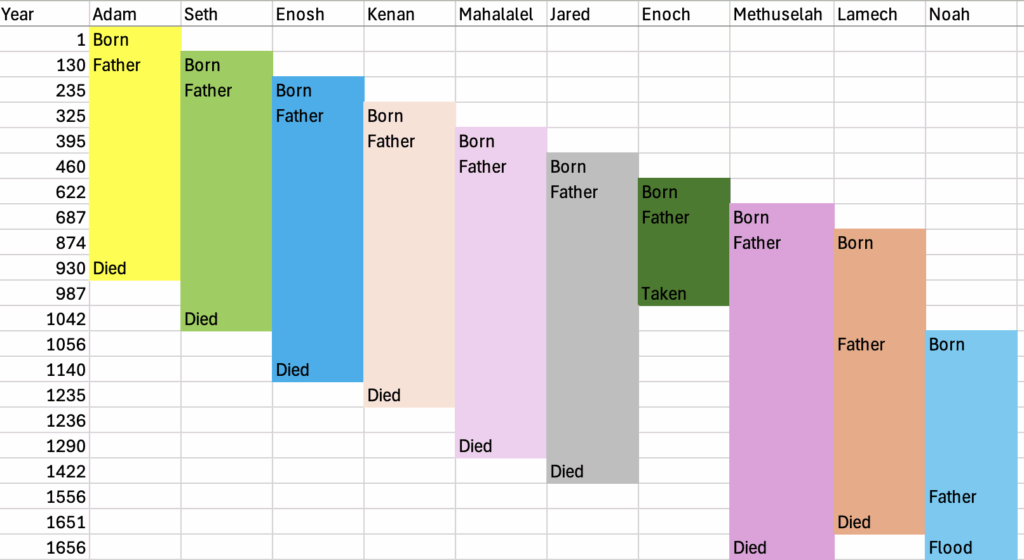
    Enoch would have been Noah’s great-grandfather. Methuselah was Noah’s grandfather. These three men were Hall of Famers of the Old Testament. They were three big role models of practical godliness.

    Enoch walked with God and was taken to be with God.

    Methusaleh meant when he dies, it will come. He died the same year as the flood happened.

    Only Noah had remained faithful to God as the world became more corrupt. He was described as “… a righteous man” (Gen. 6: 9 NLT), “… [a] blameless person …” (Gen. 6: 9 NLT), and “… [walked] in close fellowship with God” (Gen. 6: 9 NLT).

    We are told several times that Noah was completely devoted to being obedient to God (Gen. 6: 22; Gen. 7: 22).

    It didn’t matter what Noah did or didn’t know. Didn’t matter how things looked. One day, God said to him. “Height, width, and depth. Do it.” Noah’s response was, “Good plan.”

    Increasing Corruption and Violence on the Earth

    The vast majority of the population on earth were filled with corruption that led to violence. Wickedness was widespread on the earth. This was everyone – what would later be known as Jew and Gentile. People were living corrupt lives. They were not following God’s laws and commandments.

    But some of Seth’s descendants would have turned away from God, also.

    God didn’t like what He saw on the earth. Verse 6 says that “… It broke his heart” (Gen. 6: 6 NLT) that He had made humankind in the first place.

    God putting up with us is an interesting translation. The Orthodox Jewish Bible translated it as striving. In other words, God wasn’t going to continue to fight us.

    When we think about the days of Noah, we like to think about God waiting patiently around a hundred years to get the ark built. But prior to that, God had been pulling back His hand.

    There are two choices — obey God or obey Satan. Once we make our final decision, He is gone to those who reject Him or will never leave those who obey. He will not stay with an impure person.

    But God is not going to force us to obey Him. It is our choice — called free will.

    Punishment for the Earth

    God had a plan. He wanted a redo for the creation He had made. It had become corrupted, and God wanted to cleanse and liberate it.

    God had made up His mind that He would punish the wicked by destroying everything that breathes – and nothing was going to change His mind. He will allow this corruption and violence in His world only so long before He will mete out punishment.

    God didn’t destroy the earth and all living things without a purpose. That purpose was to further His kingdom of peace.

    God has absolute control over the natural world. He will pass judgment on our sin. It is in retribution for our disobedience. The ultimate judgment on sin is death and utter destruction.

    It also is amazing that Noah didn’t question what rain was. Some believe that it hadn’t rained yet (Gen. 2: 5 NLT).

    The corrupt world was not interested in following God. They wanted to continue on as they had been doing. God said, “No. I’m done.”

    The people in the days of Noah had made the choice and continued to choose wickedness — so they would suffer the consequences.

    True, the wicked may have not known what a flood or rain was any more than Noah did. But Noah took the warning as an absolute truth. They didn’t when Noah told them.

    Noah and Methusaleh (who is believed to preach the coming flood alongside Noah) could be considered unsuccessful preachers because no one else in the family or friends repented and turned from their sinful ways. They would have been laughed at, in the least, and probably mocked and belittled.

    They only way they would have escaped was to join Noah in his faith. Only that would secure a ticket on the ark.

    Noah’s Command to Build the Ark

    Humankind had the 120 years it took Noah built the ark to turn back to God or be destroyed.

    God gave Noah the specific dimensions of the ark. We don’t know exactly how he got the ark built.

    Noah or even one of his sons may have had the tools or the knowhow to build the ark. What we do know is God gave that ability to someone in his family because the ark got built. Whether Noah had the skills or he knew that someone in his family did – even if none of them did – he knew that God would provide what was needed to get the ark built.

    The whole purpose Noah built the ark was to save the family. The focus isn’t on Noah built an ark. It is on God warned him, and he obeyed. Noah was moved by reverence to do what he was told and save his household.

    When Noah started the ark, Shem, Ham, and Japheth weren’t even alive. They were born 20 years later.

    All they would have known was doom was coming to those who didn’t believe.

    Other Ark Passengers

    While there were other passengers than Noah on the ark, they were not credited as being blameless as Noah was. Noah’s three sons and their wives along with Mrs. Noah benefited from Noah’s being blameless.

    Noah was the only one called righteous. Still, his wife, the triplets, and their wives got to enter the ark, too. That is logical as the earth would need to be repopulated.

    The Hebrew words in Genesis 7: 1 don’t say anything about Noah being the only righteous person. It just comments on his spiritual condition, no one else’s.

    Where was the rest of Noah’s family? Did Noah have other kids? If he and Mrs. Noah did, they didn’t get the same ticket. He had to have had brothers and sisters alive. Pastor Steve has been reading a book that estimated there were a million people alive. Surely, he had a lot of cousins in there.

    If Noah was 500 when the triplets were born and 600 when the flood came, the triplets were 100 years old. All three were married, but it doesn’t say kids came with them. Did they not have kids yet, or were the kids too wicked? Was God waiting until post-flood to give them kids so they would repopulate the earth?

    It goes back to our relationship with God is an individual decision. We can’t coast on our parents’ laurels. We have to decide — and live — for God on our own.

    God wanted enough provisions on board to feed His people, knowing it would just be the eight in Noah’s family. Even before the first board was sawed for the ark, God didn’t tell Noah to prepare for anyone else but his family.

    God had already condemned the rest of the population. He was no longer drawing near to them.

    Taking Pairs of Animals

    God made provision for the animals. The other purpose of building the ark, besides saving the people, was to save the animals.

    Usually, I think, in our minds — and definitely in pictures and songs — we think about a two-by-two line patiently waiting to get into the ark. And I think that is significant.

    Gilfillan reminded us of the parade of animals before Adam to receive a name (Gen. 2: 11 NLT). This spectacle would rival that.

    Just as God was planning Noah and his family repopulating the earth through the family unit, He was planning the same thing through the animals. That connection was important to Him. He puts a lot of emphasis on us bring the family of God.

    God made sure every animal species would be represented on the ark, and every animals species would have the means by which to repopulate the world. He didn’t want them to come off the ark and not be able to go forth and multiply.

    Noah didn’t have to go round up the animals. They came to him.

    But God also has Noah bring seven pairs of a lot of animals. Seven is also a significant number. It means completion. On the seventh day of creation God rested.

    When Everything Was Ready

    God invited Noah and his family to enter the ark.

    Had Noah obediently followed every direction God had given him? Yes, he had, so he could confidently enter the ark.

    Noah was probably glad that the labor of building the ark was over. The mocking was over, too. But I bet his heart was breaking.

    I don’t really like how the New Living Translation translates John 3: 18. It isn’t that we will be judged, and a sentence be passed. It is we will be judged and condemned if we do not believe in Jesus Christ as our Lord and wholeheartedly, openly declared that.

    God provided Noah and his family with advanced notice of when the rain was going to start. Everyone —Noah included — was going to find out what rain was.

    I wonder how long it took the wicked to admit that Noah wasn’t a fool.

    God intended to totally annihilate the population – except for those riding in the ark.

    • It came when it was predicted to come (after the death of Methuselah).
    • It came the way it was predicted – a whole lot of rain.
    • The extent of the result (which we will get to) that was predicted happened (every breathing thing annihilated).

    Noah had come this far; he wasn’t going to start being disobedient then. It took him 120 years, and he never wavered.

    Noah didn’t bring up that he was pushing retirement age. We’ve seen time and time again that Noah was obedient (Gen. 6: 8, 22; Gen. 7: 5). God rewarded that by saving his life.

    From Where the Water Came

    As Creator of the universe, God retained control of the earth, opening the buried reservoirs. It should not surprise us that God’s created world follows His and Jesus’ voices.

    If it hadn’t rained before, I wonder what the wicked thought when the sky went dark and the clouds turned black. They probably would have been uneasy. Moses said that the rain came down in torrents.

    With the underground waters bursting forth from the earth and the rain coming down from the sky, it must have been terrifying for the wicked people seeing it coming.

    We aren’t told if the rain started during the day or during the evening. Whatever time the flood started, the wicked were going along with business as usual.

    The wicked heard the words that Noah and Methuselah spoke. They saw the ark taking shape before their eyes. They saw animals — maybe some they had never seen before — that were normally enemies lining up together to go inside a wooden structure and take a ride.

    God provided salvation for those who followed His Will. When God shut the door of the ark, He was showing that that part of the plan was completed.

    In a way, God asked Noah and his family into His house. He was already there when He invited them to enter.

    Countless thousands — maybe a million — died. But God kept those who believed in Him and lived for Him safe.

    The Floodwaters Rose and Subsided

    Everything that breathed died.

    I don’t agree that we can discount the occurrence of the flood because oceans impeded animals getting to the ark. Our seven continents once made up one continent, called Pangaea. There was no ocean to traverse at that time. We don’t know how spread out the population became.

    We don’t have to worry about the debate as to whether this was a local or global flood. Location isn’t the focus here. Results are.

    God judged His creation and sentenced them to death for their transgressions. Only Noah, his family, and the animals with them survived because they were obedient and entered the ark.

    The sad part is that the wicked died, but that wasn’t the end of wickedness. Evil is right here with us today.

    God didn’t immediately dry out the land.

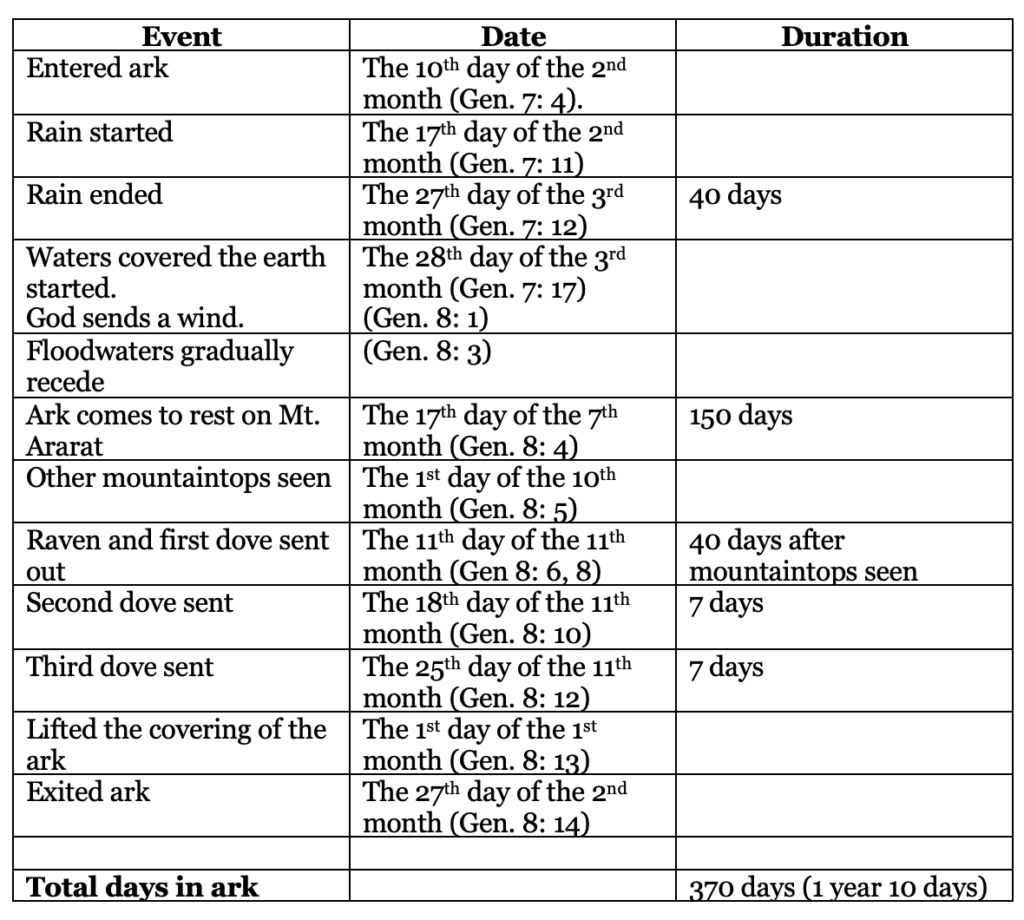
    The ark had floated on the water for 150 days. God guided the ark. He had it land on Mount Ararat.

    Sending Out the Birds

    The first bird that Noah sent out was a raven, an unclean bird. Why would Noah choose an unclean bird before he chose a clean one? Well, it was probably because, being unclean, it was more suited to what it would find.

    The raven, being an unclean bird, was associated with death – aka sin. It would have been a great choice. But then, it didn’t come back. It just kept flying back and forth until it found a spot to land. It could survive on its own.

    Noah sent out the dove at the same time as the raven. A dove was a clean bird.

    I can see the dove instinctively flying away from the ark. This poor little guy flew around for a while but didn’t find a landing spot. So, it came back – back to God in the ark.

    The second dove sent out by Noah came back with an olive branch. It meant that things were growing again in the earth. If the plants could grow, it would soon be inhabitable by the humans.

    Noah knew their time in the ark was about over when the third dove didn’t come back. 

    The Flood Officially Over

    The rain had stopped, and the earth had dried out.

    God told Noah when to exit the ark, and Noah waited for God to say, “It’s time to get out.” He didn’t want to get ahead of God.

    We can’t be stymied by sin after we have experienced God’s judgment. He doesn’t judge us to drive us away.

    God judges us to correct us and bring us back to Him. We have to let Him and not let our doubts and guilt get in the way.

    To read devotions in the Creating Everything theme, click the button below.

    Devotions in the Creation’s Do-Over series

  • God Scattered the People

    After the people on the plain of Shinar started building a great tower, God stopped their progress. This devotional reading looks at how God confused their language to stop the completion of the Tower of Babel.

    Nuggets

    • It is interesting that Moses wrote that God came down.
    • God didn’t want humans who did not believe in Him to grow unchecked.
    • God confused the languages so that people had to congregate together and move apart.
    • God may have separated humans, but He did not plan to leave us that way.
    god-scattered-the-people

    In the last devotion, we started talking about the construction of the Tower of Babel. It was built in the area that Nimrod, one of the grandsons of Ham, populated.

    As I wrote the last devotion, I wrote it believing Nimrod had a hand in building it. That may or may not be the case. His name is not mentioned in Genesis 11.

    Nimrod is described to be almost larger than life. He is described as an oppressor. For that reason, I can see him leading the charge to build something to turn the people away from God.

    God, though, had other ideas.

    Let’s Put It into Context

    To read devotions in the Creating Everything theme, click the button below.

    Devotions in the Creation’s Do-Over series

    God Came Down

    “But the Lord came down to look at the city and the tower the people were building” (Gen. 11: 5 NLT)

    It is interesting that Moses wrote that God came down.

    God knows and sees all that we do. He sees the good and the bad.

    So, God saw Nimrod and his crew doing bad. He let it go on until it was His time to shut it down.

    Let’s see what it says in the Hebrew. “And Hashem [God] came down to see the Ir [city] and the Migdal [tower], which Bnei HaAdam [the Adams or humans] built” (Gen. 11: 5 OJB).

    Yeah, it says came down, too.

    No, we don’t know what form He took. We have to assume that it was different than Him looking down.

    Parker helped us understand. He wrote, “Almighty God Himself came down to see what the children of men were doing, and when He comes down (a phrase which is used to accommodate Himself to our methods of expression).”

    Resource

    God coming down is just a way for us to say it in human-speak so we can understand.

    We know that God has come down from Heaven other times. We know He will in the end.

    • “After his baptism, as Jesus came up out of the water, the heavens were opened and he saw the Spirit of God descending like a dove and settling on him” (Mt. 3: 16 NLT).
    • “For I [Jesus] have come down from heaven to do the will of God who sent me, not to do my own will” (Jn. 6: 38 NLT).
    • “For the Lord himself will come down from heaven with a commanding shout, with the voice of the archangel, and with the trumpet call of God. First, the believers who have died will rise from their graves” (I Thess. 4: 16 NLT).
    • “And I saw the holy city, the new Jerusalem, coming down from God out of heaven like a bride beautifully dressed for her husband” (Rev. 21: 2 NLT).

    I like what Hughes said. He wrote, “God is below when men think He hath forsaken the earth, and is near to visit the wickedness of man.”

    Resource

    God is near us when we think He has left us. He is near even when we sin.

    We turn away from God. Then He turns away from us.

    “So God abandoned them to do whatever shameful things their hearts desired. As a result, they did vile and degrading things with each other’s bodies. They traded the truth about God for a lie. So they worshiped and served the things God created instead of the Creator himself, who is worthy of eternal praise! Amen. That is why God abandoned them to their shameful desires. Even the women turned against the natural way to have sex and instead indulged in sex with each other” (Rom. 1: 24-26 NLT).

    In other words, we bring it on ourselves.

    Nothing Will be Impossible

    “‘Look!’ he said. ‘The people are united, and they all speak the same language. After this, nothing they set out to do will be impossible for them!’” (Gen. 11: 6 NLT)

    God didn’t want humans who did not believe in Him to grow unchecked.

    We know nothing is impossible for God. It is interesting that He is not the subject of verse 6.

    Humans are. “‘Look!’ he said. ‘The people are united, and they all speak the same language. After this, nothing they set out to do will be impossible for them!’” (Gen. 11: 6 NLT).

    No, we are not equal to God. But remember, we are made in His image.

    What does that mean?

    • All mankind have a spirit that we get when we are given breath.
    • We all have an intelligence – we are curious and have abilities to reason.
    • We all have the free will to make choices for ourselves.
    • We all have moral character.
    • We all have consciences.
    • God has given us authority over animals but not over the earth.
    • All of mankind is going to live for eternity.
    • Mankind is creative, even though some may discount or diminish their talent.
    • Mankind are creatures who feel, especially love.

    God is Sovereign God. We are not gods.

    There are differences between worldview people and disciples.

    • Disciples also have the Holy Spirit that lives within us.
    • Our godliness accelerates our intelligence.
    • Worldview people may be good people, but disciples will one day be perfected.
    • Disciples have the Holy Spirit to guide us and remind us what is holy and righteous.
    • God has given us authority over animals but not over the earth.
    • Worldview people who are spiritually dead will live in hell; disciples who are spiritually alive will live in heaven.
    • The worldview definition of love is not as pure as God’s definition of love.

    God made us to have abilities. He didn’t want to limit them. He wanted us to be the best for Him.

    But He didn’t want a Satan Junior. Satan wanted to depose God. It sounded like these just wanted to be their own god.

    Scattered and Stopped

    “Come, let’s go down and confuse the people with different languages. Then they won’t be able to understand each other.’ In that way, the Lord scattered them all over the world, and they stopped building the city” (Gen. 11: 7-8 NLT)

    God confused the languages so that people had to congregate together and move apart.

    Why did God stop the building of the city and scatter the people? There are several answers, I believe.

    God want to prevent a universal monarchy.

    I think we have to go back to the story of King Saul to help see the reason for that. Samuel the Prophet was old, and the leaders of Israel were worried about their future.

    “Finally, all the elders of Israel met at Ramah to discuss the matter with Samuel. ‘Look,’ they told him, ‘you are now old, and your sons are not like you. Give us a king to judge us like all the other nations have’” (I Sam. 8: 4-5 NLT).

    God didn’t really say it was wrong to have a monarchy. He said their reasons for wanting one was wrong.

    “‘Do everything they say to you,’ the Lord replied, ‘for they are rejecting me, not you. They don’t want me to be their king any longer’” (I Sam. 8: 7 NLT).

    That being said, Fuller’s answer was interesting. He wrote,

    “With respect to the world, if the whole earth had continued under one government, that government would, of course, considering what human nature is, have been exceedingly despotic and oppressive. The division of the world into independent nations has also been a great check on persecution, and so has operated in a way of mercy towards the Church. If the whole world had been under one government, and that government inimical to the gospel, there had been no place of refuge left upon the earth for the faithful.”

    Resource

    Ooo, baby. One world, one people would be tyrannical and cruel with persecution for dissension. That means a world led by sin will be chaotic.

    Aren’t we heading that way? Isn’t that what the Antichrist will bring?

    Worldview people are deluding themselves if they think one world, one people will be a better world.

    God knew we can lead others astray with our plans.

    Parker was right when he said that, while Satan gives us sinful plans, skills, and insight, God does give us wonderful plans, skills, and insight. It is up to us to determine if God is getting the glory or if it is leading us away from Him.

    Resource

    That tells us that ambition itself isn’t necessarily wrong. It is the intent and focus of that ambition that leads to sin.

    Parker also said that we have to work under the human limitations that God has given us. If we think we are learning and doing because of our own understanding and skills, that is sin.

    Resource

    We will never grow beyond how God has created us. We have to make sure the focus is on Him, not us.

    Babel

    “That is why the city was called Babel, because that is where the Lord confused the people with different languages. In this way he scattered them all over the world” (Gen. 11: 9 NLT)

    God may have separated humans, but He did not plan to leave us that way.

    Babel is one of those functional translations. It sounds like the Hebrew word for confusion.

    That is the opposite of God. God is a God of peace.

    • “For God is not a God of disorder but of peace, as in all the meetings of God’s holy people” (I Cor. 14: 33 NLT).
    • “Now may the Lord of peace himself give you his peace at all times and in every situation. The Lord be with you all” (II Thess. 3: 16 NLT).
    • “And now may God, who gives us his peace, be with you all. Amen” (Rom. 15: 33 NLT).
    • “Don’t worry about anything; instead, pray about everything. Tell God what you need, and thank him for all he has done. Then you will experience God’s peace, which exceeds anything we can understand. His peace will guard your hearts and minds as you live in Christ Jesus” (Phil. 4: 6-7 NLT).
    • “Therefore, since we have been made right in God’s sight by faith, we have peace with God because of what Jesus Christ our Lord has done for us” (Rom. 5: 1 NLT).
    • “You will keep in perfect peace all who trust in you, all whose thoughts are fixed on you!” (Isa. 26: 3 NLT).
    • “Dear brothers and sisters, I close my letter with these last words: Be joyful. Grow to maturity. Encourage each other. Live in harmony and peace. Then the God of love and peace will be with you” (II Cor. 13: 11 NLT).

    If we look at all the different languages, there does seem to be some rhyme and reason.

    Adamson put it this way. He wrote,

    “The confusion of tongues was not at random. It was a systematic distribution of languages for the purpose of a systematic distribution of man in emigration. The dispersion was orderly, the difference of tongue corresponding to the differences of race. By these were the Gentiles divided in their lands, everyone after his tongue, after their families in their nations.”

    Resource

    Think back to Genesis 10. We took each of Noah’s sons separately. We got the lists of clans.

    When discussing Ham, Moses dropped in information about nations. Some of these are going to give the Israelites grief for generations to come.

    We know the Israelites come from Shem’s line. It is interesting that we aren’t told the nations descending from Japheth.

    Paget said scattering humans was the best thing God could have done to nip evil in the bud. But He didn’t stop there.

    Resource

    God devised the Plan of Salvation. He wanted us back.

    Not only did God plan to unify His children, but He also planned to restore us to Him.

    Making the Connections #1

    Ouch. It can hurt to hear it, but Hughes had it right. He wrote, “Wicked ones are much encouraging one another to evil.”

    Resource

    What Hughes doesn’t say is that disciples are often accused of being less encouraging to those these see as sinners coming to join them.

    We’ve all read the stories and even memes about how the prostitute, drug addict, homosexual, adulterer [fill in whatever sinner] has been shunned the first time they showed up in our churches. I am sure that does happen in some churches.

    We think what we label as worst of the worst sinners need to repent of their sins before they darken the church’s doors. They need to change before they come into God’s house.

    Jesus finds us where we are — in whatever sin we are committing, a minor sin or the worst sin — and loves us and calls us to redemption.

    Then, we are to repent and turn from sin. Then, we are to grow closer to being what God wants us to be.

    We have to remember what Jesus said. “When Jesus heard this, he told them, ‘Healthy people don’t need a doctor — sick people do. I have come to call not those who think they are righteous, but those who know they are sinners’” (Mk. 2: 17 NLT).

    Look what that says. “… ‘I have come to call not those who think they are righteous, but those who know they are sinners’” (Mk. 2: 17 NLT).

    Who think they are righteous. No, Jesus didn’t say they were righteous. He said they think they are — indicating He didn’t think so.

    But then, Jesus knew no one was righteous. “For everyone has sinned; we all fall short of God’s glorious standard” (Rom. 3: 23 NLT).

    Making the Connections #2

    Emmons brought up a really good point. Just who was getting dispersed?

    Was it just the tower workers? Was it all of Ham’s descendants? Was it every human?

    Well, no. It couldn’t be everyone because some had to stay in the area.

    Emmons said God’s Word tells us. He wrote,

    “But how came Nimrod the son of Ham, and his posterity, at Babylon, where Babel was built? This portion of the earth was allotted to Shem; and Nimrod with all the posterity of Ham was appointed to go to Africa. What right, then, had Nimrod, or any of the sons of Ham, to take possession of the plains of Babylon? Undoubtedly they had no right at all.”

    Resource

    Ouch. Nimrod wasn’t supposed to be there in the first place. Since he was a great warrior, do I sense hostile takeover?

    Emmons thought it was Ham’s descendants, especially Nimrod’s clan, who came to Babylon in the first place instead of Africa and waged war against Shem’s descendants to occupy it. He believed others (sounds like Japheth’s descendants) stayed around Mount Ararat.

    So, even before their building project, they were disobeying God.

    That puts a whole new twist on things. Talk about sin upon sin.

    1.     They didn’t go where they were told to go.
    2.    They fought — and probably killed — their own cousins.
    3.    They tried to build a tower to stake claim to the land and defy God.

    Not a smart move.

    Emmons called Nimrod’s people knowledgeable in arts and sciences. That, too, is what God wanted spread over the earth.

    Unfortunately, they also spread idolatry. Too bad it is easier to spread that than God’s truth.

    Isn’t it still that way today?

    Making the Connections #3

    Parker asked a good question. Why didn’t God just burn the city down? Maybe send a sickness through the group.

    Resource

    Instead, God makes it so they all can’t talk to each other.

    Did this happen overnight? Or were they on the job and suddenly lose the ability to communicate? How did they find each other to group together?

    The writer of Hebrews had it right. “It is a terrible thing to fall into the hands of the living God” (Heb. 10: 31 NLT).

    Well, it is when we are disobeying. When we are obedient, it is great.

    No, God isn’t always going to do what we think. He has a lot of things in His toolbox that we would never consider.

    But we should know that God corrects us in the way we need to bring us back to Him.

    How Do We Apply This?

    • Don’t be led into sin by others.
    • Don’t believe that sinful practices will bring for godly ends.
    • Realize that sin will not be impeded by struggles.
    • Recognize common practices that can be used to call us deeper into sin.
    • Don’t patronize sinful establishments.
    • Depend on God.
    • Don’t be proud or ambitious.
    • Don’t rely on ourselves.
    • Always trust in God.
    • Don’t disobey God.
    • Recognize how easily and quickly God can and will punish us.
    • Spread God’s truth, not idolatry.

    Resource

    Father God. Thank You for correcting us when we sin against You. Thank You for loving us enough to want us to follow You. Forgive us when we put too much value on something besides You. Draw us back into Your Will. Amen.

    What do you think?

    Leave me a comment below (about this or anything else) or head over to my Facebook group for some interactive discussion.

    If you don’t understand something and would like further clarification, please contact me.

    If you have not signed up for the email providing the link to the devotions and the newsletter, do so below.

    If God has used this devotion to speak with you, consider sharing it on social media.
  • Unity on the Earth

    Since sin had entered the earth again, it grew until it reached a head at Babylon. This devotional reading looks at setting the scene for the building of the Tower of Babel.

    Nuggets

    • Originally, all humans spoke the same language.
    • Humans started out obeying God’s command to fill the earth.
    • They built a tower for worldly purposes.
    unity-on-the-earth

    In the first years after the flood, even though Noah and Ham had sinned, it seemed like everything was going according to God’s plan. Let’s look at what was happening.

    Let’s Put It into Context

    To read devotions in the Creating Everything theme, click the button below.

    Devotions in the Creation’s Do-Over series

    Let’s Put It into Context #2

    In Genesis 10, we talked about the descendants of Noah’s three sons, Shem, Ham, and Japheth. At the end of the discussion for each son, a similar verse was repeated. “These were the descendants of Ham, identified by clan, language, territory, and national identity” (Gen. 10: 20 NLT).

    Somewhere within the genealogy discussed, the world was divided into groups. Those brief statements will be expanded on in this chapter.

    But what is a nation? Murphy seemed to think it was determined by the language the people spoke. I think it was more than that.

    Resource

    Geography plays a part in determining what is a nation. Borders lead to their identity. Proximity helps to make them a cohesive group.

    Also important is the makeup of the group. Do they have a family ties? Is there some other similarity that ties them together (besides language)?

    Just a quick note. In this chapter, we are not told where the territory each son was given and how it was chosen what they got. It does appear that they were given specific areas to populate.

    Let’s Put It into Context #3

    We have no idea of how much time transpired between the death of Noah and the building of the tower. Moses didn’t tell us.

    That is why I was surprised at what Gray said. He wrote, “For one hundred years the posterity of Noah had continued to increase.”

    Resource

    The problem I see with that is we aren’t given a starting reference for the countdown. Was it 100 years after they disembarked from the ark? Or 100 years after Noah died?

    So, was Noah still alive to see how corrupted the world had become so quickly?

    One Language

    “At one time all the people of the world spoke the same language and used the same words” (Gen. 11: 1 NLT)

    Originally, all humans spoke the same language.

    Language is a separate, big conundrum. Many linguists, for years, refused to believe that there was once only one language.

    This one-language hypothesis is called Proto-World. It is only within the last decade or so that linguists have accepted that language, in fact, began as one language. There were too many similarities to believe otherwise.

    Resource

    The oldest written language is said to be the Sumerian language. It originated in ancient Mesopotamia around 3100 BC. The one language has grown to over 5,000.

    To put this into context, the Sumerian civilization was a civilization from 3500 to 1750 BC. It occupied land along the banks of the Tigris and Euphrates Rivers, currently the non-desert areas of Iraq.

    Vaughan had a different take. He argued that the first language was Hebrew.

    Resource

    I guess I had never really thought about it. It would seem logical that it was Hebrew instead of the Sumerian language.

    But we aren’t give any hint what was the language on which others were developed.

    I’m sure part of the problem some had in believing that there was only one language was the sudden appearance of many languages. As complex as languages are, it is easier to think they evolved over time.

    But that ignores the fact that God is Sovereign God. He can do the impossible. With God, nothing is impossible.

    What would be the purpose of having only one language – besides everyone being able to talk to each other? It promotes unity within God’s Church. Everyone has the same opportunity to hear God’s Word. There are no barriers to their introduction to the Plan of Salvation.

    Ooo, baby. Sin messed that up for us, too. We now have not only language barriers but also cultural barriers.

    Populating the Earth

    “As the people migrated to the east, they found a plain in the land of Babylonia and settled there” (Gen. 11: 2 NLT)

    Humans started out obeying God’s command to fill the earth.

    If humans were to “… ‘Be fruitful and multiply and fill the earth’” (Gen. 9: 1 ESV), that means they would have to migrate out of the Fertile Crescent. And people were obeying.

    We aren’t told here who was migrating, but we can go back to the last chapter to figure that out who they were. “… People would say, ‘This man is like Nimrod, the greatest hunter in the world.’  He built his kingdom in the land of Babylonia, with the cities of Babylon, Erech, Akkad, and Calneh” (Gen. 10: 9-10 NLT).

    Nimrod was a descendant of Ham. Remember, Ham — specifically his son Canaan — was cursed for Ham’s sin that stemmed from Noah’s sin. “Then he [Noah] cursed Canaan, the son of Ham: ‘May Canaan be cursed! May he be the lowest of servants to his relatives’” (Gen. 9: 25 NLT).

    Babylonians lived in Mesopotamia between 2100 and 538 BC. The city of Babylon was constructed on the Euphrates River.

    We know the importance the empire of Babylonia played in the (then) future of the nation of Israel. The Kingdom of Judah was defeated in 586 BC, when the Babylonians destroyed Jerusalem and Solomon’s Temple and exiled many of the Israelites.

    Nimrod was also credited with founding Assyria, also. “From there he expanded his territory to Assyria, building the cities of Nineveh, Rehoboth-ir, Calah, and Resen (the great city located between Nineveh and Calah)” (Gen. 10: 11-12 NLT).

    Assyria was then northern Mesopotamia. It dated from 2025 to 609 BC. This is currently northern Iraq, southeastern Turkey, and parts of Syria.

    But back to Genesis 11.

    Yes, they had obeyed the command to populate the earth. No, they hadn’t gone too far at this point. Some did continue to walk with God as they populated the earth.

    The real issue here happened when they got settled on the plain of Shinar. They wanted something to “… keep [them] from being scattered all over the world” (Gen. 11: 4 NLT).

    It may have started with them deciding they liked the place and didn’t want to move on. But if that happened, they were choosing to disobey God’s directive.

    When God commands, we have to say, “Sir, yes sir!”

    A Great City with a Tower

    “They began saying to each other, ‘Let’s make bricks and harden them with fire.’ (In this region bricks were used instead of stone, and tar was used for mortar.) Then they said, ‘Come, let’s build a great city for ourselves with a tower that reaches into the sky. This will make us famous and keep us from being scattered all over the world’” (Gen. 11: 3-4 NLT)

    They built a tower for worldly purposes.

    We don’t know how long Nimrod and crew lived on the plain of Shinar until they got fed up with a patriarchal society. They wanted a monarch — an empire.

    Think back. Wasn’t that Ham’s sin? He had no respect for his father. He wanted to do and say what he wanted.

    This is just that on steroids.

    Their problem was they forgot we are not independent of God. Regardless of being disciples or worldview people, we are dependent on God.

    What motivated them to build the tower? We get several hints from these verses.

    • We can make something substantial.
    • We want to build it for ourselves.
    • We want it to reach to the sky.
    • We want to be famous.
    • We don’t want to be scattered.

    Fired bricks were invented around 3,000 BC. Sun-dried bricks had been around since approximately 7,500 BC, but these would have been more durable bricks.

    Depending on the translation, we are told that Nimrod and his cronies wanted to make a name for themselves. Yeah, that means being famous.

    But we have to put it into Hebrew culture to really understand it. A name wasn’t just a moniker that identified Nimrod as opposed to Malachi.

    A name in that culture told us who the person was: their character, identity, and destiny.

    • Methuselah meant when he dies, it will come.
    • Isaac means he laughs.
    • Moses means drawn out.
    • Yeshua means the Lord is salvation.

    I know. We pick names before the kids are born. They didn’t name their kid until Day 8.

    They may have gotten an idea of the baby’s character. But they may also give a name as to what role they wanted the kid to play.

    I think what they were saying was they wanted a name that established their authority. They were going to take their world in a new direction: away from God.

    Well, Nimrod’s name is still known. We don’t know any of his contemporaries, though.

    Fame was their goal. But then, they may not have been thinking this long. They probably thought that, after a couple hundred years, no one would remember who they were.

    Nimrod and his contemporaries wanted a permanent monument to their glory. They wanted something they built themselves. They wanted their ambition recognized. 

    The “… with its top in the heavens…” (Gen. 11: 4 ESV) part speaks of idolatry, and we know that the worshiping of false gods came from here. Bradford noted that the practice of worshiping false gods, called the Babylon Mystery Religions, started with Nimrod around the time of the Tower of Babel. That would make sense as Nimrod was the founder of Babylon. They were all finding their footing of being different after the language changed.

    Bradford reminded us, even though this worshiping false gods was sinful, from where they came. He wrote,

    “Yet, due to mankind’s common point of origin, each of the world’s new religions took with them the common memory of the essential doctrines of the true God who created them …. but they modified and twisted meanings and practices. When you study them closely the world’s false religions are far more similar on the surface than they are unique; they all pretty much look alike.”

    Resource

    That wasn’t the unity that God wanted. God doesn’t want us unified doing the devil’s work.

    How were these men unified? They had to have an intelligence to build what they built. (We don’t know how far they got. It sounds like they were almost done.)

    With that intelligence, they probably thought they had power. But the power was just a delusion brought upon by their scheming. That wasn’t ever going to work.

    Not with the all-powerful, all-knowing Sovereign God.

    We see it in get-rich-quick schemes. People think they can do certain things and have a big payoff.

    That doesn’t work because we are relying on ourselves, not God, to provide for us. They were going for self-preservation.

    Since the group had decided not to move on to repopulate the earth, they sought to build a tower. They thought that would ensure that they wouldn’t be forced to move again.

    Goulburn thought there was another motive. He wrote, “A remembrance of the deluge, and a guilty dread of some similar judgment, leading them to draw close to each other for support.”

    Resource

    I can see that. Worldview people don’t want to be judged for disobedience to God’s laws and commandments.

    The Tower of Babel has been described as a ziggurat. This was supposed to be a rectangular stepped tower. It usually had a temple on top.

    We have to realize that God’s Will is going to be done. He will make it so.

    They built it so they would not be scattered. Gray argued that this stunted the population growth. He felt the population would increase faster in new counties.

    Resource

    I guess I can see that. Families of the past were bigger because more were needed to help the family survive. If they had become more dependent on the community as a whole, they may have not seen the need for population growth.

    So, they were breaking both parts of God’s command. They were not only not going forth, but they were not also multiplying.

    Ooo, baby. They were taking their eternal life into their hands by disobeying God.

    They weren’t going to change God’s mind about what would or wouldn’t happen. They were breaking their part of Noah’s covenant. Their part was obedience.

    Making the Connections #1

    I wonder what it was like to have the world that unified. We certainly aren’t today.

    Look at what Vaughan said about what we must go through before we get that Unity back. He wrote,

    “Generations must pass; new eras must unfold; Christ must come down and suffer; the Holy Spirit dwell amongst us; the Church must live and work; missionaries must preach; martyrs must die; the whole earth must be regenerate before men could hear their own, their higher, their destined unity.

    Resource

    No, it hasn’t been and won’t be an easy road back to that unity. But one day it will be achieved.

    • “Therefore, God elevated him to the place of highest honor and gave him the name above all other names, that at the name of Jesus every knee should bow, in heaven and on earth and under the earth, and every tongue declare that Jesus Christ is Lord, to the glory of God the Father” (Phil. 2: 11 NLT).
    • “For the Scriptures say, ‘As surely as I live,’ says the Lord, ‘every knee will bend to me, and every tongue will declare allegiance to God” (Rom. 14: 11 NLT).
    • “I have sworn by my own name; I have spoken the truth, and I will never go back on my word: Every knee will bend to me, and every tongue will declare allegiance to me” (Isa. 45: 23 NLT).

    I know. Sometimes we scratch our heads wondering why we have to go through all this to get there.

    It is God’s way to show us — and the angels — how much He loves us.

    Making the Connections #2

    Hmmm. Read what Vaughan said. He wrote, “And even if there were a language perfectly the same, yet until there was a setting to rights of disorders which have come into human thought, and until minds were themselves set in one accord, there could not be unity.”

    Resource

    Even if it was still just one language, sin would have corrupted it. It would have corrupted our hearts and minds, corrupting the ideas and observations we have.

    So, once the original sin was committed, the language itself took a back burner because language just conveys our beliefs.

    The words themselves are not as important as the beliefs, ideas, and observation. Worship was negatively impacted.

    Making the Connections #3

    Leale tried to connect the dots as to why the world of Nimrod brought the creation do-over back to corruption.

    • Noah sinned by becoming drunk, a sin of sensual indulgence.
    • Ham sinned by gossiping about Noah, a sin of dishonoring his parent.
    • Nimrod and his contemporaries sinned by being ambitious, rejecting their dependence on God.

    Every sin is against God but look at it this way.

    Noah used a prop – the wine – in his sin. He may or may not have chosen to get drunk, but he did. Some may not see that as a sin against God.

    Ham chose to not show his father love. He may have thought he was sinning against Noah, but not against God. But his sin was a choice.

    Nimrod chose to sin, and he chose to sin against God.

    Look what Leale said. He wrote,

    “They held that the individual must be sacrificed to the outward grandeur of the State. This is the genius of all Babel-building, to make the city supreme, and to sink the individual. All must be sacrificed to one idea: the nation — State — Constitution. It is not within the province of worldly ambition to recognize the sublime importance of the individual soul.”

    Resource

    God will protect Himself and His government. To do this, He wrecks men’s plans.

    How Do We Apply This?

    • Remember that we are not independent of God, rather we are totally dependent on Him.
    • Recognize that God can and will turn His wrath on our disobedience.
    • Live and work according to God’s Will for us.
    • Have glorifying God the main goal for our lives.

    Resource

    Father God. You want us to be unified but unified under You. You want us all working together to grow in You and to expand Your kingdom. Help us to be obedient to You. Amen.

    What do you think?

    Leave me a comment below (about this or anything else) or head over to my Facebook group for some interactive discussion.

    If you don’t understand something and would like further clarification, please contact me.

    If you have not signed up for the email providing the link to the devotions and the newsletter, do so below.

    If God has used this devotion to speak with you, consider sharing it on social media.
  • Nations Descended from Noah

    The flood is over. This devotional reading looks at what happens to Noah’s three sons.

    Nuggets

    • Even from the beginning, God was separating Jew from Gentile.
    • We can tell from Ham’s genealogy that the Noah’s curse came to fruition.
    • Shem’s line would lead to the Messiah.
    nations-descended-from-noah

    Let’s face it. Noah was a senior citizen when the flood occurred. He was 600 years old when he entered the ark and 601 when he came out.

    Though he lived 350 years more after the flood and had a mostly good life, the job of repopulating the earth probably didn’t fall to Noah. We aren’t told that he had more sons and daughters.

    Maybe Noah did. Maybe he didn’t. We aren’t told.

    We are told what happened to the triplets, Noah’s three sons that entered and exited the ark with him.

    Let’s Put It into Context

    To read devotions in the Creating Everything theme, click the button below.

    Devotions in the Creation’s Do-Over series

    Descendants of Japheth

    This is the account of the families of Shem, Ham, and Japheth, the three sons of Noah. Many children were born to them after the great flood. The descendants of Japheth were Gomer, Magog, Madai, Javan, Tubal, Meshech, and Tiras. The descendants of Gomer were Ashkenaz, Riphath, and Togarmah. The descendants of Javan were Elishah, Tarshish, Kittim, and Rodanim. Their descendants became the seafaring peoples that spread out to various lands, each identified by its own language, clan, and national identity” (Gen. 10: 1-5 NLT)

    Even from the beginning, God was separating Jew from Gentile.

    We’ve talked before that God is in the business of separating those who believe in Him from those who don’t. I know we said that it started with Cain and Abel.

    Leale warned us not to get so cross-eyed reading all the names that we miss what God was telling us about the governance of the world. He seems to be quoting an unnamed source when he wrote, “This chapter ‘is as essential to an understanding of the Bible, and of history in general, as is Homer’s catalogue, in the second book of the Iliad, to a true knowledge of the Homeric poems and the Homeric times.’”

    Resource

    These aren’t just names on a page. These were real people. We talked in Genesis 5 how little information was given there: age when he became a father, how many years he lived another the birth, that there were siblings, and how old he was when he died.

    But it is more than just a list of names. It is the people on which humanity continued.

    We wouldn’t be here without them.

    One little side note on one of the names. There is some debate on the actual name of one of them: Rodanim or Dodanim. It is believed it is a copying error. More than likely, it is Rodanim because Japheth’s grandson was associated with Rhodes island.

    Second little side note. Kittim was also associated with a land region. It is either a settlement presently known as Lamaca or the whole island of Cyprus, previous known as Kition.

    I had originally planned to use the New King James Version for the verses. It translates verse 5 a little differently.

    “From these the coastland peoples of the Gentiles were separated into their lands, everyone according to his language, according to their families, into their nations” (Gen. 10: 5 NKJV).

    I mean, when we’ve talked about him, it seemed like Japheth was right up there with Shem in walking with God. Maybe. Maybe not.

    Yeah, let’s look at this in the Hebrew. “By these were the coastlands of the Goyim [Gentile, non-Jew] divided in their lands; every one after his leshon [tongue], after their mishpechot [family], in their Goyim [nation]” (Gen. 10: 5 OJB).

    Okay, one translator I did said Goyim was Gentiles (which is what I always have heard). Another just said the generic nations.

    No, the Goyim/Gentiles are not forever cut off from God – provided they repent and turn back to Him. The Plan of Salvation is open to them, too.

    But I am tripping over verse 5. “Their descendants became the seafaring peoples that spread out to various lands, each identified by its own language, clan, and national identity” (Gen. 10: 5 NLT).

    I get the seafaring part. That is just an occupation.

    I can see the sons as having land of their own. They would more than likely spread out somewhat in their own little corner of the world.

    It is the own language that is getting me. Is that just foreshadowing of Genesis 11? Is it just Moses’ way of describing what went down in language his readers would understand? Should Genesis 10 actually be after Genesis 11?

    That is something else for the UNR book – understanding not required.

    Descendants of Ham

    “The descendants of Ham were Cush, Mizraim, Put, and Canaan. The descendants of Cush were Seba, Havilah, Sabtah, Raamah, and Sabteca. The descendants of Raamah were Sheba and Dedan. Cush was also the ancestor of Nimrod, who was the first heroic warrior on earth. Since he was the greatest hunter in the world, his name became proverbial. People would say, ‘This man is like Nimrod, the greatest hunter in the world.’  He built his kingdom in the land of Babylonia, with the cities of Babylon, Erech, Akkad, and Calneh. From there he expanded his territory to Assyria, building the cities of Nineveh, Rehoboth-ir, Calah, and Resen (the great city located between Nineveh and Calah).  Mizraim was the ancestor of the Ludites, Anamites, Lehabites, Naphtuhites,  Pathrusites, Casluhites, and the Caphtorites, from whom the Philistines came.  Canaan’s oldest son was Sidon, the ancestor of the Sidonians. Canaan was also the ancestor of the Hittites, Jebusites, Amorites, Girgashites, Hivites, Arkites, Sinites, Arvadites, Zemarites, and Hamathites. The Canaanite clans eventually spread out, and the territory of Canaan extended from Sidon in the north to Gerar and Gaza in the south, and east as far as Sodom, Gomorrah, Admah, and Zeboiim, near Lasha. These were the descendants of Ham, identified by clan, language, territory, and national identity” (Gen. 10: 6-20 NLT)

    We can tell from Ham’s genealogy that the Noah’s curse came to fruition.

    This looks a little funky. In verse 8, we are given the descendants of Cush. But in verse 9, it says that Nimrod is also a descendant. What gives?

    The sons of Cush are listed in verse 8. Somewhere down the line, Nimrod is a grandson of Cush’s. We aren’t told if or how many times great is put in front of it.

    We are given a windfall of information on Nimrod. He was a warrior and hunter. He is credited with founding the city of Babylon.

    Gilfillan called him a giant and an oppressor. He noted that Nimrod preyed on other men through warfare. Talmage noted that this was accomplished by use of bow and arrows.

    Resources

    Yeah, that Babylon, which we read so much of in the books of the prophets.

    But Nimrod also built the city of Ninevah. We’ve heard of that city in the Book of Jonah. This was in Assyria.

    Ooo, baby. Look at all the nations that came out of the line of Nimrod: Hittites, Jebusites, Amorites, Hivites, and Philistines – plus Babylon and Assyria. In years to come, Joshua and David will be battling those nations.

    It doesn’t tell us who built Sodom and Gomorrah, but those are cities that are infamous. We’ll read about those further on in the Book of Genesis.

    All of the nations that we mentioned will be at war with the nation of Israel in the future. That will be their punishment for a lifetime of disobedience to God.

    We don’t know how many generations it was until it was Nimrod’s generation. That was however long it took for the world to become thoroughly wicked again.

    Starting in verse 13, it talks about Mizraim. He not only was an ancestor of the Philistines, but Hollis said that he also founded Egypt.

    Resource

    I’m reminded of the description of Cain’s descendants. We had a list of their accomplishments. However, with Seth’s line – the chosen line – we mainly got the standard name, son, and years information.

    We get very little information about the accomplishments of Japheth’s line. We’ll have to see in the next section how Seth’s line is handled.

    Doesn’t that burn us when worldview people are so successful? We would think that, when they are disobeying God, they should not have an easy, comfortable life.

    But they do many times.

    Oh, yes. In the end, they will find their disobedience was not worth the punishment that they will get.

    That doesn’t always comfort us in the here and now.

    Descendants of Shem

    “Sons were also born to Shem, the older brother of Japheth. Shem was the ancestor of all the descendants of Eber. The descendants of Shem were Elam, Asshur, Arphaxad, Lud, and Aram. The descendants of Aram were Uz, Hul, Gether, and Mash. Arphaxad was the father of Shelah, and Shelah was the father of Eber. Eber had two sons. The first was named Peleg (which means ‘division’), for during his lifetime the people of the world were divided into different language groups. His brother’s name was Joktan. Joktan was the ancestor of Almodad, Sheleph, Hazarmaveth, Jerah, Hadoram, Uzal, Diklah, Obal, Abimael, Sheba, Ophir, Havilah, and Jobab. All these were descendants of Joktan. The territory they occupied extended from Mesha all the way to Sephar in the eastern mountains. These were the descendants of Shem, identified by clan, language, territory, and national identity. These are the clans that descended from Noah’s sons, arranged by nation according to their lines of descent. All the nations of the earth descended from these clans after the great flood” (Gen. 10: 21-32 NLT)

    Shem’s line would lead to the Messiah.

    Focus turned from Japheth and Ham to Shem. That is logical, as this is the chosen line.

    We finally get a glimpse at the birth order of the sons of Noah. Shem is the older brother of Japheth. Ham is the second son. That means they are in age order when listed.

    I first started to write that means they weren’t triplets. Maybe. Maybe not. Two, even three, babies wouldn’t come out at the same moment. They would be born one after another.

    They could still be triplets or just siblings.

    We know Shem’s line was the chosen line because of the genealogy in Luke 3. “Nahor was the son of Serug. Serug was the son of Reu. Reu was the son of Peleg. Peleg was the son of Eber. Eber was the son of Shelah. Shelah was the son of Cainan. Cainan was the son of Arphaxad. Arphaxad was the son of Shem …” (Lk. 3: 35-36 NLT).

    It is interesting how Moses wrote verse 21. “Sons were also born to Shem, the older brother of Japheth. Shem was the ancestor of all the descendants of Eber” (Gen. 10: 21 NLT).

    Did Moses know about the promised Savior? Well, we just said that Bradford thought Noah did. It is conceivable that Moses did.

    If this was oral tradition that Moses was making more permanent, he may have only known that Shem was expecting something out of one of his descendants but the exact Who and what may have been lost.

    We know the Jews in Jesus’ time sure weren’t looking for a baby to take away their sins. That little tidbit had to have been lost somewhere down the line.

    Here in Genesis, Cainan was skipped, making Arphaxad the grandfather of Shelah, not the father as indicated here.

    But then, it really doesn’t say Shelah was Arphaxad’s son, just his descendant. A grandson would be his descendant.

    We have to watch when we are reading passages like that. Some would say that the passages are contradictory. Hopefully, we can discern when we are being given full information and when we are being given abbreviated information.

    We’re given a little more information on the line’s accomplishments and events that happened during their time. The event referenced is probably the Tower of Babel, which we will discuss in the next chapter.

    It is interesting that it is mentioned that Eber had two sons, Peleg and Joktan. Peleg’s name means division. Was that another instance where God separated and divided siblings? We aren’t really told.

    It seems like Hughes disagreed. He wrote, “Heber’s children are the true Church of God.” Heber has got to be Eber.

    Resource

    Children plural.

    Or was Peleg given this name because of the division caused from the punishment of the Tower of Babel? Did they know beforehand and name him as Methusaleh was given a prophetical name (when he dies, it will come)?

    Hughes kind of said he was named after the Tower of Babel. He wrote, “Saints have been careful to keep in memory such judgments of division; the naming of the child (ver. 25).”

    Resource

    I don’t see Peleg being born after the division was made. I think it was another prophetic name.

    Making the Connections #1

    Carlyle emphasized the presence of free will. He wrote, “Instead of saying that man is the creature of circumstances, it would be nearer the mark to say that man is the architect of circumstances. It is character that builds an existence out of circumstance.”

    Resource

    Take Noah’s three boys. They were probably raised the same way. They chose different paths.

    Shem was a sheep. He walked with God. Ham was a goat. He allowed sin to take over his life.

    Japheth is the kicker, isn’t he? Was he a goat masquerading in sheep’s clothing? If he was considered Goyim, he wasn’t a Jew – one of God’s people – so he wasn’t a sheep.

    Was that only because Seth was the chosen one? Or was it because of Japheth’s decisions on whether or not to follow God in his life?

    We really can’t tell. All we know is the three came out of the same family with the same saint as their father.

    They made their own choices.

    But then, they were as God made them. “From one man he [God] created all the nations throughout the whole earth. He decided beforehand when they should rise and fall, and he determined their boundaries” (Ac. 17: 26 NLT).

    Making the Connections #2

    Parker gave us a really big caution. “From one man …” (Ac. 17: 26 NLT) came everyone from saint to sinner, who is just like us – cannibal to king.

    The gist of what Parker said was that we should consider everyone our neighbor – if not family. He wrote, “If we limit our life to families, clans, and sects, we shall miss the genius of human history, and all its ennobling influences. Better join the common lot. Take it just as it is.”

    Resource

    We shouldn’t anymore hide what sins our ancestors committed than think there is home and foreign missions. If everyone is our neighbor, there is no boundaries of home.

    Making the Connections #3

    In a chapter like this, we come back to where did they get their wives? Was it a lot of intermarrying?

    Was the Nephilim — the sons of God and who the daughters of men — back in business? They would almost have to be if the Anakim (descendants of Anak) were also the descendants of the Nephilim.

    Then again, it may have been intermarriage between those practicing idolatry and the chosen people. In other words, those of the line of Seth/sons of God (Godview) marrying those of the line of Japheth or Ham/daughters of men (worldview).

    Making the Connections #4

    I have to process what Talmage said. This is going to be in Elaine-speak.

    Resource

    • Our mighty, sharp, true weapon is the Gospel.
    • It is powered by the Holy Spirit and built from the wood of the cross.
    • We must build our skills of the hunt by practicing in quiet, out-of-the-way places.
    • We have to find our prey, as it will not come to us.
    • We just be brave and bold in the hunt.
    • We must complete the hunt, not give up halfway.

    That is an interesting analogy.

    • In Paul’s armor of God analogy, the only weapon listed is God’s Word as the sword. “Put on salvation as your helmet, and take the sword of the Spirit, which is the word of God” (Eph. 6: 17 NLT)
    • The Holy Spirit leads us to knowledge of Jesus’ sacrifice for us. “So I want you to know that no one speaking by the Spirit of God will curse Jesus, and no one can say Jesus is Lord, except by the Holy Spirit” (I Cor. 12: 3 NLT).
    • We learn of God in quiet reflection during our devotional time. “Be still, and know that I am God. I will be exalted among the nations, I will be exalted in the earth!” (Ps. 46: 10 NLT).
    • Non-believers are not tearing down the church doors seeking salvation. “But how can they call on him to save them unless they believe in him? And how can they believe in him if they have never heard about him? And how can they hear about him unless someone tells them? And how will anyone go and tell them without being sent? That is why the Scriptures say, ‘How beautiful are the feet of messengers who bring good news!’” (Rom. 10: 14-15 NLT).
    • We have to boldly proclaim the Gospel. “And pray for me, too. Ask God to give me the right words so I can boldly explain God’s mysterious plan that the Good News is for Jews and Gentiles alike.” (Eph. 6: 19 NLT).

    How Do We Apply This?

    • Teach our children to walk with God.
    • Be buried in God’s Word.
    • Follow the Holy Spirit’s promptings to lead others to Jesus.
    • Make time to quietly reflect on what God is revealing to us.
    • Meet non-believers where they are and boldly witness to them.

    Father God. Lord, when You created humans, You made us to be members of families. You allowed each of us to choose for ourselves whether we would obey or disobey You. We know that You still use those who choose to disobey You. Lord, we pray that all our family members choose to follow You and not compromise with the worldview. Amen.

    What do you think?

    Leave me a comment below (about this or anything else) or head over to my Facebook group for some interactive discussion.

    If you don’t understand something and would like further clarification, please contact me.

    If you have not signed up for the email providing the link to the devotions and the newsletter, do so below.

    If God has used this devotion to speak with you, consider sharing it on social media.
  • One Sin Leads to Another — Again

    We’ve already talked about how Cain’s first sin of an unacceptable offering that led the way to his second sin of murder. In this devotional reading, we look at how Noah’s sin set the stage for Ham’s sin.

    Nuggets

    • Temptation is not the sin — the sin is what we do with it.
    • We will be given blessings for walking with God and curses for sinning against Him.
    • Noah passed after a long, eventful life as a saint.
    one-sin-leads-to-another-again

    Noah, the saint, had sinned. He had overindulged in his harvest of grapes and had gotten drunk.

    To make matters worse, his son Ham saw him drunk. How did he handle the situation?

    Let’s Put It into Context

    To read devotions in the Creating Everything theme, click the button below.

    Devotions in the Creation’s Do-Over series

    Ham’s Sin

    “Ham, the father of Canaan, saw that his father was naked and went outside and told his brothers. Then Shem and Japheth took a robe, held it over their shoulders, and backed into the tent to cover their father. As they did this, they looked the other way so they would not see him naked” (Gen. 9: 22-23 NLT)

    Temptation is not the sin — the sin is what we do with it.

    Okay. What gives?

    We talked about how Shem and Japheth were righteous. They followed God.

    Ham maybe did, too. This may be his one big sin, just as Noah’s drunkenness seems like it was his one big sin.

    But for sake of discussion, let’s say Ham was a bad apple in the bunch. The question of whether it was nature or nurture doesn’t seem to apply.

    Yes, the triplets would have been brought up the same way. They would have been introduced to God together. They had just experienced the flood and their salvation from it together, so they had shared life experiences.

    Their nurture was the same. But then so was their nature.

    All three, while made in the image of God, had a sinful nature. All three could have committed the sin Ham did.

    Ham was the only one to choose to sin.

    Hughes reminded us that, when you have children that are righteous, it showcases their sibling’s impiety. Just like the Big, Bad Wolf telling Little Red Riding Hood, “The better to see you with.”

    Resource

    So, what was Ham’s sin? I don’t think it was the seeing part. It was the telling part.

    We’ve talked before about how the temptations themselves aren’t the sin. Thoughts creep into our mind (because Satan puts them there). If they come in unbidden, that isn’t the problem.

    The issue was what we do with them. Ham ran to his brothers and told them what he saw. In other words, he gossiped.

    Yeah, gossip can seem so harmless – but it really isn’t. We may not know what we are talking about; therefore, all we are doing is spreading lies.

    We may have misinterpreted something. Or we may just be speculating.

    Several verses describe gossip as idle talk.

    • “A troublemaker plants seeds of strife; gossip separates the best of friends” (Prov. 16: 28 NLT).
    • “A gossip goes around telling secrets, so don’t hang around with chatterers” (Prov. 20: 19 NLT).
    • “Rumors are dainty morsels that sink deep into one’s heart” (Prov. 18: 8 NLT).

    The big thing, as I see it, is that it is that we break the second greatest commandment. “The second is equally important: ‘Love your neighbor as yourself’” (Mk. 12: 31 NLT).

    We may or may not be thinking of what we are doing to others. We could be ruining their reputations. We could adversely affecting how the ones we are talking to view and interact with them.

    It isn’t as small a thing as we might think. In fact, gossip is listed as a sin worthy of death.

    • “Their lives became full of every kind of wickedness, sin, greed, hate, envy, murder, quarreling, deception, malicious behavior, and gossip. They are backstabbers, haters of God, insolent, proud, and boastful. They invent new ways of sinning, and they disobey their parents” (Rom. 1: 29 NLT).
    • “For from the heart come evil thoughts, murder, adultery, all sexual immorality, theft, lying, and slander” (Mt. 15: 19 NLT).

    What I am reading this to say is gossip comes from our wicked hearts. “The human heart is the most deceitful of all things, and desperately wicked. Who really knows how bad it is?” (Jer. 17: 9 NLT).

    What makes us so eager to jump into gossiping about someone else? Dods said that it was the fact that sin is a disease. We like seeing someone else — especially someone we see as more righteous than us — take a big fall.

    We think, better them than us, right? Or worse, serves them right. Or maybe, at least we aren’t the only one still sinning.

    Blessing and Cursing the Triplets

    “When Noah woke up from his stupor, he learned what Ham, his youngest son, had done. Then he cursed Canaan, the son of Ham: ‘May Canaan be cursed! May he be the lowest of servants to his relatives.’ Then Noah said, ‘May the Lord, the God of Shem, be blessed, and may Canaan be his servant! May God expand the territory of Japheth! May Japheth share the prosperity of Shem, and may Canaan be his servant’” (Gen. 9: 24-27 NLT)

    We will be given blessings for walking with God and curses for sinning against Him.

    It is easy to read this passage of verses as Noah’s last Will and Testament. It was standard operating procedure for fathers to do this.

    We may especially think this because of the next section. We will be discussing Noah’s death.

    But we can’t gloss over the fact that this occurred right after Noah woke up. “When Noah awoke from his wine and knew what his youngest son had done to him” (Gen. 9: 24 NLT).

    There are times God waits to curse us, let alone punish us. Sometimes, He jumps in.

    God’s Words does give predictions as well as prophecies. Murphy called this instance a prediction.

    Resource

    Smith and Leale talked about what each of the blessings and curse meant.

    “The blessing of Shem was RELIGIOUS PRIVILEGE.”
    “The blessing of Japheth was ENLARGEMENT.”

    Resources

    The curse of Ham – actually Canaan – was servitude.

    This falls in line with what we already talked about. The holy line would come down through Shem. Japheth would play a significant part in the repopulation of earth.

    Would Noah see Shem’s line as leading to the Messiah? To the church?

    Probably. Jesus was prophesied in Genesis 3: 15. If Noah was looking for a Savior, somewhere down the line, his descendants got off track. Bradford believed that he even knew the Messiah would come as a baby.

    Resource

    Japheth’s blessing seems to have a backhanded curse in it. Noah said that he would “… dwell in the tents of Shem …” (Gen. 9: 27 NLT). That seems like, though he will be blessed, he won’t have a land of his own.

    Wilberforce saw this as Japheth’s moral character being weaker than Shem’s but possessing the activity and vigor needed to repopulate the earth. Another explanation brought up by Wilberforce was that this may be referring to Japheth’s rest in later years when his activity of enlargement would be completed.

    Resource

    But the power of evil is strong. The curse Noah put on Ham was not a self-fulfilling prophecy. It was a prophecy none the less.

    We can’t forget that these predictions were based on a single incident. However, Noah would have known his children. He could see what they where they were heading.

    We also have to make sure we don’t gloss over the fact that Noah was cursing Canaan, Ham’s son, instead of Ham himself. Was he delaying the dispensation of the curse because this was only one unusual instance of his character, his usual character, or his son’s upcoming character?

    Whatever, Fuller said that fulfillment of the prediction took a while. He wrote,

    “So far as the curse had reference to the other descendants of Ham, it was a long time, as I have said, ere it came upon them. In the early ages of the world they flourished. They were the first who set up for empire; and so far from being subject to the descendants of Shem or Japheth, the latter were often invaded and driven into corners by them. It was Nimrod, a descendant of Ham, who founded the imperial city of Babylon; and Mizraim, another of his descendants, who first established the kingdom of Egypt. These, it is well known, were for many ages two of the greatest empires in the world. About the time of the Captivity, however, God began to cut short their power.”

    Resource

    Yeah, Ham – and especially Canaan – would have seen this as punishment.  Even if they turned back to walk with God, they would still know that their descendants would feel the bite of the curse.

    Let’s look at this from probably what is God’s perspective. Yes, Noah sinned first. If he hadn’t, there would have been no nakedness to see. There wouldn’t be fuel for the gossip machine.

    God knows that, once sin enters into the family, it will stay for generations. (But He also knows He rewards obedience for a thousand generations.)

    • “The Lord passed in front of Moses, calling out, ‘Yahweh! The Lord! The God of compassion and mercy! I am slow to anger and filled with unfailing love and faithfulness. I lavish unfailing love to a thousand generations. I forgive iniquity, rebellion, and sin. But I do not excuse the guilty. I lay the sins of the parents upon their children and grandchildren; the entire family is affected — even children in the third and fourth generations” (Ex. 34: 6-7 NLT).
    • “But I lavish unfailing love for a thousand generations on those who love me and obey my commands” (Ex. 20: 6 NLT).

    Ham modeled his behavior for his son Canaan. Canaan then passed that viewpoint down the line to his descendants.

    Unfortunately, it was not a Godview.

    Think about this. Shem’s line — leading to the Church and the Messiah — would have remained focused on God. They would have been blessed.

    Ham’s focused on Satan. Satan’s followers will always be servants to God’s true followers.

    Noah’s Death

    “After the flood Noah lived 350 years. All the days of Noah were 950 years, and he died” (Gen. 9: 28-29 NLT)

    Noah passed after a long, eventful life as a saint.

    We talked about how Genesis 6: 3 gives a time limit to humankind’s days. “Then the Lord said, ‘My Spirit will not put up with humans for such a long time, for they are only mortal flesh. In the future, their normal lifespan will be no more than 120 years’” (Gen. 6: 3 NLT).

    There is some debate as to whether that meant 120 days until the flood or lifespans were going to be really shorter. These verses promote the flood deadline being the correct answer.

    But it could be, being the righteous man that he was, earned Noah the privilege of living longer. Or maybe God phased that in.

    We’re back to the short summary of a life. The only difference between here and the ones in Genesis 5 is there is no mention of other sons and daughters given to Mr. and Mrs. Noah.

    Whatever the case, Noah’s obedience was rewarded with him going to meet God. God accepted his worship, forgave him if his sins, and used him in witnessing to others.

    What better summary would we want for our lives?

    Making the Connections #1

    When Pastor Steve and I were listening to Bradford’s lessons in Leviticus through the Torah Class, it flitted through my mind that the national as a whole was punished at times.

    Resource

    Since Christ, we know salvation is an individual choice.

    But aren’t nations punished even today? Fuller helped me understand this. It is talking about different judgments. He wrote,

    “In the last judgment, ‘everyone shall give an account of himself to God, and be judged according to the deeds done in the body’ [Rom. 14: 12]: but while we are in this world we stand in various relations, in which it is impossible that we should be dealt with merely as individuals. God deals with families and nations as such; and in the course of His providence visits them with good and evil, not according to the conduct of individuals, but as far as conduct is concerned, that of the general body. To insist that we should in all cases be treated as individuals, is to renounce the social character.”

    Resource

    We know what happened to Ham and Canaan’s descendants. They were punished as a nation.

    “Then the LORD said to Moses, ‘Give the following instructions to the people of Israel. I am the LORD your God. So do not act like the people in Egypt, where you used to live, or like the people of Canaan, where I am taking you. You must not imitate their way of life’” (Lev. 18: 1-3 NLT).

    But we have to realize that the predictions for Shem and Japheth were also for their descendants, not just them. Like I said, though, what they modeled was passed down throughout their line.

    Making the Connections #2

    Hollis reminded us that we are never going to be sin-free. Age doesn’t give us a pass. Character really doesn’t, either.

    Resource

    Ooo, baby. That bites, doesn’t it. We keep saying the Sanctification Road is changing our character to be more like Him.

    Wouldn’t that save us from sin? Well, no. Remember, sinful nature?

    Being pastor, deacon, Bible study teacher, praise team member, part-time attender – they still sin.

    Making the Connections #3

    Okay. I have to process what Hughes wrote.

    • When a church divides — either in times of blessing or strife — it is God Who is dividing it.
    • That doesn’t mean that they will physically split or, even if they don’t, settle their differences.
    • We access the blessings prophecy through prayer.
    • Only God Himself can heal the divisions of the church by enlarging their hearts.
    • It is in God’s plan to heal the division of Jew and Gentile.

    Resource

    All the way from Cain and Abel, God chose to separate those who follow him from those who do not. Still, He calls all to salvation.

     It is up to us to accept the gift.

    How Do We Apply This?

    • Be a good role model for our descendants.
    • Live our lives — whether short or long — walking with God.

    Father God. We are tempted by Satan. May we always stand firm so that we do not sin. Help us not to gossip about others. Amen.

    What do you think?

    Leave me a comment below (about this or anything else) or head over to my Facebook group for some interactive discussion.

    If you don’t understand something and would like further clarification, please contact me.

    If you have not signed up for the email providing the link to the devotions and the newsletter, do so below.

    If God has used this devotion to speak with you, consider sharing it on social media.

  • Noah Regrouped after the Flood

    The world was now pure and new after the flood, inhabited by righteous people. This devotional reading looks at Noah and his descendants – and how sin reentered the world.

    Nuggets

    • Because of the faithfulness of Noah’s family, the earth was repopulated by their descendants.
    • Even the most righteous human can — and all except Jesus — will sin.
    noah-regrouped-after-the-flood

    I bet Noah and his family felt really relieved to be off the ark. They had spent a whole year being cooped up with the animals.

    Think of how encouraged they may have felt getting started with their new normal. Everything was new and fresh.

    It wouldn’t stay that way for long.

    Let’s Put It into Context

    To read devotions in the Creating Everything theme, click the button below.

    Devotions in the Creation’s Do-Over series

    Noah’s Descendants

    “The sons of Noah who came out of the boat with their father were Shem, Ham, and Japheth. (Ham is the father of Canaan.) From these three sons of Noah came all the people who now populate the earth” (Gen. 9: 18-19 NLT)

    Because of the faithfulness of Noah’s family, the earth was repopulated by their descendants.

    We talked about before whether Noah’s sons and all their wives were righteous, along with Noah. I tend to believe they were.

    So, that means that the flood wiped out all sin on the earth, right? Wrong.

    Water doesn’t change our spiritual nature. (Nope, baptism doesn’t save is because it has nothing to do with blood.)

    Sin was very much still alive and well.

    True, they had gotten the promise that there would never be a flood bringing total destruction again. That was what the covenant was all about.

    Melvill brought up a good point. He wrote,

    “… if this earth were to be again and again the theatre of the same provocations and the same vengeance, it would be hard to say why God spared a remnant, or why He allowed the rebellious race to be continued and multiplied. Yet, however natural it might have been for Noah and his sons to calculate on a moral improvement in the species, it is certain that after the flood, men were just the same fallen creatures that they had been before the flood.”

    Resource

    Why destroy everything if You were not going to destroy the root problem? Why give the promise there would be no more earth-destroying flood?

    Think about it. God told us why He was sending the flood.

    • “The Lord observed the extent of human wickedness on the earth, and he saw that everything they thought or imagined was consistently and totally evil” (Gen. 6: 5 NLT).
    • “So God said to Noah, ‘I have decided to destroy all living creatures, for they have filled the earth with violence. Yes, I will wipe them all out along with the earth!’” (Gen. 6: 13 NLT).
    1. They were wicked.
    2. Their minds and hearts were corrupt.
    3. They were evil.
    4. They were violent.

    Maybe these eight people were righteous, but their descendants would not always remain so.

    So, why promise no more earth-destroying floods? We’ve talked before about how God works through patterns. Why not continue that here?

    It is partly because God promised never to destroy the earth again because of humans. “And when the Lord smelled the pleasing aroma, the Lord said in his heart, ‘I will never again curse the ground because of man, for the intention of man’s heart is evil from his youth. Neither will I ever again strike down every living creature as I have done’” (Gen. 8: 21 NLT).

    It may have been also because humans hadn’t changed. God punishes us for wickedness, and then we go right back to that wickedness. Sending a flood didn’t work to eliminate sin.

    God didn’t want to get on that circular pattern.

    No, God couldn’t have done things differently at that point. Time hadn’t been fulfilled to send Jesus as their Savior. He was the only way back to a good relationship with God.

    The holy line would come down through Shem. The name signifies the name — in other words, the name of God.

    Leale and Hollis didn’t necessarily think that made Shem the new firstborn because Cain and Abel were dead. Leale wrote, “Shem is mentioned first because religion is the chief glory of man, the only source of his true greatness, and the only worthy end of his life.” Shem’s faith developed quicker than the others’ did.

    It was Leale’s belief that Japheth also played a significant part in the repopulation of earth. He wrote, “It is represented by Japheth, which signifies ‘enlargement.’ There was in him an energy by which he could overcome obstacles and expand his empire over the world. This spirit of work and enterprise has given birth to civilization.”

    Resources

    Then here came Ham. He knew right from wrong, but we’ll see in the next devotion that he had a little problem with that.

    We not only have to know God, but we must also serve Him. We not only have to know Jesus, but we must also ask Him to be our Lord and Savior.

    Knowledge isn’t enough. It must lead to faith and obedience.

    Noah’s Occupation and Sin

    “After the flood, Noah began to cultivate the ground, and he planted a vineyard. One day he drank some wine he had made, and he became drunk and lay naked inside his tent” (Gen. 9: 20-21 NLT)

    Even the most righteous human can — and all except Jesus — will sin.

    We only get Noah’s occupation after the flood. He planted a vineyard.

    Before the flood, we were not told Noah’s occupation. We are after the flood. God’s Word says Noah had a vineyard.

    The article I read from Genesis for Ordinary People said that Noah was part of the Neolithic agricultural revolution, dated to have occurred from 10,000 BCE to 4,500 BCE. This is where people went from hunter-gatherers to farmers.

    Resource

    At first, I don’t know if I totally agreed with that. God didn’t give humans the permission to eat animals until after the flood, which is estimated to have occurred ant time between 2518 and 3298 — before the agricultural revolution.

    But if eating animals was part of their wickedness before the flood, I can see the hunter part.

    This revolution is important because it allowed people to settle and grow their families. 

    But then, Cain raised crops. “When it was time for the harvest, Cain presented some of his crops as a gift to the Lord” (Gen. 4: 3 NLT). That doesn’t sound like he was a gatherer.

    If we go back to the Hebrew, though, that isn’t what it says. “And in ketz yamim [end of days aka harvest] it came to pass, that Kayin [Cain] brought of the p’ri haadamah a minchah [fruit of the ground, produce of the land] unto Hashem [God]” (Gen. 4: 3 OJB)

    That would have made Cain a gatherer. It wouldn’t have been his crops that he got “By the sweat of your brow …” (Gen. 3: 19 NLT).

    That puts a whole new twist on why Cain’s offering wasn’t accepted. He didn’t bring the fruit of his labor.

    Back to Noah. Let’s recap his accomplishments.

    • “But Noah found favor with the Lord. This is the account of Noah and his family. Noah was a righteous man, the only blameless person living on earth at the time, and he walked in close fellowship with God” (Gen. 6: 8-9 NLT emphasis added).
    • “When everything was ready, the Lord said to Noah, ‘Go into the boat with all your family, for among all the people of the earth, I can see that you alone are righteous” (Gen. 7: 1 NLT emphasis added).

    Noah was a true disciple, but even he sinned.

    We tend to think that those walking with God won’t sin. Wrong. They are still in physical bodies with the sinful nature still intact.

    Paul warned us about this. “If you think you are standing strong, be careful not to fall” (I Cor. 10: 12 NLT).

    Doesn’t it comfort us that the Hall of Famers could still sin and be forgiven by God? God still used them even when they were flawed by sin.

    Satan sabotages us enough with thinking we have sinned too badly that God would never forgive us. He would be wrong.

    God had no problem with Noah becoming a grape farmer. He had no problem with him becoming a wine maker — and He even had no problem with him sampling his product.

    • “You cause grass to grow for the livestock and plants for people to use. You allow them to produce food from the earth — wine to make them glad, olive oil to soothe their skin, and bread to give them strength” (Ps. 104: 14-15 NLT).
    • “When you arrive, you may use the money to buy any kind of food you want — cattle, sheep, goats, wine, or other alcoholic drink. Then feast there in the presence of the Lord your God and celebrate with your household” (Deut. 14: 26 NLT).
    • “And Melchizedek, the king of Salem and a priest of God Most High, brought Abram some bread and wine” (Gen. 14: 18-20).

    Not only did Jesus talk about wine in the Parable of the Prodigal Son, but He also said He sampled the drink. “For John didn’t spend his time eating and drinking, and you say, ‘He’s possessed by a demon.’ The Son of Man, on the other hand, feasts and drinks, and you say, ‘He’s a glutton and a drunkard, and a friend of tax collectors and other sinners!’ But wisdom is shown to be right by its results” (Mt. 11: 18-19 NLT).

    We are told in several verses that drunkenness is a sin.

    • “Don’t be drunk with wine, because that will ruin your life. Instead, be filled with the Holy Spirit, singing psalms and hymns and spiritual songs among yourselves, and making music to the Lord in your hearts” (Eph. 5: 18-19 NLT).
    • “I meant that you are not to associate with anyone who claims to be a believer yet indulges in sexual sin, or is greedy, or worships idols, or is abusive, or is a drunkard, or cheats people. Don’t even eat with such people” (I Cor. 5: 11 NLT).
    • “He must not be a heavy drinker or be violent. He must be gentle, not quarrelsome, and not love money” (I Tim. 3: 3 NLT).
    • “In the same way, deacons must be well respected and have integrity. They must not be heavy drinkers or dishonest with money” (1 Tim. 3: 8 NLT).

    Fuller said something interest as to why drunkenness is a sin. He wrote,

    “Drunkenness is a sin which involves in it the breach of the whole law, which requires love to God, our [neighbors] and ourselves. The first as abusing His mercies; the second as depriving those who are in want of them of necessary support, as well as setting an ill example; and the last as depriving ourselves of reason, self-government, and common decency. It also commonly leads on to other evils. It has been said, and justly, that the name of this sin is Gad — a troop cometh!

    Resource

    I looked at the end of that quote and thought I made a typo. But since I cut and pasted it, that wasn’t the case.

    Fuller was making a reference to what Jacob’s son’s name meant. “And Leah said, A troop cometh: and she called his name Gad” (Gen. 30: 11 NLT).

    Back to drunkenness.

    Oh, I got the lose self-control part. That means God isn’t in control of us.

    • “Don’t be drunk with wine, because that will ruin your life …” (Eph. 5: 18-19 NLT).
    • “For you are all children of the light and of the day; we don’t belong to darkness and night. So be on your guard, not asleep like the others. Stay alert and be clearheaded” (I Thess. 5: 6-7 NLT).

    I even got the setting a bad example part. I know — at times — getting drunk means our trust in God has slipped.

    I just never hooked it to the greatest commandments. “‘And you must love the Lord your God with all your heart, all your soul, all your mind, and all your strength.’ The second is equally important: ‘Love your neighbor as yourself.’ No other commandment is greater than these” (Mk. 12: 30-31 NLT).

    The point is — post flood — sin was still in the world.

    Dods questioned whether this was one of the first inward temptations Noah had experienced. I don’t see how that could be. Satan isn’t going to pass on tempting a righteous man — some think the only righteous man.

    Resource

    No one is immune to sin, even the most righteous person. Even when we are actively working as God calls us, we will still be tempted.

    Was it Noah’s intention to get drunk? Maybe. Maybe not. Did he know of the effects of drinking too much? Maybe. Maybe not as it might have been the first time wine was ever made.

    But just as the serpent in the Garden of Eden was cursed for being used by Satan, Noah had to suffer the consequences of his actions whether the drunkenness was intentional or not.

    Making the Connections #1

    Leale thought we should review our walk with God as a system of thought. I can see that.

    Resource

    We have to know God as well as ourselves and things. If we don’t really know God, we aren’t worshiping Him. That makes it just a religion, not a relationship.

    But then, we also have to know ourselves. I haven’t said it in a while, but we need to constantly evaluate our lives to find the sin within us. That means constantly evaluating where we are at on the Sanctification Road.

    Things is kind of a generic word. But since it is such a broad concept of what we have to know, we can’t really narrow the focus.

    Plus, if there is a line between acceptable and being a sin (such as the line between drinking and drunkenness), we have to take that into consideration, also.

    This knowledge is important because we have to bring it into our lives. We have to make God the focus.  That is the only remedy that we can have for sin.

    Making the Connections #2

    Leale gave us a hint about how we are supposed to evaluate our lives. He wrote,

    “The knowledge of spiritual truth must be expressed in duty, or man can have no religion. Doctrines are only valuable as they teach us how to live. Activity without contemplation has many evils, but united with it is the perfection of spiritual life. True thoughts of God and ourselves must be manifested in that energy by which we contend with evil, and perform our duty.”

    Resource

    Doctrine is a set of beliefs – in this case, God’s tenets. Knowledge of them alone is not good enough. We need to bring them into our hearts and have them change our lives.

    If God’s doctrines don’t bringing us closer to Him, they are of no value to us.

    We have to contemplate what we are doing and why we are doing it. God’s Word calls it meditation.

    • “Study this Book of Instruction continually. Meditate on it day and night so you will be sure to obey everything written in it. Only then will you prosper and succeed in all you do” (Josh. 1: 8 NLT).
    • “But they delight in the law of the Lord, meditating on it day and night” (Ps. 1: 2 NLT).
    • “I will study your commandments and reflect on your ways” (Ps. 119: 15 NLT).
    • “Help me understand the meaning of your commandments, and I will meditate on your wonderful deeds” (Ps. 119: 27 NLT).
    • “I remember the days of old. I ponder all your great works and think about what you have done” (Ps. 143: 5 NLT).

    Did you catch that? Meditation = perfection. Yeah, it’s important.

    How Do We Apply This?

    • Make sure we are following God’s laws, not our rewrite of them.
    • Always be in control of ourselves.

    Father God. We are so sorry we let sin into the world. Thank You that You show us that even a righteous man like Noah sinned. May we always ask forgiveness when we sin. Thank You that Your forgiveness when we sin shows us how much You love us. Amen.

    What do you think?

    Leave me a comment below (about this or anything else) or head over to my Facebook group for some interactive discussion.

    If you don’t understand something and would like further clarification, please contact me.

    If you have not signed up for the email providing the link to the devotions and the newsletter, do so below.

    If God has used this devotion to speak with you, consider sharing it on social media.

  • Blessings

    Today is a music day. 
    Sorry. I am not able to get my post broadcast tonight. I’ve got two written. I was looking forward to closing out Noah’s story with you.

    My head isn’t cooperating tonight. It’s not raining. It isn’t even windy. All I can think that is happening is it is cooling off.

    Blessings by Laura Story is one of my favorite songs. I was so pleased my wonderful sister was able to do the accompaniment for me. (I’ve kind of loaded her down lately with requests.) I sang this Sunday at our church.

    We pray for so many things that are wrapped up in our physical life. Do we spend as much time and passion asking for spiritual things?

    Pastor Steve has been reading Finney’s True Christianity. It sounded like Finney didn’t believe our usual Wednesday night prayer meetings are effective. He wrote,

    “Some people will spin out a long prayer in telling God who and what he is, or they pray out the whole system of divinity. Some preach, other exhort the people — until everyone wishes they would stop, and God certainly wishes this.” 

    We use these prayers to ask God to take away all the trials and sufferings from our lives and those we love. But while we rack up the word count, we don’t realize His answering our prayers would be the worst thing for us.

    We need to know the rain, the storms, the hardest nights are His mercies in disguise.

    Blessings
    Vocalist: Elaine Guthals
    Keyboard: Louise Guthals Weiss

    What do you think?

    Leave me a comment below (about this or anything else) or head over to my Facebook group for some interactive discussion.

    If you don’t understand something and would like further clarification, please contact me.

    If you have not signed up for the email daily or weekly providing the link to the devotions and the newsletter, do so below.

    If God has used this devotion to speak with you, consider sharing it on social media.