While traveling through Galilee, Jesus came to His hometown of Nazareth. This devotional reading looks at His travels and the synagogue at Nazareth.
Nuggets
- We again don’t have much of a timestamp to figure out how the Gospel passages mesh together.
- The Holy Spirit was with Yeshua as He is with us.
- In His travels, Yeshua returned to His hometown to share His message with those who knew Him best.
- Synagogues could be found throughout Jewish communities in Judea, Galilee, and the Diaspora in the first century.

The synagogue was important in Jewish life. It was, among other things, where they came to learn Torah.
It was to the synagogues Yeshua went to teach the people. To me, this is a way He used the religious system without relying on the Temple system. He went to the Temple and taught in the courts, but we are never told that He taught within the Temple itself.
Eventually, Yeshua made His way to His hometown.
Let's Put It into Context
To read devotions in The Battle for the Heart theme
Devotions in the The Early Ministry of the Messiah series
In Galilee
“Then Jesus returned to Galilee, filled with the Holy Spirit’s power. Reports about him spread quickly through the whole region. He taught regularly in their synagogues and was praised by everyone” (Lk. 4: 14-15 NLT)
Returned to Galilee
We again don’t have much of a timestamp to figure out how the Gospel passages mesh together.
The last thing Luke was talking about in the beginning of Chapter 4 was the temptation of Yeshua by Satan. Tradition says it occurred in the Judean Wilderness.
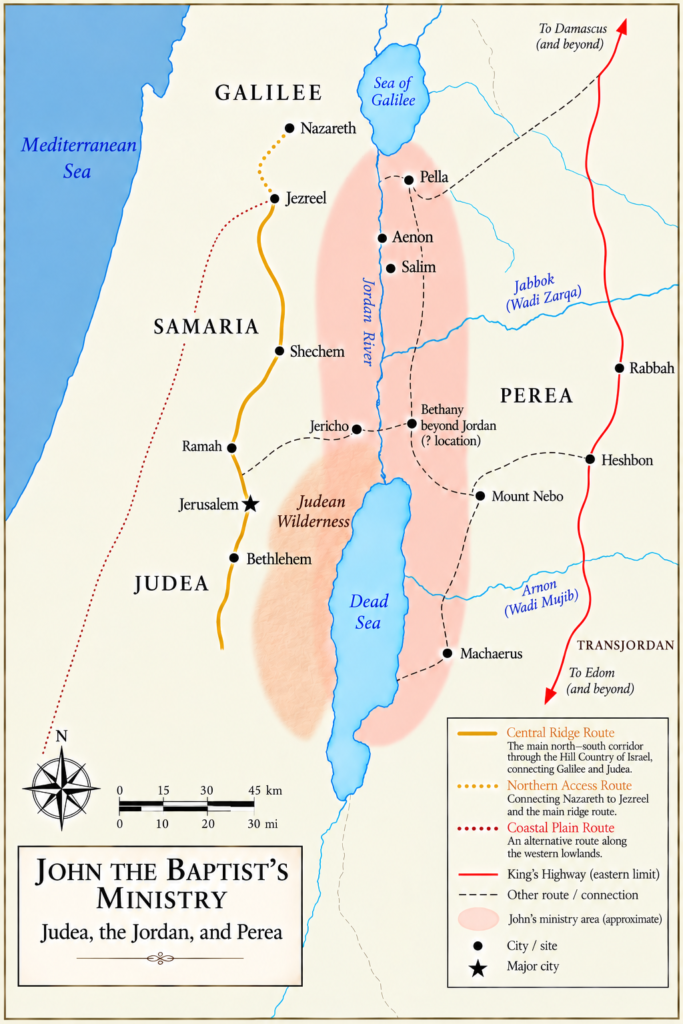
It is logical – in my opinion – to believe that John 1: 29-42 happened immediately after that. Yeshua was in the area that John the Immerser was before He went to the wilderness. He might have popped in to say goodbye to John – but He most assuredly made Himself available so two of John’s disciples could meet with Him – and one to go get his brother.
I can see Luke 4: 14 and John 1: 43 identifying the same trip. As Yeshua traveled through the region, I can see this as where He called Philip, Peter, Andrew, James, John, Nathanael, and Matthew. He may have called the other Apostles during this time, too.
The important aspect of these verses is that Yeshua was regularly teaching in the whole region’s synagogues and was accepted by the populace.
It is also important to remember that Yeshua moved to Capernaum. “He went first to Nazareth, then left there and moved to Capernaum, beside the Sea of Galilee, in the region of Zebulun and Naphtali” (Mt. 4: 13 NLT).
Filled with the Holy Spirit’s Power
The Holy Spirit was with Yeshua as He is with us.
We’ve read about the Holy Spirit in the same sentence as Yeshua at the beginning of Luke 4 and Matthew 4.
- “Then Jesus was led by the Spirit …” (Mt. 4: 1 NLT).
- “The Spirit then compelled Jesus …” (Mk. 1: 12-13 NLT).
- “Then Jesus, full of the Holy Spirit, returned from the Jordan River. He was led by the Spirit in the wilderness…” (Lk. 4: 1-2 NLT).
Each of the three Gospels noted that the Holy Spirit guided Yeshua. Luke, there as here, said that Yeshua was filled by the Holy Spirit. In this verse, though, Luke said He was filled with the Holy Spirit’s power.
How can that be?
God the Father, God the Son, and God the Holy Spirit make up the Trinity. They are three distinct identities, but They have the same nature.
That means that the Holy Spirit isn’t an external spiritual power that Yeshua needed to acquire to become divine or to accomplish divine tasks.
But Yeshua now had a humanity that was genuine. Because of that, the Holy Spirit was active in His life just as He had been active in the lives of Jehovah’s people all through the Old Testament.
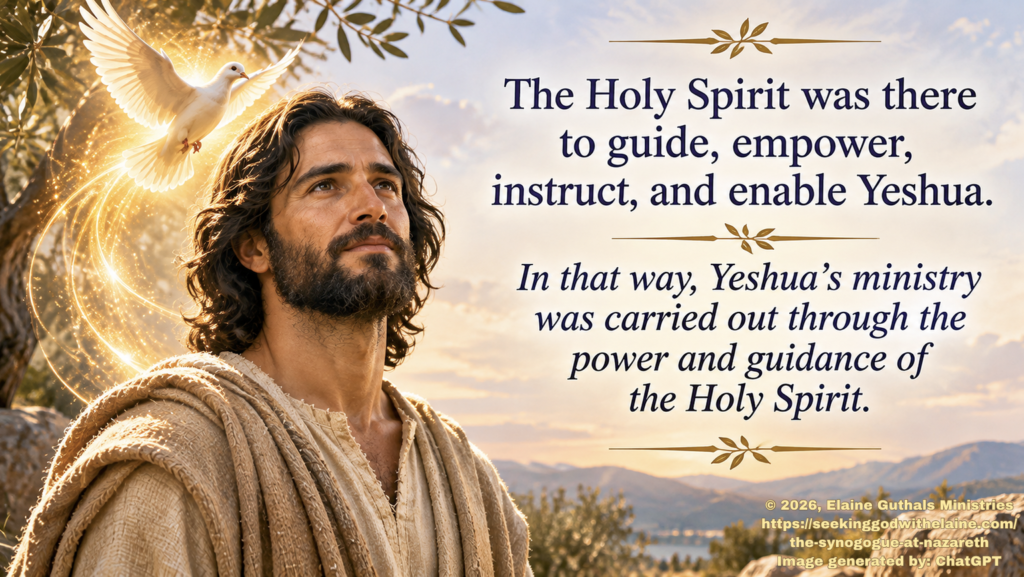
The Holy Spirit was there to guide, empower, instruct, and enable Yeshua. In that way, Yeshua’s ministry was carried out through the power and guidance of the Holy Spirit.
Think about it. Bear with me as I process this.
We say that Yeshua has experienced all the things we do (Heb. 4: 15). The exact circumstances may be different, but He went through things where He had to choose to remain obedient to Jehovah.
Wouldn’t one of the most important things for Yeshua to experience in the human way is how to rely on a Holy Spirit we don’t see? So, it isn’t, “Oh, but Yeshua was divine. He can’t sin.”
It was, “Yeshua was not in direct ‘physical’ contact with Jehovah, but He was filled with the Holy Spirit just as we are. He could rely on the guidance and encouragement the Holy Spirit offers us.”
Yeshua experienced the leading and empowerment of the same Holy Spirit Who now dwells in us. His relationship with the Spirit was unique because of His divine identity, but His human dependence upon the Spirit was real.
In Nazareth
“When he came to the village of Nazareth, his boyhood home, he went as usual to the synagogue on the Sabbath and stood up to read the Scriptures” (Lk. 4: 16 NLT)
Nazareth
In His travels, Yeshua returned to His hometown to share His message with those who knew Him best.
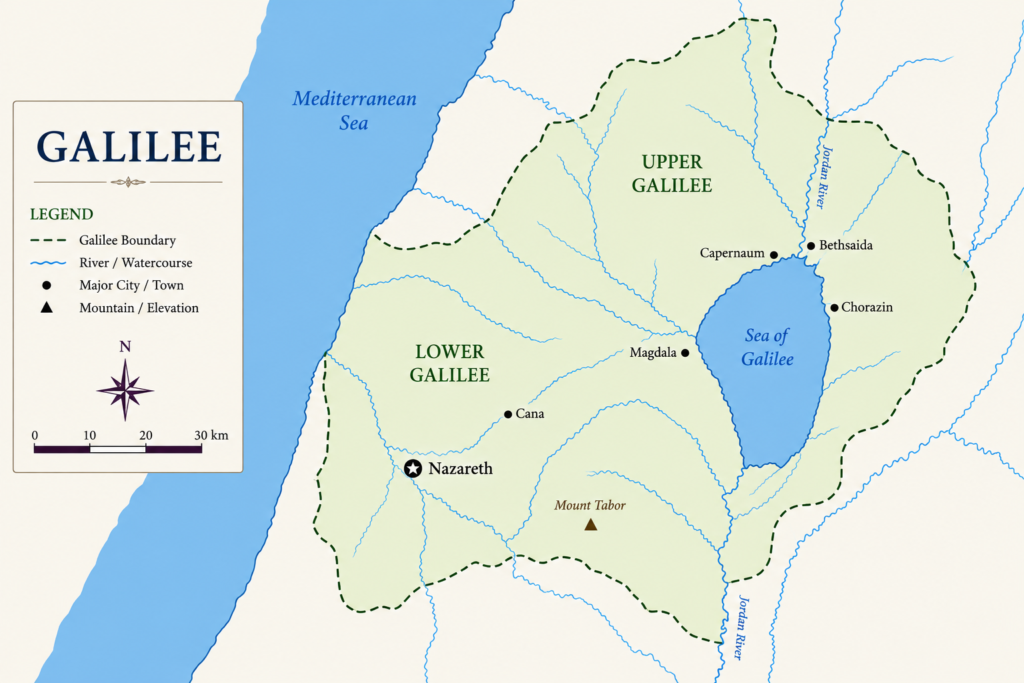
.Nazareth might have been an obscure, isolated village. Its people, however, were faithful followers of Jehovah.
Archaeology, verified by excavations, indicates a modest village that was Torah-observant but poor. Archaeologists have found simple stone homes, many which are at least partly cave based.
The Synagogue
Synagogues could be found throughout Jewish communities in Judea, Galilee, and the Diaspora in the first century.
The synagogue, as noted by the use of the Greek word synagōgē (συναγωγή), was a gathering place or an assembly. While it could refer to the assembled community, it increasingly began to describe the building in which the community met.
The building itself could have been used as a community institution in the first century. Usage included a place where the community conducted business, addressed disputes, organized charitable activities, and maintained its collective identity. It was a place where people encountered one another regularly, learned the Torah, discussed community matters, and maintained their shared identity.
The synagogue provided the social, political, and religious context essential to understanding the early development of Judaism and Christianity. Runesson expressed that scholars have reexamined known sources, paired with finds from archaeological discoveries, to give up the belief that synagogues started during the Babylonian exile as a replacement for the Temple.
Resource
First-century Jews did not see the synagogue as a replacement for the Jerusalem Temple. They acknowledged the different functions of each.

We aren’t really sure why synagogues were formed. An inscription on one, called the Theodotos inscription, had given the reasons as a place to read the Law, teach the commandments, and provide accommodations for visitors from abroad.
Synagogue attendance was part of the regular religious life of Jewish communities. It provided the social, political, and religious context essential to understanding the early development of Judaism and Christianity.
Synagogues didn’t have a set architectural plan. Still, they had similar characteristics:
- Rectangular assembly halls
- Stone benches along interior walls
- Columns supporting the roof
- An open central gathering area
- Entrances and windows providing natural light
- Space for communal meetings and instruction
Public Scripture reading was followed by explanation or teaching. It hasn’t been established that there was a fixed Torah reading cycle as there is now.
The rabbinical institutional authority wasn’t as fully established as in later times. Synagogue leadership included (with various titles):
- a synagogue ruler who served as its administrator
- elders
- an attendant from whom the reader received the scrolls
- a scribe
- a teacher who had recognized knowledge of Scripture
The sequence here is important. Yeshua went – as usual – to the synagogue on Sabbath. He stood to read. We aren’t told if He was asked to read the Scripture or if He just volunteered.
Making the Connections
Let’s go back to the discussion of Yeshua being filled with the Holy Spirit and what that means through the lens of Philippians 2: 6-8.
“Though he was God, he did not think of equality with God as something to cling to. Instead, he gave up his divine privileges; he took the humble position of a slave and was born as a human being. When he appeared in human form, he humbled himself in obedience to God and died a criminal’s death on a cross” (Phil. 2: 6-8 NLT).
We said that Yeshua has experienced all the things we do (Heb. 4: 15). We tend to discount that at times by throwing in His divine nature. Yes, He knew things we don’t and did things we can’t.
But Yeshua “… gave up his divine privileges …” (Phil. 2: 7 NLT). What does that mean?
We don’t know for sure. It is something for the UNR book – understanding not required.
However we attempt to assign specific privileges to that passage, we can’t say that Yeshua exercised unrestricted access to all knowledge during His earthly ministry. We know that He doesn’t know the timing of Judgment Day (Mk. 13: 32).
Yeshua was fully divine, but He had taken on a genuinely human nature. He was:
- led by the Spirit (Luke 4:1).
- returned in the power of the Spirit (Luke 4:14).
- declared that the Spirit had anointed Him for His ministry (Luke 4:18).
What I read into that is Yeshua didn’t have a script to follow. Jehovah always knew what was going to happen and the choices that Yeshua would make.
That was one of those things that the Father knew but the Son didn’t. So, Yeshua had to pray, seek the Father, follow the Spirit’s leading, and submit to the Father’s Will.
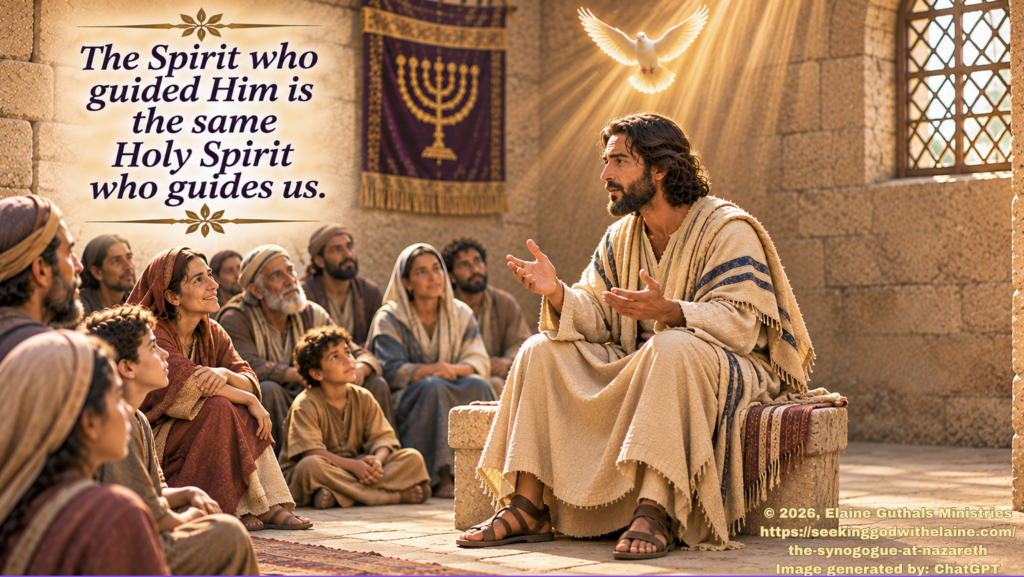
Yeshua’s obedience was genuine. The Spirit who guided Him is the same Holy Spirit who guides us.
Heart Check
Think about the battle Yeshua is engaged in for your heart. Ask yourself the following questions.
- When I face a decision, do I rely on the Holy Spirit’s guidance or depend primarily on my own understanding?
- When I don’t know what lies ahead, do I pray, seek the Father’s direction, and follow the Spirit’s leading, or do I try to work everything out on my own?
- Do I recognize the Holy Spirit as actively involved in my daily life, or do I think of Him mainly when I need something extraordinary?
How Do We Apply This?
- Recognize our dependence upon the Holy Spirit.
- Seek the Father’s direction through prayer.
- Follow the Spirit’s leading rather than relying solely on our own understanding.
- Make obedience an active choice.
- Trust the Holy Spirit to guide, empower, instruct, and enable us.
- Remember that the same Holy Spirit who guided Yeshua guides us.
Father God. You come to us with salvation You bring us to our local church so that we can learn of You. Help us, Lord, to hear the Holy Spirit and rely on Him.
If you don’t understand something and would like further clarification, please contact me.
If you have not signed up for the email providing the link to the devotions and the newsletter, do so below.
If God has used this devotion to speak with you, consider sharing it on social media.