When in Nazareth, Jesus read a passage from the Old Testament. This devotional reading looks at that passage, comparing it with what He read.
Nuggets
- Regardless of whether Yeshua had been handed the Scroll of Isaiah because it was the prescribed reading or if He requested it, the passage contained covenant promises.
- The Spirit of the Lord is on the speaker for a particular reason.
Jehovah anoints those He is separating out for a specific mission. - We’ve spent a lot of ink talking about who the speaker was, but of whom did He speak?
- The first people group to whom the anointed one was sent was the poor and afflicted.
- The second people group to which the anointed one was sent was the brokenhearted.
- The third people group described by Isaiah were the captives.
- The fourth people group Isaiah talked about was the prisoners.
- Isaiah included people who mourned over the devastation of Zion.
- We patiently wait for Jehovah to work on His timetable.
- Jehovah is a God of Love and a God of Vengeance.
In the last devotion, we left Yeshua ready to teach in the Nazareth synagogue. We aren’t told if He was asked to read the Scripture or if He just volunteered.
But it was an important passage. Yeshua was fixing to show those He grew up with Who He really is.
Let’s Put It into Context
To read devotions in The Battle for the Heart theme
Devotions in the The Early Ministry of the Messiah series
Isaiah
“The scroll of Isaiah the prophet was handed to him …’” (Lk. 4: 17 NLT)
Regardless of whether Yeshua had been handed the Scroll of Isaiah because it was the prescribed reading or if He requested it, the passage contained covenant promises.
Isaiah was a prophet back in the eighth century BC. His ministry spanned the reigns of several kings of Judah. They were Uzziah, Jotham, Ahaz, and Hezekiah.
The 66-chapter Book of Isaiah is divided into three sections. The passage that Yeshua read falls into the third section (Isaiah 56-66). This describes the era of the return from Babylonian exile and their struggles as a restored community.
Many felt still in exile even in their homeland. This was because, though they were back and the Temple rebuilt, the Davidic monarchy had ended and many who had been exiled remained in Babylon.
The Jewish people faced economic hardship, political subordination, social injustice, spiritual disillusionment, and the absence of their Davidic king.
Where was the restoration that Isaiah had promised in Isaiah 40-55? That restoration looked like comfort, redemption, and the return of the exiles.
The fulfillment of those promises, they found, was not an instantaneous event. Yes, the Temple was rebuilt, but it wasn’t Solomon’s Temple. Most importantly, Jehovah’s presence hadn’t returned to it upon completion.
Jerusalem wasn’t the same. They were still under foreign imperial authority so there was no Davidic king.
Both the eighth-century Jews and the first-century Jews would have heard the covenant promises throughout. What were those covenant promises?
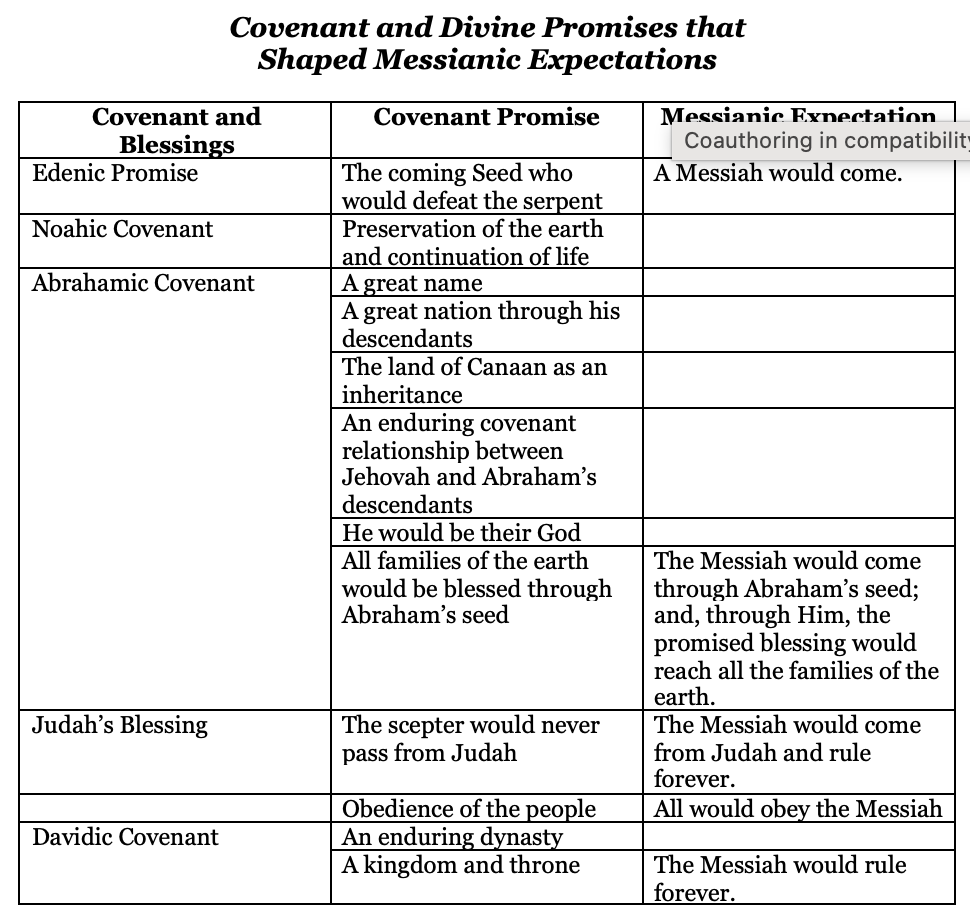
That is why this passage was so important at that time from this Man.
Isaiah Talked about Yeshua
“… He unrolled the scroll and found the place where this was written: ‘The Spirit of the Lord is upon me, for he has anointed me to bring Good News to the poor. He has sent me to proclaim that captives will be released, that the blind will see, that the oppressed will be set free, and that the time of the Lord’s favor has come’” (Lk. 4: 17-19 NLT)
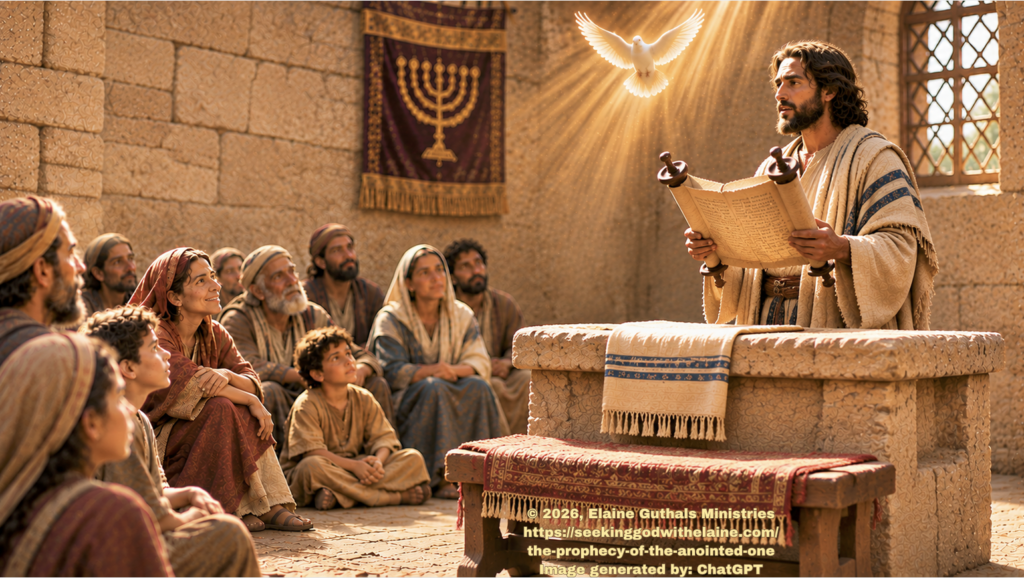
“The Spirit of the Sovereign Lord is upon me, for the Lord has anointed me …” (Isa. 61: 1-2 NLT)
The Spirit of the Sovereign Lord
The Spirit of the Lord is on the speaker for a particular reason.
The passage begins with authority, In Hebrew, it is Rûaḥ Adonai YHWH ʿālây (רוּחַ אֲדֹנָי יְהוִה עָלָי).
Rûaḥ (רוּחַ) means spirit, breath, or wind. It is how the Holy Spirit is described. He empowered and equipped the speaker for his assignment.
This empowerment is identified as coming from Adonai YHWH. Adonai is His title LORD. YHWH is His name – Jehovah.
When it says that the Spirit of the Lord is on the speaker, it doesn’t mean that Jehovah transferred His authority to the speaker. It means that Jehovah had given Isaiah the authority to speak for Him.
Who was the speaker? We aren’t told in Isaiah 61: 1. The last time we had anyone other than Jehovah saying something in Isaiah, it was Isaiah 56: 1. “This is what the Lord says: …” (Isa. 56: 1 NLT). We assume that is Isaiah talking.
We would be wrong. It is still Jehovah Himself. At least, that is what it says in verse 8. “For I, the LORD, love justice …” (Isa. 61: 8 NLT).
That is an important distinction. Isaiah wasn’t saying his own words. He had been given them by Sovereign God. Jehovah Himself knew the importance of these words, so He gave them to Isaiah through the Holy Spirit.
The Lord Has Anointed Me
Jehovah anoints those He is separating out for a specific mission.
Being anointed is an important concept. Anointing (māshaḥ — מָשַׁח) talked about setting someone apart for a particular responsibility. But here is the important part.
Having the responsibility and completing is under Jehovah’s authority.
Kings and priests were anointed. The language appears here in connection with Jehovah’s appointed servant.
So, where are we at? Isaiah was:
- Anointed by Jehovah.
- Empowered by His Spirit.
- Sent to accomplish a particular mission.
Isaiah Talked about the Mission
“… to bring good news to the poor. He has sent me to comfort the brokenhearted and to proclaim that captives will be released and prisoners will be freed. He has sent me to tell those who mourn that the time of the Lord’s favor has come, and with it, the day of God’s anger against their enemies” (Isa. 61: 1-2 NLT)
We’ve spent a lot of ink talking about who the speaker was, but of whom did He speak?
Isaiah identified several groups of people
Bring Good News to the Poor
The first people group to whom the anointed one was sent was the poor and afflicted.
The Hebrew says that the anointed one was sent Lebaśśēr ʿanāwîm (לְבַשֵּׂר עֲנָוִים). That means to bring good news to the afflicted.
The Hebrew concept is related to being humbled, afflicted, oppressed, or brought low. It can mean economically disadvantaged, but it is not limited to money.
Remember who Isaiah’s audience was. They were Jews who had just returned from exile. We know the Temple was destroyed, so homes would also have been destroyed.
It may have taken a while to get the economy restarted. People were out of jobs. In fact, some were returning to a place they had never lived before.
They had become humbled people.
It was this verse that Yeshua may have used as the foundation for His first Beatitude. “God blesses those who are poor and realize their need for him, for the Kingdom of Heaven is theirs” (Mt. 5: 3 NLT).
Isaiah’s audience were both humbled by material suffering and spiritual suffering.
Comfort the Brokenhearted
The second people group to which the anointed one was sent was the brokenhearted.
The Hebrew word Isaiah used was nishberê-lēb (נִשְׁבְּרֵי־לֵב). The nishberê part means broken, shattered, or crushed. The lēb (לֵב) part is the center of a person’s inner life – what we call the heart. It is associated with thought, understanding, will, intention, and emotion.
So, to the eighth-century Jew, they wouldn’t have heard an emotion, such as feeling sad. To them, it would mean that a person had his/her inner life crushed.
How would you feel if you were forced to leave your home – your city – in flames. Their security and national identity was gone. More importantly, they couldn’t turn to receive comfort from their worship because the Temple was gone.
They could still turn to their Father God. His presence might not have been there, but He still was.
That same Father was promising to bind their wounds. The Hebrew word used here was ḥābaš (חָבַשׁ), meaning to bind up or bandage.
Jehovah didn’t say, “Get well soon.” He said, “Here, let me bind that.”
Proclaim that Captives Will be Released
The third people group described by Isaiah were the captives.
This message would have hit home with eighth-century Jews. They had been captives — shevuyim (שְׁבוּיִם) — of the Babylonians.
They were pulled from their homes and march hundreds of miles away. They were forced to serve masters.
Then Isaiah talked derôr (דְּרוֹר) – freedom, liberty, or release. They would have tied this with Jubilee. “Then on the Day of Atonement in the fiftieth year, blow the ram’s horn loud and long throughout the land. Set this year apart as holy, a time to proclaim freedom throughout the land for all who live there. It will be a jubilee year for you, when each of you may return to the land that belonged to your ancestors and return to your own clan” (Lev. 25: 9-10 NLT).
But it was more than release of the land. “If one of your fellow Israelites falls into poverty and is forced to sell himself to you, do not treat him as a slave. Treat him instead as a hired worker or as a temporary resident who lives with you, and he will serve you only until the Year of Jubilee. At that time he and his children will no longer be obligated to you, and they will return to their clans and go back to the land originally allotted to their ancestors” (Lev. 25: 39-41 NLT).
One of the purposes of Jubilee was to recover that which was lost. It is this terminology that Isaiah used.
Prisoners Will be Freed
The fourth people group Isaiah talked about was the prisoners.
Some of us might be scratching our heads about the difference between prisoners and captives. The Hebrew words used are different.
Here, Isaiah used welaʾasûrîm peqaḥ-qôaḥ (וְלַאֲסוּרִים פְּקַח־קוֹחַ). This refers to those who are bound or imprisoned and the opening or release associated with their deliverance.
Tell Those Who Mourn
Isaiah included people who mourned over the devastation of Zion.
This is logical, especially those exiles who were returning to Jerusalem. They would not only have mourned what had been, but they would also be mourning what was lost.
The Hebrew word used was ʾAbēlîm (אֲבֵלִים). It means mourning or grieving.
We should get tripped up over the sudden appearance of the term Zion. Instead of a geographic location, it represents the covenant community and the center of Israel’s national and religious identity.
The Time of the Lord’s Favor Has Come
We patiently wait for Jehovah to work on His timetable.
We’ve talked before about the fullness of God’s time. Things happen in His time according to His plan.
It may be centuries before Jehovah’s plan comes to fruition. But it never occurs early, and it never happens late.
That was what happened with Yesha coming to earth. The time had arrived.
But it was more than just the launch of Jehovah’s plan. It was a proclamation of His favor. The Hebrew said Liqrōʾ shenat-rāṣôn laYHWH (לִקְרֹא שְׁנַת־רָצוֹן לַיהוָה) — to proclaim the year of Jehovah’s favor.
We can’t look at Jubilee, the time of great restoration, as merely the year of relief. It was to be the year of restoration.
The Day of God’s Anger against Their Enemies
Jehovah is a God of Love and a God of Vengeance.
When we look at Isaiah 61, we see something very interesting. Luke doesn’t record Yeshua reading the whole two verses. (Take a look at the connections in a minute to see all the differences – and issues).
We don’t know what exactly Yeshua read. The first problem is that Luke wrote, “… He unrolled the scroll and found the place where this was written” (Lk. 4: 17 NLT). What comes next isn’t exactly Isaiah 61: 1-2.
Luke left out the “… and with it, the day of God’s anger against their enemies” (Isa. 61: 2 NLT). The Hebrew says weyôm nāqām lēʾlōhênû (וְיוֹם נָקָם לֵאלֹהֵינוּ) — and the day of vengeance of our God.
It is talking about vengeance or retribution.
What is Jehovah’s vengeance? It isn’t uncontrolled anger. It isn’t vindictiveness.
Jehovah’s response is a righteous response. He will always act out of righteousness. He responds righteously to evil and oppression.
Most of all, this is an act of divine justice.
But look at the contrast. It is a year of Jehovah’s favor opposed to a day of vengeance. His day of vengeance isn’t going to last long.
Why didn’t Yeshua read – if He didn’t read about – the day of vengeance.
That was one of the Messianic expectations. Messiah would come and smite all of Israel’s enemies. The enemies would be put in their place and Jehovah’s vengeance would reign.
In my opinion, Yeshua was trying to get everyone to focus on His real mission. It wasn’t merely about covenant restoration. It was about sin restoration.
Yeshua wasn’t saying that the day of vengeance wouldn’t come. He was allowing people to respond to the call of repentance.
Making the Connections #1
Wait! What????
Did Luke skip part of it, or was it Yeshua that left it out?
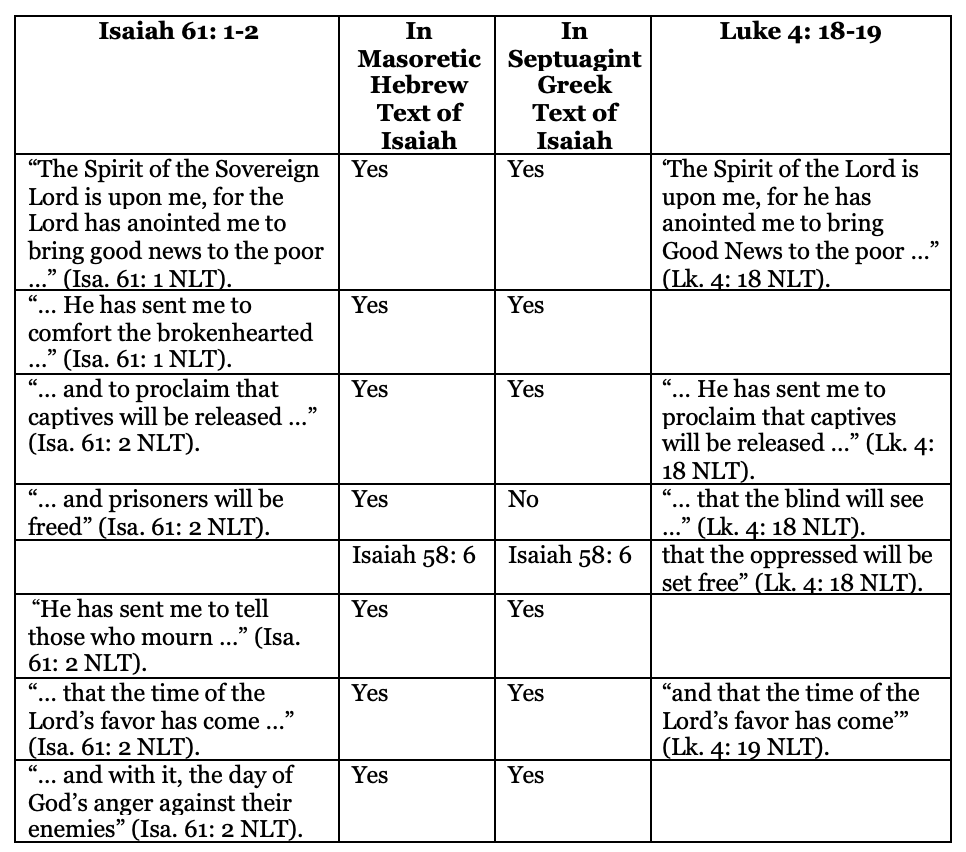
The answer may be neither.
The Hebrew Isaiah 61:1 does NOT say recovery of sight to the blind. The Masoretic Hebrew text speaks of release or opening for those who are bound.
The Septuagint, the ancient Greek translation of the Hebrew Scriptures, renders this expression differently, using language about recovery of sight to the blind. Luke’s wording reflects that Greek textual tradition.
Heart Check
Think about the battle Yeshua is engaged in for your heart. Ask yourself the following questions.
- When I face hardship, do I look for Jehovah’s faithfulness or become discouraged by what I cannot see?
- When my heart is broken, do I turn to Jehovah for comfort or try to carry the hurt alone?
- Do I understand the freedom Jehovah offers as more than relief from difficult circumstances, or do I focus only on what I have lost?
- Am I willing to wait for Jehovah’s timing, or do I become impatient when His promises aren’t fulfilled as quickly as I expect?
- Do I recognize both Jehovah’s favor and His justice, or do I tend to emphasize one while overlooking the other?
How Do We Apply This?
- Remember that Jehovah sees our afflictions, even when others do not.
- Turn to Jehovah when our hearts are broken rather than carrying our burdens alone.
- Look beyond our immediate circumstances to the restoration Jehovah promises.
- Trust Jehovah’s timing instead of measuring His faithfulness by our schedules.
- Remember that Jehovah’s favor and His justice are both expressions of His character.
- Look for opportunities to bring comfort and encouragement to those who are hurting.
Father God. You told us centuries ago what would happen. It took centuries for the Plan to come to fruition. But it is still relevant in this century. And centuries after Yeshua fulfilled this prophecy, He will come again to take us home to You. Amen.
If you don’t understand something and would like further clarification, please contact me.
If you have not signed up for the email providing the link to the devotions and the newsletter, do so below.
If God has used this devotion to speak with you, consider sharing it on social media.