Jesus had just read the Isaiah 61 passage at the Nazareth synagogue. This devotional reading looks at His teaching that followed the reading.
Nuggets
- After reading Isaiah 61: 1-2, Yeshua taught the people of its fulfillment.
- Yeshua was just starting the teaching portion of the synagogue service, taking what He had read and applying it.
- Yeshua’s posture wasn’t as important as the message itself.
- At first, it seemed Yeshua’s message was accepted.
- The congregation marveled at Yeshua’s wisdom.
- The congregation thought they knew Who Yeshua was.
In the last devotion, we left Yeshua ready to teach in the Nazareth synagogue. We aren’t told if He was asked to read the Scripture or if He just volunteered.
But it was an important passage. Yeshua was fixing to show those He grew up with Who He really is.
Let’s Put It into Context
To read devotions in The Battle for the Heart theme
Devotions in the The Early Ministry of the Messiah series
Yeshua Began Teaching
“He rolled up the scroll, handed it back to the attendant, and sat down. All eyes in the synagogue looked at him intently. Then he began to speak to them. ‘The Scripture you’ve just heard has been fulfilled this very day!’ Everyone spoke well of him and was amazed by the gracious words that came from his lips. ‘How can this be?’ they asked. ‘Isn’t this Joseph’s son?’” (Lk. 4: 20-22 NLT)
After reading Isaiah 61: 1-2, Yeshua taught the people of its fulfillment.
We didn’t discuss in the last devotion Yeshua’s standing up to read the scroll. It was more than merely honoring the reading of God’s Word.
It wasn’t a practice that started in Yeshua’s day. The reader – as well as the people – stood. We see an earlier example in Nehemiah 8: 5. “Ezra stood on the platform in full view of all the people. When they saw him open the book, they all rose to their feet” (Neh. 8: 5 NLT).
Think about what is happening in Nehemiah 8. They had returned from the Babylonian exile and were rebuilding their lives in the land. The wall around Jerusalem had just been completed, and the people were beginning to reestablish their community.
They may not have felt that their Babylonian exile was over, but at least they physically and geographically were home. In their minds, how could the exile be over when they were still under foreign occupation? Governor Nehemiah had called for an account of who had returned before they dispersed to their homes throughout Israel.
Everyone came back (Neh. 8: 1) for a very important purpose. “… They asked Ezra the scribe to bring out the Book of the Law of Moses, which the Lord had given for Israel to obey” (Neh. 8: 1 NLT).
The priest Ezra was up on a platform — specifically made for this occasion. But ……
It really doesn’t give us their position when the scroll was actually read. “… When they saw him open the book, they all rose to their feet. Then Ezra praised the Lord, the great God, and all the people chanted, “Amen! Amen!” as they lifted their hands. Then they bowed down and worshiped the Lord with their faces to the ground” (Neh. 8: 5-6 NLT).
To me, the most important position was in verse 9. “Then Nehemiah the governor, Ezra the priest and scribe, and the Levites who were interpreting for the people said to them, ‘Don’t mourn or weep on such a day as this! For today is a sacred day before the Lord your God.’ For the people had all been weeping as they listened to the words of the Law” (Neh. 8: 9 NLT).
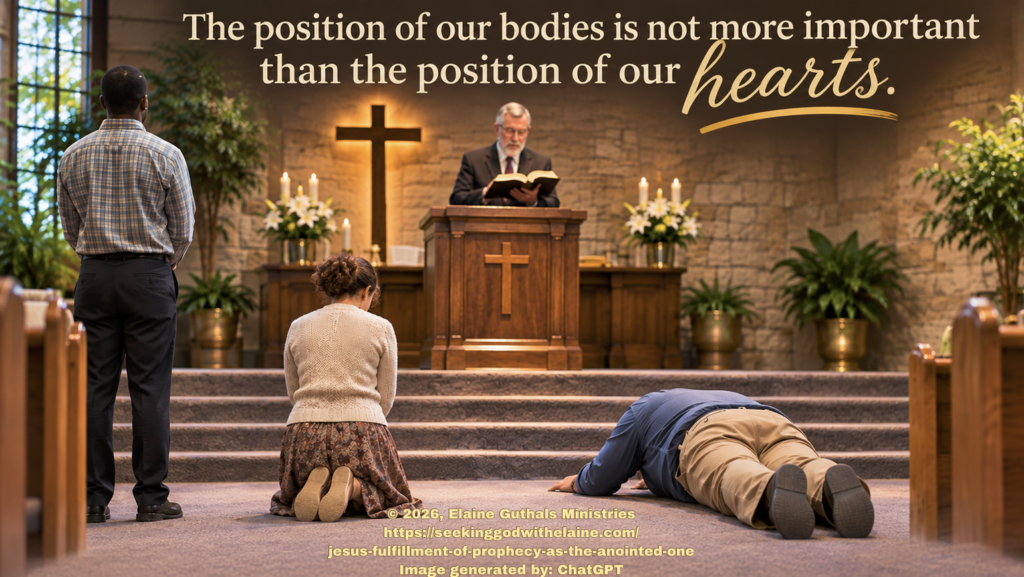
The position of our bodies is not more important than the position of our hearts. Our hearts must be surrendered to Jehovah and His Word. Our hearts must acknowledge His authority.
What was the sitting part? It established a posture of instruction. He was now interpreting what the Scripture meant.
But then the worshipers in the Nazareth synagogue would have seen sitting as a position of authority, too. “The scribes and the Pharisees sit on Moses’ seat, so do and observe whatever they tell you, but not the works they do …” (Mt. 23: 2-3 ESV).
The scribes and Pharisees claimed authority as interpreters of Moses’ Law, but Yeshua declared that the Scripture He had just read was being fulfilled in Him.
He wasn’t merely interpreting someone else’s message. He was announcing the arrival of the One about whom Isaiah had written.
Long story short, we should respect the messenger but honor the Message itself.
The Scripture You’ve Just Heard
Yeshua was just starting the teaching portion of the synagogue service, taking what He had read and applying it.
Since we believe Luke wrote in Greek, the final words were en tois ōsin hymōn (ἐν τοῖς ὠσὶν ὑμῶν) – literally, in your ears.
Of course, I would say, “You heard it for yourselves.”
But think about it. They heard the words read by the One about Whom the passage prophesied.
They didn’t hear this second hand. They were right there as the fulfillment unfolded.
Yeshua would later tell Thomas, “… Blessed are those who have not seen and yet have believed” (Jn. 20: 29 NLT). Yes, we have the opportunity to listen to His words and accept Him as our Savior and Lord.
They had the same opportunity because they were right there.
Scripture Has Been Fulfilled
Yeshua’s posture wasn’t as important as the message itself.
Notice Yeshua didn’t say, “Scripture will be fulfilled.” He said, “It has been fulfilled this day.”
The Greek read, Σήμερον πεπλήρωται ἡ γραφὴ αὕτη ἐν τοῖς ὠσὶν ὑμῶν – Today this Scripture has been fulfilled in your hearing. The has been fulfilled part is translated from the verb peplērōtai (πεπλήρωται). That comes from plēroō — to fill, make full, complete, or bring to fulfillment.
This is important. Scripture had been fulfilled with Yeshua’s birth, but it was still being fulfilled because the Plan of Salvation hadn’t been completed yet.
That puts a lot of work on the word today – sēmeron (Σήμερον). Luke repeatedly uses that word. Some of us may ask why there can be so many important todays.
- “The Savior — yes, the Messiah, the Lord — has been born today in Bethlehem, the city of David!” (Lk. 2: 11 NLT).
- “Jesus responded, ‘Salvation has come to this home today, for this man has shown himself to be a true son of Abraham’” (Lk. 19: 9 NLT).
- “And Jesus replied, ‘I assure you, today you will be with me in paradise’” (Lk. 23: 43 NLT).
Think about it. In every one of those passages the arrival of Jehovah’s promised salvation occurred in the events taking place. The common denominator was Yeshua.
Put that into context. We believe this occurred early on in Yeshua’s ministry. He wasn’t saying some distant occurrence.
Yeshua said that Jehovah’s promised work was occurring right then. They were in the midst of it.
Nope, much to the first-century Jew’s disappointment, it wasn’t a total fulfillment in the blink of an eye. As we said, Yeshua’s ministry was just starting.
We talked in the last devotion what was being fulfilled. Isaiah told us.
- Bring good news to the poor.
- Proclaim release to captives.
- Proclaim recovery of sight to the blind.
- Set the oppressed free.
- Proclaim the year of the Lord’s favor.
Yeshua plainly stated that He was the fulfillment of that promise.
- The Spirit of the Lord is upon Me (Lk. 4: 18; Isa. 61:1)
- He has anointed Me (Lk. 4: 18; Isa. 61:1)
- He has sent Me (Lk. 4: 18; Isa. 61:1)
- I am to proclaim and accomplish the work described (Lk. 4: 19; Isa. 61:2)
Why is this so important? This is talking about Jehovah’s promised restoration of Israel.
Think about it. The One Who came for the purpose of restoration came with good news – healing, release, comfort, and restoration.
That is what the people were expecting – but it was coming in a way they didn’t expect. Yeshua challenged what that restoration would be.
Yeshua was announcing a Kingdom whose restoration began with the work of Jehovah in the lives of people.
It didn’t mean that the physical and national promises of Scripture had become meaningless. It meant that the Messiah’s mission was considerably larger than many anticipated.
Message Met with Astonishment
“When Jesus had finished telling these stories and illustrations, he left that part of the country. He returned to Nazareth, his hometown. When he taught there in the synagogue, everyone was amazed and said, ‘Where does he get this wisdom and the power to do miracles?’ Then they scoffed, ‘He’s just the carpenter’s son, and we know Mary, his mother, and his brothers — James, Joseph, Simon, and Judas. All his sisters live right here among us. Where did he learn all these things?’ And they were deeply offended and refused to believe in him. Then Jesus told them, ‘A prophet is honored everywhere except in his own hometown and among his own family’” (Mt. 13: 53-57 NLT)
“Jesus left that part of the country and returned with his disciples to Nazareth, his hometown. The next Sabbath he began teaching in the synagogue, and many who heard him were amazed. They asked, ‘Where did he get all this wisdom and the power to perform such miracles?’ Then they scoffed, ‘He’s just a carpenter, the son of Mary and the brother of James, Joseph, Judas, and Simon. And his sisters live right here among us.’ They were deeply offended and refused to believe in him. Then Jesus told them, ‘A prophet is honored everywhere except in his own hometown and among his relatives and his own family’” (Mk. 6: 1-4 NLT)
Everyone Spoke Well of Him and Was Amazed
At first, it seemed Yeshua’s message was accepted.
That’s the trouble when you are speaking in front of the hometown audience. Memories are long – especially on things that you want them to forget because it embarrasses you.
At first, the audience was amazed. They had probably never heard anyone talk with this much authority.
But also, they were probably amazed because many first-century Jews were really looking forward to the Messiah coming. They may have been looking around, saying, “Okay. So, where is he?”
Where Did He Get This Wisdom and These Works
The congregation marveled at Yeshua’s wisdom.
So, the congregation had a somewhat legitimate question – one that Yeshua was frequently asked. How did He know what He knew?
John 7: 15-17 helps us understand. “The people were surprised when they heard him. ‘How does he know so much when he hasn’t been trained?’ they asked. So Jesus told them, ‘My message is not my own; it comes from God who sent me. Anyone who wants to do the will of God will know whether my teaching is from God or is merely my own” (Jn. 7: 15-17 NLT).
Is not This?
The congregation thought they knew Who Yeshua was.
Was Yeshua Joseph’s son? Well, yes and no.
Yeshua was Joseph’s son in everything but blood. Joseph knew what he was taking on from the get-go. He raised Him as his own knowing He was Someone else’s.
Isn’t it sad sometimes that familiarity breeds unbelief?
This is one of the few places in Scripture that we hear that Yeshua had siblings. His brothers’ names are listed, but his sisters’ names – plural – are not.
Making the Connections
Let’s think about all that has already occurred in this series of devotions.
- Yeshua was baptized (Lk. 3: 21)
- The Holy Spirit descended upon Him (Lk. 3: 22)
- He entered public ministry in the power of the Spirit (Lk. 4: 14).
We’ve called this Yeshua’s job description before. This was what His ministry was all about.
We may not know who the anointed person was in Isaiah’s day – but we know there was one. We know about Whom the passages ultimately identified – Yeshua.
No, Isaiah didn’t call Yeshua by name. By Yeshua’s time, however, the Isaiah passage was being understood in connection with Messianic expectations.
Heart Check
Think about the battle Yeshua is engaged in for your heart. Ask yourself the following questions.
- Am I honoring the Message, or am I placing too much emphasis on the messenger?
- Am I listening to what Yeshua says, or am I relying on what I think I already know?
- Am I recognizing Jehovah’s work, or am I expecting Him to work according to my understanding?
- Am I seeking the source of Yeshua’s wisdom, or am I questioning His authority because He doesn’t fit my expectations?
- Am I accepting Yeshua as the fulfillment of Jehovah’s promises, or am I limiting His mission to what I expect Him to accomplish?
- Am I allowing familiarity with Scripture to deepen my faith, or has it made me less receptive to what Jehovah is teaching me?
- Am I willing to believe what Yeshua says, or do I require the kind of evidence I want before I will believe?
How Do We Apply This?
- Honor the Message above the messenger.
- Examine our hearts for assumptions that interfere with our understanding of Scripture.
- Recognize Jehovah’s work even when it doesn’t fit our expectations.
- Seek to understand the source and authority of Yeshua’s teaching.
- Allow Scripture to shape our expectations rather than allowing our expectations to shape Scripture.
- Guard against allowing familiarity with God’s Word to become complacency.
- Accept Yeshua for Who He is, not merely for what we expect Him to do.
Father God. Thank You for those who can help us know what Your Word really means. Thank You for showing us when a prophecy has been fulfilled. Help us to look to You and away from our expectations. Amen.
If you don’t understand something and would like further clarification, please contact me.
If you have not signed up for the email providing the link to the devotions and the newsletter, do so below.
If God has used this devotion to speak with you, consider sharing it on social media.