Blog

  • A Life of Humble Service

    We connect with Christ when we imitate Him. This daily devotional looks at how humbly serving others helps us imitate Jesus.

    Nuggets

    • We serve others humbly, regardless of the menial task and regardless of their station in life.
    • Jesus humbly completed the job to the best of His ability.
    • Jesus humbly came for our salvation.

    Devotions in the Living Life Connected to Christ series

    If you’ve been reading my devotions for a while, you know that I am a Marvel Cinematic Universe fan. I love almost all of them — the Captain America films, the Thor films, the Spider-Man film. I especially love the team-up films like Infinity War and Endgame.

    There is a line in the first Avengers movie about needing heroes to step up to fight the battles that we can’t fight. That is what all these films are about — heroes stepping up to save the world.

    The films are fun to watch. But they are make believe. We don’t have heroes like this.

    There is only one hero that the world needs — Jesus. He is our Savior and Redeemer.

    During this part of the quarter in our Sunday Morning Bible Study, we are going to be looking at the time right before Jesus’ sacrifice on the cross. He and His disciples met in the Upper Room to observe the Passover.

    This is a goldmine of powerful statements that show us how we can live a life that is connected to Christ. We begin our study by looking at how to live a life of service.

    A big part of being a hero is serving others. Sometimes, though, the service is done with the wrong attitude.

    We must serve God and others with humility. Let’s see what Jesus teaches us here.

    Let’s Put It into Context #1

    Here is a running list of nuggets for the series.

    Let’s Put It into Context #2

    Christian humility is our yielding our dependence to Christ to serve Him and others.

    Son of God Doing the Servant’s Job

    “Jesus, knowing that the Father had given all things into his hands, and that he had come from God and was going back to God” (Jn. 13: 3 ESV)

    We serve others humbly, regardless of the menial task and regardless of their station in life.

    Jesus surprised the disciples. Here He was, the Messiah — and He was washing their feet.

    Witherspoon wrote, “Just when Jesus was at the zenith of spiritual exaltation (ver. 3), He bowed Himself to His lowly task.” He didn’t let His position — or theirs — stop Him.

    Resource

    Yep. Here was the superior washing the feet of the inferior. He was doing someone else’s job.

    Not just that. See again what verse 3 says. “Jesus, knowing that the Father had given all things into his hands, and that he had come from God and was going back to God” (Jn. 13: 3 ESV).

    Jesus was the ruler of all things. Remember right before Jesus gave the great commission, He stated this. “And Jesus came and said to them, ‘All authority in heaven and on earth has been given to me’” (Mt. 28: 18 ESV).

    But think about what the feet washing symbolized. That was what Jesus’ whole ministry was about. He valued each person He spoke to.

    Jesus values us today.

    Son of God Doing the Job

    “rose from supper. He laid aside his outer garments, and taking a towel, tied it around his waist. Then he poured water into a basin and began to wash the disciples’ feet and to wipe them with the towel that was wrapped around him.” (Jn. 13: 5-5 ESV)

    Jesus completed the job to the best of His ability.

    Look at the seven distinct actions that Jesus accomplished in these verses.

    1. rose from supper … (Jn. 13: 4 ESV)
    2. … laid aside his outer garments … (Jn. 13: 4 ESV)
    3. … taking a towel … (Jn. 13: 4 ESV)
    4. …. tied it around his waist … (Jn. 13: 4 ESV) 
    5. … poured water into a basin … (Jn. 13: 5 ESV)
    6. … wash the disciples’ feet … (Jn. 13: 5 ESV)
    7. … wipe them with the towel …” (Jn. 13: 5 ESV)

    This wasn’t a hey-this-will-only-take-a-second activity. This one had to be planned out. That is especially true since 6 and 7 were times 12. Every act is meaningful.

    We can’t wait until the middle of a situation and decide, “Oh, I am going to be humble.” It usually doesn’t work that way.

    We get in the middle of something, and our pride kicks into full gear. Why? Witherspoon reminded us that “pride is essentially selfish …”

    Look at it this way. What if Jesus would have said, “I am so humble. I am so humble”?

    But His actions didn’t jive with His words?

    The words wouldn’t mean anything — neither would His actions. Our words and our actions have to mesh.

    In reality, our words should be silent, as Jesus was. He just did what He had planned to do.

    We shouldn’t toot our own horns about how humble we are. We turn into being proud that we are humble.

    The Cleansing Effect of Humility

    Jesus humbly came for our salvation.

    Jesus had one mission on this earth. “For the Son of Man came to seek and to save the lost” (Lk. 19: 10: ESV).

    Because Jesus humbled Himself, left the splendor of Heaven, and came to save sinners from their sins, He accomplished the Plan of Salvation.

    Salvation is the gift of life through the deliverance from condemnation and sin to acceptance and holiness and changes us from being spiritually dead to spiritually alive.

    • Sins are actions by humans that disobey God and break one of His reasonable, holy, and righteous laws and commandments, goes against a purpose He has for us, or follows Satan’s promptings.
      • Holy means to be set apart — because of our devotion to God — to become perfect, and morally pure while possessing all virtues.
        • Perfection means we reach a state of maturity because the combination of the spiritual graces form, when all are present, spiritual wholeness or completeness — holy, sanctified, and righteous.
        • Spiritual graces are worldly morals that have been submitted to God to further His kingdom instead of enhancing this world.
        • Sanctified means to be set free from sin.
        • Pure means not being sinful or having the stain of sin.
          o Righteous means we are free from sin because we are following God’s moral laws.

    The ABCDs of Salvation

    If you have not become a believer in Christ, please read through the
    Plan of Salvation and prayerfully consider what God is asking you to do.

    A – admit our sins
    B – believe His Son Jesus is our Redeemer
    C – confess God as Sovereign Lord

    D – demonstrate that commitment by making any changes needed in our lives to
    live the way in which God has called us

    The Disciple’s Job Description

    Glossary

    Personally, I don’t think we can lose our salvation. Once we are genuinely saved, we are God’s children.

    Glossary

    That being said, navigating the Sanctification Road shows us the sincerity of our salvation experience. We have to be renewed daily.

    Sanctification is the transformation of mind, body, and soul, which begins with regeneration, gradually changes our nature and morals through the promptings of the Holy Spirit, and ends with perfected state of spiritual wholeness or completeness.

    • Regeneration is being changed from spiritually dead to spiritually alive and the internal new birth and requickening that God brings about through the work of the Holy Spirit to give us new character.

    Glossary

    In my opinion, if we don’t surrender ourselves to submit to God, we are not saved. If we go along for the first years of our walk with God and follow the laws and commandments, and then try to rewrite them to fit today’s worldview, we are not saved.

    We know that if we do not change our character to imitate God’s character, we are not saved. Our moral character is the most important aspect of our relationship with God.

    Spurgeon provided us with a list of things these days that can work in this situation.

    a-life-of-humble-serviceFB

    Making the Connections

    Jesus had to go around to every single disciple and wash his feet. He couldn’t lump them all together.

    Peter. Andrew. James. John. And on down the line. Jesus went to each one individually.

    Jesus comes to each of us individually. We all undertake the same salvation process — but we all approach salvation differently.

    Some need to be forgiven for murder. Some need to be forgiven of pride. Some need to be forgiven for lying.

    We all need to be forgiven for being separated from God.

    How Do We Apply This?

    • Minister to those less fortunate than us.
    • Don’t follow the worldview.
    • Remove the chains that the worldview places on us.
    • Keep pride in check.

    Resource

    Pulsford made an interesting observation. He wrote, “There is no such fact as a general relationship to Christ. We are either His personal followers, or personally estranged. There is no religion but personal religion.”

    Resource

    Those thinking they will get lost in a megachurch so nothing hurts, nothing is expected of them, are that — lost.

    Back row Baptists are the same. We can’t just slip in, mumble through a few hymns, maybe say an Amen or two, and think we’ve fulfilled our obligations.

    We are called to a personal relationship with Jesus. In order to do that we have to ABCD.

    Then Pulsford took that a step further. He wrote, “The lost are found one by one. All organization that amounts to anything is association in some form for hand-to-hand work.”

    Resource

    If Jesus comes to us individually for salvation, witnessing is the same — an individualized experience for each of us.

    Disciples need to imitate Jesus and be humble.

    Father God. Thank you for giving us Jesus as an example. May our lives and character imitate Him, because He imitated You. Thank You most of all that You sent Him to be our Savior and Redeemer. Thank You for saving us from our sins. Amen.

    What do you think?

    Leave me a comment below (about this or anything else) or head over to my Facebook group for some interactive discussion.

    If you don’t understand something and would like further clarification, please contact me.

    If you have not signed up for the email daily or weekly providing the link to the devotions and the newsletter, do so below.

    If God has used this devotion to speak with you, consider sharing it on social media.

  • March 2022 Newsletter

    Main Nugget

    Being inward takes the worship out of the cathedral, church, tabernacle, or temple. It puts it in our hearts (Preparing Our Hearts for Worship).

    We are never going to fix the inward us — our hearts — without God.
    InsideNotOutside

    Taking the Worship to Heart

    • Doing acts of kindness is not worshiping God if we are not accepting His authority and always proclaiming it with our lips. We have to submit to Him. The outward expression is not the focus. It is the inward compliance to God’s Will (Preparing Our Hearts for Worship).
    • It isn’t about where we go to praise God. It is more about our motives (Preparing Our Hearts for Worship).
    • The reason for worshiping God is to fix our hearts on Him (Preparing Our Hearts for Worship).
    • It gets easier to focus on worship as we continue to focus on worship. We do that through faith (Preparing Our Hearts for Worship).
    • We need to praise God throughout our lives. We need to worship God completely in our hearts (Preparing Our Hearts for Worship).
    • The Word of Christ has to be in our hearts, as that is where our relationship with God is. That is where our character is, so it can control it (Preparing Our Hearts for Worship).
    • God does not like it when our worship is not sincere. Ritualism leads to a routine worship of God that takes our eyes off Him. It takes what is necessary and pure and makes it a sin. That is just what Satan wants! (We Are to Worship God with Our Hearts)
    • Praising God with all our hearts is based on our attitudes (We Are to Worship God with Our Hearts).
    • Our main purpose of worship has to be to honor God. We do this through being ready, cheerful, and with a passionate intensity. Being ready for worship means we have tune out the things of this world. We are to glorify God in this life and in the next. That has to be our priority. It all comes down to attitude (We Are to Worship God with Our Hearts).
    • God is very specific in His description of how we are to worship Him. We must follow His directions or expect consequences for our actions (We Are to Worship God with Our Hearts).
    • If there is no substitute for loving man, but worship of God requires it, that worship would be offered through prayer (The Prevalence of the Essential of Love in Prayer).
    • Our worship comes from our lips, not our actions, so it is a confession. We have to do more than just say in our minds that we are accepting God’s Plan of Salvation. We have to make an outward confession that we believe. Still, there is more than that. Just believing isn’t enough. We have to confess — we have to talk about it (Belief and Practice).
    • Hebrews 13: 15 says nothing about getting all the laws and commandments right. It says, “… let us continually offer up a sacrifice of praise to God, that is, the fruit of lips that acknowledge his name” (Heb. 13: 15 ESV). We have to acknowledge His name, i.e., His authority. It comes from our lips, not our actions, so it is a confession (Rom. 10: 9). It should never stop (Preparing Our Hearts for Worship).
    • Isn’t preparing ourselves for an eternity of praising God what it’s all about? The only way we can do that is by getting our relationship cemented in him. This can’t be a once–a–week occurrence. It has to be continual (Preparing Our Hearts for Worship).

    Glossary

    We are always supposed to be prepared for worship because we are always supposed to be worshiping.
    Heart-felt worship is supposed to be part of the walk.

    Taking Salvation to Heart

    • We have to give God the reverence due Him. We have to acknowledge our need for Him in our lives because of our sinful nature (Access to God Depends on the Status of Our Hearts).
    • Our hearts are purified at conversion and through sanctification (Access to God Depends on the Status of Our Hearts).
    • A clean heart is the result of having our hearts purified. Our hearts and hands become cleansed only because of God’s unmerited grace (Access to God Depends on the Status of Our Hearts).
    • We are established in the relationship. We are established in having a clean heart. But the emphasis should be on establishing. We aren’t going to not sin. It is about changing to be like God is. It is getting it down to the heart level. We get God’s character into the center of our being. We become a man after God’s own heart. It is more than just that, though. It is hating sin (Access to God Depends on the Status of Our Hearts).
    • When we come to God for salvation, the only condition God puts on our prayers is that we genuine in seeking Him. This doesn’t say we have to clean up our acts before salvation. It doesn’t say we have to have God’s perfect character. It says we have to ABC. The D part is a commitment for our future (The Conditions of Power in Prayer).
    • God gives us a choice whether we are going to follow Him or not. It takes intelligence and knowledge about Who God really is to make a conscious, informed decision. What we have to remember is that what worldview people consider intelligence isn’t always intelligence in God’s eyes. Our quest to understand things does not lead to intelligence. It leads to self reliance. That leads away from God (The Prevalence of the Essential of Obedience in Prayer).
    • We have to genuinely believe Jesus is our Savior — and tell others (Belief and Practice).
    • We have to do more than confess, and we have to do more than just believe. We can’t do one without the other (Belief and Practice).
    • Salvation isn’t granted if we don’t ask Jesus to be our Savior and Redeemer. He is the only way to salvation (When the Status of Our Hearts Is Double-Mindedness).
    • A double-minded person may appear to have given their life to Christ, but in reality, has not. These people focus on what we don’t understand rather than just trusting God. They keep waffling between our belief and doubt (When the Status of Our Hearts Is Double-Mindedness).
    • Double-minded people are often hypocrites because they serve whoever is currently benefiting them (When the Status of Our Hearts Is Double-Mindedness).
    • When the bad double-mindedness really kicks in, we feel we have to go to our self-help books and fix ourselves (When the Status of Our Hearts Is Double-Mindedness).
    • At times, we think that our works will save us. That isn’t going to be the case (When the Status of Our Hearts Is Double-Mindedness).
    • There is no double-mindedness on the good side. Our hearts and hands — and mind— are fully focused on God. We have repented of our sins and live in submission to God’s laws and commandments (When the Status of Our Hearts Is Double-Mindedness).
    • To me, there is a continuum. There are sinners who are not double-minded. They have chosen that they will not believe in God. On the other end is believers. They are fully committed and submitted to God. In my opinion, there are two groups of double-minded people. There are those who lean more toward the worldview. Then, there are those who think they are believers, but really aren’t because they can’t leave the call of the worldview. We each have to decide where we stand with God — and be constant in and submitted to that answer (When the Status of Our Hearts Is Double-Mindedness).
    • Double-mindedness comes down to waffling between the spiritual and the worldly (When the Status of Our Hearts Is Double-Mindedness).

    Glossary

    What that tells me is we have to have unlimited faith — not in quantity but in quality.
    ConsciousDecisionConstantDevotion

    Taking Our Walk to Heart

    • Once we are converted, we begin to navigate the Sanctification Road. That is how we change our character to imitate God’s (Focusing on God’s Word).
    • One thing we have to do while we are being sanctified is to guard our hearts. That is going to take patience and diligence (Focusing on God’s Word).
    • Aptitudes, temperaments, and moods are changeable. We need to guard what status they are sliding toward. Actions and behaviors come from the heart because that is where our character is. It is who we really are (Focusing on God’s Word).
    • The gaze of our hearts must be on God. We keep the heart by watching so that is does not turn from God. It does not mean we are making less of ourselves. It means we are actively working to submit to God’s Will as stated in His Word (The Path Our Hearts Are On; Focusing on God’s Word).
    • Singleness of purpose. Unswerving regard. Constantly looking up. Steadily obeying. These are the concepts I keep reading about here. I don’t see wiggle room. I don’t see part-time occupation. I don’t see doubts. I see constant devotion to a loving God. We’d say our minds are made up (The Path Our Hearts Are On).
    • Our lives are established by the discipline of our hearts. Our ways — our lives — will be established when we choose to walk the narrow path God wants us to walk (The Path Our Hearts Are On).
    • Having God at the heart level creates an openness within us that affects how we interact with others (Characteristics of a Life of Truth).
    • Child-like obedience helps us grow closer to God. Obedience isn’t a negotiation with our sinful nature. We don’t come to an agreement, nor do we compromise. We obey regardless of the worldview take on the matter (The Conditions of Power in Prayer).
    • Obedience coupled with godliness helps us grow our hope. When we are children of God, we strive to obey, which helps us to grow closer to Him, strengthening our hope (The Conditions of Power in Prayer).
    • Child-like reverence is the respect we would give a father (The Conditions of Power in Prayer).
    • Child-like trust grows as we grow in knowledge and grace (The Essentials for Power in Prayer).
    • Child-like love means we imitate God as we walk with Him (The Essentials for Power in Prayer).
    • Child-like ways means we approach God guilelessly (The Essentials for Power in Prayer).
    • Child-like spirit means we approach God reverently (The Essentials for Power in Prayer).
    • It all comes down to having a child-like spirit. That means we genuinely submit to God (The Essentials for Power in Prayer).
    • God has not given us the spirit of fear. That being the case, where does fear come from? The enemy of our souls (Fear Running Rampant).
    • A sound mind does not operate in fear. There nothing good in hysterical fear. Plus, it shows that we have more faith in what we are afraid of than we are supposed to have in God. You are, in effect, saying that the devil has more power than God by believing in the fear he casts about and hopes to control your life by it (Fear Running Rampant).
    • The devil is creating all this fear so that he can get you to take your eyes off of God (Fear Running Rampant).
    • Though God will meet us where we are, He doesn’t want us to stay that way. He wants us to grow to have His moral character (The Prevalence of the Essential of the Spirit in Prayer).
    • It isn’t the stomach that determined what defiles a person. It is the heart. When things go into the stomach, they don’t alter our character (Defilement of the Heart).
    • The evil comes from our hearts and is shown in our thoughts and actions (Defilement of the Heart).
    • Our hearts control our minds. Our character is housed in our hearts, not our minds. It isn’t in our intellect. It is in our being (Defilement of the Heart).
    • We have to be careful about what we let into our hearts. We must cut out the evil and replace God’s good (Defilement of the Heart).
    • Only faith in Jesus can cleanse our hearts. That is why it isn’t enough just to do good works (Defilement of the Heart).
    • The issues of life are determined by the status of our character in our hearts (Belief and Practice).
    • Issues are more elements that make up our status. The issues are our words, actions, thoughts, and feelings. It is what is coming from our hearts (Belief and Practice).
    • We don’t want the state of our heart to be a bad character. We have control over our moral state. We choose what type of a person we are going to be. Our parents don’t. Circumstances don’t. We do. We choose our reactions. We choose to choose to be like God (Belief and Practice).
    • Belief is influenced by the heart based on the changes God performs on it. It does not necessarily make practice easier (Belief and Practice; Practice and Belief).
    • Why do believers still sin after conversion? Well, we get into a situation and are ruled by our passions. Our principles don’t mean a hill of beans. Principles may slow us down some. But we are very good at steamrolling right on over them (Practice and Belief).
    • Part of the reason why we may think we shouldn’t keep on sinning is because we now have knowledge of what sin is. We want to take the worldview standpoint and trust on knowledge (Practice and Belief).
    • Too many times, we know what is right, but do what is wrong anyway (Practice and Belief).
    • Knowledge is just head knowledge. It doesn’t necessarily get a change to the heart level (Practice and Belief).
    • We can’t rely solely on worldly knowledge. It isn’t going to lead us to God. It is going to try to get us to rely on ourselves (Practice and Belief).
    • Our practices still come from the amoral condition of the heart (Practice and Belief).
    • When we rely on grace, we acknowledge that it isn’t anything we do or don’t do that brings us salvation. It is all about God and what Jesus has already done for us (Practice and Belief).
    • Believing the gospel isn’t enough, because we have to accept it and act on it (Religion — A Work of the Heart).
    • The work of the heart isn’t what the worldview people would consider as the work. We are not talking about our emotions or our point of view. We are talking only about God’s view (Religion — A Work of the Heart).
    • Our profession of faith shouldn’t be based on emotions. Emotions are tied up in the heat of the moment (Religion — A Work of the Heart).
    • Believing alone doesn’t cut it. We have to take action on that belief (Religion — A Work of the Heart).
    • The work we are supposed to do is taking actions to seek God (Religion — A Work of the Heart).
    • We demonstrate our commitment to God by seeking to be more like Him. This will take work. The work we do isn’t what worldview people think. It doesn’t mean we do acts of kindness for people. Seeking God means we work on our relationship with God (Religion — A Work of the Heart).
    • It isn’t about religion. It is about relationship. It is about communing with God — fellowshipping with Him. It is about changing our character to be like His. Only by doing this do we gain eternal salvation. The good works that we do is done through this (Religion — A Work of the Heart).
    • The completion of the work God does in us is our perfection (Religion — A Work of the Heart).
    • God changes our hearts to be like His. We show this change by loving Him and others. This leads to our perfection (Religion — A Work of the Heart).
    • God can change our hearts with ease. We’ve got to believe this, or we don’t really believe in grace (Religion — A Work of the Heart).
    • Yes, we have to work at having a sincere relationship with God. We can’t just have a conversion experience and leave it at that (Religion — A Work of the Heart).
    • If you read through 1 Peter 1:13-16, you will get a good idea of what the call of becoming sanctified or going through the process of sanctification is all about. What we are talking about here is known as a call to holy living. Least I be misunderstood, I want to make clear that once we have received Jesus Christ as our Lord and Savior, we are redeemed and technically sanctified. However, there is a call upon our lives thereafter for us to seek to live our lives out in holy living. Not because we are earning our salvation or somehow performing what is necessary to be sanctified. Rather, it is a way of doing things because we love Jesus, and HE calls us into living a holy life (Sanctification).
    • As a part of being sanctified, we can participate in a communal relationship with God, where we can come boldly to His throne in prayer, seeking His face, His help, and His comfort. We can do that completely and be unafraid to do so. We can get so wrapped up in the mindset of keeping proper reverence toward God, that we forget He is our “Abba Father” our daddy, as it were. He longs for us to come to Him, crawl up into His lap and rest from all our trials and temptations. He wants this from you (Sanctification).
    • Holiness, godliness, being sanctified, all come from the same thing. It is the outward manifestation of our love for God. If we are truly as close to God as we should be, we are going to be, out of the obvious outflow of our love for Him, living a life of a sanctified person in Jesus Christ. The more we seek His will for our lives; the more we desire to be pleasing to Him, because we love Him. The more we let the Spirit who dwells within us do His work in us, the more we are going to be living the holy life that God desires for us to live. It is something that builds upon the love that we have for God (Sanctification).
    • We must learn to LET God have the control over our lives that He desires to have. We must believe and have faith that He desires only good for us as the Bible says, because if we are not doing so, we are not walking in a sanctified, holy life (Sanctification).
    • To be able to live a sanctified life, we must be able to draw near to God every day (Sanctification).
    • The devil does not want us to realize the extent to which Jesus truly is God; how much He truly is in all aspects of all things that exist in the universe that we know of … and even the parts we may not know yet (For by Him All Things).
    • Well, the fact of the matter is, if the devil can keep you from believing that everything is too hard for God, then it’s an easy step to keep you from believing that God is not able to save you from eternity in hell (For by Him All Things).

    Glossary

    CharacterFormedInHeart
    ChoiceNotCircumstances

    Taking Our Prayer Life to Heart

    • Our hearts should yearn to be obedient to God’s Will, leading us to prayer (The Prevalence of the Essential of Obedience in Prayer).
    • Our prayer life needs to show that we are devoted to God (Access to God Depends on the Status of Our Hearts).
    • More than just a prayer life is needed. We need a devotedness to God (Access to God Depends on the Status of Our Hearts).
    • We are to “pray without ceasing” (I Thess. 5: 17). It is continuous, but it is more than that. It is a firm loyalty. The way I read that is we have to be sincere. We can’t be just going through the motions — even if it is daily and at all times (Access to God Depends on the Status of Our Hearts).
    • Worldview people, especially — and sometimes disciples — believe that God should answer our prayers in the exact way that we pray them. Every. Time. God doesn’t work that way (The Conditions of Power in Prayer).
    • In order to gain access to God’s throne room, we need to sincerely pray in belief (The Conditions of Power in Prayer).
    • The thing is that answer to prayer depends on our obedience. God hears the prayers of His children. He answers our prayers — maybe not in the way we expect. But God will answer us abundantly when we are obedient (The Conditions of Power in Prayer).
    • God will always hear our prayers when we have faith in Him (The Prevalence of the Essential of Faith in Prayer).
    • Our prayers show where our hearts are because it shows how we love others (The Prevalence of the Essential of Love in Prayer).
    • If the faith isn’t going to be there, neither will the answer to our prayers. If it is there, we can ask the seemingly impossible if we are asking in God’s Will (The Prevalence of the Essential of Faith in Prayer).
    • Not only must our prayers be based on love, so must our religion — our relationship with God (The Prevalence of the Essential of Love in Prayer).
    • Our goal should be to win our enemies to Christ. We don’t do that. Only God can do that. Our prayers and love for them helps God change their hearts (The Prevalence of the Essential of Love in Prayer).
    • Prayer is not an option for a disciple. It is, though, one of the things that we struggle with the most (The Prevalence of the Essential of Obedience in Prayer).
    • Prayer follows laws. No, we don’t have to fulfill the ceremonial law anymore, but we do need to keep the moral laws the way God intends. Remember, Jesus said that He came to fulfill the law. The laws point us to God. We need to pray that we obey the laws so that we do, too (The Prevalence of the Essential of Obedience in Prayer).
    • When God abides in us, our prayers are answered more quickly because we desire to follow God’s Will (The Prevalence of the Essential of the Spirit in Prayer).
    • The purpose of prayer is also to remind us of God’s superiority (The Prevalence of the Essential of Obedience in Prayer).
    • When we obediently come to God in prayer, we acknowledge our dependence on Him. We show Him that we know we cannot rely on ourselves to complete and fix things (The Prevalence of the Essential of Obedience in Prayer).
    • We have to be genuine in coming to God in prayer. We have to sincerely believe that He is Sovereign God. God will know if we are faking our sincerity (The Prevalence of the Essential of Obedience in Prayer).
    • A huge component of our prayers is attitude. That is not an attitude we are supposed to slip on and off (The Prevalence of the Essential of Obedience in Prayer).
    • Our soul is to “pray without ceasing” (I Thess. 5: 17 ESV). No, it isn’t us physically praying all the time. That just isn’t possible. In a way it is an unconscious prayer, but it really isn’t. It isn’t a run-your-mouth type of thing. It is a constant aching and craving to be in communion with God (The Prevalence of the Essential of Obedience in Prayer).
    • The thing is, we must be known by our prayers. All disciples must be praying people. Yet, we must pray our own prayers, not someone else’s. We must go beyond the model prayer to talking with God in our own words (The Prevalence of the Essential of the Spirit in Prayer).
    • Our prayers must be that others come to submit their lives to God (The Prevalence of the Essential of Love in Prayer).

    Glossary

    If worldview people are secure in their lives, they aren’t going to be searching for God.
    Believing alone doesn’t cut it. We have to take action on that belief.

    Taking God Word to Heart

    • We have to follow God by focusing on His Word when He calls us to salvation (Focusing on God’s Word).
    • Scriptures provide us with God’s Word. We can imagine that they are God talking directly to us. Because He is (Focusing on God’s Word).
    • That is one reason we need to pay attention to them. Sovereign God has decreed them. We also need to pay attention to them because, one day, we will be judged by those words. God has told us point blank how we will be judged (Focusing on God’s Word).
    • Being judged by the do’s and don’ts is secondary. The only question that has bearing on how we spend eternity will be have we ABCDed or not (Focusing on God’s Word).
    • What God is calling us to is salvation. He is calling us to change our characters to be like Him (Focusing on God’s Word).
    • God’s Word combats the disease of sin, so ABCDing heals us from that disease and gives us life (Focusing on God’s Word).
    God can change our hearts with ease.
    SeekingGodWorksOnRelationship

    To read devotions in the At the Heart Level theme, click the appropriate button below.

    at-the-heart-level-theme-image
  • The Heart of the Wicked

    David described the heart of the wicked — those who do not believe in Sovereign God. This daily devotional looks at why non-believers won’t be moved and the consequences of thinking they won’t meet adversity.

    Nuggets

    • The heart of a wicked person does not search for God.
    • The heart of the wicked believes in themselves, not God.

    To read devotions in the At the Heart Level theme, click the button below.

    David was a man after God’s own heart, but he had a perception of people who were the exact opposite. He was describing people in his day.

    The wicked haven’t changed much.

    Let’s Put It into Context #1

    I bet someone is screaming about the use of the term wicked. There are those who don’t want anyone to be termed as wicked.

    The Scriptures has a very specific way that the term is used. Non-believers are identified in Scriptures by the terms wicked, dead, cursed, and evil.

    • Wicked means that the person purposefully does not follow God’s laws and commandments.
    • Spiritual death is the separation from God that occurred as a consequence of Adam and Eve’s original sin.
      • Sins are actions by humans that disobey God and break one of His reasonable, holy, and righteous laws and commandments, goes against a purpose He has for us, or follows Satan’s promptings.
        • Holy means to be set apart — because of our devotion to God — to become perfect, and morally pure while possessing all virtues.
          • Perfection means we reach a state of maturity because the combination of the spiritual graces form, when all are present, spiritual wholeness or completeness — holy, sanctified, and righteous.
            • Spiritual graces are worldly morals that have been submitted to God to further His kingdom instead of enhancing this world.
            • Sanctified means to be set free from sin.
            • Righteous means we are free from sin because we are following God’s moral laws.
          • Pure means not being sinful or having the stain of sin.
          • Virtues are standards of moral excellence.
    • Cursed is the consequence of being spiritually dead, as noted in Genesis 3.
    • Evil is equated with sin because it is that which goes against God and His purposes.

    Glossary

    Let’s Put It into Context #2

    “In the pride of his face the wicked does not seek him; all his thoughts are, ‘There is no God’ (Ps. 10: 4 ESV)

    Because we are beginning several verses into the chapter, we have a dangling pronoun. Verse 6 starts with he. But who is he?

    Verse 1 doesn’t really help. “Why, O LORD, do you stand far away?
Why do you hide yourself in times of trouble?” (Ps. 10: 1 ESV). David is not talking about God — he is talking to God.

    Verses 2 through 5 tell us David is talking about wicked mankind. “For the wicked boasts of the desires of his soul, and the one greedy for gain curses and renounces the LORD” (Ps. 10: 3 ESV)

    Wicked People Won’t be Moved

    “He says in his heart, ‘I shall not be moved; throughout all generations I shall not meet adversity’” (Ps. 10: 6 ESV)

    The heart of a wicked person does not search for God.

    I about cried when I read this verse.

    In his heart. In his character.

    The wicked person doesn’t want to change. He wants to stay in his own wicked ways.

    Why?

    “His ways prosper at all times; your judgments are on high, out of his sight;
as for all his foes, he puffs at them” (Ps. 10: 5: ESV).

    Let’s unpack this.

    The wicked person doesn’t want to change because the worldview way is more profitable. Brooks said that this gives worldview people a sense of false security. This isn’t good because, as Brooks wrote, “Carnal security opens the door for all impiety to enter into the soul.”

    Resource

    If worldview people are secure in their lives, they aren’t going to be searching for God.

    If worldview people are secure in their lives, they aren’t going to be searching for God.

    But God will judge them. Judgment day will come where we will be asked one question.

    Is Jesus Christ your Savior and Redeemer or not?

    Wicked people will answer no. They will be judged accordingly.

    The Wicked Think They Won’t Meet Adversity

    The heart of the wicked believes in themselves, not God.

    David said that worldview people don’t think they will meet adversity. This is because they put their security in their jobs, their skills, their knowledge, etc.

    In other words, they put their security in themselves.

    Maclaren thought that worldview people think God has forgotten them. We know that doesn’t happen.

    Resource

    God is a hands-on God. He wants our relationships with Him restored.

    Worldview people are wrong if they think they can keep going on in their present ways. Those are opposite to how God is calling us to live.

    Because they have not ABCDed, though, they have no security whatsoever. Their lives for eternity are not secured in Heaven. They are secured in hell.

    “And if anyone’s name was not found written in the book of life, he was thrown into the lake of fire” (Rev. 20: 15: ESV).

    the-heart-of-the-wickedFB

    Making the Connections

    Ooo, baby. Maclaren just threw me for a loop. He said it wasn’t worldview people.

    Maclaren wrote, “The tacit assumptions on which a life is based, though they may never come to consciousness, and still less to utterance, are the really important things. I daresay this ‘wicked man’ with his lips was a good Jew, and said his prayers all properly, but in his heart he had two working beliefs.”

    Resource

    This was not only a Jew, but he was a good Jew. He prayed like he was supposed to pray.

    But his heart was wrong. He didn’t get his love of God to the heart level.

    Yes, even those of us who have made a profession of faith can still get it wrong. That is why Jesus said, “Not everyone who says to me, ‘Lord, Lord,’ will enter the kingdom of heaven, but the one who does the will of my Father who is in heaven” (Mt. 7: 21 ESV).

    How Do We Apply This?

    We need to put our faith in Jesus. We need to ABCD.

    The ABCDs of Salvation

    If you have not become a believer in Christ, please read through the
    Plan of Salvation and prayerfully consider what God is asking you to do.

    A – admit our sins
    B – believe His Son Jesus is our Redeemer
    C – confess God as Sovereign Lord

    D – demonstrate that commitment by making any changes needed in our lives to
    live the way in which God has called us

    The Disciple’s Job Description

    Father God. We choose to admit we are sinners. We choose Jesus as our Savior and Redeemer. We choose to recognize You as Sovereign God. Thank You for giving us salvation. Amen.

    What do you think?

    Leave me a comment below (about this or anything else) or head over to my Facebook group for some interactive discussion.

    If you don’t understand something and would like further clarification, please contact me.

    If you have not signed up for the email daily or weekly providing the link to the devotions and the newsletter, do so below.

    If God has used this devotion to speak with you, consider sharing it on social media.

  • Thoughts on Mark #3

    Jesus continued to teach the disciples even thought He was turning toward Jerusalem. This daily devotional looks at how Jesus showed love to everyone and cared about our understanding.

    Devotions in the Thoughts series

    Asking about What We Don’t Understand

    “But they did not understand the saying, and were afraid to ask him” (Mk. 9: 32 ESV)

    This verse saddened me. I get the fact that the disciples didn’t understand. We have to really be focused on God to gain understanding.

    That is one reason why reading the Bible to just read the Bible doesn’t bring understanding. We have to study and meditate on it.

    God’s ways are higher than ours, so we can bank on our understanding of it.

    • “For my thoughts are not your thoughts, neither are your ways my ways, declares the LORD” (Isa. 55: 8 ESV)
    • “Trust in the LORD with all your heart, and do not lean on your own understanding” (Prov. 3: 5: ESV)

    There are just some things that we are never going to understand in this life. That isn’t what saddens me.

    What tears my heart is that the disciples were afraid to ask. Jesus had begun to tell them that He was going to die on the cross and be resurrected in three days.

    Oh, yeah. That was hard for them to wrap their minds around. It was 180 degrees from where their understanding was.

    But Jesus was their Friend. It seemed like He was open to all questions. You know, no question is a dumb question if you don’t understand what you need to understand.

    Maybe they got a better understanding as Jesus kept talking about it. Maybe it was that they weren’t going to understand until what He was telling them had happened.

    I am glad Scriptures showed us how they struggled with salvation. It didn’t single any one or group out, so we can assume all of them were struggling with this.

    It is okay for us to not understand everything about salvation. In fact, that is a key component of faith. “Now faith is confidence in what we hope for and assurance about what we do not see” (Heb. 11: 1 NIV).

    But we have to feel like we can ask Jesus what we need to get to the point we will give our lives to Him.

    Jesus wants us to gain salvation. As long as we are sincerely coming to Him and will truly submit to Him, He will ask God to forgive us of our sins.

    Father God. We know that when we ask in faith, we will receive. Help us to always understand that You want a relationship with us. We need not be afraid to ask of You in faith. Amen.

    Working in His Name

    “John said to him, ‘Teacher, we saw someone casting out demons in your name, and we tried to stop him, because he was not following us.’ But Jesus said, ‘Do not stop him, for no one who does a mighty work in my name will be able soon afterward to speak evil of me’” (Mk. 9:38-39 ESV)

    We like to think that our beliefs are correct, and everyone else’s is wrong. That isn’t so.

    There are some essential doctrines. What are those?

    • Jesus is the Messiah come to pay the penalty for our sins by shedding His blood.
    • He came to call all people to salvation.
    • He could do this because He was sinless and divine.
    • We have to believe in Him and repent of our sins.
    • He called us to follow God’s laws and commandments as described in the Scriptures.

    All who believe this and ask Jesus to be the Lord and Savior will be saved. It doesn’t matter what denomination they follow.

    We aren’t following a church or other people. We are following Jesus.

    God. We follow Your Plan of Salvation. Amen.

    It’s about Love

    “And Jesus, looking at him, loved him, and said to him, ‘You lack one thing …’” (Mk. 10: 21 ESV)

    The rich, young man was interested in eternal life. That was all he was interested in.

    Jesus was interested in the man’s eternal life, but He was more interested in the condition of his soul. Was the man following Him?

    Oh, the man had followed all of the commandments. But the law won’t save us.

    Following Jesus will. He had already said, “… ‘If anyone would come after me, let him deny himself and take up his cross and follow me’” (Mk. 8: 34 ESV).

    We have to put our faith and trust in Jesus and do His Will.

    Father God. We praise You that You designed the Plan of Salvation to restore us to You. We thank Jesus that He agreed to be the sacrifice necessary for the Plan to work. We give our lives over to You so that we may become more like You. Amen.

    Explaining the Hard Stuff

    “… And taking the twelve again, he began to tell them what was to happen to him, saying, ‘See, we are going up to Jerusalem, and the Son of Man will be delivered over to the chief priests and the scribes, and they will condemn him to death and deliver him over to the Gentiles. And they will mock him and spit on him, and flog him and kill him. And after three days he will rise’” (Mk. 10:32-34 ESV)

    Jesus told the disciples point blank what was going to happen to Him. It wasn’t going to be pretty.

    The priests and scribes were going to condemn Jesus to death. It didn’t matter that they legally couldn’t. They were going to do it anyway.

    They were going to do all these things they to do criminals to Jesus — even though He wasn’t a criminal.

    But something miraculous was going to happen. Jesus was going to rise from the dead.

    Jesus had kept telling them that nothing was impossible with God. “But Jesus looked at them and said, ‘With man this is impossible, but with God all things are possible’” (Mt. 19:26 ESV).

    What the disciples needed at this point was faith. They had to believe what they couldn’t see.

    They weren’t there yet, but Jesus didn’t give up on them.

    He won’t give up on us, either, when He know we have it in us to follow Him.

    Father God. We put our faith in You. We don’t have to see it to believe it is possible with You. Amen.

    Having Faith

    “And Jesus answered them, ‘Have faith in God. Truly, I say to you, whoever says to this mountain, “Be taken up and thrown into the sea,” and does not doubt in his heart, but believes that what he says will come to pass, it will be done for him. Therefore I tell you, whatever you ask in prayer, believe that you have received it, and it will be yours’” (Mk. 11:22-24 ESV)

    Oh, yeah. We would like the part saying whatever we want, we just have to ask for. But that isn’t what Jesus was saying.

    Jesus told us to have faith. Faith is believing without seeing.

    The kicker is that it isn’t focusing on us or what we want. It is focusing on God and what He wants.

    We have to pray in God’s Will and to expand His kingdom. Then He will supply our needs.

    Father God. We focus so much on ourselves. Help us to always focus on You. Amen.

    thoughts-on-mark-3FB

    What do you think?

    Leave me a comment below (about this or anything else) or head over to my Facebook group for some interactive discussion.

    If you don’t understand something and would like further clarification, please contact me.

    If you have not signed up for the email daily or weekly providing the link to the devotions and the newsletter, do so below.

    If God has used this devotion to speak with you, consider sharing it on social media.

  • Religion — A Work of the Heart

    When we think of religion – or a relationship with God – as being a work of the heart, we get an idea of what we must do. This daily devotional looks at the different parts this encompasses.

    Nuggets

    • Believing the gospel isn’t enough, because we have to accept it.
    • The work we are supposed to do is taking actions to seek God.
    • The completion of the work God does in us is our perfection.

    To read devotions in the At the Heart Level theme, click the button below.

    When I ran across the Congregational Remembrancer’s sermon, I liked the part where it said that religion is a work of the heart. I wanted to check it out, so I threw it in the drafts folder.

    I am brushing it off to see what we can learn from it.

    Resource

    Let’s Put It into Context

    What was previously referred to as religion, we know now is discussing a relationship with God. Ceremony and rituals don’t cut it with God.

    We must have a genuine relationship of reverence and respect for God.

    The Religion Part

    “Whoever believes and is baptized will be saved, but whoever does not believe will be condemned” (Mk. 16: 16 ESV)

    Believing the gospel isn’t enough, because we have to accept it and act on it.

    The work of the heart isn’t what the worldview people would consider as the work. We are not talking about our emotions or our point of view. We are talking only about God’s view.

    Our profession of faith shouldn’t be based on emotions. Emotions are tied up in the heat of the moment.

    We talked about this some in Focusing on God’s Word. We said that aptitudes, temperaments, and moods are changeable.

    To read a related devotion, click the button below.

    The Congregational Remembrancer’s sermon said that it is more than just a head knowledge. They wrote, “The truth may be held in unrighteousness. Christ is not only set forth a propitiation before His people, but is made unto them ‘wisdom,’ etc.”

    Resource

    We don’t want to hold unrighteousness as truth. That is the opposite of what we want.

    Being righteous means we are free from sin because we are following God’s moral laws. Sins are actions by humans that disobey God and break one of His reasonable, holy, and righteous laws and commandments, goes against a purpose He has for us, or follows Satan’s promptings.

    • Holy means to be set apart — because of our devotion to God — to become perfect, and morally pure while possessing all virtues.
      • Perfection means we reach a state of maturity because the combination of the spiritual graces form, when all are present, spiritual wholeness or completeness — holy, sanctified, and righteous.
        • Spiritual graces are worldly morals that have been submitted to God to further His kingdom instead of enhancing this world.
        • Sanctified means to be set free from sin.
      • Pure means not being sinful or having the stain of sin.
      • Virtues are standards of moral excellence.
    • Righteous means we are free from sin because we are following God’s moral laws.

    Glossary

    Being set free is a four-step process. We have to accept and admit that we are sinners and all that means. Sinners are all people who have not made a genuine profession of faith — who have not sincerely ABCDed.

    • Faith is a gift from God that enhances the conviction that the doctrines revealed in God’s Word are true, even if we do not understand all aspects of them, a belief which impacts our lives and distinguishes us from others.

    Glossary

    The ABCDs of Salvation

    If you have not become a believer in Christ, please read through the
    Plan of Salvation and prayerfully consider what God is asking you to do.

    A – admit our sins
    B – believe His Son Jesus is our Redeemer
    C – confess God as Sovereign Lord

    D – demonstrate that commitment by making any changes needed in our lives to
    live the way in which God has called us

    The Disciple’s Job Description

    The second step is believing that the only way the penalty for our sins is paid is through Jesus. “Jesus told him, ‘I am the way, the truth, and the life. No one comes to the Father except through me’” (Jn. 14: 6 CSB).

    John said that after he wrote another very important verse. “For God so loved the world, that he gave his only Son, that whoever believes in him should not perish but have eternal life” (Jn. 3: 16 ESV).

    But we can’t stop there. The third step is confessing God as Sovereign God.

    “If you confess with your mouth, ‘Jesus is Lord,’ and believe in your heart that God raised him from the dead, you will be saved. One believes with the heart, resulting in righteousness, and one confesses with the mouth, resulting in salvation” (Rom. 10: 9-10 CSB).

    See. Believing alone doesn’t cut it. We have to take action on that belief.

    Believing alone doesn’t cut it. We have to take action on that belief.

    That is why the Congregational Remembrancer called it a work. We can’t just expect God to accept us as we are and stay that way.

    We have to do the D part of ABCD.

    The Work Part

    “Then I turned my face to the Lord God, seeking him by prayer and pleas for mercy with fasting and sackcloth and ashes” (Dan. 9: 3 ESV)

    The work we are supposed to do is taking actions to seek God.

    We demonstrate our commitment to God — the fourth step — by seeking to be more like Him. This will take work.

    Searching for and Seeking God

    Hearing His Word (Rom. 10: 17).
    Reading His Word (Rev. 1: 3).
    Praying to Him (Heb. 4: 16).
    Studying His Word (Ac. 17: 11).
    Meditating on His Word (Ps. 1: 1-2).
    Memorizing His Word (Ps. 119: 11).

    The work we do isn’t what worldview people think. It doesn’t mean we do acts of kindness for people.

    Seeking God means we work on our relationship with God.

    SeekingGodWorksOnRelationship

    Remember, we started off saying it isn’t about religion. It is about relationship.

    It is about communing with God — fellowshipping with Him. It is about changing our character to be like His.

    Only by doing this do we gain eternal salvation. The good works that we do is done through this.

    God begins this work in us and finishes it. “And I am sure of this, that he who began a good work in you will bring it to completion at the day of Jesus Christ” (Phil. 1: 6 ESV).

    The Heart Part

    “Create in me a clean heart, O God, and renew a right spirit within me” (Ps. 51: 10 ESV)

    The completion of the work God does in us is our perfection.

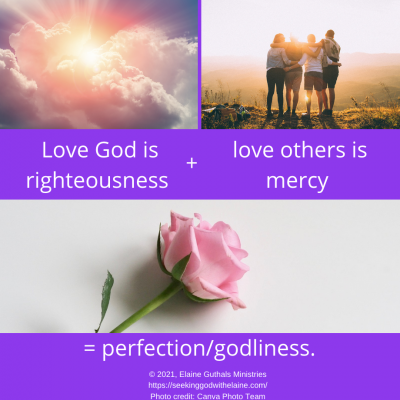
    God changes our hearts to be like His. We show this change by loving Him and others.

    This leads to our perfection.

    Love God is righteousness + Love people is mercy = perfection/godliness

    The Congregational Remembrancer had an interesting statement. “As it is not more difficult to create than to uphold, so it is as easy for Him to communicate great supplies of grace as it was to bestow it at the first.”

    Resource

    We talked about this in Attributes of God: Omnipotent and Powerful. God is able to do everything with ease.

    To read a related devotion, click the button below.

    When we apply that here, we learn that God can change our hearts with ease.

    God can change our hearts with ease.

    We’ve got to believe this, or we don’t really believe in grace. Grace is a free and unmerited gift of love from the Heavenly Father, given through His Son, Jesus Christ, that enables salvation and spiritual healing to believers by the work of the Holy Spirit.

    God uses His grace to perfect us.

    religion-a-work-of-the-heartFB

    Making the Connections

    Yes, we have to work at having a sincere relationship with God. We can’t just have a conversion experience and leave it at that.

    We have to grow in grace and knowledge of Jesus (II Pet. 3: 18). We have to work to do that.

    How Do We Apply This?

    How do we do the work expected of us? The Congregational Remembrancer gave us two activities to complete.

    • Pray
    • Read God’s Word

    Resource

    I think we need to do more than just read God’s Word. We have to study it and apply it to our own lives. We have to evaluate our relationship with Him.

    Father God. Thank You for saving us from our sins. Thank You for sending Jesus to accomplish this. Help us to grow in grace and knowledge of You. We want to be more like You. Amen.

    What do you think?

    Leave me a comment below (about this or anything else) or head over to my Facebook group for some interactive discussion.

    If you don’t understand something and would like further clarification, please contact me.

    If you have not signed up for the email daily or weekly providing the link to the devotions and the newsletter, do so below.

    If God has used this devotion to speak with you, consider sharing it on social media.

  • Practice and Belief

    We always say that we want to put our belief into practice. This daily devotional looks at why that can be hard to do.

    Nuggets

    • Belief does not necessarily make practice easier.

    To read devotions in the At the Heart Level theme, click the button below.

    Devotions in the Belief and Practice series

    In the previous devotion, we started looking at how Waterland fleshed out belief and practice in his Dependence on Our Inward Frame. We got through belief.

    Now, we are going to take a look at practice.

    Resource

    Let’s Put It into Context

    Here is a running list of nuggets for the series.

    The Issues of Practice

    “For I do not understand my own actions. For I do not do what I want, but I do the very thing I hate. Now if I do what I do not want, I agree with the law, that it is good. So now it is no longer I who do it, but sin that dwells within me. For I know that nothing good dwells in me, that is, in my flesh. For I have the desire to do what is right, but not the ability to carry it out. For I do not do the good I want, but the evil I do not want is what I keep on doing. Now if I do what I do not want, it is no longer I who do it, but sin that dwells within me” (Rom. 7: 15-20 ESV)

    Belief does not necessarily make practice easier.

    It is easy to say that, after we become disciples, our hearts should have a God-approved status. That isn’t always the case.

    Look at what Paul said in Romans 7: 15-20. He wanted to walk the straight and narrow, but he didn’t.

    Yes, the Energizer Bunny for God still sinned after his Hollywood splash conversion.

    If there was anyone who didn’t sin after conversion, consensus would probably say it would be Paul. But he is human, too. He could sin, and he did.

    Why do believers still sin after conversion? Well, we get into a situation and are ruled by our passions. Our principles don’t mean a hill of beans.

    Principles may slow us down some. But we are very good at steamrolling right on over them.

    Part of the reason why we may think we shouldn’t keep on sinning is because we now have knowledge of what sin is. We want to take the worldview standpoint and trust on knowledge.

    Too many times, we know what is right, but do what is wrong anyway. Waterland gave a good description of knowing-right-doing-wrong looks like. He wrote,

    “When some sensible good is presented to the eye or to the mind the man judges it to be agreeable or pleasant to the sense, and so far judges right. Yet this alone would not determine his choice, because other considerations, more weighty, might keep him from it. But he dwells upon the thought till his heart is inflamed: then he chooses, and not till then. The drift and bent of his soul leaning too much toward it, he cuts off all farther consideration, and is precipitately determined by it. It is the desire, the impatience, the passion of his heart that hurries him into it. Men act against principle, driven on by a prevailing passion.”

    Resource

    Knowledge is totally different than grace. Grace is a free and unmerited gift of love from the Heavenly Father, given through His Son, Jesus Christ, that enables salvation and spiritual healing to believers by the work of the Holy Spirit.

    Knowledge is just head knowledge. It doesn’t necessarily get a change to the heart level.

    Why can’t we trust knowledge and common sense? It doesn’t take into account the status of our hearts. Waterland wrote, “But our irregular actions seem rather ultimately resolvable into the false judgments which we make [them] into affection or inclination; the head is first tainted, then the heart.”

    Resource

    We can’t rely solely on worldly knowledge. It isn’t going to lead us to God. It is going to try to get us to rely on ourselves.

    Also, Waterland cautioned that the head is corrupted before the heart. Our practices still come from the amoral condition of the heart.

    When we rely on grace, we acknowledge that it isn’t anything we do or don’t do that brings us salvation. It is all about God and what Jesus has already done for us.

    practice-and-beliefFB

    Making the Connections

    Let’s go back to the knowing-right-doing-wrong concept. Why do we not follow our principles? Waterland gave us three reasons.

    • We don’t consider what they are.
    • We disregard them.
    • We don’t apply them consistently.

    Resource

    How Do We Apply This?

    • We have to stand by our principles.
    • We have to make them a part of our everyday living.
    • We have to evaluate our principles to determine if they are good or bad.
    • When we have bad principles, we have to change them to what God wants us to have.
    • We have to take our focus off the world and put it on God.

    Father God. So many times, we think it will be easy after conversion. We think we will immediately be perfect like You – and we aren’t. Help us navigate the Sanctification Road so that we do become more like You. May we hear “welcome home, my faithful servant” when we reach Your throne. Amen.

    What do you think?

    Leave me a comment below (about this or anything else) or head over to my Facebook group for some interactive discussion.

    If you don’t understand something and would like further clarification, please contact me.

    If you have not signed up for the email daily or weekly providing the link to the devotions and the newsletter, do so below.

    If God has used this devotion to speak with you, consider sharing it on social media.

  • Belief and Practice

    We are told diligently guard our hearts in order to preserve the flow of the springs of life. This daily devotional looks at what issues of life mean and how they tie into belief and practice.

    Nuggets

    • The issues of life are determined by the status of our character in our hearts.
    • Belief is influenced by the heart based on the changes God performs on it.

    To read devotions in the At the Heart Level theme, click the button below.

    Devotions in the Belief and Practice series

    I came across this sermon when we were doing the Focusing on God’s Word devotion. I thought it was really interesting, but it wasn’t exactly fitting into reading and studying God’s Word.

    To read a related devotion, click the button below.

    So, I stuck it in the drafts folder. I wanted to see how Waterland fleshed out belief and practice with respect to our hearts.

    Resource

    Let’s take a look.

    Let’s Put It into Context

    Here is a running list of what we’ve discussed previously.

    The Issues of Life

    “Keep your heart with all vigilance, for from it flow the springs of life” (Prov. 4: 23 ESV)

    The issues of life are determined by the status of our character in our hearts.

    When I was reading the sermons for the From a Wrong Heart to a Right Heart series, they talked about issues of life.

    Marling took a crack at explaining what the issues of life are. It is a little different than what we would normally think is being discussed.

    Resource

    Today, this would be seen as I am having issues with my car, or with my kid, or at work. We are thinking synonym for problem. That isn’t the definition that is being used here.

    It think what it is talking about is more elements that make up our status. The issues are our words, actions, thoughts, and feelings. It is what is coming from our hearts.

    Why is what comes from our hearts so important when we look at it this way? Marling took a stab at explaining. He wrote,

    “For though aptitudes, temperaments, and moods have much to do with the tone and quality of our life, states have more. A dark moral state stretches a permanent veil of cloud over the heart, that thins and chills all the light, while a mood or a sorrow may sail only like the swift blackness of a shower through our air. And we can do a great deal to control the moral states of the heart; we are responsible for them. Moral evils, such as envy, avarice, selfishness, license, only vivify with various colouring the one fundamental evil, sin — distance from sympathy with God, alienation from the heavenly Father, indifference or disloyalty to His will and love. This is our central foe. This is what corrupts the issues of life.”

    Resource

    I know. It is a little convoluted, but I think Marling made some good points.

    We don’t want the state of our heart to be a bad character. King argued that such a state has an component of permanency to it.

    I liked where King said we have control over our moral state. We choose what type of a person we are going to be. Our parents don’t. Circumstances don’t.

    We do. We choose our reactions.

    We choose to choose to be like God.

    What all of this is saying to me is our character is formed in our hearts by our choices. It comes out through our words, actions, thoughts, and feelings to show God and others the status of our hearts.

    CharacterFormedInHeart

    The Issue of Confession

    “Because, if you confess with your mouth that Jesus is Lord and believe in your heart that God raised him from the dead, you will be saved. For with the heart one believes and is justified, and with the mouth one confesses and is saved” (Rom. 10: 9-10 ESV)

    Belief is influenced by the heart based on the changes God performs on it.

    I know. We generally focus on the confession part of these two verses.

    What we are confessing is what we believe. We have to believe it in our hearts.

    We just talked about this verse in several past devotions.

    • Our worship comes from our lips, not our actions, so it is a confession.
    • We have to do more than just say in our minds that we are accepting God’s Plan of Salvation. We have to make an outward confession that we believe. Still, there is more than that.
    • Just believing isn’t enough. We have to confess — we have to talk about it.

    To read a related devotion, click on the appropriate button below.

    To me, that means we need both the inward and outward. We have to genuinely believe Jesus is our Savior — and tell others.

    Spurgeon reminded us that God tells us point blank what He wants. There is only one way to salvation. “Jesus said to him, “I am the way, and the truth, and the life. No one comes to the Father except through me” (Jn. 14: 6 ESV).

    To read a related devotion, click the button below.

    Go back up to our list of what we have said recently. We have to do more than confess, and we have to do more than just believe.

    We can’t do one without the other. Morrison said the same thing. He wrote, “There is no Christian faith without Christian confession, and vice versa.” Melville said we can’t done without the other.

    Resource

    belief-and-practiceFB

    Making the Connections

    We learn from this that believing in our hearts alone isn’t enough. If we do that, we could be the one Jesus talks to at judgment day. “Not everyone who says to me, ‘Lord, Lord,’ will enter the kingdom of heaven, but the one who does the will of my Father who is in heaven” (Mt. 7: 21 ESV).

    What belief has to do is show the status of our hearts. We have to show that we truly believe God.

    How Do We Apply This?

    The ABCDs of Salvation

    If you have not become a believer in Christ, please read through the
    Plan of Salvation and prayerfully consider what God is asking you to do.

    A – admit our sins
    B – believe His Son Jesus is our Redeemer
    C – confess God as Sovereign Lord

    D – demonstrate that commitment by making any changes needed in our lives to
    live the way in which God has called us

    The Disciple’s Job Description

    Make it genuine.

    Stay tuned for the completion of this series in the next devotion.

    Father God. We praise You as Sovereign God. We believe that You are Creator and Sustainer of all life. We admit that mankind was separated from God after the original sin, making us sinners; believe Jesus paid the penalty for those sins to become our Savior and Redeemer; confess You as Sovereign God; and demonstrate that commitment by submitting to living our lives following Your laws and commandments. Amen.

    What do you think?

    Leave me a comment below (about this or anything else) or head over to my Facebook group for some interactive discussion.

    If you don’t understand something and would like further clarification, please contact me.

    If you have not signed up for the email daily or weekly providing the link to the devotions and the newsletter, do so below.

    If God has used this devotion to speak with you, consider sharing it on social media.

  • Fear Running Rampant

    Society is divided these days with much fear present. This daily devotional, written by Pastor Steve, looks at what the real issue should be.

    To read devotions in the At the Heart Level theme, click the button below.

    Devotions in the Pastor Steve Sermon Series 

    Pastor Steve has written a devotion that is timely. It goes a long way to turning us around to how God wants us to live.

    Let’s see what Pastor Steve has to say.

    Pastor Steve Wrote

    I was perusing Facebook this evening, as I too often do at times, and I happened upon a post on the Laughing Christian page. Now, I don’t even remember that the comic was about, but one woman stirred up a hornet’s nest of fear response like I’ve never seen.

    This woman made a comment on this post, something to the effect that she just prayed that her adult children can find spouses who are not “vaxxed.” The implication was that something else is afoot now with the COVID vaccine and mating with someone who is vaxxed is somehow the new problematic thing to worry about.

    This of course, caused a launch of what can only be described a thread of fear running rampant. Everyone who commented had their own pet conspiracy. Everyone who commented had their own take on what to worry about. And everyone was bathing completely in the fear that the devil has helped unleash upon the world.

    Salvation Beats Fear

    I read through several of the comments and the thing that amazed me is that no one person said anything about salvation in Jesus. All were presumably church-going Christian people, but they were certainly not only drinking the fear flavored Kool-Aid, but they were going back for extra helpings.

    No matter what side of the issue you fall on, (vax yes, vax no) we must remember what the Apostle Paul wrote to young pastor Timothy. “For God has not given us a spirit of fear, but of power and of love and of a sound mind” (II Tim. 1: 7 NKJV)

    God has not given us the spirit of fear. That being the case, where does fear come from? It comes from the enemy of our souls. That’s who. And people who call themselves Christians are afraid to do most everything now, because of the scare tactics that the devil is filling us with on COVID.

    What Replaces Fear

    We need to pay attention to this verse in what it says that God HAS given us… “power and love and of a sound mind.” A sound mind does not operate in fear.

    Sure, there’s such a thing as rational fear, but most of the fear surrounding COVID can often be classified in the hysteria category. I’ve had plenty of friends who’ve gotten it, and a couple have almost died, so yes, I’m well aware of the possibility.

    But you see, there nothing good in hysterical fear. Plus, it shows that we have more faith in what we are afraid of than we are supposed to have in God. You are, in effect, saying that the devil has more power than God by believing in the fear he casts about and hopes to control your life by it.

    Pay attention to what the Apostle Peter wrote “Be sober, be vigilant; because your adversary the devil walks about like a roaring lion, seeking whom he may devour” (I Pet. 5: 8 NKJV)

    The devil is creating all this fear so that he can get you to take your eyes off of God. He will eat your lunch if he can.

    Glossary

    The Roar of Fear

    If you know anything about lions, then you know that one of their weapons to catch prey is their fierce roar. It is said that they have such a loud ominous roar that it causes their pray freeze in fear so that they can be more easily pounced upon and eaten.

    Does that not sound like that the fear the devil is causing right now?

    The Bible tells us: “Little children, you are from God and have overcome them, for he who is in you is greater than he who is in the world” (I Jn. 4: 4 ESV).

    It also says: “The Lord is my light and my salvation; whom shall I fear? The Lord is the stronghold of my life; of whom shall I be afraid?” (Ps. 27: 1 ESV).

    Is there anything too hard for our God? Is it not possible that He can watch over you and keep you from harm? Remember my last post? Jesus is in ALL things!

    To read a related devotion, click the button below.

    If He is in ALL things, then how can we be afraid of a virus that is loose in this world? How can we let fear drive us so insanely away from our friends, our loved ones and shall I be so bold as to say our sanity?

    God knows the exact moment you are going to die. He has known that from the time you were conceived. If it is your time to pass from this world into the next, is there anything you can do about it? Is there any way for you to stop God’s will? Nope, there isn’t.

    This fear that is running rampant in our world is of the devil. It’s meant to keep us from keeping our eyes on God and doing the things He’s called us to do.

    If you are truly saved and know Jesus is your Lord and Savior, you have absolutely nothing of which to be afraid. Nothing can touch you in His hand. Nothing.

    And nothing is going to happen to you that is outside of God’s will for your life. Nothing.

    If you remember when the disciples were in a boat crossing to the other side of the sea and Jesus came walking out to them on the water, you will remember that Peter asked Him to allow him to walk out to Him on the water. So Jesus told Him to come (Mt. 14: 22-33).

    Peter did great the first few steps out to Jesus, but the moment he took his eyes off of Jesus and put them on the waves he was walking on, he sank. Jesus had to reach out to him and grab him to keep him from drowning. Jesus asked Peter, “Why did you doubt?”

    fear-running-rampantFB

    Making the Connections

    My friends, this is a prime example of what is going on in the world right now. We have taken our eyes off of Jesus and are looking at the waves of the storm around us.

    And we are sinking in this sea of fear.

    May I ask, why are you doubting? Why are you losing faith in Jesus? Is there anything too hard for him to take care of?

    How Do We Apply This?

    Do you understand why all of this is going on? As Christians, Jesus told us to go into all of the world and make disciples of all men (Matt. 28: 19).

    How much are we going to be out there fulfilling the call to do that, if we are hiding, scared that we are going to pick up the COVID virus? How much are we going to do that if we have our eyes set on the storm and not on the upward call of Christ Jesus?

    I am asking you to seek God please, please. Draw near to Him. Keep your eyes on things above and not on this earth.

    For this is His will for you in Christ Jesus. Let’s take as many souls to heaven with us as we can in this short life of ours and stop worrying about what the devil is doing. He’s God’s problem, not ours.

    Almighty God in heaven, I pray for everyone who is reading this right now to be filled with a spirit of power, love, and a sound mind that Your Word talks about. Help us to rightly fulfill the call upon us and to boldly walk the path that you set us on with out fear. In your Son Jesus’ name. Amen.

    What do you think?

    Leave me a comment below (about this or anything else) or head over to my Facebook group for some interactive discussion.

    If you don’t understand something and would like further clarification, please contact me.

    If you have not signed up for the email daily or weekly providing the link to the devotions and the newsletter, do so below.

    If God has used this devotion to speak with you, consider sharing it on social media.

  • Defilement of the Heart

    The opposite of having a pure heart is having a defiled heart. This daily devotional looks at why we should be concerned about the inside instead of the outside.

    Nuggets

    • The outside doesn’t matter as much as the inside does.
    • The evil comes from our hearts and is shown in our thoughts and actions.

    To read devotions in the At the Heart Level theme, click the button below.

    We want the status of our hearts to be pure. However, Jesus warned us that our hearts can defile us. What does that mean?

    Let’s Put It into Context

    “And he called the people to him again and said to them, ‘Hear me, all of you, and understand: There is nothing outside a person that by going into him can defile him, but the things that come out of a person are what defile him’” (Mk. 7: 14-15 ESV)

    Jesus was teaching His listeners, and He put it very plainly that they got it wrong.

    Inside, not Outside

    “And when he had entered the house and left the people, his disciples asked him about the parable. And he said to them, ‘Then are you also without understanding? Do you not see that whatever goes into a person from outside cannot defile him, since it enters not his heart but his stomach, and is expelled?’ (Thus he declared all foods clean.)” (Mk. 7: 17-19 ESV)

    The outside doesn’t matter as much as the inside does.

    InsideNotOutside

    Even the disciples didn’t understand what Jesus was trying to say. Jesus couldn’t believe His ears. He came back with a why-don’t-you-understand-this response.

    First, let’s talk about the bottom line. Jesus was saying that it isn’t the stomach that determined what defiles a person.

    It is the heart.

    When things go into the stomach, they don’t alter our character. An expanding waistline does not make us a better or worse person!

    But think about who Jesus was talking to when He made the statement disciples were questioning. He was talking to the Pharisees (Mk. 7: 1).

    Jesus frequently told the Pharisees that their reliance on ceremony and tradition wasn’t going to cut it. Even their reliance on the law — especially what they had added — wasn’t what God was looking for in order to gain salvation.

    The Pharisees were all about what showed. This puffed up their pride.

    Jesus wanted them to establish a relationship with God. The Expository Outlines said that Jesus was getting them ready for the end of the ceremonial rites.

    Resource

    It was more than that, though. We need to become like God. We need to adopt His character.

    Why aren’t the outward things important? In the Expository Discourses, it was written, “The fountainhead of all that enters into human history and character, is the heart. Hence, the character of the moral law, the order of the Spirit’s work, the importance of the inspired precept, ‘Keep thine heart,’ etc.”

    Resource

    Why didn’t the disciples understand what Jesus was saying? I think, sometimes, we put too much expectation on them because they were with Jesus for three years.

    They were still humans. They still had biases and prejudices. Even up to the Last Supper, Peter was arguing with Jesus that He didn’t have to die.

    We need to see the disciples for who they were — and who they became.

    Restatement and Explanation

    “And he said, ‘What comes out of a person is what defiles him. For from within, out of the heart of man, come evil thoughts, sexual immorality, theft, murder, adultery, coveting, wickedness, deceit, sensuality, envy, slander, pride, foolishness. All these evil things come from within, and they defile a person’” (Mk. 7: 20-23 ESV)

    The evil comes from our hearts and is shown in our thoughts and actions.

    Jesus wanted the disciples to hear what He was saying, so He said it again and expanded on it. Evil comes from the heart — the inside.

    Mark 7: 21-22 give a long list of what this evil is. We have talked about some of them before, so we are not going to focus on what the evil is.

    To read a related devotion, click on the appropriate button below.

    We are going to focus on the heart. Jesus’ point was that the evil defiles the heart.

    Swinnock argued that the heart is the factory in which the evil is created. This agrees with what we said before.

    Resource

    I know we’ve talked about this before, but do you think I can find it? Of course not.

    We generally think that our minds control our hearts. But they don’t.

    Our hearts control our minds.

    Our character is housed in our hearts, not our minds. It isn’t in our intellect.

    It is in our being.

    So, I can see where Swinnock said that the heart is the factory in which the evil is created. That is where sin tries to entrench itself.

    We have to be careful about what we let into our hearts. We must cut out the evil and replace God’s good.

    Good, in the biblical sense, is the workings of God within His people through His holy, pure, and righteous behavior.

    • Holy means to be set apart — because of our devotion to God — to become perfect, and morally pure while possessing all virtues.
      • Perfection means we reach a state of maturity because the combination of the spiritual graces form, when all are present, spiritual wholeness or completeness — holy, sanctified, and righteous.
        • Spiritual graces are worldly morals that have been submitted to God to further His kingdom instead of enhancing this world.
        • Sanctified means to be set free from sin.
        • Righteous means we are free from sin because we are following God’s moral laws.
    • Pure means not being sinful or having the stain of sin.

    Evil is equated with sin because it is that which goes against God and His purposes.

    We are defiled by evil.

    defilement-of-the-heartFB

    Making the Connections

    Only faith in Jesus can cleanse our hearts. That is why it isn’t enough just to do good works. We have to have the sin cut out of us in order to be clean and pure.

    Glossary

    How Do We Apply This?

    Boardman gave us a very big caution. He wrote, “Friend, overtaken in a sin, do not judge yourself too charitably. Don’t ascribe too much to outward circumstances. Recall the first Adam: he was in a garden, where every outward circumstance was for him; yet he fell. Recall the second Adam: He was in a desert, where every outward circumstance was against Him; yet He remained erect: the Devil failed to conquer Him, not because He was Divine, but because He was sinless. Don’t excuse yourself then too much by your ‘environment. ‘Man is not altogether an imbecile. True, ‘circumstances do make the man.’ But they make him only in the sense and degree that he permits them to make him.”

    Resource

    If I were doing Elaine-speak, I would say our choices based on our circumstances — but not our circumstances — determine whether we sin or not. We will not be given a pass for making the wrong decision, even in the worst of circumstances.

    ChoiceNotCircumstances

    It comes down to choices, which is hooked to attitude. Are we going to choose for God or against Him?

    Father God. We choose You. We choose Your love and Your Salvation. Change our hearts to be more like Yours. Amen.

    What do you think?

    Leave me a comment below (about this or anything else) or head over to my Facebook group for some interactive discussion.

    If you don’t understand something and would like further clarification, please contact me.

    If you have not signed up for the email daily or weekly providing the link to the devotions and the newsletter, do so below.

    If God has used this devotion to speak with you, consider sharing it on social media.

  • The Prevalence of the Essential of the Spirit in Prayer

    Our prayers would be nothing without God in us. This daily devotional looks at how the Holy Spirit is essential for our prayers.

    Nuggets

    • When God abides in us, our prayers are answered more quickly because we desire to follow God’s Will.

    To read devotions in the At the Heart Level theme, click the button below.

    Devotions in the Conditions of Power in Prayer series

    Spurgeon told us the conditions and essentials that are needed to be met in order to access God’s power when we pray. The essentials are having child-like obedience, reverence, trust, love, ways, and spirit.

    Resource

    We said that faith, love, and obedience had to be prevalent. The last thing on Spurgeon’s list is the Spirit.

    Let’s Put It into Context #1

    Here is a running list of nuggets for the series.

    Let’s Put It into Context #2

    Prayer is a two-way communication with God in which we pour out our soul to Him.

    The Universality of the Spirit

    “Likewise the Spirit helps us in our weakness. For we do not know what to pray for as we ought, but the Spirit himself intercedes for us with groanings too deep for words” (Rom. 8: 26 ESV)

    When God abides in us, our prayers are answered more quickly because we desire to follow God’s Will.

    In the verses just prior to Romans 8: 26, Paul had been talking about the redemption of our bodies. This encompassed hope and patience.

    The weakness mentioned in verse 26 refers to the physical, mental, and moral infirmities we have. Still, God has compassion for us (Ps. 103: 13-14).

    Silcox reminded us that, though God will meet us where we are, He doesn’t want us to stay that way. He wants us to grow to have His moral character.

    To read a related devotion, click the appropriate button below.

    Resource

    But we have the Holy Spirit to help us get to that moral character. He is God within us.

    Beecher took a different scenic route than Silcox. Beecher wrote, “Feebleness of the whole economy by which we are to come into knowledge, and through knowledge into virtue, and through virtue into vital godliness — this is the general meaning of infirmity.”

    Resource

    While Beecher went on to talk about our physical weaknesses, he talked first about the weaknesses of our spiritual lives. It is hard to be in a physical body in a secular world trying to perpetuate a spiritual life.

    I see that more as what Paul was going for here. God is far more concerned about our spiritual condition than our physical condition.

    God made us even though He knew we were going to be disobedient. He knew He would have to win us back to have a relationship with us.

    The wonder of it is that God did not turn His back on us. He designed the Plan of Salvation. He resides within us when we submit to Him. He sent His Holy Spirit to guide us when we become His children again.

    Glossary

    But the problem is we are so entrenched in this world sometimes. We don’t know that for which we should pray.

    Enter the Holy Spirit. He steps in and intervenes for us.

    No, the Holy Spirit doesn’t speak English, French, or even Hebrew. He speaks God’s language.

    Remember, we just talked about the redemption of our bodies encompassing hope and patience. Paget said we put words to that hope by praying.

    Resource

    The thing is, we must be known by our prayers. Strutt said all disciples must be praying people. Yet, we must pray our own prayers, not someone else’s.

    Resource

    To me, that says we must go beyond the model prayer to talking with God in our own words.

    the-prevalence-of-the-essential-of-the-spirit-in-prayer FB

    Making the Connections

    I loved what Paget said. He wrote, “There is a grace which takes the place of knowledge, and brings the will and the aspirations of men into a mysterious harmony with the unseen: a grace which lifts the desires of the human heart above all that this fragment of the universe can offer, and orders its impulses according to a truly universal law; a grace which leads us on when knowledge falters, and will lead when knowledge shall vanish away; a grace which is His gift alone — the grace of hope.”

    Resource

    God’s grace makes our hearts rise above this world and gives us hope of the next.

    This is done through the work of the Spirit. Not that the Spirit does it Himself, though.

    The Spirit works with us.

    How Do We Apply This?

    • Pray for the world in which we live.
    • Pray that we do not fall into temptation.
    • Pray for God’s blessings.
    • Pray for a proper spirit of prayer.

    Resources

    Father God. We can only come to You through the work of Your Spirit in us. Use Him to change our hearts to be more like You. Amen.

    What do you think?

    Leave me a comment below (about this or anything else) or head over to my Facebook group for some interactive discussion.

    If you don’t understand something and would like further clarification, please contact me.

    If you have not signed up for the email daily or weekly providing the link to the devotions and the newsletter, do so below.

    If God has used this devotion to speak with you, consider sharing it on social media.