

Today is a music day.
This is one of those days that I would have paid good money to stay in bed this morning. And then the day fell apart from there.
It was nothing too major on my end. No energy. Dealing with a tire that has been flat for way too long. Dealing with God-what-do-you-have-in-store-for-us questions.
Then I got the call that my sister thought she was heading into the living room and took a header down the stairs instead. She is spending some time in the hospital, so we would appreciate all of your prayers.
God was very good today. I saw Him moving several times today. Things are going to be okay.
But even if they don’t turn out how I totally expect them to, it is well. He has this.
Even If
Vocalist: Elaine Guthals
Keyboard: Louise Guthals Weiss
What do you think?
Leave me a comment below (about this or anything else) or head over to my Facebook group for some interactive discussion.
If you don’t understand something and would like further clarification, please contact me.
If you have not signed up for the email daily or weekly providing the link to the devotions and the newsletter, do so below.
If God has used this devotion to speak with you, consider sharing it on social media.
While James had been talking faith, he now shows how it is tied to works. This daily devotion looks at whether God wants one to happen without the other.
Devotions in Living Out Our Faith series

We are saved by faith. James was not denying that.
What James said in Chapter 2 is that faith is the beginning. We have to do more with it.
Here is a running list of nuggets for the series.
Having faith in God is just the beginning of our salvation experience.
We are programmed to believe that, if we believe, we have faith. If we don’t believe or deny what God is telling us, we don’t have faith.
That isn’t all there is to it.
Let’s look at our definition of faith. Faith is a gift from God and a work of the Spirit that enhances the conviction that the doctrines revealed in God’s Word are true, even if we do not understand all aspects of them, a belief which impacts our lives and distinguishes us from others.
Yeah, it is the conviction-that-the-doctrines-revealed-in-God’s-Word-are-true part. But it is also the belief-that-impacts-our-lives part.
I worked in higher education for 34 years. I believed in their mission. I felt they were impacting lives.
If I didn’t go in and put in the work, I wouldn’t have gotten a paycheck. I wouldn’t have gone from the classified level to the professional (doing the work of an administrator) level.
We are called to activity.
I like what King said about it. Faith has nothing to do with our understanding it. It has even less to do with our understanding. It is all divine grace.
Part of me wishes James wouldn’t have called it works. But then, so did Paul. “Therefore, my beloved brothers, be steadfast, immovable, always abounding in the work of the Lord, knowing that in the Lord your labor is not in vain” (I Cor. 15: 58 ESV)
We can’t think that the only thing we have to do is come forth with a profession of faith and leave it at that.
If it did, that would make it all about us. It isn’t about us. It is about God and what He does for us.
Yes, salvation comes through confession. However, there is the working out our salvation part (Phil. 2: 12). That means faith alone does not have the power to complete the regeneration process.
Faith is the beginning of our sanctification. It isn’t the end.
Job Duty #1
Be a Living Sacrifice (Romans 12: 1-2)

Our faith has to be a living faith. Just as our job description says we need to be a living sacrifice, we have to have a vibrant faith that shows we are growing toward what God wants us to be.

Remember, James had been talking about our enduring trials to prove and grow our faith. Doing that takes work.
Guthrie also told us another way we should consider work. He wrote, “Let me now remark, in the second place, that [while] it is by faith that unites us to Jesus Christ that we are saved, good works are the certain fruit of this living, saving faith.”
We are called to be workers to further God’s kingdom.
We are called to be harvesters. “[Jesus] told them, ‘The harvest is abundant, but the workers are few. Therefore, pray to the Lord of the harvest to send out workers into his harvest’” (Lk. 10: 2 CSB).
As with any relationship, we have to invest time to build it. It takes a lot of energy, sometimes – work.
But isn’t that normal? We spend time and money on what we love. Baseball? We go to games to watch others play, buy equipment, get training, and spend years perfecting our skills.
If we wouldn’t call that work, what would it be?
Yes, God calls us to work on our salvation. Yes, He saves us where we are. We cannot stay there.
Works are based on our relationship with Jesus.
Works are evidence of a genuine faith.
James had just been talking about not showing partiality. He had told his readers not to give the wealthy preferential treatment.
What James was also saying was that they should give the poor the same treatment they did the rich. That meant they wouldn’t turn the poor away without feeding them and meeting their needs.
Here, James was saying that we use the principles of faith to perform our duty toward others. We have to show our understanding of the faith by producing fruit.
Sumner told us why we must show our faith by works. He wrote, “Thou canst not show it except by works, for faith is hidden in the heart; it cannot be seen of itself — it can be only judged of by its effects.”
We have to be careful. We can’t put more emphasis on the works than we do on the faith.
We get so caught up in the Matthew 25: 35-36 works that we forget those must be done because of the faith.
Yes, we are to love and help others. We have to show them compassion and meet their needs.
But we aren’t going to eliminate poverty. That is a result of sin. We can’t eliminate sin and it’s results.
We also have to remember God’s priority. He is more concerned with the condition of our souls.
What work did Jesus do? “The Spirit of the Lord is upon me, because he has anointed me to proclaim good news to the poor. He has sent me to proclaim liberty to the captives and recovering of sight to the blind, to set at liberty those who are oppressed” (Lk. 4: 18 ESV). He told the world His good news.
Remember, this is the law of liberty. “But the one who looks into the perfect law, the law of liberty, and perseveres, being no hearer who forgets but a doer who acts, he will be blessed in his doing” (Jas. 1: 25 ESV).
God’s perfect law moves us to action to tells others of His love.
So, it comes down to whether our faith is dead or alive and how we show it.
Cuyler argued that faith is a simple process and a sensible act. It shows its growth by being seen in our acts for others.
We can’t forget that faith and words are two distinct things. They are linked but not the same.
We have to have the works to show the genuineness of our faith. The works are meaningless without the faith. Their purpose is to judge how genuine we are.

Hammond warned about having a less than genuine faith. Belief may be present. We may have the knowledge of Jesus’ teachings that are needed.
What is missing is our devotion to Him. “Not everyone who says to me, ‘Lord, Lord,’ will enter the kingdom of heaven, but the one who does the will of my Father who is in heaven” (Mt. 7: 21 ESV).
It is important to realize that. We are going to have an everlasting life. We will be judged on whether we have truly submitted our lives to Jesus or not.
We have to have the faith that shows.
Father God. It is our desire that our faith in You grow. We want our character to change to be like Yours. Help us provide evidence by doing Your work. Amen.
What do you think?
Leave me a comment below (about this or anything else) or head over to my Facebook group for some interactive discussion.
If you don’t understand something and would like further clarification, please contact me.
If you have not signed up for the email daily or weekly providing the link to the devotions and the newsletter, do so below.
If God has used this devotion to speak with you, consider sharing it on social media.
James told his readers that they should not show favoritism because that broke the second greatest commandment. This daily devotion looks at how following the royal law helps us to love one another.
Devotions in Living Out Our Faith series
James told his readers that we are not to judge others based on appearance. Instead, we are to love them.
Here is a running list of nuggets for the series.
Showing partiality breaks the commandment to love our neighbors.
The second greatest commandment is Mark 12: 31. “The second is this: ‘You shall love your neighbor as yourself.’ …” (Mk. 12: 31 ESV).
I think it is interesting that James said, “If you really fulfill the royal law according to the Scripture …” (Jas. 2: 8 ESV emphasis added). Our love for others can’t be a fake love. We can’t love others to fit the worldview definition of love.
We have to love others the way God loves us — and the way we love God.
How are we to love God? “And you shall love the Lord your God with all your heart and with all your soul and with all your mind and with all your strength” (Mk. 12: 30 ESV).
Harris talked about this. He wrote, “It is because in God man finds the ideals which are the prototypes of all that is noble in himself, and which therefore he must love if he would be true to his own better nature and higher destiny.”
God gives us the example of how to love.
We could also tie in the Golden Rule here. “Therefore, whatever you want others to do for you, do also the same for them, for this is the Law and the Prophets” (Mt. 7: 12 CSB).
Love encompasses all these aspects.
We can struggle with loving others. For that matter, we can struggle with loving God.
I don’t think it is talking quantity right here. I think it is talking quality.
The kicker is we really aren’t going to have one without the other. We won’t have quality love with spending a quantity of time with them.
Harris went on to say why this is important. He wrote, “And the obligation of man to love his neighbour as himself lies in the fact that it is in his neighbour that man gets his clearest revelation of God — more clear than any revelation in words or works. It is in the soul of man when looked at with the eyes of neighbourliness that man gets his best vision of the majesty and beauty of God.”
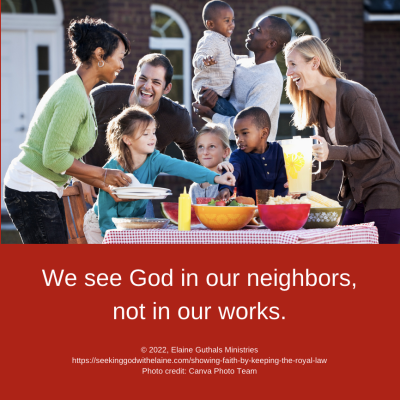
We see God in our neighbors, not in our works.
Okay. Let’s percolate for a second.
We’re getting a little ahead of ourselves in this study, but as good disciples we know what James was going to say. “So also faith by itself, if it does not have works, is dead” (Jas. 2: 17 ESV).
James has already said that the faith and patience that we get through trials brings us to perfection/maturity. We get there through our works — working out our salvation.
Now, this is saying that we see God in people, not in the things we do. We don’t see Him either in doing our acts of kindness or working out our salvation.
We see God in the relationship.
The relationship is what God really wants. We can’t earn salvation by doing things.
In our Redo for Godliness theme, we said we can only gain perfection through being. Sanctification is achieved through being, doing, and suffering.
We are sanctified through being in a relationship with God and doing what is needed to work out our salvation, which occurs through trials.
James called it the royal law. “If you really fulfill the royal law according to the Scripture …” (Jas. 2: 8 ESV).
Turnball reminded us that the royal law is the law of love and righteousness. The law of love and righteousness does not have room for condemnation or prejudice.
We tend to limit things. These limits are put on by what we see and understand.
It isn’t about us. It is about God and His purpose to love everyone.
As the laws and commandments are interconnected, we must keep all of them.
It can be hard to understand how it can be an all or nothing deal — especially when we know we will continue to sin as long as we are in these earthly bodies.
Rogers helped explain what that could mean. He sees the “one point” of sin that is committed as something that is voluntary. We consciously choose to sin when we know better.
I can see that. We have to consciously choose to follow God. Conversely, that means we have to consciously choose to sin.
To me, that explains the all or nothing aspect of keeping the law. God calls us to total submission to His law.
If we choose to sin against one law, our total submission is out the door. It could be said that we are picking and choosing what how we are following God.
God doesn’t accept that.
That also raises the point that we can’t be really good at not committing murder and think that makes up for the adultery we commit. Rogers explained it. He wrote, “For it is not our performing any particular action, but our performing it in obedience to the Divine law, that renders it acceptable to God.”
Aren’t we so like that? We want the easy way. We want the compromise.
We want it whatever way we want it at the moment.
But God says the blessing is in the obedience.
Breaking God’s laws and commandments show that we are more focused on ourselves than Him. It tells Him that we are more in tune with the worldview than Him.
I know. I know. We have free will. Free will is the ability within us to make decisions, which determine actions that produce character.
Unfortunately, that means we can make the wrong choice and break God’s law.
Fortunately when we do that, we can ask forgiveness. Forgiveness is, when we ask, the act of God pardoning us because we have shown repentance for breaking His laws and commandments, which allows us to become holy as He is.
Let’s look at it another way. What did Jesus say right after the two greatest commandments? “All the Law and the Prophets hang on these two commandments” (Mt. 22: 40 NIV).
That tells us that all the laws are interconnected. So, you break one, you break them all. Run over a nail, and the air from the entire tire is going to seep out.
What is this really saying? If we do not ask forgiveness when we break one of the laws, we will be guilty of breaking them all.
Professing belief in God to secure salvation does not give us license to continue sinning. Prior professions do not necessarily show current submission.
We should show mercy to others because only obedience to the law sets us free.
James had talked about the gospel being the law of liberty in Chapter 1. “But the one who looks into the perfect law, the law of liberty, and perseveres, being no hearer who forgets but a doer who acts, he will be blessed in his doing” (Jas. 1: 25 ESV).
Even though he had just called it the royal law, James went back to calling it the law of liberty. It is all of this.
Only our adequate obedience to the law will set us free. Conversion happens only when we agree to constrain ourselves to following God’s laws.
James admonished his readers to act like they would be judged under these laws — because everyone is going to be judged under it. Revelation 20: 12 says, “And I saw the dead, great and small, standing before the throne, and books were opened. Then another book was opened, which is the book of life. And the dead were judged by what was written in the books, according to what they had done” (ESV).
We will be judged with mercy when we have chosen salvation. God’s mercy is an act of sovereign will that produces an unexpected and undeserved response from God as He responds in love to our needs.
God loves us so much that He will forgive our sins when we ask and choose to follow His laws and commandments.

Cooper summed it up nicely. He wrote, “The great obstacle to the acceptance of the gospel message is the want of a deep and permanent conviction of the enormity of sin and of our actual transgression before God.”
The main reason many can’t submit to the gospel is they don’t have believe that sin is sin and that God has the right to call it so, let alone hold us to obedience to it.
Obedience is what it is all about. Not understanding.
Really, it isn’t even about our submission. That would make it about us.
It is totally about Him. He is Sovereign God.
Father God. We want to follow Your laws. We want to love others as ourselves. Help us to see them as You see them. Amen.
What do you think?
Leave me a comment below (about this or anything else) or head over to my Facebook group for some interactive discussion.
If you don’t understand something and would like further clarification, please contact me.
If you have not signed up for the email daily or weekly providing the link to the devotions and the newsletter, do so below.
If God has used this devotion to speak with you, consider sharing it on social media.
God is inclusive. All who confess belief in Jesus can be His children. This daily devotion looks at how God does not judge the poor on their appearance.
Devotions in Living Out Our Faith series

At the end of Chapter 1, James was switching his focus to what we do with our faith once we get it. He had just said that fulfilling the two greatest commandments entailed remaining unstained with sin and supporting orphans and widows.
James continued his focus on how we use our faith to interact with others in Chapter 2.
Here is a running list of nuggets for the series.
God doesn’t want us to treat others based on earthly distinctions.
James had just gotten off a chapter where he talked about trials. He talked about not sinning so as to become mature in our faith.
Yeah, it ended up being a kind of hard chapter to read for those who were facing trials and not doing the best job of not sinning.
To ease that, James starts Chapter 2 by calling them brothers. As disciples, we are brothers and sisters in the family of God. We are all His children, which makes us siblings.
There is another reason why James called them siblings. He wanted to get them to do what God was wanting them to do.
James wasn’t calling them to some generic lifestyle. He was calling them to a life of faith.
It can get really hard to live a life of faith when you are focused on the trials. James knew he wasn’t going to browbeat them into the life God wanted them to lead.
What James was calling them – and us – to do is to be united with Jesus. Adam talked about this. He wrote, “It is only by believing with the whole mind and heart that we are united to the Saviour, and reap the benefits of His great redemption.”
When we are united with Jesus through our whole mind and heart, we treat others the way He would treat them – with no partiality. This no partiality is applicable, according to Adam, to material possessions and worldly position and does not address their character or spiritual worth.
Let’s stop a minute and consider who is James’ audience. He is writing to the people who have been dispersed (Jas. 1: 1). This included those who didn’t come home from Babylon.
Still, James was calling them brothers (and sisters). He considered them as having some sort of relationship.
They do. As I said earlier, they are all believers, so they are in the family of God.
That initiates a relationship without our doing anything.
We are also called to not have any partiality. Turnball helped explain this. He wrote, “the gospel teacheth that with God is no respect of persons, but that they all which fear God and work righteousness are accepted through the joyful tidings of salvation by Jesus Christ, in whom there is neither male nor female, bond nor free, neither rich nor poor, but they are all alike unto Him.”
How can this happen? It happens because we serve the Lord of glory, Jesus Christ.
Jay noted that Scriptures do acknowledge the inequalities of life. He wrote, “The Scripture justifies the distinctions and inequalities of life, and rank and office are to be regarded.”
Beyond those distinctions, we are not to have prejudice or favoritism.
Okay, so what this is really saying is that material possession does not indicate their level of faith. That would be a new concept for the Jews.
Think about Abraham and Job. They were really wealthy. Yes, they had great faith.
It is nowhere said that Paul, on the other hand, possessed great wealth. He did possess great faith.
We aren’t to judge people by worldly standards. Instead, we are to judge them on being persons of faith.
Our faith is to be in Jesus, the Lord of glory.
Jesus will come again in glory. He will take us to be with Him for eternity.
James gave an example of what he was talking about.
We make a lot of assumptions based on appearance. James cautioned us not to do that.
The clothes we are wearing provide the foundation for most of the assumption.
Where is this assumption being made? “For if a man … comes into your assembly…” (Jas. 2: 2 ESV). They have come to worship.
But the scenario says that actions were performed based on the assumptions made on appearances.
How different that is from how God wants us to act! “But the Lord said to Samuel, ‘Do not look on his appearance or on the height of his stature, because I have rejected him. For the Lord sees not as man sees: man looks on the outward appearance, but the Lord looks on the heart’” (I Sam. 16: 7 ESV).
Remember how we interpreted what James said in the last chapter. If anyone has an outside religion (if he thinks he is religious) and doesn’t have the inside relationship with God (doesn’t bridle the tongue and deceives the heart), our religion is worthless.
God doesn’t want us to have just an outward religion. He wants an inward relationship with us.
We are not to judge others based on appearance.
Jesus told us not to judge others. “Judge not, that you be not judged” (Mt. 7: 1 ESV).
Moore reminded us that judgment is above our pay grade. We wouldn’t get it right.
We not only look at things from the outside only, but we also look at things only from our own viewpoint. This bias clouds our judgment.
What did Jesus say? Those who judge will be judged themselves.
The poor are heirs to the kingdom of God.
It is easy to think that God is blessing the rich and punishing the poor. James said that isn’t the case.
God did not turn His back on the poor. Manton said there were five reasons why God chose the poor.
When we become disciples, we become rich. No, this is not talking about a prosperity gospel. We aren’t promised that all our financial worries will be over.
We are promised salvation and eternal life when we obey God. Manton wrote, “Faith makes us truly rich; it is the open hand of the soul, to receive all the bounteous supplies of God.”
We only attain true riches when we are blessed by God. We are promised to be heirs to His kingdom.
James had a strong accusation for the rich. They had humiliated the poor man.

Our faith has to infiltrate our lives. We have to get it to our core.
When our inward faith is expressed outwardly, that means it affects our relationships with others. We treat them the way Jesus would.
Just as we do not discriminate because of skin color, we don’t discriminate because of the size of their bank account.
Father God. You do not show favoritism to us. All who confess You may become Your children. Help us to treat others with this impartiality. Amen.
What do you think?
Leave me a comment below (about this or anything else) or head over to my Facebook group for some interactive discussion.
If you don’t understand something and would like further clarification, please contact me.
If you have not signed up for the email daily or weekly providing the link to the devotions and the newsletter, do so below.
If God has used this devotion to speak with you, consider sharing it on social media.
Today is a music day.

It has been a long difficult week. My energy level has basically tanked.
I got written today what I wanted to get written, but what I scheduled for tomorrow isn’t going to be enough. So, I am going to try to put them together.
But that is a tomorrow project. For today, we’re going to do a music day.
Here is Restless Love. It tells us of the lengths God will go through to show His love for us.
Reckless Love
Vocalist: Elaine Guthals
Keyboard: Chris Vieth

What do you think?
Leave me a comment below (about this or anything else) or head over to my Facebook group for some interactive discussion.
If you don’t understand something and would like further clarification, please contact me.
If you have not signed up for the email daily or weekly providing the link to the devotions and the newsletter, do so below.
If God has used this devotion to speak with you, consider sharing it on social media.
James told us to be doers and not just hearers. This daily devotion looks at what we are to do and how it applies to salvation.
Devotions in Living Out Our Faith series

James had just talked about how the Word of God should be used as a reflection to see Who God is and who we need to be. We should use it as a mirror that we do more than just gaze at.
James 1: 25 tells us what specifically we are to be gazing at.
Here is a running list of nuggets for the series.
We are to look at the law, which gives us God’s character, and imitate it to receive blessings.
James had just used an analogy of looking in a mirror to see God. Spurgeon clarified that we are looking at a glass mirror. We are looking at God’s laws and commandments.
Jesus said that those laws and commandments are summed up by the two greatest commandments. “‘And you shall love the Lord your God with all your heart and with all your soul and with all your mind and with all your strength.’ The second is this: ‘You shall love your neighbor as yourself.’ There is no other commandment greater than these” (Mk. 12: 30-31 ESV).
We are to obey the laws and commandments as Jesus has shown us how.

So, if we are to “… love the Lord your God with all your heart and with all your soul and with all your mind and with all your strength” (Mk. 12: 30 ESV), then we are to bury ourselves in His Word with all our heart, soul, mind, and strength. This is how we will know it and how it will change our character.
And yes, it is law. We are commanded to obey it.
It is not a suggestion. It is not something from which we can pick and choose what to follow.
Why do we follow it? It is the perfect law.
Nothing has to be added to it. It has supreme authority.
God’s law is what sets us free.
Without Christ, we are in bondage to sin. Sin is not believing that Jesus is our Savior to save us from our actions by humans that disobey God and break one of His reasonable, holy, and righteous laws and commandments, goes against a purpose He has for us, or follows Satan’s promptings.
Punshon made a good observation. He wrote that “it has been well observed that the highest liberty is a self-imposed restraint.”
God isn’t a dictator. Yes, He commands us to obey His laws and commandments. He doesn’t force us to do that.
It is our choice. It’s called free will. Free will is the ability within us to make decisions, which determine actions that produce character.
If God commands us to obey His law (which He does) and we choose not to, we will suffer judgment. It may be in this lifetime. It may be in the next.
We have to pay attention to what we hear. It can’t go in one ear and out the other.
We have to make it a major part of our lives.
That is because it is a major part. It is the regeneration of our heart. Regeneration is being changed from spiritually dead to spiritually alive and the internal new birth and requickening that God brings about through the work of the Holy Spirit.
We have to keep looking at the law so that we do not forget.
The doing part is being fully committed to the submission part.
We are blessed because we gain salvation. Blessedness means we have been perfected.
For us, the perfection means maturity. For God, it really does mean 100% of the time perfect.
We who look in the looking glass to see the Word have two choices. We can either walk away or allow the Word to change us to be like God.
The choice is ours.
God wants a relationship with us, not a ritual.
First off, I have to play Dictionary Chick. We have to know what James was talking out when he said religion or religious.
Thomas helped us out with that. He wrote, “The word ‘religious,’ here, does not mean the entire religious life — the inner experience and the outward manifestation of religion — but only the outward expression of it.”
Hmmm. Is that what the verse is really saying?
I read it to say, “If anyone has an outside religion (if he thinks he is religious) and doesn’t have the inside relationship with God (doesn’t bridle the tongue and deceives the heart), our religion is worthless.
But then, Thomas went on to say something else that I am going to have to process. He wrote, “We are as Christians what priests in the sanctuary before the congregations profess to be — we are performing the holy rites, and thus [symbolizing] the faith and uttering the worship of Christ. Our ritual is our life. That life is the performance of religious rites which [symbolize] our faith to the world, and utter our worship to God.”
Hmmm. I like that.
We are priests. “But you are a chosen race, a royal priesthood, a holy nation, a people for his own possession, that you may proclaim the excellencies of him who called you out of darkness into his marvelous light” (I Pet. 2: 9 ESV)
We are “on display,” living out for the world to see what a disciple looks like.
Hopefully, we are giving an accurate picture.
I can see where Thomas would say that our ritual is our life. We live our lives day in and day out.
Our faith must be shown in how we live our lives. Our ritual is based on our faith.
If it doesn’t have an inward component, we are deceiving ourselves. We just have a genuine submissive relationship with God.
At first, I was kind of kicking at verse 27. But then I realized I was doing a little bit of selective reading.
I was kicking back at the only thing James said was “… visit orphans and widows in their affliction …” (Jas. 1: 27 ESV). But I don’t think he was saying that is the only way.
What I think he was going for was practical ways to live out the greatest commandments. Once again — “‘And you shall love the Lord your God with all your heart and with all your soul and with all your mind and with all your strength.’ The second is this: ‘You shall love your neighbor as yourself.’ There is no other commandment greater than these” (Mk. 12: 30-31 ESV).
The way we show that we love God is to follow His laws and commandments. The way we show love to others is we help them when they need us.

Barr made a great observation. He wrote, “It is observable that he says nothing of believing, and speaks only of doing. Nor was it necessary that he should. The ‘doer of the work’ must, in the first instance, be a believer of the Word.”
Being a good person isn’t going to cut it. Loving others isn’t going to cut it if we don’t also love God.
Belief in God is a given.
I loved what Robins had to say. He wrote, “It is a paradox, and yet it is perfectly true, that man is not justified by works, and yet that man is not justified without works.”
Justification is the act through the merits of Christ that makes us free from sin because we are following God’s moral laws.
Man is not freed from sin by works, but man is not freed from sin without them.
James had just told us “But be doers of the word, and not hearers only, deceiving yourselves” (Jas. 1: 22 ESV).
Man is not freed from sin by just hearing the Word. Man is freed from sin by ABCDing.
The ABC part is salvation. The D part is working out our salvation.
We can’t earn salvation. It is a gift of God.
But we can’t change our character unless we navigate the Sanctification Road. Sanctification is the transformation of mind, body, and soul, which begins with regeneration; gradually changes our nature and morals through the promptings of the Holy Spirit; and ends with perfected state of spiritual wholeness or completeness.
We work out our salvation through showing obedience to God and growing our faith.
Father God. Your law could not bring us salvation. It does, however, show us Your character. Help us to grow our faith and perfect us by keeping Your laws. Amen.
What do you think?
Leave me a comment below (about this or anything else) or head over to my Facebook group for some interactive discussion.
If you don’t understand something and would like further clarification, please contact me.
If you have not signed up for the email daily or weekly providing the link to the devotions and the newsletter, do so below.
If God has used this devotion to speak with you, consider sharing it on social media.
God wants us to read His Word, but He wants more than that. This daily devotion looks at how the Word of God should be a mirror that we do more than just gaze at.
Devotions in Living Out Our Faith series

James had just been telling his readers that sin is to be replaced with meekness and salvation, which is gained through the Word of God. The Word of God is able to save us — but not without something on our part. Salvation isn’t a gift that is automatically given to all.
We each have to choose to accept the gift of salvation. We not only have to accept it to be true, but we must also allow it to change us.
James continued to stress this point. In this passage, he talked about how the Word of God should be used as a reflection of Who God is and who we need to be.
Here is a running list of nuggets for the series.
We must go from head knowledge to heart knowledge regarding the Word of God.
It is easy for some to think that James was talking about our living out Matthew 25: 35-36. We need to physically be doing all this stuff to earn God’s love.
I don’t think that is what James was talking about here.
Instead, James was talking about our response to the Word of God. Once we hear the Word, we must accept it into our lives and allow it to change us to be more like God.
Remember, James has been talking about growing our faith and patience through trials so that we become mature disciples. He isn’t talking about just giving a cup of water to the thirsty.
James was talking about doing both of the greatest commandments. “‘And you shall love the Lord your God with all your heart and with all your soul and with all your mind and with all your strength.’ The second is this: ‘You shall love your neighbor as yourself.’ There is no other commandment greater than these” (Mk. 12: 30-31 ESV).
We can do without the love being involved. We can also do because we love but not love God.
That isn’t enough.
I like what Adam said. He wrote, “The doers of the Word are those who are ruled by it, who practically comply with its requirements, who not only read, understand, and believe it, but submit to its authority, regulate their tempers and lives by its precepts.”
Doing the Word is about submitting to God, not the physical acts that we accomplish.

James’ whole point is it is great that you come to church. Come hear the Word!
Don’t leave it there.
Faith and patience have to grow so that we become spiritually mature. We don’t do that by coming once a week for an hour, having some words wash over us, and do nothing else until we come back to the same bat time, same bat channel.
We have to use God’s Word to make the changes within us to imitate God’s character. We have to get the doing down to the heart level.
“I incline my heart to perform your statutes forever, to the end” (Ps. 119: 112 ESV). Doing this is the only way we show God that we love Him.
The blessings are in the obedience. Knowledge isn’t obedience.
Yes, we made the choice to sit there and listen. We haven’t made a choice to do anything with what we are hearing.
How would we deceive ourselves? One way would be to make a profession of faith but not turn from our sins.
Saying we believe Jesus is our Savior without doing what He told us to do would just be flapping our gums.
Unfortunately, I think there are going to be too many people who think they have done well and won’t get the outcome they are planning. “Not everyone who says to me, ‘Lord, Lord,’ will enter the kingdom of heaven, but the one who does the will of my Father who is in heaven” (Mt. 7: 21 ESV).
God uses His Word as a mirror to show us where we are and and where He wants us to be.
James made an interesting analogy to show what he was meaning. He talked about looking into a mirror. The kicker is the memory of what we see is fleeting.
We sit in the church service, intently listening to the Pastor Steve-types. We’re right there with him, saying our “Amen” as loudly as the next one.
We hit the door to the church — and it is gone. We have no clue what Pastor Steve said. Couldn’t even tell you the passage of Scripture he used.
For all of our intended attention, it was gone because we didn’t take it to heart. It just tickled our ears.
But isn’t this talking about something worse? “For he looks at himself and goes away and at once forgets what he was like” (Jas. 1: 24 ESV).
Being in a family where both sides have loved ones who have dealt with Alzheimer’s, forgetting oneself is real to me. Losing self would be one of the most terrifying things to go through, I would think.
I can’t stop thinking that the looking intently but then losing it means we are really looking with the wrong motivation. Are we looking for the warm fuzzies rather than transformation?
The warm fuzzies aren’t going to last long. They won’t last for eternity because they have nothing to do with character change.
We do have want to change from who we formerly were to be the men and women that God wants us to be. However, we only do that by doing God’s Word.
Spurgeon brought up a good point. God’s Word is a mirror. He wrote, “The Word of the Lord is a revealer of secrets: it shows a man his life, his thoughts, his heart, his inmost self.”
Looking into the glass isn’t wrong. The sin comes when we look into the glass and turn away or not allow transformation.
We can’t just look at the surface of God’s Word. We can’t just hear it or read it. We have to study and meditate on it. In other words, we have to genuinely seek God.
Hearing His Word (Rom. 10: 17).
Reading His Word (Rev. 1: 3).
Praying to Him (Heb. 4: 16).
Studying His Word (Ac. 17: 11).
Meditating on His Word (Ps. 1: 1-2).
Memorizing His Word (Ps. 119: 11).
We also can’t leave God’s Word in His house. We have to take it with us into our houses for the rest of the week.
We have to look at God law (Jas. 1: 25 — in the next devotion). That is what God’s Word is all about.

In the last devotion, we said that the Word of God is able to save us — but not without something on our part. Two things about that.
In Gifts for Remaining Steadfast in the Faith, we talked about how God chose to send us His word of truth (Jas. 1: 18 ESV).
What are we to do? “I have stored up your word in my heart, that I might not sin against you” (Ps. 119: 11 ESV).
We have to look into the law and See God’s love for us. Then we have to follow His law.
Father God. We praise Your name for sending Your Son — Your Truth — to redeem us from our sins. We pray that we change so that we are imitating Your character. We want to be transformed to be like You. Amen.
What do you think?
Leave me a comment below (about this or anything else) or head over to my Facebook group for some interactive discussion.
If you don’t understand something and would like further clarification, please contact me.
If you have not signed up for the email daily or weekly providing the link to the devotions and the newsletter, do so below.
If God has used this devotion to speak with you, consider sharing it on social media.
Trials can scare us. This daily devotional looks at how we are to react toward God when we are experiencing trials.
Devotions in Living Out Our Faith series
We often use these verses to guide our relationships with others. They do give us a good process on how to interact, especially during conflict.
But what have we been talking about? James has been telling us about faith, patience, perfection/maturity, and trials. He told us about blessings and gifts we will receive when we follow God.
James isn’t going to stick something else in here with no explanation. He is talking about our response to trials and our relationships with God.
Here is a running list of nuggets for the series.
We have to consider how we will respond to God when we are encountering trials.
James started off with the emphatic. We have to know this, and everyone has to do it.
It is important that we know what we are supposed to do. God will judge us on His standards, so we need to know what they are.
But knowing them alone isn’t enough. We have to do them. Our character doesn’t change unless we put them into practice.
No one gets a pass from doing things God’s way. It may look like that now because God is letting us exercise our free will. Free will is the ability within us to make decisions, which determine actions that produce character.
Yes, we get to choose, but one day we will have to pay the consequences for our choices.
We have to be ready to listen to God.
What I think James is talking about here is our attitude and level of submissiveness. We have to be docile. Docile means easily taught.
To read a related devotion, click the button below.
We have to want to learn what God wants to teach us.
How do we hear that? By eagerly listening to the Word of God.
That means being present on Sunday morning or whenever the service is. It means letting the Word of God talk to us when we read our daily devotion.
Put this into context again. James’ brothers were going through trials. They needed to listen to the Word of God.
We have to not only listen to the Word, but we also have to study it. Then we have to put it into immediate practice.
We need to be cautious. We don’t want to say the wrong thing.
Along with listening to God, James’ brothers needed to be especially cautious in approaching God. Yes, we have full access to Him after conversion.
But we have to approach God in the right way. We cannot come to Him thinking we are better than Him and know more than He does.
We can’t come with demands that God change things to the way we want them.
We need to listen to God and His Teacher, the Holy Spirit. We are not the teacher.
Too often when we pray, we just tell God what we want and move on. It is a one-way conversation.
We need to come to Him in submission.
But when are we supposed to be slow to speak the Word of God? We need to make sure we are spiritually ready to teach others what the Word says.
In other words, we have to be spiritually mature before we become teachers and preachers. We also know that we will always be learning, regardless of our spiritual maturity.
What I read Manton to say in Simple Duties is that we don’t judge God’s doctrines. We don’t interpret them our way.
We can tie slow to speak to swift to hear. If we are busy hearing — really hearing — we will be slow to speak. If we are formulating our response while listening, we have divided our attention and will miss some.
Notice that it doesn’t say we can’t speak at all. We have to make sure we have heard what we are supposed to be talking about before we say anything.
Anger does not lead to good character.
When put into context of the Word, this means, as Manton said, “… that the Word must not be received or delivered with a wrathful heart …”
Remember, faith produces patience, not anger.
Yes, Jesus got angry and cleared the temple of the money changers. That doesn’t give us license to be angry at God.
Take note of verse 20. “… for the anger of man does not produce the righteousness of God” (Jas. 1: 19-20 ESV).
Sin is to be replaced with meekness and salvation, which is gained through the Word of God.
James admonished us to “… put away all filthiness and rampant wickedness …” (Jas. 1: 21 ESV). Again, it is our choice as to what actions we are going to take. We are to be in control.
We are to relinquish evil. All of it.
We don’t hang on to our pet sin. We don’t compromise so that we come down somewhere in the middle.
But it is more than just giving up the sin. We have receive God through His Word.
We do this through meekness. Meekness is a personality trait exhibiting a mild or moderate disposition that places dependence on God.
We place our dependence on God.
I thought it was interesting that Trapp called meekness a freedom from passion and prejudice. If we are slow to anger, we don’t fall into the heat of the moment when our passions are boiling over.
Liddon told us why we are to receive the Word of God with meekness. He wrote, “It is not meant to add fuel to your controversies, it is meant to govern your lives.”
Don’t miss the last part of the verse. “… the implanted word, which is able to save your souls” (Jas. 1: 21 ESV).
The Word of God is able to save us — but not without something on our part. Salvation isn’t a gift that is automatically given to all.
We each have to choose to accept the gift of salvation. We have to have the desire to turn away from Satan and turn to God.
We receive the Word when, by faith, we believe it. We not only accept it to be true, but we also allow it to change us.

James told us to be both swift and slow. We might wonder how to accomplish such seemingly opposite reactions.
To me, that seems logical. We are not going to react to our house burning down with laughter.
We are going to evaluate the situation and respond as needed.
What I think this is really saying is we need to be sober minded. Being sober is a character trait distinguished by self-control, genuineness, and sound moral judgment. It is a calm and temperate disposition.
This self-control is important. We need to control our ears and our tongue.
We have to control our ears because what we let into our lives can take over control of us. We begin changing our viewpoints based on what the world tells us. We compromise with them.
We can’t. We need to follow God exclusively.
We have to control our tongues because our inward character is shown through our outward expressions.
But what if the be swift really means be ready? Be ready to listen to when God initiates the lesson. Be ready for the trial that is going to teach us what we need to know.
We have to be ready for the trial brings and be content to endure it in order to be changed in the way God has for us. Don’t pass on the trial.
Father God. We tend to think trials are a bad thing. You have shown where they are used to grow us closer to You. We want to have faith and patience that leads to maturity. Help us to react in the correct ways. Amen.
What do you think?
Leave me a comment below (about this or anything else) or head over to my Facebook group for some interactive discussion.
If you don’t understand something and would like further clarification, please contact me.
If you have not signed up for the email daily or weekly providing the link to the devotions and the newsletter, do so below.
If God has used this devotion to speak with you, consider sharing it on social media.
James had just talked about receiving blessings for being steadfast in the faith. This daily devotion looks at the gifts we receive as reward for enduring.
Devotions in Living Out Our Faith series

In the last couple of verses, James talked about how our desires grow into sin. We can have two issues with that.
One would be that some people think there is no sin. However, sin is a reality. Schwartz wrote, “It is not a weakness, but a power; a power which gnaws at the very core of life; a power encompassing and swaying the entire range of our being. It is an inward strife, a pain reaching even to the heart. Let us, then, seek first of all to discern the full significance of sin, that in sincere penitence we may turn away from it. It gives sin’s history.” Sin is powerful.
The other issue is that we don’t think our desires should be considered sin. However, only God gets to choose what is or isn’t a sin.
James gave us some advice to follow.
Here is a running list of nuggets for the series.
Refraining from sin takes discernment that can only come from God.
To err, is to make a mistake. It signifies a choice.
Unfortunately, we make choices based on our flawed understandings. You know, we are human. That limits our comprehension.
It has to be our choice rather to sin or not. If it wasn’t under our control, there would be nothing to safeguard against.
What has James told us is sin?
Now, James told us, “Don’t do these.”
Yes, we are still in physical bodies. We are going to keep sinning.
How does God respond?
We think God will give us a pass because we are human and can’t possibly not sin. No. God will forgive us when we ask, but we still have to deal with the results of our sin.
That means we need to pray for discernment. Discernment means we can evaluate the situation and recognize right from wrong.
We have to recognize the situation as temptation. Then we have to determine what God would have us do. Only then can we make the right choice.
We have to focus on navigating the Sanctification Road, not this world. We have to conquer sinful desires to do this.

We also can’t err in thinking that we can go on sinning and have a deathbed confession. Not all of us are given the opportunity to confess right before we die. We may be killed instantly.
Remember, we said that we don’t think our desires should be considered sin. We think they are too small to be considered wrong.
We can’t err in the moral law. We are not looking to do things from the worldview point of view.
Edwards gave us a good reminder. God is spiritual. The moral law is based on the spiritual attributes of God.
We can’t err thinking our character is good enough. It is not God’s character. We must be imitating Him.
We have to see God as He is.
One more word of warning. I said we make bad choices. This isn’t where we have a choice between two okay things and we are trying to figure out which is the better choice to make.
We are choosing between good and evil.
Good, in the biblical sense, is the workings of God within His people through His holy, pure, and righteous behavior.
Evil is equated with sin because it is that which goes against God and His purposes.
We need to choose submitting to God.
When we choose to submit to God, He rewards us with good and perfect gifts.
How many times do we think that things of this world will bring us happiness and fulfillment? They won’t.
A gift cannot be good when it has evil inherent in it. If it is of this world, it is inherently evil.
Aspinall explained why this is so important. He wrote, “By the ‘good and perfect gift which is from above,’ he means more especially the Divine grace [by] which all other spiritual blessings are rendered attainable.”
So, what is the perfect gift? Salvation. Remember, perfection is maturing in our becoming as God is.
Salvation is the gift of life through the deliverance from condemnation and sin to acceptance and holiness and changes us from being spiritually dead to spiritually alive.
If you have not become a believer in Christ, please read through the
Plan of Salvation and prayerfully consider what God is asking you to do.
A – admit our sins
B – believe His Son Jesus is our Redeemer
C – confess God as Sovereign Lord
D – demonstrate that commitment by making any changes needed in our lives to live the way in which God has called us
God gives us a variety of gifts. The Homilist gave us a list. They wrote, “Strength, consolation, hope, holiness, are the results of the soul’s fellowship with God.”
One of the best gifts God does give us is the Holy Spirit. He influences us to confess our sins, submit to God, and follow His laws and commandments. He gives us fruit of the Spirit, which are also virtues and spiritual graces.
We have to realize we all get different gifts and at different levels. I may be a good organizer, but Pastor Steve’s gift is teaching. I may be a good singer. Someone else may be a fantastic singer.
But we each are given gifts.
God chose to restore our relationships with Him by providing the word and truth — Jesus.
God devised the Plan of Salvation. He did this a long, long time ago.
“Blessed be the God and Father of our Lord Jesus Christ, who has blessed us in Christ with every spiritual blessing in the heavenly places, even as he chose us in him before the foundation of the world, that we should be holy and blameless before him …” (Eph. 1: 3-4 ESV).
Yes, before God made us, He knew He was going to have to deal with our disobedience. Before He even created the universe, He knew Jesus would have to save us.
The plan is wholly based on Jesus. If Jesus refused to do it, there would have been no conversion. Conversion is the product of repentance, when we turn away from our sins and return to God, that secures salvation.
Repentance is acknowledging our separation from God and expressing sorrow for breaking God’s laws and commandments by making the commitment to change our sinful ways to ways of righteousness through obedience.
Remember what James said. “Of his own will he brought us forth by the word of truth …” (Jas. 1: 18 ESV).
What are we to do? “I have stored up your word in my heart, that I might not sin against you” (Ps. 119: 11 ESV).

God did not create evil. God created good, as He is.
Evil entered the word during the original sin. It will not exit the world until there is no this world left.
Until that time, we will have to endure the trials and remain steadfast. We must be obedient to the Father and not sin.
Father God. We choose to obey You. Put Your word of truth in our hearts, so that we may not sin against You (Ps. 119: 11). Amen.
What do you think?
Leave me a comment below (about this or anything else) or head over to my Facebook group for some interactive discussion.
If you don’t understand something and would like further clarification, please contact me.
If you have not signed up for the email daily or weekly providing the link to the devotions and the newsletter, do so below.
If God has used this devotion to speak with you, consider sharing it on social media.
James had been talking about enduring trials to grow faith and patience in order to gain perfection. This daily devotional looks at the reward for doing that.
Devotions in Living Out Our Faith series

James has been telling us that we need to endure through our times of trials. This is how we reach perfection/maturity.
That isn’t all we get for enduring. God blesses us.
Here is a running list of nuggets for the series.
Remaining faithful to the end earns us the crown of life.
Endurance can be secured when we have the wisdom telling us how to do so. We may know what we want to do and are supposed to do. It won’t be easy.
Living a life for God does have its struggle built in. No, it isn’t going to be smooth sailing.
We are going against our human nature. We are going counterculture to the world.
How is our lives going to be easy doing that?
Because it isn’t easy and we need all the help we can get, God sent the Holy Spirit to live within us in love and power. He prompts us to do what is right. He teaches us so that we can grow in our faith.
Those who endure will be blessed. “But the one who endures to the end will be saved” (Mt. 21: 13 ESV).
Sherwood reminded us that this isn’t something we are going to earn. It is going to be a gift of grace.
What does that mean to me? It means mature, not perfect.
We are going to mess up. We won’t be able to do everything exactly right.
We ask forgiveness, and God will forgive us. He understands we can’t do it without Him.
No, that doesn’t give us license to sin. It does give us confidence that when we sin — and we will — God will forgive us and bless us.
What it comes down to is the answer to the question, “How are we going to live our lives as we are walking through them?” We want to be living it for God.
If we do this, we will be rewarded. Irons described our reward, the crown of life, as “… her crown of distinction, and dignity, and attainment.” It is a crown of glory.
This is understandable. Blessedness means we have been perfected.
We have been blessed with perfection and eternal life because we have endured the temptations and remained steadfast in our faith for and love of God.

God would never give us motive or incentive to sin.
Satan tempts us. Temptation is a suggestion in our mind that would lead us to sin rather than following God’s Will. It is also that period of time between conception and execution of doing what is sinful.
Temptations may come from Satan himself. He may put thoughts and doubts into our heads.
Other times, Satan may use others to introduce us to what he wants us to do. It may be people we know or people we don’t know.
God never tempts us. Why would He? He can’t sin and doesn’t want us to sin.
God won’t try to persuade us to sin. That would be inconsistent with His character.
Instead, God tests us to confirm our faith. Many times, as with any test, the Teacher is silent when we take them.
The testing comes out of God’s love for us. He wants us to become more like Him. The trials will get us there.
Abernethy said that God isn’t going to tempt us in order to draw those most likely to be susceptible to the temptation. He isn’t weeding out the weak. That would make Him an accessory to sin.
Either testing or temptations, we have to endure it. We have to show our dependence on God without wavering.
Let’s be clear on something. The temptation itself isn’t a sin. What we do with the temptation could be. If we choose to break God’s laws and commandments or not follow His express Will, we have sinned.
If we are struggling to make the choice but choose to follow God, we have not sinned.
That being said, the Evangelical Preacher talked about not letting the temptation hinder our growth. Any time that struggles take our eyes and minds off God, it is impeding our growth.
We want to be progressing on the Sanctification Road at a consistent pace.
Our own lusts do the tempting.
Remember, temptation is that time between conception of the idea to sin and the commission of the sin.
Satan entices us to sin by using our own desires that reside deep within us. He uses the you-know-you-want-this spiel quite often.
Does Satan know what is in our hearts? He isn’t omnipotent as God is. Omnipotent means all-powerful. Neither is he omniscient, which means all-knowing.
Satan may not be all-knowing, but he does know us enough to know where our weak points are. He know enough to get us to turn our focus off of God.
Also known to Satan is what props to use to with which to tempt us. He knows what we would consider bright and shiny to catch our eyes.

Watson put it all in perspective. He wrote, “Every circumstance of daily life becomes a trial of our virtue. The wealth we have, the talents we possess, the station in life we occupy, our knowledge, our leisure, our business capacity are all tests of character whereby we prove to God and man what we are living for — whether we are living all for self and the world, or whether we are living for anything nobler, purer, better. And not only as individuals are we thus tested, but as communities and nations.”
Every second of our entire lives as disciples presents an opportunity for God to test us and Satan to tempt us. Will we choose to choose God’s way and endure?
It should be our desire to grow our faith. But that, in itself, causes an instability.
We are to be content in our lives but not content with where we are at on the Sanctification Road.

Father God. We thank You for Your mercy. We do not want to give into temptations and sin. We want our character to be as Yours is. Strengthen us to face the temptations listening to the Holy Spirit’s promptings. Amen.
What do you think?
Leave me a comment below (about this or anything else) or head over to my Facebook group for some interactive discussion.
If you don’t understand something and would like further clarification, please contact me.
If you have not signed up for the email daily or weekly providing the link to the devotions and the newsletter, do so below.
If God has used this devotion to speak with you, consider sharing it on social media.