Blog

  • What Believers Are Still Being Commissioned?

    There are times that we think only those who have been given specific spiritual gifts are given the task to witness. That is not the case. This daily devotion looks at Jesus’ commission to His disciples.

    Flowers with title What Believers Are Still Being Commissioned?

    Witnessing can be hard. Witnessing means we tell non-believers that Jesus can be their personal Savior.

    It being hard is why we get to leave it to those with the right spiritual gifts, correct? “And he gave the apostles, the prophets, the evangelists, the shepherds and teachers, to equip the saints for the work of ministry, for building up the body of Christ,” (Eph. 4: 11-12 ESV). Jesus didn’t equip everyone to be an evangelist, pastor, or teacher, right?

    Right and wrong. No, we don’t all have the gift to be able to get in front of a group of people and tell about the Good News of Jesus.

    Yes, we all are to be witnesses. “Therefore, we are ambassadors for Christ, God making his appeal through us. We implore you on behalf of Christ, be reconciled to God” (II Cor. 5: 20 ESV). An ambassador is a resident representative.

    Therefore, we are ambassadors for Christ, God making his appeal through us. We implore you on behalf of Christ, be reconciled to God. (II Cor. 5: 20 ESV)

    Don’t you love that definition? It is so appropriate. We are residents here on this earth   who are sent by Sovereign God. Look. It doesn’t say  they, but we.

    God will make His appeal to seekers through all of us.

    Because we are all commissioned to be witnesses, we should examine the Great Commission and see what instructions Jesus left for us.

    Look at the action verbs in these verses: go, make, baptize, and teach.

    Go

    “Then Jesus came to them and said, ‘All authority in heaven and on earth has been given to me. Therefore go and make disciples of all nations, baptizing them in the name of the Father and of the Son and of the Holy Spirit, and teaching them to obey everything I have commanded you. And surely I am with you always, to the very end of the age'” (Mt. 28: 18-20 NIV)

    When Jesus said go, it means that it is somewhere other than here. Sometimes, we have to go to another country, another state, or another street. Sometimes, we just need to go to another room or another desk. Sometimes, we just have to go out of our comfort zones.

    Sometimes, we have to go to another country, another state, or another street. Sometimes, we just need to go to another room or another desk. Sometimes, we just have to go out of our comfort zones.

    A lot of verbs in the Bible can be a past, present and future participle all rolled up in one. This one would be “went,” “go,” and “as you are going.”

    Think about Jesus. He moved around a lot. He didn’t just teach people in the synagogues. He taught by the seashore, by the roadside — wherever He was.

    Jesus wasn’t just a weekend warrior. He continually moved. It wasn’t just a one-time shot but a continuous undertaking.

    Jesus expects the same from us. We need to be purposeful in our witnessing. We need to look for opportunities to share God’s love with people seeking what is missing in their lives.

    Wherever God is leading us, we have to take to our feet and move. We need to purposefully decrease the distance between us and seekers.

    Yes, God can put someone in our paths that is searching. That could happen as we are going about our daily business.

    But how are seekers going to know they can ask us about God? Is this like NASCAR where we have our sponsors on our fire suits?

    We are probably going to have to start the conversation about God’s love for them.

    Make

    Some versions say teach here also, but we’re going to look at make as in “make disciples.” That implies a change.

    We aren’t just going to seekers to make them feel better and tell them to keep doing what they have been doing. They weren’t disciples before, but after they’ve followed Jesus’ directions, a change will occur, and they will be disciples.

    We need to build a relationship with people as well to nurture their relationship with God as they navigate that change. That takes time, patience, love, and understanding. It takes a commitment.

    Seekers are probably going to have a lot of questions. We should be ready to mentor them. We should be ready to use our experiences to help them understand things.

    That means building the relationship into a trusting relationship. New believers have to be comfortable sharing with us things that are difficult for them.

    That works both ways, but ooo, baby. We generally say anything but that!

    Yes, it will take us out of our comfort zones. We may have to share some things we rather wouldn’t. We have to let God use us in the ways that are needed.

    New believers have to be comfortable sharing with us things that are difficult to them. We may have to share some things we rather wouldn’t.

    Baptize

    Seekers show this change by asking to be baptized. Baptism is the symbol of our conversion experience, providing the physical evidence that we have died and been buried to sin and have risen in a new spiritual life with Jesus.

    They can’t do this by themselves. This is a two-person job.

    Now, we aren’t like Philip and the Ethiopian eunuch (Ac. 8: 26-40). We are not normally the ones to do the actual dunking. But we can keep encouraging them until they have followed through with baptism.

    Teach

    We can’t just dunk them and drop them. We’ve got to continue to teach them.

    I see this as different from the mentoring process of making disciples. Where there we were a trusted adviser, here we are the person designing the curriculum. We see gaps in their knowledge that we strive to fill.

    Salvation isn’t the end result but rather a milestone on the journey.

    Salvation is the gift of life through the deliverance from condemnation and sin to acceptance and holiness and changes us from being spiritually dead to spiritually alive.

    • Sin is not believing that Jesus is our Savior to save us from our actions by humans that disobey God and break one of His reasonable, holy, and righteous laws and commandments, goes against a purpose He has for us, or follows Satan’s promptings.
      • Holy means to be set apart — because of our devotion to God — to become perfect, and morally pure while possessing all virtues.
        • Perfection means we reach a state of maturity because the combination of the spiritual graces form, when all are present, spiritual wholeness or completeness — holy, sanctified, and righteous.
          • Spiritual graces are worldly morals that have been submitted to God to further His kingdom instead of enhancing this world.
          • Sanctified means to be set free from sin.
          • Righteous means we are free from sin because we are following God’s moral laws.
        • Pure means not being sinful or having the stain of sin. 
        • Virtues are standards of moral excellence.
    • Holiness is the transcendent excellence of His nature that includes elements of purity, dedication, and commitment that lead to being set apart.
      • Purity means possessing God’s moral character, having eliminated the stain of sin.
    • Spiritual death is the spiritual separation from God that occurred as a consequence of Adam and Eve’s original sin.
      • The spiritually alive are those who have ABCDed, so they are no longer separated from God.

    The ABCDs of Salvation

    If you have not become a believer in Christ, please read through the
    Plan of Salvation and prayerfully consider what God is asking you to do.

    A – admit our sins
    B – believe His Son Jesus is our Redeemer
    C – confess God as Sovereign Lord

    D – demonstrate that commitment by making any changes needed in our lives to live the way in which God has called us

    The Disciple’s Job Description

    Glossary

    People aren’t going to magically understand everything. We won’t understand everything until we get to heaven.

    Witnessing isn’t just tell the stories and run. We need to be available to support new disciples.

    Heavenly Father. We call these verses the Great Commission. We see it as our game plan as to help win people to You. We acknowledge that we cannot force people to turn to You. Our mission is to go to them, tell them, and then teach them as they change to begin a relationship with You. We are called to support them. We know that this is what You would have us do because in this You will be with us always. It won’t be us; it will be You. Amen.

    what-believers-are-still-being-commissionedFB

    What do you think?

    Leave me a comment below (about this or anything else) or head over to my Facebook group for some interactive discussion.

    If you don’t understand something and would like further clarification, please contact me.

    If you have not signed up for the email daily or weekly providing the link to the devotions and the newsletter, do so below.

    If God has used this devotion to speak with you, consider sharing it on social media.

  • Do We Have to Clean Up Our Acts to Get Salvation?

    But God has shown us how much he loves us — it was while we were still sinners that Christ died for us!
    Romans 5: 8 (GNT)
    Scripture: Luke 23: 39-43

    We see ourselves as flawed. We are, so we think we have to clean up our acts before God can save us. Not so. If Christ died for us while we were still sinners, why do we think we have to fix ourselves before we ask for salvation? This devotion will try to help us see God’s expectations.

    I am super, super excited. Today is the day that Avengers: Endgame opens. And I am getting to go!!!! I have never been to a movie on opening day, and I didn’t think I would get to go today. Adam can’t take the crowds so we usually have to wait around a month before we can go to the Marvel movies. A friend called yesterday and asked if I wanted to go today. Of course, I said yes!

    In honor of the the movie opening, this post has a Marvel reference. I hope that God uses it to speak to you today.

    When the Holy Spirit is talking to us, convicting us that we need God as our Lord and Jesus as our Savior, sometimes we think that we have done such terrible things that God couldn’t love us. We resist because we just don’t see ourselves as lovable.

    Other times, we accept that God could love us. We just think we need to clean up our acts before we can ask Him for salvation.

    Really, we don’t. We may need to clean up to be in obedience to the way God wants us to live our lives. But we can come just as we are in order to ask for salvation.

    CleanUpForObedienceNotSalvation

    How do we know this? We know this because Jesus died while we were still sinners.

    Case in point — the thief on the cross. Look at Luke 23: 43: “And he said to him, ‘Truly, I say to you, today you will be with me in paradise’” (ESV). He had to admit he needed Jesus, believe who Jesus was, and confess that to Jesus.

    The thief didn’t have to pay restitution. He didn’t have to go six months steal free. All he had to say was, “… remember me when you come into your kingdom” (Lk. 23: 42 ESV).

    It is kind of like the first Thor movie. Thor was arrogant, immature, and stubborn. As lovable as he was, he was flawed. Then he willfully disobeyed the Odin. He got stripped of his power and got himself banished.

    But look what Odin did next. Did he wait until Thor saved the townspeople from the destruction Loki sent? No, he sent the hammer down to earth right after Thor. Odin even programmed it so, as soon as Thor saw the error of his ways and acknowledged that, Thor could pick the hammer back up.

    Do we see some parallels here? Adam and Eve were disobedient. Their wanting to “… be like God…” (Gen. 3: 5) showed their arrogance. It could have been stubbornness that made them, even though they had paradise, to want more.

    Adam and Eve got themselves banished, too. They were no longer in direct daily contact with God. Their relationship with God was in shambles.

    Thor couldn’t mend his relationship with Odin. Odin was up in Asgard in a deep sleep.

    We can’t mend our relationship with God. We can’t earn our way into heaven. We can’t be a good enough person and do all the do’s and don’t do all the don’ts. We can’t depend on ourselves.

    Jesus Christ was sent to mend that breach. No, He didn’t come down as quickly as the hammer did. But He did come down from heaven. He lived on this earth. He was sinless. He died on the cross to pay the price for our sins. He came back to life and ascended into heaven. He is there right now.

    Jesus on cross

    While we were still mired in sin, Jesus died so we might live. He died for us just as we are. So, we don’t have to clean up to ask God to be our Father. We just have to ask.

    Loving Heavenly Father. Some of us have committed great sins. Some of us have committed sins that are great in our mind. We feel these stop us from being in Your presence. Gracious Father, You see only a repentant heart. As soon as we ask, Lord, You forgive us. Help us to forgive ourselves. Prepare us for this life that we will live in Your Kingdom. Amen.

    What do you think? Why are we insistent that God cannot save us because of our many or large flaws? Leave me a comment below or head over to my Facebook group for some interactive discussion.

    Related Links

    One song that has spoken to me over the last year is Crowder’s Come As You Are. Click on the link below to be directed to a YouTube video of that song.

    If you have not signed up for the email providing the link to the daily devotion and the monthly newsletter, do so below.

    If you have not admitted that your relationship is not right with God,

    have not asked Jesus to be your Lord and Savior,

    and have not confessed your sins,

    please read through the Plan of Salvation and prayerfully consider what God is asking you to do.

    If God has used this devotion to speak with you, consider sharing it on social media.

  • Why Are We Still Looking Up?

    After 40 days, Jesus ascended to heaven. The disciples continued to look for Him in the clouds, until the angel told them He wasn’t coming back. This daily devotional discusses where we should fix our gaze as we wait for Jesus to return.

    Flowers with title Why Are We Still Looking Up?

    “And while they were gazing into heaven as he went, behold, two men stood by them in white robes, 11 and said, “Men of Galilee, why do you stand looking into heaven? This Jesus, who was taken up from you into heaven, will come in the same way as you saw him go into heaven” (Ac. 1: 10-11 ESV)

    I have always liked these verses. The disciples must have been going through a whirlwind of emotions.

    No, they didn’t understand — really understand — what was happening. The past month and a half had been … shall we say, chaotic?

    When Jesus rose from the grave, the disciples were probably thinking things were sorta going to go back to normal. Don’t we crave normalcy?

    The Eleven were probably thinking they would take road trips again. People would be healed. They would keep doing what they had been doing.

    But then Jesus was gone again. We don’t know if He said, “Well, today is the day I go back to Dad.” He probably had been talking about it.

    Jesus did prepare the disciples for His death. He predicted His death in Mark 8: 31, Mark 9: 31, and Mark 10: 33-34.

    Jesus said in John 14: 3 that He was going away and coming back, but He said they would be with Him always. Wouldn’t He have dropped into the conversation that He was going to be heading out in a little bit, but they weren’t going with Him yet?

    To read a related devotion, click the button below.

    Maybe Jesus told them He was going back to His Father, but didn’t tell them when. Maybe this was another “only the Father knows” situation (Mk. 13: 32). He may have told them all He knew at the present time.

    Maybe Jesus did say that the disciples would be joining Him later. They had assignments to finish first.

    Or maybe the disciples just didn’t understand. Things had been happening that they hadn’t experienced before — again — still. They were probably just having trouble processing.

    Jesus would know, whatever He said, that this was going to blindside them. Being blindsided is not fun. I remember when Mom told me she had cancer. I was home alone one afternoon. The not-yet-ex was out and about. It was pre-Adam. We had given the cat away because the not-yet-ex was allergic to her and hadn’t gotten the dogs yet. So it was totally just me.

    Mom calls and says, “Hi. I’ve got cancer. I start radiation soon. I am going to beat this. Is there anything you want to tell me before we hang up?” Yes, that may not have been word for word, but it is pretty darn close.

    I’m going, “Oh, can we slow this puppy down? Can we back up and take another run at this? I am having a little trouble processing.”

    Don’t we do that? We get blindsided, and we just freeze. Everything comes to a complete standstill, and we just go, “Huh?”

    So, Jesus was gone, and as much as He had prepared them, the disciples froze and were still looking up.

    Aren’t We Supposed Look Up?

    Part of me says, but aren’t we supposed to look up? Aren’t we supposed to seek God? Aren’t we supposed to keep our eyes fixed on Him?

    Well, yes and no.

    Hebrews 12: 2 says, “We do this by keeping our eyes on Jesus, the champion who initiates and perfects our faith …” (ESV). Jesus was up in heaven now, so that is where our eyes are to be fixed.

    Proverbs 4: 25-27, on the other hand, says, “Let your eyes look straight ahead; fix your gaze directly before you. Give careful thought to the paths for your feet and be steadfast in all your ways. Do not turn to the right or the left; keep your foot from evil” (NIV).

    So, we’re supposed to look at Jesus in heaven and on the road before us. What? Are we supposed to be cross-eyed?

    Well, yes. We are supposed to be cross eyed while we live our lives. We need to keep our focus on Him while we journey through our lives.

    We are supposed to seek to know God and Who He is. We are supposed to seek His Will for our lives.

    Searching for and Seeking God

    Hearing His Word (Rom. 10: 17).
    Reading His Word (Rev. 1: 3).
    Praying to Him (Heb. 4: 16).
    Studying His Word (Ac. 17: 11).
    Meditating on His Word (Ps. 1: 1-2).
    Memorizing His Word (Ps. 119: 11).

    Get Moving

    Just like we have to sometimes stop praying and move, we have to stop seeking and move. True, we are to pray without ceasing (I Thess. 5: 17). But that doesn’t stop us from moving.

    To read a related devotion, click the button below.

    And move we must. Matthew 28: 19-20 says, “Go therefore and make disciples of all nations, baptizing them in[a] the name of the Father and of the Son and of the Holy Spirit, 20 teaching them to observe all that I have commanded you. And behold, I am with you always, to the end of the age” (ESV). A pastor once said that the beginning verb is the present tense: as you are going.

    Here on earth, God doesn’t call us to just sit here and worship Him. He doesn’t call us to sit here and let people come to us.

    God calls us to work to expand His kingdom. We have to tell others what He has done for us. We have to seek them out.

    What better way to show God we love Him than to live out our lives through faith? What better way to show His love for us and His great power than to extend that love to others?

    Church

    But that is hard. Satan is going to try to derail our trains. He is going to throw so many obstacles into our paths.

    We have to watch the paths before us so we can avoid the temptations. We have to remain strong in our faith. The best way to do that is keeping our eyes fixed on the giver of life.

    So, yes, we have to be cross-eyed.

    This Isn’t the End

    Jesus is coming back. “They said, ‘Men of Galilee, why do you stand looking up into heaven? This same Jesus, who has been taken from you into heaven, will come in the same way that you have seen him going into heaven’” (Ac. 1: 11 CSB). I wonder what the disciples felt when they heard these words.

    I mean, Jesus was there. Then He was gone. Then He was back. Now He was gone again. They were probably getting whiplash looking for Him.

    Little did they know at that point that Christ lives in us. “I have been crucified with Christ. It is no longer I who live, but Christ who lives in me. And the life I now live in the flesh I live by faith in the Son of God, who loved me and gave himself for me” (Gal. 2: 20 ESV). Believers journey through life with Christ inside of them.

    To read a related devotion, click the button below.

    That understanding was coming for the disciples. They figured things out after they were given the Holy Spirit. They went on to complete their work for Him.

    The disciples — and us — were given the reassurance that Jesus is coming again. “Then will appear in heaven the sign of the Son of Man, and then all the tribes of the earth will mourn, and they will see the Son of Man coming on the clouds of heaven with power and great glory” (Mt. 24: 30 ESV). Although we don’t know the exact day and time (so, all these predictions are wrong), we will have signs that He is coming.

    why-are-we-still-looking-upFB

    How Do We Apply This?

    What do we do until then? We multitask. We keep seeking, and we move. We learn more about Him, and we tell others. We keep praying, and we pray while we are going.

    How do we do that?

    • We read our Bible, and we live it out.
    • We grow our faith, and we put it into practice.
    • We grow to love Him more every day, and we love others.
    • We spend time in prayer with Him, and we pray in the moment.

    The screenplay for the ending of this heaven and earth has already been written. We are just waiting on the movie. Our jobs are to encourage people to look forward with us. Whether we are looking up, out, or in, we need to be focusing on God.

    Loving Heavenly Father. You loved us so much that You sent Your only Son to die for us so that we would not experience spiritual deaths (Jn. 3: 16). You love us so much that Jesus is coming back again (Ac. 1: 11). He is preparing our places to be with You eternally (Jn. 14: 3). Help us as we go about the lives that You have given us. Help us to seek You and grow in our faith. Help us to sidestep the temptations that Satan will place in our paths. Lord, we look forward to the day that Jesus will return on the clouds. Until then, we will look up, and in, and out. Amen.

    What do you think?

    Leave me a comment below (about this or anything else) or head over to my Facebook group for some interactive discussion.

    If you don’t understand something and would like further clarification, please contact me.

    If you have not signed up for the email daily or weekly providing the link to the devotions and the newsletter, do so below.

    If God has used this devotion to speak with you, consider sharing it on social media.

  • How Did Jesus Restore Peter?

    Peter had denied Jesus and didn’t get a chance to make amends before Jesus was killed. While some of the disciples were fishing, Jesus met them on the beach and had a comforting talk with Peter. This daily devotional looks at how Jesus restored Peter and equipped him for his future ministry.

    Flowes with title How Did Jesus Restore Peter?

    We read where Peter denied Christ three times, then wept bitterly (Mt. 26: 69- 75; Mk. 14: 66-72; Lk. 22: 54-62; Jn. 18: 15-18, 25-27). The next time we read of him is when he is running to the tomb (Jn. 20: 3-10).

    Luke gives one account of Jesus appearing to the disciples, but it doesn’t mention Peter by name (Lk. 24: 36-49). John also doesn’t mention Peter in his account either but talks of two occasions when Jesus met with the disciples (Jn 20: 19-29).

    Let’s Go Fishing

    “When they had finished breakfast, Jesus said to Simon Peter, ‘Simon, son of John, do you love me more than these?’ He said to him, ‘Yes, Lord; you know that I love you.’ He said to him, ‘Feed my lambs'” (Jn. 21: 15 ESV)

    John also relates a story where some of the disciples decided to go fishing. It was Peter’s idea (Jn. 21: 3).

    Peter  must have been heartbroken. He did exactly what he said he wouldn’t do. Then Jesus died, and there was no way for Peter to make it right.

    I have often wondered why the disciples decided to go fishing. Did they go fishing because it was something they liked to do and it relaxed them. They were really stressed, being in fear for their lives and all.

    Or were they going back to their former way of life because they thought their days of fishing for men were over (Mt. 4: 19)?

    Either way, the outcome was still the same. They fished all night, and yet, caught nothing.

    Only when the Lord told them where they should fish, they found 153. Even though there was a large number, “… the net was not torn” (John 21: 11 ESV).

    When they got back to the beach, Jesus already had a fire going. The fish were already cooking.

    Then three times the Lord asked Peter if he loved Him. Three times Peter answered, “you know that I love You” (v. 15, 16, 17 ESV). Jesus answered, “Feed My sheep” (v. 17 ESV).

    Jesus went on to say that when we are young, we go where we want to, but when we are old, someone must lead us where we don’t want to go. At the end of the chapter, Peter asked about John. But Jesus said “… what is that to you? You follow me!” (v. 22 ESV).

    how-did-jesus-restore-peterFB

    Making the Connections

    So many different things can be read into this chapter. Here are professional fishermen who were not catching fish. The Carpenter tells them where to fish, and they catch a sizable amount.

    Isn’t it true that when the Lord sends us to do His work, we are greatly blessed? He goes before us, and when we go to Him, He already has the results of our work.

    He goes before us, and when we go to He, He already has the results of our work.

    But we have to be asked again and again if we love the Lord. It’s not that He doesn’t know we love Him – it’s that we keep it to ourselves. We don’t tell others — even God.

    Then when God tells us where or how He wants us to serve Him, we ask the questions about our parents or our jobs. We make excuses as to why we can’t serve Him the way He wants. We try to tell Him that He doesn’t know what is best for us.

    There are really three different questions that Jesus asked Peter: “… do you truly love me more than these? (v. 15 NIV); “… do you truly love me?” (v. 16 NIV); and “… do you love me?” (v. 17 NIV). One way of looking at these questions is saying they go from being specific to the general “do you love Me” question.

    How Do We Apply This?

    If Jesus were to ask us these questions, would they be in the same order? Would He question our love and build on it, or would He find our love lacking under the scrutiny of specifics?

    BuildOnOrLacking

    Another way is saying verse 17 has the bottom line. Do we love Jesus for who He is — or what He does for us?

    Read verse 18. There are times when God reveals His plan for our lives, and we reject it. We say we are going to go where we want to. We try it on our own — and we fail. Only then do we allow God to lead us where He has been trying to get us to go all along.

    What is our “these” when Jesus asks us if we love Him more than something? Do we love Him more than our fish — our jobs? Do we love Him more than we are afraid of being taken out of our comfort zone? Do we love Him more than having our expectations met? Do we love Him enough to give Him control of our lives?

    Store isle

    Jesus didn’t want the disciples going back to their old way of life. He had plans for them. Peter, especially, had to be assured that Jesus forgave Him.

    Sometimes, we have to be assured also. Jesus will do that. He wants to restore us, also, because He has plans to use us to expand His kingdom.

    Heavenly Father. You know what is best for us in our lives. Yet, when you reveal Your Will to us, we make excuses why we don’t think we can serve You. At times we like to keep You for ourselves instead of sharing Your love with others. Or we put this life above Your eternal life. Help us, Lord, to rely on You and completely trust in Your plan for our lives. Show us areas in our lives that do not hold up under scrutiny. Help us change these areas. Amen.

    What do you think? Most of us probably identify with Peter. Isn’t it wonderful that Jesus will restore us when we ask forgiveness? Leave me a comment below (about this or anything else) or head over to my Facebook group for some interactive discussion.

    If you have not signed up for the email daily or weekly providing the link to the devotions and the newsletter, do so below.

    If God has used this devotion to speak with you, consider sharing it on social media.

  • What Can We Learn from the Road Trip to Emmaus?

    While they were talking and discussing together, Jesus himself drew near and went with them.
    Luke 24: 15 (NKJV)
    Scripture: Luke 24: 13-35

    As two men were walking along toward Emmaus, the resurrected Jesus joined them. They didn’t know it was Him until He opened their eyes. This devotion looks at how Jesus not only came to comfort them, but also to instruct them what Scriptures mean.

    Flowers with title What Can We Learn from the Road Trip to Emmaus?

    I’ve always wondered why Jesus appeared to the two men on the road to Emmaus before He appeared to all the disciples. You would have thought He would first have appeared to the Eleven, His friends, His constant companions.

    But He didn’t. He appeared to two men who were obviously well acquainted with Him. It sounds like they were disciplines, even though they weren’t among the “chosen” ones. They were present when the women brought good news back from their visit to the tomb (Lk. 24: 24).

    Let’s take a look at these men. Mark 16: 12-13, the only other gospel to record this, summarizes that Jesus appeared to two men walking in the country. The passage doesn’t tell us much except that they tried to tell the disciples what they saw, but they didn’t believe them.

    As They Went Walking

    Luke 24: 13-35 gives us a more complete account. So, let’s break it down.

    The story starts out with a time reference. It happened on the day that Jesus rose from the grave. Now remember, the Feast of the Unleavened Bread was still going on. We have previously talked a little bit about the Feast.

    To read What Is the Significance of Jesus Observing Passover?, click the button below.

    The Feast commemorated the Jews being rescued from bondage in Egypt. Occurring right after Passover, the feast lasted for seven days. So, it is about half over.

    I have always wondered why they were leaving? Were they close enough they could make it a come-and-go event? Or did they have to get a hotel room for while they were in Jerusalem?

    Maybe they were so disillusioned after Jesus’ death that they decided to cut their trip short and go home. Verse 14 says that they were discussing current events, trying to process what all had occurred.

    The men were obviously hurting. Verse 17 says they were downcast (NIV) or sad (NRS). They were probably shell shocked. The rug had been pulled out from under their feet.

    Enter Jesus. The men didn’t recognize Him (Lk. 24: 16). To them, He was just another traveler on the road.

    I love verse 18. “What hole have you been hiding in that you don’t know what has been happening?” They filled Him in — even though He knew better than them what happened because He actually lived it.

    Let’s do the bullet points of how they described the events.

    • Jesus was a prophet (Lk. 24: 19)
    • He did great works and was a great teacher (Lk. 24: 19)
    • It was the chief priests’ and rulers’ fault at He was condemned and crucified (Lk. 24: 20)
    • They were looking for a military Messiah (Lk. 24: 21)
    • By the way, He rose from the dead on the third day (Lk. 24: 21)
    • He appeared to the women at the tomb (Lk. 24: 22-23)
    • Some of the men went to the tomb but couldn’t find Him (Lk. 24: 24)

    So, Jesus set them straight. Okay, He got on their case first (Lk. 24: 25). Then He laid it all out for them.

    Jesus started way back in the Scriptures and explained it all to them. How long did it take? It probably wasn’t a three-point sermon with a poem and a funny story. It wasn’t watered down so it wouldn’t make them feel uncomfortable.

    But it doesn’t sound like it took that long. He gave them the connections plainly and simply. Part of it was, though, the light bulb came on. They understood so it was easier to understand it all.

    What Does This Mean?

    These men were obviously hurting. Where was Jesus? Walking right beside them. How many times does that happen to us? We think God has left us, but He is right there all the time.

    Man in woods

    Jesus will initiate the comfort. Even if we have our doubts, He comes to us. We still mean that much to Him.

    The different books in the Bible are not just stand alone stories. There is a connection — and that connection is Jesus. He is in the Old Testament as well as the New.

    Look at Genesis. He was there at creation (Gen. 1: 26). Isaiah, Daniel, David, and others prophesied of His coming. The gospels tell of His time on earth. Revelation talks about when He is going to come again.

    Jesus may have comforted the two men, but His main focus was instruction. It sounds like He gave a comprehensive but concise account of the Scriptures and what they mean.

    Did they always get it? No. John 20: 9 says, “for as yet they did not understand the Scripture, that he must rise from the dead” (NKJV). Here, it says, “But their eyes were kept from recognizing him” (Lk. 24: 16 NKJV).

    Do we always get it? No. But then, God doesn’t lay it all on us at once. We get chunks of it at a time. This is so we can process it.

    It means there will always be something more for us to learn, no matter our age. Young or old, there will always be something more He is revealing to us.

    When do we learn of Jesus? It is during quiet reflection. It generally isn’t out among the crowd. It is when we have hidden ourselves away with just Him and us.

    But we do need the crowd at times — the fellowship with other believers. They can comfort us when we are down. We can discuss what we believe and grow through what others have to share with us. It may be in a small group or a large group, but God has made us a fellowship of believers.

    Church steeple

    How Can We Apply This?

    We are lucky to have the written Bible — in many versions. Even though my ladies and I grew up on the King James Version, it can be difficult to understand.

    Well, all of the versions can be difficult to understand sometimes. Especially in some of Paul’s letters, we say we wish he would have said it in plain English.

    But there are many times that, to understand it, we have to dig deeper than just a surface read. We have to actively seek God and what He is trying to tell us.

    The surface read is good for us to get an idea of who God is. But once we start believing in Him and have turned our lives over to Him, He will start giving us a greater understanding.

    To read How Can We Understand God?, click the button below.

    I do several things when I am trying to figure out what a passage of scripture means. I frequently use a couple of different websites.

    If I am looking at a complete passage, I use BibleGateway. This allows me to look at a whole chapter at a time to make sure I get the right context. I can choose the version in which I want to read. I can also search on topics, but I haven’t used that much.

    If I am tripping on a single verse, I look it up in BibleHub. I like this because it gives me several versions at once. It also has access to several online commentaries, so I can see what others have said about it.

    I look at the Holman Bible Dictionary when I want to define something or look up something specific, like festivals. It also gives me the background on the people mentioned in the Bible.

    Generally, when I am searching on a topic, I just google it. I type in the question I am trying to answer. True, you get some interesting things sometimes, but as with anything, you have to evaluate material to see how it aligns with what you believe. It pulls up some Jewish sites sometimes, which gives a whole different perspective on some things.

    I am still old school enough that I have print copies. I have a bunch of Bibles in different versions, a Bible dictionary, a Bible handbook, and Mom’s old Wycliffe commentary.

    The Bible that Mom and Dad got me when I was a teenager is a reference edition. Take, for example, our focal verse. When I looked it up, it referenced Matthew 18: 20. That shot me to Ezekiel 48:35, and Zechariah 2:5 and 28:20. It can go on and on sometimes; other times, you hit a dead end real fast.

    We should study God’s Word on our own, but we also need to study it in the company of other believers. Look for a church that believes as you do and is welcoming and open.

    The moral of this story is that we need to seek what God wants us to know. God will make Himself known to us when the time is right. We just have to be open to Him.

    Our Father. We are so thankful that we have so many resources through which we can hear Your Word. Our greatest resource is You Yourself. We are humbled by the fact that You come to us. You comfort us. You instruct us. Open the eyes of our hearts so that we may understand You. Grow us to who we need to be to further Your kingdom. Amen.

    What do you think? What resources do you use to dig deeper into scriptures? Leave me a comment below (about this or anything else) or head over to my Facebook group for some interactive discussion.

    If you have not signed up for the email daily or weekly providing the link to the devotions and the newsletter, do so below.

    If God has used this devotion to speak with you, consider sharing it on social media.

  • How Does Satan Use Lies to Trip Us Up?

    Satan uses lies to make us question God. One example of this is when the Jewish leaders bribed the Roman soldiers to say that Jesus’ disciples had stolen His body from the tomb. This daily devotional looks at the bribe, discuss how Satan uses lies to thwart us and what we can do.

    Flowers with title How Does Satan Use Lies to Trip Us Up?

    The Jewish leaders were in a pickle. Jesus’ body was gone. They knew He hadn’t come back to life, but where did His body go? They had to come up with something to explain this away.

    At all cost, the Jewish leaders had to save face. Almost from day one, it appears the lie was propagated that Jesus’ disciples stole the body.

    Could the Disciples Have Stolen the Body?

    “And when they had assembled with the elders and taken counsel, they gave a sufficient sum of money to the soldiers and said, ‘Tell people, “His disciples came by night and stole him away while we were asleep”‘” (Mt. 28: 12-13 ESV)

    Let’s look at the disciples a second. An accurate description would be that they were deeply mourning their Master. Added to that, they were reeling from one of their own betraying their Teacher and Friend.

    The disciples scattered after the arrest in the Garden of Gethsemane. We know Peter was outside of the house during the trial. We know John went to the crucifixion. We know the disciples went into hiding, scared for their lives.

    To read a related devotion, click the button below.

    If anyone did, hothead Peter might have thought about stealing the body for a minute or two. But would the disciples have been able to develop a strategy to pull off this covert mission?

    Most were fishermen by trade. That would probably be outside of their wheelhouse. They just weren’t used to being sneaky.

    Besides, the disciples were proper Jewish men. They wouldn’t have wanted to become ceremonially unclean because of a dead body — even when that body was Jesus’. It was in the middle of the feast, remember.

    The disciples were leveled. I bet they were grieving so much that they weren’t functioning well. And these were the guys who were going to go up against the Roman soldiers and steal the body? Fat chance!

    The Roman Soldiers Did or Didn’t Do What?

    Let’s squirrel for a second and look at the soldiers. There were four soldiers guarding the tomb in three-hour shifts.

    These were probably seasoned soldiers. I really don’t see Pilate and the chief priests putting rookies on this duty, even if most of the time they probably would have. This is too high of a profile case to not put the best soldiers on the stone.

    So, we are expected to believe that these four seasoned soldiers were all going to fall asleep at the same time? Not going to happen. If they were asleep, how could they say what happened? If one or two of them were awake, wouldn’t they raise the alarm to wake up everyone else?

    Shouldn’t the soldiers have gotten in trouble with the story of them falling asleep? I bet sleeping while on guard duty would have been a very serious offense back in those days. I bet the punishment for that crime would have been death.

    We know, truthfully, they weren’t asleep because of what happened when the angel(s) got there. In the previous devotion, we talked about how the appearance of the angel(s) caused the soldiers to faint.

    To read a related devotion, click the button below.

    Oh, man. I bet the soldiers didn’t want that to be common knowledge. Think of how they would be the butt of all the other soldiers’ jokes. Their lack of courage would fuel the locker room harassment for months to come.

    I wonder if the soldiers were so scared at the appearance of the angels that their memory was just wiped. We hear about people who have been in accidents not being able to access from their memory what transpired right before and at the time of the accident.

    But then again, these were probably seasoned soldiers. They had probably seen a lot during their tenure in the army. You would think that not a lot would scare them. Is admitting to sleeping better or worse than fainting?

    Could they really say, “Yes, the body is gone, but it was taken by these shiny people. I bet they were angels”? If they said that, it would lend credence to Jesus’ assertion that He was the Son of God. The chief priests didn’t want that.

    So, instead of getting court-marshaled and sentenced to death, the soldiers were bribed. They were paid money to lie.

    how-does-satan-use-lies-to-trip-us-upFB

    Making the Connections

    Satan is the master deceiver. We talked in a previous devotion about Satan’s lies when tempting Adam and Eve to commit the original sin. Satan usually gives us a half-baked story, so he can worm his way into our lives.

    To read a related devotion, click the button below.

    Usually, Satan has just enough truth in the lie to make it believable. He makes it seem like an extension of what we are already doing or a natural progression up from where we are now.

    The lie has to benefit us in some way. Satan either has to make the lie very appealing to us. Or he has to show how the lie will help us out.

    (Go ahead and tell the lie that the disciples stole the body. You know sleeping will go over better than turning into a chicken and fainting will.)

    How Do We Apply This?

    What if we are the soldiers? Many times, we are tempted to fudge the truth on something, if not downright lie.

    Don’t do it. Leviticus 19: 11 says, “You shall not steal; you shall not deal falsely; you shall not lie to one another” (ESV).

    It doesn’t say lie in one situation and not another. There are no conditions or restrictions added on. It is a straight “do not lie.”

    Colossians 3: 9 says, “Do not lie to one another, seeing that you have put off the old selfa]”>[a] with its practices” (ESV). This reminds us that lying is a practice that Satan and His followers use. God’s followers do not.

    God wants us to be trustworthy (Prov. 12: 22). Second Timothy 2: 15 says, “Do your best to present yourself to God as one approved, a worker who has no need to be ashamed, rightly handling the word of truth” (ESV).

    Do your best to win full approval in God's sight, as a worker who is not ashamed of his work, one who correctly teaches the message of God's truth (II Timothy 2: 15 GNT).

    Did it say we would be honest all the time? No. Does it say it is going to be easy? No.

    It says, “This is something you are going to have to work on. To the best of your ability, do what is right to win God’s approval.”

    When we mess up, we repent. We ask God to forgive us and to help strengthen us to withstand the temptation next time.

    Because it is challenging, Matthew 26: 41 says, “Watch and pray that you may not enter into temptation. The spirit indeed is willing, but the flesh is weak” (ESV). He knows it is a struggle to overcome our human habits.

    What if we are the people being told the disciples stole the body? How do we determine what is true or false?

    God knows that we will run into situations that leaves us scratching our head as to what is the truth. First John 4: 1 “Beloved, do not believe every spirit, but test the spirits to see whether they are from God, for many false prophets have gone out into the world” (ESV). God wants us to weigh our responses to situations.

    God will help us decide what is right and wrong — if we ask Him. James 1: 5 says, “If any of you lacks wisdom, let him ask God, who gives generously to all without reproach, and it will be given him” (ESV). Did you read that? Generously.

    If any of you lacks wisdom, let him ask God, who gives generously to all without reproach, and it will be given him (Jas. 1: 5 ESV)

    It doesn’t say that God will point us in the right direction. It doesn’t say God will couch it in uncertain terminology. It says God will generously give us wisdom — when we ask.

    We have to figure out that God has the answers that we need. Psalm 111: 10 says, “The fear of the Lord is the beginning of wisdom; all those who practice it have a good understanding. His praise endures forever!” (ESV).

    Fear, here, doesn’t mean there is a feeling of danger or threat. What fear means here is a reverence of God, a deep respect for Who He is. We respect God for His rules are right (Ps. 119: 128).

    Sometimes, it will be really, really easy to follow the rules God has decreed. Other times, it will be really really hard. This includes times when we will be tempted to lie.

    At all times, we should “Seek the Lord and his strength; seek his presence continually!” (II Chron. 16: 11 ESV). He will gladly give us His wisdom and His strength.

    Loving Heavenly Father. Satan barrages us with so many lies. He makes them so tempting. Help us to not be deceived by his trickery. Give us Your wisdom and Your strength. Help us to honest and trustworthy, being witnesses that will further Your kingdom. Amen.

    What do you think?

    Leave me a comment below (about this or anything else) or head over to my Facebook group for some interactive discussion.

    If you don’t understand something and would like further clarification, please contact me.

    If you have not signed up for the email daily or weekly providing the link to the devotions and the newsletter, do so below.

    If God has used this devotion to speak with you, consider sharing it on social media.

  • The Power of the Resurrection

    I want to know Christ and the power of his resurrection and the fellowship of sharing in his sufferings, becoming like him in his death, and so, somehow, to attain the resurrection from the dead.
    Philippians 3: 10-11 (NIV)
    Scripture: Luke 24: 1-12

    Many of us cannot comprehend the power that was needed to raise a dead Man to life. Raise Jesus it did to complete the plan of salvation. This devotion looks at what Scriptures tell us about Jesus’ resurrection and how that same power is available to us during our trials.

    Flowers with title The Power of the Resurrection

    The tomb was sealed and guarded. The disciples were in hiding, fearing for their lives.

    And then the most amazing thing happened. We get pretty much the same story in all four of the gospels so we can get the gist of what happened even if some decided to focus on specific (and different) things while others gave a more comprehensive picture.

    The gospels agree that the women went to the tomb on the first day of the week after the Sabbath. They agree it was early — but it may have still been dark (Jn. 20: 1), dawn (Mt. 28: 1), or after sunrise (Mk. 16: 2). Depending on how far they had to travel, I could see them starting out in the dark and getting there after sunup.

    Not all of the women who were present were named. Luke gives us the most comprehensive list. “It was Mary Magdalene, Joanna, Mary the mother of James, and the other women with them, who told these things to the apostles” (Lk. 24: 10 NKJV). Mark 16: 1 also names Salome. The two Mary’s seem to be the main characters.

    The purpose of going to the tomb was to finish preparing the body for burial. They had brought more spices (Lk. 24: 1) and were going to anoint Jesus (Mk. 16: 1).

    None of the gospels in verse 1 say the women were expecting an empty tomb. At this point, they were not stepping out in faith.

    Mark tells us of the concern the women had about who would roll away the stone for them (16: 3). As the stone was very large, this would have been a legitimate concern (Mk. 16: 4). Yes, they were still focused on their plans.

    No, they didn’t have to worry about the stone. All of the writers agree the tomb was open when the women got there. Matthew said it was opened by the angels, and the opening was accompanied by an earthquake (28: 2).

    Now, Matthew 28: 2 and Mark 16: 5 say there was one angel. Luke says there was two (24: 4). Matthew 28: 2 says the angel sat on the stone outside the tomb. Luke 24: 3-4 and Mark 16: 5 indicate the angel(s) were inside.

    Luke and Matthew both describe the angels as being bright. Matthew describes the angel’s “… countenance was like lightning” (28: 3), while Luke says the angels had “…shining garments (24: 4). Regardless of their appearance, they really scared the guards, because these hardened Roman soldiers fainted (Mt. 28: 4).

    Matthew, Mark, and Luke have variations of the same theme when it comes to what the angel said — because if there were two, only one probably spoke. “Don’t be afraid” was the opening statement with the acknowledgment that they were looking for Jesus (Mt. 28: 5; Mk. 16: 6; Lk. 24: 6).

    I always thought that was interesting. The angels didn’t say the women were looking for Jesus’ body — which they were. The angel said, “… You seek Jesus of Nazareth, who was crucified …” (Mk. 16: 6 NKJV). To me, the angel said, “You are seeking the living Man.”

    I can see the angel saying, “He is risen. He is not here. Check it out” (Mt. 28: 5; Mk. 16: 6). I can also see him saying, “… Why do you seek the living among the dead?” (Lk. 24: 5 NKJV). The Jews were good at asking questions when they thought something should have been obvious.

    The angel probably thought it should have been obvious. He reminded them of what Jesus told them. “… The Son of Man must be delivered into the hands of sinful men, and be crucified, and the third day rise again” (Lk. 24: 7 NKJV). Unfortunately, it doesn’t seem like they remembered until he jogged their memory.

    Then came the good part. “Run and tell everyone else. Oh, and especially tell Peter.” Yep, the angel (really God) knew Peter was kicking himself after denying the Lord three times (Mt. 26: 69-75; Mk. 14: 66-72; Lk. 21: 54-62; Jn. 18: 15-18, 25-27).

    And not only that — the angel said Jesus would meet everyone in Galilee (Mt. 28: 7). They were actually going to get to see Jesus again!

    And they did! Matthew and Mark reported that Jesus was spotted before the women left the tomb. Mark says it was just Mary Magdalene (Mk. 16: 9) while Matthew says it was all of them (Mt. 28: 9).

    Mark’s account on the surface seems to contradict itself. I don’t think it does. Mark 16: 8 says, “So they went out quickly and fled from the tomb, for they trembled and were amazed. And they said nothing to anyone, for they were afraid” (NKJV) while Mark 16: 10 says, She [Mary Magdalene] went and told those who had been with Him, as they mourned and wept” (NKJV). John 20: 15 also showed how Jesus appeared to Mary.

    Probably, the joy and excitement was just bubbling out of the women. So much so, they probably wanted to tell everyone they met. But they were cautious. Remember, the disciples were hiding, in fear for their lives (Jn. 20: 19).

    Of course, the men didn’t really believe the women when they told them Jesus was alive again (Mk. 16: 11; Lk. 24: 11).

    Peter and John had to check it out for themselves. John ran faster and got there first but was afraid to go in (Jn. 20: 4-5). Impulsive Peter, on the other hand, barreled on in (Jn. 20: 6). As incredulous as it seemed, John believed (Jn. 20: 8).

    What Does This Mean?

    This means that the plan of salvation was complete. The relationship with God that was shattered when Adam and Eve committed the original sin (Gen. 3) was restored. It was shattered for everyone, no matter how good of a person we think we are and how many good things we do for other people. “For Christ also suffered for sins once for all, the righteous for the unrighteous, that He might bring you to God, after being put to death in the fleshly realm but made alive in the spiritual realm” (I Pet. 3: 18 HCSB).

    If you have not admitted that your relationship is not right with God,

    have not asked Jesus to be your Lord and Savior,

    and have not confessed your sins,

    please read through the Plan of Salvation and prayerfully consider what God is asking you to do.

    The restoration was accomplished because “…Christ died for our sins, as written in the Scriptures” (I Cor. 15: 3 GNT). Jesus fulfilled His purpose: “… Christ Jesus came into the world to save sinners …” (I Tim. 1: 15 NIV). That is us.

    Jesus did that by being “…an offering and a sacrifice to God as a fragrant aroma” (Eph. 5: 2 NIV). He shed His blood for us because that was the only acceptable payment to restore the relationship.

    But it is more than that. Jesus died, but He rose again. That provided the way for us to be born of the spirit. “… Most assuredly, I say to you, unless one is born of water and the Spirit, he cannot enter the kingdom of God. That which is born of the flesh is flesh, and that which is born of the Spirit is spirit” (Jn. 3: 5-6 NKJV).

    Water

    But it is even more than that. Jesus’ gospel was not only that He died for our sins. He also preached that the kingdom of God is coming. “But he said to them, ‘I must preach the Good News about the Kingdom of God in other towns also, because that is what God sent me to do’ (Lk. 4: 43 GNT).

    What Does That Mean for Us Today?

    Philippians 3: 10-11 is part of what it means for us. (If we talked about what it all means, it would be a book, not a devotion. So, let’s focus on a part.)

    There is a song that talks about that resurrecting power being in us. That power is in us because God is in us.

    Wait a second here. We kind of like the “power” statement. We like that God is in control — most of the time — because it seems like it is positive.

    We are not so sure about this “sharing in his sufferings” and “like him in his death” bit. It sounds like it would hurt.

    Yep, it probably will. John the Baptist said that Jesus would “… baptize you with the Holy Spirit and fire” (Lk. 3: 16 ESV). It hurts when fire burns us.

    I remember when I was younger the pasture caught on fire. Mom and Dad weren’t too concerned because it was more of a smolder than a raging fire. Plus, it was on the other side of the creek so it couldn’t get to the house. In fact, Dad was happy because it was going to burn up the dead leaves.

    I also remember years ago when everyone was concerned when Yellowstone National Park caught on fire. They were concerned of the destruction. But the park actually thrived once the dead stuff was burnt off.

    When we are in the heat of the trials, it is easy to just focus on what is happening — the circumstances, the hurt, the disillusionment. What we have to remember is, as believers, we have this awesome, mighty power in us that can help us overcome whatever trial is thrust upon us. We just have to tap into that power.

    If God can raise Jesus from the grave, He can vanquish anything that threatens us. We need to stand back and let Him fight for us. He will do that for us. He did send His Son to die to restore the relationship so He could, didn’t He?

    As believers, we have this awesome, mighty power in us that can help us overcome whatever trial is thrust upon us. We just have to tap into that power.

    Gracious, merciful Heavenly Father. You reside in the core of our being. You have the power to speak this world into existence (Gen. 1). You have the power to raise Your Son from the grave. You have the power to control whatever happens in our lives. Help us to tap into that power as we focus on You, not our circumstances. Bring us through these trials so that we can give You the glory and the praise. Amen.

    To read Peace, Mercy, and Love where we look at how God resides in the core of our being, click the button below.

    What do you think? Have you ever recognized God’s power working in you when it could only be described as being as strong as the resurrection power? Leave me a comment below (about this or anything else) or head over to my Facebook group for some interactive discussion.

    If you have not signed up for the email daily or weekly providing the link to the devotions and the newsletter, do so below.

    Related Links

    If God has used this devotion to speak with you, consider sharing it on social media.

  • Jesus in the Tomb

    Now there was a man called Joseph, a member of the Council, a good, upright man, who had dissented from their policy and action they had taken. He came from the Judean town of Arimathaea, and he was one who looked forward to the kingdom of God. This man now approached Pilate and asked for the body of Jesus. Taking it down from the cross, he wrapped it in a linen sheet, and laid it in a tomb cut out of the rock, in which no one had been laid before.
    Luke 23: 50-53 (NEB)
    Scripture: Mark 16: 1-11

    There is a lot of information in Luke 23: 50-53. It is especially true when we add them to the verses from the other gospels and to what we know about the culture. This devotion explores what we know about Jesus’ burial.

    Flowers with title Jesus in the Tomb

    Who Was Joseph of Arimathaea?

    Joseph of Arimathaea was a prominent member of the Sanhedrin. Luke described him as “… a good, upright man, who had dissented from their [the Sanhedrin] policy and action they had taken” (Lk. 23: 50 NEB).

    Matthew called Joseph a rich man (27: 57). This fulfilled scripture. “He [Jesus] was placed in a grave with those who are evil, he was buried with the rich, even though he had never committed a crime or ever told a lie” (Isa. 53: 9 GNT).

    Joseph’s beliefs were described in either one of two ways. The first description identified him as a disciple. John indicated Joseph tried to keep his beliefs a secret (19: 38).

    The second description recognized Joseph as someone who awaited God’s kingdom. We know a lot of the Israelites were awaiting God’s kingdom but didn’t believe Jesus was the Messiah.

    I would guess, for a council member to ask for the body of the Man the council had condemned to death, Joseph really was a disciple. To me, though, the two terms are not mutually exclusive.

    Joseph Asked for the Body

    Think of the courage it had to take for Joseph to ask for the body (Mk. 15: 43). Yes, he probably had to clamp down on the fears of going public to his fellow council members.

    But Joseph probably was also a little queasy about going to Pilate. I mean, this was the governor who condemned Jesus to death. Joseph was taking a public stand on the opposite side of the issue. He would have been human if he considered how this was going to affect his future.

    What Was a Standard Burial in Those Days?

    Luke wrote that “… the Sabbath drew near (23: 54 NKJV). Jesus died approximately three hours before the beginning of Sabbath. While that may have rushed things and caused them to do just the bare minimum, Jesus was respectfully laid to rest. Even if the body wasn’t washed and anointed, it was wrapped in linen and spices.

    The spices were supplied by Nicodemus. He was also a member of the Sanhedrin whom we met in John 3. He had a good talk with Jesus one night about being born again.

    What Do We Know About Tombs?

    The fact that Joseph was rich is verified by the fact that he had a tomb “hewn out in the rock” (Mt. 27: 60; Mk. 15: 46; Lk. 23: 53). A more common tomb was a cave. Poor people were buried in potter’s fields.

    Because of it being hewn also signifying it was polished, it is probably safe to assume Joseph meant to use this tomb himself. It was a tomb “… in which no one had been laid before” (Lk. 23: 53 NEB).

    The tomb was near to where Jesus was crucified in a garden. This was verified in all four of the gospels. It would have been outside the city because contact with the dead would have made the Jewish person ceremonially unclean.

    A stone was rolled against the door of the tomb. This was unusual but think about it. Wasn’t the tomb much more secure that way? Surely someone couldn’t escape a tomb with a stone in front of the door! It made Jesus’ death seem more permanent.

    The tomb was sealed; however, more than likely that was just a string. The most important job the seal performed was to show no one tampered with the body.

    The seal was beneficial, though. When the seal was placed, the inside of the tomb would have been checked. It would have been verified that Jesus’ dead body was interned.

    Guards were also placed outside the tomb. Four soldiers guarded the tomb for three hours.

    It seems to me that this is a lot of people to make sure a dead Man stays in the grave. But you know, it is also providing a lot of witnesses that the Man was actually, truly dead.

    The Women Were Witnesses

    There were two other witness to verify that Jesus was in the tomb. Mary Magdalene and Mary the mother of Joses also were present at the tomb. Yes, they were Jesus’ believers, but through all of this, more than just His disciples verified that Jesus really was dead.

    That is a lot of background information. But other than interesting to know, what can we take away from Jesus being in the tomb?

    How Do We Apply This?

    What do we do when Jesus is in the tomb? What do we do when it seems all hope is lost? What do we do when it seems like God has taken a vacation and our prayers haven’t been invited? What do we do when the Holy Spirit isn’t comforting?

    It has long been said that we should keep on keeping on. When you keep on keeping on, you stay in your routine.

    A routine is something that you do frequently, if not every day. It is an established pattern. So you keep praying. You keep reading your Bible. You keep attending worship.

    Clouds

    But don’t we hear that you don’t want to get stuck in the routine? You don’t want it to loose its meaning.

    Could breathing be considered routine? Could eating be considered routine? You do that every day. Instead of loosing its meaning, it is life giving.

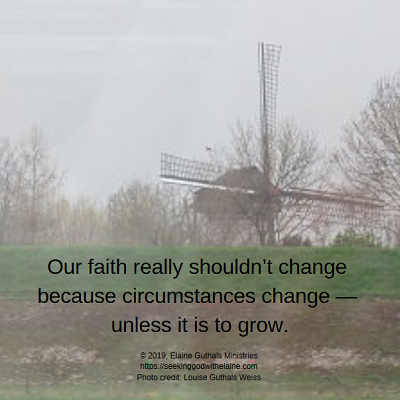
    Could staying in the routine just be considered staying faithful? Our faith really shouldn’t change because circumstances change — unless it is to grow. We shouldn’t lose our faith because things get hard. Faith shouldn’t take a hike because it seems like God did. Faith should keep on keeping on.

    Windmill

    So, when it seems like the Three in One are in the tomb, keep on keeping on. They will be back — because they aren’t really gone.

    Father. You are the One to whom we talk. Son, You are the reason we can talk. Holy Spirit, You are how we talk. When it seems that You are in the tomb again and out of our lives, it is because we have put you there. Help us to keep in our routines of seeking You. Help us to remain faithful and not get discouraged. Show us what is acting as the stone to seal You in the tomb out of our lives so we can ask You to remove it. We wait to be in sweet fellowship with You again. Amen.

    What do you think? Do you think it is advantageous to keep in a routine during those silent times? Or is it better for you to change things up? Leave me a comment below (about this or anything else) or head over to my Facebook group for some interactive discussion.

    If you have not signed up for the email daily or weekly providing the link to the devotions and the newsletter, do so below.

    If God has used this devotion to speak with you, consider sharing it on social media.

  • Why Did God Forsake Jesus?

    My God, my God, why have you forsaken me?
    Matthew 27: 46 (NIV)
    Scripture: Matthew 27: 32-56

    We all have had times we feel that God is not answering our prayers. The darkness that fell when Jesus was on the cross showed that God had to step back. This devotion discusses why it feels like God does not answer our prayers.

    Flowers with title Why Did God Forsake Jesus?

    We’ve always heard about how great a relationship God and Jesus had. Two times during Jesus’ ministry, God spoke, saying He was pleased with His Son. The first time was at Jesus’ baptism (Mt. 3: 16-17). Also, God’s voice was heard at the Transfiguration (Mt. 17: 5). God wanted everyone to know that He was pleased with His Son.

    Jesus spent all-nighters praying to God (Lk. 6: 12). He’d get up early to have His quiet time with His Father (Mk. 1:35). He made sure He spent time with His Dad.

    God, Where Are You?

    Then, bam! Jesus’ prayers hit the ceiling. God wasn’t listening to Him. It looked like God had left Him — and just at the time Jesus needed Him most.

    How do we know God left Jesus? “Now from the sixth hour until the ninth hour there was darkness over all the land” (Mt. 27: 45 NKJV).

    Here Jesus was hanging on the cross, doing and having done everything God had asked Him. He was completing His mission and completing it well.

    And where was God? Nowhere around.

    God had turned His back. Sin cannot exist in His Presence. Jesus had to take all of our sins — past, present, and future — onto Himself. So, God had to step back for a second so Jesus could do His job.

    God had to step back for a second so Jesus could do His job.

    Think about how Jesus felt. His mind must have rationalized it all. This was part of the plan. Yes, He knew God had to step back once He had assumed all of our sins.

    But sometimes when the hurt gets too much, we don’t think straight. All we focus on is the hurt.

    Think what His heart was saying. “You know I didn’t deserve all of this. I’m clean. I volunteered for this. I did everything You ever asked and didn’t once grumble. I was Your Obedient Servant in everything. Why are You cutting out when things are going as planned?”

    Maybe His human side was saying that. Well, probably not. He was quoting scripture again (Ps. 22: 1) — something He was really good at. Maybe He was just acknowledging the fact that God had to turn away from Him. Still, that was a novel experience.

    How many times do we say Jesus knows how we feel because He has felt it also? How many times had Jesus’ prayers hit the ceiling before? None. He didn’t have much more time to experience this. It had to have been then or never. God had to not answer Him.

    So, Jesus found out what it was like to be searching for God and not finding Him. And it is usually our sin that is getting in the way. He could now sympathize with us.

    What Does This Mean?

    All that is recorded in the gospels is that Jesus just said verse 1 of Psalm 22, but I have read somewhere that He said the whole thing. If we limit our knowledge to just verse 1, we miss some important points.

    Psalm 22: 3 says, “But You are holy, Enthroned in the praises of Israel” (NKJV). After His prayers ran into the roadblock, did He scream, “Okay. The deal is off. Come on, angels. Get me off this cross!”

    No, He stayed there. He knew God’s plan was the best plan. He trusted His loving Heavenly Father to take Him through the valley, albeit silent, invisible from Him. He knew God would meet Him on the other side.

    The next part strikes a chord. “But I am a worm, and no man; A reproach of men, and despised by the people. All those who see Me ridicule Me; They shoot out the lip, they shake the head, saying, ‘He trusted in the Lord, let Him rescue Him; Let Him deliver Him, since He delights in Him!’” (Ps. 22: 6-8 NKJV).

    We humans are so contradictory. We tear ourselves down, believing the worst in us, but then we are so prideful. We generally don’t call ourselves worms anymore, but I am sure we each have our own descriptive negative way to refer to ourselves. When things are at the worst, we are really creative in how we tear ourselves down.

    Did you see that? The Psalmist foretold the ridicule Jesus was going to experience while hanging on the cross.

    To read Did Jesus Experience Peer Pressure?, click the button below.

    How comforting is Psalm 22: 10-11! “I was cast upon You from birth. From My mother’s womb
    You have been My God. Be not far from Me, For trouble is near; For there is none to help” (NKJV). God is not far from us in times of trouble — in fact, ever. Even from before birth, He is there.

    Okay, I had to do verse 15 in another translation because I had no clue what a potsherd is. “My strength is dried up like baked clay; my tongue sticks to the roof of my mouth. You put me into the dust of death” (Ps. 22: 15 HCSB). Isn’t that a great description of how we feel when we are going through our trials? We feel as breakable as potsherd/baked clay.

    Verse 16 is appropriate, also. “For dogs have surrounded Me; The congregation of the wicked has enclosed Me. They pierced My hands and My feet” (Ps. 22: 16 NKJV). Don’t we sometimes feel everything closing in on us in the trials we experience?

    Believers are very thankful that they can call out to our Loving Father in times of trials. “But You, O Lord, do not be far from Me; O My Strength, hasten to help Me!” (Ps. 22: 19 NKJV). And we, like Jesus, can say, “… You have answered Me” (Ps. 22: 21). Because He does.

    Even though we think differently in the most difficult situations, “… He has not despised nor abhorred the affliction of the afflicted; Nor has He hidden His face from Him; But when He cried to Him, He heard” (Ps. 22: 24 NKJV). God will never leave us. He hears us when we call.

    How Can We Apply This?

    We talked in a previous devotion about how God answers our prayers — yes, no, wait, or He has something better.

    To read Did Jesus Struggle with His Mission?, click the button below.

    There could be a number of different reasons why God doesn’t immediately tell us “yes.” It could be we are asking for something outside His Will. He might have to work some thing out first — either in us or someone else. We may think something is perfect for us — like a job — but He has a different one in mind — one that is so much better.

    Lately, I’ve been considering why God is silent when we call out to him. Every once in a while, I see on Facebook the meme where the teacher is silent during the test.

    Isn’t that the truth? The teacher will lecture to give us what we need to know about something. S/He will provide examples to show us what is right. We get to do exercises where we apply what we are learning. There are quizzes so we can figure our what we know and don’t know.

    Then comes test day. This is where the rubber hits the road. How are we going to do when it really counts?

    God through His Word tells us what we need to know. Jesus has given us examples to show us how to apply that. We have to make daily choices to show we are letting God have control in our lives.

    Then the big one hits. It is up to us to keep our trust in God. It is up to us to resist the temptation to sin.

    Sunset over water

    God isn’t going to step in and force us to react His way. He is going to allow our free will to decide. We have to choose to follow Him and live for Him.

    Did you notice what isn’t in Psalm 22? Nowhere in those verses does Jesus show any resistance to the trial He is going through. Not us. We generally kick and scream saying we want out of this situation.

    Even though it isn’t recorded, I bet it is a safe bet that Jesus kept praying while He was on the cross.

    Remember, we just read Matthew 27: 45? Have you read the next verse? “And about the ninth hour Jesus cried out with a loud voice, saying, ‘Eli, Eli, lama sabachthani?’ that is, ‘My God, My God, why have You forsaken Me?’” (Mt. 27: 46 NKJV). The darkness lasted until the ninth hour — which is when Jesus asked God why He had forsaken Him.

    Jesus said, “God, where are You?” God said, “Right here.”

    God is right here for us, too — even when we think He isn’t.

    Loving Heavenly Father. Why can’t we be more like Jesus? Why can’t we simply trust — even in the silent times? Why can’t we realize You have a plan, and that plan is best — even if it hurts? But that would mean taking our eyes off ourselves and concentrating on You, Lord. That is the way You want it. That is the way Jesus did it. Help us to be more like Christ. Amen.

    What do you think? When you feel your prayers hitting the ceiling, what strategies do you use to remain faithful to God? Leave me a comment below (about this or anything else) or head over to my Facebook group for some interactive discussion.

    If you have not signed up for the email daily or weekly providing the link to the devotions and the newsletter, do so below.

    If God has used this devotion to speak with you, consider sharing it on social media.

  • Did Jesus Experience Peer Pressure?

    People passing by shook their heads and hurled insults at Jesus: “Aha! You were going to tear down the temple and build it up in three days! Now come down from the cross and save yourself.
    Mark 15: 29-30 (TEV)
    Scripture: Mark 15: 22-32

    More and more, believers are pressured to conform to the worldview. Peer pressure isn’t something new. This devotion looks at the pressure Jesus suffered while on the cross.

    Flowers with title Did Jesus Experience Peer Pressure?

    Imagine the scene. The betrayal. The arrest. The trial. No, on second thought, don’t image it. It is too sad. Jesus was guilt-free.

    Imagine Jesus dragging His cross through the streets. Imagine the sound of the hammer striking the spikes, the agony. No, on second thought, don’t. It’s too gruesome.

    Imagine Jesus hanging on the tree. The pain. The loss of breath. The mental agony of knowing the end of His human life was near.

    I always shake my head at Mark’s 15: 19. It says people were passing by. What? They were all in a line parading by so they could say they saw Jesus on the cross?

    But some didn’t stop at that. They hurled taunts at our Savior.

    Pressure From the Crowd

    What did the onlookers say? “Save yourself.” “Come down from there.” “You said you could save yourself.”

    What were they really saying? “Prove that You are the Messiah.” “We have to see Him come down to believe.”

    Even one of the criminals crucified with Jesus added his two cents worth. “… Aren’t you the Messiah? Save yourself and us!” (Lk. 23: 39 TEV). The thief was in for the duration. He knew Jesus was his only way out.

    But Jesus was in for the duration, also — even with all the abuse being hurled at him. He was going to work the plan.

    Jesus knew if He gave in to the challenge of the crowd, the plan of salvation would not be realized. If He had come down from the cross, He wouldn’t have died — we would, spiritually.

    Cross

    What Does This Mean?

    Jesus taught us by example how to withstand peer pressure. It had to have been hard for Him hanging on the cross, listening to everyone biting on Him, knowing He did have the power to come down.

    The crowd wanted Jesus to believe what they believed — that He was not the Messiah, that He was not the Son of God.

    Yes, they wanted Jesus to perform a miracle but not for validation of Who He was. Yes, they might have been amazed if He came down off the cross, but then He wouldn’t be doing the will of the Father.

    But Jesus hung on that cross for what He believed in. He knew His cause was worth whatever abuse He received.

    How Can We Apply This?

    We also get abuse hurled at us. For the younger generation, we think of peers giving us grief because we don’t dress in the outlandish costumes they do, have a nose ring, and sport a creative haircut and color.

    But we can also experience peer pressure as adults. We still hear it from friends and coworkers when we say “no” to allowing drugs and alcohol rule our lives. (Have you ever felt pressured to go for a drink after work? Or to one of the many parties a coworker hosts?)

    Then our coworkers can’t understand our code of ethics. They don’t understand when we won’t blur the lines to succeed. Climbing the corporate ladder has long been associated with climbing it on the backs of others. They ridicule us when we won’t perform that way.

    God knew that we would undergo pressure to accept the worldview. Romans 12: 2 says, “Do not be conformed to this age, but be transformed by the renewing of your mind, so that you may discern what is the good, pleasing, and perfect will of God” (HCSB).

    “Renewing of your mind” might be a confusing concept for some. What does that really mean?

    Let’s look at that verse in a different version. “Do not conform yourselves to the standards of this world, but let God transform you inwardly by a complete change of your mind. Then you will be able to know the will of God — what is good and is pleasing to him and is perfect” (Rom. 12: 2 GNT).

    We change our minds. But I think it is more than that. We change our focus. So, how do we do that?

    We have to reaffirm what our values and beliefs are. We have to decide for ourselves what is right and wrong — and we stick to that.

    Sometimes, we have to have the inner strength to walk away. Walking away can be scary and painful. Starting a new chapter in our lives can be formidable with all of its unknowns and unfamiliars. Walking away from a long-term friend can be heartbreaking.

    We also have to walk away from situations that make us uncomfortable or that put us in the position of being pressured. We know once we do something, it is easier to do it again the next time. We just have to remember that works for the positive as well as the negative.

    Most times, we have to have the confidence we are making the right decisions. If we continue to question whether we have made the right decisions, it will be easier to convince ourselves we haven’t when we have.

    It is easier when we have someone to support us. That is why God intended us to be a part of a fellowship of believers. Find someone to mentor you or a prayer partner.

    When we do buckle under the peer pressure, it seems we do so because we just want to fit in and be accepted. (And we will buckle).

    It is really hard to tune out those that are pressuring us. We have to ask ourselves whether we ultimately want to be accepted by the world or by God. We have to use the times we buckle as learning experiences. (Remember, God grows us through the trials.)

    We have to ask ourselves whether we ultimately want to be accepted by the world or by God.

    To read We’re Going to Have Trials, click the button below.

    We can withstand peer pressure. We just have to keep our focus on God. All we have to do is pray and tap into His resources.

    Loving Father. In our mind’s eye, we see Jesus on the cross, hanging there in sheer physical agony. We see Him silently withstanding all the abuse hurled at Him. The old nursery rhyme does not tell it like it is. Sticks and stones may break our bones, and words can cut us to the core. It must have cut Jesus, there on the cross, to hear everyone saying “save yourself” — when that was exactly what He was doing. He did it for our sake. Help us, Lord, when we get abuse hurled at us for Your sake. Remind us of the example Jesus was to give us strength to stand up for what we believe in — You. Amen.

    Edit

We can withstand peer pressure. We just have to keep our focus on God.

    What do you think? What strategies to you use most often to withstand peer pressure? Leave me a comment below (about this or anything else) or head over to my Facebook group for some interactive discussion.

    If you have not signed up for the email daily or weekly providing the link to the devotions and the newsletter, do so below.

    If God has used this devotion to speak with you, consider sharing it on social media.