Category: Sin

  • We Shouldn’t be Kept from Suffering and Tribulation

    Even though we are not of the world, we still have to experience the results of sin. This devotional reading looks at experiencing suffering and tribulation.

    Nuggets

    • Disciples shouldn’t be kept from suffering.
    • Disciples shouldn’t be kept from tribulations.

    Suffering is hard. Our reaction is usually to want to end quickly if it has to start at all.

    Wilcox said that disciples should not be kept from suffering for righteousness’ sake. Let’s see what new we can glean from this topic.

    Let’s Put It into Context

    To read devotions in the Habitual Holiness of Heart and Life theme, click the button below.

    Here is a running list of nuggets for the theme.

    Devotions in the Habits to Keep Us from Evil study

    Here is a running list of nuggets for the study.

    We are using Wilcox’s sermon as the foundation for this series.

    Resource

    Suffering because of the World

    “If you were of the world, the world would love you as its own; but because you are not of the world, but I chose you out of the world, therefore the world hates you” (Jn. 15: 19 ESV)

    Disciples shouldn’t be kept from suffering.

    Okay. This verse again. We have looked at it several times — some just recently.

    But let’s look at this through the lens of what shouldn’t be expected of disciples. That is a bit of a switch.

    Disciples are to in the world but not of it. We look at that to mean that we should be righteous in a sinful world.

    But let’s look at the world.

    Manning described different ways the world is seen. He wrote, “Some people denounce the world as unmixed evil; some say it is for the most part good, or at least innocent: some profess to see its deceitful workings everywhere; some will see them nowhere: some make their religion to consist in a separation from the world; some think the field of their religious duty is in the world: in a word, there is little or no agreement or certainly but in this, that there is such a power and reality as the world, and that it is of great moment to us to know what it is.”

    Resource

    God sees world as unrighteous. Thomas explained what that means.

    • Atheism
    • Materialism
    • Selfishness

    Resource

    It became that way because of the original sin, but it continues that way because of our continued sin. Because of this, we suffer the consequences and results of sin.

    The consequences of sin are spiritual death and separation from God.

    • Spiritual death is the separation from God that occurred as a consequence of Adam and Eve’s original sin.
      • The spiritually alive are those who have ABCDed, so they are no longer separated from God.

    The results of sin are poverty, crime, disease, death just to name a few.

    Glossary

    The ABCDs of Salvation

    If you have not become a believer in Christ, please read through the
    Plan of Salvation and prayerfully consider what God is asking you to do.

    A – admit our sins
    B – believe His Son Jesus is our Redeemer
    C – confess God as Sovereign Lord

    D – demonstrate that commitment by making any changes needed in our lives to live the way in which God has called us

    The Disciple’s Job Description

    It is the results of sin that has caused the world to be in the shape it is today. This is what causes the suffering we face.

    When it says disciples are in the world, it means we are all in it. Yes, as holy saints, we are set apart, but that is the of the world part.

    We aren’t taken out of the world. That means we are tempted to sin in every way possible.

    Thank God we have repented of our sins and accepted God’s salvation!

    Repentance is acknowledging our separation from God and expressing sorrow for breaking God’s laws and commandments by making the commitment to change our sinful ways to ways of righteousness through obedience.

    • Sin is not believing that Jesus is our Savior to save us from our actions by humans that disobey God and break one of His reasonable, holy, and righteous laws and commandments, goes against a purpose He has for us, or follows Satan’s promptings.
      • Holy means to be set apart — because of our devotion to God — to become perfect, and morally pure while possessing all virtues and to serve and worship God.
        • Perfection means we reach a state of maturity because the combination of the spiritual graces form, when all are present, spiritual wholeness or completeness — holy, sanctified, and righteous.
          • Spiritual graces are worldly morals that have been submitted to God to further His kingdom instead of enhancing this world.
          • Sanctified means to be set free from sin.
          • Righteous means we are free from sin because we are following God’s moral laws.
        • Pure means not being sinful or having the stain of sin. 
        • Virtues are standards of moral excellence.
    • Obedience means submitting ourselves to the will of God as it is presented to us and living our lives accordingly.

    Salvation is the gift of life through the deliverance from condemnation and sin to acceptance and holiness and changes us from being spiritually dead to spiritually alive.

    • Holiness is the transcendent excellence of His nature that includes elements of purity, dedication, and commitment that lead to being set apart.
      • Purity means possessing God’s moral character, having eliminated the stain of sin.

    Glossary

    But we still have to experience the tribulation. We have to endure the temptation and the hurt caused and not lose our dependence on and belief in Him.

    Tribulation because of the World

    “I have said these things to you, that in me you may have peace. In the world you will have tribulation. But take heart; I have overcome the world” (Jn. 16: 33 ESV)

    Disciples shouldn’t be kept from tribulations.

    How many times does our eyes stop on the word peace in this verse? We gloss over the will have part. We think the peace negates the tribulation part — especially the worldly type.

    But it doesn’t.

    Clapperton reminds us Jesus was talking about a spiritual peace. He wrote, “This is plain from the fact that it was to be enjoyed during tribulation, and it is the peace which Jesus promises in these words: ‘Peace I leave with you, not as the world giveth.’”

    Resource

    The problem is we think peace and tribulation are on opposite ends of the continuum. That limits God and is not true. “Not that I am speaking of being in need, for I have learned in whatever situation I am to be content” (Phil. 4: 11 ESV).

    Disciples are still going to experience the results of sin, even when we have addressed the consequences of sin. There is no getting around that.

    There is a reason we are to rejoice in our sin. “Not only that, but we rejoice in our sufferings, knowing that suffering produces endurance, and endurance produces character, and character produces hope, and hope does not put us to shame, because God’s love has been poured into our hearts through the Holy Spirit who has been given to us” (Rom. 5: 3-5 ESV).

    When tribulations interrupt our peace, we have to find the everlasting joy in the Lord. “So also you have sorrow now, but I will see you again, and your hearts will rejoice, and no one will take your joy from you” (Jn. 16: 22 ESV).

    I love Vaughan’s definition of peace. He wrote that it is “… a stilling sense of the love of God.” He also said that it is the root of holiness.

    Resource

    I love that word picture of stopping to bask in God’s love. To me, it ties right into “Be still, and know that I am God …” (Ps. 46: 10 ESV).

    Take our eyes off the boiling pot in which we are living and focus on the One Who’s attribute is love.

    Vaughan went on to say that, as we continue to laser our focus onto God, it becomes a habit. We let go of our anxieties and focus on our faith.

    Screenshot 2023-10-23 at 11.03.14 PM

    Making the Connections #1

    Jesus never sugarcoated our experiencing tribulation. In fact, He prophesied that we would face tribulation all the way up to persecution. “Then they will hand you over to be persecuted, and they will kill you. You will be hated by all nations because of my name” (Mt. 24: 9 CSB).

    All this was said to prepare us for what will happen. We can equip ourselves for it as we look for it.

    We know that there will be seasons of tribulation. It will come and go in order to grow us to where we need to be.

    Making the Connections #2

    I know I’ve said this before, but we shouldn’t want to not have suffering and tribulation. That is how we grow closer to God.

    We aren’t going to grow our faith during the easy times. That is when we think we can depend on ourselves.

    We don’t want that. We want the sin in our lives identified and cut out. Our goal should be to get our character to reflect His.

    How Do We Apply This?

    • Accept that we will suffer because we are in the world.
    • Repent when we give into temptation.
    • Recognize that the tribulations we suffer are short lived.
    • Find joy in all our circumstances.
    • Equip ourselves for tribulations by being buried in God’s Word.
    • Remember, Jesus has already overcome the world, ensuring our victory.
    • Let go of our anxieties and focus on our faith.

    Resources

    Father God. Thank You for offering to us the Plan of Salvation. We need to restore our relationships with You. We do know that accepting Your gift of salvation will not keep us from experiencing the results of sin. We will still have suffering and tribulations, even persecution. Help us to take our focus off them and put it on You to receive Your peace and love. Amen.

    What do you think?

    Leave me a comment below (about this or anything else) or head over to my Facebook group for some interactive discussion.

    If you don’t understand something and would like further clarification, please contact me.

    If you have not signed up for the email providing the link to the devotions and the newsletter, do so below.

    If God has used this devotion to speak with you, consider sharing it on social media.

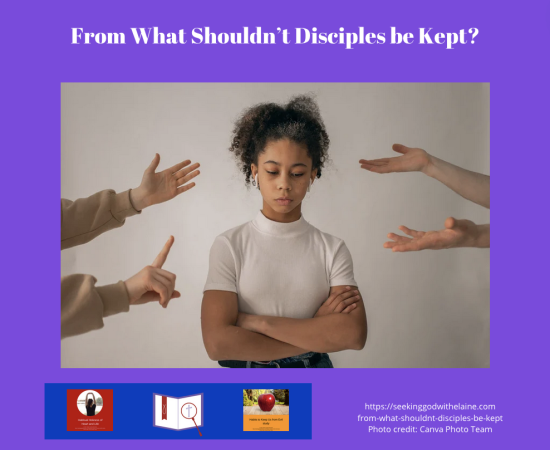
  • From What Shouldn’t Disciples be Kept?

    Isn’t it assuring that disciples should be kept from evil? But what does that mean? This devotional reading begins looking at things from which we should not be kept.

    Nuggets

    • Disciples shouldn’t be kept from God’s love.
    • Disciples shouldn’t be kept from discipline.
    • Disciples shouldn’t be kept from being judged.

    This devotion is going to start a new series in a new study. The study is going to be Habits to Keep Us from Evil.

    Before we can figure out what habits we need, we have to identify the evil from which we should be kept.

    We are using Wilcox’s sermon to delve into this. He started with a list of things from which believers shouldn’t be kept. He wrote it is not “An absolute freedom from all afflictions, which are either the consequences of sin or corrections of God.”

    Resource

    What do we as disciples need from God and shouldn’t be kept from?

    Let’s Put It into Context

    To read devotions in the Habitual Holiness of Heart and Life theme, click the button below.

    Here is a running list of nuggets for the theme.

    Devotions in the Habits to Keep Us from Evil study

    Here is a running list of nuggets for the study.

    We are using Wilcox’s sermon as the foundation for this series.

    Resource

    God’s Steadfast Love

    “My steadfast love I will keep for him forever, and my covenant will stand firm for him” (Ps. 89: 29 ESV)

    Disciples shouldn’t be kept from God’s love.

    We know that God loves believers and non-believers. “For God so loved the world, that he gave his only Son, that whoever believes in him should not perish but have eternal life” (Jn. 3: 16 ESV).

    God loves all the world. His salvation is available to all. Each of us has to make a conscious decision whether or not to follow Him.

    Does it surprise you that God loves non-believers? It shouldn’t. His character is love.

    But don’t delude yourself into thinking God will be lenient toward non-believers. They will eventually get their Judgment Day.

    We will be corrected just as Israel was corrected.

    “But if you turn aside and forsake my statutes and my commandments that I have set before you, and go and serve other gods and worship them, then I will pluck you up from my land that I have given you, and this house that I have consecrated for my name, I will cast out of my sight, and I will make it a proverb and a byword among all peoples. And at this house, which was exalted, everyone passing by will be astonished and say, ‘Why has the Lord done thus to this land and to this house?’ Then they will say, ‘Because they abandoned the Lord, the God of their fathers who brought them out of the land of Egypt, and laid hold on other gods and worshiped them and served them. Therefore he has brought all this disaster on them’” (II Chron. 7: 19-22 ESV).

    Isn’t that what books of the Old Testament are about? Israel turned away from God and Abraham’s covenant. God sent them into exile; sent earthquakes and famines to correct them; listened to their repentance and forgave them; and brought them back to freedom.

    God could have withdrawn His love from us after the original sin – or at any point thereafter. He didn’t.

    God chose to fulfill His covenant with Abraham – and now His covenant with Jesus.

    But that doesn’t mean God won’t correct us when we sin. He has a variety of ways in which He does that. He can switch up the mean, measure, and duration in which He does that.

    Regardless of how He chooses to correct us, God will never withdraw His love from us.

    Two Dangers of Correction

    “‘For the Lord disciplines the one he loves, and chastises every son whom he receives.’ It is for discipline that you have to endure. God is treating you as sons. For what son is there whom his father does not discipline?” (Heb. 12: 6-7 ESV)

    Disciples shouldn’t be kept from discipline.

    Ooo, baby. We know we’ve done wrong, but we so hate to be disciplined.

    No, we aren’t sent to the principal’s office to get our bottoms spanked. As we just discussed, God uses a variety of corrections to get the job done.

    Despising Corrections

    We shouldn’t kick and scream when God corrects us. Bates said that disciples should “… preserve themselves from the vicious extremes of despising the [chastenings] of the Lord, or fainting under them.”

    Resource

    That is logical. That fits in with being sober. Being sober is a character trait distinguished by self-control, genuineness, and sound moral judgment. It is a calm and temperate disposition.

    Being even keeled when we are sober means we don’t experience the extremes when we are corrected. We are content with whatever comes our way.

    Instead, we should make sure we know exactly why God is correcting us. We need to evaluate ourselves to determine the status of our relationship with Him.

    I know. Self-evaluation can be painful, too. It can seem unending.

    God wants us to partner with Him in transforming us to who He wants us to be.

    Fainting

    We tend to think we become unworthy when we sin. We have to realize that God still counts us worthy enough to warrant correction.

    Whenever we are corrected, it is for God’s glory. The goal is to redirect our paths to follow Him more closely.

    Think about it. It really dishonors God when we kick back at Him trying to improve us.

    But yet we do because the correction usually hurts. And face it, we are usually allergic to pain.

    We don’t want to become so obstinate that we allow God’s correction of our sin to destroy our relationships with Him.

    We don’t want to become so obstinate that we allow God’s correction of our sin to destroy our relationships with Him.

    What happens when we don’t endure the correction? “Consider him who endured from sinners such hostility against himself, so that you may not grow weary or fainthearted” (Heb. 12: 3 ESV).

    We get tired and faint. But to me this is more than lose consciousness for a short amount of time.

    To me, this will turn us into a Matthew 7: 21 person — who is really a goat.

    To read a related devotion, click the button below.

    Fainting here isn’t exactly as we think it is. This isn’t weak and dizzy until we lose consciousness.

    This is choosing to give up on God. Whether we are angry at God of what we consider punishment or whether we give up thinking this is all there is because it will never end, the choice is made to turn away from God.

    When we kick at God’s correction, we set ourselves up for further temptations by Satan. Those sins are going to be worse than the ones we’ve already committed.

    That makes God withdraw His judgments from us. Trust me, we don’t want God withdrawing from us in any way, shape, or form. We may think we are better off because the pain of the correction isn’t happening.

    We aren’t.

    What we must never lose sight of is that God sends the corrections as our Father. True, it has an element of judgment, but the intent is to transform us into His pure children.

    The corrections we get here on earth are nothing compared to the judgment we will receive on Judgment Day. This isn’t punishment.

    This is love. God loves us enough to want to transform us to be more like Him.

    God loves us enough to do the hard things to cut sin out of us.

    Judged, not Condemned

    “But when we are judged by the Lord, we are disciplined so that we may not be condemned along with the world” (I Cor. 11: 32 ESV)

    Disciples shouldn’t be kept from being judged.

    I know. The world doesn’t think it is condemned.

    It is.

    “Whoever believes in him is not condemned, but whoever does not believe is condemned already, because he has not believed in the name of the only Son of God” (Jn. 3: 18 ESV).

    The world was condemned as soon as Adam and Eve bit. They just don’t want to accept that.

    But then, the world doesn’t think that God should be the one to judge it, either. Some things God says is a sin isn’t in their book. Plus, that is when they stress free will.

    Why are there degrees in judgment? Vaughan addressed that. He wrote,

    “And I cannot read in this record the ‘thus far and no farther.’ I catch here the faint echo of the thought that God our Father has us all in His school, and is carrying on our education for a life beyond death by a direct providential dealing with us in the way of mental and bodily chastisement. ‘For this cause’ — because of such and such a sin, with which the man would not deal for himself — ‘many are weak,’ etc.”

    Resource

    • God doesn’t box Himself into a corner regarding how far He will go to correct us. His goal is to get the job done, not sugarcoat it for our sakes.
    • God is correcting every one of His children. We don’t get a pass.
    • Some correction may be physical. Some may be mental. God has a variety of methods at His disposal.
    • Regardless of the variety of methods and durations, the root cause for the correction is the same in all cases — sin.

    How can this correction give us hope? How can it not?!?!

    God is correcting us in anticipation of perfecting us.

    Don’t get me wrong. God isn’t up in Heaven, rubbing His hands together in anticipation of inflicting pain on us.

    If He could find another way to reach the goal of correcting us, God would. But He can’t.

    Now, we may try to get out of our part in correcting us. That doesn’t mean the correction is avoided. God will do it all Himself if need be.

    Nor can we do all the correcting ourselves— even if we include suffering. God is the only One Who can transform us.

    The way to look at judgment and correction is that it isn’t us against God. We are on the same team — God’s team.

    But hold on a second. We have to put this verse in context.

    Paul is talking about the Lord’s Supper in this passage. His point is that we need to evaluate ourselves before we observe the ordinance.

    God is chastising His children for not worshiping Him correctly. His correction is always about our spiritual condition, not just our actions.

    from-what-shouldnt-disciples-be-keptFB

    Making the Connections #1

    Smeaton gave us a great reminder. He wrote, “It is taken for granted that the seed of Messiah shall go astray; but their sins, it is added, do not break the covenant, which stands fast for evermore; for it was not made with us, but with the Son for us.”

    Resource

    Disciples have gained salvation, but we have not yet been perfected. We are still going to sin.

    What Smeaton said – the seed of the Messiah will continue to sin – agreed with what John wrote. “If we say we have no sin, we deceive ourselves, and the truth is not in us” (I Jn. 1: 8 ESV).

    God does not withdraw His love when disciples continue to sin no more than He withdraws it when we don’t ABCD.

    Why? God’s love is based on Him and Who He is rather than what we do nor do not do.

    Making the Connections #2

    It all boils down to how we react to this correction. I love how Fuller told us to respond. He wrote, “Let us, then, [endeavor] to amend, when God layeth His least judgment upon us. Let us humble ourselves under His hand when He layeth but His ‘little finger’ upon us; for light punishments, neglected, will draw heavier upon us.”

    Resource

    • We respond in repentance.
    • We respond with humility.
    • We respond immediately.

    We shouldn’t ignore God’s correction.

    How Do We Apply This?

    • Expect God to correct us when we sin.
    • Remain even keeled when corrections come.
    • Realize God considers us worthy enough to be corrected.
    • Be excited about following God’s laws and commandments.
    • Humbly submit to and depend on God in everything.
    • Don’t faint or turn away from God.
    • Don’t talk back when corrections come.
    • Use the corrections to fuel repentance.

    Resource

    Father God. We want to be transformed by You. We know that will mean enduring discipline and judgment. We are ready for that. May we never be separated from Your love. Amen.

    What do you think?

    Leave me a comment below (about this or anything else) or head over to my Facebook group for some interactive discussion.

    If you don’t understand something and would like further clarification, please contact me.

    If you have not signed up for the email providing the link to the devotions and the newsletter, do so below.

    If God has used this devotion to speak with you, consider sharing it on social media.
  • Joel’s Last Words

    Joel had warned the Israelites – and us – of the coming day of the Lord. This devotion looks at his final words about preparing for God’s judgment and how He provides for us.

    Nuggets

    • We prepare for Judgment Day by growing in God’s favor.
    • God will provide for His children after the desolation of judgment.

    Devotions in The Days According to Joel series

    Joel’s book isn’t very long, so he was laser focused to warn us about the coming day of the Lord. He truly wanted us to be prepared for it.

    Let’s Put It into Context

    Here is a running list of nuggets for the series.

    Consecrate for War

    “Proclaim this among the nations: Consecrate for war; stir up the mighty men. Let all the men of war draw near; let them come up. Beat your plowshares into swords, and your pruning hooks into spears; let the weak say, ‘I am a warrior.’ Hasten and come, all you surrounding nations, and gather yourselves there. Bring down your warriors, O Lord. Let the nations stir themselves up and come up to the Valley of Jehoshaphat;
for there I will sit to judge all the surrounding nations. Put in the sickle, for the harvest is ripe. Go in, tread, for the winepress is full. The vats overflow, for their evil is great. Multitudes, multitudes, in the valley of decision! For the day of the Lord is near in the valley of decision. The sun and the moon are darkened, and the stars withdraw their shining. The Lord roars from Zion, and utters his voice from Jerusalem, and the heavens and the earth quake. But the Lord is a refuge to his people, a stronghold to the people of Israel” (Jl. 3: 9-16 ESV)

    We prepare for Judgment Day by growing in God’s favor.

    It is interesting. The English Standard Version translates it consecrate. The King James Version translate it prepare.

    Excell told us why we need to prepare. He wrote, “Great armies are arrayed against God. They are bold in atheism. They are cunning in sin. They are malicious in temper.”

    Resource

    Joel told us how we should prepare. “Beat your plowshares into swords, and your pruning hooks into spears; let the weak say, ‘I am a warrior’” (Jl. 3: 10 ESV).

    I know that isn’t what we are used to hearing. We are more used to what Isaiah said. “… and they shall beat their swords into plowshares, and their spears into pruning hooks …” (Isa. 2: 4 ESV).

    The switch is brought about by sin. Sin destroys the peace and brings war and chaos.

    For the last battle, Excell said that principles of good will be adapted to promote evil. Jesus’ words will be twisted to promote Satan’s evil.

    Think about it. Hasn’t that already started?

    Jesus said, “A new commandment I give to you, that you love one another: just as I have loved you, you also are to love one another” (Jn. 13: 34 ESV).

    But worldview people have twisted that to say, “What difference does it make as to who we love?”

    It does make a difference because worldview people use it to disobey God. That leads to destruction.

    But sin has limits. (I know. It doesn’t feel like it.)

    Let’s think about it a minute. God is in control of the plans for our lives (Jer. 29: 11), not Satan. He knows how and when we are going to face trials (I Pet. 5: 9).

    Satan had to ask God for Job (Job. 1: 6-12) and Peter (Lk. 22: 31-34). Even the demons obey Him. “And they were all amazed, so that they questioned among themselves, saying, ‘What is this? A new teaching with authority! He commands even the unclean spirits, and they obey him’” (Mk. 1: 27 ESV).

    One day, God will have had enough. He will have reached His limit. Judgment Day will be here.

    No one but God knows when that will be. Even Jesus said He didn’t know (Mt. 24: 36).

    What has to happen so that can happen.

    • God’s patience with sin has to reach its limits.
    • All who are going to be saved will be saved.
    • His disciples will have grown to where they should be on the Sanctification Road.

    For what are we aiming? Our goal is to be morally mature in God’s character. That is what perfection is all about. When we reach maturity, we are ripe for the harvest.

    Now, it looks like Joel said that Judgment Day would occur in the Valley of Jehoshaphat. According to Diggle, he was basing this on tradition. Jesus never put a place on it any more than He put a time to it.

    It doesn’t matter. Diggle told us what matters. He wrote,

    “The blessed are deciding their own blessedness when they cultivate holiness of character, and the cursed are deciding their own doom when they are forgetting God and living in sin. The valley of decision is the valley which each man treads in the road of life. It is here and now.”

    Resource

    Don’t miss that. The time to decide is this minute.

    When we do decide to submit to God, we receive hope. “… But the Lord is a refuge to his people, a stronghold to the people of Israel” (Jl. 3: 16 ESV).

    God’s refuge is where we go for fixing. Jackson told us why we can only go to Him. He wrote, “He alone combines the knowledge, the ability, and the will which are needful.

    Resource

    We’ve got to decide now because this decision brings us new life. It makes us new creations.

    Glossary

    Did you see what the last verse said? Jesus is our stronghold. He is our strength.

    If we would only put as much work into increasing our spiritual strength as we do our physical strength!

    So, what is spiritual strength? It is a mature mind, focused on God and possessing His knowledge. It is a firm faith that will obey Him.

    No, we aren’t there yet. We are still navigating the Sanctification Road.

    The Glorious Future

    “So you shall know that I am the Lord your God, who dwells in Zion, my holy mountain. And Jerusalem shall be holy, and strangers shall never again pass through it. ‘And in that day the mountains shall drip sweet wine, and the hills shall flow with milk, and all the streambeds of Judah shall flow with water; and a fountain shall come forth from the house of the Lord and water the Valley of Shittim. ‘Egypt shall become a desolation and Edom a desolate wilderness, for the violence done to the people of Judah, because they have shed innocent blood in their land. But Judah shall be inhabited forever, and Jerusalem to all generations. I will avenge their blood, blood I have not avenged, for the Lord dwells in Zion’” (Jl. 3: 17-21 ESV)

    God will provide for His children after the desolation of judgment.

    After all the devastation done by the locus attack and the abject terror that will accompany the day of the Lord, what follows will be considered the golden age. Look at the prosperity we will be enjoying.

    • Sinners (aka strangers) won’t be present.
    • Wine, milk, and water will be abundant.
    • Enemies will have been conquered.
    • This prosperity will go on forever.
    • God will be living with us.

    Excell applied this to moral influences. Sin won’t be present, so we will be pure. Think of how refreshing that will be after the stain of sin. That will foster joy.

    Resource

    This moral goodness will be present for all eternity.

    That happens only after we have been purified. “Behold! I tell you a mystery. We shall not all sleep, but we shall all be changed, in a moment, in the twinkling of an eye, at the last trumpet. For the trumpet will sound, and the dead will be raised imperishable, and we shall be changed. For this perishable body must put on the imperishable, and this mortal body must put on immortality” (I Cor. 15: 51-53 ESV).

    Remember, this is a spiritual cleansing. God isn’t concerned about this body being eternal. He has a new one for His children.

    What God is concerned about is our witness for Him. We need to be like Him in order to give non-believers an accurate picture of Who He is. We have to show how He saves us and provides for us.

    joels-last-wordsFB

    Making the Connections

    “Multitudes, multitudes, in the valley of decision! For the day of the Lord is near in the valley of decision” (Jl. 3: 14 ESV)

    Joel said that we have to make a decision. We have to make this decision before Judgment Day gets here.

    MacEwen argued that Joel was deeply depressed when he penned these words. I can see this.

    Resource

    Think back about what all Joel has told the Israelites. He has seen their indecision — I would even call it indifference.

    The whole purpose of the book is to warn the Israelites as to what is coming — and they aren’t going to like it.

    But Joel gives them much hope. They can escape Judgment Day — if they obey Gods.

    How do we obey God? No, it isn’t just being a moral person.

    We have to to admit that mankind was separated from God after the original sin, making us sinners; believe Jesus paid the penalty for those sins to become our Savior and Redeemer; confess God as Sovereign God; and demonstrate that commitment by submitting to living our lives following His laws and commandments confessing God as Sovereign Lord.

    Don’t think that this valley of decision is going to be at the start of Judgment Day. Look closely at the Scriptures.

    “Then I saw a great white throne and him who was seated on it. From his presence earth and sky fled away, and no place was found for them. And I saw the dead, great and small, standing before the throne, and books were opened. Then another book was opened, which is the book of life. And the dead were judged by what was written in the books, according to what they had done. And the sea gave up the dead who were in it, Death and Hades gave up the dead who were in them, and they were judged, each one of them, according to what they had done. Then Death and Hades were thrown into the lake of fire. This is the second death, the lake of fire. And if anyone’s name was not found written in the book of life, he was thrown into the lake of fire” (Rev. 20: 11-15 ESV).

    Nowhere in there does it say God is going to ask us, “Well, what is your final decision?” The decision is made in this life.

    Decision time is now.

    How Do We Apply This?

    • Don’t let sin capture us.
    • Don’t be swayed by Satan’s moral evil — what may look moral isn’t.
    • Remember, God will triumph in the end.
    • Navigate the Sanctification Road.
    • Realize while we are growing closer to what God wants us to be that we, in reality, are unworthy and guilty.
    • Grow in trust of Jesus and the Holy Spirit.
    • Decide right now to accept Jesus as our Savior and Redeemer.
    • Renounce our sin.
    • Decide to associate with like-minded believers instead of sinful non-believers.
    • Be encouraged by the prosperity that is coming after judgment for God’s children.
    • Show worldview people what a moral heart should look like.
    • Take God’s story of redemption to the world.
    • Unite in prayer to witness to the world.

    Resource

    Father God. You have provided a way that mankind can be redeemed when we submit ourselves to You and ask Your forgiveness. Unfortunately, Lord, we still continue to sin. You judge us in this life. More importantly, You will judge those who do not submit to You in the day of the Lord. We submit our lives to You. Help us to grow more like You. Amen.

    What do you think?

    Leave me a comment below (about this or anything else) or head over to my Facebook group for some interactive discussion.

    If you don’t understand something and would like further clarification, please contact me.

    If you have not signed up for the email daily or weekly providing the link to the devotions and the newsletter, do so below.

    If God has used this devotion to speak with you, consider sharing it on social media.
  • The Lord Judges the Nations

    One day God will judge all mankind. This devotion looks at what that judgment means and how trying to fight against God doesn’t work.

    Nuggets

    • One day — the day of the Lord or Judgment Day — everyone will stand for judgment before God.
    • We can’t fight against God and win.

    Devotions in The Days According to Joel series

    Chapter 3 of Joel is not dividing in a good manner. This devotion will be short, and the next devotion will be long. But that is just the way it breaks.

    It is what it is.

    What Chapter 3 focuses on is how God provides for His children after judgment. Yes, God is a vengeful God Who punishes those who sin.

    God is also a loving God Who rewards those who are His children.

    Let’s Put It into Context

    Here is a running list of nuggets for the series.

    The Days of Judgment

    “For behold, in those days and at that time, when I restore the fortunes of Judah and Jerusalem, I will gather all the nations and bring them down to the Valley of Jehoshaphat. And I will enter into judgment with them there, on behalf of my people and my heritage Israel, because they have scattered them among the nations and have divided up my land, and have cast lots for my people, and have traded a boy for a prostitute, and have sold a girl for wine and have drunk it” (Jl. 3: 1-3 ESV)

    One day — the day of the Lord or Judgment Day — everyone will stand for judgment before God.

    Joel used the terminology days again. He wasn’t talking the 24-hour kind.

    What Joel was talking about was some time in the future. It was when God’s fullness of time would be complete.

    One of Joel’s points was that restoration of God’s children will be made. Their bondage will end.

    Glossary

    Another point was that those who had done wrong to God’s people will be judged. He will punish them for their sins. All their persecution of disciples would be held against them.

    God called the Israelites His people. But His people are only those who have surrendered their will to His.

    The Israelites were scattered because of their disobedience. God judged them and caused other nations to conquer them. Many were carried away as exiles.

    We can look at that as we have been scattered because of our disobedience. If Adam and Eve hadn’t sinned, we would still be in the Garden of Eden. Because they did, we were scattered across the world.

    The Homilist had an interesting take on persecution. He wrote, “There is a persecution that, whilst it does not involve bonds, imprisonments, and physical violences, involves the malice of hell, and inflicts grievous injury. There is social calumny, scorn, degradation, and various disabilities.”

    Resource

    Yes, disciples will undergo persecution, but Heaven will avenge them. Those who do not submit to Sovereign God will be cast into hell for eternity.

    What Joel was ultimately saying here was that sin would not be ruling us forever. It’s reign would be over without any gain.

    Going against God Backfires

    “What are you to me, O Tyre and Sidon, and all the regions of Philistia? Are you paying me back for something? If you are paying me back, I will return your payment on your own head swiftly and speedily. For you have taken my silver and my gold, and have carried my rich treasures into your temples. You have sold the people of Judah and Jerusalem to the Greeks in order to remove them far from their own border. Behold, I will stir them up from the place to which you have sold them, and I will return your payment on your own head. I will sell your sons and your daughters into the hand of the people of Judah, and they will sell them to the Sabeans, to a nation far away, for the Lord has spoken” (Jl. 3: 4-8 ESV)

    We can’t fight against God and win.

    Verse 4 reads that the Israelites did nothing that should have caused the other nations to retaliate against them. They did nothing to provoke them.

    Because of this, God was going to judge those nations. If they want to pretend they had a quarrel with the Israelites, God would give them one. They started it — He would finish it.

    Henry said they really didn’t want to do that. He wrote, “Those that contend with God will find themselves unable to make their part good with him. He will recompense them suddenly, when they little think of it, and have not time to prevent it; if he take them to task, he will soon effect their ruin.”

    Resource

    When the nation of Israel was captured and taken into exile, the victors would take all the silver and gold out of the temple. But that wasn’t the only wealth they had.

    Individuals also had wealth that would be taken. We know whatever we earn on this life is ours only because it is a gift from God. So, our wealth is His.

    Their plans would backfire on them, though. “Now in the twelfth month, which is the month of Adar, on the thirteenth day of the same, when the king’s command and edict were about to be carried out, on the very day when the enemies of the Jews hoped to gain the mastery over them, the reverse occurred: the Jews gained mastery over those who hated them” (Est. 9: 1 ESV).

    Bottom line is God will always be victorious. We are not stronger than Him. We can’t outmaneuver Him.

    In the end, God will always be victorious.

    the-lord-judges-the-nationsFB

    Making the Connections

    Joel really hadn’t talked about non-believers in his book yet. He does at the beginning of Chapter 3.

    The locust attack was to be carried out against the Israelites. The day of the Lord – Judgment Day – will focus primarily only non-believers.

    And we aren’t talking a single nation here. Judgment Day is for all nations – worldwide.

    How Do We Apply This?

    • Prepare for Judgment Day

    The ABCDs of Salvation

    If you have not become a believer in Christ, please read through the
    Plan of Salvation and prayerfully consider what God is asking you to do.

    A – admit our sins
    B – believe His Son Jesus is our Redeemer
    C – confess God as Sovereign Lord

    D – demonstrate that commitment by making any changes needed in our lives to live the way in which God has called us

    The Disciple’s Job Description

    Father God. We admit that we are sinners separated from You. We believe that Jesus is our Lord and Savior. We confess that You are Sovereign God. Please restore our relationships with You. Amen.

    What do you think?

    Leave me a comment below (about this or anything else) or head over to my Facebook group for some interactive discussion.

    If you don’t understand something and would like further clarification, please contact me.

    If you have not signed up for the email daily or weekly providing the link to the devotions and the newsletter, do so below.

    If God has used this devotion to speak with you, consider sharing it on social media.

  • The Promise of the Holy Spirit

    When we repent, God provided us with the Holy Spirit to guide us. This devotion looks at how that promise fits in with His promise of judgment.

    Nuggets

    • Upon our repentance, God will give us His Spirit to live within us.
    • Another progression is how God reveals Himself to us — from love to judgment.
    • God promises salvation when we repent.

    Devotions in The Days According to Joel series

    Joel ends Chapter 2 with a description of one of God’s greatest promises. He will pour out His Spirit on us.

    Let’s Put It into Context

    Here is a running list of nuggets for the series.

    Promise of the Spirit

    “And it shall come to pass afterward, that I will pour out my Spirit on all flesh; your sons and your daughters shall prophesy, your old men shall dream dreams, and your young men shall see visions. Even on the male and female servants in those days I will pour out my Spirit” (Jl. 2: 28-29 ESV)

    Upon our repentance, God will give us His Spirit to live within us.

    I like how the verse says “And it shall come to pass afterward …” (Jl. 2: 28 ESV). It is going to happen — not until repentance and the judgment is done — but it is going to happen.

    Joel had already detailed all of the physical blessings. Unfortunately, that is what too many people are caught up in receiving.

    Next, Joel turned to spiritual blessings. They are much more important than the physical blessings.

    What is going to happen is the abundant pouring out of God’s Spirit. Joel was the first prophet to prophesy this, according to Bayley.

    Resource

    We tend to think the Holy Spirit is only a New Testament gift, but He isn’t. Pastor Steve once said in a sermon that, in the Old Testament, the Holy Spirit was placed on people for a specific time period. It wasn’t until the New Testament, Jesus, and Pentecost that the Holy Spirit came to dwell within us.

    Excell raised the question about whether “And it shall come to pass afterward …” (Jl. 2: 28 ESV) meant after the locust attack or after Judgment Day. He contended Joel wasn’t given the answer to that question.

    Smith voted that this would be accomplished at Pentecost. Parsons argued that this would be accomplished only at the end of the age. Only then will we be totally transformed to God’s character after we are changed in a twinkling of an eye (I Cor. 15: 51). Only then can He totally fill us.

    Resources

    I think we would be safe to believe that God did bless those who repented during that judgment — and those that have repented in every judgment since then. We know what happened at Pentecost, and we know what will happen at the last age because of God’s promises.

    Why do I think this? The presence of the Holy Spirit shows that spiritual life is present. I don’t believe Abraham, Moses, Elijah, David, Samuel and all the rest didn’t have a solid spiritual life. They had to have had one.

    No, it was different than after Christ came. But God would not use those to build the faith and then not reward them while they were here on earth.

    Whenever and however this was accomplished, God Himself abundantly poured out through the Spirit. He will do it in His time and in His way.

    But what does pouring out really mean? Borrows explained it for us. He wrote, “The effusion, or pouring out, which is here promised, is the communication of His precious influences, for spiritual life, health, comfort, strength, love, wisdom unto salvation.” We are to take what the Spirit tells us to use as our guide in life.

    Resource

    To read a devotion in the Walk in the Spirit series, click on the button below.

    We do have a role. As Excell said, “We must comply with the moral conditions necessary to its reception. We must give Him the praise and glory of its advent in any measure.”

    Resource

    The Spirit will be given to everyone who believes in Jesus and confesses God as Sovereign Lord. God doesn’t show favorites (Rom. 2: 11). “There is neither Jew nor Greek, there is neither slave nor free, there is no male and female, for you are all one in Christ Jesus” (Gal. 3: 28 ESV).

    God pouring out His Spirit on us comes from His mercy and His grace.

    The term flesh here might be a little different than what we normally use. Generally, we go with Paul and say flesh is our human, sinful nature.

    Joel, here, is using flesh to signify mankind. Everyone — young and old, men and women — are going to be able to understand what God is telling us.

    The effect is great. “… your sons and your daughters shall prophesy, your old men shall dream dreams, and your young men shall see visions” (Jl. 2: 28 ESV). These are the three ways we normally think of God revealing Himself to the Israelites.

    We generally think of prophecy just for the great prophets. Isaiah, Jeremiah, and Ezekiel come to mind.

    In today’s vernacular we see dreams as little fantasies from our sleep that may or may not be true. Talmage thought they showed the disconnect between the soul and the body. He went on to caution our thinking most of our dreams are products of our physical distress.

    Resource

    However, we know that God did — and still sometimes does — reveal Himself to us through dreams.

    To read a related devotion, click the button below.

    We also see vision as our planning for the future. Where do we see us going?

    I see that Scriptures utilize dreams and visions as revelations from God. It isn’t us deciding where we are going in our lives.

    It is God taking us there.

    That gives what Joel said an interesting spin. We sometimes connect dreaming with reliving the past — stirring the embers, as Phillips said. The older generation can be stereotyped to do that.

    It is the younger generation that we equate with looking and planning for the future. Phillips called this fanning the flames.

    Resource

    Looking at it another way, we sometimes equate dreaming about what we want to happen with daydreaming. It can give it a it’s-not-going-to-happen quality.

    Vision, on the other hand, is something that we work toward. We map it all out and strive to make it come into being.

    Workman made a great observation. He wrote, “The most certain verdict of history is this: when a nation once loses its dreams and visions, its end has come.”

    Resource

    That is what Joel was talking about and to whom he was talking — the nation of Israel. While that is true for each of us, that is also true for the nation.

    Here it also includes servants. It isn’t just the rich and famous who are going to be offered salvation. It is everyone, regardless of status.

    Okay, I have to process what Borrows said. So, here goes Elaine-speak.

    God promises us that He will always be with us. Sometimes, that may be hard for us to understand, but it is a necessary part of Who He is. God’s accomplishing this promise shows His character.

    But it also shows God’s power. That power is shown in His presence with us because it shows why the Church exists. Because that power exists, the existence of the Church is ensured — even if it just a remnant.

    I once heard the saying, “If you are just standing still, you’re going backwards.” I can see that.

    Oh, yes. We love to take a break — especially after some horrendous trial or judgment. But while we are standing still, everything around us is still moving.

    Satan is still working to throw us off track. We don’t get any breaks from his attacks.

    We have to constantly be in prayer and seeking Him.

    Promise of Judgment

    “And I will show wonders in the heavens and on the earth, blood and fire and columns of smoke. The sun shall be turned to darkness, and the moon to blood, before the great and awesome day of the Lord comes” (Jl. 2: 30-31 ESV)

    Another progression is how God reveals Himself to us — from love to judgment.

    When God created us, He showed us much love. He protected for and provided us.

    However, mankind chose to disobey God. That brought on judgment.

    But that brought God’s mercy. God could have given us all an immediate death penalty, our sin was that great.

    Sin does bring a death penalty. To combat that God designed the Plan of Salvation.

    God’s mercy has postponed that sentencing. Instead of giving us the punishment then that we deserve, He gives us the opportunity to make amends with Him.

    God will give us judgments along the way, until Judgment Day occurs.

    The judgment described in Joel sounds much like what will occur on Judgment Day.

    Promise of Salvation

    “And it shall come to pass that everyone who calls on the name of the Lord shall be saved. For in Mount Zion and in Jerusalem there shall be those who escape, as the Lord has said, and among the survivors shall be those whom the Lord calls” (Jl. 2: 32 ESV)

    God promises salvation when we repent.

    To me, this is a good summary statement of all Joel had been talking about.

    • Salvation is for everyone.
    • Salvation is only through God’s Plan of Salvation.
    • Those who accept salvation will be given mercy on the day of the Lord.

    Spurgeon gave a good description of the elements of salvation.

    1. “To believe in God as He reveals Himself in Scripture.
    2. “To call upon His name in prayer.
    3. “To confess that name.”

    Resource

    Only believing in God is not enough. We have to communicate with Him and start a relationship. To do that, we have to confess in His Name.

    the-promise-of-the-holy-spiritFB

    Making the Connections #1

    We had the discussion about whether Joel’s prophecy was for the locust attack, Pentecost, or Judgment Day. Let’s look at this the way Phillips did.

    Joel had a vision of what was going to happen in the future. God revealed to Him that He would pour out His Holy Spirit.

    What Joel was doing was giving them an example of what a vision was.

    Let’s face it. Most of us would be saying, “God, who am I that You are giving me this vision?” Remember, we don’t really know who Joel was, just who his dad was.

    True. Joel said nothing about the Spirit only being poured onto those who accepted Jesus as the Savior. Here is nothing about restoring our relationships with God.

    We would see that as a major omission.

    Phillips thought Joel was just focusing on the revelations of the dreams and visions and the power given by God so that we could recognize them.

    Resource

    Making the Connections #2

    The outpouring of the Holy Spirit comes after repentance and restoration. That makes it a progression.

    That fits in with the progression of sanctification. As we navigate the Sanctification Road, we progress as we grow.

    How Do We Apply This?

    • Get rid of everything — the unholiness, ignorance, and disobedience — that is keeping God from pouring out His Spirit in us.
    • Actively pursue reviving our relationships with God by reading His Word, witnessing, and prayer.
    • Take the gift of the Holy Spirit and serve God as He calls.
    • Dream of serving God in how He calls us.
    • Dream of encouraging people to transform to follow God’s laws and commandments.
    • Dream of growing Christ-like character.
      Believe in God’s revelations.
    • Establish communication with Him through prayer.
      Confess that He is Sovereign God and Jesus is Savior and Redeemer.

    Resource

    Father God. You are Sovereign God. We believe You are Who You say You are. We believe Jesus is our Savior. We believe You give us the Holy Spirit when we repent. Amen.

    What do you think?

    Leave me a comment below (about this or anything else) or head over to my Facebook group for some interactive discussion.

    If you don’t understand something and would like further clarification, please contact me.

    If you have not signed up for the email daily or weekly providing the link to the devotions and the newsletter, do so below.

    If God has used this devotion to speak with you, consider sharing it on social media.

  • Restoration after Judgment

    Judgment will end with our repentance. This devotion looks at how God restores us after our time of judgment.

    Nuggets

    • The Plan of Salvation and judgment are both about restoring our relationships with God.
    • God’s promises are satisfying.
    • God promises to never leave us.

    Devotions in The Days According to Joel series

    God doesn’t drop us after we have been judged. The whole purpose of the judgment is for restoration.

    Let’s Put It into Context

    Here is a running list of nuggets for the series.

    God of Restoration

    “I will restore to you the years that the swarming locust has eaten, the hopper, the destroyer, and the cutter, my great army, which I sent among you” (Jl. 2: 25 ESV)

    The Plan of Salvation and judgment are both about restoring our relationships with God.

    Locusts can do a lot of damage. In some cases, it takes years for the earth to come back from the devastation.

    Only God can restore the earth from the devastation the locust caused.

    I see you jumping up and down over there saying, “But God is the one Who caused the devastation because He is the One Who passed the judgment. It is His fault.”

    Yes, God passed the judgment on us. We are the ones who brought it upon ourselves.

    We are the ones who disobeyed God and sinned, making us in need of judgement.

    We are the ones who disobeyed God and sinned, making us in need of judgement.

    Cornaby made a great observation. He wrote, “Deny God, and the locusts are victorious for ever; the desolation is final and complete.”

    Resource

    Judgment is dispensed to correct wrong behavior. If that judgment does not make the needed changes, it has failed.

    Judgment is to get us to repent. If we do not repent, Satan has won.

    Look at it this way. The time the locusts are causing the devastation is lost. The time we are committing the sins and being judged is lost.

    We aren’t going to get those back.

    What is most important is the time after conversion. This is the time we are on the Sanctification Road, striving to be more like God.

    This is the time that God restores us. He is in the business of restoration.

    Salvation is restoring our relationships to Him. Judgment does that, too.

    After conversion is the only time we can be fruitful. (Remember, that is what the locusts devoured — the fruit of the vineyards, trees, and crops.)

    Spurgeon noted that, once time is gone, it is gone. However, he felt God will give us back wasted blessings. He wrote, “By giving to His repentant people larger harvests than the land could naturally yield, God could give back to them, as it were, all they would have had if the locusts had never come; and God, by giving you larger grace in the present and in the future, can make the life which has hitherto been blighted, and eaten up with the locust, the caterpillar and the palmer-worm of sin, and self, and Satan, yet to be a complete, a blessed, and useful life to His praise and glory.”

    Resource

    Something keeps running through my mind. Think about Job. “And the Lord restored the fortunes of Job, when he had prayed for his friends. And the Lord gave Job twice as much as he had before” (Job 42: 10 ESV).

    We tend to think Job lost 10 kids, God gave him 20 back. Sometimes, that may happen. Sometimes, maybe not.

    What if it is just God is going to double the blessings? True, we may not know what that means because we don’t know what blessings God had planned to give us.

    It may not be as noticeable to us that God is giving us double blessings. But that doesn’t mean God isn’t blessing us.

    The blessings make up for the suffering during the judgment.

    God of Promises

    “You shall eat in plenty and be satisfied, and praise the name of the Lord your God, who has dealt wondrously with you. And my people shall never again be put to shame” (Jl. 2: 26 ESV)

    God’s promises are satisfying.

    Personally, I don’t think God necessarily focuses on our eating arrangements. That would put the focus on the physical. He does, however, provide for us.

    Yes, I know there are many hungry people in the world. Tom may have plenty to eat. Sally, not so much.

    I know God has promised to provide mankind with food. Sin, however, created hunger. To me, that is why it appears Sally is not getting to reap the benefit of God’s promise.

    It doesn’t mean God isn’t fulfilling His promise. It means mankind has to reap the results of sin — and sometimes that mankind means you and/or me.

    I think God focuses more on how satisfied we are. Are we content with our lives?

    Can we praise God regardless of the situation?

    I like what Shanks said. He wrote, “The blessing is in satisfaction.”

    Resource

    To me, that is just an offshoot of there is blessings in the obedience. If we are submitting ourselves to the will of God as it is presented to us and living our lives accordingly — and are content with that — we will be blessed.

    Shanks reminded us that we have a duty to God to acknowledge His goodness. This provision of satisfaction in our lives should prompt us to rejoice in Him. It fosters our desire to serve Him.

    Because God provides, we should humble ourselves before Him. Because God provides, we must give Him glory and honor.

    We have to remember, here, that God is restoring plenty to them. Henry said their reputation, joy, and faith were being restored.

    Resource

    I know. Some people trip over the middle part of the verse. They argue that God is not dealing wondrously with us.

    They would be wrong.

    God, as our Creator and Sovereign God, could punish us right now in whatever way He deems appropriate when we are disobedient. They are His laws and commandments. He gets to set the judgment.

    Instead, God shows us mercy. God’s mercy is an act of sovereign will that produces an unexpected and undeserved response from God as He responds in love to our needs.

    Don’t read over that — unexpected and undeserved response from God. We deserve punishment — even death.

    God gives us life and a chance for eternal life.

    We just have to accept God’s gift of salvation— His way.

    Look what Stone said. He wrote, “They that fear the Lord rest upon the strong arm of Omnipotence; therefore they are not afraid.”

    Resource

    No, this isn’t living in terror of God. The fear of the Lord means awe, reverence and love, not terror. In the New Testament, it means living godly lives.

    Let’s look at the last part of the verse. “… And my people shall never again be put to shame” (Jl. 2: 26 ESV).

    Shame eats at our peace, doesn’t it? It brings dread and doubt.

    But God is the God of peace. “Finally, brothers, rejoice. Aim for restoration, comfort one another, agree with one another, live in peace; and the God of love and peace will be with you” (II Cor. 13: 11 ESV).

    Peace doesn’t come from this world. Restoration brings peace because God is peace.

    Peace doesn’t come from this world. Restoration brings peace because God is peace.

    I like what Melvill had to say. He said that self-evaluation should cause us shame — unless there is sin to be found.

    But I have to process something else Melvill said. He wrote, “If a man ‘have respect unto all God’s commandments,’ conscience may produce the catalogue of his sins, and yet not put him to shame. If a man have not sinned deliberately, and if he have repented sincerely, there is nothing of which he needs to be ashamed.”

    Resource

    If we are trying to live godly lives and respecting God’s commandments, there is nothing of which to fear nor be ashamed. Yes, we will have our sins identified so that God can cut them out of us.

    Shame is tied with sin. Joy is tied with regeneration and sanctification.

    • When we are praying in God’s Will, we shouldn’t be ashamed.
    • When we are asking for God’s strength and guidance to withstand temptation, we shouldn’t be ashamed.
    • When we are doing the work to which God has called us, we shouldn’t be ashamed.

    Resource

    We should never be ashamed of the hope that we have in God.

    God Who Is Present

    “You shall know that I am in the midst of Israel, and that I am the Lord your God and there is none else. And my people shall never again be put to shame” (Jl. 2: 27 ESV)

    God promises to never leave us.

    Have you seen how Joel’s done a 180o turn? He went from total destruction in the day of the Lord to peace, joy, and confidence in repentance.

    We get this when we become one of “My people.” This is a benefit of being God’s children.

    As God’s children, we should not be ashamed of God’s laws and commandments, we need to follow God’s doctrine.

    Remember, this is after the locust attack. Even with all the devastation, the Israelites were told not to be ashamed.

    restoration-after-judgmentFB

    Making the Connections

    We don’t have to think about restoration any more than we have to think about regeneration. There is nothing that we could do to earn restoration, just as we cannot earn salvation.

    Vincent reminded us one thing that I think we often forget. He wrote, “[God’s] concern is with the present and the future, not with the past. … His work now is not to make good the past, but to give himself to the development of his new life as a new creature in Christ Jesus.

    Resource

    Don’t take that to mean we don’t need to repent. But it also doesn’t mean we have to let the repented past rule our present or future.

    We move on after we repent of our sins and concentrate on sanctification. Our focus should be on becoming a new creation.

    Glossary

    How Do We Apply This?

    • Worship and communicate with God.
    • Repent.
    • Navigate the Sanctification Road to me a new creation.

    Resource

    Father God. As much as it hurts, we know that Your judgments are for our good. You have told us that all things work together for good (Rom. 8: 28). That good will restore us to our relationship with You. This is where we want to be. Amen.

    What do you think?

    Leave me a comment below (about this or anything else) or head over to my Facebook group for some interactive discussion.

    If you don’t understand something and would like further clarification, please contact me.

    If you have not signed up for the email daily or weekly providing the link to the devotions and the newsletter, do so below.

    If God has used this devotion to speak with you, consider sharing it on social media.

  • The Lord’s Answer

    When we repent, God Himself answers us. This devotion looks at how the stain of our sins is eliminated and His peace is given.

    Nuggets

    • God responds to us when we repent.
    • Repentance brings peace to replace fear.

    Devotions in The Days According to Joel series

    Joel succeeded in calling the Israelites to repentance. The priests blew the trumpet, and the nation assembled. They fasted. They listened to the message God had for them.

    They did more than listen, though. They repented. They rent their hearts.

    The Israelites did everything they were supposed to do — and did it correctly.

    What did God do?

    Let’s Put It into Context

    Here is a running list of nuggets for the series.

    God’s Response

    “Then the Lord became jealous for his land and had pity on his people. The Lord answered and said to his people, ‘Behold, I am sending to you grain, wine, and oil, and you will be satisfied; and I will no more make you a reproach among the nations. ‘I will remove the northerner far from you, and drive him into a parched and desolate land, his vanguard into the eastern sea, and his rear guard into the western sea; the stench and foul smell of him will rise, for he has done great things.” (Jl. 2: 18-20 ESV)

    God responds to us when we repent.

    We like to say God is love — because He is. We add in forgiving — because He is.

    But God is also jealous — because He is. We said before that jealousy is one of His attributes. God’s jealousy means He does not tolerate His creation being unfaithful by worshiping anything other than Him.

    To read a related devotion, click the button below.

    Just think about it. If God doesn’t tolerate us being unfaithful, when we repent and are faithful, He is going to be elated.

    We gain back God’s mercy when we repent. Our relationships with Him are restored. God is once again in our midst.

    That is what repentance is all about — our acknowledgment of God and His presence with us.

    Excell gave us a big reminder, though. He wrote, “Repentance does not always heal the pain of sin. It does not erase sad memories. It does not always restore a wasted bodily constitution. It does not always bring back the substance wasted in the far country.”

    Resource

    God will remove the stain of sin, even when He does not remove the consequences of sin.

    Some may have the tendency to believe that confess will make everything to switch to rainbows and unicorns. We think we are going to be the Prodigal Son (Lk. 15: 11-32) or Job (Job 42: 10) and have everything restored.

    These verses seem to support that belief.

    • God gave them food (Jl. 2: 19).
    • They were no longer considered inferior among the other nations (Jl. 2: 19).
    • The threat of invasion was removed (Jl. 2: 20).

    That may happen for us. It may not.

    It may happen in a totally unexpected way.

    Just because our moral character is being regenerated doesn’t mean our physical circumstances will change.

    Just because our moral character is being regenerated doesn’t mean our physical circumstances will change.

    But after we repent, God does start to change our circumstances. It comes more as blessings out of obedience.

    So, recap. What is the foundation of this comfortable promise?

    • Sincere repentance.
    • Genuine humiliation.
    • True submission.

    Yes, God wants us to turn to Him in times of danger. But He wants it to be because we know He is all powerful, not because we don’t want the bad stuff happening to us.

    Once God saves us from our troubles, we have to give Him the glory. We can’t go back to trusting on our own and just use Him as a get-out-of-trouble card.

    Only true repentance, true submission, and true salvation brings safety.

    Repentance Alleviates Fear

    “Fear not, O land; be glad and rejoice, for the Lord has done great things! Fear not, you beasts of the field, for the pastures of the wilderness are green; the tree bears its fruit; the fig tree and vine give their full yield. Be glad, O children of Zion, and rejoice in the Lord your God, for he has given the early rain for your vindication; he has poured down for you abundant rain, the early and the latter rain, as before. The threshing floors shall be full of grain; the vats shall overflow with wine and oil” (Jl. 2: 21-24 ESV)

    Repentance brings peace to replace fear.

    Think about it. Joel was talking about devastation from locusts and the end of the world as we know it.

    That was pretty good reason to be afraid.

    But then Joel told the assembly not to be afraid. Redemption does that. It gives us reason not to fear.

    With redemption comes a promise. God promises to provide — and provide abundantly. We don’t have a reason anymore to fear.

    Don’t miss this. Excell put it perfectly. He wrote, “Sin has made the material universe to tremble. The mood of man is reflected in the material things by which he is surrounded; they reflect the terror of sin and the joy of repentance.”

    Resource

    We are influenced by our environment and circumstances. Contrary to the worldview, sin brings the terror, and repentance brings the joy.

    Remember. Before sin was around, mankind lived in the Garden of Eden. They lived in peace and joy.

    Repentance brings the peace and joy back. That allows for growth, abundance, enjoyment, and satisfaction.

    But we can’t miss the last step. That is to praise God. Read back through all the things God said He would give us. Doesn’t that deserve thanksgiving and praise.

    How do we get from fear to praise? Growth.

    We grow by watching God at work. We grow as we honor and adore God. Trusting in His promises makes us grow as we see time and time again how much we can defend on Him. That has to be bathed in prayer — communication with Sovereign God.

    the-lords-answerFB

    Making the Connections #1

    Some worldview people think that God doesn’t care about our interests, only His. Excell that isn’t true. He went as far as saying God ports our interests.

    Resource

    God allows us to keep our personality, including what interests us. He knows He can use these to bring us joy.

    Now, if those interests go against His character and laws and commandments, He is going to have a problem with that. A big problem.

    Making the Connections #2

    What are the themes of the Book of Joel?

    •  Judgment is coming.
    • Repentance can be had.
    • Restoration brings blessings.

    Time and time again, we encounter this order. That is the way God has set up our existence.

    Why does it have to be this way? Why do we have to go through the pain and fear?

    The only reason I can think of is that it builds our faith and trust like nothing else would. We very visually see the benefits of our dependence on God.

    Making the Connections #3

    No, God doesn’t do any of this to protect this world. We’ve talked many times that God is more interested in our spiritual condition than our physical condition.

    God’s promises are made to make this world a better place for us to live.

    Shanks gave a good list of what God is really doing. He wrote,  “Protect the reformed faith, furnish a ministry to preach it, raise out of every generation professors to hold it, reconcile the remnant of the seed of Abraham, gather in the fulness of the Gentiles, fill the earth with His glory, crush the insurrection of the last days, rend the heavens and come down, raise and judge the dead, dissolve the frame of the world, present the whole Church faultless in the presence of His glory, and reign over it for ever.”

    Resource

    That is a pretty good list of God’s plan. It seems to me that it shows the progression God wants.

    Making the Connections #4

    Remember, all of this started because of sin. The devastation caused by the locusts shows the power of sin. It, too, is devastating.

    Using locusts as the imagery is smart. It shows us how they swarm around us, attacking and tormenting us. It is nasty stuff.

    All we have to do is look around and see the consequences of sin. We see how awful it is.

    How Do We Apply This?

    • Truly humble ourselves before God.
    • Sincerely repent of our sins.
    • Turn away from our sins toward God.
    • Walk in the Spirit.
    • Realize our joy can be affected by our moral sentiments.
    • Have a pure heart.
    • Repent so God can be in our midst.

    Resources

    Father God. We repent of our sins. We know that we can now rely on Your promises. That brings peace and joy to our lives. Amen.

    What do you think?

    Leave me a comment below (about this or anything else) or head over to my Facebook group for some interactive discussion.

    If you don’t understand something and would like further clarification, please contact me.

    If you have not signed up for the email daily or weekly providing the link to the devotions and the newsletter, do so below.

    If God has used this devotion to speak with you, consider sharing it on social media.

  • Rend Your Hearts

    Judgment Day can be circumvented by repenting of our sins. This devotion looks how sincere repentance at the heart level cleanses us so that our relationship with God can be restored.

    Nuggets

    • God calls us to genuine repentance to restore our relationships with Him.
    • God knows who will turn back to Him and His response.
    • God is most concerned about everyone’s spiritual condition because of His mercy.

    Devotions in The Days According to Joel series

    Joel had just been talking about blowing the trumpet to warn of impending judgment. He painted a pretty bleak picture.

    In the verses we look at here, Joel is giving the Israelites — and us — a way to miss that judgment. There is a big catch.

    We have to feel total sorrow for our disobedience. This has to be all the way down at the heart level.

    Let’s look at how Joel laid this out.

    Let’s Put It into Context

    Here is a running list of nuggets for the series.

    True Repentance

    “‘Even now,’ declares the Lord, ‘return to me with all your heart, with fasting and weeping and mourning.’ Rend your heart and not your garments. Return to the Lord your God, for he is gracious and compassionate, slow to anger and abounding in love, and he relents from sending calamity” (Jl. 2: 12-13 ESV)

    God calls us to genuine repentance to restore our relationships with Him.

    There is so much in these two verses. It is going to take a bit to unpack it.

    The first gem we find is even now. Don’t wait another minute. Turn to God now so you don’t miss out a second of His blessings.

    Don’t wait until it is too late. “Seek the LORD while he may be found; call upon him while he is near” (Isa. 55: 6).

    Don’t wait because right now, we will be saved. When we genuinely seek salvation and ask is true submission, God will give it to us.

    Hold that thought.

    We first have to talk about the the second gem — that it is God Himself talking to us. God calls us to salvation. There is no other way that we can come to Him.

    To read a related devotion, click the button below.

    Now, back to where we were heading.

    How do we show we are sincere in returning to God? We “… return to [Him] with all [our] heart[s] …” (Jl. 2: 12 ESV), our third gem.

    We can’t be repenting just because we want to get out of Judgment Day. God isn’t in the business of fire insurance.

    We can’t be repenting just because we want to get God’s blessings. It isn’t about entitlement or what we get out of it.

    We need to repent because we realize we have disobeyed God and need to make things right with Him. We realize we need to worship Him and follow His laws and commandments.

    We’ve long said that the outward walk without the inward faith means nothing to God. The fourth gem changes that to the outward walk and inward transformation.

    OutwardWalkInwardTransformation

    That inward transformation is the result of rending our hearts. The modern definition of rending is tearing apart.

    I like the archaic one better. It means wrenching something violently.

    We are violently jerking, twisting, and heaving our old sinful nature from our hearts. We replace it with character like God’s.

    When we rend our hearts and transform our inward hearts, we show that by the fasting, weeping, and mourning. In other words we show sorrow for our sins.

    We just talked about fasting in A Call to Repentance. Fasting is more of a private exercise.

    It is more than just not eating. It is a pause for meditation. It’s goal is to cut out sin from our hearts.

    The weeping and mourning are seen as more known by others. But we aren’t talking about the crying jags and black clothes here.

    It goes hack to being sorrowful, which Excell told us about. He wrote, “A true turning of the soul to God is always accompanied by intense sorrow because the law of God has been broken, because the soul has been injured by sin, because time has been lost in which good might have been done, because it has enfeebled the moral manhood, and because it has moved the anger of God.”

    Resource

    So, the fifth gem is the turning back to God and proving it. We have to make the transformation permeate every facet of our lives. We can’t just go through the religious ritual.

    The sixth gem is Joel was not wispy washy about this. He said this is what was — and is — going to happen. Plan on it. Work accordingly.

    Hutcheson gave us our seventh gem. We think of punishment as being bad and one sided. God is lowering the boom on us.

    Resource

    No. God is calling us to repentance and restoration through punishment.

    God’s Response

    “Who knows? He may turn and relent and leave behind a blessing —
grain offerings and drink offerings for the Lord your God” (Jl. 2: 14 ESV)

    God knows who will turn back to Him and His response.

    No, it isn’t about predestination. It is about God’s omniscience. He is all-knowing.

    God is all-knowing, but this verse, to me, is confusing. So, let’s put 13 and 14 together.

    “Rend your heart and not your garments. Return to the Lord your God, for he is gracious and compassionate, slow to anger and abounding in love, and he relents from sending calamity. Who knows? He may turn and relent and leave behind a blessing — grain offerings and drink offerings for the Lord your God” (Jl. 2: 13-14 ESV)

    Okay. This is Sarcasm 101.

    Well, God may forgive you and give you a blessing when you repent.

    No, God will forgive us and give us blessings — when we sincerely repent. Henry felt that Joel wrote it this way because we need to be humble and modest.

    I can see that. I’ve already said we shouldn’t feel entitled. Entitlement has smattering of pride involved.

    Henry went in to expand on what will and won’t be removed. He wrote, “There is no question at all to be made, but that if we truly repent of our sins God will forgive us and be reconciled to us, but whether He will remove this or the other affliction which we are under may well be questioned, and yet the probability of it should encourage us to repent.”

    Resource

    That gives us hope. Brownrigg told us that of which we should be hopeful.

    • Returning to be in God’s favor.
    • Remembering His promised judgments.
    • Living under His mercies once more.
    • Worshiping God again.

    Resource

    If we do take this as God is the one who is repenting, as Beddome did, it does make sense.

    Resource

    No, God has not sinned and does not need forgiveness. But there is some turning on His part, also.

    What does Scriptures say about God departing from us?

    • “But your iniquities have made a separation between you and your God, and your sins have hidden his face from you so that he does not hear” (Isa. 59: 2 ESV).
    • “Therefore God gave them up in the lusts of their hearts to impurity, to the dishonoring of their bodies among themselves” (Rom. 1: 24 ESV).

    God does have to return to the relationship, also. It was our sin that separated us in the first place as He cannot be associated with sin. His anger over our disobedience has to be placated.

    God has to turn away from His judgment of us. In some cases, He may cease the punishment we are experiencing.

    Once we have repented and the stain of our sins removed, God can come back to fellowship with us.

    God always blesses His children.

    Glossary

    Sparing the People

    “Blow the trumpet in Zion, declare a holy fast, call a sacred assembly.  Gather the people, consecrate the assembly; bring together the elders, gather the children, those nursing at the breast. Let the bridegroom leave his room and the bride her chamber. Let the priests, who minister before the Lord, weep between the portico and the altar. Let them say, ‘Spare your people, Lord. Do not make your inheritance an object of scorn, a byword among the nations. Why should they say among the peoples, “Where is their God?”’” (Jl. 2: 15-17 ESV)

    God is most concerned about everyone’s spiritual condition because of His mercy.

    Joel went back to blowing the trumpet and talking about fasting. He coupled it this time with getting the nation together, but it wasn’t just any old meeting.

    Jones contends we “… declare a holy fast …” (Jl. 2: 15 ESV) by confession of sin, resolving to live as God calls us to, and depending on God’s goodness and mercy. We make it the process of repentance.

    Resource

    It was a sacred assembly. Excell thought this meant there would be the purification ceremonies conducted. (You know, like the priests got in Numbers 8: 6-7).

    Everyone — young and old — got every sin purified. No one got an excused absence that day. That was because there was a common sin and a common class.

    The priests had to ask God to spare His people. In other words, they had to confess their sins and ask forgiveness. They weren’t automatically forgiven.

    They had to pray to God for mercy and admit they had sinned against Him and ask for His forgiveness. It wasn’t where the people were allowed to try to get God to rewrite His laws and commandments or change His judgments.

    They assembly was where they were to be humbled.

    rend-your-heartsFB

    Making the Connections

    Remember, we aren’t just talking priests here. Excell spelled it out nicely. He wrote,

    “All who attended this meeting were to be washed from the defilement of their past sin, and were to come and bow before the Lord in a renewed condition of soul. This was not an assembly to inaugurate social reform, to advance scientific research, or to determine a political policy; but to manifest a deep sorrow for national apostasy, and to turn aside the peril which had been awakened thereby. This meeting was not to vaunt the prowess of the nation, [but] to confess sin before God; and surely only a solemn mood would avail at such a time. How beneficial would be the effect of such an assembly.”

    Resource

    All who attended were offered salvation. All benefit from having their sins forgiven.

    Notice what else Excell said. It isn’t about social reform. That is the worldview.

    It is about repenting of our sins and turning away from them. It is our spiritual condition, not our physical condition.

    How Do We Apply This?

    • Sincerely repent with all of our hearts.
    • Repent today.
    • “… seek [God’] mercy and expect His blessing,” as Excell said.
    • Don’t rely on religious ceremony to mortify our sins — repent.
    • Show shame at having sinned against God.
    • Change our hearts and lives to correct that disobedience.
    • Enjoy God’s presence.
    • Don’t make excuses for sin.
    • Frequently call assemblies to confess sin.
    • Don’t divide people into different groups.
    • Have God’s ministers organize the people.
    • Pray to seek the glory of God.

    Resource

    Father God. We confess our sins to You. We humble ourselves, asking for Your guidance as to how to sanctify our hearts. We confess our sins to You before the congregation. Amen.

    What do you think?

    Leave me a comment below (about this or anything else) or head over to my Facebook group for some interactive discussion.

    If you don’t understand something and would like further clarification, please contact me.

    If you have not signed up for the email daily or weekly providing the link to the devotions and the newsletter, do so below.

    If God has used this devotion to speak with you, consider sharing it on social media.

  • Using Locust in the Day of the Lord

    God will punish us when we don’t repent of our sins. This devotion looks at what Joel meant by the term the day of the Lord.

    Nuggets

    • We need to be warned of the coming judgment.
    • God’s judgment follows His plan.
    • When God passes His sentence on Judgment Day, it will have tremendous consequences.

    Devotions in The Days According to Joel series

    In the middle of Chapter 1, Joel talked about the day of the Lord. This was his terminology referring to God’s judgment for sin.

    Joel expanded on that judgment beginning in Chapter 2.

    Let’s Put It into Context #1

    Here is a running list of nuggets for the series.

    Let’s Put It into Context #2

    The day of the Lord is when mankind is called to stand in judgment. Ultimately, it refers to Judgment Day.

    Joel mentioned this in chapter 1. He really works this theme for the rest of his book.

    Judgment Day is assured for those who do not believe in Jesus as their Savior and Redeemer. “And if anyone’s name was not found written in the book of life, he was thrown into the lake of fire” (Rev. 20: 15 ESV)

    There is some debate as to whether or not disciples are going to have a Judgment Day. It is argued that, since our sins have been forgiven, we get to skip judgment, pass go, and collect eternity.

    To me, there has to be a point where the sheep are separated from the goats. That is a judgment.

    I say that especially in light of Matthew 7: 21. “Not everyone who says to me, ‘Lord, Lord,’ will enter the kingdom of heaven, but the one who does the will of my Father who is in heaven” (Mt. 7: 22 ESV).

    Judgment Comes

    “Blow a trumpet in Zion; sound an alarm on my holy mountain! Let all the inhabitants of the land tremble,  for the day of the Lord is coming; it is near, a day of darkness and gloom, a day of clouds and thick darkness! Like blackness there is spread upon the mountains a great and powerful people; their like has never been before, nor will be again after them through the years of all generations. Fire devours before them, and behind them a flame burns. The land is like the garden of Eden before them, but behind them a desolate wilderness, and nothing escapes them. Their appearance is like the appearance of horses, and like war horses they run. As with the rumbling of chariots, they leap on the tops of the mountains, like the crackling of a flame of fire devouring the stubble, like a powerful army drawn up for battle” (Jl. 2: 1-5 ESV)

    We need to be warned of the coming judgment.

    We have to put these verses into context. This is a continuation of Joel’s talk with the priests. (Remember, Joel didn’t write in chapters and verses.)

    The priests would have seen blowing the trumpet as one of their duties. “The Lord spoke to Moses, saying, ‘Make two silver trumpets. Of hammered work you shall make them, and you shall use them for summoning the congregation and for breaking camp’” (Num. 10: 1-2 ESV). Excell noted that the trumpet was also to be sounded when there was danger.

    I think this is one of those times when it is a dual warning. The trumpet was to be sounded then to call the Israelites — and us — to repentance.

    But Joel said that the trumpet would be sounded in Zion, that is Heaven. “For the Lord has chosen Zion; he has desired it for his dwelling place” (Ps. 132: 13 ESV). Zion is a term used to describe God’s place of worship.

    We know the trumpet sound will signify the end times. “Behold! I tell you a mystery. We shall not all sleep, but we shall all be changed, in a moment, in the twinkling of an eye, at the last trumpet. For the trumpet will sound, and the dead will be raised imperishable, and we shall be changed” (I Cor. 1: 51-52 ESV).

    But let’s go back to this trumpet blast being a warning. We know there is so many dangers today of which we need that warning.

    It seemed like Excell was scratching his head. “Doesn’t the church know there will be a judgment coming?”

    We shouldn’t stick our noses up and say we would do better. Too many times we stick our heads in the sand and refuse to see our own need for judgment.

    When does the church need a wake up alarm? Excell gave us three times.

    • When the church is complacent even though the nation’s morals are not up to God’s standards.
    • When the church is not concerned about the status of other’s souls.
    • When the church compromises with the worldview.

    I know. People today don’t like to be reminded of a Judgment Day. They don’t really believe there will be one. They want the love to shine through with nothing they do being deemed as sin.

    There will be a Judgment Day. It will be soon. It is going to be horrific.

    Joel said that everyone’s response should be to tremble. Even disciples?

    Excell said yes. He wrote, “The people would know that the sounding of the trumpet in Zion would foretoken evil to them, and would be deeply apprehensive of the nature and extent of the judgment to follow.”

    Resource

    Elaine-speak. Disciples know what is coming, so we have to be afraid. Because we know what is planned, we should want to repent. We should also be thankful God has given us the opportunity to repent.

    We have to “… ‘Go into all the world and proclaim the gospel to the whole creation’” (Mk. 16: 15 ESV). That doesn’t say we are just to go to the lost.

    We have to tell the self-righteous as well as the unrighteous. We have to go to the one who thinks he is the scholar as well as the hypocrite.

    We have to proclaim the gospel to anyone who is not in a right relationship with God so they can confess their sins and trust in Him. We have to help someone who is in a right relationship to grow to be even more like God.

    God calls us to be faithful to His work. It is imperative that we are because God’s judgment is going to be swift and full of terror. We don’t want someone to miss an eternity with God because we did not tell them.

    Judgment Is Orderly

    “Before them peoples are in anguish; all faces grow pale. Like warriors they charge; like soldiers they scale the wall. They march each on his way; they do not swerve from their paths. They do not jostle one another; each marches in his path; they burst through the weapons and are not halted. They leap upon the city, they run upon the walls, they climb up into the houses, they enter through the windows like a thief.” (Jl. 2: 6-9 ESV)

    God’s judgment follows His plan.

    Okay, now Joel was talking about the locusts here. They were a terrifying and noisy spectacle.

    I bet they were. They were devouring everything in sight. They weren’t going to let an obstacle slow them down.

    No, nothing the Israelites could have done was going to slow down the locust. They moved steadily toward their objective — destruction.

    But look what Joel said. There was an order to it.

    Soldiers march in line. Sometimes, they are even in step.

    God is a God of order. Everything works together. There is a progression. It follows that God expects His disciples to be orderly.

    What that tells me is that God has seen that there is a need for judgment. He has determined the punishment based on His determination of the offense. He is executing the sentence.

    Some may disagree that Scriptures are orderly when they feel some verses contradict others. Spurgeon addressed that.

    Spurgeon wrote, “Doctrines which look as if they contradicted each other, are nevertheless fully agreed. Apply the lesson to the Christian life. We should remember that our thoughts, graces, and actions, ought all to keep their proper position.”

    Resource

    Some people get all bent out of shape when they feel that Scriptures contradict themselves. They don’t realize that God doesn’t teach us everything in Scriptures. He reveals it to us through the Holy Spirit — after we become His children.

    You see, it isn’t about us figuring out which one is right and which one is wrong. It isn’t even about us understanding.

    It is about us submitting to Sovereign God. We shouldn’t try to prove that we are as smart as — if not smarter — than God. We aren’t.

    Scriptures aren’t just about doctrine, as Spurgeon reminded us. It is filled with promises and duties.

    We keep our thoughts, graces, and actions in the proper position through the Sanctification Road, which is orderly.

    Think about it. God is about order, peace, and harmony. Satan is the one who reigns in chaos.

    Punishment Is Terrible

    “The earth quakes before them; the heavens tremble. The sun and the moon are darkened, and the stars withdraw their shining. The Lord utters his voice before his army, for his camp is exceedingly great; he who executes his word is powerful. For the day of the Lord is great and very awesome; who can endure it?” (Jl. 2: 10-11 ESV)

    When God passes His sentence on Judgment Day, it will have tremendous consequences.

    Excell said that Joel was probably still focused on the locust. When they are flying in formation — a whole legion of them — they can darken the sky.

    Resource

    Yes, the locust attack was typical of a judgment from God. Think of the ten plagues here.

    I thought, however, Joel had switched to Judgment Day. “… For the day of the Lord is great and very awesome; who can endure it?” (Jl. 2: 10-11 ESV).

    Let’s take a look at some verses.

    • “For nation will rise against nation, and kingdom against kingdom, and there will be famines and earthquakes in various places” (Mt. 24: 7 ESV).
    • “When he opened the sixth seal, I looked, and behold, there was a great earthquake, and the sun became black as sackcloth, the full moon became like blood, and the stars of the sky fell to the earth as the fig tree sheds its winter fruit when shaken by a gale. The sky vanished like a scroll that is being rolled up, and every mountain and island was removed from its place” (Rev. 6: 12-14 ESV).
    • “The fourth angel blew his trumpet, and a third of the sun was struck, and a third of the moon, and a third of the stars, so that a third of their light might be darkened, and a third of the day might be kept from shining, and likewise a third of the night” (Rev. 8: 12 ESV).
    • “And he who was seated on the throne said, ‘Behold, I am making all things new.’ Also he said, ‘Write this down, for these words are trustworthy and true.’ And he said to me, ‘It is done! I am the Alpha and the Omega, the beginning and the end. To the thirsty I will give from the spring of the water of life without payment. The one who conquers will have this heritage, and I will be his God and he will be my son. But as for the cowardly, the faithless, the detestable, as for murderers, the sexually immoral, sorcerers, idolaters, and all liars, their portion will be in the lake that burns with fire and sulfur, which is the second death’” (Rev. 21: 5-8 ESV).

    This is going to be a universal judgment. We are talking everyone — dead or alive.

    Yes, the locust were destructive. Judgment Day will be more so. “Then I saw a great white throne and him who was seated on it. From his presence earth and sky fled away, and no place was found for them” (Rev. 20: 11 ESV).

    using-locust-in-the-day-of-the-lordFB

    Making the Connections

    No, we can’t relive the day of the Lord that Joel went through with the locusts. We have our own currents versions of those days of the Lord.

    The final day of the Lord — Judgment Day — is coming. Pay attention to the end times signs.

    To read a related devotion, click the button below.

    Repent. Submit to God. Do it now.

    How Do We Apply This?

    • Fulfill our duty to tell others the Plan of Salvation.
    • Preach God’s truth.
    • Believe the church can make a difference in people’s salvation experience.
    • Evaluate where we are in our relationships with God.
    • Repent of our sins.
    • Don’t wait to go and proclaim God’s gospel.
    • Find balance in our social graces.
    • Perform all our duties by determining where we draw the line to balance them.
    • Believe Judgment Day is coming — and it be bring terror.

    The ABCDs of Salvation

    If you have not become a believer in Christ, please read through the
    Plan of Salvation and prayerfully consider what God is asking you to do.

    A – admit our sins
    B – believe His Son Jesus is our Redeemer
    C – confess God as Sovereign Lord

    D – demonstrate that commitment by making any changes needed in our lives to live the way in which God has called us

    The Disciple’s Job Description

    Resource

    Father God. Lord, we have disobeyed You. We deserve Your judgment. What we do not deserve – but You give us anyway – is Your mercy and salvation. Thank You. Amen.

    What do you think?

    Leave me a comment below (about this or anything else) or head over to my Facebook group for some interactive discussion.

    If you don’t understand something and would like further clarification, please contact me.

    If you have not signed up for the email daily or weekly providing the link to the devotions and the newsletter, do so below.

    If God has used this devotion to speak with you, consider sharing it on social media.

  • A Call to Repentance

    Mankind sins when we do not follow God’s laws and commandments. This devotion looks at how our committing those sins call for repentance and judgment.

    Nuggets

    • Repentance means turning away from sin and turning to God.
    • God comes to a point where He judges us for our sin.
    • We must be punished when we depend on ourselves rather than God.
    • The only way we are going to repent and get our relationship right with God is through prayer.

    Devotions in The Days According to Joel series

    During days of calamity, our relationships with God need to be strengthened. Boyd-Carpenter wrote, “It calls man to repair the bond which is more precious than the bond of benefits or material gifts and sacrifices. It bids the people to look at the broken links of that golden chain which is righteousness, purity, faith.”

    Resource

    Joel scolded the Israelites and encouraged their repentance. Repentance is very important. We have to acknowledge the sins we have committed.

    More than that, we have to genuinely strive to be obedient to God’s laws and commandments.

    Let’s Put It into Context #1

    Here is a running list of nuggets for the series.

    The Day of Repentance

    “Put on sackcloth, you priests, and mourn; wail, you who minister before the altar. Come, spend the night in sackcloth, you who minister before my God; for the grain offerings and drink offerings are withheld from the house of your God. Declare a holy fast; call a sacred assembly. Summon the elders and all who live in the land to the house of the Lord your God, and cry out to the Lord” (Jl. 1: 13-15 ESV)

    Repentance means turning away from sin and turning to God.

    Joel was calling on the Israelites to do a complete 180o. They had to turn away from what they were doing.

    We have to go from indulging in sin to hating sin. It has to be a spiritual attitude.

    We have to go from indulging in sin to hating sin.

    God calls us to do that in a certain way. He calls us to repentance.

    But there is a little more to it. Excell noted that Joel urged the Israelites “… to thoughtfulness and repentance.”

    Resource

    I think, many times, we bypass the thoughtful element of repentance. We think that is what God wants, so we just have to do it.

    No, God wants us to make a conscious decision to follow Him. He wants us to choose to turn away from our sin and start doing His Will.

    That means we have to put some though behind our repentance. It has to be well thought out, complete, and binding. We can’t repent for a day or two, and then go back to our sinful ways.

    But look at to whom Joel was talking. No, Joel didn’t go to some government official.

    Joel went to the ministers of God. “Put on sackcloth, you priests …” (Jl. 1: 13 ESV). There was a moral condition that they needed to address with immediate attention.

    Only God could address mankind’s need. There was nothing man could do on his own.

    Now, we read that the priests were also in need of repentance. Still, Excell noted they had to step up quickly. He wrote, “They were to hasten at once to the duty required by the circumstances of the nation and by the retribution of God. This was no time for indifference or sloth; their best energies were required.”

    Resource

    But God’s ministers need to be ever mindful of the spiritual condition of others. It is their responsibility to bring others back to God’s fold.

    The priests had a ministerial duty to guide the Israelites to make the changes needed for true repentance. They were the to shepherd all others.

    The priests were to put on sackcloth. Sackcloth is the coarse material that garments were made out of to signify mourning.

    I know. I normally say the inward expression of faith is more important than the outward expression.

    But we do need both — especially when we are in a high profile situation Ike the priests. Others have to learn by our example.

    Verse 14 talks about declaring a fast. The King James Version translated it is sanctifying the feast.

    I like the concept of the feast being sanctified. Sanctification is the transformation of mind, body, and soul, which begins with regeneration; gradually changes our nature and morals through the promptings of the Holy Spirit; and ends with perfected state of spiritual wholeness or completeness.

    To me, sanctification is tied with repentance. We have to repent first and then navigate the Sanctification Road. Sanctification leads us closer to God.

    The priests were to declare a fast. A fast is more than just not eating.

    It is about breaking the routine to confess our sins through repentance by cleansing our thoughts. Remember, thoughts are an element of repentance.

    It is a day of restraint. We have to stop ourselves from following the worldview.

    We have to realize that fasting, itself, doesn’t lead to the forgiveness of sin. It is the means, not the end, because it must be accompanied by faithfulness and a decision to follow God.

    The priests were to call an assembly. They were to call out to God in prayer to ask for forgiveness.

    I know. When we have sinned, we don’t want everyone to know.

    Instead, we need to approach our repentance in humility. We have to be sincere in asking for forgiveness. Our devotion to God has to be genuine.

    When was the last time you cried unto God? Was it about Him fixing something, like your health, your finances, or a relationship gone wrong? Or was it about fixing your relationship with Him?

    The Day of the Lord

    “Alas for that day! For the day of the Lord is near; it will come like destruction from the Almighty” (Jl. 1: 15 ESV)

    God comes to a point where He judges us for our sin.

    I have been waiting all chapter for Joel to get here. He finally uses the term the day of the Lord.

    Remember, Joel had prophesied about a locust attack. But that was just the beginning.

    Why did Joel call it the day of the Lord? If the Israelites thought the locusts were bad, then the coming judgment was going to be even worse.

    Excell interpreted what Joel was saying to mean that “… all the judgments which come upon men in the present are indicative of the final judgment which is to come, and are warnings of that awful event, so that we may not be unprepared to meet it.”

    Resource

    Judgment Day is going to show us God as He really is. It is going to be a display of His power and vengeance.

    But it will also be a display of God’s love.

    Excell pointed out how different this day will be from others. God gives us our free will to choose whether we are going to follow Him or not.

    • Just as the Pharisees chose in Jesus’ day to have Him crucified, we choose whether we believe He is God’s Son.
    • Some choose today to blatantly run Jesus and His disciples down.
    • Worse still, there are those who say they are followers of Jesus — but really aren’t.

    When the day of the Lord comes, free will is going to be a thing of the past because there will not be any more time to make the choice. God will show that He is Sovereign God.

    All mankind will be judged against God’s standards. It doesn’t matter how we think we should be judged. It is all up to God.

    It has bothered people for centuries that Scriptures say “For the day of the Lord is near …” (Jl. 1: 15 ESV) — and this world spins on.

    Don’t worry. God knows when this day is going to be.

    It is going to happen suddenly. “But the day of the Lord will come like a thief, and then the heavens will pass away with a roar, and the heavenly bodies will be burned up and dissolved, and the earth and the works that are done on it will be exposed” (II Pet. 3: 10 ESV).

    Joel gets back to this theme in the next chapter.

    The Need for Punishment

    “Has not the food been cut off before our very eyes — joy and gladness from the house of our God? The seeds are shriveled beneath the clods. The storehouses are in ruins, the granaries have been broken down, for the grain has dried up. How the cattle moan! The herds mill about because they have no pasture; even the flocks of sheep are suffering” (Jl. 1: 16-18 ESV)

    We must be punished when we depend on ourselves rather than God.

    In my opinion, Joel went back to talking about the locust attack. Crops had been decimated. There wouldn’t have been any grass left, so the cattle and sheep were out of food.

    We have to realize the significance of that.

    1. They were depending on the harvest to have food for the next year.
    2. They were depending on the harvest to have seed for next year’s crop.
    3. They were depending on the harvest to provide for anything they wanted.

    But then all of that is wiped out after they had put so much work into getting it to the point it was.

    They probably thought they were entitled to a harvest. God said, “Think again.”

    God saw their sin and their need for punishment.

    God saw their sin and their need for punishment.

     Yes, God has the authority to punish us. Excell explained it this way. He wrote, “But it is a righteous thing that sin should be punished, and in the manner most likely to restrain it, and this is often done by the destruction of a cherished hope.”

    Resource

    It is all about righteousness. Righteousness is the indwelling goodness that is the result of a solid relationship with God built by a sincere life of conscientious obedience to God’s laws and commandments and from which all virtues flow.

    If it is about goodness, it can’t be about sin because sin is evil. Anything not of God is evil, even if the worldview has proclaimed it good.

    Anything not of God is evil, even if the worldview has proclaimed it good.

    Joy and gladness always comes from God, not from this world. Our sin places obstacles in its path from God to us.

    We talked in the first section about wanting to hid our sins. We talked then about how we shouldn’t.

    Here Joel said it doesn’t matter. “The seeds are shriveled beneath the clods …” (Jl. 1: 17 ESV).

    It doesn’t matter if sin is hidden or out in the open. It is still sin and has the same judgment.

    Repentance through Prayer

    “To you, Lord, I call, for fire has devoured the pastures in the wilderness and flames have burned up all the trees of the field. Even the wild animals pant for you; the streams of water have dried up and fire has devoured the pastures in the wilderness” (Jl. 1: 19-20 ESV)

    The only way we are going to repent and get our relationship right with God is through prayer.

    God will forgive us when we sincerely ask and submit to His Will.

    But it is more than just the asking. It is the believing God is Who He says He is.

    It is submitting to give God control than trying to keep it ourselves.

    Topsell made an interesting comment. He wrote, “When men do only complain of this or that want without prayer they tempt God …”

    Resource

    We know what we are complaining of is wrong. We know God is against it.

    We are trying to force His hand into giving it to us anyway.

    Ooo, baby! Wrong way!!

    We need to ask God what is right by His definition, not ours. He knows better than us what we need.

    It is only through God can we gain strength. Only by earnestly directing our petitions to Him can we gain mercy to not be judged as we should.

    We do have hope in verse 19. “To you, Lord, I call, for fire has devoured the pastures in the wilderness and flames have burned up all the trees of the field” (Jl. 1: 19 ESV).

    The judgment was already a done deal. The fire had devoured the pastures and fields.

    Joel didn’t say to give up or blame God. Even as bad as it was, he still called to Him.

    a-call-to-repentanceFB

    Making the Connections

    How can we keep out of the calamity of sin? We look at the opposite of what Black talked about.

    • Give thanks to God for all He has done for us.
    • Bag our pride.
    • Be faithful to God.
    • Look to God instead of the wealth and sexual promiscuity prevalent in the world.
      Reject the worldview — even that which looks good.
    • Look to imitate righteousness.

    Resource

    How Do We Apply This?

    • Support others in their relationships with God.
    • Genuinely repent.
    • Fast and worship God when we are in need of repentance.
    • Seek grace to sanctify fasting.
    • Publicly confess sin and worship God.
    • Bathe our fasting in prayer.
    • Cry unto God to have Him fix our relationship with Him.
    • Live with the day of the Lord in mind.
    • Witness to others so they can be ready for the day of the Lord.
    • Realize sin gains us nothing in the end.
    • Accept sin diminishes our joy and gladness.
    • Acknowledge sin brings loss where God would bring gain.
    • Live a life of faith in God.
    • Evaluate our relationship with God so we can confess and repent from sin.
    • Get our faith to the heart level.
    • Make ourselves a living sacrifice to God.
    • Don’t offer just prayers of complaint.
    • Know that we can sometimes only gain strength through prayer.
    • Cry out to God even when it feels like all hope is lost.

    Resource

    Father God. We need Your forgiveness. Too many times, we depend on ourselves. We need to focus on You and grow to have Your character. Amen.    

    What do you think?

    Leave me a comment below (about this or anything else) or head over to my Facebook group for some interactive discussion.

    If you don’t understand something and would like further clarification, please contact me.

    If you have not signed up for the email daily or weekly providing the link to the devotions and the newsletter, do so below.

    If God has used this devotion to speak with you, consider sharing it on social media.