Category: Salvation

  • Why Should We Seek God?

    Have you ever been confused about what God wants from us? Sometimes, it might get a little confusing about the why, when, and how should we seek God. This first devotion in the Should We Seek God? series, looks at why we should look for God, Who says we won’t understand His ways.

    Nuggets

    • God doesn’t want us to remain in that sinful state, so He found a way to pay the price for our sins.
    • When we genuinely seek God, we will find Him.
    • We have to have faith to please God.
    Flowers with title Why Should We Seek God?

    Not long ago, we looked at Isaiah 55: 8-9. That is the “your ways are not My ways” verses.

    To read a related devotion, click the button below.

    If God’s ways aren’t ours, that means we should give up trying to understand, right? No, God doesn’t want that.

    Side note. Remember my terminology. Those who have never made a profession of faith are searching for God.

    Those who already have made a profession but are growing in grace and knowledge are seeking Him. Sometimes, disciples have to seek Him when we have let sin enter our lives again.

    I will use seek as a shorthand when I am in actuality referring to both.

    God wants us to seek Him. Let’s back up a bit and look at Isaiah 55: 6-7 to see what He says about this.

    Let’s Put It into Context

    We have to remember where Israel was at when Isaiah was prophesying to them. Now, most of the prophets went through this “who me” routine. It seems like he was on board from the outset.

    Oh, Isaiah did do the “I’m not worthy” bit (Isa. 6: 5) — even though he was royalty. But he quickly got to the “send me” stage (Isa. 6: 8).

    Where God was sending Isaiah was to minister to Israel through a really hard time. At the beginning of the book, Israel was tangling with Assyria. At the end of the book, it was Babylon. Neither war turned out to Israel’s advantage.

    Isaiah’s message didn’t change much — repent. In order to do this, we have to seek God. Let’s look into that.

    While He May Be Found?

    “Seek the Lord while he may be found …” (Isa. 55: 6 RSV)

    So, does this mean God is lost? Well, until we ABCD, He is lost to us. Romans 3: 23 says, “for all have sinned and fall short of the glory of God” (NIV).

    The ABCDs of Salvation

    A – admit our sins

    B – believe His Son Jesus is our Redeemer

    C – confess God as Sovereign Lord

    D – demonstrate that commitment by making any changes needed in our lives to

    live the way in which God has called us

    If you have not become a believer in Christ, please read through the Plan of Salvation and prayerfully consider what God is asking you to do.

    When Adam and Eve rebelled, mankind’s relationship with God was destroyed. “But your iniquities have separated you from your God; your sins have hidden his face from you, so that he will not hear” (Isa. 59: 2 NIV). The fellowship they had with God was discontinued.

    Why Do We Seek God?

    But God doesn’t want us to remain in that sinful state. Because of that, He found a way to pay the price for our sins.

    To read devotions in the Foundations of Salvation series, click the appropriate button below.

    No, God doesn’t want to leave us in our sad, sinful state. He wants us to search for Him. He initiates that by the Holy Spirit convicting us. But it is our choice to put our trust in Him.

    Look what it doesn’t say. It doesn’t say we are looking to God for a big payday. We aren’t looking for happiness or an easy life. We aren’t looking for Him to make us immediately successful by the world’s definition.

    It says we are looking for Him. We are seeking the Lord.

    Oh, yes. God rewards us with fruits of the Spirit. “… love, joy, peace, patience, kindness, goodness, faith, gentleness, self-control” (Gal. 5: 22-23 HCSB). He is going to bless us.

    But hear this loud and clear.

    Heart
    1. Fruits of the Spirit are rooted in the Spirit. If we don’t have the Spirit, we don’t have the fruits.
    2. The reward is the relationship with Him, not the full bank account, fancy car, or friends galore.

    Yes, God does seek us. We can’t just show up at His doorstep and say, “I want to be saved today.” He has to convict us first.

    To read a related devotion, click the button below.

    But we have to accept the gift of salvation. We have to pray some version of the following prayer.

    Loving Heavenly Father. I admit that I am a sinner. Up to now, I have followed the call of this world. I believe that You sent Your Son Jesus to live on this earth, die on the cross, and be raised to life again so that my spiritual death could be changed to everlasting life. I don’t understand how You did it all, but I don’t have to. I want a relationship with You. Fill me now with Your love and Your mercy. Equip me to live my life to be the person You would have me be. Help me find like-minded believers to learn more of You. Most of all, help me find You through Your Word and communication with You. Thank You, Lord, for saving me. Amen.

    Are We Really Going to Find Him?

    When we genuinely seek God, we will find Him. “God has done all this, so that we will look for him and reach out and find him. He isn’t far from any of us” (Ac. 17: 27 CEV).

    “And without faith it is impossible to please him, for whoever would draw near to God must believe that he exists and that he rewards those who seek him” (Heb. 11: 6 ESV).

    Ooo, baby. That is a rich verse. Let’s break it down.

    • We have to have faith to please God.
    • We’ve got to believe He exists, so He is there for us to seek.
    • He will reward those who seek Him — no qualifications – but it may not be what we are expecting.

    So, if God is near, what are we waiting for in seeking Him?

    Making the Connections

    “For my thoughts are not your thoughts, neither are your ways my ways, says the Lord” (Isa. 55: 8 RSV)

    Okay, let’s backup a step. We are supposed to seek after a God we can’t understand? We have to seek a God whose ways we can’t follow?

    Yes.

    We can follow God’s ways — He has told us in His Word what He expects from us. We may not be perfect at it, but we can follow His laws and commandments.

    But remember, God isn’t interested in a checklist religion. He is interested in a loving relationship.

    God wants us to try to follow His laws and commandments. Some we won’t have any trouble with, but some, ooo, baby.

    God wants us to be genuine in loving Him and wanting to do His will.

    Church

    How Do We Apply This?

    We need to put in the time. This means seeking God.

    Searching for and Seeking God

    Hearing His Word (Rom. 10: 17 NLT).
    Reading His Word (Rev. 1: 3 ESV).
    Praying to Him (Heb. 4: 16 ESV).
    Studying His Word (Ac. 17: 11 NLT).
    Meditating on His Word (Ps. 1: 1-2).
    Memorizing His Word (Ps. 119: 11 NLT).

    To read Has God Provided Everything We Need?, click the button below.

    We need to seek God with the expectation we will find Him. No, we can’t expect to find Who we think He is. We have to go in looking for Him, not our preconceived notions.

    We have to understand science isn’t the final authority. When Pythagorus thought the earth was round, it didn’t stay flat until he proved it was round. It was always round — even when no one believed it.

    So, God isn’t a myth because science hasn’t proved His existence. God is real. He wants a relationship with us to prove that too us — individually.

    Father. You are the great Sovereign God. We cannot understand all of Your ways and thoughts. However, You have made very clear what is expected of us. We are to give up what we think and know and believe in You. We have to have faith. “Now faith is the assurance of things hoped for, the conviction of things not seen” (Heb. 11: 1 NASB). Help us to search for and seek You — and find You. Amen.

    What do you think?

    Leave me a comment below (about this or anything else) or head over to my Facebook group for some interactive discussion.

    If you don’t understand something and would like further clarification, please contact me.

    If you have not signed up for the email daily or weekly providing the link to the devotions and the newsletter, do so below.

    If God has used this devotion to speak with you, consider sharing it on social media.

  • What Does Regeneration Mean?

    We are made new creatures through regeneration. God is the only one who can make this change. This devotion looks at how regeneration is both instantaneous and an ongoing process.

    Nuggets

    • Regeneration comes after repentance from sins.
    • Learning about Christ is getting to know Him as our personal Savior.
    • God gives us free will to choose Him or not.
    Flowers with title What Does Regeneration Mean?

    Paul said in II Corinthians 5: 17 that we are “… a new creation; the old has passed away, and see, the new has come!” (II Cor. 5: 17 CSB). He can say that because of the regeneration.

    Let’s Put It into Context

    “He saved us, not on the basis of deeds which we have done in righteousness, but according to His mercy, by the washing of regeneration and renewing by the Holy Spirit” (Ti. 3: 5 NASB)

    Oh, no. Two more churchy words. Regeneration is the change in us that God brings about when we go from being spiritually dead to spiritually alive. It is where God breaks Satan’s hold on us.

    Only God has the power to do that, and He only does when we admit our sins, believe on Jesus as Redeemer, and confess God as Sovereign Lord. The admitting of our sins should include repentance.

    Repentance is expressing sorrow for things we’ve done wrong. But it is not just feeling sorry for doing those things. It is making the commitment to changing ourselves as led by the Holy Spirit and accomplished by God so that we no longer do the wrong things.

    This is what Jesus was talking about when He told Nicodemus “…I am telling you the truth: no one can see the Kingdom of God without being born again” (Jn. 3: 3 GNT). Yes, Nic was scratching his head, trying to figure out what that really meant.

    No, we don’t know how that is actually accomplished. Yes, it can — and does — happen. “… With men this is impossible, but with God all things are possible” (Mt. 19: 26 NKJV).

    What Paul is talking about here in Ephesians is what happens when we are regenerated. Remember, he just got off of a couple of verses chiding some of the Ephesians for going back to their sinful nature. Let’s see what he says next.

    Church steeple

    Regeneration, Then Learning

    “You did not so learn Christ! — assuming that you have heard about him and were taught in him, as the truth is in Jesus” (Eph. 4: 20-21 RSV)

    After getting on the Ephesians for going back to the dark side, Paul reminded them “that was not what you learned about Christ!” (Eph. 4: 20 GNT). They were taught that regeneration comes after repentance from sins.

    Regeneration is the change in us that God brings. Unfortunately, God doesn’t zap us, and we get changed all at once. We have to work out our salvation (Phil. 2: ##).

    The Disciple’s Job Description

    To access the complete job description, click the button below.

    Job Duty #1
    Be a Living Sacrifice (Romans 12: 1-2)

    This is what the Ephesians — and we — have been taught. We have to change everything that is a sin. Everything that is not in line with how God wants us to live has to be changed.

    We can’t do that on our own. Only God can accomplish that.

    Learning about Christ is getting to know Him as our personal Savior. We have to learn Who He is and how to imitate Him. We do that by seeking Him.

    Searching for and Seeking God

    Hearing His Word (Rom. 10: 17 NLT).
    Reading His Word (Rev. 1: 3 ESV).
    Praying to Him (Heb. 4: 16 ESV).
    Studying His Word (Ac. 17: 11 NLT).
    Meditating on His Word (Ps. 1: 1-2).
    Memorizing His Word (Ps. 119: 11 NLT).

    To read Has God Provided Everything We Need?, click the button below.

    The good part is, when we truly seek Jesus, He will reveal Himself to us. We won’t be seeking in vain.

    When we seek Jesus, we are learning the truth. “Jesus said to him, “I am the way, and the truth, and the life; no one comes to the Father but through Me’” (Jn. 14: 6 NASB). Learning His Truth makes us want to change.

    Let’s look at it this way. When we are seeking, we are looking to be taught. That means we want to learn. When we learn, we change to how God wants us to be. Our goal is to be more like Christ.

    That goal is attainable. We can become more like Christ here in this life.

    When we get to the eternal life part, we will be like Christ. “My dear friends, we are already God’s children, though what we will be hasn’t yet been seen. But we do know when Christ returns, we will be like him, because we will see him as he truly is” (I Jn. 3: 2 CEV).

    We Choose Regeneration

    “Put off your old nature which belongs to your former manner of life and is corrupt through deceitful lusts” (Eph. 4: 22 RSV)

    It is all about our choice. God gives us free will to choose Him or not. Yes, we will be infinitely better off choosing Him, but He still gives us the option to chose what is harmful to us.

    Oh, yes. It is more difficult than changing our outfit. Keeping our thoughts and desires controlled is very difficult. Saying no to all the bright, shiny temptations can be painful at times.

    But we get to choose to change our lifestyles. We choose to not follow the deceitful desires. So much in this world is deceitful. We chase after things we think will bring us happiness and security but end up being disappointed.

    Instead, we choose to put our faith in the Creator of the universe. We choose regeneration. We look to Him to make the necessary changes in our lives because we know we can’t change on our own.

    Universe

    Regeneration and Renewal

    “and be renewed in the spirit of your minds, and put on the new nature, created after the likeness of God in true righteousness and holiness” (Eph. 4: 23-24 RSV)

    We’ve talked before about renewing our minds by seeking Him when we looked at Romans 12: 1-2. We also talked about how faith was in our minds. We have to reason it out in our minds – and then just believe – that there is a Superior Being in control of the universe.

    To read a related devotion, click the button below.

    Remember, we are talking regeneration — God brings about change. Our initial confession renews our relationship with God. God restores our relationship and makes us spiritually alive.

    But God also knows we need renewal daily because we have to change our mindset. That takes time — our whole lives, in fact. It is a progression.

    What does Lamentations 3: 22-23 say? “The faithful love of the LORD never ends! His mercies never cease. Great is his faithfulness; his mercies begin afresh each morning” (Lam. 3: 22-23 NLT).

    What is mercy? Mercy is the unexpected way God responds in love to our needs.

    Every day, God gives us His love in new, inventive ways to help us renew our minds. He wants us to succeed in making the change. He wants our regeneration complete.

    Look back at Titus 3: 5. It says we are “… [renewed] by the Holy Spirit” (Ti. 3: 5 NASB). We have help.

    I know what some of us are saying. God does the change. God gives us mercies every day.

    We don’t have to do anything.

    Wrong.

    1. We have to decide to turn our lives over to God.
    2. We have to study His Word and listen to Him to cut out the sin in our lives.
    3. We have to live morally as God would have us.

    So, how are we made new? Since we are putting God first, we have new motives. We have different frames of mind, habits, and tempers. We think differently and feel differently. That is because we find our joy in Him, not in this world.

    Making the Connections

    We have to truthfully look at our lives and weed out all the sin in our lives. It is going to be a lifelong undertaking that may be painful at times. It is lifelong because God is probably going to work at them one at a time.

    That might make us be disappointed at times. We may think the regeneration process needs to speed up. We have to be careful that we do not start counting what all we have given up, making sure we have gained just that many good things. We have to factor in the quality of what we are receiving — a relationship with and protection of the Father, blessings we would not otherwise received, and eternal life.

    To read a related devotion, click the button below.

    How Do We Apply This?

    There are several things we can do when we are doing our self-evaluation. We can ask ourselves these questions:

    • What sin(s) is/are present in our lives that we don’t hate as we should?
    • What weakness(es) are present that can trip us up?
    • What do we have to do to conquer sinful tendencies?
    • What is our action plan to address what we found?

    We need to learn to find the joy of the moment. We tend to say that we will be happy when something is completed. Instead, we need to find the joy in completing it.

    As with salvation, regeneration is an immediate and daily occurrence. We are immediately saved when we confess Jesus as Lord. But then we have to work out our salvation and regeneration.

    Don’t worry, God will be there guiding us every step of the way.

    Father. You make us new when we invite You into our hearts. No, Lord, we don’t understand how, but we are so thankful You do. Then comes the hard part — regenerating and renewing our minds every day. Help us through the process. May we always keep our eyes on You and live as You have called us. Amen.

    Related Links

    I have created a worksheet of the questions above. Click on the button below to access it.

    What do you think?

    Leave me a comment below (about this or anything else) or head over to my Facebook group for some interactive discussion.

    If you don’t understand something and would like further clarification, please contact me.

    If you have not signed up for the email daily or weekly providing the link to the devotions and the newsletter, do so below.

    If God has used this devotion to speak with you, consider sharing it on social media.

  • Job’s Confidence in His Savior

    Job may have hit a rough patch in his life, but he had his priorities straight. He was mature in his relationship with God. This devotion looks at Job’s confidence in his expectation of a Savior.

    Nuggets

    • Satan wanted to make a point that it was easy to follow God when we were getting all the good stuff.
    • God let Satan take away the good stuff from Job.
    • Job had confidence there was a Savior even though he hadn’t seen Him.
    • We all have to consider what will happen when we die.
    • Job chose God when he put his faith and trust in God to save him.
    Flowers with title Job's Confidence in His Savior

    Job had everything going for him. He had a large, loving family. He was well off financially. He had close friends.

    All of this, however, was not the most important thing in Job’s life. He was described as “… a good man, careful not to do anything evil” (Job 1: 1 GNT). God had #1 priority.

    Then everything fell apart — on purpose. “But now suppose you take away everything [Job] has — he will curse you to your face!” (Job 1: 11 GNT). Satan wanted to make a point that it was easy to follow God when we were getting all the good stuff.

    God let Satan take away the good stuff. “‘All right,’ the Lord said to Satan, ‘everything he has is in your power, but you must not hurt Job himself’ …” (Job 1: 12 GNT).

    Things didn’t work out as Satan envisioned. Quite to the contrary.

    Job gave us a sound bite on the coming Messiah. Let’s see what he has to say.

    Job’s Confidence

    “I know that my Savior lives …” (Job 19: 25 CEV)

    When we know something, we are absolutely sure about it because we have researched the information, seen it with our own eyes, or looked into the matter. In other words, we’ve built some type of a relationship with it — or with someone.

    There is that element in faith. Faith is the belief that the doctrines stated in God’s Word are true, even if we do not understand all aspects of them. The writer in Hebrews put it this way: “Now faith is confidence in what we hope for and assurance about what we do not see” (Heb. 11: 1 NIV).

    Yep, Job had confidence there was a Savior even though he hadn’t seen Him — couldn’t have. Jesus had not come down to earth yet.

    But Job had observed enough to know God reigns. He had researched enough to know that God had already stated that He would send a Messiah. “I will put enmity between you and the woman, and between your offspring and her offspring; he shall bruise your head, and you shall bruise his heel” (Gen. 3: 15 ESV).

    More importantly, Job has the right relationship with God — even God said so. “‘Did you notice my servant Job?’ the Lord asked. ‘There is no one on earth as faithful and good as he is. He worships me and is careful not to do anything evil’” (Job. 1: 8 GNT). Yep, God told Satan that Job was His poster child.

    So, somewhere along the line, Job figured out that God already had the plan of salvation in place and Jesus was just waiting in the wings for his cue. He had confidence in his God to do what He said He would do.

    To read a related devotion, click the button below.

    Even when things were at their worst, Job knew his Savior and Redeemer was coming. “The end of my life is near. I can hardly breathe; there is nothing left for me but the grave” (Job 17: 1 GNT). He may not have believed he would get out of his present troubles, but he knew he had a Savior and couldn’t have that taken away.

    Job’s Expectation

    “… and at the end he will stand on this earth” (Job 19: 25 CEV)

    It is one thing to believe a Savior is living off somewhere we don’t have access to — or so we think. It is something entirely different to think He is coming.

    We react differently when we know people are coming. I always have a Christmas Eve celebration at my house. But I still have bins sitting around after the move because I still haven’t figured out where the stuff is going. Figuring that out got a higher priority when the word company popped in my mind.

    Job knew a Savior was coming to earth. There was no “well, maybe He’ll come sometime.” It was all “… and at the end he will stand on this earth …” (Job 19: 25 CEV).

    The only uncertainty is on our part. Is Job talking about when Jesus came to be born as a baby or when He is going to come as a judging Messiah?

    Either way, we were and will be in Jesus’ presence. He did and will stand in victory.

    But let’s look at it this way. When we stand with someone, we know how they feel. We have their backs.

    That takes on a whole different look, doesn’t it? Jesus does stand with us. “… Christ Jesus is the One who died, but even more, has been raised; He also is at the right hand of God and intercedes for us” (Rom. 8: 34 HCSB).

    And when we think this is Job saying this, we can marvel. Job experienced the highest of highs and the lowest of lows. Circumstances didn’t change his belief. His confidence didn’t waiver because he always had the expectation of Jesus’ presence.

    Job’s Frailty

    “… My flesh may be destroyed …” (Job 19: 26 CEV)

    Yep, the body is going to die. Death is a consequence of the original sin.

    To read a related devotion, click the appropriate button below.

    We just talked about Job thinking his end was near (Job 17: 1). We all eventually have questions about mortality — whether it is ours, our parents, our spouses.

    A couple of years ago, I got to thinking would Adam be prepared if something happened to me. So, I focused on making sure he could cook. No, he doesn’t do much actual cooking, but I know he can follow a recipe, measure, and stir. He can do things on top of the stove and put a dish in to bake.

    We all have to consider what will happen when we die. We won’t be worm food, so we have to make arrangements for when that happens.

    Job did.

    Job’s Future

    Bible Verse“… yet from this body I will see God” (Job 19: 26 CEV)

    Job chose God. He put his faith and trust in God to save him.

    It didn’t matter if it was good times or bad times. It didn’t matter if his friends — or even his wife — agreed with him or not.

    Job chose God and the Savior He was (at that time) going to send.

    Making the Connections

    Satan was wrong about Job — really probably about disciples in general. When things are going well, it is easy to forget about God. It is when things are spiraling out of our control that we finally latch on and cling to God. It is in those times that we have to say, “I know my Redeemer lives.

    Related Links

    HumptyFell

    How Do We Apply This?

    The Savior still lives, and He can be ours. We just have to choose Him.

    If you have not admitted that your relationship is not right with God,

    have not asked Jesus to be your Lord and Savior,

    and have not confessed your sins,

    please read through the Plan of Salvation and prayerfully consider what God is asking you to do.

    Then we live the lives God wants us to. We follow or job description.

    The Disciple’s Job Description

    To access the complete job description, click the button below.

    Nope, it isn’t easy because now Satan has put a target on our backs, just like he did Job.

    To read a related devotion, click the button below.

    But remember, Jesus is standing right here with us. He is interceding for us. So, we’ve got this.

    We’ve got this when we have Him.

    Father God. So many trials come our way. Some are designed to help us grow. Some are to test our faith in You. Whatever we are facing right now, help us to be like Job. “[We] know that [our] Savior lives and at the end he will stand on this earth” (Job 19: 25 CEV). That gives us confidence to withstand any battle we face. Strengthen us so that we won’t sin. Prepare us for when we do see You. Amen.

    What do you think?

    Leave me a comment below (about this or anything else) or head over to my Facebook group for some interactive discussion.

    If you don’t understand something and would like further clarification, please contact me.

    If you have not signed up for the email daily or weekly providing the link to the devotions and the newsletter, do so below.

    If God has used this devotion to speak with you, consider sharing it on social media.

  • What Does Atonement Mean?

    He himself bore our sins in his body on the tree, that we might die to sin and live to righteousness. By his wounds you have been healed.
    I Peter 2: 24 (ESV)

    Atonement can be a churchy word that we don’t understand. While we know it is a repayment for a wrong, we don’t know how it applies to Jesus. This devotion looks at how Jesus is the atonement or our sins.

    Nuggets

    • Atonement — along with justification, propitiation, and sanctification — addresses Jesus on the cross.
    • Sometimes, we might like to think that Jesus was able to endure this horrible punishment because He was 100% God as well as 100% man.
    • Jesus as God became a man to substitute Himself to take the punishment we deserved to restore our relationship with God.
    • Jesus’ blood provided the atonement.

    To read devotions in the Churchy Words series, click the appropriate button below.

    Flowers with title What Does Atonement Mean?

    Atonement can be a churchy word. Not necessarily the definition — we get that it is about repayment for a wrong. We just have a little trouble sometimes — with it being a noun — in understanding how Jesus is it.

    Let’s see if we can break some things down.

    Let’s Put It into Context

    Atonement — along with justification, propitiation, and sanctification — addresses Jesus on the cross.

    The problem is we look at Jesus on the cross as being a really extreme time out issue. God got really angry, and Jesus, as substitute, caught the brunt of our punishment.

    It didn’t work that way. God sent Jesus and Jesus went to and was held on the cross by love, not anger.

    Cross

    We don’t actually know how many years it was between Adam and Jesus. Let’s just say it was a really, really long time.

    And God was supposed to keep His mad on for that long? Wow! That would have been some grudge!

    Remember, God is love (I Jn. 4: 8). Out of this unfailing love comes mercy. All God does for us comes out of His love for us. Let’s see what we can see here.

    To read God’s Wrath and Mercy, click the button below.

    Jesus as the Atonement for Our Sins

    “Behold, my servant shall prosper, he shall be exalted and lifted up, and shall be very high. As many were astonished at him — his appearance was so marred, beyond human semblance, and his form beyond that of the sons of men” (Isa. 52: 13-14 RSV).

    I guess it easy to see Jesus as the recipient of God’s wrath. Isaiah 52 and 53 identifies Him as the Suffering Servant. And suffer He did!

    Sometimes, we might like to think that Jesus was able to endure this horrible punishment because He was 100% God as well as 100% man. But what does that mean?

    Jesus died just as the other two men with Him that day did. So, in a way, we can’t say He got through the incident any differently than anyone else did. That was the 100% man part.

    The 100% God part could have gotten him down from that cross. He could have ended the pain and humiliation any time He wanted.

    Ten Thousand Angels
    Vocalist: Elaine Guthals
    Pianist: Chris Vieth

    But Jesus didn’t. He patiently suffered until He gave His life for us (Lk. 23: 46).

    We have to remember that this was exactly why Jesus was born into this world. Jesus as God became a man to substitute Himself to take the punishment we deserved to restore our relationship with God.

    That is what atonement is all about. It is about love and willingness to be the payment for our sins. “He died for everyone so that those who receive his new life will no longer live for themselves. Instead, they will live for Christ, who died and was raised for them” (II Cor. 5: 51 NLT).

    Jesus’ Blood as the Atonement for Our Sins

    For the life of the flesh is in the blood, and I have given it for you on the altar to make atonement for your souls, for it is the blood that makes atonement by the life. Leviticus 17:11 (ESV)

    We have to be careful, though, when looking at atonement. It isn’t just that Jesus went to the cross. It is all about the blood.

    Jesus’ blood provided the atonement. Not the obedience. Not the sacrifice. The blood.

    According to the Holman Bible Dictionary, expiation ’emphasizes the removal of guilt through a payment of the penalty, while propitiation emphasizes the appeasement or averting of God’s wrath and justice.” If expiation is the act of atonement, the act was dying on the cross. To die, Jesus had to shed His blood.

    To read Does God Ignore Sins?, click the button below.

    We’ve talked before how bloody the animal sacrifices were. It was the blood that was an appealing aroma to God.

    Leviticus 4: 31 tells us a little about the process. “… The priest is to burn it on the altar as a pleasing aroma to the LORD. In this way the priest will make atonement on his behalf, and he will be forgiven” (Lev. 4: 31 CSB).

    The writer of Hebrews put it this way. “According to the law almost everything is purified with blood, and without the shedding of blood there is no forgiveness” (Heb. 9: 22 HCSB). So, Jesus’ death in the cross shed the blood that provided this aroma that pleased God.

    We have been compared to that aroma. Second Corinthians 2: 15 says, “For we are like a sweet-smelling incense offered by Christ to God, which spreads among those who are being saved and those who are being lost” (GNT).

    We just have to take it on faith that it was enough. Everything is based on Jesus’ blood — atonement, expiation, justification, propitiation, and sanctification.

    Making the Connections

    Bottom line is God wanted to save us. Yes, we had not been obedient. Yes, we had broken the law.

    God wanted us back. He wanted the relationship restored.

    It wasn’t out of anger. If that would have been the case, God would have just lowered the boom on us, not a Substitute. Because it was love, He worked it out.

    Since God can’t suffer, He found a way to make Jesus 100% God and 100% man so that He could suffer.

    God knew just us suffering alone would not pay the price for our sins. He knew that, if our blood was shed, it wouldn’t mark the account as paid in full.

    Have you made the connection? That is why we can’t work our way into heaven. Nothing we do makes our blood worthy to pay the price.

    Let’s face it. We don’t want our works to draw blood. We like the nice, easy, rewarding works. We don’t want the hard, painful works.

    So, all there is left is we just have to accept God’s gift of salvation. It is as simple as that.

    Yes, I know we don’t make it simple. We make it harder by saying we have to understand. There is no understanding about it.

    No, we don’t know why God said He would accept child sacrifices. “Don’t sacrifice your children in the fires on your altars; and don’t let your people practice divination or look for omens or use spells” (Deut. 18: 10 GNT).

    Then God goes and sacrifices His firstborn for us. “For God made Christ, who never sinned, to be the offering for our sin, so that we could be made right with God through Christ” (II Cor. 5: 21 NLT).

    Why? “For God so loved the world, that he gave his only Son, that whoever believes in him should not perish but have eternal life” (Jn. 3: 16 ESV).

    See? It wasn’t anger or a grudge that made God send Jesus to die. It was love. It has always been about love.

    Loving Heavenly Father. We are humbled by Your love for us. While we were still sinners — while we were still disobedient to You — while we still didn’t love You, You loved us enough to send Your Sin to die for us (Rom. 5: 8; Jn. 3: 16). You sent Jesus to do what we could never do. Nothing we could do or could be would make a good enough repayment for being sinful. All that we can do is accept Your gift of salvation. We do accept. Help us when we try to make it about us and not about You. Amen.

    What do you think?

    Leave me a comment below (about this or anything else) or head over to my Facebook group for some interactive discussion.

    If you don’t understand something and would like further clarification, please contact me.

    If you have not signed up for the email daily or weekly providing the link to the devotions and the newsletter, do so below.

    If God has used this devotion to speak with you, consider sharing it on social media.

  • The Power of One

    There is one body and one Spirit, just as you were called to the one hope that belongs to your call, one Lord, one faith, one baptism, one God and Father of us all, who is above all and through all and in all.
    Ephesians 4: 4-6 (RSV)

    Paul’s letter to the Ephesian church up to this point had been focused on peace and unity. He then turned to detail the reason for the unity. This devotion looks at the power of one in our faith and salvation.

    Nuggets

    • If the body is the church, baptism changed them — and us — all into one body.
    • That baptism into one body by the Spirit brings us unity through one Lord.
    • All we have to do is put our faith in the Lord.
    • We come to one God through Jesus because God has given us the gifts of faith and salvation.
    Flowers with title The Power of One

    Paul has been making the argument for the unity of the church. Up to this point, he has been focusing more on what we get out of it: peace. In verses four through six of Chapter 4, Paul tells us reasons for the unity. They all have to do with God.

    To read
    How Does Peace Help Us Tear Down Walls?,
    How Does God Build a Community?,
    Pray for the Family
    and
    The Family’s Calling,
    click on the button below

    One Is an Awesome Number

    When we hear the word body, we think of our physical one. Well … it is what we can see and touch. We hear the sounds that come out of it. There are smells associated with it, both good and bad. We use it to taste things.

    We aren’t the only ones who inhabit our bodies. The Holy Spirit does, too. “Do you not know that you are the temple of God and that the Spirit of God dwells in you?” (I Cor. 3: 16 NKJV).

    God doesn’t pick some of us to live in but stay far away from others. Once we admit our sins, believe on Jesus as Redeemer, and confess God as Sovereign Lord, the Holy Spirit comes to live within us. “Peter replied, ‘Each of you must repent of your sins and turn to God, and be baptized in the name of Jesus Christ for the forgiveness of your sins. Then you will receive the gift of the Holy Spirit’” (Ac. 2: 38 NLT).

    But let’s think of it this way. The body is the church. Remember, we have been talking about the disciples at Ephesus being united because there no longer was Jew or Gentile. “There is neither Jew nor Greek, there is neither slave nor free man, there is neither male nor female; for you are all one in Christ Jesus” (Gal. 3: 28 NASB).

    Baptism changed them — and us — all into one body. “For in one Spirit we were all baptized into one body — Jews or Greeks, slaves or free — and all were made to drink of one Spirit” (I Cor. 12: 13 ESV). The same one Spirit that baptized us comes to live in us all.

    That baptism into one body by the Spirit brings us unity through one Lord. “In the same way, though we are many, we are one body in union with Christ, and we are all joined to each other as different parts of one body” (Rom. 12: 5 GNT).

    Flowers

    We know that the Lord is Jesus Christ. “Jesus said to him, ‘I am the way, the truth, and the life. No one comes to the Father except through Me’” (Jn. 14: 6 NKJV). He said He was the only way, so He is Lord.

    All we have to do is put our faith in the Lord. “For by grace you have been saved through faith, and that not of yourselves; it is the gift of God” (Eph. 2: 8 NKJV).

    We come to one God through Jesus because God has given us the gifts of faith and salvation. He calls us to accept these gifts through the conviction of the Spirit. “The Spirit will come and show the people of this world the truth about sin and God’s justice and the judgment” (Jn. 16: 8 CEV). “No one can come to me unless the Father who sent me draws him. And I will raise him up on the last day” (Jn. 6: 44 ESV).

    This faith that came from one God through one Lord brought about by one Spirit gives us hope.

    This faith that came from one God through one Lord brought about by one Spirit gives us hope. “To have faith is to be sure of the things we hope for, to be certain of the things we cannot see” (Hebrews 11: 1 GNT).

    To read What Is Faith, click the button below.

    But the hope that Paul is talking about is the hope of our calling. We’ve talked before about the job description of our calling.

    The Disciple’s Job Description

    To read How Should We Give Thanks to God?, click the button below.

    Mission Statement

    “… If anyone would come after me, let him deny himself
    and take up his cross and follow me”
    (Mt. 16: 24 ESV).

    Job Description

    When we admit our sins, believe on Jesus as Redeemer, confess God as Sovereign Lord and demonstrate that commitment by following our job description, we have the hope of eternal life. You see, this heaven and earth is going to pass away (Rev. 21: 1). There will be a judgment (Rev. 20: 12). There will be a separation between the sheep and the goats (Mt. 25: 32).

    Those who have ABCDed will be a sheep on the right. Our hope will be fulfilled.

    The ABCDs of Salvation

    A – admit our sins

    B – believe His Son Jesus is our Redeemer

    C – confess God as Sovereign Lord

    D – demonstrate that commitment by making any changes needed in our lives to

    live the way in which God has called us

    If you have not become a believer in Christ, please read through the Plan of Salvation and prayerfully consider what God is asking you to do.

    Making the Connections

    Mankind is called by God. “Before I formed you in the womb I knew you, and before you were born I consecrated you; I appointed you a prophet to the nations” (Jer. 1: 5 ESV).

    We can’t just sit back and think we are entitled to God’s gifts of faith and salvation. We have to choose Him.

    Then we have to live that choice. “Therefore, brothers, be all the more diligent to make your calling and election sure, for if you practice these qualities you will never fall. For in this way there will be richly provided for you an entrance into the eternal kingdom of our Lord and Savior Jesus Christ” (II Pet. 1: 10-11 ESV).

    How Do We Apply This?

    God chooses us individually when we choose Him. He calls us to salvation. “For many are called, but few are chosen” (Mt. 22: 14 ESV).

    Once we accept salvation, we have to accept our calling. “Who saved us and called us to a holy calling, not because of our works but because of his own purpose and grace, which he gave us in Christ Jesus before the ages began” (II Tim. 1: 9 ESV).

    That calling included — for everyone — to proclaim the gospel. “And he said to them, “Go into all the world and proclaim the gospel to the whole creation” (Mk. 16: 15 ESV).

    All of that — from One true God. All that — because He loves us.

    God’s grace and His power are matchless.

    Heavenly Father. Your grace and power is matchless. Your love is matchless. Lord, You let us search for You to be our Lord and Savior. You let us seek You for direction as to how we are to grow in your grace and knowledge (II Pet. 3: 18). Help us to live for You. Help us to direct others to You. Amen.

    What do you think?

    Leave me a comment below (about this or anything else) or head over to my Facebook group for some interactive discussion.

    If you don’t understand something and would like further clarification, please contact me.

    If you have not signed up for the email daily or weekly providing the link to the devotions and the newsletter, do so below.

    If God has used this devotion to speak with you, consider sharing it on social media.

  • What Is the Mystery of Christ?

    When you read this you can perceive my insight into the mystery of Christ, which was not made known to the sons of men in other generations as it has now been revealed to his holy apostles and prophets by the Spirit; that is, how the Gentiles are fellow heirs, members of the same body, and partakers of the promise in Christ Jesus through the gospel.
    Ephesians 3: 4-6 (RSV)

    Paul, a prisoner for Christ, stated that he had insight into the mystery of Christ. This devotion looks at what that mystery is.

    Nuggets

    • Paul didn’t consider himself just a prisoner for Christ; he was also a prisoner for the Gentiles.
    • The mystery is the doctrine of salvation.
    • God and Jesus love the Gentiles just as much as They do the Jews.
    Flowers with the title What Is the Mystery of Christ?

    Paul had a glimpse at the mystery of Christ. He wanted to share it with his readers. We are lucky that we can read of his insight, also. But first, Paul had to remind his readers why he was able to share his insight with them.

    Let’s Put It into Context

    “For this reason I, Paul, a prisoner for Christ Jesus on behalf of you Gentiles — assuming that you have heard of the stewardship of God’s grace that was given to me for you, how the mystery was made known to me by revelation, as I have written briefly” (EPH. 3: 1-3 RSV).

    Sometimes, it is mind boggling how Paul owned being a prisoner for Jesus. You know the conditions has to be bad and the food — if he got it — not much better.

    Paul rocked it. Look how many times he mentioned it — seven times. He wasn’t trying to hide it.

    But Paul didn’t consider himself just a prisoner for Christ. He was also a prisoner for the Gentiles. He took himself out of being this slick televangelist with a mansion to someone who was struggling and suffering just as they were. And for the same reason — Jesus was also Lord for the non-Jews.

    Paul’s readers would have heard the particulars of his conversion. It isn’t every day that the Hollywood splash of a dead/resurrected Jesus shows up and stops someone in his tracks.

    And to have that someone be the hated Saul — persecutor of the good guys. They didn’t need CNN and Fox News back then. That message was broadcast quickly!

    What was revealed to Paul? “But rise and stand upon your feet, for I have appeared to you for this purpose, to appoint you as a servant and witness to the things in which you have seen me and to those in which I will appear to you, delivering you from your people and from the Gentiles — to whom I am sending you to open their eyes, so that they may turn from darkness to light and from the power of Satan to God, that they may receive forgiveness of sins and a place among those who are sanctified by faith in me” (Ac. 26: 16-18 ESV emphasis added). Paul got his ministry directly from Jesus.

    The Jews of the day shouldn’t have been surprised at the inclusion of the Gentiles. Jesus Himself said they would be invited. “And I tell you this, that many Gentiles will come from all over the world—from east and west—and sit down with Abraham, Isaac, and Jacob at the feast in the Kingdom of Heaven” (Mt. 8: 11 NLT).

    So, if it wasn’t Paul’s ministry that was the mystery, what was?

    What’s the Mystery?

    “When you read this you can perceive my insight into the mystery of Christ, which was not made known to the sons of men in other generations as it has now been revealed to his holy apostles and prophets by the Spirit” (Eph. 3: 4-5 RSV).

    The mystery is the doctrine of salvation. Salvation means we are not only saved from our sins by redemption through Jesus, but we are also delivered from spiritual death.

    Yes, the doctrine of salvation is hard to understand. That is one reason why God has given us His Holy Spirit to help instruct us and guide us to Him. He doesn’t want it to be too mysterious. God reveals Himself to us little by little through His Spirit.

    Sunrise

    Look at it this way. Think about how many years and through how many books of the Old Testament in which God revealed His Messiah to His people. Think about how God only showed a glimpse of Himself through the whole Bible.

    Why? Why did God wait thousands of years before He sent Jesus to be our Redeemer?

    Why? Why has God waited thousands of years before He sends Jesus back to call His children home?

    Well, the second question is easier to answer than the first. God knows that, once it is over, it will be over. Our choices will be made for us. He is waiting for everyone that is going to choose Him to do so.

    Why did He wait so long after Adam and Eve were kicked out of the Garden to send Jesus? I can only assume that it took that long time for us to get to the point to know that we needed a Savior.

    It took years for it to get bad enough and stay that way long enough before the Israelites really started looking. “Years later the king of Egypt died, but the Israelites were still groaning under their slavery and cried out for help. Their cry went up to God, who heard their groaning and remembered his covenant with Abraham, Isaac, and Jacob” (Ex. 2: 23-24 GNT).

    I think, when they began to cry in unison, God knew it was time to act and bring them out of Egypt.

    When they began to cry in unison, God knew it was time to send His Messiah. We know the Israelites were looking for the Messiah — just not the one they got. The Israelites has to get to a point where they readily admitted that they were separated from God.

    To read What Were the Israelites Expecting in a Messiah?, click on the button below.

    Did that mean the Jews at that time were His “favorites”? No. He loves us all the same. “There is neither Jew nor Greek, there is neither slave nor free man, there is neither male nor female; for you are all one in Christ Jesus” (Gal. 3: 28 NASB). He doesn’t see the differences in us.

    To read
    What Does “in Christ” Mean?
    and
    How Does Peace Help Us Tear Down Walls?,
    click on the appropriate button below.

    Back to Being Heirs

    “that is, how the Gentiles are fellow heirs, members of the same body, and partakers of the promise in Christ Jesus through the gospel” (Eph. 3: 6 RSV).

    Okay, Paul didn’t tie up the unity theme in the last chapter. He is still pushing the point that the Gentiles are not second-class citizens. They are true members of the Family.

    God and Jesus love the Gentiles just as much as They do the Jews. They are also heirs to the promise. They are going to get the same inheritance.

    To read What Does It Mean to Be Children and Heirs?, click on the button below.

    Making the Connections

    Have you every thought of the 180º Paul must have done? He described himself as a “… a Hebrew of Hebrews; as to the law, a Pharisee” (Phil. 3: 5 ESV). I am surprised he didn’t say a Pharisee of Pharisees.

    In today’s lingo, Paul, as a Pharisee, would probably have been called a racist. And here Jesus said, “That is your mission field.” Paul?? And he didn’t talk back — he just went????

    But Paul changed overnight. One day he was on the Damascus Road; the next day he was a totally different person.

    Satan doesn’t like it when we are not only following God’s Will, but also when we are actively witnessing for Him. That is when the persecution ramps up — big time.

    Stained Glass Windows

    You see, when we aren’t being effective, Satan doesn’t have to worry about us. We aren’t a threat to him. He wants the mystery to remain a mystery.

    Oooo, baby. We are when we are. When God is moving through us and getting results, Satan feels it and throws a hissy fit. That rains down persecution on us.

    How Do We Apply This?

    We’ve got to be ministers for Christ — regardless of what will be thrown at us. We have to accomplish the tasks for which God has made us. We’ve got to explain the mystery. People’s eternal lives depend on this.

    God continues to reveal Himself to those who are seeking Him to solve the mystery. Does that mean He has revealed more of Himself to me than He did to Mom and Dad in their generation? I think so.

    Maybe God just has to reveal Himself in different ways. But I know He continues to clear up the mystery. He reveals Himself to us as we seek Him through studying His Word, meditating on it, and praying to our Father.

    We have been given God’s grace because we are to be stewards of it to pass God’s message on to others.

    We have to pray to be changed as Paul was. We have to pray that God continue to reveal Himself to us in more in-depth ways.

    We must pray for understanding in how to interact with those people who are different than us. We have to pray that the Spirit guide us to where we need to be.

    Paul knew his calling. We do, too. “God has given me the responsibility of serving his church by proclaiming his entire message to you” (Col. 1: 25 NLT). We are to tell His message to all who do not know.

    Yes, we may struggle with finding out what exactly it is and how we are supposed to really do it. But God isn’t going to keep it hidden when we are intentionally seeking to do His Will.

    Isn’t that comforting when we are persecuted because we are working for God’s kingdom? We have the grace of God sustaining us because He gave us this work to do.

    God. There is a mystery around You. You want us to step out in faith, not in our knowledge of You. We are to grow in knowledge of You after we give You control of our lives. Help us to seek You and find You. Amen.

    What do you think?

    Leave me a comment below (about this or anything else) or head over to my Facebook group for some interactive discussion.

    If you don’t understand something and would like further clarification, please contact me.

    If you have not signed up for the email daily or weekly providing the link to the devotions and the newsletter, do so below.

    If God has used this devotion to speak with you, consider sharing it on social media.

  • So, What Are the Foundations of Salvation?

    For by grace you have been saved through faith; and this is not your own doing, it is the gift of God — not because of works, lest any man should boast.
    Ephesians 2: 8-9 (RSV)

    It is important to understand the foundations of salvation, regardless if you are someone searching to know God or seeking to grow your relationship with Him. Paul throws out several words in two verses that are crucial for understanding salvation – grace, faith, and works. This devotion ties all of those concepts together.

    Nuggets

    • Faith isn’t just knowledge and acceptance of that knowledge.
    • The evidence of saving faith is the existence of good works in the lives of Jesus’ disciples.
    • We have to have the outward and inward profession of faith.
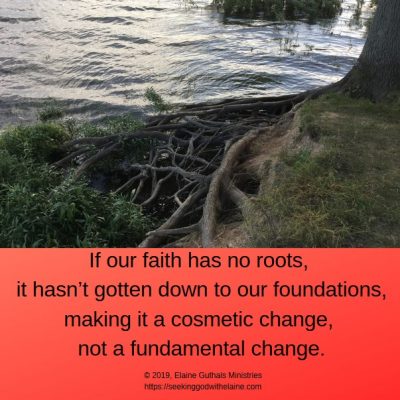
    • If our faith has no roots, it hasn’t gotten down to our foundations, making it a cosmetic change, not a fundamental change.
    • Jesus called His disciplines to be laborers.

    To read devotions in the Foundations of Salvation series, click the appropriate button below.

    Flowers with title So, What Are the Foundations of Salvation?

    In the first devotion in the series, we began discussing the foundations of salvation. We saw where Paul said that grace was the foundation on which salvation was built. In the previous devotion, we looked at faith and works.

    Paul says that “… by grace you have been saved through faith … not because of works …” (Eph. 2: 8-9 RSV). Is this telling us that we just have to say we believe and do nothing else?

    So, We Have Faith and Do Nothing?

    Well, no. Faith isn’t just knowledge and acceptance of that knowledge.

    What we do or don’t do with the do’s and don’ts is important after God has forgiven us and restored our relationship. The evidence of saving faith is the existence of good works in the lives of Jesus’ disciples: “so that you will walk in a manner worthy of the Lord, to please Him in all respects, bearing fruit in every good work and increasing in the knowledge of God” (Col. 1: 10 NASB).

    We have to show that the salvation has changed us. We have to utilize the framework God has given us as our guiding principles as a cause-and-effect in our lives. That requires obedience.

    Homeless woman

    No Works = Dead Faith

    Remember what James said. “What does it profit, my brethren, if a man says he has faith but has not works? Can his faith save him?” (Jas. 2: 14 RSV emphasis added).

    Yes, we have to have the outward profession. But we can’t just say the words, call it faith, and give it lip service.

    We also need to have the inward profession. We aren’t just supposed to sit on the porch swing and drink lemonade.

    We have to invest in our faith. We have to grow and then put it into practice. If we don’t do that, our faith really isn’t genuine.

    I think what James meant here was like the parable Jesus taught about the seeds. “Other seeds fell on rocky ground, where they had not much soil, and immediately they sprang up, since they had no depth of soil, but when the sun rose they were scorched; and since they had no root they withered away” (Mt. 13: 5-6 RSV).

    We generally think that is referring to trials. When the going gets tough, some get a one-way ticket out of here.

    Gotta Grow Our Roots

    Jesus explained it this way. “As for what was sown on rocky ground, this is he who hears the word and immediately receives it with joy; yet he has no root in himself, but endures for a while, and when tribulation or persecution arises on account of the word, immediately he falls away” (Mt. 13: 20-21 RSV).

    To me, the key words are it has no root. It hasn’t gotten down to our foundations. It is just a cosmetic change; it isn’t a fundamental change.

    Tree roots

    But what happens to those who maybe had an agenda when they made a profession of faith? What about those who find they don’t want to give up their sins?

    They don’t grow their root for whatever reason. So, they don’t have works to show for their faith — even though they weren’t undergoing trials.

    Because, let’s face it. It takes time for read your Bible, pray, worship, meditate…. And we’re supposed to do this for the long haul. If we don’t do it, we don’t grow our roots.

    Then James goes on to talk about no-root people. “Do you want to be shown, you shallow man, that faith apart from works is barren? Was not Abraham our father justified by works, when he offered his son Isaac upon the altar? You see that faith was active along with his works, and faith was completed by works, and the scripture was fulfilled which says, ‘Abraham believed God, and it was reckoned to him as righteousness’; and he was called the friend of God. You see that a man is justified by works and not by faith alone” (Jas. 2: 20-24 RSV). Our works are doing whatever God has called us to do.

    We Are Laborers

    James knew that Jesus had called on His disciplines to be laborers. “Then he said to his disciples, “The harvest is plentiful, but the laborers are few” (Mt. 9: 37 ESV). Laborers – workers – the ones who actually went out into the fields and cut the wheat, picked the corn, and gathered in the beans.

    Let’s take this agricultural discussion one step further. “You can identify them by their fruit, that is, by the way they act …” (Mt. 7: 16 NLT). Yes, Jesus was talking about false teachers here.

    But can’t this be applied to false disciples, also? Let’s look again at the fruits of the spirit. We said before that the fruits of the spirit show a pure heart: “… love, joy, peace, patience, kindness, goodness, faith, gentleness, self-control” (Gal. 5: 22-23 HCSB).

    Heart with Fruits of the Spirit

    Okay, faith is a fruit. Self-control is also an internal fruit. Peace and joy have dual expression. But look at all the rest. If you don’t show love, patience, kindness, goodness, and gentleness externally, do you really have them? Jesus said those are our identifiers.

    To read How Should We Give Thanks to God?, click the button below.

    We can do works because we think it needs to be done and that it will improve someone else’s lives. Works through faith are done because this is what God has called us to do to further His kingdom. God wants us to have a living, breathing faith.

    The way I see it is, what is our motivation? Are we doing something in response to God’s directions — either laws and commandments or through His promptings? Or are we going lone wolf and doing something of our own volition?

    I like the term that Stark used: holiness of heart and life. As James said, we can’t just say we have faith (Jas. 2: 14). We have to live it. We live it by our works.

    Paul was looking at the foundation. James was looking at how we use what we have built. Jesus never meant to allow us to keep on living our lives as we had been. He wants His disciples to change their lifestyles to better align with God’s laws and commandments. That takes work – internally and externally.

    Making the Connections

    So, what does all this we have talked about for the last three days mean?

    The riches of grace are salvation and faith. That makes a strong foundation for our relationship with God.

    Grace is the foundation for salvation, and faith is the foundation for works. We show our salvation through the works we do in faith.

    Jesus taught about building on foundations. The house built upon the rock stood firm while the house built upon the sand fell (Mt. 7: 24-27).

    But look at this. When talking about the wilderness wanderers, Paul said, “All of them also ate the same spiritual food and drank the same spiritual drink, which flowed from the spiritual rock that followed them. That rock was Christ” (I Cor. 10: 3-4 CEV emphasis added). He also said, “For no other foundation can anyone lay than that which is laid, which is Jesus Christ” (I Cor. 3: 11 NKJV emphasis added).

    Our foundation is supposed to be built on the Rock, Jesus Christ, our Lord and Savior. All we believe, all we trust, all we do is to glorify Christ, who in turn glorifies God.

    Let’s go back to Zechariah 7: 9 from the first devotion in the series. It says, This is what the LORD Almighty said: ‘Administer true justice …’” (NIV). Today’s worldview does not believe kindness has any room to include justice in it.

    Disciples of Jesus have to submit to the correcting hand of God. That is what is preparing us for our eternal life.

    How Do We Apply This?

    We have to make a choice. Are we going to step out in faith and accept God’s gift of salvation or are we going to follow the worldview?

    Once we choose to accept God’s gift of salvation, we have to choose to do that every day.

    We have to grow in our knowledge of Him (II Pet. 3: 18). God will be right there to guide us in doing that.

    Loving Father. We accept Your gift of salvation. Help us to grown in knowledge of You. Strengthen our faith in You as we read, study, and meditate on Your Word. Help us to hear You when we pray — and any time You speak to us. Help us to perform the tasks to which You have called us. Amen.

    The ABCDs of Salvation

    A – admit our sins

    B – believe His Son Jesus is our Redeemer

    C – confess God as Sovereign Lord

    D – demonstrate that commitment by making any changes needed in our lives to

    live the way in which God has called us

    If you have not become a believer in Christ, please read through the Plan of Salvation and prayerfully consider what God is asking you to do.

    What do you think?

    Leave me a comment below (about this or anything else) or head over to my Facebook group for some interactive discussion.

    If you don’t understand something and would like further clarification, please contact me.

    If you have not signed up for the email daily or weekly providing the link to the devotions and the newsletter, do so below.

    If God has used this devotion to speak with you, consider sharing it on social media.