Category: Prayer

  • Devoted to Prayer

    If we want to increase the discipline in our prayer lives, where do we start? One place we can start is evaluating how devoted we are to our prayer life. This devotion, the second in the series, looks at our attitude toward prayer.

    Nuggets

    • We discipline ourselves by devoting ourselves to prayer.
    • God isn’t focusing on the minutes – He is focusing on the attitude.
    • But the Pharisee wasn’t devoted to prayer because he made the prayer all about himself.
    • The tax collector knew he was still a sinner after conversion — he was just a forgiven sinner.

    To read devotions in the What Is Prayer? series, click the appropriate button below.

    Devoted to Prayer

    Flowers with title Devoted to Prayer

    We are looking at self-discipline. Many of us want to improve is our prayer life.

    We talked yesterday about that prayer is how we communicate with God. But how can we be more disciplined in our prayer lives? There is a great verse in Colossians that will help us with that.

    “Devote yourselves to prayer with an alert mind and a thankful heart” (Col. 4: 2 NLT)

    We discipline ourselves by devoting ourselves to prayer. It means we are going to spend a significant chunk of time in prayer.

    What? Well, that is what devote means. When we give up an activity to devote more time with our families, it means we are going to earmark that time to building relationships. We are increasing the amount of time we spend with them.

    Of course, our minds go to, “Well, how long should I pray?” We want to know expectations, so we know if we meet them or not.

    The problem with that is praying could then become a checklist. We’ve talked about this before.

    To read a related devotion, click the button below.

    Do you have trouble with your prayer list? I tend to pray through it — and check it off — to make sure I hit everyone for whom I needed to make sure I said a prayer.

    The thing is, God isn’t focusing on the minutes. He is focusing on the attitude. Let’s look at a couple of things.

    Let’s Put It into Context

    This was a parable that Jesus told. The moral of the story is what kind of prayer is acceptable.

    We generally focus on the attitudes of the people doing the praying. The Pharisee was self-centered. The tax collector was humble.

    In this devotion, let’s look at how much they said as well as what they said.

    The Pharisee

    “The Pharisee stood by himself and prayed this prayer: ‘I thank you, God, that I am not like other people — cheaters, sinners, adulterers. I’m certainly not like that tax collector! I fast twice a week, and I give you a tenth of my income’” (Lk. 18: 11-12 NLT)

    The Pharisee’s prayer was 36 words long. It consisted of three sentences.

    No, it wasn’t long by any stretch of imagination.

    But the Pharisee wasn’t devoted to prayer because he made the prayer all about himself.

    Oh, yes. The Pharisee started out with a good salutation “Thank you, God.”

    It was after that things went south quicky. It has “I” five times and “my” once.

    No, there is no evidence that the Pharisee was devoted to God. Oh, yes. He tried to give that impression by saying what he was and what he wasn’t.

    The Pharisee listed what he wasn’t first — a tax collector, a cheater, a sinner, or an adulterer. He compare himself to others and assumed he was better.

    This assumption was based on what he was — or at least what the Pharisee did. He fasted and tithed.

    Fasting is “the laying aside of food for a period of time when the believer is seeking to know God in a deeper experience” (Holman Bible Dictionary). Joel 2: 13 says, “Even now — this is the Lord’s declaration — turn to me with all your heart, with fasting, weeping, and mourning” (CSB). So, fasting is a way to humble ourselves.

    Fasting is about humbling ourselves. But the Pharisee was boasting about being obedient. He was not being humble!!!

    Tithing is “a tenth part, especially as offered to God” (Holman Bible Dictionary). The first time that tithing was mentioned was Genesis 14: 20: “… Then Abram gave him a tenth of everything” (NIV).

    We can look at the Pharisee one of two ways. We can say he was doing exactly what he was supposed to be doing. Or we can say he was doing the bare minimum.

    I wonder if Jesus was intimating the second. Liddon made an interesting comment. “Practically, for such a man, God is still a mere symbol, a name, whose most essential characteristic he has no eye for; and thus, like the Pharisee of old, he struts ‘into the awful presence, as if it were the presence of some moral equal, only invested with larger powers and with a wider knowledge than his own.’”

    That makes it sound like the Pharisee was devoted to going through the motions because he had to. It didn’t sound like he was thinking anything would come of it. Praying was just something He did.

    To many, God is god in name only. It isn’t because He is omnipotent, omniscient, and omnipresent.

    Instead, we do try to bring God to our level. We box Him up so He will do only what we want Him to do.

    That isn’t devotion.

    It is interesting that the Pharisee didn’t ask for anything. He didn’t expect anything. He thought he was good as he was.

    Related Links

    Natalie Grant

    The Tax Collector

    “But the tax collector stood at a distance and dared not even lift his eyes to heaven as he prayed. Instead, he beat his chest in sorrow, saying, ‘O God, be merciful to me, for I am a sinner.’ I tell you, this sinner, not the Pharisee, returned home justified before God. For those who exalt themselves will be humbled, and those who humble themselves will be exalted” (Lk. 18: 13-14 NLT)

    On the flip side is the tax collector. He was devoted.

    The tax collector, in his short 11-word prayer, had one “I” and one “me.” His focus, however, was that he couldn’t do anything about his sinful state.

    But God could. God could because He was merciful.

    Was this the tax collector’s conversion? Or was the prayer post-conversion? Either way, it doesn’t really matter. He knew he was still a sinner after conversion — he was just a forgiven sinner.

    The tax collector was devoted to God because he knew he was sinful. He knew only God could forgive him of his sins.

    So, the tax collector asked for forgiveness. He asked, expecting mercy.

    Remember, mercy is the unexpected way God responds in love to our needs. It is where He didn’t judge us to the extent He could have.

    Oh, yes. God does not get tired of hearing our forgive-me prayers. How do we know? If he expects us to forgive others seventy times seven times (Lk. 17: 3-4), won’t He forgive us even more?

    When we pray humbly and earnestly, God will answer our prayers. Every time. We just have to make sure we are asking in His Will.

    Did you catch that? Length of the prayer doesn’t matter. Earnestness does.
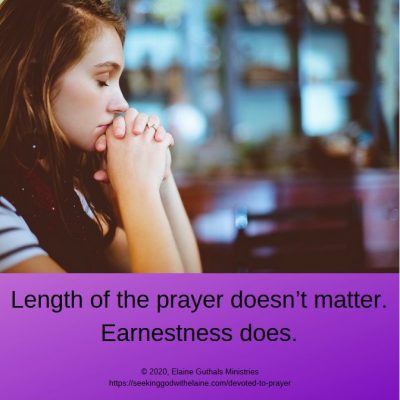
    Woman praying

    Making the Connections

    Okay. Wait a second, Chick. You said devote was to spend more time. But the shorter prayer is better?????? Are you talking out of both sides of your mouth??????

    Devotion comes out in attitude, not length. We can say a super long prayer – and not really include God in it.

    We can say a short prayer – and it totally be focused on God.

    We can be devoted because we pray constantly. We remain in an attitude of prayer – even if we aren’t saying words. We are listening.

    When I was younger, I would hear about being “prayed up.” No, I don’t think we can pray too much. What I took this to mean was, we need to have the major prayer session so the other times, we can just do the one-sentence prayers.

    How Do We Apply This?

    • Work on our attitude.
    • Work on our consistency.
    • Work on our praise.

    We show our devotion to God in the way we approach Him in prayer. We need to approach Him as Sovereign God on His throne. Our attitude is as forgiven sinners asking – again – for forgiveness.

    Consistency shows our devotion. We won’t grow our relationship with God if we don’t consistently spend time with Him in prayer. We show Him how much this relationship means to us when we spend time with Him.

    If you are like me, you are calendar driven. I schedule prayer time on my calendar associated with my email. That way I put my prayer list in it – and I am not searching for what I did with that little piece of paper when I am ready to pray.

    I can leave the structure and the ongoing requests (son/sister). I can change the ones from here on out to add something. I can edit just today’s appointment to check them off as I pray for them.

    I have found that has helped me to do better on consistency. I still need to improve, but it has helped.

    Our devotion is evident by the praise we give to God. Praise is our response to God’s working in our lives to reveal Himself to us.

    Bottom line is we are looking to change our character. Going through the motions does not change our character.

    If prayer is subject to discipline, we can work on improving our prayer lives. Devoting ourselves to prayer is a good first step.

    In the next devotion, we will be looking at watching while praying.

    Father God. We come to You as our Sovereign God. You are all powerful, all knowing. Lord, forgive us when we do not follow Your laws and commandments. We want to live as You would have us live. We want to strengthen our relationship with You. Help us to be more consistent in seeking You. Amen.

    What do you think?

    Leave me a comment below (about this or anything else) or head over to my Facebook group for some interactive discussion.

    If you don’t understand something and would like further clarification, please contact me.

    If you have not signed up for the email daily or weekly providing the link to the devotions and the newsletter, do so below.

    If God has used this devotion to speak with you, consider sharing it on social media.

  • What Is Prayer?

    What is one thing we want more self-discipline in? Prayer. This devotion, the first in a series, looks at what prayer is and some examples of prayer by Hall of Famers.

    Nuggets

    • We talk to God through prayer, and He talks back through the Holy Spirit.
    • We can’t build the type of relationship Abraham had with God in one sitting.
    • Moses was praying to be even more like God.
    • David prayed through whatever he was experiencing.
    • Jesus knew the value of keeping in close contact with God.

    Devotions in the What Is Prayer? series

    What Is Prayer?

    Flowers with title What Is Prayer?

    When we think of things that we need more discipline in, our prayer life is usually a frequent answer. We generally know what prayer is, but we can fumble around on how to do it more and how to do it right.

    If you have read my devotions before, you know I like to start off with a basic this-is-what-it-is part – whether it just be a definition or a whole devotion.

    We are going to start off this series with a half and half. This first part is going to be more of definition. Then we are going to look at our people in the Bible who pray. Yes, we could have looked at more – and probably will before this year is over.

    Remember, I start these devotions out because this is something I need. I don’t even pretend that I have all the answers. I share with you what God is telling me I need and the answers He tells me. Hopefully, by the end, we all will have more answers.

    So, let’s start off with this.

    What Is Prayer?

    “Lord, hear my prayer; listen to my plea for mercy” (Ps. 86: 6 CSB)

    Prayer “in the Bible involves the dialogue between God and people, especially His covenant partners” (Holman Bible Dictionary).

    When Adam and Eve were in the Garden of Eden, they had face-to-face contact with God. That made their ability to establish a relationship with Him easy.

    However, after the original sin, that contact was eliminated. We had to do something different to contact God.

    One of those something different is prayer. We talk to God through prayer, and He talks back through the Holy Spirit.

    To read a related devotion, click the button below.

    Let’s take a look at how some Hall of Famers and Jesus utilized prayers to talk to God.

    Abraham

    “Then Abraham prayed to God, and God healed Abimelech, his wife, and his female slaves so that they could bear children” (Gen. 20: 17 CSB)

    Abraham was the second Hall of Famer listed in the Bible. Remember, he was living in the land of Uz when God called him (Gen. 12: 1-2). God came to him that time.

    It is interesting. In all the other encounters, it always says that God came to Abraham.

    • When they established the covenant (Gen. 15: 1)
    • When they reviewed the covenant and Isaac promised (Gen. 17: 1)
    • When Sodom and Gomorrah was destroyed (Gen. 18: 1)
    • When God tested Abraham (Gen. 22: 1)

    We know, though, that Abraham had to have prayed to God in other instances. We can’t build the type of relationship Abraham had with God in one sitting.

    “By faith Abraham, when he was called, obeyed and set out for a place that he was going to receive as an inheritance. He went out, even though he did not know where he was going” (Heb. 11: 8 CSB). None of us would leave out on this road trip if we didn’t already know the Person talking to us and believe that He could and would do what He promised.

    We build that faith by spending time with God in prayer.

    To read a related devotion, click the appropriate button below.

    Moses

    “Moses said to the Lord, ‘Look, you have told me, ‘Lead this people up,’ but you have not let me know whom you will send with me. You said, ‘I know you by name, and you have also found favor with me.’ Now if I have indeed found favor with you, please teach me your ways, and I will know you, so that I may find favor with you. Now consider that this nation is your people’” (Ex. 33: 12-13 CSB)

    We know Moses talked to God face to face sometimes (Ex. 33: 11). I think there were other times when Moses just prayed.

    Look what Moses is asking here. “You’ve promised that You know me and that I am doing okay. I just feel there is so much more I need to know. So, teach me your ways. We want to be Your people.”

    God would have liked this prayer. Look what was Moses praying for — to be even more like God.

    Yes, Moses had to get the “… but you have not let me know whom you will send with me …” part in there. He probably thought Aaron as a helper was toast since the golden calf episode.

    But bottom line was Moses was asking God to increase his holiness. Holy means to be set apart, perfect, and pure.

    That is God’s goal for everyone.

    Hands

    David

    “Be gracious to me, Lord, for I call to you all day long” (Ps. 86: 3 CSB)

    David had a solid prayer life. We can tell that by the number of prayers recorded in the Bible. Most are in Psalms, but there are some in the books of Chronicles and Samuel also.

    One thing is for sure. We know that David prayed through whatever he was experiencing. Take Psalm 86 for example. It is a prayer for mercy. David, like Moses, asks for God to “teach me your way, Lord, that I may rely on your faithfulness; give me an undivided heart, that I may fear your name” (Ps. 86: 11 CSB).

    Other prayers are for forgiveness (Ps. 51) and praise (I Chron. 29: 10-20).

    And that just scratches the surface. (Yep, we will probably look at some of them more closely in the future.)

    For now, let’s just remind ourselves that David was described as a man after God’s own heart (I Sam. 13: 14). We don’t get that title by not knowing God.

    We get to know God by spending time with Him and communicating with Him. We communicate with Him through prayer.

    Praying Hands

    Jesus

    “After dismissing the crowds, he went up on the mountain by himself to pray” (Mt. 14: 23 CSB)

    We’ve talked before how Jesus would scoot off by Himself to pray. He knew the value of keeping in close contact with God.

    To read a related devotion, click the button below.

    Jesus gave instructions on how to approach prayer. “But when you pray, go into your private room, shut your door, and pray to your Father who is in secret …” (Mt. 6: 6 CSB). He also gave His disciples a model prayer (Mt. 6: 9-13).

    Besides Matthew 14: 23 and Mark 1: 35, it is mentioned at times that Jesus did pray:

    • After he was baptized (Lk. 3: 21)
    • After healing the leper (Lk. 5: 16)
    • Before He summoned the Twelve (Lk. 6: 12)
    • When He fed the five thousand (Lk. 9: 16)
    • When He fed the four thousand (Mt. 15: 36)
    • Before He asked the disciples who they thought He was (Lk. 9: 18)
    • At the Transfiguration (Lk. 9: 29)
    • Before the disciples asked Him to teach them to pray (Lk. 11: 1)
    • When Satan asked for Peter (Lk. 22:32)
    • When eating with the Emmaus travelers (Lk. 24: 30)

    Even better yet, we have examples of prayers Jesus prayed.

    The gospel writers recorded words that Jesus spoke in prayer:

    • When the 72 got back from preaching (Lk. 10: 21). Note: The same prayer was given in Matthew 11: 25-26; however, different circumstances were listed.
    • When He thanked God for hearing Him before He raised Lazarus from the dead (Jn. 11:41-42)
    • When He prayed that God’s name be glorified (Jn. 12:28)
    • When He prayed for the disciples at the end of the Passover meal (Jn. 17)
    • When He prayed in the Garden of Gethsemane (Mt. 26: 26-46)
    • When He prayed on the cross (Lk. 23: 34; Mt. 27:46/Mk. 15: 34; Lk. 23: 46)

    Making the Connections

    “Then everyone who calls on the name of the Lord will be saved” (Ac. 2: 21 CSB)

    So, what did we learn?

    • We need to spend time in prayer to build the relationship.
    • We need to pray about God things, not world things.
    • God wants us to pray to Him about everything, not just the big things.
    • We go to God once; He is going to come to us multiple times.
    • God wants us to pray for others more than ourselves.
    • God wants us to continually be in an attitude of prayer.
    • There are times, God does not want to share our prayer time with others and other things.

    Prayer is very important. It is how we access God to accept the gift of salvation.

    “For you are saved by grace through faith, and this is not from yourselves; it is God’s gift” (Eph. 2: 8 CSB). We accept this gift by admitting we are sinners, believing that Jesus is our Redeemer, and confessing God as our Sovereign Lord.

    The ABCDs of Salvation

    If you have not become a believer in Christ, please read through the
    Plan of Salvation and prayerfully consider what God is asking you to do.A – admit our sins

    B – believe His Son Jesus is our Redeemer

    C – confess God as Sovereign Lord

    If you have not become a believer in Christ, please read through the Plan of Salvation and prayerfully consider what God is asking you to do.


    D – demonstrate that commitment by making any changes needed in our lives to

    live the way in which God has called us

    The Disciple’s Job Description

    We continue praying to seek God. This is how we grow our relationship with Him. He doesn’t totally reveal Himself in the Bible. Instead, He reveals Himself to us as we little to the Holy Spirit’s promptings.

    Searching for and Seeking God

    Hearing His Word (Rom. 10: 17 NLT).
    Reading His Word (Rev. 1: 3 ESV).
    Praying to Him (Heb. 4: 16 ESV).
    Studying His Word (Ac. 17: 11 NLT).
    Meditating on His Word (Ps. 1: 1-2).
    Memorizing His Word (Ps. 119: 11 NLT).

    To read Has God Provided Everything We Need?, click the button below.

    How Do We Apply This?

    If we haven’t ABCDed, we need to search for God. We need to look into His gift of salvation.

    Once we have become a believer, we need to grow to be a disciple. We talked about this recently and had a long list of what was expected of us.

    To read a related devotion, click the button below.

    Prayer is a major avenue we can use to grow. But it is also hard. We are going to dissect prayer for the next three devotions to see if we can make it a little easier.

    Father God. We want to learn more of You. We want to grow our relationship with You. In order to do that, we need to spend time with You in prayer. Help us to discipline ourselves to meet with You consistently. Amen.

    What do you think?

    Leave me a comment below (about this or anything else) or head over to my Facebook group for some interactive discussion.

    If you don’t understand something and would like further clarification, please contact me.

    If you have not signed up for the email daily or weekly providing the link to the devotions and the newsletter, do so below.

    If God has used this devotion to speak with you, consider sharing it on social media.

  • Paul’s Prayer of Praise

    Now to him who by the power at work within us is able to do far more abundantly than all that we ask or think, to him be glory in the church and in Christ Jesus to all generations, for ever and ever. Amen.
    Ephesians 3: 20-21 (RSV)

    Paul finishes his prayer is Ephesians 3 by acknowledging God’s abundant power. This translates to His answering our prayers abundantly. This devotion looks at how we glorify Him now and will throughout eternity.

    Nuggets

    • God has abundant power, but we limit Him by asking based on our own understanding.
    • Abundant fits in with “… the unsearchable riches of Christ” (Eph. 3: 8 RSV) and “… the immeasurable riches of his grace …” (Eph. 2: 7 RSV).
    • God is working in us to make us more Christ-like.
    • God is glorified in us.
    Flowers with title Paul's Prayer of Praise

    Ephesians 3: 20-21 finish up the prayer that Paul started in verse 14. He covers a lot of ground in those six verses and adds more in these last two. Let’s take stock of what we have already:

    • Paul reverently approaches God.
    • He acknowledges that God is the Father of our Lord Jesus Christ.
    • We are made part of the Family when we accept Jesus as our Lord and Savior.
    • “The riches of his glory” are the blessings that we receive through Christ.
    • God gives us strength.
    • Jesus Christ dwells in our hearts through faith.
    • The rooting and grounding in His love ends up producing love.
    • We cannot comprehend God’s power.
    • God will give us the power to understand what we need to understand to make the decision to believe in Him.

    To read
    Pray for the Family
    and
    The Fullness of God’s Love,
    click on the button below.

    Those are some deep topics!

    What Paul is doing here is breaking into praise because of the awesomeness of the God he has just described. It may have just hit Paul that God was going to do exactly what Paul asked — give the Ephesians (and us) the riches of His glory!

    Abundant Power

    “Now to him who by the power at work within us is able to do far more abundantly than all that we ask or think” (Eph. 3: 20 RSV).

    This is God that we are talking about. You know, the One Who created everything we see and don’t see. The One that raised Jesus (and others) from the dead. The One Who is going to end this heaven and earth and create new ones. He has abundant power.

    Paul knew that God was going to answer his prayer abundantly. We can’t out-ask or out-give our loving Heavenly Father!

    The problem we have is we ask based on our own understanding. We try to limit God because we only see things one way — our way. We don’t see that “… with men this is impossible, but with God all things are possible” (Mt. 19: 26 NKJV). We see the answer only through our perception.

    We shouldn’t be surprised at Paul’s use of the Word abundant. We’ve already talked about “… the unsearchable riches of Christ” (Eph. 3: 8 RSV) and “… the immeasurable riches of his grace …” (Eph. 2: 7 RSV). We should be used to going big.

    To read
    What Should We Do About a Career Change?,
    What Are Heavenly Places?,
    and
    What Is the Foundation of Salvation?,
    click on the appropriate button below.

    But let’s refocus here. “… by the power at work within us …” (Eph. 3: 20 RSV). When we think of work, we think of eight hours a day/five days a week/forty hours a week/fifty weeks a year [put in whatever your work schedule is]. Many times, we see work as unending.

    God is working on us. Remember what we said in What Is the Foundation of Salvation?

    God initially forgives us of our sins and restores our relationship with Him. He makes us a spiritual being.

    Then comes the hard part. That salvation changes us, but we are still in this earthly body. We have a long way to go to learn about who God wants us to be.

    We still have the capacity to sin. God doesn’t just throw a switch and we are a totally different person who no longer sins. We are still us. That makes us a work in progress as we try to change to be more like God wants us to be.

    We will be sin-free only when we get to heaven. That is after we are changed (I Cor. 15: 52).

    So, yes. God is working in us to make us more Christ-like.

    Eternal Glory

    “to him be glory in the church and in Christ Jesus to all generations, for ever and ever. Amen” (Eph. 3: 21 RSV).

    We’ve talked about glory before. Glory is the expression of the qualities of God resulting from the authority of God.

    To read What Is the Foundation of Salvation?, click on the button below.

    To read What Is the Foundation of Salvation?, click the button below.

    But this is different. It says glory, but I think it means glorify. Glorify means to worship God through our praises because we recognize and accept His divinity. We acknowledge His power and majesty.

    How is God going to be glorified? “… in the church and in Christ Jesus …” (Eph. 3: 21 RSV). We are the church.

    So, how is God glorified in us?

    • God is glorified when the church grows. Most of the time when we say this, we think numbers. Yes, God wants people to believe. He wants all people to (I Tim. 2: 4) but knows that isn’t going to happen. So, He wants many.
      But God also wants us to grow spiritually. We do this by being true disciples. Remember, that means being students.
      Discipleship graph

    Seeking to Be a Disciple

    Hearing His Word (Rom. 10: 17 NLT).
    Reading His Word (Rev. 1: 3 ESV).
    Praying to Him (Heb. 4: 16 ESV).
    Studying His Word (Ac. 17: 11 NLT).
    Meditating on His Word (Ps. 1: 1-2).
    Memorizing His Word (Ps. 119: 11 NLT).

    To read Has God Provided Everything We Need?, click the button below.

    • God is glorified when we live out our faith. When we follow the do’s and don’ts, we show how they are right and good for us.
    • God is glorified when the family is at peace with itself.
    • God is glorified when we serve in Jesus’ name. He is glorified when we point others to His Son so that they, too, may ask Him to be their Lord and Savior.

    Now look at the last part. “… to all generations, for ever and ever. Amen” (Eph. 3: 21 RSV). We aren’t going to just glorify God once we are called home. We glorify Him now.

    We aren’t going to just glorify God now. We are going to glorify Him forever and ever. Even when this heaven and earth passes away, we will glorify Him. Without end. Through eternity.

    But let’s get this straight. God really doesn’t need us to praise Him. He is still going to be Sovereign God even if we don’t. We don’t add anything to Him (and we don’t take away anything if we don’t Praise Him).

    We gain by praising God. When we praise God, we put Him on His throne. That takes the focus off of us. That makes us want to learn more about Him. In turn, God blesses us more as we grow in knowledge and faith (II Pet. 3: 8).

    Making the Connections

    Too many times, I am afraid — when we do get around to praying — we don’t put the focus on God. We, at best, breeze through the Acknowledgment, Confession, and Thanksgiving part. At worst, we skip those all together. Either way, we land on the Supplication part and roost.

    How Do We Apply This?

    Do you have a prayer journal? I have one that I use when my Ladies and I voice our praises and prayer requests during class. I will go back through occasionally and indicate which prayers have been answered.

    On my actual prayer list, I make sure it always starts out with Acknowledgment, Confession, and Thanksgiving. Then I list my son and my sister, the person I am praying for that month, my focus for the day, my secret pal, and my Ladies. Then I get to the Supplications.

    I find the structure works better for me. But I also have to be carefully that it doesn’t just become a checkoff list. I want to make sure that I am having a sincere conversation with my Father.

    Our awesome, powerful Heavenly Father deserves to be praised. Remember, we are practicing now for praising Him throughput eternity.

    Gracious Father God. We praise You for Your awesome power and glory. We are amazed that You are even mindful of us. Lord, we claim the blessings that You have for us today. Help us to pray to You more. This will help us know You better and better discern Your plan for our lives. Lord, we can’t wait to praise You through eternity. Amen.

    What do you think?

    Leave me a comment below (about this or anything else) or head over to my Facebook group for some interactive discussion.

    If you don’t understand something and would like further clarification, please contact me.

    If you have not signed up for the email daily or weekly providing the link to the devotions and the newsletter, do so below.

    If God has used this devotion to speak with you, consider sharing it on social media.

  • Pray for the Family

    For this cause I bow my knees unto the Father of our Lord Jesus Christ, Of whom the whole family in heaven and earth is named
    Ephesians 3: 14-15 (KJV)

    Paul can’t help himself again. The end of Ephesians 3 is another prayer. This devotion looks at intercessory prayer and praying for God’s Family.

    Nuggets

    • Yes, we can pray anywhere and don’t have to close our eyes; but I think it is important to assume the position when we can.
    • The only thing that will last is God and His Family — the church.
    • God will not change His ideologies.
    Flowers with title Pray for the Family

    When I first read these two verses, I thought, “What in the world am I going to do with those?” When I started thinking about it, it really made sense.

    Let’s Put It into Context

    The worldview tells us that we should look out for ourselves. God doesn’t want us to do that.

    We are also supposed to look out for each other. One way we do this is through intercessory prayer.

    Intercessory prayer is when we pray on behalf of others. It is kind of a throwback to the priests. They interceded for the nation of Israel.

    One of the best examples is that of Jesus Himself. On the cross, He prayed, “… Father, forgive them, for they know not what they do …” (Lk. 23: 34 ESV). The Redeemer was praying for those who needed redeeming.

    Scriptures direct us to pray for each other.

    • “[The LORD] is astonished to see that there is no one to help the oppressed. So he will use his own power to rescue them and to win the victory” (Isa. 59: 16 GNT).
    • “Share each other’s burdens, and in this way obey the law of Christ” (Gal. 6: 2 NLT). Sometimes, the only way to share someone else’s burden is to listen as they talk, be there for them, and pray.
    • “First of all, I ask you to pray for everyone. Ask God to help and bless them all, and tell God how thankful you are for each of them” (I Tim. 2: 1 CEV).
    Man praying

    To read Why Should We Pray for Other Believers?, click on the button below.

    You see, Paul knew that we have to pray for others to be strengthened — not just physically, but spiritually. We have to pray that God invades their lives so that they are filled by His Spirit.

    Remember we said that God reveals Himself to us in our core, which is where He lives in us.

    To read
    What is the Spirit of Wisdom?
    and
    Peace, Mercy, and Love,
    click on the appropriate button below.

    We are to pray that others grow in grace and knowledge of Jesus (II Pet. 3: 8). Our goal is to be filled with His love and hope.

    Also, we must pray for others’ discernment that they would use the gifts that God has given them in order to accomplish the tasks assigned to them.

    Assume the Position

    “For this reason I bow my knees before the Father” (Eph. 3: 14 RSV).

    I think we’ve gotten out of the habit of kneeling to pray to God. I get it. As we get older and older, it gets more difficult to get up and down.

    Besides, if we are going to “pray without ceasing” (I Thess. 5: 17 NKJV), it won’t always be on our knees and our eyes closed. It is kind of hard to drive a car that way.

    Yes, we can pray anywhere. No, we don’t have to close our eyes. And I think God is perfectly fine with that.

    But I think it is important to assume the position when we can. It drives home that we have to give control to the Father, the Creator of all there is. We always have to make sure we are giving God the honor that is due Him — that is not contingent on our position when we pray.

    God is the Father of Jesus, isn’t He? Jesus is the Savior of the world, isn’t He? They deserve our honor and praise.

    How Does Our Prayers Influence God?

    We have to see that our prayers are being answered. If we keep asking for something and don’t see that our prayers make a difference, we may get discouraged.

    I think in the overall scheme of things, God has some unconditionals. These are things that are going to happen a certain way because that is how His kingdom will be expanded.

    I mean, He told Jesus “no” in the Garden of Gethsemane (Lk. 22: 42). We all know how that turned out. That would have been a deal breaker.

    What kind of car I drive is not a deal breaker. No one else — except maybe Adam — is going to care. So, if I pray to own a convertible again, that is just my choice.

    What I know is that God wants us to ask. “Ask, and it will be given to you; seek, and you will find; knock, and it will be opened to you” (Mt. 7: 7 NASB). Ask Him, and our needs will be met. Seek Him and knock on His door, and we will be given eternal life.

    Door

    Families Revisited

    “from whom every family in heaven and on earth is named” (Eph. 3: 15 RSV).

    Okay, I confess. I first read this and thought, “Paul, what in the world are you talking about?”

    Before we talked that we join God’s Family upon conversion. We talked about how that should unify us. That can be difficult at times because the family is made up of individuals that, while they have similarities, have different experiences and values.

    To read How Does God Build a Community?, click the button below.

    We have many groups today that try to replace the family. My Ladies and I have talked about this on many occasions.

    Before, society focused on the family and the church. People did not work outside the homes.

    Then came industry. Industry needed workers that may or may not have been in close proximity to the plants. Cities were formed when people relocated to get jobs in those plants.

    Activities sprung up to connect people and fill up their leisure time. People sought out others who thought as they did, played as they did, dreamed as they did.

    The problem with that is it doesn’t last. It doesn’t fix the brokenness of the world.

    The only thing that will last is God and His Family — the church. Everything else will end.

    Church

    God will not change His ideologies. He will not reinvent Himself. He will not retcon anything.

    To read The Gospel Does Not Change, click the button below.

    How do we know? Look at His name. “… I am who I am …” (Ex. 3: 14 RSV). Point blank. Not I am who I am going to be. Not I am not who I was.

    I am who I am.

    We are the church because of Jesus. Point blank. “Salvation is found in no one else, for there is no other name under heaven given to mankind by which we must be saved” (Ac. 4: 12 NIV). No Jesus, no church. No Jesus, no salvation.

    We are named children of God because of Jesus. How do we know? “And I saw the dead, great and small, standing before the throne, and books were opened. Then another book was opened, which is the book of life. And the dead were judged by what was written in the books, according to what they had done” (Rev. 20: 12 ESV).

    When we admit our sins, believe on Jesus as Redeemer, and confess God as Sovereign Lord, our names will be written in the Book of Life. We all have God as our Father. We all were sinners. We all have Jesus as our Savior.

    How Do We Apply This?

    God is a loving Father. He wants to answer our prayers.

    We just have to make sure that we are asking. He can’t answer what we don’t ask.

    We have to make sure we give God the honor that is due Him. We can bring Him down to our level. We have to acknowledge Him Sovereignty.

    Almighty God. We praise You for Your power and strength. We are in awe of Your creativity. We are humbled by Your love. Help us to pray to You more. Help us to see Your answers. Give us a heart to pray for others, especially for their spiritual condition. Amen.

    What do you think?

    Leave me a comment below (about this or anything else) or head over to my Facebook group for some interactive discussion.

    If you don’t understand something and would like further clarification, please contact me.

    If you have not signed up for the email daily or weekly providing the link to the devotions and the newsletter, do so below.

    If God has used this devotion to speak with you, consider sharing it on social media.

  • Praying for Love, Grace, and Hope

    May our Lord Jesus Christ himself and God our Father, who loved us and in his grace gave us unfailing courage and a firm hope, encourage you and strengthen you to always do and say what is good.
    II Thessalonians 2: 16-17 (GNT)

    Paul was a very caring minister. This is evident by the prayer that is nestled in the middle of II Thessalonians. This devotion looks at II Thessalonians 2: 16-17 to see how God extends to us love, grace, and hope.

    Nuggets

    • It is through Jesus that God answers our prayers.
    • Because of that love, God gives us grace.
    • This gift of grace gives us hope.
    • We have the hope of eternal life; because of His love for us, God went Jesus to live, die, and rise again in order to be made perfect.
    Flowers with title Praying for Love, Grace, and Hope

    Don’t you love Paul? He is riding along, and then he breaks out into a worship service. In this instance, he breaks out in prayer.

    This prayer, while a benediction, is intercession. Paul had a soft spot in his heart for the Thessalonicans, so it follows that he is going to break off into prayer when the mood hits him.

    Think about it this way. The Thessalonicans probably had a tough row to hoe in the first century. The Roman rule would have been only one hardship that they faced daily.

    Enter Paul with his message of hope. Jesus taught about love.

    The Thessalonicans would have been greatly encouraged. Let’s take a look at Paul’s prayer.

    Father and Son Duo

    “May our Lord Jesus Christ himself and God our Father …” (II Thess. 2: 16 GNT)

    Wow. You would think that Paul would have put God first in the list. He didn’t. Why?

    We do pray to God in Jesus’ name. When Paul prays, “… our Lord Jesus Christ himself …” (II Thess. 2: 16 GNT), that makes it sound much more personal. Yes, God is our God, but Jesus is our Brother. Paul had had personal contact with Jesus (Ac. 9: 5). He wasn’t just Jesus up in heaven.

    Let’s look at some verses that tell us about Jesus and God.

    Jesus can give eternal life (I Jn. 2: 25) to all who obey Him because He has been made perfect (Heb. 5: 9) by the shedding of His own blood (Heb. 9: 12). Because of His everlasting love for us (Ps. 103: 17), God will strengthen us when our flesh and hearts fail (Ps. 73: 26). We know we can count on Him, because the God of peace is the one who raised Jesus from the dead (Heb. 13: 20) and perfected Him (Heb. 5: 9).

    God helps us get through this life. He loves us so much that He will help us navigate this life and has given those who follow and obey Him eternal life.

    Think of how comforting that would have been to the Thessalonicans. Think of how comforting that is to us today.

    Love, Grace, and Hope

    … who loved us and in his grace gave us unfailing courage and a firm hope … (II Thess. 2: 16 GNT)

    As Father, God loves us. We previously defined God’s unconditional love as intense feelings of deep affection without limits or circumstances.

    To read Is God’s Love Unconditional?, click the button below.

    Because of that love, God gives us grace. Remember, we previously said that grace was where — even though we don’t deserve good things — God gives them to us anyway.

    This gift of grace gives us hope. Hope is where you desire and know something. I have hope that God will answer my prayers. I desire that He will do that, and I know He will because He has done so in the past. Maybe not in the way I am thinking, but God has always answered my prayers.

    That would give the Thessalonicans — and us — even more comfort. Our hope can be strong because God s consistent.

    We can also hope because it is unearned. God offers us salvation as a gift, not dependent on anything from us — but accepting the gift. “For it is by God’s grace that you have been saved through faith. It is not the result of your own efforts, but God’s gift, so that no one can boast about it” (Eph. 2: 8-9 GNT).

    God, who doesn’t lie or change His mind (Num. 23: 19), has developed a plan in which our relationship with Him is restored. He did this out of His love for us and grace.

    We have the hope of eternal life (I Jn. 2: 25); because of His love for us, God went Jesus to live, die, and rise again in order to be made perfect (Heb. 5: 9). This gift was given and offered to us through God’s grace (Eph. 2: 8-9).

    Courage and Strength

    “encourage you and strengthen you to always do and say what is good” (II Thess. 2: 17 GNT)

    Having that hope in the knowledge that God is providing for us because of His love and His grace should give us courage and strength. It should bolster us so that we can do and say what is good.

    Let’s face it, sometimes God calls us to do the tough things. Witnessing is really hard for some people. But the last recorded words of Jesus are that His disciples — including us —“will be [His] witnesses in Jerusalem and in all Judea and Samaria, and to the end of the earth” (Ac. 1: 8 ESV).

    Gnaw on that a little bit — Jesus’ very last words. They weren’t “I love you.” They weren’t even “Make sure you do all that I have commanded.”

    Jesus’ last words were “go be witnesses.” Go do the hard. Open yourself up for rejection and ridicule. Go put your lives on the line. Do it in Jesus’ name.

    What kept running through my mind when I was reading the research and writing this was that we have to make sure our hope is placed correctly. Let me explain.

    We have to watch the object on which we put out hope. Maybe my hope is that I get a huge promotion at work. Or start a relationship that I hope will be lasting. Or win the lottery.

    Unfortunately, my hope may not be in God’s Will. If it is not in His Will, I can hope all I want. It isn’t going to happen.

    How Do We Apply This?

    First off, we need to make sure we have the hope of eternal life. We need to make sure we have turned our lives over to God.

    If you have not admitted that your relationship is not right with God,

    have not asked Jesus to be your Lord and Savior,

    and have not confessed your sins,

    please read through the Plan of Salvation and prayerfully consider what God is asking you to do.

    Then, we have to make sure that our hope is grounded in God and expanding His kingdom. Yes, I think He will reward us and allow us to have some things we want.

    That still starts out with giving God control of our lives. He will reward us for doing His work.

    We are to be witnesses. We are called to be examples. We are instructed to live out that hope.

    Father God. Your love is limitless. It is unconditional. We stand in awe that You would choose to have a relationship with us. But You do. Help us to live for You, secure in the hope that we dine in Your Word. Help us to boldly tell others about Your love. Amen.

    What do you think?

    Leave me a comment below (about this or anything else) or head over to my Facebook group for some interactive discussion.

    If you don’t understand something and would like further clarification, please contact me.

    If you have not signed up for the email daily or weekly providing the link to the devotions and the newsletter, do so below.

    If God has used this devotion to speak with you, consider sharing it on social media.

  • Why Should We Pray for Other Believers?

    God knows how often I pray for you. Day and night I bring you and your needs in prayer to God, whom I serve with all my heart by spreading the Good News about his Son.
    Romans 1: 9 (NLT)
    Scripture: Romans 1: 1-17

    There is so much division in the world today. Believers are supposed to be unified under God. This devotion looks at one way that unification occurs – believer praying for other believers.

    Nuggets

    • Jesus starting to build a community of believers during His ministry.
    • Prayer is not only a form of worship, but it also unites the community of believers as they pray for each other.
    • We are to pray for each other, even if we do not know each other.
    • We should pray for their spiritual as well as physical needs.
    • If God does not answer our prayers, we should react in peace.
    Flowers with title Why Should We Pray for Other Believers?

    Paul was the consummate preacher. He had a love and concern for fellow believers — even does he have not met previously.

    Case in point. When Paul wrote his letter to the Roman believers, he had not met them yet. Yet, he tells them that he prays often for them.

    We can learn a lot from Paul’s example. Let’s take a look first at believers during that time.

    Let’s Put It into Context

    Jesus Began a Community

    When my ladies and I were studying the Gospel of Mark a while back, around Chapter 6 we saw where Jesus was starting to build a community. Now, He didn’t call it a church.

    Jesus probably thought of them as followers first. Then they morphed into students (Jn. 13: 13). “I do not call you servants any longer, because servants do not know what their master is doing. Instead, I call you friends, because I have told you everything I heard from my Father” (Jn. 15: 15 GNT). They finally became friends.

    What Jesus’ followers became was a community. “They would sell their property and possessions and give the money to whoever was in need” (Ac. 2: 45 CEV). They were a cohesive group.

    From this, we can see the love they felt for each other. We can see them stepping in to help when needed and creating their version of the Three Musketeers slogan: one for all and all for one.

    Prayer Is a Form of Worship

    Prayer is a big part of our worship. “… Your prayers and alms have ascended as a memorial before God” (Ac. 10: 4 NASB). This is where we talk to an unseen God.

    Let’s look at verse 9 in another translation. “For God is my witness, whom I serve with my spirit in the gospel of his Son, that without ceasing I make mention of you always in my prayers” (Rom. 1: 9 KJV). Paul serves God in the spirit. That would include prayer.

    I can just hear Paul lifting a prayer to God. The love and obedience would just pour out. This wouldn’t be a formal prayer. It would be a heart-felt conversation with his Lord.

    Paul served God in any way He required. This included his devotion time as well as corporate worship. He took Jesus’ commandment to love one another to heart (Jn. 13: 34).

    Man praying

    Praying for Others

    As part of the family of God, we should remember our fellow believers in prayer. The churchy term is intercessory prayer. We expand our love for others as we pray for them. That, in turn, makes it easier to pray.

    Okay. Now let’s look at what Paul was saying here.

    Paul’s Prayer for the Romans

    Wait! What? Paul was praying for people he didn’t know?

    Yes. They were fellow believers that Paul had heard great things about.

    They still needed support. They had trials only God could get them through and needs that only God could meet — even though they were believers.

    So, Paul prayed for them. Day and night. He didn’t just pray when he heard a good or bad report.

    Paul prayed often for them. He knew the God of creation knew what they needed and could — would — provide.

    It didn’t matter that Paul didn’t know them. God knew them. They were fellow believers. That was enough for Paul.

    Church

    How We Should Pray

    God isn’t going to make us pray to Him — even believers. It has to be voluntary. We need to want to pray to Him. We need to want to communicate with Him and intercede for others.

    Paul was thankful and sincere in his petitions to God. He was earnestly concerned about the Roman believers. He was thankful for their successes and concerned for their needs.

    See that? Paul didn’t keep this awesome God for himself. He wanted others to know Him like he did. He said, “my God” and “my Lord.”

    For What Was He Praying?

    Paul has a personal relationship with the Sovereign God and Lord Jesus Christ. He wanted others to have that same relationship.

    That meant Paul didn’t just pray for Uncle Tommy’s knee replacement and Valerie’s job situation.

    Yes, God wants us to pray for those things.

    God wants us to be more concerned with people’s spiritual health. He wants us to pray for their relationship with Him.

    Paul would pray for their spiritual gifts. He would pray for their witness.

    God wants us to pray for their boldness and strength against temptation. He wants us to pray that they grow in righteousness.

    Crowd

    When Prayers Aren’t Answered

    Wait! What? You said even Paul had some unanswered prayers. The great Paul? The Energizer Bunny for God?

    Let’s look at that. “One of the things I always pray for is the opportunity, God willing, to come at last to see you” (Rom. 1: 10 NLT).

    Paul always prayed for the opportunity to visit — to come see them at last. He hadn’t been there yet. His prayer was unanswered.

    So, Paul must have been really disappointed. He was praying all this time for people he didn’t know to do something he really wanted to do.

    So, Paul quit praying, right? No. Knowing Paul, he probably prayed even harder.

    Making the Connections

    One of the ways we love fellow believers is to pray for them, whether we know them or not. We pray that they are living in God’s Will. We thank God that He can use them to expand His kingdom.

    We pray for their physical journey, also. They will be facing issues in their everyday life over which God wants control.

    God wants us to be a community of believers. He wants us to be united under Him.

    How Do We Apply This?

    We need to make it a practice to pray for others. I have been working on an aid to help me. When I bet it worked out, I will share it with you.

    We have to make our requests to God — and then let Him work. He may not give us the answer we requested, especially not on our timetables. We just have to let go and be at peace. We did what we were supposed to do — pray in support of our fellow believers.

    We can’t pick and choose for whom we will pray. Paul was praying for the people in the capital of the Roman Empire. There was some good things being said about them, but they were in that dreaded city.

    We can’t let differences or preconceived notions stop us from praying for our brothers and sisters in Christ. We have to pray whether it is in our prayer closet/war room — or corporate worship service — or if we would call a radio station and broadcast it. The only One Who needs to hear it will hear our prayer.

    A little bit ago, I picked one of my friends on my private Facebook page and prayed for her for a couple of months. Then I picked someone else.

    What if we did that for our fellow believers? Pick a believer you know who is under fire by Satan and pray. Pick a church (other than your own because we should be praying for our own anyway) and pray. Pick a missionary and pray. I would say pick a state or pick a country, but I am afraid that would get too generic.

    Bottom line is believers need to pray for other believers. We need to hold each other up.

    Father God. You love us. You want your believers to be a community. Help us to be united under Your laws, doing Your work. Help us to look past differences and preconceived notions. May we always just see You reflecting out of them. Help us to be consistent. Help us to be the prayer warriors needed to resist temptation in today’s world. May our focus always be on You.

    What do you think? What are some ways that you can start praying more for other believers?

    Leave me a comment below (about this or anything else) or head over to my Facebook group for some interactive discussion.

    If you don’t understand something and would like further clarification, please contact me.

    If you have not signed up for the email daily or weekly providing the link to the devotions and the newsletter, do so below.

    If God has used this devotion to speak with you, consider sharing it on social media.

  • What Do We Do When Prayers Won’t Come?

    O Lord, they sought Thee in distress, They could only whisper a prayer. Your chastening was upon them.
    Isaiah 26: 16 (NASB)
    Scripture: Matthew 6: 5-14

    We all have times where it seems like we just can’t pray. Sometimes, it is because of sin and the consequences that we face because of it. This devotion looks at what we can do when we can’t seem to pray.

    Cliff Notes

    • While the Holy Spirit will pray for us when we feel we can’t, we need to remain in an attitude of prayer.
    • Our prayers do not have to be eloquent prayer, stating everything in specific terms. 
    • God will gladly take a one-line prayer — anything that shows Him we are looking to Him.
    • We can use these times when prayers don’t come to get really real with God.
    Flowers with title What Do We Do When Prayers Won't Come?

    There are times when we feel so out of touch with God. It may be because we have willfully sinned and have become so mired in it, we can’t see His face anymore. Or we may be so feeling His punishment for these sins that we feel He has rejected us.

    Then again, we may not know why the troubles have piled up. We just feel so overwhelmed. It is as if God is blocked out.

    How many times have we heard someone say, “Just pray”? The problem is we feel this has to be an eloquent prayer, stating everything in specific terms. We feel we have to confess everything, specifically, ask for everything, tell God exactly what we are feeling.

    Too bad life isn’t always that concrete. Those are the times we have to just allow the Holy Spirit to pray for us.

    No, that doesn’t mean we can just say, “Okay, H.S. Do your thing for me” – and not doing anything ourselves. We have to remain in the attitude of prayer.

    What Does This Mean?

    There are many times that we feel we “… are too distressed even to pray” (Ps 77: 44 LB). When my parents died six weeks apart, I got really confused. It was hard for me to articulate my feelings because I was so numb. I didn’t know what I was feeling.

    If things got really bad, I would go to my church, sit on the floor (my version of laying prostrate at His feet) and usually just sit there. I’d try to pray, and the sentences wouldn’t form. Or I’d be going along well and hit a wall because I blanked on the words (usually the two- or three-letter variety).

    When Mom was sick, someone sent me a card saying, “Prayer is the burden of a sigh, the falling of a tear, the upward glancing of the eye, when none, but God is near.” Do you really think God wants an award-winning prayer at times like these? I don’t think so.

    God will gladly take a one-line prayer — anything that shows Him we are looking to Him. He wants us to be in the attitude of prayer.

    Woman praying

    So many times we just say the words. Sometimes, the words get in the way. Don’t you think, especially in these times, He would want us to listen instead of talk?

    That’s a whole other devotion. How many times do we listen? Especially when we are hurting so much. We don’t. We just barrel our way on through our pain. He’s not interested as much in our words as He is in our attitude and reliance on Him.

    To read Do We Always Hear and Listen to God?, click the button below.

    How Do We Apply This?

    We can use these times when prayers don’t come to get really real with God. We can come as we are — all the pain and suffering. He even wants to see our tears.

    Go to His house if at all possible. Even though He is with us all the times, sometimes we feel closer to Him “where He lives.” It is a form of reverence, our approaching His throne in His house. It is a physical action showing we are actively seeking God.

    But we can and should pray where we are. God wants us to be continually in an attitude of prayer (I Thess. 5: 17). We need to especially continue to pray when we think God isn’t answering our prayers.

    To read When God Doesn’t Answer on Our Timetables, click the button below.

    We really need to be “prayed up” for when the prayers won’t come. That doesn’t mean we should check off on daily to-do list that we have prayed those long, eloquent prayers however many times per day.

    What it does mean is our relationship with God is where it needs to be. We are grounded so that, when the prayers don’t come, our foundation is firm.

    When the relationship is right, we’ve shown that our trust and faith is in God. He knows what we need when we have the one-word prayer or tear prayer.

    Look at the verse again. “O Lord, they sought Thee in distress, They could only whisper a prayer. Your chastening was upon them” (Isa. 26: 16 NASB). It talks about punishment.

    This needs to be a two-word prayer. “I’m sorry” works. “Forgive me” does, too. Hook them together, and we have good start on a prayer.

    Man praying

    We can be right with God and still mess up. I think that is when Satan tempts us the most. That is because, when we are right with God, we are more useful to Him. Satan doesn’t want that.

    Even if God is chastising us, He wants us to call to Him. He wants us to seek to improve our relationship with Him. That is how much He loves us.

    God. “See my sorrows; feel my pain; forgive my sins” (Ps. 25: 18 LB). Amen.

    What do you think? Leave me a comment below (about this or anything else) or head over to my Facebook group for some interactive discussion.

    If you have not signed up for the email daily or weekly providing the link to the devotions and the newsletter, do so below.

    If God has used this devotion to speak with you, consider sharing it on social media.

  • Called to Change and Worship

    He [Pharaoh] summoned Moses and Aaron during the night and said, “Get up, leave my people, both you and the Israelites, go and worship Yahweh as you have asked.”
    Exodus 12: 31 (HCSB)
    Scripture: Exodus 12

    There are times that we want things to change, but only in the way in which we want. When God answers our prayers, we don’t always like the rules that come with the rescue. This devotion looks at how we are called to worship God.

    Cliff Notes

    • Through prayer, we ask God to change our situations even though we hate change.
    • We don’t always follow through with what we have negotiated with God in order for Him to rescue us.
    • Ultimately, God calls us to worship Him.
    • One way we worship Him is following the rules He has established.
    • His established rules are different from the worldview.
    Flowers with title Called to Change and Worship

    I wonder what the Israelites felt as they were preparing to leave Egypt. They had been in Egypt 430 years (Ex. 12: 40). Slavery was all they had ever known.

    Still, the Israelites were dressed and ready to go. It must have been an impressive sight.

    Think of it this way. Depending on who you count, there were 66 (Gen. 46: 27), 70 (Deut. 10:22; Ex. 1:5; Gen. 46: 27), or 75 (Ac. 7: 14) Israelites in Egypt when they first moved there.

    When the Israelites came out, there were well over a million. If Exodus 12: 37 says there was 600,000 able-bodied, military-age men, a good estimate of the total number of people would be 2.4 million. They were a nation now.

    Exodus 12: 38 says, “an ethnically diverse crowd also went up with them …” (GNT). That says not just Israelites were lined up to leave. We have no clue how many these other people numbered, but the New International Version translates it as many.

    Yep, it was an impressive sight.

    Why Were They Leaving Again?

    Many of us hate change. So, if this was all the Israelites had ever known, tell me again why they were leaving.

    Sometimes, change is a good thing. The Israelites had been praying for a change, and their prayers were answered.

    The Israelites had this opportunity for a better life because they asked God to save them. Exodus 2: 23-25 says, “Years later the king of Egypt died, but the Israelites were still groaning under their slavery and cried out for help. Their cry went up to God, who heard their groaning and remembered his covenant with Abraham, Isaac, and Jacob. He saw the slavery of the Israelites and was concerned for them” (GNT). Exodus 12: 51 says, “And on that same day the LORD brought Israel’s families and tribes out of Egypt” (CEV).

    God had freed them from their slavery. God was leading them to utopia, the Promised Land. God wanted to be among them.

    But look what Pharaoh said when he told Moses they could go. “… Get up, leave my people, both you and the Israelites, go and worship Yahweh as you have asked” (Ex. 12: 31 HCSB).

    The purpose of the Exodus was not just to free the people. The ultimate reason — and the reason given for asking for their release (Ex. 5: 1) — was so they could worship God. It wasn’t about them; it was about Him.

    How many times are we like that? “Oh, God. Just get us out of this bad situation. When You have rescued us, we will worship You.” How long do we keep that promise? Usually, it is not long because we make it about us instead of Him.

    Freedom Comes With a Price

    We are called to worship God. One way we do that is living as He has asked us to do. He gave the Israelites — and us — rules.

    Yes, we don’t like rules or rule books. Leviticus can be especially boring.

    God tells us how He expects us to live. He tells us how He originally wanted our world to be — before sin entered into the picture. He tells us how it will be some day in heaven.

    Does God expect us to be perfect all the time? No. He wants to see our desire to obey Him.

    But we need to hear the rules, just like the Israelites needed to hear them. They tell us how to live. Specifically. No doubt about it. God tells us exactly what He wants.

    What Does This Mean?

    The foundation is God. His character is revealed in His Word. He doesn’t want company (Ex. 20: 3). He wants our complete devotion. He wants us to be restored to the covenant relationship (Gen. 12).

    God will meet our needs, just as he did the Israelites, even though we grumble just like they did. Even though we complain and gripe, God is faithful to meet our needs.

    So, if God meets our needs when we have our grumpy on, just think of what our lives would be like if we had our faith on. How much more would God provide if we were completely faithful!

    But it has to be a heart thing. It can’t just be a body thing. We can’t just give lip service. We have to be truly faithful and worshipful.

    Our hearts have to be focused on God. He did the reconciling. All we have to do is the obeying. God revealed His holiness and wants us to be holy.

    Flower

    How Do We Apply This to Today?

    God is still calling us to worship Him. He is still calling us to do the do’s and not do the don’ts.

    Yes, we will fail in doing that because we are human. No matter what standard we are trying to follow, we will not measure up.

    Amazingly, God doesn’t hold that against us — when we acknowledge our failings and ask forgiveness.

    Unfortunately, people today don’t see the gospel as relevant. In the worldview, people have evolved and no longer need to be limited by the rules that God instituted. People today think the Bible needs to change.

    When believers try to talk with some, they bring up their free will. Yes, God has given us the free will to make our decisions. He doesn’t force His Will on us. But doesn’t He leave us alone, either. He still loves us and convicts us.

    Let’s look at it this way. Let’s say Adam is four, and he decides to play in the middle of the street. No, he didn’t follow a ball or one of the dogs into the street. He makes a conscious decision that the middle of the street is where he wants his new clubhouse.

    Adam is smack dab in the middle of the street. No one can get around him without hitting him.

    As mom, do I say, “Adam can made his own choice, so let him play wherever he wants”? Oh, no!

    This Chick is in full momma-bear mode. I am striding out there, bodily picking up Adam. (Remember, we are pretending he is four, so this was long before he started using me as a chin rest.)

    I am talking to Adam the whole time. Yes, I am trying to get him to see the errors of His ways, but I am loving on him the whole time because I know what could have been.

    God is the same way. He lets us make our decisions, but He helps us to see the error of our ways.

    Here is the thing. God’s ways are so much better than our ways. Because of that, God’s message cannot and should not change.

    Besides, God is sovereign. He gets to call the shots.

    If we try to change God’s rules to better fit today’s lifestyle, it will not work. Trying to use things for things they were not intended can be very risky.

    God never intended sin to be a part of this world. Man made that choice. So, we do have to deal with sin.

    This world will be never be as God intended it to be. That doesn’t mean we need to change the Bible to fit us.

    People attack believers for championing things to be as God originally intended. We need to stay strong and worship Him in the ways He calls us.

    God doesn’t want us to be faithful just for us. We have a world to tell of His love and grace. We have to represent God to the world.

    Holy Father. You have conquered the enemies. You have freed us, saved us. You have established a standard of life. You even allow second — and multiple — chances. You have done all this so that we may worship You. Lord, help us to meet Your standards. Make us bold to tell others of Your holiness. Amen.

    What do you think? How is called to change and called to worship connected? Leave me a comment below (about this or anything else) or head over to my Facebook group for some interactive discussion.

    If you have not signed up for the email daily or weekly providing the link to the devotions and the newsletter, do so below.

    If God has used this devotion to speak with you, consider sharing it on social media.

  • When God Doesn’t Answer on Our Time Tables

    Lord, how long will you stand there, doing nothing? Act now and rescue me, for I have but one life and these young lions are out to get it. Save me, and I will thank you publicly, before the entire congregation, before the largest crowd I can find.
    Psalm 35: 17-18 (LB)
    Scripture: Psalm 35

    We get very frustrated when God does not answer our prayers on our time tables. When that happens, we sometimes try to negotiate with Him to get the answer for which we are looking. This devotion explores how we should respond instead.

    Flowers with title When God Doesn't Answer on Our Time Tables

    I bet the Lord gets tired of hearing it – Are You blind? Can’t You see I’m in trouble? You’re supposed to be able to see everything, so why can’t You see everyone’s out to get me?

    Are You deaf, too? I’ve been praying and praying to You, and You just sit there like a bump on a log. Are You against me, too?

    Here, I’ll make You a deal. You get me out of this mess, and I’ll do this for You. Just make it snappy!!!

    What This Means

    We go along in life, forgetting about God – until trouble comes. Suddenly, we remember He is there and can help us.

    But it seems God is not accepting the charges for our collect calls. He’s letting our calls go to voice mail instead. So, we franticly keep trying to get His attention.

    Finally, when we think God just might be listening, we try to make a deal. We’ll do anything to get out of our troubles. After our troubles are over, a lot of times, we conveniently forget the promises we’ve made to Him.

    From God’s Perspective

    Go back and read the opening paragraphs again. Only this time, pretend someone is saying that to you. Can’t you feel the anger and frustration the words convey?

    Now pretend you’re someone who knows why all this is happening and what these events are leading up to. What could you say to this angry person that will deescalate the situation? How could you get the person to listen to reason?

    We put God in this position. We order Him to make it all better right now, but we are only looking for one solution — our way.

    When He doesn’t do it our way on our time table, we all but go off the deep end. We shut down even more.

    We don’t want to know why. We don’t ask for explanations. Too much time has been wasted in just getting Him to answer us. We want results – NOW.

    Wrong Focus

    Those sentences start with a lot of “we’s.” There aren’t too many “Him’s” mixed in.

    That’s our problem. We tend to exclude Him from our lives until we think we need Him. Then we wonder why He doesn’t hop to it the first time we yell.

    Stained Glass Window

    Part of the problem is we don’t fortify the relationship with God when things are going right. We think, as long as everything is going smoothly, we can handle it ourselves – you know, show our independence.

    By doing that, though, we take our eyes off God. Why should He answer our questions when we’re not maintaining eye contact with Him?

    Then, when things do go south, we pretend we are focusing on God. Instead, we are focusing on our problems, our solution — ourselves.

    We become like Peter — we sink in the water because we take our eyes off Jesus. (Mt. 14:30). We have to get our relationships with God in line. We have to put Him in control again.

    But then we forget about verse 18. “Save me, and I will thank you publicly, before the entire congregation, before the largest crowd I can find” (Ps. 35: 18 LB).

    When the road smooths out, we sometimes forget to thank Him. We think that we’ve made it through on our own power. Or we are so glad it is finally over, we just want to forget about it.

    If we’ve been dealing with something privately, we may not want to make it public knowledge. We forget that God uses our experiences to further His kingdom (Es. 4: 14).

    Building and crowd

    How Do We Apply This?

    The next time you feel God is ignoring you, breathe. Don’t fly off the handle. He isn’t ignoring you.

    We’ve talked before about how I think there are four ways God is answering our prayers. If He isn’t immediately telling us yes, we have to figure out if God is telling us no, to wait, or that He has something bigger and better in mind.

    To read Did Jesus Struggle with His Mission?, click the button below.

    Sometimes, God will explain through His Holy Spirit why He is telling us no. He doesn’t have to because He is God. When He is silent, He may think we actually know the answer because what we are asking is clearly outside His Will.

    If you think about it, wouldn’t it be counterproductive if God answered us to tell us to wait? I can see, sometimes, where He might give us a little encouragement by nudging us to keep waiting.

    But if the issue is that we have to give God control and rely on Him, isn’t waiting part of the learning process? It is all about focus, faith, and trust.

    The question then becomes, what are we going to do while we are waiting? We can take stock and see where God is trying to get us to grow. We can solidify our relationship with Him. We can dig deeper into the meaning of His Word.

    We need to keep going and focus our eyes on heaven. God will answer in His own time. Just keep looking up.

    Lord. Forgive us for trying to order You around. We get so discouraged by our trials that we all think about is ourselves. We look inward instead of upward to You. Please forgive us. Thank You, Lord, for your unconditional love. Amen.

    What do you think? Do you agree that the waiting time allows us to take stock in where we are at and where we need to be? What hinders us from doing that? Leave me a comment below (about this or anything else) or head over to my Facebook group for some interactive discussion.

    If you have not signed up for the email daily or weekly providing the link to the devotions and the newsletter, do so below.

    If God has used this devotion to speak with you, consider sharing it on social media.

  • Why Did God Forsake Jesus?

    My God, my God, why have you forsaken me?
    Matthew 27: 46 (NIV)
    Scripture: Matthew 27: 32-56

    We all have had times we feel that God is not answering our prayers. The darkness that fell when Jesus was on the cross showed that God had to step back. This devotion discusses why it feels like God does not answer our prayers.

    Flowers with title Why Did God Forsake Jesus?

    We’ve always heard about how great a relationship God and Jesus had. Two times during Jesus’ ministry, God spoke, saying He was pleased with His Son. The first time was at Jesus’ baptism (Mt. 3: 16-17). Also, God’s voice was heard at the Transfiguration (Mt. 17: 5). God wanted everyone to know that He was pleased with His Son.

    Jesus spent all-nighters praying to God (Lk. 6: 12). He’d get up early to have His quiet time with His Father (Mk. 1:35). He made sure He spent time with His Dad.

    God, Where Are You?

    Then, bam! Jesus’ prayers hit the ceiling. God wasn’t listening to Him. It looked like God had left Him — and just at the time Jesus needed Him most.

    How do we know God left Jesus? “Now from the sixth hour until the ninth hour there was darkness over all the land” (Mt. 27: 45 NKJV).

    Here Jesus was hanging on the cross, doing and having done everything God had asked Him. He was completing His mission and completing it well.

    And where was God? Nowhere around.

    God had turned His back. Sin cannot exist in His Presence. Jesus had to take all of our sins — past, present, and future — onto Himself. So, God had to step back for a second so Jesus could do His job.

    God had to step back for a second so Jesus could do His job.

    Think about how Jesus felt. His mind must have rationalized it all. This was part of the plan. Yes, He knew God had to step back once He had assumed all of our sins.

    But sometimes when the hurt gets too much, we don’t think straight. All we focus on is the hurt.

    Think what His heart was saying. “You know I didn’t deserve all of this. I’m clean. I volunteered for this. I did everything You ever asked and didn’t once grumble. I was Your Obedient Servant in everything. Why are You cutting out when things are going as planned?”

    Maybe His human side was saying that. Well, probably not. He was quoting scripture again (Ps. 22: 1) — something He was really good at. Maybe He was just acknowledging the fact that God had to turn away from Him. Still, that was a novel experience.

    How many times do we say Jesus knows how we feel because He has felt it also? How many times had Jesus’ prayers hit the ceiling before? None. He didn’t have much more time to experience this. It had to have been then or never. God had to not answer Him.

    So, Jesus found out what it was like to be searching for God and not finding Him. And it is usually our sin that is getting in the way. He could now sympathize with us.

    What Does This Mean?

    All that is recorded in the gospels is that Jesus just said verse 1 of Psalm 22, but I have read somewhere that He said the whole thing. If we limit our knowledge to just verse 1, we miss some important points.

    Psalm 22: 3 says, “But You are holy, Enthroned in the praises of Israel” (NKJV). After His prayers ran into the roadblock, did He scream, “Okay. The deal is off. Come on, angels. Get me off this cross!”

    No, He stayed there. He knew God’s plan was the best plan. He trusted His loving Heavenly Father to take Him through the valley, albeit silent, invisible from Him. He knew God would meet Him on the other side.

    The next part strikes a chord. “But I am a worm, and no man; A reproach of men, and despised by the people. All those who see Me ridicule Me; They shoot out the lip, they shake the head, saying, ‘He trusted in the Lord, let Him rescue Him; Let Him deliver Him, since He delights in Him!’” (Ps. 22: 6-8 NKJV).

    We humans are so contradictory. We tear ourselves down, believing the worst in us, but then we are so prideful. We generally don’t call ourselves worms anymore, but I am sure we each have our own descriptive negative way to refer to ourselves. When things are at the worst, we are really creative in how we tear ourselves down.

    Did you see that? The Psalmist foretold the ridicule Jesus was going to experience while hanging on the cross.

    To read Did Jesus Experience Peer Pressure?, click the button below.

    How comforting is Psalm 22: 10-11! “I was cast upon You from birth. From My mother’s womb
    You have been My God. Be not far from Me, For trouble is near; For there is none to help” (NKJV). God is not far from us in times of trouble — in fact, ever. Even from before birth, He is there.

    Okay, I had to do verse 15 in another translation because I had no clue what a potsherd is. “My strength is dried up like baked clay; my tongue sticks to the roof of my mouth. You put me into the dust of death” (Ps. 22: 15 HCSB). Isn’t that a great description of how we feel when we are going through our trials? We feel as breakable as potsherd/baked clay.

    Verse 16 is appropriate, also. “For dogs have surrounded Me; The congregation of the wicked has enclosed Me. They pierced My hands and My feet” (Ps. 22: 16 NKJV). Don’t we sometimes feel everything closing in on us in the trials we experience?

    Believers are very thankful that they can call out to our Loving Father in times of trials. “But You, O Lord, do not be far from Me; O My Strength, hasten to help Me!” (Ps. 22: 19 NKJV). And we, like Jesus, can say, “… You have answered Me” (Ps. 22: 21). Because He does.

    Even though we think differently in the most difficult situations, “… He has not despised nor abhorred the affliction of the afflicted; Nor has He hidden His face from Him; But when He cried to Him, He heard” (Ps. 22: 24 NKJV). God will never leave us. He hears us when we call.

    How Can We Apply This?

    We talked in a previous devotion about how God answers our prayers — yes, no, wait, or He has something better.

    To read Did Jesus Struggle with His Mission?, click the button below.

    There could be a number of different reasons why God doesn’t immediately tell us “yes.” It could be we are asking for something outside His Will. He might have to work some thing out first — either in us or someone else. We may think something is perfect for us — like a job — but He has a different one in mind — one that is so much better.

    Lately, I’ve been considering why God is silent when we call out to him. Every once in a while, I see on Facebook the meme where the teacher is silent during the test.

    Isn’t that the truth? The teacher will lecture to give us what we need to know about something. S/He will provide examples to show us what is right. We get to do exercises where we apply what we are learning. There are quizzes so we can figure our what we know and don’t know.

    Then comes test day. This is where the rubber hits the road. How are we going to do when it really counts?

    God through His Word tells us what we need to know. Jesus has given us examples to show us how to apply that. We have to make daily choices to show we are letting God have control in our lives.

    Then the big one hits. It is up to us to keep our trust in God. It is up to us to resist the temptation to sin.

    Sunset over water

    God isn’t going to step in and force us to react His way. He is going to allow our free will to decide. We have to choose to follow Him and live for Him.

    Did you notice what isn’t in Psalm 22? Nowhere in those verses does Jesus show any resistance to the trial He is going through. Not us. We generally kick and scream saying we want out of this situation.

    Even though it isn’t recorded, I bet it is a safe bet that Jesus kept praying while He was on the cross.

    Remember, we just read Matthew 27: 45? Have you read the next verse? “And about the ninth hour Jesus cried out with a loud voice, saying, ‘Eli, Eli, lama sabachthani?’ that is, ‘My God, My God, why have You forsaken Me?’” (Mt. 27: 46 NKJV). The darkness lasted until the ninth hour — which is when Jesus asked God why He had forsaken Him.

    Jesus said, “God, where are You?” God said, “Right here.”

    God is right here for us, too — even when we think He isn’t.

    Loving Heavenly Father. Why can’t we be more like Jesus? Why can’t we simply trust — even in the silent times? Why can’t we realize You have a plan, and that plan is best — even if it hurts? But that would mean taking our eyes off ourselves and concentrating on You, Lord. That is the way You want it. That is the way Jesus did it. Help us to be more like Christ. Amen.

    What do you think? When you feel your prayers hitting the ceiling, what strategies do you use to remain faithful to God? Leave me a comment below (about this or anything else) or head over to my Facebook group for some interactive discussion.

    If you have not signed up for the email daily or weekly providing the link to the devotions and the newsletter, do so below.

    If God has used this devotion to speak with you, consider sharing it on social media.