Category: Prayer

  • Abraham Intercedes for Sodom and Gomorrah

    We finally get to the meat of God’s visit with Abraham. This devotional reading looks at Abraham’s response to God’s plan to judge Sodom and Gomorrah.

    Nuggets

    • Abraham questioned Jehovah about saving the cities until he was down to ten righteous people.
    • Abraham interceded with Jehovah in confidence and doubt.
       
    • Not only was Abraham confident in his relationship with Jehovah, but he also knew Jehovah’s character – and this plan, to Abraham, was out of character.
    abraham-intercedes

    God had told Abraham He had judged Sodom and Gomorrah because of its sinfulness. Abraham had some questions for God.

    Well, really it was a variation of the same question. If You found righteous people there, would you destroy the good with the evil?

    Let’s Put It into Context

    To read devotions in the Creating Everything theme, click the button below.

    Devotions in the Abraham the Patriarch series

    Abraham’s Question

    “Suppose you find fifty righteous people living there in the city — will you still sweep it away and not spare it for their sakes?’” (Gen. 18: 24 NLT) “And the Lord replied, ‘If I find fifty righteous people in Sodom, I will spare the entire city for their sake.’ Then Abraham spoke again. ‘Since I have begun, let me speak further to my Lord, even though I am but dust and ashes. Suppose there are only forty-five righteous people rather than fifty? Will you destroy the whole city for lack of five?’ And the Lord said, ‘I will not destroy it if I find forty-five righteous people there.’ Then Abraham pressed his request further. ‘Suppose there are only forty?’ And the Lord replied, ‘I will not destroy it for the sake of the forty.’ ‘Please don’t be angry, my Lord,’ Abraham pleaded. ‘Let me speak — suppose only thirty righteous people are found?’ And the Lord replied, ‘I will not destroy it if I find thirty.’ Then Abraham said, ‘Since I have dared to speak to the Lord, let me continue — suppose there are only twenty?’ And the Lord replied, ‘Then I will not destroy it for the sake of the twenty.’ Finally, Abraham said, ‘Lord, please don’t be angry with me if I speak one more time. Suppose only ten are found there?’ And the Lord replied, ‘Then I will not destroy it for the sake of the ten.’ When the Lord had finished his conversation with Abraham, he went on his way, and Abraham returned to his tent” (Gen. 18: 26-33 NLT)

    Abraham questioned Jehovah about saving the cities until he was down to ten righteous people.

    Abraham Pressed His Request

    Abraham interceded with Jehovah in confidence and doubt.

    Yeah, Abraham actually had the guts to question Jehovah. But you are probably scratching your heard that I said he approached Him in both confidence and doubt.

    We may wonder that Abraham had the audacity to question Jehovah. But Abraham knew He could confidently approached his Friend. He knew his relationship with Jehovah.

    Abraham approached Jehovah with reverence to His position. He did show confidence in his position with Jehovah. Look how Candlish described the interaction. He wrote,

    “Aspiring to no acquaintance with the secret decrees of God, and standing upon no claim of merit in himself, he has still warrant enough for all the earnestness of this intercessory pleading, in that broad general aspect of the character and moral government of God, to which he expressly refers.”

    Resource

    But Abraham didn’t approach God as an equal friend. He knew he was dealing with Sovereign God. That what the secret decrees is about.

    “The Lord our God has secrets known to no one. We are not accountable for them, but we and our children are accountable forever for all that he has revealed to us, so that we may obey all the terms of these instructions” (Deut. 29: 29 NLT). God is all-knowing – we aren’t.

    Let’s look at how Abraham approached Jehovah.

    • Boldly with reverence.
    • Humbly (verse 27)
    • Acknowledging God’s sovereignty and character.
    • Just between the two of them.
    • Persistently

    Why did Abraham approached God this way?

    • He understand God’s moral government of the world.
    • He understand God’s patience.
    • He acknowledge our position as subordinate.
    • He acknowledge God’s right to determine what is a sin and when and how to judge disobedience.

    Jehovah wants us to boldly approach His throne while we give Him the reverence He deserves as Sovereign God and our Savior.
    We can have confidence in Jehovah’s wisdom and righteousness.

    I Am but Dust and Ashes

    Not only was Abraham confident in his relationship with Jehovah, but he also knew Jehovah’s character – and this plan, to Abraham, was out of character.

    To Abraham, this destruction of the good with the wicked seemed out of character.

    Abraham would have known Noah’s story. Noah would have been Abraham’s great-great-great-great-great-great-great-great-grandfather. He was probably wondering when the equivalent of the ark would be brought up. If Jehovah was willing to save eight people and kill possibly millions, he knew He would save the faithful.

    Plus, Rowlands thought Abraham’s doubt came from the incompatibility of God’s plan with Abraham’s definition of a judge. He wrote, “The position of any judge is one of dignity, authority, and responsibility; he cannot, therefore, maintain his position for a single day unless he do right, and execute justice, and act impartially.”

    Resource

    I know. We look at the condition of Sodom and Gomorrah – and the world today – and question why a righteous Sovereign God allows the lawlessness to go on so long.

    But the doubt also came in, I think, as to how far Abraham wanted to push it.

    Yeah, Abraham was questioning Sovereign God about His plans. That would be scary.

    Again and again, Abraham noted that the lesser was questioning the Greater.

    • “… Since I have begun, … even though I am but dust and ashes” (Gen. 18: 27 NLT).
    • “‘Please don’t be angry, my Lord,’ … (Gen. 18: 30 NLT).
    • “… ‘Since I have dared to speak to the Lord …’ …” (Gen. 18: 31 NLT).
    • “… ‘Lord, please don’t be angry with me if I speak one more time …’…” (Gen. 18: 32 NLT).

    In fact, Dunning thought God brought up His plans so that Abraham could intercede. I wonder if it was a test for Abraham.But Abraham was only a righteous man because he knew he was still a sinful man. He was far from perfect – but he was forgiven.

    Resource

    Abraham could intercede because he was a righteous man. Only those God considers holy can find the power in prayer.

    But Abraham was only a righteous man because he knew he was still a sinful man. He was far from perfect – but he was forgiven.

    Suppose There Are Only

    Thousands of wicked people would have been saved if there had only been ten righteous people.

    We don’t know the actual number of people living in Sodom and Gomorrah when the cities were destroyed. It could have been in the thousands.

    If we really look at the question, we see that it is really just the same question. How many righteous people must You find before You don’t destroy the cities?

    What we can see as the number dwindles that Jehovah was averse to punish the wicked of Sodom and Gomorrah. We can tell because as long as Abraham asked, He answered with they would be saved.

    Jehovah would have much rather they would believe in Him. “I am going down to see if their actions are as wicked as I have heard. If not, I want to know’” (Gen. 18: 21 NLT).

    Jehovah is always open to people repenting from their sins and turning back to Him.

    • “The Lord isn’t really being slow about his promise, as some people think. No, he is being patient for your sake. He does not want anyone to be destroyed, but wants everyone to repent” (II Pet. 3: 9 NLT).
    • “This is good and pleases God our Savior, who wants everyone to be saved and to understand the truth” (I Tim. 2: 3-4 NLT).
    • “For this is how God loved the world: He gave his one and only Son, so that everyone who believes in him will not perish but have eternal life” (Jn. 3: 16 NLT).
    • “As surely as I live, says the Sovereign Lord, I take no pleasure in the death of wicked people. I only want them to turn from their wicked ways so they can live. Turn! Turn from your wickedness, O people of Israel! Why should you die?” (Ezek. 33: 11 NLT).

    But as he got going in the prayer, Abraham asked for more and more. Saving thousands for the sake of 50 is one thing. Saving thousands for the sake of ten is something entirely different. Yeah, that would make him doubt if he should push that far.

    Yet, we’ll find out that, though God didn’t save the cities, He saved three people and tried to save the fourth.

    We think Jehovah is the God of big things, but not the little things. But then, we think He will be offended when we ask for the big things.

    Trench had an interesting comment. Jehovah was more concerned about the absence of good than He was the presence of evil. He wrote,

    “However corrupt any fellowship of men may [be], however far gone in evil, yet so long as there is a sound, healthy kernel in it of righteous men, that is, of men who love and fear God and will witness for God, there is always hope.”

    Resource

    God was concerned that He wouldn’t find ten righteous people. That is one reason why He kept affirming Abraham’s requests.

    Trench likened the ten righteous men to lightning rods. They draw the lightning strikes/Jehovah’s vengeance away.

    I wonder how this conversation strengthened Abraham’s faith. He had to have been comforted that his relationship with Jehovah was at a level where he could ask these questions of Jehovah.

    It probably strengthened Abraham’s resolve to remain obedient to Jehovah.

    Think about it this way. Rowlands said that Sovereign God was really recognizing Abraham’s faith in Him and his selfless concern for others of faith.

    Resource

    Making the Connections #1

    Notice that not once did Abraham ask God to not go to Sodom and Gomorrah to pass judgment on them. He knew the wicked should be punished. He trusted God to judge fairly.

    Instead, Abraham learns about the spiritual condition of the cities from God’s perspective. He sees firsthand God’s patience.

    Did we expect Abraham to go even further and ask salvation of the cites for five righteous people? Maybe even one?

    Dunning had a good handle on this. He wrote, “But the failure of his intercession, if he regarded it as a failure, resulted from his ignorance of the depths of sin, and an inadequate conception of the mercy of God.”

    Resource

    According to Dunning, we shouldn’t try to weasel out of God’s judgment. We should plead for those going against His moral character.

    This also shows us what God values – righteousness. Not self-righteousness, but His righteousness – purity of our character. Not the things we do or don’t do. He only looks at the condition of our hearts.

    Making the Connections #2

    Have you ever looked at Abraham’s intercession as a prayer? Allen called it the first recorded prayer.

    Resource

    Yeah, I’ve long gotten the intercession part. I just wouldn’t call it a prayer.

    God was standing right there in front of Abraham. This wasn’t a get-down-on-your-knees prayer.

    It was a conversation between two beings who were looking at each other in the eyes.

    Making the Connections #3

    We know blessings fall on the just and the unjust. “In that way, you will be acting as true children of your Father in heaven. For he gives his sunlight to both the evil and the good, and he sends rain on the just and the unjust alike” (Mt. 5: 45 NLT).

    Do worldview people understand how many blessings are bestowed upon them because they are around disciples? Do they not get that they would receive judgment if disciples weren’t in their midst? Isn’t that what the concept of The Rapture is all about?

    Fuller gave this warning to worldview people. He wrote,

    “God was willing to spare the worst of cities for the sake of a few righteous characters. This truth is as humiliating to the haughty enemies of religion as it is encouraging to its friends, and furnishes an important lesson to civil governments, to beware of undervaluing, and still more of persecuting, and banishing men whose concern it is to live soberly, righteously, and godly in the world. Except the Lord of Hosts had left us a remnant of such characters, we might ere now have been as Sodom, and made like unto Gomorrah!”

    Resource

    Making the Connections #4

    “Ooo, baby. Mason didn’t mince words about bad prayers. He wrote, “Any other prayer must be a mockery and an abomination in the sight of God. Any other prayer is an insinuation that man is a better being than his Maker.”

    Resource

    We really don’t want to approach God with a better-than-thou attitude. An abomination is a disgrace and a horror.

    We want to approach God with honor and reverence – and above all, love.

    Making the Connections #5

    I love what Jowett said about approaching the throne of grace. He wrote, “He must lie low, and aim high.”

    Resource

    How many times do we get that backwards? We go in high and aim low.

    Making the Connections #6

    Go back to Trench’s comment. Let’s look at it again so that we won’t have to scroll back. He wrote,

    “However corrupt any fellowship of men may [be], however far gone in evil, yet so long as there is a sound, healthy kernel in it of righteous men, that is, of men who love and fear God and will witness for God, there is always hope.”

    Resource

    If the angels would have found ten righteous men in the cities of Sodom and Gomorrah, those cities would have been saved.

    What did Jesus say. “‘…’ Jesus told them. ‘I tell you the truth, if you had faith even as small as a mustard seed, you could say to this mountain, “Move from here to there,” and it would move. Nothing would be impossible” (Mt. 17: 20 NLT).

    If Jesus finds faith the size of a mustard seed in us, we will have salvation. It isn’t about the size of our faith, but it is about Who our faith is in.

    Making the Connections #7

    Let’s face it. We know, while Abraham was praying for the cities, he was mostly praying for Lot. And that is okay.

    Abraham was probably praying for Lot and his family’s safety. But that meant he was praying that God found them righteous. Because it was “if you found 10 righteous people” (Gen. 18: 32 NLT).

    Remember, we don’t know for sure how many were in Lot’s family. Surely, there was a son or two, but that isn’t guaranteed. If he had two married sons, that would be 10 people counting the daughters’ betrothed.

    But back to Abraham. What have we been saying since Ur that his Sanctification Road was built on separation.

    God was isolating Abraham – even from his family – for something bigger.

    When we first met Lot, he was never around for anything but the road trips. We never heard that he helped build the altars.

    Some might call Lot a fake person. If he was around and Moses just didn’t add that tidbit, we might call Lot as masquerading as a goat in sheep’s clothing.

    Let’s be real. Fake people and fake sheep wouldn’t want to around a righteous person. They have little in common with them.

    On top of that, Satan wouldn’t be able to stand it.

    We don’t know for sure. What we do know is that God was separating people from who would take Abraham’s focus off Him.

    God does that to us, too. As painful as it may be, that is God’s plan for us. For as long or as short of a time, God is with us while we are adding bricks to our Road.

    How Do We Apply This?

    Pray and intercede for others, even when we feel it is in vain.
    Don’t shy away from acknowledging and repenting our sin.
    Give God reasons for answering our prayers.
    Approach God in increasing earnestness.
    Humbly approach God with high expectations.

    Resources

    Father God. We are like Abraham at times. We approach You hesitantly. But You want us to approach You boldly. Help us to intercede for other righteous disciples. Amen.

    If you don’t understand something and would like further clarification, please contact me.

    If you have not signed up for the email providing the link to the devotions and the newsletter, do so below.

    If God has used this devotion to speak with you, consider sharing it on social media.
  • Blessings

    Today is a music day. 

    Sorry. I am not able to get my post broadcast tonight. I’ve got two written. I was looking forward to closing out Noah’s story with you.

    My head isn’t cooperating tonight. It’s not raining. It isn’t even windy. All I can think that is happening is it is cooling off.

    Blessings by Laura Story is one of my favorite songs. I was so pleased my wonderful sister was able to do the accompaniment for me. (I’ve kind of loaded her down lately with requests.) I sang this Sunday at our church.

    We pray for so many things that are wrapped up in our physical life. Do we spend as much time and passion asking for spiritual things?

    Pastor Steve has been reading Finney’s True Christianity. It sounded like Finney didn’t believe our usual Wednesday night prayer meetings are effective. He wrote,

    “Some people will spin out a long prayer in telling God who and what he is, or they pray out the whole system of divinity. Some preach, other exhort the people — until everyone wishes they would stop, and God certainly wishes this.” 

    We use these prayers to ask God to take away all the trials and sufferings from our lives and those we love. But while we rack up the word count, we don’t realize His answering our prayers would be the worst thing for us.

    We need to know the rain, the storms, the hardest nights are His mercies in disguise.

    Blessings
    Vocalist: Elaine Guthals
    Keyboard: Louise Guthals Weiss

    What do you think?

    Leave me a comment below (about this or anything else) or head over to my Facebook group for some interactive discussion.

    If you don’t understand something and would like further clarification, please contact me.

    If you have not signed up for the email daily or weekly providing the link to the devotions and the newsletter, do so below.

    If God has used this devotion to speak with you, consider sharing it on social media.
  • When We Pray

    Today is going to be a music day. The front is going through my head, so I didn’t get as far along in my writing as I wanted.

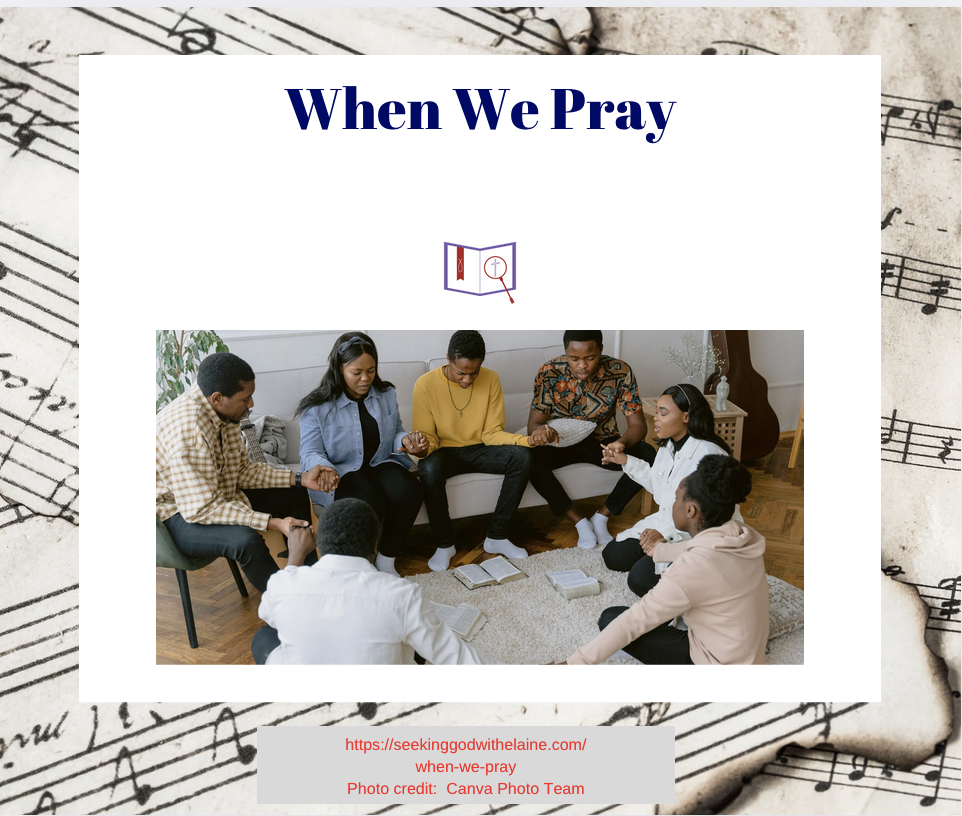
    I recorded this for a Sunday morning service when I wasn’t sure I was going to have the voice to sing. It is a strong statement about what happens when the Church prays.

    When We Pray
    Vocalist: Elaine Guthals
    Keyboard: Louise Guthals Weiss

    What do you think?

    Leave me a comment below (about this or anything else) or head over to my Facebook group for some interactive discussion.

    If you don’t understand something and would like further clarification, please contact me.

    If you have not signed up for the email daily or weekly providing the link to the devotions and the newsletter, do so below.

    If God has used this devotion to speak with you, consider sharing it on social media.

  • Music Day

    music-day

    Today is going to be a music day. We’ve had a lot of wind and rain this week; and yes, the front went through my head.

    The election results are now in. Regardless of who the winner may have been, both candidates promised to make life better. What they may have made better was different, but both had the same goal.

    The only way things will get better in this — or any other nation — is for people to turn back to God. The way we start that is to pray.

    This song is taken right out of God’s Word. “if my people who are called by my name humble themselves, and pray and seek my face and turn from their wicked ways, then I will hear from heaven and will forgive their sin and heal their land” (II Chron. 7: 14 ESV).

    We have to turn from our sinful ways and put our faith and trust in God. Only He alone can heal our land.

    What do you think?

    Leave me a comment below (about this or anything else) or head over to my Facebook group for some interactive discussion.

    If you don’t understand something and would like further clarification, please contact me.

    If you have not signed up for the email daily or weekly providing the link to the devotions and the newsletter, do so below.

    If God has used this devotion to speak with you, consider sharing it on social media.
  • The Doxology of the Lord’s Prayer

    The ending of the Lord’s Prayer is cut off in almost all translations of Scriptures. This devotional reading looks at Jesus’ final act of praise in His model prayer.

    Nuggets

    • We must praise God for His spiritual kingdom.
    • We must praise God for His unmatched power.
    • We must praise God with honor and reverence.
    • Our praise to and worship of God will never end.
    • We seal our prayers with an Amen.

    The King James Version is the only translation that ends the Lord’s Prayer with an Amen.

    I get there are different scrolls that say different things. That is why the kingdom, power, and glory part is left out of all other translations.

    But Jesus ended the prayer and didn’t say Amen? He didn’t say goodbye to His Abba???

    I have problems with that.

    Not only was the last phrase lopped off, but also the last part of the temptation phrase was just ignored.

    Let’s take a look.

    Let’s Put It into Context

    To read devotions in the Habitual Holiness of Heart and Life theme, click the button below.

    Here is a running list of nuggets for the theme.

    Devotions in the Commit to Grow Our Habits study

    Here is a running list of nuggets for the study.

    “And lead us not into temptation, but deliver us from evil: For thine is the kingdom, and the power, and the glory, for ever. Amen” (Mt. 6: 13 KJV)

    The Kingdom

    “… For thine is the kingdom…” (Mt. 6: 13 KJV)

    We must praise God for His spiritual kingdom.

    Part of the reason I am confused about the kingdom, power, and glory being left out is that it is flat out thanksgiving and praise. Jesus would have been worshiping His Father.

    The entire prayer is building to here, where Jesus can cut loose and fully praise and worship God. He wouldn’t leave this out.

    No, a lot of times we get the praise wrong. We give thanks to God for what He has done for us. We may even paise Him for the spiritual graces He has given us.

    But we don’t always praise God for Who He is. We miss the most important part.

    We have to acknowledge that it is only God’s alone — Thine.

    We are glad He provides us a job (most of the time), but we also have to be thankful he sent His Son to die for us. We can’t just be thankful for the physical aspects of our lives.

    I love how Saphir put it. He wrote, “Praise is the language of the soul in communion with God.”

    Resource

    That is what we have been focusing on during this study of the Lord’s Prayer — communication with God. We have to speak with Sovereign God.

    We have to be thankful for God’s kingdom. We have to be thankful for the spiritual aspects.

    We already spent a devotion on God’s kingdom. It is universal. All mankind — dead and alive — will be subject to Sovereign God. This will last for eternity.

    One day, God will send Jesus to call the saints home. God has that authority.

    Barrow discussed this. He wrote, “Thou hast a perpetual and [unmovable] authority whereby justly to dispose of all things …”

    Resource

    It is God’s right alone to be Judge and Ruler. His wrath at our disobedience will finally be relieved.

    The only reason this can happen is because Jesus completed the Plan of Salvation. He paid the debt for our sins.

    God’s new kingdom will be perfect. That is because we will be pure as God is because of the absence of sin.

    Sin is not believing that Jesus is our Savior to save us from our actions by humans that disobey God and break one of His reasonable, holy, and righteous laws and commandments, goes against a purpose He has for us, or follows Satan’s promptings.
    Perfection means we reach a state of maturity because the combination of the spiritual graces form, when all are present, spiritual wholeness or completeness — holy, sanctified, and righteous.

    • Spiritual graces are worldly morals that have been submitted to God to further His kingdom instead of enhancing this world.
    • Holy means to be set apart — because of our devotion to God — to become perfect, and morally pure while possessing all virtues and to serve and worship God.
      • Pure means not being sinful or having the stain of sin. 
      • Virtues are standards of moral excellence.
    • Sanctified means to be set free from sin.
    • Righteous means we are free from sin because we are following God’s moral laws.

    Glossary

    We can’t miss the opportunity to praise God for His perfect kingdom, in which we will spend eternity.

    The Power

    “… and the power…” (Mt. 6: 13 KJV)

    We must praise God for His unmatched power.

    God doesn’t have just any power. His power is, as Barrow put it, “… an indefectible and irresistible power, whereby Thou canst effect whatever seems just and good to Thee.”

    Resource

    God’s power is not going to go away on January 31, 2035. God’s power is eternal.

    Scriptures tell us that “for it is written, ‘As I live, says the Lord, every knee shall bow to me, and every tongue shall confess to God’” (Rom. 14: 11 ESV). No one is going to be able to resist Him.

    No part of this world is exempt from God’s power. Neither earths most intelligent being, nor its most powerful leader, is absolved from God’s power. All the Church, along with Satan and his demons, will all bow before Jesus.

    Because of that, we should seek Jesus as our Savior now. We don’t want to wait another day, another minute.

    In a recent devotion, we talked about desires. Edwards talked about what this power means to children of God. He wrote, “That the power by which our desires are brought about is Divine, and not human.”

    Glossary

    Resource

    We can’t rely on our own intelligence and understanding, as Barrow said. God should be the One to control our hearts’ desires.

    The Glory

    “… and the glory…” (Mt. 6: 13 KJV)

    We must praise God with honor and reverence.

    Jesus said that all the glory belongs to God. Glory expresses the essence of God — His majesty, splendor, and beauty — representing the attributes of God resulting from His authority and holiness.

    It isn’t up to us to work everything out until we understand, and then submit to God. We have to give up our understanding and take on faith that God is supreme.

    Faith is a gift from God and a work of the Spirit that enhances the conviction that the doctrines revealed in God’s Word are true, even if we do not understand all aspects of them, a belief which impacts our lives and distinguishes us from others.

    Glossary

    Worship has to be objective. We have to keep our minds open to God doing the impossible (Lk. 1: 37).

    We have to raise ourselves to God’s level rather than lowering him to ours. Only that way can we approach Heaven.

    We have to raise ourselves to God’s level rather than lowering him to ours. Only that way can we approach Heaven.

    Forever

    “… for ever…” (Mt. 6: 13 KJV)

    Our praise to and worship of God will never end.

    Manton described what this looks like. “For ever. All excellencies which are in God, are eternally in God.”

    Resource

    We have no concept of what forever actually is. We have not been alive forever.

    This is just one of the things we have to leave for God’s understanding. We have to take it on faith that there is a forever and that, being a child of God’s, we will be with Him for that time.

    Amen

    “… Amen” (Mt. 6: 13 KJV)

    We seal our prayers with an Amen.

    By saying amen to our prayers, we agree with what we have said and accept God’s answers to those prayers. We are firm our belief in God’s truth and faithfulness.

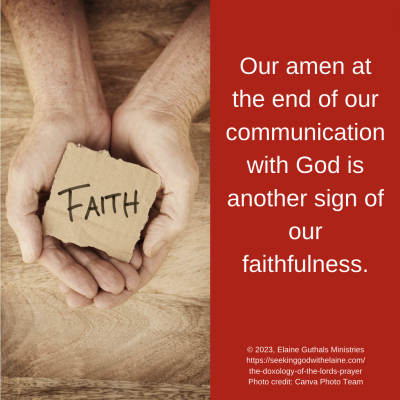
    Our amen at the end of our communication with God is another sign of our faithfulness.

    Our amen at the end of our communication with God is another sign of our faithfulness.

    By giving this sign, we also commit to deepening our devotion to God. We clear our conscience.

    the-doxology-of-the-lords-prayerFB

    Making the Connections #1

    Did you notice what the Lord’s Prayer doesn’t have a lot of? Father, heal Andrew. Help Peter in his marriage. Change James’ and John’s character. (Please take the thunder out of them!)

    What does most of our prayers contain? Supplications for things in this world.

    We need to refocus on God.

    Making the Connections #2

    Sometimes, when we pray, we are not confident in our prayers. We feel God will not accept them.

    We have nothing to worry about when we are truly God’s children, asking completely in His will.

    Edwards talked about this. He wrote, “Our confidence in the acceptableness of our prayers is derived from God and not from ourselves.”

    Resource

    That is great advice. God alone determines if our prayers are acceptable.

    How Do We Apply This?

    • Remain steadfast in our faith in God.
    • Remain confident that God will answer our prayers.
    • Be committed to praying.
    • Expect God’s abundance in answering our prayers.
    • Remember God is eternal and unchangeable.
    • Gain peace through prayers, regardless of the situation.
    • Praise God to grow our faith and prepare for Heaven.
    • Praise God for Who He is, not what He has given us.
    • Search for and seek God.
    • Give up on knowing the how of things.
    • Possess limitless adoration for Him.
    • Acknowledge and appreciate gods omnipotence.
    • Deep in our devotion to God.

    Searching for and Seeking God

    Hearing His Word (Rom. 10: 17)
    Reading His Word (Rev. 1: 3)
    Praying to Him (Heb. 4: 16)
    Studying His Word (Ac. 17: 11)
    Meditating on His Word (Ps. 1: 1-2)
    Memorizing His Word (Ps. 119: 11)

    Resource

    Our Father. You are Sovereign God. Your kingdom is eternal. Your power is omnipotent. Your glory is beautiful. Thank You for letting us communicate with You. Grow us to be more like You. Amen.

    What do you think?

    Leave me a comment below (about this or anything else) or head over to my Facebook group for some interactive discussion.

    If you don’t understand something and would like further clarification, please contact me.

    If you have not signed up for the email providing the link to the devotions and the newsletter, do so below.

    If God has used this devotion to speak with you, consider sharing it on social media.
  • The Evil of Temptation

    The last petition in the Lord’s Prayer is on temptation. This devotional reading looks at what temptation is and isn’t and how God leads us not into it.

    Nuggets

    • Temptations are a part of life in order for us to grow in faith.
    • We can’t resist temptation alone, rather God delivers us.

    a

    Let’s Put It into Context

    To read devotions in the Habitual Holiness of Heart and Life theme, click the button below.

    Here is a running list of nuggets for the theme.

    Devotions in the Commit to Grow Our Habits study

    Here is a running list of nuggets for the study.

    “And lead us not into temptation, but deliver us from the evil one” (Mt. 6: 13 NIV)

    Lead Us Away from Temptation

    “And lead us not into temptation…” (Mt. 6: 13 NIV)

    Temptations are a part of life in order for us to grow in faith.

    We usually don’t want to experience temptations. Temptation is a suggestion in our mind that would lead us to sin rather than following God’s Will. It is also that period of time between conception and execution of doing what is sinful.

    Moore described temptation as a “… moral experiment for good or evil.” He also said it is an invitation to sin. That is an excellent description!

    Resource

    We could also say it is the foundation for sin. It is the stomping grounds.

    That brings up a point that the Biblical Illistrator brought up. The quote says, “Temptation is a necessary element in a life of probation, such as our life on earth is.”

    Resource

    We are preparing for our life during eternity. We have to be transformed to have God’s character in order to gain entrance to Heaven.

    Temptations aid us in the transformation.

    What it is is a moral battle. We are trying to determine what is the proper way to act.

    It is definitely between good and evil. It is between Satan and God’s ownership of us.

    Good, in the biblical sense, is the workings of God within His people through His holy, pure, and righteous behavior.

    • Holy means to be set apart — because of our devotion to God — to become perfect, and morally pure while possessing all virtues.
      • Perfection means we reach a state of maturity because the combination of the spiritual graces form, when all are present, spiritual wholeness or completeness — holy, sanctified, and righteous.
        • Spiritual graces are worldly morals that have been submitted to God to further His kingdom instead of enhancing this world.
        • Sanctified means to be set free from sin.
        • Righteous means we are free from sin because we are following God’s moral laws.
      • Pure means not being sinful or having the stain of sin. 
      • Virtues are standards of moral excellence.

    Evil is equated with sin because it is that which goes against God and His purposes.

    We know these temptation comes from Satan. They don’t come from God because He tests us rather than tempts us.

    That may be a hard concept to grasp. Tempting. Testing. We may think it is a rose by any other name is still a rose.

    God may let us drive through the neighborhood of temptation, but He doesn’t program our GPS for it.

    Blackburn said something interesting. He wrote, “THOSE TEMPTATIONS THAT ARE RELATED TO GOD HIMSELF.”

    Resource

    Does that sound contradictory? I don’t think so.

    The temptations we face relate to God because Satan is trying to get us to do the opposite of what God wants us to do. The world is full of temptations, and Satan works overtime to get them on our radar.

    So, when we pray this, we shouldn’t be asking to bypass the temptations. We’d be missing some of our greatest blessings if we did that.

    Mangey felt we are asking not to be blindsided with trials or to not forget what we have gone through. Stanford felt it was our petition for help with the upcoming temptation because we know it is going to come. Winslow said we are asking God to weaken the power of the temptation.

    Resources

    That stresses that we have to be on guard. We have to watch because Satan is going to try to slide something in on us.

    We sometimes blame God for our troubles. To punish God, we stop praying to Him.

    Withholding our prayers solves nothing. Instead of drawing us to God, it takes us further away from Him.

    Temptation itself isn’t sin. Unfortunately, we usually give into that temptation. We commit the sins and fail at the evaluation of our faith.

    Winslow made a comment that got the gears turning. He said that the temptations come from within.

    Resource

    Don’t get me wrong. Winslow said they come from without, too.

    But even if the temptation comes from the world, it has to be addressing something we find tempting. That has to come from the inside.

    The temptation has to stem from a weakness within our faith. Faith is an inside thing.

    We don’t like to think of it that way, do we? We want Satan to be blamed for the temptations – and our giving in to the sin.

    We don’t want it to reflect weakness on our part.

    But isn’t that the whole purpose of temptations? It shows us where we are weak and need work. It cuts out that associated sin.

    We just talked about this. Satan and God aren’t to blame when we sin. We are.

    We sin because of our ability to choose – free will. Free will is the ability within us to make decisions, which determine actions that produce character.

    Sometimes, we not only choose to commit the sin associated with the temptation, but we also program the GPS ourselves. We go looking for it.

    Other times, we don’t have the specific address programmed in. We just have the neighborhood as our destination.

    Beecher made a really good observation. We can even be tempted by good things.

    Resource

    Does that seem nonsensible? A little bit of a good thing is great, be a lot of a good thing should be better. Right?

    Not necessarily.

    Remember, God calls us to be sober minded. He calls us to be even keeled.

    Glossary

    We should approach things in moderation. Wanting even more of a good thing doesn’t always mesh with moderation.

    Deliverance

    “… but deliver us from the evil one” (Mt. 6: 13 NIV)

    We can’t resist temptation alone, rather God delivers us.

    There is no way we are going to withstand Satan by ourselves. Paul told us why.

    “For we do not wrestle against flesh and blood, but against the rulers, against the authorities, against the cosmic powers over this present darkness, against the spiritual forces of evil in the heavenly places” (Eph. 6: 12 ESV).

    It would be like taking a butter knife to a gunfight.

    We can’t fight Satan on our own strength. We have to rely on God’s strength and power.

    Barrow reminded us we need God’s instructions and guidance to withstand the temptations. That is where the growing through the temptations come into play.

    Resource

    This translation says keep us from Satan. The English Standard Version broadens it to keep us from evil. Period.

    I guess — technically — they both are right. All sin comes from Satan. All evil is opposed to God’s good.

    Whether we are focusing on the who or the what of sin, it is taking our focus off God.

    Manton gave us a list of the consequences of sin.

    • We become separated from God.
    • We are prevented from experiencing of God’s comfort.
    • It reprimands our sin.

    Resource

    There is hope. Edwards reminds us that evil is something separate from us.

    Yes, we have our sinful nature. But that isn’t how mankind was originally made.

    We were originally made in the image of God. We didn’t have sin in our lives.

    Resource

    Glossary

    That gives me a lot of peace and comfort. It is easy returning something to its original form than taking something and completely changing its makeup.

    But that also signifies how important it is for us to repent of our sins. Repentance is acknowledging our separation from God and expressing sorrow for breaking God’s laws and commandments by making the commitment to change our sinful ways to ways of righteousness through obedience.

    • Sin is not believing that Jesus is our Savior to save us from our actions by humans that disobey God and break one of His reasonable, holy, and righteous laws and commandments, goes against a purpose He has for us, or follows Satan’s promptings.
    • Obedience means submitting ourselves to the will of God as it is presented to us and living our lives accordingly.


    Glossary

    Barrow gave us a list of that for which we are actually asking when we pray.

    • A clear conscious.
    • Removal of guilt.
    • Removal of our blindness to sin.
    • Softening of our hearts.
    • Increased reverence to God.
    • Love toward others.

    Resource

    I feel I have to chase a rabbit a second. God is the only One who gets to say what sin is and what it isn’t. We don’t get to choose.

    But then that leaves God with the timetable of when we are going to be delivered from the temptations.

    It is all up to Him.

    God still has us to ask for the deliverance He wants to give. As He can see our hearts and our motivations, He know when the time is right.

    We have to learn to see things God’s way.

    the-evil-of-temptationFB

    Making the Connections #1

    Let’s tie this back to forgive our debtors as we have been forgiven. One thing that might help us forgive them is when we remember they were tempted, too.

    Also, we don’t want to lead others stray by following us when we are tempted.

    Making the Connections #2

    Vaughan brought up something that we may not be thinking about. He wrote, “Admire the anticipatory character of God’s care for us.”

    Resource

    God may tell Satan that he can’t tempt us in a certain way or at a certain time. God has control.

    Sometimes, God does what we want. He takes away our proclivity to sin. We no longer have the appetite for that temptation.

    Maybe it is just me, but I bet God really likes defeating Satan in the battles. We know He is going to win the war, but winning the battles along the way is good.

    Making the Connections #3

    Have you ever thought about why temptation petition was the last one? I hadn’t until I read Saphir’s sermon.

    Saphir said that this was the last petition because it summarized the previous petitions. It is through this petition that, as Blyth said, we can grasp the others.

    Resources

    Let’s review what the others are.

    1.     Hallowed be thy name.
    2.     Thy kingdom come.
    3.     Thy will done on earth.
    4.     Our daily bread.
    5.     Forgive us our debts.
    6.     And lead us not into temptation.

    We focus on these, and we will be delivered from evil. Why? Because we will be communicating with Sovereign God.

    When we consistency communicate with God, we gain perseverance.

    How Do We Apply This?

    • Resist temptation.
    • Follow Jesus’ example in resisting temptation.
    • Be on guard against the temptations focused on our weak flank.
    • Use the temptations to grow our faith.
    • Don’t run into temptation because we have a heightened awareness of it through prayer.
    • Don’t run into temptation while trying to avoid some other temptation.
    • Recognize God’s mercy in allow trials to happen because it grows our humility.
    • Don’t expect God to keep delivering us from temptations if we do not try to keep ourselves from them.
    • Fortify our energies to resist temptation.
    • Don’t hide or ignore our weaknesses.
    • Fear temptation.
    • Pray to withstand the temptations we face.
    • Be on guard.
    • Don’t program the GPS for temptation’s neighborhood.
    • Be watching for small temptations as well as the big ones.
    • Follow the still, soft promptings of the Holy Spirit.
    • Recognize temptations change as we change.
    • Realize how great our need is to have our sinful nature removed.
    • Let God set the timetable for deliverance.
    • Recognize that Jesus is the only avenue of deliverance, the promised Deliverer.

    Resource

    Father God. We know we will be tempted. We may rather we wouldn’t be, but we know this is our opportunity to grow our faith. Help us not be blindsided by temptations. Help us stand firmly in Your Will. Amen.

    The ABCDs of Salvation

    If you have not become a believer in Christ, please read through the
    Plan of Salvation and prayerfully consider what God is asking you to do.

    A – admit our sins
    B – believe His Son Jesus is our Redeemer
    C – confess God as Sovereign Lord

    D – demonstrate that commitment by making any changes needed in our lives to live the way in which God has called us

    The Disciple’s Job Description

    What do you think?

    Leave me a comment below (about this or anything else) or head over to my Facebook group for some interactive discussion.

    If you don’t understand something and would like further clarification, please contact me.

    If you have not signed up for the email providing the link to the devotions and the newsletter, do so below.

    If God has used this devotion to speak with you, consider sharing it on social media.
  • The Forgiving of Debts

    In the Lord’s Prayer, Jesus said we are to pray asking God to forgive our debts. This devotional reading looks at what that is and how we transfer that forgiveness to others.

    Nuggets

    • Debts is an interesting term for sin.
    • Because God has loved and forgiven us, we are to love and forgive others.

    We come to the confession part of the Lord’s Prayer. This part can trip a lot of us up.

    We don’t want our mistakes – let alone our on-purposes – acknowledged and pointed out. Since He know our hearts, can’t we just skip that?

    No, we need to get right with God. We need to acknowledge our shortcomings. We need to fess up when we’ve screwed up.

    We need to get the relationship in the right place. Relationships take work. We need to be real about where we are at.

    Let’s Put It into Context

    To read devotions in the Habitual Holiness of Heart and Life theme, click the button below.

    Here is a running list of nuggets for the theme.

    Devotions in the Commit to Grow Our Habits study

    Here is a running list of nuggets for the study.

    “And forgive us our debts, as we also have forgiven our debtors” (Mt. 6: 12 NIV)

    Our Debts

    “And forgive us our debts …” (Mt. 6: 12 NIV)

    Debts is an interesting term for sin.

    Another gospel says, “and forgive us our sins …” (Lk. 11: 4, ESV). That is more the churchy way of saying it, but to me, it really is the best. It is what we are talking about.

    Sin is not believing that Jesus is our Savior to save us from our actions by humans that disobey God and break one of His reasonable, holy, and righteous laws and commandments, goes against a purpose He has for us, or follows Satan’s promptings.

    • Holy means to be set apart — because of our devotion to God — to become perfect, and morally pure while possessing all virtues and to serve and worship God.
      • Perfection means we reach a state of maturity because the combination of the spiritual graces form, when all are present, spiritual wholeness or completeness — holy, sanctified, and righteous.
        • Spiritual graces are worldly morals that have been submitted to God to further His kingdom instead of enhancing this world.
        • Sanctified means to be set free from sin.
        • Righteous means we are free from sin because we are following God’s moral laws.
      • Pure means not being sinful or having the stain of sin. 
      • Virtues are standards of moral excellence.

    Glossary

    But we’ve been using the New International Version for the verse. It says debts.

    When we think of debts, we think of what we owe. We talk about going into debt – a conscious decision. Yes, sometimes we willfully sin.

    The thing is we cannot pay this debt. With our sinful nature so ingrained within us, we cannot pay the penalty for sin ourselves.

    Only Christ can pay the debt for our sins.

    Manton said that debt also has an element of duty associated with it. This is talking about obedience and worship.

    Resource

    Debt also speaks of consequences and liability. Ooo, baby. We don’t think there should be a liability because want we don’t the consequences.

    Some worldview people say that God shouldn’t call some things sin. We want to love who we want to love, do what we want to do, and live like we want to live.

    God said no. Doing things that are not in His character is sin.

    It is hard to acknowledge and confess our sins. We want them buried (Jas. 5: 15). But 1 John 1: 9 says, “If we confess our sins, he is faithful and just to forgive us our sins and to cleanse us from all unrighteousness” (ESV).

    Our sins won’t be buried. We’ve talked before about the books of Revelation. They will be opened on Judgment Day, and our thoughts and actions will be judged.

    Glossary

    Trespass is an also interesting way to describe sin. A really old Bible translation used this term.

    When you think about it, it is an accurate description. Trespassing means you are going somewhere you aren’t supposed to be. Usually, it is posted to keep you out.

    Consequences occur if you disobey the warnings. Think about kids entering an abandoned building so they can have a party.

    It is enticing to disobey the warnings; it is secret; they think they won’t be caught; it is rebellious and challenging. Now replace the abandoned building with sin. Sin is all of those things.

    But it doesn’t stop at the commission of sins. That is where the forgiveness begins. Forgiveness is, when we ask, the act of God pardoning us because we have shown repentance for breaking His laws and commandments, which allows us to become holy as He is.

    • Repentance is acknowledging our separation from God and expressing sorrow for breaking God’s laws and commandments by making the commitment to changing ourselves through obedience so that we no longer do the wrong things.
    • Obedience means submitting ourselves to the will of God as it is presented to us and living our lives accordingly.

    Stanford gave us a really good reminder. He said that the people asking for forgiveness here are the children of God.

    Glossary

    That means they have already ABCDed. We are asking for God’s grace to forgive us of our sins.

    The ABCDs of Salvation

    If you have not become a believer in Christ, please read through the
    Plan of Salvation and prayerfully consider what God is asking you to do.

    A – admit our sins
    B – believe His Son Jesus is our Redeemer
    C – confess God as Sovereign Lord

    D – demonstrate that commitment by making any changes needed in our lives to live the way in which God has called us

    The Disciple’s Job Description

    Grace is a free and unmerited gift of love from the Heavenly Father, given through His Son, Jesus Christ, that enables salvation and spiritual healing to believers by the work of the Holy Spirit. God’s grace is the product of the joy of a life with God and His purity.

    Glossary

    We can only be forgiven when we agree to submit our lives to God. He will not forgive us if we continue to willfully sin.

    Saphir put it this way. He wrote, “He who has not received the spirit of forgiveness has not truly received the gift of pardon. … He who does not [forgive] forsakes the spirit of the gospel, and returns to the spirit of legalism.”

    Resource

    It doesn’t work if our repentance isn’t sincere. Our worship isn’t sincere. Our praise isn’t sincere.

    Moore reminded us that we are talking about our moral condition and circumstances here. Our moral condition must be tied into God’s character.

    Resource

    Our whole purpose of asking God to forgive our sins should be to submit our lives to Him. We show that by becoming like Him.

    Our whole purpose of asking God to forgive our sins should be to submit our lives to Him.

    Our Forgiving

    “… as we also have forgiven our debtors” (Mt. 6: 12 NIV)

    Because God has loved and forgiven us, we are to love and forgive others.

    The second part of the verse tells us how we are to react to being forgiven of our sins/debts/trespasses by God. We are to pass it on.

    We are to forgive everyone, not just those who have sinned just a little against us.

    Forgiveness has a reason. We are blessed when we forgive others. “Blessed are the merciful, for they shall receive mercy” (Mt. 5: 7 ESV).

    Yes, it changed from forgiving to merciful. What is mercy? Even though we deserve bad things as punishment, God doesn’t give them to us.

    Don’t you see the connection? It has to do with our attitude. It is based on our love for others. We aren’t selfish, don’t look for the worst, and hold grudges.

    That is hard to do when we encounter a wrong by an enemy. We especially love it when karma happens.

    But that isn’t how we are to react.

    • “Don’t gloat when your enemy falls, and don’t let your heart rejoice when he stumbles, or the LORD will see, be displeased, and turn His wrath away from him” (Prov. 24: 17-18 CSB).
    • “Vengeance is mine; I will repay, saith the Lord (Rom. 12: 19, KJV).”

    We can’t let God have the vengeance if we are gloating.

    God has made it our duty to love others.

    There is also instructions to reconcile with them before we approach God. “So if you are offering your gift at the altar and there remember that your brother has something against you, leave your gift there before the altar and go. First be reconciled to your brother, and then come and offer your gift” (Mt. 5: 23-24 ESV).

    Barrow had some strong words for those that do not forgive others. He wrote, “If we break it, if we retain any uncharitable inclinations, we deal falsely with God; we forfeit all [pretense] to mercy and [favor] from Him; we are neither qualified for mercy, nor shall obtain it from God.”

    Resource

    It makes sense when we think about it. We are being sanctified. Sanctification is the transformational process of the mind, body, and soul, which begins with regeneration; gradually changes our nature and morals through the promptings of the Holy Spirit; and ends with perfected state of spiritual wholeness or completeness.

    • Regeneration is being changed from spiritually dead to spiritually alive and the internal new birth and requickening that God brings about through the work of the Holy Spirit to give us new character.
      • Spiritual death is the separation from God that occurred as a consequence of Adam and Eve’s original sin.
        • The spiritually alive are those who have ABCDed, so they are no longer separated from God.

    Glossary

    The whole goal of sanctification is that we possess God’s character. God forgives. We must, too, to be like Him.

    Jesus said that we have to forgive as God forgives. Winslow and Hall told us the characteristics of His forgiveness.

    • Immediately
    • Absolutely
    • Completely
    • Heartily

    Not only that, but Winslow also reminded us God forgets. “He has removed our sins as far from us as the east is from the west” (Ps. 103: 12 NLT).

    Resources

    For all the worldview wants us to forgive others and live in harmony, they have trouble forgiving people that don’t think as they do. They also sometimes see a forgiving spirit as a weakness.

    Bottom line is don’t stoop to our enemy’s level (Prov. 25: 21-22). Take the high road. Work it out with them. Get over it. Put it to bed. Move on.

    We have heard it before. God forgives us much more than we could ever forgive others.

    the-forgiving-of-debtsFB

    Making the Connections #1

    I was kind of thrown for a loop when I read Edwards’ Our Debt sermon. He was talking about fact and theory of forgiveness.

    I kind of did a very quick search through some psychology articles — emphasis on very and quick. So, I may have glossed over something or totally missed it, but here is what I saw.

    • Forgiveness is an attitude.
    • Forgiveness repairs broken bonds and does better at creating them than communication does.
    • Forgiveness is fostered by empathy.
    • Yet, forgiveness is more about the forgiven than the one being forgiven.

    Resources

    But then Edwards went on to say something that resonated with me. He wrote, “We are led to regard forgiveness as a [favor], and not as a claim.”

    Resource

    That got things jumbled up. We grant favors. We don’t have to, but we choose to do it.

    God doesn’t say, “If you feel like it, forgive Tom.” “It’s okay to say that you forgive Sally, but really don’t.”

    God point blank says forgive. Not partially. Certainly not in words only.

    Immediately, absolutely, completely, and heartily.

    Making the Connections #2

    Let’s think about placement a second. In the last devotion, we talked about the daily bread in Matthew 6: 11.

    We need Jesus in our lives. He is our daily Bread. Through Him and Him alone do we receive forgiveness for our sins.

    We only receive Jesus as our Savior when we ask Him to be just that. We have to submit our lives to following God’s and commandments.

    But don’t elevate us because we ask. Don’t think forgiveness happens because we repent — even though non-repentance doesn’t bring forgiveness. Don’t think we earn the forgiveness in any way.

    Honor God because He extends forgiveness to us through His grace. That is the only forgiveness worth having.

    Making the Connections #3

    Hall identified three components that we have to possess to show our sincerity in wanting Divine forgiveness.

    • Conviction
    • Contrition
    • Confession

    Our sole purpose must be to repent and turn away from our sins. We must be seeking the transformation that is in the disciple’s job description.

    Resource

    The Disciple’s Job Description

    Complete Job Description

    Individual Description

    Job Duty #1
    Be a Living Sacrifice (Romans 12: 1-2)

    If these three components are not present in our petition, our petition is not sincere. Sincerity is shown by having a forgiving, merciful spirit within us. We show gratitude to God by forgiving others.

    How Do We Apply This?

    • Sincerely ask God to forgive our sins, and then sincerely forgive others.
    • Forgive to increase our enjoyment of our own forgiveness.
    • Forgive to corroborate our faith.

    Resource

    Father God. We praise You for Your merciful spirit. We do not deserve Your forgiveness, yet You give it when we sincerely believe Jesus paid the price for our sins. Grow that forgiving, merciful within us so that we can forgive others. Amen.

    What do you think?

    Leave me a comment below (about this or anything else) or head over to my Facebook group for some interactive discussion.

    If you don’t understand something and would like further clarification, please contact me.

    If you have not signed up for the email providing the link to the devotions and the newsletter, do so below.

    If God has used this devotion to speak with you, consider sharing it on social media.
  • Asking God for What We Want

    In the Lord’s Prayer, Jesus showed us showed us how to ask God to provide for our physical and spiritual needs. This devotional reading looks at how we are to continuously ask God to provide for our needs.

    Nuggets

    • We may be asking for what we want, but we know that God supplies all things.
    • God supplies for our physical and spiritual needs.
    • While God has plans for our future, He wants us to rely on Him for the day.

    The first part of the Lord’s Prayer talks about God and Who He is. We should focus on God and what He wants first, right?

    Then we get to the part where we get to ask what we want.

    But we’re good there, aren’t we? Especially when we ask for today. But are we?

    Let’s Put It into Context

    To read devotions in the Habitual Holiness of Heart and Life theme, click the button below.

    Here is a running list of nuggets for the theme.

    Devotions in the Commit to Grow Our Habits study

    Here is a running list of nuggets for the study.

    “Give us this day our daily bread” (Mt. 6: 11 ESV)

    Give Us

    “And my God will supply every need of yours according to his riches in glory in Christ Jesus.” (Phil. 4: 19 ESV)

    We may be asking for what we want, but we know that God supplies all things.

    God gives us what we need. He tells us this in His Word. He delights in providing for us.

    • “Every good gift and every perfect gift is from above, coming down from the Father of lights, with whom there is no variation or shadow due to change” (Jas. 1: 17 ESV).
    • “John answered, ‘A person cannot receive even one thing unless it is given him from heaven’” (Jn. 3: 27 ESV).

    We are very good at asking for things we need in this life. Don’t get me wrong. God wants us to do that.

    Manton tells us all about how we do this and why. We just have to do it lawfully.

    The physical things we are asking for may be needed for us to serve God. For instance, it may take money for us to do what God has called us to do. We can ask for that.

    If we don’t ask God to provide for our physical needs, Satan can use those to tempt us. Think about how much we focus on God when we are going bankrupt or losing our jobs.

    If we aren’t careful, we can take our eyes off God then.

    Asking lawfully means that we don’t put more emphasis on physical things than spiritual things. It also means we have to follow God’s plan for our lives, not our own.

    Resource

    Why would God have us ask for things when He has promised to supply all our needs?

    God doesn’t want us to feel entitled to His promises. Yes, He is going to give them to us – when we are His children.

    Glossary

    We have to submit our lives to God in order to access His choicest blessings. He wants us to acknowledge that we are dependent on Him to supply our needs.

    Something that Barrow said jiggled my mind. He talked about “… whereby we become capable of receiving and enjoying other good things.”

    Resource

    Isn’t that one of the benefits of prayer? We stop looking only at what we want. We become open to seeking God’s Will and find we enjoy more the lives He wants us to live.

    In other words, we take the focus off gumball prayers and focus on godly provision – even if the provision is different than we expect or want.

    Our shifted focus shows God that we are depending on Him. We aren’t just looking for Him to blindly give us what we want.

    We are trusting God’s plan for us.

    It is our duty to rely on God. “The end of the matter; all has been heard. Fear God and keep his commandments, for this is the whole duty of man. For God will bring every deed into judgment, with every secret thing, whether good or evil” (Ecc. 12: 13-14 ESV).

    We are told to rely on God, not ourselves. “Trust in the Lord with all your heart, and do not lean on your own understanding” (Prov. 3: 5 ESV).

    Chaplin had an interesting taking. He said that we are asking for the “… ability and opportunity to obtain our daily bread.”

    Resource

    I can see that. All we are, know, and can do is because God has made us that way.

    No, God doesn’t need us for any reason. He unselfishly wants to give us what we cannot give ourselves. We can only rely on His gifts.

    God provides for us when we seek Him. He is looking for our faith to rely on Him.

    Our Daily Bread

    “I am the living bread that came down from heaven. If anyone eats of this bread, he will live forever. And the bread that I will give for the life of the world is my flesh” (Jn. 6: 51 ESV)

    God supplies for our physical and spiritual needs.

    Okay, we are going to take this out of order. If you have read prior devotions, you know I generally start at the beginning of the verse and walk through it.

    I just think we need to know what we are talking about before we go on to quantify it. So, hold the thought of relying on Him.

    Yes, God provides all our physical needs. But we aren’t just talking about throwing some yeast and flour into some other ingredients, slapping it in the oven, and calling it bread. This isn’t a literal translation.

    Bread is a fairly basic necessity. But what we are talking about here is all our needs.

    Our dependence on God proving our needs is a must.

    Our dependence on God proving our needs is a must.

    We were just talking about our desires. God doesn’t want us to desire sinful things.

    God is more interested in the spiritual than the physical.  Edward said it this way. He wrote, “That even the wants of our bodies are to be subordinated to the purposes of religion.”

    Resource

    God wants us to focus on the eternal. That is where we get our joy.

    When we do that, the physical falls into place. (No, this isn’t a prosperity gospel.) Our priorities are aligned with His.

    We know Jesus is the Bread of Life.

    To read a related devotion, click the button below.

    We can only find salvation through Jesus. “Jesus answered, ‘I am the way and the truth and the life. No one comes to the Father except through me’” (Jn. 14: 6 NIV).

    Only God can give us this Bread. We only come to salvation when He calls us.

    No, that doesn’t mean God doesn’t call everyone. It means He calls us when the time is right.

    To read a related devotion, click on the appropriate button below.

    Mangey took this a step further. He reminded us that we need to pray in God’s Will. We shouldn’t be praying for something that God doesn’t want us to have or do.

    We may have it as a goal to become a missionary to some specific country. That may not be God’s plan for us.

    Oh, God might call us to be a missionary, but not to that specific country. But then again, He may have our mission field be where we are – even in our current job.

    Resource

    This encompasses so many Christian elements. We have to be dependent. We have to submit. We have to have the correct priorities. We have to desire spiritual things.

    Think of it this way. We have to depend on God to provide our physical needs to support life of the body. But life is greater than just physical life. It is spiritual life. We have to focus on more than this physical life, because we are going to have an eternal life somewhere.

    We want that eternal life to be in the right place – Heaven, not hell.

    Focusing on our eternal life brings us contentment. We aren’t desiring what we shouldn’t have. We aren’t even asking for what we wish we had.

    We are asking for what we need.

    It also helps us resist the temptation to sin. We aren’t coveting what someone else has, so we don’t lie and steal.

    It also fosters moderation. That helps us to be sober. Being sober is a character trait distinguished by self-control, genuineness, and sound moral judgment.

    Glossary

    Mangey also said doing that brings us independence. It frees us from the dependence associated with sinful desires.

    We are free of the disease of sin because we trust God to provide for our needs. We rely on His promises.

    This Day

    “Therefore do not be anxious about tomorrow, for tomorrow will be anxious for itself. Sufficient for the day is its own trouble” (Mt. 6: 34 ESV)

    While God has plans for our future, He wants us to rely on Him for the day.

    Back to relying on God.

    In what things do we need to rely on God? We have to rely on God’s provision over a period of time rather than right now.

    But then again, we have to rely on God daily.

    Does that seem contradictory? I don’t think so.

    God wants us to know He has a plan for us (Jer. 29: 11); therefore, we should have similar plans. He doesn’t want things left to chance.

    However, God also knows that our plans change. “We can make our plans, but the LORD determines our steps” (Prov. 16: 9 NLT).

    Think of it this way. Sanctification is a process. Sanctification is the transformational process of the mind, body, and soul, which begins with regeneration; gradually changes our nature and morals through the promptings of the Holy Spirit; and ends with perfected state of spiritual wholeness or completeness.

    • Regeneration is being changed from spiritually dead to spiritually alive and the internal new birth and requickening that God brings about through the work of the Holy Spirit to give us new character.
      • Spiritual death is the separation from God that occurred as a consequence of Adam and Eve’s original sin.
        • The spiritually alive are those who have ABCDed, so they are no longer separated from God.
      • Perfection means we reach a state of maturity because the combination of the spiritual graces form, when all are present, spiritual wholeness or completeness — holy, sanctified, and righteous.
        • Spiritual graces are worldly morals that have been submitted to God to further His kingdom instead of enhancing this world.
        • Sanctified means to be set free from sin.
        • Righteous means we are free from sin because we are following God’s moral laws.

    Glossary

    The ABCDs of Salvation

    If you have not become a believer in Christ, please read through the
    Plan of Salvation and prayerfully consider what God is asking you to do.

    A – admit our sins
    B – believe His Son Jesus is our Redeemer
    C – confess God as Sovereign Lord

    D – demonstrate that commitment by making any changes needed in our lives to live the way in which God has called us

    The Disciple’s Job Description

    Our goal is sanctification at the end of the process, but we have to go through every day to get there. Each day should be a step leading to that end.

    Because of that, we need to make sure we communicate with God every day. This is how we develop our dependence on God.

    That daily contact should alleviate our anxiety. It goes back to being moderate and sober.

    We say that being sober is being even keeled. We can be that because our focus is on God, not on the waves around us.

    asking-god-for-what-we-wantFB

    Making the Connections #1

    Mangey said something interesting. He wrote, “God allows us to ask nothing of Him, but what we may with purity desire, and with innocence enjoy.”

    Resource

    Elaine-speak. We can only come into God’s presence to ask of Him when we are submitting ourselves to His Will. Non-believers cannot ask of Him if they do not believe in Jesus and have accepted Him as their Savior.

    We have to ask in God’s Will. We can ask for physical things to support our spiritual growth and ministry.

    But I can’t ask for a million dollars just to be a millionaire.

    We need to enjoy what God gives us. Enjoyment means we are grateful and use what He has given us to glorify Him.

    Making the Connections #2

    Stanford reminded us of a big word in the verse – our. We can’t make the salvation decision for someone else. We can’t pray them into Heaven without them making the decision to submit to God.

    Yes, we are to pray for the salvation of others. We shouldn’t think that they are predestined to be saved, so we don’t have to witness to them or pray for them.

    God knows the decision they will make, but they have the free will to make it. Free will is the ability within us to make decisions, which determine actions that produce character.

    We shouldn’t abdicate our jobs – pray and tell.

    The flip side of that is the Bread is suitable for us. We need the Bread of Life in order to live.

    Making the Connections #3

    Blyth also expanded what bread we are discussing here.

    • “He who supplies seed to the sower and bread for food will supply and multiply your seed for sowing and increase the harvest of your righteousness” (II Cor. 9: 10 ESV).
    • “But he answered, ‘It is written, “Man shall not live by bread alone, but by every word that comes from the mouth of God”’” (Mt. 4: 4 ESV).
    • “Jesus said to them, ‘I am the bread of life; whoever comes to me shall not hunger, and whoever believes in me shall never thirst’” (Jn. 6: 35 ESV).

    Resource

    We can’t limit our view of bread to yeast and flour. We can’t even limit it to physical needs.

    God may use things we are familiar with in analogies, but we have to get the analogy.

    Making the Connections #4

    “The thief comes only to steal and kill and destroy. I came that they may have life and have it abundantly” (Jn. 10: 10 ESV)

    I see you jumping up and down over there. You don’t like being told you have to exercise moderation. You want what you want.

    Evans reminds that that there is no moderation in receiving the Bread itself. God’s gift of salvation is overflowing.

    Resource

    What did David say in Psalms 23: 1? I shall not want.

    Ooo, baby. David switched it from need to want. All our desires will be satisfied.

    But that is because we are desiring God’s Will. We can want more of His goodness because that is what He promises us.

    How Do We Apply This?

    • Rely on God for our physical and spiritual needs.
    • Do what God calls us to do to gain the bread.
    • Don’t become anxious as we know God will supply our needs.
    • Use the bread God gives us to promote His glory.
    • Work to mortify our sin of covetousness.
    • Align our desires with God’s.
    • Don’t share the worldview.
    • Pray daily.
    • Learn to ask for God’s overflow of blessings.
    • Ask for our daily bread when we need it.
    • Don’t hoard God’s provision.
    • Don’t be anxious for God’s provision for the future.
    • Don’t be selfish.
    • Learn humility through depending on God daily.
    • Increase our confidence and gratitude daily.

    Resource

    Father God. You provide so much for us. You give us all we need. When what we want is in Your Will, You give that to us, too. Most importantly, You give us the Bread of Life. Thank You. Help us to pray for our daily portion so that we may navigate the Sanctification Road to become like You. Amen.

    What do you think?

    Leave me a comment below (about this or anything else) or head over to my Facebook group for some interactive discussion.

    If you don’t understand something and would like further clarification, please contact me.

    If you have not signed up for the email providing the link to the devotions and the newsletter, do so below.

    If God has used this devotion to speak with you, consider sharing it on social media.

  • Thy Will be Done on Earth as in Heaven

    The Lord’s Prayer tells us that, when we ask God’s kingdom to come, we pledge to follow His Will. This devotional reading looks at how God’s Will is done on earth.

    Nuggets

    • We are to use God’s Will as our guide.
    • God’s will is being done in Heaven right now, and He wants us to be doing the same right now on earth.

    We tend to think that God’s kingdom will only come at Jesus’ second coming. That is not correct.

    We can – and do – take part of God’s kingdom here on earth. Let’s dig in and see how.

    Let’s Put It into Context

    To read devotions in the Habitual Holiness of Heart and Life theme, click the button below.

    Here is a running list of nuggets for the theme.

    Devotions in the Commit to Grow Our Habits study

    Here is a running list of nuggets for the study.

    “Your kingdom come, your will be done, on earth as it is in heaven” (Mt. 6: 10 NIV)

    Thy Will be Done

    “… your will be done…” (Mt. 6: 10 NIV)

    We are to use God’s Will as our guide.

    As children of God, we are to be like Him. “For the Scriptures say, ‘You must be holy because I am holy’” (I Pet. 1: 16 NLT).

    We like to think God’s Will is who we marry and what job we have. God is concerned about that.

    But remember, God is more interested in our spiritual condition than our physical condition.

    God’s Will is that we follow His laws and commandments. They are to help us transform to have His character.

    Mangey felt that we understand God’s Will through reason and revelation. We have to think things through to understand what God is asking of us and what we need to do to follow His laws and commandments.

    The intent of the laws and commandments is to make us pure and holy. This mortified our sin. Mortify means to place a death penalty on our sins.

    Resource

    Glossary

    I don’t know if I agree with Hambleton. He said that there are three wills of God.

    • Secret will
    • Providential will
    • Revealed will

    Resource

    I agree with the providential or divine will. God wants all to gain salvation (I Tim. 2: 4). Salvation is the gift of life through the deliverance from condemnation and sin to acceptance and holiness and changes us from being spiritually dead to spiritually alive.

    • Sin is not believing that Jesus is our Savior to save us from our actions by humans that disobey God and break one of His reasonable, holy, and righteous laws and commandments, goes against a purpose He has for us, or follows Satan’s promptings.
      • Holy means to be set apart — because of our devotion to God — to become perfect, and morally pure while possessing all virtues and to serve and worship God.
        • Perfection means we reach a state of maturity because the combination of the spiritual graces form, when all are present, spiritual wholeness or completeness — holy, sanctified, and righteous.
          • Spiritual graces are worldly morals that have been submitted to God to further His kingdom instead of enhancing this world.
          • Sanctified means to be set free from sin.
          • Righteous means we are free from sin because we are following God’s moral laws.
        • Pure means not being sinful or having the stain of sin. 
        • Virtues are standards of moral excellence.
    • Holiness is the transcendent excellence of His nature that includes elements of purity, dedication, and commitment that lead to being set apart.
      • Purity means possessing God’s moral character, having eliminated the stain of sin.
    • Spiritual death is the spiritual separation from God that occurred as a consequence of Adam and Eve’s original sin.
      • The spiritually alive are those who have ABCDed, so they are no longer separated from God.

    Glossary

    The ABCDs of Salvation

    If you have not become a believer in Christ, please read through the
    Plan of Salvation and prayerfully consider what God is asking you to do.

    A – admit our sins
    B – believe His Son Jesus is our Redeemer
    C – confess God as Sovereign Lord

    D – demonstrate that commitment by making any changes needed in our lives to live the way in which God has called us

    The Disciple’s Job Description

    Moore described God’s revealed will. He wrote, “The revealed will of God is to be the paramount, exclusive, all-determining law of human conduct.” God tells us how He wants us to live.

    Resource

    These laws and commandments tell us that as they reveal God’s character to us. He also reveals Himself to us through promptings by the Holy Spirit. Other ways are through His Word and His children.

    I don’t think God has a secret will. Yeah, He may not have revealed everything to us yet — and may not ever — but that doesn’t mean it is a secret.

    If God has a certain way of life that He wants us to live but doesn’t reveal it to us, He is setting us up for failure. God would never do that.

    Instead, God tests us and allows trials that draw us closer to Him. Yes, the difficulties in life are also God’s Will.

    Why? God isn’t only interested in us checking off the do’s and don’ts. Perfection — growing mature — is all about being like God. It is our moral duty to follow God’s Will — regardless of our circumstances.

    Perfection — growing mature — is all about being like God

    On Earth as Heaven

    “… on earth as it is in heaven” (Mt. 6: 10 NIV)

    God’s will is being done in Heaven right now, and He wants us to be doing the same right now on earth.

    Those doing God’s will right now in heaven are the angels. We’ve already talked about who they are.

    What we have to figure out is the how and what they are doing.

    Winslow and Blythe said that, whatever God asked the angels to do, they do it, harmoniously, cheerfully, promptly, perfectly, constantly, enthusiastically, and orderly. They don’t kick back at what He says. They submit to His Will.

    Resources

    We know that God wants us to be unified with Him and with other disciples. He wants us all to be working together on His plan.

    That common goal should bring us happiness. All doing our part to expand God’s kingdom should bring us solidarity.

    We should do this work promptly. Through our prayer life, we should know what God is asking us to do. He doesn’t force us to do it but rather allows us to choose.

    We have to choose to do God’s Will God’s way in everything we do. He is looking for perfect — total — commitment. He won’t accept a partial commitment or a lip service commitment.

    In other words, we have to be enthusiastic about doing God’s Will. We have to have the right attitude.

    The angels follow God’s Will in an orderly fashion. God has plans (Jer. 29: 11), and He works those plans. Nothing is out of step or off road.

    Vaughan said something that jiggled my thought process. He said that, whenever God looks out in Heaven, He sees Himself.

    Resource

    No, God isn’t like ego on guardians of the Galaxy part two. He isn’t wiping out the universe.

    We know there is individuality among the angels. Otherwise, there wouldn’t be a Gabriel nor a Michael. For that matter, there wouldn’t be a God, Jesus, and Holy Spirit.

    Vaughan said that God sees a reflection of Himself. To me, that makes sense.

    God is asking us to imitate Him here on earth (Eph. 5: 1). If Scriptures, tell us how it will be like throughout eternity, then we should expect to imitate Him from here on out.

    I see it, like God is looking in a mirror. We are to reflect His glory.

    But we realize what this means — or more importantly what it doesn’t mean. We can’t be converted and sit around to wait on Heaven to get busy.

    It means we are to be worshiping and working to expand God’s kingdom now. We aren’t supposed to be waiting on Jesus.

    Making the Connections #1

    Prayer helps us to become who God wants us to be because prayer helps us to transform based on His laws and commandments. Edwards wrote, “That God’s will may become the regulator of our wishes and pleasures.”

    Resource

    It is only through God’s Will becoming ours that we are saved. We have to submit to constantly doing His Will.

    Making the Connections #2

    Edwards reminded us that God’s kingdom coming within us is a slow process. He doesn’t just flip a switch and download it into us.

    Resource

    Sanctification is a process that will take the remainder of our lives. That means it is going to be a slow and timely process.

    But that gives us hope, doesn’t it? God knows what the end is going to be — we will be like Him.

    What can be more hopeful than that?

    Making the Connections #3

    Unfortunately, we don’t have uninterrupted service to God. We pray a while, then forget. We read His Word, then we hit the snooze button.

    Part of the reason is that we take our focus off God. We become like Peter walking on the water. We take our eyes off Jesus and look at the waves.

    Moral of the story, never take our eyes odd Jesus so that we will always be doing His Will.

    thy-will-be-one-on-earth-as-in-heavenFB

    How Do We Apply This?

    • Love God with all our heart, soul, mind, and strength.
    • Eagerly and cheerfully obey God.
    • Serve God with passion.
    • Approach God in humility and reverence.
    • Persevere through all of the trials we face.
    • Cheerfully submit to God’s plan when we face trials.
    • Endure whatever trials we face.
    • Submit to God’s authority.
    • Trust in God’s goodness, righteousness, wisdom, and promises.
    • Have an attitude of submission.
    • Realize our present submission to God Will is more important than our past or future submission.
    • Be obedient through constant integrity.
    • Submit our intellect.
    • Let our will be assimilated into His.
    • Be flexible to accept His Will another rigidly demand our own be done.
    • Do God’s Will God’s way.
    • Grow a missionary spirit within us.
    • Recognize the privilege of being allowed to do God’s Will on earth.
    • Never take our eyes odd Jesus so that we will always be doing His Will.

    Resource

    Our Father. Lord, we always want to be doing Your Will. We want to be imitating You. Thank You for the examples of Jesus and the angels to show us how to do that. May we always keep our eyes on You. Amen.

    What do you think?

    Leave me a comment below (about this or anything else) or head over to my Facebook group for some interactive discussion.

    If you don’t understand something and would like further clarification, please contact me.

    If you have not signed up for the email providing the link to the devotions and the newsletter, do so below.

    If God has used this devotion to speak with you, consider sharing it on social media.

  • God’s Kingdom

    In the Lord’s Prayer, Jesus told us to welcome God’s Kingdom. This devotional reading looks at what the coming of God’s kingdom entails.

    Nuggets

    • There can be only one King – God.
    • God’s kingdom is a spiritual kingdom.
    • God’s kingdom hasn’t arrived yet.

    I wonder what was going through the apostles’ minds there in Galilee. The Jews had been looking for a military Messiah. They wanted someone who would overthrow the Romans.

    To read a related devotion, click the button below.

    But wasn’t it really more than that? The Jews wanted a king again (I Sam. 8: 4-22).

    Instead, they had the crushing defeat of the crucifixion, then the uplifting victory of the resurrection. Now, Jesus is going away again.

    I wonder if the disciples connected “… This same Jesus, who has been taken from you into heaven, will come back in the same way you have seen him go into heaven” (Acts 1: 11, NIV) with “And if I go and prepare a place for you, I will come back and take you to be with me that you also may be where I am” (Jn. 14: 3, NIV) yet.  Probably not.

    They probably weren’t at the “… If you loved me, you would be glad that I am going to the Father, for the Father is greater than I” stage that John 14: 28 (NIV) tells us about. Jesus kept telling them what was going to happen (Jn. 14: 29); but the concepts were so foreign to them, they don’t get it.

    Let’s Put It into Context

    To read devotions in the Habitual Holiness of Heart and Life theme, click the button below.

    Here is a running list of nuggets for the theme.

    Devotions in the Commit to Grow Our Habits study

    Here is a running list of nuggets for the study.

    “Your kingdom come, your will be done, on earth as it is in heaven” (Mt. 6: 10 NIV)

    Thy

    “Your kingdom come …. (Mt. 6: 10 NIV)

    There can be only one King – God.

    The concept of God, as we’ve talked about already, can be totally confusing to some. Beyond the desire not to have someone else controlling us, we just have trouble understanding Who God is and what He is about.

    A quick recap – God is above all other gods. Therefore, His kingdom is the greatest kingdom.

    Since there is only one God, we have to follow His plan. He controls our coming and going (Ps. 121: 1).

    Jesus is the One Who is praying, but it is also His kingdom that is coming. Why is He King?

    • Jesus is the Son of God and the Son of man.
    • He is a descendant of David.
    • This is His reward for suffering and dying to complete the Plan of Salvation.

    Resource

    No, we aren’t contradicting ourselves here. “I [Jesus] and the Father are one” (Jn. 10: 30 ESV).

    Kingdom

    “Your kingdom come …” (Mt. 6: 10 NIV)

    God’s kingdom is a spiritual kingdom.

    The kingdom of God is a spiritual kingdom that describes His sovereign reign. In this kingdom God can control our character.

    The best news is that, since God is eternal, so is His kingdom.

    You see, God wasn’t interested in an earthly kingdom. This earth is temporary.

    God’s main interest isn’t in our physical bodies. God will provide what we need and heal us when these bodies break down. But God knows those were temporary.

    The kingdom God establishes is a spiritual kingdom. He is more interested in our eternal condition. He is interested in our souls.

    Let’s look at it another way. God’s kingdom is the Church.

    We see the church as splintered because we have created all these demonizations and individual churches that make up the whole.

    Mangey reminded us that God sees the Church as one. It is singular because “There is one body and one Spirit, just as you were called to one hope when you were called; one Lord, one faith, one baptism; one God and Father of all, who is over all and through all and in all” (Eph. 4: 4-6 NIV).

    Resource

    God doesn’t have multiple standards where He — or we — get to choose which one we are following. He has one set of laws and commandments for everyone.

    The only way to gain salvation is through Jesus. Salvation is the gift of life through the deliverance from condemnation and sin to acceptance and holiness and changes us from being spiritually dead to spiritually alive.

    • Sin is not believing that Jesus is our Savior to save us from our actions by humans that disobey God and break one of His reasonable, holy, and righteous laws and commandments, goes against a purpose He has for us, or follows Satan’s promptings.
      • Holy means to be set apart — because of our devotion to God — to become perfect, and morally pure while possessing all virtues and to serve and worship God.
        • Perfection means we reach a state of maturity because the combination of the spiritual graces form, when all are present, spiritual wholeness or completeness — holy, sanctified, and righteous.
          • Spiritual graces are worldly morals that have been submitted to God to further His kingdom instead of enhancing this world.
          • Sanctified means to be set free from sin.
          • Righteous means we are free from sin because we are following God’s moral laws.
        • Pure means not being sinful or having the stain of sin. 
        • Virtues are standards of moral excellence.
      • Holiness is the transcendent excellence of His nature that includes elements of purity, dedication, and commitment that lead to being set apart.
        • Purity means possessing God’s moral character, having eliminated the stain of sin.
      • Spiritual death is the spiritual separation from God that occurred as a consequence of Adam and Eve’s original sin.
        • The spiritually alive are those who have ABCDed, so they are no longer separated from God.

    To read a related devotion, click the button below.

    Glossary

    The ABCDs of Salvation

    If you have not become a believer in Christ, please read through the
    Plan of Salvation and prayerfully consider what God is asking you to do.

    A – admit our sins
    B – believe His Son Jesus is our Redeemer
    C – confess God as Sovereign Lord

    D – demonstrate that commitment by making any changes needed in our lives to live the way in which God has called us

    The Disciple’s Job Description

    To seek the kingdom of God, we submit our whole hearts and lives to God. We can only find it through submitting to Him.

    We think we can gain entrance to God’s kingdom by doing good deeds – essentially being a good person. We can’t.

    We can only be ushered into God’s kingdom when we commit to becoming like Him. Our character must be like His.

    Luthardt explained it this way. He wrote, “The way of its coming is an inner, a spiritual, a moral one.”

    Resource

    No, working in God’s kingdom is not going to be easy. One of the biggest struggles is going to be our acquiescence to His Will.

    Some may think that the Kingdom of God is only applicable to His subjects – His disciples. Nope.

    “For the Scriptures say, ‘As surely as I live,’ says the Lord, ‘every knee will bend to me, and every tongue will declare allegiance to God” (Rom. 14: 11 NLT).

    Every knee means everyone – living and dead. God is Creator of all, not just His disciples.

    Every applies to everyone.

    Come

    “Your kingdom come …” (Mt. 6: 10 NIV)

    God’s kingdom hasn’t arrived yet.

    The significant word here is come. We haven’t seen all we are going to get.

    Brown made an interesting statement. He said that it has to come in the church.

    Resource

    Ooo, baby! Doesn’t God’s kingdom come to us at conversion?

    Well, yes and no. Remember, regeneration comes at conversion, but then we have to go through sanctification.

    Conversion is the product of repentance, when we turn away from our sins and return to God, that secures salvation.

    • Repentance is acknowledging our separation from God and expressing sorrow for breaking God’s laws and commandments by making the commitment to change our sinful ways to ways of righteousness through obedience.
    • Obedience means submitting ourselves to the will of God as it is presented to us and living our lives accordingly.

    Regeneration is being changed from spiritually dead to spiritually alive and the internal new birth and requickening that God brings about through the work of the Holy Spirit.

    Sanctification is the transformational process of the mind, body, and soul, which begins with regeneration; gradually changes our nature and morals through the promptings of the Holy Spirit; and ends with perfected state of spiritual wholeness or completeness.

    Glossary

    Sanctification is a process. We have to get it to the heart level. Therefore, God’s kingdom comes to us throughout the process.

    Since it is a process, we need to pray for the process. Our prayers should be to stay in God’s Will.

    Praying also shows how much we want for God’s kingdom to come. So, that is how God’s kingdom comes in the Church.

    When we usually think of God’s kingdom coming, we think of Jesus’ second coming. It is only then — when everyone bows to Him — that the process of His coming will be complete.

    No, the process isn’t complete yet because we are not totally obedient to God.

    Saphir made a great observation. If the kingdom of God has to come to us — and it is not here yet — that further confirms that being a good person is not enough.

    Further, we cannot go to the kingdom. It has to come to us. God calls us to salvation.

    Resource

    To read a related devotion, click the button below.

    Let’s look at this from another way. It is to our advantage that God’s kingdom hasn’t come yet.

    If we haven’t ABCDed yet, we still have the opportunity to do so. Once Jesus comes, we can’t change our decision. It has already been finalized.

    We have ever how much time is left to finish maturing. A lot of times, it is called getting right with God. We need to not procrastinate and do it.

    gods-kingdomFB

    Making the Connections

    So, how does prayer fit into this? Easy. This is so much bigger than us.

    Think about it. It is a hard process, one that where we will need help. We can only tap that help through prayer.

    One way we navigate the Sanctification Road process is helping Sovereign God expand His kingdom. We have to do it in His way, in His time, under His direction – through Him.

    The only way we can figure what all that means is to be in constant communication with Him. That communication is prayer.

    How Do We Apply This?

    • Sincerely and earnestly pray to God to seek and to use us to expand His kingdom.
    • Consecrate ourselves to God’s service.
    • Seek God’s blessing as a reward for obeying Him.
    • Pray for God’s kingdom to be established here on earth.
    • Pray that everyone seeks the coming of His kingdom.
    • Pray that we get God’s kingdom to the heart level now.
    • Ask God to reign in our hearts now.
    • Pray that God’s truth be evident in the world today.
    • Pray for an eternity filled with holiness and joy.
    • Pray for unity.

    Resources

    Our Father. You love us so much. You sent Your Son to earth to die this cruel, horrible death. You set Him up with friends who just didn’t get what He was saying. But He accomplished part one of Your plan. Lord, we are waiting for part two – His second coming. Help us to keep our eyes fixed on You, not on these lives we are living. Give us the strength to navigate the Sanctification Road. Bring us home to be with You eternally. Amen.

    What do you think?

    Leave me a comment below (about this or anything else) or head over to my Facebook group for some interactive discussion.

    If you don’t understand something and would like further clarification, please contact me.

    If you have not signed up for the email providing the link to the devotions and the newsletter, do so below.

    If God has used this devotion to speak with you, consider sharing it on social media.