Category: Eternity

  • Smyrna, The Persecuted Church

    The second church to receive a letter in Revelation was Smyrna. This daily devotional looks at how Jesus encouraged them to prepare them for persecution.

    Devotions in the Pastor Steve Sermon Series 

    “And to the angel of the church in Smyrna write: ‘The words of the first and the last, who died and came to life. “‘I know your tribulation and your poverty (but you are rich) and the slander of those who say that they are Jews and are not, but are a synagogue of Satan. Do not fear what you are about to suffer. Behold, the devil is about to throw some of you into prison, that you may be tested, and for ten days you will have tribulation. Be faithful unto death, and I will give you the crown of life. He who has an ear, let him hear what the Spirit says to the churches. The one who conquers will not be hurt by the second death’” (Rev. 2: 8-11 ESV)

    In this devotion, we begin our study on the Church of Smyrna. In an effort to lay some foundation on our study, I am going to give you some historical background regarding Smyrna.

    Smyrna, an ancient city now surrounded by the modern city of Izmir, was originally established around 1000 BC by Aeolian Greek settlers in “Old Smyrna” (Bayraklı Höyüğü) on a small peninsula jutting out from Asia Minor into the Aegean Sea, similar to Old Tyre.

    It was in this Old Smyrna that the famous Greek poet Homer, author of the epics the Iliad and the Odyssey, was probably born around 850 BC. A shrine to Homer stood in the Roman period (Herodotus, Histories; Strabo, Geography; coins of Smyrna).

    Then, just after the time of Alexander the Great in the late 4th century BC, a “new” Smyrna was built by the Seleucids along the coast and up the slopes of Mount Pagos/Kadifekale (Strabo, Geography). This region eventually became part of Asia Province during the Roman period. Smyrna, between Ephesus and Pergamum, developed into a wealthy port city and one of the most important cities of the province, with a population of nearly 100,000 residents (Yamauchi, New Testament Cities in Western Asia Minor).

    During the Roman period, Smyrna was apparently a city of great beauty and impressive architecture that circled Mount Pagus like a “crown” (Philostratus, Apollonius of Tyana; Strabo, Geography; cf. Revelation 2:10 “crown of life”). Walking through the city, one would a see many things.

    • the Ephesian gate
    • a gymnasium
    • a stadium
    • a theater (holding 20,000)
    • temples to Zeus (including a large altar), Cybele (the Mother Goddess), Aphrodite, Dionysius, and the Emperors (probably Tiberius in 26 AD and Domitian before 96 AD),
    • the harbor
    • a library, and
    • a massive agora with a bema on the west and a basilica on the north (McRay, Archaeology and the New Testament; Strabo, Geography; Vitruvius; Jones, “Heracles at Smyrna”; Hasluck, “Dionysos at Smyrna”).

    As Smyrna was severely damaged by an earthquake in 178 AD, the Roman period city was repaired or rebuilt in the 2nd century AD, but most of the structures and layout are probably substantially the same as in the 1st century (Strabo, Geography).

    With a long history of ties to Rome, Smyrna was an obvious choice for an imperial temple in Asia (Cicero, Pro Flacco). Along with the other cities of Asia Province, Smyrna competed for the honor of building a temple to Tiberius in 26 AD, winning the honor and becoming the “temple warden” of the imperial cult (Tacitus, Annals; Lewis, “Sulla and Smyrna”).

    In the 2nd century AD, Smyrna built another imperial temple to Hadrian. Along with inscriptions honoring the emperors and statues of Domitian and Trajan, coins issued by the city often depicted emperors and even the imperial temples, so it is obvious that Smyrna was dedicated to the worship of the emperor and the imperial cult.

    Letter to Smyrna

    In the book of Revelation, John addressed his second letter to Smyrna, as it was located just north of Ephesus and next on the semicircular route of the seven churches of Asia Province (Revelation 1:11; McRay, Archaeology and the New Testament). The reference to Jesus as the one “who was dead and has come to life” may have been used in the letter for this particular city due to its rebuilding and resurgence (Revelation 2:8).

    In the letter to Smyrna, John remarked that the Christians in Smyrna had experienced oppression and that they were “poor” but also rich, alluding to the reputation of the city as pagan and wealthy (Rev. 2: 8-9). The letter then goes on to mention blasphemy by Jews who are actually part of a “synagogue of Satan,” and in the future that some of the Christians will be thrown into prison, but that they must be faithful until death (Rev. 2: 9-10).

    Written during the time of Domitian and Christian persecution, the church at Smyrna faced even more opposition than most. This was due to the strong influence of emperor worship in the city, which at that time was required by law and punishable by imprisonment or death.

    An interpretation of the reference to the “synagogue of Satan” is tentative, but it may refer to Jews who not only opposed Christianity, but also participated in the imperial cult. Like many other cities of Asia Minor, there was a significant community of Jews, including at least one synagogue (Rev. 2: 9; Josephus, Antiquities).

    Unfortunately, many of these Jews were fiercely opposed to Christianity. Just as Paul and his friends had been opposed and attacked by Jews in other cities, the Christians in Smyrna also faced persecution from not only the pagans, but the Jews. Polycarp, who had known and been taught by John the Apostle, was martyred in Smyrna at the instigation of Jews in about 156 AD (Martyrdom of Polycarp; Eusebius, Ecclesiastical History). The 2nd century Church bishop and apologist Irenaeus was born in Smyrna, and knew Polycarp in his youth, although he relocated to Lyon in Gaul to lead the local church there.

    Why is all this important?

    For us to have a better understanding of what Jesus is talking about to the Church in Smyrna, we must understand the times that they were living in, as well as the environment that they lived in. Thus, we can have a better idea of what Jesus was speaking to them about.

    Ephesus Compared to Smyrna

    Let’s begin our study …

    In verse 8 of Revelation 2, notice the difference in how Jesus describes Himself here compared to the letter to the Church of Ephesus. He goes from “… The words of him who holds the seven stars in his right hand, who walks among the seven golden lampstands” in Revelation 2: 1 (ESV) to “… The words of the first and the last, who died and came to life” (Rev. 2: 8 ESV) in the letter to Smyrna .

    I think Jesus had a reason for that. You see, the Ephesian church thought they had it all going just right, but they had lost their first love. So, Jesus needed to remind them what they had lost. It important to remember that in Ephesus, the believed that they were doing ok in all things God. But the reality is, they weren’t doing much of anything right, because they were doing things out of their flesh instead of out of their spirits. This is counter to what God wants us to do.

    The Smyrna church was very persecuted and needed to know that Jesus was going to be with them until the very end. If you have ever had times in your life where nothing ever seemed to go right, no matter what you did and you ended up feeling discouraged because of it, you may have some idea of what the church in Smyrna needed. The encouragement that Christ gave them was true and hopefully gave them faith to go on.

    Jesus says in Revelation 22: 13 that “I am the Alpha and the Omega, the first and the last, the beginning and the end” (ESV). That means He was here in the beginning, and He will be here in the end.

    In the Greek alphabet, Alpha is the first letter and Omega is the last letter. It would be very much the same thing if Jesus said he is the A and the Z. That doesn’t sound nearly as cool as alpha and omega, but it has the same idea behind it.

    The Suffering of Smyrna

    Did Jesus even care that they were suffering?

    Jesus assures them that He is aware of their suffering and poverty in which they found themselves. As I said above, it’s very easy to get into a mindset that makes us become discouraged and feel that God doesn’t even care about what’s going on it our lives. Jesus wanted to address that.

    The people of Smyrna believed that they were poor, apparently, suffering very much. We don’t know for certain if that is poor financially, poor in spirit, poor in faith, or whatever. We aren’t told that. We are only told that they thought that they were poor.

    Jesus encouraged them by telling them that they think that they are poor, but they are actually rich. No doubt, the sound of that probably made them think, “What you talkin’ about Jesus?” But the reality was that they were much richer than they realized.

    Rich, not Poor

    Why were they rich instead of poor as they thought?

    The people of Smyrna were very rich in spiritual things! While it is true God cares about every facet of our lives, He cares far more about our spiritual lives than He does about how much money we have.

    The Apostle Paul said in Philippians 4:12, “I know how to be brought low, and I know how to abound. In any and every circumstance, I have learned the secret of facing plenty and hunger, abundance and need” (ESV).

    Paul had known the best in life and the worst in life. When he wrote this letter to the Philippians, he was under house arrest in Rome; chained to at least four different guards throughout the day. He was also waiting for his sentencing, not knowing if he was going to die at any moment or not.

    And yet through all that Paul experienced in his life before and even in his arrest in Rome, he found himself able to experience joy and contentment through Jesus.

    So, given that, how much more could the church in Smyrna be rich in spiritual things? Certainly no worse off than Paul was. Jesus was saying, “you are much richer than you realize.” What’s more, he was indirectly praising them for their great spiritual being.

    OK, sounds good. What’s next?

    In verse 10 of Revelation 2, Jesus continued to encourage them to be faithful, even during the time where what He was warning them would take place. They were about to be persecuted even more.

    There were certain Jews in Smyrna who claimed to be something that they were not. They were from a ”… synagogue of Satan” (Rev. 2: 9 NKJV), as Jesus called them. They were working for the devil, not God. So, they would be persecuting the people of Smyrna even more.

    But Jesus is saying here, “don’t be afraid!”
    I believe that it is no accident that “Don’t be afraid” occurs 365 times in the Bible. That’s one for every day of the year.

    Clearly, God does not want us to be afraid when certain circumstances come about to be afraid of. He desires that we have faith that he will see us through.

    How do I know this?

    God promises to see us through the trying times. For example, in Isaiah 43:2 he said,” When you pass through the waters, I will be with you; and through the rivers, they shall not overwhelm you; when you walk through fire you shall not be burned, and the flame shall not consume you” (ESV).

    God also said in Jeremiah 32:40 “I will make with them an everlasting covenant, that I will not turn away from doing good to them. And I will put the fear of me in their hearts, that they may not turn from me” (ESV).

    While there are more places to see this in sort of faith-building verses, here’s one last one for good measure. In Matthew 28:20 he said,” teaching them to observe all that I have commanded you. And behold, I am with you always, to the end of the age” (ESV)

    God will always be with me?

    Absolutely. He will be with you, me, and every other believer in Christ, until the very end. What more can we need to not fear.

    smyrna-the-persecuted-churchFB

    How Do We Apply This?

    OK, that’s great for those in the Biblical times, but what about now?

    We can count on these promises for ourselves today! To the end of the age pretty much means until the end of time.

    Is that encouraging enough? I know, it’s hard to grab onto such things as this. I still struggle with fear myself more than I want to admit.

    But there comes a point in our life of faith that we must decide if God was lying to us or not. If He is, He isn’t the one true God. If He isn’t, then we need to believe in Him. Our faith counts on it.

    When we strive to live a Christian life, we will have trials and tribulations. We can count on it. The Bible says in 2 Timothy 3:12, “Indeed, all who desire to live a godly life in Christ Jesus will be persecuted” (ESV).

    You must ask yourself, what are you going to do when that happens, knowing that it will happen.

    OK, we’ve decided, now what?

    God promises to reward us due to our obedience of Him. Here is no exception. Jesus told the church in Smyrna in Revelation 2: 10 that they would be tested for a little while, but those who are faithful to the end would receive the Crown of Life. The ultimate promise/reward from God is to those who endure to the end: the crown of life.

    Some pastors teach that the crown of life is eternal life. If that was the case, then salvation wouldn’t be a free gift from God. The crown of life is a special reward for a special act of service and dedication to the King. We are rewarded with the crown of life for being faithful until the end.

    What would you do if you knew you were likely to be killed for your faith soon? How would you react? Would it cause you to lose you faith and run away? Or would it cause you to draw closer to grow closer to God.

    I encourage to read the Book of Philippians and understand where Paul was at in his joy of the Lord. He was in jail; knowing he could die at any time; yet he said he had joy.

    Heavenly Father, help us to understand what you are saying to the church in Smyrna and help us to apply that to our faith walk with you. Let us see and experience the joy in our hearts that the Apostle Paul had, so that we can walk without fear as he did. Amen!

    What do you think?

    Leave me a comment below (about this or anything else) or head over to my Facebook group for some interactive discussion.

    If you don’t understand something and would like further clarification, please contact me.

    If you have not signed up for the email daily or weekly providing the link to the devotions and the newsletter, do so below.

    If God has used this devotion to speak with you, consider sharing it on social media.

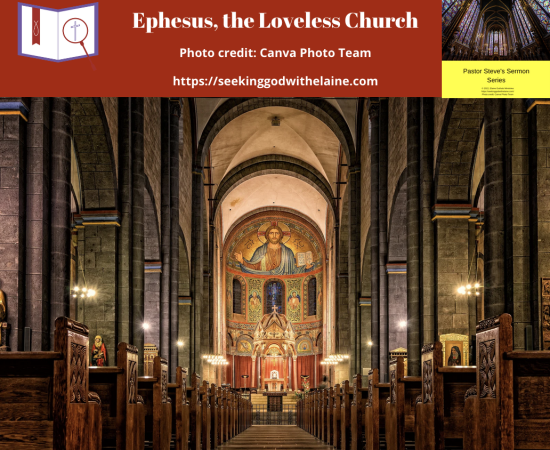
  • Ephesus, the Loveless Church

    Jesus’ first letter to the churches was to the church at Ephesus. This daily devotional looks at the importance of remaining in love with Christ.

    Devotions in the Pastor Steve Sermon Series 

    In Revelation, Jesus gave John instructions to write letters to seven churches of the first century. Pastor Steve begins a series looking at the letter to the first church.

    An Overview

    In this devotion, we are starting to look at the first of the seven churches in Revelation. Perhaps it was because they were on the Trade Routes that were used back then. Perhaps it was because they were in big cities.

    Although, I suspect that it was something to do with the fact that the cities they were in they all were in the Asian province of the Roman Empire. That’s simply my presupposition, and I can’t prove it one way or another.

    Whatever the case may be, we don’t really know.

    One thing that we do know however, is that it is evident by the letters that John writes to each church, that Jesus had a reason for them to repent from what He had against them. He was giving them a chance to repent and carry on serving Him in the right way.

    The First Church

    “To the angel of the church in Ephesus write: ‘The words of him who holds the seven stars in his right hand, who walks among the seven golden lampstands. I know your works, your toil and your patient endurance, and how you cannot bear with those who are evil, but have tested those who call themselves apostles and are not, and found them to be false. I know you are enduring patiently and bearing up for my name’s sake, and you have not grown weary. But I have this against you, that you have abandoned the love you had at first. Remember therefore from where you have fallen; repent, and do the works you did at first. If not, I will come to you and remove your lampstand from its place, unless you repent. Yet this you have: you hate the works of the Nicolaitans, which I also hate. He who has an ear, let him hear what the Spirit says to the churches. To the one who conquers I will grant to eat of the tree of life, which is in the paradise of God’” (Rev. 2: 1-7 ESV).

    The first church is the church in Ephesus. Did you noticed the name as being the same as the book? It is the church that the Apostle Paul wrote the Epistle to the Ephesians.

    Jesus lets the Ephesians know that He is aware of their works, their labor, and their patience (Rev. 2: 2). Since He is an all-knowing, all-seeing God, it makes sense that He would be aware of that which they were doing. “for the Lord knows the way of the righteous, but the way of the wicked will perish” (Ps. 1: 6 ESV).

    The Lord is aware of everything. He is all knowing, all seeing, everywhere present. He is aware of everything.

    Determining False Prophets

    Jesus praises the church for testing people.

    The last part of Revelation 2: 2, shows that Jesus was also aware of them testing people who came along claiming to be apostles and proving them to be false. He was aware that they could not bear these liars and would not stand for their attempts to misguide the church.

    How did they do that? Another of John’s writing answer that question for us. “Beloved, do not believe every spirit, but test the spirits to see whether they are from God, for many false prophets have gone out into the world. By this you know the Spirit of God: every spirit that confesses that Jesus Christ has come in the flesh is from God, and every spirit that does not confess Jesus is not from God. This is the spirit of the antichrist, which you heard was coming and now is in the world already” (I Jn. 4: 1-3 ESV).

    This is the same way we can determine false teachers today. The more we get into the end times, however, the desire to test the spirits grows less and less. I would expound on that more, but that’s for another sermon series.

    Jesus also provides us with another way to determine the false prophets. “Beware of false prophets, who come to you in sheep’s clothing but inwardly are ravenous wolves. You will recognize them by their fruits. Are grapes gathered from thornbushes, or figs from thistles? So, every healthy tree bears good fruit, but the diseased tree bears bad fruit. A healthy tree cannot bear bad fruit, nor can a diseased tree bear good fruit. Every tree that does not bear good fruit is cut down and thrown into the fire. Thus you will recognize them by their fruits” (Mt. 7: 15-20 ESV).

    The “fruit” that is being spoken of here, refers to the manner of how people act towards others. It also has a sense of what these people cause to happen by their actions. The fruit of their actions is indicative of who they are inside.

    Even the way they talk can be an indication of this. Jesus also said, “The good person out of the good treasure of his heart produces good, and the evil person out of his evil treasure produces evil, for out of the abundance of the heart his mouth speaks” (Lk. 6: 45 ESV).

    One of the main things for us to keep in mind is that these same things are available today to those who know Jesus as Lord and Savior.

    Jesus praised the church at Ephesus for enduring patiently the trying times like they have done and for not having grown weary because of them (Rev. 2: 3).

    What Was Wrong?

    What did the Ephesians do wrong?

    Despite all these good things that they had done, though, Jesus had things against them.

    One thing was that they had abandoned their first love. Some versions of the Bible says that they left their first love.

    What is their first love? For the Christian, the first love is when one first falls in love with the truth that is found in Jesus.

    Jesus said, “And you shall know the truth, and the truth shall make you free” (Jn. 8:32 ESV). This “knowing” comes only through Him. So, knowing Him as our Lord and Savior is to know the truth.

    Let’s look at another verse. “Jesus said to him, ‘I am the way, and the truth, and the life. No one comes to the Father except through me’” (Jn. 14: 6 ESV). To know Him as Lord and Savior is to know the truth and be made free by him.

    Why is leaving their first love such a terrible thing?

    “I am the vine; you are the branches. Whoever abides in me and I in him, he it is that bears much fruit, for apart from me you can do nothing” (Jn. 15: 5 ESV).

    To do anything that’s of value to God, that is true and real for God, we must abide in him. Without keeping our first love of Him, we are not doing the things He as called us to do by the spirit.

    Instead, we are doing it by our flesh. Nothing good has ever come from our flesh.

    Doing from Our Flesh

    “Who is wise and understanding among you? By his good conduct let him show his works in the meekness of wisdom. But if you have bitter jealousy and selfish ambition in your hearts, do not boast and be false to the truth. This is not the wisdom that comes down from above, but is earthly, unspiritual, demonic. For where jealousy and selfish ambition exist, there will be disorder and every vile practice. But the wisdom from above is first pure, then peaceable, gentle, open to reason, full of mercy and good fruits, impartial and sincere. And a harvest of righteousness is sown in peace by those who make peace.” (Jas. 3: 13-18 ESV).

    Let’s look at these verses. The reality is anything we do from our flesh (earthly wisdom) is unspiritual and demonic.

    Many of us probably have never thought about it before, but to be doing anything that is not of the spirit is to be against God. If you are doing things from the flesh and not the spirit, it is truly working against God and working through the demonic influences in the world.

    Jesus also talked about the flesh in John 3:6. “That which is born of the flesh is flesh, and that which is born of the Spirit is spirit” (Jn. 3: 6 ESV). It should be plain to see here that if we are doing things through our flesh, it is of the flesh. And if we are doing things through our Spirit, it is of the spirit.

    When this are done through our spirit, they are operating out of love, which is the greatest thing we should be doing. The Apostle Paul wrote so vividly when he said in I Corinthians 13:1-8a – “If I speak in the tongues of men and of angels, but have not love, I am a noisy gong or a clanging cymbal. And if I have prophetic powers, and understand all mysteries and all knowledge, and if I have all faith, so as to remove mountains, but have not love, I am nothing. If I give away all I have, and if I deliver up my body to be burned, but have not love, I gain nothing. Love is patient and kind; love does not envy or boast; it is not arrogant or rude. It does not insist on its own way; it is not irritable or resentful; it does not rejoice at wrongdoing, but rejoices with the truth. Love bears all things, believes all things, hopes all things, endures all things. Love never ends …” (I Cor. 13: 1-8).

    Why is this so important?

    This was serious enough to Jesus that He called for them to repent. (vs. 5) Jesus never calls us to repent of anything but sin. He does not call us to repent because we did something good. Only when we’ve sinned.

    This should surely indicate to us that to do anything that is not out of love — making it out of the spirit — is a sin. The one thing the church of Ephesus did that was such a sin was that they stopped loving people. They stopped operating out of the spirit, which means that they could have only have been operating out of the flesh, which means that they were operating from demonic influences and not out of love. To be operating from demonic influences is to be operating against God.

    It can be said that the Pharisees were operating from this same mode. They we not doing anything of the spirit as they had been called to do. Jesus referred to them as hypocrites because they acted like they were all that they should be, but they really weren’t. They were operating out of their flesh, not of love.

    So what happened?

    Jesus called the church at Ephesus to repent of what they had been doing. If they did not, he said that he would remove their lampstand. If you read the first part of Revelation 1, you will see Jesus referring to being the keeper of the seven golden lampstands.

    I believe that the lampstands signify the Holy Spirit that is in each church. I truly believe that even today that each church has a lampstand.

    I also truly believe that every church that has died has had their lampstand removed because they stopped doing what God wanted them to do.

    Jesus said here that if the church did not repent their lampstand would be removed. And to have their lampstand removed is to have the Holy Spirit leave and not cover the church. This is a very important thing to consider about the churches we attend today.

    The Nico-whos-its?

    The Nicolaitans mentioned in verse 6 were not true Christians. They held to a lot of unbiblical practices that led a lot of people away from God. Therefore, Jesus hated their works.

    Whenever we see it says in the Bible, “The who has an ear, let him hear …”, as it does in Revelation 2: 7 (ESV), this is Jesus impressing the importance of what He just said. This phrase was meant to get our attention and effectively says, “Hey! Pay attention to this! It’s important!”

    Next time, we will be looking at what Jesus had to say to the church in Smyrna.

    Father God. Help us to see what You’d have us see in these studies of the churches in Revelation. Help us to understand why it was important enough to You to have John write individual letters to these churches and help us to apply what we’ve learned to our own lives. In Jesus’ Name, Amen.

    ephesus-the-loveless-churchFB

    What do you think?

    Leave me a comment below (about this or anything else) or head over to my Facebook group for some interactive discussion.

    If you don’t understand something and would like further clarification, please contact me.

    If you have not signed up for the email daily or weekly providing the link to the devotions and the newsletter, do so below.

    If God has used this devotion to speak with you, consider sharing it on social media.
  • Greeting To The Seven Churches

    In Revelation, Jesus gave John letters to seven churches of the day. In this daily devotional, Pastor Steve starts with an overview on those letters.

    Devotions in the Pastor Steve Sermon Series 

    In this devotion, I (Pastor Steve) am beginning a series of sermons on the Seven Churches in the book of Revelation. It is based on a series of sermons I recently did at our church, and I wanted to write is in a more detailed format to post on my wonderful wife Elaine’s blog.

    Today’s sermon is intended to serve as an introduction, of sorts. The main text for the seven churches occurs in Revelation chapter two and three. I am going to be writing from Revelation 1: 1-8 in this post.

    Let’s Put It into Context

    Here is some interesting background to help us get our minds situated to how this all fits together. The book of Revelation was written down by the Apostle John. This would be the same John that whose Mother Salome had approached Jesus on behalf of her two sons, James, and John, asking that her sons be allowed to sit one on his left and the other on his right when he came into his kingdom (Mt. 20:21).

    The other disciples weren’t thrilled with them asking for such a thing. And if you think about it, how many grown guys would want their mommy coming up to their boss to ask such a thing?

    That said, Salome properly approached Jesus when she asked and gave Him the respect He is due, so she knew full well what she was doing.  I’ve always found it interesting that she felt comfortable enough to approach Jesus with that kind of a request.

    Let’s Put It into Context #2

    I thought it would be interesting to provide some “fun facts” about John to make this study a bit more interesting: 

    1. John the Apostle is traditionally believed to be one of two disciples (the other being Andrew) recounted in John 1:35-39, who upon hearing the Baptist point out Jesus as the “Lamb of God,” followed Jesus and spent the day with him. Thus, some traditions believe that he was first a disciple of John the Baptist, even though he is not named in this episode. 
    2. James and John are listed among the Twelve Apostles. Jesus referred to the pair as “Boanerges” (translated “sons of thunder”). A Gospel story relates how the brothers wanted to call down heavenly fire on an unhospitable Samaritan town, but Jesus rebuked them. John lived on for another generation after the martyrdom of James, who was the first Apostle to die a martyr’s death. 
    3. According to a Roman Historian (in The Prescription of Heretics), John was banished (presumably to Patmos) after being plunged into boiling oil in Rome and suffering nothing from it. It is said that all in the audience of Colosseum were converted to Christianity upon witnessing this miracle. This event would have occurred in the late 1st century, during the reign of the Emperor Domitian, who was known for his persecution of Christians. 
    4. John was also the only Apostle to die of natural causes.  All the others of the 12 were killed in some way. 

    So, let’s begin by reading at Revelation 1:1-3.

    The Revelation

    “The revelation of Jesus Christ, which God gave him to show to his servants the things that must soon take place. He made it known by sending his angel to his servant John, who bore witness to the word of God and to the testimony of Jesus Christ, even to all that he saw. Blessed is the one who reads aloud the words of this prophecy, and blessed are those who hear, and who keep what is written in it, for the time is near” (Rev. 1: 1-3 ESV)

    We are told in this passage of Scripture, the reason that Revelation was written: 

    1. He wanted to show us, his servants, the things that must soon take place. (vs 1-2)
    2. Those who read it aloud and hear and keep the words of this prophecy are blessed. 
    3. There must be something to that “read aloud” part. The Bible says in Romans 10:17:  “So faith comes from hearing, and hearing through the word of Christ” (ESV).
    4. Not only are those who read it aloud blessed, but also are those who hear, and keep what is written in it, for the time is near. 

    Have you ever thought about being blessed simply because you heard something? Now, that doesn’t include gossip, of course, because the Bible is plain about not gossiping.  

    Take another look at number 3 above. It says that faith comes from hearing.

    Whenever we hear something that God intends us to hear, it is a blessing because we are building up our faith. This is especially true when we keep what we have heard.

    James told us what is needed. “But be doers of the word, and not hearers only, deceiving yourselves (Jas 1: 22 ESV).

    It’s not enough for us to hear the Word of God and do nothing with it. It is no accident that you are given understanding of God’s Word when you hear it. 

    No, it’s meant for you to apply it to your life and grow in your faith. It’s also meant for you to share it with others. God has never intended for us to do nothing with what we’ve heard. Now, back to Revelation.  

    Who Is Writing the Letter?

    “John to the seven churches that are in Asia: Grace to you and peace from him who is and who was and who is to come, and from the seven spirits who are before his throne, and from Jesus Christ the faithful witness, the firstborn of the dead, and the ruler of kings on earth. To him who loves us and has freed us from our sins by his blood and made us a kingdom, priests to his God and Father, to him be glory and dominion forever and ever. Amen. Behold, he is coming with the clouds, and every eye will see him, even those who pierced him, and all tribes of the earth will wail on account of him. Even so. Amen. ‘I am the Alpha and the Omega,’ says the Lord God, ‘who is and who was and who is to come, the Almighty'” (Rev. 1: 4-8 ESV)

    From verse 4 on, we see John greeting the seven churches that are referred to in this prophecy. There must have been something special about these churches for Jesus to take the time to have the Apostle John write this Book of Revelation to them specifically.

    We don’t know what that reason is because we aren’t told. One thing I recognize though, and we will see this as we go through this series: there are many churches in existence today who have the same problems that are addressed about to each of these churches. I believe that we have much to learn from them all. 

    John starts out with a greeting from Jesus and the seven spirits. This greeting is addressed to all seven of the churches that he will be writing to. It is interesting how Jesus had John write this mass greeting to start off the letters to the churches, but later, He has him write an individual letter to each of the seven churches.

    I think the significance of that, however, is that the greeting is giving Jesus all of the glory and praise due him, well before any of the pronouncements that Jesus gives to the seven churches are even made.

    You see, He announces himself as “The Alpha and The Omega.” Alpha is the first letter of the Greek alphabet and Omega is the last letter of the Greek alphabet. Him saying that would be likened to if He were to have said, “I am the A and the Z.”  He literally means here that He is the beginning and the end of all things.

    greeting-to-the-seven-churchesFB

    Making the Connections

    If you read in the Gospel of John chapter one, you will see that it says:  ‘”In the beginning was the Word, and the Word was with God, and the Word was God. He was in the beginning with God. All things were made through him, and without him was not anything made that was made” (Jn. 1: 1-3 ESV).

    Jesus was here at the beginning, and He will be here at the end. Indeed, He is, “… the Lord God Almighty, who was, and is, and is to come” (Rev. 4: 8 NIV).

    So, as we delve into this study of the seven churches in Revelation, we are going to see what Jesus had to say to them and why He said it.  We are going to cover one of the churches individually, until all of them are covered and we harvest all that we can from them.

    How Do We Apply This?

    It is my prayer that you grow and learn from what we study here and strive to be all that God is calling you to be.

    Father, may Your Will be done in all that we strive to do for you, because we love You. May this study accomplish that which You will have it do and thank You for loving us so much. In Jesus’ name we pray.  Amen. 

    What do you think?

    Leave me a comment below (about this or anything else) or head over to my Facebook group for some interactive discussion.

    If you don’t understand something and would like further clarification, please contact me.

    If you have not signed up for the email daily or weekly providing the link to the devotions and the newsletter, do so below.

    If God has used this devotion to speak with you, consider sharing it on social media.

  • What Are Heavenly Places (2.0)

    In his letter to the Ephesians, Paul talked several times about heavenly places. This is the only place in Scriptures that this terminology is used. This daily devotional explores where those heavenly places are, Jesus’ role in those heavenly places, and how the impact on the coming ages.

    Nuggets

    • Jesus’ glory is the expression of the qualities of God resulting from the authority of God.
    • While Ephesians 2: 6 is not the first or only time in this letter that Paul referred to heavenly places, he uses this term only in this letter.
    • God and Jesus (at God’s right hand) are going to rule from New Jerusalem.
    • God has made Himself very accessible to us.
    • Those reigning with Jesus for 1,000 years will be those who remained faithful unto death during persecution and those who did not worship the image erected (Rev. 13: 14) or take the mark (Rev. 13: 16).
    • The great thing about New Jerusalem and whoever gets there first is that they will be living in fellowship with God the Father and God the Son.
    • God is going to take His grace and kindness to the next level.

    Devotions in the The Letter of Paul to the Ephesians series

    I had someone tell me once that, since Jesus laid down His glory to come to earth, He could not pick it up again. Jesus’ glory is the expression of the qualities of God resulting from the authority of God.

    Therefore, Jesus wouldn’t be residing in heaven. He would rule on the new earth once we are all called home.

    I was always a little skeptical of that but haven’t taken the time to research it. Until now.

    I remembered this conversation when I read Ephesians 2: 6. It talks about heavenly places and the coming age.

    What role is Jesus going to have then – glorified or not glorified? Let’s see what we can find.

    Let’s Put It into Context

    Here is a running list of nuggets for the series.

    Heavenly Places

    “and raised us up with him and seated us with him in the heavenly places in Christ Jesus” (Eph. 2: 6 ESV)

    This is not the first or only time in the letter to the Ephesians that Paul referred to heavenly places (Eph. 1: 3; Eph. 1: 20; Eph. 3: 20; Eph. 6: 12). But he uses this term only in this letter.

    Paul’s use of the term here begs the question: How is heavenly places different from heaven? From my research of commentaries, I don’t think Paul was trying to make a distinction.

    I think Paul was trying to tie this to Jesus’ ascension. He went up to what has been interpreted as high places. Heavenly — high — sounds like they are synonymous.

    We do know that Jesus talked about there being some sort of division. “In my Father’s house are many rooms. If it were not so, would I have told you that I go to prepare a place for you” (Jn. 14: 2 ESV).

    If it were not so, Jesus probably wouldn’t have said anything at all. There could be some division between heaven and high places.

    Trust is assurance that the promises of God are true.

    Then we tie this in with Revelation. It talks about a new heaven and a new earth. “Then I saw a new heaven and a new earth, for the first heaven and the first earth had passed away, and the sea was no more.” (Rev. 21: 1 ESV).

    After that, we get a New Jerusalem. “And I saw the holy city, new Jerusalem, coming down out of heaven from God, prepared as a bride adorned for her husband” (Rev. 21: 2 ESV). It is identified as a great city (Rev. 21: 10) with walls (Rev. 21: 14) and gates (Rev. 2: 12). It has a street (Rev. 21: 21; Rev. 22: 2). (One street — not plural.)

    But look at this. “No longer will there be anything accursed, but the throne of God and of the Lamb will be in it, and his servants will worship him” (Rev. 22: 3 ESV).

    This is along the same lines as what Paul wrote in Colossians. “If then you have been raised with Christ, seek the things that are above, where Christ is, seated at the right hand of God.” (Col. 3: 1 ESV). Jesus already is where He will forever be — right next to the Father.

    So, what all is that telling us? God and Jesus are going to rule from New Jerusalem. Jesus is even now at God’s right hand. I doubt that Jesus would be ruling if He had laid down His glory and not been able to pick it back up.

    One commentary pointed out that Paul’s whole message in all of this was the accessibility of heaven. “Set your minds on things that are above, not on things that are on earth” (Col. 3: 2 ESV).

    “Set your minds on things that are above, not on things that are on earth” (Col. 3: 2 ESV).

    God has made Himself very accessible to us. He was the one Who devised the Plan of Salvation to restore His relationship with mankind.

    Jesus is the one Who gave us the model prayer to make sure we have a line of communication open to us now. We are told to “pray without ceasing” (II Thess. 5: 17 ESV). That is how we access heaven today.

    Where Will New Jerusalem Be?

    Bible Verse

    “And he carried me away in the Spirit to a great, high mountain, and showed me the holy city Jerusalem coming down out of heaven from God” (Rev 21: 10 ESV).

    Back up a second. There is some question where New Jerusalem is going to land. Revelation 21: 2 and Revelation 21: 10 both say it descends out of heaven.

    That would have to come out of the new heaven, because the old heaven already passed away in verse 1. That makes some assume that it will land on earth, where we will spend eternity.

    Maybe that is an assumption because Revelation 22: 3 says, “No longer will there be anything accursed …” (Rev. 22: 3 ESV). The earth, not heaven, was cursed (Gen. 3: 17).

    However, Revelation 21 and 22 does not say if or where New Jerusalem lands. The Scriptures only say that it descends. We don’t know if it lands on earth or stays suspended between heaven and earth.

    It is also assumed that Jesus will reign on earth for the 1,000 years. “… They came to life and reigned with Christ for a thousand years” (Rev. 20: 4 ESV).

    Who is they? “Then I saw thrones, and seated on them were those to whom the authority to judge was committed. Also I saw the souls of those who had been beheaded for the testimony of Jesus and for the word of God, and those who had not worshiped the beast or its image and had not received its mark on their foreheads or their hands …” (Rev 20: 4 ESV).

    So, they is not all of the saints. It is those who remained faithful unto death during persecution. Also, those who did not worship the image erected (Rev. 13: 14) or take the mark (Rev. 13: 16).

    To read a related devotion, click the button below.

    The great thing about New Jerusalem and whoever gets there first is that they will be living in fellowship with God the Father and God the Son. The cares of this world will be a thing of the past. Think of the rejoicing and celebrating that will be going on!

    What Does the Future Hold?

    “so that in the coming ages he might show the immeasurable riches of his grace in kindness toward us in Christ Jesus” (ESP. 2: 7 ESV).

    But back to Ephesians. We need to look at verse 7.

    Paul talked about the future when he said, “so that in the coming ages …” (Eph. 2: 7 ESV). He was talking about eternity.

    In the last devotion, we talked about immeasurable. We said it talked about taking things to the next level.

    To read a related devotion, click the button below.

    God is going to take His grace and kindness to the next level. We think He shows us grace and mercy now — just wait!

    We all want to be better than we are right now. We know that we are not as He made us because we are trapped in sinful bodies.

    We also know that, one day, we will be changed (I Cor. 15: 52). We will truly be in God’s image. We won’t have to deal with sin or sickness. Everything will be like God originally intended.

    To read God’s Wrath and Mercy, click the button below.

    Making the Connections

    We don’t understand now — we aren’t supposed to understand now. “For we know in part and we prophesy in part, but when the perfect comes, the partial will pass away” (I Cor. 13: 9-10 RSV).

    Perfection means we reach a state of maturity because the combination of the spiritual graces form, when all are present, spiritual wholeness or completeness — holy, sanctified, and righteous.

    • Spiritual graces are worldly morals that have been submitted to God to further His kingdom instead of enhancing this world.
    • Holy means to be set apart — because of our devotion to God — to become perfect, and morally pure while possessing all virtues.
      • Pure means not being sinful or having the stain of sin.
    • Sanctified means to be set free from sin.
      • Sin is not believing that Jesus is our Savior to save us from our actions by humans that disobey God and break one of His reasonable, holy, and righteous laws and commandments, goes against a purpose He has for us, or follows Satan’s promptings.
    • Righteous means we are free from sin because we are following God’s moral laws.
    • Virtues are standards of moral excellence.

    Glossary

    We can understand some things now. He has raised us from being dead. Jesus justified and sanctified us by substituting Himself for us. We’ve been adopted into the holy family.

    To read a related devotion, click the button below.

    God already blesses us. He provided what we need. He isn’t waiting for us to all get to New Jerusalem before He gives us the good stuff.

    I told my Ladies the other day that Mom and Dad once gave me money to by a three-bedroom mobile home from another lady in the singles group in which we belonged. They told me they were spending my inheritance on me.

    God is doing that, too. He is rewarding us now while He is giving us a glimpse of things to come.

    what-are-heavenly-places-1.1FB

    How Do We Apply This?

    We are supposed to watch. We need to believe and trust.

    Watchfulness is a continual conscious examination of ourselves and all events so that we may follow God in all things.

    Trust is assurance that the promises of God are true.

    To read a related devotion, click the button below.

    When we are in the midst of trials, God will give us what we need to remain faithful to Him.

    Paul got it that this life is precursor to the next life. He knew God would show us enough to want the next life. He knew that God was fixing us to prepare us for what is to come.

    We have to be open to the fixing.

    Loving Heavenly Father. You have told us to watch for Jesus’ return. We will watch. Whichever way You choose to send Him back and call us home doesn’t matter. What matters is we will be home with You. We look forward to that day. Amen.

    What do you think?

    Leave me a comment below (about this or anything else) or head over to my Facebook group for some interactive discussion.

    If you don’t understand something and would like further clarification, please contact me.

    If you have not signed up for the email daily or weekly providing the link to the devotions and the newsletter, do so below.

    If God has used this devotion to speak with you, consider sharing it on social media.

  • What a Beautiful Name

    Today is a music day.

    Life happened today, and I wasn’t organized enough to get my post done before I had to focus on other things. Sorry.

    But life is good when we are walking in God’s Will.

    Why is it so good? We focus on our Lord and Savior and His beautiful name.


    What a Beautiful Name

    Vocalist: Elaine Guthals
    Keyboard: Chris Vieth

    What do you think?

    Leave me a comment below (about this or anything else) or head over to my Facebook group for some interactive discussion.

    If you don’t understand something and would like further clarification, please contact me.

    If you have not signed up for the email daily or weekly providing the link to the devotions and the newsletter, do so below.

    If God has used this devotion to speak with you, consider sharing it on social media.

  • Will Jesus Come Back in Fire?

    Sometimes, we have to go to God’s Word to see if what others have written is what God has said. This daily devotional looks at the role fire plays in Jesus’ second coming.

    Nuggets

    • We need to live the way God calls us to live – even through the trials – in preparation for Jesus’ second coming.
    • God will fight for us.
    • Disciples are promised rest and will receive it in Heaven.
    • God appeared in the fire on numerous occasions and will use it to punish those who have not ABCDed.

    When I was doing the research for a previous devotion, I came across this phrase that Jesus was going to come back in fire. I didn’t remember hearing that before, so I wanted to look into it.

    I googled and came up with these verses. The sermons I pull brought up so many verses. I really wanted to look at them, so I am going to pull them in without many of my own words.

    I usually am hesitant to go down these paths. I see the phrase. I want to know more about the phrase. I am so afraid that is one person’s take.

    Hopefully, we can figure out the fire by the end. If not, hopefully, something else will have spoken to us along the way.

    Doing Things Right

    “It is clear evidence of God’s righteous judgment that you will be counted worthy of God’s kingdom, for which you also are suffering” (II Thess. 1: 5 CSB)

    We need to live the way God calls us to live – even through the trials – in preparation for Jesus’ second coming.

    • “Don’t be intimidated in any way by your enemies. This will be a sign to them that they are going to be destroyed, but that you are going to be saved, even by God himself” (Phil. 1: 28 NLT).
    • “Therefore, let us approach the throne of grace with boldness, so that we may receive mercy and find grace to help us in time of need” (Heb. 4: 16 CSB).
    • “Then the King will say to those on his right, ‘Come, you who are blessed by my Father; inherit the kingdom prepared for you from the foundation of the world’” (Mt. 25: 34 CSB)
    • “For I consider that the sufferings of this present time are not worth comparing with the glory that is going to be revealed to us” (Rom. 8: 18 CSB).
    • “Do not fear what you are about to suffer. Behold, the devil is about to throw some of you into prison, that you may be tested, and for ten days you will have tribulation. Be faithful unto death, and I will give you the crown of life” (Rev. 2: 10 ESV).
    • “Prove by the way you live that you have repented of your sins and turned to God” (Mt. 3: 8 NLT).
    • “Keep alert at all times. And pray that you might be strong enough to escape these coming horrors and stand before the Son of Man” (Lk. 21: 36 NLT)
    • “But seek ye first the kingdom of God, and his righteousness; and all these things shall be added unto you” (Mt. 6: 33 KJV).
    • “Blessed is the man who remains steadfast under trial, for when he has stood the test he will receive the crown of life, which God has promised to those who love him” (Jas. 1: 12 ESV).
    • “Jesus said to them, “You do not know what you are asking. Are you able to drink the cup that I drink, or to be baptized with the baptism with which I am baptized?’” (Mk. 10: 38 ESV).
    • “There is reserved for me the crown of righteousness, which the Lord, the righteous Judge, will give me on that day, and not only to me, but to all those who have loved his appearing” (II Tim. 4: 8 CSB).

    Resource

    Those Against Us

    “since it is just for God to repay with affliction those who afflict you” (II Thess. 1: 6 CSB)

    God will fight for us.

    • “For you are not a God who delights in wickedness; evil may not dwell with you” (Ps. 5: 4 ESV).
    • “The Rock — his work is perfect; all his ways are just. A faithful God, without bias, he is righteous and true” (Deut. 32: 4 CSB).
    • “He will repay each one according to his works” (Rom. 2: 6 CSB).
    • “God is not unjust; he will not forget your work and the love you have shown him as you have helped his people and continue to help them” (Heb. 6: 10 NIV).
    • “And this is the judgment: the light has come into the world, and people loved the darkness rather than the light because their works were evil” (Jn. 3: 19 ESV).
    • “Just think how much worse the punishment will be for those who have trampled on the Son of God, and have treated the blood of the covenant, which made us holy, as if it were common and unholy, and have insulted and disdained the Holy Spirit who brings God’s mercy to us” (Heb. 10: 29 NLT).
    • “For the wrath of God is revealed from heaven against all ungodliness and unrighteousness of men, who by their unrighteousness suppress the truth” (Rom. 1: 18 ESV).
    • “Then people will say, ‘Yes, there is a reward for the righteous! There is a God who judges on earth!’” (Ps, 58: 11 CSB)
    • “But because you are stubborn and refuse to turn from your sin, you are storing up terrible punishment for yourself. For a day of anger is coming, when God’s righteous judgment will be revealed” (Rom. 2: 5 NLT).
    • “They have become callous and have given themselves up to sensuality, greedy to practice every kind of impurity” (Eph. 4: 19 ESV)
    • “So I let them follow their own stubborn desires, living according to their own ideas” (Ps. 81: 12 NLT).
    • “For the LORD is righteous; he loves righteous deeds. The upright will see his face” (Ps. 11: 7 CSB).
    • “There will be trouble and distress for every human being who does evil: first for the Jew, then for the Gentile” (Rom. 2: 9 NIV).

    Resource

    Rest in Him

    “and to give relief to you who are afflicted, along with us. This will take place at the revelation of the Lord Jesus from heaven with his powerful angels” (II Thess. 1: 7 CSB)

    Disciples are promised rest and will receive it in Heaven.

    • “Let us, then, make every effort to enter that rest, so that no one will fall into the same pattern of disobedience” (Heb. 4: 11 CSB).
    • “There remains, then, a Sabbath-rest for the people of God” (Heb. 4: 9 NIV).
    • “This is all the more urgent, for you know how late it is; time is running out. Wake up, for our salvation is nearer now than when we first believed” (Rom. 13: 11 NLT).
    • “Come to me, all who labor and are heavy laden, and I will give you rest” (Mt. 11: 28 ESV).
    • “We are made right with God by placing our faith in Jesus Christ. And this is true for everyone who believes, no matter who we are” (Rom. 3: 22 NLT).
    • “So prepare your minds for action and exercise self-control. Put all your hope in the gracious salvation that will come to you when Jesus Christ is revealed to the world” (I Pet. 1: 13 NLT).
    • “waiting for our blessed hope, the appearing of the glory of our great God and Savior Jesus Christ” (Ti. 2: 13 ESV).
    • “Heaven must receive him until the time comes for God to restore everything, as he promised long ago through his holy prophets” (Ac. 3: 21 NIV).
    • “Once, on being asked by the Pharisees when the kingdom of God would come, Jesus replied, ‘The coming of the kingdom of God is not something that can be observed’” (Lk. 17: 20 NIV).
    • “Beloved, we are God’s children now, and what we will be has not yet appeared; but we know that when he appears we shall be like him, because we shall see him as he is” (I Jn. 3: 2 ESV).
    • “For the creation eagerly waits with anticipation for God’s sons to be revealed” (Rom. 8: 19 CSB).
    • “Praise the LORD, you his angels, you mighty ones who do his bidding, who obey his word” (Ps. 103: 20 NIV).
    • “Now Christ has gone to heaven. He is seated in the place of honor next to God, and all the angels and authorities and powers accept his authority” (I Pet. 3: 22 NLT).
    • “And he will send out his angels with a loud trumpet call, and they will gather his elect from the four winds, from one end of heaven to the other” (Mt. 24: 31 ESV).

    Resource

    Flaming Vengeance

    “when he takes vengeance with flaming fire on those who don’t know God and on those who don’t obey the gospel of our Lord Jesus” (II Thess. 1: 8 CSB)

    God appeared in the fire on numerous occasions and will use it to punish those who have not ABCDed.

    • “These are the commandments the LORD proclaimed in a loud voice to your whole assembly there on the mountain from out of the fire, the cloud and the deep darkness; and he added nothing more. Then he wrote them on two stone tablets and gave them to me” (Deut. 5: 22 NIV).
    • “Our God comes; he does not keep silence; before him is a devouring fire, around him a mighty tempest” (Ps. 50: 3: ESV).
    • “And the angels will throw them into the fiery furnace, where there will be weeping and gnashing of teeth” (Mt. 13: 42 NIV).
    • “But the day of the Lord will come like a thief. The heavens will disappear with a roar; the elements will be destroyed by fire, and the earth and everything done in it will be laid bare. Since everything will be destroyed in this way, what kind of people ought you to be? You ought to live holy and godly lives” (II Pet. 3: 10-11 NIV).
    • “All who sin apart from the law will also perish apart from the law, and all who sin under the law will be judged by the law. For it is not those who hear the law who are righteous in God’s sight, but it is those who obey the law who will be declared righteous. (Indeed, when Gentiles, who do not have the law, do by nature things required by the law, they are a law for themselves, even though they do not have the law. They show that the requirements of the law are written on their hearts, their consciences also bearing witness, and their thoughts sometimes accusing them and at other times even defending them.)” (Rom. 2: 12-15 NIV).
    • “Such people claim they know God, but they deny him by the way they live. They are detestable and disobedient, worthless for doing anything good” (Ti. 1: 16 NLT).
    • “For it is time for judgment to begin at the household of God; and if it begins with us, what will be the outcome for those who do not obey the gospel of God?” (I Pet. 4: 17 ESV).
    • “But we are not those who draw back and are destroyed, but those who have faith and are saved” (Heb. 10: 39 CSB).

    Resource

    WillJesusComeBackInFirePin

    Making the Connections

    “Whoever believes and is baptized will be saved, but whoever does not believe will be condemned” (Mk. 16: 16 CSB)

    Okay. So, we know God has appeared in the fire before. We know that those who haven’t ABCDed will end up in the fire.

    (And why didn’t they pull out Revelation 20: 15? “And anyone whose name was not found written in the book of life was thrown into the lake of fire” (Rev. 20: 15 CSB).)

    So, I think it isn’t that Jesus is going to come back in the fire but with the fire.

    How Do We Apply This?

    The ABCDs of Salvation

    If you have not become a believer in Christ, please read through the
    Plan of Salvation and prayerfully consider what God is asking you to do.

    A – admit our sins
    B – believe His Son Jesus is our Redeemer
    C – confess God as Sovereign Lord

    D – demonstrate that commitment by making any changes needed in our lives to
    live the way in which God has called us

    The Disciple’s Job Description

    Searching for and Seeking God

    Hearing His Word (Rom. 10: 17).
    Reading His Word (Rev. 1: 3).
    Praying to Him (Heb. 4: 16).
    Studying His Word (Ac. 17: 11).
    Meditating on His Word (Ps. 1: 1-2).
    Memorizing His Word (Ps. 119: 11).

    Father God. We need You in our lives now. We need You as our loving Father. We need You as Sovereign God. Amen.

    What do you think?

    Leave me a comment below (about this or anything else) or head over to my Facebook group for some interactive discussion.

    If you don’t understand something and would like further clarification, please contact me.

    If you have not signed up for the email daily or weekly providing the link to the devotions and the newsletter, do so below.

    If God has used this devotion to speak with you, consider sharing it on social media.

  • The Difficult Last Days

    Paul gave Timothy some advice about the last days. This daily devotional looks at the difficulties that will be prevalent in those days and how disciples should watch for and avoid those sins.

    Nuggets

    • Disciples are to read Scriptures and apply them to our lives.
    • We shouldn’t love ourselves more than we love God.
    • The items listed in verses 3 and 4 do not reflect God’s character.

    We’ve started looking at Romans 12-16 to look at how we transform our lives to be more like God. We just finished Romans 12.

    We are going to take a break before we start Romans 13. I went back to the drafts folder and pulled out a devotion I had passed up before.

    I think it is very important that we be reminded this world is going to end. God gave us several signs to give us a heads up that we are sliding into the end.

    True, there are some from every generation who see the signs within their own generation — and the world keeps spinning. I think that is just their sensitivity and watchfulness to God’s Word.

    Let’s see what we come up with.

    The End Is Coming

    “But understand this, that in the last days there will come times of difficulty” (II Tim. 3: 1 ESV)

    Disciples are to read Scriptures and apply them to our lives.

    We need to watch for signs of the end times. Also known as perilous times, Boston said that they are “times wherein it will be hard for people to keep their feet, to know how to carry themselves, to keep out of danger, and keep a good conscience.”

    Resource

    God wants us to read and apply Scriptures so that we can escape the dangers in which Satan is trying to trap us.

    We definitely do not want to be secure in what God hates. Owen wrote, “Our great wisdom then will be to eye the displeasure of God in perilous seasons, since there is a judicial hand of God in them: and we see in ourselves reason enough why they should come.”

    Resource

    We can’t give lip service to being a disciple. Salvation isn’t to be an outward change. It is to be an inward one.

    Screen Shot 2021-05-13 at 9.37.42 PM

    “Now the Holy Spirit tells us clearly that in the last times some will turn away from the true faith; they will follow deceptive spirits and teachings that come from demons” (I Tim. 4: 1 NLT).

    Unfortunately, some disciples are going to turn away from God. They are going to follow the worldview.

    Once we become disciples, we are to turn away from our sins. Sins are actions by humans that disobey God and break one of His reasonable, holy, and righteous laws and commandments, goes against a purpose He has for us, or follows Satan’s promptings.

    Unfortunately, there are some who don’t. They are just giving lip service to the gospel.

    Paul warned Timothy of people who will forsake the truth. “For the time will come when people will not tolerate sound doctrine, but according to their own desires, will multiply teachers for themselves because they have an itch to hear what they want to hear” (II Tim. 4: 3 CSB).

    We are just as susceptible as Adam and Eve were when they fell into Satan’s temptation. We succumb to His lies, too.

    We “… will not tolerate sound doctrine …” (II Tim. 4: 3 CSB). We won’t follow God’s laws and commandments.

    Instead, we try to rewrite them. We just want “… to hear what [we] want to hear” (II Tim. 4: 3 CSB). We want God’s laws to lead to what we want them to be and do.

    They lead to God — Who He is and what He wants us to be.

    We are to be different than the world.

    • “He gave his life to free us from every kind of sin, to cleanse us, and to make us his very own people, totally committed to doing good deeds” (Ti. 2: 14 NLT).
    • “If you were of the world, the world would love you as its own; but because you are not of the world, but I chose you out of the world, therefore the world hates you” (Jn. 15: 19 ESV).
    • “But you are a chosen race, a royal priesthood, a holy nation, a people for his possession, so that you may proclaim the praises of the one who called you out of darkness into his marvelous light” (I Pet. 2: 9 CSB).

    Jesus came to cleanse us from our sins and make us a priesthood. Sin has no place in that.

    Owen made an interesting comment. We keep thinking that the end times will be the last of this earth as we know it. But it is more than that.

    Owen said it was the last days of the gospel. Think about it.

    The gospel is the good news of Jesus’ birth, death, and resurrection. It tells us about the Man “… who takes away the sin of the world!” (Jn. 1: 29 ESV).

    The gospel gives us the opportunity to believe this. By ABCDing, our relationships with God are restored.

    One day, that will end. God will cut off our opportunities to turn to Him. We will have to live throughout eternity based on the choice we made.

    God won’t end all this and then say, “Okay. Who believes in Me now?” and allow that answer to change. The decisions we made in this life will remain.

    Lovers of Ourselves

    “For people will be lovers of self, lovers of money, proud, arrogant, abusive, disobedient to their parents, ungrateful, unholy” (II Tim. 3: 2 ESV)

    We shouldn’t love ourselves more than we love God.

    Oh, we can have some self-love. Waterland thought that was an indication of our happiness.

    When does this self-love slip into sin? We do that when we want control of our lives so that we always get the good things.

    Waterland had some interesting things about fairness. He said that we should not desire everything because it looks fair.

    The self-love should not escalate into pride. That is another name for self-flattery.

    The self-love can be so strong within us that we start boasting about all of our good points. Then we start boasting of our possessions.

    But this self-love and self-flattery turns into self-interest. We forget about God and come to depend on ourselves.

    Resource

    The self-interest can turn into covetousness. Covetousness is an inordinate greed for wealth and possessions.

    When we covet something, we take our focus off God and put it on ourselves.
    It is a form of selfishness.

    Bottom line is we can’t give God lip service. We can’t say that we want to give Him glory, and then don’t follow Him.

    We can’t blaspheme God. Blasphemy is not only cursing God but also cursing the name of God.

    To me, it all ties together. When we think more of ourselves — proud, arrogant, abusive, ungrateful — we blaspheme God. We tell him through our actions if not our words that He isn’t our Creator and all-powerful Sovereign God.

    Disciples are called to follow God. We aren’t looking for everything to be the same for everyone. We are looking for God’s plan to be fulfilled.

    Without Character

    “heartless, unappeasable, slanderous, without self-control, brutal, not loving good, treacherous, reckless, swollen with conceit, lovers of pleasure rather than lovers of God” (II Tim. 3: 3-4 ESV)

    The items listed in verses 3 and 4 do not reflect God’s character.

    God calls us to be sober. Sober is a character trait distinguished by self-control, genuineness, and sound moral judgment. It is a calm and temperate disposition.

    The distinguished by self-control cancels out the reckless and without self-control. The genuineness cancels the heartless, swollen with conceit, and treacherous. The sound moral judgment cancels out unappeasable, slanderous, and brutal.

    The lovers of pleasure focus more on this world than the next. Payson said lovers of pleasure partake in that which is forbidden to them.

    Resource

    Raleigh described the moral effects of being lovers of pleasure. He wrote, “Gluttony, drunkenness, licentiousness, not only eclipse the mental lights, and scorch the moral sensibilities of the soul, but they hasten the body to dissolution; they dig many a dishonoured grave. But apart from these physical consequences, and even in those cases where they do not follow, the moral effects of the love of pleasure are very sad.”

    Resource

    Paul is not saying that God doesn’t want us to have any pleasure. He is talking about worldliness.

    Most think worldliness is the pursuit of something material or an activity. Hall said worldliness was an internal state of the soul.

    Resource

    Paul is saying we are not to make pleasure a priority over God. God is to be priority #1.

    Priority

    Making the Connections

    “When the seventh angel blows his trumpet, God’s mysterious plan will be fulfilled. It will happen just as he announced it to his servants the prophets” (Rev. 10: 7 NLT).

    God rewards us when — even in the worst times — we follow Him.

    One day, this world will be over. It won’t be because of sword, plague, famine, persecution, according to Hall. Those are the results of sin.

    Resource

    God will end things. His plan will be fulfilled. Eternity will be ready to start.

    In what shape will our relationships with God be?

    TheDifficultLastDaysPin

    How Do We Apply This?

    • Pay attention to the perils of this world.
    • Use God’s Word to interpret what is happening.
    • Focus on God, not the world.
    • Pray for grace.
    • Mourn our sins and sinful nature.
    • Watch.
    • Look to God for our happiness, as it only comes from Him.
    • Don’t compare ourselves to others.
    • Sincerely humble ourselves before Him.
    • Submit all of us to His plan.
    • Grow in faith, hope, patience, and consistency.
    • Be morally upright.

    Resource

    God calls us to follow Him, not the world. We need to recognize the sins that could lead us away from Him in the last days.

    Father God. We place You as the priority in our lives. We look to You every day — but especially in the last days. Thank You for being our Father. Amen

    What do you think?

    Leave me a comment below (about this or anything else) or head over to my Facebook group for some interactive discussion.

    If you don’t understand something and would like further clarification, please contact me.

    If you have not signed up for the email daily or weekly providing the link to the devotions and the newsletter, do so below.

    If God has used this devotion to speak with you, consider sharing it on social media.

  • What a Beautiful Name

    Life happened today. It just seemed to spin out of control. So, I am going to do a music day.

    There is one line in this song that gets me every time. “You didn’t want heaven without us, so Jesus, You brought heaven down.”

    We should have been separated from God forever. But Jesus couldn’t stand the idea of us not being in heaven with Him.

    So, Jesus died on the cross to pay the penalty for our sins. What a wonderful Savior we have!

    What a Beautiful Name
    Vocalist: Elaine Guthals
    Keyboard: Chris Vieth

    WhatABeautifulNamePin

    What do you think?

    Leave me a comment below (about this or anything else) or head over to my Facebook group for some interactive discussion.

    If you don’t understand something and would like further clarification, please contact me.

    If you have not signed up for the email daily or weekly providing the link to the devotions and the newsletter, do so below.

    If God has used this devotion to speak with you, consider sharing it on social media.

  • The Rewards and Penalty of the Cross

    God calls us to salvation. He will reward those who obey His call and penalize those who do not. This daily devotional looks at those rewards and the penalty.

    Nuggets

    • Those who do not believe in the Christ of the cross will perish.
    • Those that believe in the Christ of the cross will have eternal life.

    Devotions in the Love Led to the Cross series

    Jesus endured the pain and humiliation of the cross in order to restore our relationships with God. Restoring those relationships bring many rewards. Not restoring that relationship brings a penalty.

    Let’s look first at our fate when we continue to refuse God’s love.

    Let’s Put It into Context

    “For God so loved the world, that he gave his only Son, that whoever believes in him should not perish but have eternal life” (Jn. 3: 16 ESV)

    • God’s character is love.
    • God does not discriminate on who He loves.
    • Because of His love for us, God gave the best gift He could — part of Himself.
    • Because God wanted our relationships restored, He gave Jesus freely and willingly to die to be our Sacrifice.
    • We can only gain salvation through God’s gift, secured by Jesus.
    • We cannot be in a position to accept Christ of the cross until we recognize we need Him.
    • We need to follow the steps of salvation in order for Jesus’s shedding His blood on the cross to cover our sins.
    • Only God can regenerate us, which He does through the Holy Spirit.
    • God is adamant that we have to come to salvation His way.
    • Believing in Jesus means we are confident in our hearts that Jesus offered His life on the cross so that His blood would pay the penalty for our sins.
    • Knowing of Christ isn’t enough — we have to believe and be committed to Him.

    The Penalty for Unbelief Is High

    “… should not perish but have eternal life” (Jn. 3: 16 ESV)

    Those who do not believe in the Christ of the cross will perish.

    When we think of perishing, we think of dying. But we think of physical dying.

    Lewis reminded us that we are talking souls here. Our soul is our spiritual part that is immortal.

    Resource

    What is meant here is spiritual death. Spiritual death is the separation from God that occurred as a consequence of Adam and Eve’s original sin.

    Glossary

    Some worldview people may believe perishing is not a big deal. Part of the problem is they are focusing solely on this world.

    But perishing has its downside in this world. Spurgeon wrote, “To perish is to lose all hope in Christ, all trust in God, all light in life, all peace in death, all joy.” Bible Notes and Queries added duty to that list.

    Resource

    As much as not having peace and joy in this life is bad enough, the penalty for not believing in the Christ of the cross has eternal consequences.

    Spiritual death is something a lot more serious. That means we will spend eternity in hell.

    To read a devotion in the Hell Does Have Fury series, click on the appropriate button below.

    For some, it comes down to they do not want to submit to God. Submitting to God is actions by humans that obey God and keep His reasonable, holy, and righteous laws and commandments, follows His purpose for us, and does not follow Satan’s promptings.

    We not only have to ask forgiveness for our sins, but we also turn away from them. We give them up because we know they are breaking God’s laws and commandments.

    We can’t just make it a surface religion. Our faith has to lead to a relationship with God. A relationship with God has to lead to a change in our character.

    Glossary

    Our ability to submit hinges on our ability to humble ourselves. You don’t start with submission and become humble. You start with the humble, that facilitates the submission.

    Salvation is given to those who are truly repentant and will submit to God. There may be some who have made a profession of faith but haven’t submitted. They will not enter Heaven and will perish.

    To read a related devotion, click the button below.

    Back to perishing.

    Brewin whittled it down for us. He said to perish was “… to die in our sins …”

    Resource

    Jesus’ death on the cross delivered us from that. He sacrificed Himself so that the penalty of our sins would be paid.

    Remember how the verse starts? “For God so loved the world …” (Jn. 3: 16 ESV).

    This sacrifice occurred because of love. God doesn’t want us to perish.

    This sacrifice occurred because of love.

    The Rewards for Believing Are Endless

    “… but have eternal life” (Jn. 3: 16 ESV)

    Those that believe in the Christ of the cross will have eternal life.

    Believing that Jesus, as God’s Son, shed His blood to pay the penalty for our sins brings us redemption. Redemption is where something is used in exchange for something else to gain or regain something.

    Jesus is our Redeemer because

    • He was born of a virgin, making Him 100% God and 100% man;
    • gave His life on the cross for us so that His blood could pay the price for our sins; and
    • because of God’s great might and power, rose from the grave, conquering death and paying the price for our sins.

    Redemption allows us to receive forgiveness for our sins. Forgiveness is, when we ask, God pardons us because we have broken His laws and commandments and restores our relationship with Him.

    How do we access this redemption? Barrows’ wrote, “This deliverance is made ours by a personal faith in the Lord Jesus Christ.”

    Redemption is possible through God’s love. He loved mankind — even though we disobeyed Him.

    Rogers reminded us that this love was felt even before Christ died for us. “But God proves his own love for us in that while we were still sinners, Christ died for us” (Rom. 5: 8 CSB).

    Resource

    That also proves that we don’t have to clean up our acts before conversion. God sent His Son to die for us when we were still disobeying Him. Talk about mercy!

    Then the cleanup comes on the Sanctification Road.

    Glossary

    Rogers also informed us that a doctrine like this can only be found in the Scriptures. A sacrifice such as this is needed to secure such a great prize.

    The prize is eternal life with the Father.

    TheRewardsAndPenaltyOfTheCrossPin

    Making the Connections

    Think about it.

    • A love this forgiving can only be found with God.
    • A love this encompassing can only be found with God.
    • A love this inclusive can only be found with God.
    • A love given this freely to an enemy can only be found with God.

    And worldview people want to paint God as a dictator? They want us to see Him as a mean tyrant?

    If God was the dictator they want to paint Him, they would not have the free will to reject Him. They would be on their knees before Him now.

    Instead, many do not call God Lord. They follow Satan.

    One day, worldview people will bow before God. “For the Scriptures say, ‘As surely as I live,’ says the LORD, ‘every knee will bend to me, and every tongue will declare allegiance to God’” (Rom. 14: 11 NIV).

    I can’t remember which devotion it was, but we talked once about eternity has already started. We don’t have to wait to get to Heaven. That means we do need to strive for purity in this world.

    Rogers took the flip side of that. He wrote, “He that believeth not is dead already.”

    Resource

    So, it sounds like we aren’t really waiting for judgment day. Eternity is now.

    I’m going to have to ponder on that.

    How Do We Apply This?

    Rogers wrote, “God has lavished the love of His heart on us and requires the trust and love of ours.” We have to have faith in Him.

    Resource

    We need to ABCD to show God we have the faith in Him. Then we need to seek Him.

    The ABCDs of Salvation

    If you have not become a believer in Christ, please read through the
    Plan of Salvation and prayerfully consider what God is asking you to do.

    A – admit our sins
    B – believe His Son Jesus is our Redeemer
    C – confess God as Sovereign Lord

    D – demonstrate that commitment by making any changes needed in our lives to
    live the way in which God has called us

    The Disciple’s Job Description

    Searching for and Seeking God

    Hearing His Word (Rom. 10: 17).
    Reading His Word (Rev. 1: 3).
    Praying to Him (Heb. 4: 16).
    Studying His Word (Ac. 17: 11).
    Meditating on His Word (Ps. 1: 1-2).
    Memorizing His Word (Ps. 119: 11).

    When Jesus returns, we want Him to find us faithful.

    Father God. Your love is an unfailing love. Because You loved us so much, You sent Your Son to die for us. Lord, we choose to believe He is our Savior. We confess You as Sovereign God. Lord, we look forward to spending eternity worshiping You. Amen.

    What do you think?

    Leave me a comment below (about this or anything else) or head over to my Facebook group for some interactive discussion.

    If you don’t understand something and would like further clarification, please contact me.

    If you have not signed up for the email daily or weekly providing the link to the devotions and the newsletter, do so below.

    If God has used this devotion to speak with you, consider sharing it on social media.

  • Why and How Are We to Live Godly Lives?

    What is the payoff for living godly lives, and how do we get there? This daily devotional looks at things we can do while we are waiting for Jesus to return to take us home.

    Nuggets

    • If we know the end of this Heaven and earth is coming, we want to live godly lives to prepare us for eternity.
    • We need to be godly because God will not change His laws and commandments and expectations for us.
    • We have to be ready for the day of the Lord by ABCDing.
    • We have to live godly lives until the day of the Lord arrives.

    Devotions in the Review 101: Godliness series

    Being human, we ask ourselves what is in it for us when we live godly lives. That is an easy question to answer.

    How do we live godly lives? That takes a little more to answer it.

    Let’s Put It into Context #1

    Godliness, equated with the Old Testament term fear of the Lord, is reverence in thought, feeling, and conduct that is promoted by walking in His Spirit and obeying God’s laws and commandments and produces a moral likeness of God. The fear of the Lord means awe, reverence and love, not terror.

    Let’s Put It into Context #2

    “But the day of the Lord will come like a thief, and then the heavens will pass away with a roar, and the heavenly bodies will be burned up and dissolved, and the earth and the works that are done on it will be exposed” (II Pet. 3: 10 ESV)

    I don’t want to chase a rabbit. (New year’s resolution? Don’t worry. It won’t last.).

    But I need to explain what all is being dissolved in verse 11. Then we can get to the good stuff.

    Verse 11 refers back to what Peter had discussed in previous verses. It is commonly referred to as the day of the Lord.

    The day of the Lord is when we will be called home. Yep, we are talking end times here.

    • Christ’s reign will have been completed.
    • God’s mercy for sinners will end.
    • Jesus will come again.
    • All that God said would happen will come true.
    • We are going to get to see God for Who He is.
    • God’s glory, power, and wrath will clearly be on display.
    • We will see God really is in control.
    • We will be judged according to our sheep and goat nature.

    Resource

    Glossary

    This Heaven and earth is going to pass away. This verse says it will burn and dissolve. However that takes place, all of the sin of this world will be exposed.

    Until that time, we have to put the correct emphasis on the earth, then. It is a temporary thing.

    Are you still tripping over the fact that this world is going to go away? It is doctrine.

    TheEarthWillPassAway

    The earth will pass away. We won’t. Spaulding wrote, “Dissolution is not annihilation, it is simply transformation.”

    Resource

    If we don’t put our emphasis on the temporary earth, we need to put it on what is eternal. We have to put our emphasis on being godly when Jesus returns.

    Being Godly Because the End Is Coming

    “Since all these things are thus to be dissolved, what sort of people ought you to be in lives of holiness and godliness” (II Pet. 3: 11 ESV)

    If we know the end of this Heaven and earth is coming, we want to live godly lives to prepare us for eternity. Peter is contrasting “… lives of holiness and godliness” (II Pet. 3: 11 ESV) with the “… the works that are done on … ” the earth (II Pet. 3: 10 ESV).

    I know. We think the works that are done on the earth are pretty special. We consider ourselves knowledgeable and caring.

    We don’t hold a candle to God. “For as the heavens are higher than the earth, so are my ways higher than your ways and my thoughts than your thoughts.” (Isa. 55: 9 ESV).

    Let’s look at the arguments posed here for godly living. Spalding gave us several.

    • The day of the Lord is a direct result of man’s sins.
    • Man will be restored to the relationship God intended when the day of the Lord occurs.

    The thing is — we know the end is coming. We just don’t know when. “But the day of the Lord will come like a thief …” (II Pet. 3: 10 ESV).

    We aren’t going to get any more warning than the end time signs.

    To read a related devotion, click the appropriate button below.

    To read devotions in the How Do We Know If We Don’t Know series, click the appropriate button below.

    If we don’t know when Jesus is coming back, that means we have to prepare like it could be today — this minute. “Be watchful, stand firm in the faith, act like men, be strong” (I Cor. 16: 13 ESV).

    What does standing firm in our faith mean? “Only let your manner of life be worthy of the gospel of Christ, so that whether I come and see you or am absent, I may hear of you that you are standing firm in one spirit, with one mind striving side by side for the faith of the gospel” (Phil. 1: 27 ESV).

    We need to live like the gospel tells us to live. We need to live godly lives.

    LiveLikeGospelTells

    Being Godly Because God Never Changes

    “For I the Lord do not change; therefore you, O children of Jacob, are not consumed” (Mal. 3: 6 ESV)

    We need to be godly because God will not change His laws and commandments and expectations for us.

    Melvill pointed out something that is easy to overlook. In essence, we’ve been talking about the changes we will encounter with this earth passing away.

    Resource

    God will never change. “God is not man, that he should lie, or a son of man, that he should change his mind. Has he said, and will he not do it? Or has he spoken, and will he not fulfill it?” (Num. 23: 19 ESV).

    Things are really going to happen just as God says they are. He doesn’t lie. He is not going to reconsider. He isn’t going to be talked out of it.

    Living Godly Lives Start with ABCD

    “Repent therefore, and turn again, that your sins may be blotted out” (Ac. 3: 19 ESV).

    So, we have to be ready for the day of the Lord by ABCDing.

    How do you do that? Let’s start with repent.

    Repentance is acknowledging our separation from God and expressing sorrow for breaking God‘s laws and commandments by making the commitment to changing ourselves through obedience so that we no longer do the wrong things. We need to repent of the sins we’ve committed by doing something that is wrong or not don’t something that is right. Sins our actions by humans that disobey God and break one of his reasonable, holy, and righteous laws and commandments, goes against a purpose he has for us, or follows Satan‘s promptings.

    God designed a Plan of Salvation so that we could be delivered from the consequences of sin. The consequences of sin are spiritual death and separation from God.

    This was accomplished through His grace. Grace is a free and unmerited gift from the Heavenly Father given through His Son, Jesus Christ that enables salvation and spiritual healing to believers by the work of the Holy Spirit. Because of God’s infinite grace, Jesus our Redeemer in order to forgive us of our sins.

    Redemption is where something is used in exchange for something else to gain or regain something. Jesus is our Redeemer because He was born of a virgin, making Him 100% God and 100% man; gave His life on the cross for us so that His blood could pay the price for our sins; and because of God’s great might and power, rose from the grave, conquering death and paying the price for our sins. 

    We access this grace through faith. Faith is the conviction that the doctrines revealed in God’s Word are true, even if we do not understand all aspects of them, a belief which impacts our lives. Because we have faith and believe, we gain the forgiveness of our sins. Forgiveness is, when we ask, God pardons us because we have broken His laws and commandments.

    We accept the pardon by letting go of the guilt and remorse that we feel because we have done something wrong. It is a conscious decision to accept His forgiveness. We also commit to changing ourselves so that we no longer do the wrong things.

    By doing this we gain eternal life in heaven. Heaven is the opposite of hell. It is a perfect existence.

    The ABCDs of Salvation

    If you have not become a believer in Christ, please read through the
    Plan of Salvation and prayerfully consider what God is asking you to do.

    A – admit our sins
    B – believe His Son Jesus is our Redeemer
    C – confess God as Sovereign Lord

    D – demonstrate that commitment by making any changes needed in our lives to
    live the way in which God has called us

    The Disciple’s Job Description

    What Type of Person Should We Be?

    “Do not be conformed to this world, but be transformed by the renewal of your mind, that by testing you may discern what is the will of God, what is good and acceptable and perfect” (Rom. 12: 2 ESV)

    We have to live godly lives until the day of the Lord arrives. What does that mean?

    • We use our intelligence to discern what God wants us to know and good from evil.
    • We are to love as God loves.
    • We are to preach His gospel and make disciples.
    • We are to do whatever God asks us to do.
    • We need to grow in faith and grace.
    • We need to repent of the sins we continue to commit and omit and broken-hearted because we still commit the sins.
    • We need to watch and waiting expectantly for Jesus’ coming.
    • We must be sincere and diligent in living for God.
    • We are to be patient.
    • We need to live lives full of charity

    To read a related devotion, click on the appropriate button below.

    Devotions in the How to Discern the Voice of God series

    Devotions in the Consistency Needed for Spiritual Growth series

    Devotions in the What Is Charity? series

    WhyAndHowAreWeToLiveGodlyLivesPin

    Making the Connections

    I think the bottom line is we need to want it. We need to want godly lives.

    It is going to be hard. Satan is going to throw everything he has at us to try to derail us off the narrow path.

    Glossary

    Wilson told us how we should do this. He wrote, “Christians should live and walk as on the borders of eternity, dying daily.”

    Resource

    Remember when I said if we don’t know when Jesus is coming back, that means we have to prepare like it could be today — this minute.

    This is what Wilson is talking about. Start each day thinking today is going to be the day.

    Vaughan took that a step further. He said we should hasten the day. “In every age Christians are to be praying and labouring for the extension of the gospel over the whole earth.”

    Resource

    I know what you are thinking. How can we do that?

    We do that by spreading and praying for the spread of the gospel. “And this gospel of the kingdom will be proclaimed throughout the whole world as a testimony to all nations, and then the end will come” (Mt. 24: 14 ESV).

    How Do We Apply This?

    Well, we already gave a list of what we are to be doing. Now we have to do it.

    Gracious Heavenly Father. We want to start living as if You are coming today. We want You to find us watching. We want to be living as we should. Help us to live godly lives. Amen.

    What do you think?

    Leave me a comment below (about this or anything else) or head over to my Facebook group for some interactive discussion.

    If you don’t understand something and would like further clarification, please contact me.

    If you have not signed up for the email daily or weekly providing the link to the devotions and the newsletter, do so below.

    If God has used this devotion to speak with you, consider sharing it on social media.