Category: Eternity

  • The Reason for the Revelation

    God had a specific reason for giving John the message of prophecy. This devotional reading looks at how John was to be an eyewitness to the revelation given to the angel so that we may be blessed.

    Nuggets

    • The Book of Revelation was given by the angel to the Apostle John.
    • John was to be an eyewitness to the revelation of God.
    • We are blessed when we heed the prophecy given.
    the-reason-for-the-revelation

    God and Jesus had a specific purpose for sending John the message that became the Book of Revelation.

    Let’s Put It into Context

    To read devotions in the On the Day of the Lord theme, click the button below.

    Devotions in the Getting Started in Revelation study

    Related Links

    We the People

    Sent to John

    “… He made it known by sending his angel to his servant John” (Rev. 1: 1 ESV)

    The Book of Revelation was given by the angel to the Apostle John.

    John was one of Jesus’s disciples. In fact, he is always listed as one of the first disciples called. Peter, Andrew, James, and John were called together (Mt. 4: 18-22).

    That calling came while John was going about his daily business as a fisherman. “And going on a little farther, he saw James the son of Zebedee and John his brother, who were in their boat mending the nets. And immediately he called them, and they left their father Zebedee in the boat with the hired servants and followed him” (Mk. 1: 19-20 ESV).

    Along with Peter and his brother James, John was in Jesus’ inner circle. He got to experience and witness things other disciples didn’t.

    • “While Jesus was saying this, some messengers came from Jairus’ house and told him, ‘Your daughter has died. Why bother the Teacher any longer?’ Jesus paid no attention to what they said, but told him, ‘Don’t be afraid, only believe.’ Then he did not let anyone else go on with him except Peter and James and his brother John” (Mk. 5: 35-37 ESV).
    • “And after six days Jesus took with him Peter and James, and John his brother, and led them up a high mountain by themselves.  And he was transfigured before them, and his face shone like the sun, and his clothes became white as light” (Mt. 17: 1-2 ESV).
    • “Then Jesus went with them to a place called Gethsemane, and he said to his disciples, ‘Sit here, while I go over there and pray.’ And taking with him Peter and the two sons of Zebedee, he began to be sorrowful and troubled” (Mt. 26: 36-37 ESV).

    John is the self-described disciple whom Jesus loved. “One of his disciples, whom Jesus loved, was reclining at table at Jesus’ side, so Simon Peter motioned to him to ask Jesus of whom he was speaking” (Jn. 13: 23-24 ESV).

    Well. John had been given a place of honor at the last supper. But there were some things he had to work on. He was called one of the Sons of Thunder (Mk. 3: 17).

    John was the only disciple who was not put to death. Because of this, he was the last of Jesus’ disciples to die.

    Some might trip over John being called Jesus’ servant. John obviously had no qualms about being called a servant.

    Yes, Jesus called John to be a disciple that day by the boat. But John had to decide to follow that call. He had to voluntarily leave his father and follow Jesus.

    Being a servant of Jesus is not a derogatory remark. He was the servant of the Servant of the Lord – the Messiah. “Behold my servant, whom I uphold, my chosen, in whom my soul delights; I have put my Spirit upon him; he will bring forth justice to the nations” (Isa. 42: 1 ESV).

    John would have welcomed that title!

    Bearing Witness to the Word of God

    “who bore witness to the word of God and to the testimony of Jesus Christ, even to all that he saw” (Rev. 1: 2 ESV)

    John was to be an eyewitness to the revelation of God.

    John bore witness to Who Jesus was. He had spent three years of his life traveling with Him and spent the rest of his life telling others Who He was.

    This book that John wrote is a testimony to what he was shown. It is an eyewitness account of the visions given to him by God the Father.

    We are shown Who God is all throughout His Word – and Jesus is the Word (Jn. 1: 1). We need to read all of it to get a clear picture of Who He is.

    That being said, God’s Word is just an introduction, but it isn’t all. God loves to reveal things to us.  “For the Lord God does nothing without revealing his secret to his servants the prophets” (Amos 3: 7 ESV).

    God wants us to know Who He is and what He is going to do.

    We are also given the testimony of Jesus. He is the subject and object of the Book of Revelation.

    Blessing the Readers

    “Blessed is the one who reads aloud the words of this prophecy, and blessed are those who hear, and who keep what is written in it, for the time is near” (Rev. 1: 3 ESV)

    We are blessed when we heed the prophecy given.

    Verse 3 is the first of seven benedictions in the Book of Revelation. It blesses the readers of the book.

    Ooo, baby. Do we ever need blessings to make it through the book!

    John would have thought the blessing was based on the shema. “You shall love the LORD your God with all your heart and with all your soul and with all your might” (Deut. 6: 5 ESV).

    We probably would, too, as it is the greatest commandment – with the addition of loving God with our mind.

    Glossary

    The blessing is based on three steps. We have to read, hear, and keep what is written in it (Rev. 1: 3 ESV). We have to be obedient. The blessing is conditional.

    It says read aloud. Reading it aloud does help us understand it at times. If you are like me, there can be times I skip over words when I read it. Saying it aloud makes me slow down and look more closely at what is being said.

    We can’t look at this book as only an accounting of a vision. Yes, John was charged to write down everything he saw. Yes, it was revealed to him in visions.

    This revelation is more than that. It is prophecy. This is what the future holds. That is why it is also called the Apocalypse.

    That future for some will be bright; for others, not so much. It is a revelation that details a cataclysmic ending.

    We know the hear part. “How then will they call on him in whom they have not believed? And how are they to believe in him of whom they have never heard? And how are they to hear without someone preaching? And how are they to preach unless they are sent? As it is written, ‘How beautiful are the feet of those who preach the good news!’ But they have not all obeyed the gospel. For Isaiah says, ‘Lord, who has believed what he has heard from us?’ So faith comes from hearing, and hearing through the word of Christ” (Rom. 10: 14-17 ESV).

    We join like-minded believers in a worship service to hear the Pastor Steve-types tell us the words God have given him to say.

    Hey! Those are two ways in which we seek God!

    Searching for and Seeking God

    Hearing His Word (Rom. 10: 17)
    Reading His Word (Rev. 1: 3)
    Praying to Him (Heb. 4: 16)
    Studying His Word (Ac. 17: 11)
    Meditating on His Word (Ps. 1: 1-2)
    Memorizing His Word (Ps. 119: 11)

    But it doesn’t stop there. We have to keep them.

    • “If you know these things, blessed are you if you do them” (Jn. 13: 17 ESV).
    • “My son, be attentive to my words; incline your ear to my sayings. Let them not escape from your sight; keep them within your heart. For they are life to those who find them, and healing to all their flesh. Keep your heart with all vigilance, for from it flow the springs of life” (Prov. 4: 20-23 ESV).
    • “If you keep my commandments, you will abide in my love, just as I have kept my Father’s commandments and abide in his love” (Jn. 15: 10 ESV).
    • “And this is love, that we walk according to his commandments; this is the commandment, just as you have heard from the beginning, so that you should walk in it” (II Jn. 1: 6 ESV).

    That is the focus of Revelation. We have to obey – not just keep but obey – God’s Word so that we can spend eternity with Him.

    Young put this into perspective. He wrote, “To keep those things is to believe them. Faith must be mixed with the hearing of the gospel; we cannot keep those things unless we believe them.”

    Resource

    We have to believe what John wrote in the Book of Revelation. Yes, it is difficult to understand.

    We need to take what God reveals to us and keep it. Some stuff, we will have to put in the UNR book – understanding not relevant.

    We must say that all of it is God’s prophetic word. We will get a special blessing to read, hear, and keep the words in Revelation.

    The Time is Near

    Ooo, baby. We aren’t even off the third verse, and we’ve hit confusion already. Jesus told John that the end was near.

    Hello! Two thousand years later, and we are still here!!!

    John and Paul – and probably a lot of other people – thought Jesus’ return was going to happen any day.

    Personally, I can see why it didn’t happen way back then. Even with John the only original Apostle still left, they would have completely missed the Jesus-the-religious-Savior focus of Jesus’ mission. They were so intent on Him being Jesus-the-military-savior.

    As long as they were under the rule of Rome, the Jews were going to miss Who He was. Even after He died, they probably thought He was going to come riding in and save the nation. In their minds, He was probably both religious and military.

    There was no way on God’s green earth that Jesus was coming back until their thinking got switched around.

    Wouldn’t it have been a comfort to them, though? They were going through severe persecution, but Jesus was going to call them home soon.

    How many times have we thought Jesus is coming soon because it can’t get any worse?

    We shouldn’t fault them, though. They weren’t the only ones struggling to understand what the words really meant. There are different ways to interpret Revelation.

    • Preterist – Revelation talks about past occurrences, such as the destruction of the temple in 70 AD or even the exile to Babylon. The problem with this viewpoint is that it is hard to connect it to historical events. Also, not all of the prophecies have been fulfilled yet – in fact, most. In their viewpoint, the Church has replaced Israel as God’s people.
    • Historicist – Revelation is talking about the development of the church, giving rise to the belief that Christ would come at that time. The problem is still we’re still here.
    • Futurist – Revelation is talking about things to come and should be taken literally and chronologically. That order is Israel’s restoration, rapture, tribulation, antichrist, Christ’s 1000-year rule, Armageddon, and eternity. That makes Revelation irrelevant to everyone except those living in the actual end times.
    • Redemptive-Historical-Idealist – Revelation is symbolic rather than literal. It applies to the Church.

    I see good and bad in all of these. Plus, I don’t think it matters what someone else thinks. We have to develop our own understanding based on God’s revelation to us. That way we can apply it to our own lives.

    What we do have to have is the urgency that John, Paul, and the others of their day had. They thought Jesus was coming as early as today.

    We have to be looking for Jesus’ return that soon, too.

    Why? We need to be ready when it gets here. There are two parts to that.

    We don’t know when Jesus will return. ““But concerning that day and hour no one knows, not even the angels of heaven, nor the Son, but the Father only” (Mat 24: 36 ESV).

    We can’t put gaining salvation off because He may come back before we do.
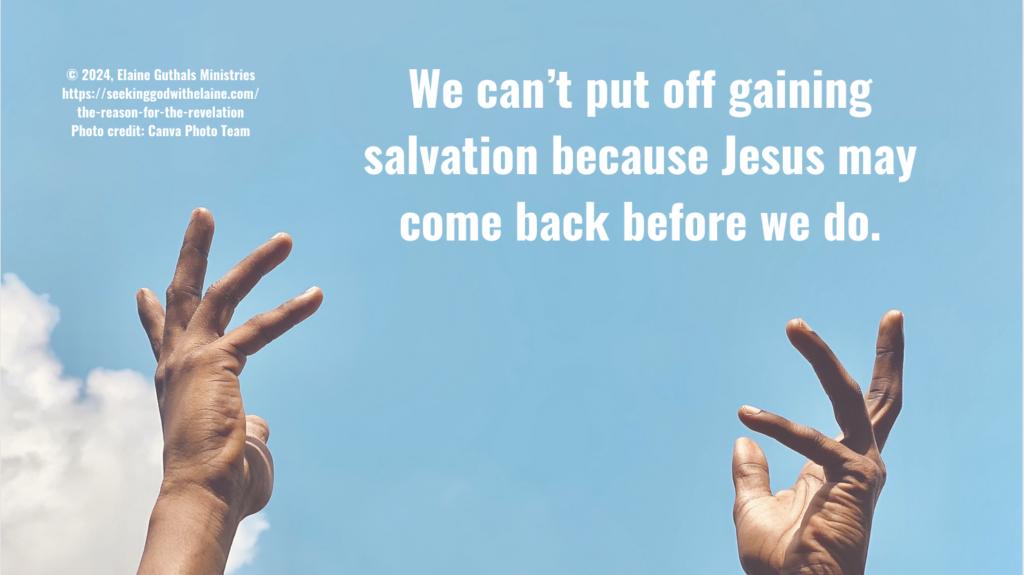
    The other part is we might not be here when Jesus returns. John thought Jesus was coming in his lifetime. He’s been long dead.
     
    If John – or we – wait for any reason, we are taking our eternal life into our hands. We may not be glad we waited.

    How Do We Apply This?

    • Watch for apocalyptic events in our time so we don’t miss them.
    • Follow the directions of the prophecy.
    • Seek salvation today.

    Resource

    Father God. We want to know You as You are. Thank You for showing us the way to salvation. Thank You for showing us what will come. Amen.

    What do you think?

    Leave me a comment below (about this or anything else) or head over to my Facebook group for some interactive discussion.

    If you don’t understand something and would like further clarification, please contact me.

    If you have not signed up for the email providing the link to the devotions and the newsletter, do so below.

    If God has used this devotion to speak with you, consider sharing it on social media.

  • The Revelation of Prophecy

    The Book of Revelation is a message of prophecy regarding the end times. This devotional reading looks at the message given to Jesus by God.

    #dailydevotionalreading #disciplesofchrist #understandingthebookofrevelation

    Nuggets

    • The Book of Revelation is an account given to John about Jesus.
    • God gave the message of Revelation to Jesus.
    • The theme of the Book of Revelation is about what will happen in the end times.
    • Jesus gave the message to His angel to give to John.
    the-revelation-of-prophecy

    When I first began writing devotions, I was going to steer way clear of Revelation. I am no learned biblical scholar. How am I supposed to teach what I don’t know?
     
    But that is just it. I write these devotions so I can learn. In fact, that was how these devotions started before I began putting them online.
     
    How am I going to learn if I don’t study and write?
     
    So, when God told me very early in 2023 that the theme for 2024 was going to be the Book of Revelation, I shook in my boots and said, “Okay. You’ve got Your work cut out getting me up to speed.”
     
    I’m banking on sanctified ability. He is going to equip me with what I need to know to do the job He has called me to do.
     
    So, am I going to get everything right? No, but I don’t believe anyone will be allowed to get it all right. I’ll be stating my opinions.
     
    What I am going to share with you is what God has laid on my heart. Isn’t that what we are to do – serve Him in the way He calls?

    Introduction to the On the Day of the Lord Theme

    In the Book of Revelation, we are introduced to Sovereign God more than in any other book. Oh, yes. We can see His power and majesty throughout His Word.

    But — just as at the cross — we are shown all of God’s attributes in Revelation. We see not only His wrath but also His love, mercy, and grace.

    Is Revelation one of those times where there is past, present, and future prophecy contained within its words? Maybe. Probably.

    We know that it is definitely talking about the future.

    This year, we are going to look at Revelation through the lens of the end of the age and the beginning of eternity. It has been described as being in the day of the Lord.

    We are going to look at it as being on the day of the Lord. That day has arrived!

    It is easy to think that Revelation is a stand-alone book. It doesn’t quote directly from the Old Testament as other New Testament books do.

    However, John correlates his phrasing with that of the Old Testament. John’s imagery harkens back to Ezekiel, Daniel, and Isaiah. He pulled in the Psalms, Samuel, and Chronicles, too.

    We do know that Jesus’ description of the end times in Matthew 24 described the fall of Jerusalem and the end of the age. That ties into Revelation.

    Also, Paul’s letters corroborate what John says. I want to pull all those passages in to see if we can make the connections.

    I am also going to chase some rabbits to make sure we know what we are talking about and its significance. So, no. We aren’t going to be in Revelation the whole time.

    But think of it this way. We know part of Jesus’ mission was to fulfill the Old Testament prophesies. We have to know what those prophecies are.

    Do we really think Jesus has fulfilled all of them already? That would mean there are none about God calling us to Himself.

    Revelation is a difficult book to understand. There is a verse in Matthew that seems to fit real well here. “At that time Jesus declared, ‘I thank you, Father, Lord of heaven and earth, that you have hidden these things from the wise and understanding and revealed them to little children’” (Mt. 11: 25 ESV).

    Why is it so difficult? Because the more we study, the more confused we can become.

    So, am I going to clear everything up for you? Maybe some things (hopefully) but not everything.

    My prayer is that this theme opens the eyes of our hearts to what God wants us to know. May He remove the veil so He can reveal things to us at a deeper and deeper level.

    What should you do if I say something you question? Dig deeper into them so that you can find what God is telling you.

    Let’s get this party started.

    Let’s Put It into Context

    To read devotions in the On the Day of the Lord theme, click the button below.

    Devotions in the Getting Started in Revelation study

    The Revelation of Jesus Christ

    “The revelation of Jesus Christ, which God gave him to show to his servants the things that must soon take place …” (Rev. 1: 1 ESV)

    The Book of Revelation is an account given to John about Jesus.

    It is significant that this is a revelation about Jesus. Remember, the last time Jesus was asked about the end times, He said He didn’t have all the information. “But concerning that day and hour no one knows, not even the angels of heaven, nor the Son, but the Father only” (Mt. 24: 36 ESV).

    It is easy to think that didn’t change once Jesus retook His rightful place in Heaven. But we know that – even before the ascension – Jesus was given authority over creation by God. “And Jesus came and said to them, ‘All authority in heaven and on earth has been given to me’” (Mt. 28: 18 ESV).

    Now, too, Jesus is Head of the Church. 

    • And he put all things under his feet and gave him as head over all things to the church” (Eph. 1: 22 ESV).
    • “And he is the head of the body, the church. He is the beginning, the firstborn from the dead, that in everything he might be preeminent” (Col. 1 18 ESV).
    • So we, though many, are one body in Christ, and individually members one of another” (Rom. 12: 5 ESV).
    • “For just as the body is one and has many members, and all the members of the body, though many, are one body, so it is with Christ” (I Cor. 12: 12 ESV).

    Who better to tell the judgment of the world than the Head of the Church and the One Who will judge the world?

    God may have entrusted Him with the timing and sequence of the end times. That would explain why it is God’s message that He gave to Jesus.

    The Revelation of God

    “… which God gave him …” (Rev. 1: 1 ESV)

    God gave the message of Revelation to Jesus.

    We can’t gloss over an important word in verse 1. God gave these words to Jesus.  The message wasn’t just Jesus’ words.

    God is the source.

    Wasn’t that what Jesus did all throughout His ministry the first time? Jesus gave us the message that God gave Him. He was and still is the Mediator between God and us.

    Remember, Jesus said He only told us what the Father had given Him.

    • “So Jesus said to them, ‘Truly, truly, I say to you, the Son can do nothing of his own accord, but only what he sees the Father doing. For whatever the Father does, that the Son does likewise. For the Father loves the Son and shows him all that he himself is doing. And greater works than these will he show him, so that you may marvel” (Jn. 5: 19-20 ESV).
    • “So Jesus answered them, ‘My teaching is not mine, but his who sent me’” (Jn. 7: 16 ESV).
    • “So Jesus said to them, ‘When you have lifted up the Son of Man, then you will know that I am he, and that I do nothing on my own authority, but speak just as the Father taught me’” (Jn. 8: 28 ESV).
    • “For I have not spoken on my own authority, but the Father who sent me has himself given me a commandment — what to say and what to speak” (Jn. 12: 49 ESV).
    • “Do you not believe that I am in the Father and the Father is in me? The words that I say to you I do not speak on my own authority, but the Father who dwells in me does his works” (Jn. 14: 10 ESV).
    • “Now they know that everything that you have given me is from you” (Jn. 17: 7 ESV).
    • “All things have been handed over to me by my Father, and no one knows the Son except the Father, and no one knows the Father except the Son and anyone to whom the Son chooses to reveal him” (Mt. 11: 27 ESV).
    • “For I did not receive it from any man, nor was I taught it, but I received it through a revelation of Jesus Christ” (Gal. 1: 12 ESV).

    Look at how many of those verses are in the Book of John. That could be why God picked him to write the apocalyptic book.

    Jesus’ job was – and had always been – to pass on the message. It wasn’t a request. It was a commandment.

    If Jesus hadn’t said what God gave Him, He would have sinned against God. We know Jesus didn’t sin, so He said exactly what God gave Him to say.

    Think of it this way. The rest of God’s Word was inspired.

    • “All Scripture is breathed out by God and profitable for teaching, for reproof, for correction, and for training in righteousness” (II Tim. 3: 16 ESV).
    • “For no prophecy was ever produced by the will of man, but men spoke from God as they were carried along by the Holy Spirit” (II Pet. 1: 21 ESV).

    Revelation is a thus declares the Lord book, along the lines of Jeremiah. But it is also along the lines of the Gospels. These are Jesus’ own words.

    But then, the message always was about Jesus. The Gospel is about the Plan of Salvation. Jesus accomplished the Plan of Salvation so that our relationships with God could be restored.

    Show Things that Must Soon Take Place

    “… to show to his servants the things that must soon take place …” (Rev. 1: 1 ESV)

    The theme of the Book of Revelation is about what will happen in the end times.

    We’re going to talk about the timing later. Right now, we are going to focus on the message.

    The purpose of the Book of Revelation is to show John – and us – what the end of the world as we know it will look like. That way, when it happens, we can know God told us the truth.

    Jesus did the same with the Apostles. “And now I have told you before it takes place, so that when it does take place you may believe” (Jn. 14: 29 ESV).
     
    God gave us time to prepare so that our spiritual conditions may be right when Jesus comes again.
     
    More importantly, the Book of Revelation is showing us Who Sovereign God really is. True, this quote from Young works for all other books of God’s Word, but to me it is especially applicable in this book.
     
    Young wrote, “There is an objective revelation of the character and will of God which is given in His Word; of the great plan of mercy which is given in the gospel; of the great events of Providence which are given in sacred prophecy.”

    Resource

    God wants us to know Him as our loving Father. He also wants us to know Him as a wrathful God.
     
    The last thing God wants is for us to be blindsided on the Day of the Lord. If we are, we’re lost to Him. We have to know the eternal consequences of our choices.
     
    God is more than willing to direct us in the ways we are to go.

    • “I will instruct you and teach you in the way you should go; I will counsel you with my eye upon you” (Ps. 32: 8 ESV).
    • “The heart of man plans his way, but the Lord establishes his steps” (Prov. 16: 9 ESV).
    • “Thus says the Lord, your Redeemer, the Holy One of Israel: ‘I am the Lord your God, who teaches you to profit, who leads you in the way you should go’” (Isa. 48: 17 ESV).
    • “Keep steady my steps according to your promise, and let no iniquity get dominion over me” (Ps. 119: 133. ESV).

    We just have to listen to Him.

    Made Known by His Angel

    “… He made it known by sending his angel to his servant John” (Rev. 1: 1 ESV)

    Jesus gave the message to His angel to give to John.

    The revelation took more a scenic route, which I had never caught before. There is a couple more steps than from Jesus to John.
     
    In reality, the message went from God to Jesus (more on that later) to the angel to John to us. “The revelation of Jesus Christ, which God gave him to show to his servants the things that must soon take place. He made it known by sending his angel to his servant John” (Rev. 1: 1 ESV emphasis added).
     
    In later chapters, it does seem that there is an angel that is a tour guide.
     
    This is evidence of the trinity – maybe. The Trinity is God the Father, God the Son, and God the Holy Spirit, three distinct Persons within one indivisible Divine nature.

    Making the Connections

    God gave the message to Jesus, Who gave it to an angel to give to John. Because John wrote it down, we can read it still today.
     
    The message that was given is that important. We need to read it. We need to believe it.
     
    We need to prepare.

    How Do We Apply This?

    • Accept Jesus as God’s Son.
    • Accept Jesus as the Head of the Church.
    • Accept God as Sovereign God.
    • Read Revelation.

    Father God. We are humbled that You love us enough to tell us how the world will end. We thank You that You, Yourself, gave the message to Jesus to be passed down. Open the eyes of our hearts so that we can understand what You want us to understand. Amen.

    What do you think?

    Leave me a comment below (about this or anything else) or head over to my Facebook group for some interactive discussion.

    If you don’t understand something and would like further clarification, please contact me.

    If you have not signed up for the email providing the link to the devotions and the newsletter, do so below.

    If God has used this devotion to speak with you, consider sharing it on social media.

  • Committing to Engage Our Soul

    Our soul is the only thing about us that is eternal. This devotional reading looks at how we engage our souls to gain eternal life.

    Nuggets

    • All souls of mankind belong to God.
    • Ezekiel said the soul that sins must die because they are separated from God.
    • God offers us salvation to repair the damage done by sin.

    We talked a devotion or two back about the soul being the only thing about us that is eternal. The only thing we can do to engage the soul to gain eternal life is to ABCD.

    Let’s Put It into Context

    To read devotions in the Habitual Holiness of Heart and Life theme, click the button below.

    Here is a running list of nuggets for the theme.

    Devotions in the Commit to Grow Our Habits study

    Here is a running list of nuggets for the study.

    Ownership of Our Souls

    “Behold, all souls are mine; the soul of the father as well as the soul of the son is mine: the soul who sins shall die” (Ezek. 18: 4 ESV)

    All souls of mankind belong to God.

    God told Ezekiel that all souls were His. He did not show favoritism and claim only some of the souls.

    God claims all of them.

    But it is more than souls are of equal value. Each soul is valued independently.

    Adam’ soul does not belong to God because I have submitted my life to Him. Adam is a child of God’s because he has submitted his life to Him.

    Clifford took that farther. In Elaine-speak, sin may have entered the world because of Adam’s sin, but our suffering is present for more than that.

    We endure suffering because of our own sins.

    Resource

    Our souls belong to God for all time. They are not His only while we are here on earth. They are His for eternity.

    We are God’s in all things. We cannot compartmentalize when we are His and when we aren’t.

    I see you jumping up and down in the corner, screaming, “No! No! NO!!! God doesn’t own our souls.”

    Yes, He does. Carpenter told us why. He wrote, “We must never for a moment imagine that we can dissociate the idea of God’s rights from the idea of a Divine character. It is the declaration not only of His claim over men by right of His creation of them, but of His nearness to them and His care for them; that they have a claim to His care arising out of His creation of them.”

    Resource

    All souls belong to God because He is our Creator and He cares for us.

    What traits do the soul have? For one, we share the attributes of God. He has made us in His image.

    Glossary

    The Homilist said we are intelligent, free, influential, and eternal.

    Resource

    We are smart creatures. We can reason things out.

    We have free will to make decisions based on what we have reasoned out. Free will is the ability within us to make decisions, which determine actions that produce character.

    We do have influence over others. We can discuss our stories of what God has done for us to help convince them they should submit to Him.

    Our souls are eternal. They are the only part of us that will live forever.

    We are temporary stewards of our souls so that we may serve God.

    I love what Clifford had to say. He wrote, “The motive to Ezekiel’s ministry is the loving, omnipotent, and regenerating God.”

    Resource

    So many times, we do ministry for the wrong reasons. They are focused on our wants, needs, and benefits rather than serving God.

    Being of service to God — especially doing the sheep and the goat list — has to focus on God and His motives.

    Glossary

    God cares for each and every one of us. He maintains a personal interest in all our dealings — both big and small.

    Oh, sometimes, it may be easy to miss signs of God’s care. We may be looking for something else. Or we may have grown complacent and entitled to His blessings.

    I think we don’t look close enough. We see smooth sailing as blessings and trials as curses.

    Not necessarily so, my friends.

    We know that God prunes us when necessary. These trials are needed for our growth.

    Separation of Our Souls from God

    “And the dust returns to the earth as it was, and the spirit returns to God who gave it” (Ecc. 12: 7 ESV)

    Ezekiel said the soul that sins must die because they are separated from God.

    There are two kinds of death. One is physical, and one is spiritual.

    This body is going to die. Death is a consequence of the original sin.

    Glossary

    Upon death, our bodies return to dust. “By the sweat of your face you shall eat bread, till you return to the ground, for out of it you were taken; for you are dust, and to dust you shall return” (Gen. 3: 19 ESV).

    However, our souls will remain for eternity. Guyse gave verses in Scripture as confirmation that souls are immortal.

    • “And as her [Rachel’s] soul was departing (for she was dying), she called his name Ben-oni; but his father called him Benjamin” (Gen. 35: 18 ESV).
    • “Then he [Elijah] stretched himself upon the child three times and cried to the LORD, “O LORD my God, let this child’s life come into him again” (I Kgs. 17: 21 ESV).
    • “But you have come to Mount Zion and to the city of the living God, the heavenly Jerusalem, and to innumerable angels in festal gathering, and to the assembly of the firstborn who are enrolled in heaven, and to God, the judge of all, and to the spirits of the righteous made perfect, and to Jesus, the mediator of a new covenant, and to the sprinkled blood that speaks a better word than the blood of Abel” (Heb. 12: 22-24 ESV).

    Resource

    Through sin, we have turned our backs on God. Vaughan called us being runaways.

    Resource

    We are held accountable for our sins. We are accountable for Adam’s sin because all mankind feels it’s effect.

    When Adam sinned, he — and us — were separated from God. We cannot endure this separation and live. Separation equals death.

    We are also responsible for the sins that we ourselves commit. We choose whether we remain separated from God or not.

    The Thinker brought up a good point. He wrote, “No actual sin is ever transferred from one soul to another, nor eternal penalty incurred through the misdeeds of ancestors.”

    Resource

    It is our fault we sin – we pay the consequences.

    Engaging our soul to show love to God is imperative. We cannot hold ourselves from God in any form and expect that we are showing Him love.

    Hutchings made an interesting point. He likened death to a withdrawal.

    Resource

    I can see that as what happens in our physical death. I can also see God’s withdrawal from us because of sin.

    Bottom line is we don’t want to remain separated from God.

    Restored to God

    “And do not fear those who kill the body but cannot kill the soul. Rather fear him who can destroy both soul and body in hell” (Mt. 10: 28 ESV)

    God offers us salvation to repair the damage done by sin.

    Luckily, God has offered a way that we can stop being runaways. Only through accepting Jesus as our Savior and Redeemer can the penalty for our sins be paid.

    Clarke said it this way. He wrote, “Again, all souls belong to God by redemption. The work of Christ is for all: He died for all, the just and the unjust, that He might bring them to God.”

    Resource

    Yes, all souls will make it to eternity. The difference is where they are going to spend eternity.

    Those who have ABCDed will spend it with God. Those who haven’t, won’t.

    What happens when we ABCD?

    • “I will sprinkle clean water on you, and you shall be clean from all your uncleannesses, and from all your idols I will cleanse you. And I will give you a new heart, and a new spirit I will put within you. And I will remove the heart of stone from your flesh and give you a heart of flesh” (Ezek. 36: 25-26 ESV).
    • “And I will put my Spirit within you, and you shall live, and I will place you in your own land. Then you shall know that I am the LORD; I have spoken, and I will do it, declares the LORD.” (Ezek. 37: 14 ESV).

    Resource

    The ABCDs of Salvation

    If you have not become a believer in Christ, please read through the
    Plan of Salvation and prayerfully consider what God is asking you to do.

    A – admit our sins
    B – believe His Son Jesus is our Redeemer
    C – confess God as Sovereign Lord

    D – demonstrate that commitment by making any changes needed in our lives to live the way in which God has called us

    The Disciple’s Job Description

    When we repent of our sins and ask Jesus to be our Savior, we accept the Plan of Salvation.

    committing-to-engage-our-soulFB

    Making the Connections

    Many times, we just want to take our sins and hide. We don’t want others to know what we have done — or how bad we are.

    But tie this back to what we talked about a couple of devotions ago. Pastor Steve talked about bearing one another’s burdens.

    To read a related devotion, click the button below.

    Pastor Steve said that bearing one another’s burdens is fellowship on the deepest level possible. That is where, out of true love, we should strive to be in our fellowship with one another.

    Lewis showed how we are to bear things. He wrote, “‘Bear ye one another’s burdens’ — in his relation to his fellow creatures, ‘for each man shall bear his own burden’ — in his relation to God.”

    Resource

    God wants to make us new creations so that we can spread the word of His love.

    How Do We Apply This?

    • Be dedicated to the service of God because our souls belong to Him.
    • Act according to the Will of God.
    • Rely totally on God for His protection.
    • Constantly maintain that God does, indeed, own our souls.
    • Love Him with all heart, soul, mind, and strength.
    • Trust God implicitly.
    • Serve Him as He calls.
    • Realize how much God values us.
    • Fix being separated from God.
    • Don’t make excuses for sin.
    • Show gratitude to God for saving our souls.
    • Pray when we experience trials.
    • View death as a gateway to eternal life.

    Resource

    Father God. When mankind disobeyed You, You could have left us to our fate — to realize the consequences of our actions. You didn’t. You designed the Plan of Salvation so that we could be restored to You. Convict us until all accept this wonderful Plan. Amen.

    What do you think?

    Leave me a comment below (about this or anything else) or head over to my Facebook group for some interactive discussion.

    If you don’t understand something and would like further clarification, please contact me.

    If you have not signed up for the email providing the link to the devotions and the newsletter, do so below.

    If God has used this devotion to speak with you, consider sharing it on social media.

  • Jesus as an Inhabitant of Heaven

    One day, we will be called home to Heaven. As we are looking at the Lord’s Prayer, Jesus told us to pray to God in Heaven. This devotional reading looks at how we will live with Jesus for eternity.

    Nuggets

    • As Jesus had descended to earth, it is only natural that He ascend again to Heaven.
    • After Jesus returned to Heaven, He was given a place of honor – at the right hand of God.
    • Once eternity begins, there will be nothing that can separate us from Jesus.

    It might seem like we are chasing a rabbit, but we’ve been talking about the inhabitants of Heaven. We said that angels, the Church, God, and Jesus will live there.

    We’ve already identified Heaven as the home of God, so we aren’t going to rehash that. Let’s move on to Jesus as an inhabitant.

    Let’s Put It into Context

    To read devotions in the Habitual Holiness of Heart and Life theme, click the button below.

    Here is a running list of nuggets for the series.

    Devotions in the Commit to Grow Our Habits study

    Here is a running list of nuggets for the study.

    Ascended to Heaven

    “And when he [Jesus] had said these things, as they were looking on, he was lifted up, and a cloud took him out of their sight” (Acts 1: 9 ESV)

    As Jesus had descended to earth, it is only natural that He ascend again to Heaven.

    Oh, yeah. There was nothing natural about it to the men who were watching Jesus. The way it is written makes it sound like a cloud just came, picked Him up, and – after a bit – hid Him from view.

    Not every day we see a cloud taxi.

    Think about it. Ascension back to Heaven was a really important part of the Plan of Salvation.

    Yes, I think the Plan was completed on the cross. Jesus actually said it was (Jn. 18: 30).

    The resurrection was important. Jesus’ sacrifice wasn’t just about death. It was about new life.

    To read a related devotion, click the appropriate button below.

    Then we get to the ascension. The actual lift off shouldn’t trip us up. Jesus had said in Matthew 28: 18, “… ‘All authority in heaven and on earth has been given to me’” (ESV).

    The disciples had to see Jesus going up to Heaven. He didn’t want them to continue looking for Him when He was long gone from this earth.

    Jesus wanted them focused on the missions that He had for them. They were to “Go therefore and make disciples of all nations, baptizing them in the name of the Father and of the Son and of the Holy Spirit, teaching them to observe all that I have commanded you …” (Mt. 28: 19-20 ESV).

    The disciples’ calendars were going to be too full to be playing hide and seek.

    Beyond that, us being us, we would have seen Jesus as we are. He would have grown old, gotten sick, and died in our mind’s eye if we didn’t have the account of Him leaving alive.

    There is a problem, though. We may see Jesus going back to Heaven not as new life, but as a resumption of His old life.

    But it wasn’t. It was more than that.

    Hamilton explained it this way. He wrote, “The ascension of Jesus was essential to the plan and work of redemption. It was necessary to relate again the work which Jesus had come to do in the earth with the world from whence He came.”

    Resource

    Jesus was fulfilling His prophecy that He would go back to Heaven and intercede for us.

    How many times in the gospels did we read that Jesus went off on His own to spend time with His Father? Part of that time was spent praying for the apostles – and us.

    You don’t think Jesus was going to give that up, did you?

    It was very important that Jesus go back to Heaven alive. He had conquered sin, which had ushered in death. We are free and able to obtain His character.

    It was important that the disciples had to see Jesus – then not see Him. They had to see there was more after life on this earth.

    They had to see Jesus go. They had to know about the unseen.

    To read a devotion in the The Unseen Spirit World series, click on the button below.

    The ascension was also about glorifying Jesus. “After the Lord Jesus had spoken to them, he was taken up into heaven and he sat at the right hand of God” (Mk. 16: 19 NIV). He had been obedient to the Father. The Father was now rewarding Him.

    We can ascend, too. Jesus told us that Himself.

    “In my Father’s house are many rooms. If it were not so, would I have told you that I go to prepare a place for you? And if I go and prepare a place for you, I will come again and will take you to myself, that where I am you may be also” (Jn. 14: 2-3 ESV).

    One day, we will ascend to Heaven to be with Jesus.

    At the Right Hand of God

    “He is the radiance of the glory of God and the exact imprint of his nature, and he upholds the universe by the word of his power. After making purification for sins, he sat down at the right hand of the Majesty on high” (Heb. 1: 3 ESV)

    After Jesus returned to Heaven, He was given a place of honor – at the right hand of God.

    Some of us probably know that this positioning is a reward; and in this case, it is a reward specifically for Jesus’ obedience. We picture in our minds Jesus whispering in God’s ear, advocating for us,

    Moule said it was a little more than that. He wrote, “The metaphor (from an Oriental throne, a seat admitting more than one occupant) implies the share of the incarnate Lord in the supreme glory — more than mere nearness to it.”

    Resource

    Let’s see what Scriptures say.

    • “Then the angel showed me the river of the water of life, bright as crystal, flowing from the throne of God and of the Lamb” (Rev. 22: 1 ESV).
    • “And now, Father, glorify me in your own presence with the glory that I had with you before the world existed” (Jn. 17: 5 ESV).

    I love that last one. It doesn’t say glorify me in Your presence. It says, “… glorify me in your own presence …” (Jn. 17: 5 ESV).

    My being is Your being. God and Jesus are One (Jn. 10: 30), so they share the being.

    Parsons stressed that Jesus is sitting down. He gave us several reasons why this is important.

    • Jesus is experiencing calm after the struggles through which He went.
    • It indicates His authority.
    • It indicates it is His permanent position.

    Resource

    I keep thinking back to the reading of the Scriptures in synagogue. Once the Rabbi was done reading, he sat down.

    Jesus has successfully completed the Plan of Salvation. He has earned the right to sit down.

    Always with Jesus in Heaven

    “Then we who are alive, who are left, will be caught up together with them in the clouds to meet the Lord in the air, and so we will always be with the Lord” (I Thess. 4: 17 ESV)

    Once eternity begins, there will be nothing that can separate us from Jesus.

    Oh, wait! Don’t we have that now?

    “And I am convinced that nothing can ever separate us from God’s love. Neither death nor life, neither angels nor demons, neither our fears for today nor our worries about tomorrow — not even the powers of hell can separate us from God’s love. No power in the sky above or in the earth below — indeed, nothing in all creation will ever be able to separate us from the love of God that is revealed in Christ Jesus our Lord” (Rom. 8: 38-39 NLT).

    We might have trouble believing that right now. We shouldn’t.

    Once we submit our lives to God, we can bank on this promise. It will never end. “… nothing in all creation will ever be able to separate us from the love of God that is revealed in Christ Jesus our Lord” (Rom. 8: 39 NLT emphasis added).

    Spurgeon explained it this way. He wrote, “As we have received Him, so shall we walk in Him, whether in life or death.” Once we have ABCDed – and put emphasis on the D part – we will walk with Him.

    Resource

    Think about this. We know we are to walk in the Spirit here on earth. We won’t be in the Spirit in Heaven, but we will be doing the same walk – obeying God. That isn’t going to change.

    To read devotions in the Walk in the Spirit series, click on the appropriate button below.

    What? Did you think God’s laws were going to change once we get called home? No.

    God’s laws reflect His character. That isn’t going to change.

    jesus-as-an-inhabitant-of-heavenFB

    Making the Connections #1

    I love what Mangey said. He wrote, “Our [Savior], to oppose narrowness of opinion, requires us to pray to our Father which art in heaven, showing by this, that our petitions have equal access to Him from all places.”

    Resource

    Our prayers reach God regardless of where we are. We don’t have to be in a church or synagogue. We could even be in a bar, and God would hear a sincere prayer from one of His children.

    The prayers of the greatest disciple doesn’t have precedence over mine. Mine doesn’t have precedence over someone else.

    Making the Connections #2

    Johnson also made a great observation. We talk about God’s goodness. Heaven is the meeting place where we will come into contact with that goodness.

    Resource

    Yes, we have access to some of God’s goodness now. But God is saving the best blessings for Heaven – after we have endured and become perfected.

    How Do We Apply This?

    • Believe in the unseen world.
    • Respond as the apostles did – with joy.
    • Imitate Jesus – be meek and lowly, serving in love.
    • Live in the fear of the Lord and hope.
    • Work to become like Jesus now so that eternity begins now.

    Resource

    Father God. We thank You that You loved us enough to send Your Son to complete the Plan of Salvation. We thank You that, one day, we will get to thank Him face to face. We look forward to living with Jesus for eternity. Amen.

    What do you think?

    Leave me a comment below (about this or anything else) or head over to my Facebook group for some interactive discussion.

    If you don’t understand something and would like further clarification, please contact me.

    If you have not signed up for the email providing the link to the devotions and the newsletter, do so below.

    If God has used this devotion to speak with you, consider sharing it on social media.

  • The Church as Inhabitants of Heaven

    As we continue our look at Heaven in the Lord’s Prayer, we continue our look at the inhabitants of Heaven. This devotional reading looks at how the Church fits in.

    Nuggets

    • Only those who accept salvation and endure the Sanctification Road will become the Church and eventually reside in Heaven.
    • At a specific point in the future, God will stop individually calling us home to Heaven and call the Church as a whole.
    • The Church will be judged upon reaching Heaven.
    • There will be no church/temple in Heaven.

    This group of devotions is focusing on Heaven in the Lord’s Prayer. After looking at Heaven being the dwelling place of God, we started in the last devotion looking at the inhabitants of Heaven.

    In the last devotion, we looked at angels. In this devotion, we will look at the Church. In the next devotion, we will look at God and Jesus as inhabitants of Heaven.

    Let’s Put It into Context

    To read devotions in the Habitual Holiness of Heart and Life theme, click the button below.

    Here is a running list of nuggets for the series.

    Devotions in the Commit to Grow Our Habits study

    Here is a running list of nuggets for the study.

    Preparing the Church for Heaven

    “For God so loved the world, that he gave his only Son, that whoever believes in him should not perish but have eternal life” (Jn. 3: 16 ESV)

    Only those that accept salvation and endure the Sanctification Road will become the Church and eventually reside in Heaven.

    We as humans are not entitled to Heaven. It can only be gained one way.

    That is to accept God’s gift of salvation. Salvation is the gift of life through the deliverance from condemnation and sin to acceptance and holiness and changes us from being spiritually dead to spiritually alive.

    • Sin is not believing that Jesus is our Savior to save us from our actions by humans that disobey God and break one of His reasonable, holy, and righteous laws and commandments, goes against a purpose He has for us, or follows Satan’s promptings.
      • Holy means to be set apart — because of our devotion to God — to become perfect, and morally pure while possessing all virtues and to serve and worship God.
        • Perfection means we reach a state of maturity because the combination of the spiritual graces form, when all are present, spiritual wholeness or completeness — holy, sanctified, and righteous.
          • Spiritual graces are worldly morals that have been submitted to God to further His kingdom instead of enhancing this world.
          • Sanctified means to be set free from sin.
          • Righteous means we are free from sin because we are following God’s moral laws.
        • Pure means not being sinful or having the stain of sin. 
        • Virtues are standards of moral excellence.
    • Holiness is the transcendent excellence of His nature that includes elements of purity, dedication, and commitment that lead to being set apart.
      • Purity means possessing God’s moral character, having eliminated the stain of sin.
    • Spiritual death is the spiritual separation from God that occurred as a consequence of Adam and Eve’s original sin.
      • The spiritually alive are those who have ABCDed, so they are no longer separated from God.

    The ABCDs of Salvation

    If you have not become a believer in Christ, please read through the
    Plan of Salvation and prayerfully consider what God is asking you to do.

    A – admit our sins
    B – believe His Son Jesus is our Redeemer
    C – confess God as Sovereign Lord

    D – demonstrate that commitment by making any changes needed in our lives to live the way in which God has called us

    The Disciple’s Job Description

    Glossary

    Once we submit to God, Satan will use trials to try to tempt us to disobey Him.

    Spencer cautioned us that these trials are not to be unexpected. He wrote, “There is nothing said in the Scriptures which gives us any reason to suppose that it is an easy thing to be faithful Christians.”

    Resource

    The difficulties of trials doesn’t mean that God wants us to fail. He doesn’t. He wants us to endure.

    Enduring through these trials is how we gain Heaven. “Blessed is the man who remains steadfast under trial, for when he has stood the test he will receive the crown of life, which God has promised to those who love him” (Jas. 1: 12 ESV). We gain strength to resist Satan through the process of sanctification.

    Temptation is a suggestion in our mind that would lead us to sin rather than following God’s Will. It is also that period of time between conception and execution of doing what is sinful.

    Sanctification is the transformational process of the mind, body, and soul, which begins with regeneration; gradually changes our nature and morals through the promptings of the Holy Spirit; and ends with perfected state of spiritual wholeness or completeness.

    • Regeneration is being changed from spiritually dead to spiritually alive and the internal new birth and requickening that God brings about through the work of the Holy Spirit to give us new character.

    Glossary

    We just talked about consistency. Our reward for enduring as we navigate the Sanctification Road so that our character becomes more like God’s is to spend eternity with Him in Heaven.

    Prayer is the constant through all this. We cannot gain salvation without prayer. We endure the Sanctification Road through prayer.

    Making the Transition from Church to Heaven

    “Then we who are alive, who are left, will be caught up together with them in the clouds to meet the Lord in the air, and so we will always be with the Lord” (I Thess. 4: 17 ESV)

    At a specific point in the future, God will stop individually calling us home to Heaven and call the Church as a whole.

    It isn’t going to take much to call the church home to Heaven. All Jesus will have to do is sound the trumpet.

    Then everyone who has ABCDed will have a change of address. We will now be living in Heaven.

    This is called the second coming of Christ. He is coming for His saints.

    So, what does living in Heaven mean? Well, we don’t get an extended, in-depth explanation.

    We know we will reach perfection/maturity. Davison explained some of what that means. He wrote, “It is not only to see Him and live in His house, one of His family, always in His presence; it is the getting rid forever of what unChristlike in character, the gaining of the real perfect sympathy with the Christ life.”

    Resource

    Davison went on to say that it isn’t about being in the same place as Him. Our thoughts, love, and life have to reflect Him.

    I think it is a safe bet to believe that God will be teaching us throughout eternity. He will continue to reveal Himself to His children.

    We will see God’s truth as it becomes clearer to us. It cannot be clear to us until we have bodies that have been perfected.

    But that emphasizes the fact that we will live with God forever. Eternity is a long time – and we will spend it with Him.

    Judgment for the Church in Heaven

    “For we must all appear before the judgment seat of Christ, so that each one may receive what is due for what he has done in the body, whether good or evil” (II Cor. 5: 10 ESV)

    The Church will be judged upon reaching Heaven.

    Many think that disciples won’t be judged in any way when we reach Heaven. They think that we get to pass go and just collect the $200, as in Monopoly.

    Paul said, “Not so fast.”

    Jesus said that we would be separated into sheep and goats. That is a judgment as to whether or not we have ABCDed.

    Glossary

    Stanley helped us realize the image Paul was painting here. Paul was describing the tribunal of the Roman magistrate. This is where justice was decreed.

    Stanley described it this way. He wrote, “The ‘Berea’ was a lofty seat raised on an elevated platform, usually at the end of the Basilica, so that the figure of the judge must have been seen towering above the crowd which thronged the long nave of the building.”

    Resource

    What was the purpose of this judgment? Stanley told us that, too – to glorify God’s grace. “Therefore, preparing your minds for action, and being sober-minded, set your hope fully on the grace that will be brought to you at the revelation of Jesus Christ” (I Pet. 1: 13 ESV).

    We have to remember that Jesus is just, as God is. He knows right from wrong, and His providence judges accordingly.

    Manton told us the four attributes of a judge – wisdom, justice, power, and authority. Jesus has all of those.

    Resource

    • “Nothing in all creation is hidden from God’s sight. Everything is uncovered and laid bare before the eyes of him to whom we must give account” (Heb. 4: 13 NIV).
    • “This is the message we have heard from him and declare to you: God is light, and there is absolutely no darkness in him” (I Jn. 1: 5 CSB).
    • “But the one who endures to the end will be saved” (Mt. 24: 13 ESV).
    • “Then Jesus came to them and said, ‘All authority in heaven and on earth has been given to me’” (Mt. 28: 18 NIV).

    Read the verse from Corinthians again. There are a couple of absolutes.

    • The judgment is going to happen.
    • It is going to happen to everyone.
    • Our service and sins will be made known.
    • We will be judged accordingly.
    • Huntington wrote that Jesus and God will be the Judges. Well, they are One (Jn. 10: 30).

    Resource

    I don’t see us as being able to call witnesses on our behalf. I don’t even see us defending our own actions.

    I just see this as the indictment and sentencing phase.

    No More Church in Heaven

    “And I saw no temple in the city, for its temple is the Lord God the Almighty and the Lamb” (Rev. 21: 22 ESV)

    There will be no church/temple in Heaven.

    I know I’ve read this verse before, but it never hit me until now. Church as we know it is going to change in Heaven.

    Yes, there will still be worshiping and praising of God. Music is going to play a big part.

    But we won’t need church as we did on earth. We may never hear Amazing Grace again. We may never hear Waymaker again.

    Related Links

    Carrie Underwood

    Michael W. Smith

    The temple was where God lived among us. We don’t need the temple because we will be living with God.

    We won’t need to go to God’s house to meet God – we’ll already be there.

    There won’t be a distinction between those who have ABCDed and those who haven’t. We all will have because those who haven’t will be burning in hell (Rev. 20: 15).

    Only saints will be in Heaven.

    Hall says that all of heaven is the temple. We won’t need anything else.

    Resource

    This is important. Don’t miss it.

    The Homilist said that, in Jewish culture, a city without a temple should be avoided. So if there is no church/temple in Heaven, it would have to be avoided.

    Resource

    But if Heaven was the temple, it would be fine.

    We won’t need the institutions and ceremonies anymore. They were for our sake.

    We already know we don’t need sacrifices anymore. Jesus shedding His blood negated that need.

    We don’t need the symbol when we have the real thing.

    Plus, we won’t need to sacrifice to atone for our sins. There won’t be any sin in a Heaven.

    We may be singing Scripture instead of songs.

    So, what will we be doing? Boyd talked about the difference between earth and Heaven. He wrote, “Now, all the means of grace — and God’s house, with its praises, prayers, and exhortations, among the rest — are just as steps towards heaven. And when the soul has reached heaven their need is over. The church and its services are no more than the means, and when we can have the end without the means we may well be content.”

    Resource

    This makes sense to me. Here, we can’t see God, so we have to focus our worship differently. There, we will be perfected, so earthly worship practices aren’t going to cut it. We won’t need reconciliation — we already will be reconciled.

    the-church-as-inhabitants-of-heavenFB

    Making the Connections

    Doing the first section, I was struggling again on not earning salvation through works, but needing to work after salvation. How do those mesh?

    Spencer helped me understand. He wrote, “Grace is a gift, but it is the nature of grace to improve by action. No man can be of strong body whose muscles have not been used to hard work. No mind can attain much vigour without much severe exercise. And the temptation which tries grace may be necessary for that perfection of grace which fits for heaven.”

    Resource

    Our doing ensures the growth of our faith. While that doesn’t give us salvation, it ensures that our salvation stays healthy. What doesn’t grow, dies.

    How Do We Apply This?

    • Watch for Jesus’ second coming to take us home to Heaven.
    • Comfort those who have recently lost a loved one.
    • Witness to non-believers.
    • Constantly meditate on Christ.
    • Constantly imitate Christ.
    • Realize that life is short, we are going to die, and we will be judged – act accordingly.

    Resource

    Father God. Your Church is awaiting the time when You call us home to be with You. We pray that day comes soon, but we also pray that we endure here on earth until it does. Help us to grow to be like You. Amen.

    What do you think?

    Leave me a comment below (about this or anything else) or head over to my Facebook group for some interactive discussion.

    If you don’t understand something and would like further clarification, please contact me.

    If you have not signed up for the email providing the link to the devotions and the newsletter, do so below.

    If God has used this devotion to speak with you, consider sharing it on social media.

  • Laodicea, a Lukewarm and Uncommitted Church

    Jesus finished His letters to the Seven Churches by writing to Laodicea about the temperature of their faith. In this daily devotional, Pastor Steve tells us why Jesus wanted us hot or cold instead of lukewarm.

    Devotions in the Pastor Steve Sermon Series 

    Here we are at the last church in our study on the Seven Churches in Revelation. I hope that you have been able to get a lot out of these studies. I trust that God will do with them as He will in your life.

    This letter to the church in Laodicea reprimands lukewarm Christians whose inconsistent lives stand for nothing but themselves. They sicken Christ to the point of His spitting them from His mouth.

    We all have times in our lives that we tend to be lukewarm in our faith. The issue is when we stay that way, never knowing the truth of a strong relationship with Christ.

    Historical Background

    Laodicea was situated 40 miles SouthEast of Philadelphia, and it was the economic and judicial center of a metropolitan regions that included Colosse and Hierapolis. The citizens of Laodicea were very proud of their self-sufficiency, it is said. For example, after a severe earthquake in AD 60, they refused aid from Rome and rebuilt their city themselves, making it very beautiful.

    Amen

    “And to the angel of the church in Laodicea write: ‘The words of the Amen, the faithful and true witness, the beginning of God’s creation. “‘I know your works: you are neither cold nor hot. Would that you were either cold or hot! So, because you are lukewarm, and neither hot nor cold, I will spit you out of my mouth. For you say, I am rich, I have prospered, and I need nothing, not realizing that you are wretched, pitiable, poor, blind, and naked. I counsel you to buy from me gold refined by fire, so that you may be rich, and white garments so that you may clothe yourself and the shame of your nakedness may not be seen, and salve to anoint your eyes, so that you may see. Those whom I love, I reprove and discipline, so be zealous and repent. Behold, I stand at the door and knock. If anyone hears my voice and opens the door, I will come in to him and eat with him, and he with me. The one who conquers, I will grant him to sit with me on my throne, as I also conquered and sat down with my Father on his throne. He who has an ear, let him hear what the Spirit says to the churches.’” (Rev. 3: 14-22 ESV)

    As you can see in the first part of verse 14, Jesus describes Himself as the “Amen.” Amen was used as an oath during this time. It in effect means, “Let it be so.” Therefore, whenever we say it after a prayer or a statement we agree with, we are saying, “Let it be so.”

    Amen is also a promise of truth. Jesus is that promise (Jn. 14: 6), and His message is authenticated by the truthfulness and reliability of His word.

    Faithful and True Witness

    In the second part of verse 14, the description of Christ as the “faithful and true witness” declares that He knew them as they really were. So, as the faithful and true witness, what He is going to declare about them is true — whether they think so or not.

    Though wealthy and proud of their status and accomplishments, the Laodiceans were not measuring up to God’s expectations. We run into problems when we start counting our accomplishments “for God” more than our relationship “with God.”

    While doing works for the Lord is one thing, if we are doing it apart from His influence upon our lives (spiritually), we are truly accomplishing nothing. Our relationship with Him is far more important to Him than what we do. Our works for Him flow out of the love we have for Him, built up through our relationship with Him.

    If we have not received Jesus as our Lord and Savior, we do not have the ability to have that true and effective relationship with Him. That is of the spirit. Apart from the spirit, nothing can happen of value.

    We cannot rightly believe that we will get into Heaven because we’ve done X, Y, or Z. That is a works-oriented theology and a lie from the pit of hell.

    The Apostle Paul told us, “For by grace you have been saved through faith. And this is not your own doing; it is the gift of God, not a result of works, so that no one may boast” (Eph. 2: 8-9 ESV). We cannot get saved by the work we do for the Lord.

    I should also remind you here what Jesus said in the book of Matthew:

    “Not everyone who says to me, ‘Lord, Lord,’ will enter the kingdom of heaven, but the one who does the will of my Father who is in heaven. On that day many will say to me, ‘Lord, Lord, did we not prophesy in your name, and cast out demons in your name, and do many mighty works in your name?’ And then will I declare to them, ‘I never knew you; depart from me, you workers of lawlessness’” (Mt. 7:21-23 ESV).

    Jesus is referring here to the Judgement Day. Many are going to be believing that they will be allowed into Heaven because of all the things that they did for Jesus in their lives. But they never truly knew Him as their Lord and Savior. He will say on that day that He never knew them, because they never asked Him to be their Lord and Savior.

    The Beginning of God’s Creation

    In the last part of verse 14, Jesus says He’s the “beginning of God’s Creation.” This is an amazing thing to consider. I mentioned this before in an earlier study when Jesus referred to Himself and the “Alpha and Omega.” It should be mentioned again.

    In John 1:1-5 it says, “In the beginning was the Word, and the Word was with God, and the Word was God. He was in the beginning with God. All things were made through him, and without him was not anything made that was made. In him was life, and the life was the light of men. The light shines in the darkness, and the darkness has not overcome it” (ESV).

    Take note of this … Jesus was with God in the beginning and all things were made through Him, plus, without Him not anything was made that was made. He is indeed, “beginning of God’s creation.” So, He, in fact, is the source of the new creation.

    Be Hot or Cold

    In verses 15 and 16, Jesus told this church that He is well aware of their works, but they are neither hot nor cold. It is interesting that He wants them to get either way, but because when they are lukewarm, they are neither.

    I find it interesting that Jesus would rather see us be completely cold to Him, rather than simply lukewarm. Obviously, hot is what He desires most of all, but He doesn’t want those who are lukewarm.

    To be lukewarm is to show no enthusiasm about what we are doing. If we consider this at its very root, it is understandable why Jesus does not like lukewarmness. It has a sense of double mindedness to it.

    If we are not able to fully give ourselves to something, such as serving Christ, we are likely bouncing back and forth between several things. In doing that, we have no commitment to any one thing that we are doing.

    In the book of James, it speaks of double minded people. “But let him ask in faith, with no doubting, for the one who doubts is like a wave of the sea that is driven and tossed by the wind. For that person must not suppose that he will receive anything from the Lord; he is a double-minded man, unstable in all his ways” (Jas. 1: 6-8 ESV).

    Being lukewarm shows that we have no passion for what we are doing, no commitment, and no real care for what we are doing.

    In an interesting sidebar here, not many are aware of this, but there were hot springs in Hierapolis, and they were famous for their healing qualities. Colossae was equally famous for its cold, refreshing springs.

    In contrast, the water that was available to Laodicea was smelly and lukewarm. Such water is distasteful. Jesus was saying that the church’s indecisive commitment to Him was revolting.

    I don’t know about you, but when I drink a cup of coffee, I like it hot. There have been times when I’m working on something and pick up my cup of coffee to take a drink, only to find that it has chilled to lukewarm (room temperature) since the last time I drank it.

    I don’t know why, but there’s something about the taste of cold or lukewarm coffee that makes me almost gag. To that extent, whenever it gets in my mouth, I immediately want to spit it out.

    If we can picture that in relation to how Jesus says that He will spit out those out of His mouth who are lukewarm, we can get an idea of what that might be like, spiritually speaking.

    But Aren’t We Doing Pretty Good Here?

    In verse 17, we see that that Jesus says that this church’s attitude was one of self-sufficiency. This attitude brings about a sense of having no need for God at all. Although the Christians in Laodicea felt prosperous and self-sufficient, Jesus accurately saw their wretched, miserable, and poor spiritual condition.

    Because Laodicea was such a prosperous place, they had no need of financial things. They believed that they were doing just fine.

    The problem is, when we end up in such a place, we can tend to forget about God. It’s strange, but we tend to believe that we don’t have need of God when everything is going great. But when it’s not so good, we become aware of how much we need God right away (hopefully).

    What Did They Need to Do to Fix That?

    Jesus has the answer for that in verse 18. The prescription required for Laodicea was a  complete change of attitude from self-reliance to dependence on God.

    The Apostle Paul wrote in Philippians 4: 19, ” And my God shall supply all your need according to His riches in glory by Christ Jesus” (ESV). What they needed to realize, and we do too, is that even when we have enough, it was provided by God. No matter what it is.

    Whether we have plenty or not enough at a given time, God has and will provide. So, there is absolutely never a reason for us to have the feeling or attitude that we don’t need God. Because we do.

    Buy from Me

    In verse 18, Jesus encourages them to obtain that which is truly important. They were to obtain spiritual things by saying, “Buy from me.”

    Materially, the Laodiceans could buy whatever they wanted, but they needed to acquire the treasures of Heaven so they would have spiritual riches through faith in Christ.

    While material wealth will not withstand God’s purging by fire, spiritual wealth has eternal value. Purifying by fire improved the quality of the gold and made it more valuable. Spiritually speaking, being purified/refined by fire brings us to place spiritually where all things of the flesh have been purged from our soul.

    White garments represent spiritual purity. When we have obtained the things we need to be spiritually pure, we’ve obtained those white garments.

    Interestingly enough, black wool cloth and garments were prized exports of Laodicea. The famous black wool cloth was a source of Laodicea’s material wealth. It probably represented Laodiceans’ proud and unredeemed spiritual condition.

    Laodicea was also known for their Phrygian eye ointment, which may have been used in the eye clinic there.

    The Laodiceans needed to buy ointment from Christ through faith. Only his eye salve would enable them to see their sin and repent.

    I Correct and Discipline

    In verse 19 Jesus stated that He corrects those He loves. He encouraged us to be zealous and repent because of that. That’s in contrast to being lukewarm.

    Christ will correct and discipline those whom He loves.

    Hebrews 12: 5-6 told us, “And have you forgotten the encouraging words God spoke to you as his children? He said, ‘My child, don’t make light of the Lord’s discipline, and don’t give up when he corrects you. For the Lord disciplines those he loves, and he punishes each one he accepts as his child’” (NLT).

    Rather than rejecting us, Jesus disciplines us because He loves us. His faithfulness extends to even the unfaithful.

    Be diligent to turn to Him because He loves us. We can take a lot of encouragement by this.

    I Stand at the Door and Knock

    Verse 20a is probably one of the most encouraging in the Bible to many Christians. “… I stand at the door and knock …” (Rev. 3: 20 ESV).

    A person or a church must HEAR Jesus knocking and OPEN THE DOOR to Him. Christ provides a pattern of revival for a church that has grown spiritually weak and out of fellowship with Him. Simply opening in the door can renew their former bond.

    We Will Share a Meal

    We will share a meal (vs. 20b). A shared meal symbolizes acceptance, deep friendship, and a covenant relationship.

    I believe that Jesus had a purpose in setting forth the example of the Lord’s Supper at the Last Supper. It was a time of celebrating Passover, but it was a time of fellowship, too.

    I believe that the observance of the Lord’s Supper needs to be of a fellowship bent in church, rather than a mindless ritual that we were told to do in remembrance of Him. Surely, we are doing it in remembrance of Him, but we are also celebrating the fellowship in faith that we have. Read below and see what you think.

    “Now as they were eating, Jesus took bread, and after blessing it broke it and gave it to the disciples, and said, ‘Take, eat; this is my body.’ And he took a cup, and when he had given thanks he gave it to them, saying, ‘Drink of it, all of you,  for this is my blood of the covenant, which is poured out for many for the forgiveness of sins. I tell you I will not drink again of this fruit of the vine until that day when I drink it new with you in my Father’s kingdom” (Mt. 26: 26-30 ESV).

    In verse 21 we see the reward for victorious and obedient faith is to:

    • Sit with Christ on His throne.
    • Christians do not become divine, but they share in Christ’s victorious reign.
    • 2 Timothy 2:11-13 says, ‘The saying is trustworthy, for: If we have died with him, we will also live with him; if we endure, we will also reign with him; if we deny him, he also will deny us; if we are faithless, he remains faithful — for he cannot deny himself.‘ (ESV).
    laodicea-a-lukewarm-and-uncommitted-churchFB

    How Do We Apply This?

    Which do you want to be in your walk in God: someone who is lukewarm and uncommitted to Jesus like the church in Laodicea or do you want to be someone who’s heart is on fire for Him?

    If you’re lukewarm now and uncommitted to Jesus and want to get on fire for him and don’t know how, here’s three tips to help you get there.

    1. Repent. Turn back to Him and pray for forgiveness and seek His face.
    2. Fan into flames what you already have. “For this reason I remind you to fan into flame the gift of God, which is in you through the laying on of my hands” (II Tim. 1: 6 ESV)
    3. Find people you can serve.

    Lord Jesus, show us how not be lukewarm. Most importantly, show us when we have become lukewarm in our faith. Help us to be on fire for You. We want to be totally sold out for You. Help us to win souls for You. Amen.

    What do you think?

    Leave me a comment below (about this or anything else) or head over to my Facebook group for some interactive discussion.

    If you don’t understand something and would like further clarification, please contact me.

    If you have not signed up for the email daily or weekly providing the link to the devotions and the newsletter, do so below.

    If God has used this devotion to speak with you, consider sharing it on social media.

  • Philadelphia, a Weak, but Obedient Church

    Many times, we think that having a weak faith means we are disobedient. In this daily devotional, Pastor Steve explains that the two are not necessarily linked.

    Devotions in the Pastor Steve Sermon Series 

    “And to the angel of the church in Philadelphia write: ‘The words of the holy one, the true one, who has the key of David, who opens and no one will shut, who shuts and no one opens. “‘I know your works. Behold, I have set before you an open door, which no one is able to shut. I know that you have but little power, and yet you have kept my word and have not denied my name. Behold, I will make those of the synagogue of Satan who say that they are Jews and are not, but lie — behold, I will make them come and bow down before your feet, and they will learn that I have loved you. Because you have kept my word about patient endurance, I will keep you from the hour of trial that is coming on the whole world, to try those who dwell on the earth. I am coming soon. Hold fast what you have, so that no one may seize your crown. The one who conquers, I will make him a pillar in the temple of my God. Never shall he go out of it, and I will write on him the name of my God, and the name of the city of my God, the new Jerusalem, which comes down from my God out of heaven, and my own new name. He who has an ear, let him hear what the Spirit says to the churches'” (Rev. 3: 7-13 ESV)

    In this devotion, we are continuing our study of the Seven Churches of Revelation with the church in Philadelphia. Just one more church to go after this one, and we will be finished with this study.

    Background about Philadelphia

    Philadelphia was situated in the foothills of the Timolus Mountains, open to fertile plains in the east. One of the main problems with this city, however, is that it repeatedly had severe earthquakes that left it weak and impoverished.

    Purpose

    One of the main purposes of this passage of Scripture is that it serves to encourage Christians who seem to be weak and powerless to realize that their true strength is in Christ. So, it’s intended to be a comforting message.

    The interesting thing about it is that, unlike the churches we’ve looked at already, this church has no disapproving words to it. Keep this in mind as we go through the passage  and remember that the Kingdom of God does not depend on human strength or wisdom, but on God’s power and authority.

    The Apostle Paul reminds us of this when he wrote, “That’s why I take pleasure in my weaknesses, and in the insults, hardships, persecutions, and troubles that I suffer for Christ. For when I am weak, then I am strong” (II Cor. 12:10 NLT).

    The Study

    Jesus introduces Himself in this letter beginning in the first part of verse 7 as: …” the holy one, the true one, who has the key of David, who opens and no one will shut, who shuts and no one opens. ‘”

    The Key of David is referring to Jesus the Messiah, Who is successor to David’s royal line. So, indeed, He would be the one who holds the key of David. Many times, in the New Testament we see Him referred to as “the son of David”.

    • “The book of the genealogy of Jesus Christ, the son of David, the son of Abraham” (Mt. 1: 1 ESV).
    • “A Gentile woman who lived there came to him, pleading, ‘Have mercy on me, O Lord, Son of David! For my daughter is possessed by a demon that torments her severely’” (Mt. 15: 22 ESV).
    • “… What do you think about the Christ? Whose son is he?’ They said to him, ‘The son of David’” (Mt. 22: 42 ESV).

    Jesus goes on to say in the second part of verse 7 that what He opens, no one can close; and what He closes, no one can open. As the gatekeeper of heaven, Jesus has authority to open and close the way to heaven.

    In Matthew 16:13-19, it says, “Now when Jesus came into the district of Caesarea Philippi, he asked his disciples, ‘Who do people say that the Son of Man is?’ And they said, ‘Some say John the Baptist, others say Elijah, and others Jeremiah or one of the prophets.’ He said to them, ‘But who do you say that I am?’ Simon Peter replied, ‘You are the Christ, the Son of the living God.’ And Jesus answered him, ‘Blessed are you, Simon Bar-Jonah! For flesh and blood has not revealed this to you, but my Father who is in heaven. And I tell you, you are Peter, and on this rock I will build my church, and the gates of hell shall not prevail against it. I will give you the keys of the kingdom of heaven, and whatever you bind on earth shall be bound in heaven, and whatever you loose on earth shall be loosed in heaven’” (ESV).

    Clearly, this shows that Jesus does hold the keys of the kingdom of heaven. Only the gatekeeper gets to hold the keys to the gate and allows whomever he desires to enter in.

    Interestingly enough, Jesus promises the keys to the kingdom as well. I don’t believe that they were allowed to decide who gets to come into heaven. However, they are, as we are, to tell all the world how to get to the gate.

    He Knows Our Works

    In verse 8, Jesus tells the church that He knows their works. He also points out to them that He has opened a door to them, that no one can close and that He knows that they have but a little power.

    It’s interesting that Jesus tells them of this marvelous opportunity that they have, because He has opened the door to them.

    Even though He is aware that they have but little power, He has opened it for them anyway. This shows that it doesn’t matter how much power we have. It’s all up to him.

    Little power is like the city of Philadelphia itself. The Christians there were not prosperous, and they lacked status and power.

    But Christ had opened a door for them to claim his status and authority. Despite their weakness, the Philadelphia church obeyed Christ’s word and did not deny him under pressure.

    Satan’s Synagogue?

    In verse 9, it mentions “those who belongs to Satan’s synagogue…” It’s believed that the Christians had suffered greatly by the treatment of anti-Christian Jews.

    In that time, captives were often forced to bow down and prostrate themselves before their conquerors. The church’s human enemies will ultimately acknowledge that Christians are the ones God loves.

    Romans 14:11 says, “For the Scriptures say, ‘As surely as I live,’ says the LORD, ‘every knee will bend to me, and every tongue will declare allegiance to God” (NLT). This is not simply a threat.

    No, it is a promise from Jesus to all His believers. This will, in fact, happen.

    Because They Obeyed Him

    Where Jesus mentioned in verse 10, “Because you have obeyed my command…”, He promised them, and us, that He will protect Christians who persevere through trials and from the great time of testing. During our struggles through trying times, it’s easy to wonder if Jesus even knows what we are going through or if He’s going to do anything about it.

    I promise you that Jesus does know and that He will do something about it. Perhaps not on our timetable, but His timetable will be the exact time.

    In every trial we go through, there is a lesson to be learned from it. It has been said that the quicker you learn the lesson, the faster the trial will be over.

    I think that’s true sometimes, but there’s other times we are taken through things that will last our entire lifetime. We won’t see the solution to it this side of heaven. We still have that promise.

    He Is Coming Soon

    Verse 11a shows that Jesus encourages the Philadelphia church by telling them He is coming soon. The Bible tells that a 1000 years is as a day and a day is as a 1000 years to the Lord.

    I am coming soon could mean years from now or it could even be today. We don’t know. That’s why we should always be ready to go and yet keep living our lives as God has ordained for us to.

    When you take into consideration the meaning of “soon,” consider the following:

    Soon has a meaning of suddenly or quickly. Meditate on the following scriptures today:

    • “For you know quite well that the day of the Lord’s return will come unexpectedly, like a thief in the night” (I Thess. 5: 2 NLT).
    • “When the Son of Man returns, it will be like it was in Noah’s day. In those days, the people enjoyed banquets and parties and weddings right up to the time Noah entered his boat and the flood came and destroyed them all” (Lk. 17: 26-27 NLT).
    • “Most importantly, I want to remind you that in the last days scoffers will come, mocking the truth and following their own desires. They will say, ‘What happened to the promise that Jesus is coming again? From before the times of our ancestors, everything has remained the same since the world was first created’” (II Pet. 3: 3-4 NLT).

    We Must Hold on Until the End

    The second part of verse 11 tells us of the importance of holding on until the end. Christians must hold on.

    We must persevere in difficulty so we will not lose our crown. The crown is our expected reward in Heaven.

    I’m Going to be a Pillar?

    Well, that IS what the first part of verse 12 says … “will become pillars in the temple…”, but not literal pillars, because pillars are a part of the temple holding up the roof. You would never be able to leave it.

    But think about it this way. Those who are victorious will become the foundation of the temple.

    Supporting the Temple with Your Entire Being

    You will never want to leave it. We who are victorious will never have to leave the temple. Therefore, we become pillars of the temple.

    Is God Going to Write His Name on Me?

    As the second part of verse 12 speaks to us, Jesus says He will… “write on them the name of my God …” (Rev. 3: 12 ESV). God’s name upon us describes that we are His, that He owns us.

    Think of it as a “Holy Brand” if you will. It shows Who we belong to.

    The Apostle Paul tells us in I Corinthians 6: 20 “for you were bought with a price. So glorify God in your body” (ESV). We do not belong to ourselves if we know Jesus as our Lord and Savior. We were purchased with his shed blood.

    How much more when we enter the kingdom of heaven?

    The City Name of the New Jerusalem, Too?

    The reason it is so important to mention the city name also is that it gives Christians who have persevered, who are victorious, security in knowing that they are God’s. We can enjoy the peace and comfort that comes with that.

    The New Jerusalem is not a realm constructed by humans, but God’s gift from heaven. I am not exactly sure of the significance of having the name of the city written on us, but surely, it means that we belong there because we have been victorious until the end.

    Dear Heavenly Father, help us to know the comfort of having Your name written upon our hearts. Help us to reach a victorious end in You. Amen.

    philadelphia-a-weak-but-obedient-churchFB

    What do you think?

    Leave me a comment below (about this or anything else) or head over to my Facebook group for some interactive discussion.

    If you don’t understand something and would like further clarification, please contact me.

    If you have not signed up for the email daily or weekly providing the link to the devotions and the newsletter, do so below.

    If God has used this devotion to speak with you, consider sharing it on social media.

  • Sardis, a Dead Church

    Have you noticed that Jesus has had more against the churches? In this daily devotional, Pastor Steve looks at the dead church of Sardis.

    Devotions in the Pastor Steve Sermon Series 

    “And to the angel of the church in Sardis write: ‘The words of him who has the seven spirits of God and the seven stars. “‘I know your works. You have the reputation of being alive, but you are dead. Wake up, and strengthen what remains and is about to die, for I have not found your works complete in the sight of my God. Remember, then, what you received and heard. Keep it, and repent. If you will not wake up, I will come like a thief, and you will not know at what hour I will come against you. Yet you have still a few names in Sardis, people who have not soiled their garments, and they will walk with me in white, for they are worthy.  The one who conquers will be clothed thus in white garments, and I will never blot his name out of the book of life. I will confess his name before my Father and before his angels. He who has an ear, let him hear what the Spirit says to the churches.’”’” (Rev. 3: 1-6 ESV)

    We are continuing our study on the Seven Churches of Revelation in this devotion with the church of Sardis.  This church probably wasn’t so very different than the other churches we have studied already. 

    The biggest thing about them is that they were simply dead.

    Background information on Sardis

    The city of Sardis was nearly 50 miles east of Smyrna on the southeast highway from Pergamom and Thyatira. It was home to a large colony of prosperous Jews, called “Sephardic” after the city’s ancient name.

    It was a fortified acropolis that gave its inhabitants an overconfident sense of security. An acropolis is a citadel or fortified part of an ancient Greek city, typically built on a hill.

    If you have ever seen The Lord of The Rings, Return of the King movie, the city of Gondor is a good example of an acropolis. Though it is a fantasy story and probably bigger than reality would have it, it gives you a good idea of what an acropolis was.

    Now, this letter to the church in Sardis warns the Christians there, who were reputed to be spiritually alive (they were spiritually dead), that without genuine transformation, they would face God’s judgement (Rev. 3: 1-6).

    How Does Jesus Address Himself in This Letter?

    “This is the message from the one who has the sevenfold Spirit of God and the seven stars …” (Rev. 3: 1)

    Sevenfold Spirit literally means the “seven spirits.” Some argue that the seven spirits mean seven angels, but it is acknowledging the Holy Spirit’s perfection, as the number 7 indicates.

    When it comes to the biblical meaning of the number 7, it is said that it is the number of perfection and completeness. God created the earth in 7 days, then he was done. And when you see 777 together, it represents the threefold completeness of the Trinity.

    God Sees Everything We Do

    The way many live their lives, one could get the idea that God has no idea what they do.  However, Jesus said here to the church in Sardis that He was well aware of what was going on.

    Revelations 3:1b says “… I know your works. You have the reputation of being alive, but you are dead” (ESV).

    The church in Sardis was well known for being an alive church, but Jesus knew that they were not truly alive at all.  They were dead.

    This kind of death occurs when we rely on our flesh to go about serving the Lord, instead of relying on the Spirit to serve him.  Anything done of the flesh is not of God, which is something I said in a previous study.

    There are so many churches today that are in the same boat. They put on a pretty good show of being alive, but they are actually dead. This is a seriously bad place to be in.

    Who was the Sardis Church?

    Other churches in the area may have believed that the Sardian Christians comprised a dynamic church, but their secularism revealed their lack of spiritual life.

    Outwardly, they looked like they had it all together and were very spiritual in all that they did, but the reality was they weren’t that at all.

    They Weren’t at All What They Seemed to Be

    God told Samuel when He was having him anoint the next king, since Saul had failed, that he should not pay attention to outward appearances. “But the Lord said to Samuel, ‘Do not look on his appearance or on the height of his stature, because I have rejected him. For the Lord sees not as man sees: man looks on the outward appearance, but the Lord looks on the heart’” (I Sam. 16: 7 ESV).

    Likewise, we should not look at outward appearances either, whether it is a church, a person or whatever the case may be.

    Granted, it is often difficult to tell who is true and who is not. That’s why it’s important for us to seek God about people. 

    Who Were the Hypocrites in Jesus’ Day?

    Many times, Jesus chastised the Pharisees for being hypocrites. It was clearly a problem with them. People being hypocrites in our time is no less a problem.  

    • “Woe to you, scribes and Pharisees, hypocrites! For you are like whitewashed tombs, which outwardly appear beautiful, but within are full of dead people’s bones and all uncleanness. So you also outwardly appear righteous to others, but within you are full of hypocrisy and lawlessness” (Mt. 23: 27-28 ESV).
    • “You hypocrites! Well did Isaiah prophesy of you, when he said: ‘This people honors me with their lips, but their heart is far from me; in vain do they worship me, teaching as doctrines the commandments of men.’” (Mt. 15: 7-9 ESV)

    The Church in Sardis apparently had the same problem . They appeared to be alive from the outside observation, but they were truly dead spiritually.

    They Were Warned

    The Church in Sardis needed to wake up or it would suddenly fall. They were already so far gone that, spiritually, there was very little left. Even what little was left was almost dead.

    Jesus pointed out in verse 2, “I find that your actions do not meet the requirements of my God“ (Rev. 3: 2 NLT).

    It’s interesting how we can go about doing things in the name of God, but totally miss the mark in what we are doing.  Clearly, Sardis had that problem.

    If what they had was pretty much gone, what was left to revive?  That’s difficult to say. However, there must have been something still there, otherwise, Jesus would not have warned them to wake up. He did encourage them to strengthen what was left.

    What Did They Need to Do to Wake Up?

    Jesus told them plainly, “Go back to the beginning!” Find their first love – Jesus!

    Just like the Ephesian Church, they left their first love! “Repent and turn to me again! If you don’t wake up, I will come to you suddenly, unexpected, as a thief” (Rev. 3: 3 NLT).

    Repentance is something that we all must do from time to time.  The longer we wait to repent, the longer and harder it may be to repent. 

    Apparently, considering how dead Jesus said they were as a church, repenting was a long time coming. And yet, He was giving them one last chance to repent.

    What Is This about the Soiled Clothes?

    Jesus said in verse 4 of Revelation 3 that they still had a few names left in Sardis. People who had not spoiled their clothes. It might be said that there was a remnant of people in Sardis who were still dedicated to Jesus.

    The soiled clothes mentioned here represent an impure life. Isaiah 64: 6 says, “We are all infected and impure with sin. When we display our righteous deeds, they are nothing but filthy rags. Like autumn leaves, we wither and fall, and our sins sweep us away like the wind” (NLT).

    White clothes depict purity in life. As it says in Psalm 51: 7 “Purify me from my sins, and I will be clean; wash me, and I will be whiter than snow” (NLT).

    Repentance brings about that purifying.

    So, What about Being Victorious?

    Those who are victorious will be clothed in white. Those who are faithful to Jesus to the very end of their lives shall be called victorious. “His face shone like lightning, and his clothing was as white as snow” (Mt. 28: 3 NLT).

    To the very end means until we pass away and stand before God on the Judgement Day.  This is a very important thing to be ready for, don’t you think?

    In verse 5b, Jesus says that He will “… never erase their names from the Book of Life.” The Book of Life records those who have received Jesus as their Lord and Savior and are going to heaven.

    Erasing their names indicates that the there are people who had their names recorded in the Book of Life, but because of their unrepentant sin, they got their names erased from it. It implies condemnation and eternal death.

    In case you doubt that, please read Revelation 20: 11-15. “And I saw a great white throne and the one sitting on it. The earth and sky fled from his presence, but they found no place to hide. I saw the dead, both great and small, standing before God’s throne. And the books were opened, including the Book of Life. And the dead were judged according to what they had done, as recorded in the books. The sea gave up its dead, and death and the grave gave up their dead. And all were judged according to their deeds. Then death and the grave were thrown into the lake of fire. This lake of fire is the second death. And anyone whose name was not found recorded in the Book of Life was thrown into the lake of fire” (Rev. 20: 11-15 NLT).

    There is little doubt that we will all stand before God on the Judgement Day. The main thing is to be sure that your sins will not be counted against you on this day, by accepting Jesus as your Lord and Savior and by repenting of you sins thereafter as much as you need to.

    Lord God, help us to see where we have sinned and help us to readily repent as you convict us of our sins.  By your saving Grace we ask this in Jesus’ name. Amen.

    sardis-a-dead-churchFB

    What do you think?

    Leave me a comment below (about this or anything else) or head over to my Facebook group for some interactive discussion.

    If you don’t understand something and would like further clarification, please contact me.

    If you have not signed up for the email daily or weekly providing the link to the devotions and the newsletter, do so below.

    If God has used this devotion to speak with you, consider sharing it on social media.

  • Thyatira, An Overly Tolerant Church

    The worldview tells us that we need to tolerate everyone’s sins. Jesus addressed the issue of tolerating sin in His letter to the church at Thyatira. In this daily devotional, Pastor Steve tells us what Jesus had to say.

    Devotions in the Pastor Steve Sermon Series 

    We come to our fourth church in our study of the seven Churches in Revelation. The first one was Ephesus, the Loyal Church. The second one was Smyrna, the Suffering Church, and the third was Pergamum, a Compromising Church. In this devotion, we come to Thyatira, an Overly Tolerant Church.

    In each of these churches, Jesus had something He praised them for and something He had against them. Thyatira is no different.

    “And to the angel of the church in Thyatira write: ‘The words of the Son of God, who has eyes like a flame of fire, and whose feet are like burnished bronze. I know your works, your love and faith and service and patient endurance, and that your latter works exceed the first. But I have this against you, that you tolerate that woman Jezebel, who calls herself a prophetess and is teaching and seducing my servants to practice sexual immorality and to eat food sacrificed to idols. I gave her time to repent, but she refuses to repent of her sexual immorality. Behold, I will throw her onto a sickbed, and those who commit adultery with her I will throw into great tribulation, unless they repent of her works, and I will strike her children dead. And all the churches will know that I am he who searches mind and heart, and I will give to each of you according to your works. But to the rest of you in Thyatira, who do not hold this teaching, who have not learned what some call the deep things of Satan, to you I say, I do not lay on you any other burden. Only hold fast what you have until I come. The one who conquers and who keeps my works until the end, to him I will give authority over the nations, and he will rule them with a rod of iron, as when earthen pots are broken in pieces, even as I myself have received authority from my Father. And I will give him the morning star. He who has an ear, let him hear what the Spirit says to the churches.’ (Rev. 2: 18-29 ESV)

    As some background about the city of Thyatira, it was an outpost city, known for its many trade guilds, including weavers and dyers. This is evidenced in Acts 16: 14, where it says, “One who heard us was a woman named Lydia, from the city of Thyatira, a seller of purple goods, who was a worshiper of God …” (ESV).

    Being an “outpost city” indicates that it was away from most of the known civilization at the time. And having all the trade guilds that it did indicates that there was quite a bit of business going on there.

    Most likely, it was a place where people came from all over the known world at the time to trade and do business. So, there would have been a lot of different beliefs present there, as well.

    The Letter’s Introduction

    Jesus starts off this letter introducing Himself saying, ‘… ‘The words of the Son of God, who has eyes like a flame of fire, and whose feet are like burnished bronze” (Rev. 2: 18 ESV).

    The flaming eyes of the “Son of God” give an indication of penetrating perception. Penetrating means able to make a way through or into something. Perception means the ability to see, hear, or become aware of something through the senses.

    It’s no coincidence that Jesus threw in the “… and whose feet are like burnished bronze” (Rev. 2: 18 ESV). Bronze was amongst the most solid and strong metals at this time. It was used to make swords, knives, spears, and even armor and helmets.

    The solid feet portray Christ’s strength and stability. This is in vivid contrast to the nearby Colossus of Rhodes, which was once thought to have been firmly planted until an earthquake destroyed it.

    Now, let me explain what the Colossus of Rhodes was. It was a gigantic bronze statue of the sun God Helios that stood at the entrance to the harbor of the city Rhodes.

    This statue was 108 feet tall. It was massive for its time.

    It was erected in 280 BC and stayed there until around 228 or 226 BC, according to ancient history books. It is said that it laid in ruins where it fell for over a millennium before it was melted down.

    Why Would This Matter to Us?

    Jesus said that his feet are like polished bronze here. The knowledge of this statue was likely known throughout the entire Mediterranean, even in Jesus’ time.

    It would have been known for its strength, presumably, and the greatness that went into building it. So burnished bronze would symbolize the strength and stability in Jesus’ feet here.

    Another interesting thing is that Jesus said his feet were like polished bronze. Anyone who was in the Navy, no doubt, had to polish some brass at some point while you were in. It was very shiny when you were done, right?

    Just like polished brass, polished bronze shines, and sparkles when the light hits it. How much does that mark that Jesus is not only our stability, but also our shining light?

    Combined with the fact that Jesus said He had eyes of fire, that’s a telling picture of how He is our light in the darkness AND our strength and stability.

    In verse 19, Christ emphasizes knowing and seeing all the things as He praises the Thyatirans. He knows what they did, just as He knows what we do today as a church and individuals. He knows both the good and bad.

    So many churches as a whole and people go about doing things as if God does not see and know what they are doing. There is nothing hidden from the Lord. He knows.

    Don’t make the mistake of assuming that because God will forgive you for what you do that it’s OK to do whatever you want.

    It’s interesting to see that Jesus pointed out that Thyatira’s later works were greater than the first. That seems to say that they had been progressing in their faith, love, and works as time had gone by.

    How Did They Compromise as a Church?

    In verses 20-21, however, Jesus mentions a woman He called “… that Jezebel …” (ESV), whom the church was allowing to teach. Now, Jesus didn’t mean the original Jezebel from Old Testament times.

    Sometimes you hear of people having a “Jezebel” spirit. That is what Jesus meant here. It is a type of Jezebel, if you will.

    The mention of Jezebel, who led Israel into pagan idolatry and immorality, indicates a serious problem. You can read about Jezebel in 1 Kings 16:31-33 and 21:5-26 and see how evil she was.

    She was Queen of Israel with her husband King Ahab. He was a whimpy king and allowed Jezebel to control everything. She led Israel into the pagan cult of Baal.

    Baal worship was a fertility cult, and part of their worship practices was sacrificing their children, literally throwing them into the fire. Israel was involved in this and their queen had led them there.

    Jesus likened this woman in the Thyatira church as just such a woman and Jezebel, and the church leadership did nothing about it. In fact, the allowed her to freely do her thing.

    OK, but that was then.

    This same thing is going on in our churches today as well. There are many churches who are allowing people to teach false doctrines, which are in fact “doctrines of demons.”

    The Apostle Paul warned Timothy in 1 Timothy 4: 1-5. “Now the Spirit expressly says that in later times some will depart from the faith by devoting themselves to deceitful spirits and teachings of demons, through the insincerity of liars whose consciences are seared, who forbid marriage and require abstinence from foods that God created to be received with thanksgiving by those who believe and know the truth. For everything created by God is good, and nothing is to be rejected if it is received with thanksgiving, for it is made holy by the word of God and prayer” (I Tim. 4: 1-5 ESV).

    The things that Jesus said of that Jezebel woman in Thyatira are going on even today. It’s important that we don’t allow just anyone to teach, speak, and lead in our churches.

    For this reason, we must be certain of them before they are allowed such positions of influence and authority.

    We don’t know who the woman was who was mentioned here as that Jezebel. She proclaimed herself to be a prophet and was leading God’s people into various forms of immorality. This includes sexual misconduct and straying from God into idolatrous alliances and actions (vs. 21)

    We also don’t know for certain, but through various messengers, Christ must have already given this false prophet opportunity to repent of her sinful teachings and actions. It tells us this in verse 21, but like so many, she refused.

    When we refuse to repent, we can be sure that there are going to be repercussions to our refusal. In verse 22, Jesus stated that He would throw this woman AND all those who’ve committed adultery with her into a sick bed. To be sure, this can happen today just like it did back then.

    Don’t be fooled into thinking that, because Jesus loves us, He would never do such a thing as that. Don’t you believe it!

    Jesus can and does still do such things to get us to repent. As a father disciplines his children, so God does the same thing.

    Also remember what the Bible says in Malachi 3: 6. “For I the Lord do not change; therefore you, O children of Jacob, are not consumed” (Mal. 3: 6 ESV).

    “Oh, but Pastor Steve, that’s Old Testament. We are under the age of grace now.”

    OK, read that verse again then get back to me.

    God still expects obedience.

    Because of her disobedience, Christ pronounces His judgement upon Jezabel, which comes in 3 stages.

    • She’ll be put on a bed of suffering.
    • Her followers will suffer greatly.
    • Her children will die (vs. 22)

    This judgement seems to echo the plaques that befell Egypt. Those ended with the deaths of Egypt’s firstborn sons.

    We don’t know exactly what these judgements are, but we can at least assume one of them was a sickness of some kind since the “sick bed” is the first one.

    God knows our thoughts and intentions. You may think you’re being clever and sneaky in what you’re doing, but you are not fooling God one bit.

    And I have no doubt that this Jezebel woman thought she was clever and sneaky. too. But God knew what she was doing.

    I don’t think it’s by accident that God has had me share this verse a few times over the last couple of months, but here it is again… Hebrews 4:12-13 says, “For the word of God is living and active, sharper than any two-edged sword, piercing to the division of soul and of spirit, of joints and of marrow, and discerning the thoughts and intentions of the heart. And no creature is hidden from his sight, but all are naked and exposed to the eyes of him to whom we must give account” (ESV).

    It exposes our innermost thoughts and desires.

    Because He knows this, God gives whatever sentence people deserve.

    I don’t have a complete understanding of verses 26-28, but Christ promises that those who are obedient will share authority with Him. This is symbolized by the iron rod that will smash the opposition like clay pots.

    The morning star, which is the planet Venus, signals the coming of a new day. Here it refers to the promise of the resurrection at Christ’s return.

    Lord Jesus, help us to have a better understanding of what happens when we make compromises of one sort or another of our faith. Give us the strength to stand strong for what Your word teaches and help us to live the life of obedience to which You have called us. Amen.

    thyatira-an-overly-tolerant-churchFB

    What do you think?

    Leave me a comment below (about this or anything else) or head over to my Facebook group for some interactive discussion.

    If you don’t understand something and would like further clarification, please contact me.

    If you have not signed up for the email daily or weekly providing the link to the devotions and the newsletter, do so below.

    If God has used this devotion to speak with you, consider sharing it on social media.

  • Pergamum, The Compromising Church

    Pergamum was the third church in Revelation to receive a letter from Jesus. This daily devotional looks at how the church compromised with the worldview and the issues Jesus had with that.

    Devotions in the Pastor Steve Sermon Series 

    “And to the angel of the church in Pergamum write: ‘The words of him who has the sharp two-edged sword. I know where you dwell, where Satan’s throne is. Yet you hold fast my name, and you did not deny my faith even in the days of Antipas my faithful witness, who was killed among you, where Satan dwells. But I have a few things against you: you have some there who hold the teaching of Balaam, who taught Balak to put a stumbling block before the sons of Israel, so that they might eat food sacrificed to idols and practice sexual immorality. So also you have some who hold the teaching of the Nicolaitans. Therefore repent. If not, I will come to you soon and war against them with the sword of my mouth. He who has an ear, let him hear what the Spirit says to the churches. To the one who conquers I will give some of the hidden manna, and I will give him a white stone, with a new name written on the stone that no one knows except the one who receives it’” (Rev. 2: 12-17 ESV)

    In this devotion, we are continuing our study of the Seven Churches in Revelation with the Church in Pergamum, The Compromising Church. The letter to the church in Pergamum portrays Christians who are tempted to compromise their morality and their loyalty to God.

    The city of Pergamum was the earliest capital of the Roman province of Asia.  It contained a famous library, and its citizens developed the use of animal skins as writing materials.

    Sharp Two-Edged Sword?

    At the start of this letter, Jesus told John to write “the words of him who has the sharp two-edge sword.” The two-edge sword was a sword of choice for many warriors ever since it was conceived. It had a tactical advantage from a single-edged sword because it did not need for the sword to be turned over for it to cut in another direction. A two-edge sword will cut both ways that it is slicing. 

    It is very likely, however, that Jesus was not referring to a literal sword, but the sword of God’s Word.

    Hebrews 4:12 says, “For the word of God is living and active, sharper than any two-edged sword, piercing to the division of soul and of spirit, of joints and of marrow, and discerning the thoughts and intentions of the heart” (ESV).

    So, Jesus was saying to the church in Pergamum that He with the sharp two-edge sword (God’s word) was speaking to them. Christ’s “sharp two-edged sword” indicates that these Christians would receive the Lord’s most severe judgment.

    A Fun Fact …

    The two-edged sword was the Roman symbol of authority. Since Pergamum was the capital of the Asian province, it was the place of Roman authority in Asia.

    If the church failed, the true governor of the city (Christ) would turn his authority against them.

    The Throne of Satan?

    In Revelation 2: 13, Jesus tells the church that He knows where they dwell – where Satan’s throne is.  Now, where a ruler’s throne is indicates where his capital is – where he lives himself. 

    There were several different temples in Pergamum that were for the worship of pagan gods, such as Athena, the Roman Emperor Augustus, and various other pagan deities. So, the referral to Satan’s throne may well refer to that. The fact that there were so many different temples for pagan gods clearly shows that Pergamum was not the main place for worshiping Jesus.

    What Did Jesus Have Against This Church?

    In Revelation 2: 14-15, Jesus points out that He had a few things against them. The worst was allowing the teaching of Balaam to members of this church. 

    In Numbers 25: 1-3, we read about what Balaam did to Israel. Long story short, he taught Balak what to do to cause the Israelite men to defile themselves. He told Balak that he could trip up the Israeli men by enticing them to have relations with the Moabite women, which led them into sexual immorality (against God’s law). The Moabite women also invited them to attend sacrifices to their gods, which caused them to eat food sacrificed to idols (against God’s law) and the Israelites feasted with them and worshiped the gods along with them.

    How Does This Affect the Church in Pergamum?

    Having the people in the church who were teaching people in the church that it was OK to sin in this way was a great lie. The church allowed this teaching, which caused this sin to enter into the church and thus compromised their witness of the Lord.

    Sinning against the Lord is never a good thing. This compromise affected their ability to serve the Lord in power, because it broke their fellowship with God. No one can habitually sin and expect that God will bless their efforts. He will not condone sin in His churches. They will not flourish as He would have them to.

    Because the church at Pergamum allowed the Nicolaitans into the church, Jesus had that against them. The Nicolaitans where much like the Moabites. 

    First John 3:9 says, “No one born of God makes a practice of sinning, for God’s seed abides in him; and he cannot keep on sinning, because he has been born of God” (ESV).

    We cannot be truly saved and keep practicing sin. God will not allow us to continue to get away with that. 

    First John 3:4 also says, “Everyone who makes a practice of sinning also practices lawlessness; sin is lawlessness” (ESV).

    What Was the Church Supposed to Do Then?

    In Revelation 2: 16, Jesus stated very clearly what they are to do, “Therefore repent.” The word therefore is there for a reason. It’s referring to all the things that Jesus had listed that He had against the church at Pergamum and flat out said, “REPENT!”

    Repent means to turn, turn away from their wicked and sinful ways and go back to the way they were supposed to be living. This means following God’s commands and doing what He says to do. Jesus gave them no other option.

    Repentance is acknowledging our separation from God and expressing sorrow for breaking God’s laws and commandments by making the commitment to change our sinful ways to ways of righteousness through obedience.

    • Sin is not believing that Jesus is our Savior to save us from our actions by humans that disobey God and break one of His reasonable, holy, and righteous laws and commandments, goes against a purpose He has for us, or follows Satan’s promptings.
    • Holy means to be set apart — because of our devotion to God — to become perfect, and morally pure while possessing all virtues.
      • Perfectionmeans we reach a state of maturity because the combination of the spiritual graces form, when all are present, spiritual wholeness or completeness — holy, sanctified, and righteous.
        • Spiritual graces are worldly morals that have been submitted to God to further His kingdom instead of enhancing this world.
        • Sanctified means to be set free from sin.
        • Righteous means we are free from sin because we are following God’s moral laws.
      • Pure means not being sinful or having the stain of sin.
      • Virtues are standards of moral excellence.
    • Righteousness is the indwelling goodness that is the result of a solid relationship with God built by a sincere life of conscientious obedience to God’s laws and commandments and from which all virtues flow.
    • Obedience means submitting ourselves to the will of God as it is presented to us and living our lives accordingly.

    Glossary

    Many of us these days are living our lives as if we have an option. Many of us are sinning and sinning and sinning and thinking that, because of God’s grace, we are ok and will make it through.

    Those people need to realize that the people in the church of Pergamum were living under God’s grace, too. They were still warned to repent, and today, we are too.

    Don’t let anyone tell you that, because Jesus loves them, it’s all ok. You can live however you want to and Jesus will still let you into heaven. 

    That’s a lie straight out of the pit of hell. Jesus is the same today as He ever has been.

    Remember the study on the church of Smyrna. Jesus is the beginning and the end. He doesn’t change. 

    So, no, you cannot go on living the way you want and expect to get into heaven because Jesus loves you.  You will be one of the ones who he will say at the judgement seat, “go away, I never knew you” (Mt. 7: 21). Don’t accept this lie from hell.

    War Against Them with the Sword?

    This is the warning that Jesus gave them for what was going to happen if they did not repent and did not stop what they were doing.  He was going to go to war against them with the sword of his mouth.  As we saw above, the sword is the word of God.  Jesus was going to war against them with the word of God if they did not repent.  That’s exactly what he will do today as well. 

    That two-edge sword of the word of God will be what guides us or destroys us for our constant sinning.  Which would you rather having, the word that guides and directs us, or the two-edge sword of the word that judges us?

    He Who Has an Ear to Hear?

    One thing that Jesus always said when He said something that people needed to hear and heed was “He who has an ear to hear, let him hear!” This passage is just like that.

    Revelation 2:17 says, “He who has an ear, let him hear what the Spirit says to the churches …” (ESV).
    Jesus was speaking about spiritual hearing. To hear the importance of what He said requires the spiritual regeneration that comes from knowing him as Lord and Savior. To have “ears to hear,” we must be born again.

    The Bible says, “The natural person does not accept the things of the Spirit of God, for they are folly to him, and he is not able to understand them because they are spiritually discerned” (I Cor. 2: 14 ESV).

    The “natural person” here refers to those who live according to the flesh and not the spirit. Anyone who is not saved is a natural person because they do not have the regeneration of their spirit through salvation in Jesus. 

    Regeneration is being changed from spiritually dead to spiritually alive and the internal new birth and requickening that God brings about through the work of the Holy Spirit.

    • Spiritual death is the separation from God that occurred as a consequence of Adam and Eve’s original sin.
      • The spiritually alive are those who have ABCDed, so they are no longer separated from God.

    Salvation is the gift of life through the deliverance from condemnation and sin to acceptance and holiness and changes us from being spiritually dead to spiritually alive.

    • Holiness is the transcendent excellence of His nature that includes elements of purity, dedication, and commitment that lead to being set apart.
      • Purity means possessing God’s moral character, having eliminated the stain of sin.

    Glossary

    The natural person can also refer to a Christian who is living a carnal life and not a spiritual one.
    “For to set the mind on the flesh is death, but to set the mind on the Spirit is life and peace” (Rom. 8: 6 ESV).

    Jesus also said, “That which is born of the flesh is flesh, and that which is born of the Spirit is spirit” (Jn. 3: 6 ESV).

    So, it is very important that we seek to gain the ear to hear when Jesus speaks. We cannot come to understand spiritual things without it.

    What Is This Manna Thing?

    “… To the one who conquers I will give some of the hidden manna, and I will give him a white stone, with a new name written on the stone that no one knows except the one who receives it” (Rev. 2: 17 ESV).

    The hidden manna Jesus speaks of – this manna from heaven – refers back to the Exodus of Israel from Egypt. During the exodus, God had initially given Israel manna to eat. A jar of manna was placed in the Ark of the Covenant. According to Jewish tradition, it was said that at the coming of the Messiah, the Ark would reappear, and manna would be eaten at the Messianic banquet. 

    “Jesus then said to them, ‘Truly, truly, I say to you, it was not Moses who gave you the bread from heaven, but my Father gives you the true bread from heaven. For the bread of God is he who comes down from heaven and gives life to the world.’ They said to him, ‘Sir, give us this bread always.’ Jesus said to them, ‘I am the bread of life; whoever comes to me shall not hunger, and whoever believes in me shall never thirst’” (Jn. 6: 32-35 ESV).

    Jesus is the bread from heaven and the bread of life.

    What about This White Stone Thing?

    In Roman times, a white stone was often given to victors at the games. It was also common for special banquets or festivities to use a white stone for admission. 

    It therefore suggests acceptance and victory. Symbolically speaking, Jesus is proclaiming the sign of victory to those who endure and are victorious over the persecution that they will endure.

    A New Name?

    The new name probably refers to the recipient’s transformed nature in Christ. “He brought him to Jesus. Jesus looked at him and said, ‘You are Simon the son of John. You shall be called Cephas” (which means Peter)’” (Jn. 1: 42 ESV).

    When we are saved and our sins have been forgiven, we become new creations.  No longer are we known as thief, drunkard, prostitute or whatever the sin is for which we are “known.”  Our forgiveness brings about a new name, new life, and a new future than what we would have if we were not saved.

    pergamum-the-compromising-churchFB

    How Do We Apply This?

    What is your new name?  Do you know it?  How are you different than you were before you got saved?  If you don’t know, pray to God and ask Him to tell you what your new name is; what your new purpose is and what He is calling you to do.

    Gracious heavenly Father, help me to understand what you were saying to the church in Pergamum.  Forgive me for when I have failed you by compromising my faith and followed the wrong path.  Please place me back on the path you have for me and help me walk it faithfully. In Jesus’ Name, Amen.

    The ABCDs of Salvation

    If you have not become a believer in Christ, please read through the
    Plan of Salvation and prayerfully consider what God is asking you to do.

    A – admit our sins
    B – believe His Son Jesus is our Redeemer
    C – confess God as Sovereign Lord

    D – demonstrate that commitment by making any changes needed in our lives to live the way in which God has called us

    The Disciple’s Job Description

    What do you think?

    Leave me a comment below (about this or anything else) or head over to my Facebook group for some interactive discussion.

    If you don’t understand something and would like further clarification, please contact me.

    If you have not signed up for the email daily or weekly providing the link to the devotions and the newsletter, do so below.

    If God has used this devotion to speak with you, consider sharing it on social media.