Author: admin

  • Growing Our Soul

    When we silence our souls, we set ourselves up for growing our souls. This daily devotional looks at the importance of creating this new self.

    Nuggets

    • We are called to take off our old outward life.
    • We put off our old self off through regeneration.
    • We are asked to give up our sinful ways, but we gain so much more when we choose to live as God wants us to live.

    To read devotions in the Redo for Godliness series, click the appropriate button below.

    When we were going through the Silence of the Soul series, I put some things in an overflow file. (It is slightly different than the drafts file, but it is on the same order.)

    When I was looking at it to see what to do this week, I pulled out five files that seemed to hang together. They struck me as talking about growing our souls.

    I know we have talked about all of the topics and, probably, all of the verses. I think God is wanting me — and, by extension, you — to take stock as to how far we’ve come on the journey.

    Let’s also switch this and look at this more through the lens of inward and outward.

    Let’s Put It into Context #1

    We’ve specifically looked at this passage before.

    To read a related devotion, click on the appropriate button below.

    Glossary

    But we’ve also looked at the topics before. In fact, renewing our minds is part of our job description. It is part of being a living sacrifice.

    To read a related devotion, click on the appropriate button below.

    Glossary

    The Disciple’s Job Description

    Let’s Put It into Context #2

    What jumpstarted this reflection on inward and outward changes was Beecher’s sermon entitled Morality the Basis of Piety. It talks about God’s full work in the soul. Beecher wrote, “Truth, in opposition to lies; honesty, in opposition to craft and stealing; purity, in opposition to all manner of corrupt desires; general integrity and uprightness — these are inculcated as the indispensable prerequisites of Christian life.”

    Resource

    What Paul and Beecher were calling us to do is to give up our sinful passions and replace them with passions pleasing to God. We are to be faithful to Him, changing our old lifestyle and opinions. In our dealings with others, we need to be equitable with all. We need to love them as God does.

    We are talking more than reputation here. We are talking character. Reputation is who others think we are; character is who we really are. Beecher called reputation the shadow of our character.

    Getting Rid of Our Old Selves

    “to take off your former way of life, the old self that is corrupted by deceitful desires” (Eph. 4: 22 ESV)

    We are called to take off our old outward life to replace with with an inner life.

    We all know the concept of taking off and putting on clothes. It may get a little fuzzy when we think about taking off the old person and replacing it with someone new.

    Paul had just gotten done with telling the Ephesians in Ephesians 4: 17-20 that he was talking about a Gentile lifestyle. His audience would have known that he meant living without God.

    What Paul was trying to tell the Jews was that they, too, had been living without God. Yep, they probably had a hissy fit on that.

    The problem was that they were banking on the ceremony and rituals to be enough for salvation.

    • Salvation is the gift of life through the deliverance from evil and the consequences of sins to replace them with good and eternal life.
    • The consequences of sin are spiritual death and physical separation from God.
    • Spiritual death is the spiritual separation from God that occurred as a consequence of Adam and Eve’s original sin. The spiritually alive are those who have ABCDed, so they are no longer separated from God.
      • Eternal life is the promise of living eternally – even if we have died in this life – because we have admitted our sins, believed Jesus as Savior and Redeemer, and confessed God as Sovereign Lord.

    Glossary

    The ABCDs of Salvation

    If you have not become a believer in Christ, please read through the
    Plan of Salvation and prayerfully consider what God is asking you to do.

    A – admit our sins
    B – believe His Son Jesus is our Redeemer
    C – confess God as Sovereign Lord

    D – demonstrate that commitment by making any changes needed in our lives to
    live the way in which God has called us

    Changing Our Selves

    “to be renewed in the spirit of your minds” (Eph. 4: 23 ESV)

    We put off our old self through regeneration.

    It may be called renewing your mind, but Eadie reminds us that it is the renewing of the spirit of the mind.

    We’ve talked before that it is still the same us after conversion. God doesn’t suddenly flip a switch and make us into a totally different person.

    The spirit of our mind undergoes regeneration. Regeneration is being changed from spiritually dead to spiritually alive and the internal requickening in us that God brings about through the work of the Holy Spirit to give us new character.

    I am not even sure I am going to be able to do an Elaine-speak on this one. Eadie said that the change “… is ‘in the spirit of the mind,’ in that which gives mind both its bent and its materials of thought. It is not simply in the spirit, as if it lay there in dim and mystic quietude; but it is ‘in the spirit of the mind,’ in the power which, when changed itself, radically alters the entire sphere and business of the inner mechanism.”

    Resource

    Well, that makes sense. We are to worship God in spirit and in truth (Jn. 4: 24).

    I am reading this as it changes the mind control room. It is the power source. It changes what our inclinations are.

    This change has to be made. If we don’t change, we need to go over the steps again and make sure we genuinely ABCDed.

    Putting on Our New Selves

    “and to put on the new self, the one created according to God’s likeness in righteousness and purity of the truth” (Eph. 4: 24 ESV)

    We are asked to give up our sinful ways, but we gain so much more when we choose to live as God wants us to live.

    We don’t just make the decision to believe in God and are done with it. Neither are we expected to renounce everything.

    Watkinson wrote, “It is felt that Christian life is chiefly occupied with sacrifice and resistance; what we forego is the main matter, the great idea being that of renunciation throughout. Out of this negative view, constantly set forth and exaggerated, sprung great evils.”

    Longing for the sinful things we are to give up keeps our eyes off of all that God will open up for us. Watkinson also wrote, “For all that we give up for Christ’s sake, a new world opens to us of fresh interests, activities, and pleasures, and this world we must forthwith claim and realize.”

    Resource

    Asking Jesus to be our Savior and God to be our Sovereign Lord changes our focus and our wants and desires.

    If we do not put on our new selves, we haven’t made a genuine profession of faith. If we don’t focus on God, we may be tempted to slip back into a sinful lifestyle.

    The Weekly Pulpit gives us a list of the new things with which we are now to fill our lives.

    • New thoughts.
    • New motives.
    • New dispositions.
    • New enjoyments.

    Resource

    Martin reminded us that we are not just changing our appearances to the world. We are getting a renewed heart as well as a renewed mind.

    Resource

    True, Martin does say that we have to not neglect our outward character. But that has to stem from a heart changed by God.

    Martin discussed how we sometimes justify our sinful actions even after conversion. I know I have had someone tell me that “that is just how I am made” when she acted in an unChristian-like way to me.

    I thought to myself, “It may be. But that is not how God wants us to act.” We have to change our habits and temperament to reflect God’s.

    GrowingOurSoulPin

    Making the Connections

    In the past, I told you that I thought regeneration was one of those past, present, and future words. For example, we are saved at the moment of conversion, but we aren’t perfected. We have to work through our salvation in this lifetime. Once we get to Heaven, we will truly be saved because we will be perfected and no longer sin.

    I thought regeneration had a similar progression. Now, I don’t think it does.

    We have to make a concrete decision as to whether we are for God or against Him. Are we going to submit to Him or not?

    Regeneration is being changed from spiritually dead to spiritually alive. Our character being changed to be like God is what happens on the Sanctification Road.

    Sanctification is the transformation of mind, body, and soul, which begins with regeneration, gradually changes our nature through the promptings of the Holy Spirit, and ends with the perfected state of spiritual wholeness or completeness. The perfected state indicates the combination of the spiritual graces which, when all are present, form spiritual wholeness or completeness.

    Glossary

    Watkinson reminded us what we have to gain. He wrote, “The Christian life begins with renunciation, but renunciation leading to possession — possession of higher and nobler qualities and characteristics.”

    Resource

    How Do We Apply This?

    While holiness is a gift of God, we have to do our part to cultivate it.

    • Benson reminded us of the Beatitude which says we have to crave righteousness. That means we have to put a priority on doing the morality-graces-holiness progression.
    • If we hunger for the righteousness, that means we eat by having a good prayer life. We need to cultivate a spirit of prayer.

    Resource

    Salvation is not about the do’s and don’ts. Submission is. By following God’s laws and commandments — and asking for forgiveness when we break them — we are growing holiness.

    That growth starts and conversion and goes until we are perfected in Heaven. Happy growing!

    Father God. We know we were so far from what You wanted us to be when we were sinners. Now, we confess You as our Sovereign God and Jesus as our Savior. Grow us to be more like You. Amen.

    What do you think?

    Leave me a comment below (about this or anything else) or head over to my Facebook group for some interactive discussion.

    If you don’t understand something and would like further clarification, please contact me.

    If you have not signed up for the email daily or weekly providing the link to the devotions and the newsletter, do so below.

    If God has used this devotion to speak with you, consider sharing it on social media.

  • Attributes of God: He Is Everything

    We’ve looked at the attributes of God individually. In reality, they cannot be parsed. This daily devotional looks at how the attributes are interconnected.

    To read devotions in the Redo for Godliness series, click the appropriate button below.

    Devotions in the Finding Our Center series

    This devotion is going to be totally different than any I have ever done. It is going to be all quotes.

    What I want to do is give the quotes that show us the attributes of God cannot be parsed out. As the last devotion in the series, I want to show how they are intricately tied together. God is everything!

    Let’s Put It into Context

    Here is a running list of what we’ve discussed previously.

    God’s Attributes Can’t be Parsed

    “God’s majesty and strength as a ruler is, in fact, the union of His perfect attributes.”

    Resource

    God’s Attributes Are Overarching

    “Lord, our Lord, how magnificent is your name throughout the earth!” (Ps. 8: 9 CSB)

    “No other attribute could have helped us had ‘mercy’ refused. As we are by nature, justice condemns us, holiness frowns upon us, power crushes us, truth confirms the threatening of the law, and wrath fulfils (sic) it. It is from the mercy of God that all our hopes begin.”

    Resource

    “Many theologians consider the goodness of God as an overarching attribute.”

    Resource

    “Goodness is perhaps an attribute of wider reach than mercy, embracing mercy for the sinner and the wretched in the beneficent relation towards all whose welfare and happiness God ever seeks. Truth is that harmony of being upon which we may ever depend. It is order and peace, it is fidelity and changelessness — everything that renders trust in the truthful God a certain thing, not liable to disappointment, change, and decay.”

    Resource

    “He exercises His sovereignty in doing only what is ‘holy and just and good.’ His sovereignty is itself ‘holy and just and good.’”

    Resource

    “… God’s mercy is inseparable from his justness. He is infinitely, unchangeably, unfailingly merciful – forgiving, lovingly kind toward us. He is inexhaustibly, actively compassionate. His mercy is also undeserved by us.”

    Resource

    “Mercy is the fountain of our consolation, and truth and faithfulness convey it to us, and keep it for us. It is these two that go before His face when He sits on a throne of majesty and makes Himself accessible to sinners (Psalm 89:14), and so they are the pathway He walks in towards those who seek Him (Psalm 25:10).”

    Resource

    “Mercy is the intervention of gratuitous goodness. It is benevolence, bending in pity and compassion over the very creature, whose guiltiness has deserved the everlasting abandonment of Heaven.”

    Resource

    “God is PERFECTLY GOOD. His other attributes are rendered engaging to us by His goodness. How extensive the Divine goodness (Psalm 145:9, 16). Is God perfectly good?”

    Resource

    God’s Attributes Are Perfect

    “For the Lord is righteous; he loves righteous deeds. The upright will see his face” (Ps. 11: 7 CSB)

    “Just like his other attributes, God’s goodness exists within his immutability, and infinite nature, so that he is unchangingly, always good. His mercy flows from his goodness.”

    Resource

    “1. If it be true that the supreme beauty or glory of God consists in His pure and universal goodness, then sinners hate God for that for which alone they ought to love Him supremely.”
    “3. If God be perfectly good, and His goodness spreads a moral beauty and excellence over all His perfections, then there is nothing to hinder sinners from loving Him but merely their own selfishness.”
    “4. If the supreme glory of God consists in His goodness, then the more clearly His goodness is exhibited before the minds of sinners, the more difficult they always find it to be to love Him.”

    Resource

    “EVERY OTHER MORAL CONCEPTION THAT YOU CAN FORM OF GOD WHEN YOU ANALYSE IT WILL CARRY YOU BACK TO THE FUNDAMENTAL THOUGHT THAT GOD IS A HOLY BEING. He is said to be good. Goodness, if you analyse it, will bring you back to the idea of doing that only which is pure and fit and just and right.”

    Resource

    “God could not be infinitely perfect without wisdom. All the other perfections of God without this would be as a body without an eye, a soul without understanding. God, being the first Being, possesses whatsoever is most noble in any being.”

    Resource

    “Righteousness is similar to goodness and holiness, but differs in that it requires works to establish it. Something (like Adam) can be holy, but not righteous if good works do not accompany it. God is good, but He refers to Himself as righteous because He works the good as well.”

    Resource

    “This stability [of the world] is an emanation of the wisdom [omniscience] and power [omnipotence] of God — of wisdom which has contrived it as the theatre where He is carrying forward His great plan, and which must be kept in its place as long as the plan demands, and of power which deals with unyielding matter, as easily as the potter with the clay.”

    Resource

    “There can be but one Infinite Being, and therefore there is but one God. Two infinites imply a contradiction.”

    Resource

    “The doctrine of the Trinity, as represented in Scripture, is no more repugnant to the dictates of sound reason than many other doctrines which all Christians believe concerning God. It is generally believed that God is a self-existent Being, or that there is no cause or ground of His existence out of Himself.”

    Resource

    “God is a pure spiritual being.”

    Resource

    “An infinite Spirit must, of necessity, be immutable.”

    Resource

    “Justice, goodness, love, and compassion, are principles that belong exclusively to spirit. But we cannot infer, from the possession of these moral excellences, that God is simply spirit; for these qualities may attach to a complex nature, as they sometimes do in man. It is the infinity of His perfections that indicates the exclusive character of His essence.”

    Resource

    “As God exists everywhere, so all and whole God exists everywhere, because God is indivisible.”

    Resource

    “Tis worthy of observation, that this right notion of the omnipresence of God, will very much assist us to form a just apprehension of the nature of that Providence, which attends to and inspects, not only the great events, but even the minutest circumstances of every the smallest action and event in the world: Even that Providence, without which not a sparrow falls to the ground, and by which the very hairs of our head are all numbered. There is a certain determinate number or quantity of things, which every intelligent creature, according to the proportion of its sphere of power and activity, is able to attend to. And by this we may judge, that as creatures of larger capacities can observe a much greater number of things at one and the same time, than beings of a lower rank can imagine it possible they should, so God, who is present everywhere, can with infinitely greater ease direct and govern all things in the world at once, than we can attend to those few things which fall within the compass of our short observation.”

    Resource

    “If God be a God of truth, and faithful in performing His promise, then here is a firm foundation for our hope and trust.”

    HeIsEverythingPin

    Making the Connections

    What an awesome God we serve!

    I entitled the working copy of this devotion Attribute Soup. In a soup, all the ingredients are mixed together. It is usually really hard to separate them.

    We can’t separate God’s attributes. But then, we don’t want to do that.

    God wants us to be like Him. That is what our redo for godliness is all about.

    That is a total makeover.

    How Do We Apply This?

    “Therefore, be imitators of God, as dearly loved children” (Eph. 5: 1 CSB).

    Father God. You are One Who deserves to be imitated. Lord, You are every good thing that we want to be. Help us to grow to be like You. Amen.

    What do you think?

    Leave me a comment below (about this or anything else) or head over to my Facebook group for some interactive discussion.

    If you don’t understand something and would like further clarification, please contact me.

    If you have not signed up for the email daily or weekly providing the link to the devotions and the newsletter, do so below.

    If God has used this devotion to speak with you, consider sharing it on social media.

  • Instituting the Lord’s Supper

    Jesus was excited to get the opportunity to observe the Passover meal with His disciples. This daily devotional looks at how preparation for the Lord’s Supper mirrors preparation for salvation.

    Nuggets

    • We need to prepare ourselves to know Jesus as our Savior.
    • We must spend time with Jesus in order to decide to believe in Him.
    • We must choose Jesus and then learn more of Him.

    Devotions in the Luke’s Diagnosis and Prescription series

    Jesus knew He was facing His death on the cross. First, He observed the Passover meal with His friends.

    At the end of the meal, Jesus instituted the Lord’s Supper. It points toward salvation. Let’s take a look.

    Let’s Put It into Context

    We’ve talked Lord’s Supper a couple of times. We looked at it when we were doing ordinances. It was observed after the Passover meal.

    To read a related devotion, click the button below.

    Fun Fact

    Ridgeway gave us an interesting nugget. He wrote, “It [The Lord’s Supper] was at first the only act of united worship. And it was celebrated at least every Lord’s Day.”

    Resource

    Preparation Is Needed

    “Then the Day of Unleavened Bread came when the Passover lamb had to be sacrificed. Jesus sent Peter and John, saying, ‘Go and make preparations for us to eat the Passover.’ ‘Where do you want us to prepare it?’ they asked him. ‘Listen,’ he said to them, ‘when you’ve entered the city, a man carrying a water jug will meet you. Follow him into the house he enters. Tell the owner of the house, “The Teacher asks you, ‘Where is the guest room where I can eat the Passover with my disciples?’” Then he will show you a large, furnished room upstairs. Make the preparations there.’ So they went and found it just as he had told them, and they prepared the Passover” (Lk. 22: 7-13 CSB)

    We need to prepare ourselves to know Jesus as our Savior.

    Passover was a big deal to the Jews. It was a ceremony that God Himself instituted so they could remember what God had done for them.

    It was an elaborate meal with several courses. Not having a house in Jerusalem, Jesus and the disciples had to borrow space in someone else’s house in order to comply with God’s requirements. Preparations had to be made.

    Tyng equated the preparations for the Passover meal with the preparations we need to make to ask Jesus to be our Savior. He noted that all of the Old Testament led up to His coming. There is a time we must also use in order to prepare for accepting our Savior.

    Resource

    Jesus was sending the two disciples out to prepare before the time of the Passover meal was upon them. Luke left out a nugget that Matthew put in. “On the first day of Unleavened Bread, when they sacrifice the Passover lamb, his disciples asked him, ‘Where do you want us to go and prepare the Passover so that you may eat it?’” (Mk. 14: 12 CSB). Matthew 26: 17 gives the same information.

    We have to come to Jesus, also. God isn’t a dictator that forces Himself on us. Just as Adam and Eve chose to disobey Him, we have to choose to obey Him.

    We have to come to Jesus.

    We need to learn that our ways are sinful. Sins are actions by humans that disobey God and break one of His reasonable, holy, and righteous laws and commandments, goes against a purpose He has for us, or follows Satan’s promptings. These laws and commandments not only show us what we have done wrong, but they also show us the character of God. It is an attitude that encourages us to exercise our free will and not follow God.

    Jesus was, as Dunning pointed out, very deliberate in His directions on preparing for the Passover meal. He even went so far as to what to tell the man just carrying a jug of water.

    The disciples had heard at least three times that Jesus was going to die for our sins. Jesus knew, though, they didn’t understand it all. He would want to take this time during the meal to prepare them for what they faced.

    Resource

    The meal had to be set up in a certain way to represent that Jesus is the way of salvation.

    • Salvation is the gift of life through the deliverance from evil and the consequences of sins to replace them with good and eternal life.
    • The consequences of sin are spiritual death and physical separation from God.
    • Spiritual death is the spiritual separation from God that occurred as a consequence of Adam and Eve’s original sin. The spiritually alive are those who have ABCDed, so they are no longer separated from God.
    • Eternal life is the promise of living eternally – even if we have died in this life – because we have admitted our sins, believed Jesus as Savior and Redeemer, and confessed God as Sovereign Lord.

    The ABCDs of Salvation

    If you have not become a believer in Christ, please read through the
    Plan of Salvation and prayerfully consider what God is asking you to do.

    A – admit our sins
    B – believe His Son Jesus is our Redeemer
    C – confess God as Sovereign Lord

    D – demonstrate that commitment by making any changes needed in our lives to
    live the way in which God has called us

    The Disciple’s Job Description

    Glossary

    I feel I need to add a disclaimer. God doesn’t expect us to become perfect and then approach Him for salvation. He saves us where we are and then works with us to become perfect in His sight.

    To read a related devotion, click the button below.

    The Time Comes

    “When the hour came, he reclined at the table, and the apostles with him. Then he said to them, ‘I have fervently desired to eat this Passover with you before I suffer. For I tell you, I will not eat it again until it is fulfilled in the kingdom of God.’ Then he took a cup, and after giving thanks, he said, ‘Take this and share it among yourselves. For I tell you, from now on I will not drink of the fruit of the vine until the kingdom of God comes’” (Lk. 22: 14-18 CSB)

    We must spend time with Jesus in order to decide to believe in Him.

    I have long thought how great it was that Jesus had this last time to spend with His Disciples. John gave us an extensive account of what Jesus said that night.

    But in a way, it has always amazed me that Jesus had “… fervently desired to eat this Passover with you …” (Lk. 22: 15 CSB). How could He so look forward to one of the last things before His arrest?

    Beddome wrote that, “Hereby he gave an undeniable proof, that He was made under the ceremonial as well as moral law.” He wanted to show that He did not come to do away with the law but to fulfill it (Mt. 5: 17).

    Resource

    That was what Jesus was all about — fulfilling His mission. Ker said of the Passover that it had “… now reached its end, and found its full meaning.” That could be said, too, of Jesus’ mission.


    To read a related devotion, click on the appropriate button below.

    Resource

    Part of the reason Jesus was really looking forward to this meal was the “… before I suffer” part (Lk. 22: 15 CSB). He knew what He was facing: agony and humiliation. He needed His friends.

    I don’t mean to say Jesus needed them to keep Him from backing out. But they did bolster His courage. I am sure they had been His support circle for three years.

    Ker made a great point. He wrote, “We may feel startled at the thought that the Son of God should be dependent on such aid at such a moment. And yet it is in keeping with all His history — with the whole plan of redemption. The Divine and human are inseparably interwoven in the life and work of Christ.”

    Resource

    But then, Jesus wanted that time together just as much for them as He did for Him. He knew they were going to need support.

    Think about Peter denying Jesus three times if he hadn’t just heard all Jesus had told him.

    • “‘You will never wash my feet,’ Peter said. Jesus replied, ‘If I don’t wash you, you have no part with me.’ Simon Peter said to him, ‘Lord, not only my feet, but also my hands and my head’” (Jn. 13: 8-9 CSB).
    • “‘Lord,’ Simon Peter said to him, ‘where are you going?’ Jesus answered, ‘Where I am going you cannot follow me now, but you will follow later.’” (Jn. 13: 36 CSB).
    • “Don’t let your heart be troubled. Believe in God; believe also in me. In my Father’s house are many rooms. If it were not so, would I have told you that I am going to prepare a place for you? If I go away and prepare a place for you, I will come again and take you to myself, so that where I am you may be also” (Jn. 14: 1-3 CSB)
    • “Peace I leave with you. My peace I give to you. I do not give to you as the world gives. Don’t let your heart be troubled or fearful” (Jn. 14: 27 CSB).

    The preparation of the meal was important, but the time had come to actually eat. It all comes down to us making a decision: are we going to ABCD or not?

    “Don’t let your heart be troubled. Believe in God; believe also in me. In my Father’s house are many rooms. If it were not so, would I have told you that I am going to prepare a place for you? If I go away and prepare a place for you, I will come again and take you to myself, so that where I am you may be also” (Jn. 14: 1-3 CSB)

    The Actual Ceremony

    “And he took bread, gave thanks, broke it, gave it to them, and said, ‘This is my body, which is given for you. Do this in remembrance of me.’ In the same way he also took the cup after supper and said, ‘This cup is the new covenant in my blood, which is poured out for you’” (Lk. 22: 19-20 CSB)

    We must choose Jesus and then learn more of Him.

    It is really interesting to think about the previous sacrifices and the ordinance of the Lord’s Supper. God had decreed that He wanted all these blood sacrifices. They were messy and smelly. They were probably noisy.

    Not so with the Lord’s Supper. It is to be subdued and reflective.

    To me, that shows us the twist that Jesus’ sacrifice brought. The ceremonial sacrifices through the years were to be outward indications of our relationship with God. It was to be binational-wide.

    David and Elijah really couldn’t get close to God. Sin stood in the way.

    The Lord’s Supper is all about the individual. After Jesus’ blood worked its atoning job, we can — and should — be close to God.

    We have to know where we stand with God. In fact, Ridgeway called the Lord’s Supper “… the test of the reality of your Christian profession” and “… a test of our faithfulness [as] the servants of Christ.”

    Resource

    I belong to a denomination that takes these elements spiritually, not literally. The bread and grape juice stay just that.

    I can see that. Right now, we are worshiping God spiritually. The purpose of the supper is to feed our souls.

    Some day, we will get to fall at His feet and worship Him. That isn’t now.

    The focus right now is on remembering. We think of His willingness to shed His blood on the cross when His body was broken.

    Jesus’ focus was on establishing a new covenant. “… This cup is the new covenant in my blood, which is poured out for you’” (Lk. 22: 20 CSB).

    The Weekly Pulpit said the covenant was all about forgiveness and life.

    Resource

    InstitutingTheLordsSupperPin

    Making the Connections

    Dunning reminded us that we, too have to prepare for the Lord’s Supper. He wrote, “It requires the preparation of mind and heart made by private meditation, and by the gathering together beforehand of disciples for prayer, conference, and instruction.”

    Resource

    What that is really telling us is that our focus has to be right. It has to be on God.

    Jesus was also telling us that our lives had to be right. He did call Judas out as His betrayer. “Jesus replied, ‘He’s the one I give the piece of bread to after I have dipped it.’ When he had dipped the bread, he gave it to Judas, Simon Iscariot’s son” (Jn. 13: 26 CSB).

    Ridgeway reminded us that it was Jesus’ last wish that, “… as often as [we] eat this bread and drink the cup, [we] proclaim the Lord’s death until he comes” (I Cor. 11: 26 ESV). He wanted us to remember.

    Resource

    How Do We Apply This?

    We are to come to the Lord’s Supper table focusing on God. Ridgeway said we did that by coming

    • Humbly.
    • Trustingly.
    • Earnestly.
    • Reverently.
    • Regularly.
    • Frequently.
    • Early.

    Resource

    Brooke told us how not to come to the table. We are to not come formally or begrudgingly. Instead, we are to come humbly, reverently, and faithfully.

    Resource

    Did you catch that? We are to come reverently but not formally. Yes, we are to approach Him as Sovereign God — but He is also Dad.

    I think Hughes helps us out with that. We are to come to the table in anticipation while we are reviewing where we are in our relationship with God.

    Resource

    Jesus wanted us to not only remember Him, but He also wanted us to be like Him. We can take time during the ordinance of the Lord’s Supper to evaluate how we are doing with that.

    Father God. We praise Your name for sending Your Son to pay the penalty for our sins. We believe He is our Savior. Help us to remember Him through the Lord’s Supper. May it be a time when we can evaluate our relationships with You so we can grow them. Amen.

    What do you think?

    Leave me a comment below (about this or anything else) or head over to my Facebook group for some interactive discussion.

    If you don’t understand something and would like further clarification, please contact me.

    If you have not signed up for the email daily or weekly providing the link to the devotions and the newsletter, do so below.

    If God has used this devotion to speak with you, consider sharing it on social media.

  • Attributes of God: Goodness

    We hear a lot about God’s goodness. But how is it an attribute? This daily devotional looks at how God reveals His goodness and invites us to it.

    Nuggets

    • God shows us the goodness of His character in many ways.
    • We should experience the goodness of God’s character.

    To read devotions in the Redo for Godliness series, click the appropriate button below.

    Devotions in the Finding Our Center series

    This was another topic in which I found limited sermons on God’s goodness being an attribute. If they talked about it being an attribute, it was just a statement, not an explanation.

    Let’s Put It into Context #1

    Here is a running list of what we’ve discussed previously.

    Let’s Put It into Context #2

    Hmmm. We haven’t defined goodness yet. I really liked Harris’ definition. He wrote, “Goodness is the perfection of things for which they are desirable; perfection imports freedom from all defects, and fulness (sic) of all excellences, and is chiefly seen in the being, working, end of things …”

    Resource

    Goodness is the condition of being morally excellent and perfect, the overflow of God’s magnanimity.

    God’s Goodness Revealed

    “How great is your goodness, which you have stored up for those who fear you. In the presence of everyone you have acted for those who take refuge in you” (Ps. 31: 19 CSB)

    God shows us the goodness of His character in many ways.

    Spurgeon gave us a list of how we see and have seen God’s goodness.

    • The Plan of Salvation
    • God’s grace
    • Forgiveness
    • Justification
    • Laid-up treasures
    • Eternal life

    Resource

    God shows His goodness to believers and non-believers alike. It is one way in which He takes care of those made in His image.

    Glossary

    Maclaren made a great point that was echoed by Miller. Miller wrote, “The Divine goodness is not emptied out in heaps at our feet, when we first start in faith’s pathway. Rather, it is kept in reserve for us until we need it, and then disbursed.”

    Resource

    God hasn’t revealed all of His goodness to us. We have only seen part of it.

    God has so much more goodness that He wants to share with us. Forsyth called it a “… treasury of inexhaustible wealth.”

    Priceless. Uncountable. Unending. Good. We’ve not seen anything yet!

    An Invitation to God’s Goodness

    “Taste and see that the Lord is good. How happy is the person who takes refuge in him!” (Ps. 34: 8 CSB)

    We should experience the goodness of God’s character.

    Most of the sermons I read considered taste and see as invitations. The Homilist saw it as a call to delight in God’s goodness. In order to fully experience this delight, we need freedom from the guilt of sin and to feel gratitude.

    Resource

    We can delight in God’s goodness when we taste and see because that means we experience it. We really don’t know God’s goodness until we are the recipient of that goodness.

    Blood pointed out the word order. He felt that taste was before see because we may see it first, but we don’t really know it. We don’t fully see it until we experience it.

    That experience builds trust in God. We can trust Him because He will use His goodness for our good (Rom. 8: 28).

    Resource

    Jay reminded us that God’s goodness shouldn’t just stay with us. It needs to reach others through us, even strangers.

    Resource

    Jowett said that we need to experiment with God’s goodness. He meant that we should evaluate everything to make sure it is of God and how we should use it to grow.

    Resource

    I think that we can combine Jay and Jowlett’s concepts. When we experiment with our faith, we use it to witness to others. We cannot quantify and qualify our faith until we have a good handle on it. What better way to solidify our faith than to share it with others?

    Price took the discussion on God’s goodness another way. He said that God’s goodness is contrasted with our sin.

    Resource

    That is the preconceived notion that I started with when I began looking up the sermons. We’ve previously defined good, in the biblical sense, as the workings of God within His people.

    The polar opposite of good is evil or sin. Sins are actions by humans that disobey God and break one of His reasonable, holy, and righteous laws and commandments, goes against a purpose He has for us, or follows Satan’s promptings.

    So, I see God’s goodness coming out of His purity. Regardless of the manifestation of His goodness, it stems from His sinlessness.

    Birch told us that God pours His goodness on everyone. McCulloch clarified that as His “… distinguishing goodness and blessings are extended only to whom He manifests Himself in another way than He doth unto the world, and who believe on His Son according to the Gospel.”

    Resource

    I think they both are right. God blesses non-believers through the sun and the rain. He blesses them through life itself. He provides them knowledge, skills, and abilities so that they can live their lives.

    Believers are rewarded with blessings. He provides abundantly. Each blessing is used to grow us to be like Him.

    GoodnessPin

    Making the Connections

    There was a great nugget in the Sketches of Four Hundred Sermons’ sermon. They wrote, “There is something more in religion than the mere profession, or outward form; there is the exercise of mental powers; a tasting and seeing the Lord is good. This is personal, and known only to ourselves.”

    Resource

    We can’t just do the lip service or just be a good person. Our mind has to be involved. I would add, so does our heart, soul, and strength.

    Glossary

    We do have to make it personal. We must make a personal decision to accept God’s gift of salvation.

    • Salvation is the gift of life through the deliverance from evil and the consequences of sins to replace them with good and eternal life.
    • The consequences of sin are spiritual death and physical separation from God.
    • Spiritual death is the spiritual separation from God that occurred as a consequence of Adam and Eve’s original sin. The spiritually alive are those who have ABCDed, so they are no longer separated from God.
    • Eternal life is the promise of living eternally – even if we have died in this life – because we have admitted our sins, believed Jesus as Savior and Redeemer, and confessed God as Sovereign Lord.

    The ABCDs of Salvation

    If you have not become a believer in Christ, please read through the
    Plan of Salvation and prayerfully consider what God is asking you to do.

    A – admit our sins
    B – believe His Son Jesus is our Redeemer
    C – confess God as Sovereign Lord

    D – demonstrate that commitment by making any changes needed in our lives to
    live the way in which God has called us

    The Disciple’s Job Description

    Glossary

    How Do We Apply This?

    • Observe God’s goodness. We can’t rationalize it as something else.
    • Remember the times God showed us His goodness and access more opportunities where He will do so again to add to our memory banks.
    • Remember the dates when God poured His goodness on us. Celebrate the anniversaries.
    • Allow God to remove the guilt of sin from us.
    • Express gratitude to Him.

    Resource

    I think part of our problem in describing and processing God’s goodness is it is so beyond our understanding, we really can’t describe it. We just have to believe that God is inherently good and try to live like Him.

    Father God. You are good. You bestow this goodness on all of Your creation. You bless Your children with more. Lord, we want to have Your goodness as a character trait in us. Amen.

    What do you think?

    Leave me a comment below (about this or anything else) or head over to my Facebook group for some interactive discussion.

    If you don’t understand something and would like further clarification, please contact me.

    If you have not signed up for the email daily or weekly providing the link to the devotions and the newsletter, do so below.

    If God has used this devotion to speak with you, consider sharing it on social media.
  • Attributes of God: Providential and Caring

    God’s caring for us leads Him to provide for us. But is that all? This daily devotional looks at how God provides what is needed in His creation.

    Nuggets

    • Sovereign God is Creator of the universe.
    • God will provide for us what we need.
    • God will withhold His provision when we are disobedient.

    To read devotions in the Redo for Godliness series, click the appropriate button below.

    Devotions in the Finding Our Center series

    The working title for this devotion was providential and caring. Then I waffled to just providential. Now, I am back.

    None of the verses addressed caring. I was hard enough to find verses discussing providential.

    The reason I left caring in was that had to be the foundation of providential.

    Let’s Put It into Context #1

    Here is a running list of what we’ve discussed previously.

    Let’s Put It into Context #2

    I am not really one to go with Wikipedia, but I like their dual definition of providence as an attribute of God. They wrote, “While the providence of God usually refers to his activity in the world, it also implies his care for the universe, and is thus an attribute.”

    Resource

    We like to focus God’s care on us. God cares for and sustains everything in our lives. God also cares for and sustains the universe.

    God Cares for the Universe

    “Neither is he served by human hands, as though he needed anything, since he himself gives everyone life and breath and all things” (Ac. 17: 25 CSB)

    Sovereign God is Creator of the universe.

    You see it. God created it.

    You don’t see it. God created it.

    The way the Scriptures say it is “the God who made the world and everything in it — he is Lord of heaven and earth …” (Ac. 17: 24 CSB).

    God made everything.

    Paul was speaking to the citizens of Athens. They had an altar for an unknown god.

    Paul was contrasting this unknown god — who in reality was Jehovah God — with their idols. An idol is an object of worship in any form that is below God that takes from God the worship that is His due.

    I thought it was interesting that Morris said, “The idol was supposed to be a needy, dependent being, fed by the hands of man.”

    Resource

    The contrast of the idol being fed and Sovereign God not dependent on mankind is huge. Mankind had to do everything for the idol.

    God doesn’t need a relationship with us. He wants a relationship with us.

    I wonder is that is the way people want it, though. If they have to do everything for the idol, doesn’t that make them god? Well, at least in their mind it probably does.

    Paul was making the point, “What could anyone possibly do for the One Who created the universe?” How can we possibly think He needs us to walk alongside to help pick up the slack?

    How can God give life to everything? He can because He is alive. Unlike the idols who are just made of wood and stone, God is a Living Being.

    God provides a life by giving us breath. He gives us the ability to breathe and the air to breathe.

    It was never in God’s plan to create us and the universe and leave us to our own designs. He always intended to implement the Plan of Salvation so that we might be restored to Him.

    God Cares for Us

    “Consider the ravens: They don’t sow or reap; they don’t have a storeroom or a barn; yet God feeds them. Aren’t you worth much more than the birds? Can any of you add one moment to his life span by worrying? If then you’re not able to do even a little thing, why worry about the rest? “Consider how the wildflowers grow: They don’t labor or spin thread. Yet I tell you, not even Solomon in all his splendor was adorned like one of these. If that’s how God clothes the grass, which is in the field today and is thrown into the furnace tomorrow, how much more will he do for you — you of little faith?” (Lk. 12: 24-28 CSB)

    God will provide for us what we need.

    When we think of God providing for us, we generally think of Him giving us what we need.

    God gives us life. He gives us homes and jobs in order to afford those homes. He gives us food and clothing along with a myriad of other items.

    It is in God’s nature to be a giving God. This shows us the capacity He has to love us, which is also an attribute.

    The problem I ran into is that most of the sermons — and there are pages and pages of sermons — generally talk about what we are supposed to learn from the passage. For example, Wright wrote, “There are three virtues which Jesus was endeavouring to teach when He told His disciples to consider the lilies. They are, contentment, obedience, humility.”

    Resource

    Good stuff. Not our discussion.

    They don’t talk about this being an attribute. When they do talk about it, they talk about being providence, not providential.

    Whyte wrote, “But the immediate aim of Christ in this most exquisite passage is to lead us all to trust ourselves and all that concerns us to the Fatherly providence of Almighty God.”

    Resource

    Ooo, baby. Did you notice that the quote said we had to trust ourselves, too? To me, that means we have to be totally onboard with our decision to make God our Sovereign God.

    Yes, we have to trust that God will provide for our needs and wants. McCosh said that the grounds that choice must be made one are that God loves us so much more than those things discussed.

    God loves us more than the birds and the bees and the flowers and the trees. Every last one of them.

    If God is going to take care of the lilies of the field, He is going to take care of us. Martin wrote, “God does not provide for us according to the rigid rule of that which is necessary. He adds to that which is necessary that which is pleasant to the senses and agreeable to the soul. The cup of supply is not only filled, it runs over.”

    Resource

    God is going to take care of us because it is His nature to provide for us. His provisions will be made out of His love, so that we will know that they are best for us.

    God Can Give and Take Away

    “I also withheld the rain from you while there were still three months until harvest. I sent rain on one city but no rain on another. One field received rain while a field with no rain withered. Two or three cities staggered
to another city to drink water but were not satisfied, yet you did not return to me. This is the Lord’s declaration. I struck you with blight and mildew; the locust devoured your many gardens and vineyards, your fig trees and olive trees, yet you did not return to me. This is the Lord’s declaration. I sent plagues like those of Egypt; I killed your young men with the sword, along with your captured horses. I caused the stench of your camp to fill your nostrils, yet you did not return to me. This is the Lord’s declaration. I overthrew some of you as I overthrew Sodom and Gomorrah, and you were like a burning stick snatched from a fire, yet you did not return to me — This is the Lord’s declaration. Therefore, Israel, that is what I will do to you, and since I will do that to you, Israel, prepare to meet your God!” (Amos 4: 7-12 CSB)

    God will withhold His provision when we are disobedient.

    I know. It felt good when we were talking about the good stuff God gives us.

    It doesn’t feel so good when we are disobedient and receive punishment, does it?

    The first thing I got out of these verses was it was God’s decision and He was making it abundantly clear. He will not tolerate sin.

    God will pass judgment to correct us. The whole purpose of the Sanctification Road is to get us to be more like God.

    We can’t delude ourselves into thinking that, since God is a loving God, He is not going to hold us accountable.

    We have to remember that an attribute that God posses is wrath.

    God has also told us what to expect. Tyng wrote, “The second advent is, for all who live now, a future event; and it will be for the full salvation of His people, for the universal judgment of the world, and for the final settlement of His glorious and ever. lasting kingdom. How far removed this day is neither men nor angels know.”

    Resource

    ProvidentialAndCaringPin

    Making the Connections

    We have to keep God’s provision in perspective. We are not entitled to anything He gives us. We don’t even deserve it.

    God provides for us because of His unfailing love. That is just Who He is.

    How Do We Apply This?

    • Cast our cares on Him.
    • Diligently work daily on our appointed tasks for Him.
    • Repent and believe.
    • Simply trust God.

    Resource

    Since we know God will provide, that gives us a great confidence that we can do this. We can do whatever God calls us to do.

    Father God. We are humbled by the blessings You bestow on us. You provide us all that we need. Forgive us when we get selfish and begging to start feeling entitled. Help us to keep our focus on You. Amen.

    What do you think?

    Leave me a comment below (about this or anything else) or head over to my Facebook group for some interactive discussion.

    If you don’t understand something and would like further clarification, please contact me.

    If you have not signed up for the email daily or weekly providing the link to the devotions and the newsletter, do so below.

    If God has used this devotion to speak with you, consider sharing it on social media.

  • Attributes of God: Merciful and Forgiving

    The next two attributes we will be discussing are merciful and forgiving. This daily devotional looks at the abundance of God’s mercy and how it leads to forgiveness.

    Nuggets

    • God chooses to show us mercy in order to forgive us of our sins.
    • Mercy plays a part in salvation.
    • God’s abundant mercy stems from His love.
    • The abundance of God’s mercy impacts God’s forgiveness.

    To read devotions in the Redo for Godliness series, click the appropriate button below.

    Devotions in the Finding Our Center series

    Mercy is a major attribute for God. Then again, so is forgiveness.

    Let’s Put It into Context #1

    Here is a running list of what we’ve discussed previously.

    Let’s Put It into Context #2

    God’s mercy is an act of sovereign will that produces an unexpected and undeserved response from God as He responds in love to our needs.

    Forgiveness is, when we ask, God pardons us because we have broken His laws and commandments and restores our relationship with Him.

    God Chooses the Recipients of His Mercy

    “For he tells Moses, I will show mercy to whom I will show mercy, and I will have compassion on whom I will have compassion. So then, it does not depend on human will or effort but on God who shows mercy” (Rom. 9: 15-16 CSB)

    God chooses to show us mercy in order to forgive us of our sins.

    When you first look at these words that Paul wrote, it appears that God is showing favorites. Paul has already said that is not the case. “For God does not show favoritism” (Rom. : 11 NLT).

    That isn’t what Paul means here. Lyth interpreted it is “… God’s purpose in redemption is independent of man.”

    Resource

    I think it makes sense if we look at it as God is the big-picture guy. Jesus is the little-picture guy. The Holy Spirit is the minutiae guy.

    God makes decisions for mankind as a whole. Jesus brings each of us individually to salvation. The Holy Spirit leads in the day-to-day routine.

    When Adam and Eve committed the original sin, God did not have to forgive us. He did not have to have any contact anymore with His creation.

    Glossary

    God chose to forgive us because of His mercy. We didn’t deserve forgiveness, but in His mercy, He chose to give it to us anyway.

    Arnot cautioned that we have to remember that God has a Will. Worldview people — and sometimes disciples — question His Will.

    Resource

    We’ve talked before how God has to work off of a plan. He knows what He wants and how to accomplish it.

    God’s plan is that everyone have an opportunity to accept the gift of grace. Goodwin argued these were were not about preventing grace but what happens with justification, adoption, and all of the other churchy word.

    Resource

    I wish Goodwin would have expanded on that statement. In my opinion, I think he is meaning either one of two things. The first is salvation itself.

    All are offered the gift of salvation, but it is only given to those who accept it. Justification, adoption, etc. happens only when we turn our lives over to God.

    But part of me keeps saying this is addressing Matthew 7: 21. “Not everyone who says to me, ‘Lord, Lord,’ will enter the kingdom of heaven, but the one who does the will of my Father who is in heaven” (Mt. 7: 21 ESV).

    We have to have a genuine conversion. We have to sincerely repent. Repentance is acknowledging our separation from God and expressing sorrow for breaking God’s laws and commandments by making the commitment to changing ourselves through obedience so that we no longer do the wrong things.

    If we don’t turn away from the desire to sin, we aren’t saved.

    The Gift and the Attitude of Giving

    “Therefore, let us approach the throne of grace with boldness, so that we may receive mercy and find grace to help us in time of need” (Heb. 4: 16 CSB)

    Mercy plays a part in salvation.

    Okay. Why do we “… receive mercy and find grace …” (Heb. 4: 16)?

    Patterson explains “… that the former describes the emotion of kindness and compassion with which the application for assistance is met, while the latter describes the actual communications of celestial influence with which, in answer to prayer.”

    Resource

    Ephesians 2: 8 says, “For you are saved by grace through faith, and this is not from yourselves; it is God’s gift” (ESV). There is nothing we can do to earn salvation.

    • Salvation is the gift of life through the deliverance from evil and the consequences of sins to replace them with good and eternal life.
    • The consequences of sin are spiritual death and physical separation from God.
    • Spiritual death is the spiritual separation from God that occurred as a consequence of Adam and Eve’s original sin. The spiritually alive are those who have ABCDed, so they are no longer separated from God.
      • Eternal life is the promise of living eternally – even if we have died in this life – because we have admitted our sins, believed Jesus as Savior and Redeemer, and confessed God as Sovereign Lord.

    The ABCDs of Salvation

    If you have not become a believer in Christ, please read through the
    Plan of Salvation and prayerfully consider what God is asking you to do.

    A – admit our sins
    B – believe His Son Jesus is our Redeemer
    C – confess God as Sovereign Lord

    D – demonstrate that commitment by making any changes needed in our lives to
    live the way in which God has called us

    The Disciple’s Job Description

    Glossary

    So if grace is the gift, mercy is the way the gift is given. It is the emotion behind the gift.

    Havergal felt that the mercy is given to us first, then grace. I can see that. The mercy carries with it the element of pity. God pities the sinful state we are in and then provides the grace through which we are saved.

    Resource

    However, Havergal went on to say something I need to process. He wrote, “You will not find grace to help in time of need till you have sought and found mercy to save.”

    I am tripping over the mercy saves part. Ephesians 2: 8 does not says, “For you are saved by mercy through faith.”

    I think Havergal was saying that God, in His mercy, sent Jesus to be our Savior. That mercy is the start of our salvation.

    However we want to look at it we are saved through the grace and mercy of a loving God.

    God’s Abundant Mercy

    “But God, who is rich in mercy, because of his great love that he had for us” (Eph. 2: 4 CSB)

    God’s abundant mercy stems from His love.

    Finally, I think we are going to get around to taking about mercy as an attribute. Bayne’s reiterated that God’s mercy is an offshoot of God’s love.

    Resource

    Rossi gave us a good reminder. God doesn’t have mercy for only certain sins. God has mercy for all sins.

    In regard to all divine perfections, Rossi said that “… it [His mercy] is as great as God Himself.” Because if this, it is the aspect which is needed first in the Plan of Salvation.

    Spurgeon made a really great observation. He wrote, “Mercy is needed for the miserable, and yet more for the sinful.”

    Resource

    God gives mercy to the depressed and discouraged. He shelters them and carries them through rough times.

    Even more than that, God gives mercy to His sinful creations. Despite the fact we disobeyed Him and continue to willingly disobey Him, He has provided a Plan of Salvation so that we may be restored to Him.

    God is said to possess abundant mercy. That is good news for us.

    Mercy Leads to Confession and Forgiveness

    “If we confess our sins, he is faithful and righteous to forgive us our sins and to cleanse us from all unrighteousness” (I Jn. 1: 9 CSB)

    The abundance of God’s mercy impacts God’s forgiveness.

    Candlish wrote, “The forgiveness is so free, so frank, so full, so unreserved, that it purges our bosom of all reserve, all reticence, all guile; in a word, ‘of all unrighteousness.’ And it is so because it is dispensed in faithfulness and righteousness; ‘He is faithful and just in forgiving our sins.’”

    How could mercy be high and forgiveness be low? How could mercy be low and forgiveness be high?

    These two attributes must go hand in hand. Mercy leads us to confession, through which God forgives our sins.

    Clarke pointed out that the forgiveness is contingent on a profession of faith. Faith is the conviction that the doctrines revealed in God’s Word are true, even if we do not understand all aspects of them, a belief which impacts our lives.

    Resource

    MercifulAndForgivingPin

    Making the Connections

    We see God’s mercy most in our salvation. Bevan wrote, “For man is not merely a sinner, but he perpetuates the sin, he continues sinning; he is alienated from God, and remains an alien, with hard and ever harder heart, going farther away, being less accessible, increasing his rebellion ever. And how yet God’s mercy does not cease. He loses no patience. He waits and watches. And of this mercy and clemency no one need doubt the power or the sufficiency.”

    We don’t want to abuse God’s mercy. Yes, we continue to sin because we are still in sinful bodies.

    But we do not want to continue to sin. We can’t think that we are allowed to continue sinning because God, in His mercy, will forgive us. We are forgiven when we ask and repent.

    Resource


    Spencer made another good observation. Worldview people see the suffering disciples go through and form an inaccurate picture of God. God will not call us out of the trials. He will help us through with His mercy and love.

    How Do We Apply This?

    Recognizing God’s mercy is important. Spencer wrote, “By this attribute God peculiarly shows Himself” and “… in which the Deity peculiarly delights.”

    Resource

    If we are going to ABCD, we have to know of God’s mercy. If we are going to accept His gift of grace, we have to know Him.

    God does have abundant mercy and unending forgiveness. He will freely give them to all who accept His Plan of Salvation.

    Father God. We cannot fathom why You deal with us in mercy and forgiveness. Yet, You do. We are immensely grateful for Your forgiveness. We confess our sins to You. Amen.

    What do you think?

    Leave me a comment below (about this or anything else) or head over to my Facebook group for some interactive discussion.

    If you don’t understand something and would like further clarification, please contact me.

    If you have not signed up for the email daily or weekly providing the link to the devotions and the newsletter, do so below.

    If God has used this devotion to speak with you, consider sharing it on social media.
  • Attributes of God: Gracious and Compassionate

    It is comforting to us that God is described by the warm fuzzy words of gracious and compassionate. This daily devotional looks at how grace is the foundation for compassion.

    Nuggets

    • All of the warm fuzzy words are attributes of God.
    • The Plan of Salvation was given because of God’s grace.

    To read devotions in the Redo for Godliness series, click the appropriate button below.

    Devotions in the Finding Our Center series

    I am running into problems right off the bat with this devotion. When I looked up the attributes, it said gracious and compassionate. The verses associated with it says gracious and merciful.

    Merciful was on tap for the next devotion. I think we will be okay, though, because we are looking at different verses.

    So, we are going to jump in and say mercy and compassion are synonymous for this discussion.

    The front is still going through my head — not migraine strength anymore, but still there. I have a feeling we will be doing a lot of quotes today because my words aren’t wanting to come out my fingers.

    Let’s Put It into Context #1

    Here is a running list of what we’ve discussed previously.

    Let’s Put It into Context #2

    We haven’t defined compassion in our devotions. It doesn’t really look like it is going to happen now, does it?

    Grace is a free and unmerited gift from Heavenly Father given through His Son, Jesus Christ that enables salvation and spiritual healing to believers by the work of the Holy Spirit.

    God’s mercy is an act of sovereign will that produces an unexpected response from God as He responds in love to our needs.

    All the Warm Fuzzy Word

    “The Lord passed in front of him and proclaimed: The Lord — the Lord is a compassionate and gracious God, slow to anger and abounding in faithful love and truth” (Ex. 34: 6 CSB)

    All of the warm fuzzy words are attributes of God.

    When we think of a proclamation, we think of a formal, cut and dry presentation. This wasn’t that.

    Yes, God was talking about His moral nature. The discussion was effused with His love and mercy. Remember, in the last devotion, we said that love was the foundation.

    I like how Bevan described the first quality with all the warm fuzzy words. He wrote, “By the first quality we understand pitifulness, a tenderness towards the weak and helpless, with an added sense of gentleness and forgiveness towards those that are not only weak but wicked, sinful as well as sad.”

    Resource

    The pity jumped out at me first. When we have tenderness/compassion, we need the sympathetic aspect.

    Sympathetic, however, was the adjective to the word sorrow. Pitiful, weak, helpless, wicked, sinful, and sad all fuel the feelings of sorrow.

    I thought Bevan did a good job pulling out the gamut. Wicked and sinful are synonymous, but weak and sad are great diverse concepts to illustrate compassion.

    Resource

    They all run smack dab into God’s mercy. Spencer had an interesting definition of mercy. He wrote, “Mercy is the intervention of gratuitous goodness.”

    Resource

    I like the goodness at the end. That means God is merciful because of His inherent nature.

    I think we could substitute compassion there. God’s nature is love, which He shows through His compassion. The compassion pulls in the pity again.

    God wants us to show compassion. In some instances, compassion can be a precursor to love.

    If goodness is the feeling, mercy is the act.

    If goodness is the feeling, mercy is the act. Or maybe it is the springboard.

    See, this is why I think mercy and compassion are two different things. Spencer wrote, “God has trusted His world to demonstrate His other attributes, but not to demonstrate His mercy.”

    Resource

    Listen to what Cross said. He wrote, “Grace is the twin-sister of mercy — gratuitous favour, unmerited bounty, benefit bestowed where there is no claim, blessing communicated without worthiness in the recipient.” More warm fuzzes.

    Resource

    “… compassionate and gracious … faithful love and truth” (Ex. 34: 6 CSB). “… pitifulness, a tenderness … gentleness and forgiveness …” Those are some real warm fuzzy words.

    Let’s look at it this way. Gracious, faithful, love, truth, and forgiveness are attributes of God. So is compassion if we are saying it is synonymous with mercy. Gentleness is a fruit of the spirit.

    God tells us about Himself by telling us about Himself. It is all so interconnected together.

    Grace Initiated the Plan of Salvation

    “For all have sinned and fall short of the glory of God; they are justified freely by his grace through the redemption that is in Christ Jesus” (Rom. 3: 23-24 CSB)

    The Plan of Salvation was given because of God’s grace.

    Before the creation of the world, God knew we were going to disobey Him. He didn’t want that to be the circumstances for eternity.

    To rectify that, God devised the Plan of Salvation. God, the Creator of the universe, is our Father Who wants to have a relationship with His people. God Sent His Son Jesus to be the Redeemer of mankind.

    Adam and Eve committed the original sin because they disobeyed God. That let sin into the world.

    Glossary

    That necessitated the Plan of Salvation. Jesus was born of a virgin, making Him 100% God and 100% man. He gave His life on the cross for us so that His blood could pay the price for our sins. Because of God’s great might and power, He rose from the grave, conquering death and paying the price for our sins.

    Through His actions, Jesus justified us. There was nothing we could do for ourselves.

    It is only by God’s grace that we gain salvation.

    • Salvation is the gift of life through the deliverance from evil and the consequences of sins to replace them with good and eternal life.
    • The consequences of sin are spiritual death and physical separation from God.
    • Spiritual death is the spiritual separation from God that occurred as a consequence of Adam and Eve’s original sin. The spiritually alive are those who have ABCDed, so they are no longer separated from God.
    • Eternal life is the promise of living eternally – even if we have died in this life – because we have admitted our sins, believed Jesus as Savior and Redeemer, and confessed God as Sovereign Lord.

    Glossary

    We have been justified by grace. Justification is the act through the merits of Christ that makes us free from sin because we are following God’s moral laws. Jesus justifies us when we put our lives in His hand.

    Okay. None of the sermons I’ve seen for this verse talk about graciousness as an attribute.

    GraciousAndCompassionatePin

    Making the Connections

    If grace is part of God, mercy is how He shows it. It just flows out of Him.

    It is logical for these two attributes to be tied.

    How Do We Apply This?

    I think we need to use the grace as a foundation just like the love is. It is overarching all God does.

    I think we don’t do anything — except ABCD. There is nothing we can do to earn salvation, so there isn’t anything we can do to sustain God’s grace.

    It is the other part — the compassion and mercy. After we get to the love God part under the grace, we need to focus on the love others part.

    Father God. Your grace is sufficient for us. We cannot add anything to it. We cannot subtract from it because it is Your holy character. Help this is the thankfulness we have for this gift of grace by increasing our compassion for others, especially their knowledge of you as Lord and Savior. Amen.

    The ABCDs of Salvation

    If you have not become a believer in Christ, please read through the
    Plan of Salvation and prayerfully consider what God is asking you to do.

    A – admit our sins
    B – believe His Son Jesus is our Redeemer
    C – confess God as Sovereign Lord

    D – demonstrate that commitment by making any changes needed in our lives to
    live the way in which God has called us

    The Disciple’s Job Description

    What do you think?

    Leave me a comment below (about this or anything else) or head over to my Facebook group for some interactive discussion.

    If you don’t understand something and would like further clarification, please contact me.

    If you have not signed up for the email daily or weekly providing the link to the devotions and the newsletter, do so below.

    If God has used this devotion to speak with you, consider sharing it on social media.

  • Attributes of God: Love

    We are told that God is love. But how does that fit into it being an attribute? This daily devotional looks at how God loves us and wants us to imitate Him.

    Nuggets

    • If we know God and try to imitate Him, we will imitate His love.
    • God expects a response to love – but it may not necessarily be what we think.

    To read devotions in the Redo for Godliness series, click the appropriate button below.

    Devotions in the Finding Our Center series

    I have to have a big disclaimer for this devotion. I am struggling with a migraine today, and the number of sermons is overwhelming me.

    We’ll see how far I get. Hopefully, it will be coherent.

    If I have a lot left over, I’ll throw it in the overflow folder. I have been putting other things from this series and the Silence of the Soul series in there that we said we were going to dig into more deeply.

    Let’s Put It into Context #1

    Here is a running list of what we’ve discussed previously.

    Let’s Put It into Context #2

    Love is an intense feeling of deep affection.

    Love Comes from God through Us

    “The one who does not love does not know God, because God is love” (I Jn. 4: 8 CSB)

    If we know God and try to imitate Him, we will imitate His love.

    Morgan stated that love does originate with God. However, Candlish contended that God did not create love as it is not a created thing. Instead, he called it God’s property and an offshoot of His love.

    Resource

    Either way, we can take the verse to the bank. God is love. Period. End of discussion.

    Reading through all of these sermons, it boils down to No Love = No God; Love = Know God. But two disclaimers keep running through my mind.

    • We are not talking worldview definition of love. We are talking pure, sinless love.
    • Knowing God doesn’t mean we have ABCDed. Knowing is the first step to admitting, believing, confessing, and demonstrating. But knowing isn’t the end-all/be-all.

    I bet it gets worldview people up in arms when we consider verse 7. “Dear friends, let us love one another, because love is from God, and everyone who loves has been born of God and knows God” (I Jn. 4: 7 CSB).

    The last part is the kicker. It is the “… everyone who loves has been born of God …” (I Jn. 4: 7 CSB) deal.

    Worldview people would argue that they love even though they have nothing to do with God. I think we can explain it.

    We said in How Else Are We Made in His Image? that mankind are creatures who feel, especially love. We can because we are made in God’s image. I think the “… and knows God” (I Jn. 4: 7 CSB) part means we know Him because we are like Him, even those who have never heard of His love.

    To read a related devotion, click the button below.

    I do think there are two levels of meaning at work here. What we were just discussing is for non-believers. The other level addresses disciples.

    The way I read all this is that, in order to live correctly, we need to know God and become disciples. We are all made in His image and have the capacity to love in us. But we have to love in His pure way, not the worldview’s tolerant way.

    Jenkins stressed that love is an important aspect of sonship and daughtership. Love is the mirror that reflects God in us.

    Resource

    We said that God does keep secrets from us. His love is not one of them.

    Candlish addressed the elements that make up the attribute of love. He wrote that, because we know God, we know “how it is the manner of God to love; what sort of love His is; love going out of self; love sacrificing self; love imparting and communicating self; love unsought and unbought; unconditional and unreserved; what kind of being, in respect of love, God is …”

    Resource

    What all of that told me is we are to open ourselves up to others. We need to let them in, and they need to see the real us. If we do that, they see the God we are imitating.

    Butler wrote, “It [knowing God] speaks of a state of mind rather than of a degree of attainment.” Morgan said it was a part of regeneration.

    • Regeneration is being changed from spiritually dead to spiritually alive and the internal requickening in us that God brings about through the work of the Holy Spirit to give us new character.
    • Spiritual death is the separation from God that occurred as a consequence of Adam and Eve’s original sin. The spiritually alive are those who have ABCDed, so they are no longer separated from God.

    Resource

    Glossary

    The ABCDs of Salvation

    If you have not become a believer in Christ, please read through the
    Plan of Salvation and prayerfully consider what God is asking you to do.

    A – admit our sins
    B – believe His Son Jesus is our Redeemer
    C – confess God as Sovereign Lord

    D – demonstrate that commitment by making any changes needed in our lives to
    live the way in which God has called us

    The Disciple’s Job Description

    Morgan made another interesting comment. He felt that love was the foundations of all the other attributes being perfections. If God didn’t love, wisdom, power, and truth wouldn’t be perfect.

    Beecher solidified our understanding of love as a attribute.

    • The law is the measuring stick of character.
    • Jesus said that the law could be summed up by the greatest commandments.
    • The focus of the greatest commandments is love.

    Resource

    What I would add to that is that the law shows us God’s character. To me, the attributes are the elements that make up our character.

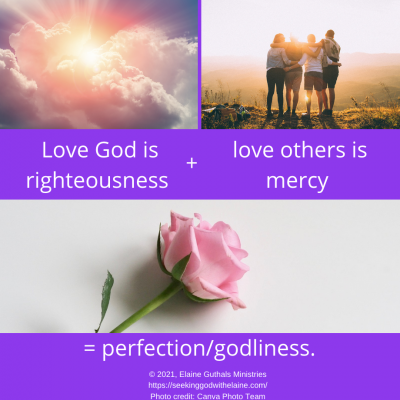
    Love God is righteousness + Love people is mercy = perfection/godliness

    If loving God and loving others leads to perfection, we have to embrace God’s love upon conversion and keep it at the forefront of our redo for godliness.

    The Output of Love

    “And we have come to know and to believe the love that God has for us. God is love, and the one who remains in love remains in God, and God remains in him” (I Jn. 4: 16 CSB)

    God expects a response to love – but it may not necessarily be what we think.

    The title of Bushnell’s sermon caught my eye. It is Loving God Is but Letting God Love Us.

    Resource

    I don’t want us to slip into the entitlement mentality. Nothing we did made us earn God’s love. God loves believers and non-believers.

    But just because God loves us doesn’t mean we can sit back and let Him. We have to have faith that He is Sovereign God. Faith is the conviction that the doctrines revealed in God’s Word are true, even if we do not understand all aspects of them, a belief which impacts our lives.

    The only thing we do is to accept the gift of salvation.

    • Salvation is the gift of life through the deliverance from evil and the consequences of sins to replace them with good and eternal life.
    • The consequences of sin are spiritual death and physical separation from God.
    • Eternal life is the promise of living eternally – even if we have died in this life – because we have admitted our sins, believed Jesus as Savior and Redeemer, and confessed God as Sovereign Lord.

    Glossary

    God expects us to seek Him and imitate Him. He wants us to build His character within us.

    Aitken brought up a good point. Jesus isn’t looking at quantity. He is looking at quality. He is also looking at motivation.

    Resource

    The great thing is God is unchangeable. He loves us forever, regardless of what we do or don’t do.

    Voysey brought up a good point. We look at God and His moral attributes through a worldly lens. That viewing of these attributes is through our limited.

    Resource

    We can’t try to bring God down to our level. He calls us to come up to His.

    UpToHisLevel

    Making the Connections

    This devotion is #23 in the series. We got 5 or 6 more to look at (yeah, unless I have to break them up).

    Love is the foundation. Mant wrote, “He does not say that God is benevolent, or kind, or merciful, or compassionate, or affectionate: he does not say that God is a Being of infinite goodness, or mercy, or loving kindness: but, as if he intended to magnify above measure this most adorable of the Divine attributes, he pronounces Him to be the quality in the abstract, and thus, as it were, identifies the Godhead with love.” Vaughan called it His essence.

    Resource

    LovePin

    How Do We Apply This?

    Beecher made a strong statement, he said that we cannot be a Christian if we do not love God’s way.

    Resource

    Butler put that into a practical application. He wrote, “To know God in any true sense is to be unselfish, to be loving, to have towards others the heart of a brother.”

    Resource

    Carpenter suggested that, because we love, we pursue the highest good of greatness, purity, and goodness of character. He noted the highest good is a spiritual quest.

    Resource

    I like the idea of love being the foundation. It gives the other attributes a good purpose.

    In the next few devotions’ we will examine the attributes that tie into love.

    Father God. We are humbled by the love You have for us. We want to take that love and grow closer to You. Help us to live the greatest commandments. Amen.

    What do you think?

    Leave me a comment below (about this or anything else) or head over to my Facebook group for some interactive discussion.

    If you don’t understand something and would like further clarification, please contact me.

    If you have not signed up for the email daily or weekly providing the link to the devotions and the newsletter, do so below.

    If God has used this devotion to speak with you, consider sharing it on social media.

  • The Silence of Cheerfulness and Rejoicing

    Say what? How can we be silent while cheerfully rejoicing? This daily devotional looks at what silence in the temple really means.

    Nuggets

    • God’s temple is an essential part of His kingdom.
    • Silence facilitates worship.
    • Silence is an indication of self-denial, self-discipline, and self-sacrifice.

    To read devotions in the Redo for Godliness series, click the appropriate button below.

    Devotions in the Silence of the Soul series

    When we did the Silence of the Soul series, I did all of the devotions on my list – except this one. It just didn’t seem to fit with the others.

    The other ones talked about us being truly silent. But this one was different.

    Part of it is the contrast between silence and rejoicing. It is hard to be silent when we are truly rejoicing.

    So, what is it truly trying to tell us? Let’s see where we can go with this.

    Let’s Put It into Context #1

    Here is a running list of what we’ve discussed previously.

    Let’s Put It into Context #2

    Our soul is our spiritual part that is immortal. The mind is a component of the soul that controls our will. It is in our minds that we process and make judgments and decisions.

    The Merriam-Webster Dictionary defines rejoice as “to feel joy or great delight.” Cheerfulness is defined by them as ungrudgingly, such as in cheerful obedience.

    Resource

    Cheerfulness and Rejoicing

    “But the Lord is in his holy temple; let all the earth keep silence before him” (Hab. 2: 20 ESV)

    Now, wait a minute. Aren’t we supposed to be praising and worshiping God in the temple? I don’t equate that with silence.

    Let’s concentrate on the temple first.

    The Importance of the Temple

    God’s temple is an essential part of His kingdom.

    Mortimer wrote, “God loves the tents of Jacob, He loves the dwellings of Israel, but He loves His own house above them all, as the place where He makes His honour to be known.” That means the temple is consecrated — it is holy.

    Resource

    Our being in the temple has no bearing with God being in the temple. “But the Lord is in his holy temple …” (Hab. 2: 20 ESV). Hastings said we could be indifferent, neglectful, or downright rebellious toward God. He will still be God in His temple.

    We just talked about God being self-existent or self-sufficient. God doesn’t need us in order to be Sovereign God.

    To read a related devotion, click the button below.

    But we need to be in His temple. God wants to have a relationship with us. That is an important place where God reveals Himself to us.

    We need to be in a continuous state of worship. That is especially so when we are in His house. Roberts said we are to adore Him.

    We can’t think that God is only in His temple. One thing we cannot forget is we are also God’s temple. He lives within us.

    Also, Jack reminded us that the universe is God’s temple. Every person — even worldview people — are in God’s temple.

    Resource

    Roberts noted that “a Church is sanctified by the Word of God, prayer, and praise, independent of all other ceremonies.” We listen to His Word; we communicate with Him; we acknowledge His sovereignty.

    Resource

    Silence leads to celebration!

    Silence leads to celebration!

    The Importance of Silence in Worship

    Silence facilitates worship.

    The silence comes in because Jesus said that “… My house shall be called a house of prayer …” (Mt. 21: 13 ESV).

    When we pray, we have to settle ourselves down. Why? Prayer is a two-way communication with God.

    Hastings told us about the the importance of silence. He wrote, “‘Keeping silence’ indicates a sense of weakness and unworthiness, reverence and devout attention. It points also to the glory, majesty, and power of the Lord God omnipotent.” Collier said we should zip it unless we are praying or praising God.

    Resource

    God doesn’t want us to think we have to rely on ourselves. He wants us to submit to Him and rely on Him.

    Calvin contended that submission is silence. He wrote, “But there is another kind of silence, and that is, when we willingly submit to God; for silence in this respect is nothing else but submission: and we submit to God, when we bring not our own inventions and imaginations, but suffer ourselves to be taught by His Word.”

    Resource

    I would say that Calvin was saying we need to silence our independence. Our arrogant, selfish desires need to be silenced. We can’t kick and scream when things don’t go our way.

    The Biblical Illustrator noted there are five types of silences:

    • Humiliation
    • Adoration
    • Submission
    • Expectation
    • Quiet resolution

    Hmmm. I wish they would have expanded on what they were thinking on quiet resolution.

    Collier reminded us of something important. He wrote, “The Psalmist calls the human voice ‘man’s glory’; and so it is, as sharing with the possession of reason ‘the glory’ of distinguishing between man himself and the coasts that perish. And our Lord warns us against the vain and idle use of this great gift, by the solemn declaration that ‘by thy words thou shalt be justified, and by thy words thou shalt be condemned’; and again, that ‘for every idle word that men shall speak, they shall give account thereof in the day of judgment.’

    Resource

    The voice is man’s glory, not God’s glory. We use our words to build ourselves up and heap the honor on ourselves.

    The words that justify us are “Father, I have sinned” and “I submit to You, Sovereign Lord.”

    Anything but that would be the vain use of the gift. Would it be an idle use?

    Psalms 4: 4 says, “Stand in awe, and sin not: commune with your own heart upon your bed, and be still” (KJV). We talked about this before as meditating on Him.

    To read a related devotion, click the button below.

    What we said there was, when we meditate on God, we look inside ourselves to take stock. He wants us to think about where we are as a disciple and what we need to work on to be more holy. We have to come into God’s presence the right way.

    Collier also said that the silence allows us to prepare for when “… the sinner stands before God self-accused and self-condemned.” We will all stand before God one day and be judged.

    But to me, it is more than that, too. When I decided to do a blog online, I needed to be quiet. I didn’t need to be telling God, “I can and will do this, and this, and this. But I will not do that, and that, and that.“ I needed to listen.

    Kelman brought up the fact that people today call for more leisure time. This is different than silent time. Kelman wrote, “No one can worship rightly, no one can even hear the call to worship, who does not often feel that he must be silent.”

    Resource

    Too often, we think of leisure time as sport and hobby time. Maybe it is decomp time.

    God wants it to be listening time. We listen as we study His Word and pray to Him. We listen as we worship.

    God wants it to be listening time. We listen as we study His Word and pray to Him. We listen as we worship.

    What Is the Root of Silence?

    Silence is an indication of self-denial, self-discipline, and self-sacrifice.

    OK, let’s stop a second. Where did I get this topic? The Silence of the Soul series came out of Edwards’ sermon Of Taking Up the Cross when we were doing the What Should We Do about Who Jesus Is? devotion.

    That devotion was in the Who Is Jesus? series. It was in the Sunday Morning Bible Study series. Jesus was asking His disciples Who they thought He was.

    Then He told them, “Then he said to them all, ‘If anyone wants to follow after me, let him deny himself, take up his cross daily, and follow me’” (Lk. 9: 23 CSB).

    Edwards told us that submission and silence fuel happiness. I think the submission fuels the silence.

    Resource

    The root of all of that is self-denial. We talked self-denial, self-discipline, and self-sacrifice.

    We take self out. We put the focus on God— which leads to the silence.

    How do we do that? Foote said we must give up our sinful bodily indulgences. They eat at the spirituality of our mind.

    Resource

    When we live a life of self-denial, we focus on God. When we focus on God, we worship Him.

    God wants it to be listening time. We listen as we study His Word and pray to Him. We listen as we worship.

    Making the Connections

    But sometimes, we get the wrong attitude. Hastings said something that stopped me in my tracks. He wrote, “He is accountable to no one.”

    Resource

    Ooo, baby. Don’t we try to make God accountable to us sometimes? Let Him not answer a prayer on our timetable or in the way we want. Don’t we start trying to make Him see things our way?

    TheSilenceOfCheerfulnessAndRejoicingPin

    How Do We Apply This?

    • We need to fear the Lord. We need to reverence Him and praise Him.
    • We should meet whenever possible in the house of the Lord. He reveals Himself to us there.
    • Jack said that it is our duty to worship God.
    • Edwards said that Heaven is a temple. We need to prepare to praise and worship God for eternity.
    • We have to voluntary submit.
    • Bag the evil voices. Kelman listed them as “passion, selfishness, self-assertion, lust, fear …”
    • We must calm our mind, heart, and conscience.
    • We need to study God’s Word and communicate with Him.

    Resource

    It is important to remember that we are God’s temple. Think of it this way. We are unworthy, rebellious creatures who are made worthy because of our faith in Jesus. He comes to live inside of us, just as He fills His temple

    The biggest silence is the silence of death. There will be a judgment day, but it is not going to be a debate. It is not going to be a trial where we defend ourselves. It will be the books being opened, our lives being examined, and God judging us while we stand there silently.

    We have to make decisions in this life. It is our choice now whether to submit to God or not. Once we die, we cannot change our choice.

    We have to ABCD – today. We can’t wait, because we are not guaranteed tomorrow.

    The silence of cheerfulness and rejoicing. If silence is submission to God, that leads to cheerfulness and rejoicing because that makes Him our Heavenly Father. Being a child of God for eternity brings much joy.

    Father God. We talk too much. Lord, we need to listen to You and focus on what You are telling and teaching us. We stand in silence at the foot of Your throne, listening to what You need to say to us. Amen.

    The ABCDs of Salvation

    If you have not become a believer in Christ, please read through the
    Plan of Salvation and prayerfully consider what God is asking you to do.

    A – admit our sins
    B – believe His Son Jesus is our Redeemer
    C – confess God as Sovereign Lord

    D – demonstrate that commitment by making any changes needed in our lives to
    live the way in which God has called us

    The Disciple’s Job Description

    What do you think?

    Leave me a comment below (about this or anything else) or head over to my Facebook group for some interactive discussion.

    If you don’t understand something and would like further clarification, please contact me.

    If you have not signed up for the email daily or weekly providing the link to the devotions and the newsletter, do so below.

    If God has used this devotion to speak with you, consider sharing it on social media.

  • Saying Goodbye

    Saying goodbye to a loved one is hard. Even when you know it is coming, even when you know they no longer have pain, even when you know they are with the Lord, it is hard to give them up.

    I had to give up my Springfield Dad today. Forty years ago, he “adopted” me. He has loved me and Adam, and we have loved him back.

    I’ve been trying to finish up my devotion, but I just can’t focus. So, I am going to leave you with a song.

    Master the Tempest is Raging
    Vocalist: Elaine Guthals
    Keyboard: Louise Guthals Weiss

    SayingGoodbyePin

    What do you think?

    Leave me a comment below (about this or anything else) or head over to my Facebook group for some interactive discussion.

    If you don’t understand something and would like further clarification, please contact me.

    If you have not signed up for the email daily or weekly providing the link to the devotions and the newsletter, do so below.

    If God has used this devotion to speak with you, consider sharing it on social media.