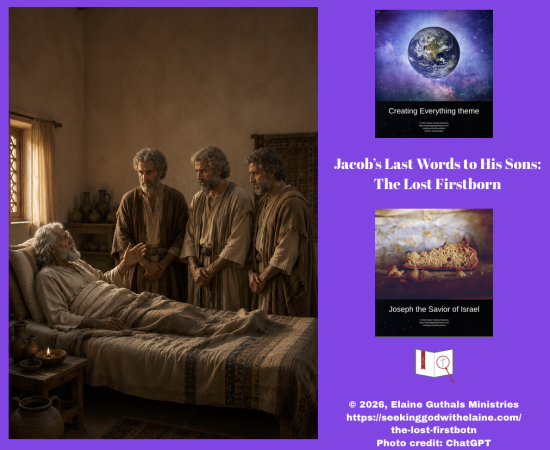
Jacob knew he was dying. This devotion begins our look at the blessings and curses he gave his sons – beginning with Reuben, Simeon, and Levi.
Nuggets
Jacob’s final words to his sons served several purposes.
Reuben, the firstborn, lost that designation because he sinned against his father.
Simeon was the second son and Levi the third son of Jacob and Leah.
We talked about Genesis 48 being a chapter of transition. Genesis 49 continues that transition by setting the tone for the coming tribes. It summarizes their legacy, identity, and divine purpose.
Jacob was on his last days on this earth. Not only that, but he was also the last of the patriarchs — Abraham, Isaac, and Jacob. That part of Jehovah’s plan had come to an end.
Programming note: We are going to save the connections and application for the end.
Let's Put It into Context
To read devotions in the Creating Everything theme, click the button below.
Devotions in the Joseph the Savior of Israel series
Jacob Blessed His Sons
“Then Jacob called together all his sons and said, ‘Gather around me, and I will tell you what will happen to each of you in the days to come. Come and listen, you sons of Jacob; listen to Israel, your father’” (Gen. 49: 1-2 NLT)
Jacob’s final words to his sons served several purposes.
Just as Isaac blessed Jacob, Jacob blessed his children just prior to his death. True, not all would see this as a blessing but rather a curse.
Still, this was more than a last will and testament that divided an inheritance.
Genesis 49 functioned simultaneously as a covenant declaration, patriarchal blessing, inheritance distribution, prophetic revelation, and covenantal last will and testament all rolled into one.
Jacob was not merely speaking as a dying father. He was speaking as the covenant patriarch of Israel.
His words carried covenant authority tied to the promises Jehovah had made to Abraham and Isaac. Through these declarations, Jacob identified future tribal roles, inheritance identity, covenant trajectory, and even the future development of Israel itself.
That is why these blessings were not always pleasant. Some were corrective. Some were disciplinary. Some were predictive. Some established future leadership structures within the nation.
These words were directed to the sons standing before Jacob, but they looked far beyond them to the tribes that would descend from them. Rather than providing a detailed photograph of the future, Jacob’s declarations provide a shadowy outline of the destiny, identity, and the role each tribe would play within Jehovah’s covenant people.
When looking back, we see that Jacob told five sons much detail about their future. The rest were very general.
It is through this vague style of speech that we can be assured that the inspiration and prophecy came from Jehovah.
Reuben
“Reuben, you are my firstborn, my strength, the child of my vigorous youth. You are first in rank and first in power. But you are as unruly as a flood, and you will be first no longer. For you went to bed with my wife; you defiled my marriage couch” (Gen. 49: 3-4 NLT)
Reuben, the firstborn, lost that designation because he sinned against his father.
Reuben was the first son born to Jacob and Leah and Jacob’s firstborn. This should have cemented his future.
When we think about it, though, Reuben would have had an unusual time at being firstborn. Generally, in the Ancient Near East, there was several years difference between the firstborn and the next son.
Not with Jacob’s sons. Reuben was the oldest, and Joseph was the youngest — until Benjamin came along 17 years later — so there was probably around six years difference in 11 of the sons’ ages.
Still, Reuben was decidedly in his mother’s marital camp. This division rocked the family for years.
With Jacob’s opening words, Reuben was probably heartened at Jacob’s first words. Then he heard the words he was dreading.
Reuben had staged a coup against Jacob by sleeping with Jacob’s concubine after Rachel’s death, and Jacob had a long memory.
Because of that, Reuben lost family leadership. “The oldest son of Israel was Reuben. But since he dishonored his father by sleeping with one of his father’s concubines, his birthright was given to the sons of his brother Joseph. For this reason, Reuben is not listed in the genealogical records as the firstborn son.” (I Chron. 5: 1 NLT).
Jacob was concerned that Reuben’s unsoundness was the result of his sensual character. Reuben’s act stemmed from his character, not his performance. Robertson noted this act showed him to be hesitant, weak, and miserable.
Reuben, the firstborn, lost that designation because he sinned against his father.
Reuben was the first son born to Jacob and Leah and Jacob’s firstborn. This should have cemented his future.
When we think about it, though, Reuben would have had an unusual time at being firstborn. Generally, in the Ancient Near East, there was several years difference between the firstborn and the next son.
Not with Jacob’s sons. Reuben was the oldest, and Joseph was the youngest — until Benjamin came along 17 years later — so there was probably around six years difference in 11 of the sons’ ages.
Still, Reuben was decidedly in his mother’s marital camp. This division rocked the family for years.
With Jacob’s opening words, Reuben was probably enheartened at Jacob’s first words. Then he heard the words he was dreading.
Reuben had staged a coup against Jacob by sleeping with Jacob’s concubine after Rachel’s death, and Jacob had a long memory.
Because of that, Reuben lost family leadership. “The oldest son of Israel was Reuben. But since he dishonored his father by sleeping with one of his father’s concubines, his birthright was given to the sons of his brother Joseph. For this reason, Reuben is not listed in the genealogical records as the firstborn son.” (I Chron. 5: 1 NLT).
Jacob was concerned that Reuben’s unsoundness was the result of his sensual character. Reuben’s act stemmed from his character, not his performance. Robertson noted this act showed him to be hesitant, weak, and miserable.
Resource
Robertson’s Jacob’s Predictions
https://biblehub.com/sermons/auth/robertson/jacob’s_predictions.htm
Would some say that Reuben shouldn’t be judged by one single event that happened years ago? Can’t he change?
Yes, people do change — that is the foundation of salvation. Jehovah takes the sinful person and regenerates us into holy, righteous children.
Sin builds our character. We must ask Jehovah to build in us His character.
Reuben’s actions that we saw seemed only to be geared to getting back into Jacob’s affections so that he could be restored as firstborn. Jacob appears to have not seen a conscience focused on Jehovah.
In the end, nothing Reuben did gained back his father’s favor. Joseph received the double portion, Judah became the family leader, and Levi became the family priest.
Resource
Would some say that Reuben shouldn’t be judged by one single event that happened years ago? Can’t he change?
Yes, people do change — that is the foundation of salvation. Jehovah takes the sinful person and regenerates us into holy, righteous children.
Sin builds our character — when we acknowledge it and repent. We must ask Jehovah to build in us His character.
Reuben’s actions that we saw seemed only to be geared to getting back into Jacob’s affections so that he could be restored as firstborn. Jacob appears to have not seen a conscience focused on Jehovah.
In the end, nothing Reuben did gained back his father’s favor. Joseph received the double portion, Judah became the family leader, and Levi became the family priest.
Reuben’s Tribe
In the Exodus, Reuben’s tribe was designated part of the South Division in surrounding the Tabernacle.
The tribes of Reuben, Gad, and half of Manasseh chose to live on the east side of the Jordan. They chose the fine grazing lands they saw instead of entering the Promised Land.
Reubenites promised — and fulfilled their promise — of helping the other tribes conquer Canaan. They supplied fighting men during Joshua’s campaigns.
However, they were physically and spiritually separated from the center of covenant life. Not cut off, but isolated.
This may be one reason that the tribe of Reuben never produced a judge, king, or major prophet. The tribe survived but never rose to national prominence.
Instead, the clan’s hesitancy was evident to Deborah, one of the judges. “The princes of Issachar were with Deborah and Barak. They followed Barak, rushing into the valley.But in the tribe of Reuben there was great indecision” (Jdg. 5: 15 NLT).
Separated from the bulk of the tribes, Reubenites were exposed and vulnerable. Their numbers fell from 46,500 (Num. 1) to 43,730 (Num. 26) when censuses were conducted.
This separation and decreasing numbers helped to contribute to this tribe becoming the first Lost Tribe. They were carried away in exile by the Assyrians. This allowed their territory to disappear centuries before the Southern Kingdom of Judah fell.
Still, the tribe of Reuben retained its covenant identity. “Moses said this about the tribe of Reuben: ‘Let the tribe of Reuben live and not die out, though they are few in number’” (Deut. 33: 6 NLT).
Preeminence, no. Covenant identity, yes.
Simeon and Levi
“Simeon and Levi are two of a kind; their weapons are instruments of violence. May I never join in their meetings; may I never be a party to their plans. For in their anger they murdered men, and they crippled oxen just for sport. A curse on their anger, for it is fierce; a curse on their wrath, for it is cruel. I will scatter them among the descendants of Jacob; I will disperse them throughout Israel” (Gen. 49: 5-7 NLT)
Simeon was the second son and Levi the third son of Jacob and Leah.
Little was initially heard about Simeon and Levi. That changed when they took center stage for avenging Dinah when she was raped by Shechem. Levi and Simeon were the two brothers to murder the men of the town of Shechem.
Simeon and Levi both showed a cruel disposition. In other words, Jacob was not necessarily calling them out for avenging Dinah. No doubt, Jacob was angry himself at the time.
They took vengeance on the whole city instead of on the man or family.
This showed itself in their fierce, nomadic lives. Because of this sin, both tribes eventually were scattered in Israel.
Because of their sin, their tribes would be scattered within the inheritance of the other tribes.
The same prophecy was accomplished in two very different ways.
Simeon’s Tribe
In the Exodus, Simeon’s tribe was designated part of the South Division.
Like the Reubenites, the Simeonites saw a great decline. Their numbers fell from 59,300 (Num. 1: 23) — making it one of the largest tribes — to 22,200 (Num. 26: 14) when censuses were conducted.
That is a big decline — over half of the tribe.
Many scholars connect this with the judgment surrounding Baal-Peor in Numbers 25.
- “Just then one of the Israelite men brought a Midianite woman into his tent, right before the eyes of Moses and all the people, as everyone was weeping at the entrance of the Tabernacle. When Phinehas son of Eleazar and grandson of Aaron the priest saw this, he jumped up and left the assembly. He took a spear and rushed after the man into his tent. Phinehas thrust the spear all the way through the man’s body and into the woman’s stomach. So the plague against the Israelites was stopped, but not before 24,000 people had died. (Num. 25: 6-9 NLT).
- “The Israelite man killed with the Midianite woman was named Zimri son of Salu, the leader of a family from the tribe of Simeon” (Num. 25: 14 NLT).
When we think about it, we may question whether or not the tribe of Simeon got land in the distribution among the tribes. Didn’t the Simeonites get something?
Well, yes and no. The Simeonites got their distribution in Joshua 19: 1-9.
But look at Joshua 19: 9. “Their allocation of land came from part of what had been given to Judah because Judah’s territory was too large for them. So the tribe of Simeon received an allocation within the territory of Judah” (Josh. 19: 9 NLT).
The tribe of Simeon got cities inside the land of Judah’s allotment. Eventually, the tribe of Simeon was swallowed up by Judah.
But again, they were not erased as the appear in the Book of Revelation’s listing of tribes.
They did not have a turning point such as Levi had. Simeon was scattered and absorbed. Levi was scattered and elevated.
Levi’s Tribe
Levi had a dark history but was redeemed.
Levi was the third son of Jacob and Leah. Little, too, was initially heard about him.
Levi accompanied Simeon to murder the men of the town of Shechem.
However, they began to redeem themselves during the exodus. At Mt. Sinai when Aaron made the golden calf, the tribe of Levi supported Moses in punishing the others (Ex. 32).
Levi’s descendants became the priestly tribe. Because of that, they were scattered among the other tribes. Their ministry was to serve in the Tabernacle, later the Temple.
They also performed another important thing. “For all the firstborn among the people of Israel are mine, both of man and of beast. On the day that I struck down all the firstborn in the land of Egypt I consecrated them for myself, and I have taken the Levites instead of all the firstborn among the people of Israel. And I have given the Levites as a gift to Aaron and his sons from among the people of Israel, to do the service for the people of Israel at the tent of meeting and to make atonement for the people of Israel, that there may be no plague among the people of Israel when the people of Israel come near the sanctuary” (Num. 8: 17-19 NLT).
The census conducted at the beginning of the Book of Numbers told us the tribe of Levi did not see their numbers decline as the other two did.
- “The number of firstborn sons who were one month old or older was 22,273” (Num. 3: 43 NLT).
- “There are 273 more firstborn sons of Israel than there are Levites …” (Num. 1: 46 NLT).
- “The men from the Levite clans who were one month old or older numbered 23,000 …” (Num. 26: 62 NLT).
Unlike Reuben and Simeon, Levi did not experience a dramatic decline. While the other two tribes diminished, Levi remained stable and even grew slightly. The tribe that had once shared Simeon’s judgment was transformed by Jehovah into a tribe of service and blessing.
This fulfilled Jacob’s prophecy, but in a different way than Simeon’s. The priests were not swallowed by the tribes in which they served. They were revered.
Father God. Thank You for giving us families. Forgive us for our sins. Thank You for showing us that we, like Levi, can be restored to service to You. Amen.
Making the Connections
Post
How Do We Apply This?
Post
The ABCDs of Salvation
If you have not become a believer in Christ, please read through the
Plan of Salvation and prayerfully consider what God is asking you to do.
A – admit our sins
B – believe His Son Jesus is our Redeemer
C – confess God as Sovereign Lord
D – demonstrate that commitment by making any changes needed in our lives to live the way in which God has called us
The Disciple’s Job Description
Heading
Searching for and Seeking God
Non-believers search for God.
Disciples seek Him.
Hearing His Word (Rom. 10: 17)
Reading His Word (Rev. 1: 3)
Praying to Him (Heb. 4: 16)
Studying His Word (Ac. 17: 11)
Meditating on His Word (Ps. 1: 1-2)
Memorizing His Word (Ps. 119: 11)
It Was Enough
Vocalist: Elaine Guthals
Keyboard: Chris Vieth
Related Links
I have created a worksheet of the questions above. Click on the button below to access it.
Don’t know what your spiritual gifts are?
Take this Spiritual Gifts Inventory
The Disciple’s Job Description
Complete Job Description
Individual Description
The Disciple’s Job Description
Complete Job Description
Individual Description
Job Duty #4
Proclaim the Gospel (Mark 16: 15)
Job Duty #6
Make Disciples (Matthew 28: 19-20)
Job Duty #1
Be a Living Sacrifice (Romans 12: 1-2)
Job Duty #2
Work Out Our Salvation (Philippians 2: 12)
Job Duty #3
Bring Him Glory (Matthew 5: 16)
Job Duty #4
Proclaim the Gospel (Mark 16: 15)
Job Duty #5
Love People (John 15: 12)
Job Duty #6
Make Disciples (Matthew 28: 19-20)
Job Duty #7
Other Duties as Assigned
(Ecclesiastes 3: 1)
If you don’t understand something and would like further clarification, please contact me.
If you have not signed up for the email providing the link to the devotions and the newsletter, do so below.
If God has used this devotion to speak with you, consider sharing it on social media.