Nuggets
- We don’t know how long it took Jacob’s family to eat the grain, but Jehovah was still using the famine to further the covenant line.
- Jacob delayed buying more food from Egypt as long as possible.
- Judah stepped up instead of Reuben.
- Jacob got emotional when he was forced to choose.
- Jacob finally agreed to let Benjamin go to Egypt.
- Jacob wanted to remove every suspicion Joseph may have had about them stealing the money.
- Jacob finally surrendered.
- Eleven men immediately left for Egypt.

Jacob had sent ten of his sons to Egypt to buy food during the famine. The grain they bought there was now almost gone — and the famine was showing no signs of abating.
The brothers know they have to go back to Egypt sometime because Simeon had remained there to ensure they did come back.
Let’s see how the story unfolds.
Let's Put It into Context
To read devotions in the Creating Everything theme, click the button below.
Devotions in the Joseph the Savior of Israel series
The Grain Is Almost Gone
“But the famine continued to ravage the land of Canaan. When the grain they had brought from Egypt was almost gone, Jacob said to his sons, ‘Go back and buy us a little more food.’ But Judah said, ‘The man was serious when he warned us, “You won’t see my face again unless your brother is with you.” If you send Benjamin with us, we will go down and buy more food. But if you don’t let Benjamin go, we won’t go either. Remember, the man said, ‘You won’t see my face again unless your brother is with you.’ ‘Why were you so cruel to me?’ Jacob moaned. ‘Why did you tell him you had another brother?’ ‘The man kept asking us questions about our family,’ they replied. ‘He asked, “Is your father still alive? Do you have another brother?” So we answered his questions. How could we know he would say, “Bring your brother down here”?’ Judah said to his father, ‘Send the boy with me, and we will be on our way. Otherwise we will all die of starvation — and not only we, but you and our little ones. I personally guarantee his safety. You may hold me responsible if I don’t bring him back to you. Then let me bear the blame forever. If we hadn’t wasted all this time, we could have gone and returned twice by now” (Gen. 43: 1-10 NLT)
The Grain Was Almost Gone
We don’t know how long it took Jacob’s family to eat the grain, but Jehovah was still using the famine to further the covenant line.
An undisclosed amount of time had passed. The famine was still continuing. In fact, wording used in Genesis 43: 1 is almost identical to that in Genesis 42: 5.
This is important. The brothers didn’t suddenly find their courage or righteousness. It still was either go to Egypt or starve.
If we look at the Hebrew, we can see the severity of the famine. It says, wəhārāʿāḇ kāḇēḏ bāʾāreṣ (וְהָרָעָב כָּבֵד בָּאָרֶץ) — and the famine was heavy in the land.
That gives the impression of being burdensome and oppressive — even grievous. In the Old Testament, it can mean oppressive conditions and severe suffering, but it can also mean hardened hearts.
We don’t want to harden our hearts against Jehovah. We want to be submissive to His Will.
What is interesting is the word for glory — kāḇôḏ (כָּבוֹד). It shares the same root word as severity.
Think about it. We say trials are severely difficult. This makes them heavy for us to bear. They can cause such high anxiety and depression that we feel buried under it.
But what is the purpose of those trials? To restore our relationship with Jehovah — to bring Him glory.
Jehovah often moves His people through pressure before restoration arrives. Unfortunately, we resist change until the weight becomes too heavy to ignore.

Jacob Said to His Sons
Jacob delayed buying more food from Egypt as long as possible.
As we said, we don’t know how long it had been since the first trip to Egypt — but all the while, Simeon had been sitting in the Egyptian prison. I doubt Joseph gave him preferential treatment, but I also doubt Simeon had been abused.
Still, Jacob hadn’t hurried the sons on a second trip to rescue Simeon until absolutely necessary.
Again, we can see that Joseph hasn’t lost his favoritism. He wanted to send the brothers to Egypt to buy “… a little more food” (Gen. 43: 2 NLT).
I don’t know. Did Jacob think they could get in and out of Egypt without Joseph seeing them so he didn’t have to send Benjamin? They wouldn’t get Simeon back that way.
Jacob was resisting sending Benjamin to Egypt.
But — like the first trip — it was Jacob telling his sons to go to Egypt to purchase grain for them.
Life in Canaan was at a standstill because of terms established in Egypt. Providence has cornered them.
Doesn’t this happen frequently when we delay obedience? We just seem to get mired down. But then delayed obedience collides with reality, and we are forced to face the situation.
The brothers blamed God for their money back — which, ultimately, was correct if we consider He worked events so that Joseph would be in that position at that time. Jacob blamed the brothers for putting him in this situation — which, really, wasn’t correct.
But Judah Said
Judah stepped up instead of Reuben.
Reuben had stepped up before. The problem was his offer was to sacrifice his two sons if Benjamin didn’t return with them (Gen. 42: 37). Jacob didn’t even respond to that.
So, Judah stepped up to be the substitute. He would pay restitution. (Do you know which brother was the great … great grandfather of Yeshua? Yep, Judah.)
Judah doesn’t offer his children as guarantee of Benjamin’s safe return. But he does talk more responsibly, more realistically, and more sacrificially.
One of the ways Judah talks responsibly is by reminding Jacob of Joseph’s words. But that is where some interpreting took place.
Joseph didn’t say “…’You won’t see my face again unless your brother is with you’” (Gen. 43: 3 NLT) in so many words. He did get his point across.
- “This is how I will test your story. I swear by the life of Pharaoh that you will never leave Egypt unless your youngest brother comes here!” (Gen. 42: 15 NLT emphasis added).
- “But you must bring your youngest brother back to me. This will prove that you are telling the truth, and you will not die.’ To this they agreed” (Gen. 42: 18-20 NLT emphasis added).
In essence – to me – it sounds like Joseph was threatening the brothers with what they subjected him to — forced abandonment of Canaan and possible death.
Did Joseph ask the questions Judah said he did, and Moses just not record them. Probably. He would want to know about Jacob and Benjamin. Remember, Benjamin wasn’t even a year old when Joseph was sold.
Let’s talk through what Judah did say. In the Ancient Near East, seeing the face of a ruler meant a person had gained access to him or secured an audience with him — in other words, was accepted by him.
Judah was laying it our straight for Jacob. No Benjamin, no audience. No audience, no grain.
If by chance they would get in to see Joseph, no Benjamin, no mercy.
So, in Judah’s mind, Jacob had a choice. Keep Benjamin home with him and they would all die together or let Benjamin go so they all could live.
That was the situation with no sugarcoating involved.
Why Did You Tell Him
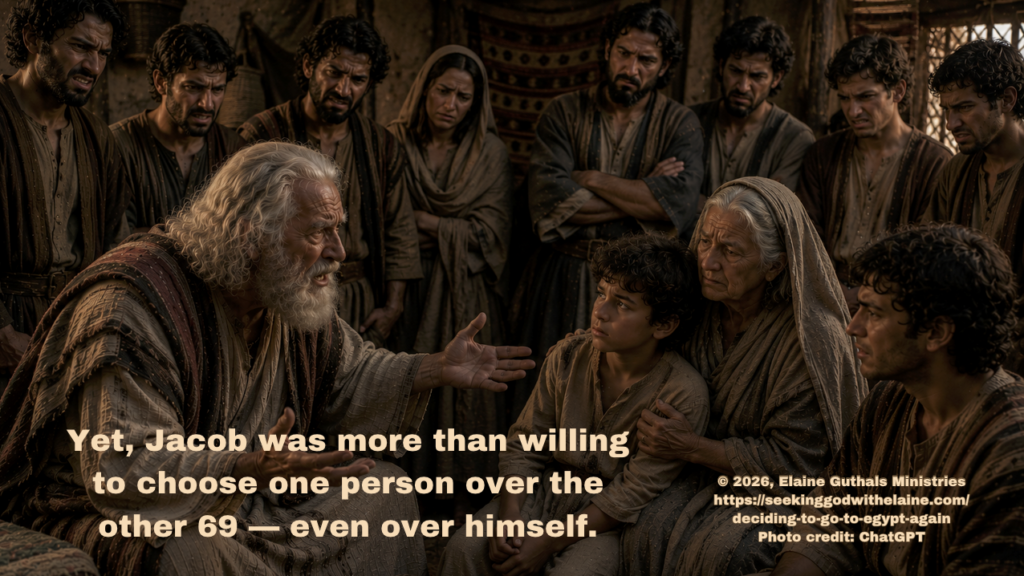
Jacob got emotional when he was forced to choose.
In some peoples’ minds, this would have been an easy choice. The larger number would justify the choice of allowing Benjamin to go to Egypt.
But this is just another example of how deeply rooted Jacobs favoritism was. We will be told in another chapter or so that Jacobs family included 70 people.
Yet, Jacob was more than willing to choose one person over the other 69 — even over himself.
The interesting thing is that, if we look at the Hebrew, in verse 8 Moses identified Judah’s father as Israel, not Jacob. He usually only calls Jacob Israel in covenant movement and redemptive framing.
Resource
But isn’t that the case here? Jehovah had orchestrated this in order to save the nation of Israel.
That does not discount Jacob’s fear. Our fears can be real and visceral.
Jehovah allowed Jacob to make his decision.
The sad part is Jacob believed the brothers created this problem unnecessarily by not anticipating the “Egyptian’s” questions.
I can see it both ways. On one hand there is no way they would know that they were going to be accused of being spies.
On the other hand, shouldn’t they have expected some questioning? They were unknown foreigners seeking to purchase something. We know there was cases of others doing the same thing who could have really been spies.
Wouldn’t they have been asked routine questions like, “How many are you buying for?”
Still, if the brothers were asked about who they were or anything about their family, Moses didn’t record it. The only thing Joseph asked was where they were from.
To me, it seems logical that they used their family situation as evidence for not being spies. They were just a typical Hebrew family, not spies.
The irony is that Jacob believed this situation was created by the “Egyptian’s” questions. The real issue began decades earlier with Jacob’s favoritism, the brothers’ deception, and unresolved sin. None of this was Joseph’s doing.
A Feast at Joseph’s Palace
“So their father, Jacob, finally said to them, ‘If it can’t be avoided, then at least do this. Pack your bags with the best products of this land. Take them down to the man as gifts — balm, honey, gum, aromatic resin, pistachio nuts, and almonds. Also take double the money that was put back in your sacks, as it was probably someone’s mistake. Then take your brother, and go back to the man. May God Almighty give you mercy as you go before the man, so that he will release Simeon and let Benjamin return. But if I must lose my children, so be it.' So the men packed Jacob’s gifts and double the money and headed off with Benjamin. They finally arrived in Egypt and presented themselves to Joseph” (Gen. 43: 11-15 NLT)
Pack Your Bags with the Best Products of This Land
Jacob finally agreed to let Benjamin go to Egypt.
Sometimes, you just have to step out on faith. Yes, you have to prepare and do your part. You can’t just say you are entitled to good stuff and do nothing.
It may mean giving up something. It may mean doing something you really rather wouldn’t do.
Bottom line — if God is asking you to do something, you just have to swallow and do it.
The interesting things is that Jacob was allowed to send luxury or specialty products from Canaan to the “Egyptian” ruler. They followed the Ancient Near East custom of approaching powerful rulers with gifts.
What I find interesting is they had luxury items but not standard food items. They would have starved on a diet of honey, nuts, and almonds.
Take Double the Money
Jacob wanted to remove every suspicion Joseph may have had about them stealing the money.
Jacob and the brothers did the right thing. They not only took money for the grain they would buy on this trip, but they also took the money that they found in their sacks.
This should convince the “Egyptian” that they were upright men (Gen. 42: 11). The returned money from Genesis 42 terrified the brothers because they feared being accused of theft.
Take Your Brother
Jacob finally surrendered.
Jacob finally turned the situation over to Jehovah. He called on El Shaddai (אֵל שַׁדַּי). This is the covenant name used with Abraham and Isaac.
Jacob was finally putting everything in Jehovah’s hands.
But then Jacob said, “… But if I must lose my children, so be it” (Gen. 42: 14 NLT). Does this sound like surrender or despair?
Maybe it was a bit of both. To me, this sounds like resignation with faith.
So the Men Packed
Eleven men immediately left for Egypt.
It sounds like preparation for the second trip to Egypt didn’t take long. Emphasis, though, was on Benjamin — they left with Benjamin.
When we are doing God’s Will, we need to prepare, get started, and follow through to the end.

Making the Connections #1
We rarely understand what Jehovah is doing while events are unfolding. We can be looking at events and see His hand in them, but we may not be seeing all He is doing in our lives. In fact, we may get the answers for many years.
Sometimes, we may never get the answers.
We just have to continue to trust Jehovah.
Making the Connections #2
Judah had had his own Sanctification Road event back in Genesis 38. This is the first time that we get to see who he was transforming into. Here, we see that he was transforming into the leader of the brothers, and we see foreshadows of why the royal line would eventually come through him.
Judah wasn’t shifting blame anymore. He was carrying responsibility.
More importantly, Judah was looking at the situation without any blinders on. “If we hadn’t wasted all this time, we could have gone and returned twice by now” (Gen. 43: 10 NLT).
Judah knew who all had to make the trip to Egypt. He accepted Jehovah’s decree.
Making the Connections #3
After all this time, Jacob was still mourning for Joseph. Yes, he had seen the bloodied coat. He accepted Joseph was gone.
Jacob just didn’t accept that Joseph wouldn’t come back. “… may he send back your other brother and Benjamin. …” (Gen. 43:14 ESV).
We don’t know Jacob’s thought process. Maybe he just trusted in God to believe that was how it would turn out.
There was no way Jacob would know that Joseph was in Egypt — where they were wanting to take Benjamin. Unless the brothers had talked about it over the years, and Jacob overheard them. Who knows.
What can we learn? We have to believe all things are possible for God (Mt. 19: 26). But we can’t lop off the in-Your-Will part.
How Do We Apply This?
- Stop resisting the direction Jehovah is clearly pushing you toward – even if it is uncertain – and let pressure drive you toward Jehovah instead of away from Him.
- Refuse to let fear keep your life spiritually stalled by trusting Jehovah even when obedience feels costly.
- Stop delaying the obedience you already know Jehovah requires by surrendering the situation you keep trying to control.
- Choose responsibility and sacrifice over self-preservation and stop shifting blame.
- Trust that Jehovah is working even when you cannot see the full picture and stop interpreting every hardship as abandonment from God.
- Bring your anxieties to Jehovah instead of trying to carry them alone.
- Prepare carefully — then step out in faith.
- Accept that sanctification often happens through uncomfortable situations.
- Remember that Jehovah can redeem even deeply dysfunctional situations.
- Submit to Jehovah’s providence to deepen your faith instead of fighting it by letting trials produce surrender instead of bitterness.
- Trust Jehovah with the people and situations you cannot protect yourself.
Father God. We know there are times when You are working in our lives, and all we do is kick and scream. Forgive us when we fight sanctification. Help us to become the disciples You want us to be. Amen.
If you don’t understand something and would like further clarification, please contact me.
If you have not signed up for the email providing the link to the devotions and the newsletter, do so below.
If God has used this devotion to speak with you, consider sharing it on social media.