Like Abraham’s Abimelech, Isaac’s Abimelech came to enter into a treaty with Isaac. This devotional reading looks at their relationship after Isaac’s lie was exposed.
Nuggets
- Isaac obeyed Jehovah.
- Isaac – like Abraham – was fearful for his life because of his beautiful wife.
- Isaac’s love for Rebekah was evident.
- There might have been a famine in the land of Canaan, but Isaac was successful in Gerar.
- Isaac did what was good resource management by reopening the closed wells that Abraham dug and digging new ones.
- It is significant that Jehovah appeared to Isaac on the night he arrived in Beersheba.
- Abimelech decided, if he couldn’t defeat Isaac, he had better make friends with him.
- Esau’s decision to take Canaanite women went against Jehovah’s commands.

This part of the chapter will particularly show why this chapter is out of place. It smacks of déjà vu.
Let's Put It into Context
To read devotions in the Creating Everything theme, click the button below.
Devotions in the Isaac the Patriarch series
Isaac and Abimelech
“So Isaac stayed in Gerar. When the men who lived there asked Isaac about his wife, Rebekah, he said, ‘She is my sister.’ He was afraid to say, ‘She is my wife.’ He thought, ‘They will kill me to get her, because she is so beautiful.’ But some time later, Abimelech, king of the Philistines, looked out his window and saw Isaac caressing Rebekah. Immediately, Abimelech called for Isaac and exclaimed, ‘She is obviously your wife! Why did you say, “She is my sister”?’ ‘Because I was afraid someone would kill me to get her from me,’ Isaac replied. ‘How could you do this to us?’ Abimelech exclaimed. ‘One of my people might easily have taken your wife and slept with her, and you would have made us guilty of great sin.’ Then Abimelech issued a public proclamation: ‘Anyone who touches this man or his wife will be put to death!’” (Gen. 25: 6-11 NLT)
Isaac Stayed in Gerar
Isaac obeyed Jehovah.
Jehovah told Isaac to stay put in Gerar instead of going to Egypt (Gen. 26: 2). He not only listened, but he also obeyed.
We don’t know how long he stayed. But he did.
Asked Isaac about his Wife
Isaac – like Abraham – was fearful for his life because of his beautiful wife.
Some would say that the circumstances conveyed fear. Famine. Strangers. Different customs. Lack of trust.
Did Isaac take a page from Abraham’s playbook? He must have. He handled it the same way.
Go to another country. Lie about your relationship with your wife so you don’t get killed.
The thing is, Sarah was Abraham’s sister. Rebekah was Isaac’s cousin, granddaughter of Abraham’s brother Nahor.
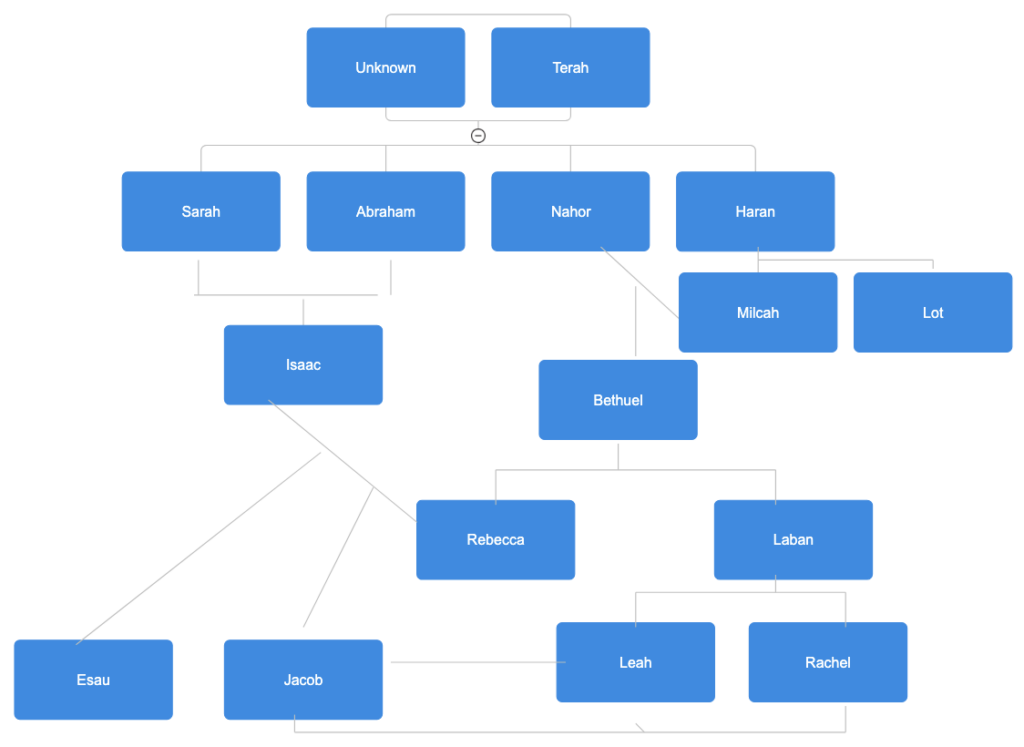
Leale noted that Isaac would have suffered greater guilt than Abraham. I can see that. His lie was a flat-out lie, not a deception.
Resource
Why do I say this chapter is out of order? If Isaac and Rebekah would have had kids already, they wouldn’t have been able to pull this off. I think this is true if the kids were toddlers, but equally true if they were teenagers.
Abimelech Saw Isaac Caressing Rebekah
Isaac’s love for Rebekah was evident.
We don’t know how much time some time was. It could have been a week. It could have been an undisclosed number of months.
Unlike Sarah, Rebekah was not taken to become a member of Abimelech’s haram. That allowed Isaac and Rebekah to remain together.
More than that, they were doing what husbands and wives do. Isaac caressed Rebekah. They may have thought they were alone.
They weren’t.
Yep, Abimelech was angry. It hurts when someone lies to you.
But, as with Abraham, when the truth was told, Isaac’s Abimelech ordered their men not to touch the women in Abraham’s family.
Isaac’s Abimelech must have heard about what had happened to Abraham’s Abimelech. “… thou shouldest have brought asham (guilt) upon us” (Gen 26: 10 OJB).
Jehovah stepped in and spoke to Abraham’s Abimelech.
- “Now return the woman to her husband, and he will pray for you, for he is a prophet. Then you will live. But if you don’t return her to him, you can be sure that you and all your people will die” (Gen. 20: 7 NLT).
- “Then Abraham prayed to God, and God healed Abimelech, his wife, and his female servants, so they could have children. For the Lord had caused all the women to be infertile because of what happened with Abraham’s wife, Sarah” (Gen. 20 17-18 NLT).
God Blessed Isaac
“And Isaac sowed in that land and reaped in the same year a hundredfold. The Lord blessed him, and the man became rich, and gained more and more until he became very wealthy. He had possessions of flocks and herds and many servants, so that the Philistines envied him. (Now the Philistines had stopped and filled with earth all the wells that his father's servants had dug in the days of Abraham his father.) And Abimelech said to Isaac, ‘Go away from us, for you are much mightier than we’” (Gen. 26: 12-16 NLT)
There might have been a famine in the land of Canaan, but Isaac was successful in Gerar.
We may think that shepherds did not plant crops. Bradford noted that those who had flocks and herds in Isaac’s day would plant what we would call a garden to provide grain and herbs.
Resource
No, the nomads were not fixing to settle down. But they didn’t want them or their animals to starve.
God blessed him with a bountiful harvest. He also gained flocks and herds. That meant he needed people to watch over the animals, so he gained servants.
In fact, God blessed Isaac so much, the Philistines started envying him. If truth be told, they were probably fearing him as well. They more than likely saw Isaac as a threat.
Abimelech took the easy way out. He just told Isaac to go away. He was only a visitor, wasn’t he?
Could Isaac have refused? Probably. He probably had the strength to counter any attack that Abimelech made.
Beginning Well Problems
“So Isaac moved away to the Gerar Valley, where he set up their tents and settled down. He reopened the wells his father had dug, which the Philistines had filled in after Abraham’s death. Isaac also restored the names Abraham had given them. Isaac’s servants also dug in the Gerar Valley and discovered a well of fresh water. But then the shepherds from Gerar came and claimed the spring. ‘This is our water,’ they said, and they argued over it with Isaac’s herdsmen. So Isaac named the well Esek (which means ‘argument’). Isaac’s men then dug another well, but again there was a dispute over it. So Isaac named it Sitnah (which means ‘hostility’). Abandoning that one, Isaac moved on and dug another well. This time there was no dispute over it, so Isaac named the place Rehoboth (which means ‘open space’), for he said, ‘At last the Lord has created enough space for us to prosper in this land’” (Gen. 26: 17-22 NLT)
Isaac did what was good resource management by reopening the closed wells that Abraham dug and digging new ones.
The problem was the Philistines were still envious. Plus, isn’t it so much like today’s society: “I want something, but I don’t want to do it myself. So, I’ll wait for you to do it and take yours.”
Their envy of Isaac probably started with their envy of Abraham. That played out in the Philistines responses to Abraham digging wells – they filled them in.
“Then Abraham complained to Abimelech about a well that Abimelech’s servants had taken by force from Abraham’s servants” (Gen. 21: 25 NLT). Once they got possession of the wells, they closed them.
Isaac did what was good resource management. He reopened the closed wells that Abraham dug and dug new ones.
The problem was the Philistines were still envious. Plus, isn’t it so much like today’s society: “I want something, but I don’t want to do it myself. So, I’ll wait for you to do it and take yours.”
God’s Word says that four wells were dug. Clark believed that Isaac moved from well to well until he reached Beersheba and enough room.
Resource
I always laugh at the meaning of the last name. Did Isaac name it open space with a touch of humor, or through total exasperation and relief?
Either way, Isaac saw that his prosperity and peaceful existence came from Sovereign God.
Another Visit from God
“From there Isaac moved to Beersheba, where the Lord appeared to him on the night of his arrival. ‘I am the God of your father, Abraham,’ he said. ‘Do not be afraid, for I am with you and will bless you. I will multiply your descendants, and they will become a great nation. I will do this because of my promise to Abraham, my servant.’ Then Isaac built an altar there and worshiped the Lord. He set up his camp at that place, and his servants dug another well” (Gen. 26: 23-25 NLT)
It is significant that Jehovah appeared to Isaac on the night he arrived in Beersheba.
Remember, Isaac had left the land of Canaan because of a famine.
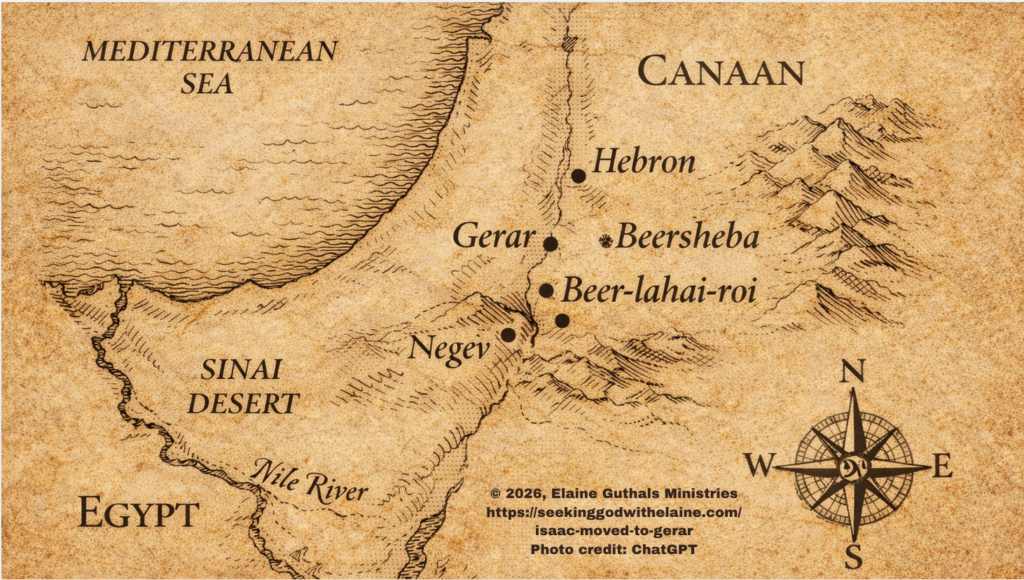
Isaac’s arrival at Beersheba meant he was back on Promised Land. In fact, the city is mentioned several times in Scriptures when the writer is taking about the land that encompasses the Promised Land.
- “Then all the Israelites were united as one man, from Dan in the north to Beersheba in the south, including those from across the Jordan in the land of Gilead. The entire community assembled in the presence of the Lord at Mizpah” (Jdg. 20: 1 NLT).
- “And all Israel, from Dan in the north to Beersheba in the south, knew that Samuel was confirmed as a prophet of the Lord” (I Sam. 3: 20 NLT).
It was also a previous home to Abraham. “Then they returned to the servants and traveled back to Beersheba, where Abraham continued to live” (Gen. 22: 19 NLT).
There was no city at this time. There was just the well by which Abraham and Abimelech made their covenant. “Then he named the place Beersheba (which means ‘well of the oath’), because that was where they had sworn the oath” (Gen. 21: 31 NLT).
The night Isaac “got home,” Sovereign God was right there. To celebrate, Isaac built an altar.
Isaac’s Covenant with Abimelech
“One day King Abimelech came from Gerar with his adviser, Ahuzzath, and also Phicol, his army commander. ‘Why have you come here?’ Isaac asked. ‘You obviously hate me, since you kicked me off your land.’ They replied, ‘We can plainly see that the Lord is with you. So we want to enter into a sworn treaty with you. Let’s make a covenant. Swear that you will not harm us, just as we have never troubled you. We have always treated you well, and we sent you away from us in peace. And now look how the Lord has blessed you!’ So Isaac prepared a covenant feast to celebrate the treaty, and they ate and drank together. Early the next morning, they each took a solemn oath not to interfere with each other. Then Isaac sent them home again, and they left him in peace. That very day Isaac’s servants came and told him about a new well they had dug. ‘We’ve found water!’ they exclaimed. So Isaac named the well Shibah (which means ‘oath’). And to this day the town that grew up there is called Beersheba (which means ‘well of the oath’)” (Gen. 26: 26-33 NLT)
Abimelech decided, if he couldn’t defeat Isaac, he had better make friends with him.
My first thought whenever I read this is, “Did Abimelech just show up on Isaac’s doorstep and want to make nice now?” It didn’t trouble him taking over wells that he hadn’t had dug????
Isaac also seems to have questioned Abimelech’s intentions. He got his dig in before Abimelech said anything.
Isaac’s Abimelech showed up with two people. Abraham’s Abimelech (Gen. 21: 22) showed up with one. He showed up with Phicol, so that must be a title, also, instead of a name.
Abimelech’s response in interesting. “They replied, “We can plainly see that the Lord is with you …” (Gen. 26: 28 NLT).
Again, I go back to Isaac’s Abimelech knowing about Abraham’s Abimelech’s conversation with Jehovah. He would have known the might of Jehovah.
Abimelech was interested in a peace treaty. “Swear that you will not harm us …” (Gen. 26: 29 NLT). This would be a binding covenant, confirmed by an oath.
This treaty is similar to the one Abraham and his Abimelech entered into. We might be able to say that this was a reactivation or an extension of the existing covenant.
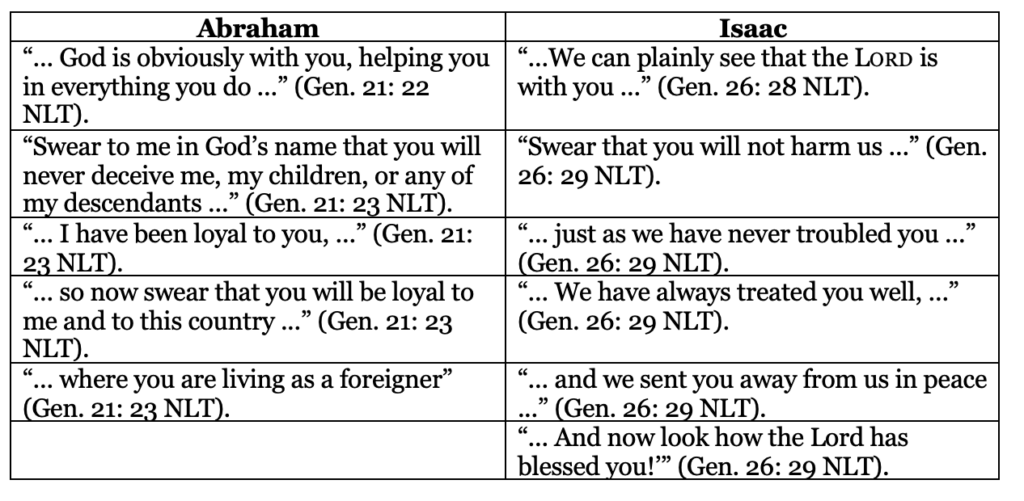
Why did Isaac need this peace treaty? Bradford told us that by guaranteeing the peace, Isaac was given the space to grow and prosper.
Esau Takes Two Wives
“At the age of forty, Esau married two Hittite wives: Judith, the daughter of Beeri, and Basemath, the daughter of Elon. But Esau’s wives made life miserable for Isaac and Rebekah” (Gen. 26: 34-35 NLT)
Esau’s decision to take Canaanite women went against Jehovah’s commands.
Okay, let’s do some figuring. Isaac was 40 when he got married and 60 when he became a father. The kids are now 40, so Isaac is 100.
Abraham was 100 when Isaac was born, so he would have been 200 when Esau got married. But he died at the age of 175.
Esau was without Abraham’s influence for 25 years. Would the outcome have been any different if Abraham was still alive?
Do we think Esau should marry anyone he wants? Parker disagreed. He wrote, “Esau went against the law of his country and his people in marrying Canaanitish women.”
Resource
So, what was Esau’s punishment for breaking that law? He lost his right as firstborn.
Was this how Jehovah planned to give Jacob birthright privileges? He should have waited 25 years.
The sad part was “But Esau’s wives made life miserable for Isaac and Rebekah” (Gen. 26: 35 NLT)
Making the Connections #1
In a previous devotion, we talked about how Jehovah works through patterns. This is an example. We can see that through the several similarities in the stories.
Making the Connections #2
Yes, Isaac was tempted when he showed up at Gerar. But don’t forget – Jehovah sent him there.
Fuller addressed that. He wrote, “Even the calls of necessity and duty may, if we be not on our watch, prove ensnaring; and if so, what must these situations be in which we have no call to be found?
Resource
Why would Jehovah send us places where He knows we will be tempted? Because He knows Romans 8: 28. “And we know that God causes everything to work together for the good of those who love God and are called according to his purpose for them” (Rom 8: 28 NLT).
Sovereign God knows we learn best through the trials rather than the mountaintop experiences.

Making the Connections #3
Remember, names were important to Hebrews. Isaac’s meant laughter. That would mean he would be filled with joy and laughter.
In spite of the lie, it seems like Isaac handled the Philistines correctly. Hughes said that he showed patience and – like Abraham – did not like confrontations.
Resource
Not bad.
Making the Connections #4
Think about it. Isaac lied.
- “You must not testify falsely against your neighbor” (Ex. 20: 16 NLT).
- “Do not steal. Do not deceive or cheat one another” (Lev. 19: 11 NLT).
- “The Lord detests lying lips, but he delights in those who tell the truth” (Prov. 12: 22 NLT).
- “I will not allow deceivers to serve in my house, and liars will not stay in my presence” (Ps. 101: 7 NLT).
But still Jehovah came to Isaac personally. He used him for covenant purposes.
Making the Connections #5
I like how Clark described Isaac. He wrote,
“I have said that he had a good father behind him, a brave heart within him, a good will to men about him; but he put the crown upon his success by owning and seeking THE FAVOUR OF GOD ABOVE HIM.”
Resource
It is easy to focus on how Isaac has a dysfunctional family. It is nice to be reminded there was good as well as the bad.
How Do We Apply This?
- Recognize that prosperity as well as poverty can be a testing.
- Choose peace.
Resource
Father God. We know You are Truth. Help us to not fall into the temptation of telling lies. May we stay wholly focused on You. Amen.
If you don’t understand something and would like further clarification, please contact me.
If you have not signed up for the email providing the link to the devotions and the newsletter, do so below.
If God has used this devotion to speak with you, consider sharing it on social media.
Making the Connections
Post
How Do We Apply This?
Post
The ABCDs of Salvation
If you have not become a believer in Christ, please read through the
Plan of Salvation and prayerfully consider what God is asking you to do.
A – admit our sins
B – believe His Son Jesus is our Redeemer
C – confess God as Sovereign Lord
D – demonstrate that commitment by making any changes needed in our lives to live the way in which God has called us
The Disciple’s Job Description
Heading
Heading
Searching for and Seeking God
Non-believers search for God.
Disciples seek Him.
Hearing His Word (Rom. 10: 17)
Reading His Word (Rev. 1: 3)
Praying to Him (Heb. 4: 16)
Studying His Word (Ac. 17: 11)
Meditating on His Word (Ps. 1: 1-2)
Memorizing His Word (Ps. 119: 11)
It Was Enough
Vocalist: Elaine Guthals
Keyboard: Chris Vieth
Related Links
I have created a worksheet of the questions above. Click on the button below to access it.
Don’t know what your spiritual gifts are?
Take this Spiritual Gifts Inventory
The Disciple’s Job Description
Complete Job Description
Individual Description
The Disciple’s Job Description
Complete Job Description
Individual Description
Job Duty #4
Proclaim the Gospel (Mark 16: 15)
Job Duty #6
Make Disciples (Matthew 28: 19-20)
Job Duty #1
Be a Living Sacrifice (Romans 12: 1-2)
Job Duty #2
Work Out Our Salvation (Philippians 2: 12)
Job Duty #3
Bring Him Glory (Matthew 5: 16)
Job Duty #4
Proclaim the Gospel (Mark 16: 15)
Job Duty #5
Love People (John 15: 12)
Job Duty #6
Make Disciples (Matthew 28: 19-20)
Job Duty #7
Other Duties as Assigned
(Ecclesiastes 3: 1)
If you don’t understand something and would like further clarification, please contact me.
If you have not signed up for the email providing the link to the devotions and the newsletter, do so below.
If God has used this devotion to speak with you, consider sharing it on social media.