Category: Trials

  • Joseph Was Thrown into Prison

    Wrongfully accused, Joseph was thrown into prison. This devotional reading looks at what that meant in his time.

    Nuggets

    • Potiphar had several reasons to be furious.
    • Joseph wasn’t thrown in a city jail, not even really a prison.
    • Once again, Joseph was rewarded for faithfulness.
    • Three times in Genesis 39, we are told that Jehovah was with Joseph (Gen. 39: 2; Gen. 21; and Gen. 39: 23).

    joseph-was-thrown-into-prison

    Joseph must have thought he hit rock bottom when he was sold in slavery to Egypt. He would have been wrong.

    During the early years of his captivity (and we don’t know how many), Joseph was well provided for in Potiphar’s house. He was put into a position of authority.

    But that safe lifestyle was about to change.

    Let’s Put It into Context

    To read devotions in the Creating Everything theme, click the button below.

    Devotions in the Joseph the Savior of Israel  series

    Potiphar Was Furious

    “Potiphar was furious when he heard his wife’s story about how Joseph had treated her.” (Gen. 39: 19 NLT)

    Potiphar had several reasons to be furious.

    We don’t know how long Joseph would have been a slave in Potiphar’s house. We do know it was long enough for him to come up the ranks.

    He would have started as a lowly slave running errands and carrying out simple instructions. As he showed his trustworthiness, his duties would have expanded.

    What kind of things might Joseph have been steward over? One probability over food and management. As it would entail distributing food rations and preparation flow, it was involved in daily survival.

    But then again, Joseph may have been a steward in inventory and storage. He would have to track what came and went out in order to determine if they had enough. In other words, he would have been overseeing the storehouses.

    Both positions – and I would think he would have cycled through both – would have prepared Joseph for what was to come.

    Joseph’s position as a steward would have meant he would have been taught to read and write Egyptian. He would have had to keep records and communicate things up the chain.

    It is even possible within these duties that Joseph would have supervised other servants as a steward. That ability would have definitely been needed as overseer.

    I would think that Potiphar’s estate was attached to land. If Joseph had maybe started out with the livestock – because he knew animals – he might have gotten experience in agricultural matters. He knew animals, but had he gotten enough knowledge and skill in Canaan about crops?

    Joseph would definitely need that!

    All that to say, Potiphar had invested a lot of time in Joseph. He would have been furious that his investment was no longer viable.

    Then there is the trust aspect. Joseph would have had to prove himself trustworthy to reach the position of overseer.

    Joseph didn’t abuse power. He didn’t cut corners. He didn’t take advantage of Potiphar.

    Because of that, Joseph was promoted to overseer. He was put in charge – pāqad (פָּקַד).

    One thing we may not think about is that Joseph probably was still functioning in some way as a steward even when promoted to authority. Joseph was made overseer in position, but he lived as a steward in practice — holding authority without ever forgetting it was entrusted, not owned.

    Remember what was said way back in verse 6. “So Potiphar gave Joseph complete administrative responsibility over everything he owned. With Joseph there, he didn’t worry about a thing — except what kind of food to eat! …” (Gen. 39: 6 NLT).

    And now that trust was all gone.

    That doesn’t even get into Potiphar’s feelings about Joseph allegedly attacking Mrs. Potiphar.

    Threw Him into the Prison Where the King’s Prisoners Were Held

    “So he took Joseph and threw him into the prison where the king’s prisoners were held, and there he remained” (Gen. 39: 20 NLT)

    Joseph wasn’t thrown in a city jail, not even really a prison.

    We said that Potiphar was the Captain of Pharaoh’s Guard. We said that the Hebrew phrase for that literally means chief of the slaughterers. As head of royal security, Potiphar oversaw royal prisons.

    Think about that a second. Potiphar oversaw both prisons and executions. Normally, slaves would have been executed.

    Joseph was imprisoned. Maybe Potiphar didn’t believe Mrs. Potiphar’s story. Or maybe he thought Joseph was too important to kill.

    It wasn’t a common dungeon, as we think of prisons at that time. It was a royal detention center (Gen. 39: 20). We know this because we are going to meet two players shortly.

    The normal prisoners were royal officials, political prisoners, and the accused but not condemned. There were probably about 20 to 80 prisoners at a time. Those held there would have been selective and high in value.

    This was not a crowded prison of forgotten men, but a controlled holding place for Pharaoh’s servants. It was small enough to be managed, yet significant enough to shape the course of a nation.

    This was a holding center until cases were resolved. Again, we know this because of the two men who will soon be held there.

    Some may have been being held there until trial, judgment, or execution. That would have made the normal term either weeks or months.

    That makes Joseph’s tenure here unusual. He stayed over two years (Gen. 41: 1). Did that mean his case was left unresolved, forgotten, or buried?

    Why so long? Well, maybe it was a sanctification reason. Maybe Jehovah was not positioning Joseph – but positioning Egypt.

    Let’s take a look at the prison itself — one that Potiphar may have administered. Look at this layout.
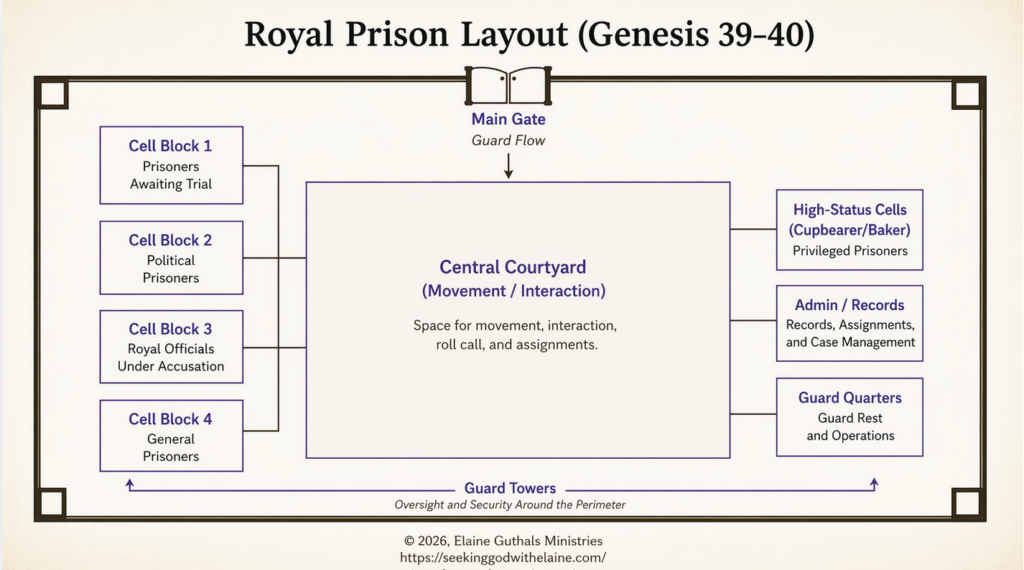
    This layout represents a fortified compound. The outer walls were thick mudbrick or stone. There would have been limited access points — and all guarded.

    The interior courtyard was an open-air space. It is possible that this was a congregating space. It may have been a place where they could have moved “freely.”

    The holding cells would have been small, enclosed rooms. Lighting would have been minimal. They might have been grouped by status.

    Of course, there would have been administrative space and guard quarters.

    The Lord Was With Joseph

    “But the Lord was with Joseph in the prison and showed him his faithful love. And the Lord made Joseph a favorite with the prison warden” (Gen. 39: 21 NLT)

    Three times in Genesis 39, we are told that Jehovah was with Joseph (Gen. 39: 2; Gen. 21; and Gen. 39: 23).

    The first time was when Joseph reached Egypt. He was just settling into Potiphar’s.  house.

    The second time was when Joseph was punished for a crime that he did not commit. Not only that, but he was also being punished for choosing to remain faithful.

    In this verse, we are told that Joseph found favor — ḥēn (חֵן). This is grace that produces visible acceptance.

    Ooo, baby. How many times have we wanted something — anything — visible from Jehovah. But would we know it if we saw it?

    What if Joseph though Jehovah’s favor would only be evident when he got out of the prison? It would have been a long two years.

    But Jehovah’s favor was easing Joseph’s situation in the prison.

    The third time we are told Jehovah was with Joseph was when he had been in the prison for an undisclosed amount of time. It had been, though, time enough for him to become second-in-command at the prison.

    Since we know the rest of the story, we know that this was all in God’s plan.  Even in prison, God’s presence didn’t leave Joseph. He still prospered because God was still with him.

    In Charge of All the Other Prisoners and Everything that Happened in the Prison

    “Before long, the warden put Joseph in charge of all the other prisoners and over everything that happened in the prison. The warden had no more worries, because Joseph took care of everything. The Lord was with him and caused everything he did to succeed” (Gen. 39: 22-23 NLT)

    Once again, Joseph was rewarded for faithfulness.

    We aren’t told exactly what Joseph’s responsibilities as second-in-command entailed. We are just told that he took care of everything.

    One responsibility was probably managing prisoners. We know that Joseph had personal interaction with the other prisoners. He played a big role on the situation of two such prisoners.

    Joseph probably was in charge of distributing resources. Food would have been a big item. I would think that any health care needed would be under his watch. Basically, he would be overseeing daily operations.

    Surely, the prisoners had chores to do within the prison. Joseph possibly supervised them.

    Look at this.

    At each place where Joseph was held against his will, he was given responsibilities that grew in size, complexity, and reach, preparing him for what was ahead. Through it all, his obedience remained the same.

    Even in prison, Joseph was in proximity to power. He was placed to intersect with those to take him to the next level.

    Making the Connections #1

    Joseph was faithful in whatever circumstance he was in. He didn’t wait to get promoted before he became faithful. He didn’t demand freedom before he would give his faithfulness.

    As we said in the last devotion – Joseph allowed Sovereign God to use him wherever He put him. His circumstances changed, but his obedience did not.

    Joseph didn’t need Jacob to retain his integrity. He didn’t need an accountability structure. He didn’t need witnesses.

    Jehovah was the only Witness Joseph needed. He chose righteousness.

    Making the Connections #2

    Have you ever looked at Joseph’s time in prison was actually an attitude adjustment? He would have had to be upset when he was suddenly removed from what he would have seen as a good job and accused of a crime he didn’t commit.

    But Joseph went from being accused in Potiphar’s house to being trusted again in prison.

    Joseph was not thrown away — he was transferred. The prison was not a dead end, but a corridor within Pharaoh’s system, placing him exactly where the next door would open.

    Making the Connections #3

    If Jehovah was with Joseph in his trials, won’t He be with us in ours? We, too, can find favor with Him when we are content in whatever situation in which He puts us.

    Remain faithful in all things.

    Making the Connections #4

    Let’s compare Judah and Joseph.
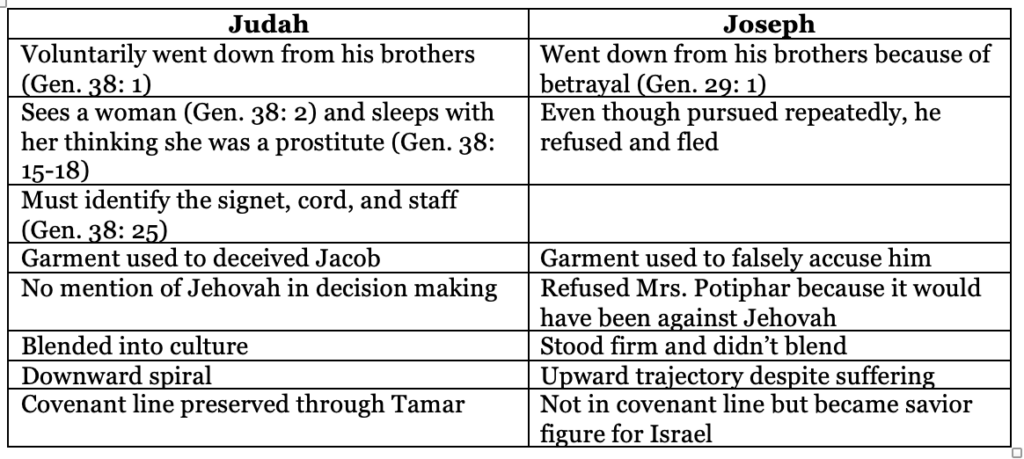
    Judah’s story shows us what happens when covenant identity is abandoned. Joseph’s story shows us what happens when covenant identity is maintained under pressure.

    How Do We Apply This?

    • Reflect on our own challenges to recognize Jehovah’s presence.
    • Persevere, maintain integrity, and rely on Him.

    Prayer

    If you don’t understand something and would like further clarification, please contact me.

    If you have not signed up for the email providing the link to the devotions and the newsletter, do so below.

    If God has used this devotion to speak with you, consider sharing it on social media.

  • Jacob and Esau Part Company

    After Jacob and Esau’s emotional reunion, it was time to move on. This devotional reading will look at whether they stayed together or separated.

    Nuggets

    • The time had come for Jacob and Esau to leave where they were.
    • Jacob refused Esau’s offer to send some of his men with Jacob as protection.
    • Instead of going to Seir, Jacob ended up in Shechem.
    jacob-and-esau-part-company

    The meeting with Esau turned out much better than Jacob had hoped or dream. They were reconciled.

    But how was their parting? Did they stay together or part on bad terms again?

    Let’s Put It into Context

    To read devotions in the Creating Everything theme, click the button below.

    Devotions in the Jacob the Patriarch series

    Moving On

    “‘Well,’ Esau said, ‘let’s be going. I will lead the way.’ But Jacob replied, ‘You can see, my lord, that some of the children are very young, and the flocks and herds have their young, too. If they are driven too hard, even for one day, all the animals could die. Please, my lord, go ahead of your servant. We will follow slowly, at a pace that is comfortable for the livestock and the children. I will meet you at Seir’” (Gen. 33: 12-14 NLT)

    Time had come for Jacob and Esau to leave where they were.

    We may think it was nice that Esau had reconciled enough to offer to travel ahead of Jacob to offer mutual protection. What we may or may not know is that was probably Esau’s attempt attempt to form an alliance. Another reason may have been that Esau saw it as shared leadership.

    What the Hebrew really said, though, was proceed at your pace. Going alongside of you is a whole lot different than blazing the trail, which is what the New Living Translation implies.

    Smith suggested that Jacob was still a little afraid of Esau. We don’t know how long their hugging/weeping/kissing/catching up session lasted. Was it a couple of hours or a couple of days!

    Resource

    Maybe. But maybe Jehovah told Jacob that, deep down, Esau still was not following Him. He probably didn’t want an alliance between the twins.

    Smith pointed out that Jacob would need to raise his sons to understand and follow the Abraham’s covenant. It wasn’t just the firstborn who would be the covenant son.

    Jacob declined the offer politely. He noted they would have to move slower. That was true.

    The reason Jacob gave first was probably correct. He would only be able to drive the herds and flocks only so quickly.

    We estimated the age of the kids.

    1716 BC – Jacob, 84, was tricked into marrying Leah. He agreed to work seven more years for Rachel
    ~1715 BC — Reuben born (Leah)
    ~1714 BC — Simeon born (Leah)
    ~1713 BC — Levi born (Leah)
    ~1712 BC — Judah born (Leah)
    ~1712 BC — Dan born (Bilhah)
    ~1711 BC — Naphtali born (Bilhah)
    ~1711 BC — Gad born (Zilpah)
    ~1710 BC — Asher born (Zilpah)
    ~1710 BC — Issachar born (Leah)
    ~1709 BC — Zebulun born (Leah)
    1709 BC – Joseph was born (Rachel)
    1703 BC – Jacob, 97, and his family left to return to Canaan (Gen. 31: 3)
    1680 BC – Isaac died at the age of 180 (Gen. 35: 28-29)

    Based on Timeline from

    Joseph and Zebulun may have been 6. Issachar and Asher may have been 7. Gad and Naphtali may have been 8. Dan and Judah may have been 9. Levi, Simeon, and Reuben may have been 10, 11, and 12 respectively.

    Kalisch thought Jacob’s fear of Jacob was exaggerated but warranted. He knew Esau’s character. If it had changed, it might revert at any time.

    Resource

    Jacob agreed to meet Esau in Seir. That may seem strange — especially since he didn’t go — but hospitality etiquette would have ensured that Esau would keep Jacob safe.

    Moving Apart

    “‘All right,’ Esau said, ‘but at least let me assign some of my men to guide and protect you.’ Jacob responded, ‘That’s not necessary. It’s enough that you’ve received me warmly, my lord!’ So Esau turned around and started back to Seir that same day.  Jacob, on the other hand, traveled on to Succoth. There he built himself a house and made shelters for his livestock. That is why the place was named Succoth (which means ‘shelters’)” (Gen. 33: 15-17 NLT)

    Jacob refused Esau’s offer to send some of his men with Jacob as protection.

    Is it strange that Jacob didn’t want to travel with Esau or any of his men? Well, he had been on his own for 20 years. I bet that would have been an independent person.

    But if Esau was going for a political alliance, Jacob didn’t seem like he wanted anything to do with that.

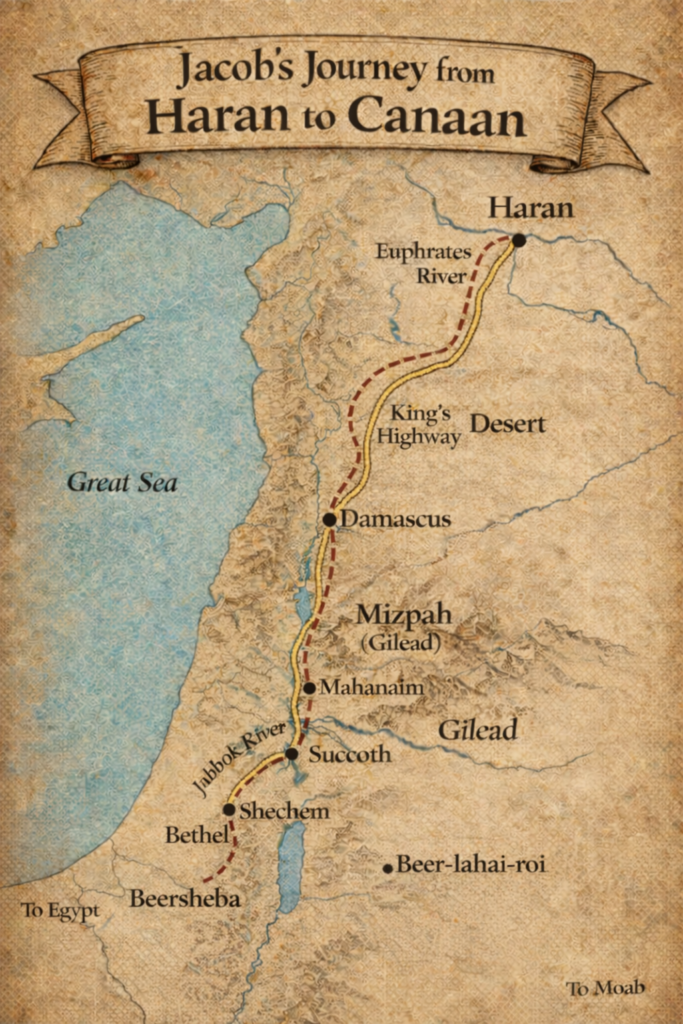
    But where was Jacob heading to in the first place? Was he going to Esau or Isaac? If he was going to Isaac, that would have been through Sukkot and Shechem — the way he ended up going.

    So, did Jacob lie?

    HaCohen gave one explanation. What if Jacob previously lived in Seir? Look what HaCohen wrote.

    “As I argued in my “Locating Beer-lahai-roi” (TheTorah 2014), the story of Jacob stealing his brother’s blessing (Genesis 27) is set in the area of Ein el-Chai, biblical Beer-lahai-roi, a site midway between Siq el-Bared (biblical Bered) and Ein el-Musa (biblical Kadesh), on the outskirts of Petra (Gen 16:14). In fact, the Torah is explicit elsewhere that this is where Isaac lived …”

    Resource

    Maybe Jacob was going to both Esau and Isaac. I do not believe — and God’s Word never tells us — that Jacob ever lived in Seir.

    I have to process this. We know Isaac lived at Beer-lahai-roi before he and Rebekah were married (Gen. 24: 62). He was still there when Abraham died (Gen. 25: 11).

    Genesis 26 talked about Isaac and Rebekah moving to Gerar. I am of the opinion that happened before the twins were born. Even if it happened after the boys were 15, it would be obvious that Rebekah was a mother. The whole Abimelech episode wouldn’t have happened if he would have known that.

    Isaac moved to Beersheba in Genesis 26: 23. We know they are still there when Jacob leaves for Paddan-aram because that is from where he left (Gen. 27: 10).

    Maybe Isaac had moved back to Beer-lahai-roi sometime in the 20 years. We do know, though, that when he died 23 years later, he lived in Mamre — renamed Hebron (Gen. 35: 27-29).

    But the problem is that most think Beer-lahai-roi was not in Seir, as HaCohen had it.

    There may have been a deeper reason Jacob didn’t go with Esau to Seir. “And the Lord told her, ‘The sons in your womb will become two nations. From the very beginning, the two nations will be rivals. One nation will be stronger than the other; and your older son will serve your younger son’” (Gen. 25: 23 NLT).

    They were to become separate nations. Jacob’s future had long been known to be Canaan. Esau’s territory was Seir/Edom.

    To me, this might be another Abraham/Lot situation. We are told Jacob has a lot of livestock. We aren’t really told about Esau, but he probably had a herd and flock or two.

    Jacob went to Succoth and, basically, built a house. He built shelters for the livestock.

    Going a Different Ways

    “Later, having traveled all the way from Paddan-aram, Jacob arrived safely at the town of Shechem, in the land of Canaan. There he set up camp outside the town.  Jacob bought the plot of land where he camped from the family of Hamor, the father of Shechem, for 100 pieces of silver.  And there he built an altar and named it El-Elohe-Israel” (Gen. 33: 18-20 NLT)

    Instead of going to Seir, Jacob ended up in Shechem.

    This is the first time Jacob is said to have built an altar. What he did at Bethel was a standing stone (a memorial).

    We need to remember the significance of Shechem. “… When they arrived in Canaan, Abram traveled through the land as far as Shechem. There he set up camp beside the oak of Moreh. At that time, the area was inhabited by Canaanites.” (Gen. 12: 5-6 NLT).

    Jehovah had not only brought Jacob back to the land promised to Abraham but also to the first place that we know Abraham built an altar.

    So many emotions probably prompted Jacob to build this altar. He was thankful that Jehovah had brought him home — and given him comfort and guidance throughout the 20 years.

    It was probably the first time that Jacob felt he could build an altar on which to worship God and how his faith. True, he probably lived on land owned by Laban — and you would think Laban should have been okay with that.

    But this is the first time we are told that Jacob bought land. “Jacob bought the plot of land where he camped from the family of Hamor, the father of Shechem, for 100 pieces of silver” (Gen. 33: 19 NLT).

    More importantly, Jacob now probably had the hope of the covenant — and the realization that he was truly the covenant son. Yes, he grew up hearing about it from Abraham and Isaac.

    Now, after all that had happened, it was real. It was real because Jacob was walking more closely with Jehovah. He knew he could depend on Jehovah’s promises.

    I like what Jacob called the altar that he built – El-Elohe-Israel (God, the God of Israel). Jacob was owning his new identity.

    Look what Sherwood said. He wrote, “Only when he ceased to rely on his own strength, and resorted to the weapon of prayer, did he succeed. So it is ever with the Christian.”

    Resource

    We should follow Jacob’s example.

    But I think Jacob’s destination was always Bethel. Shechem wasn’t far from Bethel.

    Making the Connections #1

    I love the story Guthrie told about reconciliation. He wrote,

    “A man lying under sentence of death has sent off a petition for mercy, and waits the answer in anxious suspense. One day his ear catches rapid steps approach his door — they stop there. The chain is dropped; the bolts are drawn; a messenger enters with his fate; the sovereign pities the criminal, but cannot pardon the crime. His hopes dashed to the ground, he gives himself up for lost. And now the messenger draws near, and tells him that if the king’s son would change places with him and die in his room, that would satisfy justice, and set him free. Drowning men will catch at straws; not he at that. The king give up his son! If there is no hope but that, there is no hope at all! Now fancy, if you can, his astonishment, sinking to incredulity, and then rising into a paroxysm of joy, when the messenger says, I am the king’s son; it is my own wish, and my father’s will that I should die for you; take you the pardon, and give me the fetters. In me shall the crime be punished; in you shall the criminal be saved. Such love never was shown by man; only by God. Did David, when he considered the heavens the work of God’s fingers, exclaim, What is man that Thou art mindful of him? How much more may God’s people break out into expressions of adoring wonder, when they stand beneath the Cross.”

    Resource

    No, it really isn’t about Jacob and Esau.

    But this story is about true reconciliation. That is true atonement.

    Making the Connections #2

    This chapter has had everything, hasn’t it?

    • Divine provision
    • Fear
    • Transformation
    • Covenant understanding and acceptance
    • Reconciliation
    • Mercy

    Yes, we all have our own Sanctification Roads.

    One thing we might not recognize is that the whole chapter reads like a formal reconciliation ceremony. Let’s look at the clear example of Ancient Near Eastern diplomacy.

    • Fear of confrontation
    • Tribute gifts
    • Submission gestures
    • Approach with bows
    • Emotional reconciliation
    • Gift exchange
    • Escort offer
    • Peaceful separation

    According to established cultural rules of honor and reconciliation, Esau and Jacob’s relationship was fully restored.

    Jacob apologized for his devotion. But he also restored Esau’s honor.

    Making the Connections #3

    One thing that it is easy to forget is that the twins were 97 years old. They were 77 when Jacob left, and that was 20 years ago.

    They were not young heroes going to battle against their foe from their early adulthood. True, Isaac lived to 180, but Jacob didn’t.

    I doubt that Esau was a reckless man charging toward Jacob. But he would have been a seasoned soldier by then.

    Remember, Esau was his own nation. So, he was a patriarch as much as Jacob was.

    How Do We Apply This?

    • Put our faith and trust in Jehovah.

    Father God. You want us to be at peace with others. We also know that there are those You don’t want us to be around. Help us to associate those who live for You. Amen.

    If you don’t understand something and would like further clarification, please contact me.

    If you have not signed up for the email providing the link to the devotions and the newsletter, do so below.

    If God has used this devotion to speak with you, consider sharing it on social media.
  • Jacob and Esau Were Reconciled

    Jacob must have gotten up that morning thinking, “Today is the day.” This devotional reading looks at Jacob and Esau’s meeting after 20 years – and how it didn’t go as planned.

    Nuggets

    • Morning had arrived and so had Esau.
    • Jacob showed that he was cautious and still thought strategically by dividing his family into groups.
    • We need to understand the cultural significance of “… he bowed to the ground seven times before him” (Gen. 33: 3 NLT).
    • Instead of vengeance, Esau offered Jacob reconciliation.
    • Esau saw Jacob’s family as a blessing.
    • Esau questioned the gifts from Jacob.
    • We may think Jacob’s comment about seeing Esau’s face was “… like seeing the face of God!” (Gen. 33: 10 NLT) equated the two, but it didn’t.
    • Jacob was asking Esau to accept this blessing.
    jacob-and-esau-were-reconciled

    The Jacob/Esau story had been a long time in the making. From Genesis 25 — when Jacob stole the birthright when they were probably age 15 — through stealing the blessing at age 77 all the way up to now at age 97 when Jacob returned with wives and much livestock.

    1820 BC – Isaac, at age 40, married Rebekah (Gen. 25: 20)
    1800 BC – Jacob and Esau were born (Gen. 25: 24-26)
    1785 BC – Esau sold the birth right to Jacob in exchange for lentil stew Jacob was cooking while mourning for Abraham
    1723 BC – Jacob cheated Esau (both age 77) out of the birthright blessing given by Isaac (age 137). He flees Canaan to Paddan-aram to Rebekah’s family. He agrees to work seven years to earn the right to marry Rachel (Gen. 29: 1-20)
    1716 – Jacob, 84, was tricked into marrying Leah. He agrees to work seven more years for Rachel
    1709 BC – Jacob, 91, finished working seven years for Rachel and agreed to continuing working for Laban to build up his personal wealth.
    1709 BC – Joseph was born
    1703 BC – Jacob, 97, and his family left to return to Canaan (Gen. 31: 3)

    Based on Timeline from

    Twenty years was a long time, but was Esau able to hold a grudge against Jacob all that time?

    How would Esau feel now about Jacob’s deceit?

    Let’s Put It into Context

    To read devotions in the Creating Everything theme, click the button below.

    Devotions in the Jacob the Patriarch series

    The Meeting Anticipated

    “Then Jacob looked up and saw Esau coming with his 400 men. So he divided the children among Leah, Rachel, and his two servant wives. He put the servant wives and their children at the front, Leah and her children next, and Rachel and Joseph last. Then Jacob went on ahead. As he approached his brother, he bowed to the ground seven times before him” (Gen. 33: 1-3 NLT)

    Saw Esau Coming

    Morning had arrived and so had Esau.

    Jacob had spent the night wrestling with Sovereign God. One look at Esau and his 400 men brought the fear crushing back. The number is significant.

    We are probably looking at a couple of Ancient Near East practices.

    • An Ancient Near Eastern leader would travel with a large entourage to show his strength and ensure the honor he deserved.
    • The number conveys a military potential, the size of a clan chief’s war band.

    Gray wondered if maybe Esau did initially come to meet Jacob to exact revenge. Maybe Jehovah worked on his heart and flipped it – as He did Laban’s.

    Resource

    One sermon I read said that Jehovah had, even if it doesn’t tell us, appeased Esau like He had Laban. Well, yes and no. Jehovah may have appeared, but the outcome was different.

    Resource

    Laban attributed Jehovah’s intervention in everything. He was blessed because of Jacob (Gen. 30: 27). He responded without force when it reads as if he was chomping at the bit to do so (Gen. 31: 29). But Laban left in peace — sort of.

    We are never expressly told that Jehovah intervened with Esau. It looks like He providentially softened Esau. The reunion had a much happier ending!

    Who knows when the change of heart came. Maybe Esau was just trying to show his power.

    Though seeing all the wealth in the gifts of livestock, Esau knew Jacob hadn’t had an easy life.

    Divided the Family

    Jacob showed that he was still cautious and thought strategically by dividing his family into groups.

    Jacob always had his favorites. It looks like does so now as he lines them up from the least favored to the most favored.

    But Jacob also uses the family hierarchy. The concubines come before the wives.

    The difference is that Leah, as first wife, comes before Rachel, as second wife. That makes Rachel and Joseph the most protected.

    Jacob Went on Ahead

    Even though Jacob divided his family into groups, he went before them.

    This is huge. Jacob was approaching Esau after 20 years. He was not running. He was not scheming. He was not hiding behind deception.

    Jacob was limping. He was limping toward the brother he wronged — the one who even now might be fixing to kill him.

    One thing is for sure – Jacob was not the strong man who left Beersheba. He now had what many would see in his day as a permanent weakness.

    But neither did Jacob now feel the fear that drove him away. (Oh, he was still afraid of Esau, but he put his trust in Jehovah.)

    He had learned humility. He was now full of hope and confidence because he had wrestled with Jehovah and prevailed.

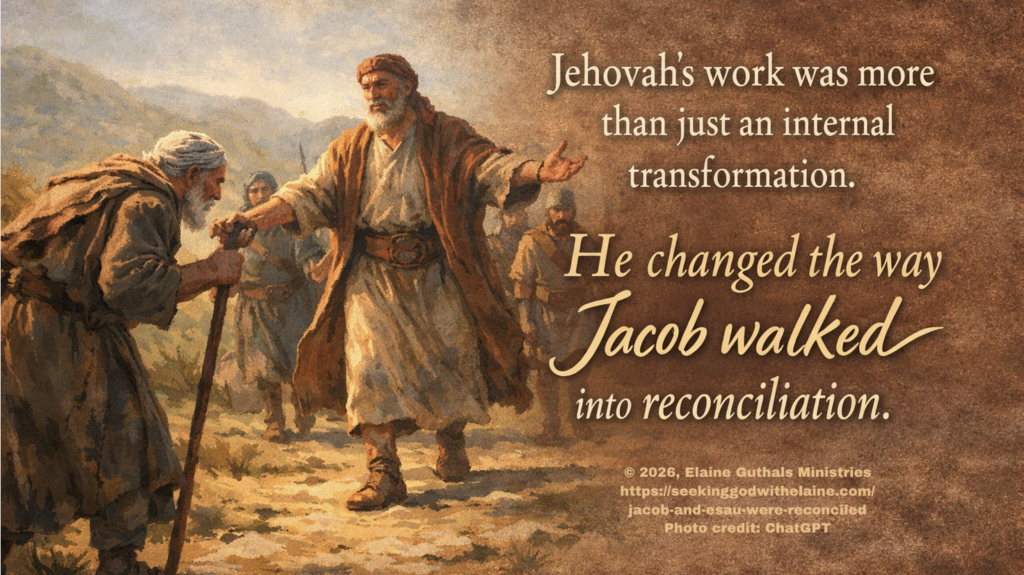
    Jehovah’s work was more than just an internal transformation. He changed the way Jacob walked into reconciliation. As Gray said Jacob “… — the prevailer — does not fear to meet the first storm of his brother’s rage.”

    Resource

    Bowed to the Ground Seven Times

    We need to understand the cultural significance of “… he bowed to the ground seven times before him” (Gen. 33: 3 NLT).

    As disciples of Christ, we see the number seven and think completion. That isn’t the case here.

    When a person in the Ancient Near East bowed seven times, they were showing a formal diplomatic gesture of submission and repentance. Yes, it was an Ancient Near East custom, but it has a huge significance for Jacob.

    Twenty year prior, Jacob had stolen the blessing from Esau. Now, he was acting like the younger brother again. He was giving Esau the submission and respect he deserved while acknowledging his authority.

    Jacob was righting the social order between him and Esau. He removed the insult that he gave to Esau.

    We may think of Jacob’s language of my lord/your servant as something inappropriate between brothers. But it was common dialogue between brothers and relatives.

    The Meeting Took Place

    “Then Esau ran to meet him and embraced him, threw his arms around his neck, and kissed him. And they both wept. Then Esau looked at the women and children and asked, ‘Who are these people with you?’ These are the children God has graciously given to me, your servant,’ Jacob replied. Then the servant wives came forward with their children and bowed before him. Next came Leah with her children, and they bowed before him. Finally, Joseph and Rachel came forward and bowed before him. ‘And what were all the flocks and herds I met as I came?’ Esau asked. Jacob replied, ‘They are a gift, my lord, to ensure your friendship.’  ‘My brother, I have plenty,’ Esau answered. ‘Keep what you have for yourself.’ But Jacob insisted, ‘No, if I have found favor with you, please accept this gift from me. And what a relief to see your friendly smile. It is like seeing the face of God! Please take this gift I have brought you, for God has been very gracious to me. I have more than enough.’ And because Jacob insisted, Esau finally accepted the gift” (Gen. 33: 4-11 NLT)

    Esau Ran to Meet Him

    Instead of vengeance, Esau offered Jacob reconciliation.

    I guess that Esau didn’t get the memo that Hebrew men do not run. It was undignified as they had to lift up their robes in order to complete the activity. Running was for the young – and face it, the twins weren’t young.

    But this is telling me how strong Esau’s emotions were. He was not only willing but also eager to reconcile with his brother.

    Ooo, baby. I bet Jacob was surprised to see Esau running toward him. That was not the welcome-home response that ever entered Jacob’s mind.

    Neither did Jacob expect the tears. That act — including falling on Jacob’s neck and kissing him — truly showed Esau’s heart and coming from a point of restored kinship.

    Esau was exhibiting all the actions of reconciliation. He ran, embraced, kissed, and wept. The deep emotions were clearly evident.

    But the meaning behind all of those emotions are precious. We see urgency, initiative, acceptance, reconciliation, and healing.

    If Jacob had changed, so had Esau.

    How many times do we expect something to go down one way, and it occurs totally the opposite?

    We base our determinations on the old Tom or Sally — and the old Elaine. Or we generalize some other experience we have had with experience at hand. Maybe worse, we take what we think we have seen happen to someone else and apply it to our situation.

    We need to follow God. God said He was bringing Jacob back. Esau was still there. That meant Jacob and Esau were going to have to live together somehow.

    We have to have faith that God will change our Esau’s as he changes us.

    Who Are These People

    Esau saw Jacob’s family as a blessing.

    We may read Esau’s question as a little terse. It wasn’t.

    Esau was recognizing Jacob’s family. He knew families were a blessing (Gen. 1: 28).

    This allowed Jacob to acknowledge they were a gift from Jehovah. It was further evidence to Esau that Jacob had changed.

    Each group came forward and bowed before Esau. This was symbolic restitution. Even though Jacob once stole Esau’s blessing, his entire household now honored Esau.

    Flocks and Herds

    Esau questioned the gifts from Jacob.

    Esau talked about the tribute appeasement that we read about in Genesis 32. (Remember, there were goats, sheep, camels, cattle, and donkeys that Jacob was giving Esau.) Esau would have understood that practice, too.

    The purpose of sending the waves of animals as gifts to Esau was to demonstrate submission and soften Esau’s anger. But it was also restoring Esau’s honor and publicly acknowledging the wrong.

    Custom said Esau was first supposed to decline the gifts. Then at Jacob’s insistence, he was free to accept them. (We saw it play out this way when Abraham bought the cave to bury Sarah in Genesis 23.)

    Part of us says, come on, we know Esau was always materialistic. He didn’t care about birthrights and blessings. He didn’t care about God. All he had cared about was wealth and power. He didn’t want the duties that went with it.

    That was part of why Jacob got the covenant promise. It was the most important thing to him. Material wealth was secondary.

    God was Jacob’s priority.

    But Jacob needed Esau to accept the gifts. Reconciliation wouldn’t occur if he didn’t.

    What if it was more than that? What if it was Esau’s statement that he didn’t demand compensation for reconciliation? We really don’t know how successful Jehovah was in softening Esau’s heart.

    Think about it. Esau many have not gotten the covenant blessing, but he was still blessed (Gen. 27: 39-40). He was promised material blessing outside Israel.

    I think Esau did forgive Jacob, and Jacob did forgive Esau. I like how Guthrie put it. He wrote, “The long estranged brothers have embraced and buried in one grave Esau’s wrongs and Jacob’s crimes — being enemies, they were reconciled.”

    Resource

    It does seem like reconciliation took place. Esau called Jacob brother in verse 9.

    Something else is really huge. Esau said he had enough (Gen. 32: 9 JPS). Jacob said he had plenty (Gen. 32: 11 JPS).

    Enough signifies adequate. Plenty — as in Jehovah’s blessings — means we have an abundance.

    Like Seeing the Face of God

    We may think Jacob’s comment about seeing Esau’s face was “… like seeing the face of God!” (Gen. 33: 10 NLT) equated the two, but it didn’t.

    This statement of Jacob’s in verse 10 may be totally unexpected to us, especially after Genesis 32: 30. Jacob actually saw God’s face.

    That was a cultural thing, again. A ruler’s face would determine a person’s fate. Seeing anger in the person’s fate would mean punishment was coming. If the ruler’s face showed acceptance, it meant the person was safe.

    At Peniel, Jacob saw God’s mercy. Here, he saw Esau’s mercy. Of course, he would connect those in his mind because God answered Jacob’s prayer and did that.

    I’d say Jehovah changed both boys’ hearts.

    Look at verse 11 again. “‘Please take this gift I have brought you, for God has been very gracious to me. I have more than enough.’…” (Gen. 33: 11 NLT).

    Jehovah was enough for Jacob.

    Please Accept

    Jacob was asking Esau to accept this blessing.

    If we don’t go back to the Hebrew, we may miss something important. Yes, Jacob was wanting Esau to accept the gift.

    But the Hebrew word used — berakhah — means blessing. Jacob was returning the stolen blessing to Esau.

    Resource

    Both had learned the meaning of disinterestedness. Disinterestedness means a willingness to give up something for a greater good. Both had finally learned the lesson Abraham had.

    Is that contentment only given to disciples? No. Worldview people can be totally content in their lives.

    Unfortunately, their contentment doesn’t come from Jehovah’s provision. It comes from reliance upon themselves.

    Making the Connections #1

    This restoration was more than Jacob hoped would happen. What he feared would happen didn’t.

    Grace can appear where judgment is expected.

    Did Jacob kick himself for being fearful for 20 years? Did he wish he would have come home sooner?

    I guess Jacob could have gotten home, and Esau could have said, “You know, I’m going to wait to see if he has really changed.”

    But Esau took Smith’s advice. He wrote,

    “Therefore, as the apostle says, Repent, for the kingdom of heaven is at hand, we may say, Forgive, for the kingdom of heaven is at hand. Forgive while forgiveness is worth having; forgive while there remains enough of life for the renewal of kindness; forgive while you have something else to bestow on repentance than lingering looks and faltering words.”

    Resource

    Forgiveness is for us, not them.

    Making the Connections #2

    Speaking of grace, doesn’t this whole chapter reveal Jehovah’s character?

    Our character includes sinful things. We betray each other — sometimes through violence— causing division.

    Jehovah offers reconciliation, preservation, and salvation.

    • Ishmael and Esau were reconciled enough to stand together when Abraham died (Gen. 25: 9).
    • Jacob and Esau were reconciled.
    • Joseph explained to his brothers that Jehovah used his brothers’ evil to save what would become the nation of Israel and preserve the covenant.

    Making the Connections #3

    Compare this to the Parable if the Prodigal Son.

    Mercy moves faster than judgment.

    Making the Connections #4

    Leale made a statement that kind of set me back for a minute. Talking about the differences of character, he wrote, “Esau was generous and forgiving.” On the other hand, he said, “In Jacob there are traces of his old subtlety.”

    Resource

    Wait! What????

    Jacob was the one who gave all the animals. Wasn’t that generous?

    Well, no. Not if that was what was expected to appease the other.

    We see Jacob’s subtlety as he divides the wives and kids up. He had Plan B in place if Jehovah let Plan A fall apart.

    Esau, on the other hand gave unconditional forgiveness.

    The worldview would question whether that made Esau a better candidate for covenant son than Jacob. The answer would be no.

    The status of being covenant son is based upon keeping the covenant, not performing the Matthew 25 to-do list. It isn’t even based on our being 100 perfect in slaying our sinful nature.

    Being the covenant son is based on submission to the Heavenly Father, not submission to the older brother. Jacob showed humility to both.

    How Do We Apply This?

    • Respect our brothers and our sisters.
    • Consider children a gift from Jehovah.
    • Practice self-denying submission when we have wronged someone.

    Resource

    Father God. Thank You that You have a plan for each of our lives. We thank You control how they intersect with others. All that happens is in Your plan. Amen.

    If you don’t understand something and would like further clarification, please contact me.

    If you have not signed up for the email providing the link to the devotions and the newsletter, do so below.

    If God has used this devotion to speak with you, consider sharing it on social media.

  • Jacob’s Wrestling Match with God

    The Jabbok River was behind Jacob, and Esau was in front of him. This devotional reading looks at the night in between, which included an unusual wrestling match.

    Nuggets

    • Jehovah comes to us when we are alone.
    • A vision wouldn’t have given Jacob a permanent limp.
      Jacob was earnest to receive a blessing from the man.
    • Jehovah didn’t need to ask Jacob’s name — He wanted him to think.
    • Joy comes in the morning, but many things leave a scar.
    jacobs-wrestling-match-with-god

    When Jacob crossed the Jabbok, he had done things right according to custom. He called Esau my lord and himself his servant. He declared his wealth to establish a peaceful intent.

    Esau respond with an army of 400 soldiers. Jacob sent his family on to ensure their safety.

    This was a crisis point in Jacob’s life. It is in this point that he met Jehovah.

    Let’s Put It into Context

    To read devotions in the Creating Everything theme, click the button below.

    Devotions in the Jacob the Patriarch series

    The Wrestling Match

    “This left Jacob all alone in the camp, and a man came and wrestled with him until the dawn began to break. When the man saw that he would not win the match, he touched Jacob’s hip and wrenched it out of its socket. Then the man said, ‘Let me go, for the dawn is breaking!’ But Jacob said, ‘I will not let you go unless you bless me.’ ‘What is your name?’ the man asked. He replied, ‘Jacob.’ ‘Your name will no longer be Jacob,’ the man told him. ‘From now on you will be called Israel, because you have fought with God and with men and have won.’ ‘Please tell me your name,’ Jacob said. ‘Why do you want to know my name?’ the man replied. Then he blessed Jacob there” (Gen. 32: 24-29 NLT)

    A Man Came and Wrestled with Jacob

    Jehovah comes to us when we are alone.

    Remember, Jacob was alone in his camp. He had sent his family across the Jabbok.

    Later that night, a wrestling match occurred. At first, we are just told it was a man. Later, we are told it was Jehovah.

    One thing is for sure – it wasn’t a vision. We’ll get to that in a second.

    This was a Man, but we are told it was Jehovah. Because of that, many think this is Yeshua.

    Maybe, but I don’t think so – and neither does Jewish tradition. Yes, Yeshua and God are One (Jn. 10: 30), but they are separate. Their nature is one.

    Look at Hosea 12: 3-4. “Even in the womb, Jacob struggled with his brother; when he became a man, he even fought with God. Yes, he wrestled with the angel and won. He wept and pleaded for a blessing from him. There at Bethel he met God face to face, and God spoke to him” (Hos. 12: 3-4 NLT).

    Angel. God. Man. What are some thoughts as to who/Who this is?

    • Esau’s guardian angel
    • A prophetic visitation 
    • A messenger from God, so he “saw” God

    Never once does it say that is Yeshua or a pre-incarnate Messiah. Jewish interpretation does not say that it was Jehovah in the flesh.

    I go with Door #3, which is Hebrew thought. The shaliach principle is where an agent represents the sender so fully that he can speak as the sender.

    The messenger can speak as Jehovah and be described as Jehovah but not be Jehovah.

    So, Jacob was alone, wrestling with a divine being that had a solid form. That tells me that Jehovah’s messenger, being a spirit, took on the substance of humans, specifically a male.

    Some think this was only a spiritual wrestling. I agree that was the most important aspect, but I disagree that there was no physical wrestling happening.

    If this was just spiritual, Jacob would have had to be dreaming — but like Ness said, Jacob wasn’t getting mush sleep that night. He wrote,

    “Assuredly Jacob had little either list or leisure for sleeping, much less for dreaming, while he was so struck even with a panic fear of his bloody brother. It was, therefore, a real and corporal combat, not visional or imaginary, which appears by many reasons.”

    Resource

    But if we are totally honest, wasn’t the wrestling both spiritual and physical?

    How did Jacob triumph in his wrestling match? He realized he couldn’t rely on his own strength — he had to depend on Jehovah. He had to acknowledge his weakness.

    This strength had to be a spiritual force. It is made up of trust and prayer.

    He Touched Jacob’s Hip and Wrenched It

    A vision wouldn’t have given Jacob a permanent limp.

    Norwood believed that the wrestling was spiritual in nature, not physical. I don’t think so.

    Resource

    How could a vision or a conversation within his heart wrench Jacob’s hip? Seriously?

    Yes, I know Jehovah spoke this universe into existence. But He touched Jacob. I really don’t think that is a figurative touch.

    Yes, we are to pray. But I believe Abraham saw men. They ate with him. They ate with Lot.

    Why couldn’t Jehovah or His messenger come wrestle with Jacob?

    Whoever it was and however the match occurred, there is something everyone could agree upon. Jacob walked a different walk after his wrestling match with Jehovah.

    The Midrash reminds us that our encounters with Jehovah are meant to leave their mark. They are meant to make us different people.

    Jacob’s limp has become a type of badge of victory. The injury occurred when the man could not best Jacob. True, the victory did not come without a cost, but Jehovah always rewards perseverance.

    To honor this struggle, Moses told us that the sciatic nerve is not eaten. To this day, the nerve is removed in a process called nikkur.

    One thing we have to keep in mind is that Jacob’s limp is not looked on as punishment. It is seen as the struggle happened in the darkness, the blessing – including the limp – occurred at sunrise. Jacob won, not by strength, but by refusing to let go.

    The limp marks the moment the struggle becomes visible.

    Not Unless You Bless Me

    Jacob was earnest to receive a blessing from the man.

    Jacob, sometime in the preceding hours, had gone from fearful to comforted. He was comfortable enough to wrestle with Jehovah or His messenger.

    It is only when we wrestle with Jehovah — against doubt, against temptation, and against anything thrown at us by our enemies — that we can and and will receive the blessing.

    When Jacob yielded to Jehovah or His messenger, we can see that he fully trusts Jehovah. Carpenter said that he became a spiritually minded man.

    I love what Carpenter also said. He wrote, “At Bethel Jacob said, ‘If Thou wilt be with me and wilt do me good.’ At Jabbok his first thought was, ‘Tell me Thy name.’ He desired to know more of God, not to get more from God. To gain further spiritual experience — this is the thirst of the spiritual man. To make a friend of God for the good that we can get — this is the idea of the merely religious man.”

    Resource

    Jacob went from making a deal with Sovereign God to knowing His Heavenly Father.

    Did you catch this? Jacob stole the blessing from Esau. Here, he clings until he gets one from with whom he is wrestling.

    Will No Longer Be

    Jehovah didn’t need to ask Jacob’s name — He wanted him to think.

    Names were very important to the Hebrews. It wasn’t just an identifier. It showed the person’s character.

    Jacob got a name change — and a character change — because he clung to Jehovah. Look what Krumreacher said. He wrote, “The Lord had asked Jacob how he was called, not as if He did not know it, but in order to give him a name more in accordance with his present state of grace.”

    Resource

    When Jacob got his blessing, I bet he went, “Huh? How is that going to help me?”

    The blessing which Jacob was a name change. When he was born, we thought Jacob was the perfect name. He had come out holding Esau’s heel, and he was a deceiver.

    That’s what Jacob means. It means heel grabber, supplanted, and trickster.

    Jacob was not that anymore. As names were to mean something, his name no longer reflected who he had become.

    Jacob would now be Israel. That means he who struggles with God or God prevails.

    The name change was to reflect Jacob’s new purpose in life. He went from deceiver to conquerer.

    Gregory said that it acknowledged Jacob’s change in his state. It was an inward deliverance. He also received a change of character.

    God was starting to reveal more of His plan. Abraham the Hebrew had Isaac the Hebrew and Ishmael (and others) the non-Hebrew. Isaac had Jacob the Hebrew and Esau the non-Hebrew. Jacob the Hebrew had all Hebrew children.

    God’s nation — as promised to Abraham in Genesis 12 — was in its infancy.

    There was probably another reason God changed Jacob’s name. In the past, he had been a deceiver. True, I don’t think Jacob had done a complete about face.

    But Jacob was now more sensitive to the feelings of others, case in point Esau. He knew more about what God was looking for in relationships with others.

    Most importantly, Jacob now knew what Jehovah expected of him.

    Jacob still wasn’t totally consistent after he was renamed. Yes, he’d grown and grew some more. None of us are going to be perfect in this life. We just have to be growing in maturity.

    The Limp

    “Jacob named the place Peniel (which means ‘face of God’), for he said, ‘I have seen God face to face, yet my life has been spared.’ The sun was rising as Jacob left Peniel, and he was limping because of the injury to his hip. (Even today the people of Israel don’t eat the tendon near the hip socket because of what happened that night when the man strained the tendon of Jacob’s hip)” (Gen. 32: 30-32 NLT)

    Joy comes in the morning, but many things leave a scar.

    After however much sleep Israel got — if any — he got up a changed man. He had a new name, a new character — and a new limp.

    What? Do you really think we  are supposed to come out of trials with no scars?

    Vaughan said no way. He wrote,

    “We may wrestle and prevail, but there will be touches of the enemy, which will leave their long and bitter memories. The way to heaven is made of falling down and rising up again. The battle is no steady, onward fight, but rallies and retreats, retreats and rallies.”

    Resource

    When we come face to face with our Sovereign God, it changes us.

    Making the Connections #1

    The last time I wrote on this passage, I told you about my Warrior Princess Bracelet. It was a little cuff that said Believe. Unfortunately, both of the bracelets I had like that kept getting caught on something. One totally broke; the other was on the way to breaking.

    To read a related devotion, click the button below.

    This year for my birthday, my wonderful sister bought me a bracelet that connects with my phone. It pulls up Bible verses when I activate it. It is my new Warrior Princess bracelet.

    I have turned my fake-it-till-I-make-it attitude into a self-fulfilling prophecy. I look at it as identity preceding full maturity.

    I did it through my own type of wrestling. I am a processor. In the past, I have had coworkers ask me something and then comment, “Oh, I see the gears spinning in your head.” That is because I am thinking things through.

    In my mind, I take all of these pieces of information and find the connections. Okay, some may be a stretch for other people, but they make perfect sense in my wee mind.

    As I put the connections together, I learn new things. It helps me strengthen or question past knowledge and beliefs.

    I do this with scriptures, also. One word or phrase may trigger some connection that others may or may not see. Since then, I’ve started looking at how Scriptures were actually written — what they actually said.

    I can see my growth. (I hope that if you have been with me a while that you can see it, too).

    I only grew because Jehovah grew me. It wasn’t something I could do on my own. He had to reveal His word to me.

    I like what Magee said about wrestling. He wrote,

    “It is by wrestling that we win the Divine blessing, but whether in struggling against doubt, against temptation, or against the enemies of the Church, we must take heed that we fight wisely as well as earnestly. We may strive, and we must strive; but let us strive wisely and lawfully if we would win the blessing.”

    Resource

    God wants us to wrestle with Him so that we can grow. He wants us to figure it out.

    The biggest and greatest struggle of our lives is to know Jehovah.

    Making the Connections #2

    When we look back at Bethel, we see Jacob beginning to understand the Sovereign God that established the covenant with his family. Parker said that he wasn’t promoted to his high place with Jehovah.

    Resource

    Now, that night around the Jabbok River, Jacob received his blessing.

    What was present? Faith, atonement, justification, regeneration

    Making the Connections #3

    We can’t gloss over the fact that this blessing was given because Jacob prayed back in verses 9-12. Jacob prayed a powerful pray showing he now possessed a living faith. It was about safety — but it wasn’t about safety.

    Jacob didn’t give up because — at the moment he prayed — no heavenly fire fell from the skies and consumed the threat against him.

    In fact, it didn’t look like there was any kind of answer from Jehovah.

    At that time.

    But Jehovah answered Jacob’s prayer on His schedule and in His way. We have to wait on Him.

    Look what Taylor said. He wrote,

    “When our earnest applications to Him appear to be met with indifference, when our repeated importunity seems only to call forth repeated repulse, when in the yearning earnestness of our entreaty, our hearts feel as if they had lost all strength, even as Jacob’s limb went from beneath him when the angel touched it, let us remember that His design is either to bring our faith to the birth, or by the discipline of resistance %o develop it into greater strength, and let us cling to Him all the more, saying, “I will not let Thee go, except Thou bless me.”

    Resource

    I know. Taylor must have graduated from Paul’s School of Writing. So, let’s break this down.

    • Looks like prayer unanswered
    • Even repeated prayers don’t seem to get the job done
    • Even when really important to us
    • Even when our hearts feel dejection
    • Even when we crumble
    • Strengthen our faith.
    • Keep on clinging

    Making the Connections #4

    Wait a second. I thought Jehovah told Moses that no one could see Him face to face. “But you may not look directly at my face, for no one may see me and live” (Ex. 33: 20 NLT).

    There are Scriptures that says humans did.

    • “The Lord appeared again to Abraham near the oak grove belonging to Mamre. One day Abraham was sitting at the entrance to his tent during the hottest part of the day. He looked up and noticed three men standing nearby. When he saw them, he ran to meet them and welcomed them, bowing low to the ground” (Gen. 18: 1-2 NLT).
    • “Jacob named the place Peniel (which means ‘face of God’), for he said, ‘I have seen God face to face, yet my life has been spared’” (Gen. 32: 30 NLT).
    • “Inside the Tent of Meeting, the Lord would speak to Moses face to face, as one speaks to a friend …” (Ex. 33: 11 NLT).
    • “Then Moses, Aaron, Nadab, Abihu, and the seventy elders of Israel climbed up the mountain. There they saw the God of Israel. Under his feet there seemed to be a surface of brilliant blue lapis lazuli, as clear as the sky itself” (Ex. 24: 9-10 NLT).
    • “It was in the year King Uzziah died that I saw the Lord. He was sitting on a lofty throne, and the train of his robe filled the Temple” (Isa. 6: 1 NLT).
    • “As the flames from the altar shot up toward the sky, the angel of the Lord ascended in the fire. When Manoah and his wife saw this, they fell with their faces to the ground” (Jdgs. 13: 22 NLT).

    Okay. So, Exodus 33: 20 is after Exodus 33: 11 and way after Exodus 24: 9-10. What gives?

    The way I see it, Jehovah chose a form in which to appear to Abraham, Jacob, and Moses. That was fine with Moses – until he wanted more.

    “Moses responded, ‘Then show me your glorious presence’” (Ex. 33: 18 NLT).

    Moses wanted to see all of Sovereign God as He is.

    No, Jehovah didn’t bite on Moses, telling him that he was asking too much. Our loving Father wants us to grow our relationship with Him until we want more and more of Him.

    How Do We Apply This?

    • Make our prayers genuine.
    • Rely on the weapon of prayer.
    • Rest on Jehovah’s promises.

    Resources

    Father God. May we have the transformation that Jacob did. May we persevere in our struggles. May we consider the scars as badges of honor as those trials put bricks in our Sanctification Road. May we always pray to You in good times and in bad. Amen.

    If you don’t understand something and would like further clarification, please contact me.

    If you have not signed up for the email providing the link to the devotions and the newsletter, do so below.

    If God has used this devotion to speak with you, consider sharing it on social media.

  • Jacob’s Gifts for Esau

    Jacob and Esau had parted company 20 years early with anger and fear. This devotional reading looks at how Jacob tried to curry Esau’s favor.

    Nuggets

    • Jacob’s gift to Esau wasn’t a casual gift.
    • Jacob presented the animals to Esau to secure peace.
    • Jacob instructed the men what to say as the gift was from him.
    • Jacob atoned for his sins against Esau.
    • Pass through the water can have significant meaning.
    jacobs-gifts-for-esau

    Jacob sent Esau a message in order to give Esau fair warning and not blindside him.

    The message was structured according to custom. Jacob used very deferential language in his message to Esau. He called Esau my lord and himself his servant. He declared his wealth to establish a peaceful intent.

    How did Esau respond? With an army of 400 soldiers.

    In order to soften Esau’s temper, Jacob sent him a really nice gift.

    Let’s Put It into Context

    To read devotions in the Creating Everything theme, click the button below.

    Devotions in the Jacob the Patriarch series

    The Gift Strategy

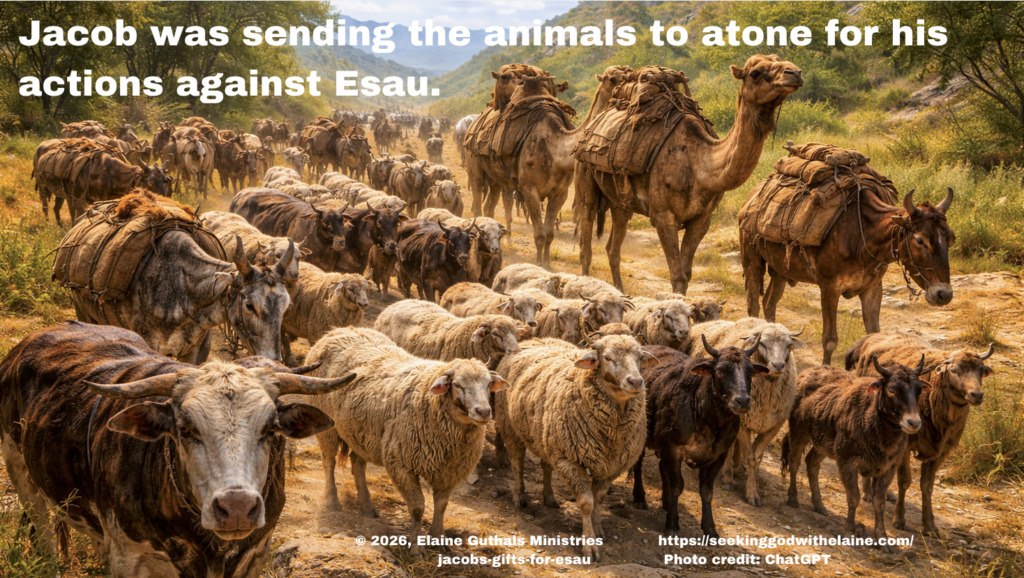
    “Jacob stayed where he was for the night. Then he selected these gifts from his possessions to present to his brother, Esau: 200 female goats, 20 male goats, 200 ewes, 20 rams, 30 female camels with their young, 40 cows, 10 bulls, 20 female donkeys, and 10 male donkeys. He divided these animals into herds and assigned each to different servants. Then he told his servants, ‘Go ahead of me with the animals, but keep some distance between the herds.’ He gave these instructions to the men leading the first group: ‘When my brother, Esau, meets you, he will ask, “Whose servants are you? Where are you going? Who owns these animals?” You must reply, “They belong to your servant Jacob, but they are a gift for his master Esau. Look, he is coming right behind us.”’ Jacob gave the same instructions to the second and third herdsmen and to all who followed behind the herds: ‘You must say the same thing to Esau when you meet him. And be sure to say, “Look, your servant Jacob is right behind us.”’ Jacob thought, ‘I will try to appease him by sending gifts ahead of me. When I see him in person, perhaps he will be friendly to me.’ So the gifts were sent on ahead, while Jacob himself spent that night in the camp” (Gen. 32: 13-21 NLT)

    These Gifts

    Jacob’s gift to Esau wasn’t a casual gift.

    We have to think about Jacob’s gift in his time. It was an Ancient Near Eastern custom to have sequential waves of gifts to soften a superior’s anger.

    But Ligonier.org thought this was an excessive gift. They argued that Jacob had already returned the stolen blessing (Gen. 25: 23; 27: 27–29) by calling Esau my lord. The author questions Jacob’s sincerity regarding the means he used to obtain the ends. Was he really sorry for how he gained the wealth?

    Resource

    Yes, Jacob is following the custom of the day – a pagan custom. Is he just trying to buy Esau’s favor and forgiveness?

    But that what Jacob is trying to do? I don’t think so.

    Several times in this passage, Jacob uses the Hebrew word minchah. The New Living Translation uses the word gifts.

    • “… Then he selected these gifts from his possessions to present to his brother, Esau” (Gen. 32: 13 NLT emphasis added).
    • “You must reply, ‘They belong to your servant Jacob, but they are a gift for his master Esau. Look, he is coming right behind us’” (Gen. 32: 18 NLT emphasis added).
    • “… Jacob thought, ‘I will try to appease him by sending gifts ahead of me …’” (Gen. 32: 20 NLT emphasis added).
    • “So the gifts were sent on ahead …” (Gen. 32: 21 NLT emphasis added).

    Why is this important? Look at Leviticus 2. In Hebrew, Bradford said the grain offering is called the Minchah. The Englishman’s Concordance used a slightly different spelling – except in the URL.

    Resources

    It wasn’t a gift or present. It was an offering.

    No, Jacob wasn’t trying to make Esau a god. He was atoning to his Sovereign God through restoring his relationship with his brother.

    “So if you are presenting a sacrifice at the altar in the Temple and you suddenly remember that someone has something against you, 24leave your sacrifice there at the altar. Go and be reconciled to that person. Then come and offer your sacrifice to God” (Mt. 5: 23-24 NLT).

    Can we make an argument that Jacob was combining the sacred and the pagan? Probably.

    Did Jacob go too far in trying to make amends with Esau? Maybe.

    Did Jehovah have a problem with this? Well, Moses didn’t say one way or the other.

    Divided These Animals

    Jacob presented the animals to Esau to secure peace.

    Jacob just didn’t willy-nilly give Esau the animals. He provided the servants to care for those animals.

    In other words, Jacob put some thought into it. This showed his sincerity.

    The way that Jacob sent them is waves is also an Ancient Near East custom when a servant was trying to appease a king. The sequential gifts in waves were meant to soften a superior’s anger.

    Instructions to the Men

    Jacob instructed the men what to say as the gift was from him.

    I am sure that Jacob picked men that were not only good livestock handlers but also ones who would carry out his instructions fully.

    The message was, “Tell Esau the animals are his, and that I’m coming.”

    Jacob Thought

    Jacob atoned for his sins against Esau.

    The Hebrew in verse 20 says kaphar panav. Kaphar means atone, pacify, or cover. Panav means his face. Taken together, it is talking about atoning for his presence.

    Resources

    I can see that. Jacob is asking Esau’s forgiveness upon returning (coming into his presence again) by giving him to animals to pacify his anger and atone for his sins.

    But the really telling thing is the root part of the word. It is the same root as atonement – kippur.

    Jacob’s intent was to have the herds and flocks function as a show of reconciliation. He did all that he could to turn aside his brother’s wrath and curry his favor. He was sending the animals to atone for his actions against Esau.

    Wasn’t that what Jehovah wanted? Jacob was the covenant son, not Esau. Rebekah knew that from before they were born (Gen. 25: 23).

    I say it again. The ends do not justify the means. Election does not excuse deception.

    So, Jacob needed to atone for his sins.

    To do this, instead of buying the blessing now, he was trying to repair the breach. That is how much he has grown.

    Crossing the Jabbok

    “During the night Jacob got up and took his two wives, his two servant wives, and his eleven sons and crossed the Jabbok River with them. After taking them to the other side, he sent over all his possessions” (Gen. 32: 22-23 NLT)

    Pass through the water can have significant meaning.

    Think about this – I hadn’t before.

    Jacob sent everyone ahead. He had to reenter Canaan by himself. He left alone; he had to come back alone.

    But it is more than that, isn’t it? Water.

    • Jacob, in this instance, is crossing the river.
    • Moses and the Israelites crossed the Red Sea (Ex. 14: 21-22).
    • Elijah crossed before his ascension (2 Kgs. 2: 8).

    Can we see this as a type of baptism? We’re getting to the spot where Jacob will have a new identity.

    Even in the Old Testament, Jehovah wanted the Hebrews and then the Israelites to become new creations. “This means that anyone who belongs to Christ has become a new person. The old life is gone; a new life has begun!” (II Cor. 5: 17 NLT).

    Making the Connections #1

    When Jacob crossed the Jabbok, he needed rescue from Esau. When he limped into the sunrise renamed Israel, he needed belonging – identity.

    Both were true within 24 hours.

    Who showed up? Angels surrounding Jacob to fulfill their purpose.

    We shouldn’t bite ourselves when our Sanctification Road takes swings like that.  We have angels guarding us, also.

    • “For he will order his angels to protect you wherever you go. They will hold you up with their hands so you won’t even hurt your foot on a stone” (Ps. 91: 11-12 NLT).
    • “Therefore, angels are only servants — spirits sent to care for people who will inherit salvation” (Heb. 1: 14 NLT).
    • “For the angel of the Lord is a guard; he surrounds and defends all who fear him” (Ps. 34: 7 NLT).

    Look what Spurgeon said. He wrote,

    “When God means to deliver you, beloved, in the hour of danger, you will find the appointed force ready for your [succor]. God’s messengers are neither behind nor before their time; they will meet us to the inch and to the second in the time of need; therefore let us proceed without fear, like Jacob, going on our way even though an Esau with a band of desperadoes should block up the road.”

    Resource

    This is but one way Jehovah provides for us. It is but one way that He is always with us.

    Making the Connections #2

    I like what Ligonier.org said about why Jacob was fearful. We tend to think fear and anxiety should be washed away in the baptismal waters. Wrong.

    “Fear remains a factor among God’s chosen. True, fearfulness is not ideal, and some biblical heroes seem to fear nothing (see Dan. 6, for example). Yet until we are glorified, we will battle the flesh (Rom. 6:12–14). ‘Perfect love casts out fear’ (1 John 4:18), but love, faith, and hope (1 Cor. 13:13) will not be perfected in us until that final day (1 John 3:2). Christ destroyed sin’s power (Rom. 8:2), but its presence remains; thus, fear often colors our faith, hope, and love.”

    Resource

    How many times do verses start out with “Don’t be afraid”? No, it isn’t 365 times. That is a nice thought, but not true.

    It is a part of many of our Sanctification Roads that we turn from fear to trust. We van do this as our faith in and love for Jehovah grows.

    That is going to be a struggle for us until we are called home.

    Listen to this song by John Reddick. It has a good message about not fearing.

    Related Links

    John Reddick

    How Do We Apply This?

    • Realize our past sins will come up if we have not repented of and/or confronted them.
    • Meet difficulties with prayer.

    Resource

    Father God. You don’t want us to have conflicts with others, especially our family. But Yeshua knew that would happen (Lk. 12: 51-53; Mt. 10: 34-36). Help us be grounded in our faith in You so that we can witness to our families for You. Amen.

    If you don’t understand something and would like further clarification, please contact me.

    If you have not signed up for the email providing the link to the devotions and the newsletter, do so below.

    If God has used this devotion to speak with you, consider sharing it on social media.
  • Jacob and Esau on a Collision Course

    With Jacob on the way home from Paddan-aram, we know he is going to run into Esau sooner or later. This devotional reading looks at what happened when Jacob knew Esau was coming.

    Nuggets

    • Jacob again encountered Jehovah’s messengers.
    • Jacob made contact with Esau according to custom.
    • Esau was already on his way.
    • Jacob’s reaction was to divide into two camps.
    • Jacob finally put his situation in God’s hands.
    • We have to acknowledge Jehovah’s sovereignty and appealed to the Maker of the covenant.
    • We need to keep ourselves humble before Jehovah and express our need for Him.
    • Jacob knew his petitions would be answered because he knew he could count on Jehovah’s mercies.
    • We have to claim Jehovah’s promises with us and assure Him that they are at the forefront of our minds.
    jacob-and-esau-on-a-collision-course

    The morning after Jacob and Laban made their covenant, Laban kissed his daughters and grandchildren and left. We do not hear about him again.

    Jacob was ready to move on, too.  He may no longer have totally feared Laban, but he was his rearview mirror.

    Esau, who would have been a fiercer enemy than Laban, was in his windshield. They had parted with a rocky relationship.

    Had Esau made his peace, or did Jacob still need to be on his toes?

    Let’s Put It into Context

    To read devotions in the Creating Everything theme, click the button below.

    Devotions in the Jacob the Patriarch series

    The Angels at Mahanaim

    “As Jacob started on his way again, angels of God came to meet him. When Jacob saw them, he exclaimed, ‘This is God’s camp!’ So he named the place Mahanaim” (Gen. 32: 1-2 NLT)

    Jacob again encountered Jehovah’s messengers.

    To begin Genesis 32, we have another encounter with angels. That is what all Hebrew translations I’ve found calls the beings we see in Genesis 32: 1.

    Both the Greek and Hebrew words mean messenger. The Greek is angelos where the Hebrew word is malake.

    Resource

    The problem I have with the Greek translation is that deities and mythological figures in Greek culture also were associated with angels. It would have been easy for them to bring that worldview image into their spiritual lives.

    The reality is that we aren’t told how Jehovah’s messengers look. Wings? Who knows? Halos? Doesn’t say. Young, old, strong, swift? Your guess is as good as mine – and it would be a guess.

    You know, we said a while back that everyone but Abraham was afraid when they saw angels. I think we need to add Jacob to that list of being unafraid.

    Go back to Bethel on the trip to Paddan-aram (Gen. 28: 12). Jacob saw angels in his dream. He could have written that off as a … dream. He didn’t. He accepted it as a real conversation with Jehovah.

    No, this wasn’t a dream. This was a wide-awake, I-can-see-you experience.

    The messengers met Jacob where he was in his walk.

    Think of it this way. Just as Jacob was leaving Canaan, he had a visit. Now that he was reentering, he gets another visit. Jehovah is not only with us in the day-to-day walk but also in the transitions.

    Here, Jacob recognized them for what they were. We don’t know the express reason for their visit, but I think we can take a good stab at it with Leale’s help.

    We are told in verse 2 that Jacob named the place the visitation occurred. Names are important in Scripture, even names of places. Mahanaim means two camps.

    Leale thought that name came from the unknown number of messengers splitting up and going before and after Jacob.

    Resource

    Can we spell escort and legitimacy even in the unsettling?

    To me, it sounds like a squadron of messengers. When Jacob called the place Mahanaim, it was military language. I would say it had to be enough to give Jacob that impression.

    It may have been an acknowledgement that Jacob was at a different place in his relationship with God than he was when he left Canaan 20 years before.

    But it also brings up a very good point. Our loving Father will come to meet us where we are with what we need.

    Once again, Jacob had an encounter with the unseen world.

    The Esau Crisis

    “Then Jacob sent messengers ahead to his brother, Esau, who was living in the region of Seir in the land of Edom. He told them, ‘Give this message to my master Esau: “Humble greetings from your servant Jacob. Until now I have been living with Uncle Laban, and now I own cattle, donkeys, flocks of sheep and goats, and many servants, both men and women. I have sent these messengers to inform my lord of my coming, hoping that you will be friendly to me.”’ After delivering the message, the messengers returned to Jacob and reported, “We met your brother, Esau, and he is already on his way to meet you — with an army of 400 men!” Jacob was terrified at the news. He divided his household, along with the flocks and herds and camels, into two groups. He thought, ‘If Esau meets one group and attacks it, perhaps the other group can escape’” (Gen. 32: 3-8 NLT)

    Jacob Sent Messengers Ahead

    Jacob made contact with Esau according to custom.

    Jacob wasn’t sure what kind of reception he was going to get from Esau. When he had left those twenty years before, Jacob had to high tail it out of there because he thought Esau was going to kill him.

    Now, Jacob was coming home an influential man. He has all these wives, kids, servants, flocks, and herds that were coming with him.

    But Jacob couldn’t know if Esau was still steamed about the birthright and blessing theft. Oh, yeah. Esau made the choice to sell him his birthright, but it wasn’t something really Jacob should have approached.

    Jacob approached this correctly, though. He didn’t blindside Esau — he gave him fair warning.

    Jacob used very deferential language in his message to Esau. He called Esau my lord. He said he was his servant.

    We may think listing his wealth meant Jacob was trying to be a show-off. That is far from the truth.

    It was an Ancient Near Eastern custom to declare wealth to establish a peaceful intent. I mean, how many times have we heard of raiding parties listing their assets?

    Esau and His Army Is Already on His Way

    Esau was already on his way.

    Esau’s response? Jacob’s messengers weren’t even back before Esau had started out.

    Moving with enough to break into two camps probably meant they weren’t moving stealthily. Esau probably had warning someone was coming.

    Or did Jehovah tell Esau to come meet Jacob? He knew this issue had to be settled.

    Whichever way, it sure sounded like a war party to Jacob. That was a show of strength.

    Jacob didn’t wait for anything. Immediately upon hearing of Esau’s threat, Jacob acted.

    Does this show Jacob has retained a measure of his planning and scheming? Well, he should.

    Jehovah is an organized God. He runs on plans. So should we.

    We do have to calculate the consequences of our actions — both good and bad. That must be factored into our decision-making process.

    But what about the scheming? Sometimes, we may have to make plans in secret, but they shouldn’t be underhanded.

    In the end, Jacob wronged his brother by his suspicions that Esau was coming to take revenge.

    Yare’ means afraid, coming from the root word yira meaning to fear. Tsar means distressed.

    This wasn’t just external pressure. It was an internal panic.

    Wouldn’t we have had the same feelings as Jacob? He sent servants. Esau sent soldiers.

    Jacob Divided His Household

    Jacob’s reaction was to divide into two camps.

    Yeah, go back to verse 1 and 2. That was two camps, also; but that wasn’t out of fear.

    This – even with the escort of the messengers – was done out of fear.

    Ooo, baby. Can’t things of this world really scare us at times? Sometimes, it is just a gut reaction.

    Dividing into two camps wasn’t a show that Jehovah could not protect him. Jacob was saying he was going to do everything is his power to protect what Jehovah gave him.

    The dividing came out if responsibility. Jacob had a responsibility to his family to provide for their safety. In this case, he succeeded.

    It was stewardship. True, he should have said the prayer before he did the dividing. Was he afraid he didn’t have time?

    Gray had a good point. He wrote, “It must have been a huge company at the first, for him to think, after the message he sent (vers. 4, 5), that his brother would imagine the half was all he had.”

    Resource

    Jacob’s second step was to pray.

    Jacob’s Prayer

    “Then Jacob prayed, ‘O God of my grandfather Abraham, and God of my father, Isaac — O Lord, you told me, “Return to your own land and to your relatives.” And you promised me, “I will treat you kindly.”  I am not worthy of all the unfailing love and faithfulness you have shown to me, your servant. When I left home and crossed the Jordan River, I owned nothing except a walking stick. Now my household fills two large camps!  O Lord, please rescue me from the hand of my brother, Esau. I am afraid that he is coming to attack me, along with my wives and children. But you promised me, “I will surely treat you kindly, and I will multiply your descendants until they become as numerous as the sands along the seashore — too many to count”’” (Gen. 32: 9-12 NLT)

    Jacob Prayed

    Jacob finally put his situation in God’s hands.

    We get the first recorded prayer from Jacob in this chapter. Craig told us that gave us a good picture of his heart. He also called it a real prayer.

    Resource

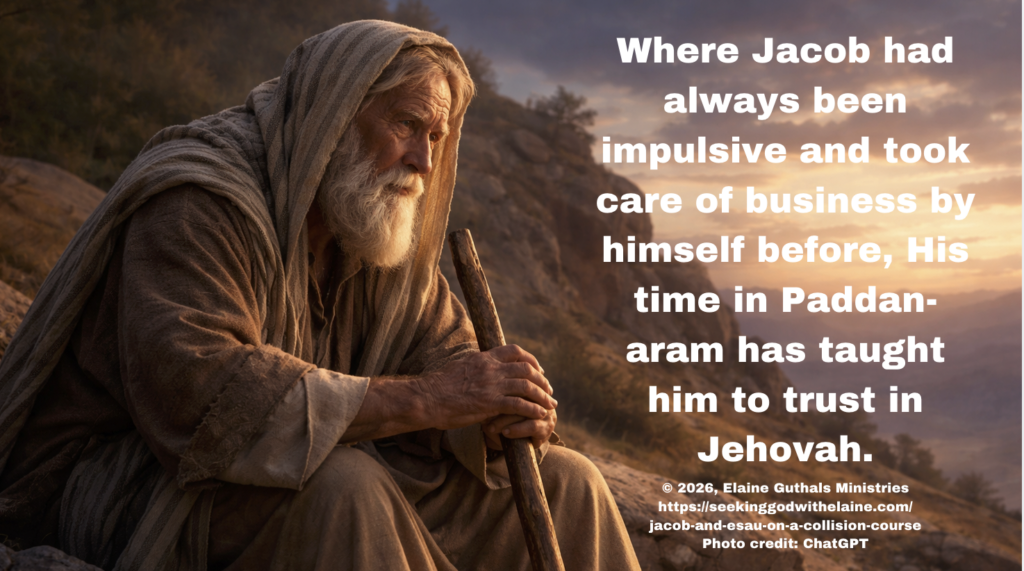
    Where Jacob had always been impulsive and took care of business by himself before, His time in Paddan-aram has taught him to trust in Jehovah.

    Jacob did ask Jehovah to bless his plan. Good thing that was His plan all along. What Jacob lost doing it this way was peace.

    Yeah, Jacob knew the messengers were there and would protect him. But the threat was real, not something to be ignored.

    And doesn’t that tell us something? Jehovah answered the prayer before Jacob prayed it. So, no. Jacob didn’t necessarily get the order wrong.

    Jacob started his prayer out by telling Jehovah what circumstances he was in. Because Jehovah didn’t know? No!

    We pray to align our will with Jehovah’s. We have to tell Him where we are at now, even if it is afraid and distressed.

    I see you jumping up and down over there. You think we aren’t supposed to feel anxious. “Don’t worry about anything; instead, pray about everything” (Phil. 4: 6 NLT).

    Merimnate, the Greek word used, is translated several different ways in English. Don’t worry. Don’t be anxious. Take no thought. Be careful.

    Resource

    Not feeling anxious isn’t going to happen. It is human nature.

    I take this as, “Don’t keep worrying and feeling anxious. Start praying. He’s got this.”

    O God

    We have to acknowledge Jehovah’s sovereignty and appealed to the Maker of the covenant.

    Part of us may look at “… ‘O God of my grandfather Abraham, and God of my father, Isaac …’” (Gen. 32: 9 NLT) and think, “Why didn’t he say, ‘Where is my God?’”

    No, Jacob wasn’t backsliding. He was making a covenant appeal.

    Jackson acknowledged that Jacob was addressing Sovereign God’s presence in his family’s past. He was hooking into his family’s past obedience to help grow his faith.

    Resource

    This wasn’t just about Jacob. It was about the promises Jehovah made to Abraham and Isaac. He promised a relationship with them – and carried that on to Jacob.

    This was a don’t-leave-me-now plea.

    But this is also about Jacob’s obedience. “You told me to come home, and I came. You said You would work things out. This is a big thing only You can work out.”

    I Am not Worthy

    We need to keep ourselves humble before Jehovah and express our need for Him.

    How do we know Jacob was making a covenant appeal? “I am not worthy of all the unfailing love and faithfulness you have shown to me, your servant …” (Gen. 32: 10 NLT). Then he said, “But You promised.”

    Think again of leaving and returning to Canaan. Jacob left with a staff. He was a cheater and liar. We would think that would disqualify him from being a man of faith.

    Jehovah doesn’t. What made Jacob — and us — God’s people, His children, is our acknowledgment that we need Him and His saving grace.

    We have to admit that we cannot save ourselves. Only belief in Jesus can do that.

    The foundation of our belief must be our recognizing Sovereign God’s love and faithfulness to us. All we have to do is to submit to Him. What that means is we follow His laws and commandments.

    Now, Jacob returned with wives, children, flocks, herds, camels – enough for two camps.

    More importantly, Jacob has fixed his relationship with His Creator. The deceiver had been humbled. The Hebrew word is qatonti — I have become small.

    That humility is exactly what Jehovah wants.

    On top of that, this follows the classic covenant prayer structure.

    In this prayer, Jacob also acknowledged everything that Jehovah had given him. He gave him enough to divide into two companies, each of which looked big enough to be all he had.

    Please Rescue Me

    Jacob knew his petitions would be answered because he knew he could count on Jehovah’s mercies.

    Jacob asked Jehovah to “… rescue me from the hand of my brother, Esau …” (Gen. 32: 11 NLT).

    Don’t we hate it when our peaceful gestures are met with hostility?

    Let’s step back a second. What was Jacob feeling?

    There was fear. This time, Esau had the army to do him the bodily hard that he had threatened.

    There was the guilt. Now, Jacob now fully admitted he was guilty. He would take responsibility for his actions.

    But there are other responsibilities. He has a wife, children, servants, and livestock. What would Esau and his vengeance do about those lives?

    Now, there was humility.

    We can’t miss one very important aspect of Jacob’s prayer. We have to ask Jehovah what we want Him to do.

    Yes, that was going to be the way the prayer was answered because this was a covenant prayer. But we have to ask that Sovereign God’s Will be done.

    This is how we align with that Will.

    You Promised Me

    We have to claim Jehovah’s promises with us and assure Him that they are at the forefront of our minds.

    Does it seem arrogant to give Jehovah’s words right back to Him? No. We show we are listening and expect Him to keep His promises.

    Jehovah wants us to quote Scripture and promises back to Him. Through these prayers is one way He will broaden our understanding of them.

    Making the Connections #1

    I loved what Spurgeon said. He wrote,

    “He was leaving Laban and the school of all those tricks of bargaining and bartering which belong to the ungodly world. By a desperate stroke he cut himself clear of entanglements; but he must have felt lonely, and as one cast adrift. He missed all the associations of the old house of Mesopotamia, which, despite its annoyances, was his home. The angels come to congratulate him. Their presence said, ‘You are come to this land to be a stranger and sojourner with God, as all your fathers were. We have, some of us, talked with Abraham, again and again, and we are now coming to smile on you. You recollect how we bade you good-bye that night, when you had a stone for your pillow at Bethel; now you have come back to the reserved inheritance, over which we are set as guardians, and we have come to salute you. Take up the nonconforming life without fear, for we are with you. Welcome I welcome I we are glad to receive you under our special care.’”

    Resource

    Jehovah and his messengers know when we have given up a previous life to be obedient to Him. They know when that gives us a queasy tummy.

    They are right there to encourage, protect, and guide us.

    Did Jacob need a reminder about Bethel, as Spurgeon questioned? Maybe. Jehovah and His messengers were right there for that, too.

    Making the Connections #2

    Vaughan gave us a good description of a messenger’s job description.

    • Ministering spirits to the heirs of salvation.
    • Perform the tasks given to them by Jehovah.
    • Listen to what Sovereign God said in His Word.

    Resource

    What they don’t do is just sit there and worship Jehovah all day. They have tasks to do.

    Making the Connections #3

    Doesn’t the twins’ actions show the still-present differences in their characters? “As the boys grew up, Esau became a skillful hunter. He was an outdoorsman, but Jacob had a quiet temperament, preferring to stay home” (Gen. 25: 27 NLT).

    Jacob was still with his family, and Esau was still displaying his physical strength and skills.

    How Do We Apply This?

    • Advance when Jehovah calls us to advance.
    • Move in the way Jehovah commands.
    • Acknowledge received blessings.
    • Pray when obeying Jehovah’s directions.
    • Take care of what Jehovah has given us.

    Resources

    Father God. We know that You will protect us. Forgive us when we take our eyes off you and focus on the coming trouble. Amen.

    If you don’t understand something and would like further clarification, please contact me.

    If you have not signed up for the email providing the link to the devotions and the newsletter, do so below.

    If God has used this devotion to speak with you, consider sharing it on social media.
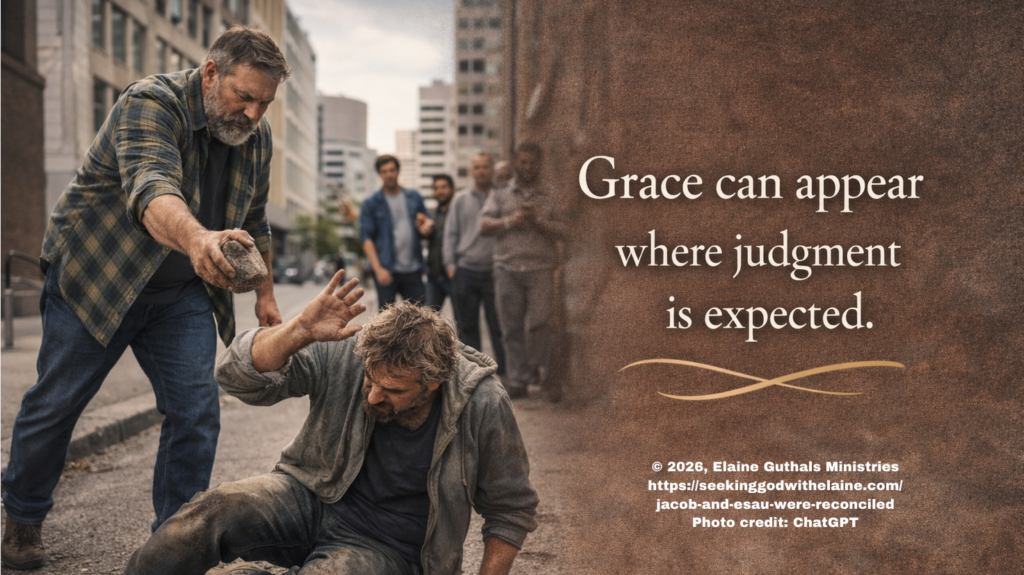
  • God through the Struggles

    God will always lead us through the struggles that we go through. This daily devotional looks at turning the corner after a year of struggles.

    Hey, guys. I need to take a day, today. So, I am just going to talk to you. (No, it has nothing to do with health issues.)

    There is a lot of things going on today (July 11) that is bringing up a lot of feels.

    Do you realize that tomorrow (July 12) has been a year since Pastor Chad was called home to be with the Lord? I know I used a lot of what he said in these devotions. The last thing I used has a story behind it.

    We were having church on the parking lot. Pastor Chad loved it because he was able to be in his shorts and sandals. What came out of his mouth was pure gold.

    It just came out as an 89-word sentence. So, I texted him I was using it with a few edits. He laughed. Here it is.
    
“Each and every one of us, through the power of the gospel message, have the ability to bring change in this world because, by just simply speaking the gospel, introducing people to God through His Word, people will come to know Him, and peoples’ lives will be transformed. Once you’ve had an encounter with Christ, your life will be transformed. We understand that, if we can introduce people to Christ and they can come to be saved, then the problems of this world will seem like bygone issues.”

    That will always be how I remember Pastor Chad. Witness. Transform. Pass on what we have. Make an impact. Make the world better.

    Each and every one of us. Every one of us is a witness for God. We are all to tell at least one other person (hopefully more) about our loving Savior. We can do this.

    It isn’t in our own power. It is through the power of the gospel message. It is through God’s power. Why? Because it is all about Him. There is nothing about us.

    Yes, we have the ability. Can you talk to your child/spouse/parent/sibling/family member/coworker/friend/neighbor? If you can say hello to them, the answer must be yes.

    We should introduce people to God two different ways. One should be a personal introduction.

    You have at least one story you can tell them, your salvation story. You probably have at least one more where God pulled you through some trial.

    The other way we introduce people to God should be through His Word. I know. This is where we think it trips us up. We don’t think we know it well enough.

    Learn it.

    I am not sure I could memorize passages anymore, but I better know what it says and where to find it or how to Google it.

    But that is what we are supposed to be doing when we are seeking God, isn’t it?

    Searching for and Seeking God

    Hearing His Word (Rom. 10: 17).
    Reading His Word (Rev. 1: 3).
    Praying to Him (Heb. 4: 16).
    Studying His Word (Ac. 17: 11).
    Meditating on His Word (Ps. 1: 1-2).
    Memorizing His Word (Ps. 119: 11).

    Pastor Chad wanted us to transform our lives. I – and he would – want you to transform yours.

    This year has been rough, but I think, as a church, we are in a good place. We held together. We didn’t splinter.

    Now, we have to turn a corner we never thought we would be turning but need to turn anyway.

    On July 12, Mrs. Pastor Chad and their three boys are moving two states away to be with her family.

    • Pray for comfort on a difficult day.
    • Pray for safety on a long trip.
    • Pray for love and patience as they build their new normal.
    • Pray for faith for whatever comes their way.
    • Pray for a life of serving God wherever He leads them.

    Also on July 12, our new pastor will start. Pastor Joey has taped some announcements and a prayer for our services but will start full time tomorrow.

    I am sure you will be hearing what Pastor Joey has to say, too.

    • Pray for Pastor Joey and his family as they make this transition.
    • Pray for Pastor Joey, Pastor Chris, and the staff as they form a team to do the work God has for them.
    • Pray for the congregation to be loving and accepting and not look at it as Pastor Joey having big shoes to fill.
    • Pray for rest for Pastor Tim and Pastor John after leading us as well as doing their day jobs.

    Pastor John had a lot of good things to say today. I needed to hear them. Maybe they can help you.

    • Having struggles doesn’t mean there is a problem with our faith.
    • God permits what He hates to accomplish what He loves.
    • What He loves is making His children into the image of His Son.
    • If we don’t become like Christ, we’ve lost.
    • Struggles do not mean we are alone; struggles mean God is at work.
    • God is for us. Who is against us? The answer is not nobody. The answer is it doesn’t matter.

    Pastor John also said something that is a little different than what I say. He was talking about Romans 8: 28. “We know that all things work together for the good of those who love God, who are called according to his purpose” (Rom. 8: 28 CSB).

    I have always said that didn’t mean we were assured a prosperity gospel. I thought it meant that the benefit would be to God’s kingdom — therefore benefiting us.

    Pastor John said, no. The good meant that God’s purpose is to make us in the image of His Son.

    Well, that benefits God’s kingdom, but it is very personal. I like that.

    God takes us through the deepest waters and brings us to the other side. He brings us to Him, changing us to be like Him.

    Father God. Your plans for us are perfect. Sometimes, they are hard and definitely not what we would have chosen. You have Your reasons, and You have it all worked out. It may be years before this tapestry is woven. Give us faith and patience to live in obedience. Just as You have sheltered us in the palm of Your hand for the past year, continue to do so, especially during this next week of change. We look to You, Lord. Amen.

    GodThroughOurStrugglesPin

    What do you think?

    Leave me a comment below (about this or anything else) or head over to my Facebook group for some interactive discussion.

    If you don’t understand something and would like further clarification, please contact me.

    If you have not signed up for the email daily or weekly providing the link to the devotions and the newsletter, do so below.

    If God has used this devotion to speak with you, consider sharing it on social media.
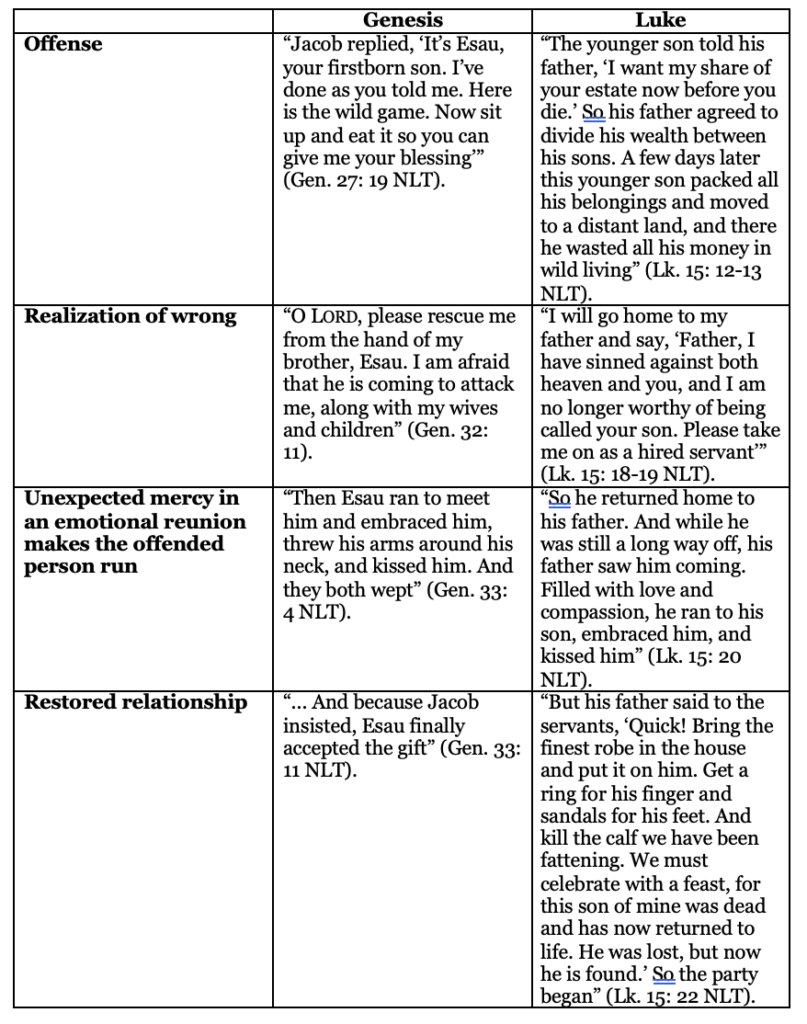
  • Sometimes, War Is Judgment

    We can’t avoid all war because it is sometimes God’s judgment. This devotion looks at how He uses war to punish us for breaking His laws and commandments.

    Nuggets

    • God’s turning against Israel had huge consequences.
    • The Israelites were going to try to defend themselves, but fight turned into flight.
    • One passage said that the enemies wouldn’t be a nation but marauders.

    Devotions in the What I Believe series

    Devotions in the Peace and War category

    Flowers with title Sometimes, War Is Judgment

    We talked in the last devotion about how we can sometimes avoid war. Sometimes, we can’t because it is judgment from God.

    Let’s Put It into Context #1

    I am entitling this category Peace and War – but we are only going to touch on the peace as being the opposite of war.

    I am doing this because we have had many discussions about peace. We’ve said peace is an inward tranquility resulting from a balanced life with spiritual order, equity, and truth.

    Glossary

    War, according to the Merriam-Webster Dictionary, is “a state of usually open and declared armed hostile conflict between states or nations.”

    Resource

    Let’s Put It into Context #2

    Apostasy means not believing in the state religion or not being a Christian. Apostasy is fixed by conversion and sanctification. Sanctification is the transformation of mind, body, and soul beginning with regeneration and ending with perfected state of spiritual wholeness or completeness.

    Glossary

    We have to be careful – even as disciples that we fully believe in God’s sovereignty. We can’t be lured into apostasy by the worldview.

    Apostasy isn’t just the unpardonable sin. The unpardonable sin is the one sin that God cannot forgive – unbelief in God. Jellie warned that it could be progressive.

    Glossary

    Resource

    We get to apostasy when we don’t hearken and don’t do as God commands us to do. Hearken has the following characteristics: duty, gratitude, ritual, and eager and fervent attention. In Elaine-speak, we just don’t listen.

    If we don’t listen, we don’t do – whatever we are supposed to do. We don’t follow God’s laws and commandments. We ignore what He is trying to teach us. We don’t do what He is calling us to do.

    To read a related devotion, click the button below.

    This is a full spiritual rebellion. We are breaking His covenant.

    Glossary

    Let’s Put It into Context #3

    “I have abandoned my house; I have deserted my inheritance. I have handed the love of my life over to her enemies” (Jer. 12: 7 CSB)

    Some see God only as a loving God. True, “… God is love” (I Jn. 4: 8 NIV).

    We can’t forget God’s wrath. We’ve talked about it several times.

    Glossary

    God’s wrath comes out of His nature because of the need to maintain order. God’s anger is used to help get us back on His track.

    God’s wrath should not be minimized. Scriptures say that “… our God is a consuming fire.” (Heb. 12: 29 CSB). Consuming. Not a nice little candle flame. A raging fire consuming. That should make us think twice before we disrespect Him.

    God Turns Against Us

    “I will turn against you, so that you will be defeated by your enemies. Those who hate you will rule over you, and you will flee even though no one is pursuing you.” (Lev. 26: 17 CSB)

    “I will reduce your cities to ruins and devastate your sanctuaries. I will not smell the pleasing aroma of your sacrifices. I also will devastate the land, so that your enemies who come to live there will be appalled by it. But I will scatter you among the nations, and I will draw a sword to chase after you. So your land will become desolate, and your cities will become ruins” (Lev. 26: 31-33 CSB)

    What? We expect us to turn against God – and He does nothing? It doesn’t work that way.

    God’s turning against Israel had huge consequences. Their freedom would be taken away from them as they would be defeated by their enemies.

    Not just any enemies, either. They would be subordinate to “… those who hate you …” (Lev. 26: 17 CSB).

    That tells me a couple of things. They have a history because – usually – we don’t get to hate upon first introduction.

    If someone hates us that much, human nature means we aren’t really too fond of them, either. Yeah, we could say that we probably hate them, too.

    The Israelites sinned – and continued to sin. Oh, they could have confessed their sins and repented. Repentance is expressing sorrow for breaking God’s laws and commandments by making the commitment to changing ourselves through obedience so that we no longer do the wrong things.

    But they didn’t. Look what other consequences will be felt.

    • Destroy your cities (Lev. 26: 31 CSB)
    • Destroy your sanctuaries (Lev. 26: 31 CSB)
    • Refuse your sacrifices (Lev. 26: 31 CSB)
    • Devastate the land (Lev. 26: 32 CSB)
    • Be overrun by your enemies (Lev. 26: 32 CSB)
    • Scatter you among the nations (Lev. 26: 33 CSB)
    • Continue to pursue you (Lev. 26: 33 CSB)

    It doesn’t sound like a fun time, does it? God was fixing to ruin them.

    Oh, the passage goes on and on about what God is going to do to ruin them. We get the gist. You can read the whole passage by clicking on the link below.

    Resource

    Think of it this way. Their homes were going to be trashed. Where they would go for sanctuary was going to be trashed.

    They had nowhere to go. There was nowhere to run.

    They were going to have to stand and take their punishment.

    And this punishment was going to last for years. The land was going to be trashed. It was going to take a while for it to come back.

    What are the results of sin? Disease and suffering. “Then I will do this to you: I will bring terror on you — wasting disease and fever that will cause your eyes to fail and your life to ebb away …” (Lev. 26: 16). God can bring the results on Himself or use others to mete out the results.

    Fight and Flight

    “The Lord will cause you to be defeated before your enemies. You will march out against them from one direction but flee from them in seven directions. You will be an object of horror to all the kingdoms of the earth. Your corpses will be food for all the birds of the sky and the wild animals of the earth, with no one to scare them away” (Deut. 28: 25-26 CSB)

    This passage was interesting to me. The Israelites were going to try to defend themselves. That is just human nature. Fight is probably going to lead.

    But flight is going to take over. They were – and we are – going to try to run away.

    You see, we can’t fight God. We think we can.

    There is no way we are going to defeat God. Satan isn’t either. That ending has already been written. Check out the end of Revelation.

    Look what this passage adds to the list of consequences.

    • Derision of others (Deut. 28: 25)
    • Become bird and animal food (Deut. 28: 26 CSB)

    That means they were dead.

    Sky

    Marauders

    “The Lord’s anger burned against Israel, and he handed them over to marauders who raided them. He sold them to the enemies around them, and they could no longer resist their enemies” (Judg. 2: 14 CSB)

    Maclaren saw this passage as a summary of the Book of Judges. Well, longer than that, really.

    Israel would sin. God would release His wrath. They would repent. Things would be okay for a little bit.

    Resource

    I thought it interesting in this passage that the enemies wouldn’t be a nation but marauders. To me, that means it would be like guerrilla warfare style.

    Hmmm. How many ways could that play out today? Our countries can be war zones even though we aren’t at war with another country.

    Did you catch the anger burned and handed over? It doesn’t sound like too much time transpired between the two.

    One thing we can’t forget is that God loved the Israelites. Still does.

    What they did or didn’t do didn’t change God’s love for them. If He didn’t love the Israelites, He would judge them.

    People

    Making the Connections

    We might be asking why God is judging a nation for the actions of a few. Foster made an interesting observation. He wrote, “There is an amazing tendency in communities to commit the same sins … Every nation, every city, has its characteristic virtues, its characteristic sins.”

    Resource

    Ooo, baby. Didn’t Foster hit that nail on the head? It isn’t just a few. It is most.

    We don’t just limit it to cities and nations, do we? I know of one university that has the label of the Party University.

    We tend to congregate with like-minded people. If you were into fencing, would you really be hanging around with someone into football?

    Yes, it is probably a safe bet that some of the Israelites kept God’s laws and commandments. He has said that there will always be a remnant.

    They had to endure the consequences of the sins of the nation.

    I just want to pull out Leviticus 26: 35. “As long as it lies desolate, it will have the rest it did not have during your Sabbaths when you lived there (Lev. 26: 35 CSB). How quickly did the world start to come back after this plague hit when we were in lockdown and not abusing it? It started to right itself quickly.

    I see this as different. We’re talking devastation of war here. Bombs, missiles, bullets, etc. They are going to destroy the environment like the plague never did.

    Making the Connections to Self-Discipline

    We’ve brought up a couple of concepts that non-believers might question when we are witnessing to them.

    • How can a loving God bring judgment?
    • Why do true disciples feel the judgment along with those breaking His laws and commandments?

    We’ve been looking at defending our beliefs when we are witnessing. That means we have to be secure enough to convince someone to accept our beliefs.

    Our questions should still serve us to determine on what we need to focus.

    • What does the Scriptures say?
    • What do I believe?
    • Why do I believe the same/differently than the Scriptures?
    • What are the talking points when witnessing to a non-believer?

    Related Links

    I have created a worksheet of the questions above. Click on the button below to access it.

    How Do We Apply This?

    Why did all of this happen? Because God got a wild hair and decided to destroy His people?

    No. Their sin brought these consequences on them. They did it to themselves.

    Henry stressed that “God had provided sacrifices for these; not the sins they repented of and forsook, but sins presumptuously committed and obstinately persisted in.”

    Resource

    They had a chance to repent. They repented of some but not all. They kept committing those of which they didn’t repent.

    We can’t think that we can get by if we just repent of some things. We have to repent of all sins.

    They didn’t submit to God’s authority over them. They didn’t follow His laws and commandments. They held them in contempt. They didn’t think He had the authority to judge them. They broke His covenant.

    Sound familiar?

    We need to make sure we are following God’s laws and commandments.

    In His perfect timing, God will judge those who are breaking His laws and commandments. He will judge nations as well as people. He will just us.

    Father. We praise You, Lord, because Your laws and commandments show us Your love. Too many times, we break them. Too many times when we break them, we don’t repent. Lord, forgive us of our sins. Amen.

    What do you think?

    Leave me a comment below (about this or anything else) or head over to my Facebook group for some interactive discussion.

    If you don’t understand something and would like further clarification, please contact me.

    If you have not signed up for the email daily or weekly providing the link to the devotions and the newsletter, do so below.

    If God has used this devotion to speak with you, consider sharing it on social media.
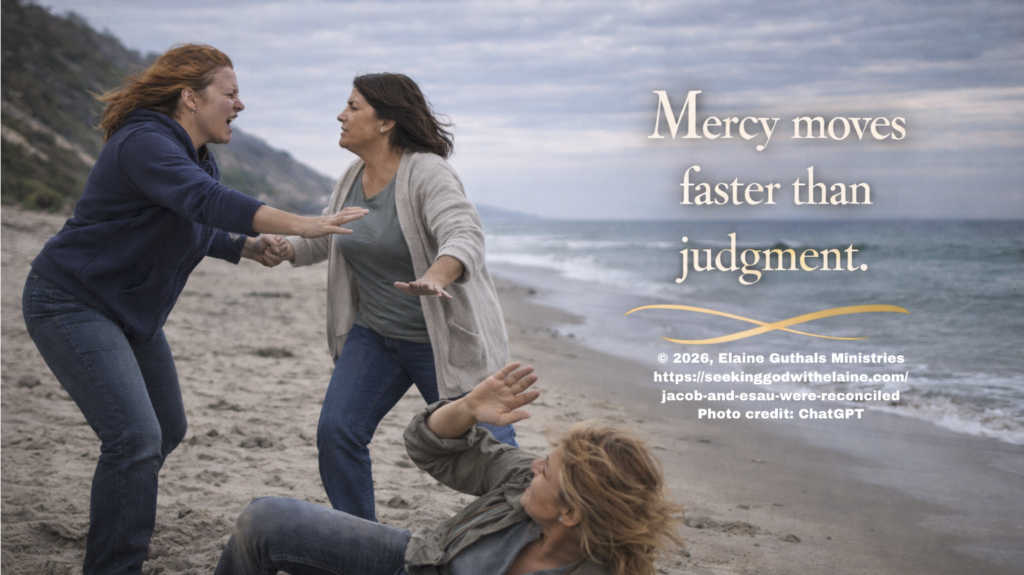
  • How Should We Handle God’s Discipline?

    After looking at rewards for obedience, Solomon turns to discipline for disobedience. This devotion looks at what our attitude should be when God send discipline in the form of trials our way.

    Nuggets

    • We aren’t supposed to despise it when God corrects us.
    • Because God is using the corrections to grow us, we shouldn’t be overwhelmed by them.
    • God discipline us because He love us.
    Flowes with title How Should We Handle God's Discipline?

    No one likes the trials that God sends us. Sometimes, these trials are sent to discipline us.

    They are not fun, but they are needed to help us grow to imitate God.

    Let’s Put It into Context

    “Honor the Lord with your possessions and with the first produce of your entire harvest; then your barns will be completely filled, and your vats will overflow with new wine” (Prov. 3: 9-10 CSB)

    Solomon had just given ten verses on how God rewards faithfulness. One of the verses we said looked like it could be the poster child for the prosperity gospel.

    The rest of the verses focus on remembering not only God’s laws and commandments, but also his love for us. Out goal is to strengthen our relationship with Him so that He will completely fill and overflow us by making us godly, holy, and righteous.

    To read a related devotion, click the appropriate button below.

    Then Solomon did a quick turnaround in verses 11 and 12. We go from rewards to discipline in the form of trials.

    But think about it. Solomon told us that we would be rewarded for obedience. He was now telling us that disobedience would be disciplined. Doesn’t that follow?

    Not Liking Discipline

    “Do not despise the Lord’s instruction, my son, and do not loathe his discipline” (Prov. 3: 11 CSB)

    We aren’t supposed to despise it when God corrects us.

    Seriously? But that will hurt, won’t it? We don’t like to hurt.

    Also, we don’t like having our decisions questioned, at a minimum, or being told we are downright wrong, at a maximum. We like having control of our own lives.

    Those disciplines usually come in the form of trials. The opposite of despising the trials is peacefulness. That is what we want, instead.

    Spencer contended that this passage has practical wisdom for disciples on their walks. He wrote, “It has reference to those dealings of God with men which have a stern and severe aspect, which are in themselves painful and unwelcome, and under which the human soul cannot well be satisfied or sustained aside from the two considerations, first, that they are the appointments of God, and second, that they are designed to be instrumental of our good.”

    One of Spencer’s advice was to view most trials as disciplinary actions from God. We know God does correct us when we sin. “For the LORD disciplines those he loves, and he punishes each one he accepts as his child” (Heb. 12: 6 NLT). Bryce seems to agree with that opinion, as he wrote that life in part is disciplinary.

    Yes, God uses trials to discipline us, and they do closely follow when we have sinned. No, He doesn’t especially like it, but He does it.

    But not all trials are discipline. Remember when Jesus addressed this? The disciples were asking why a man was blind. “‘It was not because of his sins or his parents’ sins,’ Jesus answered. ‘This happened so the power of God could be seen in him.’” (Jn. 9: 3 NLT). Some trials are God testing us.

    To read a related devotion, click the button below.

    Whether it is discipline or tempting, the reason is still the same. God is trying to get us to change our character to be more like His.

    Johnson wrote that God is trying to purify us from evil. Evil is equated with sin because it is that which goes against God and His purposes.

    Because God is using the corrections to grow us, we shouldn’t be overwhelmed by them. We like to hold onto what Paul said. “… And God is faithful. He will not allow the temptation to be more than you can stand” (I Cor. 1o: 13 NLT).

    We have a tendency to forget about the last part of the verse. “… When you are tempted, he will show you a way out so that you can endure” (I Cor. 1o: 13 NLT). We may not be able to handle the trial on our own, but God will give us the ability to handle it.

    One aspect of any trial is its capacity to increase our endurance. The rough patches in our walk come up, but we keep putting one foot in front of the other. And we navigate them patiently and watching for God in all we go through.

    We get stronger as we endure the trials because God is giving us strength. “I pray that he may grant you, according to the riches of his glory, to be strengthened with power in your inner being through his Spirit, and that Christ may dwell in your hearts through faith. I pray that you, being rooted and firmly established in love, may be able to comprehend with all the saints what is the length and width, height and depth of God’s love, and to know Christ’s love that surpasses knowledge, so that you may be filled with all the fullness of God” (Eph. 3: 16-19 CSB).

    To read a related devotion, click the button below.

    God doesn’t want to destroy us. “Say to them, As I live, declares the Lord God, I have no pleasure in the death of the wicked, but that the wicked turn from his way and live; turn back, turn back from your evil ways, for why will you die, O house of Israel?” (Exek. 33: 11 ESV). Non-believers are identified in Scriptures by the terms wicked, dead, cursed, and evil.

    Bryce also made the comment that, if we were not disciplined, we would not know the purpose for our lives. We were created to worship God. A component of that is imitating Him — changing our character to be more like Him.

    Clarkson warns us about thinking trials are accidental. I would add to this that we not only think trials just happen, but we also sometimes refuse to believe they come from God. This decreases our subordination to Him.

    Oh, yeah. It is easy to say God is love and a loving God wouldn’t allow hurtful things.

    We forget God is a wrathful God. Even though we can’t see God, we know when He is angry at our sinfulness. God’s anger is used to get us back on His track.

    Glossary

    To read a related devotion, click the appropriate button below.

    Reasons Why

    “for the Lord disciplines the one he loves, just as a father disciplines the son in whom he delights” (Prov. 3: 12 CSB)

    Why does God discipline us? Why does any good parent discipline their child?

    Because God loves us.

    I know. I am repeating myself. “For the LORD disciplines those he loves, and he punishes each one he accepts as his child” (Heb. 12: 6 NLT).

    God loves us. He wants us to turn and follow His ways.

    Let’s face it. We have a lot of areas in which we have to improve — pride, selfishness, submission, unity — just to name a few.

    But God is addressing us as a Father addresses a child. Yes, those who have ABCDed, are His children. “But to all who did receive him, who believed in his name, he gave the right to become children of God” (Jn. 1: 12 ESV).

    Henderson made a good observation. Most parents try to convince the child to obey before they break out the discipline. God is the same way. He tries to convince us to follow Him before He brings out the trial.

    Because God is trying to get us to positively build our character, He works with us in the best way possible. Sometimes, it might be tenderly. Sometimes, it might more like tough love.

    Johnson told us how we should approach trials in the following ways:

    • In humility
    • Seeking endurance

    Making the Connections

    Our attitude plays a big part in how we perceive God’s corrections. Bryce wrote, “Life is a discipline, but life may not be in any true sense a discipline to this individual and to that, because so much depends upon the attitude of the soul to God, and to His will. It remains with each man to enter into God’s redeeming purpose, and to become a fellow-worker with Him.”

    Our attitude shows how much we are truly submitting to God. Yes, it starts out with obedience, but we are not going to be 100% obedient in this life. (That doesn’t give us license to sin, but it means we don’t have to beat ourselves up after every sin.)

    It all boils down to how much are we truly committed to God.

    How much are we truly committed to God?

    How Do We Apply This?

    • Keep evaluating where we are in walking with the Spirit.
    • Evaluate the trial to see why we are being disciplined and what changes we need to make to draw us closer to God.
    • Faithfully submit to the discipline.
      Not grow weary.

    We’ve got to keep our attitude focused on God. Then when the disciplines come in the form of trials, we will be hidden in the palm of His hand.

    Father God. Because of our physical nature, we continue to sin, even after our conversion. We don’t want to do that, but we continue to give into temptations. Forgive us, Lord. Strengthen us so that we will follow You. Amen.

    What do you think?

    Leave me a comment below (about this or anything else) or head over to my Facebook group for some interactive discussion.

    If you don’t understand something and would like further clarification, please contact me.

    If you have not signed up for the email daily or weekly providing the link to the devotions and the newsletter, do so below.

    If God has used this devotion to speak with you, consider sharing it on social media.
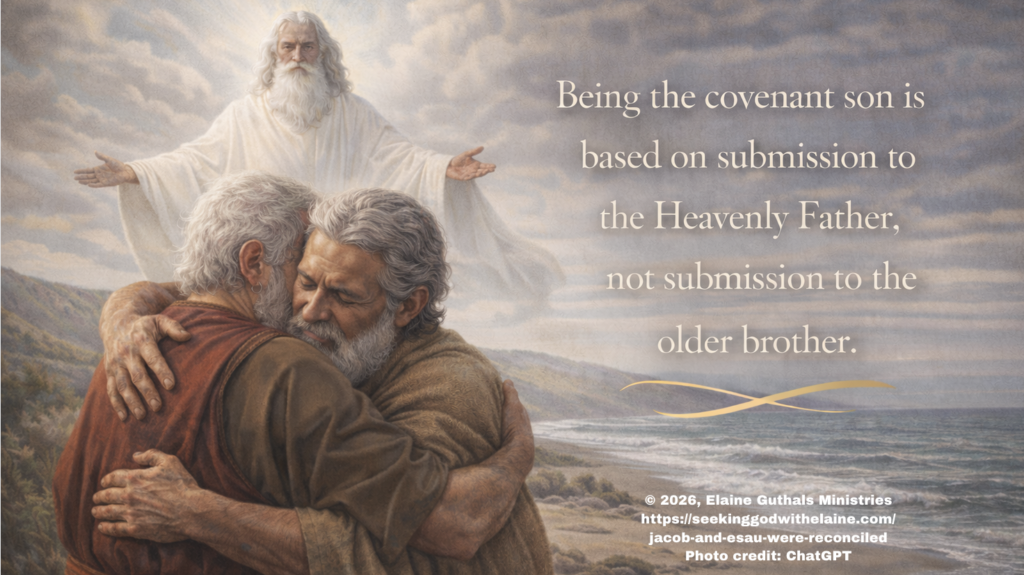
  • Are Disciples to be Proactive or Reactive?

    How should disciples approach trials? Should we be proactive or reactive? This devotion looks at how we should prepare for the trials that will inevitably come our way.

    Nuggets

    • We are to have minds that are ready for action.
    • We have to clear our minds.
    • We are supposed to be watchful.
    • We have to be steadfast in our moral character.
    • We only have that hope when we have Jesus as our Savior and Redeemer.
    Flowers with title Are Disciples to be Proactive or Reactive?

    There is something to be said about being prepared. Financial managers suggest that we have the equivalent of several months’ income in a savings account for emergencies. Sometimes, that can happen; for most, that seems impossible.

    There are other ways to be prepared for trials. Trials are going to come. Jesus said so. “I have told you these things so that in me you may have peace. You will have suffering in this world. Be courageous! I have conquered the world” (Jn. 16 33 CSB).

    How can we prepare for trials in our lives? Peter gave us some advice in his first letter. Let’s check it out.

    Let’s Put It into Context

    How many times have we heard that it’s not what happens to you — it is how you react to it?

    I know. Some of us may have that one thing that we say our lives would be over if it happened.

    I remember years ago I had to have a biopsy done. I was supposed to sing a solo at church like two days later.

    The biopsy turned out okay, but I made the comment to one of the ladies that, if it hadn’t turned out benign, I wouldn’t have been able to sing. She took it to mean that I thought I would never be able to sing again if I would have been diagnosed with cancer. What I meant was that, when I am really emotional, it is almost physically impossible for me to sing in front of an audience.

    We react different ways for different trials. A factor in that is the amount of warning we receive for the trial. I had no warning that the routine doctor’s visit would turn into something much more.

    Some trials we know are coming. We may know what is specifically going to happen, or we may just know something is coming. There are times when we are blindsided.

    Either way, how we react tells much about our relationships with God. That is something we can strengthen. In that way, when the trials develop around us, we are secure in His hand.

    But how can we do that?

    Minds Good to Go

    “So then, have your minds ready for action …” (I Pet. 1: 13 GNT)

    Peter’s first advice is that we are to have minds that are ready for action. I hear you. How can we be ready when we don’t know what the trial is going to be?

    Easy. We know that — whatever it is — God is going to give us victory. “For the LORD your God is going with you! He will fight for you against your enemies, and he will give you victory!” (Deut. 20: 4 NLT). The victory has already been won.

    The problem is when God’s definition of victory is different that our definition of victory. Our definition may be we get or keep a certain job. God’s definition is we are employed elsewhere. God’s definition wins.

    Look at this verse in the Names of God Bible. “Therefore, your minds must be clear and ready for action. Place your confidence completely in what God’s kindness will bring you when Yeshua Christ appears again” (I Pet. 1: 13 NOG).

    We have to clear our minds. That means sweeping out all the doubts and anger. We have to get rid of all our preconceived notions.

    Yeah, sometimes it is very difficult to corral the mind. That’s one reason I felt a kick out of the King James Version of this verse. “Wherefore gird up the loins of your mind …” (I Pet. 1: 13 KJV).

    Yep, strap in. Check all of the laces to make sure they are tight.

    But we can also look at that as strap on the armor. “Put on the whole armor of God, that you may be able to stand against the schemes of the devil” (Eph. 6: 11 ESV).

    We strap on and completely believe two things.

    • God has the situation totally under control.
    • “And we know that God causes everything to work together for the good of those who love God and are called according to his purpose for them” (Rom. 8: 28 NLT).
    God has the situation totally under control.

    Because God has it and it is going to be good in the end, we don’t have to run the trial marathon in our heads. We can sit back and be ready.

    Let me rephrase that. We have to sit back and let God take the lead, but we have to be ready for action. God is generally going to ask us to do something in the trial.

    Yes, it may mean move or change careers. But there is also an always-to-do-list.

    • Pray
    • Believe
    • Praise

    No, God doesn’t want us to do — and think that we’ve done it on our own. He wants us to put our faith and trust in Him.

    Look at exactly what that means.

    • Faith is the belief that the doctrines stated in God’s Word are true, even if we do not understand all aspects of them.
    • Trust is confidence that the promises of God are true.

    Our minds are focused on Him — not on us. We have to be prepared in the way that imitates Him. Well described that as righteousness, faithfulness, and truth.

    Resource

    Alert or Sober?

    “… Keep alert …” (I Pet. 1: 13 GNT)

    Some of the versions translate this as alert (NIV, CEV, GNT) and some as some form of sober (NIV, ESV, NASB, NKJV, KJV, CSB HCSB). I am not really sure which one I like best. They both make good points.

    I like alert because we are supposed to be watchful. “Keep watch and pray that you will not fall into temptation. The spirit is willing, but the flesh is weak” (Mt. 26: 41 GNT).

    There are a couple of things for which we have to watch. Disciples must remain alert to keep on guard, so we don’t sin. We are to watch for Jesus’ return, not knowing when that will be.

    To read a related devotion, click the button below.

    Yep, that is a 24/7/365 deal. We must continually be on alert.

    We have to be alert for trials. What did Pastor Tim say? We are always in one of three conditions: getting ready to enter trials, experiencing trials, or ending trials.

    To read a related devotion, click the button below.

    But then, I really like sober, too. Sober is a character trait distinguished by self-control, genuineness, and sound moral judgment. It is a calm and temperate disposition. Bird said it was a nobility in character.

    Bird pointed out that we have to be diligent. Working out our salvation is not be an easy undertaking. We need to be vigilant to be on guard for attack. We need to stop trying to do things on our own and seek His Will. We have to be steadfast in our moral character.

    Resource

    To read a related devotion, click the button below.

    It also means that we are to do things in moderation. Spurgeon reminded us that this is true in all things.

    To me, this is all about being consistent in making sure we are living a holy life. Spurgeon wrote, “… do not fritter away life upon trifles, but live to purpose, with undivided heart, and decided resolution.”

    Resource

    We can’t be following the worldview fad of the moment. Wells described the opposite of being sober as “foolish, yet conceited; and he is quarrelsome, and hazardous, and he would lie down and go to sleep anywhere.”

    Resource

    We shouldn’t blow the trials out of proportion. We have to be deliberate in navigating the trials to ensure we are following God.

    Our Hope in Jesus

    “… and set your hope completely on the blessing which will be given you when Jesus Christ is revealed” (I Pet. 1: 13 GNT)

    God said that if we had faith the size of a mustard seed, we could move mountains (Mt. 17: 20). Along with that faith comes hope. Hope is where we desire for something that we believe is obtainable.

    Because we have the hope, we believe in the ultimate triumph of Truth. That will be Jesus’ second coming. In this instance, our hope is in eternal life. It is hearing, “… Well done, good and faithful servant! …” (Mt. 25: 21 NIV).

    Thomas reminded us we only have that hope when we have Jesus as our Savior and Redeemer. We have to be a child of God, not just a creation made in His image.

    Resource

    Glossary

    That hope should strengthen our confidence in God. Our hope is in His grace.

    I love what Thomas said. He wrote, “God will never deal with you upon the ground of merit; He has begun with you in grace, and He will go on with you in grace, therefore ‘hope to the end for the grace.’”

    Resource

    Our reward isn’t based on what we do or don’t do. It is based on God loving us and providing the way to restore our relationships with Him.

    We are going to have trials up until that time. When this age is over, our trials will also be over. We will be rewarded throughout eternity.

    Making the Connections

    Wow! You know what just popped into my head? I think God, really wants us to be both proactive and reactive.

    We’ve got to be proactive. We have to strengthen our relationships with God. We have to be actively seeking Him.

    Searching for and Seeking God

    Hearing His Word (Rom. 10: 17).
    Reading His Word (Rev. 1: 3).
    Praying to Him (Heb. 4: 16).
    Studying His Word (Ac. 17: 11).
    Meditating on His Word (Ps. 1: 1-2).
    Memorizing His Word (Ps. 119: 11).

    But when the trials come, that is going to be our test. That is when we will have to make up our minds if we are truly going to follow God and obey His laws and commandments.

    God isn’t going to pressure us during that time to follow Him. He is going to let us have our free will. Free will is the ability within us to make decisions that determine actions that produce character.

    Glossary

    Spurgeon wrote that girding our minds teaches us earnestness. He wrote, “A true believer should be ready for suffering or service — ready, indeed, for anything.” We have to be sincere in our desire to live for God.

    Resource

    How Do We Apply This?

    Somehow, I ended up doing the nuggets before the application. Good thing. I think they work.

    • We are to have minds that are ready for action.
    • We have to clear our minds.
    • We are supposed to be watchful.
    • We have to be steadfast in our moral character.
    • We only have that hope when we have Jesus as our Savior and Redeemer.

    The best way to prepare ourselves for trials is to learn all that God is trying to teach us before the trials start. Attend the lecture sections. That will prepare is for the tests.

    Father God. Thank You that You instruct us. You sent Your Holy Spirit to dwell in us to teach us and prepare us for when the trials hit. May we always stand firm in our faith in You. We watch for the day that Jesus will return. Amen.

    The ABCDs of Salvation

    If you have not become a believer in Christ, please read through the
    Plan of Salvation and prayerfully consider what God is asking you to do.

    A – admit our sins
    B – believe His Son Jesus is our Redeemer
    C – confess God as Sovereign Lord

    D – demonstrate that commitment by making any changes needed in our lives to
    live the way in which God has called us

    The Disciple’s Job Description

    What do you think?

    Leave me a comment below (about this or anything else) or head over to my Facebook group for some interactive discussion.

    If you don’t understand something and would like further clarification, please contact me.

    If you have not signed up for the email daily or weekly providing the link to the devotions and the newsletter, do so below.

    If God has used this devotion to speak with you, consider sharing it on social media.