Philip brought Nathanael to Jesus, but Nathanael was a little skeptical that He was the Messiah. This devotional reading looks at how Yeshua addressed that skepticism.
Nuggets
- Yeshua knows us, but we have to know Him before He knows us.
- We probably would have reacted the same way Nathanael did.
Nathanael used two titles that some may think don’t fit together. - Nathanael had been taken aback when Yeshua said he could see him under a fig tree.
- Yeshua told Nathanael what would happen in his future.
Yeshua had gone to Galilee specifically to call Philip as a disciple. It seems immediately that Philip went to find Nathanael.
Nathanael, however, wasn’t certain if he came to the same conclusion as Philip that Yeshua was the Messiah. However, he went with him anyway.
How was Yeshua going to react to that skepticism?
Let's Put It into Context
To read devotions in The Battle for the Heart theme
Devotions in the The Early Ministry of the Messiah series
Before They Even Got to Yeshua
“As they approached, Jesus said, ‘Now here is a genuine son of Israel — a man of complete integrity.’ ‘How do you know about me?’ Nathanael asked. Jesus replied, ‘I could see you under the fig tree before Philip found you.’ Then Nathanael exclaimed, ‘Rabbi, you are the Son of God — the King of Israel!’” (Jn. 1: 47-49 NLT)
Son of Israel
Yeshua knows us, but we have to know Him before He knows us.
Wait! What?? Yeshua had never met Nathanael before. Yeshua knows us as a creation of Jehovah before we come to Him for salvation.
Because of this, Yeshua described Nathanael as a man of complete integrity. What did He mean by calling Nathanael a genuine son of Israel?
We need to remember that Israel was more than a name for a nation. Israel was the name Jehovah gave Jacob after their encounter at Peniel (Gen. 32: 28). Jacob’s descendants became the people of Israel, the people with whom Jehovah established His covenant.
But being descended from Israel didn’t automatically mean a person lived faithfully before Jehovah. Throughout Israel’s history, the prophets called the people to return to their covenant responsibilities. They could identify themselves as Israelites while their hearts and actions were far from what Jehovah required.
Yeshua’s description of Nathanael goes beyond his ancestry. The New Living Translation translates the expression as a genuine son of Israel and explains it with the words a man of complete integrity. Nathanael was not merely an Israelite by birth. Yeshua recognized something about his character.
The Greek word translated integrity in this passage is dolos (δόλος), which ordinarily means deceit, guile, or deception. John uses it here in the negative construction: there is no deceit in Nathanael. Yeshua was describing a man who was not characterized by duplicity or dishonesty.
That doesn’t mean Nathanael was sinless. Scripture doesn’t present him as a man who had never done anything wrong. Rather, Yeshua’s words describe the kind of man he was — someone without the deceit that would make his outward profession different from his inward character.
Think about that for a minute. We can identify ourselves as Jehovah’s children, know the Scriptures, attend worship, and speak the right words.
But Jehovah is concerned with more than the identity we claim. He cares about the truthfulness of our hearts and the integrity of our lives.
Nathanael had just questioned whether anything good could come from Nazareth. Now Yeshua was describing him as a man without deceit. Nathanael’s question hadn’t prevented Yeshua from recognizing his character.
There is another thing we need to think about. “On judgment day many will say to me, ‘Lord! Lord! We prophesied in your name and cast out demons in your name and performed many miracles in your name.’ But I will reply, ‘I never knew you. Get away from me, you who break God’s laws’” (Mt. 7: 22-23 NLT).
Us coming to Yeshua isn’t what He is looking for. We would call that having head knowledge of Him.
Neither is Yeshua wanting us to do good deeds in His name – especially not just on our own. We can’t earn salvation.
Salvation comes only when we spend time with Yeshua and get to know Him as our Savior and Redeemer. We have to know Him as our Savior before He knows us as His brothers and sisters.
Do You Know Me?
We probably would have reacted the same way Nathanael did.
Nathanael was taken aback by Yeshua seeming to know him before they had ever met. We may have been in the same situation in our past. It gives us a start for a moment.
Nathanael asked a reasonable question. Philip had brought Nathanael to meet Yeshua, but Nathanael had no reason to expect Yeshua to know anything about him. Yet Yeshua had already described his character before he asked Him anything.
Yeshua answered by giving Nathanael’s fig tree location.
Wait! What?? Yeshua didn’t tell Nathanael how He got that information. He simply told Nathanael that He had seen him under the fig tree before Philip called him – with no explanation as to how that was possible.
We aren’t told what Nathanael was doing under that tree. He may have been resting, studying, praying, or doing something else entirely. What matters in this conversation is that Yeshua knew where Nathanael had been before Philip brought them together.
That knowledge changed the conversation. Nathanael had previously questioned whether anything good could come from Nazareth. Now he was face-to-face with Someone Who showed Someone could come from an inconsequential background.
Sometimes, an unexpected moment can make us stop and reconsider what we thought we understood. Nathanael came to meet the man Philip had described. He wasn’t prepared for the Man to reveal that He already knew something about him.
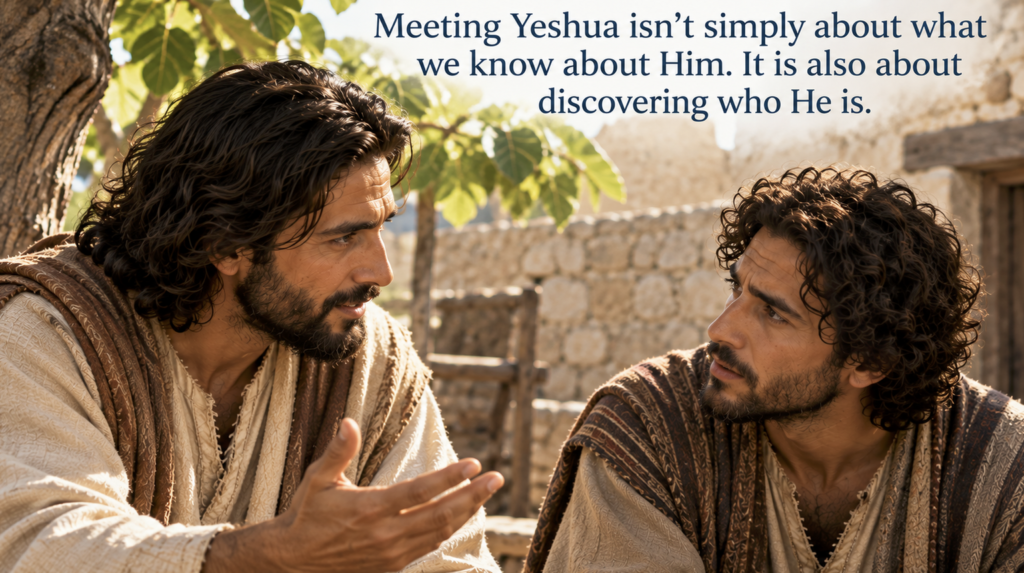
If we have experienced a moment when someone knew something about us that we hadn’t told them, it can make us stop and wonder, too. Nathanael’s encounter reminds us that meeting Yeshua isn’t simply about what we know about Him. It is also about discovering who He is.
Son of God and King of Israel
Nathanael used two titles that some may think don’t fit together.
Notice that Nathanael used the two titles the Son of God and the King of Israel together. These titles weren’t unrelated declarations. They connected Yeshua to Israel’s expectation of the King Jehovah had promised.
Modern readers often hear the phrase Son of God exclusively through later theological categories. However, the Hebrew Scriptures had already established sonship language in Israel’s relationship with Jehovah and in the Davidic kingship. Israel itself could be called God’s son (Ex. 4: 22-23). David’s royal descendant was also described through this language.
Psalm 2 is particularly important for understanding Nathanael’s confession. Jehovah addressed His anointed King: “… ‘The Lord said to me, “You are my son. Today I have become your Father”’” (Ps. 2 :7 NLT). This is royal enthronement language.
This was not simply a statement about physical descent. The king is called Jehovah’s son because of his special covenant relationship with Jehovah and his appointment to rule under His authority. It identified the king’s God-given position, authority, and responsibility.
The psalm goes on to speak of the nations as the King’s inheritance and the ends of the earth as His possession (Ps. 2: 8). The promised King’s rule, therefore, reaches beyond Israel’s borders. He is Jehovah’s appointed ruler, whose authority ultimately extends to the nations.
When Nathanael called Yeshua the Son of God and the King of Israel, he connected these ideas. Son of God pointed to Yeshua’s relationship with Jehovah and His place as Jehovah’s appointed King. King of Israel identified the royal and Messianic significance of that relationship. Nathanael was recognizing Yeshua as the King Israel had been promised.
But we must be careful not to assume Nathanael understood everything his words would ultimately mean. We must distinguish between recognizing the promised King and understanding the full significance of His identity.
Nathanael had just met Yeshua. He hadn’t yet witnessed the full course of His ministry, His death and resurrection, or His exaltation.
Nathanael recognized something true about Yeshua’s identity, but he didn’t yet have the full revelation that would come through Yeshua’s life and the events that followed. He could recognize Yeshua as the promised Messiah without yet understanding everything Scripture would reveal about Him.
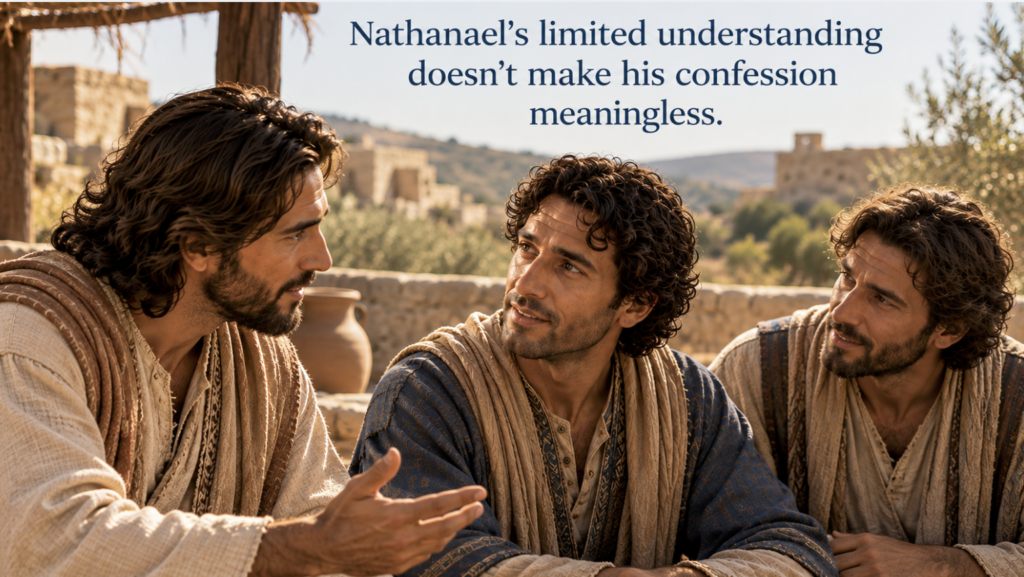
This distinction matters. Nathanael’s limited understanding doesn’t make his confession meaningless. He correctly recognized Yeshua as God’s promised King, even though he had more to learn about the One he had just confessed.
The New Testament will reveal that Yeshua is more than another king in David’s line. His identity as the Son of God involves divine authority and a unique relationship with the Father that cannot be reduced to royal adoption or appointment. The Gospel of John progressively reveals this greater reality.
Nathanael’s confession is, therefore, an important beginning. He recognized the King of Israel standing before him. He had yet to discover the full significance of the Son of God.
Questioning Understanding
“Jesus asked him, ‘Do you believe this just because I told you I had seen you under the fig tree? You will see greater things than this.’ Then he said, ‘I tell you the truth, you will all see heaven open and the angels of God going up and down on the Son of Man, the one who is the stairway between heaven and earth’” (Jn. 1: 50-51 NLT)
Under the Fig Tree
Nathanael had been taken aback when Yeshua said he could see him under a fig tree.
What matters is that Yeshua knew where Nathanael had been before the two of them met. When Yeshua told him this, Nathanael recognized that he was encountering someone who knew more about him than he could explain.
Scripture tells us of times when Yeshua knew people’s thoughts and actions. He knew them before He came to earth, while He was here, and continues to know them after ascension.
- Yeshua knew the Pharisee’s thoughts when He said the paralytic’s sins had been forgiven (Mt. 9: 2-4; Mk 2: 5-8; and Lk 5: 20-22).
- He knew the religious leader’s thoughts and the purpose behind these thoughts when He healed the man with a withered hand on the Sabbath (Lk. 6: 6-8).
· Yeshua knew the accusations of the crowd when He healed the demon-possessed man (Mt. 12: 25; Lk. 11: 17). - He knew the crowd beyond the surface when they believed He was a great miracle worker but didn’t believe in Him as the Son of God, the Messiah (Jn. 2: 23-25).
- Yeshua knew about the woman at the well’s past (Jn. 4: 16-19, 28-29).
- He knew when Lazarus had died (Jn. 11: 1-16).
- Yeshua knew Judas would betray Him (Jn. 6: 64; Jn. 13: 10-11, 18—27).
- He knew Peter would deny Him (Lk. 22: 31-34; Jn. 13: 36-38).
Yeshua knew people’s thoughts and actions while He was on earth. That hasn’t changed since He has ascended to Heaven.
Did you catch the significance of that? Yeshua knew Nathanael before salvation occurred. He knew what he was doing. He knew what he was thinking.
But it doesn’t stop there.
We sometimes forget that Yeshua doesn’t have to be physically present with us to know what is happening in our lives. He knows our thoughts before we put them into words. He knows what we say when no one else is listening. He knows what is in our hearts, even when we have not found a way to explain it to anyone else.
Think about that for a moment. We can be sitting alone in our homes, driving down the road, or lying awake in the middle of the night, and Yeshua is not limited by His physical absence from us. We can’t hide our thoughts from Him, and we don’t have to find the right words to make Him understand what we are experiencing. He already knows.
That knowledge should make us pause. It reminds us that our private thoughts matter as much as our spoken words, even when we believe no one else knows about them.
But it can also bring comfort. When we can’t explain what hurts, what worries us, or what we are struggling to understand, Yeshua knows. We are never required to make Him aware of our circumstances before He can understand them.
Nathanael was surprised that Yeshua knew where he had been before Philip called him. We have the benefit of knowing more of Yeshua’s story than Nathanael did at that moment. We can remember that His knowledge is not confined to what He can see with human eyes or what someone tells Him. He knows us wherever we are, and He knows us as we truly are.
Will See Heaven Open
Yeshua told Nathanael what would happen in his future.
Yeshua wasn’t finished revealing Himself to Nathanael. After Nathanael declared Him to be the Son of God and the King of Israel, Yeshua told him he would see greater things than these.
John 1: 50–51 records Yeshua’s response. He promised Nathanael that he would see Heaven open and the angels of God ascending and descending on the Son of Man.
That wording takes us back to Genesis 28: 10–17, when Jacob dreamed of a stairway connecting earth and heaven, with the angels of God ascending and descending on it. When Jacob awoke, he recognized that Jehovah was present in that place. He called it Bethel, meaning house of God.
Now, Yeshua was telling Nathanael that he would see something greater. In Jacob’s dream, the angels ascended and descended on the stairway. In Yeshua’s words, they would ascend and descend on the Son of Man. Yeshua placed Himself at the center of this heavenly picture.
The title Son of Man is important here. Yeshua used it repeatedly throughout His ministry. It can point to His identification with humanity, but it also recalls Daniel 7: 13–14, where one like a son of man comes with the clouds of heaven and receives authority, glory, and a kingdom that will never pass away. The title carries a significance much greater than simply calling attention to His humanity.
Again, we shouldn’t assume Nathanael understood every layer of meaning in Yeshua’s words at that moment. He had just begun to recognize who Yeshua was.
But the promise pointed beyond the first signs that had impressed him. Nathanael would see greater evidence of Yeshua’s identity and authority as he continued following Him.
Yeshua had already shown Nathanael that He knew something about him before they met. Now, He promised that he would see more. His understanding of the Messiah was only beginning, and the things he would witness would continue to deepen it.
Nathanael’s opportunity to see greater things didn’t end with Yeshua’s earthly ministry. After His resurrection, Yeshua appeared to His apostles over a period of forty days, teaching them about the Kingdom of God (Ac. 1: 3). Then, as they watched, He was taken up into Heaven (Ac. 1: 9–11).
Think about how far Nathanael had come. Philip had brought him to meet Yeshua, and Nathanael had recognized Him as the Son of God and the King of Israel. Now he had witnessed the risen Messiah return to Heaven. The One Nathanael had only begun to understand had revealed Himself through His ministry, His death, His resurrection, and His ascension.
Yeshua had promised Nathanael that he would see greater things. The Gospel accounts show us that following Yeshua meant witnessing events far beyond that first encounter under the fig tree. Nathanael’s understanding of the Messiah had begun with a personal meeting, but what he witnessed afterward revealed more and more of who Yeshua was.
Our own understanding can grow in the same way. We may recognize something true about Yeshua when we first encounter Him, but we should never assume we have exhausted the depths of Who He is. As we continue learning from Scripture and watching how Jehovah’s purposes unfold through His Son, we discover more of the significance of the One we have come to follow.
Making the Connections
Yeshua recognized Nathanael’s doubts. He didn’t shut them down. He didn’t say “You shouldn’t be having these. How dare you doubt Me.”
On the contrary. Even before Nathanael could express them – so we don’t really know if he was going to do so or not – Yeshua took them head on. He took the shortest path to ridding Nathanael of those doubts.
This tells us that doubts are okay – as long as they don’t shut us down from searching for Yeshua. We can question things, but we have to do so in faith.
Heart Check
Think about the battle Yeshua is engaged in for your heart. Ask yourself the following questions.
- When I have doubts about Yeshua, do I seek Him for answers, or do I allow my doubts to keep me from seeking Him?
- Do I focus on what I already know about Yeshua, or am I willing to keep learning who He is?
- Do I recognize that Yeshua knows me completely, or do I live as though I can keep parts of my life hidden from Him?
- Do I depend on knowing about Yeshua, or have I come to know Him as my Savior and Redeemer?
- When Yeshua challenges my assumptions, do I let Him change my understanding, or do I cling to what I thought I knew?
How Do We Apply This?
- Bring our doubts to Yeshua.
- Examine our hearts honestly.
- Look beyond outward appearances.
- Grow in our knowledge of Yeshua.
- Welcome opportunities to learn.
- Remember that knowing about
- Yeshua is not the same as knowing Him as Savior and Redeemer.
Father God. You know us – everything about us – what we think, feel, believe. You call us to believe in You. Help us to come to Yeshua. Strengthen our faith. Relieve our doubts. May our faith that You are Sovereign God and He is our Savior never waver. Amen.
If you don’t understand something and would like further clarification, please contact me.
If you have not signed up for the email providing the link to the devotions and the newsletter, do so below.
If God has used this devotion to speak with you, consider sharing it on social media.