As Jacob started on his journey to Paddan-aram, he had a very important encounter. This devotional reading looks at how Jehovah, at the top of the stairway, met Jacob, at the bottom.
Nuggets
- While he was going to family, it is probably a safe bet that Jacob had never left Canaan before.
- We’ve have heard this described as both Jacob’s ladder and a stairway to Heaven.
- This is the first time we are told that Jehovah communicated with Jacob.
- God reaffirmed with Jacob the covenant that he made with Abraham.

Jacob hadn’t gotten too terribly far on the first day of his journey to Paddan-aram. But something very important happened.
Let's Put It into Context
To read devotions in the Creating Everything theme, click the button below.
Devotions in the Jacob the Patriarch series
Set Up Camp
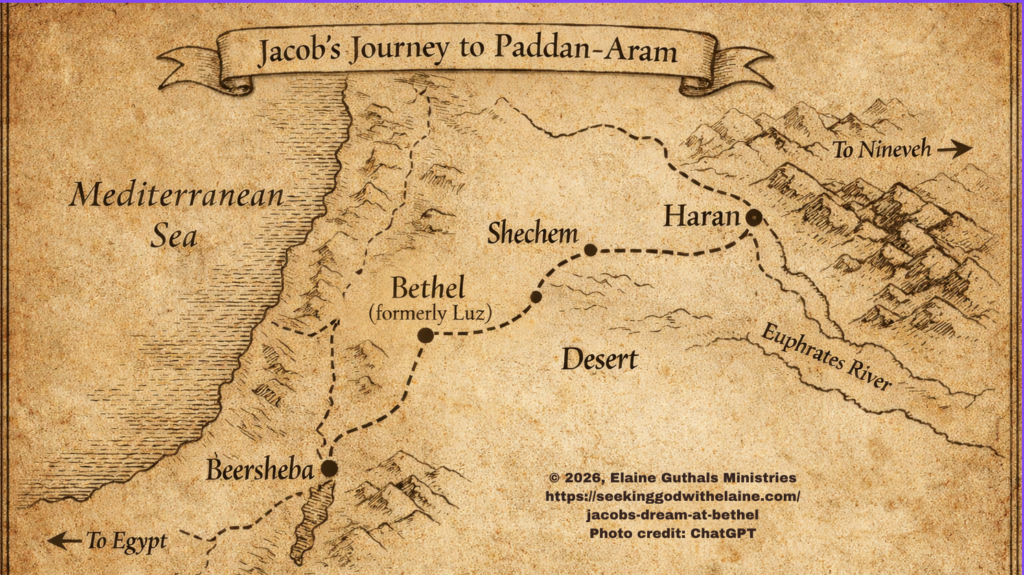
“Meanwhile, Jacob left Beersheba and traveled toward Haran. At sundown he arrived at a good place to set up camp and stopped there for the night. Jacob found a stone to rest his head against and lay down to sleep" (Gen. 28: 10-11 NLT)
While he was going to family, it is probably a safe bet that Jacob had never left Canaan before.
That is a little more amazing when we remember that Jacob was 77 years old. He was just starting to assert his independence.
Jacob had set off with his father’s blessing to find a covenant bride. Abraham was already married to Sarah when we met them. It took us several devotions to get Isaac married off.
Now it is Jacob’s turn to go wife hunting.
But this is much different than when Abraham sent Eliezer to get Rebekah as Isaac’s bride. As covenant bearer, Abraham assumed full responsibility for ensuring Isaac’s marriage aligned with God’s promises.
The process was highly structured. Eliezer negotiated directly with Rebekah’s family, presented bride-gifts (mōhar), and secured consent.
Rebekah’s voice was acknowledged, yet the decisive authority remained with the patriarchal household. The marriage was finalized before Isaac ever met his bride, emphasizing that covenant continuity — not personal choice — drove that union.
By contrast, Isaac’s sending of Jacob occurred under duress. Esau’s marriages to Canaanite women had already demonstrated the dangers of covenantal compromise (Gen. 26:34–35). Jacob was sent away both to preserve lineage and to escape Esau’s wrath.
Unlike Eliezer, Jacob traveled without wealth, servants, or formal authority. He had to negotiate his own marriage arrangements, offering labor in place of material bride-price (Gen. 29:18–20). The absence of formal rituals — oaths, immediate payment, or public consent scenes — left Jacob vulnerable to deception by Laban. The substitution of Leah for Rachel exposed how fragile betrothal arrangements became when authority and security were lacking.
Theologically, the aim of betrothal remained constant: preservation of the covenant line through faithful, endogamous marriage. What changed was the human mechanism. Abraham’s confidence and resources produced order; Jacob’s exile produced disorder. Yet God remained sovereign in both settings.
We have to remember that Jacob was essentially running for his life. Esau had promised to kill him after Isaac died (Gen. 27: 41). Jacob may have thought Esau would like to fulfill his promise sooner rather than later.
This was, though, right after Isaac had blessed Jacob as the heir to Abraham’s covenant. Although God had told Rebekah that Jacob would be the family ruler (Gen. 25: 23), it was now official.
Jacob didn’t know if Esau came after him when he found who he would have called the deceiver was gone. Because of that, Jacob must have been looking back at least as many times as he looked forward. His level of fear would be elevated.
Jacob traveled until he reached the town of Luz. The interesting thing is Luz was the original name of the city. Later it was known as Bethel (Gen. 28: 19) – one of the places Abraham built an altar.
I love Mears’ description of Jacob’s campsite. He wrote, “It was upon the barren mountainside. Tier on tier of rocks reaching to the mountain-summit were the stairs of nature’s cathedral.”
Resource
At Luz, God came to Jacob in a dream.
Don’t write the dream off as just a fantasy. We’ll find out just how real this vision was.
Let’s just say right now that Jacob had to stop his forward motion to his destination.
Dreamed of a Stairway to Heaven
“As he slept, he dreamed of a stairway that reached from the earth up to heaven. And he saw the angels of God going up and down the stairway" (Gen. 28: 13 NLT)
We’ve have heard this described as both Jacob’s ladder and a stairway to Heaven. In the Hebrew, both are correct. A sullam is a ladder or stairway.
The stairway would have been a sight to see. We can’t gloss over the fact that traffic was heading both ways. Angels were coming and going.
Was this stairway a one-shot deal? I don’t see how it could be.
Jehovah wouldn’t have needed a stairway to meet with Jacob. If that is the focus of the visit — which it was — the angels didn’t have to be present. They weren’t germane to the narrative.
Angels would be descending Heaven’s stairway to minister to humans. They care about our welfare.
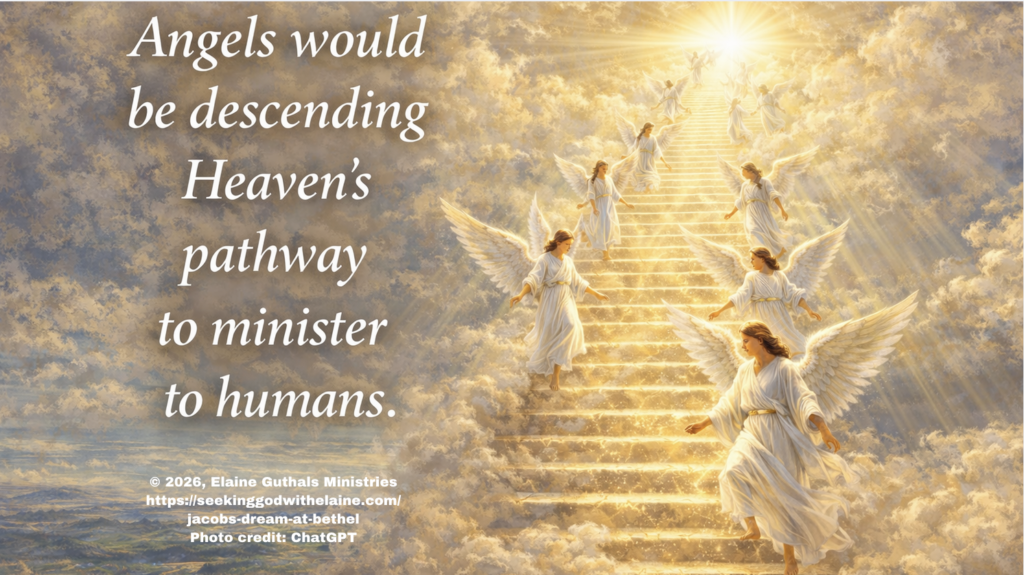
For one night, Jehovah made it visible to one man. It was important that He show Jacob how the seen and the unseen are connected.
Roost there for a second. In one of His parables, Yeshua said that there is an impassable chasm between Heaven and he’ll (Lk. 16: 26). That cannot be said between Heaven and earth.
We are not completely cut off from Jehovah. Reconciliation is possible.
Beecher thought we each have our own stairway. He said, “No man can be a Christian by separating himself from his kind.” Jehovah and Yeshua will always be present. Angels will also traverse our stairway.
Resource
Flip the picture a second. Jacob, through Rebekah’s persuasion, took matters into his own hands and deceived Isaac to secure the covenant blessing. He didn’t wait on Jehovah.
And here, Jehovah came to him.
The God of Abraham and the God of Isaac
“At the top of the stairway stood the Lord, and he said, ‘I am the Lord, the God of your grandfather Abraham, and the God of your father, Isaac ...’” (Gen. 28: 13 NLT)
This is the first time we are told that Jehovah communicated with Jacob.
Think how comforting that would have been for Jacob. Running for his life, leaving all he had ever known — just to meet the King of the universe.
This is especially important when we think that Jacob was probably still experiencing guilt. He had sinned against Esau and deceived Isaac. And here he was meeting the King of the universe.
More than likely, Jacob’s ambition was wrestling with his faith. He wanted the covenant relationship with Jehovah, but what did that look like in application?
We are never told that God appeared to Isaac as he did to Abraham (Gen. 18: 1). Still, God identified Himself as the God of Isaac.
Think about it. We aren’t told how much time passed between “So Isaac sent Jacob away, and he went …” (Gen. 28: 5 NLT) to “Meanwhile, Jacob left Beersheba and traveled toward Haran” (Gen. 28: 10 NLT). I doubt there would be much.
With all that Jacob had done and all the emotions he would have been feeling, the first words he heard Jehovah say was, “I am the God of your fathers.”
No, his name wasn’t included at the moment. It would be later. But Jacob had a choice.
Was Jacob going to follow the God of his fathers and walk with Him, or was Jacob going to try to keep on doing this his own way?
So, Jehovah came to Jacob. Not only did He show him the connection between Heaven and earth, but He also showed him that He is ruler of all.
But we said it once, Jacob was 77 years old at that time. And he and God hadn’t met before???
We have to put this into societal context. The gods in the ancient Near Eastern world were considered localized gods. In other words, they stayed in their temple, city, or region, and didn’t come out.
Here Jacob was traveling from Beersheba to Haran. If going with prevailing theory, Jehovah would stay put in Canaan.
But Jehovah didn’t stay in Beersheba. He met Jacob in Bethel.
Covenant Blessings Belong to You
“...The ground you are lying on belongs to you. I am giving it to you and your descendants. Your descendants will be as numerous as the dust of the earth! They will spread out in all directions — to the west and the east, to the north and the south. And all the families of the earth will be blessed through you and your descendants. What’s more, I am with you, and I will protect you wherever you go. One day I will bring you back to this land. I will not leave you until I have finished giving you everything I have promised you’” (Gen. 28: 13-15 NLT)
God reaffirmed with Jacob the covenant that he made with Abraham.
Jacob would have grown up with hearing about Abraham’s covenant with Jehovah. This would be about the first opportunity He had to affirm it with him.
What we do know was this is the first day of the journey. Jehovah didn’t take much time to reaffirm the covenant. And reaffirm it, He did.
- Jehovah would give the land he laid on to him (Gen. 28: 13).
- His descendants would be numberless (Gen. 28: 14).
- All the Earth would be blessed through him and his descendants (Gen. 28: 14).
This sounds a lot like Abraham’s covenant.
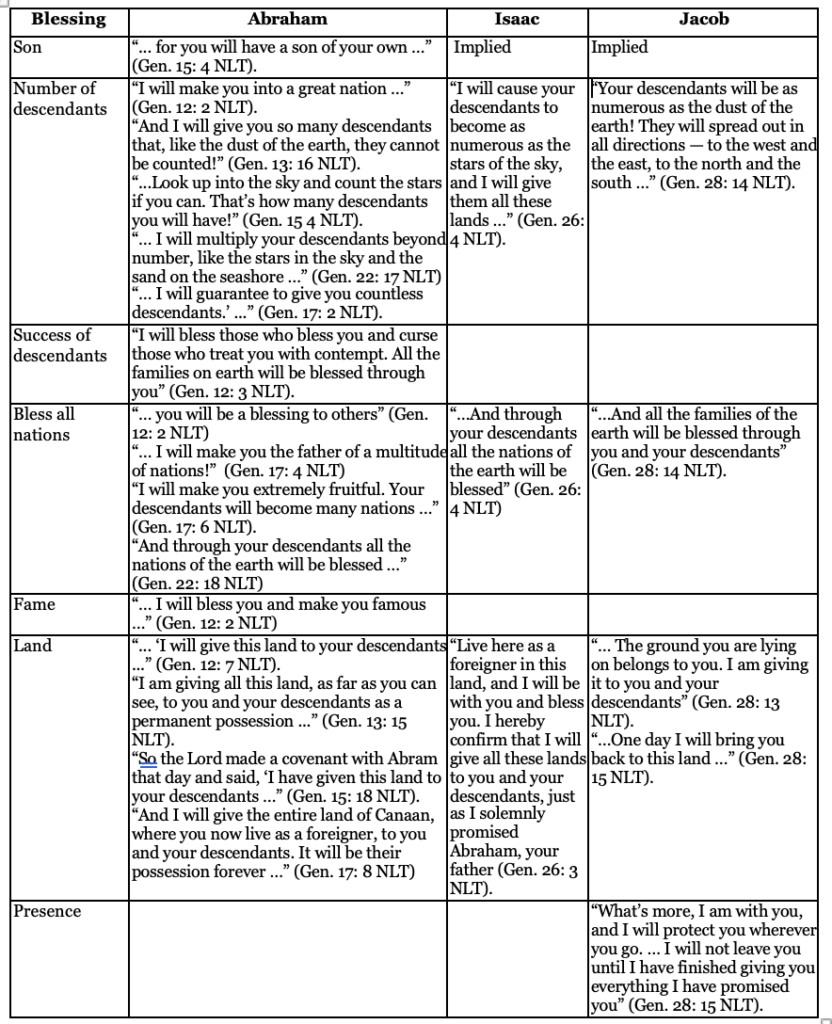
Yes, there was a big addition. Jehovah promised Jacob His presence and protection. It was needed as, beyond Abraham’s trip to Egypt, we aren’t told that either patriarch left Canaan.
Jehovah included that He would keep Jacob safe, wherever he went. He also told Jacob that he would return to this land at a future date. Basically, what God was saying was that he would be with Jacob always.
This new addition is very meaningful. Jehovah has told us many times in His Word that He will never leave us.
- “Even when I walk through the darkest valley, I will not be afraid, for you are close beside me. Your rod and your staff protect and comfort me” (Ps. 23: 4 NLT).
- “Don’t be afraid, for I am with you. Don’t be discouraged, for I am your God. I will strengthen you and help you. I will hold you up with my victorious right hand” (Isa. 41: 10 NLT).
- “Teach these new disciples to obey all the commands I have given you. And be sure of this: I am with you always, even to the end of the age” (Mt. 28: 20 NLT).
- “So be strong and courageous! Do not be afraid and do not panic before them. For the Lord your God will personally go ahead of you. He will neither fail you nor abandon you” (Deut. 31: 6 NLT).
- “I can never escape from your Spirit! I can never get away from your presence! If I go up to heaven, you are there; if I go down to the grave, you are there. If I ride the wings of the morning, if I dwell by the farthest oceans, even there your hand will guide me, and your strength will support me” (Ps. 139: 7-10 NLT).
What we may or may not always remember is that Jehovah doesn’t put any conditions on that. He will be with us when we are walking the path with Him and when we go off trail.
The wording was a little different on the descendants. Jacob and his descendants would expand to all four points of the compass.
This is important as we read in other books of God’s word that this means inclusion for Gentiles. Remember in Isaac’s blessing, the different used of the word nations. It wasn’t goy — nation. It was ve-hayita likhal — assembly/peoples.
Making the Connections #1
Okay. People believed that gods were localized, but hadn’t Jehovah already shown them He could? Abraham was called by Him in Haran (and maybe even Ur). He brought him to Canaan. He even went with him to Egypt and Gerar.
Wasn’t that evidence enough? Jacob would have known this.
Jacob may have known this in his head. But I’m sure there was a lot of tradition and cultural norms that would have to be set aside to get this down to heart-level acceptance. Knowing something and putting it into practice are two different things.
That is an important point. What happens on Abraham’s Sanctification Road sometimes has to be repeated on Jacob’s Road.
This begins the pattern: Jehovah will go with them wherever they go. It doesn’t matter if the road leads to Haran, Egypt, Babylon, or the ends of the earth.
Sovereign God will always be with us – even when we have our fears and doubts.

Making the Connections #2
We said that each of us have our own ladders. Ours are bit different than Jacob’s.
Yeshua is our ladder. He not only gives us access to the Father, but He also expands it.
Nose called it a living ladder. Yeshua was dead, and now He lives. Because we have accepted the gift of His salvation, we will live eternally.
Resource
This ladder is built with love. It is inclusive for those that accept His gift.
Communication is key.
Making the Connections #3
Ooo, baby. I like what Tipple and Jenkins had to say. In Elaine-speak:
- We can’t rely on our feelings to know if Jehovah is near.
- Our awareness/unawareness does not negate His presence.
- We don’t dream about spiritual things.
- Whatever anxiety Jacob had felt during the day, it melted away as he slept.
- We have to remove ourselves from the equation before Jehovah can come in and make things add up.
- We have to begin to identify His presence in all things.
Resources
Making the Connections #4
Robinson called Jacob the typical Jew. He was separated from Jehovah but desiring a relationship with Him.
Resource
Continuing, Robinson compared Jacob to the Church.
- He was chosen in the womb.
- His human nature struggled with grace.
- He chose Jehovah.
We see that when we look beyond this being just a personal experience. It is more than just a provision of care.
This is a reaffirmation of the covenant. That covenant lasted through many generations and is still in effect today — albeit merged with Yeshua’s covenant.
Making the Connections #5
Yes, Jehovah is up in Heaven where we can’t see Him. Still, He reveals Himself to us — especially when we need it.
Making the Connections #6
I hadn’t really thought about this before.
Jehovah had Abraham go out into the night sky to see the expanse of the covenant promises. “Then the Lord took Abram outside and said to him, ‘Look up into the sky and count the stars if you can. That’s how many descendants you will have!’” (Gen. 15: 5 NLT).
Here, Jacob was already outside. So, Jehovah showed him the expanse of Heaven.
It was like Jehovah was saying, “Don’t let your limited perception of space minimize what I am promising you. Not even the sky is the limit when you choose Me.”
We talk about expanding our horizons. We have to let Jehovah expand then.
How Do We Apply This?
- Get the stairway of repentance, submission, and obedience.
- Keep a good grip on the ladder.
- Find success and security in repenting.
- Realize the repenting does not good if we do not intend to turn away from the sin.
- Recognize some of our covenant decision must be made in a split second’s time.
- Use our experiences to grow in grace.
- Recognize Jehovah is nearer to us than we realize.
Resources
Father God. You are with us always. You are there when we are doing routine activities, and You are their when we are journeying into the unknown. Thank You for Your care and provision. Amen.
If you don’t understand something and would like further clarification, please contact me.
If you have not signed up for the email providing the link to the devotions and the newsletter, do so below.
If God has used this devotion to speak with you, consider sharing it on social media.