Jacob had been traveling to Paddan-aram. This devotional reading looks at his arrival and his connecting with his family.
Nuggets
- The trip from Beersheba to Paddan-aram would have lasted weeks.
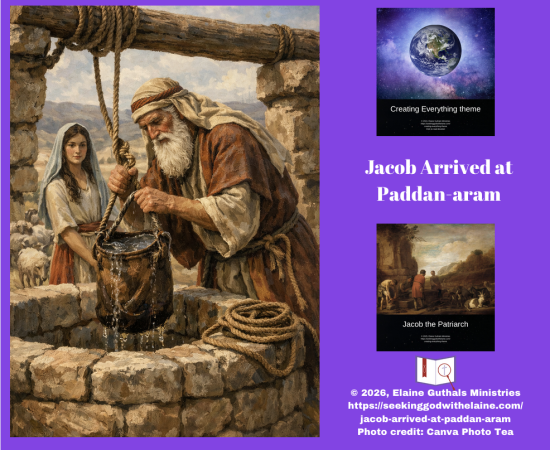
- Jacob immediately searched for his mother’s family when he got to the well.
- Jacob asked his new shepherd friends if they had heard of Laban.
- Rachel came to the well with her father’s sheep.
- Rachel went home to get Laban – just as Rebekah had done.
Jacob, though 77 years old, had been living with his father. Well, that fell apart when he and his mother deceived his father.
The main reason for the journey to his mom’s family was to find a wife. The timing of the trip was determined by Jacob’s brother wanting to kill him.
Let’s look at Jacob getting to where he was going.
Let's Put It into Context
To read devotions in the Creating Everything theme, click the button below.
Devotions in the Jacob the Patriarch series
Travel
“Then Jacob hurried on, finally arriving in the land of the east” (Gen. 29: 1 NLT)
The trip from Beersheba to Paddan-aram would have lasted weeks.
Jacob continued on after the stop at Bethel. It says nothing about camels this time, so we have to assume he was waking.
Since more than likely he took a trade route, such as the ancient Way of the Patriarchs, Jacob would have traveled approximately 75 miles (100-120 km) from Beersheba to Bethel. If he got to cover 12-20 miles a day, which was the average for ancient foot travelers, that is a minimum four-day trek or a maximum six-day hike.
That was the short part of the journey. The trip from Bethel to Haran was approximately 400-450 miles.

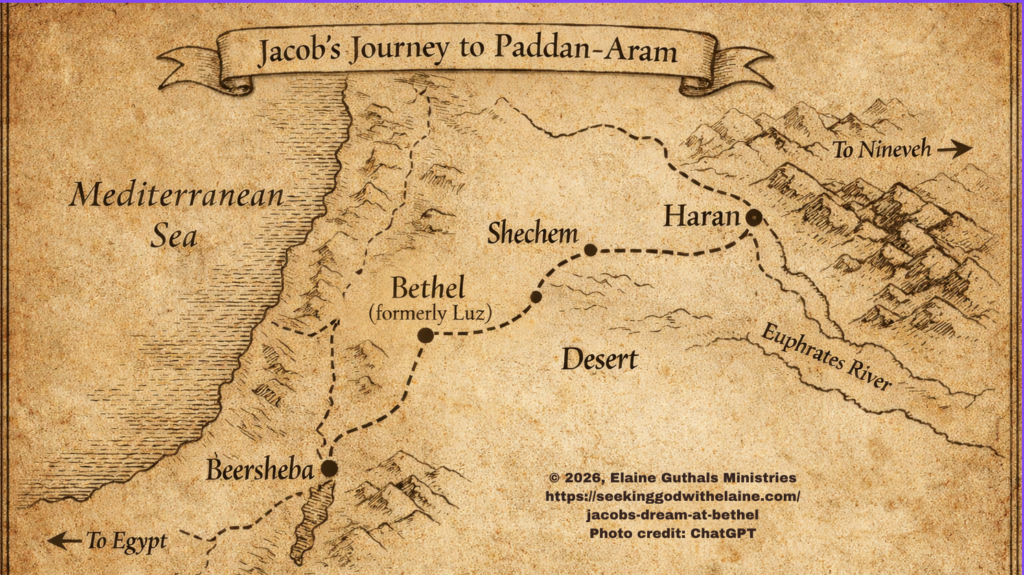
I am sure that there were many factors that went into determining how fast Jacob could go. He would have been going over mountains, across rivers and deserts, and through rocky wilderness according to Gray.
Resource
Plus, I am sure it wouldn’t be the same number of miles each day. Some days it would be 12 miles a day; some 15; some 20; and some anywhere in between.
What would Jacob’s day look like?
- In the early morning cool on the open road, Jacob could have gone at a good clip for 2.5- to 3-miles an hour.
- Toward late morning when the sun started to heat up, he’d have to take a water break. But he may have to go a little longer to find a well or shade trees.
- Late morning to early afternoon would be slower going. The overhead sun would dry out the air. That would be uncomfortable if there was little shade on long, open stretches.
- Jacob would stop entirely during the heat of the day.
- He’d be off again once the heat broke. As it got closer to sunset, Jacob would start looking for a campsite: a safe place near water but away from wild animals. He might build a fire and eat.
That isn’t factoring in weather or terrain. It would seem to me that 12 to 15 miles a day would be the usual.
If he did take an established route, Jacob may have encountered other travelers. It would have been safer that way.
Otherwise, Jacob would have had a lot of me time. I am sure thoughts were crashing around in his head. That would have been especially true after his dream. That would have taken up a lot of think time — and hopefully prayer time.
What we do know for sure is that Jehovah went with Jacob. He said He would, so He did.
Leale summed up Jacob’s life to this point and explained why this journey was so important. He wrote, “All his life through Providence had guided him, but he knew it not as he ought to know. Now, even in the most ordinary and likely events of life he learns to trace the hand of Providence.”
Resource
Bradford’s agreed. He said that encounter with Jehovah made Jacob a changed man. He now possessed Jehovah’s peace.
Resource
Isn’t that what an encounter with Jehovah is supposed to do? Yes, He comes and meets us where we are.
But the whole goal is sanctification. That is where we are changed to be as Jehovah wants us — like Him.
Jacob Arrived at the Well
“He saw a well in the distance. Three flocks of sheep and goats lay in an open field beside it, waiting to be watered. But a heavy stone covered the mouth of the well. It was the custom there to wait for all the flocks to arrive before removing the stone and watering the animals. Afterward the stone would be placed back over the mouth of the well. Jacob went over to the shepherds and asked, ‘Where are you from, my friends?’ ‘We are from Haran,’ they answered. ‘Do you know a man there named Laban, the grandson of Nahor?’ he asked. ‘Yes, we do,’ they replied. ‘Is he doing well?’ Jacob asked. ‘Yes, he’s well,’ they answered. ‘Look, here comes his daughter Rachel with the flock now.’ Jacob said, ‘Look, it’s still broad daylight — too early to round up the animals. Why don’t you water the sheep and goats so they can get back out to pasture?’ ‘We can’t water the animals until all the flocks have arrived,’ they replied. ‘Then the shepherds move the stone from the mouth of the well, and we water all the sheep and goats’” (Gen. 29: 2-8 NLT)
Jacob immediately searched for his mother’s family when he got to the well.
A Well in the Distance
My first thought was, “Was this the well where Eliezer met Rebekah?”
Jacob would have heard the story. Eliezer came to town — probably by the same route he had. Rebekah gave him and his camels a drink — which was his fleece to ensure he picked who Jehovah wanted for Isaac’s wife.
Here came Jacob up to 100 years later.
c. 1823–1820 BC – Abraham sent Eliezer to Paddan-Aram to find a wife for Isaac (Gen. 24)
1820 BC – Isaac, at age 40, married Rebekah (Gen. 25: 20)
1800 BC – Jacob and Esau were born (Gen. 25: 24-26)
1723 BC – Jacob cheated Esau (both age 77) out of the birthright blessing given by Isaac age 137). He flees Canaan to Paran-Aman to Rebekah’s family. He agrees to work seven years to earn the right to marry Rachel (Gen. 29: 1-20)
Based on Timeline from
The outcome — securing a wife — was still the same. Look what else Leale said. He wrote,
“Providence brings to this spot the very woman who is designed to be the wife of Jacob. Surely he could not fail to see that even through all the strange trials of his journey, and through the most untoward events, the will of God was being accomplished.”
Resource
But why were the shepherds standing around waiting for everyone to get there before uncapping the well?
Think about what we know of wells. Abraham dug some, so they became his wells. This showed wells could be owned by individual families or landowners. Sometimes, they were commissioned by rulers or governing authorities.
It wouldn’t have been easy to dig a well in those days. They had to have resources, significant labor, and technical skill. On top of all that was the risk involved.
- Locating groundwater
- Excavating deep into hard soil or rock
- Lining the shaft with stone to prevent collapse
Once the wells were built, they had to be maintained. Silt had to be removed. The stone lining had to be repaired. The covering stone had to be maintained.
If the owner of the well had extensive herds, as Abraham and later Isaac did, there would be a need to maintain the rights. It would be understood that it was not a public access well.
That is one reason the well was capped, but there are more. It protected the water from contamination by dust, debris, and animals. It prevented unauthorized use. It hinted at a system of fairness in dispensing the water and discouraged monopolization.
So, if it wasn’t a public access well, how did the shepherds gain access to the water? That would have been through agreements, relationships, and covenants.
Jacob would have understood this.
What he didn’t understand was a why they didn’t go ahead and take off the stone. Talmage could see two reasons. He thought they may have been being courteous and waiting for all. He also mentioned the weight of the stone being heavy.
Resource
They had their reasons, and they had their system.
Do You Know?
Jacob asked his new shepherd friends if they had heard of Laban.
If we go back to the Hebrew, he would have asked about Lavan ben Nachor. That may seem strange to us.
Jacob skipped right over Bethuel, Laban’s father.
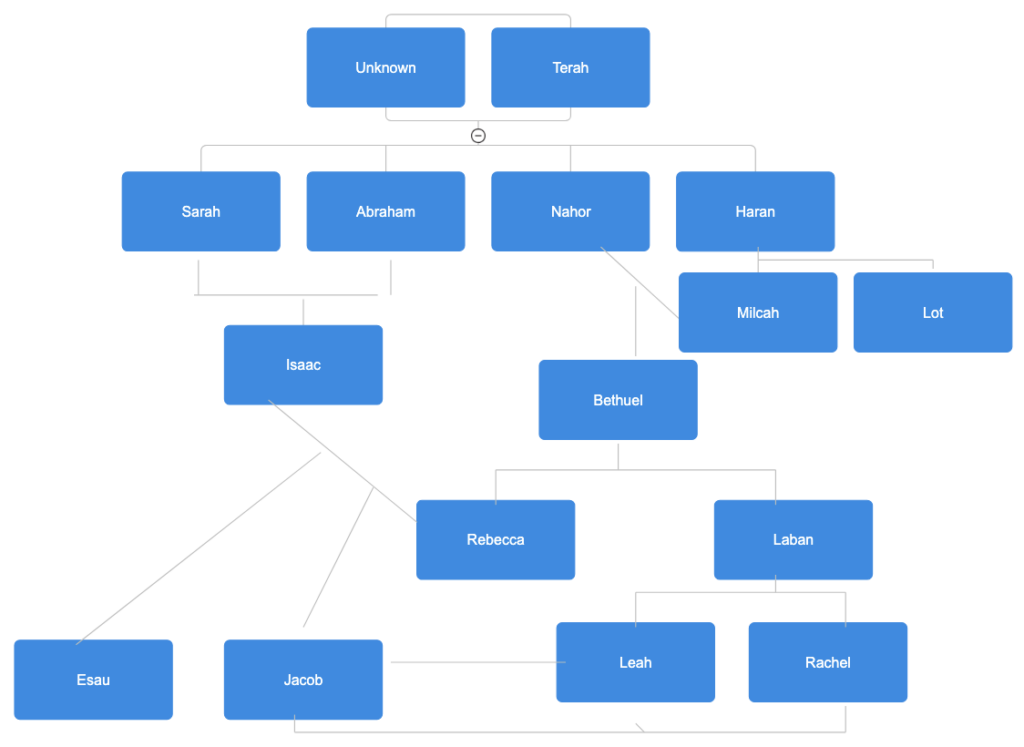
Why ask about Nahor?
What Jacob was doing was identifying the clan. This is addressing the family hierarchy.
- Tribe: Terah
- Clan: Nahor
- Household: Bethuel
- Man-by-man (family): Laban
Rachel Arrived
“Jacob was still talking with them when Rachel arrived with her father’s flock, for she was a shepherd. And because Rachel was his cousin — the daughter of Laban, his mother’s brother — and because the sheep and goats belonged to his uncle Laban, Jacob went over to the well and moved the stone from its mouth and watered his uncle’s flock. Then Jacob kissed Rachel, and he wept aloud. He explained to Rachel that he was her cousin on her father’s side — the son of her aunt Rebekah. So Rachel quickly ran and told her father, Laban” (Gen. 29: 9-12 NLT)
Rachel came to the well with her father’s sheep.
Jacob had an immediate encounter with Laban’s family. Look what Hughes said. He wrote, “God’s good hand [sends] the mercy sometimes to His servants while they inquire about it.”
Resource
Isn’t it so like Jehovah to answer our prayer before we get finished asking it? That’s what He did with Eliezer (Gen. 24: 15).
Ditto Jacob — even though Jacob was not in the attitude of prayer.
Rachel was there as a shepherdess, not with a water jar like Rebekah had (Gen. 24: 15). Bradford said that it was unusual for Mesopotamian women to ten flocks and herds.
Gray disagreed. He thought daughters of wealth pitched in to care for the flocks and herds.
Resource
Moses recorded that Jacob was the one to remove the cap stone from the well. That is significant.
Beyond being a practical gesture, it could show Jacob’s willingness to engage with the community he was entering. He knew that, in order to secure a bride, he was going to have to barter something — probably work related.
Remember, we said the betrothal process had changed. The highly structured process where someone negotiated for the groom directly with the bride’s family bride-gifts (mōhar) and secured consent was a thing of the past.
Jacob was on his own. There would be no oaths, no immediate payment, and no public consent scenes.
With what did Jacob have to barter? Being a shepherd.
Back to the well.
I always thought that Jacob took the cap stone off before he was supposed to do so. To me, Laban asking why Rachel got back early solidified that reasoning.
But look how carefully Moses described it. “And because Rachel was his cousin — the daughter of Laban, his mother’s brother — and because the sheep and goats belonged to his uncle Laban, Jacob went over to the well and moved the stone from its mouth and watered his uncle’s flock” (Gen. 29: 10 NLT).
Cousin — belonged to family. That gave him the justification to move the stone.
Bradford thought Jacob had another reason for removing the stone cap. He just wanted the other herds to get gone so he could talk to his family.
Was it a coincidence that Rachel — the mother of the Church — was a shepherdess?
Jacob lost it. After the long hard journey and — bam! Here was the woman of his dreams.
Don’t read anything into the kiss Jacob gave Rachel. That was the standard greeting, equivalent to our handshake.
Leale explained these tears. Jacob was probably remembering from where he started — faithless, questioning. But he made it — and he was a better man.
Resource
Jacob was where he was supposed to be.
On top of that, the approximate 500-mile journey was successfully completed. He was with family.
Laban Arrived
“As soon as Laban heard that his nephew Jacob had arrived, he ran out to meet him. He embraced and kissed him and brought him home. When Jacob had told him his story, Laban exclaimed, ‘You really are my own flesh and blood!’ ...” (Gen. 29: 13-14 NLT)
Rachel went home to get Laban – just as Rebekah had done.
I wonder what Laban was thinking when he heard family had returned from Canaan. Remember last time? Bride gifts.
We talked about how Laban saw the bride gifts before he heard the story of who the man giving them was. He probably thought Eliezer was blessed, not necessarily Abraham. Schmoozing? Probably.
Laban probably thought — if he worked it right — he could get some of that wealth for himself.
Who is to say that Laban might have thought — again — “How can I tap into the wealth again?”
Once again, Laban offered hospitality to family.
Gray thought Jacob would have announced his birthright and the covenant blessing given to him. I can see this because he knew he was to go to his mother’s family — specifically to Laban — to secure a wife.
Resource
I am sure that he did at some point. I don’t know if he led with that.
But we know there was time for that.
Making the Connections #1
Rachel, like Rebekah, was just going about her day. True, it was herding sheep instead of household duties.
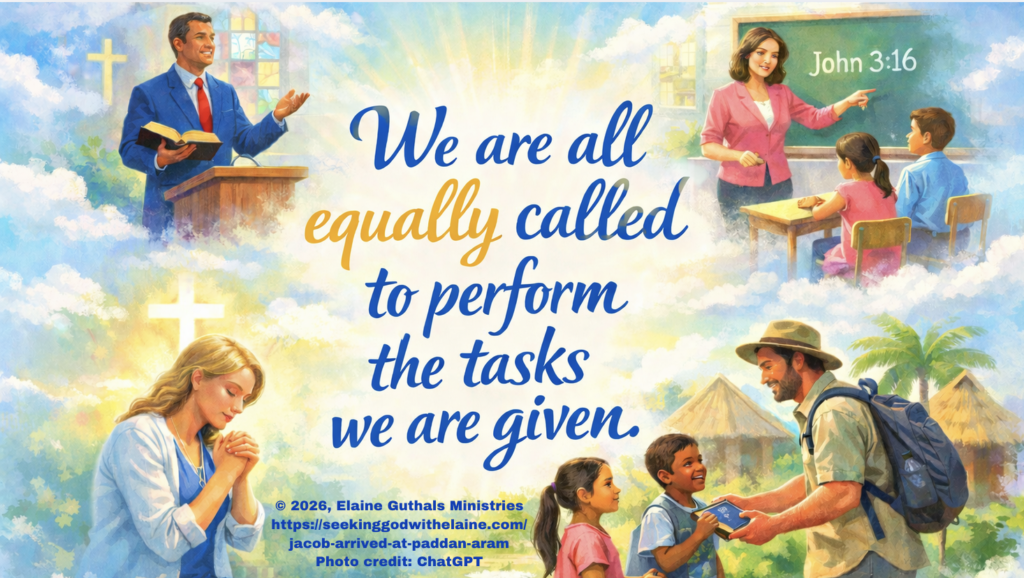
We each are called to work. That work isn’t always the same.
That doesn’t mean one job is more important than another. We are all equally called to perform the tasks we are given.
Making the Connections #2
Talmage equate the well in Jacob’s time to the well around which the Gospel gathers. Yeshua is the well of Living Water (Jn. 4: 10).
Resource
Ooo, baby. Do we come up with excuses as to why we can’t uncap the well and witness!
We shouldn’t. There are so many who need to hear of Yeshua and His love. They need to get to know Him as their Savior.
We can’t be like the Pharisees and say that the Church is just for us. Witnessing isn’t about the Church. It is about the Messiah. All need the Messiah’s saving grace.
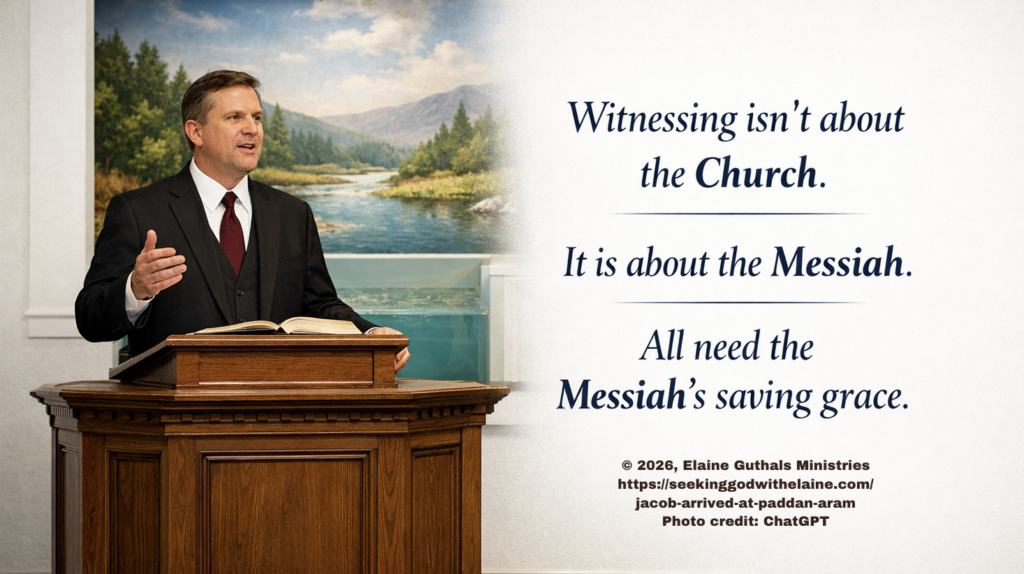
Talmage gave a list of what is stopping us from witnessing.
- Pride
- A stubborn heart
Yeshua said, “Come unto me, all ye that labour and are heavy laden …” (Mt. 11: 28 KJV). He could have just as easily said, “Come, ye who are thirsty.”
How Do We Apply This?
Listen for Jehovah’s encouragement and look for His directions.
Go where He is calling us to go.
Observe how Jehovah orders our steps.
See how Jehovah keeps His promises — especially when we commit to Him.
Resources
Father God. You call us into a covenant relationship with You. Then You bless us with the things You have promised. Thank You. Amen.
If you don’t understand something and would like further clarification, please contact me.
If you have not signed up for the email providing the link to the devotions and the newsletter, do so below.
If God has used this devotion to speak with you, consider sharing it on social media.