


He determines the times set for them and the exact places where they should live.
Acts 17: 26 (NIV)
Scripture: Acts 17: 24-31
Even strong believers can have doubts. Fortunately, we have a loving God who will shield us and protect us. This devotion looks at how we can find our security in God.
Lord, I know You have a plan for my life (Jer. 29: 11). I feel You have a direction You want my life to take. I have prayed about it, and I truly believe I am on the right path. People and events, however, have put doubts in my mind.
People I know have suggestions for me on what I should do. I don’t want to follow others. Their ways may not be Your ways (Isa. 55: 8-9). I want to follow You.
I look to You and Your Word for guidance, comfort, chastisement, redirection — whatever You want me to find. I want to look inward to the core of me where You reside.
To read Peace, Mercy, and Love, click the button below.
Lord, I know I will find You. You have said that all who seek will find (Mt. 6: 33).
I am ready for whatever You have to say.
How it encourages me that I am the beloved of You, Lord! You know me perfectly, and yet You still love me.
To read You Think I Am Perfect?, click the button below.
You know my faults and failures. You know my innermost thoughts. You know how I struggle with these doubts.
Still, I have security in You. You will never leave me. You have said in Your Word, “I will not leave you as orphans; I will come to you” (Jn. 14: 18 ESV). You will always be my Father.
Lord, I feel Your guidance in my life. That gives me security so that my doubts will decrease. I know I only have to look to You for direction, seek Your Will and obey Your commands. I invite You to dwell in my heart all day long and all through my life.
You keep me in the palm of Your hand (Isa. 49: 16). You are my shield (Ps. 28: 7) and my fortress (Ps. 18: 2).
Father, I put my trust in You. “When I am afraid, I put my trust in you” (Ps. 56: 3 ESV). You will work all the seemingly unconnected events together to bring about Your Will.
I stand in awe watching You put all the pieces of this puzzle that is my life together. You always work things out according to Your plan (Jer. 29: 11), which is best (Rom. 8: 28). How can I doubt when I remember this?
I know You are in complete control. All I have to do is put my faith in You and obey You.
I lift my eyes to look to You, Father. I watch for Your guiding hand. I will constantly look to You for signs telling me the way to go.
When Your directions come, I will follow them — and I will be blessed because of my obedience. “Remember that the Lord will give you an inheritance as your reward, and that the Master you are serving is Christ” (Col. 3: 24 NLT). I will follow You.
Lord, I will wait for You. I will look up to You when my adversaries have trodden down my hopes. Forgive me when I doubt Your love and provision.
Father, bear me on eagles’ wings until I have reached the quiet resting place in Your arms (Isa. 40: 31). I love You, Lord.
Father, You give us so much. You give us purposes in life. You love us through everything — through our stubbornness, through our disobedience, through our selfishness. You have a plan for each of our lives (Jer. 29: 11) that gives us rewards far greater than we can ever imagine (Co. 3: 24). Lord, we look to You for guidance and perseverance. Lead us to You, O God. Amen.
What do you think? Leave me a comment below (about this or anything else) or head over to my Facebook group for some interactive discussion.
If you have not signed up for the email daily or weekly providing the link to the devotions and the newsletter, do so below.
If God has used this devotion to speak with you, consider sharing it on social media.
Forgive our sins, as we forgive everyone who has done wrong to us.
Luke 11:4 (CEV)
Scripture: Matthew 5: 43-48
Forgiving someone is hard. Our spouses, family, or friends may have done something that hurt us and requires our forgiveness. This devotion explores a process we can take to forgive others.
To read devotions in the When We’ve Been Wronged series, click the buttons below.

We all will hurt those we love because we are human. The issues should be whether we do it intentionally or not and whether it is unresolved.
Luke 17: 4 says we must forgive those who ask for forgiveness – even multiple times. It is easy to forgive those who are trying their best to do right and are truly contrite when they realize they have wronged us. It is harder to forgive people when it seems like we are continually – purposefully – being wronged.
It is especially hard to give forgiveness if the relationship is toxic. A toxic relationship has some kind of physical or emotional abuse as a component.
But relationships don’t need to be toxic to have one partner break a relationship in some significant way. Whatever the situation, God expects us to forgive them.
Forgiveness is when we give up the bitterness and resentment that we feel because we have been wronged. It is a conscious decision to not seek vengeance.
Read that again. It is talking about us, not them. Forgiveness is more for us, not them.
It is not saying that we are condoning their actions. It doesn’t say the forgiveness has to be justified. Forgiveness is not going to turn our feelings and emotions off like a faucet or wipe our memories of the incident.
It is not even saying that the relationship will magically be restored. We might decide that we no longer want to have contact with them, and that is okay. We may decide to not tell them we have forgiven them, and that is okay, too.
It is saying that it is a conscious decision. We control whether we give forgiveness or not – yes, even in situations where we feel we have no control.
That is what my research into this topic said. What does God say?
God says that forgiveness has a reason. It is so we can be blessed (Mt. 5: 7).
Matthew 5: 43-45 says, “You have heard that it was said, ‘You shall love your neighbor and hate your enemy.’ But I say to you, love your enemies, do good to those who hate you, and pray for those who spitefully use you and persecute you, that you may be sons of Your Father in heaven …” (NKJV).
The most common argument for believers to forgive others is that God first forgave us. Matthew 5: 14-15 says, “If you forgive others the wrongs they have done to you, your Father in heaven will also forgive you. But if you don’t forgive others, your Father will not forgive you the wrong you have done” (GNT).
When we don’t forgive someone that damages our relationship with God. We have to be right with man before we can be right with God (Mk. 11: 25-26).
Not forgiving someone has consequences of its own. Matthew 18: 35 says, “So My heavenly Father will also do to you if each of you does not forgive his brother from his heart” (HCSB). Ouch!
Bitterness can come out of not forgiving someone. Unfortunately, a lot of times the person doesn’t care if we have forgiven them or not. It is just eating at us.
It is easy to say the words, “You’re forgiven.” But how do we actually do that? From the definition above, it is a conscious choice.
We have to deal with our anger first. Ephesians 4: 26 says, “Be angry and do not sin. Don’t let the sun go down on your anger” (HCSB).
While anger itself is okay, we have to stop letting it control our lives. Uncontrolled anger is not good for us – mentally or physically. Healing is not going to start to begin until we process the situation and turn the corner toward living the way in which God wants.
Acknowledging what we are feeling comes next – and then we need to move on. We have to be honest with ourselves, but rehashing the past doesn’t help us. True, this may seem beyond our control as the person may still be doing a variation of the same theme.
Forgiveness should have an element of forgetfulness to it. That doesn’t mean you have to put yourself back in the situation. It means that you shouldn’t harp on it. Get over it. Put it to bed. Move on.
We have to watch to see if we are making ourselves the victim. Yes, we can be the victim, but we may not always be. We have to take a good, honest look at the situation. What transpired and why?
What is stopping us from forgiving? What changes do we need to make to diffuse the anger? What can we use as a substitute to divert our attention when the anger starts to build? How are we fanning the resentments, and how can we get past that? How can we avoid the situations that feeds the anger?
I don’t know about you, but I do a lot of conversations in my head. We may need to corral some of our thoughts. They can be used to make something an even bigger deal than it is. They can also flip the situation so that we are not taking responsibility for our actions.
To read How Can We Corral Our Thoughts?, click the button below.
We need to focus on God and us. Why did this trigger this much of a response from us? What does God want the takeaway from this experience to be? How can we use what we’ve learned to help others?
One of the hard parts is trying not to judge the other. A lot of times this stems from our hurt. It can be where we lash out. What God wants us to do is love this person.
Some may find it helpful to write down their thoughts and feelings. Journaling or writing a letter you may or may not send can be a private way to get it all out. We can acknowledge when things are really getting us down while taking a good look at how things really are.
We can use the conversations in our heads to be able to “say” to the person what we never would be able to say in reality for various reasons. If it were real, the situation might escalate because the other may try to press our buttons – and we know how most of us try to avoid confrontations!
Or we may have trouble getting everything out if we were really talking with the person. Sometimes, when things mean the most to us, it is more difficult to have the needed discussions. Hopefully, we can have the discussions with ourselves while taking all the emotion out.
We can talk it out with a trusted friend or a professional. We may just need to say everything out loud. There is nothing wrong with going to a professional to work through things. They may be able to bring up things we hadn’t thought about.
Remember, though, forgiveness can’t be forced. It has to be genuine. It must be our desire to forgive those who have wronged us.
It probably isn’t going to be a quick fix, not a one-and-done type of thing. It is going to take us time to process and work through it. Plus, we may have to do the process several times.
We won’t have necessarily failed when the hurt feelings comes back. We may not be letting God have full control of the situation. We like to try to clean ourselves up, but only God can do that (Jer. 2: 22). But God may just be still growing us.
Also, it could be Satan trying to trip us up again and trying to get us farther from God. We just have to say, “I am not listening to you today, Satan.”
We also have to remember that we are probably not going to be able to change the person. That is up to them. They are in charge of themselves. We only work on ourselves.
Back to the definition. Forgiveness is about us. It is about us letting go of the hurt and what we can’t change. It is about us giving God, not the situations, control of our lives.

Well, I’ve given myself a lot of food for thought over these four devotions. Excuse me while I go spin my gears to process all of this. It isn’t going to be easy for me. I just hope I make substantial strides. I know this isn’t going to be over and done because, hey, it is what it is.
Loving Father. You ask us to show love to others by forgiving them. When the pain cuts too deeply, Lord, that is hard. Help us to be more like You and love others enough to forgive them. Amen.
On researching how to forgive others for this devotion, I came across these these resources, which I used as the foundation for my devotion.
Brandt, A. (2016). How do you forgive even when it feels impossible? (Part 2). Retrieved May 24, 2019, from https://www.psychologytoday.com/us/blog/mindful-anger/201605/how-do-you-forgive-even-when-it-feels-impossible-part-2
Greater Good Magazine. (n.d.) What is forgiveness? Retrieved May 24, 2019, from https://greatergood.berkeley.edu/topic/forgiveness/definition#what-is-forgiveness
Greater Good Magazine. (n.d.) Why practice it? Retrieved May 24, 2019, from https://greatergood.berkeley.edu/topic/forgiveness/definition#why-practice-forgiveness
Greater Good Magazine. (n.d.) How do I cultivate it? Retrieved May 24, 2019, fromhttps://greatergood.berkeley.edu/topic/forgiveness/definition#how-cultivate-forgiveness
Hey Sigmund. (n.d.). 15 Signs of a Toxic Relationship. Retrieved May 24, 2019, from https://www.heysigmund.com/toxic-relationship-15-signs/
O’Shoney, C. (n.d.). How to forgive someone who has hurt you (including yourself). Retrieved May 24, 2019, from https://www.melyssagriffin.com/forgive-someone/
Pushing Beauty. (n.d.) Forgiveness: 7 steps to healing after someone’s hurt you. Retrieved May 24, 2019, from https://www.pushingbeauty.com/articles/2016/4/28/how-to-forgive-someone-whos-hurt-you
What do you think? What else can we do to make sure forgiveness is more than words? Leave me a comment below (about this or anything else) or head over to my Facebook group for some interactive discussion.
If you have not signed up for the email daily or weekly providing the link to the devotions and the newsletter, do so below.
If God has used this devotion to speak with you, consider sharing it on social media.
Whenever you stand up to pray, you must forgive what others have done to you. Then your Father in heaven will forgive your sins.
Mark 11: 25 (CEV)
Scripture: Matthew 18: 21-35
This devotion is the third in the four-part When We’ve Been Wronged series. If we are not to react in revenge, what attitude should believers have when someone has wronged them? This devotion looks at forgiveness.
To read devotions in the When We’ve Been Wronged series, click the buttons below.

Joseph got it. He was able to say, “I forgive you,” without hearing, “we’re sorry.” Jonah didn’t get it. He wanted his enemies mowed down. Joseph was reacting as God would have us react; Jonah was reacting as the world would react.
What God is calling us to do is the direct opposite of what the world feels is the norm. He is calling for forgiveness. Mark 11: 25 says, “Whenever you stand up to pray, you must forgive what others have done to you. Then your Father in heaven will forgive your sins” (CEV).
The world says extract your revenge. At a minimum, it tells you to wait for karma to occur. It does not say show forgiveness.
When others wrong us, sometimes we may need to keep forgiving them. In response to a question from Peter asking how many times do we have to forgive another who wrongs us, “Jesus answered, ‘I tell you, not seven times, but seventy-seven times’” (Mt. 18: 22-). This is the biblical way of saying “ever how many it takes.” He wants us to have an attitude of forgiveness.
No, I don’t think God expects us to continue in or return to a situation where we keep forgiving the other person, and that person keeps on doing what s/he had been doing wrong. I just saw the meme that said that if you didn’t change your actions after you apologized, you were being manipulative. I agree with that.
The words, “I’m sorry,” are not a get-out-of jail-free card. You have to mean them and change your behavior so that your words match your actions.
But when the person tries to change their ways — and it may not always be easy — we have to forgive them. It is not up to us to sentence them for their crimes. It is our job to love them.
We have to believe that God will address the situation as it should be addressed (I Pet. 2: 21-23). That is on His timetable, in His way. We are called to model Him.

Jesus did turn the “eye for an eye” bit from Exodus 21: 24 on its ear. Matthew 5: 39 says, “But I tell you, do not resist an evil person. If anyone slaps you on the right cheek, turn to them the other cheek also” (NIV).
I know, that is so not us! It takes special people to put themselves in harm’s way. Why would we put ourselves up for more abuse?????
Instead, the world says, “Once is on you; twice is on me.” We call it learning from our mistakes. It is more of saving ourselves from those who do not have our best interest in mind.
This isn’t saying be a door mat and let everyone walk all over you. God doesn’t expect us to not stick up for ourselves. It is about our witness and showing how we are different from the world.
It all comes down to Luke 6: 27-28: “But I say to you who hear: Love your enemies, do good to those who hate you, bless those who curse you, and pray for those who spitefully use you” (NKJV).
Proverbs 10: 12 tells us why we need to love our enemies. “Hatred stirs up trouble; love overlooks the wrongs that others do” (CEV). No, love doesn’t whitewash them. It says make a choice to put the focus elsewhere. We need to focus on God.
God would prefer that we seek full restoration with those who have wronged us. “Finally, brothers and sisters, rejoice! Strive for full restoration, encourage one another, be of one mind, live in peace. And the God of love and peace will be with you” (II Cor. 13: 11 NIV). He is looking for unity.

Seeking revenge and holding grudges takes away our peace. God wants us to live in peace with everyone (Rom. 12: 18). No, He knows that isn’t possible all the time. But that is our goal to work toward.
What are we miserable about? To whom do we refuse to say they are forgiven?
Why can’t we say, “we’re sorry?” Why do we refuse to admit we were wrong? Why do we feel saying those words spotlight a weakness in us? Why do we think it would be a blow to our pride?
It is very hard for us to forgive others. (Remember what I said when I started this series. This came out of God talking to me.) So, we sit and stew. Are we as stubborn as Joseph’s brothers that it takes us 70 years?
We need to stop wasting time by refusing to give forgiveness. We need to take model God – and live the good, peaceful life.
God. Life is hard. Some may be things we are experiencing because they are consequences for our sins. Some may be the results of actions for others. It is so hard for us to admit when we are wrong. It is so hard to ask for forgiveness. Lord, how can we expect that we will ask Your forgiveness when we fail in asking forgiveness from others? Show us where we need to seek forgiveness – from You and from others. Show us where we need to forgive. Only by doing that can we find contentment in our lives. Use these opportunities to grow our relationships with You. Help us to focus on You and where we need to be. Help us always to remain Christ-like. Lord, You tell us to love our enemies. Help us to do so in these situations. Amen.
What do you think? Leave me a comment below (about this or anything else) or head over to my Facebook group for some interactive discussion.
If you have not signed up for the email daily or weekly providing the link to the devotions and the newsletter, do so below.
If God has used this devotion to speak with you, consider sharing it on social media.
The Lord will fight for you, and you have only to be silent.
Exodus 14: 14 (ESV)
Scripture: Psalm 94: 1-23
This devotion is the second in the four-part When We’ve Been Wronged series. We sometimes feel that, if we don’t retaliate in a situation, we are doing what God is asking. This devotion looks at holding a grudge and how that isn’t what God is asking us to do, either.
To read devotions in the When We’ve Been Wronged series, click the button below.

We are looking at the story of Joseph and his brothers. All of his brothers were expecting Joseph to extract his revenge now that Jacob was dead.
Everyone, except Joseph. He’d gotten over it years ago. Joseph didn’t strike out at his brothers in the years after the Israelites moved to Egypt or after Jacob died.
It looks like Joseph let God dish out the vengeance. He did nothing to make the brothers pay. He left it in God’s hands.
We know he did say, “’But as for you, you meant evil against me, but God meant it for good, in order to bring it about as it is this day, to save many people alive. Now therefore, do not be afraid; I will provide for you and your little ones.’ And he comforted them and spoke kindly to them” (Gen. 50: 20-21 NKJV).
Don’t you think Joseph’s life was so much richer than his brothers’ lives? He has spent years focusing on the positive, not rehashing the negative.
I wonder if the brothers envied his happiness now as they had growing up. Those brothers were probably miserable.
Vengeance is mine says the Lord (Deut. 32: 35; Lev. 19: 18; Ps. 94: 1-2 NKJV). We read that, and most of the time, we think that we are OK here.
We really don’t plan to cause bodily harm to people. We may in our heads wish some kind of punishment come to them, but we don’t follow through to make that happen. We may think of a lot of bad things that we wish would happen to them, but we don’t do those things to them.
Karma – the law of cause-and-effect. That is generally what we wish on them. We want them to see how much they needed us. We want them to regret what they did because it didn’t work out as planned. It is in the consequences of their actions that we want bad things to happen to them.
So, there are times, we don’t really act. However, sometimes our inactions are rooted in a mindset of revenge. We could be saying we are sitting back and letting God do it, but we brought the popcorn and the soda to the show.

We do like Jonah did. Remember, he ran away instead of going to preach to Nineveh. After he was fish food for three days, he did make it to Nineveh. The people of Nineveh repented, and God relented from sending the destruction that He had planned for them.
But look at Jonah. “So Jonah went out of the city and sat on the east side of the city. There he made himself a shelter and sat under it in the shade, till he might see what would become of the city” (Jnh. 4: 5 NKJV). No, he wasn’t picking up the sword to fight the battle. But he sure was waiting for the show to start!
But isn’t that holding a grudge? Let’s look at what a grudge is. What we feel is animosity, a strong dislike that, if we are not careful, can turn into a hatred. That is because it becomes deep-seated.
We are not talking about a “give me a week and I’ll get over it” kind of thing. We are talking about an active dislike that we don’t really need to pull out and brush off every so often to make sure we fan the flames of the hatred. It is usually already there.
We are talking about the grudge having taken up residency in the hurt and the anger. Yep, we probably use pride as a bellow.
Still, we feel that holding a grudge is vengeance light. Want and desire is a lot better than following through with actions. In our minds that is what is the difference between grudges and vengeance.
We may feel justified because the grudge is based on actions of the others. They did this to us! We wouldn’t feel this way if they hadn’t missed treated us.
So, it is their fault. We have no choice in the matter – or so we would like to think.
We do have a choice. No, we can’t choose their actions. However, we can choose how we react to their actions. We have control over ourselves.
The root cause of the grudge, in some cases, may be that their actions have caused us to doubt ourselves. We maybe thought we were stronger so that we wouldn’t be hurt by something like this. We think we are better judges of character than to be associating with someone who would treat us like this.
So, we judge ourselves and come up lacking. We are biting on ourselves because we have fallen short of our expectations of ourselves.
Then again, even on good days, we don’t often love ourselves. We see our faults, our failures, and things we lack. The grudge forms because of our pride.
So, we sit back and let God do His job. “The LORD will take revenge and punish them; the time will come when they will fall; the day of their doom is near” (Deut. 32: 35 GNT). But we are still trying to call the shots in some way.
We try to decide what the punishment will be. We try to control timing, preferably now.
Remember in the last devotion, we talked about God will fight our enemies for us, but it would not necessarily happen on our timetables. God will decide when and how He will take His vengeance.
It isn’t about us. It isn’t about how hurt we are or how much damage has been done to us and our self-esteem.

God taking His vengeance is about God and His plan for our lives. It is about someone messing with one of His own.
We have to take ourselves all the way out of it. We have to focus on God and what He is calling us to do. We have to learn what He wants us to learn.
We have to focus on God and on ourselves. We need to focus on our relationship to God and what he would have us do. We need to work His plan and forget about the actions are of others.
God. Life is hard. We may think we are doing a good job of letting you exact the vengeance, but we do buy the ticket and bring the snacks to see You accomplish that. That is not what You want us to do. Help us always to remain Christ-like. Amen.
What do you think? Do we think a grudge is vengeance light? Leave me a comment below (about this or anything else) or head over to my Facebook group for some interactive discussion.
If you have not signed up for the email daily or weekly providing the link to the devotions and the newsletter, do so below.
If God has used this devotion to speak with you, consider sharing it on social media.
Realizing that their father was dead, Joseph’s brothers said, “What if Joseph still bears a grudge against us and pays us back in full for all the wrong that we did to him?”
Genesis 50: 15 (NRS)
Scripture: Genesis 50: 1-21
This devotion is the first in the four-part When We’ve Been Wronged series. Let’s face it, people are always hurting others by an authentic or perceived wrong. Our gut reaction is to pay them back in kind. That isn’t exactly the way God wants us to handle it. This devotion looks at what revenge is and whose it is.

I wrote this devotion about a year and a half ago. It was actually a rewrite of something I had previously started. The timing of the rewrite was at the beginning of my spiritual tornado.
It came up in the queue today to work on to schedule so you could read it. Oh, man. I need to hear this today. But God is leading me to turn this into a series. So, once again, I am preaching to the choir here. Come join me in my attempt to hear what God is telling me.
All those years – wasted. Wasted denying their guilt. Wasted justifying the means with the end. Wasted worrying whether revenge would come. Wasted because they refused to admit their actions were wrong and to tell Joseph, “we’re sorry.”
So, for 70 years, Joseph’s brothers wrangled with unfinished business. They hid behind Dad’s robe, secure in the fact Joseph would do nothing while his precious father was alive.
They probably thought Joseph was too busy accomplishing the reason he was in Egypt to worry about seeking recompense for how he got there. Joseph was a success. He had bigger fish to fry.
Now Jacob was dead. Everything had changed.
Or did it? Did Joseph finally have his brothers thrown into prison? He could have, you know. It was probably tempting to make them face what he, himself, had faced. The only difference was they had “committed the crime” where Joseph hadn’t done anything wrong other than possibly being an arrogant brat.
Joseph could have had them killed. Remember it had been one of their options to leave him in the pit to die.
Now, he was an important man in Egypt. No one would have questioned his requests – this was their savior. What he wanted, he was entitled to get.
And knocking off his family members? What ruler didn’t to that in that day and age? No, everyone who knew the true story probably spelled revenge S-W-E-E-T.
In Bible speak, the word is vengeance. That is a kind of old-fashioned word. There are several different aspects in it.
The act of vengeance is to punish someone. It is directed specifically at a certain individual or group of individuals.
The punishment is seen as retribution. The person who is performing the act of vengeance does not feel like they are the one who “started it.” Their act is a response.
It is a response to an injury or a wrong. The person is hurt or angry enough to (usually) lash out to punish the other person.
Using today’s wording, we would say we were taking revenge. Close. We probably use this wording because it seems like it is talking about the act itself. We are action-oriented people.
There are a couple verses that point blank tell us that revenge is God’s job. Probably the most familiar verse on the topic says, “Don’t seek vengeance. Don’t bear a grudge; but love your neighbor as yourself, for I am Jehovah” (Lev. 19: 18 LB).

There are two others. “The LORD will take revenge and punish them; the time will come when they will fall; the day of their doom is near” (Deut. 32: 35 GNT). “O Lord God, to whom vengeance belongs — O God, to whom vengeance belongs, shine forth! Rise up, O Judge of the earth; Render punishment to the proud” (Ps. 94: 1-2 NKJV).
A verse that adds to this is Exodus 14: 14. “The Lord will fight for you, and you have only to be silent” (Ex. 14: 14 ESV). This is when the Israelites were at the Red Sea, pinned between it and Pharaoh’s approaching army.
God will fight our enemies for us. He will retaliate for us. He has our back. But this will not necessarily happen on our timetables.
To read How Can We Wait Silently While Not Being Silent?, click the button below.
Oh, man! You mean, God won’t slap them down now? Doesn’t He know what they did to us?
That is one reason why we try to take things into our own hands. We go ahead and avenge ourselves.
The Bible is also clear that we shouldn’t take it on ourselves to extract vengeance. First Peter 3: 9 says, “Don’t repay evil for evil. Don’t retaliate with insults when people insult you. Instead, pay them back with a blessing. That is what God has called you to do, and he will grant you his blessing” (NLT). First Thessalonians 5: 15 says, “See that no one repays anyone evil for evil, but always seek to do good to one another and to everyone” (ESV).

It is easy to want to avenge ourselves. We do take it on the whole “eye for an eye” bit in Exodus 21: 24. But that is another verse taken out of context. What is being talking about here is the law regarding violence. It is talking crime and punishment. It is talking violence, not insult.
But don’t we consider striking back to be human nature? I mean, a lot of times it happens without our thinking about it – especially if our weapon is our tongue.
What God is calling us to do is counterculture. That is huge. So, we are leaving that for the next devotion.
God. Life is hard. Situations happen to us where we end up lashing out at others because of perceived wrongs. Lord, You have told us in Your Word not to take vengeance. Help us to focus on You and where we need to be. Help us always to remain Christ-like. Help us to do so in these situations. Amen.
What do you think? Leave me a comment below (about this or anything else) or head over to my Facebook group for some interactive discussion.
If you have not signed up for the email daily or weekly providing the link to the devotions and the newsletter, do so below.
If God has used this devotion to speak with you, consider sharing it on social media.
But when the king came in to view the guests, he saw a man there who was not dressed for the wedding. So he said to him, ‘Friend, how did you get in here without wedding clothes?’ The man was speechless.
Matthew 22: 11-12 (HCSB)
Scripture: Matthew 22: 1-14
When we read the Parable of the Wedding Banquet, we like the idea that everyone is invited. We kind of get thrown, though, when the guest is kicked out. This devotion looks that the parable to see how we could apply it today.

It is easy to get riled up about the story about the wedding feast if we don’t know the facts. The time has come to get the party started, and the high-powered father of the groom sends out a reminder to the people who have already been invited to attend. Come one, come all, invitees.
Now, it is not our normal SOP to send out a reminder after the wedding invitation. This was more like a “it’s time” reminder.
But the guests didn’t come. No one came. They weren’t interested.
(Don’t we worry about that sometimes? Something is really important to us. Is it going to be important to others?)
So, Dad sent His people out again. Food’s ready. Who has been known to pass up free food? These people. Not only that, some of them went to the extreme of killing the messenger.
Dad said, okay. Go find the people going about their daily lives, even the homeless and the beggar on the street corner. Don’t limit the invitation; invite everyone you see.
The banquet was in full swing. Dad came in and saw someone wasn’t dressed right. We go, “Stop. You had this I’ll-take-what-I-get thing going. Now you are going to judge how dressed up they are?”
God is the father of the groom; Jesus is the Son; and we are the wedding guests. The wedding feast is the Messianic kingdom.
We need a history lesson. When the people came for the wedding, they were given clothes to wear. They didn’t have to go out and buy a new dress or suit and get all gussied up. Clothing was provided.
So, the issue wasn’t what he was wearing. It wasn’t that it was a black-tie affair, and he showed up in jeans.
The issue was the guest wasn’t wearing what he was supposed to be wearing. It meant he was still wearing his own clothes, not the outfit provided.
Aren’t we like the guest? God has provided the plan of salvation. He has given us everything.
If you have not admitted that your relationship is not right with God,
have not asked Jesus to be your Lord and Savior,
and have not confessed your sins,
please read through the Plan of Salvation and prayerfully consider what God is asking you to do.
God let’s us come as we are to accept this plan. We don’t have to clean up our acts for salvation. We could be a mass murderer, a hypocrite, or even a racist, for example. God will accept us — if we turn our lives over to Him — and work on not being a mass murderer, a hypocrite, or a racist.
To read Do We Have to Clean Up Our Acts to Get Salvation?, click the button below.
On the flip side, we don’t have to have a certain amount in our bank account, drive a specific type of vehicle, or belong to a specific Save-the-Whatever organization. We come as we are.
We aren’t forced to be a child of God. We are allowed to reject His gift. Since the Jews rejected His gift, it was offered to the Gentiles.
The inclusiveness is evident. Anyone can come to the Father.
God offers His salvation free of charge — but He does expect us to accept it. It must be our choice.

There is a requirement that we must meet to get into heaven. We must admit that we are sinners and that our relationship with God is broken. We must believe that Jesus, the Son of God, was sent to be the sacrifice to provide forgiveness for our sins and to mend that relationship. We must confess that God is the Sovereign God and that we give our lives to Him.
God also expects us to change. And not just our clothes (or anything on the outside). We don’t pretend that we are following Him — and then don’t.
What is expected is that we have a change of heart. We have to put our faith and trust in Him. We are expected to follow His guidelines. We are to try to do the do’s and try not to do the don’ts.
But for some there is that one thing to which we want to keep hold. “No, Jesus isn’t the only way to heaven.” “No, I can earn my way in.” “I want to do this one thing my way.” “This isn’t really a sin.”
Wrong, wrong, wrong, and wrong. We have to put complete faith in God and consciously, willingly turn everything over to Him and do it His way. We have to acknowledge and live that trust.
Is it easy turning everything over to God? No. Will Satan keep gnawing on us to keep it for ourselves? Yes.
Remember this. If God has given us the clothes to change into, He is going to make sure they fit and give us the fitting room so we can change into them. They are going to be in a style that is flattering to us.
The clothes that God gives us are going to be perfect — for Him and for us. He is going to help us change into them. But change we must. We’ll be glad we did.
Father. You have prepared the feast. You have invited everyone. Unfortunately, not everyone will come. Unfortunately, some of us who do struggle with putting everything completely in your hands. You told us in Jeremiah 29:11 Your plans are good. Forgive us, Lord. Help us to turn everything over to You. Amen.
One song that has spoken to me over the last year is Crowder’s Come As You Are. Click on the link below to be directed to a YouTube video of that song.
What do you think? Leave me a comment below (about this or anything else) or head over to my Facebook group for some interactive discussion.
If you have not signed up for the email daily or weekly providing the link to the devotions and the newsletter, do so below.
If God has used this devotion to speak with you, consider sharing it on social media.
If any man has ears to hear, let him hear.
Mark 4: 23 (KJV)
Scripture: Mark 4: 3-9
Topic: Dependence
There are times we hear but do not listen. Other times, we may not understand what we are hearing. This devotion discusses how we need to hear, listen, and understand when God is talking with us.

I used to think Mark 4: 23 contained a silly statement. Of course, people have ears, unless they have some defect or were in some accident. So, unless they are deaf, they are going to hear.
But how many times do we miss something that is said to us? We either just aren’t paying attention or else we don’t understand what the speaker has said.
“If you have ears, listen!” (Mark 4: 23 LB). There is a big difference between hearing and listening.
Hearing is like having the words wash over us like water at the beach. It stays on the outside of us — unless we open our mouths (minds) and swallow it. Bringing it in is listening.
But hearing and listening aren’t enough. Look at Matthew 14: 10: “… Hear, and understand” (KJV). We can hear the words said and actively listen; but we have to think about it, assimilate it, and make it part of us. Finally, we have to act on it.
There may be another explanation why Jesus said this statement. Matthew 13: 3-9, Mark 4: 3-9, and Luke 8: 5-6 are all the Parable of the Sower. That is a parable describing believing and why some people accept salvation, and some don’t. It was real important that the disciples understood what Jesus was saying. So, He said, “Don’t miss it.”
There are times we quit listening when we feel people are opposing us. Either they are questioning us in some way or accusing us of something. Then again, they may be just trying to change status quo.
Jesus talked about John the Baptist in Matthew 11: 7-15. He questioned people’s motives for going out to see Johnny. Most people don’t like it when their motives are questioned, so they stop listening at the threatening part.
Mark 4: 21-23 is the hide-the-candle-under-the-bushel story. Most people would be indignant to have someone accuse them of doing something stupid like that. Close the ears.
But we do that, don’t we? We hide our true selves under a facade of what we want others to think of us. Ouch.
The hard one to sit and listen to is Mark 7: 14-16. We’ve been told since way back what to do and what not to do. The Israelites were long knew what was clean and what was unclean. Now we’re saying it isn’t so! Like pork, touching dead bodies and stuff like that? You mean being defiled comes from who we are, not the world around us? Don’t get personal now.
Even after Jesus ascended to heaven, he’s talking in the “come on, guys, listen” routine. That’s how He starts out the letters to the churches in Revelation (2: 7). He wanted those churches to stand up and take note.
Ooo, baby. Don’t we stop listening sometimes? We hear the Bible stories, but we don’t listen to them. Or we listen to them, but if it is Paul writing, we don’t always understand them. But let’s look at it this way.
Sometimes, we need that prompting, too. “Hey, Chick. You are all caught up in what is happening in this world. Something important is fixing to happen. You are going to miss me working in your life if you don’t pay special attention.”
We are at different points in our journey with Christ. We have differing commitment levels – that can change constantly.
Jesus was calling us to keep the focus on Him. He wants us to grow in our faith. He was us to work our soil until we are fertile soil on which His Word can fall.
Christianity is counterculture to the view of this world. If what Christ was talking about was radically different than the norm, just a quick listen wasn’t going to cut it.
It takes more than a quick listen for us to learn the hard things. It is going to be like when I had an overview of Chemistry. I was listening (I really was). For the life of me, I just could not understand it.
When something is so foreign to us, it may take a while before the light bulb clicks on and we understand it. It may be because it is so far out of our experiences, we have little to link it to in order to facilitate the understanding.
On the other hand, we may be — consciously or self-consciously — balking. Let’s face it. God can call us to do a lot of things that are out of our comfort zones. Okay, He will take us out of our comfort zones.
When we hear God telling us to listen, we need to actively listen to Him. We need to turn away from the distractions and focus solely on Him and His Word.
There are things we can do to strengthen our relationship with Him. We can read His Word more and truly study it. We can pray, seeking His guidance.
We can find a fellowship of like-minded believers. Maybe one can act as either a mentor or an accountability partner.
Sometimes, we need to get away from the distractions. My retreat was exactly what I needed at the time. We can get away to plan, to read books to increase our skills and knowledge for God to use, and to restore our soul.
It is paramount that, when God is talking to us, we hear, listen, and understand. We don’t want to miss what He is calling us to do. We need to hear any corrections that He has for us.
We need to understand the plans God has for our lives. Then we have to follow through and do what He is asking of us.
Gracious Heavenly Father. We don’t hear You sometimes. We like our independence and don’t want Your guiding Hand. We don’t listen. There are times when You tell us things we don’t want to hear. Challenge us to change things we don’t want to change and accept responsibility for our actions when we would rather blame it on external forces or someone else. Help us, Lord, to hear, to listen, and to understand. Most of all, help us to obey. Amen.
What do you think? Leave me a comment below (about this or anything else) or head over to my Facebook group for some interactive discussion.
If you have not signed up for the email daily or weekly providing the link to the devotions and the newsletter, do so below.
If God has used this devotion to speak with you, consider sharing it on social media.
Before him will be gathered all the nations, and he will separate people one from another as a shepherd separates the sheep from the goats.
Matthew 25: 32 (ESV)
Scripture: Matthew 25: 31-46
Matthew 25: 31-46 is used by some to slam believers who are viewed as hypocrites for their intolerance of sin. Does this passage mean that you can just be a kind person and get a pass? This devotion looks at what it takes to get into heaven.

I saw on Facebook a meme that said going to church was not going to get people into heaven. Being kind to others will.
Part of that is right — just going to church is not enough. Part of that is wrong — just being kind to others is not enough, either.
Yes, Matthew 25: 31-46 does say Jesus separates people as if they were sheep and goats. It says that those who fed Him, clothed Him, and visited Him when He is sick and in prison gain entrance to heaven. Those who didn’t, don’t.
Jesus defined “me” as “… as you did it to one of the least of these my brothers, you did it to me” (Mt. 25: 40 ESV). What that says is that how we treat our fellow man is important.
But it seems to me like a couple of things are missed here. The first thing missed is that those gaining entrance to heaven (the sheep on the right) first were blessed by the Father. “Then the King will say to those on his right, ‘Come, you who are blessed by my Father, inherit the kingdom prepared for you from the foundation of the world’” (Mt. 25: 34 ESV emphasis added). It wasn’t their actions that put them on the right. It was being blessed by the Father.
Who is blessed by the Father? Jeremiah 17: 7 says, “But I [God the Father] will bless the person who puts his trust in me” (GNT). Trusting God is paramount. Believing God is our Sovereign King is the most important aspect of our faith, not how we treat others. Putting our trust in Him that He will provide for and protect us will make us sheep on the right. If we don’t do that — no matter how we treat others — we will be a goat on the left.

You cannot take Matthew 25: 31-46 out of the context of Matthew 22: 36-40. The greatest commandment is to love God; then you have to love other people.
The only way to love God and be restored so that we can have a relationship with Him is through Jesus. “Jesus said to him, “I am the way, and the truth, and the life. No one comes to the Father except through me’” (Jn. 14: 6 ESV). If we don’t accept Jesus as our Savior, it isn’t really going to matter how we treat others. Being kind to others is not a substitute for accepting Jesus as our Savior.

The goats (and we don’t mean Greatest of All Time) are the ones who haven’t accepted Jesus as their Savior. They won’t be let into heaven. “Don’t you know that the unrighteous will not inherit God’s kingdom? …” (I Cor. 6: 9 HCSB). Only those who have accepted Jesus as their Savior will be sheep on the right.
No, that doesn’t make the second commandment any less important. Jesus was only asked for the greatest commandment. “Teacher, which is the greatest commandment in the Law?” (Mt. 22: 36 NIV). He was the one Who added the bonus: “And the second is like it …” (Mt. 22: 39 NIV). He wouldn’t have said it if it wasn’t important. The second commandment just isn’t as important as the first. The second commandment is suppose to flow from the first.
God doesn’t want us to only hear what He is telling us in His Word. He wants us to put it into practice. “But if you look closely into the perfect law that sets people free, and keep on paying attention to it and do not simply listen and then forget it, but put it into practice — you will be blessed by God in what you do” (Jas. 1: 25 GNT). We put His guidelines into practice by treating those around us how He would treat us.
Did you see what that says — “… the perfect law that sets people free …” Then it goes on to the doing. The hearing and believing have to come first. You can’t enter heaven by being a kind person without trusting in God.

The second thing missed is what the actions are. It doesn’t mean that the sheep let the goats believe anything the goats wanted. It means the sheep supported them during the rough spots in their lives. It means we share the love of Christ with them so they can become redeemed.
We need to look at what sin is for a second. Galatians 5: 19-21 says the works of the flesh (a.k.a. sin) “… are evident: sexual immorality, impurity, sensuality, idolatry, sorcery, enmity, strife, jealousy, fits of anger, rivalries, dissensions, divisions, envy, drunkenness, orgies, and things like these. I warn you, as I warned you before, that those who do such things will not inherit the kingdom of God” (ESV). People try to use Matthew 25: 31-46 to mean that believers have to condone sexual immorality, impurity, sensuality, idolatry, yada, yada, yada. That’s wrong.
Believers are not called to tolerate the sins of others. Sometimes, I think the world wants believers to give a blanket pass to those pursuing a life of sin. They don’t understand that forgiveness comes to us individually.
Believers are to love non-believers and support them in order to show God to them. Jesus came to earth to be the sacrifice to pay the price for our sins. He also came to be an example as to how we are to live. He came to show us Who God really is. If we follow His example, we show others Who God really is.
Are believers going to commit yada, yada, yada? Yes — at least yada. We want to follow God’s guidelines, but we are still human. We are still in our sinful flesh. That makes a tug of war that we sometimes lose.
Thankfully, “But if we confess our sins to God, he will keep his promise and do what is right: he will forgive us our sins and purify us from all our wrongdoing” (I Jn. 1: 9 GNT). All we have to do is go to the Father, confess what we did wrong, be forgiven, and turn from doing that sin.
What is God’s promise? “‘The mountains and hills may crumble, but my love for you will never end; I will keep forever my promise of peace.’ So says the LORD who loves you” (Isa. 54: 10 GNT). His love for us is never ending.
Yes, it is hard. “Enter by the narrow gate; for wide is the gate and broad is the way that leads to destruction, and there are many who go in by it. Because narrow is the gate and difficult is the way which leads to life, and there are few who find it” (Mt. 7:13-14 NKJV). Yes, believers will mess up at times. We won’t be perfect until we are one of the sheep in line.
No, we can’t get into heaven by just being a kind person. We have to follow the first commandment to love God with our whole being before we can love everyone else. After that, it is a work in progress.
Father. That You love us is beyond our comprehension. But You loved us so much that You sent Your Son to give us new and eternal life (Jn. 3: 16). You ask us that we model, as Christ did, Your love to those around us. In today’s world, we run into people who would rather just be kind people than put their trust in You. Help us to show them the Way. Work in their hearts and lives to make them more receptive to You and Your love. Lord, we don’t want them to be goats. We want them to be sheep. Amen.
If you have not admitted that your relationship is not right with God,
have not asked Jesus to be your Lord and Savior,
and have not confessed your sins,
please read through the Plan of Salvation and prayerfully consider what God is asking you to do.
To read those devotions that discuss conflicting verses, click the button below.
What do you think? Leave me a comment below (about this or anything else) or head over to my Facebook group for some interactive discussion.
If you have not signed up for the email daily or weekly providing the link to the devotions and the newsletter, do so below.
If God has used this devotion to speak with you, consider sharing it on social media.
I believed, therefore have I spoken.
Psalm 116: 10 (KJV)
Scripture: II Corinthians 4: 1-18
One of our jobs as believers is to share with others what God has done and is doing for us. Many times, though, we choose not to witness because we are insecure and do not want to risk a confrontation. This devotion looks at sharing what we believe.

I have told you that I am a processor. A word or a phrase may trigger a thought that others may or may not see.
To read How Do We Wrestle with God?, click the button below.
Psalm 116 is one of those passages. If you look at it, it is about thanking God because He didn’t kill off the author. We should be thankful for all God does for us.
My nugget came in verse 10. The whole verse says, “I believed, therefore have I spoken, I was greatly afflicted” (Ps. 116: 10 KJV). The Good News Translation has it as “I kept on believing, even when I said …” The International Standard Version has “I will continue to believe, even when I say …” It is all here – past, present, and future.
We’ve also talked about the verbs in the Bible having those three aspects to them. That may be why the different translations take a different angle for this verse.
To read Why Do Christians Sin?, click the button below.
The “I believed, therefore I said” struck a chord with me. Believers don’t always do that.
Years ago, I was talking with some friends, most of whom are around my mother’s age. One lady mentioned it was hard for her to talk with others regarding Christianity because she didn’t have to practice it when she was young. When she was growing up, everyone she knew was a believer. She had no need to tell others.
But society has changed. Fewer people know Jesus. Society is more tolerant of differing beliefs – and of non-belief. Now we come into more contact with people who aren’t believers and need for us to tell them of Jesus’ love and sacrifice.
The opportunities are there for us to witness, but we generally aren’t doing it (myself included). We aren’t because, a lot of times, we are insecure about sharing our beliefs with others. We feel unsure about how to begin the conversations. We’re scared we will be rejected. We feel inadequate in our own walk with God. And we have had no practice.
Another reason we don’t witness is because religion has become taboo. The worldview demands believers not talk about their beliefs because they are seen as intolerant. We shy away from the confrontation. We dread the confrontation especially when we have had no practice in witnessing.
So, we say nothing. But by our silence, we then agree with the way the world is being run by Satan. We don’t take a stand for what we believe in.
Paul must have made the same connection that I did. (Yeah, me!) He also pulled out the nugget as a call to witness (II Cor. 4: 13). It is our job to tell others what we believe and what has been done in our lives by our loving Father.
Interestingly, Paul added some other nuggets that can help us. “… As we have received mercy, we do not lose heart” (II Cor. 4: 1 NKJV). Witnessing is hard and challenging. But we can’t give up. God doesn’t expect a perfect conversion rate. He doesn’t want us to get discouraged, so He made sure scriptures encouraged us.
Why won’t we have a perfect conversion rate? When we witness, not all will accept what we have to say. Nope, we aren’t guaranteed a 100% success rate. “But even if our gospel is veiled, it is veiled to those who are perishing” (II Cor. 4: 3 NKJV). Okay, sometimes the gospel is a little hard to understand (especially when Paul is talking).
Non-believers sometimes try to figure it all out. We are told to “… lean not on [our] own understanding” (Prov. 3: 5). It is even harder for non-believers to just take it on faith.
Few like rejection and failure. Sometimes, that makes us not want to put ourselves out there. If we are uncomfortable witnessing, that makes us even more uncomfortable.
The bottom line, though, is not everyone is going to acknowledge God as Lord and Jesus as our Redeemer. For whatever reason, they are going to choose not to put their faith in God. We have to remember that it is not us that non-believers are rejecting. It is God.
More times than not, we just don’t feel “qualified” to be witnesses. We see all of our faults and failures that we think disqualify us from being witnesses.
God thinks differently. “But we have this treasure in earthen vessels that the excellence of the power may be of God and not of us” (II Cor. 4: 7 NKJV).
Witnessing isn’t about us. It is about His power and what He has done for us. That is the message we are to get across.
We may use our experiences to apply it so those we are talking to can see the fit for their lives. But the message isn’t, “Oh, look at us.” The message is, “Look what God has done for us.”
We can’t care about the “we” part in witnessing. We have to concentrate on the “God” part. We won’t be us doing it, anyway. It will be God working through us.
That is, I feel, the main problem we have with witnessing. The focus is wrong. It is hard for us to see because we and the situation are all we see. We concentrate on the “we” part and forget about the “God” part.
God wants us to be bold and speak up for Him. He wants us to share His love with everyone. He doesn’t want us to concentrate on the consequences of witnessing. God wants us to concentrate on the people we are witnessing to and Him, not us.
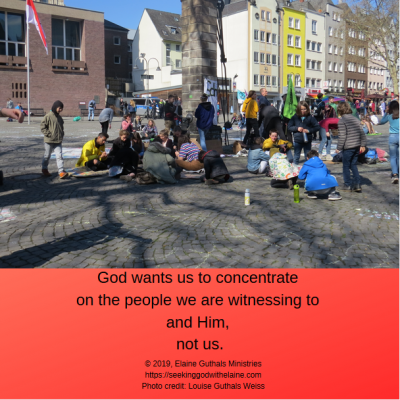
Sometimes, we think we don’t have a compelling enough story to help win others to Christ. Luke 24: 48 says, “You are witnesses of these things” (NIV). We may not have been with Christ from the beginning as the disciple were (Jn. 15: 27), but we, too, have a relationship with Christ. We have our own stories to tell. People we talk to today will be more interested in how the gospel is relevant today, not 2000 years ago.
Remember, not everyone is going is going to accept what we are telling them. We have to do what Jesus told the disciples when He sent them out. “And if anyone will not receive you or listen to your words, shake off the dust from your feet when you leave that house or town” (Mt. 10: 14 ESV). We have to be ducks. Let is roll off our backs. Don’t take it personal like.
It is really important that we Oh, we have to take back the world from Satan. We have to prepare for the end times. The time is now for us to stand up and be counted. We have to up our witnessing game.
Heavenly Father. We believe in You. We believe You sent Your Son to save us from our sins. We believe You sent the Holy Spirit to guide us through our lives. We believe; therefore, we will tell others. Help us to overcome our inexperience, our fears and our insecurities. Put us in situations where we can share Your plan of salvation. Use us as instruments to bring others to You. Amen.
Paul’s Roman Road is a good tool to use when presenting the plan of salvation to a non-believer. For a refresher, click on the button below.
What do you think? What are some other issues that are stopping us from witnessing? Leave me a comment below (about this or anything else) or head over to my Facebook group for some interactive discussion.
If you have not signed up for the email daily or weekly providing the link to the devotions and the newsletter, do so below.
If God has used this devotion to speak with you, consider sharing it on social media.
While we wait for the Lord to act, Psalm 62: 1 says we are to stand silently. Does that mean we are to be inactive? This daily devotional looks at what waiting silently for God to rescue us really means.

How many times have we stood in line before? That is probably the epitome of waiting.
Okay, now how many times have we stood in line silently? Oooo, baby. That throws a kink into it.
We do not wait patiently or silently. Right away we start talking to the person in front of or behind us. “We haven’t moved in five minutes.” “Look at that person just standing behind the closed counter while the line gets longer and longer.” Not very patient, are we? And definitely not silent!
The scene switches. Our lives are a mess. Everything that could go wrong is going wrong. Bills are piling up. The flu is making the rounds at work so our load has increased in just trying to get the “can’t wait” stuff done. Everyone at home has an ax to grind [add what challenges you are facing to the list]. So, all in all, things are going lousy.
“I stand silently before the Lord …” (Ps. 62: 1 LB).

Stand? No, we aren’t standing. We do our Ichabod Chicken imitation.
We’re running around like chickens with our heads cut off trying to fix the problems to get ourselves out of whatever situations in which we find ourselves. We try everything in our power to make our lives better.
You have got to be kidding, right? “… Waiting for him to rescue me” (Ps. 62: 1 LB). Waiting?
We are tired of waiting! We want out of this, and we want out now!!!!
No, we are not patient people. Our lives, our decisions, our time tables — that’s what we want for our lives.
No mess, no fuss, no drama, no worries. We want smooth sailing.
If God can’t make our lives smooth sailing, the least He could do is throw in tickets to Hawaii, right?
But in our hustle and bustle, isn’t it easy to miss God? Isn’t it easy to forget about God?
There are great benefits in standing still — taking a breath. We can let His peace seep through us.
Silently? Not in our lifetimes. We’re complaining to high heaven. We’re moaning that it isn’t fair and asking ourselves – and anyone else who will listen – why this is happening to us.
We bargain, complain, and rail at God for the situations that we find ourselves in.
We definitely believe in the squeaky-wheel-gets-fixed principle. If we are silent, we will not get this thing solved.
I don’t think God pays any attention to the squeaky wheel. What He pays attention to is what is in the plan for our lives (Jer. 29: 11). He pays attention to what is best for us.
More importantly, God pays attention to our focus on Him. He pays attention to our obedience.
But I don’t think God wants us to be inactive while we are waiting. God wants us to pray to Him.
In a way, God doesn’t want us to remain totally silent. He wants us to call on Him and ask for His help. He wants us to keep praising Him.
God listens to our prayers, but He answers then on His timetable. Hence, sometimes we wait.

“I stand silently before the Lord, waiting for Him to rescue me” (Ps. 62: 1 LB). Come on, now. Have you ever known God not to rescue you? No.
It may not be as dramatic and obvious as the knight riding up on the white horse, slaying all the dragons like we want. It may not be on our timetables. But God does rescue us.
The problem is, if we are running around like chickens with our heads cut off, we may miss Him. Unless we are silent and seeking Him, we may just breeze on by Him.
Besides, remember how He came to Elijah? Elijah didn’t find Him in the dramatic wind or thunder. He found Him in the quiet whisper (1 Kings 19: 12). He had to listen so hard, because if he didn’t, he would have missed His voice.
Devotions in the Elijah Was Depressed series
Part of the problem is we are so independent. We think we have to do things to make things better.
God says that is not the case. Look at these scriptures.
“The Lord will fight for you, and you have only to be silent” (Ex. 14: 14 ESV).

“You will not need to fight in this battle. Stand firm, hold your position, and see the salvation of the Lord on your behalf, O Judah and Jerusalem.’ Do not be afraid and do not be dismayed. Tomorrow go out against them, and the Lord will be with you” (II Chron. 20: 17 ESV).
“For the Lord your God is he who goes with you to fight for you against your enemies, to give you the victory” (Deut. 20: 4 ESV).
“You shall not fear them, for it is the Lord your God who fights for you” (Deut. 3: 22 ESV).
In reality, we don’t have to battle. God will fight our battles for us. Who better to do that? Our strength is limited.
Plus, the enemy we are fighting is not of this world. Ephesians 6: 12 says, “For we do not wrestle against flesh and blood, but against the rulers, against the authorities, against the cosmic powers over this present darkness, against the spiritual forces of evil in the heavenly places” (ESV). We are engaged in spiritual warfare — a fight God has already won.

Waiting isn’t just doing nothing. It is praying, reading our Bibles, and actively seeking Him. It means growing in the ways we need in order to do the work He has for us.
Waiting is standing firm (II Chron. 20: 17). It is putting our faith and trust in God that he will provide for and protect us. It is holding our position — staying strong in that faith, not giving in to Satan’s lies and temptations.
To read a related devotion, click the button below.
We’ve got to get the focus off us and onto God. That is the only way we will see Him when He works. He will work. In His time. In His way. Sorry, we don’t get to choose the when or how.
So, let’s slow down, keep our complaints shut down, and let Him rescue us.
Lord, we try so hard to dig ourselves out of the messes we make. We say it’s us looking for You, but it isn’t. It’s us believing in ourselves and our own abilities. It’s us trying to set the parameters of how and when You will rescue us. Silence us, Lord. You’ll probably have to give us this lesson more than once. Teach us the patience to wait on You. Only then can Your name truly be glorified. Amen.
What do you think?
Leave me a comment below (about this or anything else) or head over to my Facebook group for some interactive discussion.
If you don’t understand something and would like further clarification, please contact me.
If you have not signed up for the email daily or weekly providing the link to the devotions and the newsletter, do so below.
If God has used this devotion to speak with you, consider sharing it on social media.