Blog

  • What Does “in Christ” Mean?

    Therefore remember that at one time you Gentiles in the flesh, called the uncircumcision by what is called the circumcision, which is made in the flesh by hands — remember that you were at that time separated from Christ, alienated from the commonwealth of Israel, and strangers to the covenants of promise, having no hope and without God in the world. But now in Christ Jesus you who once were far off have been brought near in the blood of Christ.
    Ephesians 2: 11-13 (RSV)

    Remembering may or may not be a pleasant experience. Paul wanted us to remember what it was like “without Christ” in order to contract it with our lives “in Christ.” This devotion looks at what exactly being “in Christ” means.

    Nuggets

    • Everybody was in the same unredeemed boat as, in the spiritual sense, we are all uncircumcised Gentiles.
    • Paul specifically wanted his readers to remember the time before salvation to contrast “without Christ” to “in Christ.”
    • When we are “in Christ,” sin no longer has a hold on us.
    • The restoration of our relationship with God has been made because of the power “… in the blood of Christ” (Eph. 2: 13 RSV).

    Flowers with title What Does "in Christ" Mean?

    Remembering our past can sometimes be something enjoyable. However, it can also be something we would rather not do.

    Paul wanted us to remember our lives before we had invited Jesus to be our Lord and Savior and God to be our Sovereign God — “without Christ.” He wanted us to remember so that we could be encouraged when looking at our lives “in Christ.” What, really, does “in Christ” mean?

    Remembering Our Sinful Condition

    “Therefore remember that at one time you Gentiles in the flesh, called the uncircumcision by what is called the circumcision, which is made in the flesh by hands” (Eph. 2: 11 RSV).

    I thought the words that Paul used was interesting: “… you Gentiles in the flesh …” (Eph. 2: 11 RSV). I wondered if Paul was trying to say everyone — even Jews — were in a lost condition.

    You know. “Obviously, the law applies to those to whom it was given, for its purpose is to keep people from having excuses, and to show that the entire world is guilty before God” (Rom. 3: 19 NLT). Everybody was in the same unredeemed boat.

    I think Paul was speaking more than literally here. Yes, “being Gentile” was a derogatory remark used by the Jews. The Israelites (the circumcised) looked down on the Gentiles (the uncircumcised). Big time.

    But Paul was saying, in the spiritual sense, we are all uncircumcised Gentiles. We are all “without Christ” until we ask Him to be our Lord and Savior.

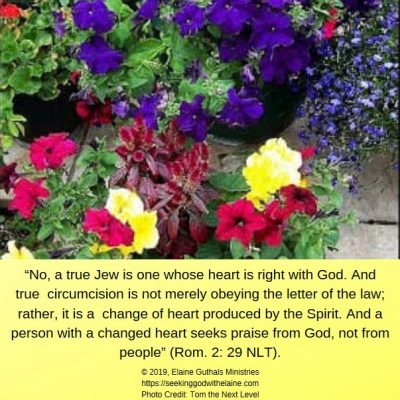
    Paul was talking about an inward circumcision. “No, a true Jew is one whose heart is right with God. And true circumcision is not merely obeying the letter of the law; rather, it is a change of heart produced by the Spirit. And a person with a changed heart seeks praise from God, not from people” (Rom. 2: 29 NLT).

    But that isn’t the focus of the verse. The focus of this verse — and verse 12 — is to remember. Remember what used to be without Christ.
    Flowers

    “Without Christ”

    “remember that you were at that time separated from Christ, alienated from the commonwealth of Israel, and strangers to the covenants of promise, having no hope and without God in the world” (Eph. 2: 12 RSV).

    Paul specifically wanted his readers to remember the time that they were without Christ. He wanted them — and us — to contrast “without Christ” to “in Christ.” Paul said eight — maybe nine depending on how you read one of the “in Him” references — times that we are “in Christ.”

    That is stressing the contrast. Before Christ, we were lost; after Christ, we are saved. Before Christ, we were dead; after Christ, we are alive. Before Christ, we were miserable; after Christ, we are joyful.

    Some may consider the “alienated … strangers … having no hope …” (Eph. 2: 12 RSV) the worst parts. Paul saw the worst was “… without God …” (Eph. 2: 12 RSV).

    Paul’s point was we have nothing without God. We are not blessed without God.

    Yes, we know that God does bless even non-believers (Mt. 5: 45). Believers receive blessings abundantly. “But seek first his kingdom and his righteousness, and all these things will be given to you as well” (Mt. 6: 33 NIV). “All these things” are food, drink, and clothing. He will provide to His children.

    But it isn’t all about the material things. It is about eternal life.

    The kicker is we have no hope of it getting better if we don’t have God. This is about the alienation.

    There was a time when man was not alienated from God. “And they heard the sound of the Lord God walking in the garden in the cool of the day, and the man and his wife hid themselves from the presence of the Lord God among the trees of the garden” (Gen 3: 8 RSV).

    Yes, this was the only time we see the interaction between God and man in the Garden — and this doesn’t end well. But Adam and Eve are not hiding because God is in the Garden. They are hiding because they are naked.

    Their not being scared of Him leads us to believe that God had visited them before. That would mean He has seen them naked before. That is the polar opposite of alienation. That is relationship.

    That is what God wants back. He wants the connection. The sense of family.

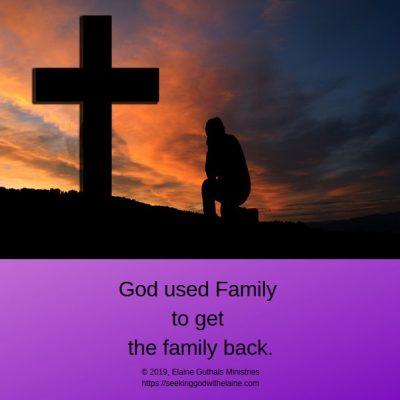
    The way we get that back is to be “in Christ.” God used Family to get the family back.
    Kneeling at Cross

    But Now “in Christ”

    “But now in Christ Jesus you who once were far off have been brought near in the blood of Christ” (Eph. 2: 13 RSV).

    But now.

    Now that God has sent His Son to be our Redeemer and Savior. Now that the plan to restore our relationship with Him has been accomplished.

    Now that we have ABCDed. Now that we have asked Jesus to be our Redeemer and Savior.

    The ABCDs of Salvation

    A – admit our sins

    B – believe His Son Jesus is our Redeemer

    C – confess God as Sovereign Lord

    D – demonstrate that commitment by making any changes needed in our lives to

    live the way in which God has called us

    If you have not become a believer in Christ, please read through the Plan of Salvation and prayerfully consider what God is asking you to do.

    Now we are “in Christ.” Sin no longer has a hold on us.

    Our relationship has been restored. We can call on God as our Father. We can walk with Him in the Garden — and on the street and in our houses.

    That restoration has been made because of the power “… in the blood of Christ” (Eph. 2: 13 RSV). His blood sealed the everlasting covenant. “Now may the God of peace, who brought up from the dead our Lord Jesus — the great Shepherd of the sheep — with the blood of the everlasting covenant” (Heb. 13: 20 HCSB). The everlasting covenant is “… between me and you and your descendants after you for the generations to come, to be your God and the God of your descendants after you” (Gen. 17: 7 NIV).

    By putting our faith in Jesus, we are members of that covenant. By believing in the power of His blood, our sins are completely punished and pardoned.

    Making the Connections

    Looking at the bad reminds us of how good the good is. When we contrast “without Christ” to “with Christ,” there is no comparison.

    We also need to look back at the mistakes we have made in the past. God uses those experiences to bring us to Him.

    Remembering those experiences to help us grow in the present. This happens when we put the past experience in the right context.

    I am thinking of the I Am They song Scars. I love how it says, without the scars, we wouldn’t know who Jesus is.

    Related Links

    Scars

    I Am They

    Without our scars, we don’t know who we — and He — are.

    We shouldn’t just be humiliated and biting on ourselves. If we are stymied by that experience, it can’t be used to help us grow.

    However, if we truthfully look at the experience, evaluate it, and use it to set goals for improvement, we can grow from it.

    If we don’t remember, we can’t see how God uses this experience to expand His kingdom and help us grow. We will not be able to use our experiences to help others grow.

    God does want us to remember. “Remember that you were slaves in Egypt, and that I, the LORD your God, rescued you by my great power and strength. That is why I command you to observe the Sabbath” (Deut. 5: 15 GNT). He wants us to remember His love, power, and deliverance. He wants us to remember He saved us, not we ourselves.

    God wants us to remember so we can be grateful. It should make us want to change.

    How Do We Apply This?

    Satan is going to try to stymie us. He is going to use our past failures to get us to think we are unworthy of God’s love. That will make us think we can’t accept God’s gift of salvation.

    When we continue to mess up even as disciples, Satan will try to get us to think that God has given up on us. He hasn’t. He loves us and is preparing us — even through the mess ups — for life with Him.

    We’ve got to forget about this is how we messed up. We have to remember this is how God rescued us.

    Loving Heavenly Father. Thank You for not giving up on us. Thank You for loving us enough to want our relationships with You restored. Thank You for providing a way for that to be accomplished. Help us to remember all of the good things You have done for us. Help us to remember our mistakes so that we can grow closer to You. Amen.

    What do you think?

    Leave me a comment below (about this or anything else) or head over to my Facebook group for some interactive discussion.

    If you don’t understand something and would like further clarification, please contact me.

    If you have not signed up for the email daily or weekly providing the link to the devotions and the newsletter, do so below.

    If God has used this devotion to speak with you, consider sharing it on social media.

  • How Do We Remake Ourselves?

    For we are his workmanship, created in Christ Jesus for good works, which God prepared beforehand, that we should walk in them.
    Ephesians 2: 10 (RSV)

    We generally have something that we don’t like about ourselves. Many times, we wish for a makeover. In this devotion, we discuss how salvation provides the way to remake ourselves.

    Nuggets

    • The first thing we need to do to work out our salvation is to make a total commitment.
    • The second thing is living as God would have us live.
    • Finding God’s Will for our lives is the third thing.
    • To accomplish His Plan, God has prepared works for us based on our talents and nature.

    In Ephesians 2: 9, Paul emphatically told us that works were not necessary for salvation. In verse 10, he told us that we were “… created in Christ Jesus for good works …” (Eph. 2: 10 RSV). Did the boy lose a screw switching from one verse to the next?

    We have to look at this a little closer.

    Let’s Put It into Context

    “For we are his workmanship, created in Christ Jesus …” (Eph. 2: 10 RSV).

    Usually, there are things we don’t like about ourselves. We would like to remake ourselves.

    We are remade when we accept the gift of salvation. When we gain salvation, we are transformed. We become a spiritual as well as a physical being.

    People

    Sometimes, after we have accepted Jesus as our Lord and Savior, we don’t feel like we’ve changed. We don’t feel we are God’s workmanship.

    What we do feel is God was having an off day when we were created. There are a couple of reasons for that.

    One, we tend to just look at the physical body. The list of the things that we don’t like about ourselves is generally long.

    Cutting ourselves down is a consequence of the original sin. However, we are “… fearfully and wonderfully made …” (Ps. 139: 14 NIV).

    Two, we forget that we are made a new creation. “Therefore, if anyone is in Christ, he is a new creation. The old has passed away; behold, the new has come” (II Cor. 5: 17 ESV).

    Churchy word alert. That is called regeneration. Yep, we probably could (and should) do a whole devotion on that sometime.

    What does regeneration mean? It is the spiritual transformation through which God changes us from being spiritually dead to being spiritually alive by instilling in us a holiness of heart and life.

    We can’t see any of these changes since they are spiritual. Sometimes we don’t feel totally different — or we can go back to not feeling different.

    But let’s go on to the “… created in Christ Jesus for good works …” part (Eph. 2: 10 RSV). We just spent a whole devotion on how it was faith, not works, and here Paul slips in good works.

    To read So, What Are the Foundations of Salvation?, click the button below.

    I know. I had trouble with that, too, at first. But I think Paul has it right.

    Paul makes the argument that, by doing the good works, we become the creation that God has just recreated. He is saying, to me, that this is how we work out our salvation (Phil. 2: 12) and live a Christian life.

    To read How Do We Work Out Our Salvation?, click the button below.

    Good Works to Work Out Our Salvation

    We could say that making the decision to ABC is the fairly easy part. The D part is a little more challenging.

    The ABCDs of Salvation

    A – admit our sins

    B – believe His Son Jesus is our Redeemer

    C – confess God as Sovereign Lord

    D – demonstrate that commitment by making any changes needed in our lives to

    live the way in which God has called us

    If you have not become a believer in Christ, please read through the Plan of Salvation and prayerfully consider what God is asking you to do.

    God knew that it wouldn’t be easy. He also knew that a lot of us learn by doing.

    Another thing God knew was it was probably going to take us a little time to get used to the idea that now we are disciples of Jesus. Remember, what Jesus taught was countercultural — then and today.

    The first thing we need to do to work out our salvation is to make a total commitment. We have to believe that only He can — and will — change us. This is more than just head knowledge. This is believing it and putting it into action.

    The second thing is the action — living as God would have us live. That encompasses faith, love, and obedience. Here are just some of the things for which He is looking.

    • Transformation (Rom. 12: 2)
    • Avoidance of sinful activities (Col. 3: 5-10)
    • Followers of God’s Word (Jas. 1: 22-27)
    • Quick to hear, slow to anger (Jas. 1: 19-20)
    • Be kind and forgiving (Eph 4: 32)
    • Be content (Heb. 13: 5)
    • Be true, honorable, just, pure, lovely, and commendable (Phil. 4: 8-9)

    It must be a daily, consistent walk with and for God. “Remind the believers to submit to the government and its officers. They should be obedient, always ready to do what is good” (Ti. 3: 1 NLT). We have to be ready to do His work.

    We work out our salvation by being obedient in doing the good works God has for us. By doing those works, we are distinguished as being disciples.

    Finding God’s Will for our lives is the third thing. Many times, we struggle with this. Satan tries very hard to distinguish what God has called us to do. We need to remember that God has plans prepared for us.

    To read How Do We Determine God’s Will?, click the button below.

    Good Works Prepared for Us — and We for Them

    “… created in Christ Jesus for good works, which God prepared beforehand, that we should walk in them” (Eph. 2: 10 RSV).

    God’s Plan utilizes us to accomplish it. Our responsibility is not to just live our our lives. We are called to expand God’s kingdom.

    To accomplish His Plan, God has prepared works for us based on our talents and nature. God knows He is not going to use me for anything math and science related. But He knows I can organize and teach.

    People

    Don’t know what your spiritual gifts are?

    Take this Spiritual Gifts Inventory

    God has prepared us to perform those tasks. He has given us natural abilities. He has also provided us with the capacity to learn. He knows that these tasks will grow us into the disciples we need to be.

    Because it is God’s work that we will be doing, we will be successful at it. Now, we have to be careful that we don’t define success by the worldview. We will be successful in furthering God’s kingdom.

    Let’s think of it this way. God knows we will be successful at what He has called us to do, so He expects great things for and from us.

    There are also times where God can seem to suddenly take us in a different direction. We have to daily make sure we are following God’s Will. But read the last sentence of the last paragraph again. Even though plans have changed, God still expects great things from us. He can and will still use us.

    Look at verse 10 again. “… created in Jesus for good works …” (Eph. 2: 10 RSV). Jesus is in heaven. We will continue working once we are called home. Remember, we have said that this life is a practice for our next life.

    Making the Connections

    What Paul means here by the term good works is living a Christian life. Good works means that we give God our best to complete whatever tasks He assigns for us to do.

    We think of good works as activities we do. We don’t think of it as the worship and praise that we raise.

    Growing up, we may have been programmed to watch out for our pride in our accomplishments. Matthew 5: 16 puts a little different spin on that. “Make your light shine, so others will see the good you do and will praise your Father in heaven” (Mt. 5: 16 CEV).

    Luckily, we aren’t on our own. God has given us the Holy Spirit to guide us and instruct us. He also inspires us to perform these works in love. God also uses the Holy Spirit to refresh us.

    Don’t you think the good works are tied to the fruits of the spirit? It ties into what we were talking about in the last devotion.

    To read How Should We Give Thanks to God?, click the button below.

    Jesus said. “You can identify them by their fruit, that is, by the way they act …” (Mt. 7: 16 NLT).
    We said before that the fruits of the spirit show a pure heart: “… love, joy, peace, patience, kindness, goodness, faith, gentleness, self-control” (Gal. 5: 22-23 HCSB).

    Good works are going to come out of love, joy, peace, kindness, goodness, and gentleness. We use these to glorify God.

    How Do We Apply This?

    How do we apply this? We live it.

    The Disciple’s Job Description

    To read How Should We Give Thanks to God?, click the button below.

    Mission Statement

    “… If anyone would come after me, let him deny himself
    and take up his cross and follow me”
    (Mt. 16: 24 ESV).

    Job Description

    If you’ve read previous devotions, you know how much I struggled with is this really what God was calling me to do. I wish I would have known/remembered this then.

    God has a plan for us. It is the best plan. He has equipped us. Get on board.

    Verse 10 has verified what we discussed in the previous devotion. Works aren’t necessary for salvation. They are imperative for living for Christ.

    Gracious Heavenly Father. You humble us. That You love us so much You devised a plan to restore our relationship with You is something more than we can understand. But You don’t stop there. You have developed a plan so that we may complete tasks that will further Your kingdom and grow us. You chose these tasks based on the abilities we possess and the interests that we have. You have equipped us to accomplish them given us the Holy Spirit to help us. Lord, we pray that we are successful in these plans so that — whatever he outcome — Your kingdom be expanded. Amen.

    What do you think?

    Leave me a comment below (about this or anything else) or head over to my Facebook group for some interactive discussion.

    If you don’t understand something and would like further clarification, please contact me.

    If you have not signed up for the email daily or weekly providing the link to the devotions and the newsletter, do so below.

    If God has used this devotion to speak with you, consider sharing it on social media.

  • So, What Are the Foundations of Salvation?

    For by grace you have been saved through faith; and this is not your own doing, it is the gift of God — not because of works, lest any man should boast.
    Ephesians 2: 8-9 (RSV)

    It is important to understand the foundations of salvation, regardless if you are someone searching to know God or seeking to grow your relationship with Him. Paul throws out several words in two verses that are crucial for understanding salvation – grace, faith, and works. This devotion ties all of those concepts together.

    Nuggets

    • Faith isn’t just knowledge and acceptance of that knowledge.
    • The evidence of saving faith is the existence of good works in the lives of Jesus’ disciples.
    • We have to have the outward and inward profession of faith.
    • If our faith has no roots, it hasn’t gotten down to our foundations, making it a cosmetic change, not a fundamental change.
    • Jesus called His disciplines to be laborers.

    To read devotions in the Foundations of Salvation series, click the appropriate button below.

    Flowers with title So, What Are the Foundations of Salvation?

    In the first devotion in the series, we began discussing the foundations of salvation. We saw where Paul said that grace was the foundation on which salvation was built. In the previous devotion, we looked at faith and works.

    Paul says that “… by grace you have been saved through faith … not because of works …” (Eph. 2: 8-9 RSV). Is this telling us that we just have to say we believe and do nothing else?

    So, We Have Faith and Do Nothing?

    Well, no. Faith isn’t just knowledge and acceptance of that knowledge.

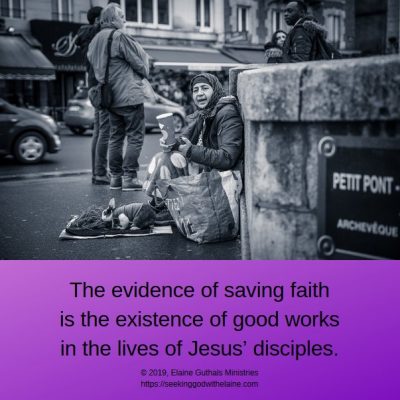
    What we do or don’t do with the do’s and don’ts is important after God has forgiven us and restored our relationship. The evidence of saving faith is the existence of good works in the lives of Jesus’ disciples: “so that you will walk in a manner worthy of the Lord, to please Him in all respects, bearing fruit in every good work and increasing in the knowledge of God” (Col. 1: 10 NASB).

    We have to show that the salvation has changed us. We have to utilize the framework God has given us as our guiding principles as a cause-and-effect in our lives. That requires obedience.

    Homeless woman

    No Works = Dead Faith

    Remember what James said. “What does it profit, my brethren, if a man says he has faith but has not works? Can his faith save him?” (Jas. 2: 14 RSV emphasis added).

    Yes, we have to have the outward profession. But we can’t just say the words, call it faith, and give it lip service.

    We also need to have the inward profession. We aren’t just supposed to sit on the porch swing and drink lemonade.

    We have to invest in our faith. We have to grow and then put it into practice. If we don’t do that, our faith really isn’t genuine.

    I think what James meant here was like the parable Jesus taught about the seeds. “Other seeds fell on rocky ground, where they had not much soil, and immediately they sprang up, since they had no depth of soil, but when the sun rose they were scorched; and since they had no root they withered away” (Mt. 13: 5-6 RSV).

    We generally think that is referring to trials. When the going gets tough, some get a one-way ticket out of here.

    Gotta Grow Our Roots

    Jesus explained it this way. “As for what was sown on rocky ground, this is he who hears the word and immediately receives it with joy; yet he has no root in himself, but endures for a while, and when tribulation or persecution arises on account of the word, immediately he falls away” (Mt. 13: 20-21 RSV).

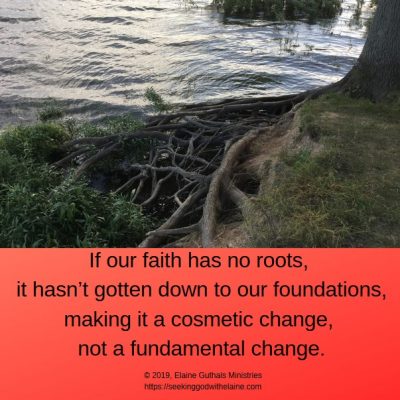
    To me, the key words are it has no root. It hasn’t gotten down to our foundations. It is just a cosmetic change; it isn’t a fundamental change.

    Tree roots

    But what happens to those who maybe had an agenda when they made a profession of faith? What about those who find they don’t want to give up their sins?

    They don’t grow their root for whatever reason. So, they don’t have works to show for their faith — even though they weren’t undergoing trials.

    Because, let’s face it. It takes time for read your Bible, pray, worship, meditate…. And we’re supposed to do this for the long haul. If we don’t do it, we don’t grow our roots.

    Then James goes on to talk about no-root people. “Do you want to be shown, you shallow man, that faith apart from works is barren? Was not Abraham our father justified by works, when he offered his son Isaac upon the altar? You see that faith was active along with his works, and faith was completed by works, and the scripture was fulfilled which says, ‘Abraham believed God, and it was reckoned to him as righteousness’; and he was called the friend of God. You see that a man is justified by works and not by faith alone” (Jas. 2: 20-24 RSV). Our works are doing whatever God has called us to do.

    We Are Laborers

    James knew that Jesus had called on His disciplines to be laborers. “Then he said to his disciples, “The harvest is plentiful, but the laborers are few” (Mt. 9: 37 ESV). Laborers – workers – the ones who actually went out into the fields and cut the wheat, picked the corn, and gathered in the beans.

    Let’s take this agricultural discussion one step further. “You can identify them by their fruit, that is, by the way they act …” (Mt. 7: 16 NLT). Yes, Jesus was talking about false teachers here.

    But can’t this be applied to false disciples, also? Let’s look again at the fruits of the spirit. We said before that the fruits of the spirit show a pure heart: “… love, joy, peace, patience, kindness, goodness, faith, gentleness, self-control” (Gal. 5: 22-23 HCSB).

    Heart with Fruits of the Spirit

    Okay, faith is a fruit. Self-control is also an internal fruit. Peace and joy have dual expression. But look at all the rest. If you don’t show love, patience, kindness, goodness, and gentleness externally, do you really have them? Jesus said those are our identifiers.

    To read How Should We Give Thanks to God?, click the button below.

    We can do works because we think it needs to be done and that it will improve someone else’s lives. Works through faith are done because this is what God has called us to do to further His kingdom. God wants us to have a living, breathing faith.

    The way I see it is, what is our motivation? Are we doing something in response to God’s directions — either laws and commandments or through His promptings? Or are we going lone wolf and doing something of our own volition?

    I like the term that Stark used: holiness of heart and life. As James said, we can’t just say we have faith (Jas. 2: 14). We have to live it. We live it by our works.

    Paul was looking at the foundation. James was looking at how we use what we have built. Jesus never meant to allow us to keep on living our lives as we had been. He wants His disciples to change their lifestyles to better align with God’s laws and commandments. That takes work – internally and externally.

    Making the Connections

    So, what does all this we have talked about for the last three days mean?

    The riches of grace are salvation and faith. That makes a strong foundation for our relationship with God.

    Grace is the foundation for salvation, and faith is the foundation for works. We show our salvation through the works we do in faith.

    Jesus taught about building on foundations. The house built upon the rock stood firm while the house built upon the sand fell (Mt. 7: 24-27).

    But look at this. When talking about the wilderness wanderers, Paul said, “All of them also ate the same spiritual food and drank the same spiritual drink, which flowed from the spiritual rock that followed them. That rock was Christ” (I Cor. 10: 3-4 CEV emphasis added). He also said, “For no other foundation can anyone lay than that which is laid, which is Jesus Christ” (I Cor. 3: 11 NKJV emphasis added).

    Our foundation is supposed to be built on the Rock, Jesus Christ, our Lord and Savior. All we believe, all we trust, all we do is to glorify Christ, who in turn glorifies God.

    Let’s go back to Zechariah 7: 9 from the first devotion in the series. It says, This is what the LORD Almighty said: ‘Administer true justice …’” (NIV). Today’s worldview does not believe kindness has any room to include justice in it.

    Disciples of Jesus have to submit to the correcting hand of God. That is what is preparing us for our eternal life.

    How Do We Apply This?

    We have to make a choice. Are we going to step out in faith and accept God’s gift of salvation or are we going to follow the worldview?

    Once we choose to accept God’s gift of salvation, we have to choose to do that every day.

    We have to grow in our knowledge of Him (II Pet. 3: 18). God will be right there to guide us in doing that.

    Loving Father. We accept Your gift of salvation. Help us to grown in knowledge of You. Strengthen our faith in You as we read, study, and meditate on Your Word. Help us to hear You when we pray — and any time You speak to us. Help us to perform the tasks to which You have called us. Amen.

    The ABCDs of Salvation

    A – admit our sins

    B – believe His Son Jesus is our Redeemer

    C – confess God as Sovereign Lord

    D – demonstrate that commitment by making any changes needed in our lives to

    live the way in which God has called us

    If you have not become a believer in Christ, please read through the Plan of Salvation and prayerfully consider what God is asking you to do.

    What do you think?

    Leave me a comment below (about this or anything else) or head over to my Facebook group for some interactive discussion.

    If you don’t understand something and would like further clarification, please contact me.

    If you have not signed up for the email daily or weekly providing the link to the devotions and the newsletter, do so below.

    If God has used this devotion to speak with you, consider sharing it on social media.

  • What Are Heavenly Places?

    and raised us up with him, and made us sit with him in the heavenly places in Christ Jesus that in the coming ages he might show the immeasurable riches of his grace in kindness toward us in Christ Jesus.
    Ephesians 2: 6-7 (RSV)

    In his letter to the Ephesians, Paul talked several times about heavenly places. This is the only place in the Bible that this terminology is used. This devotion explores where those heavenly places are, Jesus’ role in those heavenly places, and how the impact on the coming ages.

    Nuggets

    • Jesus’ glory is the expression of the qualities of God resulting from the authority of God.
    • While Ephesians 2: 6 is not the first or only time in this letter that Paul referred to heavenly places, he uses this term only in this letter.
    • God and Jesus (at God’s right hand) are going to rule from New Jerusalem.
    • God has made Himself very accessible to us.
    • Those reigning with Jesus for 1,000 years will be those who remained faithful unto death during persecution and those who did not worship the image erected (Rev. 13: 14) or take the mark (Rev. 13: 16).
    • The great thing about New Jerusalem and whoever gets there first is that they will be living in fellowship with God the Father and God the Son.
    • God is going to take His grace and kindness to the next level.
    Flowers with title What Are Heavenly Places?

    I had someone tell me once that, since Jesus laid down His glory to come to earth, He could not pick it up again. Jesus’ glory is the expression of the qualities of God resulting from the authority of God.

    Therefore, Jesus wouldn’t be residing in heaven. He would rule on the new earth once we are all called home.

    I was always a little skeptical of that but haven’t taken the time to research it. Until now.

    I remembered this conversation when I read Ephesians 2: 6. It talks about heavenly places and the coming age.

    What role is Jesus going to have then – glorified or not glorified? Let’s see what we can find.

    Heavenly Places

    “… and made us sit with him in the heavenly places in Christ Jesus …” (Eph. 2: 6 RSV).

    This is not the first or only time in the letter to the Ephesians that Paul referred to heavenly places (Eph. 1: 3; Eph. 1: 20; Eph. 3: 20; Eph. 6: 12). But he uses this term only in this letter.

    Paul’s use of the term here begs the question: How is heavenly places different from heaven? From my research of commentaries, I don’t think Paul was trying to make a distinction.

    I think Paul was trying to tie this to Jesus’ ascension. He went up to what has been interpreted as high places. Heavenly — high — sounds like they are synonymous.

    We do know that Jesus talked about there being some sort of division. “In My Father’s house are many mansions; if it were not so, I would have told you …” (Jn. 14: 2 NKJV). If it were not so, Jesus probably wouldn’t have said anything at all. There could be some division between heaven and high places.

    Mansion

    Then we tie this in with Revelation. It talks about a new heaven and a new earth. “Now I saw a new heaven and a new earth, for the first heaven and the first earth had passed away …” (Rev. 21: 1 NKJV).

    After that, we get a New Jerusalem. “Then I, John, saw the holy city, New Jerusalem, coming down out of heaven from God, prepared as a bride adorned for her husband” (Rev. 22: 2 NKJV). It is identified as a great city (Rev. 21: 10) with walls (Rev. 21: 14) and gates (Rev. 2: 12). It has a street (Rev. 21: 21; Rev. 22: 2). (One street — not plural.)

    But look what it says next. “And there shall be no more curse, but the throne of God and of the Lamb shall be in it, and His servants shall serve Him” (Rev. 22: 3 NKJV).

    This is along the same lines as what Paul wrote in Colossians. “If then you were raised with Christ, seek those things which are above, where Christ is, sitting at the right hand of God” (Col. 3: 1 NKJV). Jesus already is where He will forever be — right next to the Father.

    So, what all is that telling us? God and Jesus are going to rule from New Jerusalem. Jesus is even now at God’s right hand. I doubt that Jesus would be ruling if He had laid down His glory and not been able to pick it back up.

    One commentary pointed out that Paul’s whole message in all of this was the accessibility of heaven. “Set your mind on things above, not on things on the earth” (Col. 3: 2 NKJV).

    Clouds

    God has made Himself very accessible to us. He was the one Who devised the plan of salvation to restore His relationship with mankind.

    Jesus is the one Who gave us the model prayer to make sure we have a line of communication open to us now. We are told to “pray without ceasing” (II Thess. 5: 17 ESV). That is how we access heaven today.

    Where Will New Jerusalem Be?

    “And he carried me away in the Spirit to a great and high mountain, and showed me the great city, the holy Jerusalem, descending out of heaven from God” (Rev 21: 10 NKJV).

    Back up a second. There is some question where New Jerusalem is going to land. Revelation 21: 2 and Revelation 21: 10 both say it descends out of heaven.

    That would have to come out of the new heaven, because the old heaven already passed away in verse 1. That makes some assume that it will land on earth, where we will spend eternity.

    Maybe that is an assumption because Revelation 22: 3 says, “And there shall be no more curse …” (Rev. 22: 3 NKJV). The earth, not heaven, was cursed (Gen. 3: 17).

    However, Revelation 21 and 22 does not say if or where New Jerusalem lands. The scriptures only say that it descends. We don’t know if it lands on earth or stays suspended between heaven and earth.

    It is also assumed that Jesus will reign on earth for the 1,000 years. “… And they lived and reigned with Christ for a thousand years” (Rev. 20: 4 NKJV).

    Who is they? “And I saw thrones, and they sat on them, and judgment was committed to them. Then I saw the souls of those who had been beheaded for their witness to Jesus and for the word of God, who had not worshiped the beast or his image, and had not received his mark on their foreheads or on their hands …” (Rev 20: 4 NKJV).

    So, they is not all of the saints. It is those who remained faithful unto death during persecution. Also, those who did not worship the image erected (Rev. 13: 14) or take the mark (Rev. 13: 16).

    To read Are We Really Saints?, click the button below.

    The great thing about New Jerusalem and whoever gets there first is that they will be living in fellowship with God the Father and God the Son. The cares of this world will be a thing of the past. Think of the rejoicing and celebrating that will be going on!

    What Does the Future Hold?

    “that in the coming ages he might show the immeasurable riches of his grace in kindness toward us in Christ Jesus” (ESP. 2: 7 RSV).

    But back to Ephesians. We need to look at verse 7.

    Paul talked about the future when he said, “that in the coming ages …” (Eph. 2: 7 RSV). He was talking about eternity.

    In the last devotion, we talked about immeasurable. We said it talked about taking things to the next level.

    To read God’s Wrath and Mercy, click the button below.

    God is going to take His grace and kindness to the next level. We think He shows us grace and mercy now — just wait!

    We all want to be better than we are right now. We know that we are not as He made us because we are trapped in sinful bodies.

    We also know that, one day, we will be changed (I Cor. 15: 52). We will truly be in God’s image. We won’t have to deal with sin or sickness. Everything will be like God originally intended.

    Making the Connections

    We don’t understand now — we aren’t supposed to. “For our knowledge is imperfect and our prophecy is imperfect; but when the perfect comes, the imperfect will pass away” (I Cor. 13: 9-10 RSV).

    We can understand some things now. He has raised us from being dead. Jesus justified and sanctified us by substituting Himself for us. We’ve been adopted into the holy family.

    To read
    How Can We Be Alive but Dead?,
    What Does Justification Mean?,
    What Does Sanctification Mean?, and
    What Does It Mean to Be Children and Heirs of God?

    click the appropriate button below.

    God already blesses us. He provided what we need. He isn’t waiting for us to all get to New Jerusalem before He gives us the good stuff.

    I told my Ladies the other day that Mom and Dad once gave me money to by a three-bedroom mobile home from another lady in the singles group in which we belonged. They told me they were spending my inheritance on me.

    God is doing that, too. He is rewarding us now while He is giving us a glimpse of things to come.

    How Do We Apply This?

    We are supposed to watch. We need to believe and trust.

    To read What Did Jesus Mean When He Said Watch?, click the button below.

    When we are in the midst of trials, God will give us what we need to remain faithful to Him.

    Paul got it that this life is precursor to the next life. He knew God would show us enough to want the next life. He knew that God was fixing us to prepare us for what is to come.

    We have to be open to the fixing.

    Loving Heavenly Father. You have told us to watch for Jesus’ return. We will watch. Whichever way You choose to send Him back and call us home doesn’t matter. What matters is we will be home with You. We look forward to that day. Amen.

    What do you think? Do you think heavenly places are synonymous with heaven? Where do you think we will spend eternity?

    Leave me a comment below (about this or anything else) or head over to my Facebook group for some interactive discussion.

    If you don’t understand something and would like further clarification, please contact me.

    If you have not signed up for the email daily or weekly providing the link to the devotions and the newsletter, do so below.

    If God has used this devotion to speak with you, consider sharing it on social media.

  • God’s Wrath and Mercy

    Once we were also ruled by the selfish desires of our bodies and minds. We had made God angry, and we were going to be punished like everyone else. But God was merciful! We were dead because of our sins, but God loved us so much that he made us alive with Christ, and God’s wonderful kindness is what saves you.
    Ephesians 2: 3-5 (CEV)

    God cannot condone sin. In fact, sin makes Him angry. His wrath, though, it tempered by His mercy and love. This devotion explores why God is angry, the punishment determined to appease His wrath, and how His mercy and love can rectify that.

    Nuggets

    • Sin, which leads to wrath, is the polar opposite of the Spirit — with which we are supposed to be filled.
    • Sovereign God gets to decide crimes and punishments.
    • There is hope for us because God is rich in mercy (Eph. 2: 4).
    • Mercy comes out of God’s love, which is His character (I Jn. 4: 8).
    Flowers with title God's Wrath and Mercy

    My Ladies and I were talking yesterday about how rich each verse in Ephesians is. That being said, I am going to be daring and try to tackle three verses in this devotion. These three verses show the foundation on which the plan of salvation is built.

    Let’s Put It into Context

    First, we need to see what wrath is. Wrath is extreme, fierce anger. It is also a vengeance or punishment that comes as a result of the anger.

    We’ve talked before that the person who is performing the act of vengeance does not always feel like they are the one who “started it.” Their act is a response.

    To read Should Believers Seek Revenge?, click the button below.

    Deuteronomy 32: 35 says, “I [God] will take revenge; I will pay them back” (NLT). We aren’t supposed to let our anger row to the point where we retaliate. God calls dibs on the wrath and vengeance.

    God’s Wrath

    “Among these we all once lived in the passions of our flesh, following the desires of body and mind, and so we were by nature children of wrath, like the rest of mankind” (Eph. 2: 3 RSV).

    Next, we need to see what God’s wrath is. Romans 1: 18 says, “For God’s wrath is revealed from heaven against all godlessness and unrighteousness of people who by their unrighteousness suppress the truth” (HCSB). Hmmm. Too many churchy words.

    Let’s try this one. “God’s anger is revealed from heaven against all the sin and evil of the people whose evil ways prevent the truth from being known” (Rom. 1: 18 GNT). That is better.

    Now, let’s see what we can see in Ephesians 2. Verse 3 says that “… we were by nature children of wrath …” (Eph. 2: 3 RSV). If we look at it from the lens of sin, it starts to make sense.

    God had to have been angry when mankind decided we weren’t going to follow His laws and commandments. We know He was angry enough to kick Adam and Eve out of the Garden of Eden.

    When sin entered mankind, we went from being children of God to children of wrath. We started being controlled by Satan and filled with the lusts of the flesh. Those included sexual immorality, impurity, homosexuality, idolatry/covetousness, jealousy, fits of anger, rivalries, dissensions, divisions, envy, greed, drunkenness, filthiness, and all impurity to name a few (Gal. 5: 19-21; Eph. 5: 3-6; and I Cor. 6: 9-10).

    To read What Did Jesus’ Baptism Mean?, click the button below.

    That is a pretty long list, and what is there are doozies. It doesn’t just stop there those. Think about the fallout because of the commission of those sins.

    When you think about those being polar opposite of the Spirit — which we are supposed to be filled with — we can see where the wrath comes into play. The relationships that God wanted turned into alienation.

    Isn’t that so like us? We get something good and end up mucking it up. We perverted His truth.

    God’s Punishment

    So, we messed up and deserve the wrath. That means we also deserve the punishment.

    Romans 6: 23 says, “For the wages of sin is death …” (ESV). Ouch. Since there are many opponents to capital punishment, I am sure many of them see the Bible outdated because of this.

    However, this is what the Bible says. “Now let me remind you, brothers, of what the Gospel really is, for it has not changed …” (I Cor. 15: 1 LB). It also says, “You shall not add to the word which I am commanding you, nor take away from it, that you may keep the commandments of the Lord your God which I command you” (Deut. 4: 2 NASB).

    God is Sovereign God. He gets to decide crimes and punishments. We don’t get to rewrite the Bible to make it more politically correct. God’s ways are not the ways of this world.

    To read Why Do We Try to Rewrite Scripture?, click the button below.

    In His infinite wisdom, God decided that the punishment for alienation from Him was death. Plain and simple.

    God’s Mercy

    “But God, who is rich in mercy, out of the great love with which he loved us, even when we were dead through our trespasses, made us alive together with Christ (by grace you have been saved)” (Eph. 2: 4-5 RSV).

    Well, not so fast. There is hope for us. God is rich in mercy (Eph. 2: 4).

    Remember what mercy is. Mercy is where God doesn’t judge us to the extent He could have. Even though we deserve bad things as punishment, God doesn’t give them to us.

    To read Is God’ Love Unconditional?, click the button below.

    God doesn’t have just a little bit of mercy. He doesn’t dole it out just on the first Thursday of the month (ooops, missed that!). It is not contingent on Tom, Sally, and Elaine being perfect children.

    Nope. The only contingency on God’s mercy is that we have to be His children.

    It doesn’t say it works for one sin but not another (except for the one unpardonable sin). We don’t max out the number. There is no expiration date.

    To read What Does Forgiveness of Our Sins Mean?, click the button below.

    God’s mercy is infinite. It is immeasurable.

    My Ladies and I talked about the term immeasurable yesterday. My materials said it could mean to “throw to the next level.”

    Just think about that a second. We make a goal and attain it, so we have to make a new, higher goal. That is usually how we think of getting to the next level.

    Now think about God’s mercy. There is always a next level. We think we used up His mercy the other times we’ve confessed this sin. We haven’t.

    We think that, once we sin “bad” enough, God will withdraw His mercy. Or that the shoe is going drop when Jesus returns.

    Nope. Nope. Nope.

    God’s Love

    Mercy comes out of love. God is love (I Jn. 4: 8). That is His character. He can’t be what He isn’t.

    That means God loves the obedience but hates the sin. That had the mercy kicking in full throttle.

    But remember what we said. God only shows mercy to the repentant and obedient. He is only merciful to the faithful.

    Flowers

    Making the Connections

    Did you notice that it mentioned mercy first and love second? Remember we said the mercy comes out of the love.

    I am not sure I am going to say this right, but mercy has a closer connection to us in our sinful state than love does. The love accepts us as we are, but the mercy connects with why we need the forgiveness.

    Remember in the last devotion, we said that we were alive but dead? It says it again here. Without God as our Sovereign God, without Jesus as our Lord and Savior, and without the Holy Spirit guiding our footsteps, we are dead in our sins.

    To read How Can We Be Alive But Dead?, click the button below.

    Love and mercy set up the plan of salvation. God knew that “… all have sinned and fall short of the glory of God” (Rom. 3: 23 ESV). He set up a way that we could “… repent of [our] sins and turn to God, so that [our] sins may be wiped away” (Ac. 3: 19 NLT).

    But part of the problem is that “because the sentence against an evil deed is not executed speedily, the heart of the children of man is fully set to do evil” (Ecc. 8: 11 ESV). We don’t see punishment meted out, so we convince ourselves there is none.

    We have to watch that we don’t start using the mercy as a license to sin. We have to repent and turn from our sinful ways.

    How Do We Apply This?

    There will be punishment. “And if anyone’s name was not found written in the book of life, he was thrown into the lake of fire” (Rev. 20: 15 ESV).

    God provided the only way to rectify that. “But God showed how much he loved us by having Christ die for us, even though we were sinful” (Rom. 5: 8 CEV). All we have to do is believe and repent.

    We need to make sure that we have given our lives to God before Jesus returns to call God’s children home. Then we need to live according to His laws and commandments.

    If you have not admitted that your relationship is not right with God,

    have not asked Jesus to be your Lord and Savior,

    and have not confessed your sins,

    please read through the Plan of Salvation and prayerfully consider what God is asking you to do.

    Father God. Your love is immeasurable. Your mercy is immeasurable. Because of that, You have devised a plan so that Your wrath can be appeased. You sent You Son to pay the price for our sins. We commit our lives to You. Help us to live according to Your laws and commandments. Amen.

    What do you think?

    Leave me a comment below (about this or anything else) or head over to my Facebook group for some interactive discussion.

    If you don’t understand something and would like further clarification, please contact me.

    If you have not signed up for the email daily or weekly providing the link to the devotions and the newsletter, do so below.

    If God has used this devotion to speak with you, consider sharing it on social media.
  • What Does Sanctification Mean?

    And such were some of you. But you were washed, you were sanctified, you were justified in the name of the Lord Jesus Christ and by the Spirit of our God.
    I Corinthians 6:11 (ESV)

    Sanctification is the final word in the Churchy Word series. This devotion looks at that word and determines how it tries to several words we have been discussion lately.

    Nuggets

    • God alone can sanctify us through His grace.
    • Disciples are sanctified through faith.
    • God calls us and sanctified us so that we may be used to expand His kingdom.
    • Sanctification is a process.

    To read devotions in the Churchy Words series, click the appropriate button below.

    Flowers with title What Does Sanctification Mean?

    We’ve been discussing churchy words for the last couple of devotions. Another churchy word is sanctification. That means God is setting us apart so that we can be used for our intended purpose.

    Sanctified by God’s Grace

    “Now may the God of peace himself sanctify you completely, and may your whole spirit and soul and body be kept blameless at the coming of our Lord Jesus Christ” (I Thess. 5: 23 ESV).

    God alone can sanctify us through His grace. He sets us apart. When we ask God into our hearts and lives, He restores us to being sanctified.

    God fills us with His peace. This peace does make us different from the rest of the world. When things are falling apart around us, we know we are okay because God not only lives within us, but He also has us in the palm of His hand (Jn. 10: 29).

    Since we are sanctified, our “… whole spirit and soul and body [should] be kept blameless …” (I Thess. 5: 23 ESV). Yes, I know that is a struggle because we are still in these earthly bodies. There is no switch thrown when we ask Jesus to be our Lord and Savior to make us only do what He wants us to do.

    Sunset

    There is a way we can keep being sanctified as we live our lives and help us withstand the struggles. John 17: 17 says, “Sanctify them in the truth; your word is truth” (ESV).

    God uses His Word to reveal Himself to us. If we keep reading and studying His Word, He will use that to set us apart. He uses the Holy Spirit to guide us closer to Him.

    We are sanctified by Jesus’ blood. “So Jesus also suffered outside the gate in order to sanctify the people through his own blood.” (Heb. 13: 11 ESV). If He suffered, we should expect to suffer, also.

    Sanctification by Faith

    “to open their eyes so that they may turn from darkness to light and from the dominion of Satan to God, that they may receive forgiveness of sins and an inheritance among those who have been sanctified by faith in Me” (Ac. 26: 18 NASB).

    Disciples are sanctified through faith. This got me to thinking.

    “For it is by grace you have been saved, through faith — and this is not from yourselves, it is the gift of God” (Eph. 2: 8 NIV). Bottom line, nothing happens except by God’s grace. No redemption, no forgiveness, no justification, no propitiation, no sanctification.

    What did we say before? Because of God’s infinite grace, He devised the plan of salvation that made Jesus our Redeemer in order to forgive us of our sins. Our acceptance of that plan provided us with justification and sanctification.

    To read devotions in the Forgiveness of Sins through Grace by Redemption series,

    click the appropriate button below.

    Yes, all of that was set up “… before the foundation of the world …” (Eph. 1: 4 RSV). Jesus was the only One Who could accomplish it.

    But just because Jesus completed the plan, it doesn’t mean we are automatically sanctified. We have to come to God in faith and repentance in order for Him to restore our sanctification. If we don’t go to Him in contrition, we don’t receive sanctification.

    Leaves

    Sanctified for Use

    “Therefore, if anyone cleanses himself from what is dishonorable, he will be a vessel for honorable use, set apart as holy, useful to the master of the house, ready for every good work” (II Tim. 2: 21 ESV).

    God calls us and sanctified us so that we may be used to expand His kingdom. He has a job for each of us to do. Each of us has someone with whom we are to share His love.

    No, it isn’t just to be a show-them-how-I-live witness. It is an actual relationship, tell-them-what-I-believe witness. We have to tell them why we believe what we believe and how their believing too can change them for the better.

    We just have to be willing to be used by God in the ways He feels are best. We will be used according to the gifts He has given us.

    God usually uses the broken and the common to witness for Him. Mary and Joseph were just a poor, common couple, asked to raise the Savior of the world.

    Sanctification by a Process

    “But we ought always to thank God for you, brothers and sisters loved by the Lord, because God chose you as firstfruits to be saved through the sanctifying work of the Spirit and through belief in the truth” (II Thess. 2: 13 NIV).

    Sanctification is another three-part process. We were sanctified when we asked Jesus to be our Lord and Savior and sanctify us through His blood.

    We are in the process of being sanctified. “And we all, who with unveiled faces contemplate the Lord’s glory, are being transformed into his image with ever-increasing glory, which comes from the Lord, who is the Spirit” (II Cor. 3: 18 ESV). This transformation doesn’t happen overnight.

    We won’t be totally sanctified until we receive our new bodies when we are through with this one.

    To read Why Do Christians Sin?, click the button below.

    Look at it this way. “For it was fitting that he, for whom and by whom all things exist, in bringing many sons to glory, should make the founder of their salvation perfect through suffering. For he who sanctifies and those who are sanctified all have one source. That is why he is not ashamed to call them brothers” (Heb 2: 10-11 ESV).

    Being made perfect means the same thing as being sanctified. Jesus was sanctified through sufferings. Shouldn’t we expect the same thing?

    Making the Connections

    Do you see the connections forming here? We’ve ended up looking at a lot of interconnected words in the last several devotions.

    Redemption is where something is used in exchange for something else to gain or regain something. Through Jesus’ blood, we have redemption of our sins. Sin is when we disobey God and break one of His laws and commandments. Redemption allows us to receive forgiveness for our sins.

    Forgiveness is when God pardons us because we have broken His laws and commandments. We accept the pardon by letting go of the guilt and remorse that we feel because we have done something wrong. It is a conscious decision to accept His forgiveness.

    Grace is a free and unmerited gift from Heavenly Father given through His Son, Jesus Christ that enables salvation and spiritual healing to believers. Because of God’s infinite grace, He devised the plan of salvation that made Jesus our Redeemer in order to forgive us of our sins.

    When Jesus redeems us after we have asked for forgiveness of our sins, we are called saints. Saint means we have been set apart. God does not want us to follow the patterns of this world. He wants us to be set apart.

    Jesus justifies us when we put our lives in His hand, Justification means the act of making something righteous before God.

    Jesus substitutes Himself — became the propitiation — for us so He could do the hard stuff, the stuff we would never be able to do. Jesus knew God’s wrath had to be appeased so He shed His blood to pay the price for our sins.

    Sanctification means to make holy. Holy mean to be set apart, perfect, and pure. Saints are set apart.

    Okay, stop a second. My brain is spinning.

    Because of God’s infinite grace, He devised the plan of salvation that made Jesus, through propitiation, our Redeemer in order to forgive us of our sins. Becoming saints when we accept the gift of salvation, we are set apart to be holy through being justified. Justification is the act of sanctification.

    Clouds

    How Do We Apply This?

    After taking aspirin — we need to work on being holy. We have to work on it each and every day. We strive to be holy to glorify Hod.

    Since sanctification is a process, and we know our salvation is a process, we need to seek God through the process. This includes hearing His Word, reading it, studying it, meditating on it, and memorizing it. All through that, we need to be in prayer, asking God to provide the meaning.

    • Hearing His Word (Rom. 10: 17 NLT).
    • Reading His Word (Rev. 1: 3 ESV).
    • Praying to Him (Heb. 4: 16 ESV).
    • Studying His Word (Ac. 17: 11 NLT).
    • Meditating on His Word (Ps. 1: 1-2).
    • Memorizing His Word (Ps. 119: 11 NLT).

    The Bible tells us that we should proactive in sanctifying ourselves -% and sanctifying God. “But sanctify the Lord God in your hearts, and always be ready to give a defense to everyone who asks you a reason for the hope that is in you, with meekness and fear” (I Pet. 3: 15 NKJV).

    Sanctifying God is where we acknowledge Him as Sovereign God and follow His laws and commandments. We follow only Him.

    We depend on God to protect us. “Whoever dwells in the shelter of the Most High will rest in the shadow of the Almighty” (Ps. 91: 1 NIV). We cast all of our cares on Him (I Pet. 5: 7). That talks not only of an active trust, but also a complete obedience.

    Disciples need to be set apart. We can’t be of the world. We have to be different. We have to reflect God’s higher ways (Isa. 55: 8-9). We have to live for Him.

    Father. We thank You for sending Your Son as a substitute so that You could justify and sanctify us. We pray that You will strengthen us to live the lives to which You are calling us — service to You. Amen.

    What do you think?

    Leave me a comment below (about this or anything else) or head over to my Facebook group for some interactive discussion.

    If you don’t understand something and would like further clarification, please contact me.

    If you have not signed up for the email daily or weekly providing the link to the devotions and the newsletter, do so below.

    If God has used this devotion to speak with you, consider sharing it on social media.
  • What Does Propitiation Mean?

    and He Himself is the propitiation for our sins; and not for ours only, but also for those of the whole world.
    1 John 2:2

    Propitiation is another churchy word that is difficult to understand. Usually, we just don’t understand what it means. This devotion, the second in the series, looks at the meaning of propitiation and how it fits into the plan of salvation.

    Nuggets

    • Propitiation can be a form of appeasement or how God remains Who He is so He can keep on loving us.
    • God wouldn’t have designed the plan of salvation if it wasn’t because of He loves us and His wish to restore the relationship.
    • Jesus knew that He was the only One who could appease God’s wrath.
    • Jesus’ blood gave us new life.
    • God is not going to excuse those who have not confessed their sins.

    To read devotions in the Churchy Words series, click the appropriate button below.

    Flowers with title What Does Propitiation Mean?

    I made omelets for breakfast this morning, so Adam was done with his almost before I got mine made. I thought he had gone upstairs so I was gnawing in my mind on what I would do for this post.

    Of course, Adam caught me. We talked through a little bit about the levels of understanding of the term propitiation. Some of us know what it means; some of us have no clue. Others think they know but may not really.

    I mean, when was the last time you used propitiation in a sentence or conjugated it? If you are like me, like never.

    Let’s take a look to see what is meant. I found two different explanations of propitiation. (Okay, see. It is a difficult concept.)

    The first one said that it was about appeasement or satisfaction. In order to be justified, God had to do something to appease His wrath. (It doesn’t stop there. We then have to be reconciled to Him.)

    The second explanation that I found said that propitiation is how God remains Who He is so He can keep on loving us.

    Propitiation Because of Love

    “In this is love, not that we loved God, but that He loved us and sent His Son to be the propitiation for our sins” (I Jn. 4: 10 NKJV).

    If we look at propitiation as a form of appeasement, look who is doing the actions. “… [God] loved us and sent his Son …” (I Jn. 4: 10 ESV). The only us in there comes after the verb.

    My first thought was there is no us about it; it is all Him. But that isn’t totally right. The action is all Him, but we are the object of the action.

    God wouldn’t have designed the plan of salvation if it wasn’t for us. It was all about His love for us. He wanted to restore the relationship.

    Our loving Father knew there was no way we could make amends for the sin. “Therefore [Jesus] had to be made like his brothers in every respect, so that he might become a merciful and faithful high priest in the service of God, to make propitiation for the sins of the people” (Heb. 2: 17 ESV).

    Propitiation by the Only Way

    “He is the propitiation for our sins, and not for ours only but also for the sins of the whole world” (I Jn. 2: 2 ESV).

    I bet if there was any other way than sending His Son to die this horrible, agonizing death, God would have done it. Jesus asked for some other way to be found. “He went a little farther and fell on His face, and prayed, saying, ‘O My Father, if it is possible, let this cup pass from Me; nevertheless, not as I will, but as You will’” (Mt. 26: 39 NKJV).

    To read Did Jesus Struggle with His Mission, click the button below.

    But Jesus knew that there was no other way. He had already said that. “Jesus said to [Thomas], ‘I am the way, the truth, and the life. No one comes to the Father except through Me’” (Jn. 14: 6 NKJV).

    Jesus knew that He was the only One who could appease God’s wrath. So, He willingly did it. Was it easy? No. Did it hurt? Yes. Jesus died anyway because He loves us, too.

    Church

    Propitiation by Jesus’ Blood

    “Whom God put forward as a propitiation by his blood, to be received by faith. This was to show God’s righteousness, because in his divine forbearance he had passed over former sins” (Rom. 3: 25 ESV).

    We’ve talked a couple of times over the last few devotions that it is about Jesus’ blood.

    I am not squeamish about blood, but I haven’t really seen a lot of blood at once. I remember watching Mel Gibson’s The Passion of the Christ for the first time. I know that blood was all Hollywood smoke and mirrors (thank goodness!), but to think that was probably a pretty accurate picture of the real thing stopped me in my tracks.

    To think that Jesus went through that agony was unfathomable. As one who is allergic to pain, that really had to hurt.

    And not for any reason involving Him. Jesus hadn’t sinned. It was all for us and our sin.

    Let’s look at it this way. Usually when you have wrath, the outcome is this epic battle.

    God had the wrath that needed appeasing. Jesus was a one-Man army in the epic battle. And He was victorious! Jesus saved us from God’s wrath. He stepped in front of us and took the brunt of the battle for us.

    Church

    Let’s look at it another way. We talked before about vengeance being God’s responsibility.

    To read Should Believers Seek Revenge?, click the button below.

    God really wasn’t seeking vengeance on us (even though He probably should have). He was looking for justice, instead.

    When we think about justice, we think about someone who has committed a crime getting caught and punished. In our minds, they get what they deserve.

    Who is the criminal in this story? Yes, it is Adam and Eve — and ultimately all mankind. But it is in reality Satan. He was the deceiver that got the ball rolling. Adam and Eve were the deceived.

    That doesn’t pardon Adam and Eve. They made the choice to buy the baloney Satan was selling.

    But God’s vengeance — if there is any at all — is pointed toward Satan, not us. God loves us. He was disappointed in us, sure; but He still loves us.

    Here is a third way to look at it. Think about how necessary blood is for life. Think about someone bleeding out. People can lose their lives because of one well-placed cut.

    Jesus’ blood gave us new life. He bled out so that we might live.

    Propitiation that Condemns

    “God’s anger is revealed from heaven against all the sin and evil of the people whose evil ways prevent the truth from being known.” (Rom. 1: 18 GNT).

    I know what you are saying. “Hang on, Chick. You’ve just been talking pardon, love, life. Where does this condemn come from?”

    It comes from the if-there-is-any-vengeance-it-is-against-Satan idea. But man is an accomplice. There may or may not be vengeance, but there is condemnation.

    Yes, there is the no condemnation verse. “There is therefore now no condemnation for those who are in Christ Jesus” (Rom. 8: 1 ESV).

    But that doesn’t mean there is no condemnation. “Whoever believes in him is not condemned, but whoever does not believe is condemned already, because he has not believed in the name of the only Son of God” (Jn. 3: 18 ESV).

    We can talk about all of the warm fuzzies we want. But they mean nothing if the propitiation isn’t there.

    What? Did you think God was going to green flag sin? Nope. He is going to black flag it.

    God is not going to excuse those who have not confessed their sins. His anger has not been appeased if we do not accept that Jesus is the only Way.

    God still loves the non-believers. The problem is the relationship has not been restored. There is no free pass into heaven.

    To read Does God Love Non-Believers?, click the button below.

    Making the Connections

    The main thing I get out of all of this is substitution. Jesus substitutes Himself for us so He could do the hard stuff, the stuff we would never be able to do.

    Jesus knew God’s wrath had to be appeased because we wouldn’t have been able to take it if it was directed at us. He stepped in front of us to take the bullet we never could.

    Why? Love.

    Plain and simple.

    How Do We Apply This?

    We accept the love. We accept the sacrifice. We ABCD. We live for Him.

    Loving Father. We know when Adam and Eve committed the original sin that You must have been disappointed in us. We know Your wrath has been directed toward Satan. Though all of these years, You have continued to love us. You showed this when You sent Your Son to die for us. We are humbled that Jesus would willingly, purposefully step in front of us to take all that — by rights — we should have taken ourselves. We admit we are sinners. We believe that Jesus is the only way — the propitiation — by which our relationship with You can be mended. We confess You as Sovereign God. Help us to demonstrate this commitment we have made by changing our lifestyles to live in the way in which You have called us. Amen.

    The ABCDs of Salvation

    A – admit our sins

    B – believe His Son Jesus is our Redeemer

    C – confess God as Sovereign Lord

    D – demonstrate that commitment by making any changes needed in our lives to

    live the way in which God has called us

    If you have not become a believer in Christ, please read through the Plan of Salvation and prayerfully consider what God is asking you to do.

    What do you think?

    Leave me a comment below (about this or anything else) or head over to my Facebook group for some interactive discussion.

    If you don’t understand something and would like further clarification, please contact me.

    If you have not signed up for the email daily or weekly providing the link to the devotions and the newsletter, do so below.

    If God has used this devotion to speak with you, consider sharing it on social media.