Category: Sin

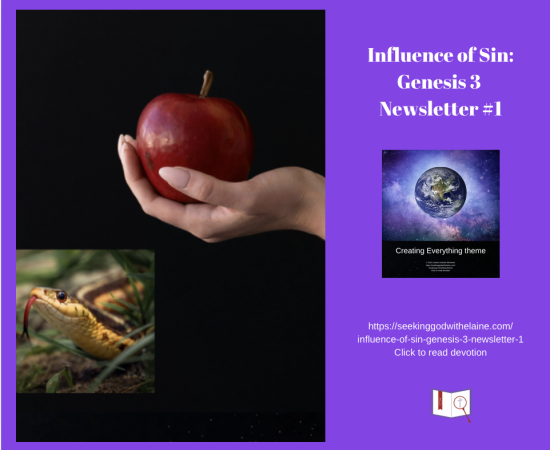
  • The Influence of Sin: Genesis 3 Newsletter #1

    influence-of-sin-genesis-3-newsletter-1

    God’s Law

    God’s law in Genesis 2: 16-17 is all about obedience.

    Too many disciples, though, think that loving God is good enough. Nothing else is needed for salvation.

    But there is something else. We have to choose to obey God daily. That is how we show God we love Him.

    Our love for God should be an even bigger deterrent for sin. We love Him so much we want to do what He says.

    Was it a good thing that God gave humankind this one law? If God knew that the man and woman would disobey Him, did God set them up for failure?

    Yes, it was and no, God didn’t. He provided them with grace to strengthen them to be obedient. God gives us grace to strengthen us to make the right decision, but God does not force us to choose Him.

    The command in Genesis 2: 17 clearly lists the consequence of sin — death. But if death is some sort of nebulous concept out there, is it really a deterrent? Maybe. Maybe not.

    The knowledge that there would be a punishment if the woman did eat the fruit should have been some deterrent. We don’t have to understand all the consequences to know that something bad is going to happen when God point blank tells us what to do.

    God doesn’t have to spell out every consequence fully. All He should need to say is, “Obey Me.” Yeah, God can say, “Because I said so.”

    We will only be strong enough to not sin when we have been perfected. We won’t be perfected until we are called home or the end of the age.

    The breaking of the law of God is sin. It is a practice — a decision.

    Sin

    On the surface, the original sin doesn’t look like it is much of a sin at all. What is the big deal about eating a piece of fruit?

    The first sin was about obedience to God. Are we going to listen to what He says or disobey Him? That is a big deal.

    Sin is a moral disease that brings many devastating consequences. Even if God did not create sin, He created the opportunity for us to choose not to obey Him — which is a sin.
    God alone determines what is a punishable offense – what is a sin. Subsequently, He is the One to establish the punishment. It is our choice to follow the law or break it — and suffer the consequences when we break it.

    Two moral forces battle for control of this world. One is the worldview led by Satan, and the other is the Godview. These are polar opposites.
    If the root of our worldview moral feelings is not cut out of us, we will not be obedient to God. It addresses the motivations and character, not just the actions.

    There is an order to sin.

    • We have to doubt that God is good.
    • We have to disbelieve that He wants our relationships restored.
    • We have to reject His holiness.

    Satan tempts us in many ways.

    • Satan tries to catch us by surprise.
    • Satan tries to convince us that restrictions on our lives are too impulsive, unequal, unkind or unnecessary – leaning in on his concern for us.
    • Satan tries to convince us that God’s character should not be respected, lowering our gratitude towards Him.
    • Satan tries to cast doubt on God and our faith in Him.
    • Satan tries to coach our disobedience out of our unbelief.
    • Satan tries to convince us that we should have that which we lust after.
    • Satan will flat out lie to us about consequences of disobedience.

    Sin is a hereditary disease as it entered into the world when the couple sinned. Every man, woman, and child from every nation, culture, socioeconomic status – everyone – has a sinful nature.
    That means every person who ever was born or ever will be born comes into this world spiritually dead and separated from God. On top of that, we know that every single person since the couple committed the original sin has also sinned.

    Still, we are responsible for our own sins. Each and every one of us is going to have to deal with our sin.

    We cannot quit sin on our own. That may be why sin is so prevalent. We think we can come and go into a sinful situation on our own, never realizing it is beyond our abilities.

    It is not a sin to be tempted. It is a sin for us to tempt someone else. If I know someone has a weakness to sin in a certain area, it is a sin if I put that person in circumstances that create that certain area.

    By allowing us to stumble and fall, stumble and fall, God is showing us how much He loves us. By sending His Son to die and be the sacrifice for us, He is showing us there is nothing He wouldn’t do in His power to show us that love.

    Sin does have to be tangible – if not visible. How else do we know if its existence? And Satan sure does want us to know of its existence!

    God wants us to know what happens when we disobey Him. Think if the couple hadn’t sinned – and no one from that time until now had either. If no one had ever sinned, we would not know the value of obedience or the true cost of disobedience.

    Satan

    Satan’s fall from God’s grace would have already happened, although we aren’t told about it in Genesis. We don’t know where he went after he got kicked out of Heaven.

    All we read in God’s Word is Satan was kicked out of Heaven. We are not told if or how his appearance changed. We assume he had wings, which he may or may not have lost.

    Satan convinced supposedly one-third of the angels to believe he was a god, turn into demons, and leave with him (Rev. 12: 4).

    Satan’s sin came from himself. It certainly wasn’t from God. Satan didn’t have any external nudging, pushing, or prodding.

    In a recent sermon, Pastor Steve said, “Satan’s sin was wanting to be like God and take over Heaven.” Satan wanted to be God.

    The enemy of God knew about our world. He has been known to roam earth.

    Satan may have hated humankind because he was kicked out of Heaven while humans were given this beautiful garden in which to live. Not only that, but they were also very happy in their lives.

    Have we ever considered why Satan tried to tempt mankind to sin in the first place? Was he only trying to steal us away from God? Or was he trying to get us to ally with him against God?

    We almost have to wonder if Satan had presented himself to the humans before. I mean, why did the woman just automatically believe someone she had never met before over Someone who had created her and had provided for her?

    It can be argued, if God created humans because of Satan’s revolt, that would escalate his hatred of us.

    On the other hand, Satan may have been trying to extract revenge. If he knew how greatly God valued humankind, he may have been jealous of our relationship with Him.

    This is especially true if Satan knew of God’s Plan of Salvation before the promise in Genesis 3: 15. He knew mankind would be restored where he and the other demons wouldn’t.

    The Serpent and His Punishment

    Satan was disguised as a serpent when he went to tempt the woman.

    Most of us have queasy stomachs when we think about serpents – or snakes, as many of us call them. But back in the Garden of Eden, I don’t think there was any fear among the different species.

    It is hard for us to visualize the snake doing anything but slithering on the ground. But that brings us back to the question of whether it was a snake or a serpent.

    There may have been serpents prior to this who had crawled on their bellies. That does not mean this serpent did.

    Either way, we can read this animal used to walk upright. After the judgment, it couldn’t.

    We don’t really know what the animal looked like. We will need to put that in the UNR book – understanding not required. Along with that, we would have to include how the serpent talked with the humans. They understood, but we sure don’t at this point.

    The serpent was told his punishment first, which is logical. The serpent was the root of sin.

    Basically, the snake was going to slither on the ground and not be liked. God cursed the serpent/snake on that day, the punishment to begin that very minute.

    It is easy to look at the passage and say the serpent/snake  was tricked just as much as Adam and Eve were. Or maybe we like to think that he was just taken over by Satan, like he took over demoniacs.

    Didn’t matter. The serpent was punished regardless of how it was taken over. It was punished because it was taken over. “… Because you have done this …” (Gen. 3: 14 NLT).

    It was perfectly within God’s authority as Creator of the serpent/snake to punish it. We shouldn’t argue against that any more than we should argue that He has no authority over us.

    If it wasn’t the physical serpent being punished to crawl on his belly, it would be Satan himself as the object of this punishment. Remember, Satan had been an angel before he rebelled. Do we visualize Satan as crawling on his belly? No, so it was the serpent/snake that received punishment.

    If Satan uses us as an instrument to cause someone else to sin, we share in the blame. We will be punished.

    We think sin only affects us, but it doesn’t. Sin spreads to others and contaminates relationships and integrity.

    Satan and His Punishment

    But the serpent wasn’t the one calling the shots – Satan was.

    Satan was the real tempter in this occurrence. He enticed the couple to disobey God, not the serpent/snake.

    The punishment in Genesis 3: 14 could be directed to the serpent, but it is also directed toward Satan. It not only shows the opposition, but it also identifies the victor. Good will strike evil’s head – our moral feelings.

    We shouldn’t gloss over the fact that Satan can only reach the heel. What power Satan has over us is what we give him.

    Ooo, baby. That would bite. Satan was trying for a complete overthrow of God, and all he was going to accomplish was a swat at the heel.

    No, there will be a new — and more definitive — judgment.

    The important thing is that Satan tempted the couple to disobey God, and they did.

    Satan’s insistence that what God has presented as good is really evil is heartbreaking. Portraying God as Someone Who can’t follow through on His promises or flat out promising something He has no intention of supplying is so totally out of God’s character.

    Satan succeeded in separating us from God. He was trying to set up His own kingdom on earth. But he failed in that he did not win our full-blown allegiance. God stepped in so that allegiance didn’t happen, His first act of grace.

    God didn’t want Satan and humankind to expand their newly formed relationship, so He established a hostility between us. God did not want to make it easy for us to sin.

    If Satan was an adversary with God, He wanted him to be an adversary with us. In fact, the word Satan means adversary in Hebrew.

    Satan’s goal is to manipulate us so that we will sin. Though he is good at disguising himself so that his true character is concealed from us, he hides in plain sight.

    Satan is not one to back down from a challenge when we resist him. He may finally back down, but not before he has tried the most daring, reckless, foulest temptations.

    Even more than the hostility, God gives us power to overcome Satan’s temptations when we ask. He wants us to succeed in withstanding sin.

    Satan’s Question

    Satan didn’t accuse God of being mean or selfish. He didn’t outright attack God. Satan didn’t really say that God shouldn’t give humankind laws.

    What he did know was the woman had a good relationship with her Creator. He didn’t want to trash Him outright.

    Satan gave Eve a lie that was shaded with the truth. It was a leading question because he knew that God had not said that. He knew good and well that God had not put all the trees off limits. In fact, Satan knew that God had given the humans permission to eat freely of all the trees — except the one, which they were supposed to leave alone.

    To Satan, the point wasn’t how many trees on which God placed restrictions. The point was God had put something off limits.

    What Satan was doing was questioning the severity of the law. He wanted to show the restriction as not in humankind’s best interest.

    There was nothing wrong with the fruit, such as it being poisonous. God told the humans that they couldn’t eat the fruit just because.

    Satan wanted Adam and Eve to doubt God’s Word. If we don’t know exactly what God said in His Word when Satan starts tempting us, we might fall for his lies as the woman did.

    We have to be doubly careful when we start to debate God’s Truth. The problem is we want to have options. We’ve got that little thing called free will.
     
    Instead, we should want to make the right decision.
     
    The tree of life and the tree of knowledge of good and evil were both in the Garden of Eden. The man and the woman were forbidden to eat from the tree of knowledge. There was no restriction on eating from the tree of life — until they ate from the tree of knowledge.
     
    At the beginning stage of the Garden, God would have had no problem with them eating that fruit. They were made in God’s image. They would have been fine living for eternity.

    Satan’s Response to the Woman

    Of course, Satan had a comeback to Eve’s response to his question— another misdirect.
     
    We can look at Satan’s response in two ways. The first way was, instead of correcting the woman’s error, Satan lied. He misrepresented the meaning of the words to make it look like God didn’t love them.
     
    Satan had to know the law that God gave them, or he wouldn’t be tempting her if this didn’t lead to a sin.
     
    Satan tried to use the fact that God will correct us through love to get us to fear and disobey Him. He knows we like to do things our own way without any consequences.
     
    Doesn’t the delay of our punishment of death show how much He does love us? He is postponing it to allow us to repent of our sins.
     
    Oh, Satan knew he was talking physical death while God was talking spiritual death. Did Satan even have a clue what physical death was? It had never happened before, and he isn’t all-knowing as God is.
     
    God may have explained the concept of physical death, but it may have seemed that He was talking a different language. We don’t always understand until we experience something.
     
    I think we tend to forget Satan had been at this juncture before. He had a choice whether to obey God or not.
     
    Satan chose not, but he was still alive and kicking. He just had a change of address.
     
    While he didn’t physically die, Satan knew exactly what spiritual death meant.
     
    So, Satan lied about the consequences of disobeying God. But, then, he is a liar.
    Satan likes telling us that we can do whatever we want, and God won’t do anything — even if He said He would. He switches off from telling us, “You can’t depend on what He says” to “God just won’t require that of you.”
     
    Satan had lied when he offered the woman promises. They sure didn’t get what they were promised.  In fact, they got the opposite: alienation and terror.
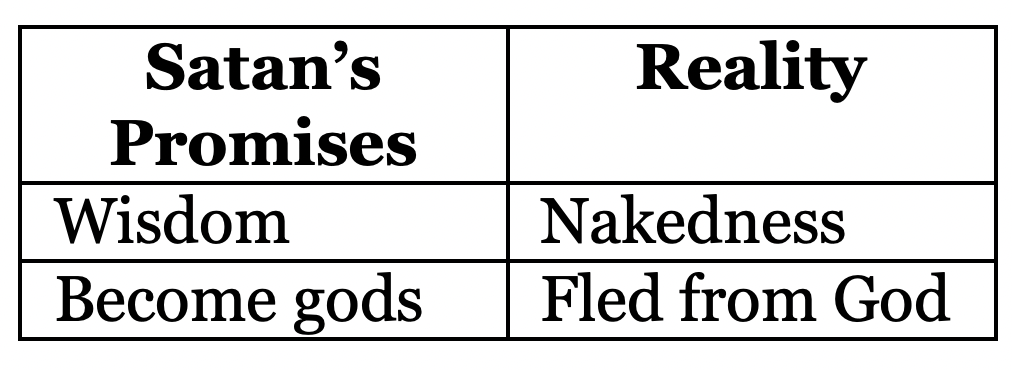
    They allowed Satan to seduce them into sin and steal their innocence.
     
    The second way we can look at this is that Satan was encouraging the woman to want to be a god. “Eat this, and you will be like Him.”
     
    Maybe the woman thought — since the name of the tree was the tree of knowledge of good and evil — it would make her smarter.
     
    But more than likely, the woman did want to be like God. She wanted to make her own choices. She didn’t want Anyone to have control over her.
     
    In other words, Satan wanted our sin to mirror his sin. The only way he could get that to happen was to convince the woman to think as he did. But he had no real facts to back up his lies.
     
    The woman, if she already was doubting God, was a sitting duck.

    creating-everything-theme

    To read devotions in the Creating Everything theme, click the button below.

    Devotions in the Celebrating Creation’s Story series

  • Staying Out of the Garden of Eden

    As we draw our discussion of the original sin to a close, this devotional reading looks at the extent God went to in order to keep Adam and Eve out of the Garden of Eden. Then we tie up our thoughts on sin and God’s redemption.

    Nuggets

    • God set up a guard at the gate of the Garden of Eden.
    • Satan still leaves out the death and destruction part of sinning, and he sure knows about it now if he didn’t then.
    • Sin is not accidental.
    • Yes, God allowed sin to happen even though it is totally against His nature.
    staying-out-of-the-garden-of-eden

    Genesis 3 is a packed chapter. We found lots of nuggets that shows us God’s love for us even when we disobey Him.

    Let’s see if we can wrap up our discussion in this devotion.

    Let’s Put It into Context

    To read devotions in the Creating Everything theme, click the button below.

    Devotions in the Celebrating Creation’s Story series
    Cherubim as a Guard

    “After sending them out, the LORD God stationed mighty cherubim to the east of the Garden of Eden. And he placed a flaming sword that flashed back and forth to guard the way to the tree of life” (Gen. 3: 24 NLT)

    God set up a guard at the gate of the Garden of Eden.

    This is the first time we see an angel in Genesis. And not just any angel, but a cherubim.

    We may think that Adam and Eve had to be physically forced from the Garden of Eden. Bevan agreed. Not only why would they not embrace change, but also why would they want to leave a good thing behind?

    Resource

    In the sermon The Plan of Redemption Exhibited at Eden, whoever wrote it didn’t think so. Remember that, if God had already seen Adam’s request for salvation in verse 20, his relationship with God had already been restored. He was back in God’s good graces.

    Resource

    What I don’t agree with Bevan on is that Adam and Eve could have returned anytime they wanted, cherubim or not. Wrong.

    Humans will not defeat God. Humans will not overpower one of Hod’s angels, especially the cherubim.

    But Adam and Eve couldn’t stay in the Garden. The Garden was of earth. Humankind has to aspire to Heaven.

    Thomas made an interesting observation. He wrote, “The tree of life was there in the garden within possible reach, and if man had conquered instead of being conquered, no cherubim could have prevented his tasting of this ambrosial fruit and so entering into life.”

    Resource

    But Thomas, as Bullock thought of the tree, believed the cherubim guarding the tree was figurative. Murphy disagreed, believing it was real.

    Resource

    The creatures in Revelation 4: 6-8 have been identified by some as the cherubim, a special order of angels, which represents God’s presence.

    “… And around the throne, on each side of the throne, are four living creatures, full of eyes in front and behind: the first living creature like a lion, the second living creature like an ox, the third living creature with the face of a man, and the fourth living creature like an eagle in flight. And the four living creatures, each of them with six wings, are full of eyes all around and within …” (Rev. 4: 6-8 ESV).

    When a distinction is made, most angels are identified as cherubim. “Then I looked, and behold, on the expanse that was over the heads of the cherubim there appeared above them something like a sapphire, in appearance like a throne” (Ezek. 10: 1 ESV).

    I am inclined to think the cherubim guard significant places, and the living creatures are a distant cousin of the cherubim but are more mobile.

    But making a definitive decision is above my pay grade.

    What it is after is the fulfillment of the law. “The person who sins is the one who will die. The child will not be punished for the parent’s sins, and the parent will not be punished for the child’s sins. Righteous people will be rewarded for their own righteous behavior, and wicked people will be punished for their own wickedness” (Ezek. 18: 20 NLT).

    Only allowing our sins to be cleansed through the sacrifice of Jesus can we eat of the tree of life and gain eternal life.

    And isn’t that a blessing in this whole sad tale? Jesus wants to return us to God’s presence.

    Another blessing is the description of the sword. “… And he placed a flaming sword that flashed back and forth to guard the way to the tree of life” (Gen. 3: 24 NLT).

    It was written in The Plan of Redemption Exhibited at Eden that means that the sword was turning back on itself. The cherubim was not focused on punishing Adam and Eve. He was focused on maintaining the purity of the Garden.

    Don’t gloss over the fact that God didn’t destroy the Garden of Eden. He didn’t chop down the tree of life. He didn’t burn the place to the ground.

    God kept the Garden of Eden intact. Remember this was Heaven on earth – the Tabernacle.

    God just put it off limits.

    For a while.

    “Enter by the narrow gate. For the gate is wide and the way is easy that leads to destruction, and those who enter by it are many. For the gate is narrow and the way is hard that leads to life, and those who find it are few” (Mt. 7: 13-14 NLT).

    God’s promised Messiah has provided a path back to fellowship with God. He has thrown open the gate of Heaven so that we may access the tree of life.

    Making the Connections #1

    I keep saying that God is trying to get us back to Eden. Thomas had some issue with that. He wrote,

    “Eden was but a garden, primitive, narrow, and circumscribed, suited for a life of simple innocence with little expansion or development of capacity and power. But redemption introduces us to a noble city with its complicated claims, its vast possibilities, and its myriad grandeurs. Leaving metaphor aside, God in Christ is calling us to a life full of large and noble and varied activity.”

    Resource

    Is God trying to get us back to the Garden of Eden. Well, yes and no.

    Yes, God wants to get us back to that character and innocence that Adam and Eve displayed in the Garden. He wants the relationship and the access back.

    No, once we die, God will have a different place for us. We will be in New Jerusalem.

    Making the Connections #2

    Satan still leaves out the death and destruction part of sinning, and he sure knows about it now if he didn’t then.

    The sales pitch is still, “Make your own decisions in this life. Eat, drink, and be merry. You aren’t going to die — you’ll live forever. Be a god.”

    Well, yes, we are all going to live forever. It is the location that is important.

    Are we going to live in Paradise with God or the fiery depths of hell with Satan?

    We get to choose.

    Making the Connections #3

    Sin is not accidental.

    God always knew humankind would sin. He wouldn’t have set up the Plan of Salvation before He created us if He didn’t know that.

    Ooo, baby. Did we fall into the plan! “But I did find this: God created people to be virtuous, but they have each turned to follow their own downward path” (Ecc. 7: 29 NLT).

    Brown argued that man was made for sin. God, being omniscient, knew that Adam and Eve would choose sin over perfection. Therefore, He made our bodies to withstand the toil and suffering.

    Brown further argued that this was the best. He wrote,

    “Had he remained in Eden the highest interest of heaven in man’s career would have been lost; and more would have been lost, the highest, fullest, most absolute manifestation of God. Him, redemption alone could fully declare. If man comes forth into full manhood through that perverse exercise of his freedom, which leaves human nature suppliant for redemption under peril of imminent death, God, in redeeming man from the penalties and fruits of that perverseness, reveals Himself most fully as God.

    Resource

    Okay. That is a fancy way of saying what I always say. We wouldn’t know the extent of God’s love if we hadn’t sinned. He couldn’t honor Jesus as our Savior if there was no reason for Him to sacrifice Himself for us.

    Brown really nailed it when he says that redemption has components of discipline and education. We have to know God and what He wants of us — and then we have to choose to do it.

    Making the Connections #4

    Alexander reminded us that this wasn’t the only time Adam and Eve would be tempted to sin. The conflict of the two wills was now present and would be in all humans.

    Resource

    It was the couple’s new normal. It is our normal.

    The difference is that the promise has now been fulfilled when it was just a promise to Adam and Eve (Gen. 3: 15). Jesus is our Savior and Redeemer.

    Making the Connections #5

    God is still a loving God even though He takes us out of our comfort zones and from what is familiar as a result of sin. Regardless of our opinion of the punishment, God is lovingly correcting us.

    I don’t think I’ve heard it stated the way Hughes did. He wrote, “The habitation of innocency is no place for sinners.”

    Resource

    We think of Adam and Eve as innocents in the Garden of Eden. But that innocence was tarnished after the sin.

    Imperfect humans could no longer live in the purity of the Garden.

    It’s that habitation that is interesting. We can look at habitation a couple of ways.

    It is a lodging or dwelling. That talks about physical location. If we equate innocence with purity, that means sin shouldn’t be in the building.

    It is a state or process. That leads us to the spiritual aspect.

    We can’t become complacent, or sin might overtake us. (I almost didn’t use that word because we still have a choice, but our choice is so bombarded that we can do almost anything but.)

    We talked about the world outside of the Garden being corrupt. That is the lodging or dwelling. Sin isn’t really a process, but it is a state. It is our normal state since humankind became sinful creatures.

    Making the Connections #6

    Yes, God allowed sin to happen even though it is totally against His nature.

    Why? We talked way back in Genesis 1 that God created the universe to honor His Son, Jesus Christ our Lord. We were made to worship Him and God.

    We talked about God couldn’t show His love for us until He really showed it. We had to see how much He was willing to give up when we were totally not worth it.

    “But God showed his great love for us by sending Christ to die for us while we were still sinners” (Rom. 5: 8 NLT).

    We just have to accept Jesus as our Lord and Savior.

    How Do We Apply This?

    The ABCDs of Salvation

    If you have not become a believer in Christ, please read through the
    Plan of Salvation and prayerfully consider what God is asking you to do.

    A – admit our sins
    B – believe His Son Jesus is our Redeemer
    C – confess God as Sovereign Lord

    D – demonstrate that commitment by making any changes needed in our lives to live the way in which God has called us

    The Disciple’s Job Description

    Searching for and Seeking God

    Hearing His Word (Rom. 10: 17)
    Reading His Word (Rev. 1: 3)
    Praying to Him (Heb. 4: 16)
    Studying His Word (Ac. 17: 11)
    Meditating on His Word (Ps. 1: 1-2)
    Memorizing His Word (Ps. 119: 11)

    Father God. You loved us enough to give us choice as to whether we would obey You. You allowed sin in this word in order to show us how much You loved us. You sent Your Son to die in our place so that we might be restored to You. You still give us the choice as to whether we would obey You. Thank You for Your love. Amen.

    What do you think?

    Leave me a comment below (about this or anything else) or head over to my Facebook group for some interactive discussion.

    If you don’t understand something and would like further clarification, please contact me.

    If you have not signed up for the email providing the link to the devotions and the newsletter, do so below.

    If God has used this devotion to speak with you, consider sharing it on social media.

  • Paradise Lost

    Sin always leads to some form of punishment. This devotional reading looks at the results of the original sin – banishment from the Garden of Eden.

    Nuggets

    • Even though humankind was made in God’s image at creation, Adam and Eve became more like God in knowing the difference between good and evil.
    • It is imperative that we have eaten of the fruit from the tree of life.
    • There was a good reason to banish Adam and Eve from the Garden of Eden – and not just for punishment reasons.
    paradise-lost

    Adam and Eve had committed the original sin. They had stood by while they and Satan were given their punishment.

    But God wasn’t done with handing out punishment. He had another big thing left – banishment from the Garden of Eden.

    We could say this this punishment was only for them, as they were the only humans to have lived there. But because of that, everyone lost access to a face-to-face life with God.

    I had intended to complete Genesis 3 in this post, but it went long. I had to cut it in an interesting place. The connections and application will be added to the completion of the verses in the next devotion.

    Let’s Put It into Context

    To read devotions in the Creating Everything theme, click the button below.

    Devotions in the Celebrating Creation’s Story series

    Paradise Lost

    “Then the LORD God said, ‘Look, the human beings have become like us, knowing both good and evil. What if they reach out, take fruit from the tree of life, and eat it? Then they will live forever!’” (Gen. 3: 22 NLT)

    Become like Us

    Even though humankind was made in God’s image at creation, Adam and Eve became more like God in knowing the difference between good and evil.

    Wait! What???

    What happened to made in God’s image? “Then God said, ‘Let us make human beings in our image, to be like us …’” (Gen. 1: 26 NLT).

    I take this to mean that the singular issue we are discussing here is we now possess knowledge of good from evil. We are still like God because we have the fundamental aspects of His character.

    But then, this was part of the truth part that Satan told them when he was tempting Eve to sin. “‘You won’t die!’ the serpent replied to the woman. ‘God knows that your eyes will be opened as soon as you eat it, and you will be like God, knowing both good and evil’” (Gen. 3: 5 NLT emphasis added).

    Satan is going to use scripture, tell us half-truths, not explain things fully, flat out lie – anything – to get us to sin against God. He will use whatever it take to make his story bright and shiny to attract us to the sin.

    But let’s think about this a second. We become like God. Wouldn’t that be a good thing?

    Well, yes, but not this way. The ends do not justify the means.

    We aren’t to become like God and have His character any way we can. Our godliness is grown through the long process of sanctification.

    Brown had an interesting nugget. He thought our in God’s image part was dormant prior to this point. It was awakened and grown through the disobedience.

    Look what Brown said. He wrote,

    “It was a step out, a step on for man in the unfolding of the latent powers and possibilities of his being as an embodied spirit; but it brought him within peril and under the hand of woes and evils, which have made his history one long wail, and his life one long night. Adam, the child of Eden, made in God’s image, could find the completeness of his life in Eden. … God made man in His own image,” is the original description of the constitution of man.”

    Resource

    Adam and Eve tried to be gods — which, to a point, was possible — but fell on their face because that took them to the opposite of God. They were like God on the outside but not on the inside.

    In finding out that it is the inside that is most important, Adam and Eve lost access to the Heavenly Father. Their selfish desires destroyed their relationship with Him.

    Brown is right. On the surface, it looks like a growth. They became like God.

    But they already were, so it really wasn’t a growth. Instead, the results of sin have weakened them.

    • They are going to die now.
    • They are going to have to navigate through chaos.
    • Conflict will rear its nasty head.
    • Confusion will occur.

    I’m sure Satan left all that out of the marketing spiel — if he even knew it.

    The problem is that Satan was promising them something that was never going to happen. We will never be divine like God. We won’t even become angels.

    That is further evidence that the “… have become like us …” (Gen. 3: 22 NLT) only refers to gaining the knowledge of sin’s existence.

    Fruit from the Tree of Life

    It is imperative that we have eaten of the fruit from the tree of life.

    We mostly talk about the tree of knowledge of good and evil in the Garden. There was another tree there – the tree of life.

    When we were introduced to the tree of life’s existence in Genesis 2, we said its life-giving or life-sustaining properties focused on our spiritual conditions. If we hadn’t sinned, we would have had eternal spiritual life.

    It would do us well to read again how Bonar clarified what that meant. He wrote, “Not that one eating of it could confer immortality; but the continuous use of it was intended for this. The link between soul and body was to be maintained by this tree. So long as he partook of this, that tie could not be broken.”

    Resource

    What that means here is, if they would have eaten that, they would have lived forever in their sinful state. God didn’t want the choice to return to Him taken away.

    I think this is part of the reason Bullock called it a figurative tree. It presents a state of unending happiness.

    Resource

    But I think it was a literal tree. The eating-the-leaves-and-gaining-eternal-life may be figurative, as I see it. But the tree is real.

    Think about what a tree is. It is a living, growing thing. It probably bears fruit.

    According to Edwards, our faith begins a as a germ until it grows and produces fruit.

    Resource

    Boston reminded us that it is not the tree itself that makes us immortal. That is God Himself.

    Resource

    Again, it is God’s mercy to keep us from accessing the tree. “Good people pass away; the godly often die before their time. But no one seems to care or wonder why. No one seems to understand that God is protecting them from the evil to come” (Isa. 57: 1-2 NLT).

    Banished from the Garden of Eden

    “So the LORD God banished them from the Garden of Eden, and he sent Adam out to cultivate the ground from which he had been made” (Gen. 3: 23 NLT)

    There was a good reason to banish Adam and Eve from the Garden of Eden – and not just for punishment reasons.

    Adam and Eve got kicked out of the Garden for their own good.

    Oh, I am sure it didn’t feel like it at the time. We probably know these without being told.

    • Their happiness was really nonexistent at the moment.
    • Their purity and uprightness was gone.
    • Their conscience was damaged.
    • Access to God was lost.

    I think we forget a very important component of our disobedience to God. We become His enemies when we sin.

    So, yes. God had every right to banish Adam and Eve from the Garden.

    Yes, Adam and Eve probably had guilty consciences. And you know — they should. It should not be a light thing when we disobey Sovereign God, our Creator.

    We’ve gotten really blasé about sinning against God. We look for the boundaries of what is and isn’t sin, we look for levels, and we look to argue what is an isn’t sin.

    Our looking is not true obedience.

    White noted that Adam and Eve probably left the Garden thinking they couldn’t depend on God anymore for help. And in a way, God did set them loose to whatever life they wanted to have.

    Resource

    But we have to go back to Genesis 3: 15. God had already promised His Messiah. He had already promised the best help that He could — a way to restore their relationships with Him.

    We must never gloss over the fact that we choose whether to sin or not. We could just as easily choose to obey than disobey.

    Parsons put it this way. He said, “Let no one for a moment suppose that man sins by decree; he is saved by decree, but he is not lost by decree.”

    Resource

    We choose to disobey. We choose to obey.

    True, we might have to realign our beliefs and actions to His Will. We might have to let go of some very important things — even people — in our lives.

    Obeying God is worth whatever we need to give up in order to remain so.

    Pastor Steve always tells us that the blessings are in the obedience. It says that in God’s Word.

    • “Blessed are those whose lawless deeds are forgiven, and whose sins are covered; blessed is the man against whom the Lord will not count his sin” (Rom. 4: 7-8 ESV).
    • “Blessed is the one whose transgression is forgiven, whose sin is covered. Blessed is the man against whom the Lord counts no iniquity, and in whose spirit there is no deceit (Ps. 32: 1-2 ESV).

    We are obedient and blessed when we obey God’s laws and commandments. In other words, we gain salvation.

    No, that doesn’t make it a works-based salvation. Only belief in Jesus gains us salvation.

    • “Salvation is not a reward for the good things we have done, so none of us can boast about it” (Eph. 2: 9 NLT).
    • “There is salvation in no one else! God has given no other name under heaven by which we must be saved” (Ac. 4: 12 NLT).
    • “You must not have any other god but me. You must not make for yourself an idol of any kind or an image of anything in the heavens or on the earth or in the sea” (Ex. 20: 3-4 NLT).
    • “Jesus told him, ‘I am the way, the truth, and the life. No one can come to the Father except through me’” (Jn. 14: 6 NLT).

    Salvation is a change of nature when we choose to obey God.

    Bullock described it this way. He wrote,

    “The persons in the text have the right, because God has declared and promised in His Word, which can never be broken, that they who possess that character which manifests itself in aiming at a holy and constant obedience to His law, shall have the right, or more properly the privilege of eating of the tree of life, and of entering in hereafter through the gates into the city. To the [fulfillment] of this promise it is by no means necessary that obedience and right should be connected together as cause and effect.”

    Resource

    Having a regenerated heart lets us eat from the tree of life. It shows we have the right character, the character of God. That character is shown through our obedience to God’s laws.

    Bevan made a distinction between being banished from the Garden and guilt. Guilt is partially caused by the banishment, but it should be more so caused by committing the sin itself.

    We shouldn’t feel guilty that we were caught. We should feel guilty because we disobeyed and committed the sin.

    Resource

    Exell made a great point. Adam and Eve were banished from the Garden before they could feel they were entitled to be there.

    Resource

    To my way of thinking, it wasn’t only that Adam and Eve should feel entitled to eat of the tree of life. Also included would have been their frustration at their lives being harder. It is human nature to think things should go back to the way they were — and ignore the circumstances that brought about the change in the first place.

    Exell reminded us that God’s laws and commandments aren’t just about this life. They are preparing us for eternal life — where we will get to eat from the tree of life.

    • “For our present troubles are small and won’t last very long. Yet they produce for us a glory that vastly outweighs them and will last forever!” (II Cor. 4: 17 NLT).
    • “… On each side of the river grew a tree of life, bearing twelve crops of fruit, with a fresh crop each month. The leaves were used for medicine to heal the nations” (Rev. 22: 2 NLT).

    Think of it this way. Eden was about purity and devotion — most of all obedience.

    Adam and Eve would no longer be happy there.

    In other words, sin made that choice for them, too. They chose the impure and disobedient, so they chose against staying in the Garden of Eden.

    We can’t forget that there was a vast world outside of the Garden of Eden. The problem was condemned and uncultivated.

    Father God. You knew that the best for us would be to chose You as our Father. You allowed the original sin to happen. You banished them from the Garden of Eden for their — and our — best interests. Thank You, Lord.  Amen.

    What do you think?

    Leave me a comment below (about this or anything else) or head over to my Facebook group for some interactive discussion.

    If you don’t understand something and would like further clarification, please contact me.

    If you have not signed up for the email providing the link to the devotions and the newsletter, do so below.

    If God has used this devotion to speak with you, consider sharing it on social media.

  • Making the Connections of Sin

    For the past several devotions, we’ve been taking about the original sin and the punishment for that. This devotional reading looks at some of the thoughts I’ve had over the past

    Nuggets

    • The man — and the woman and all of us — lost the initial salvation.
    • The couple who committed the original sin were punished, but not with judgments aimed specifically at them and no one else.
    • Unless we bruise the root of our disobedience, we don’t crush the head of evil.
    • A long time ago, I wrote a devotion on what would have happened if the man and the woman hadn’t sinned.
    making-the-connections-of-sin

    Throughout the last couple of devotions, things have been swirling through my mind. You know me, I kept them in a connections file.

    I thought we should take a minute and go through those.

    Let’s Put It into Context

    To read devotions in the Creating Everything theme, click the button below.

    Devotions in the Celebrating Creation’s Story series

    Making the Connections #1

    The man — and the woman and all of us — lost the initial salvation.

    God, the man, and the woman had a unique relationship. They met face to face.

    We’re getting a little ahead of ourselves, but the couple were kicked out of the garden (Gen. 3: 23 ESV).

    If they had not lost their salvation – the perfect condition in which they were made – how could anyone who chose to sin be separated from God?

    Aren’t sin and salvation are all about that? Sin makes us lose access to God. Salvation restores it.

    Oh, I know. Jesus hadn’t died yet, so the Plan of Salvation wasn’t accomplished at this point.

    Do you really think none of the Hall of Famers are going to be in Heaven? Noah? Abraham? Joseph? Moses? David? Jesus’s own earthly father????

    The Parable of the Rich Man and Lazarus tells us Abraham is already in Heaven (Lk. 16: 19-31). The transfiguration showed us Moses and Elijah are still alive (Mt. 17: 1-13).

    The Old Testament is all about justice. Justice is conformity to God’s standard, causing order in creation.

    Old Testament salvation is based on obedience. Yet, the man wasn’t killed immediately. He was given the opportunity to repent.

    God’s Word really doesn’t say the man repented, but I think he did. Just because he wasn’t allowed back in the Garden of Eden doesn’t mean he won’t be in Heaven.

    Monro made an interesting observation. He wrote, “There is a popular impression, not unfrequently given children and ignorant persons, that our first parents were in a state of entire freedom from any kind of suffering.”

    Resource

    In Elaine-speak, obedience – therefore salvation – was something they would have wanted to keep. Their free will should have been ruled by the desire to keep that.

    But instead, they weren’t content with the status quo, implying they were experiencing from mental suffering. Both the fruit of the tree and the knowledge it would impart was attractive to the couple. If they weren’t having qualms about their obedience to God, they would have not been in this situation.

    In other words, their doubts would have sabotaged their contentment. Their disobedience was neither sudden nor unpremeditated to some degree.

    Think of it this way. The couple chose what they could see rather than choose to modify their actions.

    Making the Connections #2

    The couple who committed the original sin were punished, but not with judgments aimed specifically at them and no one else.

    That is true. All women suffer in childbirth and are to be submissive to their husbands. All men must struggle to earn a living. All suffer the consequences and results of sin.

    All men must work for a living, and that work became more difficult after the fall. All – regardless of gender – experience physical death. “And just as each person is destined to die once and after that comes judgment” (Heb. 9: 27 NLT).

    While they did feel the punishment of the judgments, none were limited to them alone. Humankind has suffered from the punishments in all times since then.

    God’s Word tells us about that. “I lavish unfailing love to a thousand generations. I forgive iniquity, rebellion, and sin. But I do not excuse the guilty. I lay the sins of the parents upon their children and grandchildren; the entire family is affected — even children in the third and fourth generations” (Ex. 34: 7 NLT).

    Sin changes the person who committed the sin. The effects of sin are felt for generations.

    Don’t get me wrong. We are responsible for our own sins.

    • “You must not bow down to them or worship them, for I, the Lord your God, am a jealous God who will not tolerate your affection for any other gods. I lay the sins of the parents upon their children; the entire family is affected — even children in the third and fourth generations of those who reject me” (Ex. 20: 5 NLT).
    • “Yet you say, ‘Why should not the son suffer for the iniquity of the father?’ When the son has done what is just and right, and has been careful to observe all my statutes, he shall surely live. The soul who sins shall die. The son shall not suffer for the iniquity of the father, nor the father suffer for the iniquity of the son. The righteousness of the righteous shall be upon himself, and the wickedness of the wicked shall be upon himself” (Ex. 18: 19-20 NLT).
    • “Parents must not be put to death for the sins of their children, nor children for the sins of their parents. Those deserving to die must be put to death for their own crimes” (Deut. 24: 16 NLT)
    • “The Lord is slow to anger and filled with unfailing love, forgiving every kind of sin and rebellion. But he does not excuse the guilty. He lays the sins of the parents upon their children; the entire family is affected—even children in the third and fourth generations” (Num. 14: 18 NLT).

    Yes, God is a God of wrath. He will punish us when we disobey.

    But God is a God of love. “But I lavish unfailing love for a thousand generations on those who love me and obey my commands” (Ex. 20: 6 NLT).

    When we obey, God lavishes His love on us.

    Making the Connections #3

    Unless we bruise the root of our disobedience, we don’t crush the head of evil.

    Nice sentence, but what did I mean when I wrote that? That was my take on what the Homilist wrote.

    Resource

    Two moral forces battle for control of this world. One is the worldview – the seed of the serpent, as the Homilist called it – and the Godview – the seed of the woman through Christ.

    These are polar opposites. The Homilist described it this way. He wrote, “The thoughts, actions, and conduct of men are so radically different that they must be referred to two distinct moral forces.

    Resource

    Remember back to the punishment of the serpent. “And I will cause hostility between you and the woman, and between your offspring and her offspring. He will strike your head, and you will strike his heel” (Gen. 3: 15 NLT).

    This not only shows the opposition, but it also identifies the victor. And this is where the first sentence of this section came from.

    Good will strike evil’s head – our moral feelings. Remember, sin is universal, so the worldview is also universal.

    The Gospel calls us to be counterculture. In order to do that, Jesus – through the Holy Spirit – must attack each of our thoughts, actions, and conduct that is opposite to His Truth.

    If the root of our worldview moral feelings is not cut out of us, we will not be obedient to God.

    I like what the Homilist wrote. It says, “It does not strike at the mere forms of murder, adultery, and theft; but at their spirit, anger, lust, and covetousness. This its characteristic.”

    Resource

    It doesn’t address only the actions. It addresses the motivations. It addresses character.

    The Church can’t miss this. We can’t be doing God’s work through worldview principles and expectations.

    If we are doing what we call God’s work under the wrong motivation, we aren’t doing God’s work. That is why we can’t get to Heaven by only being good people.

    Making the Connections #4

    A long time ago, I wrote a devotion on what would have happened if the man and the woman hadn’t sinned.

    I believe they would have kept on living in the Garden of Eden. They would have kept on being caretakers of the earth. It wouldn’t have been the back-breaking job that farming became.

    The man and the woman would have lived in harmony. Marital strife wouldn’t have even been considered. The battle of the sexes wouldn’t have raged. In fact, no conflict would have been par for the course.

    But I think someone – somewhere along the line – would have sinned.

    Part of the reason for creation was so that God could honor Jesus. If some human hadn’t sinned, Jesus wouldn’t have had to sacrifice Himself for us.

    God didn’t make us to be slaves of Jesus. We made ourselves, through the couple’s sin, to be slaves of sin.

    • “Jesus replied, ‘I tell you the truth, everyone who sins is a slave of sin’” (Jn. 8: 34 NLT).
    • “So Christ has truly set us free. Now make sure that you stay free, and don’t get tied up again in slavery to the law.” (Gal. 5: 1 NLT).
    • “We know that our old sinful selves were crucified with Christ so that sin might lose its power in our lives. We are no longer slaves to sin” (Rom. 6: 6 NLT).
    • “They promise freedom, but they themselves are slaves of sin and corruption. For you are a slave to whatever controls you” (II Pet. 2: 19 NLT).
    • “Don’t you realize that you become the slave of whatever you choose to obey? You can be a slave to sin, which leads to death, or you can choose to obey God, which leads to righteous living” (Rom. 6: 16 NLT).

    How Do We Apply This?

    Searching for and Seeking God

    Hearing His Word (Rom. 10: 17)
    Reading His Word (Rev. 1: 3)
    Praying to Him (Heb. 4: 16)
    Studying His Word (Ac. 17: 11)
    Meditating on His Word (Ps. 1: 1-2)
    Memorizing His Word (Ps. 119: 11)

    Father God. We are sorry that sin had to be allowed into this world. However, if it never had come, we wouldn’t have known the extent of Your love for us. You would never have to give Your Son to die in our stead. Things do turn out for good. Amen.

    What do you think?

    Leave me a comment below (about this or anything else) or head over to my Facebook group for some interactive discussion.

    If you don’t understand something and would like further clarification, please contact me.

    If you have not signed up for the email providing the link to the devotions and the newsletter, do so below.

    If God has used this devotion to speak with you, consider sharing it on social media.

  • Punishment for the Man

    God punished all three participants in the original sin. This devotional reading looks at the punishment He gave to the man — in fact, all humankind.

    Nuggets

    • Even though the man just went with the flow, he encountered punishment, too.
    • Maintaining life became a struggle.
    • Because of the original sin, every human will suffer physical death.
    punishment-for-the-man

    God saved the punishment for the man for last. But if we think about it, the punishment wasn’t just for the male version of our species.

    It was for humankind.

    Let’s Put It into Context

    To read devotions in the Creating Everything theme, click the button below.

    Devotions in the Celebrating Creation’s Story series

    .Since The Man Listened to His Wife

    “And to the man he said, ‘Since you listened to your wife and ate from the tree whose fruit I commanded you not to eat, the ground is cursed because of you. All your life you will struggle to scratch a living from it. It will grow thorns and thistles for you, though you will eat of its grains. By the sweat of your brow will you have food to eat until you return to the ground from which you were made. For you were made from dust, and to dust you will return’” (Gen. 3: 17-19 NLT)

    Even though the man just went with the flow, he encountered punishment, too.

    The man didn’t get a pass when God was handing out punishment because someone else led him to sin. While he was offered the fruit, it was his decision alone to go ahead and bite.

    We each have to seek to do God’s Will. His Will for us is that we gain salvation and are obedient.

    God alone determines what is a punishable offense – what is a sin. Subsequently, He is the One to establish the punishment.

    The Ground Is Cursed Because of You

    Maintaining life became a struggle.

    We’re not God. We don’t get to say, “Let there be green beans,” and they show up. It takes work to till the soil, plant, weed, water, and harvest. That is all before we either store the harvest or prepare it for consumption.

    That is part of what it means when the ground was cursed. It takes work to till the land. It takes more work now than it did before the original sin.

    This may be where weeds came into being (thorns and thistles). Those may have been around before the original sin. At a minimum, this means the weeds took on a more invasive existence.

    Yes, this is mainly talking about farming and tending plants. No, most of us don’t do that anymore – but someone, somewhere is doing just that.

    I think we can apply this to our 21st century jobs. They are harder and more complex than they were. We have to work at them, too.

    I think we also need to look at this as the Earth as a whole. This is where tornados, hurricanes, famine, drought, flooding, climate change, and more challenges came into being. God’s perfect paradise was thrown off kilter because two people got selfish.

    Some of us don’t see work as a blessing. For some, working for a living is a curse in itself.

    That goes against some thinking that there should be more leisure time and less work time. At the same pay, of course.

    Jessopp said something interesting about leisure time. He wrote, “The sweetness of leisure consists in the change from our ordinary employments, not in a cessation of all employment.”

    Resource

    We don’t appreciate the leisure time enough if we don’t have the work time.

    Instead, we should see secular work a being done for the Lord. When we work in His name and for His glory – regardless of the hob we are doing — we will be fruitful.

    Parker equated it to our spiritual condition. He said the sanctification process – spiritual cultivation – is hard and a slow process.

    Resource

    In other words, we have to toil in order to restore our relationships with God. We have to want to.

    We can only be sanctified by God’s power. We can’t do it on our own.

    To Dust You Will Return

    “By the sweat of your brow will you have food to eat until you return to the ground from which you were made. For you were made from dust, and to dust you will return’” (Gen. 3: 19 NLT)

    Because of the original sin, every human will suffer physical death.

    Before the man and woman bit the fruit, they would have lived eternally as they were. That was a reward of obedience.

    That ended when they disobeyed God. Physical death – brought about disease, natural causes, murder, accidents, etc. – became the new normal.

    God’s Word backs that up.

    • When Adam sinned, sin entered the world. Adam’s sin brought death, so death spread to everyone, for everyone sinned” (Rom. 5: 12 NLT).
    • “So you see, just as death came into the world through a man, now the resurrection from the dead has begun through another man. Just as everyone dies because we all belong to Adam, everyone who belongs to Christ will be given new life” (I Cor. 15: 21-22 NLT).

    Verse 19 talks about returning to dust. That does back to a verse we read in Chapter 2. “Then the Lord God formed the man from the dust of the ground. He breathed the breath of life into the man’s nostrils, and the man became a living person” (Gen. 2: 7 NLT).

    That shows how fragile the human body really is. “And just as each person is destined to die once and after that comes judgment” (Heb. 9: 27 NLT).

    Since Death had entered the picture (Gen, 3: 19), we had to have a cause of death. This is where disease reared its ugly head. Everything from wars to I-want-the-money-in-your-wallet-or-I’ll-kill-you also showed up. This is where the body started to just wear out (with the help of accidents).

    Maclaren argued this curse was talking only of physical death. He hooked it back to Genesis 2: 7, also.

    Resource

    The fact that the soul isn’t addressed here, according to Maclaren, also supports this not being spiritual death. I disagree.

    The man and the woman experienced spiritual death, too, when they lost their salvation. Their holiness was gone.

    Let’s just sum it up in a really simple sentence. The consequences and results of the original sin are still being felt today in a significant way.

    Exell believed that this is where anxiety entered in the world. He wrote, “The anxious and painful toil of man consequent upon the Fall.”

    Resource

    Ooo, baby. I get it. Dad had many nail-biting times when he was farming. If weather didn’t sabotage the harvest, machinery breakdowns did. That isn’t talking about the nasty little things and bigger things that used the fields as restaurants.

    Anxiety itself isn’t a sin. God’s Word doesn’t tell us to never be anxious.

    Instead, the most important thing is what we do when the anxiety begins.

    • “Don’t worry about anything; instead, pray about everything. Tell God what you need, and thank him for all he has done” (Phil. 4: 6 NLT).
    • “That is why I tell you not to worry about everyday life — whether you have enough food and drink, or enough clothes to wear. Isn’t life more than food, and your body more than clothing?” (Mt. 6: 25 NLT).
    • “Give all your worries and cares to God, for he cares about you” (I Pet. 5: 7 NLT).
    • “Worry weighs a person down; an encouraging word cheers a person up” (Prov. 12: 25 NLT).

    Making the Connections #1

    Sin is universal.

    Every man, woman, and child from every nation, culture, socioeconomic status – everyone – has a sinful nature. That means every person who ever was born or ever will be born comes into this world spiritually dead and separated from God.

    Isn’t it amazing that God gave the solution two verses before He gave the curse?

    Boyd talked about how God changes evil into blessings. He wrote, “Out of man’s evil and man’s transgression God contrives blessing. Sorrow in itself is an apparent evil; as God manages it, it is the harbinger of joy. It was the curse, but it also brings the blessing.”

    Resource

    Isn’t this really what Romans 8: 28 is about? “And we know that God causes everything to work together for the good of those who love God and are called according to his purpose for them” (Rom. 8: 28 NLT).

    As we look toward the Easter weekend, we can use this as a reminder of why Jesus did what He did. He sacrificed His life for our spiritual condition. He and God both wanted us to have a way to restore our relationships with Them.

    Making the Connections #2

    “And to the man he said, ‘Since you listened to your wife and ate from the tree whose fruit I commanded you not to eat, the ground is cursed because of you. All your life you will struggle to scratch a living from it. It will grow thorns and thistles for you, though you will eat of its grains. By the sweat of your brow will you have food to eat until you return to the ground from which you were made. For you were made from dust, and to dust you will return’” (Gen. 3: 17-19 NLT)

    I hope you read those verses again. Do you sense any anger? I don’t. I don’t know if I even read severity in them.

    Oh, don’t get me wrong. The punishment is severe.

    I think God’s attitude is more of discouragement here.  It is rimmed with sadness.

    The sadness doesn’t come, I think, from all that God has lost. He lost the couples’ companionship, as well as their worship and obedience.

    I think, more, the sadness comes from what they have lost. He knows what a huge price they have paid for disobedience. What a huge price humankind has paid for their disobedience.

    If God was this sad, why did He put us through all of this? Why have us disobey just to be reinstated?

    There is a couple of reasons I can think of off the top of my head. Doing it any other way wouldn’t have given us free will.

    Think about it. How we would have kicked back if we would have been forced into it! Even something as good as what the couple had!!!

    God isn’t a dictator. He doesn’t force us.

    People still to this day have the option to choose to not obey God. Yes, they will have to pay the consequences for that choice in the end, but it is their choice.

    God isn’t going to send them to hell. They chose to go there themselves.

    The other reason is Romans 8: 28. “And we know that God causes everything to work together for the good of those who love God and are called according to his purpose for them” (Rom. 8: 28 NLT).

    By allowing us to stumble and fall, stumble and fall, God is showing us how much He loves us. By sending His Son to die and be the sacrifice for us, He is showing us there is nothing He wouldn’t do in His power to show us that love.

    No, God saying to Jesus, “I am just going to let everyone in, even those who don’t acknowledge You as Lord” isn’t going to happen. That isn’t in God’s power. He can’t operate in opposition to His character.

    So, since the original sin, the fall from grace, every choice we’ve made has been in God’s plan, set into motion before the foundation of the world.

    God did it for us.

    How Do We Apply This?

    • Seek to do God’s Will – gain salvation and be obedient.
    • Be disciplined in order to restore our righteousness.
    • Approach God in humility.
    • /Don’t fall to Satan’s temptations to get us to sin.

    Resources

    Father God. We disobeyed You. You had every right to punish us. But your punishment was tinged with Your grace and mercy. Thank You.

    What do you think?

    Leave me a comment below (about this or anything else) or head over to my Facebook group for some interactive discussion.

    If you don’t understand something and would like further clarification, please contact me.

    If you have not signed up for the email providing the link to the devotions and the newsletter, do so below.

    If God has used this devotion to speak with you, consider sharing it on social media.

  • Punishment for The Woman

    As each player in the original sin had to face judgment for their part in the sin, it was now time for judgment for the woman. This devotional reading looks at how pain would now be experienced in childbirth and how the wife would be submissive to the husband.

    Nuggets

    • The woman’s sin was different from the man’s as she not only sinned, but she also led others to sin.
    • The woman’s punishment is also psychological and social because it deals with her relationship with her husband.
    punishment-for-the-woman

    Once the serpent/snake and Satan had received their punishments, it was now time for the humans to receive their punishment. This devotional reading looks at

    Have you ever thought about how God was interrogating the humans and stopped? It seems kind of like a hard break from the interrogation to the punishment of the humans to punishment of the serpent/snake.

    Well, God found out – from the human perspective – what happened. He was showing them mercy.

    • “I want you to show love, not offer sacrifices. I want you to know me more than I want burnt offerings” (Hos. 6: 6 NLT).
    • “Then he [Jesus] added, ‘Now go and learn the meaning of this Scripture: “I want you to show mercy, not offer sacrifices.” For I have come to call not those who think they are righteous, but those who know they are sinners’” (Mt. 9: 13 NLT).

    Then, God took care of the root cause. He punished Satan.

    But that doesn’t mean the humans would get a pass. Both the woman and the man would get their own punishment.

    Let’s Put It into Context

    To read devotions in the Creating Everything theme, click the button below.

    Devotions in the Celebrating Creation’s Story series

    Pain in Childbirth

    “Then he said to the woman, ‘I will sharpen the pain of your pregnancy, and in pain you will give birth …’” (Gen. 3: 16 NLT)

    The woman’s sin was different from the man’s as she not only sinned, but she also led others to sin.

    The woman was dealt with after Satan and the serpent/snake had received their judgment. It was appropriate that God dealt with Satan’s sin first as he was the tempter.

    It was also appropriate that the woman’s sin was addressed first as she sinned first. That, however, did make her sin more than the man’s. Because she offered the fruit to the man, she invited him to sin.

    With that in mind, it is interesting to note that the woman’s judgment was just this one verse. Satan got two verses; the man got three verses.

    But the man’s punishment was for humankind regardless of gender.

    God gave the woman a two-part judgment. One regarded childbirth; the other, her relationship with her husband.

    Since we know the man’s judgment at this point, we also know that she gained physical death. But we are going to wait to talk about that.

    God blessed the woman and man, calling them to multiply. “Then God blessed them and said, ‘Be fruitful and multiply. Fill the earth and govern it …’” (Gen. 1: 28 NLT).

    The multiply process goes by several names. Procreation and childbirth are two of them, though it can be argued that they describe two separate processes that make up the whole.

    Both man and women are needed for the procreation process. An X chromosome and a Y chromosome are needed to fertilize the egg.

    The childbirth processes happens exclusively within the woman’s body. This may be a reason why it was chosen for the woman’s judgment.

    Childbirth would no longer be easy. A woman would now suffer from physical pain during the birth process. In other words, every time a woman gives birth, there will be a reminder of that sin that had occurred in the way distant past.

    Bonar thought that reminder caused God to backtrack some on that first blessing. How can a blessing be a reminder of sin?

    No, Bonar didn’t think it cut back on the multiply part. Now, sorrow was going to be mingled with the joy.

    Resource

    Part of me gets what Bonar is saying. The other part of me says, “Oh, no.”

    How many times has God told us in His Word to remember where we were before we gave our lives to Jesus? Remember what He did for us?

    • “Don’t forget that you Gentiles used to be outsiders. You were called ‘uncircumcised heathens’ by the Jews, who were proud of their circumcision, even though it affected only their bodies and not their hearts. In those days you were living apart from Christ. You were excluded from citizenship among the people of Israel, and you did not know the covenant promises God had made to them. You lived in this world without God and without hope” (Eph. 2: 11-12 NLT).
    • “remember the former things of old; for I am God, and there is no other; I am God, and there is none like me” (Isa. 46: 9 NLT).
    • “But then I recall all you have done, O Lord; I remember your wonderful deeds of long ago” (Ps. 77: 11 NLT).

    God uses our memories of sin to show us His love for us. He wants us to recognize how better off we are with Him than we are without Him.

    But go back to Satan’s judgment. “And I will cause hostility between you and the woman, and between your offspring and her offspring. He will strike your head, and you will strike his heel” (Gen. 3: 15 NLT emphasis added).

    We just said it takes two to tango, but God talked about her offspring, not theirs. The woman was the first to sin, but it is through her offspring that salvation would come.

    Look how Jukes said it. He wrote,

    “Then comes a promise, full of grace and truth, touching the woman’s Seed; a promise not to old Adam, for the old man is fallen and must pay the penalty — no reprieve is given to the flesh: the cross which saves us is Adam’s condemnation — but a promise to the Seed or New Man, who shall be born, in and by whom man shall regain paradise.”

    Resource

    • Even after we disobeyed Him, God interacted with the couple in grace and truth.
    • The man, being created from dust – therefore made of flesh – was as he was. He became sinful, so even if we believe that he asked for and was granted forgiveness for his sin, there was nothing he personally could do to rectify the matter.
    • The woman, on the other hand, through childbirth, could fulfill the promise of a Messiah to be born in the future, Who would save the world from its sin.

    Brooke equated the ability to have children to our relationship with God. This creation of a new life is what salvation through this Man is all about. “This means that anyone who belongs to Christ has become a new person. The old life is gone; a new life has begun!” (II Cor. 5: 17 NLT).

    Resource

    Think about it. Carrying a child in our bodies is one of the most unselfish things women can do.

    • Our figures get stretched to the max while being a hotel for our bundle of joy.
    • I may have gotten most of my figure back, but I sure didn’t get back to my weight before Adam was born – and I only gained ten pounds and he was six of that.
    • We give up all sorts of things to ensure the safety of the fetus.
    • The discomfort is real, especially if we are pregnant during the heat of the summer.
    • Then we get to the pain of the birth process itself.
    • After that, our lives are no longer our own.

    Submission in Marriage

    “… ‘And you will desire to control your husband, but he will rule over you’” (Gen. 3: 16 NLT)

    The woman’s punishment is also psychological and social because it deals with her relationship with her husband.

    There was a book in the early 1990s entitled Men Are from Mars, Women Are from Venus. It highlighted the difference between males and females.

    In a way, that is true here. A woman’s desire is psychological; a man’s rule is social.

    No, this does not mean all women are to be submissive to all men. A woman is to submissive to her husband only. This is to be a loving role, not subjugation.

    Don’t miss this. This submission was not present before the sin. In God’s perfect world, men and women are equal. “There is no longer Jew or Gentile, slave or free, male and female. For you are all one in Christ Jesus” (Gen. 3: 28 NLT).

    We also know that there are times that woman do rule over men. A mother rules over her son.

    Jesus did not limit His disciples to just the men. “Her [Martha’s] sister, Mary, sat at the Lord’s feet, listening to what he taught” (Lk. 10: 39 NLT).

    Just the opposite. When Martha wanted Mary to help doing women’s work, Jesus said, “There is only one thing worth being concerned about. Mary has discovered it, and it will not be taken away from her” (Lk. 10: 42 NLT).

    Babington thought this judgment derived from the fact that the woman was not with her husband when the serpent/snake tempted her. He made it sound like the woman was too bold and went above her place to talk with the serpent.

    Resource

    God expects wives to be obedient to their husbands. I think Colossians 3: 23 is for everyone. “Work willingly at whatever you do, as though you were working for the Lord rather than for people” (Col. 3: 23 NLT).

    Wives – and husbands, children, slaves/employees – must work willingly. The product of our work is for God’s glory.

    To me, this says our work has to be done from the heart, not just going through the motions.

    Making the Connections #1

    In a past devotion, we talked about how many relationships were made when God created man and woman. When sin entered, those relationships were broken.

    Our relationship with God was severed. Humankind was banished from His presence. Before this, God had come to visit His creation.

    Now, He couldn’t.

    Our relationship with each other was damaged. Shame, jealousy, envy, and hate were now elements causing that damage.

    The relationship between people and God’s creation was strained. Adam was told that “… All your life you will struggle to scratch a living from it” (Gen. 3: 17 NLT).

    But that also changed the way we view God’s creation. Some can view our role as owner or controller. God has not given us authority over the earth. He maintains that for Himself.

    Our view of ourselves have changed. We became self-conscious. We see ourselves as fat or ugly – along with a lot of other derogatory ways.

    True, God sees us as sinners now – until we accept His Plan of Salvation. Then He seems us as redeemed.

    It is only through Jesus’ sacrifice on the cross that we are able to restore our relationship with God.

    Making the Connections #2

    Brooke was right. He noted that disciples, as do mothers, need to sacrifice self in order to serve others. We can’t count the cost, as Paul said.

    What we gain is seeing others come to a new life in Christ.

    Resource

    This self-surrender is vital to serving God. We can’t put limitation on where He can call us and to what we will do for Him. We certainly can’t dig in our heels and say we won’t do His Will at all.

    We, as do mothers, sacrifice for another life – an eternal life.

    How Do We Apply This?

    Remember our sins so that we don’t repeat them.
    Learn from the sins of others.
    Have right relationships with others.

    Father God. You lovingly correct Your children. Increase our desire to what to be obedient to You. Forgive us when we give into temptation. Help us in our relationships with others, especially our spouses. Amen.

    What do you think?

    Leave me a comment below (about this or anything else) or head over to my Facebook group for some interactive discussion.

    If you don’t understand something and would like further clarification, please contact me.

    If you have not signed up for the email providing the link to the devotions and the newsletter, do so below.

    If God has used this devotion to speak with you, consider sharing it on social media.

  • The Plan of Salvation Revealed

    When God passed judgment on Satan for the original sin, He started revealing the Plan of Salvation. This devotional reading looks at how the serpent’s and woman’s offspring would interact.

    Nuggets

    • The Messiah was promised to restore humankind’s relationship with God.
    the-plan-of-salvation-revealed

    Not long after Satan succeeded in unleashing sin on the world, he got a sentence of losing to the Son of God. I don’t think he knew about the lake of fire yet (Rev. 20: 10).

    But Satan knew from the get-go that, though he may win some battles, he was going to lose the war with God.

    The loss would be a crushing defeat. His head was going to get smashed. “The time for judging this world has come, when Satan, the ruler of this world, will be cast out” (Jn. 12: 31 NLT).

    Let’s Put It into Context

    To read devotions in the Creating Everything theme, click the button below.

    Devotions in the Celebrating Creation’s Story series

    The Promised Messiah

    “… He will strike your head, and you will strike his heel” (Gen. 3: 15 NLT)

    The Messiah was promised to restore humankind’s relationship with God.

    Satan learned this of is defeat by being informed there would be a Messiah to save us. He would arrive through a human birth.

    Ooo, baby. I bet that was a blow to Satan. He thought humans were worse than second-class citizens – and One of them was going to defeat him!

    Before we were even created, God knew our relationship with Him would break, and He set a path to lead us back. It looks like two seconds after God confronted the couple about their sin, the Plan of Salvation was unveiled.

    God, when He had to have been upset and hurt because the couple had sinned, immediately became the first Preacher.

    “I have heard all about you, LORD. I am filled with awe by your amazing works. In this time of our deep need, help us again as you did in years gone by. And in your anger, remember your mercy” (Hab. 3: 2 NLT).

    No, God did not come up with the Plan of Salvation on the fly. It was designed long before it was needed.

    • “God chose him [Jesus] as your ransom long before the world began, but now in these last days he has been revealed for your sake” (I Pet. 1: 20 NLT)
    • “Even before he made the world, God loved us and chose us in Christ to be holy and without fault in his eyes” (Eph. 1: 4 NLT).
    • “And all the people who belong to this world worshiped the beast. They are the ones whose names were not written in the Book of Life that belongs to the Lamb who was slaughtered before the world was made” (Rev. 13: 8 NLT).
    • “Father, I want these whom you have given me to be with me where I am. Then they can see all the glory you gave me because you loved me even before the world began!” (Jn. 17: 24 NLT).
    • “The beast you saw was once alive but isn’t now. And yet he will soon come up out of the bottomless pit and go to eternal destruction. And the people who belong to this world, whose names were not written in the Book of Life before the world was made, will be amazed at the reappearance of this beast who had died.” (Rev. 17: 8 NLT).
    • “For God saved us and called us to live a holy life. He did this, not because we deserved it, but because that was his plan from before the beginning of time—to show us his grace through Christ Jesus” (II Tim. 1: 9 NLT).
    • “Then the King will say to those on his right, ‘Come, you who are blessed by my Father, inherit the Kingdom prepared for you from the creation of the world’” (Mt. 25: 34 NLT).
    • “If that had been necessary, Christ would have had to die again and again, ever since the world began. But now, once for all time, he has appeared at the end of the age to remove sin by his own death as a sacrifice” (Heb. 9: 26 ESV).

    Belief in the Messiah was the way to the path of restoration. “Jesus told him, ‘I am the way, the truth, and the life. No one can come to the Father except through me’” (Jn. 14: 6 NLT).

    We can’t say that Jesus wasn’t in the Old Testament. We can’t say that Old Testament believers knew nothing about a Messiah.

    Don’t miss this. When the Messiah was promised here, there is no mention of Him being a military Messiah. It is clearly – and only – about spiritual freedom from sin.

    Make no mistake. Salvation came through a curse. God cursed Satan by telling him that he would lose through our turning back toward good.

    The third thing not to gloss over is that Satan can only reach the heel. Manton put it this way. Manton wrote, “The devil cannot reach to the head, but the heel only, which is far from any vital part.”

    Resource

    Ooo, baby. That would bite. Satan was trying for a complete overthrow of God, and all he was going to accomplish was a swat at the heel.

    Gibson made a great point. The Gospel had to come through a curse because, even today, there are those who feel a good works salvation is enough.

    It isn’t. We can’t earn our way back into Heaven.

    Being a good person isn’t good enough. It does address our disobedience to God.

    We have to commit to being obedient to God and His laws and Will.

    Resource

    Paul explained how the Gospel, instead of the law, leads to salvation. “The old way, with laws etched in stone, led to death, though it began with such glory that the people of Israel could not bear to look at Moses’ face. For his face shone with the glory of God, even though the brightness was already fading away. Shouldn’t we expect far greater glory under the new way, now that the Holy Spirit is giving life? If the old way, which brings condemnation, was glorious, how much more glorious is the new way, which makes us right with God! In fact, that first glory was not glorious at all compared with the overwhelming glory of the new way. So if the old way, which has been replaced, was glorious, how much more glorious is the new, which remains forever!” (II Cor. 3: 7-11 NLT).

    Jesus came as our substitute. He stands between God and us to take God’s wrath for our sin.

    Buddicom had an interesting reminder. “… Jesus should not get the victory unwounded.” Jesus had to suffer as Messiah to fulfill this prophecy.

    Resource

    Not only did Jesus have to suffer the pain and humiliation of the cross — not just spill His blood — but He also had to experience normal human trials. He had to be one of us.

    I don’t think this means only the way the battles between good and evil will occur. I believe it means the battles will be continuous.

    The outcome, however, was always secure. “… He will strike your head, and you will strike his heel” (Gen. 3: 15 NLT). The Prince of Life would defeat the devil of death.

    • “But ye denied the Holy One and the Just, and desired a murderer to be granted unto you; And killed the Prince of life, whom God hath raised from the dead; whereof we are witnesses” (Ac. 3: 14-15 KJV).
    • “Because God’s children are human beings — made of flesh and blood — the Son also became flesh and blood. For only as a human being could he die, and only by dying could he break the power of the devil, who had the power of death” (Heb. 2: 14 NLT).

    Satan sticking out at a human’s heel isn’t too life threatening to the human on its own. Jesus striking Satan’s he’d is fatal.

    But think of it this way. Not only would Jesus be victorious over Satan, but also all humans who accept Him as our Savior and Redeemer also kick him in the head.

    Not bad for mere humans!

    Spurgeon took it a different way. He took the Messiah’s heel to be His lower part – His human nature.

    Resource

    How many times did Jesus agonize over His dense followers?

    • “But they didn’t understand any of this. The significance of his words was hidden from them, and they failed to grasp what he was talking” (Lk. 18: 34 NLT).
    • “They didn’t understand what he was saying, however, and they were afraid to ask him what he meant” (Mk. 9: 32 NLT).
    • “There is so much more I want to tell you, but you can’t bear it now. When the Spirit of truth comes, he will guide you into all truth. He will not speak on his own but will tell you what he has heard. He will tell you about the future” (Lk. 16: 12-13 NLT).

    Wasn’t He in anguish in the Garden of Gethsemane?  “He prayed more fervently, and he was in such agony of spirit that his sweat fell to the ground like great drops of blood” (Lk. 22: 44 NLT).

    Didn’t He weep over Jerusalem? “But as he came closer to Jerusalem and saw the city ahead, he began to weep. ‘How I wish today that you of all people would understand the way to peace. But now it is too late, and peace is hidden from your eyes’” (Lk. 19: 41-42 NLT).

    Jesus was the Suffering Servant. “He was despised and rejected — a man of sorrows, acquainted with deepest grief …” (Isa. 53: 3 NLT).

    Suffering, bruised, in anguish – true. “… Here on earth you will have many trials and sorrows. But take heart, because I have overcome the world” (Jn. 16: 33 NLT).

    It’s going to hurt, but He will be victorious in the end.

    Manton reminded us that this suffering was in God’s plan. This makes salvation mean all that much more to us.

    I see you over there asking how Satan could only bruise the Messiah’s heel when He ended up dying. But did He stay dead?

    No. The Messiah was resurrected. “But the angel said, ‘Don’t be alarmed. You are looking for Jesus of Nazareth, who was crucified. He isn’t here! He is risen from the dead! Look, this is where they laid his body’” (Mk. 16: 6 NLT).

    We can expect the same. “That is why we never give up. Though our bodies are dying, our spirits are being renewed every day” (II Cor. 4: 16 NLT).

    So, the very first promise God ever gave to us was that He had a way to restore our relationship with Him. Even though we had rebelled and been disobedient, He had a way to love us back into His fold.

    This verse gives a wonderful picture of the gospel. Jesus is going to stand in the gap between mankind and Satan. He will protect us from Satan.

    But Jesus is also in the gap between mankind and God. He has provided the way in which we can once again have access to our Heavenly Father.

    Jesus will be the One to free us. “So if the Son sets you free, you are truly free” (Jn. 8: 36 NLT).

    Making the Connections

     Yep, the original sin blew it for every human born after that time — for all time.

    Since we aren’t told until later that there were children involved, we have to believe that the children didn’t show up until after the original sin. True, as we will learn in the next chapter, Cain had the free will to make his own wrong choice.

    But after the original sin, humankind had a sinful nature as well as free will. That is why disciples continue to sin even after conversion.

    Bradford make an interesting observation. He said, “… while our evil inclination is centered in our minds, our sinful nature is pretty much centered in our spirits or our souls, depending on how one defines spirit and soul. That is, we either have a corrupt spirit in us, OR we have a Holy spirit in us. We don’t have a little of each, or none at all…..it’s fully one or fully the other.”

    Resource

    We get the Holy Spirit in our souls by asking Jesus to be our Savior and Redeemer. “This means that anyone who belongs to Christ has become a new person. The old life is gone; a new life has begun!” (II Cor. 5: 17 NLT).

    Bradford argued that is why the burnt offering (Olah) and grain offering (Minchah) were instituted. They were to address humankind’s sinful nature, not sinful behavior.

    That is why we say the animal sacrifices aren’t needed after Jesus’ death, burial, and resurrection. Yes, we keep on sinning; but when we are children of God, our nature has been restored.

    Yes, we have to ask forgiveness when our sinful behavior occurs. But we now have access to God to ask for that forgiveness.

    That is a really important point. God still does not accept disobedience from His children. He still demands obedience.?

    How Do We Apply This?

    Understand the Messiah’s victory is for this world but is mainly for eternity.
    Accept we are not exempt from trials and temptation in this world.
    Realize we will still sin in this world after conversion.
    Encourage fellow disciples to withstand Satan’s temptations.

    Resource

    Father God. We are awed at how much You love us. We disobeyed You, and You immediately told us there would be a way to restore our relationships with You. Thank You. We could never have earned our way back into Your presence. By sending Your Son to die for us, all we have to do is believe He paid the debt for our sins. Amen.

    What do you think?

    Leave me a comment below (about this or anything else) or head over to my Facebook group for some interactive discussion.

    If you don’t understand something and would like further clarification, please contact me.

    If you have not signed up for the email providing the link to the devotions and the newsletter, do so below.

    If God has used this devotion to speak with you, consider sharing it on social media.

  • Punishment for the Serpent

    The sin has been committed. This devotional reading looks at the punishment for Satan, aka the serpent/snake.

    Nuggets

    • Basically, the snake was going to slither on the ground and not be liked.
    • But the serpent wasn’t the one calling the shots – Satan was.
    • Satan’s offspring act just like him.
    punishment-for-the-serpent

    We get the mistaken notion that we can hide our sin from God. How can we hide from an all-seeing Sovereign God?

    “The Lord is watching everywhere, keeping his eye on both the evil and the good” (Prov. 15: 3 NLT).

    Yes, God can see everywhere. He can see our deepest secrets. He knows our every thought.

    God is the Judge of the world. He created it. He entered into a covenant with humankind. He alone can judge whether we have kept that covenant or not.

    Each of the three parties involved in the original sin received judgment. Their punishment addressed them individually.

    It looks like God didn’t take any time before He meted out the punishment. The serpent was told his punishment first.

    Well, that’s logical. The serpent was the root of sin.

    Let’s look at this curse two ways. The serpent was punished, and Satan was punished.

    Let’s Put It into Context

    To read devotions in the Creating Everything theme, click the button below.

    Devotions in the Celebrating Creation’s Story series

    Crawl on Your Belly

    “Then the LORD God said to the serpent, ‘Because you have done this, you are cursed more than all animals, domestic and wild. You will crawl on your belly, groveling in the dust as long as you live’” (Gen. 3: 14 NLT)

    Basically, the snake was going to slither on the ground and not be liked.

    It is hard for us to visualize the serpent/snake doing anything but slithering on the ground. But that brings us back to the question of whether it was a snake or a serpent.

    We don’t really know. We will need to put that in the UNR book – understanding not required.

    Either way, we can read the animal used to walk upright or on fours. After the judgment, it couldn’t.

    Winterbotham argued just the opposite. He wrote,

    “Unless all science is a lie, there were plenty of serpents on the earth ages before man was made, and these serpents precisely like the present ones in their general construction. If our serpents may be said to go on their bellies and eat dust, so might those. From the creation of the world — long ages ago — it has been “their nature to.” Further, I must maintain that the structure and habits of the serpent tribe bear no trace of any designed degradation.”

    Resource

    There may have been serpents prior to this who had crawled on their bellies. That does not mean this serpent did.

    It also does not mean this variety of serpent isn’t extinct, and none of its fossils have been recovered.

    We don’t know a lot about things – or for sure – in the Bible.

    • We don’t know where the Ark ended up.
    • We don’t know where the four rivers in the Garden really flowed.
    • We don’t know for sure where Jesus’ tomb was.

    That doesn’t mean things didn’t happen as they are recorded in God’s Word. We must believe without man-made evidence – because that is what science is – it is human interpretation that we have deemed as definitive evidence.

    Winterbotham also based his opinion on the belief that a loving God wouldn’t punish a creature that had not really sinned. He also felt validated by Isaiah 62: 25.

    “The wolf and the lamb will feed together. The lion will eat hay like a cow. But the snakes will eat dust. In those days no one will be hurt or destroyed on my holy mountain. I, the LORD, have spoken!” (Isa. 65: 25 NLT). He argued we could not believe that judgment was going to be enacted after the Day of the Lord.

    But then I wonder if Winterbotham felt that those who had not ABCDed would be allowed to enter Heaven because God, as a loving God, wouldn’t willingly cast anyone into the fires of hell.

    That isn’t going to happen.

    Personally, I think Winterbotham forgot one major principle about God’s Word. While it does talk prophesy about what will occur in the future, it does talk about what was occurring then.

    God cursed the serpent/snake on that day, the punishment to being that very minute. Whatever punishment it will suffer through eternity is up to God.

    It is easy to look at the passage and say the serpent — what we usually depict as a snake — was tricked just as much as the man and the woman were. Or maybe we like to think that he was just taken over by Satan, like he took over demoniacs.

    Didn’t matter. The serpent was punished regardless of how it was taken over. It was punished because it was taken over. “… Because you have done this …” (Gen. 3: 14 NLT).

    It was perfectly within God’s authority as Creator of the serpent/snake to punish it. We shouldn’t argue against that any more than we should argue that He has no authority over us.

    If Satan uses us as an instrument to cause someone else to sin, we share in the blame. We will be punished. “… Surely you repay all people according to what they have done” (Ps. 62: 12 NLT).

    Look at it this way. If it wasn’t the physical serpent being punished to crawl on his belly, it would be Satan himself as the object of this punishment.

    Do we visualize Satan as crawling on his belly? No.

    Remember. Satan had been an angel before he rebelled. He did not crawl. We assume he had wings, which he may or may not have lost.

    If our upright position raises us above animals, wouldn’t Satan’s position as an angel have raised him above us? All we read in God’s Word is Satan was kicked out of Heaven. We are not told if or how his appearance changed.

    We can’t just assume that nothing has changed in the thousands of years since this occurred. We can’t base it on our time constraints.

    In other words, just because we don’t want our present to change, we shouldn’t assume that there hasn’t been changes in the past.

    We do need to read God’s Word literally. God isn’t going to hide the important things from us.

    The important thing is that Satan tempted the couple to disobey God, and they did.

    But what does “… cursed more than all animals …” (Gen. 3: 14 NLT)? Does more than mean all animals were cursed in the original sin? Bonar thought so.

    Resource

    I can see Bonar’s first argument. We think sin only affects us, but it doesn’t. Sin spreads to others and contaminates relationships and integrity. Bonar warned of the ripple effect.

    Creation does depend on each other. We depend on animals for food, just as they have a feeding chain. We are interdependent on each other.

    Sin does have to be tangible – if not visible. How else do we know if its existence? And Satan sure does want us to know of its existence!

    But then, God, too, wants us to know what happens when we disobey Him. Think if the couple hadn’t sinned – and no one from that time until now had either.

    If no one had ever sinned, we would not know the value of obedience or the true cost of disobedience.

    Cause Hostility between You and the Woman

    “And I will cause hostility between you and the woman, and between your offspring and her offspring. He will strike your head, and you will strike his heel” (Gen. 3: 15 NLT)

    But the serpent wasn’t the one calling the shots – Satan was.

    Satan was the real tempter in this occurrence. He enticed the couple to disobey God, not the serpent/snake.

    We have to believe Satan had already been kicked out of Heaven. So, he had his major punishment already — separation from God. Or was it?

    No, there will be a new — and more definitive — judgment. But this is the punishment for Satan, not the serpent/snake.

    Have we ever considered why Satan tried to tempt mankind to sin in the first place? Was he only trying to steal us away from God? Or was he trying to get us to ally with him against God?

    Exell argued that Satan’s hostility toward humankind existed from the beginning of the world. From the very beginning, he wanted to come between us and God.

    Resource

    I can see that. It can be argued, if God created humans because of Satan’s revolt, that would escalate his hatred of us.

    On the other hand, Satan may have been trying to extract revenge. If he knew how greatly God valued humankind, he may have been jealous of our relationship with Him.

    This is especially true if Satan knew of God’s Plan of Salvation before the promise in Genesis 3: 15. He knew mankind would be restored where he and the other demons wouldn’t.

    Satan succeeded in the first option: he did separate us from God. But he failed in the second: he did not win our full-blown allegiance.

    God stepped in so that allegiance didn’t happen, His first act of grace. He was going to set up His own kingdom on earth.

    Animosity had to be established between Satan and humankind.

    God didn’t want Satan and humankind to expand their newly formed relationship, so He established a hostility between us. God did not want to make it easy for us to sin.

    If Satan was an adversary with God, He wanted him to be an adversary with us. In fact, the word Satan means adversary in Hebrew.

    Even more than the hostility, God gives us power to overcome Satan’s temptations when we ask. He wants us to succeed in withstanding sin. As Arnot said, we cannot quit sin on our own.

    Resource

    That may be why sin is so prevalent. We think we can come and go into a sinful situation on our own, never realizing it is beyond our abilities. It is then we must cry out, “Create in me a clean heart, O God. Renew a loyal spirit within me” (Ps. 51: 10 NLT).

    Cause Hostility between Satan’s Offspring and the Woman’s Offspring

    “… between your offspring and her offspring …” (Gen. 3: 15 NLT)

    Satan’s offspring act just like him.

    Yikes! Satan is going to have offspring????

    Gibson helped us understand this. He directed us to several Scripture passages. The first was Jesus’ go around with the Pharisees, who were trying to justify themselves by being children of Abraham.

    Resource

    “For you are the children of your father the devil, and you love to do the evil things he does …” (Jn. 8: 44 NLT).

    Jesus was telling the Pharisees that they were not the spiritual children of Abraham. Spiritual children would believe what Jesus was telling them, and not be trying to put Him to death.

    The second passage was where Jesus was again talking with the Pharisees. “Snakes! Sons of vipers! How will you escape the judgment of hell?” (Mt. 23: 33 NLT). That does bring it back full circle, doesn’t it?

    Jesus also referred to the sons of Satan in the Parable of the Tares. “The field is the world, and the good seed represents the people of the Kingdom. The weeds are the people who belong to the evil one” (Mt. 13: 38 NLT).

    John also addressed this in one of His epistles. “But when people keep on sinning, it shows that they belong to the devil, who has been sinning since the beginning. But the Son of God came to destroy the works of the devil” (I Jn. 3: 8 NLT).

    It is more than not being a child of God we are a child of Satan. We are a child of Satan when we are following his ways and disobeying God.

    Making the Connections

    From that time onward, humans were in conflict with Satan. Gibson reminded of a verse. “As a result, you will be held responsible for the murder of all godly people of all time — from the murder of righteous Abel to the murder of Zechariah son of Berekiah, whom you killed in the Temple between the sanctuary and the altar” (Mt. 23: 35 NLT).

    Resource

    Yeah, murder is a big one. Murder of innocents is even bigger.

    But let’s back up. The sermon Jesus is preaching ends in verse 36. “I tell you the truth, this judgment will fall on this very generation” (Mt. 23: 35 NLT).

    The whole thirty-six-verse sermon criticizes the religious leaders. And boy, He doesn’t hold back.

    • The Pharisees did not practice what they preach, making them hypocrites.
    • Jesus railed on them for placing unbearable religious demands on the people, causing them a burden.
    • The Pharisees did things more for show than to honor God.
    • The Pharisees were not leading the people to God’s kingdom. In fact, they made the people even worse than they are.
    • They expected their tithes, even though carefully measured, to replace justice, mercy, and faith, which was not what God wanted.
    • The Pharisees were more concerned about the physical aspects than the spiritual aspects.
    • The Pharisees believed that they would not have killed the prophets as their ancestors did, but they were not accepting Jesus as the Messiah.

    That led up to the Abel/Zechariah reference.

    We know who Abel was. Some say we don’t know who Zechariah, son of Berekiah, was. All we now is he was killed in the Temple between the sanctuary and the altar.

    Others think it is the prophet Zechariah (as in the Book of Zechariah). The only kicker is that Zechariah wasn’t murdered.

    The Abarim Publication noted that – if the was the Zechariah to whom Jesus was referring – we’re talking about 500 years before Jesus made this reference.

    Resource

    Ooo, baby! That is a long time for no innocent blood to be shed.

    But that may not be it, if we think about it. There was a 400-year time of silence between the Old and New Testaments.

    Scratch that. Jesus would have known, even if it wasn’t recorded in God’s Word.

    There was another prophet Zechariah (II Chron. 24: 21) that was murdered right after Judah and Israel broke into two kingdoms. (That is an even longer time than 400 years for no innocent blood to be shed!) On top of that, the father’s name is different.

    The last Zacharias that we know of before Jesus’ time was John the Baptist’s father. But we don’t know who his father was or that he was killed in the temple court.

    Moral of the story is – if it was a Zechariah from the late Old Testament, it was still a long time for no innocent blood to be shed. That is surprising since we are in a huge conflict with Satan.

    Hmmm. It really didn’t gain us anything trying to figure out who Zechariah was. It is one for the UNR book – understanding not required.

    But the list of sins of the Pharisees was interesting. They were sins, even though they were the religious leaders. No one is immune from sin.

    How Do We Apply This?

    • Don’t dishonor God by committing sin.
    • Admit when we sin and ask God’s forgiveness.
    • Use the punishments God has meted out in His Word as instructions for us not to follow suit.
    • Accept God punishes only the deserving.
    • Ask Jesus to help us overcome sin.

    Resources

    Father God. Satan can be so deceiving when he tempts us to sin. Help us to know Your Word, so that we know what sin is. Help us to recognize when Satan is tempting us. Help us to stay obedient to You. Amen.

    What do you think?

    Leave me a comment below (about this or anything else) or head over to my Facebook group for some interactive discussion.

    If you don’t understand something and would like further clarification, please contact me.

    If you have not signed up for the email providing the link to the devotions and the newsletter, do so below.

    If God has used this devotion to speak with you, consider sharing it on social media.

    Lorem ipsum dolor sit amet, consectetur adipiscing elit. Ut elit tellus, luctus nec ullamcorper mattis, pulvinar dapibus leo.

  • Trying to Get Out of Sin

    God went to the Garden of Eden ad confronted the couple after they had sinned. This devotional reading looks at how they did — or didn’t — answer for their sins.

    Nuggets

    • Once we sin, we are very good at trying to explain away what why we did it and what went wrong.
    • God was more concerned that the man had found out that he was naked than that he was naked.
    • God forgives our sins when we confess them to Him and ask for forgiveness.
    trying-to-get-out-of-sin

    God had come to the Garden, as He had done many times before. But this time was different. The couple had sinned for the very first time.

    Still, God came to them as He had always done. When He found them hiding, He asked them where they were. Let’s see their answers.

    Let’s Put It into Context

    To read devotions in the Creating Everything theme, click the button below.

    Devotions in the Celebrating Creation’s Story series

    Explanation of The Man’s Actions

    “He replied, ‘I heard you walking in the garden, so I hid. I was afraid because I was naked’” (Gen. 3: 10 NLT)

    Once we sin, we are very good at trying to explain away what why we did it and what went wrong.

    What was the man’s response to God’s question of where are you? I heard, I was afraid, I was naked, and I hid.

    That is a lot of I statements. This is especially true when we said in the last devotion that the couple should have been running to God saying, “You …”

    But since their focus was off God and on themselves, what they had done, and what transpired, their human nature kicked in.

    The problem was hiding in the trees wasn’t going to cut it. Making clothes out of fig leaves really wasn’t going to give them the coverage they would need.

    Concealment is a characteristic of sin. It piggy backs on the hiding theme.

    Mursell thought our penchant to conceal our sin is preposterous. He is right.

    Resource

    How can we think our measly little efforts are going to pull the wool over the Omnipotent, Omniscient Sovereign God? Mursell was right again thinking that was full of hypocrisy and delusion.

    True, part of the reason for this subterfuge is because we are trying to vindicate ourselves. We want to either clear ourselves of blame or prove ourselves to be right.
    True, part of the reason for this is because we are trying to vindicate ourselves. We want to either clear ourselves of blame or prove ourselves to be right.

    Exell told us what is wrong with that. He said that makes us ungrateful, selfish, and ineffective. On top of that, we try to lay the fault on the circumstances.

    As much as we use those tactics, aren’t we found out in the end? Doesn’t the truth present itself regardless of what we do to hide or deflect it?

    The bottom line is we have sinned.

    True, Satan had lied when he offered the woman promises. But Exell showed us what really happened with those.

    Ooo, baby. They sure didn’t get what they were promised.  In fact, they got the opposite: alienation and terror.

    We know now what the couple had no way of knowing at the time. Satan and God are polar opposites.

    But the couple’s response was a sinful response. They allowed Satan to seduce them into sin and steal their innocence.

    Did you hear the man’s statement and God’s response?

    • I was afraid.
    • Who told you that you were naked?

    Look what Liddon said. He wrote, “The greatness of God was the measure of Adam’s fear; his own lost greatness was the measure of his shame.”

    Resource

    Morris argued that the man’s admission of fear showed his guilt. He knew he had disobeyed God.

    Resource

    God didn’t address the man’s fear. It should have been a given that the God of Love doesn’t cause us abject terror.

    However, we do need to fear God — both kinds. We should always fear God as in reverence Him.

    But there are times when we need the shake-in-our-boots fear. When we disobey, we need to be concerned about what our punishment will be. We should expect God to punish us for our sins.

    How do we know the difference? Motivation. Was the man afraid because he know he had disobeyed God, or was the man afraid of the punishment he would deserve because of being disobedient?

    The answer to that question should always be Door #1, we know we have sinned.

    Mursell told us part of Door #2’s punishment. He informed us that sin identified the absence of the Holy Spirit in our hearts. It also brings with the certain punishment that strikes terror into humankind’s being.

    Jones noted that we do have to watch one thing, though. He wrote, “There is no cure for the terrors of conscience but from God.”

    Resource

    If we stay stuck in the terror fear and never get to the reverence fear, we will never confess Jesus as our Savior and Redeemer.
    Temptation can be seen as the fun part. Sin brings a sad consciousness, which is fertile ground for the fear.

    Exell said that, sometimes, that sad consciousness pushes farther away from God. We stop praying to Him, stop reading His Word, and increased irreverent behavior.

    Resource

    We grow further away from God when our moral character is shattered by sin. Our moral righteousness, spoken of as a garment, is no longer white and is no longer on us. “I am overwhelmed with joy in the Lord my God! For he has dressed me with the clothing of salvation and draped me in a robe of righteousness. I am like a bridegroom dressed for his wedding or a bride with her jewels” (Isa. 61: 10 NLT).

    Welldon made an interesting observation. He thought maybe the couple was running from sin, instead of running from God. He cited the flight from prison, not from their Maker.

    Resource

    Well, the couple may have wanted things to go back as they were. They may have gotten an instantaneous, overwhelming sense of their slavery to sin. “Jesus replied, ‘I tell you the truth, everyone who sins is a slave of sin’” (Jn. 8: 34 NLT).

    Let’s look at the I statements again. I heard, I was afraid, I was naked, and I hid.

    Hmmm. They don’t really tell us what the man was afraid of. We’ve always just assumed he was running from God.

    Maybe the man was immediately remorseful. We’ll talk a little later that he had a funny way of showing it.

    Who Told You?

    “‘Who told you that you were naked?’ the LORD God asked. ‘Have you eaten from the tree whose fruit I commanded you not to eat?’” (Gen. 3: 11 NLT)

    God was more concerned that the man had found out that he was naked than that he was naked.

    We shouldn’t look at God’s question as one searching for knowledge. God already knew what had happened, and He knew why they found out they were naked.

    This question was just emphasizing the loss of communication. No longer was the connection between God and His creation there because sin had severed it.

    “It’s your sins that have cut you off from God. Because of your sins, he has turned away and will not listen anymore” (Isa. 59: 2 NLT).

    Let’s dig into this a little. How many times have we heard that God can’t be in the proximity of sin? We sort of talked about this in a past devotion.

    • “But you are pure and cannot stand the sight of evil. Will you wink at their treachery? Should you be silent while the wicked swallow up people more righteous than they?” (Hab. 1: 13 NLT).
    • “I form the light, and create darkness: I make peace, and create evil: I the Lord do all these things” (Isa. 45: 7 KJV).

    Then we said that, even if God did not create sin, He create the opportunity for us to choose not to obey Him — which is a sin.

    Doesn’t that kind of bear out? God was standing next to the couple, talking with them. He hadn’t banished them from the Garden yet.

    If God can’t be in the proximity of sin, why is He in it here? Was this the first and last time?

    Take that a step further. If God can’t be in the presence of sin, how then does He send the Holy Spirit to convict us? The Holy Spirit is part of the Trinity – meaning God and the Holy Spirit are One – just as God and Jesus are one (Jn. 10: 30).

    So, it isn’t that God can’t be in the proximity of sin. It is He doesn’t want to be.

    But back to the questions God asked.

    The man didn’t answer the first question. He didn’t address how he knew he was naked.

    Maybe it was because he was speechless. It is hard to read God’s reaction into the questions, but maybe He was angry – an emotion the couple hadn’t seen before from God. That would have been scary.

    Probably, this was a result of their fear. They surely were terrified of facing God once they had broken the one law He had established.

    It is easy to assume that when their eyes were opened (Gen. 3: 7), the couple just focused on their physical nakedness. They may or may not have looked at their spiritual nakedness.

    But then, wouldn’t God have made it so that their disobedience would immediately showcase the loss of their righteousness? Our spiritual condition has always been more important to Him than our physical condition.

    The man may have been too ashamed to answer that question. Maybe he thought how he determined his nakedness wasn’t as important as his act of disobedience.

    I love how Bonnet described it. In Elaine-speak, he wrote, Who needed fig leaves when you were clothed in innocence, light, and glory. You were made in God’s image. Didn’t you glory in that? Didn’t you value your gifts from God?

    Resource

    The man did answer the second question. “Have you eaten that which I forbid you to eat?”

    Well, the second question is the question of greatest importance.

    The couple was no longer innocent. Even though they were still made in the image of God, they also had a sinful nature.

    They had to get to the point where they would ask for forgiveness.

    The root of asking forgiveness is confession of the sin. We will not confess what we do not acknowledge our wrongdoing.

    White said gave the reason that disobedience hurts so much. He wrote, “Disobedience is not only an injury to God, but an injury to Him in the highest degree, wherein His authority is rejected, His wisdom slighted, His holiness despised, and His providence, and power, and justice, both in rewarding and punishing not regarded.

    Resource

    So, the confession also gives honor to God. It acknowledges His justice.

    Excuses

    “The man replied, ‘It was the woman you gave me who gave me the fruit, and I ate it.’ Then the LORD God asked the woman, ‘What have you done?’ ‘The serpent deceived me,’ she replied. ‘That’s why I ate it’” (Gen. 3: 12-13 NLT)

    God forgives our sins when we confess them to Him and ask for forgiveness.

    I get it. The couple just wanted to be independent. They didn’t think they needed to obey God.  They thought that they could be just as important as He is.

    Oh, how far the mighty have fallen! The couple were promised by Satan that they would become gods.

    Well, they had been given reign over the animals of God’s creation. “Then God blessed them and said, ‘Be fruitful and multiply. Fill the earth and govern it. Reign over the fish in the sea, the birds in the sky, and all the animals that scurry along the ground’” (Gen. 2: 28 NLT).

    Instead, they are called before God by God Himself, trying to justify their actions.

    The man must have been feeling really guilty. He immediately tries to deflect, showing his guilt.

    There are times that we may be lucky and be successful at deflecting and denying. Otherwise, we probably wouldn’t continue to do that.

    But it doesn’t always work. It especially doesn’t work with God. He knows our actions as well as our thoughts and motivations.

    Excuses won’t work with God any more than our dog ate our homework does with teachers.

    It is interesting that Adam really didn’t say anything about his decision. It was all couched in wording that put the blame on the woman.

    That isn’t the way confessions work. He may be admitting, but he definitely isn’t confessing.

    We have to say, “I disobeyed You, God. I’m sorry, and I repent.” God doesn’t accept, “I was duped.”

    Instead, Adam must not have gotten the memo. He started the blame game. He blamed it all on the woman.

    It was more than that, though. He blamed God. “… ‘It was the woman you gave me who gave me the fruit …’” (Gen. 3: 12 NLT).

    If God would have looked at the woman the way the man wanted Him, too, all guilt for the sin would have fallen on her. He wanted God to look at him as, basically, an innocent bystander who went along with crowd.

    Unfortunately, it doesn’t work that way.

    Next, God started questioning the woman. She also deflected. Her excuse was the serpent.

    Now, that was true. He set up and carried through the temptation.

    If we read this another way, we can read it as the woman taking responsibility for her sin. He deceived me, and I ate. She didn’t say so I ate.

    What was God’s response? Kingsley said that God was patient with the couple – as He is with us.

    Resource

    Oh, yeah. Those of us who know how the story ends know that the couple were punished. God having patience – His mercy – doesn’t mean He doesn’t punish us.

    God’s mercy was He didn’t kill us. Mercy is when God’s response is something we don’t expect.

    Making the Connections #1

    We know that every single person since the couple committed the original sin has also sinned. “For everyone has sinned; we all fall short of God’s glorious standard” (Rom. 3: 23 NLT).

    If we have all sinned, that means we all must appear before God on Judgment Day. “For we must all stand before Christ to be judged. We will each receive whatever we deserve for the good or evil we have done in this earthly body” (II Cor. 5: 10 NLT).

    God will either reward us or repay us for what we have done in accepting Jesus as our Savior and Redeemer. “But he will pour out his anger and wrath on those who live for themselves, who refuse to obey the truth and instead live lives of wickedness” (Rom. 2: 8 NLT).

    Making the Connections #2

    Don’t we still try to hide our sins and justify and excuse them? Don’t we love to deflect whenever possible?

    Part of that stems from the fact that we are, by nature, liars. “For you are the children of your father the devil, and you love to do the evil things he does. He was a murderer from the beginning. He has always hated the truth, because there is no truth in him. When he lies, it is consistent with his character; for he is a liar and the father of lies” (Jn. 8: 44 NLT).

    Making the Connections #3

    Ooo, baby. Raleigh called the couple hiding themselves among the trees a flight. All I could think of was fight or flight.

    Resource

    I am so glad they weren’t stupid enough to lash out at God. They didn’t turn to Him in anger.

    Don’t get me wrong. The denying and deflecting are bad enough.

    Anger directed toward God when it stems from our sin is not good.

    Making the Connections #4

    Parker told us about one of sin’s consistencies. He wrote, “Sin is the only separating power.”

    Resource

    Well, yes.

    God is in the business of separating and dividing. He separated Abram from his family. He separated Ishmeal from Isaac. He separated Jacob from Esau.

    On the Day of the Lord, Jesus will separate the goats from the sheep. “But when the Son of Man comes in his glory, and all the angels with him, then he will sit upon his glorious throne. All the nations will be gathered in his presence, and he will separate the people as a shepherd separates the sheep from the goats. He will place the sheep at his right hand and the goats at his left” (Mt. 25: 31-33 NLT).

    Making the Connections #5

    I have to process what Armstrong said. He wrote,

    “If it be sin to tempt, it is also sin to yield; if it be sin to give of forbidden fruit, it is also sin to take; if it be sin to Suggest evil counsel, it is also sin to follow it.”

    Resource

    Okay, I agree with all of that except that it is a sin to tempt. If it is Satan tempting us, it is not a sin until we act on the sin.

    It is a sin for us to tempt someone else. If I know someone has a weakness to sin in a certain area, it is a sin if I put that person in circumstances that create that certain area.

    But I also see what Armstrong was saying. The man was trying to say the woman sinned because she tempted him, but he did not sin because he yielded. Wrong.

    God’s Word tells us so many times and in so many ways that we need to resist sin.

    • “So humble yourselves before God. Resist the devil, and he will flee from you” (Jas. 4: 7 NLT).
    • “Take note of those who refuse to obey what we say in this letter. Stay away from them so they will be ashamed. Don’t think of them as enemies, but warn them as you would a brother or sister” (II Thess. 3: 14-15 NLT).
    • “God blesses those who patiently endure testing and temptation. Afterward they will receive the crown of life that God has promised to those who love him” (Jas. 1: 12 NLT).

    How Do We Apply This?

    • Realize willfully sinning leads to unbelief.
    • Understand that sin eliminates God from our hearts.
    • Accept that sin and righteousness cannot exist together.
    • Be humbled by the fact that God comes to us to convict us of our sins.
    • Don’t let our fears damage our relationships with God.
    • Strictly follow God’s law and Will.
    • Decide to literally conform to God’s laws.
    • Hide in God (Ps. 143: 9).
    • Be at peace with God.

    Resources

    Father God. Your willingness to forgive us of our sin shows how much You love us. All You ask is for us to ask forgiveness and repent. Instead, we give you excuses. We even blame You. Forgive us, Lord. Amen

    What do you think?

    Leave me a comment below (about this or anything else) or head over to my Facebook group for some interactive discussion.

    If you don’t understand something and would like further clarification, please contact me.

    If you have not signed up for the email providing the link to the devotions and the newsletter, do so below.

    If God has used this devotion to speak with you, consider sharing it on social media.

  • Busted

    Once the couple sinned, they had to face God. This devotional reading looks at how God came to them to address their disobedience.

    Nuggets

    • God addresses our sin when His timing is right.
    • When the couple heard God coming, they hid because they knew they had disobeyed Him.
    • When God came to the couple, He called them as He was walking.
    busted

    We see early on in Genesis that God spent time with Adam and Eve. He didn’t just dump them in the Garden and take off. God was a hands-on Father with Adam and Eve.

    This is what God is wanting back. He wants that close relationship with us restored.

    Let’s Put It into Context

    To read devotions in the Creating Everything theme, click the button below.

    Devotions in the Celebrating Creation’s Story series

    The Cool of the Day

    “When the cool evening breezes were blowing, the man and his wife heard the LORD God walking about in the garden. So they hid from the LORD God among the trees” (Gen. 3: 8 NLT)

    God addresses our sin when His timing is right.

    The cool of the day is the time sliding into evening. The labor of the day has been completed. It is time for the family to gather.

    What happens then? The family members evaluate their day. Was it a good day or bad day? Where did we sin?

    Spurgeon described the cool of the day in those terms. He wrote, “When earth was silent that man might meditate, and when heaven was lighting her evening lamps, that man might have hope in darkness; then, and not till then, forth came the offended Father.”

    Resource

    But connect this to what we’ve learned earlier. Darkness is equated with sin. “The earth was formless and empty, and darkness covered the deep waters …” (Gen. 1: 2 NLT).

    Yes, the sin would have been committed before the darkness showed up, but we don’t know how long. Did it happen around supper time, when they were hungry anyway?

    Bonar thought that God appeared in the wind, not really face to face, either on the cool evening breeze or in the breeze. There is some evidence in God’s Word to back that up.

    Resource

    • “As I looked, I saw a great storm coming from the north, driving before it a huge cloud that flashed with lightning and shone with brilliant light. There was fire inside the cloud, and in the middle of the fire glowed something like gleaming amber” (Ezek. 1: 4 NLT).
    • “Mounted on a mighty angelic being, he flew, soaring on the wings of the wind” (Ps. 18: 10 NLT; also in II Sam. 2: 11 NLT).
    • “You are dressed in a robe of light. You stretch out the starry curtain of the heavens; you lay out the rafters of your home in the rain clouds. You make the clouds your chariot; you ride upon the wings of the wind” (Ps. 104:2-3 NLT).

    That seems logical. God uses the wind as a type of chariot. But some of the verses, if you put them back into context, break down a bit.

    • To me, Ezekiel 1: 4 is describing the Living Creatures found in Revelation more than he is describing Jehovah Himself.
    • David was crying out to the Lord in Psalms 18: 10 and in II Samuel 2: 11 after God saved Him from Saul. While is said “He opened the heavens and came down …” in Psalms 18: 9 and in II Samuel 2: 10 (NLT), it said later that “The LORD thundered from heaven; the voice of the Most High resounded” (Ps. 18: 13 NLT; II Sam. 2: 14 NLT). How could God thunder from Heaven if He came down to earth on the wings of the wind?
    • A possible explanation is Psalms 104: 4. “The winds are your messengers; flames of fire are your servants” (Ps. 104: 4 NLT).

    I think there is a good explanation of why God came in the cool of the day. God can shut us down when we are in the act of sin.

    Look at Ananias and Sapphira. The same thing happened to them three hours apart.

    “Then Peter said, ‘Ananias, why have you let Satan fill your heart? You lied to the Holy Spirit, and you kept some of the money for yourself. The property was yours to sell or not sell, as you wished. And after selling it, the money was also yours to give away. How could you do a thing like this? You weren’t lying to us but to God!’ As soon as Ananias heard these words, he fell to the floor and died. Everyone who heard about it was terrified” (Ac. 5: 2-5 NLT).

    God’s punishment in this instant was immediate. But He doesn’t always work that way.

    There are times when our sins are punished hours, even months or years later. There are some sins that only be punished on Judgment Day.

    God gives us time to recognize our sin and – hopefully – become remorseful for it.

    Parkhurst talked about that in a roundabout way. He wrote,

    “The garden of the Lord concealed from Adam and Eve the Lord of the garden. God did not turn Adam out of paradise till Adam had turned God out. It is a long lesson to learn to be able to keep the garden of the Lord, and the Lord of the garden both.”

    Resource

    God gives us time to make sure our repentance is genuine. He doesn’t want lip service.

    • “And so the Lord says, ‘These people say they are mine. They honor me with their lips, but their hearts are far from me. And their worship of me is nothing but man-made rules learned by rote’” (Isa. 29: 13 NLT).
    • “Jesus replied, ‘You hypocrites! Isaiah was right when he prophesied about you, for he wrote, “These people honor me with their lips, but their hearts are far from me. Their worship is a farce, for they teach man-made ideas as commands from God.” For you ignore God’s law and substitute your own tradition’” (Mk. 7: 6-8 NLT).
    • “But despite all this, her faithless sister Judah has never sincerely returned to me. She has only pretended to be sorry. I, the Lord, have spoken!” (Jer. 3: 10 NLT).
    • “Such people claim they know God, but they deny him by the way they live. They are detestable and disobedient, worthless for doing anything good” (Ti. 1: 16 NLT).

    In other words, our faith has to be genuine.

    Look at the imagery, though. God could have been coming at sunset. Just as it was the end of the day, so too was it the end all for which the Garden stood.

    That must have made God very sad.

    Heard and Hid

    When the couple heard God coming, they hid because they knew they had disobeyed Him.

    Think of God coming to the couple in the Garden after the original sin. He is a loving Father, coming to see His disobedient children. That really shows His tenderness.

    No, God didn’t have to ask the couple why they were hiding or who had told them they were naked. He already knew they had sinned.

    Just think how heartbroken God was stepping foot into that Garden. Where before He had always looked forward to being with them, I wonder if this time He would have rather skipped it.

    I mean, that is what we tend to want to do. We want to ignore what we know will be bad.

    But God came to the couple anyway. He gave them a chance to admit they had disobeyed Him.

    Make no mistake. God came to the couple as He always did. Yes, they had changed because now they were disobedient. His way of approaching them as He always did.

    God was going to find the couple. He was going to have them acknowledge and face their sin.

    But God would much rather we come to Him than make Him come to us. He would rather we choose to submit to Him.

    The main thing is God wants us back. As many times as the Hebrews/Wilderness Wanderers/Israelites/Jews walked away from Him, He wanted them back. He showers us with mercy.

    “But then I will win her back once again. I will lead her into the desert and speak tenderly to her there. I will return her vineyards to her and transform the Valley of Trouble [Achor] into a gateway of hope. She will give herself to me there, as she did long ago when she was young, when I freed her from her captivity in Egypt” (Hos. 2: 14-15 NLT).

    God knew they were in hiding, where they weren’t supposed to be. He wanted them to tell Him why.

    The man and the woman had reason to fear God. They had disobeyed His direct order – His only law.

    But we know it was more than just fear. “At that moment their eyes were opened, and they suddenly felt shame at their nakedness. So they sewed fig leaves together to cover themselves” (Gen. 3: 7 NLT). We also talked about the guilt they felt.

    Candlish believed that this was what God had been talking about when He set up the covenant. He wrote, “This was the fulfilment of the threatening — ‘Thou shalt surely die — dying, thou shalt die.’ There was present death felt, and future death feared.”

    Resource

    The couple knew they had become separated from God. The shame and fear drove them away from Him. It is logical that they felt the same when they came back into His presence.

    They could have run. They could have made the decision to leave the Garden, but they didn’t. They stayed and hid.

    Look at it this way. The couple didn’t go to God to repent and ask for forgiveness. “Repent, therefore, of this wickedness of yours, and pray to the Lord that, if possible, the intent of your heart may be forgiven you  Maybe they didn’t know they need to do so” (Ac. 8: 22 ESV).

    Maybe they didn’t know they had to do so.

    Instead of going to God, they hid. That didn’t do them any good.

    It didn’t matter where the couple went to hide. “Nothing in all creation is hidden from God. Everything is naked and exposed before his eyes, and he is the one to whom we are accountable” (Heb. 4: 13 NLT).

    So, in other words, God went to them.

    God Called

    “Then the LORD God called to the man, ‘Where are you?’” (Gen. 3: 9 NLT)

    When God came to the couple, He called them as He was walking.

    Oh, to have had face-to-face contact with God! That is one thing mankind lost because of the original sin.

    No, God doesn’t have a face. He doesn’t walk. He is a spirit.

    But who is to say God didn’t come to them in human form? We know He did at times.

    • “So Jacob called the name of the place Peniel, saying, ‘For I have seen God face to face, and yet my life has been delivered’” (Gen. 32: 30 ESV).
    • “In the year that King Uzziah died I saw the Lord sitting upon a throne, high and lifted up; and the train of his robe filled the temple” (Is. 6: 1 ESV).
    • “As I looked, thrones were placed, and the Ancient of Days took his seat …” (Dan. 7: 9 ESV).
    • “I saw the Lord standing beside the altar …” (Amos 9: 1 ESV).

    We don’t want to limit God because of our minuscule understanding. We certainly don’t want to box Him up because of our beliefs.

    One sin leads to another. Disobedience led to lying.

    What was the man thinking when he placed himself above God? I love what Brown said. He wrote, “The sin of Adam is substantially the history of every attempt of self-will to counterwork the will of God.”

    Resource

    Brown nailed that. Sometimes, it seems like everything humankind does is to go against God’s Will because we want to make ourselves gods.

    Look at it this way, though. God came walking through the Garden – just as He always did – calling out to the couple. Where are you?

    Did God have a brain freeze, and He didn’t know where they were? No.

    Think about it. The first question in God’s Word is, “Where are you?”

    From the very get go, God has been wanting to restore our relationship with Him.

    I think it is very safe for us to assume this was an audible voice. Yes, it is a voice of love. Yes, it is a voice of judgment.

    We can be assured that whenever we hear God’s voice – be it in love or judgment – it will be one of a just and faithful God.

    Evens noted that we can hear God’s voice in peace when where we are at is in Christ. White reminded us that we can only be at peace when we hear the word of God.

    Resource

    The couple should have been running through the Garden, crying to God, “Where are You? Forgive us.”

    But they didn’t.

    The couple knew fear, but did they feel remorse? They knew guilt, but did they feel repentance?

    God didn’t come running for the couple. He walked as He called them.

    • God wasn’t coming quickly to punish them, though He was coming to judge them.
    • He didn’t wait until the dead of the night to come when it might have been more terrifying, especially after more time for the couple to worry over what they had done.
    • He didn’t come immediately with a passionate response.  “The Lord is slow to anger and filled with unfailing love, forgiving every kind of sin and rebellion. But he does not excuse the guilty. He lays the sins of the parents upon their children; the entire family is affected—even children in the third and fourth generations” (Num. 14: 18 NLT).

    Making the Connections

    I need to check out some of the verses that White used in his Observations sermon.

    Resource

    • “As they listen, their secret thoughts will be exposed, and they will fall to their knees and worship God, declaring, ‘God is truly here among you’” (I Cor. 14: 25 NLT).
    • “Then Joshua said to Achan, ‘My son, give glory to the LORD, the God of Israel, by telling the truth. Make your confession and tell me what you have done. Don’t hide it from me’” (Josh. 17: 19 NLT).
    • “My anger will be gone. If I find briers and thorns growing, I will attack them; I will burn them up — unless they turn to me for help. Let them make peace with me; yes, let them make peace with me” (Isa. 27: 4-5 NLT).
    • “You will find no place to hide; there will be no way to escape” (Jer. 25: 35 NLT).
    • “If someone sins against another person, God can mediate for the guilty party. But if someone sins against the LORD, who can intercede?” But Eli’s sons wouldn’t listen to their father, for the LORD was already planning to put them to death” (I Sam. 2: 25 NLT).
    • “The sinners in Jerusalem shake with fear. Terror seizes the godless. ‘Who can live with this devouring fire?’ they cry. ‘Who can survive this all-consuming fire?’” (Isa. 33: 14 NLT).
    • “Just see what this godly sorrow produced in you! Such earnestness, such concern to clear yourselves, such indignation, such alarm, such longing to see me, such zeal, and such a readiness to punish wrong. You showed that you have done everything necessary to make things right” (II Cor. 7: 11 NLT).
    • “For no one is abandoned by the Lord forever. Though he brings grief, he also shows compassion because of the greatness of his unfailing love. For he does not enjoy hurting people or causing them sorrow” (Lam. 3: 31-33 NLT).

    God’s purpose for creating humankind was so that we could worship Him. He shows His power by knowing our secret thoughts. He knows because He never leaves us.

    When we sin, our relationship with Him is patched with a confession. We have no need to hide.

    Once we repent of our sins, God forgets them. “He has removed our sins as far from us as the east is from the west” (Ps. 103: 12 NLT).

    That means all of our sin is gone after repentance – the stain of sin, the guilt, the shame. God totally forgets it once we have asked His forgiveness.

    There is no getting away from God. He is everywhere. He never leaves us.

    The greatest commandments say that we are to love God above anything. “Jesus replied, ‘The most important commandment is this: “Listen, O Israel! The Lord our God is the one and only Lord. And you must love the Lord your God with all your heart, all your soul, all your mind, and all your strength.” The second is equally important: “Love your neighbor as yourself.” No other commandment is greater than these’” (Mk. 12: 29-31 NLT).

    If we sin against another person, there more than likely are others that know we did. They can help guide us back to God.

    Our sins against God may be known only to Him and ourself. There is no one but ourselves to guide us back.

    If we are true children of God, we have no need to fear Him. If we aren’t, there should be a whole lot of shaking going on. Anyone who isn’t God’s child – who is godless – will not survive the fire (Rev. 20: 15).

    God does come to restore us when we sin. He sends the Holy Spirit to convict us so that we may repent and restore our relationships with God.

    It is only through a genuine repentance that we can be blessed with this forgiveness. We have to be truly sorry for the sin and vow to turn away from it. We, too have to do “… everything necessary to make things right” (II Cor. 7: 11 NLT).

    How Do We Apply This?

    • Determine if we are in God’s family or not.
    • Determine – if we are children of God – whether we are obedient or disobedient to Him.
    • Determine if we are on the path of duty and how we need to do to get there if we aren’t.
    • Make sure we are navigating the Sanctification Road as we should.
    • Always be doing what we are supposed to be doing – God’s Will.
    • Humbly be in our proper place.
    • Always seek God.
    • Submit to God’s judgment without fear.
    • Remember Judgment Day is coming – even if it doesn’t look like it.
    • Recognize that it is guilt, not fear, that drives us from God.

    Resources

    Father God. Thank You for not shutting the door on us when we disobey You. You come and want our relationships restored. Forgive us when we disobey You. Amen.

    What do you think?

    Leave me a comment below (about this or anything else) or head over to my Facebook group for some interactive discussion.

    If you don’t understand something and would like further clarification, please contact me.

    If you have not signed up for the email providing the link to the devotions and the newsletter, do so below.

    If God has used this devotion to speak with you, consider sharing it on social media.