Category: Lifestyle

  • Abraham the Patriarch Newsletter #3

    abraham-the-patriarch-newsletter-3

    Abraham and His Disobedience

    A Famine in Canaan

    Abram probably had some of the doubts we have, too. We get really good at questioning God after the fact when things don’t turn out the way we think they should.

    That has the potential of making us take our focus off God. Makes it a good test, doesn’t it? Can we focus on God over and above the chaos?

    The onset of these trials doesn’t mean that God has forsaken us. It means He is sanctifying us.

    We say we take what we have learned from past experiences, evaluate what we are going through now, and grow. But if our perception of the past is flawed, the growth is flawed, isn’t it?

    I can just see Satan using that to ensure that we are thinking we’re good to go — but we aren’t.

    Egypt

    The famine in Genesis 12 must have been really bad for Abram to even consider moving. It must have been widespread for him to consider moving to another country.

    There is one tidbit on which this section that is glaringly silent. Did God tell Abram to go to Egypt? Maybe. Maybe not.

    Did Abram have any business being in Egypt? Not if God didn’t tell him to go.

    We aren’t told how long Abram and Sarai stayed in Egypt, but we are given only half of one chapter of their story there – and it isn’t a flattering one.

    Since it said Abram lived as a foreigner in Egypt, I would think he took his whole household.

    Abram probably didn’t know how long the famine was going to last. He didn’t have a Joseph-type down in Egypt prophesying there was even going to be a famine.
    Abram wasn’t given the land in Canaan. He wasn’t even given possession of any of it until later in life.

    That may have caused Abram to still have the urge to wander. If he doesn’t own the land, how can he put down roots?

    But surely, Abram considered God’s provision getting him from Ur to Shechem. Whether obedient or not, Abram and Sarai headed down to Egypt.

    As obedient as Abram had been, he succumbed to the temptation of sin by not believing God could handle what his new circumstances were.

    Abram thought he would run into trouble in Egypt. He was concerned for his life. He thought the men of Egypt would kill him to take Sarai.

    Moses doesn’t tell us how much of a struggle Abram had making this decision. We have no way of knowing if Abram immediately thought God wouldn’t be able to take care of them or if he had to talk himself into it.

    Abram decided to tell, and Sarai agreed to go along with, a lie. He forfeited truth for safety.

    True, Sarai was Abram’s sister. But she was more – she was his wife.

    But Abram wasn’t really worried about Sarai in this instance. He was worried for himself! He was asking Sarai to lie for him for his benefit.

    Faith opposes false practicality. We can’t conceal the truth because a lie would be easier or more rewarding.

    Abram may not have liked confrontation. He was a peaceful man.

    Don’t we hate it when Hall of Famers disobey God? If they mess up, how will we not?

    But Abram — like us — probably thought this was a small thing. It was just a lie. We don’t like to bother God with the small things.

    God says, “Nothing you go through is a small thing to me. You must decide in every situation whether nor not you are going to trust me and obey me.”

    God knows we are not going to be 100% fruit-of-the-Spirit perfect. He knows He will forgive us when we ask.

    Arrival in Egypt

    God didn’t like how things were going down and stepped in.

    When we tell a lie, we tell ourselves that no one will know. Well, maybe no human will know.

    God always knows. God is all-seeing and all-present.

    God stepped in the situation to put things back to right.

    Yes, Abram had sinned. He didn’t trust God.

    That didn’t stop God.

    The Pharaoh found out that God is all-powerful. Pharaoh may have thought he was, but he was no match for God.

    We aren’t told what the plagues were and how many (since it is plural). I doubt that they were to the level of the plagues Moses saw God do.

    This time God didn’t send a Moses-type to warn the Pharaoh the plagues were coming. We aren’t told how Pharaoh figured out that it was because he was messing with Abram’s wife.

    Yeah, this may be Moses picking and choosing what to tell of the story.  What is important to know is God instigated the tell-all, and Abram’s secret was made known.

    Abram was concerned for his life. Instead, his integrity took a hit. He probably would have used the word dishonored instead of integrity.

    What the Egyptians saw was Abram was not, in God’s terms, pure and righteous. They probably would have just said he was a liar and untrustworthy.

    The Egyptians were quick to point out that Abram caused the problem by not telling them Sarai was his wife. And they would be right.

    Yes, Abram told a lie. That lie did not force them to take Sarai into the palace. That was their choice alone.

    This is just another example of deflection of sin. “I did it, but it isn’t my fault.”

    But the Egyptians were done with Abram. In fact, he and his family were being escorted out of the country of Egypt.

    Abraham Deceived Abimelech

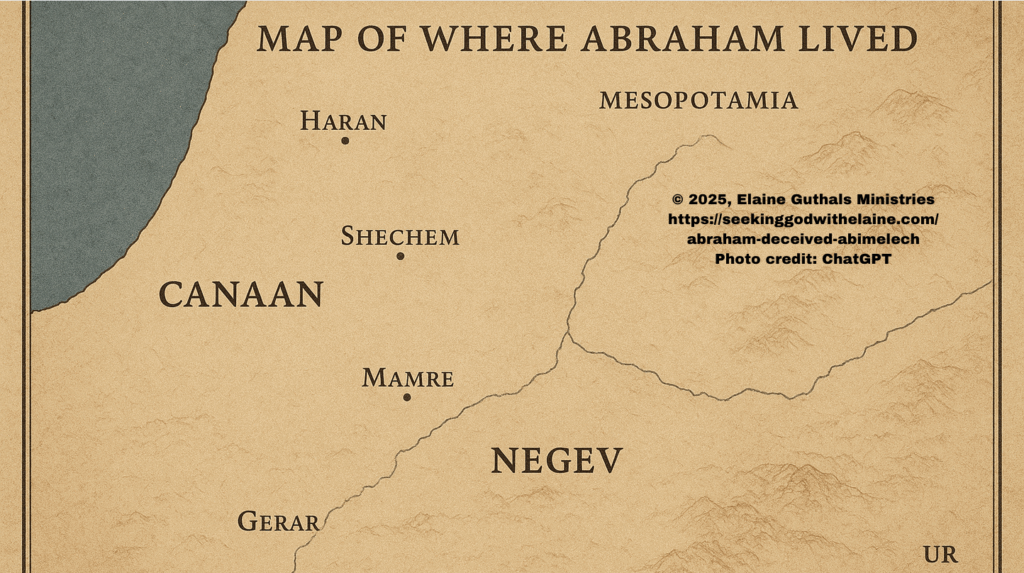
    God’s Word does not tell us why Abraham moved again. We have to remember that Abraham was a shepherd. In other words, he was a nomad.

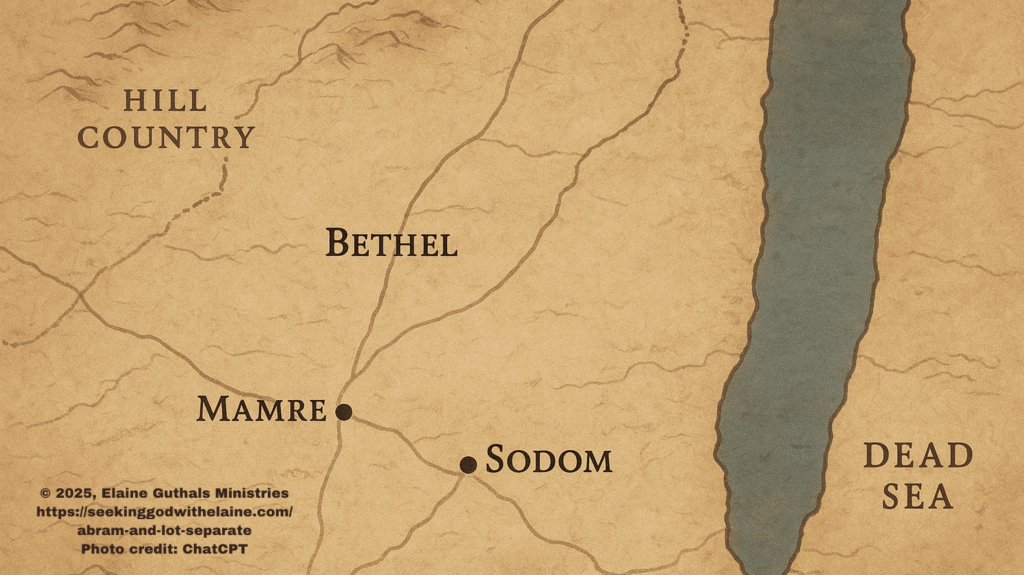
    More than likely, at Mamre, Abraham had used up its resources. He had to move on to find grazing lands and water for his flocks and herds.

    Was it a famine as it was when Abraham and Sarah moved to Egypt? Maybe it was a famine that wasn’t as severe as the earlier one.

    When Abraham went to Egypt, we weren’t told that God moved him. We aren’t told that He initiated this move, either.

    We don’t know that for sure. Again, Moses didn’t reference God here.

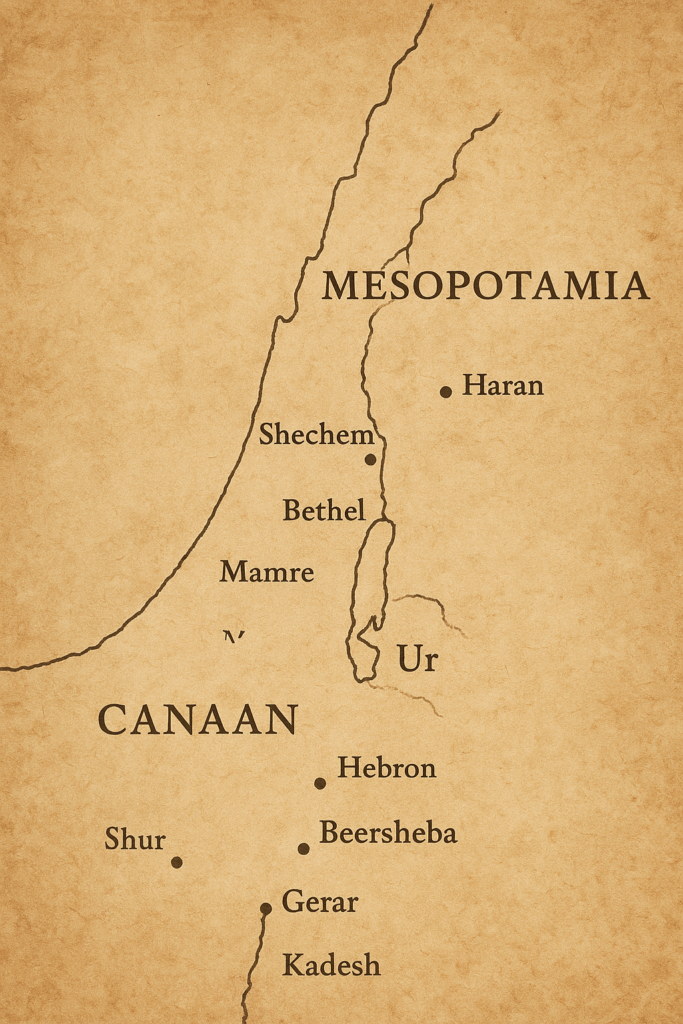
    Gerar was in the land that – in the future – would be the land of Philistia, aka the Gaza Strip. Yes, the Philistines are the modern-day Palestinians – the Greek translation of Philistine.

    Gerar was on the eastern border.
    She Is My Sister

    Abraham didn’t learn the first time in claiming Sarah was his sister. He did it again. He said that Sarah was his sister, not his wife.

    Isn’t it easy to forget about what went wrong when it ended up okay? I mean, it had been 24 years since the last deception. Memories fade.

    Doesn’t that also show us that, when we think we have learned from one temptation, it will probably come up again to make sure we have learned it?

    But since Abraham had been tempted once – and caved – and was being tempted again and caved, wouldn’t that make this sin worse in our way of thinking?

    Abraham was more concerned about his life in the lawless region – again – than his wife’s safety.

    Does Jehovah allow us to throw out His laws and commandments just because we live in the world? A big emphatic NO!

    The opposite is true. Jehovah doesn’t want us to compromise His laws and commandments, let alone throw them out altogether. He wants us to be the example in a lawless society.

    I think many disciples have done compromised today. We want to be very careful doing that. When we find we have, we need to repent and turn from those actions and thoughts.

    King Abimelech

    Abimelech wasn’t only a name. It was also a title that meant my father is king. So, we don’t know if this Abimelech was king or prince. I think the way we should look at it is that this Abimelech’s father the king died making him, the prince, king.

    Sarah was taken again. Yep, a 90-year-old woman was taken for her beauty.

    Since the visit was mostly peaceful, it wasn’t the kidnapping the Egypt situation may have been.

    But if – going into this – knowing it was all about an alliance – a marriage – was Abraham going to give up his wife????

    Didn’t Abraham think about his covenant with Jehovah (Gen. 18: 10 NLT)?

    Jehovah Came to Abimelech

    Once again Jehovah came to deal with the situation. Abraham appears to have been okay with it going on. God wasn’t.

    Abraham had agreed to put his faith and trust in God. He was to rely on Jehovah’s provision. That went out the window again.

    It may be interesting to some that Jehovah came to Abimelech. He came to a Gentile.

    What? Do we think Jehovah only comes to His children?

    In Elaine-speak, God will use believers and non—believers to further His plan.

    Since Abimelech was a Gentile, we may question how he knew it was Jehovah.

    I don’t think we are going to know. It has to go in our UNR book – understanding not required.

    Jehovah came out playing hardball. Abimelech was a dead man because of what he had done.

    I’m sorry. I’m tripping over Abimelech taking a pregnant woman for an alliance. If she was showing – as much as children, especially sons, were valued – I don’t see him taking someone else’s son if this was a peaceful alliance.

    Abimelech Defends Himself

    We can see Abimelech’s outrage. He was just acting on the information he had been given. There was no way he would know if it was truth or a lie.

    Isn’t that how we comfort ourselves? We make the best decision we can with the information that we have at that time. What else can we do?

    Besides, Abimelech hadn’t slept with Sarah yet.

    It doesn’t seem that Abimelech had any trouble understanding what the dream meant.  A God was talking to Him, albeit one he didn’t know.

    But as a pagan, Abimelech may have believed that there were many gods. Some believed each region had their own gods. As Abraham was from a different region, Abimelech may have thought that this was Abraham’s God – which it was.

    Still, that would have been something foreign to Abimelech. Yes, they believed there were gods over regions, but they didn’t believe that those gods could function outside of those regions. To have one to come with Abraham all this way would have been unnormal.

    Whatever Abimelech thought, he knew he was talking to a god. He gave Jehovah the title Adonoi – Lord.

    God’s Response

    Jehovah acknowledged that Abimelech had not done nothing wrong – but only because He hadn’t allowed it.

    So, what Jehovah was saying was, if Abimelech would have bedded Sarah, he would have suffered the death penalty. Not knowing Sarah’s status wasn’t enough to commute the sentence.

    In this instance, Jehovah accepted Abimelech’s ignorance in the situation. That is not always the case.

    But the ball was in Abimelech’s court. If he would have pursued the path that led to bedding Sarah, he would have been put to death by Jehovah.

    It is interesting that God would call Abraham a prophet. We think of him as Patriarch, not a seer.

    God gave Abimelech the opportunity to do what was right.

    Even if Abimelech didn’t acknowledge God as Sovereign Lord, he listened to Him when he came to him in the dream. He did what God said – and immediately.

    Plus, Jehovah recognized his intentions. We can’t judge someone else’s relationship with Jehovah. We don’t know their hearts or intentions.

    Abimelech probably knew Jehovah meant business. If he didn’t immediately return Sarah to Abraham, He would make good His word and make Abimelech a dead man.

    We have to give Abimelech his due. It quickly set up getting Sarah back.

    Called Out

    Abimelech didn’t mince words with Abraham. He said that people just don’t do this to others.

    Abraham was allowed to defend himself. The problem was that it showcased his doubt that God would protect them.

    The fact that Sarah really was Abraham’s sister caused him to believe he really wasn’t telling a lie. She was his sister, but it was a lie because she was his wife, also.

    But Abraham’s insecurities all stemmed from him believing Abimelech was a godless man. Instead of fearing for his life this time, Abraham said that he was afraid Abimelech didn’t reverence God.

    No amount of whining from Abraham was going to make it less a lie. He should have just left it at, “I lied.”

    Abraham blamed this on God (Gen. 20: 13 NLT). That isn’t a smart thing to do.

    The choice was Abraham’s. He could have chosen to tell the truth, but he chose to lie.

    Restitution

    Once again, Abraham was rewarded handsomely for lying. Abimelech gave him everything the Pharaoh gave him except donkeys and camels.

    Instead, Abimelech gave Abraham 1,000 pieces of silver. That wasn’t too shabby.

    Well, at least Abraham wasn’t kicked out of the country this time. He just got loot again – making him even more wealthy.

    But don’t we question when Jehovah rewards sinful behavior? We question why Abraham should have – again – increased his wealth for telling a lie.

    Another Intercessory Prayer

    God had Abraham intercede for Abimelech. What he was interceding for was for the ability of Abimelech’s wives and concubines to become pregnant.

    If the consequence was done in a night, it wouldn’t be much of a consequence. It had to be felt.

    God had Abraham pray for Abimelech for a couple of reasons. We build that faith by spending time with God in prayer. Even though Abraham was righteous, there was more work needed to be done in him.

    Abraham had to be gracious and truthful in praying for Abimelech. If he rebelled about what Jehovah would have him do, He wouldn’t answer the prayer.

    But remember. Jehovah called Abraham a prophet. This after calling him His friend.

    I wonder if part of the reason was because the last time Abraham tried to intercede – for Sodom and Gomorrah – it didn’t go so well.

    Remember, the 20 questions that Abraham asked Jehovah about finding the righteous in Sodom and Gomorrah. That was him interceding with Him.

    In reality, Abraham was interceding for Lot. That was accomplished. But his prayer was also for the whole cities of the plains. That didn’t succeed.

    But as he stood looking at the smoke across the plain (Gen. 19: 28), Abraham’s heart had to be breaking.

    Did Abraham think Jehovah hadn’t answered his prayer? Did He ignore his intercession?

    At that point, Abraham didn’t know Lot’s fate. He probably felt his intercessory prayers wouldn’t be answered.

    God wanted to prove differently to Abraham.

    A Visit from Abimelech

    Abraham and Abimelech’s relationship had been built on shaky ground.

    It has been a minute since we discussed Abraham and Abimelech. Their relationship didn’t start off on a good note. Abraham lied to Abimelech.

    Abraham had moved to Gerar, probably in search of pastureland. Abimelech, probably a Philistine, was the king of Gerar.

    Abraham was more concerned about his life in the lawless region – again – than his wife’s safety. He tried to pass Sarah off as his sister.

    Just as the Pharaoh had done in Egypt, Abimelech “… brought [Sarah] to him at his palace” (Gen. 20: 2 NLT). He may have done this in order to form an alliance through marriage with Abraham.

    Whatever the reason for Abimelech taking Sarah, Jehovah intervened. He came to Abimelech in a dream.

    This had to have occurred sometime between the destruction of Sodom and Gomorrah in 1861 BC and the birth of Isaac in 1860 BC. Abraham was living in Mamre when Sodom and Gomorrah was destroyed.

    At the time of this story, it was at least 1858. According to its placement — which may or may not be chronological, it was after Isaac was weaned.

    Abimelech didn’t come alone. He brought his army commander, Phicol. This was probably due to the perilousness of the journey. If Abimelech thought he would need military support when talking to Abraham, I think Phicol would have been mentioned more than just at the arrival and departure.

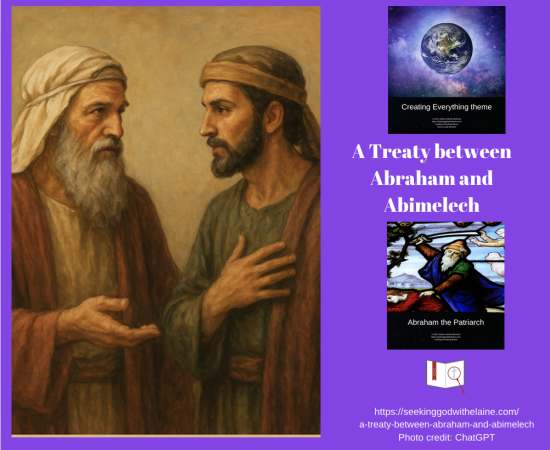
    A Treaty with Abimelech

    Since a good relationship wasn’t really established, Abimelech wanted to establish a treaty with Abraham.

    I doubt Abimelech knew of Jehovah’s blessing. “I will bless those who bless you and curse those who treat you with contempt. All the families on earth will be blessed through you” (Gen. 12: 3 NLT).

    What Abimelech did know was that Abraham’s success came from Jehovah.

    We talked about Sarah may or may not have been pregnant when the fiasco happened with Abimelech. Either way, Abimelech would have acknowledged the miracle needed for this old couple to have conceived a child.

    But Abimelech’s view would also be a worldview. Don’t we like to have successful, influential friends?

    It may have been that — after they got Abraham’s deception straightened out — Abimelech saw Abraham as he really was. He would have seen a goodness in Abraham.

    Still, Abimelech prefaced the treaty with one condition — don’t deceive me or mine again. He was telling Abraham that for however long it had been since Abraham had been living in the country as a foreigner, he had been loyal to him despite the initial deception.

    Abimelech was wanting a little reassurance that that loyalty would not be returned with more deception n the future.

    Abraham’s answer was immediate. “Yes, let’s make a treaty.”

    Remember, Abraham’s reason for the deception was that he thought the land was lawless. He would have been told, I am sure, that Jehovah came to speak to Abimelech.

    Working Out a Problem

    This is the first time we are told that Abraham dug wells. It is logical that he would. He needed water for his flocks.

    This will be confirmed when we get to Genesis 26. “So the Philistines filled up all of Isaac’s wells with dirt. These were the wells that had been dug by the servants of his father, Abraham” (Gen. 26: 15 NLT).

    When I googled it, it said these wells were a source of water for his family, servants, and livestock.

    So, go back to Hagar and Ishmael. When Abraham told them they had to leave, they would probably have been traveling from well to well. If Abraham built them for family use, and not just livestock use, they would have been depending on these wells.

    If the wells had been commandeered by the pre-Philistines, they may not have let travelers use them. That is especially true for travelers association with the man who dug them in the first place and from whom they commandeered them.

    creating-everything-theme

    To read devotions in the Creating Everything theme, click the button below.

    Devotions in the Abraham the Patriarch series

  • Abraham the Patriarch Newsletter #2

    abraham-the-patriarch-newsleter-2

    The Covenant between Jehovah and Abraham

    Jehovah entered into a covenant with Abram.

    • Covenant established (Gen. 12: 1-3)
    • Blessings of the covenant (Gen. 12: 7; Gen.13: 14-17)
    • Sign of the covenant (Gen. 15: 1-21)
    • Acceptance of the responsibilities of the covenant (Gen. 17: 1-27)Promise of the covenant (Gen. 18: 9-15).

    Five promises were given during Abraham’s original call.

    • I will make you a nation (Gen. 12: 2).
    • I will bless you (Gen. 12: 2).
    • I will make your name great (Gen. 12: 2).
    • I will bless those who bless you, curse those who curse you (Gen. 12: 3).
    • All will be blessed through you (Gen. 12: 3).

    We have to look at the Hebrew here because something is lost in translation. “On that day Hashem cut a brit (covenant) with Avram, saying, Unto thy zera have I given ha’aretz hazot, from the Wadi of Mitzrayim unto the great river, the river Euphrates:” (Gen. 15: 18 OJB emphasis added).

    The Hebrew word for cut is karat. What did Abram do to most of the animals that were sacrificed in Genesis 15: 10? He cut them in half. That allowed the parties to pass through them, showing agreement and acceptance of the covenant.

    But it is more than that. If the covenant was broken – one party did not do what was required – the other party could cut him in two!

    So, God cut a covenant with Abram.

    The covenant was kept for many years. Then, Israel broke it – and was cut into two nations.

    There are three ways God says that the covenant with be eternal.

    • generation to generation (Gen. 17: 7)
    • everlasting covenant (Gen. 17: 7)
    • possession forever (Gen. 17: 8)

    We don’t want to miss this. God made one man – Adam – and, through his family, created all humankind. God made one man – Noah – and, through his family, saved humankind from distinction. God made one man – David – and, through him, really made Israel into a nation. God made one man – Jesus – and, through His sacrifice, saved all humankind from our sins when we accept Him as our Savior.

    Don’t think one person doesn’t have influence.

    Promise of a Son  

    The promise was fulfilled with the birth of Isaac.

    Sovereign God knew that Abram was right in Genesis 15 – all the promised blessings hinged on him having a son.

    Abram struggled with the promise of descendants. Giving Abram the land meant nothing if he didn’t have descendants.

    Oh yeah. This was probably building up for a while. Ten years is a long time to wait.

    No, we don’t know why God asked Abram to wait for a son. God had his reasons. Maybe Abram knew them. Maybe he didn’t.

    We aren’t always told why. We are told to obey anyway. Abram did.

    Abram wasn’t doubting. He was just impatient.

    Abram only wanted to know. It wasn’t that he didn’t believe. He only needed a little reassurance.

    Jehovah was looking into the future when He came to Abram to repeat the promise of the covenant (Gen. 15: 2-3). Abram was looking into the future, too, but he wasn’t seeing what God was seeing. He didn’t see how he was going to get there.

    What Abram was seeing was that he was old and Sarai was old. That left a servant for his heir – not exactly what God was promising.

    Abram wasn’t just saying, “I don’t have a son.” He was saying, “I can’t take my eyes off of today’s problems, so they are blocking the view of tomorrow.”

    The thing is we have to watch how we approach Sovereign God. We don’t want to whine. We definitely don’t want to doubt.

    Jehovah answered Abram’s whine. He said, “Have faith. You are going to have a son.”

    We need to remember that we can be rock solid when we are standing on God’s promises. If He has promised it, He will see it through to completion.

    Notice, God wasn’t slapping Abram down for questioning. He wasn’t upset at Abram because he was going through a hard time.

    Just the opposite. “I am your shied and your reward because you belong to Me. You are mine.”

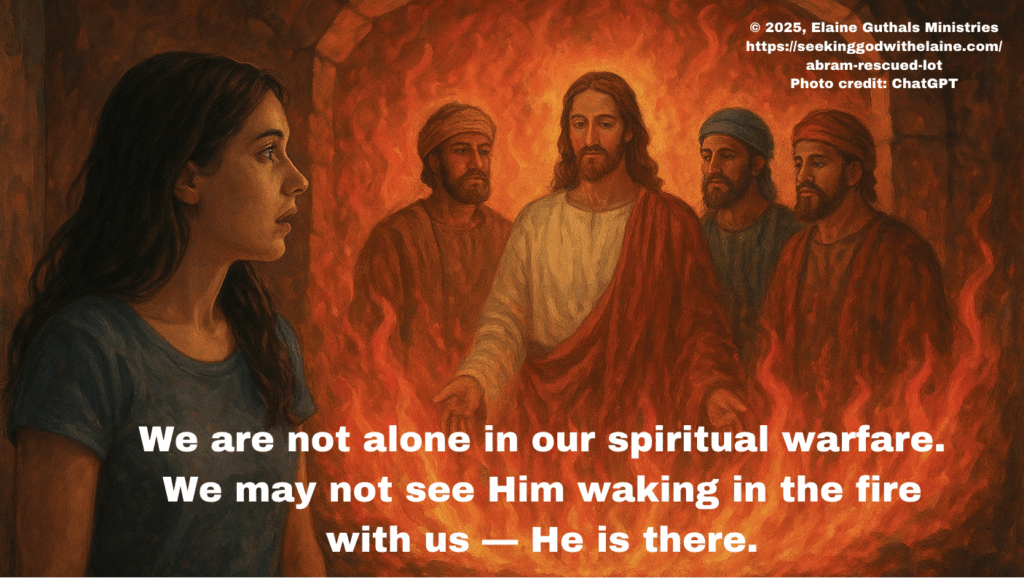
    It doesn’t matter if our trials come through nature or Satan himself – even if we bring them on ourselves – Jehovah is right there with us.

    Genesis 17 was the first time Sarah is directly included in the covenant. When God and Abraham had talked covenant dealings before, Abraham hadn’t really talked about Sarah’s part of it. There is no talk of who would be the mother of the descendants.

    Sarai not only got a name change, but she also got the promise of a son. Sarai means princess. Sarah means mother of nations.

    Moses really didn’t say anything about Sarah’s faith. She had to believe in the promise as much as Abraham did, or I doubt the couple would have been chosen. But we do see her arrogance in the way she treated Hagar.

    Abraham and Sarah both laughed (Gen. 17: 17; 18: 11-12). They were both old, way past the childbearing years.

    God is the God of the impossible (Lk. 1: 37). We can’t limit Him by our human limitations. We have to let Him work in our lives.

    The laughter in Genesis 17 was just the outward expression of Abraham’s lack of faith that he and Sarah would have a child. That is the main reason he offered Ishmael as the covenant son.

    Since Abraham didn’t believe deep down to his core that God was the God of the impossible, he offered the son he had.

    We can’t lose track of the fact that, the last time God and Abraham had a covenant discussion, Abraham was 85 years old. Now, he was 99. In his estimation, time wasn’t only a-wasting, but it was already gone.

    The other reason Ishmael was offered as a substitute was that, regardless of Abraham’s relationship with Hagar — slave, concubine, or wife — he probably saw Ishmael as his firstborn. It was common practice in the culture that the firstborn was the one to inherit. Plus, we know that Abraham probably loved him (Gen. 21: 11).

    In that culture, children whose mother was a slave was also a slave. Isaac was born free — his mother wasn’t a slave. Ishmael was a slave because his mother was a slave.

    Abraham could have been praying that God not take out his and Sarah’s unbelief on Ishmael. He may have thought that God would end Ishmael’s life when Isaac was born. At a minimum, he may have thought Ishmael would be banished as Cain was.

    Abraham may have been praying for Ishmael’s spiritual condition. At the core, he knew that walking with God was how we needed to live. He was asking that Ishmael walk as God had told Abraham to: “… Walk in my presence and be pure-hearted” (Gen. 17: 1 CJB).

    Abraham wanted Ishmael to have a relationship with God. He not only wanted Ishmael to be living and breathing but also obediently walk with God and worshiping Him.

    But God’s refusal to choose Ishmael most assuredly stemmed from one fact. That fact was Isaac was the chosen son.

    God assured Abraham that Ishmael — even though he was rejected — would be blessed.

    Now it was time — when Abraham was 100 and Sarah was 90 — to fulfill that promise. The promise had taken a quarter of a century or more to be fulfilled.

    The covenant son wasn’t just any son — like Ishmael Abraham’s son through Hagar. It was Sarah’s son (Gen. 18: 10 NLT).

    Isaac was born only through the grace of God in a distinctive action. Without God giving Abraham and Sarah this child as promised, he would not have been born. This is like Jesus.

    Isaac was born within the bounds of matrimony. God is all about working through families.

    The bottom line was God’s covenant was through Isaac, a type of Christ.

    Descendants

    It wasn’t just one son Abraham was being promised. He was being promised many sons (Gen. 17: 7 NLT).

    Think about it. Here was this possibly despondent man in Genesis 15. It definitely sounds like he was frustrated.

    God told him, “You may not hear pitter patter of little feet right now, but eventually you are going to have as many descendants as there are stars in the sky.”

    Sovereign God’s talking to Abram had the intended effect. “And Abram believed the Lord, and the Lord counted him as righteous because of his faith” (Gen. 15: 8 NLT).

    The thing is we all need to have a faith like Abram’s. That is the way in which we will be blessed through the covenant.

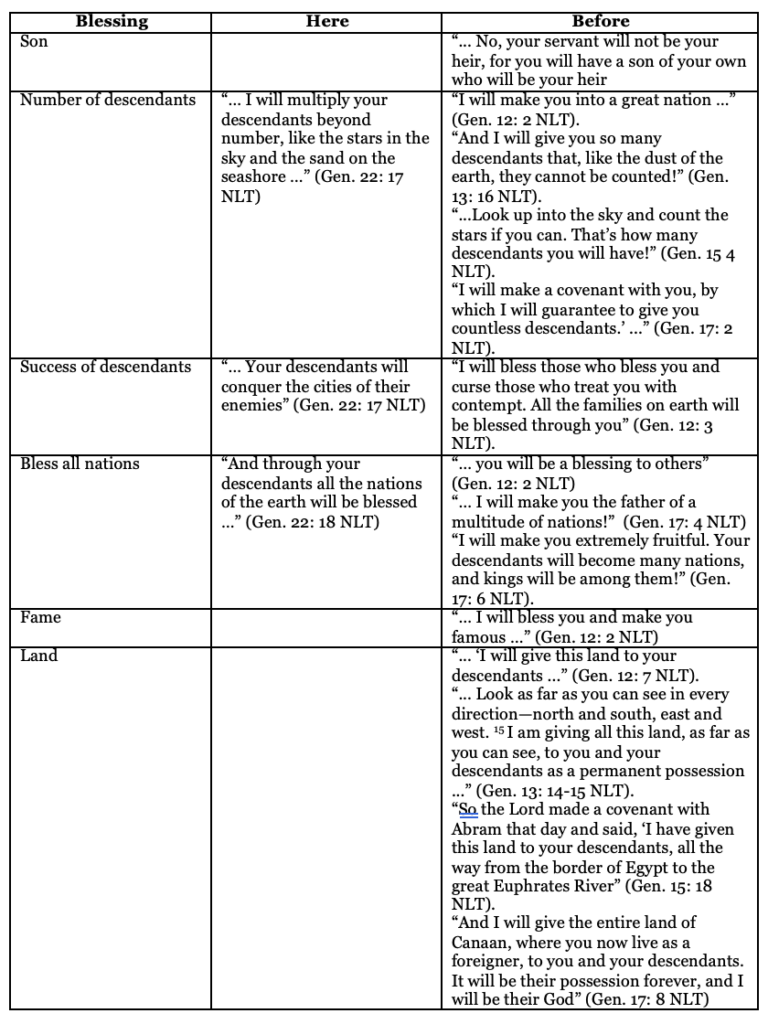
    Look at all the “I will” combinations in this passage.

    • “I will make a covenant with you, by which I will guarantee to give you countless descendants” (Gen. 17: 2 NLT).
    • “This is my covenant with you: I will make you the father of a multitude of nations!” (Gen. 17: 4 NLT).
    • “I will make you extremely fruitful. Your descendants will become many nations, and kings will be among them! I will confirm my covenant with you and your descendants after you, from generation to generation. This is the everlasting covenant: I will always be your God and the God of your descendants after you. And I will give the entire land of Canaan, where you now live as a foreigner, to you and your descendants …” (Gen. 17: 6-8 NLT).

    Seven “I will” statements in eight verses. God was committed to this covenant. We know He followed through on His part!

    We also need to react to Jehovah as Abram did. We need to fall on our faces before God. Yeah, this may mean literally down on the ground. It definitely means figuratively.

    Abram believed that, through his descendants, humans would be reconciled to God. He may not have known that Jesus was the One to do it, but he knew the Messiah would be His descendant.

    This covenant was for Abraham and his descendants. (Yeah, we get that with it being an everlasting covenant.) But does that mean they have no choice in the matter?

    Abraham’s children still had free will. They had to choose to serve God.

    A Great Nation

    Sovereign God really didn’t elaborate in Genesis 12 on make a nation as Abram having kids — or specifically kid singular. But Abram was saying in Genesis 15: 4, “What good would any other blessing be if I don’t have a son?”

    Jehovah would make of Abraham a great nation. To me, this goes back a couple of chapters. “… This is now etzem (bone, essence, self, substance) of my etzem, and basar (flesh, meat) of my basar …” (Gen. 2: 23 OJB).

    Otherwise, who’s to say that can’t be interpreted as Abraham defeating a king and becoming ruler of an established nation — which is not what Jehovah had in mind.

    Right from the get-go, God told Abram that He was not only calling Abram but also calling his descendants. He was going to be the father of many.

    Abram was going to be blessed by his descendants forming a nation as well as blessing others.

    Abram’s name change showed the changes that would be coming in his life. Both Abram and Abraham showcase aspects of fatherhood.

    ·      Abram means exalted father.
    ·      Abraham means father of many nations.

    Abraham would also be the father of many faiths. We also know that he is the patriarch of Judaism, Christianity, and Islam. That would probably make the name change based on a change of character, also. Abraham would now be the father of the faithful, also.

    It is interesting what Genesis 17: 4 says in the Orthodox Jewish Bible. “As for Me, hinei, My brit (covenant) is with thee, and thou shalt be an Av [father, forefather] of many Goyim [see 18:18] [Gentiles]” (Gen. 17: 4 OJB).

    The translation for the word hinei delivered a much deeper commitment — a total commitment — to fulfilling this covenant.

    Maybe I am just being picky, but it seems like the New Living Translation has rewritten verse 5 “…. I will make you the father of a multitude of nations!” (Gen. 17: 5 NLT).

    Look what the Hebrew says. “… Av hamon Goyim (Father of a multitude of Goyim) have I made thee. [T.N. Ga 3:29 says “And if you belong to Moshiach [Messiah] (YESHAYAH 53:10), then you are of the ZERAH [shining, brightness, dawning] of Avraham Avinu, [our father] you are yoreshim (heirs) according to the havtachah (promise).]” (Gen. 17: 5 OJB).

    It doesn’t necessarily say nations. It says a multitude of Gentiles.

    Blessing to Others

    God had an ideal in view when He made the choice of Israel to be His peculiar people.

    One promise was to bless everyone through Abram. Yes, he was going to have enough descendants to become a nation. But even people not his descendants were going to be blessed – even Ham’s descendants including Nimrod.

    We just have to grab hold of that blessing (Jer. 17: 7 NLT). The opposite is to be cursed (Jer. 17: 5 NLT).

    It has nothing to do with our moral characteristics – being a good person. Salvation is based only on our relationship with God. We have to be a good, not evil, person before we can do good for others – spiritual or physical.

    The Jews, though, thought salvation came through Abraham. Jesus said, “Wrong. It comes through Me.”

    Jehovah blessed Abraham, and He blesses us in the same way.

    Jehovah comes to us. He doesn’t force Himself on us. We have to be obedient, like Abram, and listen to His call.

    We use Genesis 12: 3 to say that those who bless Israel will be blessed, and those who curse Israel will be cursed. I think the bless those that bless you part is talking about Jesus. God has already talked about the Messiah (Gen. 3: 15). He is going to take care of our spiritual condition before a physical condition.

    The most important thing Abram gained was that his descendant – Jesus – became the Savior for all, not just the Hebrews/Israelites/Jews. That is what everyone from Adam on own needed/needs.

    Land

    When Abram left Haran, he wasn’t promised land of his own. Genesis 12: 7 was the first time the promise of land was involved. Jehovah gave the land of Canaan to Abraham as a permanent possession.

    Once Lot moved, Sovereign God came to Abram. He had a special reason for coming. He clarified what land He was giving to Abram and his descendants.

    God gave Abraham the land “… as far as you can see in every direction — north and south, east and west” (Gen. 13: 14 NLT). That is a lot of land.

    Why would God tell Abram to look in all directions?

    Bethel was in the land that – in the future – would be given to the tribe of Benjamin. That was considered the middle of the Promised Land.

    So, yes, Abram could see all of the Promised Land from where he was standing.

    God knew that the only land Abram was going to own in his lifetime was where he was going to be buried. But He had something bigger in mind.

    God knew that, even though Abram would have a dysfunctional family, he was a family man. So, He made sure he saw the land that would be given to his descendants. “It’s not yours, but look at it.”

    This road trip in Genesis 13 would have made it more tangible for Abram. He could see the land on which he was walking.

    But think about it. Abram could only see that day. God could see hundreds of years into the future.

    Sovereign God was confirming the covenant He made with Abram. God promised the land of Canaan to Abram four times (Gen. 12: 7: 13: 15; 15: 7; and 17: 8).

    We like to say the third time is the charm. God went even one more.

    Protection and Reward

    In the sign of the covenant with Abram, Jehovah promised him to protect and reward/fulfill his desires.

    For 10 years, Abram has been walking with God, following His commandments. Sometimes, he did a good job. Sometimes, he didn’t.

    Before, God promised blessings. What God had offered Abram in Genesis 15 was Himself.

    God never gave up on Abram. He knew Abram would become Abraham, the father of Israel.

    On this day, when Jehovah came to Abram, He told him not to fear. What did Abram have to fear?

    • Famine, which had occurred and may again (Gen. 13)
    • War, which already had occurred once and probably would again (Gen. 14).
    • Persecution, considering he was surrounded by idol worshipers.
    • Pain, because it is customary to humans.

    Abram already knew God would protect Him. He showed him that in Egypt (Gen. 13).

    God came with assurance.

    God said, “I am thy shield and reward” (Gen. 15: 1 OJB). Not that “… your reward will be great” (Gen. 15: 1 NLT).

    It isn’t that we will live eternally in Heaven. It is that we will live eternally with God.

    If you can’t stand to live with God now, you aren’t going to Heaven. If you can’t stand to do His laws and commandments by His interpretation, you aren’t going to Heaven.

    Because God Himself is our reward, we have a surety of Him being our shield. He will keep us safe. King said He would defend us by his providence and grace.

    God is our portion means He is the definitive source of our happiness, fulfillment, and inheritance. In all things, we can be content in Him.

    Our joy and happiness — in fact, life current and eternal — is only through Him.

    The Mark of the Covenant

    God’s making a covenant with Abraham was a sure thing, but Abraham had responsibilities that he had to perform. His part was simple.

    • Walk in God’s presence (Gen. 17: 2)
    • Be pure-hearted (Gen. 17: 2)
    • Practice circumcision (Gen. 17: 10)

    Bottom line is we have to be obedient to what God says.

    It is easy to think that circumcisions began with Abraham, that this was a new and singular practice of the Hebrews/Israelites/Jews. Wrong. The practice was practiced throughout other people groups.

    Circumcision was required of all males in Israel. This included those who were born as slaves into the household or bought into it. No, God didn’t make it about a tight knit group.

    God knew having worldview people around would lead us to drawing away from Him. He didn’t want to put us in that predicament.

    True, babies don’t have a choice, but their parents do. Yeah, circumcision was required but again, humans have free will.

    Anyone who was not circumcised was cut off (Gen. 17: 14 NLT). Remember, God is in the business of separating and dividing. He wants His children to have obvious differences from those around them.

    There is another aspect to this. God works through families. This practice was to be handed down through the generations.

    We can’t think the act of circumcision was just about the physical act, even though the stone knife used certainly made it that. We need to know the spiritual meaning of it. By this act, others would know they were God’s people as they were dedicated to God.

    We have to remember that blood is shed in this practice. That made it a personal covenant.

    We know that only through the blood are our sins forgiven. Some may say that Yeshua did away with the circumcision requirement. Oh, no.

    Abraham was prompt in getting himself, Ishmael, and all other makes in his household circumcised. He didn’t put it off (Gen. 17: 23).

    Think about it. Abraham was diligent and circumcised Ishmael even though he knew Ishmael would not be a Hebrew. Maybe he was keeping him as a spare just in case. Maybe he thought God would change His mind.

    Look at it this way. Ishmael was not the chosen son, but he was allowed into the covenant process. He could have chosen to follow God.

    Ishmael chose not to follow God.

    This wasn’t just a works-based faith. Yes, the circumcision was outward, but it had to be fostered by an inward faith.

    No, Abraham didn’t say that he was old, so he wasn’t going to change the way he worshiped God. He didn’t shy away from the pain and blood.

    Abraham circumcised his heart.

    In accordance with the covenant, Abraham had Isaac circumcised on the eighth day after his birth.

    Though circumcision did not originate with the Hebrews, it was the sign of the covenant with Abraham (Gen. 17: 9-14). Yet where those were probably a medical procedure to prevent incurable diseases and disorders, this was an act of acceptance of the covenant.

    Circumcision was required of all males in Israel. This included those who were born as slaves into the household or bought into it. Circumcision was required, but humans have free will to chose to do it or not. The consequences of choosing not to be circumcised was being cut off from Jehovah.

    Just as he was obedient when the sign was given, Abraham was obedient when his covenant son was born.

    creating-everything-theme

    To read devotions in the Creating Everything theme, click the button below.

    Devotions in the Abraham the Patriarch series
  • Abraham the Patriarch Newsletter #1

    abraham-the-patriarch-newsletter-1

    Abraham and His Family

    1960 BC — Abram was born (Gen. 25: 7)
    1950 BC – Sarai was born (Gen. 17: 17)   
    1890 BC — Terah, Abram, Sarai, and Lot moved from Ur to Haran (Gen. 11: 31)
    1885 BC — Abram called at age 75 (Gen. 12: 1-3)
    c. 1880 – 1875 BC — Abram defeated King Chedorkiamer to rescue Lot (Gen. 14)
    1875 BC — God promised an 85-year-old Abram that he will have a son (Gen. 15)
    1874 BC — Ishmael was born (Gen. 16: 15)
    1861 BC — God reestablished His covenant with Abram; and Abraham, Ishmael, and males were circumcised (Gen. 17)
    1861 BC — Sodom and Gomorrah were destroyed one year before the birth of Isaac (Gen. 18 – 19)
    c. 1861-1860 BC – Abraham and Sara move to Gerar, and Abraham deceives Abimelech
    1860 BC — Isaac was born (Gen. 21: 2)
    c. 1858 BC — Isaac was weaned (Gen. 21: 8)
    c. 1845 – 1830 BC — God tested Abraham, at the age of 115- 130, by commanding he sacrifice his only son Isaac (Gen. 22)
    1823 BC – Sarah died (Gen. 23: 1)
    c. 1823–1820 BC – Abraham sends Eliezer to Paddan-Aram to find a wife for Isaac (Gen. 24)
    1820 BC – Isaac, at age 40, marries Rebekah (Gen. 25: 20)
    1785 BC — Abraham died at the age of 175 (Gen. 25: 7 – 8)

    Based on Timeline from

    Terah’s Descendants

    We are told that Terah lived in Ur of the Chaldeans, possibly from the plain of Shinar where they tried to construct the Tower of Babel. We know he and his sons worshiped false gods (Josh. 24: 2-4 NLT). In fact, Terah may have sold idols, sometimes enlisting Abram as a salesman.

    Terah was the one who chose to move to Canaan. However, he never went farther than Haran.

    It is believed Nahor was the oldest, and Abraham was the youngest. Once again, God called the son who was not the firstborn in the family.

    Think about it. Terah was the father of Abraham, Sarah, Nahor, and Haran. Since Milcah was Haran’s daughter, Nahor kept it in the family also. They did this for continuation of the family line and inheritance purposes.

    Way back in Genesis 12, we talked about whether Terah or Abraham was called. If Terah was not, he was still picked to have the chosen family to descend from him.

    Haran and Lot

    Terah’s middle son Haran, though his wife was not listed, had a son named Lot, who will figure greatly into the Genesis narrative. Haran also had two daughters, Milcah and Iscah (Gen. 11: 29).

    Unfortunately, Haran died before the family left Ur.

    Some think Mrs. Lot came with them from Ur. However, we aren’t told that for sure.

    Nahor and Milcah

    Nahor married his brother Haran’s daughter Milcah. They raised a large family.

    The most important to Abraham’s future was Bethuel. Bethuel would become the father of Rebecca, Isaac’s future wife, and Laban, Jacob’s father-in-law.

    Abraham and His Wives

    Abraham died at the age of 175.

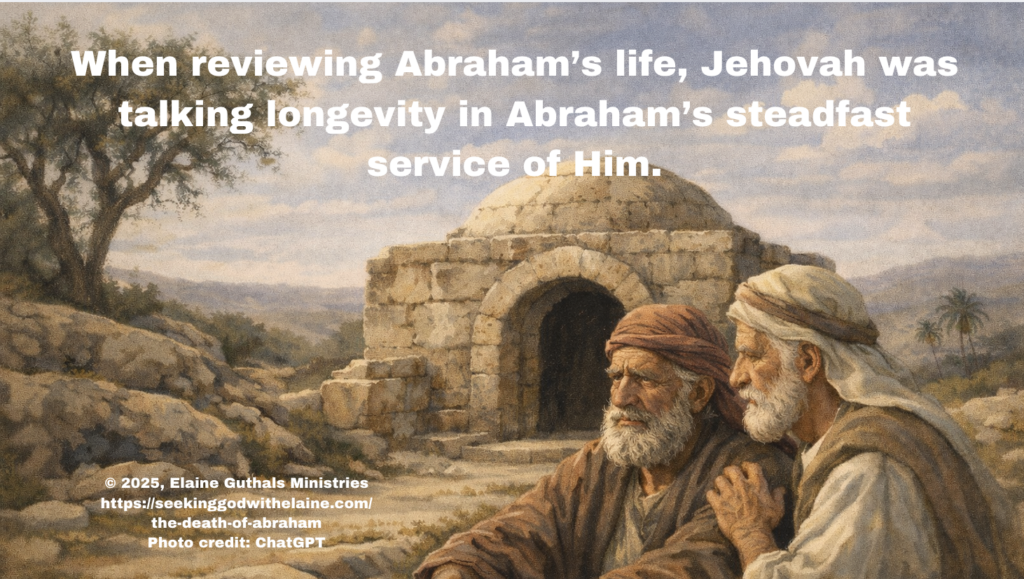
    The wording of Genesis 25: 8 indicated that Abraham had a good life. They didn’t have any concept of eternity, so living a long life was what was prized.

    Abraham’s death happened as it was foretold by Sovereign God as peaceful (Gen. 15: 15).

    Abraham was being gathered to his people. More importantly, he was being gathered to his Heavenly Father.

    Gathered to his people means more than Abraham was buried in the cave alongside Sarah. It meant that Abraham would be reunited with his ancestors who had died before him — Terah, Shem, Noah, and Seth.

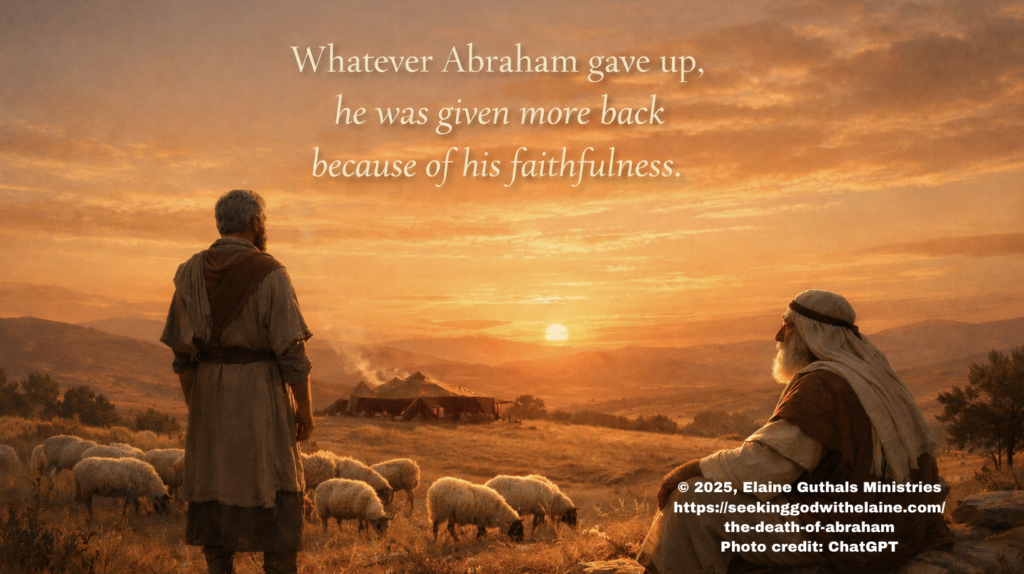
    Whatever Abraham gave up, he was given more back because of his faithfulness.

    Abraham had three wives. Concubines (pilegesh) – while they were generally servants – were secondary wives, typically chosen to bear children when the primary wife was barren.

    Women who had the legal status of concubines, though, did not have the full privileges of the primary wife. But they were treated well and held in high regard.

    There would have been no betrothal, no marriage ceremony. There would have just been a statement.

    Abram and Sarai

    Because of his faith, Abraham became the first Hebrew patriarch. That is why he is called “father of the Jews.”

    But with Sarai barren, Abram wasn’t becoming the father of anything.

    It was very important for women to bear children in those days. The woman’s job was to reproduce and build the family.

    Sarah’s barrenness would have been difficult for Abraham because it was his legacy. It would have been an embarrassment to Sarah because she wasn’t fulfilling her purpose.

    When Sarah took matters into her own hands to get a son through Hagar, Abraham and Sarah were looking at the promise from their perspective. They thought they needed to understand before it could happen. They were wrong on both counts.

    Added to that, they were unwilling to wait on Jehovah for His time.

    Sarah devised a plan to hurry Jehovah along in His promise of a child and then didn’t like how it turned out. She could be seen as being mean to Hagar and Ishmael — even though they brought some of that upon themselves.

    The thing is, Abraham loved her. Yeah, Abraham did try to pass Sarah off as just his sister – which she was. They had a long, full life together; and in the end, Abraham mourned for Sarah.

    Sarah was Abraham’s last link to Ur. She wasn’t just his wife; she was the last family member (sister) — person altogether — to have seen the complete transformation from idol worshiper to child of Jehovah.

    Her death may have thrown Abraham for a loop. Sarah was ten years younger than him. Yet she died first.

    If we go back to the Hebrew, it says something interesting. Genesis 23: 1 talks about two lives. What does two lives mean? There are a couple of ways this is interpreted.

    The first way is that Sarah had a full significant life. In other words, it was a she-had-a-good-life statement.

    The other way to interpret it is that there were two distinct phases in Sarah’s life. It is easy to see the dividing line.

    She was born Sarai and lived most of her life as that person. In fact, she lived 89 years under this name. She went from a child to an adult, from being single to being a wife.

    The second phase, she became Sarah — a mother with a spiritual transformation. She was a princess who became princess, mother of nations.

    But this is something Jehovah’s children would understand (II Cor. 5: 17 NLT). We call it changing from a physical life to eternal life.

    Sarah lived 127 years. She was 65 when Abraham received the call to go to Canaan. She stayed with him up until now.

    This had to have been one of the biggest separations Jehovah required of Abraham.

    Abraham had already experienced the death of a loved one – father and brother. But this was Abraham’s mate – the mother of the covenant son.

    Abram and Hagar

    If Abram had been in Canaan ten years (Gen. 16: 3), Chapter 16 had to happen fairly soon after the events of Genesis 15.

    Sarai and Abraham were going to have a baby — together. It was a promise from the Sovereign God.

    But seriously! They were 85 and 75 respectively. It was impossible, right?

    We can see that Sarai was all in on the plan of her having a child. It probably was natural instinct to do all in her power to get the baby she had probably wanted for years.

    Sarai couldn’t see how God was going to keep His promise that she would have a biological son.

    The problem was that her desire for a child overshadowed the fact that it was going to be God Who gave it to her. She probably had a little fear in the back of her mind as as to whether or not God could do as He promised.

    So, she took matters into her own hands.

    Sarai had a slave (shifchah [female slave of the lowers rank]) named Hagar. She performed menial duties.

    Hagar was Egyptian. She probably became Sarai’s servant when they were in Egypt (Gen. 12: 14-16).

    Jewish tradition — Midrash — believes that Hagar was Pharaoh’s daughter. Instead of allowing her to be a princess in her own country, her father gave her to Abraham in the great payoff (Gen. 12: 16), thinking she would be better off there — even if it was as a slave.

    A slave in that culture could be used as a surrogate mother, but that isn’t what Jehovah wanted. He is One to keep clean blood lines.

    In the Hebrew in Genesis 16: 2, Hagar was given the title isha (wife), not philegesh (concubine) or a secondary wife with lower legal and social status.

    However, Hagar is always referred to as shifchah [female slave of the lowers rank] by Sarai, Abram, and Jehovah in Genesis 16: 5, 6, and 8, respectively.

    Sarai’s plan came to fruition – and it didn’t work out the way she wanted. After she became pregnant, Hagar held Sarai in contempt.

    Sarai blamed Abram, even though it had been her plan. Instead of taking responsibility for her actions, Sarai tried to shift the blame onto Abram.

    Because Sarai was probably mad on a couple of fronts, she mistreated Hagar. She was taking her frustration and hurt out on the person she put in the middle in the first place.

    It seems to me that Hagar thought she was better than her mistress. It probably stemmed from the fact that Hagar could provide what Sarai couldn’t – a child.

    I get it that Hagar may have thought she was going to get to be primary isha, not philegesh, but she was still a shifchah in everyone’s eyes but her own. She was asked to do one thing – which would have, in her mind, elevated her son to firstborn status and set him for life.

    Hagar must have been wandering how things worked out the way it did. But in a way, didn’t she bring it on herself?

    No, Hagar probably didn’t have any say in the matter about becoming Abram’s secondary wife. She did have a say about the contempt and disrespect she felt for Sarai.

    Hagar’s response was to run away. She jumped ship before the baby was born. She wasn’t going to put up with Sarai’s abuse.

    That wasn’t what God wanted, either.

    In the New Living Translation, it says God sent an angel to comfort her. If we go back to the Hebrew, the way I read it is it says God came Himself. Yes, Hagar was an Egyptian and, therefore, a Gentile. God still came to her to provide for and comfort her.

    God was gracious to her. No, He didn’t elevate her; but He didn’t start accusing her, either. God came to her with pity.

    Notice Hagar didn’t answer the angel’s second question. She either didn’t know where she was going or didn’t want to say. She may not have thought it was an option to return, even if the Holy Spirit was prompting her.

    God had plans for who Hagar’s baby would be. One of those plans was to be raised by Abram.

    God knew He wasn’t going to make Hagar’s son the firstborn even though he was born first. (God has a way of usually doing that.) That privilege was saved for Sarai’s firstborn.

    But that didn’t mean God left Hagar high and dry. He came to comfort her.

    God wanted Hagar to go back to her station and rank. We have to remember that Hagar was an escaped slave. As much as we may want to cheer for her freedom, she legally was in the wrong.

    Still, God came and found Hagar.

    God really didn’t cut Hagar any slack. Some would think she was entitled to a pass because of the harsh treatment of Sarai against her. Nope.

    It was Hagar’s duty to go back. Yes, that grates on our sensibilities in today’s society, but we cannot judge ancient society.

    We need to see what God says about it. He worked Hagar’s plan out just as He did Abram’s and Sarai’s.

    God laid out who Ishmael would become.

    Hagar, a Gentile, responded to Abram’s God. If she had known anything about Abram’s God, she would have known he had never seen Him. He was always up in Heaven.

    But here God was — on earth — talking to Hagar — a Gentile.

    Not only does God see us, but He also sees the real us. He knows our thoughts and motives. He knows what our actions will be before we do them.

    Most of all, God sees our response to Him. Are we His child or just one of His creation? Does our faith produce obedience and fruit, or do we even believe He is God?

    Because God came to Hagar and ministered to her in .her time of need, she obeyed Him and returned to Mamre.

    Once the covenant child was born, issues arose between him (Isaac) and Abraham’s firstborn son (Ishmael).

    At the celebration of Isaac being weaned, Ishmael and his mother Hagar made fun of Isaac. A 16-year-old was mocking and scoffing a 2- or 3-year-old?

    For 16 years — even if he knew about the covenant — Ishmael probably thought there was a chance that he would be Abraham’s heir as he would have qualified as heir without Isaac. We know Ishmael was much loved by Abraham.

    It was Sarah’s idea that Ishmael be born in the first place, but now she just wanted him to go away.

    After the covenant son was born, any standing Hagar gained in that plan would have gone down. A good-enough heir was no longer needed.

    Hagar was Sarah’s slave, not Abraham’s. Sarah was operating legally with regard to Hagar. But Abraham, as Ishmael’s father, had the final determination whether he would be allowed to go with Hagar.

    It was Jehovah’s direct command to Abraham that got Hagar and Ishmael cast out. In the end, Sarah was following God’s plan to banish them from the clam.

    Here, Jehovah did not want any confusion about who the covenant child was. This is especially true since, for 13 years, Ishmael would have been considered the firstborn.

    Isaac was a Hebrew. Ishmael wasn’t. It wasn’t about ancestry. Jacob was a Hebrew. Esau wasn’t.

    Abraham knew Ishmael wasn’t the covenant son. Jehovah made that clear. But Jehovah also made it clear that He would bless Ishmael (Gen. 17: 16-18 NLT).

    For all parties involved, it was better to cut Ishmael’s dream of an inheritance off right then.

    Abraham agreed with Sarah’s request and was obedient to Jehovah’s direction and sent Hagar and Ishmael away.

    The Wilderness of Beersheba included wells dug by Abraham. Wouldn’t Hagar and Ishmael have known where those were at — especially if Ishmael helped with the flocks?

    But there were some problems with at least one of the wells. It was called the well of oath because Abraham’s men and Abimelech’s men quarreled over it.

    Maybe this was why the water wasn’t available to Hagar and Ishmael.

    We don’t know how long Hagar and Ishmael wandered in the Wilderness of Beersheba.

    Since the water had run out, Hagar and Ishmael were about to die of thirst. She was ready to give up.

    The last thing Hagar wanted to do was to see Ishmael die.

    Hagar may have thought the Genesis 16 prophecy had already come true. She may not have known about the Genesis 17 prophecy.

    Ishmael, so named because Jehovah heard Hagar during the first flight from Sarah, was heard by Jehovah. The last time, Jehovah heard Hagar. This time, He heard Ishmael crying.

    Remember Hagar’s first flight away from Sarah’s cruelty? Jehovah Himself came to Hagar (Gen. 16: 7). This has different wording (Gen. 21: 17).

    Think about it. This was the second time that Hagar was in the wilderness. And the first time she talked to “… the God who sees me …” (Gen. 16: 13 NLT).

    Hagar should have drawn from the faith she established then.

    Jehovah in His mercy opened Hagar’s eyes to what she needed. Did the well just miraculously appear? Or did Hagar not see it because she had sand and tears in her eyes?

    What we need will always be within arm’s reach. The big question for us is how many times do we not see Jehovah’s well right beside us? He offers us living water from that well.

    Jehovah promised Hagar that a nation would come through Ishmael’s line as well as through Isaac’s line.

    If we read through those verses, we think that Ishmael got the exact same inheritance that Isaac did. Everything except being the covenant son.

    Nowhere in God’s Word was Ishmael ever promised land. He was promised nations — people groups. Isaac, the covenant child, was promised land.

    Ishmael grew under Jehovah’s provision. As Ishmael grew, he learned how to defend himself. Eventually, Ishmael became a husband and a father himself.

    Abram and Keturah

    Abraham took Keturah as a wife, with whom he had several sons.

    Remember, concubines had legal status but did not have the full privileges of the primary wife. To me, this is why Keturah could be called an isha in Genesis 25: 1 and a pilegesh in I Chronicles 1: 32. She was a secondary isha because she was a pilegesh.

    This is different than how Hagar is described. True, Hagar was given the title isha (wife), not philegesh (concubine) in Genesis 16: 2. After that, she is always referred to as a shifchah [female slave of the lowers rank] (Gen. 16: 5, 8).

    But then concubines (pilegesh) generally were slaves/servants.

    I had always been under the impression that Abraham married Keturah after Sarah had died. This could have occurred during the 13 years between Ishmael’s birth and Isaac’s birth. They may not have been mentioned before because they did not further the spiritual narrative.

    The mention of Ishmael may have been representative of the others. Plus, it may have been more of a story because of the demand of Sarah and the flight of Hagar.

    A fun fact is that Abraham’s son Midian was the ancestor of the Midianites, who were spice traders who traveled in caravans. These were the people to whom Moses fled after killing the Egyptian.

    Abraham may have had more wives because there were a lot of things about his life that we weren’t told. I would say that he probably didn’t.

    We are told that Abraham had concubines, but we aren’t told if two was it or if or how many sons the others had.

    Abraham wouldn’t have been lamenting he was childless – meaning in Hebrew destitute of children – if Eliezer was his biological child. “… since I go childless …” (Gen. 15: 2 OJB). (To me, this means he couldn’t have been married to Keturah at this point and had children with her.)

    Abraham had no problem with suggesting Ishmael as a substitute. Why wouldn’t he have offered the older, who was more in line with the character Jehovah wanted?

    Home

    When we were first introduced to Abraham – then Abram – he lived in Ur. In 1890 BC, he and at least part of his family moved to Haran.

    In 1885 BC, Abram was called by Jehovah to move to an unnamed country. That country turned out to be Canaan.

    Abraham lived several other places in his lifetime. Upon arriving in Canaan, he settled in Shechem (Gen. 12: 6).

    Next, Abraham moved between Bethel and Ai (Gen. 12: 9). When a famine came to the region, he and his family lived as foreigners in Egypt (Gen. 12: 10).

    When they left Egypt, Abraham moved his family back between Bethel and Ai (Gen. 13: 3). He then moved to a small village named Mamre by Hebron and settled near the oak grove belonging to Mamre (Gen. 13: 13).

    To read devotions in the Creating Everything theme, click the button below.

    Devotions in the Abraham the Patriarch series
  • Christmas Greetings 2025

    Merry Christmas, everyone!

    I can’t believe it is the end of the year already. The snow has already started to fly — and stack up — and the temperatures have tanked.

    But not this week. I was telling one of our church members that this may be another year we threaten to have Christmas dinner on the picnic table.

    It just doesn’t feel like Christmas this year. We’ve had to cancel three out of the four advent services.

    Two of the three in my family have finally started feeling better. Unfortunately, Pastor Steve is dealing with some health issues, so say a little prayer for him.

    I think right now I need a little Breath of Heaven. It is nice to know that Jehovah never leaves us. He is always there to hear our “Help me!”

    Praise to the Father for sending the Son for us.

    Breath of Heaven
    Vocalist: Elaine Guthals
    Keyboard: Louise Guthals Weiss

    creating-everything-theme

    If you don’t understand something and would like further clarification, please contact me.

    If you have not signed up for the email daily or weekly providing the link to the devotions and the newsletter, do so below.

    If God has used this devotion to speak with you, consider sharing it on social media.

  • Negotiating for a Burial Plot

    Sarah had died, and Abraham was negotiating with the Hittites for a burial plot. This devotional reading looks at those negotiations and their outcome.

    Nuggets

    • Abraham approached the Hittite elders to purchase a burial plot.
    • Abraham showed honor to the Hittites.
    • Abraham approached the Hittite elders to purchase a burial plot.
    • Abraham wanted to buy the field, which included a cave, from Ephron.
    • Abraham bought the field from Ephron for 10 pounds of silver.
    • Abraham had a permanent burial place.
    negotiating-for-a-burial-plot

    After Sarah’s death and Abraham’s initial grief, he began negotiating for a burial plot. He found what he wanted and began negotiations with the Hittites of Hebron.

    Let’s Put It into Context

    To read devotions in the Creating Everything theme, click the button below.

    Devotions in the Abraham the Patriarch series

    Beginning to Secure a Burial Place

    “Then, leaving her body, he said to the Hittite elders, ‘Here I am, a stranger and a foreigner among you. Please sell me a piece of land so I can give my wife a proper burial.’ The Hittites replied to Abraham, ‘Listen, my lord, you are an honored prince among us. Choose the finest of our tombs and bury her there. No one here will refuse to help you in this way’” (Gen. 23: 3-6 NLT)

    Abraham approached the Hittite elders to purchase a burial plot.

    This was a rather significant experience. It is the first time in God’s Word that we are told of a person’s burial after death. Always before, we are just told of the persons death.

    It was custom in Abraham’s time not to go directly to the person owning the land desired for a burial place. Instead, the transaction should begin with the elders of the city.

    Dykes did say Moses left out one little tidbit. Abraham made “… his repeated prostrations with his face to the ground …”

    Resource

    The exchange looks like it is a polite conversation. Parker thought they were treating Abraham with pity and helpfulness. Robertson noted, though, the Hittites didn’t really mean what they were saying.

    Resource

    Look at their response to Abraham’s request for land. “Listen, my lord, you are an honored prince among us. Choose the finest of our tombs and bury her there. No one here will refuse to help you in this way” (Gen. 23: 6 NLT).

    They had no more intention to just give Abraham the ground than Abraham had in taking it as a gift.

    Zeroing in on What Abraham Wanted

    “Then Abraham bowed low before the Hittites and said, ‘Since you are willing to help me in this way, be so kind as to ask Ephron son of Zohar to let me buy his cave at Machpelah, down at the end of his field. I will pay the full price in the presence of witnesses, so I will have a permanent burial place for my family.’ Ephron was sitting there among the others, and he answered Abraham as the others listened, speaking publicly before all the Hittite elders of the town. ‘No, my lord,’ he said to Abraham, ‘please listen to me. I will give you the field and the cave. Here in the presence of my people, I give it to you. Go and bury your dead’” (Gen. 23: 7-11 NLT)

    Abraham Bowed Low

    Abraham showed honor to the Hittites.

    We have to look at this in the Hebrew to get the real meaning. “And Avraham stood up, and bowed himself to the am ha’aretz, [the land] even to the bnei Chet [sons of Heth, Hitttes]” (Gen. 23: 7 OJB).

    Abraham’s actions — standing, then bowing — might seem odd, but the Hittites recognized these gestures as respectful, legally proper, and humble for a foreigner.

    We understand the bowing is respectful. The standing and bowing formalized the exchange.

    Remember, the Hittites called Abraham an honored prince (Gen. 23: 6). And here he was on the ground. That was his humility.

    Let Me Buy the Cave at Machpelah

    Abraham wanted to buy the field, which included a cave, from Ephron.

    It was the custom in Abraham’s time for prominent people to bury their dead in caves. Burial in a cave kept the body from animals and possible grave robbers.

    A multi-layered cave, as this one was, allowed family members to be buried together. This helped promote the concept of family continuity in death. That was why it was said people were gathered to their ancestors upon burial. That secured honor for their lineage.

    The Hebrew had a little phrase added to verse 8. “And he spoke to them, saying, If it be your nefesh (will) that I should bury my dead out of my sight; hear me, and intercede for me to Ephron ben Tzochar” (Gen. 23: 8 OJB emphasis added).

    Yes, getting buried in a cave would be out of my sight. But think about it.

    Sarah was this beautiful woman. She was taken in Egypt and by Abimelech because of this beauty.

    This probably refers back to verse 2. Abraham mourned and wept for her.

    Abraham was experiencing immense grief. He felt the need to proceed with the burial process because he could no longer bear to look upon his beautiful wife in this condition.

    Verse 10 in the New Living Translation doesn’t really give us a complete picture. “And Ephron dwelt among the bnei Chet: and Ephron the Chitti answered Avraham in the hearing of the bnei Chet [sons of Heth, Hitttes], even of all that went in at the sha’ar [gate, entrance] of his city, saying” (Gen. 23: 10 NLT).

    We talked about the importance of the gate or entrance to the city when the angels found Lot at the gate of Sodom. Gates were the place townspeople gathered to govern the city or conduct their business.

    This further emphasized this was a legal transaction.

    The Financial Aspect of the Deal

    “Abraham again bowed low before the citizens of the land, and he replied to Ephron as everyone listened. ‘No, listen to me. I will buy it from you. Let me pay the full price for the field so I can bury my dead there.’ Ephron answered Abraham, ‘My lord, please listen to me. The land is worth 400 pieces of silver, but what is that between friends? Go ahead and bury your dead.’” (Gen. 23: 12-15 NLT)

    Abraham bought the field from Ephron for 10 pounds of silver.

    When they got down to discussing price — which they were going to get to all along — there was a lot of listening going on.

    Abraham bought the sadeh. This meant he bought the cultivated land, open country, pasture, or even the habitat of the wild animals.

    Taylor reported that an earliest currency was cattle. At some point, silver was also used.

    Resource

    What we see here is Abraham willing to pay the full price. He does not give into the temptation to lower the price, even when Ephron gives him the opportunity.

    Abraham transacted the business deal in a professional manner. He was courteous and respectful, and comported himself with integrity.

    Closing the Deal

    “So Abraham agreed to Ephron’s price and paid the amount he had suggested — 400 pieces of silver, weighed according to the market standard. The Hittite elders witnessed the transaction. So Abraham bought the plot of land belonging to Ephron at Machpelah, near Mamre. This included the field itself, the cave that was in it, and all the surrounding trees. It was transferred to Abraham as his permanent possession in the presence of the Hittite elders at the city gate. Then Abraham buried his wife, Sarah, there in Canaan, in the cave of Machpelah, near Mamre (also called Hebron). So the field and the cave were transferred from the Hittites to Abraham for use as a permanent burial place” (Gen. 23: 16-20 NLT)

    Abraham had a permanent burial place.

    Abraham succeeded in purchasing his first and only land in the promised Land. But it was not for his enjoyment. It was not an investment to make him more money.

    It was a place for eternal rest of his physical body. Ness noted that a burial place was a sign of obvious and lasting possession.

    Resource

    This is even more significant when we tied this to Abraham’s covenant with God and the promise of his eternal possession of the land.

    Making the Connections #1

    “Abraham never wavered in believing God’s promise. In fact, his faith grew stronger, and in this he brought glory to God. He was fully convinced that God is able to do whatever he promises. And because of Abraham’s faith, God counted him as righteous” (Rom. 4: 20-22 NLT)Bible Verse

    Did Abraham believe in eternal life? Paul thought so.

    But we do have to make the connections. “Abraham never wavered in believing God’s promise …” (Rom. 4: 20 NLT).

    What was Jehovah’s promise? “I am giving all this land, as far as you can see, to you and your descendants as a permanent possession” (Gen. 13: 15 NLT).

    This said that Jehovah was giving the land to Abraham – all that he could see. No, he didn’t own it in his lifetime.

    So, Abraham knew there had to be more than this lifetime. “I will confirm my covenant with you and your descendants after you, from generation to generation. This is the everlasting covenant: I will always be your God and the God of your descendants after you” (Gen. 17: 7 NLT emphasis added).

    What Abraham believed was that the covenant promised a lasting legacy. Did he have to understand what lasting entailed?

    No. Remember, Abraham was a believer of the God of the seen and unseen.

    What we do know is that Abraham was an example of faith. He was described as a righteous man.

    Making the Connections #2

    Smith is one who believes believers go to Paradise on the way to Heaven. He wrote, “‘Paradise’ is the peaceful resting-place of those who ‘sleep in Jesus.’ Heaven is the final [fullness] of joy.

    Resource

    Paradise is where Jesus told the thief He could take him that day. “And Jesus replied, ‘I assure you, today you will be with me in paradise’” (Lk. 23: 43 NLT).

    But look at it in Hebrew. “And Rebbe [Rabbi], Melech HaMoshiach [King Messiah] said to him, Omein, I say to you, hayom (today) with me you will be in Gan Eden” (Lk. 23: 43 NLT).

    Paradise is the description of the Garden of Eden. In fact, Jewish tradition holds that the cave at Machpelah is a gateway to the Garden of Eden.

    Making the Connections #3

    Let’s have Dykes give us a quick run-through of the negotiation process 9which I’ve numbered) to make sure we saw it all. He wrote,

    “[1] Abraham’s respectful attitude, [2] his repeated prostrations with his face to the ground, [3] the polite hospitality of the townsmen, [4] the difficulty in coming to a bargain, [5] the offer of Ephron to waive the question of price, [6] his indirect mention of the four hundred shekels, [7] the conclusion of the sale at the city gate in the place of concourse, [8] the weighing of uncoined rings or ingots of silver which served for a medium of exchange, and [9] the copious phraseology as of a legal document, by which, before witnesses, the cave, with the field, the fence around it, and the trees on it, were all conveyed in perpetuity to their new owner — these particulars correspond, we are assured by Dr. Thomson, a competent witness, to what may be seen at this day in Eastern bargain-making.

    Resource

    Isn’t that such a worldview way to do things? Blow smoke to make it look like you are giving the land to Abraham for free, but – sorry, not sorry – I told you the price I want for it.

    In other words, their words mean nothing. They are hollow. The words may sound polite, but – to me – it is not polite to lie. It is not polite to make yourself look like a kind, caring person when you aren’t.

    Making the Connections #4

    Parker was right. He wrote, “In the grave, there is no repentance; the deadman cannot obliterate the past.”

    Resource

    There is no option to make a final decision. Our loved ones cannot press out of the consequences of the decisions we did make.

    Once we are dead, judgment is executed.

    That means we should decide today whether we are going to obey or disobey Jehovah. Our eternity rests on that decision.

    We don’t want to spend more time on the temporary location of our bodies and less time on the location in which we will spend eternity.

    Making the Connections #5

    A Herodian structure was built at the side of the cave in 20 BC. It is revered by Jews, Christians, and Muslims alike.

    Making the Connections #6

    It was appropriate for Abraham to buy the field and cave. This would probably be the same reason it was appropriate that Abraham didn’t keep any of the spoils from defeating King Chedorkiamer.

    That way it could not be said that the Hittites — just as the King of Sodom — provided the land instead of Jehovah — and made him rich instead of Sovereign God.

    How Do We Apply This?

    • Understand that we can suffer even when doing Jehovah’s Will.
    • Be prepared for when our time ends.

    Resource

    Father God. Help us to be in the world but not of it. Help us to see when other are not totally truthful with us. Amen.

    If you don’t understand something and would like further clarification, please contact me.

    If you have not signed up for the email providing the link to the devotions and the newsletter, do so below.

    If God has used this devotion to speak with you, consider sharing it on social media.

  • Abraham’s Family Relationships

    The rest of Genesis 22 and all of Genesis 23 focus on Abraham’s family relationships. This devotional reading looks at a letter from Nahor’s family and the death of Sarah.

    Nuggets

    • Abraham got an update from his family.
    • Abraham was separated from his wife of many years.
    • Sarah died near Hebron.
    • Since Jehovah called Abraham to move to Canaan, He had not given him land to call his own.
    abrahams-family-relationship

    God has put us in family units. The remainder of our time studying Abraham is going to focus on his relationships with that family.

    We have a few verses at the end of Genesis 22 to look at. This is going to be an unexpected correspondence from family he left in Ur.

    Genesis 23 is a sad chapter. It focuses on the death of Sarah.

    Programming note: I was hoping this would make one devotion, but it ran long. We are going to begin talking about her death but leave the purchase of the burial ground for the next devotion. We’ll leave the connections and applications until then also.

    Let’s Put It into Context

    To read devotions in the Creating Everything theme, click the button below.

    Devotions in the Abraham the Patriarch series

    An Update on Terah’s Family

    “Soon after this, Abraham heard that Milcah, his brother Nahor’s wife, had borne Nahor eight sons. The oldest was named Uz, the next oldest was Buz, followed by Kemuel (the ancestor of the Arameans), Kesed, Hazo, Pildash, Jidlaph, and Bethuel. (Bethuel became the father of Rebekah.) In addition to these eight sons from Milcah, Nahor had four other children from his concubine Reumah. Their names were Tebah, Gaham, Tahash, and Maacah” (Gen. 22: 20-24 NLT)

    Abraham got an update from his family.

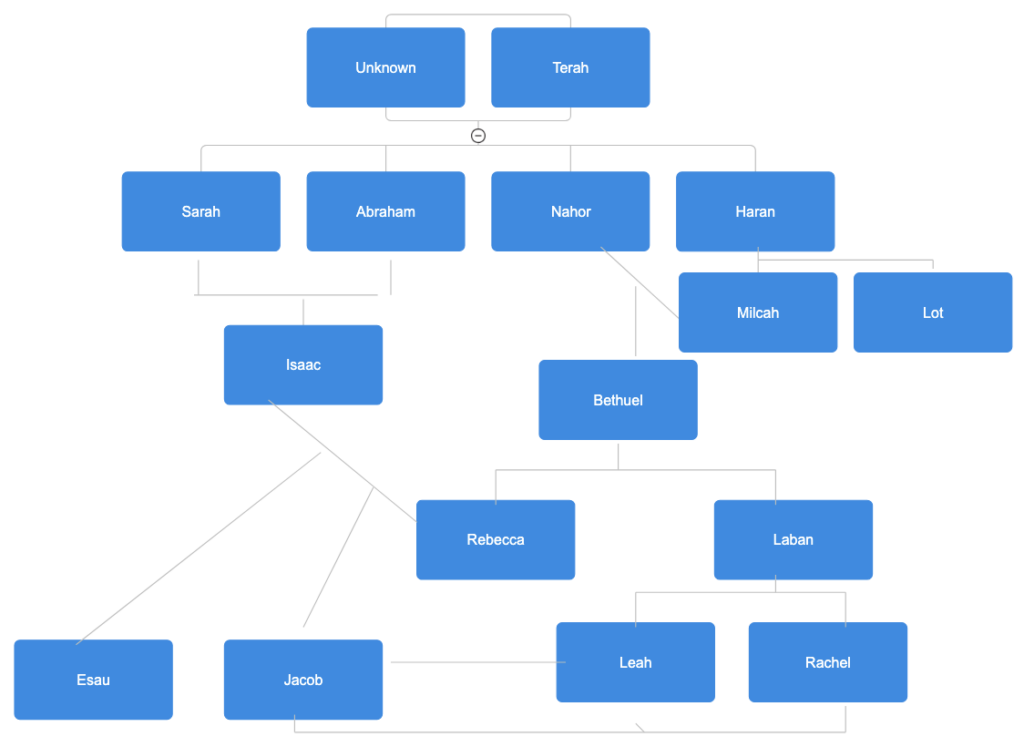
    Abraham then got an update from his family. Remember, Terah was the father of Abram, Nahor, and Haran (Gen. 11: 27). Nahor had married Milcah, the daughter of Haran (Gen. 11: 29).

    Most societies in today’s world have passed laws that make an uncle marrying his niece illegal. That was not the case in Abraham’s day.

    The Bible Hub gives us a little insight as to what it was okay in Abraham’s age but is usually illegal now. It says,

    “In the cultural context of the ancient Near East, Milcah’s marriage to Nahor and her role as a mother would have been seen as vital for the continuation of family lines and the inheritance of property and blessings. Her account reflects the importance of kinship and familial loyalty, themes that are prevalent throughout the biblical narrative.”

    Resource

    Think about it. Terah was the father of Abraham, Sarah, Nahor, and Haran. Since Milcah was Haran’s daughter, Nahor kept it in the family also.

    Nahor and Milcah had raised a large family. The most important to Abraham’s future was Bethuel. Bethuel would become the father of Rebecca, Isaac’s future wife, and Laban, Jacob’s father-in-law.

    Okay. We need a visual.

    That is several diagonal lines that aren’t usually there.

    Way back in Genesis 12, we talked about whether Terah or Abraham was called. If Terah was not, he was chosen to have the chosen family to descend from him.

    This is going to be important to keep this in mind for the next couple of chapters.

    Let’s connect all of this. In Chapter 24, Abraham looked for a wife for Isaac. Would he thought to look at his family for a wife for his son? Probably.

    But Abraham may or may not have had contact with them since he moved out of Ur. If he didn’t, this brought it back to his mind.

    Truthfully, I am sure that Jehovah put it in his mind.

    The Death of Sarah

    “When Sarah was 127 years old, she died at Kiriath-arba (now called Hebron) in the land of Canaan. There Abraham mourned and wept for her” (Gen. 23: 1-2 NLT)

    Sarah Died

    Abraham was separated from his wife of many years.

    To me, Sarah is portrayed in Scriptures as a difficult woman. She devised a plan to hurry Jehovah along in His promise and then didn’t like how it turned out. She could be seen as being mean to Hagar and Ishmael — even though they brought some of that upon themselves.

    The thing is, Abraham loved her. He didn’t take another wife while she was alive. (Remember, Hagar wasn’t described as an isha [wife] but a shifchah [female slave of the lowers rank]).

    Yeah, Abraham did try to pass Sarah off as just his sister – which she was. But he had to have loved her when he could have taken another wife when it was evident she was barren.

    Dykes noted that, because the duties of being a shepherd were straightforward, it would of left Abraham and Sarah plenty of time to interact. It allowed them at establish and grow their life together.

    Although Dykes did make an interesting observation. Sarah was Abraham’s last link to Ur. She wasn’t just his wife, she was the last family member (sister) — person altogether — to have seen the complete transformation from idol worshiper to child of Jehovah.

    Resource

    They had a long life, full together; and in the end, he mourned for her.

    It may have thrown Abraham for a loop. Sarah was ten years younger than him. Yet she died first.

    If we go back to the Hebrew, it says something interesting. “And Sarah was an hundred and seven and twenty shanah old: these were the shnei chayyai [two lives] Sarah” (Gen. 23: 1 OJB).

    What does two lives mean? There are a couple of ways this is interpreted.

    The first way is that Sarah had a full significant life. In other words, it was a she-had-a-good-life statement.

    The other way to interpret it is that there were two distinct phases in Sarah’s life. It is easy to see the dividing line.

    She was born Sarai and lived most of her life as that person. In fact, she lived 89 years under this name. She went from a child to an adult, from being single to being a wife.

    The second phase, she became Sarah — a mother with a spiritual transformation. She was a princess who became princess, mother of nations.

    But this is something Jehovah’s children would understand.

    • “This means that anyone who belongs to Christ has become a new person. The old life is gone; a new life has begun!” (II Cor. 5: 17 NLT).
    • “It doesn’t matter whether we have been circumcised or not. What counts is whether we have been transformed into a new creation” (Gal. 6: 15 NLT).
    • “For you have been born again, but not to a life that will quickly end. Your new life will last forever because it comes from the eternal, living word of God” (1 Pet. 1: 23 NLT).
    • “Jesus replied, “I tell you the truth, unless you are born again, you cannot see the Kingdom of God’” (Jn. 3: 3 NLT).

    We call it changing from a physical life to eternal life.

    Robinson had an insight into Abraham’s grief. He wrote, “Had he not had to arouse himself and procure a grave for Sarah, he would have brooded over his grief.

    Resource

    Oh, yeah. The busyness of the funeral and the first couple of weeks help focus us and get us through. Then about week 3, it hits us. They are gone and not coming back.

    But then Robertson also wondered if Abraham’s tears indicated he felt some remorse. He may have been thinking back to his deception in Egypt and to Abimelech.

    Resource

    It is correct, though, when Robertson says, Abraham treated Sarah with mostly tenderness, concession, and dignity.

    Sarah lived 127 years. She was 65 when Abraham received the call to go to Canaan. She stayed with him up until now.

    This had to have been one of the biggest separations Jehovah required of Abraham. We have talked about how He had a lifetime of these separations. Abraham’s Sanctification Road being built on bricks formed by separations.

    • Left his country and kin (Gen. 11: 31)
    • Father died (Gen. 11: 32)
    • Left Haran (Gen. 12: 1)
    • Left Canaan for Egypt (Gen. 12: 10)
    • Left Egypt (Gen. 12:  20)
    • Separated from Lot (Gen. 13: 13)
    • Separated from Ishmael (Gen. 21:  14)
    • Almost separated from Isaac (Gen. 22: 10)
    • Separated from Sarah (Gen. 23: 1-2)
    • Separated from worldly possessions (Gen. 25: 5)
    • Separated from life (Gen. 25:  7-8)

    Abraham had already experienced the death of a loved one. His brother Haran died before they left Ur. His father Terah died in Haran.

    But this was Abraham’s mate – the mother of the covenant son.

    Kiriath-arba (now called Hebron)

    Sarah died near Hebron.

    Wait! What????

    When did they move from Mamre? And why does verse 17 say they were near Mamre?

    Well, Mamre was both a town and an oak grove. “The Lord appeared again to Abraham near the oak grove belonging to Mamre. One day Abraham was sitting at the entrance to his tent during the hottest part of the day” (Gen. 18: 1 NLT).

    The oak groves and the altar Abraham built eventually became identified with Hebron.

    The city of Hebron was in the vicinity of the oak grove of Mamre. Remember, Mamre was one of the allies who helped rescue Lot and the owner of the oak grove.

    “But one of Lot’s men escaped and reported everything to Abram the Hebrew, who was living near the oak grove belonging to Mamre the Amorite. Mamre and his relatives, Eshcol and Aner, were Abram’s allies” (Gen. 14: 13 NLT).

    Beginning to Secure a Burial Place

    “Then, leaving her body, he said to the Hittite elders, ‘Here I am, a stranger and a foreigner among you. Please sell me a piece of land so I can give my wife a proper burial.’ The Hittites replied to Abraham, ‘Listen, my lord, you are an honored prince among us. Choose the finest of our tombs and bury her there. No one here will refuse to help you in this way’” (Gen. 23: 3-6 NLT)

    A Stranger and Foreigner

    Since Jehovah called Abraham to move to Canaan, He had not given him land to call his own.

    Abraham and Sarah had basically been nomads up to that point. Yes, Jehovah had promised that He would give the land to his descendants.

    Jehovah just hadn’t given Abraham any of it yet.

    Because of this, Abraham knew that he was a stranger in the land. “And even when he reached the land God promised him, he lived there by faith — for he was like a foreigner, living in tents …” (Heb. 11: 9 NLT emphasis added).

    This is the Old Testament way of also saying we are in the world but not of the world. Look how Breed described Abraham’s relationship with those around him. He wrote,

    “We shall attempt the task of [analyzing] the relations which Abraham sustained to his heathen [neighbors]. We perceive at once that they were those of entire friendliness, but of absolute separation. We shall follow, therefore, this simple division of the subject of this chapter.”

    Resource

    Friendly but separate. The lifestyle of those around him would have been repugnant and offensive to Abraham. He did not condone their cruel, covetous, and licentious lifestyle.

    Breed gave us a list of how Abraham was separate.

    • Food
    • Dwelling in a tent
    • His covenant relations with Jehovah.
    • His slow acquisition of his wealth.
    • His display of power when needed (rescuing Lot).

    We also read of the term sojourner in God’s Word. That highlights our temporary status here in this life. Abraham was experiencing that first-hand here.

    Abraham went to negotiate the purchase of land of which he could use as a burial ground. This is the only land that Abraham would ever own.

    In a way, that is sad. He was promised all this land for his descendants. None of it was given to him until he needed a burial plot.

    But it allowed Abraham to keep his focus on Jehovah.

    Hittites (Khitti)

    Hebron was populated by the Hittites.

    One nation living in Canaan during Abraham’s time was the Hittites. Little is known about the Hittites, also known as Hethites. They were a mighty nation in the 15th and 16th centuries, the size of their empire rivaling that of the Roman Empire.

    The Hittites were descendants of Canaan, the grandson of Noah (Gen. 10: 15). Their territory was (currently) part of northern Syria and eastern Turkey.

    • “Canaan fathered Sidon his firstborn and Heth” (Gen. 10: 15 ESV).
    • “Canaan’s oldest son was Sidon, the ancestor of the Sidonians. Canaan was also the ancestor of the Hittites” (Gen. 10: 15 NLT).

    During Abraham’s lifetime, the Hittites settled in the Hill Country around Hebron.

    Father God. You have put us in families to love us and support us. We grieve when we lose a loved one to death. Help us keep our eyes on You, as Abraham did, when our hearts are breaking. Amen

    If you don’t understand something and would like further clarification, please contact me.

    If you have not signed up for the email providing the link to the devotions and the newsletter, do so below.

    If God has used this devotion to speak with you, consider sharing it on social media.

  • A Treaty between Abraham and Abimelech

    The end of Genesis 21 tells us about a visit from an old “friend.” This devotional reading looks at another encounter between Abraham and Abimelech.

    Nuggets

    • Abraham and Abimelech’s relationship had been built on shaky ground.
    • Since a good relationship wasn’t really established, Abimelech wanted to establish a treaty with Abraham.
    • This is the first time we are told that Abraham dug wells.
    • Treaties were similar to covenants.
    • Abraham planted a tamarisk tree where he worshiped Jehovah
    a-treaty-between-abraham-and-abimelech

    Abraham had a life just as everyone else does. People come in and out of them all the time.

    At this point in Abraham’s life, he had an acquaintance walk across the corner of his life again.

    Let’s Put It into Context

    To read devotions in the Creating Everything theme, click the button below.

    Devotions in the Abraham the Patriarch series

    A Visit from Abimelech

    “About this time, Abimelech came with Phicol, his army commander, to visit Abraham …” (Gen. 21: 22 NLT)

    Abraham and Abimelech’s relationship had been built on shaky ground.

    It has been a minute since we discussed Abraham and Abimelech. Their relationship didn’t start off on a good note. Abraham lied to Abimelech.

    Abraham had moved to Gerar, probably in search of pastureland. Abimelech, probably a Philistine, was the king of Gerar.

    Abraham was more concerned about his life in the lawless region – again – than his wife’s safety. He tried to pass Sarah off as his sister.

    Just as the Pharaoh had done in Egypt, Abimelech “… brought [Sarah] to him at his palace” (Gen. 20: 2 NLT). He may have done this in order to form an alliance through marriage with Abraham.

    Whatever the reason for Abimelech taking Sarah, Jehovah intervened. He came to Abimelech in a dream.

    This had to have occurred some time between the destruction of Sodom and Gomorrah in 1861 BC and the birth of Isaac in 1860 BC. Abraham was living in Mamre when Sodom and Gomorrah was destroyed.

    At the time of this story, it was at least 1858. According to its placement — which may or may not be chronological, it was after Isaac was weaned.

    Abimelech didn’t come alone. He brought his army commander, Phicol. This was probably due to the perilousness of the journey. If Abimelech thought he would need military support when talking to Abraham, I think Phicol would have been mentioned more than just at the arrival and departure.

    A Treaty with Abimelech

    “‘… God is obviously with you, helping you in everything you do,’ Abimelech said. ‘Swear to me in God’s name that you will never deceive me, my children, or any of my descendants. I have been loyal to you, so now swear that you will be loyal to me and to this country where you are living as a foreigner.’ Abraham replied, ‘Yes, I swear to it!’” (Gen. 21: 22-24 NLT)

    Since a good relationship wasn’t really established, Abimelech wanted to establish a treaty with Abraham.

    Leale discussed why Abimelech felt this way. Let’s face it. Even though Abimelech and Abraham got off on the wrong foot, Abraham’s success was something that would have been attractive to Abimelech.

    Resource

    I doubt Abimelech knew of Jehovah’s blessing. “I will bless those who bless you and curse those who treat you with contempt. All the families on earth will be blessed through you” (Gen. 12: 3 NLT).

    What Abimelech did know was that Abraham’s success came from Jehovah.

    We talked about Sarah may or may not have been pregnant when the fiasco happened with Abimelech. Either way, Abimelech would have acknowledged the miracle needed for this old couple to have conceived a child.

    But Abimelech’s view would also be a worldview. Don’t we like to have successful, influential friends?

    It may have been that — after they got Abraham’s deception straightened out — Abimelech saw Abraham as he really was. He would have seen a goodness in Abraham.

    Still, Abimelech prefaced the treaty with one condition — don’t deceive me or mine again. He was telling Abraham that for however long it had been since Abraham had been living in the country as a foreigner, he had been loyal to him despite the initial deception.

    Abimelech was wanting a little reassurance that that loyalty would not be returned with more deception n the future.

    Abraham’s answer was immediate. “Yes, let’s make a treaty.”

    Remember, Abraham’s reason for the deception was that he thought the land was lawless. He would have been told, I am sure, that Jehovah came to speak to Abimelech.

    Working Out a Problem

    “Then Abraham complained to Abimelech about a well that Abimelech’s servants had taken by force from Abraham’s servants. ‘This is the first I’ve heard of it,’ Abimelech answered. ‘I have no idea who is responsible. You have never complained about this before’” (Gen. 21: 25-26 NLT)

    This is the first time we are told that Abraham dug wells.

    It is logical that Abraham would dig wells. He needed water for his flocks.

    This will be confirmed when we get to Genesis 26. “So the Philistines filled up all of Isaac’s wells with dirt. These were the wells that had been dug by the servants of his father, Abraham” (Gen. 26: 15 NLT).

    When I googled it, it said these wells were a source of water for his family, servants, and livestock.

    So, go back to Hagar and Ishmael. When Abraham told them they had to leave, they would probably have been traveling from well to well. If Abraham built them for family use, and not just livestock use, they would have been depending on these wells.

    If the wells had been commandeered by the pre-Philistines, they may not have let travelers use them. That is especially true for travelers association with the man who dug them in the first place and from whom they commandeered them.

    Elements of a Treaty

    “Abraham then gave some of his sheep, goats, and cattle to Abimelech, and they made a treaty. But Abraham also took seven additional female lambs and set them off by themselves. Abimelech asked, ‘Why have you set these seven apart from the others?’ Abraham replied, ‘Please accept these seven lambs to show your agreement that I dug this well’” (Gen. 21: 27-30 NLT)

    Treaties were similar to covenants.

    We’ve talked about the process of establishing a covenant. Covenants are agreements, contracts, or promises between two parties to perform the responsibilities listed in the covenant. It is formally binding.

    A bond would be formed to mutually benefit both parties. Acceptance of the responsibilities of the covenant is shown by giving an oath.

    There were several elements in covenants. Many included a time of fellowship centered around a meal.

    • Covenant established
    • Blessings of the covenant
    • Sign of the covenant
    • Acceptance of the responsibilities of the covenant
    • Promise of the covenant Covenant established
    • Blessings of the covenant
    • Sign of the covenant
    • Acceptance of the responsibilities of the covenant
    • Promise of the covenant

    A treaty is similar because it is formal and binding. It also requires responsibilities.

    The differences are treaties are political, and covenants, with Jehovah. That makes covenants a divine commitment, meaning breaking it carries a higher price for disobedience.

    Jehovah initiated the covenants. Either party could initiate a treaty.

    Abraham Worshiped

    “Then he named the place Beersheba (which means “well of the oath”), because that was where they had sworn the oath. After making their covenant at Beersheba, Abimelech left with Phicol, the commander of his army, and they returned home to the land of the Philistines. Then Abraham planted a tamarisk tree at Beersheba, and there he worshiped the Lord, the Eternal God. And Abraham lived as a foreigner in Philistine country for a long time” (Gen. 21: 31-34 NLT)

    Abraham planted a tamarisk tree where he worshiped Jehovah.

    The tamarisk tree was the sign of the covenant — treaty — that the two men forged. It was a slow-growing tree or bush that thrived in the arid environment of the Negev. “Abraham moved south to the Negev and lived for a while between Kadesh and Shur, and then he moved on to Gerar …” (Gen. 20: 1 NLT).

    Because of this hardiness, it would have been a perfect symbol for a treaty or covenant. It symbolized permanence and endurance.

    That would have resonated with Abraham. Look what Raymond said. He wrote,

    “Earlier in Genesis (12:7ff) God had promised Abraham that he would give his descendants this land. Now, nearly a quarter century later Abraham is standing in the land with the son of the promise in his tent. He is planting a tree in the land and declaring the faithfulness of God.”

    Resource

    Yeah. A quarter of a century is a long time to wait. 

    It is interesting that Abraham didn’t build an altar. But that is also logical. The altars were just between Abraham and Jehovah.

    But think about it this way. By planting a tamarisk tree, Abraham was showing Jehovah that he had faith God would provide — even if it was provision some time in the future, as it would take many years for the tree to mature.

    By the way, a tamarisk tree also played a role in the life of King Saul. “The news of his arrival in Judah soon reached Saul. At the time, the king was sitting beneath the tamarisk tree on the hill at Gibeah, holding his spear and surrounded by his officers” (I Sam. 22: 6 NLT).

    Saul was also buried under a tamarisk tree. “Then they took their bones [Saul and his three sons] and buried them beneath the tamarisk tree at Jabesh, and they fasted for seven days” (I Sam. 31: 13 NLT).

    Making the Connections

    Hughes made an interesting statement. He wrote, “What was done by Abraham with God’s approbation might be turned to sin by man’s superstition. So the groves.”

    Resource

    We may start out with Jehovah’s approval, but it may turn into a sin. How can that be?

    Superstition is “a belief or practice resulting from ignorance, fear of the unknown, trust in magic or chance, or a false conception of causation.”

    Resource

    In other words, it is an unjustifiable attitude toward Jehovah.

    Groves, in God’s Word, was a place where pagans went to worship false gods. This was particularly tied to Asherah and Baal. This makes groves a good example of some holy that was desecrated for purposes of idolatry.

    Our actions become a sin when we try to manipulate Jehovah. We make it more of a ritual, charm, or other practice than trusting in Jehovah.

    We aren’t believing with an inward faith. We are relying on an outward action.

    Don’t we do that with prayer? If I ask enough timers, Jehovah will give me what I want. If I get down on my knees, Jehovah will see me as being submissive — and give me what I want. If I avoid something, God will see me as righteous.

    Even attending church can become a ritual. Our motivation can be wrong.

    Worst of all is when we attribute a something Jehovah has done to Satan. Pastor Steve and I had a discussion the other day. He thinks this could be part of the unpardonable sin.

    How Do We Apply This?

    Watch the company we keep.
    Remember we are to be in the world but not of it.

    Father God. We must interact with people every day. Help us to choose our friends wisely. Amen.

    If you don’t understand something and would like further clarification, please contact me.

    If you have not signed up for the email providing the link to the devotions and the newsletter, do so below.

    If God has used this devotion to speak with you, consider sharing it on social media.

  • Lord, Give Me Light

    Today is a music day. 

    Hey guys. I am going to do a music day today. The three of us have all been sick and had issues that we’ve had to deal with.

    On top of that, my other hat as pastor’s wife has taken a little more time than usual. Pastor Steve is really good at listening to God, even if God changes the sermon topic or even just the focus of that topic. I am in charge of music and the bulletin, so that has me switching up things, too.

    Then there is this song. One of the sermon changes meant Pastor Steve was preaching on repentance. I always do a Google search to see what are all the different songs out there that I can choose to include in the service.

    Lord, Give Me Light popped up. Well, the lyrics did. When I goggled it to see if there was a video of it, I fell in love with what I found.

    The music was the same music for the hymn Higher Ground.I found a really neat accompaniment track for it.

    Easy-peasy from there, right?

    Ummmm.

    I am a visual person, so I needed the music in front of me. My wonderful sister had told me about a program that allowed me to do that.

    The first issue I ran into was Higher Ground in the hymnal was three beats to the measure, and the accompaniment was four. So, it took me a while to figure out what was happening for each of the four beats.

    Next, I had to deal with putting the words in, which I hadn’t tried in my other times playing around with it. I finally got it done.

    But then I had to modify the accompaniment track. There were too many choruses on it but not enough verses.

    I recorded this at 4:00 Sunday morning — the day I sang it at church. (Of course, my nocturnal kid wasn’t nocturnal that night.)

    Really listen to these words. It isn’t a check list, but it brings up a lot of areas in our lives where we might need repentance. 

    God wants us to be totally focused on Him. We can’t keep any area of ourselves back from turning it over to Him. This song should make us think about what we need to pray about.

    If you don’t understand something and would like further clarification, please contact me.

    If you have not signed up for the email providing the link to the devotions and the newsletter, do so below.

    If God has used this devotion to speak with you, consider sharing it on social media.

  • Abraham the Emigrant Part 2

    abraham-the-emigrant-part-2

    Famine

    Canaan was an unpredictable region. It had both fertile land and unpredictable weather.

    The unpredictable weather reared its ugly head as a famine. We don’t know how long Abram and Sarai had been in the region, but they were on the move again.

    We may question why God sent a famine that would lead to another road trip. It was another testing of his obedience. It was a little more than that, I think. 

    Abram didn’t feel that he could provide for his family and flocks during the famine where they were at. The famine must have been really bad for Abram to even consider moving. 

    As obedient as Abram had been, he succumbed to the temptation of sin by not believing God could handle what his new circumstances were.

    The onset of these trials doesn’t mean that God has forsaken us. It means He is sanctifying us.

    Whether obedient or not, Abram and Sarai headed down to Egypt. If Moses did write this chronologically, the trip to Egypt would have happened somewhere between 1885 and 1880 BC, according to the Old Testament Timeline. 

    Egypt

    There is one tidbit on which this section that is glaringly silent. Did God tell Abram to go to Egypt? Maybe. Maybe not.

    Did Abram have any business being in Egypt? Not if God didn’t tell him to go.

    Yeah, we may say Abram only lied, but it was more than that. Abram wrecked his witness with the Egyptians.

    Abram has only been a disciple for around three years. He is still a milk baby (Heb. 5: 13).

    Satan would have really been working on Abram. He would have been throwing doubts and temptations at him right and left.

    Abram probably didn’t have any idea what spiritual warfare was. If he did know spiritual warfare was going on, that it was an internal battle may have been outside his understanding.

    Truth be known, it is outside of our understanding sometimes.

    We bite on Abram because he lied. But he went.

    Abram could have stayed – and lost his flocks. But he knew that God was Sovereign God. He knew God could and would take care of him.

    So, what happened? Abram didn’t know that lying was a sin? Or was Abram trying to help God out?

    We have to stay obedient to God regardless of the circumstances. We need to trust Him through it all.

    We don’t see Abram calling on the name of the Lord here. Maybe that was part of the problem.

    We aren’t told how long Abram and Sarai stayed in Egypt, but we are given only one chapter of their story there – and it isn’t a flattering one. That may tell us they weren’t supposed to go.

    But isn’t that how it goes? One sin leads to another.

    Abram left his altar behind. We lose a lot when we don’t consistently meet with God in His house. But we lose even more if we do not have a strong daily devotional time. 

    Abram thought he would run into trouble in Egypt. He was concerned for his life. He thought the men of Egypt would kill him to take Sarai if he told them he was her husband.

    Moses doesn’t tell us how much of a struggle Abram had making this decision. We have no way of knowing if Abram immediately thought God wouldn’t be able to take care of them or if he had to talk himself into it.

    Part of us wants to say that we shouldn’t bite too hard on Abram. His fears came to fruition.

    But this was an intentional sin.

    Abram decided to tell, and Sarai agreed to go along with, a lie. He forfeited truth for safety.

    Sarai technically was his sister. But that was a lie and a deception because she was his wife. 

    Faith opposes false practicality. We can’t conceal the truth because a lie would be easier or more rewarding.

    Abram may have told the Pharaoh Sarai was his sister because he didn’t want a confrontation. Abram was a peaceable man with a big heart.

    Think of the position Abram put Sarai in. When they took her into the palace, was she just supposed to sit back and let whatever happened to her happen? Was she supposed to commit adultery because her husband sanctioned it? Sarai sure got the raw end of the deal.

    But Sarai did agree to go along with the lie and followed through. Maybe she didn’t think she had any choice; but in the end, she chose to go along with the ruse.

    God didn’t like how things were going down and stepped in.

    We aren’t told how Pharaoh figured out that it was because he was messing with Abram’s wife. Yeah, this may be Moses picking and choosing what to tell of the story.  What is important to know is God instigated the tell-all, and Abram’s secret was made known.

    The Pharaoh found out that God is all-powerful. Pharaoh may have thought he was, but he was no match for God.

    Think about Abram. Yes, he was concerned for his life. Instead, his integrity took a hit. He probably would have used the word dishonored instead of integrity.

    What the Egyptians saw was Abram was not, in God’s terms, pure and righteous. They probably would have just said he was a liar and untrustworthy.

    The Egyptians’ response were quick to point out that Abram caused the problem by not telling them Sarai was his wife. And they would be right. But that lie did not force them to take Sarai into the palace. That was their choice alone.

    The Egyptians were done with Abram. In fact, he and his family were being escorted out of the country of Egypt.

    If Moses was writing this record right before the Israelites made the exodus from Egypt, wouldn’t that have given the Israelites a boost before the start of their journey?

    Abram saw Egypt. Jacob saw it. Joseph saw it. Jesus saw it.

    Abram was heading home after a failure. Not just heading home, but Abram was heading home forgiven and favored.

    Abram couldn’t have lived in Canaan more than a couple of years before he headed for Egypt. Was he returning because of his love for the land? Was Abram going back just because it was promised to him? 

    I don’t think God was upset that Abram was heading there “… by stages …” (Gen. 13: 3 NLT). Our sanctification happens in stages. Through his camel steps, Abram was showing Sarai, Lot, and anyone in the caravan what true repentance was. 

    Abram turned away from his lie and deception and went back to God. He was in a better place spiritually.

    God made Abraham prosper. No, that didn’t make it a prosperity gospel. It made it an obedience gospel. 

    When we sin, God calls us back to where we were with Him.

    Abram knew a response that God wanted was worship. He was constantly building altars. He was heading back to the altar he built at Bethel. Abram was heading back to God.

    Lot

    Terah’s either youngest or possibly middle son Haran, though his wife was not listed, had a son named Lot. Unfortunately, Haran died before the family left Ur. 

    Lot didn’t find his way back to God because he hadn’t been with God previously. When we’ve talked about the altars that Abram built, Lot wasn’t mentioned.

    Really, we have just heard Lot’s name mentioned a couple of times in conjunction with the trip to Canaan.

    Moses didn’t give us any clue as to how old Lot was. At first glance, we may say Terah had been raising Lot after Haran died. But Moses said Terah took Abram and Sarai, who were 70 and 60 respectively, in the same breath as he said Terah took Lot.

    We know Lot had two daughters who were betrothed. They had fiancés but not husbands yet. That may put them around 13.

    It is easy to think that these two girls are Lot and Mrs. Lot’s only children. However, I don’t see the angels asking about other sons and daughters if they knew he didn’t have any. If they didn’t know beforehand, I am sure God would have given them a manifest when He gave them this assignment. “Go get these specific people out.”

    Wait a second. Doesn’t that mean Mrs. Lot had to come from Ur with them???? So, why isn’t Mrs. Lot on the manifest? She does play a very brief but significant role in the future.

    Lot had become a wealthy man in his own right. His problem, as we will see, is that he was self-seeking.

    Maybe Lot had started out from Ur following God’s call. Like salvation, our initial acceptance of God at conversion is only the beginning. We must then walk with God daily as we are sanctified.

    The wealth and opulence of Egypt may have had an impact on Lot. Being dazzled by the country may have turned him away from God if he had called upon God previously.

    Regardless of Lot’s relationship with Abram and God, the herdsmen were fighting. True, the herdsmen could be seen as doing their jobs — providing for and protecting their herd. They were surely frustrated that there was not enough resources for both. Neither Abram nor Lot owned the land.  The Canaanites and Perizzites did.

    We may judge Lot here, but by the time he left Sodom, he was a righteous man. He was sick of the culture in which he lived. Abram’s nephew, though he ends up a righteous man, is an ineffective disciple.

    It sounds like Lot started good, got lost it in the middle, but came back to God before the end.

    Lot didn’t go directly to Sodom. He didn’t instantaneously choose evil. He inched toward it.

    Doing for ourselves brings us way worse results than doing it God’s way. He chooses who He will bless and what gifts they will receive.

    Abram and Lot

    Abram and Lot both being wealthy caused problems.

    Their herdsmen were quarreling. Lot and Abram were probably being drawn in by degrees. However far it had progressed, the dispute doesn’t seem to have alienated Abram and Lot. 

    Abram didn’t want to conflict to escalate to include him and Lot. They did come to a solution between themselves.

    What Abraham didn’t have to do was give Lot the first choice on the land. He was the elder, not Lot. Not only that, he also was now the head of the family. He probably had the bigger herd than Lot.

    Abram may have believed that God would bless him either way he went. So, he let Lot choose because, to him, it didn’t matter.

    Abram showed us that pulling rank is not always the answer. Neither is always being right.

    So, Abram’s gentle, generous answer was, “Lot, you mean more to me than having the best land. I want to see you settled, happy, and thriving. Where do you want to live?”

    Abram showed us that God meant all to him. God meant more to him than his worldly interests.

    Abram imitated the graciousness of God. What Abram was doing was extending to Lot the type of grace that God extended to him. 

    It is easy to say that, regardless of where Abram ended up, God would bless him. And maybe Lot thought that in part, too.

    And yes, God will bless us in not-so-good circumstances when we are being obedient to Him. It wasn’t — and shouldn’t be — a test for Him to do that.

    Lot chose wrong. Genesis 13 was a defining moment in Lot’s life. His choice here set in motion the rest of his story.

    Many of us wonder how Lot could have been so insensitive to his Uncle Abram. Abram was being generous while Lot was being selfish.

    It is easy for us to say that Lot chose to live among the idolators. But there were isolators all around Abram. 

    Lot wanted to see a path that led to material wealth. He wanted to be able to make his own decisions without censure from anyone — human or divine.

    Our choices may seem inconsequential at the time. They do lead to the next decision — if not in relation to it, at least in mindset used to make the decision.

    Lot went south, and Abram was in the north at Bethel.

    Many would say that Abram got the short end of the stick. I’ve always thought that the land that Lot left for Abram was more desert. Abram would obviously have a harder time making a living on the land that Lot left for him.

    Lot chose the fertile ground compared to the Garden of Eden to live among the idolators – and lost everything.

    Abram took what was left – regardless of how good or bad the land was – went with God and gained everything.

    Abram made his home in Mamre in Hebron.

    Mamre was a small village 22 Roman miles (a shade over 20 miles) from Jerusalem. It was where Isaac was born and where, later, Abraham, Sarah, Isaac, Rebekka, Jacob, and Leah were buried.

    God gave Abram the promise of the land. The only land Abram owned was the cave in which he buried Sarah (Gen. 23: 17-20) – and where he, Isaac, Rebekka, Jacob, and Leah were buried.

    Abram walked with God in faith and obedience. Sure, he still sinned.

    Rescue

    Kedorlaomer (Cherdorlaomer) was King of Elam, a descendant of Shem. The Cities of the Plains had been under the rule of Kedorlaomer (Cherdorlaomer), King of Elam for 12 years.

    A close ally would have been the king of Goiim or Goyim. That is the word used for Gentiles. Japheth, Seth’s brother, was the forefather of the Gentiles.

    In the 13th year, five kings, most descendants of Canaan, rebelled against Kedorlaomer.

    Lot wanted wealth and possessions, but here he was a captive stripped of his possessions

    Uncle Abram went to the rescue. 

    It is interesting that Moses listed three allies. It is nice to know Abram had allies in the area.

    Lot may have been out of sight, but he was not out of Abram’s mind and heart. 

    Abram and Lot had parted ways because of a conflict. We think they parted on decent terms, but there may have been some residual resentment.

    That didn’t stop Abram. He didn’t let past history affect his desire to rescue Lot. He and his 318 fighting men took off to rescue Lot.

    Abram didn’t need the numbers. He had God fighting with Him and for Him. 

    Kedorlaomer was the ruling power in those parts at the time. Abram as a private citizen had no right to wage war against a king.

    Up to this point, we haven’t seen Abram as a warrior. We’ve seen him as a worshiper. But in that era, Abram had to have been at least a fighter. 

    Walking with God does not mean Abram was turned into a doormat. He wasn’t a conscientious objector.

    Abram did become a general in this instance. The New Living Translation sugarcoats the battle. It says victory. The Complete Jewish Bible says slaughter. He knew enough about fighting to see the benefit of a nighttime offensive.

    This tells me that, even though it sounds like they picked up and went after Lot without much notice, they were ready. They already had the training. They may have had a generic contingency plan for being attacked, defending themselves, etc.

    Abram and his soldiers were ready.

    But I wonder if Abram knew they were family. That is a kicker, isn’t it? Abram was going to save family from family.

    Celebration

    Abram met with two diverse kings after returning. The King of Sodom was a worldview king.

    The King of Sodom came to Abram, not the other way around. Sounds like Abram thought this was just a duty call. It doesn’t sound like Abram gave the King of Sodom any great reverence. 

    Abram did give reverence to Melchizedek because he was a High Priest and King. Yeah, probably ungodly verses godly had something to do with it.

    Abram took a minute to worship God with Melchizedek.

    Also, for the first time, we learn about tithing. Abram gave Melchizedek a tenth of the spoils.

    Some say Melchizedek was Shem. Some say he was Jesus. I just have problems with Jesus being in human form before it was time to be Messiah. Did He come down and not sin? Or did He sin as Melchizedek?  Even if He was Melchizedek – if He sinned – wouldn’t that disqualify Jesus as Messiah?

    The job of the priest is to bless others. Melchizedek performed this task. 

    Melchizedek also knew that Abram was a blessing to God. We are to bless God with our faith, obedience, and worship.

    Abram’s disinterestedness and independence led to him not taking any of the recovered goods.

    Abram accomplished his goal of rescuing Lot. He didn’t care about the rest. It wasn’t his before. He had no desire for it after he gave the 10 percent to God.

    Abram certainly didn’t want to gain from people who had lost because of war. But then was it the King of Sodom’s stuff get give away anyway?

    Elam, Babylonia, Ellasar, and Goiim invaded Sodom, Gomorrah, Adman, Zeboiim, and Zoar. Abram defeated Elam, Babylonia, Ellasar, and Goiim. Abram then owned Canaan.

    Abram didn’t take the country. Wouldn’t that have legitimized the promise God gave Abram?

    But then the land wouldn’t be a gift from God. It would have been something Abram earned. It would have been from man – specifically the Sodomites.

    Some may say that Abram should have taken it. Maybe then Sodom and Gomorrah wouldn’t have been destroyed (Gen. 19). 

    If Abram would have demanded the land, then the covenant would have been broken.

    creating-everything-theme

    To read devotions in the Creating Everything theme, click the button below.

    Devotions in the Abraham the Emigrant series
  • Abraham the Emigrant Part 1

    how-do-we-love-godFB

    Shem’s line is the one who led to the Messiah. On its way there, we come to Abraham.

    God was in the habit of picking one man to do His Will: Adam, Noah, Abraham, Joseph, Moses, and Jesus. We’ve been calling it separating. 

    How was Abram separated?

    • Separated from  country and kin (Gen. 11: 31).
    • Separated from father (Gen. 11: 32).
    • Left the city of Haran (Gen. 12: 1).
    • Left Canaan for Egypt (Gen. 12: 10).
    • Left Egypt (Gen. 12:  20).
    • Separated from Lot (Gen. 13: 13).
    • Separated from Ishmael (Gen. 21:  14).
    • Almost separated from Isaac (Gen. 22: 10).
    • Separated from Sarah (Gen. 23:  1-2).
    • Separated from worldly possessions (Gen. 25: 5).
    • Separated from life (Gen. 25:  7-8).

    Terah

    We set up the story of Abraham by learning about his father and his early life.

    Terah lived in Ur of the Chaldeans. He was reported to have not only worshiped idols, but he also sold idols, sometimes enlisting Abram as a salesman.

    Some think Terah began in Haran and, at some point, moved to Ur Kasdim and – five years prior – moved back. That could be the explanation for being called from his country.

    Abram

    We may or may not be familiar with who Abram was under that name, which means “father is exalted.” We probably know what God changed His name to — Abraham. That means “father of a multitude.”

    From the list of names of Terah’s sons, it looks like Abram was the firstborn. Some say that is correct. Some say that isn’t correct. Once again, God may have called the son who was not the firstborn in the family.

    Because of his faith, Abraham became the first Hebrew patriarch. That is why he is called “father of the Jews.” Hebrew means to cross over. More literally, it means from the other side of the river. Abram had to cross over from the other side of the Euphrates River to enter Canaan.

    The Call

    We credit Abram for leaving Ur and going to some unknown land. If Abram left Ur in 1890 BC at the age of 70, they would have had to get there within the year if Terah lived five years in Haron before he died and Abram was called to move in 1885 BC at 75 years old. 

    But we read in the last part of Genesis 11 that Terah, Abram’s father, left Ur to go to Canaan. Did God call Terah to go to Canaan? We aren’t told that. If Genesis 31: 53 is correct, He was worshiping Jehovah but apparently not with full obedience.

    Maybe the reason Canaan is in Chapter 11 is that Moses knew where they were going, and he put it in where they didn’t know that yet. We know he did put current – to him – names of town so that readers would know where he was talking about.

    If God did call Terah before or after he and Abram converted to worshiping God, he disobeyed because they stopped for some unknown reason at Haran. 

    It doesn’t seem that God held the stop against Abram. If Abram’s call had been made but he stopped because Terah had gone as far as he could, God knew Abram would keep going. Maybe Genesis 12: 1-3 is that restart. 

    If Terah was called and he disobeyed by stopping in Haran, he wasn’t rewarded. That is a significant contrast to Abram’s obedience. Procrastination v. complete, immediate obedience.

    Whether or not Terah was the one originally called, he did leave his home to follow God’s call to Abram. 

    Whether Abram was called from Ur or Haran – or both – he was being called from the fallen people. He was coming from the Land of Nod – anywhere where the Garden of Eden wasn’t – to where God wanted hm to be.

    But even from the move from Ur, Abram had to have faith. Abram moved from Ur to Haran to Canaan because the Sovereign God – the God of Shem – told him to go. Whatever he knew in Ur was enough to get him going – and he grew from there.

    God worked out His plan for Abram’s life. Whatever part God had planned for Terah to play, he got Abram to Canaan, so He could make and fulfill His promises.

    Whoever was called, it was a family move – grandpa, uncle, and nephew. God does work through families. We’ll see that especially in this family.    

    Yes, it is speculating, but both ways teaches us good lessons. It is the difference between obedience and disobedience. We know the man who would become Abraham was obedient. 

    Here is what I think.

    • Terah was not called.
    • Terah may have been prompted to go to Canaan, but he probably didn’t know it. Moses probably put that in after-the-fact.
    • Terah stopping may have been the plan.
    • Abram was called when he was in Haren.
    • Abram immediately left when he was called and didn’t stop until he got to Canaan.

    Why did God choose Abraham? We don’t know. God called Abram to follow Him into the unknown.

    Abram was being called to start moving again. This was the first time that terminology was used. It wasn’t persecution, famine, poverty, or wanderlust that got Abram moving. It was a call.

    So, Terah may have set up a household in Haran from which Abram left. He had to if Abram was to leave some – and possibly never see them again – since everyone else who came from Ur left with Abram.

    Another possible explanation is that God included both trips – the trip from Ur to Haran and the trip from Haran to Canaan. That would have been logical for two reasons.

    The first reason is God often does things in steps. First God separated Abram from his homeland of Canaan and any relatives that remained there. Then He separated him from his father.

    The second reason is God would have included it to recognize Abram’s obedience. 

    Ur to Haran was an unsuccessful journey because the destination was Canaan. Haran to Canaan was the successful journey.

    Do you think Abram should have just gone ahead and left after Terah died? But Abram didn’t just go. Just as Noah who waited until he was told to get on and off the ark, Abram was following God’s directions every step of the way.

    Abram was making this journey on faith. He had to put his faith and trust solely in God.

    God didn’t entice Abram to leave because He was offering this spectacular living place. The place could have been a desert for all Abram knew.

    Yes, the “… Leave your native country, your relatives, and your father’s family …” (Gen. 12: 1 NLT) part meant Abram gave up a lot. God promised him a lot in return.

    The most important thing Abram gained was that his descendant – Jesus – became the Savior for all, not just the Hebrews/Israelites/Jews. That is what everyone from Adam on down needed/needs. 

    Abram immediately set out as God instructed him for a new home.

    We know of Abram’s obedience because of the outward things he did. He left. He built an altar. He made the public profession of faith.

    God’s Covenant with Abram

    Abram’s covenant is based on separation and grace. But even God’s covenant with Abram says it is for all. 

    Real faith + sincere heart = forgiveness, pardon, and increased faith.

    It was with Abram the covenant that made the Israelites God’s people was established. We may think it is three different covenants, but it really is all part of one.

    • Covenant established (Gen. 12: 1-3)
    • Blessings of the covenant (Gen. 12: 7; Gen.13: 14-17)
    • Sign of the covenant (Gen. 15: 1-21)
    • Acceptance of the responsibilities of the covenant 17: 1-27)
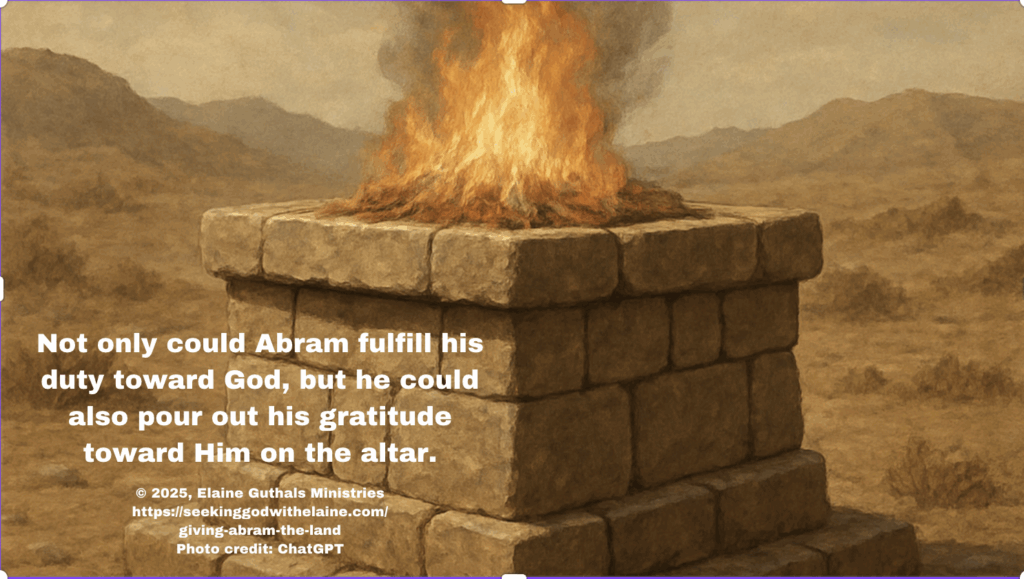
    • Promise of the covenant (Gen. 18: 9-15).

    God gave Abram five promises.

    • I will make you a nation (Gen. 12: 2).
    • I will bless you (Gen. 12: 2).
    • I will make your name great (Gen. 12: 2).
    • I will bless those who bless you, curse those who curse you (Gen. 12: 3).
    • All will be blessed through you (Gen. 12: 3).

    Abram was going to be blessed by his descendants forming a nation as well as blessing others. The Jews put a lot of stock in being descendants of Abraham and being a great nation. The Jews thought salvation came through Abraham.  That made them very proud of their identify.

    God promised to bless everyone through Abram. Yes, he was going to have enough descendants to become a nation. But even people not his descendants were going to be blessed – even Ham’s descendants including Nimrod’s. 

    God gave the land to Abraham and his descendants — but Abram didn’t have either promise yet. He struggled with the promise of descendants for the next four chapters or so. Giving Abram the land meant nothing if he didn’t have descendants.

    When God initially called Abram, He didn’t say anything about land. Genesis 12: 7 was the first time the promise of land was involved. God gave the land of Canaan to Abram as a permanent possession.

    Palestine was described as a land of milk and honey, so, it would be a wonderful piece of land, right?

    Once Abram and Lot separated, God came to Abram. He clarified what land He was giving to Abram and his descendants.

    God probably blew Abram’s mind. It wasn’t, “Oh, I’ll give you and the son I am going to give you a couple of acres.”

    It was, “Do a 360o turn. Everything you can see is yours.”

    Bethel, where Abram lived, was in the land that – in the future – would be given to the tribe of Benjamin. That was considered the middle of the Promised Land.

    So, yes, Abram could see all of the Promised Land from where he was standing.

    God was already setting up His eventual blessing of the nation of Israel. He doesn’t wait until the last minute to implement His plan.

    God knew that the only land Abram was going to own in his lifetime was where he was going to be buried. But He had something bigger in mind.

    God knew that, even though Abram would have a dysfunctional family, he was a family man. So, God made sure Abram saw the land that would be given to his descendants. “It’s not yours but look at it.”

    This road trip would have made it more tangible for Abram. He could see the land on which he was walking.

    Abram didn’t stay put at Shechem. He moved to Mamre.

    When God says, “Go,” we have to go.

    Our goal must be set on obeying God. That means we have to distance ourselves from engaging in current, worldly events.

    Arrival in Canaan

    The distance our small party had to travel was a couple of hundred miles — first from Ur to Haran, then another couple of hundred miles from Haran to Canaan.

    They slept in tents. That means Abram went from being a ruler in Ur with the living arrangements for someone in that status to nomad in a tent.

    As much as the Canaanites warred with the Israelites, it is hard to remember that they were distant cousins. Abram was a descendant of Shem’s. The Canaanites were descendants of Ham.

    Yeah, both of them were sons of Noah. Their kids looked at themselves as anything but distant cousins.

    This is also the land of the wicked in which God dropped Abram to be a missionary.

    Ham’s descendant: “Why did you move here?”

    Abram: “God told me to.”

    Altars

    Throughout Abram’s lifetime, he built altars to memorialize the mercies of God.

    Abram built an altar to exclusively honor God. He wanted to show his thankfulness for the promise of provision. 

    Just to keep it straight in my mind, we know of four altars Abram/Abraham built.

    • Shechem: Abram built his first altar upon entering the land of Canaan (Gen. 12: 7).
    • Bethel: He constructed an altar between Bethel and Ai as a place of worship (Ge. 13: 3).
    • Hebron: Abram built an altar in the region of Mamre, near Hebron (Gen. 13: 18).
    • Mount Moriah: Abraham prepared an altar for the sacrifice of Isaac, demonstrating his faith (Gen 22: 9).

    Yes, Abram kept building altars because they were in different places. He wanted something where he was.

    More importantly, Abram kept building altars because He kept worshiping God whatever the circumstance.

    But Abram was taking a chance, wasn’t he? The Canaanites could have disagreed strenuously – and probably painfully for Abram. Abram built them anyway.

    Abram now knew what dependance on God really was. It wasn’t slavery. It wasn’t subjugation. It was a relationship with the all-knowing, all-powerful Sovereign God. It was being the recipient of His mercy.

    creating-everything-theme

    To read devotions in the Creating Everything theme, click the button below.

    Devotions in the Abram the Emigrant series