

Today is a music day.
Today is the day we celebrate the Lord’s birth. We don’t know exactly when He was born. The exact date doesn’t matter.
We don’t really know how God made a young virgin pregnant, other than the angel saying the Holy Spirit would come upon here. The exact way doesn’t matter.
We don’t know how the young couple got to Bethlehem. We just know why they had to go — and that they did go. The way doesn’t matter.
What matters is that a young Jewish girl gave birth to the Savior of the world. That is all we need to know.
We don’t have to understand it. In fact, it is better that we don’t.
We just have to believe — as Mary did.
From Pastor Steve and myself, Merry Christmas. May the peace of the Prince of Peace fill you today.
Mary, Did You Know?
Vocalist: Elaine Guthals
Keyboard: Louise Guthals Weiss
What do you think?
Leave me a comment below (about this or anything else) or head over to my Facebook group for some interactive discussion.
If you don’t understand something and would like further clarification, please contact me.
If you have not signed up for the email daily or weekly providing the link to the devotions and the newsletter, do so below.
If God has used this devotion to speak with you, consider sharing it on social media.
Solomon ended his Book of Ecclesiastes when he concluded the meaning of life. This daily devotional looks at our purpose in life.
Devotions in The Meaning of Life series
We’ve been going through Ecclesiastes for six weeks now in our Sunday Morning Bible Study devotions. This is the last in The Meaning of Life series.
For the next quarter, we will be looking at Philippians, Colossians, and Philemon. We will be looking at Joy in the Gospel.
But we have to finish up with Solomon and Ecclesiastes first. Solomon switched from telling us about his search for the meaning of life to talking about who he was. Let’s take a look.
Here is a running list of what we’ve discussed previously.
Teachers must be conscientious in presenting God’s Word; readers must be conscientious in studying it and making needed changes in their lives.
Solomon knew that if his readers just read through his work, that was good. What would be better was if they would read his work, find God, and be changed by it.
Emmons put it this way. He wrote, “Every wise preacher knows that unless he impresses the minds of his hearers, he can do them no good by his preaching. Hearers must feel what they hear, or what they hear will be like sounding brass, or a tinkling cymbal.
That tells us what we must do. I must write, not only in a way that makes you want to read what I have written, but also in a way that challenges you. My goal should be to get you to think about what God is telling you through these devotions.
Your responsibility in this is to study what I am saying. Is it right? (I am not going to get everything right because we cannot fully understand God.)
How does it compare with what you believe? Did it solidify what you believe, or did it wreck it? Or was it somewhere in between?
That means you must study and meditate in what God is wanting you to hear. Then you must make the necessary changes in your lives.
Don’t worry. I have to do that, too. No, it isn’t easy for me, either.
The creative part in writing the devotions take up most of the day. The techie stuff in getting them to the website and broadcasting them takes most of the night.
It is hard to sit down and say, “What is God actually telling me?”
But God doesn’t want us to go through the motions. It isn’t about religion. It isn’t about checking things off our list.
We’ve got to grow our relationships with God. This is all about becoming more like Him.
No, we’re not going to get it all right, but we need to try to do so. We are talking God’s truth. Whenever we witness or try to make disciples, we need to make sure we are giving the most accurate picture of Him.
We know that the words that will do the most good to change us to be like God will be those that hurt the most. We can’t just sugarcoat everything so we up our numbers.
That won’t do those we witness to and disciple any good. “Not everyone who says to me, ‘Lord, Lord,’ will enter the kingdom of heaven, but only the one who does the will of my Father in heaven” (Mt. 7: 21 CSB).
We need to be buried in God’s Word so that we may be close to His altar. Our lives are about praising Him and telling others.
Our purpose is to have a relationship with God.
We must guard against reading — and watching — things that do not follow God’s purpose for our lives. Satan can use books, television, films, and the internet to pull us away from God. We need to keep watch that he doesn’t succeed.
Walters wrote that our purpose in life is “… to see that we get into right relationship with God.” It isn’t about the job we do. It isn’t about the friends we make.
Our purpose in life is about being right with God. It is about following God’s laws and commandments. It is about worshiping Him.
Johnson said that we look at our lives and see that it didn’t turn out how we planned. It reminds me of a line in Plumb’s Need You Now.
“Standing on a road I didn’t plan Wondering how I got to where I am”
Plumb
God is in control of our lives. We must remember that He is working out everything that happens for our good (Rom. 8: 28).
Johnson pointed out that Solomon was sympathetic with people who found themselves on an unplanned road. It is easy for us to exclaim in those times, “‘Absolute futility,’ says the Teacher. ‘Everything is futile’” (Ecc. 12: 8 CSB).
Thompson reminded us that that exclamation is a worldview point of view. Disciples know this life is worth living because it prepares us for our life in eternity.
Solomon found in his searching that the purpose of life is to fear God — “… fear God and keep his commands …” (Ecc. 12: 13 CSB). The Old Testament’s fear of the Lord meant we approach God in awe, reverence and love, not terror.
Hastings expanded on that. He wrote, “This is the fear of God, not such a dread as wicked men have, and which makes them tremble — like the devils in their prison beneath, but a holy and reverential sense of His majesty — a belief in His presence, power, and goodness — the adoration of His love and wisdom — the reliance upon His providence and the dread of His displeasure.”
There is no doubt in Solomon’s mind. There aren’t any mitigating circumstances.
We not only have to fear God, but we also must keep his laws and commandments. To me, that means we must have heart knowledge, not just head knowledge.
Hasting also brought up that the fear of the Lord must contain an element of worship in it. It boils down to we must believe enough in Him to submit to Him.
Cowell reminded what keep God’s commandments entailed.
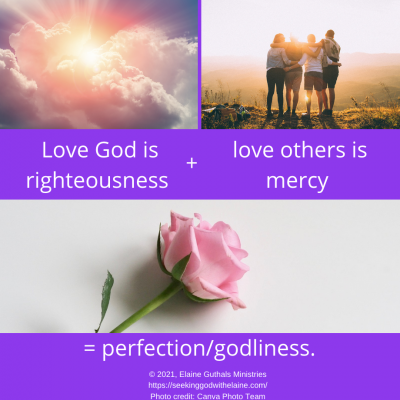
Notice, when it says greatest commandment, commandment isn’t plural. Salvation is not contingent on “… ‘You shall love your neighbor as yourself’” There is no other commandment greater than these.’” (Mk. 12: 30 ESV).
Notice that it is plural when it says we are to obey all statutes. We can’t pick and choose in which laws and commandments we don’t believe. It is all or nothing.
This is the only way to God. He is adamant that we must come to salvation His way. Believing in Jesus means we are confident in our hearts that Jesus offered His life on the cross so that His blood would pay the penalty for our sins.
To read a related devotion, click the button below.
We know that the two greatest commandments are a simplification of all the others. “All the Law and the Prophets hang on these two commandments” (Mt. 22: 40 NIV).
We can’t, though, just look at those two commandments, say we keep them, and break all the others. Breaking any of the other laws and commandments breaks the greatest commandment.
We’ve got to try to imitate God. We’ve talked before about the New Testament word for fear of the Lord is godliness.
In our How Can We Live Godly Lives? series that we are doing for our Redo for Godliness, we’ve been talking about meditation. Buckley wrote, “This [the whole duty of man] suggests as a theme for meditation the fact that the religion revealed by God includes the entire sphere of possible human activity; that there is nothing good that a man can think, do, or say, or feel, which cannot in its highest forms be shown to be rooted in, and a fruit of, the religion which God has revealed.”
We need to meditate on everything we think, do, say, or feel — everything. Our whole lives have to be given over to God.
We know there will be a judgment day.
To read a related devotion, click on the appropriate button below.
We want to find meaning in our life because our relationship with God is where it needs to be.

For me, in reading Ecclesiastes, it was difficult to determine where Solomon fell with his beliefs. Johnson brought up something important. He wrote, “Never does the author of this book speak of religion as if it were an illusion, or of God as if He were other than true. The spiritual part by which we are related to God and know God is our genuine self.”
Solomon knew God was real. He knew He was the one for whom we should be searching.
How is sure we have the fear of the Lord is through worshiping Him and keeping His commandments. If we don’t change our character to be like His, then we really aren’t following Him.
It is important that we find that the meaning of life rests solely with a relationship with God. That will help us gain salvation and will help us in our redo for godliness. It all centers on God.
Father God. We praise Your name. We thank You that You love us and have chosen us. We commit to keep all Your laws and commandments. The meaning of life is to have a solid relationship with You. That is what we want. Amen.
What do you think?
Leave me a comment below (about this or anything else) or head over to my Facebook group for some interactive discussion.
If you don’t understand something and would like further clarification, please contact me.
If you have not signed up for the email daily or weekly providing the link to the devotions and the newsletter, do so below.
If God has used this devotion to speak with you, consider sharing it on social media.
We all at some point question what life is about. This daily devotional looks at what Solomon found in his search.
Devotions in The Meaning of Life series

The Book of Ecclesiastes is Solomon’s search for the meaning of life. We’ve come to the final chapter. What did he find?
Here is a running list of what we’ve discussed previously.
God calls us to restore our relationship with Him.
Solomon sounded like he put all of his search together and came up with the right answer. “So remember your Creator in the days of your youth …” (Ecc. 12: 1 CSB) is talking about salvation.
If you have not become a believer in Christ, please read through the
Plan of Salvation and prayerfully consider what God is asking you to do.
A – admit our sins
B – believe His Son Jesus is our Redeemer
C – confess God as Sovereign Lord
D – demonstrate that commitment by making any changes needed in our lives to
live the way in which God has called us
But what does it mean remember? We’ve talked before how God wants us to remember the past.
How can we remember Someone we don’t know? If this is prior to salvation, it seems a little odd that He would want us to reminisce about something we haven’t experience yet.
Well, we can know God through His nature. “The heavens proclaim the glory of God. The skies display his craftsmanship” (Ps. 19: 1 NLT).
But maybe we do have other things to muse on. Whale said that we owe all to God — our life and our health — as He created us. The Christian Observer brought up how He provides for us.
If we think about all of that, we can see that God didn’t create us and leave us to fend for ourselves. He is a hands-on God.
Let’s look at it this way, too. Youth is a fun time of exploring who we are. My Springfield Mom and I talked about kids going off to college for the first time. They get to make choices on their own.
The pull of the world will be great. Young disciples will have to stay strong or they might get pulled away.
Then they will have to remember their Heavenly Father and come back to Him.
Coming to salvation early in life is best.
When we first read this passage, we might think that the only time we can be saved is when we are teenagers. That isn’t what it means.
God can call us to salvation when we are as young as five. Or we can be senior citizens. God will call us when we are searching for Him and more willing to accept His gift of salvation.
We sometimes question when a child comes forward for salvation. We look, as Mudge said, on childhood as a time for enjoyment.
What is there not to enjoy in salvation? We have a relationship with our Heavenly Father. We are pursuing good. We no longer have the guilt of sin.
Burrell said what Solomon was talking about here was serving God. He thought that the best time to start serving God was when we are in our youth.
It is about piety. Piety is defined as the persistent application of moral virtues to our lives because of our supreme love for God.
It is to our advantage that we come to salvation when we are younger. It helps when we are thrown into the trials of life — when “… the days of adversity …” (Ecc. 12: 1 CSB) come. Plus, even the young are not guaranteed a long life.
Booth pointed out that, when we are younger, asking Jesus to be our Savior helps build our character. The younger we are, the easier it is to form good habits.
That is important because our character is who we are. Our character is our thoughts, feelings, and actions all added together.
Booth wrote, “At the centre of character there is always a governing principle.” If the governing principle is at the center of character, we have to make a choice as to whether it will be good or evil. That choice will form our character.
Solomon described life a couple of different ways in these verses.
Solomon’s discourse told us several things. All of us will die once. We won’t get out of that.
However, there is something after this lifetime. We will live throughout eternity. It just depends where we will be taking up residence.
Mankind will have to suffer the consequences for our choices for eternity. Since we are responsible beings, we cannot get around paying the price when we choose an evil act.
But we start paying the consequences here. Burrell wrote, “Reverent obedience to God is the only method of having a life that shall be worth living.” When we have God as the center of our character, obedience is much easier.
This life is in preparation for our lives in eternity.
Talmage explained that the almond tree blooms in January in Palestine. He wrote, “It breathes its life into that winter month as a promise of God sometimes lightens up and sweetens the coldness and desolation of a sorrowing spirit.”
I love what Young said. He wrote, “He does not enter it [eternity] by a sudden leap or bound, but he is, as on a journey, continuously progressing nearer and nearer to it. This is life — a constant home-going.”
What Young is talking about is living our lives so that we can get to eternity. It is a journey — a journey down the Sanctification Road.
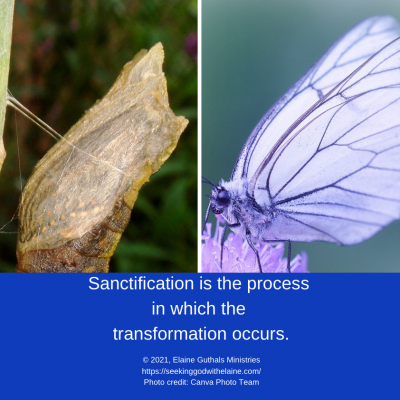
When we realize there is a spiritual nature, we can be assured that God is real. That is what gives us the strength to not fear death.
Scott told us why we can believe that the soul is immortal. Since our souls are spiritual, they can make endless improvements. He reminded us that, since we are made in the image of God, we are all predisposed to be religious.
We know through Scriptures that Heaven is real. We know that we immediately go to Heaven or hell upon death.
Still, after 12 chapters, Solomon still says it is futile. “‘Absolute futility,’ says the Teacher. ‘Everything is futile’” (Ecc. 12: 5-8 CSB)
Solomon couldn’t look beyond himself to truly make Sovereign God his #1 priority in life. So, he did fail in life. It was obvious why he would say it is futile.
Worldview people would probably say Solomon had it all. He was a king, so he had wealth, position, and prestige.
That isn’t enough for happiness. Happiness comes from God.

Young nicely summed up what we should do. He wrote, “Live obediently unto God in this world that you may live joyfully with God in the next world.”
Hearing His Word (Rom. 10: 17).
Reading His Word (Rev. 1: 3).
Praying to Him (Heb. 4: 16).
Studying His Word (Ac. 17: 11).
Meditating on His Word (Ps. 1: 1-2).
Memorizing His Word (Ps. 119: 11).
Life is about restoring our relationships with God. He calls us to do that. It is our choice to follow Him.
Father God. We want to follow You. We admit our sins, believe on Jesus as our Savior, and confess you as Sovereign God. We look forward to spending eternity with You. Amen.
What do you think?
Leave me a comment below (about this or anything else) or head over to my Facebook group for some interactive discussion.
If you don’t understand something and would like further clarification, please contact me.
If you have not signed up for the email daily or weekly providing the link to the devotions and the newsletter, do so below.
If God has used this devotion to speak with you, consider sharing it on social media.
When we look to being of the world but not in it, we focus on God. This daily devotional looks at focusing on salvation.
To read devotions in the Redo for Godliness series, click the appropriate button below.
To read devotions in the How Can We Live Godly Lives? series, click the button below.

If we take our focus off the world, we can focus on God and find salvation.
We’ve been looking at Charnock’s sermon entitled The Sinfulness and Cure of Thoughts to show us how to cleanse, a.k.a. sanctify, our thought processes. Charnock has taught us
Here is a running list of what we’ve discussed previously.
Focusing on God helps us to look past the world and to repent from our sins.
Being of the world is not a good thing. Jesus said we would die in our sins if we were.
Dying in our sins should be a scary thing for mankind. The Evangelist told us what that would mean.
We’ve talked before about how the spending eternity in hell will be excruciating.
To read a devotion in the Hell Does Have Fury series, click on the appropriate button below.
But we can escape it. We have to search for God and ABCD.
Hearing His Word (Rom. 10: 17).
Reading His Word (Rev. 1: 3).
Praying to Him (Heb. 4: 16).
Studying His Word (Ac. 17: 11).
Meditating on His Word (Ps. 1: 1-2).
Memorizing His Word (Ps. 119: 11).
If you have not become a believer in Christ, please read through the
Plan of Salvation and prayerfully consider what God is asking you to do.
A – admit our sins
B – believe His Son Jesus is our Redeemer
C – confess God as Sovereign Lord
D – demonstrate that commitment by making any changes needed in our lives to
live the way in which God has called us
It comes down to do we believe Jesus is our personal Savior. Do we believe that we are sinners and that He paid the penalty for our sins so that our relationships with God can be restored?
What does it take to believe? Beddome gave us a list. We have to recognize that
If we know those three things to be true, we believe in Jesus as our Savior. The next step is to ABCD.
Just think of all the blessings we would miss if we hadn’t ABCDed! Thomas said these are physical, social, mental, and redemptive blessings.
But it is our choice whether we are going to believe Jesus is our Savior or not. We don’t have to worry that we have committed too great a sin that God will not forgive us. Ryle wrote, “All manner of sin may be forgiven.”
We know that there is only one sin that God won’t forgive. I believe that the unpardonable sin is unbelief.
God isn’t going to go up to Jesus and say, “Son, You did everything I asked You to do. But I just can’t send all these people to hell. I am going to let everyone into Heaven — whether they have ABCDed or not.”
That isn’t going to happen. We know God is unchangeable.
To read a related devotion, click the button below.
Yes, God has love, mercy, and grace that He lavishes on us. But we have our part. It isn’t just a one-sided covenant.
It is the unbelief that marks people to be of the world.
Believing isn’t enough. We have to repent and believe. “And saying, ‘The time is fulfilled, and the kingdom of God is at hand; repent and believe in the gospel’” (Mk. 1: 15 ESV).
Bolton noted the importance of repentance. Repentance is acknowledging our separation from God and expressing sorrow for breaking God’s laws and commandments by making the commitment to changing ourselves through obedience so that we no longer do the wrong things. Bolton wrote, “If but one sin be unrepented of, the man continues still a bond slave of hell.”
If we leave one sin unrepented. One sin.
We don’t want that. We want to be prayed up.

The sermons didn’t say anything about thoughts. But we have to consider our thoughts when we look at salvation.
What we have to do is renew our minds, including our thoughts. Renewing our minds – in fact, all of us – means changing ourselves to be more like God.
When we search for salvation and find it, we have to change our views and convictions to those God holds. We have to concentrate on being a new creation.
To read a related devotion, click the button below.
Thomas did address our character, though.
Christ’s character was divine. But when we think about it, Thomas said that our soul is, too. We were made in the image of God.
Thomas brought up another good point. Jesus mingled with people, yet He was distanced from them in character. He wrote, “The crowd had nothing in common with Him. What they honoured, He despised; what He loved, they hated. Hence, He only felt akin to those who had kindred sympathy.”
Thomas explained why Jesus had to be morally above mankind. “Had He not been thus morally above mankind, He had lacked the qualification to redeem souls. Holiness has the power to convict, to renovate, to sanctify, and to save. A man who is one with sinners, morally standing on the same platform, can never save them.”
This is a good argument for when worldview people say they believe having a good character is enough. Only Jesus could save us from our sins because His moral character was above ours.
We have to be sanctified up to His character. Mankind’s character is not enough to redeem ourselves. What the worldview sees as good enough isn’t because the worldview character does not have God in it.
We know what Jesus’ character was — and still is. Thomas wrote, “Though His physical personality is gone, His character is here still.”
We have everything to lose if we do not ABCD and choose Jesus. We have everything to gain if we do.
Father God. We praise You for being Sovereign God. Thank You for designing the Plan of Salvation so that we can have our relationships restored with You. We look to You instead of the world. Amen.
What do you think?
Leave me a comment below (about this or anything else) or head over to my Facebook group for some interactive discussion.
If you don’t understand something and would like further clarification, please contact me.
If you have not signed up for the email daily or weekly providing the link to the devotions and the newsletter, do so below.
If God has used this devotion to speak with you, consider sharing it on social media.
There is a lot of living for us to do once we join the living and before we face death. This daily devotional looks at God’s expectations on how we live our lives.
Devotions in The Meaning of Life series

We started by talking about facing death – facing spiritual death. The last devotion was about how we joined the living.
Usually, there is a lot of time between. How does God expect us to live the life that we’ve been given in between?
Here is a running list of what we’ve discussed previously.
We are to enjoy life.
I bet there are some who really question these words. Taken one way, it can smack of worldview pleasures.
In fact, the Plain Sermons by Contributors to the “Tracts for the Times” thought that was Solomon’s intent. They wrote, “As they stand in Ecclesiastes, they are intended to represent the sayings of sensual, careless people, indulging themselves in their profane ways, their utter neglect of God and goodness, with the notion that this world is all. It is much the same as the unbeliever’s saying, ‘Let us eat and drink, for to-morrow we die.’”
No, I don’t think God is saying that to us. But I do know He is saying these words to us.
What? Do you think being a disciple of Christ means putting on our grumpy faces, starving ourselves, and being sticks in the mud?
No, we are to enjoy life. We are to find the joy that God gives. “May the God of hope fill you with all joy and peace in believing, so that by the power of the Holy Spirit you may abound in hope” (Rom. 15: 13 ESV).
To read a related devotion, click the button below.
If God gives us this joy, peace, and hope, He isn’t going to want us to be blowing it with our pouty faces on — or worse. He wants us to exude a happiness of knowing Him.
Yes, God does ask us to give up things. Sometimes, He asks us to give up everything. He definitely asks up to give up sin.
Devotions in the Forsaking All for Jesus series
Just think about what encouragement those words would be when we are in give-up mode. “Enjoy life because your works have been accepted.”
We know we are set for good works. “For we are his workmanship, created in Christ Jesus for good works, which God prepared beforehand, that we should walk in them” (Eph. 2: 10 ESV).
Remember, good works means that we give God our best to complete whatever tasks He assigns for us to do. God accepts our work when He has called us to do it.
We are to enjoy a life free from sin.
Okay, where does the white robes come from? Peter described us as being priests.
“But you are a chosen race, a royal priesthood, a holy nation, a people for his own possession, that you may proclaim the excellencies of him who called you out of darkness into his marvelous light.” (I Pet. 2: 9 ESV). Prentiss wrote that “The priestly robes worn in the temple service were white …”
We know that one day we will wear those white robes. “After this I looked, and behold, a great multitude that no one could number, from every nation, from all tribes and peoples and languages, standing before the throne and before the Lamb, clothed in white robes, with palm branches in their hands” (Rev. 7: 9 ESV)
This is a command, though, for each of us to ensure our robe stays white. We don’t want to soil it with the stain of sin.
We want to remain pure. Pure means not being sinful or having the stain of sin.
Prentiss reminded us that this is something we have to do on our own. I can’t keep Adam’s robe white.
Oh, yeah. Momma Bear here wants to do just that. But I can’t.
Buddy Bear is in charge of his own robe. “Whoever believes in him is not condemned, but whoever does not believe stands condemned already because they have not believed in the name of God’s one and only Son” (Jn. 3: 18 NIV).
I know. Verse 8 says “… all the time …” (Ecc. 9: 8 CSB).
The human side of me is screaming, “Not going to happen.” The disciple side of me is countering, “But we want to have the character of God all the time.”
We strive to be the disciples God calls us to be. When we fail, we ask for forgiveness. Forgiveness is, when we ask, God pardons us because we have shown repentance for breaking His laws and commandments.
Prentiss said this that caught my eye. He wrote, “The clean garment shows the dirt at the slightest contact.” We have to be very careful to ensure that we stay pure in God’s sight.
God didn’t call us to be idle.
The first thing we have to do is work out our own salvation. This is on our job description.
Job Duty #2
Work Out Our Salvation (Philippians 2: 12)
Next, God wants us to tell others about His love to expand His kingdom. He called us to do His work as we go.
“Go therefore and make disciples of all nations, baptizing them in the name of the Father and of the Son and of the Holy Spirit, teaching them to observe all that I have commanded you. And behold, I am with you always, to the end of the age” (Mt. 28: 19-20 ESV).
The go therefore isn’t necessarily a call to move to a foreign country. It is a call to witness as we are living our lives.
So, yeah, each of us can do it. Each of us are supposed to do it.
But why does God call all of us to it? Isn’t that a Pastor Joey job?
It is a basic principle of education. We learn by doing.
Lecture at us, and we will pick up some of it. Make us actually do it, we retain more. (Do you really want a surgeon who has never even practiced on dummies cutting on you?)
Barrow gave us a list of why we should find something to do with our hands.
What God wants to see is our diligence. Tillotson identified this as a sincere obedience to God’s laws and commandments and a sincere repentance.
To read a related devotion, click on the appropriate button below.
I think it is interesting that this verse starts with “Whatever your hands find to do …” (Ecc. 7: 10 CSB). I know I won’t be able to find it right now, but I know we just talked about us having to do the work that God wants us to do.
We can’t just say, “I am going to do this,” and expect God just to accept and bless it. We have to do what God is calling us to do.
Let’s look at it this way. We think of God’s work as the missionaries, preachers — some full-time job.
But what did Jesus say when He talked about separating the sheep and the goats? “For I was hungry and you gave me food, I was thirsty and you gave me drink, I was a stranger and you welcomed me, I was naked and you clothed me, I was sick and you visited me, I was in prison and you came to me” (Mt. 25: 35-36 ESV).
Those don’t have to be full-time jobs. They don’t even have to be an everyday occurrence.
The point is, when God puts someone in our path, we respond in His way in His name. We do it sincerely and promptly.

We don’t know how long we will have the opportunity to serve. The opportunity may be available for a limited time. We may be facing death before we know it.
God wants us to act when He calls.

Tillotson reminded us of something we do tend to forget. He wrote “So that to obey and please God is in truth nothing else but to do those things which are really best for ourselves.”
God is only asking us to do what is the very best for us. He isn’t being some meany. He is loving us.
Romans 8: 28 says, “And we know that for those who love God all things work together for good, for those who are called according to his purpose” (ESV). God works all things, not just some. All.
Tillotson gave us some thoughts to stimulate our diligence when considering our service to God that I’ve turned into questions.
Tillotson reminded us that, when we do face death, a life in the service of God will give us much solace. How we spend eternity is determined how we spend our lives here. That means we will reap what we sow.
I have created a worksheet of the questions above. Click on the button below to access it.
God wants us to live this life. If He didn’t, He would have taken us home at conversion. He left us here so that we could become more like Him and spread His gospel message to those who need to hear it.
Father God. Thank You for providing this life for us. We choose to serve You in whatever way You call us to do. We will do random acts of kindness in Your name. Help us to serve You. Amen.
What do you think?
Leave me a comment below (about this or anything else) or head over to my Facebook group for some interactive discussion.
If you don’t understand something and would like further clarification, please contact me.
If you have not signed up for the email daily or weekly providing the link to the devotions and the newsletter, do so below.
If God has used this devotion to speak with you, consider sharing it on social media.
All of mankind face death. This daily devotional looks at what it means to join the living.
Devotions in The Meaning of Life series

It was always God’s plan that we should not have to face spiritual death long. Even before we were created and committed the original sin, the Plan of Salvation was waiting for the fullness of God’s time to be implemented.
Solomon quickly turned from his discussion of facing death to the hope od joining the living. Let’s take a look.
Here is a running list of what we’ve discussed previously.
Choosing to accept God’s gift of salvation changes us from being spiritually dead to spiritually alive.
Hope is the expectation, also called a living hope, based on the confidence that, because of our relationship with God, our names will be found in the book of life.
What Solomon is talking about here is hope for spiritual life over spiritual death.
We’ve talked before about there really aren’t degrees of sin. All sin, regardless of what we consider its severity, is a rejection of God.
To read a related devotion, click the button below.

That being said, the Homilist interpreted verse 4 an interesting way. He wrote, “Some sinners ARE MORE CONTEMPTIBLE THAN OTHERS.”
See, I would have interpreted verse 4 to mean live dog was someone who had joined the living through a profession of faith and the dead lion as being someone who was still facing death. When we add verse 5, that makes sense if Solomon was talking about a discussion of spiritual death.
But then, I can see where the Homilist is coming from. Even though the outcome — rejection of God — is the same, the nature of the person committing the sin is different.
A murderer is different than a liar. A thief is different than an adulterer.
The sin could be, as the Homilist said, based on circumstances. What we would call extenuating circumstances doesn’t negate that we committed the sin.
We sin based on free will. Free will is the ability within us to make decisions, which determine actions that produce character.
The bottom line, though, doesn’t change. Sinners will be judged and condemned to an eternity in hell if they do not ABCD. That lion will be dead.
If you have not become a believer in Christ, please read through the
Plan of Salvation and prayerfully consider what God is asking you to do.
A – admit our sins
B – believe His Son Jesus is our Redeemer
C – confess God as Sovereign Lord
D – demonstrate that commitment by making any changes needed in our lives to
live the way in which God has called us
Part of it, too, is that I wasn’t aware of the symbolism of the lion and the dog. Bray said that the lion was the symbol of something brave and kingly. The dog symbolized something base and contemptible.
Bray is correct in saying that God is not looking for a show. We must make a choice to fully change our character to be more like His. We can’t ABCD, and then not start on the Sanctification Road.
God isn’t interested in us buying into the ceremony of religion. He doesn’t want us going through the motions. He wants the relationship.
Hughes didn’t differentiate between the contemptibleness of the sin. He just noted that, once dead, we no longer have hope. He wrote, “Life is the period within which all is possible that is requisite and required. A dead lion is helpless and hopeless, a living dog is able and hopeful.”
Once we take our last breath, we lose our free will. Our choice has been made. If we haven’t chosen Jesus as our Savior, all hope is gone.
Hughes argued that what Solomon was talking about here was how we live our lives. We can’t be a good person and think we will get into Heaven. We have to ABCD.
We don’t know that we are spiritually dead until we realize we need Jesus as our Savior.
Solomon expanded on what he meant by saying that the living understand what the dead don’t. It is one of those passage that we really have to know what we are talking about.
The way I read it isn’t exactly the same way Hopkins interpreted it in the one sermon I found. But I think we are coming at it from different directions.
What I got from Hopkins was that we are so busy living, we don’t pay attention to dying. It is only when we come up with an illness that we acknowledge the mortality of this body. Sometimes, it comes when a loved one dies.
Still, we aren’t given a ticket with a date and time stamp on it. We don’t know when we are going to take our final breath. We don’t know how it is actually going to shake out.
Ooo, baby. Hopkins wrote that, even when we know the end is coming, we sometimes are in denial. We still don’t prepare to meet our Maker.
Hopkins wrote, “There is a double necessity of death on account of sin. As a punishment. As a purgation of it.”
I take it another way, especially if we didn’t grow up in a church environment. We aren’t going to have any clue about spiritual life/spiritual death until we start searching for God.
Remember, a spiritual life is totally opposite to our normal physical, sinful life. We aren’t going to be born with knowledge of it.
We are going to have to actively search for God. We are going to have to make a conscious decision to follow Him.
Hearing His Word (Rom. 10: 17).
Reading His Word (Rev. 1: 3).
Praying to Him (Heb. 4: 16).
Studying His Word (Ac. 17: 11).
Meditating on His Word (Ps. 1: 1-2).
Memorizing His Word (Ps. 119: 11).
I really liked Hughes’ sermon. He said some things that I really needed to hear/read.
Hughes wrote, “The past of life will not satisfy and meet the present demands of human need and Divine requirements. Every day creates its duties — every day brings its wants; the provision of the day covers the need of a day, as the work of the day covers the obligation of a day. The present will not cover the future, no more than the future can cover the present — every day must provide for itself; if it does not, it is a day of want, for the blessings of yesterday and to-morrow are partly dead things to us to-day.
Ooo, baby. Aren’t we always trying to build and grow? Haven’t we said that is what the Sanctification Road is about?
What if it isn’t a continuum leading us to be closer to God? What if it is the circles, and we begin the circle again each day?
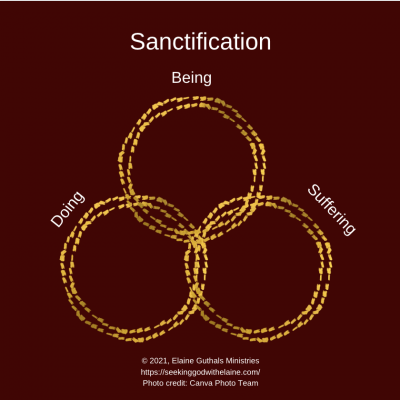
When the circles interlock like the picture shows, the doing and the suffering does kick us up to the being. The being invites Satan to tempt us, kicking us down to the suffering.
The doing is probably something different than we would think. It isn’t works based — although we have to show through our actions that we are disciples of Christ.
The doing, in my opinion, is us showing we have made the choice to join the living. We have to show we are doing for the right reason — because we are honoring Sovereign God.

We are programmed by society to shoot for bigger and better. We are to try to climb the ladder to be the head honchos, the experts, the innovators, and the influencers.
God says, no. That isn’t His definition of success. Hughes wrote, “The small used rightly is better than the great unused.”
Instead, Hastings gave us a great snapshot of what a spiritual life looks like. He wrote, “Spiritual life is characterized by peace through faith in the one great sacrifice, effort after purity, love of the Word, and practice of prayer and charity toward all.”
Did you see that? Loving others is at the of the list. We are going to get a pass from the other four things by just doing the one.
We don’t want to continue facing death. We want to join life by putting our faith and trust in God.
Father God. It humbles us that You designed the Plan of Salvation before You even created us. You sent Your Son to die on the crisis while we were still sinners (Rom. 5: 8). Still, You allow us to choose whether or not we will accept Your gift of salvation. Lord, we accept Your gift of life. Amen.
What do you think?
Leave me a comment below (about this or anything else) or head over to my Facebook group for some interactive discussion.
If you don’t understand something and would like further clarification, please contact me.
If you have not signed up for the email daily or weekly providing the link to the devotions and the newsletter, do so below.
If God has used this devotion to speak with you, consider sharing it on social media.
Facing death changes how we see our lives here. This daily devotional begins looking at what Solomon found: knowing God is the most important thing we can do.
Devotions in The Meaning of Life series

When I was diagnosed with the seizures after the EEG, I was sure the MRI was going to find a tumor. I found myself facing death.
A lot of things went through my mind. I was preparing to meet God. I was thinking about ways that I needed to continue to teach Adam how to overcome his disabilities to live a productive life.
Facing death puts a whole new emphasis on the meaning of life. Scholars think that is why Solomon was grappling with the issue in Ecclesiastes. He, himself, was older.
Let’s see what Solomon came up with.
Here is a running list of what we’ve discussed previously.
Death is scary for those who do not know Jesus as their personal Savior.
The way I read Ecclesiastes is that Solomon had been grappling with issues. Here, he finally gets it to fall into place. “… The righteous, the wise, and their works are in God’s hands …” (Ecc. 9: 1 CSB).
But this says that our works are in the hands of God. That means we can’t see them. Is that a little unsettling?
It really shouldn’t be.
Oh, I know. We don’t really care for the withdrawn part because that means it is hidden from us. It is about us, but we aren’t on top of it.
Who are we kidding? We aren’t controlling it.
Gibson wrote, “It is of great importance for our peace of mind firmly to grasp the thought that we cannot at all infer what God thinks or intends concerning any person or his works from the outward circumstances we observe.”
Elaine-speak. By what we see going on in our lives and in the world around us, we can’t tell what God’s plans for us are. So, we have to be at peace with that.
Remember what Proverbs 3: 5 says. “Trust in the Lord with all your heart, and do not lean on your own understanding” (Prov. 3: 5 ESV). Trust God, not ourselves.
We aren’t going to figure it out.
Part of me is jumping up and down right now saying, “But I have to figure it out! How can I know I am doing what You want me to be doing if I can’t figure it out?”
(These devotions started because God was talking to me. He still is. Don’t think I’ve got it all figured out.)
One of the best things I did this year was reusable pictures. What have we been talking about all along?

It’s about being, not doing.
We want to make it about doing. What am I supposed to do with these devotions now that I am on this medicine that has totally changed me? I didn’t realize how much the seizure medicine had taken me down until they tapered me off of it to put me on a different one.
I am going to do what I can, when I can. I am going to focus on being His child.
We will all face judgment and answer the same question: Have you ABCDed or not?
If you have not become a believer in Christ, please read through the
Plan of Salvation and prayerfully consider what God is asking you to do.
A – admit our sins
B – believe His Son Jesus is our Redeemer
C – confess God as Sovereign Lord
D – demonstrate that commitment by making any changes needed in our lives to
live the way in which God has called us
Gibson told us that we are safe because we are in God’s hands. There is no better place to be.
Homilies was correct in saying that, in this life, it does seem like the children of God are treated in the same ways as worldview people. They wrote, “All are subject to the same diseases, bereavements, disappointments, all go down to the grave alike.”
It brings up a good question. Why are we trying to be morally correct if it doesn’t make any difference?
Homilies brought up two good reasons.
The first one first. We aren’t getting to Heaven based on being a good person. We can champion human rights, put our money where our mouth is, and help grandma across the street.
Doesn’t matter. The only thing that matters is that we know Jesus as our personal Savior.
To read a related devotion, click the button below.
We want to base everything on what we see and know. That isn’t going to fly.
God is a spirit. He lives in a spiritual world. We will be going to a spiritual world one day.
Devotions in the The Unseen Spirit World series
The cry these days is that everything has to be more equally distributed. That may have been how God originally planned it, but Satan nixed that. In other words, that will never happen on this earth.
Homilies brought up a good point. Disciples look at things differently than worldview people do. They see trials as judgment. We see it as a Father correcting His children. They see the wealth and prosperity they have earned through their own merits. We see gifts from our loving Heavenly Father. We see what we gain from trials, not what they cost us.
We face death because of the original sin.
Once Adam and Eve bit into the fruit, mankind became sinful and cut off from God. The consequences of sin are spiritual death and separation from God. The results of sin are poverty, crime, disease, and death just to name a few.
We may think we have good hearts, but we don’t. “The heart is deceitful above all things, and desperately sick; who can understand it?” (Jer. 17: 9 ESV).
Cooper said it correctly. “The Gospel uniformly proceeds on the supposition that man is born in sin; that his corruption is not accidental, but innate; not acquired, but hereditary.”
If if is hereditary, there is nothing we can do about not having it in the first place. If it is innate, there is nothing we can do about not having it in the first place
Notice, Solomon said that our hearts are full of evil. Not a touch bad — not like the chili has a touch of firebrand in it. It is the whole bowl of firebrand.
But there is something we can do. It is called free will. Free will is the ability within us to make decisions, which determine actions that produce character.
Robertson reminded us that we have all sinned within our hearts. “You have heard that it was said, ‘You shall not commit adultery.’ But I say to you that everyone who looks at a woman with lustful intent has already committed adultery with her in his heart” (Mt. 5: 27-28 ESV).
Worse than mental madness is moral madness. The Homiliest notes those with moral madness ignore God, the greatest interests, and the greatest dignities. He wrote what God is looking for is “the dignity of a pure character, moral conquests, and self-sacrificing deeds.”

God designed the Plan of Salvation so that the consequences of sin could be eliminated – if we accepted His gift. Gibson described it this way. He wrote, “It is with Him who looks on from the side of eternity, and who makes all things work together for good to them that love Him.”
Finney noted that, when talking about moral insanity, it was talking about that of the heart. He wrote, “By the heart here is meant the will — the voluntary power.
To me, that means we make a choice. We must choose to believe in God.
We need to search for God if we do not know Him.
Hearing His Word (Rom. 10: 17).
Reading His Word (Rev. 1: 3).
Praying to Him (Heb. 4: 16).
Studying His Word (Ac. 17: 11).
Meditating on His Word (Ps. 1: 1-2).
Memorizing His Word (Ps. 119: 11).
Father God. We are full of sin. We admit we are separated from You, believe that Jesus died so that His blood paid the price for them, and confess You as Sovereign God. We will live for You in the life and can’t wait until we will stand before You in the next. Amen.
What do you think?
Leave me a comment below (about this or anything else) or head over to my Facebook group for some interactive discussion.
If you don’t understand something and would like further clarification, please contact me.
If you have not signed up for the email daily or weekly providing the link to the devotions and the newsletter, do so below.
If God has used this devotion to speak with you, consider sharing it on social media.
Solomon concluded his discussion about balance by discussing finding the balance of righteousness. This daily devotional looks at how we can be too righteous.
Devotions in The Meaning of Life series

Solomon interrupted his discussion of wisdom to talk about righteousness. He then transitioned to talk about perfection. Those two play a big part in our feeling balanced in our lives.
Here is a running list of what we’ve discussed previously.
Our lives become unbalanced when we become too righteous.
Wait. Something is really wrong here. Righteous means we are free from sin because we are following God’s moral laws.
“In my futile life I have seen everything: someone righteous perishes in spite of his righteousness, and someone wicked lives long in spite of his evil” (Ecc. 7: 15 CSB). Perishes in spite of his righteousness just seems wrong.
We generally think of this as someone who is an over-the-top religious person. Hook contrasted those with the people who “… will take care of what is the minimum of faith and good works which will save them from damnation …” Those are the ones we generally think God will look down upon.
But is Hook saying that God has problems with both ends of the continuum?
I think it will depend on our definition of overly much. If it is, like Hook described, our having increased prayer time, frequent attendance at services, and fasting, that really isn’t overly much.
Worldview people think our witnessing to them is overly much. They think we should keep our relationship with God to ourselves. What they don’t want to acknowledge is that witnessing is part of our job description.
Job Duty #4
Proclaim the Gospel (Mark 16: 15)
Job Duty #6
Make Disciples (Matthew 28: 19-20)
So, what is overly much righteousness?
Hook talked about pretenders in religion. The Pharisees were the poster child here. They thought they were overly religious, but Jesus said they didn’t have a clue.
There are also those who identify as believers who think that gives them license to sin. (Hook thought the Pharisees did, but I am not so convinced on that.) It doesn’t. God calls us to follow His laws and commandments.
Taylor identified those who try to work out their righteousness for themselves.
We try to do our own self-help program. But remember God said we can’t do it without Him.
To read a related devotion, click the button below.
It isn’t about our personal righteousness, either. It is about God’s righteousness, which we reflect.
To read a related devotion, click the button below.
Watkinson said that sometimes we allow righteousness to run wild. He noted it can be strained, arbitrary, inharmonious, and exaggerated.
We even get out of balance when we evaluate ourselves. We bite on ourselves too much for the sins we commit. We keep biting on ourselves for sins God on which has already forgiven us.
Oh, slam. Watkinson wrote, “But some of us are evermore arraigning ourselves at the bar of conscience about arbitrary, frivolous, vexatious things.”
In other words, we are sweating the small stuff. We need to quickly respond to God’s call and totally choose to follow His ways on the meaty matters of life.

Unfortunately, runaway righteousness gives itself away when it strives for standards of a character that is unattainable. Now, don’t get me wrong. We’ve been looking all year at sanctifying our character in our redo for godliness.
The problem, as Watkinson describes it, is when we try for something even more than what God is asking. I read it to mean we are trying to make us more godlike than God.
Stillingfleet took it another way. He thought what we get wrong is “… the nature and measures and bounds of what they account duties of religion.” Okay, I see that.
We like our yard sticks. We especially like our boundaries. We want to know we can go this far and no farther — but especially that we can go this far. We can do this, but not if it bleeds over into that.
Yeah. That smacks of the checklist we so love. “Just let us know so we don’t have any doubts what You are looking for, God.”
“Just let us know so we can judge others.” Yeah, that is probably more like it. Remember Wilkinson’s arbitrary and inharmonious?
Stillingfleet tied this back to our previous devotion on wisdom. Wisdom is a moral virtue.
Sometimes, we think we are the smartest person in the room. That gets really bad when we try to hook that with being overrighteous.
Jortin said meddle into other people’s lives and try to fix defects that may or may not be there. Worse yet, we try to fix God’s doctrines.
Trust me. He isn’t going to just send us to time out for that offense.
Even though we are sinful in nature, God calls us to be perfect as He is.
My first thought reading these verses was that Solomon thought he was still in Proverbs.
Boston described verse 20. He wrote, “Here is the undoubted character of all the human race, fixing imperfection and sinfulness on the best of the kind in this world, and so concluding all to be liable to sin, and under it.”
Yep, that’s how it is. We ABCD. We think we are going to keep God’s laws and commandments perfectly, and — oops, we don’t.
We’ve talked multiple times what does it really mean when it says, “Be perfect, therefore, as your heavenly Father is perfect” (Mt. 5: 48 CSB).
Boston wrote, “It is a perfect conformity of heart and life to the commands of God …” That means obeying God’s laws and commandments through the greatest commandments.
Another thing Boston said was “sincerity is not enough in the eye of the law.” We can be people of integrity. Good for us.
It isn’t going to get us anywhere on judgment day if we haven’t ABCDed.
No, we can’t be perfect in this life. “If we say we have no sin, we deceive ourselves, and the truth is not in us” (I Jn. 1: 8 ESV).
It is our duty to be perfect, but there is struggle in life as we try to be. “For the desires of the flesh are against the Spirit, and the desires of the Spirit are against the flesh, for these are opposed to each other, to keep you from doing the things you want to do” (Gal. 5: 17 ESV).
Every time we fall short, we need Jesus’ blood to take away the sin.
Solomon told us to not pay attention to what others say of us. Park disagreed to some extent. If we have wronged others, we need to know this.
However, we shouldn’t be overly concerned about what others think. We have to realize that worldview people are judging us on worldview standards, not God’s. We shouldn’t be concerned with worldview standards.
We need to be concerned with what God thinks of us.

God doesn’t want us hitting the extremes. He wants to be sober and self-controlled. Sober is a character trait distinguished by self-control, genuineness, and sound moral judgment.
Hearing His Word (Rom. 10: 17).
Reading His Word (Rev. 1: 3).
Praying to Him (Heb. 4: 16).
Studying His Word (Ac. 17: 11).
Meditating on His Word (Ps. 1: 1-2).
Memorizing His Word (Ps. 119: 11).
I can’t give any better advice than Hook. He wrote, “… be as righteous as you possibly can; go on improving; seek to grow in grace; attend to little things, as well as great; be always careful lest you should not be righteous enough, if God were this day to require your soul of you. Be very careful lest you should be overmuch wicked; let no man scare you from your duty, in seeking to advance in the straight and narrow path, which leadeth unto life, by their suggestions that ye be not ‘righteous overmuch.’”
We need to keep in balance by being sober and even keeled.
Father God. You call us to be sober and balanced. You call us to be righteous and perfect. Lord, help us to be what You call us to be. Amen.
What do you think?
Leave me a comment below (about this or anything else) or head over to my Facebook group for some interactive discussion.
If you don’t understand something and would like further clarification, please contact me.
If you have not signed up for the email daily or weekly providing the link to the devotions and the newsletter, do so below.
If God has used this devotion to speak with you, consider sharing it on social media.
Many of us are constantly looking for balance in our lives. This daily devotion looks at where that balance can be found.
Devotions in The Meaning of Life series

In this hectic world, it is easy to get our lives out of balance. Part of the problem is that we are looking at the wrong things to give us balance. Let’s take a look at what Solomon said when he was talking about the meaning of life
Here is a running list of what we’ve discussed previously.
If you have not become a believer in Christ, please read through the
Plan of Salvation and prayerfully consider what God is asking you to do.
A – admit our sins
B – believe His Son Jesus is our Redeemer
C – confess God as Sovereign Lord
D – demonstrate that commitment by making any changes needed in our lives to
live the way in which God has called us
We gain balance by gaining knowledge of God.
Patterson argued that education gives people much more than just providing for outward, physical necessities, as it is a defense. He felt this was especially true of religious knowledge. He noted “that wisdom giveth life to them that have it.”
Wisdom also gives us an intellectual life. But we have to remember that this isn’t wisdom according to the world. “For the wisdom of this world is foolishness in God’s sight. As it is written: ‘He catches the wise in their craftiness’” (I Cor. 3: 19 NIV).
It isn’t the need for knowledge that God is poo-pooing. We know that we need knowledge to know God. Patterson wrote, “It is ‘the key of knowledge’ that opens the kingdom of heaven; and if this be the constitution of the Gospel, very plain it is that the state of a human soul abandoned to utter ignorance is that of a soul devoted to inevitable death.”
We said something along that line in Elaine-speak a while back. We don’t get anywhere on our path to salvation without knowledge.

The knowledge that the Holy Spirit gives us is said to quicken us. That means it enlivens or animates us. It gets us going from spiritually dead to spiritually alive.
Melvill wrote that it also gives us the feeling of “… having thrown off the bondage of corruption …” A lot of that has to do with being new creations. “Therefore, if anyone is in Christ, he is a new creation. The old has passed away; behold, the new has come” (II Cor. 5: 17 ESV).
We can’t try to use knowledge to make it our god. We can’t look for an explanation that will replace God as Sovereign God.
Patterson had a lot to say about those who grew up uneducated. He called them wasteful and immoral.
I am sure worldview people would probably take exception to that. Whatever they do is a waste because, unless it is done for God, it is temporary — even if they think it is good. This world will end, and unless the service is performed for God, all the reward will end when the earth does.
We’ve talked about the worldview morals not being enough. They need to be kicked up to spiritual graces. They have to come through our faith. Faith is the conviction that the doctrines revealed in God’s Word are true, even if we do not understand all aspects of them, a belief which impacts our lives.

God works in our lives to give us balance.
Verse 13 starts out with an interesting phrase. It talks about the work of God. Roe talked about several different applications of this phrase.
God works in our lives. He controls what happens.
Jay reminded us that God is the author of life. He wrote, “Nothing can befall us without the permission and appointment of the all-disposing providence of our Heavenly Father.”
Roe pointed out that it is our duty to be satisfied with our lives. Yes, he said it is our responsibility and obligation to be happy and content — regardless of the circumstances.
Think about it. We are sinners by nature. Sinners are all people who have not made a genuine profession of faith — who have not sincerely ABCDed.
We are also sinners because we choose to sin. Sins are actions by humans that disobey God and break one of His reasonable, holy, and righteous laws and commandments, goes against a purpose He has for us, or follows Satan’s promptings.
We don’t deserve God’s mercy. We definitely aren’t entitled to it.
Boston said that we can only obtain the balance by faith. We can’t get there by our feelings. He wrote, “For it is the light of the Word alone that represents them justly, discovering in them the work of God, and consequently designs becoming the Divine perfections. These perceived by the eye of faith, and duly considered, one has a just view of afflicting incidents, fitted to quell the turbulent motions of corrupt affections under dismal outward appearances.”
What is this thing that has been made crooked? “When Adam sinned, sin entered the world. Adam’s sin brought death, so death spread to everyone, for everyone sinned” (Rom. 5: 12 NLT).
We can’t save ourselves. “For by grace you have been saved through faith. And this is not your own doing; it is the gift of God” (Eph. 2: 8 ESV).
The Homilist reminded us that not all crooked things are evil. All, however, are made by God. I loved the reasoning for the crooked things.
The Homilist expanded on what was meant by crooked things. Included were natural disasters. Anxiety, fear, sorrow, and bereavement were added. The results of inequitable distribution of wealth and abilities is attributed to sin. Broken character feeds broken relationships.
Unfortunately, we can see it in our relationship with God, too. The Homilist wrote, “No sooner do we begin to try to serve and love God than these roughnesses crop up. Watch the door of your lips and see how much irreverence, how many vain and foolish words come forth. Watch your tempers, and something surely comes to put them out of gear.”
We can only find our balance by finding it in a right relationship with God. When our relationship with Him is as it should be, our lives will be balanced.

Jortin compared Solomon’s treatment of the subject with Paul’s. Where Solomon advocated cheerfulness in prosperity and considerateness in adversity, Paul pressed us to rejoice always. Jesus, on the other hand, told us to rejoice and be glad.
That follows. When we think about God’s attributes of goodness, purity, and holiness, it doesn’t have room for gloom and doom.

We want to find our balance in God. We want to be preparing for our lives for eternity.
Father God. We know we will not find balance in our lives without You. We look to You for purity, holiness, and love. We will find it in a relationship with You. Amen.
What do you think?
Leave me a comment below (about this or anything else) or head over to my Facebook group for some interactive discussion.
If you don’t understand something and would like further clarification, please contact me.
If you have not signed up for the email daily or weekly providing the link to the devotions and the newsletter, do so below.
If God has used this devotion to speak with you, consider sharing it on social media.
Paul begins Romans 16 by mentioning a lot of people we have no clue who most are. This daily devotion looks at a practical application of unity and love.
To read devotions in the Redo for Godliness series, click the appropriate button below.
Devotions in the Transformed to Perfection series
Devotions in the On Being a Minister series

Wow. We’re on the last chapter of Romans Part 2. I don’t know about you, but I always find these a potpourri chapter. They seem like they are a hodgepodge of everything Paul wants to cram in before he says, “Sincerely, Paul.”
Let’s wade through and see what we get.
Here is a running list of what we’ve discussed previously.
I know. A lot of verses listing a lot of people, most of whom had never been mentioned before and who were never mentioned again.
But look at it this way. We sometimes get this impression that Paul is an elitist and hard to get along with. Maybe it is a holdover from his Saul days.
We get this impression that Paul is a harsh, his-way-or-the-highway type of guy. He seems to be a rigid, stuffy, stubborn guy.
Well, it is God’s-way-or-the-highway. There is no wiggle room there.
Still, look at all these people Paul has connected with at a church he hasn’t even been at before. What better way to finish out the theme of unity than with a chapter on specific people!
To me, it is interesting that Paul started out with Phoebe. He had high praise of her — who Parker calls a deaconess — that seems to contradict I Timothy 2: 12. “I do not permit a woman to teach or to exercise authority over a man; rather, she is to remain quiet” (I Tim. 2: 12 ESV).
“So you should welcome her in the Lord in a manner worthy of the saints and assist her in whatever matter she may require your help …” (Rom. 16: 2 CSB). It does not sound like Paul was putting any limits on how the Romans were to assist Phoebe.
Paul also mentioned Priscilla and Aquila, who we met in Acts 18. Brock reminded us that the Roman church would have been more than likely meeting in homes. Robinson agreed. He wrote, “Private houses (Acts 2:46) were the birthplaces of Christian worship, and public buildings were not erected till the third century. When it became dangerous to meet even in private houses the Christians assembled in the catacombs. Aquila’s house became a Church wherever he went, which shows us that zeal for Christ’s cause should be carried about with us.”
There may just have been two or three meeting at a time. “For where two or three are gathered in my name, there am I among them” (Mt. 18: 20 ESV). So, welcome each other with a kiss of peace.
I kind of like the King James Version of this verse. “… Salute my well-beloved Epaenetus, who is the firstfruits of Achaia unto Christ” (Rom. 16: 5 KJV).
Look at how Lathrop ties that into Jewish history. He wrote,
“The firstfruits under the law were an offering made to God of the first ripe fruits before the harvest was begun. In allusion to this Christ is called ‘the firstfruits of them that slept,’ because His resurrection is an earnest and pledge of the resurrection of believers. The sanctifying and comforting influences of the Spirit are called the firstfruits of the Spirit, as earnests of heavenly happiness. James tells us that God hath begotten us ‘that we should be a kind of firstfruits of His creatures’ (Revelation 14:4). By a like allusion the apostle calls the first converts in a particular place the firstfruits of that place unto Christ. Now consider this man, dwelling in the midst of heathen, on the preaching of the apostle, coming out from among a corrupt and idolatrous multitude, and, by his example and conversation, inviting his fellow-citizens to turn to the living God; and will you not admire his integrity, zeal and fortitude?”
Yeah, don’t get me wrong. The first convert in Asia is very important. Epaenetus was the first of many. He was the first of the harvest. Jesus was the first to be resurrected.
Andronicus and Junia, kinsmen of Paul, were husband and wife. Robinson thought he could have been a nephew. Spurgeon brought up their conversion prior to Paul’s and their praying for his uncle’s salvation. Family praying for family.
Ooo. That means we have to do some math. Blackburn said that Paul wrote this letter in A.D. 58. If Paul’s conversion happened in A.D. 34, and Andronicus’ and Junia’s happened before that, for their day, they would have been considered getting on in years.
The only imprisonment before the writing of this letter where Andronicus and Junia could have been prisoners with Paul was in Acts 16. This was when Paul and Silas were in the Philippian jail and God sent the earthquake to get them out.
Robinson also thought Andronicus might have been the nephew who discovered the plot to kill Paul in Acts 23. “But when the son of Paul’s sister heard of this plot, he went into the barracks and told Paul” (Ac. 23: 16 NIV).
That started Paul on his trip to Rome.
Next, we have a list of unknown people. Robinson thought that Amplias might have been another adopted son, like Timothy and Titus. I kind of doubt that. We would have heard about him if he were.
Gifford thought Aristobulus was “… the grandson of Herod the Great, and brother of Agrippa and Herod, kings of Judaea and Chalcis …” But the greeting wasn’t going to him. It was going to his household. Likewise, greetings were sent to the household of Narcissus.
Spurgeon noted that Tryphaena and Tryphosa were two sisters. He wondered where the menfolk were. Burn pointed out that, even though they had bad names, they served God.
Really, we don’t know much about these people. Brown calls them unknown Christians. That’s enough. They served God. He knows them.
That comforts me. I am an unknown Christian. But God knows me.
Brock had an idea who the mother was. More than likely, when Saul the Jew became Paul the Christian, Saul’s mother disowned him. It sounds like Paul picked up a Jerusalem mom like I picked up a Springfield mom. He adopted Rufus’ mom. I hope his was a jewel like mine.
(I personally like the mother/son combination.)
Philologus and Julia may have also been husband and wife, or they may have been brother and sister. Nereus and his sister definitely were siblings.
But did you notice the ones listed in verse 15 only get a greeting? They don’t get a commendation. Philologus’ sister doesn’t even get mentioned by name. Well, Rufus’ mother in verse 13 doesn’t either.
Did you see the diversity in this list? Some were men; some, women. Some were Jews; some, Gentiles. Some were old; some, young.
What did they all have in common? They were doing God’s work. Yes, even the women.
They were doing what God wanted them to do. They were listening and obeying.
God isn’t always going to ask us to do the easy stuff. Sometimes, He is going to ask us to do the hard. Paul said that Priscilla and Aquila “… risked their own necks for my life …” (Rom. 16: 4 CSB).
Maybe God won’t ask that of us. He may just ask us to give up something or someone we really rather would not. Sometimes, He does ask us to give up all.
Devotions in the Forsaking All for Jesus series
God uses each of us — man, woman, young, old — to further His kingdom. We shouldn’t stand in His way.
Here is how Parker described it. He wrote, “What is the secret of union between such a community and the solitary apostle? Love. This is the indissoluble bond. Every other tie snaps. Some persons have suggested that Paul was not the most lovable of men. Probably this was so according to the common canons, but so much the worse for the common canons. Paul was a man who made enemies every day, but the man who is most hated is also the man who is most loved.”
What does this tell us? We are going to have our detractors, the ingratitude. But if we are doing God’s work, we will find the love.
Looking back on my spiritual tornado, I can see the detractors and the ingratitude — and I can see the community where I had the love. I always said I was right where God wanted me to be — until He wanted me somewhere else.
Wouldn’t you expect the lost to be a long list? This is a big world. It takes a lot of workers to get God’s Word out to all who haven’t heard it yet.
Also, God is the God of love. He loves the world. That is a huge list, too.

What does this mean? Thomas put it best. He wrote, “That right relationship to Christ creates a right mutual relationship between men.”
Not as the world thinks is right, but as God thinks is right.
Look at it this way, too. If Paul is the Pastor Joey-type and we are the ones mentioned in the first fifteen verses, that’s a lot of love in the ministry!
Father God. You call each of us because You want our relationships restored to You. You want each of us to share our love with others. Help us to love each other and show this love to those who need to know You. Amen.
What do you think?
Leave me a comment below (about this or anything else) or head over to my Facebook group for some interactive discussion.
If you don’t understand something and would like further clarification, please contact me.
If you have not signed up for the email daily or weekly providing the link to the devotions and the newsletter, do so below.
If God has used this devotion to speak with you, consider sharing it on social media.