Category: Attitude

  • How Do We Choose Our Plans Wisely?

    People may plan all kinds of things, but the LORD’s will is going to be done.
    Proverbs 19: 21

    This is what the Lord says: “Stand at the crossroads and look; ask for the ancient paths, ask where the good way is, and walk in it, and you will find rest for your souls.”
    Jeremiah 6: 16
    Scripture: Matthew 5: 21-26

    We generally make plans regarding what we want to do in our lives. Sometimes, though, we hit a crossroad and wonder which direction we should go. This devotion looks at Proverbs 19: 21 and Jeremiah 6: 16 to see what directions those verses give us in going through our daily walks.

    Cliff Notes

    • We use everything from goals to to-do lists to plan our lives.
    • God may have other plans for us.
    • At times, He leads us to a crossroad so that we must choose or reject the way He is leading us.
    • God wants us to go back to the way He originally intended us to live.
    • By choosing God’s way, we will find rest in our souls.
    Flowers with title How Do We Choose Our Plans Wisely?

    We Are Planners

    I remember when Adam was little, it was his goal to be seven feet tall. I tried to convince him to pick a goal that he could work toward and have a impact on instead of something that just is what it is.

    Generally, we like to have things all mapped out. We like to have something to work toward. Even if we don’t have it all written down, we usually have a pretty good idea where we are going and what we want out of life.

    Most of us try not to leave too many things to chance. We have everything from goals to to-do lists to get us where we are going.

    This is especially true of our careers. We are asked from a young age what we want to be when we grow up.

    That gets us to start planning. We have to make sure we get the education needed. Sometimes, we have to relocate to go where the jobs are. Sometimes, it feels like all of the dominoes have to fall into place.

    There are some people who also have personal goals. They want to be married by a certain age. Some parents have their kids either by a certain age or according the ages of the siblings.

    God May Have Different Ideas

    And here comes God. Some of our plans, He may give us a “yes.” Others, He might give us a flat-out “no.” He may have plans of His own.

    Those are the easiest to see. We like definitive yes/no answers. It is the “wait” or the “I’ve got something better” answers that twist us up.

    We have been so programmed for instant gratification that waiting is hard. We feel that we have to be — at a minimum — making progress toward the goal. If we don’t see forward movement, we fly off the handle.

    To some of us, better isn’t always better. Have you ever had something on your Christmas list, but someone got you something ‘better”? In your mind, you are going, “Why did you get me this?”

    We generally have our minds set on one thing — what we want. It is difficult for us to see how something else would be better. This is especially true if we don’t see God’s hand working in the situation.

    At the Crossroads

    We may not see God’s hand working — until we get to the crossroads. Hopefully, we then can see how He has brought us to where we are. Hopefully, we can see how He is offering us a choice.

    You see, it is always about our choice. We can always do it God’s way, or we can head off on our own.

    The Bible talks about the choices that we have. “… For the gate is wide and the way is easy that leads to destruction, and those who enter by it are many. For the gate is narrow and the way is hard that leads to life, and those who find it are few” (Mt. 7:13-14 ESV).

    The wide gate on the crossroad to the left is where the goats are headed. We can imagine that it is bright and sunny with lots of trees and flowers. Everything about it is inviting.

    The narrow gate on the crossroad to the right is where the sheep are headed. We can imagine nothing about it will be particularly inviting. It is rocky and steep. You are going to want to have to go there.

    To read Will Being Kind to Others Get Us into Heaven?, click the button below.

    Ask for the Ancient Path

    The kicker is that the path God wants us to go on is not only narrow, but it is also ancient.

    Hasn’t God heard of new and improved? We always want things that run faster, cost less, and have a slimmer, sleeker design.

    But God wants us to go back to the olden days? In a way.

    God wants us to go back to how the law was originally intended. God wants us to go back to the way He originally intended us to live. Look at Matthew 5: 21-22 as just one example of what I am talking about.

    “You have heard that it was said to the men of old, ‘You shall not kill; and whoever kills shall be liable to judgment.’ But I say to you that every one who is angry with his brother shall be liable to judgment; whoever insults his brother shall be liable to the council, and whoever says, ‘You fool!’ shall be liable to the hell of fire” (Mt. 5: 21-22 RSV emphasis added).

    Jesus was saying that is what you have been taught, but this is what God really intended. You hear these redirections all through His messages in the gospels.

    Bible

    It wasn’t necessarily that it was the old way instead of the new. Jesus’ point was it was the right way. It was the way that God intended.

    Rest for Our Souls

    There is a reason for choosing the narrow way. When we walk on God’s path, we find rest for our souls. This is because “… Jesus said, ‘Come to me, all of you who are weary and carry heavy burdens, and I will give you rest. Take my yoke upon you. Let me teach you, because I am humble and gentle at heart, and you will find rest for your souls. For my yoke is easy to bear, and the burden I give you is light’” (Mt. 11: 28-30 NLT).

    This is not necessarily talking about physical rest, mind you. It is talking about rest for our souls — contentment when we live our lives for God.

    What Does This Mean?

    In a way, it seems like polar opposites, though, doesn’t it? Narrow unadorned gate. Hard life guaranteed.

    But Jesus offers peace and rest. A light pack to carry on that narrow road.

    How can it be both?

    I guess you have to put it into perspective. Jesus’ way is more fulfilling, more rewarding. It leads to eternity in paradise. What we are committed to makes us notice the weight of the load less.

    Hot air balloon

    But as always, we have to keep choosing to follow Jesus. We have to daily choose God. What God wants is for us to put our trust in Him daily. He doesn’t want us to rely on our plans and efforts to accomplish those plans.

    To read What Does It Mean to Follow Jesus?, click the button below.

    How Do We Apply This?

    How do we choose God?

    Well, first, He chose us. “For God so loved the world, that he gave his only begotten Son, that whosoever believeth in him should not perish, but have everlasting life” (Jn. 3: 16 KJV). We didn’t do anything to earn this favor. He chose us because He wanted the relationship with us.

    We do, however, have to choose God. Just as Joshua gave the Israelites the choice, so, too, must we “… choose this day whom [we] will serve …” (Josh. 24: 15 ESV). We make the choice to switch sides from being God’s enemy to God’s child.

    We choose God by admitting we are sinners, believing Jesus’ death was God’s gift to make salvation available to us, and confessing that God is now our Lord of lords and King of kings. We choose to listen to the promptings of the Holy Spirit as He convicts us and shows us of our need for the Savior.

    Then it comes full circle. “Commit to the LORD whatever you do, and he will establish your plans” (Prov. 16: 3 NIV). Our plans will be blessed because they are God’s plans for our lives.

    Gracious, merciful God. You bestow rich blessings on us that we do not deserve. You do not punish us for our transgressions to the extent we deserve. Help us to plan our paths to live in Your Will. Guide us when we reach the crossroads so that we stay within Your favor. Lead us home to be with You. Amen.

    If you have not admitted that your relationship is not right with God,

    have not asked Jesus to be your Lord and Savior,

    and have not confessed your sins,

    please read through the Plan of Salvation and prayerfully consider what God is asking you to do.

    What do you think? Think about the last time that you stood at a crossroads in your life. Did you choose God? Would you make that same decision today?  Even if you chose not to follow God in that instance, how did God use it to grow you? Leave me a comment below (about this or anything else) or head over to my Facebook group for some interactive discussion.

    If you have not signed up for the email daily or weekly providing the link to the devotions and the newsletter, do so below.

    If God has used this devotion to speak with you, consider sharing it on social media.

  • How Do We Forgive Others?

    Forgive our sins, as we forgive everyone who has done wrong to us.
    Luke 11:4 (CEV)
    Scripture: Matthew 5: 43-48

    Forgiving someone is hard. Our spouses, family, or friends may have done something that hurt us and requires our forgiveness. This devotion explores a process we can take to forgive others.

    To read devotions in the When We’ve Been Wronged series, click the buttons below.

    Cliff Notes

    • The issues are not whether we will hurt those we love; they should be whether we do it intentionally or not and whether it is unresolved.
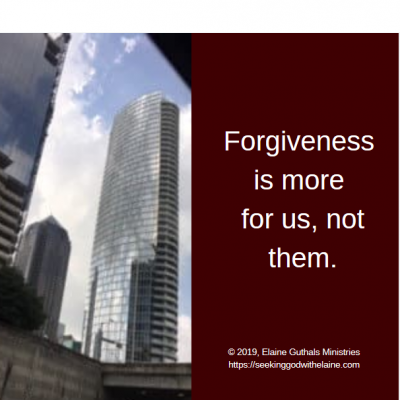
    • Forgiveness is more for us, not them.
    • We have to deal with our anger first.
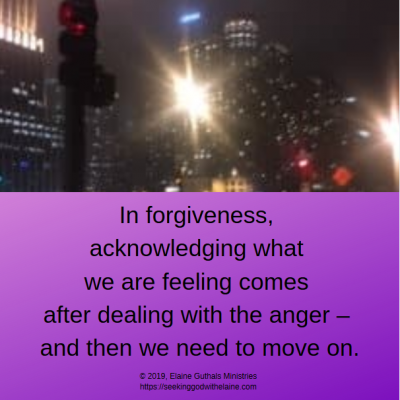
    •  Acknowledging what we are feeling comes next – and then we need to move on.
    •  Forgiveness should have an element of forgetfulness to it.
    • It probably isn’t going to be a quick fix, not a one-and-done type of thing. 
    Flowers with title How Do We Forgive Others?

    We all will hurt those we love because we are human. The issues should be whether we do it intentionally or not and whether it is unresolved.

    Luke 17: 4 says we must forgive those who ask for forgiveness – even multiple times. It is easy to forgive those who are trying their best to do right and are truly contrite when they realize they have wronged us. It is harder to forgive people when it seems like we are continually – purposefully – being wronged.

    It is especially hard to give forgiveness if the relationship is toxic. A toxic relationship has some kind of physical or emotional abuse as a component.

    But relationships don’t need to be toxic to have one partner break a relationship in some significant way. Whatever the situation, God expects us to forgive them.

    What Is Forgiveness?

    Forgiveness is when we give up the bitterness and resentment that we feel because we have been wronged. It is a conscious decision to not seek vengeance.

    Read that again. It is talking about us, not them. Forgiveness is more for us, not them.

    City building

    It is not saying that we are condoning their actions. It doesn’t say the forgiveness has to be justified. Forgiveness is not going to turn our feelings and emotions off like a faucet or wipe our memories of the incident.

    It is not even saying that the relationship will magically be restored. We might decide that we no longer want to have contact with them, and that is okay. We may decide to not tell them we have forgiven them, and that is okay, too.

    It is saying that it is a conscious decision. We control whether we give forgiveness or not – yes, even in situations where we feel we have no control.

    That is what my research into this topic said. What does God say?

    God says that forgiveness has a reason. It is so we can be blessed (Mt. 5: 7).

    Matthew 5: 43-45 says, “You have heard that it was said, ‘You shall love your neighbor and hate your enemy.’ But I say to you, love your enemies, do good to those who hate you, and pray for those who spitefully use you and persecute you, that you may be sons of Your Father in heaven …” (NKJV).

    The most common argument for believers to forgive others is that God first forgave us. Matthew 5: 14-15 says, “If you forgive others the wrongs they have done to you, your Father in heaven will also forgive you. But if you don’t forgive others, your Father will not forgive you the wrong you have done” (GNT).

    When we don’t forgive someone that damages our relationship with God. We have to be right with man before we can be right with God (Mk. 11: 25-26).

    Not forgiving someone has consequences of its own. Matthew 18: 35 says, “So My heavenly Father will also do to you if each of you does not forgive his brother from his heart” (HCSB). Ouch!

    Bitterness can come out of not forgiving someone. Unfortunately, a lot of times the person doesn’t care if we have forgiven them or not. It is just eating at us.

    So, What Do We Do to Forgive Someone?

    It is easy to say the words, “You’re forgiven.” But how do we actually do that? From the definition above, it is a conscious choice.

    We have to deal with our anger first. Ephesians 4: 26 says, “Be angry and do not sin. Don’t let the sun go down on your anger” (HCSB).

    While anger itself is okay, we have to stop letting it control our lives. Uncontrolled anger is not good for us – mentally or physically. Healing is not going to start to begin until we process the situation and turn the corner toward living the way in which God wants.

    Acknowledging what we are feeling comes next – and then we need to move on. We have to be honest with ourselves, but rehashing the past doesn’t help us. True, this may seem beyond our control as the person may still be doing a variation of the same theme.

    City at night

    Forgiveness should have an element of forgetfulness to it. That doesn’t mean you have to put yourself back in the situation. It means that you shouldn’t harp on it. Get over it. Put it to bed. Move on.

    We have to watch to see if we are making ourselves the victim. Yes, we can be the victim, but we may not always be. We have to take a good, honest look at the situation. What transpired and why?

    What is stopping us from forgiving? What changes do we need to make to diffuse the anger? What can we use as a substitute to divert our attention when the anger starts to build? How are we fanning the resentments, and how can we get past that? How can we avoid the situations that feeds the anger?

    I don’t know about you, but I do a lot of conversations in my head. We may need to corral some of our thoughts. They can be used to make something an even bigger deal than it is. They can also flip the situation so that we are not taking responsibility for our actions.

    To read How Can We Corral Our Thoughts?, click the button below.

    We need to focus on God and us. Why did this trigger this much of a response from us? What does God want the takeaway from this experience to be? How can we use what we’ve learned to help others?

    One of the hard parts is trying not to judge the other. A lot of times this stems from our hurt. It can be where we lash out. What God wants us to do is love this person.

    How Do We Apply This?

    Some may find it helpful to write down their thoughts and feelings. Journaling or writing a letter you may or may not send can be a private way to get it all out. We can acknowledge when things are really getting us down while taking a good look at how things really are.

    We can use the conversations in our heads to be able to “say” to the person what we never would be able to say in reality for various reasons. If it were real, the situation might escalate because the other may try to press our buttons – and we know how most of us try to avoid confrontations!

    Or we may have trouble getting everything out if we were really talking with the person. Sometimes, when things mean the most to us, it is more difficult to have the needed discussions. Hopefully, we can have the discussions with ourselves while taking all the emotion out.

    We can talk it out with a trusted friend or a professional. We may just need to say everything out loud. There is nothing wrong with going to a professional to work through things. They may be able to bring up things we hadn’t thought about.

    Remember, though, forgiveness can’t be forced. It has to be genuine. It must be our desire to forgive those who have wronged us.

    It probably isn’t going to be a quick fix, not a one-and-done type of thing. It is going to take us time to process and work through it. Plus, we may have to do the process several times.

    We won’t have necessarily failed when the hurt feelings comes back. We may not be letting God have full control of the situation. We like to try to clean ourselves up, but only God can do that (Jer. 2: 22). But God may just be still growing us.

    Also, it could be Satan trying to trip us up again and trying to get us farther from God. We just have to say, “I am not listening to you today, Satan.”

    We also have to remember that we are probably not going to be able to change the person. That is up to them. They are in charge of themselves. We only work on ourselves.

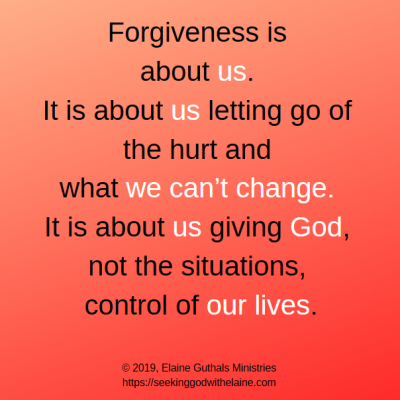
    Back to the definition. Forgiveness is about us. It is about us letting go of the hurt and what we can’t change. It is about us giving God, not the situations, control of our lives.

    Forgiveness is about us. It is about us letting go of the hurt and what we can’t change.

    Well, I’ve given myself a lot of food for thought over these four devotions. Excuse me while I go spin my gears to process all of this. It isn’t going to be easy for me. I just hope I make substantial strides. I know this isn’t going to be over and done because, hey, it is what it is.

    Loving Father. You ask us to show love to others by forgiving them. When the pain cuts too deeply, Lord, that is hard. Help us to be more like You and love others enough to forgive them. Amen.

    Related Links

    On researching how to forgive others for this devotion, I came across these these resources, which I used as the foundation for my devotion.

    Brandt, A. (2016). How do you forgive even when it feels impossible? (Part 2). Retrieved May 24, 2019, from https://www.psychologytoday.com/us/blog/mindful-anger/201605/how-do-you-forgive-even-when-it-feels-impossible-part-2

    Greater Good Magazine. (n.d.) What is forgiveness? Retrieved May 24, 2019, from https://greatergood.berkeley.edu/topic/forgiveness/definition#what-is-forgiveness

    Greater Good Magazine. (n.d.) Why practice it? Retrieved May 24, 2019, from https://greatergood.berkeley.edu/topic/forgiveness/definition#why-practice-forgiveness

    Greater Good Magazine. (n.d.) How do I cultivate it? Retrieved May 24, 2019, fromhttps://greatergood.berkeley.edu/topic/forgiveness/definition#how-cultivate-forgiveness

    Hey Sigmund. (n.d.). 15 Signs of a Toxic Relationship. Retrieved May 24, 2019, from https://www.heysigmund.com/toxic-relationship-15-signs/

    O’Shoney, C. (n.d.). How to forgive someone who has hurt you (including yourself). Retrieved May 24, 2019, from https://www.melyssagriffin.com/forgive-someone/

    Pushing Beauty. (n.d.) Forgiveness: 7 steps to healing after someone’s hurt you. Retrieved May 24, 2019, from https://www.pushingbeauty.com/articles/2016/4/28/how-to-forgive-someone-whos-hurt-you

    What do you think? What else can we do to make sure forgiveness is more than words? Leave me a comment below (about this or anything else) or head over to my Facebook group for some interactive discussion.

    If you have not signed up for the email daily or weekly providing the link to the devotions and the newsletter, do so below.

    If God has used this devotion to speak with you, consider sharing it on social media.
  • If Not Revenge, Then What?

    Whenever you stand up to pray, you must forgive what others have done to you. Then your Father in heaven will forgive your sins.
    Mark 11: 25 (CEV)
    Scripture: Matthew 18: 21-35

    This devotion is the third in the four-part When We’ve Been Wronged series. If we are not to react in revenge, what attitude should believers have when someone has wronged them? This devotion looks at forgiveness.

    To read devotions in the When We’ve Been Wronged series, click the buttons below.

    Cliff Notes

    • God calls us to do the exact opposite of what the world thinks is the norm.
    Flowers with title If Not Revenge, Then What?

    Joseph got it. He was able to say, “I forgive you,” without hearing, “we’re sorry.” Jonah didn’t get it. He wanted his enemies mowed down. Joseph was reacting as God would have us react; Jonah was reacting as the world would react.

    Counterculture

    What God is calling us to do is the direct opposite of what the world feels is the norm. He is calling for forgiveness. Mark 11: 25 says, “Whenever you stand up to pray, you must forgive what others have done to you. Then your Father in heaven will forgive your sins” (CEV).

    The world says extract your revenge. At a minimum, it tells you to wait for karma to occur. It does not say show forgiveness.

    To Infinity and Beyond

    When others wrong us, sometimes we may need to keep forgiving them. In response to a question from Peter asking how many times do we have to forgive another who wrongs us, “Jesus answered, ‘I tell you, not seven times, but seventy-seven times’” (Mt. 18: 22-). This is the biblical way of saying “ever how many it takes.” He wants us to have an attitude of forgiveness.

    No, I don’t think God expects us to continue in or return to a situation where we keep forgiving the other person, and that person keeps on doing what s/he had been doing wrong. I just saw the meme that said that if you didn’t change your actions after you apologized, you were being manipulative. I agree with that.

    The words, “I’m sorry,” are not a get-out-of jail-free card. You have to mean them and change your behavior so that your words match your actions.

    But when the person tries to change their ways — and it may not always be easy — we have to forgive them. It is not up to us to sentence them for their crimes. It is our job to love them.

    We have to believe that God will address the situation as it should be addressed (I Pet. 2: 21-23). That is on His timetable, in His way. We are called to model Him.

    Church

    Jesus did turn the “eye for an eye” bit from Exodus 21: 24 on its ear. Matthew 5: 39 says, “But I tell you, do not resist an evil person. If anyone slaps you on the right cheek, turn to them the other cheek also” (NIV).

    I know, that is so not us! It takes special people to put themselves in harm’s way. Why would we put ourselves up for more abuse?????

    Instead, the world says, “Once is on you; twice is on me.” We call it learning from our mistakes. It is more of saving ourselves from those who do not have our best interest in mind.

    This isn’t saying be a door mat and let everyone walk all over you. God doesn’t expect us to not stick up for ourselves. It is about our witness and showing how we are different from the world.

    It all comes down to Luke 6: 27-28: “But I say to you who hear: Love your enemies, do good to those who hate you, bless those who curse you, and pray for those who spitefully use you” (NKJV).

    Peace

    Proverbs 10: 12 tells us why we need to love our enemies. “Hatred stirs up trouble; love overlooks the wrongs that others do” (CEV). No, love doesn’t whitewash them. It says make a choice to put the focus elsewhere. We need to focus on God.

    God would prefer that we seek full restoration with those who have wronged us. “Finally, brothers and sisters, rejoice! Strive for full restoration, encourage one another, be of one mind, live in peace. And the God of love and peace will be with you” (II Cor. 13: 11 NIV). He is looking for unity.

    Crowd

    Seeking revenge and holding grudges takes away our peace. God wants us to live in peace with everyone (Rom. 12: 18). No, He knows that isn’t possible all the time. But that is our goal to work toward.

    How Do We Apply This?

    What are we miserable about? To whom do we refuse to say they are forgiven?

    Why can’t we say, “we’re sorry?” Why do we refuse to admit we were wrong? Why do we feel saying those words spotlight a weakness in us? Why do we think it would be a blow to our pride?

    It is very hard for us to forgive others. (Remember what I said when I started this series. This came out of God talking to me.) So, we sit and stew. Are we as stubborn as Joseph’s brothers that it takes us 70 years?

    We need to stop wasting time by refusing to give forgiveness. We need to take model God – and live the good, peaceful life.

    God. Life is hard. Some may be things we are experiencing because they are consequences for our sins. Some may be the results of actions for others. It is so hard for us to admit when we are wrong. It is so hard to ask for forgiveness. Lord, how can we expect that we will ask Your forgiveness when we fail in asking forgiveness from others? Show us where we need to seek forgiveness – from You and from others. Show us where we need to forgive. Only by doing that can we find contentment in our lives. Use these opportunities to grow our relationships with You. Help us to focus on You and where we need to be. Help us always to remain Christ-like. Lord, You tell us to love our enemies. Help us to do so in these situations. Amen.

    What do you think? Leave me a comment below (about this or anything else) or head over to my Facebook group for some interactive discussion.

    If you have not signed up for the email daily or weekly providing the link to the devotions and the newsletter, do so below.

    If God has used this devotion to speak with you, consider sharing it on social media.
  • Isn’t Karma Enough?

    The Lord will fight for you, and you have only to be silent.
    Exodus 14: 14 (ESV)
    Scripture: Psalm 94: 1-23

    This devotion is the second in the four-part When We’ve Been Wronged series. We sometimes feel that, if we don’t retaliate in a situation, we are doing what God is asking. This devotion looks at holding a grudge and how that isn’t what God is asking us to do, either.

    Cliff Notes

    • At times, our desire for revenge is for karma to happen.
    • We bear grudges, believing that we are letting God take care of the vengeance.
    • Grudges can grow out of the actions of others causing us to doubt ourselves.
    • We have to take ourselves out of the equation and focus on God.

    To read devotions in the When We’ve Been Wronged series, click the button below.

    Flowers with title Isn't Karma Enough?

    We are looking at the story of Joseph and his brothers. All of his brothers were expecting Joseph to extract his revenge now that Jacob was dead.

    Everyone, except Joseph. He’d gotten over it years ago. Joseph didn’t strike out at his brothers in the years after the Israelites moved to Egypt or after Jacob died.

    It looks like Joseph let God dish out the vengeance. He did nothing to make the brothers pay. He left it in God’s hands.

    We know he did say, “’But as for you, you meant evil against me, but God meant it for good, in order to bring it about as it is this day, to save many people alive. Now therefore, do not be afraid; I will provide for you and your little ones.’ And he comforted them and spoke kindly to them” (Gen. 50: 20-21 NKJV).

    Don’t you think Joseph’s life was so much richer than his brothers’ lives? He has spent years focusing on the positive, not rehashing the negative.

    I wonder if the brothers envied his happiness now as they had growing up. Those brothers were probably miserable.

    Fast Forward Umpteen Thousand Years

    Vengeance is mine says the Lord (Deut. 32: 35; Lev. 19: 18; Ps. 94: 1-2 NKJV). We read that, and most of the time, we think that we are OK here.

    We really don’t plan to cause bodily harm to people. We may in our heads wish some kind of punishment come to them, but we don’t follow through to make that happen. We may think of a lot of bad things that we wish would happen to them, but we don’t do those things to them.

    Karma – the law of cause-and-effect. That is generally what we wish on them. We want them to see how much they needed us. We want them to regret what they did because it didn’t work out as planned. It is in the consequences of their actions that we want bad things to happen to them.

    So, there are times, we don’t really act. However, sometimes our inactions are rooted in a mindset of revenge. We could be saying we are sitting back and letting God do it, but we brought the popcorn and the soda to the show.

    Ridge

    We do like Jonah did. Remember, he ran away instead of going to preach to Nineveh. After he was fish food for three days, he did make it to Nineveh. The people of Nineveh repented, and God relented from sending the destruction that He had planned for them.

    But look at Jonah. “So Jonah went out of the city and sat on the east side of the city. There he made himself a shelter and sat under it in the shade, till he might see what would become of the city” (Jnh. 4: 5 NKJV). No, he wasn’t picking up the sword to fight the battle. But he sure was waiting for the show to start!

    Grudgeville

    But isn’t that holding a grudge? Let’s look at what a grudge is. What we feel is animosity, a strong dislike that, if we are not careful, can turn into a hatred. That is because it becomes deep-seated.

    We are not talking about a “give me a week and I’ll get over it” kind of thing. We are talking about an active dislike that we don’t really need to pull out and brush off every so often to make sure we fan the flames of the hatred. It is usually already there.

    We are talking about the grudge having taken up residency in the hurt and the anger. Yep, we probably use pride as a bellow.

    Still, we feel that holding a grudge is vengeance light. Want and desire is a lot better than following through with actions. In our minds that is what is the difference between grudges and vengeance.

    We may feel justified because the grudge is based on actions of the others. They did this to us! We wouldn’t feel this way if they hadn’t missed treated us.

    So, it is their fault. We have no choice in the matter – or so we would like to think.

    It Is All a Matter of Choices

    We do have a choice. No, we can’t choose their actions. However, we can choose how we react to their actions. We have control over ourselves.

    The root cause of the grudge, in some cases, may be that their actions have caused us to doubt ourselves. We maybe thought we were stronger so that we wouldn’t be hurt by something like this. We think we are better judges of character than to be associating with someone who would treat us like this.

    So, we judge ourselves and come up lacking. We are biting on ourselves because we have fallen short of our expectations of ourselves.

    Then again, even on good days, we don’t often love ourselves. We see our faults, our failures, and things we lack. The grudge forms because of our pride.

    Letting God

    So, we sit back and let God do His job. “The LORD will take revenge and punish them; the time will come when they will fall; the day of their doom is near” (Deut. 32: 35 GNT). But we are still trying to call the shots in some way.

    We try to decide what the punishment will be. We try to control timing, preferably now.

    How Will God Take His Vengeance?

    Remember in the last devotion, we talked about God will fight our enemies for us, but it would not necessarily happen on our timetables. God will decide when and how He will take His vengeance.

    It isn’t about us. It isn’t about how hurt we are or how much damage has been done to us and our self-esteem.

    Woman and Flower

    God taking His vengeance is about God and His plan for our lives. It is about someone messing with one of His own.

    We have to take ourselves all the way out of it. We have to focus on God and what He is calling us to do. We have to learn what He wants us to learn.

    We have to focus on God and on ourselves. We need to focus on our relationship to God and what he would have us do. We need to work His plan and forget about the actions are of others.

    God. Life is hard. We may think we are doing a good job of letting you exact the vengeance, but we do buy the ticket and bring the snacks to see You accomplish that. That is not what You want us to do. Help us always to remain Christ-like. Amen.

    What do you think? Do we think a grudge is vengeance light? Leave me a comment below (about this or anything else) or head over to my Facebook group for some interactive discussion.

    If you have not signed up for the email daily or weekly providing the link to the devotions and the newsletter, do so below.

    If God has used this devotion to speak with you, consider sharing it on social media.
  • Should Believers Seek Revenge?

    Realizing that their father was dead, Joseph’s brothers said, “What if Joseph still bears a grudge against us and pays us back in full for all the wrong that we did to him?”
    Genesis 50: 15 (NRS)
    Scripture: Genesis 50: 1-21

    This devotion is the first in the four-part When We’ve Been Wronged series. Let’s face it, people are always hurting others by an authentic or perceived wrong. Our gut reaction is to pay them back in kind. That isn’t exactly the way God wants us to handle it. This devotion looks at what revenge is and whose it is.

    Cliff Notes

    • Many people strike back when they feel someone else has wronged them.
    • God says that we are not supposed to perform these acts of vengeance, paying back evil for evil.
    • Instead, we are to let God extract vengeance.
    Flowers with title Should Believers Seek Revenge?

    I wrote this devotion about a year and a half ago. It was actually a rewrite of something I had previously started. The timing of the rewrite was at the beginning of my spiritual tornado.

    It came up in the queue today to work on to schedule so you could read it. Oh, man. I need to hear this today. But God is leading me to turn this into a series. So, once again, I am preaching to the choir here. Come join me in my attempt to hear what God is telling me.

    Regarding the Brothers

    All those years – wasted. Wasted denying their guilt. Wasted justifying the means with the end. Wasted worrying whether revenge would come. Wasted because they refused to admit their actions were wrong and to tell Joseph, “we’re sorry.”

    So, for 70 years, Joseph’s brothers wrangled with unfinished business. They hid behind Dad’s robe, secure in the fact Joseph would do nothing while his precious father was alive.

    They probably thought Joseph was too busy accomplishing the reason he was in Egypt to worry about seeking recompense for how he got there. Joseph was a success. He had bigger fish to fry.

    Now Jacob was dead. Everything had changed.

    How Did Joseph React?

    Or did it? Did Joseph finally have his brothers thrown into prison? He could have, you know. It was probably tempting to make them face what he, himself, had faced. The only difference was they had “committed the crime” where Joseph hadn’t done anything wrong other than possibly being an arrogant brat.

    Joseph could have had them killed. Remember it had been one of their options to leave him in the pit to die.

    Now, he was an important man in Egypt. No one would have questioned his requests – this was their savior. What he wanted, he was entitled to get.

    And knocking off his family members? What ruler didn’t to that in that day and age? No, everyone who knew the true story probably spelled revenge S-W-E-E-T.

    What Does the Bible Say?

    In Bible speak, the word is vengeance. That is a kind of old-fashioned word. There are several different aspects in it.

    The act of vengeance is to punish someone. It is directed specifically at a certain individual or group of individuals.

    The punishment is seen as retribution. The person who is performing the act of vengeance does not feel like they are the one who “started it.” Their act is a response.

    It is a response to an injury or a wrong. The person is hurt or angry enough to (usually) lash out to punish the other person.

    Using today’s wording, we would say we were taking revenge. Close. We probably use this wording because it seems like it is talking about the act itself. We are action-oriented people.

    Revenge is God’s Job

    There are a couple verses that point blank tell us that revenge is God’s job. Probably the most familiar verse on the topic says, “Don’t seek vengeance. Don’t bear a grudge; but love your neighbor as yourself, for I am Jehovah” (Lev. 19: 18 LB).

    People

    There are two others. “The LORD will take revenge and punish them; the time will come when they will fall; the day of their doom is near” (Deut. 32: 35 GNT). “O Lord God, to whom vengeance belongs — O God, to whom vengeance belongs, shine forth! Rise up, O Judge of the earth; Render punishment to the proud” (Ps. 94: 1-2 NKJV).

    A verse that adds to this is Exodus 14: 14. “The Lord will fight for you, and you have only to be silent” (Ex. 14: 14 ESV). This is when the Israelites were at the Red Sea, pinned between it and Pharaoh’s approaching army.

    God will fight our enemies for us. He will retaliate for us. He has our back. But this will not necessarily happen on our timetables.

    To read How Can We Wait Silently While Not Being Silent?, click the button below.

    Oh, man! You mean, God won’t slap them down now? Doesn’t He know what they did to us?

    That is one reason why we try to take things into our own hands. We go ahead and avenge ourselves.

    Don’t Do It

    The Bible is also clear that we shouldn’t take it on ourselves to extract vengeance. First Peter 3: 9 says, “Don’t repay evil for evil. Don’t retaliate with insults when people insult you. Instead, pay them back with a blessing. That is what God has called you to do, and he will grant you his blessing” (NLT). First Thessalonians 5: 15 says, “See that no one repays anyone evil for evil, but always seek to do good to one another and to everyone” (ESV).

    Dog with butter in his mouth

    It is easy to want to avenge ourselves. We do take it on the whole “eye for an eye” bit in Exodus 21: 24. But that is another verse taken out of context. What is being talking about here is the law regarding violence. It is talking crime and punishment. It is talking violence, not insult.

    But don’t we consider striking back to be human nature? I mean, a lot of times it happens without our thinking about it – especially if our weapon is our tongue.

    So, What Are We Supposed to Do?

    What God is calling us to do is counterculture. That is huge. So, we are leaving that for the next devotion.

    God. Life is hard. Situations happen to us where we end up lashing out at others because of perceived wrongs. Lord, You have told us in Your Word not to take vengeance. Help us to focus on You and where we need to be. Help us always to remain Christ-like. Help us to do so in these situations. Amen.

    What do you think? Leave me a comment below (about this or anything else) or head over to my Facebook group for some interactive discussion.

    If you have not signed up for the email daily or weekly providing the link to the devotions and the newsletter, do so below.

    If God has used this devotion to speak with you, consider sharing it on social media.

  • How Can We Wait Silently While Not Being Silent?

    While we wait for the Lord to act, Psalm 62: 1 says we are to stand silently. Does that mean we are to be inactive? This daily devotional looks at what waiting silently for God to rescue us really means.

    Nuggets

    • We need to stand silently before the Lord without being silent.
    • Waiting does not mean inactivity.
    • The squeaky wheel principle doesn’t always work with God.
    • God will fight our battles.
    • We need to focus on God instead of ourselves.
    Flowers with title How Can We Wait Silently Without Being Silent

    How many times have we stood in line before? That is probably the epitome of waiting.

    Okay, now how many times have we stood in line silently? Oooo, baby. That throws a kink into it.

    We do not wait patiently or silently. Right away we start talking to the person in front of or behind us. “We haven’t moved in five minutes.” “Look at that person just standing behind the closed counter while the line gets longer and longer.” Not very patient, are we? And definitely not silent!

    Standing Before the Lord

    “I stand silently before the Lord, waiting for him to rescue me” (Ps. 62: 1 LB)

    The scene switches. Our lives are a mess. Everything that could go wrong is going wrong. Bills are piling up. The flu is making the rounds at work so our load has increased in just trying to get the “can’t wait” stuff done. Everyone at home has an ax to grind [add what challenges you are facing to the list]. So, all in all, things are going lousy.

    “I stand silently before the Lord …” (Ps. 62: 1 LB).

    Church pews

    Stand? No, we aren’t standing. We do our Ichabod Chicken imitation.

    We’re running around like chickens with our heads cut off trying to fix the problems to get ourselves out of whatever situations in which we find ourselves. We try everything in our power to make our lives better.

    You have got to be kidding, right? “… Waiting for him to rescue me” (Ps. 62: 1 LB). Waiting?

    We are tired of waiting! We want out of this, and we want out now!!!!

    No, we are not patient people. Our lives, our decisions, our time tables — that’s what we want for our lives.

    No mess, no fuss, no drama, no worries. We want smooth sailing.

    If God can’t make our lives smooth sailing, the least He could do is throw in tickets to Hawaii, right?

    But in our hustle and bustle, isn’t it easy to miss God? Isn’t it easy to forget about God?

    There are great benefits in standing still — taking a breath. We can let His peace seep through us.

    Squeaky Wheel Principle Doesn’t Always Work with God

    Silently? Not in our lifetimes. We’re complaining to high heaven. We’re moaning that it isn’t fair and asking ourselves – and anyone else who will listen – why this is happening to us.

    We bargain, complain, and rail at God for the situations that we find ourselves in.

    We definitely believe in the squeaky-wheel-gets-fixed principle. If we are silent, we will not get this thing solved.

    I don’t think God pays any attention to the squeaky wheel. What He pays attention to is what is in the plan for our lives (Jer. 29: 11). He pays attention to what is best for us.

    More importantly, God pays attention to our focus on Him. He pays attention to our obedience.

    Waiting Doesn’t Mean Inactive

    But I don’t think God wants us to be inactive while we are waiting. God wants us to pray to Him.

    In a way, God doesn’t want us to remain totally silent. He wants us to call on Him and ask for His help. He wants us to keep praising Him.

    God listens to our prayers, but He answers then on His timetable. Hence, sometimes we wait.

    Sunrise

    Focus, People

    “I stand silently before the Lord, waiting for Him to rescue me” (Ps. 62: 1 LB). Come on, now. Have you ever known God not to rescue you? No.

    It may not be as dramatic and obvious as the knight riding up on the white horse, slaying all the dragons like we want. It may not be on our timetables. But God does rescue us.

    The problem is, if we are running around like chickens with our heads cut off, we may miss Him. Unless we are silent and seeking Him, we may just breeze on by Him.

    Besides, remember how He came to Elijah? Elijah didn’t find Him in the dramatic wind or thunder. He found Him in the quiet whisper (1 Kings 19: 12). He had to listen so hard, because if he didn’t, he would have missed His voice.

     Devotions in the Elijah Was Depressed series

    God Will Fight Our Battles

    Part of the problem is we are so independent. We think we have to do things to make things better.

    God says that is not the case. Look at these scriptures.

    “The Lord will fight for you, and you have only to be silent” (Ex. 14: 14 ESV).

    Knights

    “You will not need to fight in this battle. Stand firm, hold your position, and see the salvation of the Lord on your behalf, O Judah and Jerusalem.’ Do not be afraid and do not be dismayed. Tomorrow go out against them, and the Lord will be with you” (II Chron. 20: 17 ESV).

    “For the Lord your God is he who goes with you to fight for you against your enemies, to give you the victory” (Deut. 20: 4 ESV).

    “You shall not fear them, for it is the Lord your God who fights for you” (Deut. 3: 22 ESV).

    In reality, we don’t have to battle. God will fight our battles for us. Who better to do that? Our strength is limited.

    Plus, the enemy we are fighting is not of this world. Ephesians 6: 12 says, “For we do not wrestle against flesh and blood, but against the rulers, against the authorities, against the cosmic powers over this present darkness, against the spiritual forces of evil in the heavenly places” (ESV). We are engaged in spiritual warfare — a fight God has already won.

    how-can-we-wait-silently-while-not-being-silentFB

    How Do We Apply This?

    Waiting isn’t just doing nothing. It is praying, reading our Bibles, and actively seeking Him. It means growing in the ways we need in order to do the work He has for us.

    Waiting is standing firm (II Chron. 20: 17). It is putting our faith and trust in God that he will provide for and protect us. It is holding our position — staying strong in that faith, not giving in to Satan’s lies and temptations.

    To read a related devotion, click the button below.

    We’ve got to get the focus off us and onto God. That is the only way we will see Him when He works. He will work. In His time. In His way. Sorry, we don’t get to choose the when or how.

    So, let’s slow down, keep our complaints shut down, and let Him rescue us.

    Lord, we try so hard to dig ourselves out of the messes we make. We say it’s us looking for You, but it isn’t. It’s us believing in ourselves and our own abilities. It’s us trying to set the parameters of how and when You will rescue us. Silence us, Lord. You’ll probably have to give us this lesson more than once. Teach us the patience to wait on You. Only then can Your name truly be glorified. Amen.

    What do you think?

    Leave me a comment below (about this or anything else) or head over to my Facebook group for some interactive discussion.

    If you don’t understand something and would like further clarification, please contact me.

    If you have not signed up for the email daily or weekly providing the link to the devotions and the newsletter, do so below.

    If God has used this devotion to speak with you, consider sharing it on social media.

  • How Do We Wrestle with God?

    Even though we can’t see God, we can still wrestle with Him. Many times, we do this as we are processing what He is calling us to do. This daily devotional looks at how we wrestle with God and our self-perception or attitude about ourselves.

    Nuggets

    • Jacob wrestled God the night before he was to meet Esau again after 20 years.
    • We wrestle with God when we try to understand what His Word is telling us.
    • We wrestle with God when we try to connect new information about God with what we already know of Him.
    • We wrestle with God when we try to determine and accept what His mission is for us.
    • We are in a wrestling match when Satan tries to tempt us to deny God.
    Flowers with title How Do We Wrestle with God?

    I have a Warrior Princess bracelet. No, I am not a warrior, and I am definitely not a princess.

    My bracelet is just a thin metal cuff that has the word “believe” stamped on it. What do I believe?

    What I am is a fake-it-until-you-make-it girl. I believe my self-talk goes a long way in determining who I am and who I am becoming. I believe that I have to have faith that I will grow into who I am supposed to be.

    I Have to Process

    You see, I am a processor. In the past, I have had coworkers ask me something and then comment, “Oh, I see the gears spinning in your head.” That is because I am thinking things through.

    In my mind, I take all these pieces of information and find the connections. Okay, some may be a stretch for other people, but they make perfect sense in my wee mind.

    As I put the connections together, I learn new things. It helps me strengthen or question past knowledge and beliefs.

    I do this with scriptures, also. One word or phrase may trigger some connection that others may or may not see.

    Jacob Wrestled with God

    Jacob was left alone, and a man wrestled with him until daybreak. (Gen. 32: 24 CSB)

    Let’s take “wrestled” in Genesis 32: 24 as an example. It is talking about the night before Jacob was to meet Esau again after 20 years. God came to meet Jacob, and they got into it for some unknown reason.

    It is important to note that the verse says that the man wrestled with Jacob. God instituted it. So He is okay with us processing

    The reason isn’t the important thing. If it would have been, God would have made sure it was recorded.

    The focus is on that God and Jacob wrestled.

    Many believe that Jacob actually physically wrestled with God. Unfortunately, God is not sitting in a chair beside us, so we don’t have the physical part. If He were, we would not be hitting the mats in a demonstration of strength (remember, non-warrior here for me).

    How Do We Wrestle with God?

    But we do wrestle with God – sometimes more than others. We wrestle with what He is telling us in His Word.

    Sometimes, the translation of the Scriptures that I am reading may be English, but it sure is Greek to me. I just don’t understand what God is trying to tell me.

    Paul talks Greek in his letters, even though they are translated into English. I think he was one of those super-smart people who, when he gets caught up in his topic, can end up talking way above our heads.

    I have to process when the scripture I am reading says something different than what another scripture says. You know there are those. We have talked about a couple of them.

    So, I have to process. What do I know about what other Scriptures tell me? How does this fall in line with them? If this conflicts with other Scriptures, what do I believe and why? What nugget can I glean from this passage?

    I believe that all the verses of the Bible give us a glimpse into God’s character — but just a glimpse. God is complex, so there is a lot to understand.

    To read a related devotion, click the button below.

    Plus, Scriptures are only an introduction to Who God is. God reveals it to us as we navigate the Sanctification Road and grow closer to Him.

    • Sanctification is the transformation of mind, body, and soul, which begins with regeneration, gradually changes our nature and morals through the promptings of the Holy Spirit, and ends with perfected state of spiritual wholeness or completeness.
    • Regeneration is being changed from spiritually dead to spiritually alive and the internal requickening in us that God brings about through the work of the Holy Spirit to give us new character.
    • Spiritual death is the separation from God that occurred as a consequence of Adam and Eve’s original sin. The spiritually alive are those who have ABCDed, so they are no longer separated from God.
    • The perfected state indicates the combination of the spiritual graces which, when all are present, form spiritual wholeness or completeness.
    • Spiritual graces are worldly morals that have been submitted to God to further His kingdom instead of enhancing this world.

    The ABCDs of Salvation

    If you have not become a believer in Christ, please read through the
    Plan of Salvation and prayerfully consider what God is asking you to do.

    A – admit our sins
    B – believe His Son Jesus is our Redeemer
    C – confess God as Sovereign Lord

    D – demonstrate that commitment by making any changes needed in our lives to
    live the way in which God has called us

    The Disciple’s Job Description

    Glossary

    We have to wrestle with how the new glimpses to see how they augment what we already know. How is God pulling us into a deeper knowledge of Him and His ways?

    Flowers

    We wrestle with God in trying to figure out what He is calling us to do. Usually when that happens, it is because we don’t see how it is all going to shake out. Even if we are willing to do what God is calling us to, we struggle with the logistics of actually accomplishing that.

    I like seeing the big picture, so if the box lid to the puzzle is missing to show me how it all fits together, I struggle. It becomes a big wrestling match.

    Exhibit A: when God called me to start this blog. He took me from something I knew inside and out to something that was totally foreign to me.

    It started out just wanting to get the devotions I had written dusted off so other people could read them and wanting to write more. I felt God was calling me to do this.

    But I kept running into roadblocks as to what God was wanting me to do. I wrestled with it so much that I had myself convinced it was Satan talking to me to get me to go down a totally different path than what God wanted.

    Then it morphed into we’re going to do this online. Then the wrestling match got fierce.

    Does God really know what He is doing? I am a decent end user, but I am definitely not a techie. (So, let me apologize now for all the technical difficulties Seeking God with Elaine experiences – we will have them.) Wouldn’t He be better served with someone with even a little more technical ability than what I have?

    The answer was no — I am the one He is calling. But He let me wrestle around with the idea and do enough research until I got to believing I could do this.

    How Do We Apply This?

    We have to wrestle/process until we can latch onto whatever God is telling us and make it our own. We tend to work harder at something when we own it, when we are in whole hog.

    We just need to be stepping out in faith while we wrestle — just like Abraham did when God called him (Gen. 12: 4). Abraham may have kicked it around in his mind, questioning where he was going to end up, but he did he questioning while the feet did the moving.

    Feet

    A lot of this wrestling goes on in our minds and thoughts. In my former career, that was tied into self-efficacy. Self-efficacy is a fancy word for self-perception. It is our attitude about ourselves.

    An integral part of self-efficacy is the belief that we can complete a future task or goal. Did your mother ever tell you that you can do anything that you put your mind to?

    If we think we can do something, we are more motivated to do it. If we think we will have problems doing something – and ultimately fail – we will procrastinate and do anything but that.

    Sometimes, we have to wrestle and change our self-perception. Trust me. That isn’t easy. When I was growing up, I was a total mouse. I have very low self-esteem.

    What happened to change my picture of myself? I saw the battles I had to go through. Getting Adam the education he needed was a constant battle.

    My marriage and its demise was a battle. I had to learn that I could depend on God more than myself. I had to find out that I not only could succeed, but also flourish on my own.

    My job really boosted my self-confidence. I was good at what I did. I was able to help many of the faculty members do their jobs better.

    God knows that we have to believe in Him and in ourselves. He also knows that we do not see ourselves as He sees us. “But you are a chosen race, a royal priesthood, a holy nation, a people for his own possession …” (1 Pet. 2: 9 NIV). We see our faults and imperfections; He see us in His image (Gen. 2: 27).

    At times, it can be a huge struggle to change our self-perception to how God sees us. God is right there with us as we go through that wrestling match. He knows it isn’t easy.

    The wrestling match is all just a part of God molding us to be what He wants us to be. Remember, “… we are the clay, and you [God] are our potter; we are all the work of your hand” (Is. 64:8 ESV). God will mold us into the people He has made us to be.

    God wants us to make a conscious decision to follow Him. That takes working it out. “Therefore, my dear friends, just as you have always obeyed, so now, not only in my presence but even more in my absence, work out your own salvation with fear and trembling” (Phil. 2: 12 CSB).

    That means wresting to get it right. We have to follow God’s Will for our lives. When He is calling us to go right, we have to go right.

    God is more than a willing participant in that wrestling match because He knows Satan will try to get us to wrestle, also. Satan will come at us to get us to sin. God knows that we have to be strong enough in those wrestling matches to resist Satan.

    Okay, maybe I am a warrior. I will fight to become the person that God wants me to be. I will fight Satan every time he wants me to deny my Father. Also, I am a princess because I am the child of a King. Wow, I am a warrior princess.

    Our Father. You are so patient with us. You know who we are, even if we do not see ourselves that way. We are children of the King. We are made in Your image. Lord, we choose You. Forgive us when we just don’t see that. Mold us to be who You want us to be. Let our wrestling lead to You. Keep us in the palm of Your hand while we wrestle with all that You are calling us to be and do. Prepare us for the day when faith will become sight. Amen.


    HowDoWeWrestleWithGodPin

    What do you think?

    Leave me a comment below (about this or anything else) or head over to my Facebook group for some interactive discussion.

    If you don’t understand something and would like further clarification, please contact me.

    If you have not signed up for the email daily or weekly providing the link to the devotions and the newsletter, do so below.

    If God has used this devotion to speak with you, consider sharing it on social media.

  • Did Jesus Experience Peer Pressure?

    People passing by shook their heads and hurled insults at Jesus: “Aha! You were going to tear down the temple and build it up in three days! Now come down from the cross and save yourself.
    Mark 15: 29-30 (TEV)
    Scripture: Mark 15: 22-32

    More and more, believers are pressured to conform to the worldview. Peer pressure isn’t something new. This devotion looks at the pressure Jesus suffered while on the cross.

    Flowers with title Did Jesus Experience Peer Pressure?

    Imagine the scene. The betrayal. The arrest. The trial. No, on second thought, don’t image it. It is too sad. Jesus was guilt-free.

    Imagine Jesus dragging His cross through the streets. Imagine the sound of the hammer striking the spikes, the agony. No, on second thought, don’t. It’s too gruesome.

    Imagine Jesus hanging on the tree. The pain. The loss of breath. The mental agony of knowing the end of His human life was near.

    I always shake my head at Mark’s 15: 19. It says people were passing by. What? They were all in a line parading by so they could say they saw Jesus on the cross?

    But some didn’t stop at that. They hurled taunts at our Savior.

    Pressure From the Crowd

    What did the onlookers say? “Save yourself.” “Come down from there.” “You said you could save yourself.”

    What were they really saying? “Prove that You are the Messiah.” “We have to see Him come down to believe.”

    Even one of the criminals crucified with Jesus added his two cents worth. “… Aren’t you the Messiah? Save yourself and us!” (Lk. 23: 39 TEV). The thief was in for the duration. He knew Jesus was his only way out.

    But Jesus was in for the duration, also — even with all the abuse being hurled at him. He was going to work the plan.

    Jesus knew if He gave in to the challenge of the crowd, the plan of salvation would not be realized. If He had come down from the cross, He wouldn’t have died — we would, spiritually.

    Cross

    What Does This Mean?

    Jesus taught us by example how to withstand peer pressure. It had to have been hard for Him hanging on the cross, listening to everyone biting on Him, knowing He did have the power to come down.

    The crowd wanted Jesus to believe what they believed — that He was not the Messiah, that He was not the Son of God.

    Yes, they wanted Jesus to perform a miracle but not for validation of Who He was. Yes, they might have been amazed if He came down off the cross, but then He wouldn’t be doing the will of the Father.

    But Jesus hung on that cross for what He believed in. He knew His cause was worth whatever abuse He received.

    How Can We Apply This?

    We also get abuse hurled at us. For the younger generation, we think of peers giving us grief because we don’t dress in the outlandish costumes they do, have a nose ring, and sport a creative haircut and color.

    But we can also experience peer pressure as adults. We still hear it from friends and coworkers when we say “no” to allowing drugs and alcohol rule our lives. (Have you ever felt pressured to go for a drink after work? Or to one of the many parties a coworker hosts?)

    Then our coworkers can’t understand our code of ethics. They don’t understand when we won’t blur the lines to succeed. Climbing the corporate ladder has long been associated with climbing it on the backs of others. They ridicule us when we won’t perform that way.

    God knew that we would undergo pressure to accept the worldview. Romans 12: 2 says, “Do not be conformed to this age, but be transformed by the renewing of your mind, so that you may discern what is the good, pleasing, and perfect will of God” (HCSB).

    “Renewing of your mind” might be a confusing concept for some. What does that really mean?

    Let’s look at that verse in a different version. “Do not conform yourselves to the standards of this world, but let God transform you inwardly by a complete change of your mind. Then you will be able to know the will of God — what is good and is pleasing to him and is perfect” (Rom. 12: 2 GNT).

    We change our minds. But I think it is more than that. We change our focus. So, how do we do that?

    We have to reaffirm what our values and beliefs are. We have to decide for ourselves what is right and wrong — and we stick to that.

    Sometimes, we have to have the inner strength to walk away. Walking away can be scary and painful. Starting a new chapter in our lives can be formidable with all of its unknowns and unfamiliars. Walking away from a long-term friend can be heartbreaking.

    We also have to walk away from situations that make us uncomfortable or that put us in the position of being pressured. We know once we do something, it is easier to do it again the next time. We just have to remember that works for the positive as well as the negative.

    Most times, we have to have the confidence we are making the right decisions. If we continue to question whether we have made the right decisions, it will be easier to convince ourselves we haven’t when we have.

    It is easier when we have someone to support us. That is why God intended us to be a part of a fellowship of believers. Find someone to mentor you or a prayer partner.

    When we do buckle under the peer pressure, it seems we do so because we just want to fit in and be accepted. (And we will buckle).

    It is really hard to tune out those that are pressuring us. We have to ask ourselves whether we ultimately want to be accepted by the world or by God. We have to use the times we buckle as learning experiences. (Remember, God grows us through the trials.)

    We have to ask ourselves whether we ultimately want to be accepted by the world or by God.

    To read We’re Going to Have Trials, click the button below.

    We can withstand peer pressure. We just have to keep our focus on God. All we have to do is pray and tap into His resources.

    Loving Father. In our mind’s eye, we see Jesus on the cross, hanging there in sheer physical agony. We see Him silently withstanding all the abuse hurled at Him. The old nursery rhyme does not tell it like it is. Sticks and stones may break our bones, and words can cut us to the core. It must have cut Jesus, there on the cross, to hear everyone saying “save yourself” — when that was exactly what He was doing. He did it for our sake. Help us, Lord, when we get abuse hurled at us for Your sake. Remind us of the example Jesus was to give us strength to stand up for what we believe in — You. Amen.

    Edit

We can withstand peer pressure. We just have to keep our focus on God.

    What do you think? What strategies to you use most often to withstand peer pressure? Leave me a comment below (about this or anything else) or head over to my Facebook group for some interactive discussion.

    If you have not signed up for the email daily or weekly providing the link to the devotions and the newsletter, do so below.

    If God has used this devotion to speak with you, consider sharing it on social media.

  • Did Jesus Struggle With His Mission?

    “Father,” he said, “if you will, take this cup of suffering away from me. Not my will, however, but your will be done.”
    Luke 22: 42 (GNT)
    Scripture: Luke 22: 39-46

    I gave this devotion the working title of Garden Crisis. Jesus had a moment in the Garden of Gethsemane. This devotion looks at how Jesus struggled with the mission He was given and how He overcame.

    Flowers with title Did Jesus Struggle With His Mission?

    When we picture Jesus in our minds, what does He look like? We probably see Him gently talking to people or curing the ill. Or we see Him calming the storm. Sometimes, we think the waves are crashing everywhere — except the place where He is.

    We probably think of Jesus as an even-keeled guy. Yes, He had that one outburst at the Temple when He overturned the tables (Mt. 21: 12-17: Jn. 2: 13-22), but we can excuse that as provoked. The rest of the time, we see Him as in control of everything.

    Jesus in the Garden

    Then we see Jesus in the Garden of Gethsemane. He was a Man in crisis. He was having His own spiritual tornado.

    Jesus may have been unsure of Himself. His world was out of control. Things were careening, and He was along for the ride.

    On the other hand, Jesus might have been dreading then time when God would have to turn away from Him. He was going to take on all the sins of the world — past, present, and future. God couldn’t look at that.

    If there was some other way for the redemptive plan to be accomplished, Jesus was all for that. He specifically prayed for the cup to pass from Him (Mt. 26: 39; Mk. 14: 36; Lk. 22: 42). Many would say God didn’t answer that prayer – even though Jesus asked Him three times.

    Whoa, wait! God didn’t answer all of Jesus’ prayers??? Was this a first, or were there other times? Don’t know.

    God did answer Jesus’ prayer. The answer was, “Drink the cup.” It was a huge, resounding, “No!”

    Jesus didn’t have to go to the cross. As the song says, He could have call 10,000 angels to come rescue Him.

    But Jesus chose not to abandon the plan. He knew what He had to do, and He did it.

    What Does That Mean?

    Jesus was having His own spiritual tornado here, but what did He do? He prayed, “Father, if you are willing, remove this cup from me. Nevertheless, not my will, but yours, be done” (Lk. 22: 42 ESV).

    Coffee cup

    God allowed Jesus to question Him. Yes, Jesus had gone 33 years and done everything perfect. You might say He was entitled to one crisis — especially when the culmination was about to commence.

    Even though we had seen others question God, we needed to see Jesus do it. We needed to see Jesus exhibit some of the same fears and conflicts that we do. True, most of the time our spiritual tornadoes aren’t life and death matters like this one was. Many, however, are vitally important to us.

    To read When Can We Question God?, click the button below.

    We saw Jesus make a choice – was He going to do what He wanted or what God wanted? Was He going to take the easy way or the painful way?

    Yes, Jesus questioned God and suggested an alternate route. But through it all, He said, “The decision is Yours. I will do what You have set for me to do.”

    What About Us?

    When things get rough for us, don’t we ask God what He is doing? Don’t we say there has to be a better way? Don’t we acknowledge we don’t feel in control and don’t know what is happening?

    That is okay — as long as we say, “But You are in control. You know what is best. Your Will be done.”

    We’ve heard that God answers prayers in three ways — “yes,” “no,” and “wait.” I really think that there is a fourth way —  “I have something better for you.” God can tell you “no” without saying “I have something better for you.” (I am not sure we can classify Jesus dying better for Him — for us, yes; for Him, not so much.)

    God does answer all of our prayers. When something doesn’t work out the way we think it should, it is easy for us to think He hasn’t answered our prayers when, in fact, He has told us “no.” Sometimes, He tell us, “Just do what you were told.”

    Attitude plays a big part in how we can question God. We don’t want to sin when we are trying to work things out in our minds. We need to roll things around until we get to the point we can say, “It’s all Yours, God.” God let’s us get to that point as long as we always acknowledge His sovereignty.

    We need to accept His plans for our lives and turn everything over to Him. Is that easy? No. But practice makes perfect. God will generally start us out with little things so we can see His hand working in our lives. Then He grows us to grow our faith in Him.

    So, it is attitude and choice. We have to back off so God can step up and work in us through our spiritual tornadoes. It won’t be easy because it goes against our human nature and what society has taught us. It does get easier as we learn to live more in His Will.

    Jesus struggled and overcame because He put His complete trust in His Father. We can, too, because God is our Father, too.

    Merciful Father. You love us so much. You put up with so much from us. We don’t question Your sovereignty. At times, we may not see the purpose or the pathway. We want to question to make sure we are doing Your Will. Forgive us if we try to do things on our own. Forgive us if we don’t put our trust in You. Amen.

    What do you think? Does it help you to know that Jesus went through a spiritual tornado? Or would you have rather seen Him always totally in control? Leave me a comment below (about this or anything else) or head over to my Facebook group for some interactive discussion.

    If you have not signed up for the email providing the link to the daily devotion and the monthly newsletter, do so below.

    If God has used this devotion to speak with you, consider sharing it on social media.

  • How Quickly the Crowd Changes

    “Blessed is the king who comes in the name of the Lord!” “Peace in heaven and glory in the highest!”
    Luke 19: 38 (NIV)
    Scripture: Luke 19: 28-48

    Jesus entered Jerusalem as a King. He ended the week hung on the cross as a criminal. What changed? This devotion examines the attitude of the crowds.

    Jesus had spend three years roaming the countryside. He had preached to huge crowds, doing miracles. Even though the Pharisees were against Him, the common man listened and pondered.

    Then Jesus headed toward Jerusalem. It probably looked to the people that He — the Promised Messiah — was beginning to make His move. He was finally going to set up His earthly kingdom — so they thought.

    The Beginning

    When He arrived at Jerusalem, Jesus was greeted as King by those common people. People placed their cloaks on the road (the beginning of the red-carpet treatment?). Joyfully, they shouted praises, calling Him King.

    That was Sunday. The week went downhill from there.

    The End

    What happened? How could the scene go from this joyful one to a mob shouting “…Crucify him! Crucify him!” (Lk. 23: 21 NIV)? In just one short week! That was really a 180 degree switch. What happened to make Jesus lose their devotion?

    Did He tick them off when He cleansed the temple? (Lk. 19: 45-46). Maybe they didn’t like being told they still had to pay taxes to Caesar (Lk. 20: 25). Maybe they didn’t like it when Jesus said less was more when giving with the right attitude (Lk. 21: 1-4). Maybe they felt left out when they weren’t invited to the Last Supper because they liked the miracles that involved food.

    What Changed?

    The crowd could have thought that Jesus was going to be a military Messiah, as discussed in the last devotion. When He didn’t make the move to set up an army, they could have gone gotten discouraged and disillusioned.

    To read What Were the Israelites Expecting in a Messiah?, click the button below.

    It could possibly be that the crowd didn’t like it because Jesus no longer looked like a winner. The authorities had gotten Him. He looked down for the count. He was no longer meeting their Messianic expectations.

    You know how we are. We shy away from those whose luck has failed them. Maybe they thought they would be “guilty by association” — whatever the charge was!

    The people kind of had a point there. Weren’t the disciples hiding after the crucifixion (Jn. 20: 19)? They all thought their arrests were imminent.

    It could have just been a crowd mentality. It is hard to go against what everyone else is thinking and doing. We so much do not want to stand out these days. We don’t want to be questioned or scorned because we think differently.

    It may just have taken a couple of people — maybe even strategically placed by the Pharisees and other leaders — who started the chant to crucify Jesus. Matthew 27: 20 says, “Now the chief priests and the elders persuaded the crowd to ask for Barabbas and destroy Jesus” (ESV). It doesn’t say how they persuaded the crowd.

    Get the crowd going, add in the ones who were disappointed that no military guy was showing up, kick in the easily swayed, and you have a crowd yelling “crucify Him, crucify Him.”

    City

    What Does This Mean?

    The bottom line is Jesus didn’t change. He did exactly what He set out to do. Every step He took for 33 years pointed toward the cross. That was His destination all along.

    The people changed. Their attitude toward Jesus changed. We don’t know the real reason for this change. We just know it happened.

    But, you know. That was in the plan, too. God’s plan was for Jesus’ blood to cleanse us from our sins. Jesus accomplished His mission!

    Cross

    What Does This Mean to Us?

    So, what about us? Jesus isn’t on trial anymore. He already has died, arose, and ascended. How does this apply to us?

    How single-minded are we at times? We think we have everything figured out. We know how circumstances should turn out. We’ve got the plans in place — things just have to fall into place.

    Then they don’t. God has a different plan for our lives. Then what happens?

    Do we acknowledge God’s control in our lives? Or do we kick and scream because things aren’t happening as they are supposed to happen? What is our attitude?

    It is a choice, you know. No, God doesn’t expect us to be doormats and just blindly do His Will. If that is what He wanted, He wouldn’t have given us free will.

    God wants us to choose Him. Now that the crucifixion has completed the restoration plan, He doesn’t want us to shout our own version of “we choose Barabbas.” He wants us to joyfully shout at the top of our lungs “we choose Jesus.”

    Bench

    God doesn’t want us to follow the crowd mentality. This is especially true in today’s world, as the crowd mentality follows that of this world. He wants us to be in the world, but not if the world (Jn. 17: 14-16). He wants us to live for Him.

    That can be hard. We are often called to make difficult decisions on whether we are going to follow God or Satan.

    We have to make sure our focus remains on God and what He has called us to do. Are we walking on the path He has set for us? Are we choosing to follow His Word? Are we damaging our witness? Are we uplifting the body of believers?

    Things can change in the blink of an eye. It can go from praise and palm leaves to anger and nails in .03 seconds. That is why we need to be rooted in God the Father.

    Father. The words “crucify Him, crucify Him” echo through our hearts and minds. Even though we know the crucifixion completed Your plan for our restoration, we feel great sorrow that the joy of the Triumphal Entry so quickly turned to the ugliness of crucifixion. Yet, we hang our heads knowing how quickly our attitudes change for the worse. We go down hill. Lord, forgive us. You never change. We change. Change us to be like Christ. Amen.

    What do you think? What are some triggers for you that turn praise and palm leaves to anger and nails in .03 second? Leave me a comment below (about this or anything else) or head over to my Facebook group for some interactive discussion.

    If you have not signed up for the email providing the link to the daily devotion and the monthly newsletter, do so below.

    If God has used this devotion to speak with you, consider sharing it on social media.