Author: admin

  • What Does It Mean Wives Are to Be Submissive?

    There are several verses in the Bible that call for wives to submit to their husbands. That has caused some to believe the Bible is no longer relevant. This daily devotional looks at what was meant in those passages.

    Nuggets

    • Part of the consequence of Eve’s sin was submission to her husband.
    • Paul was saying that the marriage is symbolic of the relationship between God and man.
    • While it does say women are to submit to their husbands, it doesn’t say women are inferior or subjugated to men or need to submit to all men.
    • Instead of degrading women, God is the one who was giving women a higher standard in marriage.
    • Wives are not supposed to neglect their responsibilities to their families.
    • He wanted wives to show their husband the nature of Jesus — His love and obedience to His Father.
    • Disciples are unconscious witnesses because unbelievers are always watching them.
    Flowers with title What Does It Meam Wives Are to Be Submissive?

    My Springfield Mom is going to fall off her chair when she reads this post. I am starting on my Bible study lesson for Sunday, and it isn’t Saturday yet. I actually started this on Wednesday.

    That is because Mom said Tuesday at the prayer breakfast that we were going to be studying a really tough topic. So, I am doing my research and organizing my thoughts — and sharing them with you!

    The topic is wives being submissive to their husbands. Ooo, baby, that doesn’t go over well in today’s society.

    This is one topic that makes some say the Bible is no longer relevant. So, let’s take a look at what is said on the matter.

    Let’s Put It into Context

    We have to go way back to look at submission. Eve was the one who bit first when the original sin occurred (Gen. 3: 6). Part of the consequences for her was submission. “… Your desire will be for your husband, yet he will rule over you” (Gen 3: 16 CSB).

    To read a related devotion, click the button below.

    Think about it this way. Why did Eve bite? Wasn’t it because she didn’t want to submit to God? She didn’t want Him to control her thoughts and actions.

    Eve’s consequences identify it is for the wife-husband relationship. In several different passages I read when researching this, it was said that wife meant weaver. Isn’t that a great description?

    Wives generally do create the atmosphere of the home. I see the nurturing aspect falling under this.

    Paul mentioned the concept of submission several times in his various letters. To submit means to yield to the authority of someone else. Peter also addressed the issue.

    In Ephesians, Paul just addressed the relationship between husbands and wives. In Colossians and Titus, these verses are just part of a list.

    Ephesians

    “Wives, submit to your own husbands, as to the Lord. For the husband is the head of the wife even as Christ is the head of the church, his body, and is himself its Savior.Now as the church submits to Christ, so also wives should submit in everything to their husbands” (Eph. 5: 22-24 ESV).

    Paul was saying that the marriage is symbolic of the relationship between God and man. Sovereign God has authority over us. He has the right to make decisions and enforce obedience over us.

    Wives are to submit to their husbands in everything. No, there is no limits here — except it is to be to their husbands only. It doesn’t say women are inferior to men or need to submit to all men.

    This is different than being made a slave of someone else. A slave is forced to obey the person of authority. Just as God does not force us to obey Him, this should be the wife’s choice.

    Paul is not talking here about that a wife should be humiliated and shamed. She should not be demeaned.

    In order to have this work, it must be a mutual relationship. I think Paul is saying that a wife should honor her husband and the husband should honor his wife. If the honor is not there, it is just a subjugated relationship. This isn’t supposed to be a power play.

    But in this – as in everything – we must follow Christ’s example. Obedience to God was first. That was quickly followed by love for all. Humility had a strong third-place finish.

    Lady

    We also have to take into consideration something else Paul said. In Philippians 2: 3, he wrote: “Do nothing from selfish ambition or conceit, but in humility count others more significant than yourselves” (ESV).

    Back to Adam and Eve. Eve was made to be a helper for Adam. “Then the LORD God said, ‘It is not good for the man to be alone. I will make a helper who is just right for him’” (Gen. 2: 18 NLT). The wife is to help her husband in what he does.

    Wives needs to depend on their husbands. Isn’t that how you make a marriage work? Trust me. Once a wife doesn’t think she can believe what the husband is saying or can’t depend on him to provide and support her, the marriage gets really rocky.

    Colossians

    “Wives, submit to your husbands, as is fitting in the Lord” (Col. 3: 18 RSV).

    We have to realize this was probably a new concept to Paul’s readers. Women had no rights in those days.

    Think of it this way. Instead of degrading women, God is the One Who was giving women a higher standard through marriage.

    Maclaren said, “As in the loving obedience of the believing soul to Christ, the wife submits not because she has found a master, but because her heart has found its rest.” Think of the strength and generosity it requires to submit to someone else.

    Resource

    Titus

    “Older women likewise are to be reverent in behavior, not slanderers or slaves to much wine. They are to teach what is good, and so train the young women to love their husbands and children, to be self-controlled, pure, working at home, kind, and submissive to their own husbands, that the word of God may not be reviled” (Ti. 2: 3-5 ESV).

    The older women were to be teachers. In order to teach, you have to be knowledgeable. Being knowledgeable means you can figure things out for yourselves.

    I read the domestic as to be family oriented. Wives are seen as the keeper of the home. I think the main message here is that wives are not supposed to neglect their responsibilities to their families.

    First Peter

    “Likewise, wives, be subject to your own husbands, so that even if some do not obey the word, they may be won without a word by the conduct of their wives, when they see your respectful and pure conduct” (I Pet. 3: 1-2 ESV).

    We have to chase a rabbit for a little bit here. Second Corinthians 6: 14 says, “Do not be unequally yoked with unbelievers. For what partnership has righteousness with lawlessness? Or what fellowship has light with darkness?” (ESV).

    This is another instance if where we have to consider to whom Peter is writing. Remember, Jesus hadn’t been crucified, buried, resurrected, and ascended very long. It was probably a frequent occurrence when one spouse became a disciple and the other didn’t.

    Back on track.

    Peter’s main concern here is witness. God didn’t want wives to just end their marriages; he wanted them to witness to husbands. He wanted wives to show their husband the nature of Jesus — His love and obedience to His Father.

    Couple

    It is interesting that Peter is talking about an unconscious influence. We’ve talked before about an unconscious witness. Disciples are unconscious witnesses because unbelievers are always watching them. If wives can win husbands over “… without a word by behavior…,” then doesn’t it follow that other family members, friends, coworkers, and acquaintances do the same?

    To read a related devotion, click the button below.

    what-does-it-mean-wives-are-to-be-submissiveFB

    Making the Connections

    But isn’t that the whole intent of the submission? Go back to Ephesians.

    “Wives, submit to your own husbands, as to the Lord. For the husband is the head of the wife even as Christ is the head of the church, his body, and is himself its Savior.Now as the church submits to Christ, so also wives should submit in everything to their husbands” (Eph. 5: 22-24 ESV).

    Look what it says right before that. “Submit to one another out of reverence for Christ” (Eph. 5: 21 NIV).

    It is all about our relationship to God. The purpose of wives submitting to husbands is to imitate Jesus’ relationship with God. If the relationship has elements that are not a part of that holy relationship, it wasn’t what God intended.

    Couple

    We have to remember what Jesus said. “For I have come down from heaven, not to do my own will but the will of him who sent me” (Jn. 6: 38 ESV). He didn’t call the shots, but rather He submitted to God’s Will.

    Just as the world’s definition of love means tolerance, the world’s definition of submission means subjugation. There is nothing further from the truth. This is to be a loving relationship, not a domineering one.

    How Do We Apply This?

    Submission is a choice. It is a choice just as asking Jesus to be our Redeemer and acknowledge our Sovereign God is.

    We can look at this as another dress rehearsal for heaven. When we get to Heaven, we will be submitting to our loving Father.

    Let’s start now.

    Father. You created a perfect world for us to live in. You created us as perfect beings. We messed that up. Ever since, we have been struggling against how You really want us to live and behave. You have given us the relationship between a husband and a wife as an example. Help us to follow that example. Show us where we need to work at putting Your ways above our ways. Prepare us for when You call us home. Amen.

    If you don’t understand something and would like further clarification, please contact me.

    If you have not signed up for the email daily or weekly providing the link to the devotions and the newsletter, do so below.

    If God has used this devotion to speak with you, consider sharing it on social media.

  • God’s Eye Is on Us

    Are not two sparrows sold for a penny? Yet not one of them will fall to the ground apart from the will of Your Father. Are not two sparrows sold for a penny? Yet not one of them will fall to the ground apart from the will of Your Father.
    Matthew 10:29 (NIV)

    We know God is present with us always. However, at times, it is hard to feel that. This devotion looks at accepting through faith the knowledge that God is with us – even if we don’t feel His presence.

    Flowers with title God's Eye Is on Us

    The old hymn says, “His eye is on the sparrow, and I know he watches me.” But we don’t always feel that way.

    God, Where Are You?

    Oh, I know You watch me, but it doesn’t feel like You are watching. My head knows it; my heart just isn’t feeling it. Or maybe it is the other way around.

    I don’t feel Your presence. I don’t see evidence that You are in control of my life. I can’t even sense that You are in my life.

    That’s what scares me. I can’t handle this without You. Things are too big and too bad. I admit I can’t control them.

    Yes, that is a big admission on my part. But then again it is easy to admit that I can’t just speak and have things happen that way. Even if I work toward something, that doesn’t guarantee it isn’t going to change somewhere in the middle.

    I need some help here. I’m scared, and I’m lonely. That isn’t so easy to admit.

    Independent me doesn’t ask for help. Confident me doesn’t flinch. With-it me doesn’t depend on others.

    But I am asking. So, where are You?

    Taking Care of You

    “Who provides food for the raven when its young cry out to God and wander about for lack of food?” (Job 38: 41 NIV).

    Okay, You take care of all the animals, but You takes care of people, too. Case in point, the wilderness wanderers. You gave them manna and quail (Ex. 16: 3-15).

    “Look at the birds of the air; they do not sow or reap or store away in barns, and yet your heavenly Father feeds them. Are you not much more valuable than they?” (Matt. 6:26 NIV).

    Weren’t we the only creation that You said was very good (Gen. 1: 10, 12, 18, 25 and 31). The Bible says that You takes care of the birds, and You’ll take care of me because I am more valuable.

    Reading that it is one thing. Believing it, applying it in a situation, and seeing it is another.

    You’re Special

    “Now if you will obey me and keep my covenant, you will be my own special treasure from among all the peoples on earth; for all the earth belongs to me” (Ex 19: 5 NLT).

    You know, that is probably most of the problem. I don’t feel more valuable. I don’t feel special.

    I feel flawed and broken — even my most independent, confident, with-it self. Nothing is giving me the success and happiness I thought it would.

    “Any coldness still between us is not because of any lack of love on my part but because your love is too small and does not reach out to me and draw me in” (II Cor. 6: 12 LB).

    Okay, I get that. I am the problem.

    All I have to do is reach out and grab hold of Your promises. I have to more than just believe in You.

    I have to live for You. I have to trust You.

    Maybe the problem is I am running on feelings. I need to run on faith.

    Faith is putting my hope into things not seen (Heb. 11: 1). Feelings are more tangible to us.

    No, we can’t see feelings either, but they are something more natural to us. Okay, I’ll say it — and I’m more in control of my feelings.

    Faith seems against human nature. Maybe that is why it is so important.

    I have to give You control. I have to depend on You. I have to trust You.

    I will.

    God. We need help. We are scared and lonely. We can’t control our situations. We need You. We need to wait on You and put everything securely in Your hands. That is so hard because it is against human nature. But we love You, Lord, and depend on You. We will wait. Amen.

    What do you think? When was the last time you let feeling win over faith? What in the situation was sabotaging your faith? What do you need to work on for the next test?

    Leave me a comment below (about this or anything else) or head over to my Facebook group for some interactive discussion.

    If you don’t understand something and would like further clarification, please contact me.

    If you have not signed up for the email daily or weekly providing the link to the devotions and the newsletter, do so below.

    If God has used this devotion to speak with you, consider sharing it on social media.

  • Not Judge, But Forgive

    Do not judge, and you will not be judged. Do not condemn, and we will not be condemned, forgive, and you will be forgiven.
    Luke 6: 37 (NIV)
    Scripture: Luke 6: 37-42

    Disciples of Jesus have been accused of being judgmental. That is not what Jesus called us to be. This devotion looks at Luke 6: 37 to see how what attitude Jesus has called us to have.

    Nuggets

    • Jesus commanded His disciplines to love, not judge.
    • Unfortunately, we not only judge, but we also condemn.
    • Instead, Jesus calls us to forgive.
    • While we must concentrate on our own relationships with God, we are called to witness to others.
    Flowers with title Not Judge, But Forgive

    Society today is quick to label the church as being judgmental. Pastor Chad recently said, “As we have judged the world for their sinfulness, the world judged the church for its unlovingness.”

    It is not the church’s job to judge others. Jesus said that in Luke 6: 37. Let’s look at that after we set the stage.

    Let’s Put It into Context

    To begin, let’s see how Merriam-Webster defines the words. I am only going to show the definitions that apply to this discussion.

    Judge as “one who makes judgments: such as one who gives an authoritative opinion or critic.” I would probably use who think they have instead of give.

    Condemn us then defined as “declared to be reprehensible, wrong, or evil.” Although, I can see the “pronounced guilty and sentenced to punishment” sometimes fits.

    Forgiveness, on the other hand, is defined as “the act of forgiving,” which means “to cease to feel resentment against.”

    Judge and Jury

    Do not judge, and you will not be judged … Luke 6: 37 (NIV)

    Jesus’ commandment said to love, not judge. “The second most important commandment says: ‘Love others as much as you love yourself.’ …” (Mk. 12: 31 CEV).

    But we get in a situation where we think we have valid opinions. So, we let that opinion be known.

    And things go south from there because it is really a judgment, not just an opinion.

    We might rationalize our giving the opinion by saying we are just being honest, not judgmental. Unfortunately, our opinion may or may not be valid. At best, it is based on a partial observation.

    Let’s face it. We don’t always know someone. We see their public persona. We don’t know what they are going through. We don’t necessarily know the thought process that got them to that point.

    So, here we are judging.

    Usually when we are judgmental, it creates a heart of stone. That is one reason why judges can be seen as rigid and uncaring.

    They can also be seen as hypocritical. This is especially true if people see the judge as committing a “worse” sin than they are.

    When we are judgmental, many times it stems from one of the seven sins. Pride usually rears its head most of the time. Envy probably isn’t too far behind, though.

    Satan gives us impulses to judge others. He does this in order to sow discord among us. Unfortunately, Satan tries to get us to build ourselves up at the expense of others.

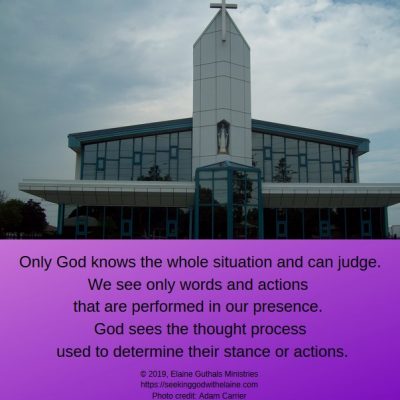
    Only God knows the whole situation and can judge. We see only words and actions that are performed in our presence. God sees the thought process used to determine their stance or actions.

    Church

    Executioner

    … Do not condemn, and we will not be condemned … Luke 6: 37 (NIV)

    Unfortunately, we not only judge, but sometimes we also pass sentence. We are very opinionated, and when things don’t go our way, we can be quick to place blame. Relationships can be broken because we stand by our opinion and degrade others that do not share our opinion in some way.

    Paul said in Romans 2: 1-2, “Therefore you have no excuse, O man, every one of you who judges. For in passing judgment on another you condemn yourself, because you, the judge, practice the very same things. We know that the judgment of God rightly falls on those who practice such things” (ESV). So, instead of them being condemned, we are.

    Ideal

    … forgive, and you will be forgiven. Luke 6: 37 (NIV)

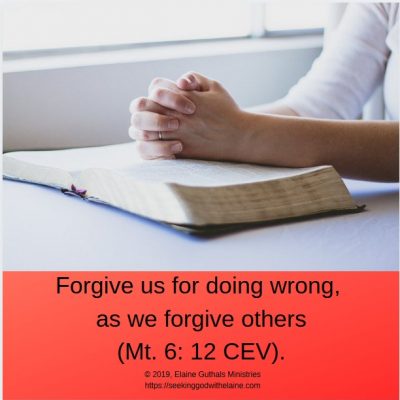
    What we are to be is forgiving. God requires it. “Forgive us for doing wrong, as we forgive others” (Mt. 6: 12 CEV).

    Praying hands

    We are to “make allowance for each other’s faults, and forgive anyone who offends you. Remember, the Lord forgave you, so you must forgive others” (Col. 3:13 NLT). Being a forgiving person is the best way to show others God’s love.

    Pastor Chad said, “‘I can’t forgive them.’ ‘I love you, but I don’t like you.’ Those sentences shouldn’t be in our vocabulary. There is no limit on our ability to forgive. There is no justifiable reason to not forgive.” Yes, it may take a strong conviction to accomplish it, but God will strengthen us to go beyond what we are able.

    When I was looking through my sermon notes, I found this. Pastor Chad didn’t say it; one of my former pastors did. “Genuine faith involves private devotion and public goodness. The tongue is a diagnostic devise that takes stock of the heart. Our compassion is an indication of the grace on our hearts.”

    Disciples are not to be judgmental and condemning. We are to be forgiving and compassionate. That requires grace and mercy. Pastor Chad said this in one sermon: “Our job is not judgment, but mercy and grace in expanding the kingdom of God. We must accept them because they are a child of God.”

    Why Is Judging Forbidden?

    Just like vengeance, God keeps the judging for Himself. James 4: 12 says, “God alone, who gave the law, is the Judge. He alone has the power to save or to destroy. So what right do you have to judge your neighbor?” (NLT). It is God’s job.

    We will be judged for judging – both by the world and by God. If we are merciful, on the other hand, we will be seen as good.

    Making the Connections

    Remember, we will be judged as we judge. I get the “judge and be judged,” “give and be given,” “forgive and be forgiven.”

    Still, part of me hates saying that. I think it is too easy to get to a “what’s in it for me” stance. It is not about what we gain because we have not judged or have given and forgiven. It is about our relationship with our Sovereign God and Redeemer.

    Jesus is really talking about attitude here. He would rather see us full of humility and compassion.

    Judging can sometimes be a form of comparison. We are very good at holding ourselves up to someone else — and find ourselves lacking. In a way, it is just a form of coveting. That can make us look for faults in the person. That makes us more judgmental.

    Olshausen said, “The way to righteousness lies in finding not other people’s sins, but our own.” That is so true. We need to worry about ourselves.

    But What Should We Do When We Encounter Someone Else’s Sin?

    We do have to make sure our relationship with God is right. But He also calls us to be witnesses for Him. In order to do that, we have to address sin in the lives of others.

    Part of the church’s problem today is it has tried to be culturally relevant. We have been some of the ones rewriting the scriptures. We haven’t been addressing sin – in our lives or the lives of others.

    To read Why Do We Try to Rewrite Scripture?, click the button below.

    Disciples have to figure out how to do that in a loving, not judgmental, way. We can’t tolerate sin.

    We have to help them to admit their sins, believe on His Son Jesus as Redeemer, and confess Him as Sovereign Lord. “Let the wicked forsake his way, and the unrighteous man his thoughts; let him return to the Lord, that he may have compassion on him, and to our God, for he will abundantly pardon” (Isa. 55: 7 ESV).

    How Do We Apply This?

    We should figure out what we really do know and don’t know about the situation. We shouldn’t lead with our opinion.

    We should lead with love and mercy. “Love bears all things, believes all things, hopes all things, endures all things” (I Cor. 13: 7 ESV). We have to put the person above the situation.

    Yes, we may have to address the sin aspect of the situation. However, we do not want to sin in trying to lead them to Christ.

    I think what we really need to remember is it is about relationships. We have our relationship with God. We want others to have that relationship with Him, too. Plus, we have our relationship with them.

    If we focus on the relationship, hopefully, we can work through the situation. We can if we let God lead.

    Loving Heavenly Father. We just praise You, Lord. You are Sovereign God but still want a relationship with us. Help us with our relationships with others. May we reflect Your love to them. Help us to resolve any conflicts in a loving manner. Show us where we are judgmental so that we may see how You would rather us be. Help us to be forgiving. But never let us diminish the gospel by trying to be culturally relevant. May we always obey You and Your standards. Amen.

    What do you think? In what types of situations do you find yourself most judgmental? What strategies do you need to implement to be more forgiving?

    Leave me a comment below (about this or anything else) or head over to my Facebook group for some interactive discussion.

    If you don’t understand something and would like further clarification, please contact me.

    If you have not signed up for the email daily or weekly providing the link to the devotions and the newsletter, do so below.

    If God has used this devotion to speak with you, consider sharing it on social media.
  • Are We to Live for Today or Tomorrow?

    Therefore do not be anxious about tomorrow, for tomorrow will be anxious for itself. Sufficient for the day is its own trouble.”
    Matthew 6: 34 (ESV)
    Scripture: Matthew 6

    God has told us in His Word that He wants us to focus on today, not tomorrow. But would that mean we could miss the narrow gate? This devotion looks at the connection of living for today and living for tomorrow.

    Nuggets

    • God wants us to focus what He is doing in our lives today.
    • We have to figure out how He wants us to live, leading to growing in Him.
    • We are supposed to focus on God’s kingdom first.
    • If we are trying to live a holy life for today, that will help us for living for His return tomorrow.
    • Jesus wants us to be evaluating the signs for His return.
    Flowers with the title Are We to Live for Today or Tomorrow?

    When I was writing a post for the What It Mean to Be a Believer? series, the question flirted through my mind as to whether we as disciples of Christ should live for today or for tomorrow. Let’s see what the Bible says.

    Live for Today

    There are several verses that tell us to focus on today. “Therefore do not be anxious about tomorrow, for tomorrow will be anxious for itself. Sufficient for the day is its own trouble” (Mt. 6: 34 ESV). God knows how hard this life is going to be.

    Uncertainty in Life

    God wants us to focus what He is doing in our lives today. Matthew 6: 25 says, “That is why I tell you not to worry about everyday life — whether you have enough food and drink, or enough clothes to wear. Isn’t life more than food, and your body more than clothing?” (NLT). God is going to provide what we need. “And my God will supply every need of yours according to his riches in glory in Christ Jesus” (Phil. 4: 19 ESV).

    That is a good thing because tomorrow doesn’t have any guarantees. “Do not boast about tomorrow, for you do not know what a day may bring” (Prov. 27: 1 ESV). In fact, we aren’t even guaranteed there will be a tomorrow. “Yet you do not know what tomorrow will bring. What is your life? For you are a mist that appears for a little time and then vanishes” (Jas. 4: 14 ESV).

    So, we are to focus on today but not worry about it. “Do not be anxious about anything, but in everything by prayer and supplication with thanksgiving let your requests be made known to God” (Phil. 4:6 ESV). God has this.

    Focus on Living Right

    But we’re supposed to do something, right? No, we don’t have to make any changes to get salvation. But He doesn’t want us to stay the way we are, right?

    To read
    Do We Have to Clean Up Our Acts to Get Salvation?
    and
    God Meets Us Where We Are,
    click on the appropriate button below.

    No, God doesn’t want us to stay where we are. Second Peter 3: 18 says, “But grow in the grace and knowledge of our Lord and Savior Jesus Christ …” (ESV). We have to figure out how He wants us to live. That will mean growing in Him.

    How are we supposed to do that? First Chronicles 16: 11 says, “Seek the Lord and his strength; seek his presence continually!” (ESV). We seek to learn how He wants us to live.

    Lake

    One way we are is to live is to not conform to the world (Rom. 12: 2). We recently talked about this in another devotion.

    To read What Are the Patterns of the World?, click the button below.

    So, how are we to live? Philippians 4: 8-9 says, “Finally, brothers, whatever is true, whatever is honorable, whatever is just, whatever is pure, whatever is lovely, whatever is commendable, if there is any excellence, if there is anything worthy of praise, think about these things. What you have learned and received and heard and seen in me—practice these things, and the God of peace will be with you” (ESV).

    We do this by following Colossians 3: 12-14. “Put on then, as God’s chosen ones, holy and beloved, compassionate hearts, kindness, humility, meekness, and patience, bearing with one another and, if one has a complaint against another, forgiving each other; as the Lord has forgiven you, so you also must forgive. And above all these put on love, which binds everything together in perfect harmony” (Col. 3: 12-14 ESV).

    We are called to follow God today. “This is the day that the Lord has made; let us rejoice and be glad in it” (Ps. 118: 24 ESV). Today is enough.

    Live for Tomorrow

    But are we just supposed to focus on today? Do we not give any thought to tomorrow? We have to think about tomorrow.

    Priority Is God’s Kingdom

    We are supposed to focus on God’s kingdom first — which we will be doing if we are putting priority on living the life God wants us to live today. Matthew 6: 33 says, “But seek first the kingdom of God and his righteousness, and all these things will be added to you” (ESV).

    Paul put it this way: “You have been raised to life with Christ, so set your hearts on the things that are in heaven, where Christ sits on his throne at the right side of God. Keep your minds fixed on things there, not on things here on earth. For you have died, and your life is hidden with Christ in God” (Col. 3: 1-3). Our focus should be upward.

    Our focus has to be upward. If we are just focusing on this life, what we create will be for nothing. Matthew 6: 19-20 says, “Don’t store up treasures on earth! Moths and rust can destroy them, and thieves can break in and steal them. Instead, store up your treasures in heaven, where moths and rust cannot destroy them, and thieves cannot break in and steal them” (CEV).

    Clouds

    Live a Holy Life

    If we are trying to live a holy life for today, that will help us for living for His return tomorrow. Matthew 7: 13-14 says, “Enter through the narrow gate. For wide is the gate and broad is the road that leads to destruction, and many enter through it. But small is the gate and narrow the road that leads to life, and only a few find it” (NIV).

    To read Will Being Kind to Others Get Us into Heaven?, click the button below.

    Sounds like we really need to pay attention to make sure we hit the narrow gate, doesn’t it? If we are not paying attention to the lives we are living today, we might be heading down a path that doesn’t lead to the gate.

    That is especially true when we remember Galatians 6: 7-8. “Do not be deceived: God is not mocked, for whatever one sows, that will he also reap. For the one who sows to his own flesh will from the flesh reap corruption, but the one who sows to the Spirit will from the Spirit reap eternal life” (ESV). If the life today is the sowing and the life tomorrow is the reaping, they really are interconnected.

    Matthew 16: 26 puts it all into perspective. “For what will it profit a man if he gains the whole world and forfeits his soul? Or what shall a man give in return for his soul?” (Mt. 16: 26 ESV). If we equate daily living with the world (because that is where we are) and heaven with the soul (because we will be changed to a spiritual body) — and don’t have the connection — we are up a creek with no boat or paddle. We will be swamped.

    Watch for Jesus’ Return

    We have talked in a previous devotion about what Jesus meant when He told us to watch. Jesus wants us to actively be alert. He wants us to be continuously on guard.

    To read What Did Jesus Mean When He Said Watch?, click the button below.

    Jesus wants us to be evaluating the signs for His return. No, He doesn’t want us to pick a day and time. He would rather we focus on being prepared for His return. He doesn’t want us to fall for impostors claiming to be Him.

    To read
    What Are the End Time Signs?
    and
    Will Jesus Come in Secret?,
    click on the appropriate button below.

    Again, that means we have to focus on the daily life, not just the tomorrow life. But that will get us to the tomorrow life in good shape. They are connected.

    Why are they so connected? Because “… our citizenship is in heaven, and from it we await a Savior, the Lord Jesus Christ, who will transform our lowly body to be like his glorious body, by the power that enables him even to subject all things to himself.” (Phil. 3: 20-21 NLT). We are citizens there but wait here.

    Church

    How Do We Apply This?

    In order to live for today and live for tomorrow, we need to live by God’s laws and commandments. That is what we will be living by after Jesus’ return. That is what God calls us to live by now.

    It is that simple. No, it isn’t easy to live by God’s standards in today’s world.

    We have to pray for strength and discernment to keep the focus where it should be — on God.

    Sovereign God. You have called us to live by Your laws and commandments. That will be easy when You have called us home and changed us to our spiritual bodies. Lord, that is challenging when we are still locked in this human body. Help us to know Your commandments. Help us to keep them. Help us to resist Satan as he tries to get us to break them. We look forward to Your blessings as we grow closer to You. Amen.

    What do you think? Do you focus more on living for today or living for tomorrow? What do you need to focus on in order to live for today ad tomorrow?

    Leave me a comment below (about this or anything else) or head over to my Facebook group for some interactive discussion.

    If you don’t understand something and would like further clarification, please contact me.

    If you have not signed up for the email daily or weekly providing the link to the devotions and the newsletter, do so below.

    If God has used this devotion to speak with you, consider sharing it on social media.
  • When Does God Hold Back His Mercies?

    Lord, don’t hold back your tender mercies from me! My only hope is in your love and faithfulness.
    Psalm 40: 11 (LB)
    Scripture: Psalm 40

    We see God as a loving, faithful God. He is. However, we are told that He will also withhold His tender mercies. This devotion looks at Psalm 40: 11 as it connects a song of thanksgiving with a prayer of rescue from a trial.

    Nuggets

    • We should praise God when He rescues us from trials.
    • Many times, a mountain-top experience is followed by a valley of trials.
    • God chooses to extend mercies instead of judgment; however,
    • He will withhold those mercies when we are not obedient.
    • God through His Son Jesus is our only hope for salvation and eternal life.
    • Judgment will come, but God has provided the plan of salvation to pay the cost of our sins.
    Flowers with title When Does God Hold Back His Mercies?

    Psalm 40 is really interesting. The first five verses are straight out praise. It is a prayer of thanksgiving for God rescuing David from trials he was facing. We should praise God when He rescues us from trials.

    To read Waiting Patiently, click the button below.

    Verses six through ten documented David’s response. David said he finally understood (Ps. 40: 6). God wanted obedience (Ps. 40: 8), not sacrifices or offerings (Ps. 6). He told everyone who would listen about God’s unfailing love (Ps. 40: 10). Everything was good.

    Then comes verse 11 and following. “… Don’t hold back your tender mercies from me! …” (Ps. 40: 11 NLT). Wait! What?

    Where did that come from — left field? If things were good, why would God want to hold back tender mercies? When does God hold back tender mercies?

    Let’s Put It into Context

    Verses 1 through 10 show David is through with a season of trials. Verses 12 through 17 show he was right back in a new season of trials.

    How many times have we had mountain-top experiences immediately followed by valley experiences? When we get overtaken by the trial, sometimes it seems like it we get blindsided.

    To read When Was the Last Mountain-top Experience?, click the button below.

    We are still in the glow of being at the top. Then, bam.

    I can see us saying, “God, where did You go?” I can see saying, “Oh, please don’t leave me.”

    God’s Tender Mercies

    Mercy is where God won’t judge us to the extent He could. When Adam and Eve committed the original sin, God could have judged us harshly. He could have said he was done with mankind.

    God chose mercy. “For judgment is without mercy to one who has shown no mercy. Mercy triumphs over judgment” (Jas. 2: 13 ESV). It was God’s choice — He didn’t have to choose mercy.

    Instead of judgment and death, we get salvation and eternal life. “He saved us, not because of works done by us in righteousness, but according to his own mercy, by the washing of regeneration and renewal of the Holy Spirit” (Ti. 3: 5 ESV). Salvation is offered to us because of mercy.

    God is merciful because of His unfailing love for us. “But God, being rich in mercy, because of the great love with which he loved us” (Eph. 2: 4 ESV). What a great love He has!

    But what is the “hold back mercies” bit? “The Lord is slow to anger and abounding in steadfast love, forgiving iniquity and transgression, but he will by no means clear the guilty, visiting the iniquity of the fathers on the children, to the third and the fourth generation” (Num. 14: 18 ESV). To me, this is an example of “if … then.”

    If we accept God’s gift of salvation, He will forgive us of our sins. “For I will be merciful toward their iniquities, and I will remember their sins no more” (Heb. 8: 12 ESV).

    If we are obedient and follow His laws and commandments, He will be merciful toward us.

    If we are not obedient, why should we expect God to be merciful?

    God expects obedience from us. We need to live the lives He wants us to live. We can’t expect to live the opposite of how He wants us to live and still get the rewards from Him.

    Lady

    My Only Hope

    David knew that his only hope was in God. That is why he was hanging on to Him during the good times and the bad.

    He may not have understood all what his Descendant was going to accomplish. “I will make sure that one of your descendants will always be king” (II Sam. 7: 16 CEV). He knew that God was going to choose one of his to sit on the throne forever.

    That Descendant was Jesus, “… the resurrection and the life. He who believes in Me, though he may die, he shall live” (Jn. 11: 25 NKJV).

    Jesus is our only hope to gain salvation because He was the sacrifice given to pay the price for our sins. Acts 4: 12 says, “Salvation is to be found through him alone; in all the world there is no one else whom God has given who can save us” (GNT). Believing in Jesus in the only way to restore our relationship with God.

    Our salvation means so much to God and Jesus that they completed the plan of salvation — at great personal cost — so that our relationship with them could be restored.

    We have to

    • admit that we are sinners;
    • believe Jesus, who didn’t sin, died and rose again to be the sacrifice needed to restore our relationship with God;
    • confess that we have asked God to be Lord of our lives and Jesus to be our Redeemer;
    • change our lifestyle so that we are living the way God wants us to; and 
    • follow Jesus’ example on how to live.

    If you have not admitted that your relationship is not right with God,

    have not asked Jesus to be your Lord and Savior,

    and have not confessed your sins,

    please read through the Plan of Salvation and prayerfully consider what God is asking you to do.

    Your Love and Faithfulness

    God extends His tender mercies and is our only hope because of His unfailing love for us. “For God so loved the world, that he gave his only begotten Son, that whosoever believeth in him should not perish, but have everlasting life” (Jn. 3: 16 KJV).

    Sometimes it is really difficult to fathom how God loved us enough to send His Son. “But God has shown us how much he loves us – it was while we were still sinners that Christ died for us!” (Rom. 5: 8 GNT). To know He did that when we were still so far from Him is mind boggling.

    There is a reason God sent Jesus to be the sacrifice for our sins. There is a judgment day coming. “Love has been perfected among us in this: that we may have boldness in the day of judgment …” (I Jn. 4: 17 NKJV).

    Sunrise

    A day is coming where Jesus will return to earth. Eventually, there will be a rewards/repayment ceremony. We will have to decide if we are going to be a sheep on the right or a goat on the left. God, through the sacrifice of Jesus, has paid the price for our sins so that we can be a sheep on the right.

    To read
    Will We Be Rewarded or Repaid?
    and
    Will Being Kind to Others Get Us into Heaven?,
    click the appropriate button below.

    Making the Connections

    Okay, let’s put the verse back in the context of the chapter. We’ve been talking big picture and future.

    But doesn’t that help us with the present? David’s present was he was going back into a season of trials. “For innumerable evils have surrounded me; My iniquities have overtaken me, so that I am not able to look up …” (Ps. 40: 12 NKJV). That doesn’t sound like “He also brought me up out of a horrible pit …” (Ps. 40: 2 NKJV).

    If God is our only hope in providing salvation and eternal life, isn’t He going to take care of us in this life? True, it may still hurt and be really, really bad at times.

    But God is going to be there with us, surrounding us as we are going through the trial. He is still going to be loving us. He is still going to be faithful.

    How Do We Apply This?

    Yes, there are times that it is really hard to keep our faith and trust in God when we are knee deep in the bog David was talking about (Ps. 40: 2). But we have to keep the faith. God will get us through our trials.

    What do we do when we are scraping bog goo off our knees? We work on our relationship with God. We pray more. We read His Word more. We fellowship with our fellow believers so they can support us.

    There will always be seasons of trials while we are still on this earth. We have to do what we have to do to weather the storm. We also have to remind ourselves of the big picture. This is just an experience that is growing us to be what God wants us to be. It is preparing us for our heavenly home.

    Gracious Lord. We thank You that You never leave us – either in the good times or in the bad. We know because of Your unfailing love for us that You will be right there for us. Lord, we know You expect obedience. We commit to obeying You. Help us to be even more obedient. Help us through the seasons of trials. May we use them to grow closer to You. Amen.

    What do you think? Thing back on your experiences. Is there a time when you knew God help back His mercies for you? What do you need to change in your life so that He does not hold back again?

    Leave me a comment below (about this or anything else) or head over to my Facebook group for some interactive discussion.

    If you don’t understand something and would like further clarification, please contact me.

    If you have not signed up for the email daily or weekly providing the link to the devotions and the newsletter, do so below.

    If God has used this devotion to speak with you, consider sharing it on social media.

  • Why Should We Pray for Other Believers?

    God knows how often I pray for you. Day and night I bring you and your needs in prayer to God, whom I serve with all my heart by spreading the Good News about his Son.
    Romans 1: 9 (NLT)
    Scripture: Romans 1: 1-17

    There is so much division in the world today. Believers are supposed to be unified under God. This devotion looks at one way that unification occurs – believer praying for other believers.

    Nuggets

    • Jesus starting to build a community of believers during His ministry.
    • Prayer is not only a form of worship, but it also unites the community of believers as they pray for each other.
    • We are to pray for each other, even if we do not know each other.
    • We should pray for their spiritual as well as physical needs.
    • If God does not answer our prayers, we should react in peace.
    Flowers with title Why Should We Pray for Other Believers?

    Paul was the consummate preacher. He had a love and concern for fellow believers — even does he have not met previously.

    Case in point. When Paul wrote his letter to the Roman believers, he had not met them yet. Yet, he tells them that he prays often for them.

    We can learn a lot from Paul’s example. Let’s take a look first at believers during that time.

    Let’s Put It into Context

    Jesus Began a Community

    When my ladies and I were studying the Gospel of Mark a while back, around Chapter 6 we saw where Jesus was starting to build a community. Now, He didn’t call it a church.

    Jesus probably thought of them as followers first. Then they morphed into students (Jn. 13: 13). “I do not call you servants any longer, because servants do not know what their master is doing. Instead, I call you friends, because I have told you everything I heard from my Father” (Jn. 15: 15 GNT). They finally became friends.

    What Jesus’ followers became was a community. “They would sell their property and possessions and give the money to whoever was in need” (Ac. 2: 45 CEV). They were a cohesive group.

    From this, we can see the love they felt for each other. We can see them stepping in to help when needed and creating their version of the Three Musketeers slogan: one for all and all for one.

    Prayer Is a Form of Worship

    Prayer is a big part of our worship. “… Your prayers and alms have ascended as a memorial before God” (Ac. 10: 4 NASB). This is where we talk to an unseen God.

    Let’s look at verse 9 in another translation. “For God is my witness, whom I serve with my spirit in the gospel of his Son, that without ceasing I make mention of you always in my prayers” (Rom. 1: 9 KJV). Paul serves God in the spirit. That would include prayer.

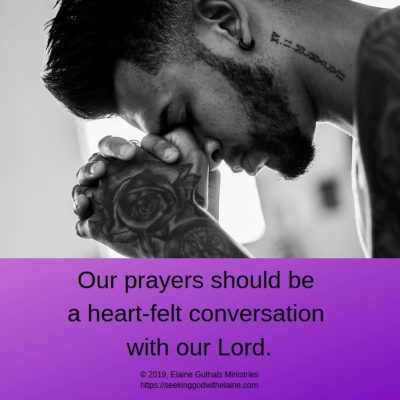
    I can just hear Paul lifting a prayer to God. The love and obedience would just pour out. This wouldn’t be a formal prayer. It would be a heart-felt conversation with his Lord.

    Paul served God in any way He required. This included his devotion time as well as corporate worship. He took Jesus’ commandment to love one another to heart (Jn. 13: 34).

    Man praying

    Praying for Others

    As part of the family of God, we should remember our fellow believers in prayer. The churchy term is intercessory prayer. We expand our love for others as we pray for them. That, in turn, makes it easier to pray.

    Okay. Now let’s look at what Paul was saying here.

    Paul’s Prayer for the Romans

    Wait! What? Paul was praying for people he didn’t know?

    Yes. They were fellow believers that Paul had heard great things about.

    They still needed support. They had trials only God could get them through and needs that only God could meet — even though they were believers.

    So, Paul prayed for them. Day and night. He didn’t just pray when he heard a good or bad report.

    Paul prayed often for them. He knew the God of creation knew what they needed and could — would — provide.

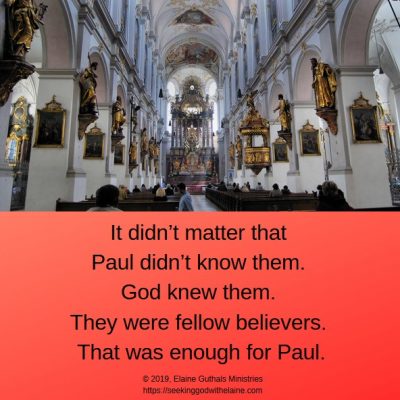
    It didn’t matter that Paul didn’t know them. God knew them. They were fellow believers. That was enough for Paul.

    Church

    How We Should Pray

    God isn’t going to make us pray to Him — even believers. It has to be voluntary. We need to want to pray to Him. We need to want to communicate with Him and intercede for others.

    Paul was thankful and sincere in his petitions to God. He was earnestly concerned about the Roman believers. He was thankful for their successes and concerned for their needs.

    See that? Paul didn’t keep this awesome God for himself. He wanted others to know Him like he did. He said, “my God” and “my Lord.”

    For What Was He Praying?

    Paul has a personal relationship with the Sovereign God and Lord Jesus Christ. He wanted others to have that same relationship.

    That meant Paul didn’t just pray for Uncle Tommy’s knee replacement and Valerie’s job situation.

    Yes, God wants us to pray for those things.

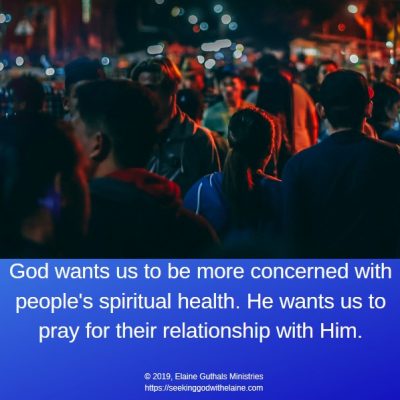
    God wants us to be more concerned with people’s spiritual health. He wants us to pray for their relationship with Him.

    Paul would pray for their spiritual gifts. He would pray for their witness.

    God wants us to pray for their boldness and strength against temptation. He wants us to pray that they grow in righteousness.

    Crowd

    When Prayers Aren’t Answered

    Wait! What? You said even Paul had some unanswered prayers. The great Paul? The Energizer Bunny for God?

    Let’s look at that. “One of the things I always pray for is the opportunity, God willing, to come at last to see you” (Rom. 1: 10 NLT).

    Paul always prayed for the opportunity to visit — to come see them at last. He hadn’t been there yet. His prayer was unanswered.

    So, Paul must have been really disappointed. He was praying all this time for people he didn’t know to do something he really wanted to do.

    So, Paul quit praying, right? No. Knowing Paul, he probably prayed even harder.

    Making the Connections

    One of the ways we love fellow believers is to pray for them, whether we know them or not. We pray that they are living in God’s Will. We thank God that He can use them to expand His kingdom.

    We pray for their physical journey, also. They will be facing issues in their everyday life over which God wants control.

    God wants us to be a community of believers. He wants us to be united under Him.

    How Do We Apply This?

    We need to make it a practice to pray for others. I have been working on an aid to help me. When I bet it worked out, I will share it with you.

    We have to make our requests to God — and then let Him work. He may not give us the answer we requested, especially not on our timetables. We just have to let go and be at peace. We did what we were supposed to do — pray in support of our fellow believers.

    We can’t pick and choose for whom we will pray. Paul was praying for the people in the capital of the Roman Empire. There was some good things being said about them, but they were in that dreaded city.

    We can’t let differences or preconceived notions stop us from praying for our brothers and sisters in Christ. We have to pray whether it is in our prayer closet/war room — or corporate worship service — or if we would call a radio station and broadcast it. The only One Who needs to hear it will hear our prayer.

    A little bit ago, I picked one of my friends on my private Facebook page and prayed for her for a couple of months. Then I picked someone else.

    What if we did that for our fellow believers? Pick a believer you know who is under fire by Satan and pray. Pick a church (other than your own because we should be praying for our own anyway) and pray. Pick a missionary and pray. I would say pick a state or pick a country, but I am afraid that would get too generic.

    Bottom line is believers need to pray for other believers. We need to hold each other up.

    Father God. You love us. You want your believers to be a community. Help us to be united under Your laws, doing Your work. Help us to look past differences and preconceived notions. May we always just see You reflecting out of them. Help us to be consistent. Help us to be the prayer warriors needed to resist temptation in today’s world. May our focus always be on You.

    What do you think? What are some ways that you can start praying more for other believers?

    Leave me a comment below (about this or anything else) or head over to my Facebook group for some interactive discussion.

    If you don’t understand something and would like further clarification, please contact me.

    If you have not signed up for the email daily or weekly providing the link to the devotions and the newsletter, do so below.

    If God has used this devotion to speak with you, consider sharing it on social media.

  • How Is Trust Different Than Faith?

    Sovereign LORD, you are God! Your covenant is trustworthy, and you have promised these good things to your servant.
    II Samuel 7: 28 (NIV)
    Scripture: II Samuel 7: 18-29

    The last devotion began the How Is Faith Different Than Trust series by looking at faith. This devotion continues by looking at trust. It concludes by considering both terms.

    Nuggets

    • Trust is believing God will do what He says He will do.
    • We can trust Him even when we are afraid because of His unfailing love.
    • We can trust God because He is Sovereign God — our God.
    • Trusting God also has benefits.

    To read devotions in the How Is Faith Different Than Trust? series, click the button below.

    Flowers with title How Is Trust Different Than Faith

    In the previous devotion, we discussed faith. In this devotion, we will look at trust, and then compare the two terms.

    Let’s Put It into Context

    Trust is a believing that you can rely on someone or something. It is the considering that something to be true.

    Trusting Is Believing

    Trust is believing God will do what He says He will do. “Sovereign LORD, you are God! Your covenant is trustworthy, and you have promised these good things to your servant” (II Sam. 7: 28 NIV). We know God is trustworthy because He has never abandoned those seeking Him (Ps. 9: 10).

    Church

    Trust in His Unfailing Love

    God doesn’t abandon us because of His unfailing love (Ps. 13: 5; Ps. 143: 8). Putting our trust in this love is better than putting our trust in material things (Ps. 20: 7). We can trust Him even when we are afraid (Ps. 56: 3).

    Trust Because of Who He Is

    We can trust God because He is Sovereign God — our God. “But I trust in You, O LORD; I say, ‘You are my God.’” (Ps. 31: 14 ESV). We can lean on Him (Prov. 3: 5-6).

    God never abandons those who seek Him and put their trust in Him. “Everyone who honors your name can trust you, because you are faithful to all who depend on you” (Ps. 9: 10 CEV).

    Sailboat

    Those seeking God and putting their trust in Him will be blessed (Prov. 16: 20). “Oh, the joys of those who trust the LORD, who have no confidence in the proud or in those who worship idols (Ps. 40: 4 NLT).

    We should seek God rather than putting our trust in mankind. “Put not your trust in princes, and a son of man, and home there is no salvation” (Ps. 143: 3 ESV).

    Trust Also Has Benefits

    Trusting God also has benefits. God rewards those who trust Him (Ps. 37: 4-6). Because we trust Him, God will bless us (Ps. 84: 12). “Blessed is the man who trusts in the Lord, trust is the Lord. He is like a tree planted by the water, that sends out its roots by the stream, and does not fear when heat comes, for its leaves remain green, and is not anxious and the year of drought, or it does not cease to bear fruit“ (Jer. 17: 7-8 NIV). We thrive when we put our trust in Him (Prov. 11: 28).

    God gives His peace to those that trust Him (Isa. 26: 3). “May the God of hope fill you with all the joy and peace as you trust in him, so that you may overflow with hope by the power of the Holy Spirit” (Rom. 15: 13 NIV).

    Beach

    God keeps us safe when we trust in Him (Prov. 28: 26). Case in point — Daniel in the lion’s den (Dan. 6: 23). God is our strength and shield (Ps. 28: 7).

    When we trust in the Lord, we will wait for Him. “But those who trust in the Lord will find new strength. They shall soar high on wings like eagles. They will run and not grow weary. They will walk and not faint” (Isa. 40: 31 NLT).

    Making the Connections

    So, let’s have a recap of what faith is.

    • Faith is belief.
      Doubt detracts from faith.
    • Believers gain much when they have faith.
    • People who do not have faith in God suffer consequences.
    • Even though believers are called to live by faith, that does not guarantee believers will have easy journeys.

    Trust, on the other hand, is the following:

    • Trust is believing God will do what He says He will do.
    • We can trust Him even when we are afraid because of His unfailing love.
    • We can trust God because He is Sovereign God — our God.
    • Trusting God also has benefits.

    Part of me sees faith and trust as interchangeable. They both are contingent on belief. Can you have one without the other? Is this another chicken and the egg instance?

    Part of me sees them as being different. I see faith as a noun and trust as a verb. Faith is underlying foundation. Trust is how we get it and exhibit it.

    I know. I wrote that sentence and said, “Is that even possible?”

    We can’t exhibit trust until you have it. We have to have the belief before we can latch on to it.

    The belief is the faith. We say, “Yes, I am going to believe Jesus is the Son of God.” The trust ingrains it in us. It grows our faith.

    How Do We Apply This?

    I am sticking with chicken and egg. We have to believe enough to put our trust totally in God. Little faith equals little trust. Little trust calls our faith into question.

    We have to choose what we are going to believe. Then we need to go whole hog. We have to grow our faith until our trust is solid.

    I would say that we probably can’t parcel out faith and trust. God makes it abundantly clear that we are to do both. We need to grow both.

    Loving Heavenly Father. You call us to have faith in You — even when we can’t see You. You call us to put our trust in You — even when it contradicts what the world tells us. Lord, help us to seek You. Help us to grow in You. We thank You in advance for the rewards and blessing You will give us as we grow closer to You. Amen.

    What do you think? Do you think faith and trust are the chicken and the egg? Can you have one without the other?

    Leave me a comment below (about this or anything else) or head over to my Facebook group for some interactive discussion.

    If you don’t understand something and would like further clarification, please contact me.

    If you have not signed up for the email daily or weekly providing the link to the devotions and the newsletter, do so below.

    If God has used this devotion to speak with you, consider sharing it on social media.

  • What Is Faith?

    Now faith is the assurance of things hoped for, the conviction of things not seen.
    Hebrews 11: 1
    Scripture: Hebrews 11

    Churchy terms can sometimes be confusing. For instance, how is faith different than trust? This devotion, the first in the How Is Faith Different Than Trust series, looks at what faith is.

    Nuggets

    • Faith is belief.
    • Doubt detracts from faith.
    • Believers gain much when they have faith.
    • People who do not have faith in God suffer consequences.
    • Even though believers are called to live by faith, that does not guarantee believers will have easy journeys.
    Flowers with title What Is Faith?

    In researching a previous post, the question popped into my mind as to how faith is different than trust. Are they different? Are they interchangeable?

    The answers that I came up with are too long for one devotion. For this devotion, we will look at faith. In the next devotion, we will look at trust and consider both terms.

    Let’s Put It into Context

    The object of our faith and trust is God. “And when he did come, it was to lead you to have faith in God, who raised him from death and honored him in a glorious way. This is why you have put your faith and hope in God.” (I Pet. 1: 21 CEV).

    According to the Smith’s Bible Dictionary, faith is “the assent of the mind to the truth of God’s revealed will.” Faith is the central concept of Christianity.

    Faith Is a Belief

    Faith is described by beliefs, a.k.a., the assent of the mind. It is the gateway to salvation. “For it is by grace you have been saved, through faith — and this is not from yourselves, it is the gift of God” (Eph. 2: 8 NIV).

    Belief in God opens the way to incredible things. “…’If You can? Everything is possible to the one who believes” (Mk. 9: 23 HCSB). Through this belief, we can overcome the world (I Jn. 5: 4-5) and secure eternal life (I Jn. 5: 13).

    Many people were healed by Jesus because of their faith. Jesus told the centurion that his servant would be healed because he had believed (Mt. 8: 13). The friends that brought the man sick with palsy and dropped him through the roof had their faith recognized by Jesus (Mt. 9: 2).

    Faith is a choice. “ I have chosen the way of faithfulness; I have set my heart on your laws” (Ps. 119: 30 NIV). We make the choice even though we can’t see (II Cor. 5: 7) — we can’t see God, we weren’t alive when Jesus walked the earth. We choose to stand firm (I Cor. 16: 13).

    Town

    Faith Is Not Doubt

    Doubt detracts from faith. “… I tell you the truth, if you have faith and don’t doubt, you can do things like this and much more. You can even say to this mountain, ‘May you be lifted up and thrown into the sea,’ and it will happen.” (Mt. 21: 21 NLT).

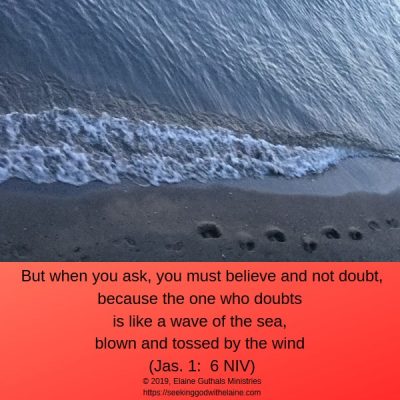
    The Bible gives us a good image of doubt. “But when you ask, you must believe and not doubt, because the one who doubts is like a wave of the sea, blown and tossed by the wind” (Jas. 1: 6 NIV).

    Beach

    Faith Has Benefits

    We gain so much when we have faith. We gain patience (Jas. 1: 3-4).

    When we ask in faith, our prayers are answered (Mk. 11: 24). This faith can be small. “… I tell you the truth, if you had faith even as small as a mustard seed, you could say to this mountain, ‘Move from here to there,’ and it would move. Nothing would be impossible” (Mt. 17: 20 NLT).

    Belief also allows us to see the glory of God. “Then Jesus said, ‘Did I not tell you that if you believe, you will see the glory of God?’” (Jn. 11: 40 NIV). We also see His glory as He shields us by His power (I Pet. 1: 5). Because of His power, we do not have to rely on worldly wisdom (I Cor. 2: 5).

    Faith brings assurance. “Let us draw near to God with a sincere heart and with the full assurance of faith brings, having our hearts sprinkled to cleanse us from a guilty conscious and having our bodies washed with pure water” (Heb. 10: 22).

    Lack of Faith Has It’s Consequences

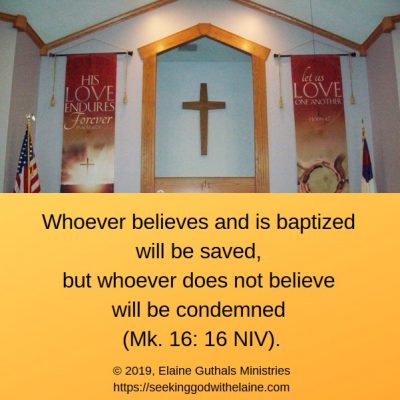
    While having faith provides benefits, the lack of faith presents consequences. “Whoever believes and is baptized will be saved, but whoever does not believe will be condemned” (Mk. 16: 16 NIV).

    Baptistry

    We’ve talked in a previous devotion what the consequences would be when Jesus returned. We will either be rewarded or repaid, depending on whether we have asked Him to be our Redeemer, Lord, and Savior.

    To read Will We Be Rewarded or Repaid?, click the button below.

    Faith Doesn’t Make Things Easy

    Having faith doesn’t mean we are going to have an easy go of it. “But you must resist the devil and stay strong in your faith. You know that all over the world the Lord’s followers are suffering just as you are” (I Pet. 5: 9 CEV). That faith will be put to the test (I Pet. 1: 7).

    This is kind of a scary verse. “Anyone who is destined for prison will be taken to prison. Anyone destined to die by the sword will die by the sword. This means that God’s holy people must endure persecution patiently and remain faithful” (Rev. 13: 10 NLT).

    Testing of our faith, however, produces persistence and endurance. “You know you learn to endure by having your faith tested ” (Jas. 1: 3 CEV).

    Still, we are called to live by faith. “So that it is no longer I who live, but it is Christ who lives in me. This life that I live now, I live by faith in the Son of God, who loved me and gave his life for me” (Gal. 2: 20 GNT). Living by faith will lead us to live a righteous life (Rom. 1: 17).

    We have to pursue faith: “… pursue righteousness, godliness, faith, love, endurance and gentleness” (I Tim. 6: 11 NIV).

    When we live a life of faith, we are promised provision. “Then Jesus declared, “I am the bread of life. Whoever comes to me will never go hungry, and whoever believes in me will never be thirsty” (Jn. 6: 35 NIV). We are not thirsty because belief in Him causes the living water He provides to flow in us (Jn. 7: 38).

    In What Do We Have Faith?

    We believe and have faith in the following:

    • That God, the Creator of the universe, is our Father Who wants to have a relationship with His people. 
    • That God sent His Son Jesus to be the Redeemer of mankind.
    • That the Trinity, which consists of God as Father, Son, and Holy Spirit, are three different forms of the same Being.
    • That Jesus was born of a virgin, making Him 100% God and 100% man.
    • That Jesus gave His life on the cross for us so that His blood could pay the price for our sins.
    • That because of God’s great might and power, Jesus rose from the grave, conquering death and paying the price for our sins.
    • That at some point, Jesus is going to come back to earth and take believers home with Him.

    To read Does Believe or Repent Come First?, click the button below.

    If you have not admitted that your relationship is not right with God,

    have not asked Jesus to be your Lord and Savior,

    and have not confessed your sins,

    please read through the Plan of Salvation and prayerfully consider what God is asking you to do.

    Father. You have called believers to be people of faith. You want us to believe in You and what You have done for us. Lord, we do believe. We thank You that You sent Your Son to be our Redeemer. Bu His doing that, our relationship with You was restored. Help us to grow stronger in our faith daily. Amen.

    What do you think? What is your definition of faith? What are your core statements of faith?

    Leave me a comment below (about this or anything else) or head over to my Facebook group for some interactive discussion.

    If you don’t understand something and would like further clarification, please contact me.

    If you have not signed up for the email daily or weekly providing the link to the devotions and the newsletter, do so below.

    If God has used this devotion to speak with you, consider sharing it on social media.

  • The Gospel Does Not Change

    Now let me remind you, brothers, of what the Gospel really is, for it has not changed — it is the same Good News I preached to you before.
    I Corinthians 15: 1 (LB)
    Scripture:  I Corinthians 15

    The world would like God to change to reflect their desires and allow them to continue to sin. That is not going to happen. This devotion looks at how the gospel does not change.

    Nuggets

    • The world wants God to allow people to go on sinning; however, God does not change.
    • While people – even believers – will continue to sin, believers are to try to live holy lives.
    • Believers should be united, not divided.
    Flowers with the title The Gospel Does Not Change

    Adam and I are home. It was such a good trip. We had been wanting to do a missions trip. We had been wanting to travel. I had been wanting to get new pictures to share with you here.

    Check. Check. And check.

    Reflecting on what this means, I think — providing he doesn’t have his usual digestive issues — Adam is capable of doing more than he has done in the past. That means more missions trips in the future!

    Adam has grown so much the past year or so by being assistant greeter at church. He was able to take that out to a park and crush greeting people who were responding to a flyer for Family Fun Night.

    Place changed. People changed. The need to greet them and love them did not change.

    My Note Card with the Verse

    We got home after a seven-hour drive with one stop, and I am drained. I said, “God, I have no clue what to write for this devotion. I have been collecting all these index cards with verses I’ve written on them. I am going to go down and grab one. Let it be what You want me to write on and give me the words.”

    The verse was I Corinthians 15: 1. It is about God’s Word staying the same.

    Let’s break it down. If it isn’t clear, it is my fatigue. If it is, it is all God talking straight to you.

    The World Wants God’s Word to Change

    The world wants God to allow people to keep on sinning. They want Him to change His definition of what sins are.

    Not going to happen. That is Satan controlling this world. Watch out.

    God does not change. Numbers 23: 19 says, “God is not man, that he should lie, or a son of man, that he should change his mind. Has he said, and will he not do it? Or has he spoken, and will he not fulfill it?” (ESV).

    Church

    Grow up. Who do you think you are trying to make God change to your way of thinking?

    I am nobody. You are nobody. God is Creator, sustainer, Sovereign God. He gets to decide how things are. Not us.

    Some Believers Like Our Cliques

    We have so many denominations. Each have their own spin on what they believe.

    In a way, it is great. You can find like-minded believers and become members there. That can make you more comfortable.

    In a way, it is horrible. It forms cliques. “Well, This Denomination doesn’t believe what we believe.”

    Worse yet, some believers are uncomfortable with people who do not look like us, talk like us, and act like us. We find so many things to divide us.

    This isn’t how God intended things to be. Colossians 3: 11 says, “In this new life, it doesn’t matter if you are a Jew or a Gentile, circumcised or uncircumcised, barbaric, uncivilized, slave, or free. Christ is all that matters, and he lives in all of us” (NLT). God wants believers united; Satan wants the whole world divided.

    Hands

    Making the Connections

    You know what, God doesn’t call us to be comfortable. In fact, God ups are discomfort because God wants to change us to what He wants us to be.

    No, God is not going to change His laws and commandments so we will be comfortable. We have to obey Him. Period. End of discussion.

    Yes, we may have done a lot of things in the past that God considers sin. Once we admit, believe, and confess, we need to turn away from doing those sins.

    Yes, even believers will still sin. God knows we cannot be perfect. If we could do all the do’s and not do all the don’ts, Jesus would not have had to die to pay the price for our sins.

    But just because we can’t be perfect, doesn’t give us license to go on doing what we are doing. “For the Scriptures say, ‘You must be holy because I am holy’” (I Pet. 1: 16 NLT). We have to work to be holy like God. We have to want to be holy like God.

    How Do We Apply This?

    Because God is worthy of complete devotion and is perfect in goodness and righteousness, we should be devoted to Him. We should give Him control. We should obey His laws and commandments.

    When we mess up — and we will — we ask God to forgive us again. We haven’t lost our salvation. He is perfecting us for when Jesus comes to call us home.

    We need to work on being united. No, not tolerant of sin. United in love for God. United in serving Him. United in loving each other.

    We need the work on being holy.

    Father. You are Sovereign. You are holy. You are love. You do not change. Even though man let sin in the world when Satan tempted them, Your love for us did not change. In fact, You sent Your Son to restore our relationship with You. Help us to live holy lives. Help believers to be united. Help us to stand firm when this world wants us to tolerate what You say is sin. We wait for the day Jesus will return. We pray that those who have not given their lives to You will do so. We know You would rather all would be saved. We know that You will judge those who have not asked Jesus to be their Lord and Savior. We wait for that day. Amen.

    If you have not admitted that your relationship is not right with God,

    have not asked Jesus to be your Lord and Savior,

    and have not confessed your sins,

    please read through the Plan of Salvation and prayerfully consider what God is asking you to do.

    What do you think? What are you struggling with that God isn’t going to change?

    Leave me a comment below (about this or anything else) or head over to my Facebook group for some interactive discussion.

    If you don’t understand something and would like further clarification, please contact me.

    If you have not signed up for the email daily or weekly providing the link to the devotions and the newsletter, do so below.

    If God has used this devotion to speak with you, consider sharing it on social media.

  • What Do You Mean Believers Have Other Duties as Assigned?

    There is an appointed time for everything. And there is a time for every event under heaven.
    Ecclesiastes 3: 1 (NASB)
    Scripture: Ecclesiastes 3

    We’ve been looking at a job description for a believer. Most career job descriptions have an “other duties as assigned” phrase at the end. This devotion looks at what that would mean for our believer’s job description.

    Nuggets

    • In our jobs, the “other duties as assigned” phrase can mean that duties can be added to our responsibilities that we would rather not be added.
    • God sometimes changes the plans for our lives that we question.
    • We need to remember that God knows the reasons for the change and knows the plans for our lives.
    • We need to remain obedient when God changes our plans.
    Flowers with title What Do You Mean Believers Have Other Duties As Assigned?

    The What It Means to Be a Believer series ends with this post. Plus, Adam and I are almost home from the mission trip/vacation.

    I thought it was appropriate to end the job duties with the usually dreaded “other duties as assigned” designation. That is a good catch-all duty, so employers don’t have to keep redoing the job descriptions.

    Other Duties as Assigned

    We, as employees, usually dread this line of our job descriptions because we basically have little control over it. Duties can be assigned to us that we feel we are not qualified for, have no desire to perform, and/or increases the workload significantly — with no added compensation.

    I was lucky for the most part. The other duties always were interesting and challenging to me. When job reclassification studies came along, I would receive promotions because of them.

    The bad part came at the end. My new supervisor made the comment that I was performing way above my job classification. I just looked at her and thought, “We’ve all known that for years.”

    What Other Duties Does God Give Us?

    You might be scratching your head as to how God uses other duties as assigned. I think He does. The other duties as assigned that God gives us are those in His plan that aren’t necessarily in our plan.

    Have you ever had your life all planned out, and God sent you in another direction? That happened to me with my spiritual tornado. I was planning on staying in education, not writing daily devotions.

    Have you ever gotten a surprise promotion — in a different state? God could have a number of different reasons to transplant you. Maybe He was getting you out of a bad situation — that was either happening then or coming. Maybe He was sending you somewhere where you would grow more. Maybe there were people in the new state that you had to impact their lives.

    Making the Connections

    God can change our direction for any number of reasons. He may want us to keep doing what we are doing somewhere else or do something totally different. It could be our reason or someone else’s reason.

    I think a lot of times we get so used to what we have been doing that we don’t see the opportunities. We generally don’t like change, so we are upset when God mixes things up.

    It could be a control issue. Giving up control is hard for us to do.

    Then again, how many times do we think we don’t have the knowledge or skills to do what God is asking us to do? It isn’t on our radar because we sell ourselves short. When it ends up a wonderful opportunity for us, we are glad that we let God have control.

    How Do We Apply This?

    We have to be ready for whatever God calls us to do. We have to be ready – even if we don’t want to switch jobs, or states, or churches, or friends, or [fill in the blank].

    God knows what He has created us to do and be. He made us for this – even if we don’t feel made. We have to trust His plan for our lives.

    So, we pray and make sure we know what that plan is. We give Him control.

    We have to remember that God has reasons for doing what He does. Second Thessalonians 1: 11 says, “To this end we always pray for you, that our God may make you worthy of his calling and may fulfill every resolve for good and every work of faith by his power” (ESV). I love that — God is making us worthy.

    God knows what we need. He knows the past, present, and future. He has everything worked out to advance His kingdom.

    We have to remember that God calls us to do His work. Second Peter 1:10 says, “Therefore, brothers, be all the more diligent to make your calling and election sure, for if you practice these qualities you will never fall” (ESV). Our work is important — our being a child of God is more important.

    We also have to remember that God’s ways are higher than our ways (Isa. 55: 8-9). He knows how everything is interconnected. He will work it out for His glory. He loves us and will provide for us.

    So, when God decides to change things up, we just need to keep our faith and trust in Him. We need to continue to do what He calls us to do.

    Gracious Heavenly Father. Your ways are so much higher than ours (Isa. 55: 8-9). You know all things, and You know what is best for us. Help us to keep our faith and trust in You when You ask us to do something we are unsure of. Help us to remain faithful to You and, if we question the situation, do so in faith. We look forward to seeing You work in our lives. Amen.

    What do you think?

    Leave me a comment below (about this or anything else) or head over to my Facebook group for some interactive discussion.

    If you don’t understand something and would like further clarification, please contact me.

    If you have not signed up for the email daily or weekly providing the link to the devotions and the newsletter, do so below.

    If God has used this devotion to speak with you, consider sharing it on social media.