Author: admin

  • How Does Boldness Help Consistency?

    What is the relationship between boldness and consistency? This devotion looks at how we can become more consistent by becoming bolder.

    Nuggets

    • Boldness is a virtue that is equated with courage.
    • Being righteous — being upright — leaves no room for fear.
    • We have access to God and can boldly approach Him through our prayers.
    • We can boldly approach God because Jesus paid the price for our sins.
    • We have to boldly live for Jesus until He returns for us.

    Devotions in the Consistency Needed for Spiritual Growth series

    Flowers with title How Does Boldness Help Consistency?

    Our consistency can be dependent on a variety of factors. Our boldness is one of them. Tied into that is our level of confidence. Let’s look at the relationship between boldness and consistency.

    Let’s Put It into Context

    We are getting at consistency through diligence. Diligence talks about being persistent. The Merriam-Webster Dictionary defines diligence as being a “steady, earnest, and energetic effort.”

    The Holman Bible Dictionary gives two definitions of boldness. The first “describes the courageous manner of those who preach the Gospel (Acts 2:29; Acts 4:13, Acts 4:13,4:31; Acts 9:27-29; Acts 13:46; Acts 14:3; Acts 18:26; Acts 19:8; Acts 26:26; Acts 28:31; see 1 Thessalonians 2:2; Philippians 1:20).” Most of us don’t think we are the preacher-types.

    We generally are about for the second definition. It “describes the confidence with which Christians can now approach God because of the redeeming work of Christ (2 Corinthians 3:4-6, 2 Corinthians 3:12; Hebrews 10:19; 1 John 2:28; 1 John 4:17).”

    Lion-Hearted

    “The wicked flee when no one is pursuing them, but the righteous are as bold as a lion” (Prov. 28: 1 CSB)

    Boldness is a virtue that is equated with courage. Because of that, sometimes those of us who lack boldness are shamed.

    Dowling gave disciples a very good reminder. He wrote, “it is not for Christian men to judge of timidity as the world judges. There is much that the world accounts cowardly which we regard as noble and magnanimous.”

    Ooo, baby. Don’t we do that? We bite on ourselves because the world sees us as mice.

    They don’t get to judge us. God does.

    God made us in His image (Gen. 1: 26-27). He made us exactly the way He wanted us. That is true if our experiences make us who we are meant to be. “For I know the plans I have for you, declares the Lord, plans for welfare and not for evil, to give you a future and a hope” (Jer. 29: 11 ESV).

    To be like God, we are to be righteous. Righteousness is the result of a solid relationship with God built by a sincere life of obedience to God’s laws and commandments.

    Being like God makes us “… as bold as a lion” (Prov. 28: 1 CSB). Being righteous — being upright — leaves no room for fear.

    Why can we be bold? We can’t go wrong when we are trusting God. We are not deceitful.

    Timidity makes us fear. Boldness because of righteousness brings peace.

    Boldness is needed to foster obedience. I mean, when Satan is flinging stuff at us right and left, doesn’t boldness play a big part in choosing to follow God’s laws and commandments?

    We know that God is going to ask us to do the hard things. We have talked about His tests not being easy.

    To read a related devotion, click the appropriate button below.

    Bold Access

    “in whom we have boldness and access with confidence through our faith in him” (Eph. 3:12 ESV)

    We have access to God. We can call on Him any time.

    We can call on God to worship Him and praise Him.

    Why do we have this boldness? “… confidence through our faith in him” (Eph. 3:12 ESV).

    Okay, wait a second. That sounds familiar. “Now faith is confidence in what we hope for and assurance about what we do not see” (Heb. 11: 1 NIV).

    We can boldly come to God through our prayers.

    Doesn’t that access give us boldness when we are going through a season of trials? We have access to the Creator of the universe. We can run to ur Heavenly Father. We can tap into the power that raised Jesus from the dead.

    What support do we need besides God?

    We are told we need to humbly approach God. Does that knock out boldly approaching Him?

    No. Remember, we said humility is “a personal quality in which an individual shows dependence on God and respect for other persons” (Holman Bible Dictionary). We can boldly step right up because we are showing our dependence on God.

    To read a related devotion, click the button below.

    God doesn’t expect us to be mice. We’re supposed to be lion-hearted.

    Spurgeon is the one who equated going boldly to the throne of God with consistency — and he said Paul gave the reason. “… There we will receive his mercy, and we will find grace to help us when we need it most” (Heb. 4: 16 NLT).

    Because God awaits to give us mercy and grace, we can approach Him unreservedly. We can come to Him with anything — large or small. We don’t have have to Pray in the King James Version. We can know that we will be heard.

    Atherton did give us a couple of thou-shalt-not-approach ways.

    Irreverently
    Presumptuously
    Begrudgingly
    Standoffishly
    Grumpily
    With a closed heart and mind
    Unconfidently
    Sporadically

    Boldly by the Blood

    “Therefore, brothers and sisters, since we have boldness to enter the sanctuary through the blood of Jesus” (Heb. 10: 19 CSB)

    We can boldly approach God because Jesus paid the price for our sins. We can only approach Him through Jesus. “Jesus answered, “I am the way and the truth and the life. No one comes to the Father except through me” (Jn. 14: 6 NIV).

    Burns said that we should enter God’s presence “with a true heart” and “in full assurance of faith.” We can enter because the price for restitution of our sins has already been paid.

    Boldly Abiding in Him

    “And now, little children, abide in Him, that when He appears, we may have confidence and not be ashamed before Him at His coming” (I John 2: 28 NKJV)

    We talked in What Is Diligence? about abiding in God’s love. We said we

    • Take up residence.
    • Hang in there.
    • Hunker down and get through it without complaining.
    • Show our eagerness for His plans for our lives.

    What John is saying in this verse is that we have to boldly live for Jesus until He returns for us. It is our duty to be consistently portraying His character in the world.

    Hawes argues that abiding in Christ “implies that he is already in Him; if any man be in Christ he is a new creature. And surely in the great day of the Lord’s coming we shall need something to rest upon as a ground of confidence firmer and more abiding than anything the world can afford us.”

    Making the Connections

    I think part of it is a chicken and the egg thing. Boldness grows as we become more consistent. But then again, as we grow bolder, we gain confidence and become more consistent.

    Case in point – witnessing.

    We begin witnessing.
    After a couple of times, we find we can do it, so our boldness grows.
    As our boldness grows, we increase our witnessing efforts and become more consistent.

    Moral of the story – we have to be faithful and do what God is calling us to do.

    We can be timid. Part of the problem is we judge ourselves — and ooo, baby, can we be our worst critic!

    We see ourselves as broken. We see our flaws and sins. We see where we fall short — and don’t think that will ever change.

    We don’t see ourselves as God does — perfected.

    Making the Connections to Self-Discipline

    We can become bolder. When God continues to show us His love for us, as we continue to commune with Him, our boldness should grow.

    By learning to abide in Him to an even greater extent should boost our confidence and increase our boldness.

    By seeing ourselves as perfected, we know what areas need our work.

    How Do We Apply This?

    Discipleship is a hands-on endeavor. We have to actively seek God.

    Searching for and Seeking God

    Hearing His Word (Rom. 10: 17).
    Reading His Word (Rev. 1: 3).
    Praying to Him (Heb. 4: 16).
    Studying His Word (Ac. 17: 11).
    Meditating on His Word (Ps. 1: 1-2).
    Memorizing His Word (Ps. 119: 11).

    As our relationship grows, so should our boldness. Yes, it will take practice, but God’s got this.

    Father God. We thank You that You allow us access to You. You love us and want to have communion with us. You want us to boldly proclaim Your gospel and make disciples to expand Your kingdom. Help us to boldly step out in our faith of You. Amen.

    If you have not admitted that your relationship is not right with God,

    have not asked Jesus to be your Lord and Savior,

    and have not confessed your sins,

    please read through the Plan of Salvation and prayerfully consider what God is asking you to do.

    Related Links

    Related Links

    Related Links

    Song

    Related Links

    I have created a worksheet of the questions above. Click on the button below to access it.

    Don’t know what your spiritual gifts are?

    Take this Spiritual Gifts Inventory

    The Disciple’s Job Description

    Complete Job Description

    Individual Description

    It Was Enough
    Vocalist: Elaine Guthals
    Keyboard: Chris Vieth

    What do you think?

    Leave me a comment below (about this or anything else) or head over to my Facebook group for some interactive discussion.

    If you don’t understand something and would like further clarification, please contact me.

    If you have not signed up for the email daily or weekly providing the link to the devotions and the newsletter, do so below.

    If God has used this devotion to speak with you, consider sharing it on social media.

  • How Does Dedication Help Consistency?

    Dedication and diligence go hand in hand. This devotion discusses being committed to being holy.

    Nuggets

    • Holiness isn’t a character trait but about spiritual purity.
    • Christian perfection is achieving the two greatest commandments.
    • We have to be fully committed to God.
    • Our job is to proclaim the gospel and make disciples — even if we aren’t the preacher-types.

    Devotions in the Consistency Needed for Spiritual Growth series

    Flowers with title How Does Dedication Help Consistency?

    I am not sure this devotion is going to turn out as I originally envisioned it. I was thinking more along the lines of a we-need-to-be-dedicated-to-the-task topic.

    I think God is changing it to a we-need-to-be-dedicated slant.

    Well, hasn’t He done that before? I though self-discipline was going to mean work on this list of sins. God said become a mature disciple.

    God isn’t interested in what we do for Him. Really, He doesn’t need us.

    Rather, He is interested in us becoming more like Him. He is interested in our character. He wants our worship and our praise.

    So, let’s see where that road takes us.

    Let’s Put It into Context

    My first veer off of the path I had set for us was with the definition. The Holman Bible Dictionary defines dedicate as “a general term used in the Bible to describe an act of setting apart or consecrating persons or things to God (or gods), persons, sacred work, or ends.”

    It goes on to list different people who were dedicated. Included were the Israelites as a whole: “… you are a holy people belonging to the Lord your God. The Lord has chosen you to be his own possession out of all the peoples on the face of the earth” (Deut. 14: 2).

    Out of that group, God dedicated a smaller group as priests. Priests were “personnel in charge of sacrifice and offering at worship places, particularly the tabernacle and Temple” (Holman Bible Dictionary).

    Israel’s Priests

    “Appoint Aaron and his sons to carry out the duties of the priesthood. But any unauthorized person who goes too near the sanctuary must be put to death” (Num. 3: 10 NLT)

    Israel’s priests were priests because they were born into the job. They were priests because God said so. He didn’t say Reuben’s sons were priests – so they weren’t. He said Levi’s sons were.

    It had nothing to do with their ability – or even if they wanted the job. God said so – so it was so.

    I know. I know. Just because God said so didn’t necessarily make them good priests. Case in point – Eli’s sons (I Sam. 3: 13). Well, even Aaron couldn’t live up to God’s high standards (Lev. 16: 11).

    But look at this quote that I found. “The word ‘holy’ means set apart for sacred use, something dedicated to Yahweh and His work. Holiness is often confused with qualities of character or a sacred bearing. Holiness doubtless encompasses these things, but is much more. Holiness is spiritual purity, dedication, total commitment and a setting apart for Yahweh, His Son and His kingdom – being set apart for the calling and work of priesthood” (Hebrew Roots).

    Ooo, let’s unpack that.

    We know holy means set apart. Since we are holy, we are called saints. Saint means holy ones.

    But look at what it says about character. Holiness isn’t a character trait — like funny, independent, and dependable. And like angry, bewildered, and cruel.

    It is about spiritual purity (which is in the queue for a series of devotions). But it is also about dedication and total commitment.

    Yes, that was where I was originally going!

    Committed Hearts

    “And may your hearts be fully committed to the LORD our God, to live by his decrees and obey his commands, as at this time” (I Kgs. 8: 61 NIV)

    This verse is a part of the prayer that Solomon gave at the dedication of the temple. To me, it is a really interesting verse.

    What Solomon is saying is, “Don’t give lip service.” If the Israelites wanted to worship in the temple, they needed to worship outside the temple by obeying God’s laws and commandments.

    Anything less would be hypocritical.

    But it is more than just our actions. Waite wrote, “A man’s heart must be ‘perfect with the Lord’ before he can walk acceptably in the path of His commandments.”

    Let’s start with the hard part — perfect. The Holman Bible Dictionary says perfect is “reaching an ideal state of spiritual wholeness or completeness.”

    I like the word reaching. To me, that means it is a process. “Through a covenant relationship with His people, and by grace, God thus offers to His people the possibility of perfection” (Holman Bible Dictionary). We’re not there yet, but we can get there from here.

    We are in the process of being made holy and righteous. Righteousness is the result of a solid relationship with God built by a sincere life of obedience to God’s laws and commandments.

    That process is called sanctification. Sanctification is the transformation of mind, body, and soul beginning with regeneration and ending with perfected state of spiritual wholeness or completeness. Regeneration is the change in us that God brings about when we go from being spiritually dead to spiritually alive.

    Christian perfection is achieving the two greatest commandments: “He said to him, “Love the Lord your God with all your heart, with all your soul, and with all your mind. This is the greatest and most important command. The second is like it: Love your neighbor as yourself” (Mt. 22: 37-39 CSB).

    That segues us to a discussion on the heart. Yes, we’ve talked about it lots — even using the Matthew passage in a How Do We Love God?

    We’ve talked in Peace, Mercy, and Love about our hearts being at our center — our innermost being. That is our foundation.

    Also, we’ve talked in The Fullness of God’s Love about how Jesus is the Word (Jn. 1: 1) that we are to hide in our hearts (Ps. 119: 11). Jesus is a major part of that foundation.

    In Have We Lost Our First Love?, we talked about how we have to open our hearts to allow Jesus to take full residence within them. We lose our first love when we either don’t allow Him full control or we kick Him out after a while.

    Obedience has to come from the heart. In Getting Obedience to the Heart Level, we said God’s Word is supposed to be a part of us. His laws and commandments are supposed to affect our character or our core – our heart level. If we are to engrave God’s laws and commandments on our hearts, we internalize them, and they change us.

    How Are Disciples Pure in Heart? taught us how God wants us to get back to where Adam and Eve were before the original sin. This can happen only through grace. Nothing we can do or give up will purify us. If we don’t have the pure heart — or at least are not working toward it — we don’t see God.

    To read a related devotion, click the button below.

    This adds — or at least pinpoints what was implied — that we have to be fully committed to God. Obedience does come from the heart.

    If we are dedicated to serving God, the possibility of perfection will turn into perfection when we are called home.

    Flower

    Committed Careers

    “For this I toil, struggling with all his energy that he powerfully works within me” (Col. 1: 29 ESV)

    My Ladies and I are studying Romans this quarter. I am really looking forward to diving into this rich book with the theme of the plan of salvation.

    One thing we talked about Sunday is Paul wrote many of his letters while he was in jail. God had to stop the boy’s forward motion long enough so he could sit down and write what He gave him. (We call Paul the Energizer Bunny — he keeps going and going and going.) If God wouldn’t have stopped him, we probably wouldn’t have half of the New Testament.

    One reason was Paul was so dedicated to the job God gave him. Think of it this way.

    Paul’s “job” took him down the Damascus Road. Jesus intercepted him, and he did a complete 180°. Yes, he went somewhere to relearn everything he had ever been taught, but the change was immediate.

    And complete. Paul became one of the driving forces of growing the early church rather than destroying it.

    Paul definitely was dedicated to his job. “Are they servants of Christ? I know I sound like a madman, but I have served him far more! I have worked harder, been put in prison more often, been whipped times without number, and faced death again and again. Five different times the Jewish leaders gave me thirty-nine lashes. Three times I was beaten with rods. Once I was stoned. Three times I was shipwrecked. Once I spent a whole night and a day adrift at sea. I have traveled on many long journeys. I have faced danger from rivers and from robbers. I have faced danger from my own people, the Jews, as well as from the Gentiles. I have faced danger in the cities, in the deserts, and on the seas. And I have faced danger from men who claim to be believers but are not. I have worked hard and long, enduring many sleepless nights. I have been hungry and thirsty and have often gone without food. I have shivered in the cold, without enough clothing to keep me warm. Then, besides all this, I have the daily burden of my concern for all the churches” (II Cor. 11: 23-28 NLT).

    No, Paul did not preach a prosperity gospel, one where financial and physical blessings are God’s Will for every disciple.

    Paul didn’t think he needed to sit back and just wait for Jesus to come again.

    Paul said, “Jesus made a difference in my life, and I want Him to make a difference in your life, too.”

    And then the boy kept going and going and going.

    Spurgeon made an interesting observation. “That the Christian life is always described as a thing of energy: as a journey, a race, a boxing match.” Nothing is staying still — there is movement.

    Our job is to proclaim the gospel and make disciples — even if we aren’t the preacher-types. Even if we are the office support types. Even if we are the retail types. Even if we are the scientist types.

    We have to be dedicated to that job. We can’t just focus on our earthly job. Spurgeon also said that the Holy Spirit usually doesn’t work alone when converting a soul.

    “You know the saying, ‘Four months between planting and harvest.’ But I say, wake up and look around. The fields are already ripe for harvest” (Jn. 4: 35 NLT).

    “He said to his disciples, ‘The harvest is great, but the workers are few’” (Mt. 9: 37 NLT).

    Making the Connections

    • Upon conversion, we are set apart for God (holy).
    • Holiness is total commitment/dedication, not a character trait.
    • Holiness limits our freedom of actions — we try not to sin — giving us spiritual purity.
    • This spiritual purity is being “perfect with the Lord.”
    • Christian perfection is achieved by loving God and our neighbor.

    Making the Connections to Self-Discipline

    Okay, now to tie this to diligence. That is how we are getting at consistency. Diligence talks about being persistent. The Merriam-Webster Dictionary defines diligence as being a “steady, earnest, and energetic effort.”

    Being persistent usually means we are committed. Commitment gives us dedication. The steady effort of dedication, of which we may need self-discipline, gives us self control.

    How Do We Apply This?

    I would say we work on our commitment. There are going to be days we don’t want to seek God.

    Searching for and Seeking God

    Hearing His Word (Rom. 10: 17).
    Reading His Word (Rev. 1: 3).
    Praying to Him (Heb. 4: 16).
    Studying His Word (Ac. 17: 11).
    Meditating on His Word (Ps. 1: 1-2).
    Memorizing His Word (Ps. 119: 11).

    To read Has God Provided Everything We Need?, click the button below.

    There are days we aren’t going to want to do something — like memorize. We have to be committed to God anyway.

    I know this devotion has taken the scenic route to get where it did. Thanks for hanging in there with me.

    Father. We dedicate ourselves to You. Lord, we commit to follow Your laws and commandments so that we may be holy in Your sight. Amen.

    What do you think?

    Leave me a comment below (about this or anything else) or head over to my Facebook group for some interactive discussion.

    If you don’t understand something and would like further clarification, please contact me.

    If you have not signed up for the email daily or weekly providing the link to the devotions and the newsletter, do so below.

    If God has used this devotion to speak with you, consider sharing it on social media.

  • How Does Perseverance Help Consistency?

    How should continued effort affect our walk? This devotion looks at how perseverance can help lead to consistency.

    Nuggets

    • We have to be alert to dodge those things that Satan throws.
    • Perseverance is all about going from milk babies to steak adults.
    • Our goal is to please God.
    • When we gather the knowledge and study His Word, God wants that information to change us.

    Devotions in the Consistency Needed for Spiritual Growth series

    Flowers with title How Does Perseverance Help Consistency?

    I figured the title of this devotion would be How Does Endurance Help Consistency? However, Holman Bible Dictionary didn’t even define the word. Nave’s Topical Bible took me to perseverance.

    I can take a hint.

    Let’s Put It into Context

    Merriam-Webster Dictionary defined endurance as “the ability to withstand hardship or adversity” or “the act or an instance of enduring or suffering.” Perseverance, on the other hand, was defined as “continued effort to do or achieve something despite difficulties, failure, or opposition.”

    Thank You, God. Continued effort does fit in better with the idea of consistency.

    We are getting at consistency through diligence. Diligence talks about being persistent. The Merriam-Webster Dictionary defines diligence as being a “steady, earnest, and energetic effort.”

    If perseverance is continued effort, what efforts are we continuing?

    Stand Firm

    “Be alert, stand firm in the faith, be courageous, be strong” (I Cor. 16: 13 CSB)

    Remember, we are in spiritual warfare in this life. It is hard with Satan throwing everything he has at us.

    We have to be alert to dodge those things that Satan throws. I know. Keep an eye out for spiritual warfare darts. Being watchful helps us know what we are up against — and we have a lot for which to watch!

    But the fight does take place here, too. We get the consequences of that war.

    We have to consider that we have God’s armor to protect us. God calls us to stand while He fights for us. We have to remain alert in order to make sure which way the fight is going.

    God calls us to be vigilant. He tells us to stand firm. That takes continued effort. If we aren’t consistent and don’t take that firm stand, our efforts will not be as effective.

    But look how we are standing. “… stand firm in the faith …” (I Cor. 16: 13 CSB). Faith is the belief that the doctrines stated in God’s Word are true, even if we do not understand all aspects of them.

    We don’t have to be in control. We don’t even have to see it. “Now faith is confidence in what we hope for and assurance about what we do not see” (Heb. 11: 1 NIV).

    God is in control.

    That stability of standing firm helps us to “… be courageous, be strong” (I Cor. 16: 13 CSB). We have God’s promises on which to hold.

    I know. Many of us don’t feel courageous. Let’s see what some say about courage.

    Vaughan wrote, “Courage lies midway between timidity and recklessness.”
    Fairbairn wrote, “Sin produces despair. Holiness begets courage and faith.”

    What does that tell me? Courage is in there — it comes from God. It is more evident when we persevere and stand firm.

    Grow Up

    “Then we will no longer be little children, tossed by the waves and blown around by every wind of teaching …” (Eph. 4: 14 CSB)

    Perseverance is all about going from milk babies to steak adults. We don’t want to stay the way we are. Our goal is to navigate the process of sanctification so that we can become more like God.

    To read a related devotion, click the button below.

    Ephesians 4: 14 identifies one aspect of milk babies. They are “… tossed by the waves and blown around by every wind of teaching …” (Eph. 4: 14 CSB). Lathrop warns us that growing up will not be easy.

    When we are following the worldview, it is easy to get caught up in the fads and trends that characterizes it.

    If we are wanting world acceptance, we can feel like we are tossed from one fad to another. That can easily happen when our focus is wrong.

    But what is that really saying about us when we flail around like that? It means we are being inconsistent.

    Woods wrote, “The inconsistency, the fickleness, the shiftiness, natural in a child, because a sign of immaturity, is out of place in those who are no longer children.” That inconsistency is out of place in disciples of God.

    Inconsistency not only makes us look immature, but it also makes us an ineffective witness. Our testimony is wrecked because we do not show that our faith is strong enough to be firm.

    To grow requires continued, sustained efforts. We need to focus on God. Our goal should be walking in His Spirit.

    To read a related devotion, click the button below.

    When We Go Walking

    “so that you may walk worthy of the Lord, fully pleasing to him: bearing fruit in every good work and growing in the knowledge of God” (Col. 1: 10 CSB)

    Daille defined the way of man as “… the fashion and method of life which each man follows.” Walking is used “… to signify a regulating and framing of the life after some certain manner, whether good or evil …”

    Huntington noted disciples are to walk with “… purpose, strength, and circumspection ….” He, too, warned us it isn’t going to be easy.

    Our goal is to please God. We can only attempt to do that through faith.

    Paul told us that the outcome of our walks should be producing fruit. This fruit is leading people to God so that they can ABCD, supporting other believers, and growing the church, both inwardly and outwardly (Burns).

    Production of fruit indicates growth is occurring. Spence advised us that “the real means of growth is the knowledge of God.”

    It takes work for us to produce fruit. That work stems from knowing the truth (Arnot). Fruit is only produced through continued effort.

    Rooted and Grounded

    “But now he has reconciled you by his physical body through his death, to present you holy, faultless, and blameless before him — if indeed you remain grounded and steadfast in the faith and are not shifted away from the hope of the gospel that you heard. This gospel has been proclaimed in all creation under heaven, and I, Paul, have become a servant of it” (Col. 1: 22-23 CSB)

    In order to produce the fruit, we need to be rooted and grounded. Thomas encouraged us to “strike the roots of your faith deep into the soil of eternal truth.

    We talked before that, because we have Jesus in our hearts, we are “… rooted and grounded in love” (Eph. 3: 17 RSV). This love provides the fertile ground in which to grow our fruit.

    When we gather the knowledge and study His Word, God wants that information to change us. We need to take it and build a strong root system.

    Change is not easy for us, so we have to make sure we persevere.

    Making the Connections

    We have to put continued effort into the following:

    • Growing our faith so we can stand firm.
    • Growing to be a mature disciple.
    • Producing the fruit to show evidence of our conversion.
    • Establishing a sustaining root system.

    Making the Connections to Self-Discipline

    “And let endurance have its full effect, so that you may be mature and complete, lacking nothing” (Jas. 1: 4 CSB)

    All we do should have one purpose — working out our salvation so that we become mature disciples. We are going to need to discipline ourselves so that we don’t give up.

    We know that the end goal we are working on is Bassett’s list:

    • spiritually perfect,
    • having all our graces and virtues in their entirety,
    • not being deficient in anything.

    How Do We Apply This?

    “But the one who looks intently into the perfect law of freedom and perseveres in it, and is not a forgetful hearer but a doer who works—this person will be blessed in what he does” (Jas. 1: 25 CSB)

    “Don’t be led astray by various kinds of strange teachings; for it is good for the heart to be established by grace and not by food regulations, since those who observe them have not benefited” (Heb. 13: 9 CSB)

    We have to seek God. We have to hear His Word, read it, study it, meditate on it, and memorize it. All through that, we need to be in prayer, asking God to provide the meaning.

    Searching for and Seeking God

    Hearing His Word (Rom. 10: 17).
    Reading His Word (Rev. 1: 3).
    Praying to Him (Heb. 4: 16).
    Studying His Word (Ac. 17: 11).
    Meditating on His Word (Ps. 1: 1-2).
    Memorizing His Word (Ps. 119: 11).

    To read Has God Provided Everything We Need?, click the button below.

    Disciples aren’t supposed to only hear the word. It is supposed to change us. This transformation is supposed to elicit a response. God wants to see the evidence of our internalizing what He has to say to us.

    We follow God’s laws and commandments. All of them.

    We have to watch and pray. We have to be on alert and prepared. We can’t follow the world’ fad or trend of the moment.

    Continued effort. Continued effort will bring consistency as it establishes a habit. God will guide us on what we need to go.

    Father. The end goal is to be like You. It is to have Your thoughts and Your ways. Help us succeed.

    If you have not admitted that your relationship is not right with God,

    have not asked Jesus to be your Lord and Savior,

    and have not confessed your sins,

    please read through the Plan of Salvation and prayerfully consider what God is asking you to do.

    Related Links

    Related Links

    Related Links

    Song

    Related Links

    I have created a worksheet of the questions above. Click on the button below to access it.

    Don’t know what your spiritual gifts are?

    Take this Spiritual Gifts Inventory

    The Disciple’s Job Description

    Complete Job Description

    Individual Description

    It Was Enough
    Vocalist: Elaine Guthals
    Keyboard: Chris Vieth

    What do you think?

    Leave me a comment below (about this or anything else) or head over to my Facebook group for some interactive discussion.

    If you don’t understand something and would like further clarification, please contact me.

    If you have not signed up for the email daily or weekly providing the link to the devotions and the newsletter, do so below.

    If God has used this devotion to speak with you, consider sharing it on social media.

  • What Is Diligence?

    Working out our salvation to become a mature disciple is not an easy task. Consistency helps. This devotion looks at diligence to promote the consistency needed.

    Nuggets

    • God expects us to use our free will to choose whether or not we are going to submit to Him.
    • Working out our salvation is not be an easy undertaking.
    • We need to be vigilant to be on guard for attack.
    • We need to stop trying to do things on our own and seek His Will.
    • We need to abide in His love.
    • God calls us to be worker bees.
    Flowers with the title What Is Diligence?

    In the last series on virtues, there were several sermons on Christian diligence included in my research. That is understandable as Second Peter 1: 5 says “… make every effort to supplement your faith …” (CSB). Growing in grace and knowledge to become a mature disciple is going to take effort.

    Let’s Put It into Context

    I thought about addressing diligence when we were looking at Second Peter 1: 5-7 because it is on the really long list of virtues that I found. Remember, Merriam-Webster Dictionary defines virtue as a “conformity to a standard of right” or “a particular moral excellence.” Diligence would be a standard for which we should shoot.

    I decided to wait, though. I am following Vincent’s sermon on becoming a mature teacher/disciple. He wrote, “By reason of time a Christian should have become a teacher in the matter of habitual consistency of life, obedience, and docility.” We’ve already talked about obedience and docility.

    To me, we get to consistency through diligence (kind of like we get to self-control through self-discipline). One of the definitions for consistency, according to the Merriam-Webster Dictionary, is “firmness of constitution or character.” It is talking about being persistent.

    Diligence also talks about being persistent. The Merriam-Webster Dictionary defines diligence as being a “steady, earnest, and energetic effort.”

    I came up with perseverance, dedication, boldness, forbearance, and circumspection as components of diligence. (Funny. Those are all on my long list of virtues, too.) But let’s look at diligence first.

    Devotions in the Consistency Needed for Spiritual Growth series

    God’s Expectations

    “The slacker craves, yet has nothing, but the diligent is fully satisfied” (Prov. 13: 4 CSB)

    God has expectations of us. He expects us to use our free will to choose whether or not we are going to submit to Him.

    When we choose to admit our sins, believe Jesus is our Savior and Redeemer, and confess God as our Sovereign Lord, we are redeemed and regenerated.

    But then we have to figure out what this salvation is all about. Paul called it working out our salvation (Phil. 2: 12).

    The Disciple’s Job Description

    Complete Job Description

    Individual Description

    Job Duty #2
    Work Out Our Salvation (Philippians 2: 12)

    Adams cautioned us that working out our salvation would not be an easy undertaking. The only way we are going to succeed is through diligence.

    God is not looking for us to exert a shoddy effort. Establishing the relationship with God and growing in grace and knowledge — all the while fending off Satan — is no easy task.

    We’ve got to work at it. How do we do that? Adams gave us four ways to accomplish that.

    Vigilance

    “Be sober, be vigilant; because your adversary the devil walks about like a roaring lion, seeking whom he may devour” (I Pet. 5: 8 NKJV)

    Taylor gives a list of things about which we are to be vigilant: food, drink, pleasures, and thoughts. The virtues Satan will be attacking are temperance, chastity, humility, modesty, and contentment.

    We have to watch the little things. We may think they are little, but inattentiveness makes them susceptible to attack.

    You know Satan is going to be at his sneakiest the more committed we are. He going to make it as sparkly as he can to tempt us.

    A couple of devotions ago, we said that sober, according to the Holman Bible Dictionary, means “characterized by self-control, seriousness, and sound moral judgment.” It is a character trait, not an action.

    To read a related devotion, click the button below.

    In the newer versions, vigilance is translated as alert. Both paint a picture of our needing to be on guard for attack.

    Carefulness

    “As you enter the house of God, keep your ears open and your mouth shut. It is evil to make mindless offerings to God” (Ecc. 5: 1 NLT).

    We looked at this verse a while back through the lens of worship. We took the slant that God really wants us to use the time of worship to focus on Him. If we diligently meet God in His house and listen to what He has to tell us, we will escape from doing evil.

    To read a related devotion, click the appropriate button below.

    Let’s look at it this way this time. If we approach God and don’t stop and listen to Him, we really aren’t submitting to Him. We are trying to get Him to fall into our plans.

    God doesn’t want our irreverence and insincerity. He wants us to truly make Him Lord of our lives.

    Standard Operating Procedure should be we ask God first about situations. We need to stop trying to do things on our own and seek His Will.

    Love

    “As the Father has loved me, so have I loved you. Abide in my love” (Jn. 15: 9 ESV)

    Abide in His love.

    • Take up residence.
    • Hang in there.
    • Hunker down and get through it without complaining.
    • Show our eagerness for His plans for our lives.

    Why? Because God loves us. He knows what has gone before, what is happening now, and what will happen in the future.

    God knows what He has called us to do to expand His kingdom. That is what requires our diligence — our ministry.

    Work

    “Be diligent to present yourself to God as one approved, a worker who doesn’t need to be ashamed, correctly teaching the word of truth” (II Tim. 2: 15 CSB)

    God calls us to be worker bees. We each have our part to do.

    No, works aren’t needed for salvation. Works are needed for obedience after salvation.

    But still, faith is the defining factor. “Then they said to him, ‘What must we do, to be doing the works of God?’ Jesus answered them, ‘This is the work of God, that you believe in him whom he has sent’” (Jn. 6: 28-29 ESV).

    That being said, we are not going to grow in grace and knowledge — we won’t progress through sanctification — if we don’t work at seeking God.

    Searching for and Seeking God

    Hearing His Word (Rom. 10: 17).
    Reading His Word (Rev. 1: 3).
    Praying to Him (Heb. 4: 16).
    Studying His Word (Ac. 17: 11).
    Meditating on His Word (Ps. 1: 1-2).
    Memorizing His Word (Ps. 119: 11).

    To read Has God Provided Everything We Need?, click the button below.

    Making the Connections

    God is looking for us to be all in. We can’t give it only half an effort. We can’t sit back and expect Him just to give us manna and quail.

    We have to watch. We have to work.

    If we are diligent, that increases our consistency.

    Making the Connections to Self-Discipline

    Being on the look out for Satan and his shenanigans means we will have to discipline ourselves. Being constantly alert takes its toll if we aren’t careful. We have to find ways to have God recharge us.

    How Do We Apply This?

    • We’ve got to watch how we spend our time. We want to be diligent the right way, not following Satan’s way.
    • Symson cautioned “that it is not enough to flee and abstain from our fleshly lusts, and so perform the duty of mortification, unless also we add unto the same, faith, virtue, knowledge, temperance, and the like Christian graces.”
    • Symson also said that this diligence must be sought with all of our beings — inside and out.
    • Beecher reminded us to not just rely on our senses when working out our salvation. I would add that we should not rely on our own we should not rely on our own understanding.
    • Through all of this, we have to be docile. We have to be reachable.

    I know. It sounds like a lot, doesn’t it? Thankfully, God is going to be right there with us — loving us, supporting us, encouraging us.

    We can do this.

    Father. We want to be diligent in growing our relationship with You. We want to be obedient in all of Your laws and commandments. Help us to remain alert and steadfast. Amen.

    What do you think?

    Leave me a comment below (about this or anything else) or head over to my Facebook group for some interactive discussion.

    If you don’t understand something and would like further clarification, please contact me.

    If you have not signed up for the email daily or weekly providing the link to the devotions and the newsletter, do so below.

    If God has used this devotion to speak with you, consider sharing it on social media.

  • Kindness and Love as Virtues

    If faith is on one end of the continuum and godliness on the other, where do kindness and love fit in as virtues? This devotion considers the last of the virtues discussed in Second Peter.

    Nuggets

    • Love is to bubble out of us and shine on others in the same way that God’s glory filled the temple!
    • Adams did qualify that this love is directed to other disciples, and Thompson also limited his directions to the church.
    • God’s character of love triggers the thought (godliness), which triggers the act itself (righteousness).
    • We are not using the world’s definition of love.

    Devotions in the Christian Virtues series

    Flowers with title Kindness and Love as Virtues

    As we close this series on virtues, we will be looking at kindness and love. In the last devotion, we learned that faith was on one end of the continuum and godliness on the other.

    I kept thinking, “Well, where is kindness and love?”

    Now, we just took a week to look at charity — or love. So, let’s dive in and see how kindness and love fits in the progression of virtues.

    Let’s Put It into Context

    “For this very reason, make every effort to supplement your faith with goodness, goodness with knowledge, knowledge with self-control, self-control with endurance, endurance with godliness, godliness with brotherly affection, and brotherly affection with love” (II Pet. 1: 5-7 CSB)

    Merriam-Webster Dictionary defines virtue as a “conformity to a standard of right” or “a particular moral excellence.” It is talking about how we conduct ourselves as we live our lives. Peter wrote this list of virtues as a progression, indicating there was growth associated with it.

    Kindness is defined by the Holman Bible Dictionary as “the steadfast love that maintains relationships through gracious aid in times of need.” Also noted was, “When kindness is included in lists of human virtues, it can be understood as helpfulness to others prompted by an experience of God’s redemptive love.”

    When I looked up charity for the What Is Charity? series, it was kind of a involved definition. I processed it like this:

    • Love is a main theme of the New Testament.
    • Charity (dearness, affection or high regard) is used to translate agape (God love).
    • Today, we think of charity as acts of benevolence.
    • What is meant is agape (love) flavored with benevolence.

    Devotions in the What Is Charity? series

    What Is the Difference Between Love and Kindness?

    As we can see from the definitions, love and kindness are related. Kindness is defined as an element of love.

    The biggest distinction I found was in Adams’ Brotherly Kindness. He wrote, “Charity hath a great latitude, and is like the heaven that covers all; brotherly kindness like the sun that shines upon the one half at once.”

    The sun is just one element in the sky. There are clouds, birds, and planes.

    But the sun is the biggest element. Without the sun, we would be in a world of hurt.

    Williams believed the difference was in their scope. He felt kindness was more of a human emotion. Love, on the other hand, came more from God.

    So, we can say there is a difference between love and kindness. However, there is a major connection. To simplify things here, we are going to say kindness is the way to express the love. I will probably just use love — unless I directly quote a resource.

    Adams did qualify that this love is directed to other disciples. Thompson also limited his directions to the church, “a body of professed believers in Christ, associated under a covenant for mutual watchfulness and help in the Christian life, and for maintaining the ordinances of the gospel.”

    Why Do We Need Love?

    We were told by John that God is love (I Jn. 4: 8). Thomas likened His love to His glory. “It is love which, like the Shekinah that glorified the temple, alone glorifies the structure of a character built on faith, and consisting of virtue, temperance, etc., is an empty shrine till it glows there.”

    Love is to bubble out of us and shine on others in the same way that God’s glory filled the temple! This comes out of faith, goodness, knowledge, self-control, patience, and godliness. We don’t have the others, we really aren’t going to have to love — not true love, not God’s type of love.

    Hear that loud and clear. We don’t have the godliness — we won’t have the love. Maclaren wrote, “There is only one thing that can conquer the selfishness which is the great enemy of this universal charity, and that is that the love of God poured into a man’s heart shall on its bright waves float out the self-regard which is central and deep almost as life itself.”

    When we are at the end of the progression, we can live the lives to which God has called us. We have true godly character.

    Thompson addressed equality. “This law of Christian brotherhood declared by our Lord, not only secures to each and every disciple the same rights and privileges in His kingdom; it forbids any relation between Christians which is inconsistent with their absolute equality before Him, and their fraternal love for each other.”

    We have to remember the why we are loving others. We love them because they, like us, are children of God. That is an equalizer.

    Maclaren did caution us. He noted, “The place which this brotherly kindness occupies in our series, may further teach us that it is a great mistake for good men to cultivate the gentler graces at the expense of the sterner and the stronger. Christian love is no mere feeble emotion, but a strong and mailed warrior, who beareth all things, and can do all things.”

    It is a progression — and it won’t be a walk in the park. We need one step for the foundation of the next. Only as we go through the process of sanctification do we get to righteousness and godliness. Satan is going to try to derail us off the oath of sanctification any chance that he gets.

    Get your equivalent of my Warrior Princess bracelet on!

    To read a related devotion, click the button below.

    Elements of Love

    Adams said that love is a product of piety. The Holman Bible Dictionary says there are a couple of words/phrases used to translate piety.

    • Fear of the Lord/reverence
    • Righteousness/blameless

    To read a related devotion, click the appropriate button below.

    Okay, let’s put all of the building blocks together.

    Godliness in the New Testament is equivalent to the Old Testament’s the fear of the Lord, which means reverence and love (What Does Fear of the Lord Mean?). Righteousness is the result of a solid relationship with God built by a sincere life of obedience to God’s laws and commandments (How Do Disciples Crave Righteousness?). Righteousness is the thought or behavior. Godliness is the cause of the thought or behavior.

    To read a related devotion, click the appropriate button below.

    Adams wrote that brotherly kindness helps moderate godliness. I know. I am still trying to wrap my head around that one. To me, godliness would moderate kindness since it is before kindness on the progression.

    Let’s look at it another way. We are equating kindness and love. God’s character is love — it is who He is. That triggers the thought (godliness), which triggers the act itself (righteousness). So, Who God is — in fact — is controlling thoughts and behaviors.

    That makes sense.

    This love comes out of renovated, regenerated, and sanctified hearts. Regeneration is the change in us that God brings about when we go from being spiritually dead to spiritually alive. Sanctification is the process where, through obedience, our lives are changed, and we made righteous.

    What Love Is Not

    We have to be careful that we make sure we are clear on what love isn’t. First off, we are not using the world’s definition of love. We are commanded to “… Love one another as [Jesus has] loved [us]” (Jn. 15: 12 CSB).

    To read a related devotion, click the button below.

    Williams warns us that “Spiritual ties, whilst overriding, do not annul all natural bonds.” We still have ties to friends, family, fellow citizens, etc.

    Thompson made a bold statement. He wrote, “Our very love for Christ forbids that we should love as brethren those who do not, above all errors and faults, clearly evince their love for Him.” I think I know what he was saying.

    Yes, we are to love our neighbors (Mk. 12: 31) and our enemies (Mt. 5: 44). But even though we are all made in God’s image, we are not all children of God.

    • “Stay away from people who are not followers of the Lord! Can someone who is good get along with someone who is evil? Are light and darkness the same?” (II Cor. 6: 14 CEV).
    • “Do not be deceived: ‘Bad company ruins good morals’” (I Cor. 15: 33 ESV).

    We have to watch with whom we associate. Yes, it says don’t ruin our morals. What are virtues? Moral excellence.

    We have got to make sure we focus on God and be obedient to Him. Obedience means to hear and carry out the instructions that God gives us. We don’t let someone else talk us into lowering our moral standards.

    Thompson has a lot of good reminders of what brotherly love does and does not require. Unfortunately, we don’t have room here to list them all. I strongly recommend that you check out his sermon at the link below.

    Making the Connections

    Hamer summed up the dilemma we may encounter. “Christianity, the religion of faith and love, is the law of the heavenly life, but it is sent to us here, and now, for the ordering of this earthly life.”

    We are to focus on God, not this world. Our job is to proclaim the gospel and make disciples so that the whole earth can be united under God’s love. God’s love shining out through us is an effective witness to those with whom we come into contact.

    Maclaren made a good comment. “It is just as much your duty to cherish brotherly love to all professing Christian people as it is to govern your own passions, or to do any of these other things that are enjoined upon us here.” Our relationship with Jesus is personal, but we were created to be witnesses.

    I am thinking godliness is the end of the continuum, but kindness and love overarch the whole continuum. God as love is involved every step of the way.

    Making the Connections to Self-Discipline

    There should be a correlation — growing in dependence on God, growing in our love for our fellow men. I know. We think it’s just about us, don’t we?

    Well, our salvation is personal. We can’t hook onto our parents’ salvation. We have to make the decision to admit our sins, believe on Jesus as our Savior and confess God as our Sovereign Lord on our own.

    How Do We Apply This?

    • We have to build relationships with those to whom we are going to witness.
    • Pray for them.
    • We have to frequently perform acts of love.
    • Look for good in others, don’t just tear them down.
    • We have to tame our pride and envy.
    • Most of all, we need to make sure our relationship with God is where it is supposed to be.

    Whether godliness is the end of the progression or love is, the focus has to be our growing to be more like God. We want the sanctification, so we get to righteousness.

    Father God. We want to be like You. Show us how to love as You love. Let others see You in us. Amen.

    What do you think?

    Leave me a comment below (about this or anything else) or head over to my Facebook group for some interactive discussion.

    If you don’t understand something and would like further clarification, please contact me.

    If you have not signed up for the email daily or weekly providing the link to the devotions and the newsletter, do so below.

    If God has used this devotion to speak with you, consider sharing it on social media.

  • Godliness as a Virtue

    Godliness means being like God, doesn’t it? It doesn’t!?!? This devotion determines what it really means and how we progress to achieve it.

    Nuggets

    • We love and show reverence to God by following His laws and commandments.
    • Faith is the foundation, and the end result is godliness.
    • We have to live like we were converted.
    • Righteousness is the thought or behavior; godliness is the cause for the thought or behavior.

    Devotions in the Christian Virtues series

    Flowers with title Godliness as a Virtue

    With this devotion, we turn a corner. The previous devotions in this series —really — focus on us: faith, goodness, knowledge, temperance, and patience.

    Now, we are going to focus on God. Specifically, we are going to talk about godliness. But what does that really mean? We have to know what we’re making the standard, right?

    Let’s Put It into Context

    “For this very reason, make every effort to supplement your faith with goodness, goodness with knowledge, knowledge with self-control, self-control with endurance, endurance with godliness, godliness with brotherly affection, and brotherly affection with love” (II Pet. 1: 5-7 CSB)

    Merriam-Webster Dictionary defines virtue as a “conformity to a standard of right” or “a particular moral excellence.” It is talking about how we conduct ourselves as we live our lives. Peter wrote this list of virtues as a progression, indicating there was growth associated with it.

    The Holman Bible Dictionary defines godliness as “an attitude and style of life that acknowledges God’s claims on human life and seeks to live in accordance with God’s will.”

    Hmmmm. An attitude? That really makes it clear as mud.

    Let’s try to flesh it out a little bit.

    Reverence and Love

    “For the training of the body has limited benefit, but godliness is beneficial in every way, since it holds promise for the present life and also for the life to come” (I Tim. 4: 8 CSB)

    Maclaren has an interesting take on what godliness is. He wrote that “the fundamental idea is reverence toward God.”

    Hmmm. I was expecting something along the line of this is God’s character — imitate it.

    There was another shocker. Maclaren also wrote, “The word covers substantially the same ground as the Old Testament expression, ‘the fear of the Lord.’”

    Whoa! We know what that is! We’ve talked about it before.

    We learned in What Does Fear of the Lord Mean? that the fear of the Lord means reverence and love, not terror. In What Does It Mean to Walk in the Spirit?, we said that walking in the Spirit should promote the fear of the Lord.

    In What Constitutes an Obedient Disciple?, we said that, when we fear God and give honor to Him, we want to serve Him. In Finding Favor by Acknowledging God, we talked about our following God’s laws and commandments shows that we fear God.

    We love and show reverence to God by following His laws and commandments. Isn’t that what the definition of godliness said: “… seeks to live in accordance with God’s will.”

    What trips us up is we think doing God’s Will is more personal. What career am I going to have? Who am I going to marry? Where am I going to church?

    Oh, yeah. God wants to be God of the little stuff, too.

    Sorry, that is little stuff to Him.

    Think spiritual, not physical. What do the laws and commandments tell us — what the character of God is.

    God isn’t as interested in what we do as He is who we are — and Whose we are. We will do as we are.

    If we have taken God’s laws and commandments to heart level, it will change who we are to be more like Him. If we change who we are, the rest will fall into place.

    To read a related devotion, click the appropriate button below.

    Don’t get me wrong. What we do or don’t do matters. That is the expression of our love and reverence. It is the evidence of who we are.

    Salvation is not a license to keep on doing the opposite of God’s laws and commandments. We are accountable for doing the do’s and not doing the don’ts.

    Godliness partially is loving God enough that we want to be like Him.

    Trees

    Bookends

    “Beyond all question, the mystery from which true godliness springs is great: He appeared in the flesh, was vindicated by the Spirit, was seen by angels, was preached among the nations, was believed on in the world, was taken up in glory” (I Tim. 3: 16 NIV)

    Let’s think about the progression for a second. Faith is on one end; godliness is on the other.

    We said that faith was the foundation. All of the others — goodness, knowledge, temperance, and patience — are built on that.

    The end result is godliness. It is a progression that takes patience and self-control to construct. The building blocks are goodness and knowledge.

    Maclaren put it this way. “No man becomes ‘godly’ by mere desiring. The bridge between faith and godliness is made of manly strength, discrimination and discernment of duty, rigid self-control, patient perseverance.”

    The discrimination can sometimes trip us up. That is talking about discerning between good and evil.

    Our physical nature wants to keep asking how much we can fudge the line between good and evil. I mean, it is a continuum, isn’t it?

    At least, we hope it is, don’t we? We hope there is some gray in there somewhere.

    Well, that brings up another issue, doesn’t it? We are accountable to God.

    Thompson wrote, “A religious man is he who practically makes his accountability to God the law of his life, who is bound to God with the sense of personal obligation for all that he receives, in all that he does.”

    Thompson contended that we aren’t just supposed to be like God. Rather, it is an attitude to put all of our love, trust, and reverence in Him. We submit to His authority and live under moral obligation to Him.

    Remember, we said that God’s #1 priority for us isn’t what we do or don’t do. Priority #1 is to submit to Him — and then do what He tells us.

    Church

    What Is and Isn’t on the Progression

    Maclaren made another interesting comment. “Exercise thyself into godliness, and do not fancy that the Christian life comes as a matter of course on the back of some one initial act of a long-forgotten faith in Jesus Christ.”

    We can’t admit our sins, believe He is our Savior and Redeemer, and confess God as our Sovereign Lord — and drop it. That is just signing up for fire insurance.

    We have to submit.

    We have to live like we were converted. We have to do the progression. We have to undergo the sanctification.

    Elements of Godliness

    “But you, Timothy, are a man of God; so run from all these evil things. Pursue righteousness and a godly life, along with faith, love, perseverance, and gentleness” (I Tim. 6: 11 NLT)

    Thompson set me straight on godliness and righteousness. I was thinking synonyms.

    Not so, as Thompson interprets Paul. He says righteousness is the thought or behavior. Godliness is the cause for the thought or behavior.

    Peter wrote, “But sanctify the Lord God in your hearts, and always be ready to give a defense to everyone who asks you a reason for the hope that is in you, with meekness and fear” (I Pet. 3: 15 NKJV).

    If sanctify is set apart or be made holy, how do we sanctify God in our hearts? Bright explained, “They sanctify Him who give Him His due, who treat His claims as real and absolute, who look away from all other powers, from all imagined resources or grounds of confidence, to Him as the origin and centre of their existence.”

    We sanctify God by reverencing Him. We fear the Lord — which we just said was the Old Testament equivalent of godliness.

    We not only reverence God, but we grow in that relationship. Bright also said that “true piety is grounded in a love of His holiness.” Piety is also translated as righteousness (and fear of the Lord), which is the result of a solid relationship with God built by a sincere life of obedience to God’s laws and commandments.

    To read a related devotion, click the button below.

    Making the Connections

    • Success does not equate to godliness.
    • Self-grandiosity does not cut it.
    • Just saying Jesus was a man or a prophet doesn’t cut it. We have to believe He is God’s Son and our Savoir.
    • It isn’t enough just to say there is a God.
    • It isn’t enough to plug into a ritual of a church.
    • We have to become godly through the process of sanctification.

    Making the Connections to Self-Discipline

    Williams contends that godliness is a triangle. The three sides are the following:

    • Our relationship with God
    • Our assimilation of his laws and commandments into our life
    • Our reflection of Him to others.
    Triangle

    We can work on our relationship with God. We can work on our obedience. We can work on our witness.

    Yep, all three will take self-discipline.

    How Do We Apply This?

    Well, Williams put the brakes on us thinking we can do it ourselves. He said that godliness is a gift. It is a gift He gives through daily instruction.

    How do we do that? Yep, you guessed it.

    Searching for and Seeking God

    Hearing His Word (Rom. 10: 17).
    Reading His Word (Rev. 1: 3).
    Praying to Him (Heb. 4: 16).
    Studying His Word (Ac. 17: 11).
    Meditating on His Word (Ps. 1: 1-2).
    Memorizing His Word (Ps. 119: 11).

    Thompson reminded us about attitude. We should be reverent in prayer and in obedience.

    Maclaren did give a caveat. We can’t just isolate one virtue. They are all interrelated.

    Oh, yeah. I’ve been thinking that for a while now. All these churchy words do all tie together.

    I’ve just been sitting here thinking about how much ground we’ve covered these short two months since we started on this self-discipline kick. That isn’t counting where we’ve come in the past year.

    In my mind, I have been kicking around a tie-it-all-together piece. Stay tuned.

    But back to godliness for closure.

    Maclaren gave us one more nugget to help guide us. “Put godliness in the middle, let that be the centre, and from it will flow on the one side all needful self-discipline and tutoring, and on the other all wise and Christlike regard to the needs and sorrows of the men around us.”

    God wants us to become like Him. I heard a filler on the radio today. They were talking about being made in God’s image — but man looking nothing like God these days. Next is a paraphrase of what was said.

    We are made in God’s image. However, worldly man looks nothing like God. Do they resist submitting to God because they see the distance between what we are and what He is? But being like Him is our true selves. Why do we think we can’t get back there?

    We are capable of becoming godly — and holy, sanctified, and righteous. We have to accept His gift of bringing us back to who we were meant to be.

    Father. It is so comforting to think that You aren’t asking the impossible of us. You are leading us to get us back to what we were. We know we cannot do that on our own. While we can’t even do it period, You do ask us to have a part. Help us to grow to be like You. Amen.

    What do you think?

    Leave me a comment below (about this or anything else) or head over to my Facebook group for some interactive discussion.

    If you don’t understand something and would like further clarification, please contact me.

    If you have not signed up for the email daily or weekly providing the link to the devotions and the newsletter, do so below.

    If God has used this devotion to speak with you, consider sharing it on social media.

  • Patience as a Virtue

    What? Are you trying to tell me that we really can grow our patience? This devotion tells you how.

    Nuggets

    • We are going to need patience as Jesus Himself told us we would have trouble.
    • We have to keep keeping on until God calls time on whatever we are facing.
    • Meekness is an element of patience, but not the whole pie.
    • Patience doesn’t mean we just sit there and do nothing.

    Devotions in the Christian Virtues series

    Flowers with title Patience as a Virtue

    I’ve been looking forward to this one. We are finally at patience. It may be one of the best-known virtues.

    Have you ever told yourself “patience is a virtue”? Oh, I have.

    But 99% of the time, I follow it up with “but I am not very virtuous today.”

    Let’s see what I need to learn in this — and hopefully, you will see what you need to learn.

    Let’s Put It into Context

    “For this very reason, make every effort to supplement your faith with goodness, goodness with knowledge, knowledge with self-control, self-control with endurance, endurance with godliness, godliness with brotherly affection, and brotherly affection with love” (II Pet. 1: 5-7 CSB)

    Merriam-Webster Dictionary defines virtue as a “conformity to a standard of right” or “a particular moral excellence.” It is talking about how we conduct ourselves as we live our lives. Peter wrote this a progression, indicating there was a growth associated with it.

    According to the Holman Bible Dictionary, patience means “an active endurance of opposition, not a passive resignation. … Patience is endurance, steadfastness ….”

    Patience is another fruit of the spirit (Gal. 5: 22). It is interesting that, if the fruits are also written as a progression, goodness comes after patience as a fruit but before as a virtue.

    Let’s see what the research has to say.

    Why Do We Need Patience?

    “I have told you these things, so that in me you may have peace. In this world you will have trouble. But take heart! I have overcome the world” (Jn. 16: 33 NIV)

    As disciples, we are going to need patience. Jesus Himself told us we would have trouble.

    No, this isn’t all rainbows and unicorns. Trials are going to come.

    We know Satan is going to bite on us because we are no longer following the worldview. God’s tests aren’t going to be limited to easy ones.

    Thompson made an interesting statement. He wrote, “In working against evil we are prone either to irritation or to despondency.”

    I can see the irritation. We are doing what is right. We may not always understand when things aren’t smooth sailing.

    What kind of threw me was the despondency. Thompson explained some of the things that could make us lose hope. “We need this patience under the afflictions and wrongs which we personally suffer — afflictions at the hand of God, persecution, calumny, wrong from our fellow-men.”

    We need this patience so that we can accomplish the plans that God has for us. It is not going to be easy doing what He asks. It is totally opposite as to how the world operates. That will cause a lot of frustration for us.

    Our fellowmen may attack us — verbally, mentally, and physically. We have to keep on God’s plan and His timeline.

    Elements of Patience

    One element of patience is perseverance. According to Holman Bible Dictionary, perseverance is “maintaining Christian faith through the trying times of life.” We can’t give in to the despondency.

    It isn’t just keep putting one foot in front of the other until you have climbed the hill.

    It is just keep putting one foot in front of the other during the zombie apocalypse, being invaded by Elementals, and [add any trial that you are facing].

    We have to keep keeping on until God calls time on whatever we are facing. We can’t give up. We can’t lose faith in Him.

    Oh, yeah. It could get hard by the end. But we have the power of God behind us. We’ve got this.

    Sometimes, patience can be misinterpreted as meekness. Meekness is “a personality trait of gentleness and humility, the opposite of which is pride. Meekness does not refer to weakness or passivity but to controlled power.”

    Resource
    Holman Bible Dictionary’s definition of meekness
    https://www.studylight.org/dictionaries/hbd/m/meekness.html

    To read a related devotion, click the button below.

    Don’t get me wrong. Meekness is an element of patience, but not the whole pie.
    However, meekness is sometimes not seen by the world as controlled power but as a weakness.

    Perseverance and meekness have to have an element of tenacity mixed in there. You know – that latch-on-and-dig-in mentality.

    It is all about endurance. We have to be able to withstand whatever is thrown at us. Calmly. (I know, that can be the kicker.)

    Patience has the tenacity because it also has an element of hope. In fact, Thompson wrote, “Patience is incompatible with despair.” Instead, he wrote it is “… constancy, stability, steadiness.”

    What Patience Is Not

    Thompson tells us what patience is not. Patience doesn’t mean we just sit there and do nothing.

    True, there is the whole “Be still, and know that I am God! …” verse (Ps. 46: 10 NLT). But God isn’t calling for us to bury our heads in the sand.

    Remember, at a minimum, God has called us to watch. Believers must remain alert to keep on guard. We not only have to watch for Satan trying to tempt us, but we also have to watch for Jesus’ return, not knowing when that will be.

    To read a related devotion, click the appropriate button below.

    How Does Patience Change Us?

    Hamer really wrote a squirrelly sentence. He said disciples are “… stronger and yet more susceptible than he was before.”

    Well, think about it. “These trials will show that your faith is genuine. It is being tested as fire tests and purifies gold — though your faith is far more precious than mere gold. So when your faith remains strong through many trials, it will bring you much praise and glory and honor on the day when Jesus Christ is revealed to the whole world” (I Pet. 1: 7 NLT).

    God takes us like we are a hunk of gold (yes, that valuable) and gets all the impurities out. We just have to have patience while He is doing that.

    But that means we need the trials to light the fire. But remember, Jesus said we would have those.

    Making the Connections

    God wants us actively pursuing His plan. I loved Thompson saying we needed “the consciousness of a right intent.” We need to be aware of the purpose.

    Ooo, baby. Can’t we be more patient when we know the why something is happening? (And don’t we work harder and longer?)

    It does give our confidence a boost. Isn’t that what it is all about — our confidence in God?

    Well, what is confidence (I know, Dictionary Chick is slow here). Confidence is “a feeling or consciousness of one’s powers or of reliance on one’s circumstances
    had perfect confidence in her ability to succeed,” “faith or belief that one will act in a right, proper, or effective way,” “the quality or state of being certain,” and a relation of trust or intimacy” (Merriam-Webster Dictionary).

    Isn’t that what faith is about? Faith is the belief that the doctrines stated in God’s Word are true, even if we do not understand all aspects of them. “Now faith is confidence in what we hope for and assurance about what we do not see” (Heb. 11: 1 NIV).

    We don’t have confidence, we don’t have faith. We don’t have faith, we don’t have patience.

    Thompson also said that submission to God is an integral part of patience. When we submit to His leadership and have the confidence that we can stand on His promises, we can have patience.

    Patience comes after self-control or temperance. That is logical since self-control is the ability to regulate emotions, thoughts, or behavior. How are we going to have patience if we aren’t in control?

    Making the Connections to Self-Discipline

    I know. Sometimes, it doesn’t feel like we can teach ourselves patience. But Williams said it could be attained.

    How Do We Apply This?

    How?

    Searching for and Seeking God

    Hearing His Word (Rom. 10: 17).
    Reading His Word (Rev. 1: 3).
    Praying to Him (Heb. 4: 16).
    Studying His Word (Ac. 17: 11).
    Meditating on His Word (Ps. 1: 1-2).
    Memorizing His Word (Ps. 119: 11).

    To read Has God Provided Everything We Need?, click the button below.

    Specifically, Williams noted study and prayer.

    Notice he didn’t just say read. He said study.

    “The believer in Scripture who would feed, from its full pages, his faith and knowledge and piety into richer development and greater vigour, must be patient in searching, patient in pondering and comparing, and patient in praying over those sacred lines.”

    How many of us just read the textbook in school and nothing else? If there were questions at the end of the chapter, did we do them if they weren’t assigned?

    It has to be more than a quick skim.

    Williams noted that the end goal was to increase faith, not just increase patience.

    What does it take to gain knowledge? Patience.

    What does it take to gain faith? Patience.

    The progression is getting intertwined, isn’t it? That is because God wants all of us. He will sanctify all of us. Our whole being will be perfected by Him.

    Father. You love us so. Because of that, You are growing us to be more like You. Help us to learn patience. Give us the confidence we need to grow in You. Amen.

    What do you think?

    Leave me a comment below (about this or anything else) or head over to my Facebook group for some interactive discussion.

    If you don’t understand something and would like further clarification, please contact me.

    If you have not signed up for the email daily or weekly providing the link to the devotions and the newsletter, do so below.

    If God has used this devotion to speak with you, consider sharing it on social media.
  • Temperance as a Virtue

    Temperance is the churchy word for self-control. We aren’t talking about controlling the situations around us. This devotion looks at controlling our human passions so that we can let God have control.

    Nuggets

    • When disciples do not exhibit self-control, we are not following God’s laws and commands.
    • Obedience can only be attained when human passions can be controlled.
    • We can’t control ourselves because, since the original sin, these bodies are flawed.
    • Faith, strength, and insight help us learn self-control.

    Devotions in the Christian Virtues series

    Flowers with title Temperance as a Virtue

    We are moving along on our progression of virtues. So far, I can see the progression. I hope you can.

    Faith is the foundation because, without faith, we wouldn’t need the foundation. We wouldn’t care about anything godly.

    Fortunately, we do. Goodness is how God starts changing us. He does that through our gaining knowledge — of Him and of how He expects us to live.

    Next in the lineup is temperance. Oh, yes — old-time churchy word. We have talked about it before.

    Let’s Put It into Context

    “For this very reason, make every effort to supplement your faith with goodness, goodness with knowledge, knowledge with self-control, self-control with endurance, endurance with godliness, godliness with brotherly affection, and brotherly affection with love” (II Pet. 1: 5-7 CSB)

    Merriam-Webster Dictionary defines virtue as a “conformity to a standard of right” or “a particular moral excellence.” It is talking about how we conduct ourselves as we live our lives.

    When we think about a virtue, we think about this being something on which we do not compromise. At times, we look at it as a strength of character. Peter wrote this a progression, indicating there was a growth associated with it.

    The old-time word is temperance. That means, according to Merriam-Webster, “moderation in action, thought, or feeling — restraint.” It talks about a habitual moderation.

    To read a related devotion, click the button below.

    The Holman Bible Dictionary definition of self-control says this: “Modern translations’ term for several Greek words indicating a sober, temperate, calm, and dispassionate approach to life, having mastered personal desires and passions.” We’ve said before that self-control is the ability to regulate emotions, thoughts, or behavior in the face of temptations. It is where we master our reactions.

    We know self-control is a fruit (Gal. 5: 22-23). I believe that self-control is the end product of self-discipline.

    To read a related devotion, click the button below.

    Usually, when we think about self-control, we think about a couple of other words. Williams wrote, “Christian temperance … includes, thus considered, sobriety, and chastity, and moderation — all the varieties of a wise self-discipline, imposed on man’s fierce quest of pleasure.”

    These days, when we hear about sobriety, we generally think of drunkenness. That isn’t all it alluded to here. Sober, according to the Holman Bible Dictionary, means “characterized by self-control, seriousness, and sound moral judgment.” It is a character trait, not an action.

    Chastity is a form of chaste, which means “holy purity demanded of God’s people with special reference to the sexual purity of women” (Holman Bible Dictionary). These aspects help us exercise self-control.

    Why Is Self-Control Important?

    Self-control is important. When disciples do not exhibit self-control, we are not following God’s laws and commands. God wants to be in control of us.

    If God isn’t in control, our human nature is. If our human nature is in control, Satan is.

    Let’s look at it this way. We ABC. However, we don’t let God control us for the D.

    The ABCDs of Salvation

    If you have not become a believer in Christ, please read through the
    Plan of Salvation and prayerfully consider what God is asking you to do.A – admit our sins

    B – believe His Son Jesus is our Redeemer

    C – confess God as Sovereign Lord

    If you have not become a believer in Christ, please read through the Plan of Salvation and prayerfully consider what God is asking you to do.


    D – demonstrate that commitment by making any changes needed in our lives to

    live the way in which God has called us

    The Disciple’s Job Description

    Is God going to be okay if we lead in faith but veer off before we turn our lives over to Him? Oh, no, no, no, no. He is not going to accept that.

    Paul talked about this. “Those who obey their human nature cannot please God” (Rom. 8: 8 GNT). We can’t get any plainer than that.

    But don’t we know people who think that way? Some think belief is enough. It isn’t.

    James said, “You believe that there is one God. Good! Even the demons believe that — and shudder” (2: 19 NIV). Demons aren’t going to heaven because they believe.

    Only repentance is enough. “Now repent of your sins and turn to God, so that your sins may be wiped away” (Ac. 3: 19 NLT). If we don’t turn away and turn to God, it sounds like our sins are not wiped away.

    Williams made a real interesting point, that I had not thought of before. “Let it be remembered, then, that in the sin of our first parents, the knowledge which they sought, beyond God and His instructions, was knowledge which brought with it a sin against the holy temperance that had before been the law of Paradise, and the defence (sic) of primeval innocence.”

    Let’s break that down a little. We sometimes blow over the fact that Adam and Eve were looking for knowledge. We think of it as something more tangible — like power, prestige, or position.

    Their sin was, in part, lack of self-control. They couldn’t bring their passions their human nature under control. They wanted to bite — they bit.

    To read a related devotion, click the appropriate button below.

    So, God wants us to have self-control so that we follow Him, not our human passions.

    Cross in clouds

    When Self-Control?

    Abernethy made the point that, sometimes, self-control is needed for things good for us as well as things bad for us. It isn’t that we just have to cut out the stuff that is bad for us. We have to replace it with moderation.

    Have a cookie. One is good, right? Try five — maybe ten. More is better, right?

    What was good ends up not being so good, doesn’t it? Excuse me while I get told off by my stomach.

    Unfortunately, we want to rule ourselves. That is what the worldview tells us we should want.

    Maclaren wrote, “… the worth of self-control depends, to a large extent, on the motive from which it is practised (sic) ….” In other words, motive plays into how successful we are at self-control.

    Maclaren also contends that obedience can only be attained when human passions can be controlled. Obedience means to hear and carry out the instructions that God gives us. We are to respond in faith and do God’s Will.

    Why Doesn’t Our Self-Control Work?

    We are able-bodied, able-minded people. Why can’t we control ourselves?

    Maclaren gives us the answer to that, too. He remind us that, since the original sin, these bodies are flawed.

    Well, think about it. Maclaren wrote, men “… are seeking to exercise a thorough-going self-restraint, when the self which should govern is itself tainted and evil, the will bribed and enslaved, the conscience sophisticated and darkened.”

    Nailed it in one, didn’t he?

    What Works?

    Don’t worry. Maclaren had three suggestion to help us learn self-control: faith, strength, and insight.

    Faith is the belief that the doctrines stated in God’s Word are true, even if we do not understand all aspects of them. Remember, we said that faith is the foundation for all the other virtues.

    Strength is interesting to me. “And you shall love the Lord your God with all your heart and with all your soul and with all your mind and with all your strength” (Mk. 12: 30 NLT).

    I am going to paraphrase what the KJV Dictionary said about strength. It is the quality that allows us to move. It is the power and force behind the movements. But it is also firmness and toughness.

    Insight is “the power or act of seeing into a situation,” according to Merriam-Webster Dictionary.

    Ooo, baby. Think about what Maclaren was saying. We have the tenacity to discern something so we can believe it, even if we don’t understand it all.

    Doesn’t that help give us self-control? We have the tenacity to overcome [add your challenge] because we believe God can work it out and Jesus has rule in our hearts, even though we don’t understand how it can be accomplished. We can because we see what He is calling us to versus where we are if we continue [the challenge]. We choose to have God change us.

    Adams argues that self-control is not a virtue by itself. Rather, he says that it moderates all the other virtues.

    In one place, Adams talks about discretion. Ooo, doesn’t that add another dimension? That is where our free will comes into play.

    We have free will, but God asks us to put that will and self-control under His guidance. Lack of self-control can lead to self-indulgence, which can lead to sin. Thompson also talked about sins caused by lack of self-control had an element of selfishness in it.

    We can’t, no matter how much we try, bring self-control in line just by force of will. We also can’t just deny what we want to control.

    Making the Connections

    I think sometimes we believe that our desire for our earthly passions comes from one of our senses. We forget that they are all regulated by our minds. So, our self-discipline has to be 99% mind control.

    I think a lot of times we think that abstinence is synonymous with self-control. Some things we do have to give up all together because they are sins. Other things may not be a sin until the lack of restraint kicks in.

    Making the Connections to Self-Discipline

    Sometimes, we may be tempted to think that self-discipline is the end-all, be-all. It isn’t.

    Williams reminded us that “drunkenness is enough to damn a man; but the mere absence of drunkenness is by no means enough to save him.” Controlling our human passions isn’t enough.

    We are only saved through admitting our sins, believing Jesus is our Savior and Redeemer, and confessing God as Sovereign Lord. Then, and only then, does what we do or don’t do come into play.

    That being said, Williams also said, “[Self-control] is necessary to true piety. The knowledge and love of God cannot lodge in a heart crowded and dragged downward by debasing and sinful pleasure. If men are Christ’s, they are crucified with Him to the flesh and the world.”

    I interpret that as, on our sanctification road, self-control plays a big part in securing our successes along the way. We will not continue to progress toward righteousness if we allow our human passions to rule our lives.

    How Do We Apply This?

    • If we aren’t under God’s control, we may not be as useful to Him. Oh, yes. God may still use us, but not to the extent He could.
    • When we feel our self-control slipping, we should pretend we are in His presence. (I know, we really are, but don’t we forget that too often?)
    • Be sober — be serious and have sound moral judgment
    • Don’t miss the opportunities to fellowship with other disciples, specially those that have overcome this struggle
    • Seek God

    Searching for and Seeking God

    Hearing His Word (Rom. 10: 17).
    Reading His Word (Rev. 1: 3).
    Praying to Him (Heb. 4: 16).
    Studying His Word (Ac. 17: 11).
    Meditating on His Word (Ps. 1: 1-2).
    Memorizing His Word (Ps. 119: 11).

    To read Has God Provided Everything We Need?, click the button below.

    Self-control seems like it is a challenge that frequently trips us up. We need to do a better job at it, especially since it is in the middle of the virtues list.

    We need to master self-control so we can master patience.

    Father. We want You to be in control of our lives. We choose to serve You. Help us to control our human passions. Amen.

    If you have not admitted that your relationship is not right with God,

    have not asked Jesus to be your Lord and Savior,

    and have not confessed your sins,

    please read through the Plan of Salvation and prayerfully consider what God is asking you to do.

    Related Links

    Related Links

    Related Links

    Song

    Related Links

    I have created a worksheet of the questions above. Click on the button below to access it.

    Don’t know what your spiritual gifts are?

    Take this Spiritual Gifts Inventory

    The Disciple’s Job Description

    Complete Job Description

    Individual Description

    It Was Enough
    Vocalist: Elaine Guthals
    Keyboard: Chris Vieth

    What do you think?

    Leave me a comment below (about this or anything else) or head over to my Facebook group for some interactive discussion.

    If you don’t understand something and would like further clarification, please contact me.

    If you have not signed up for the email daily or weekly providing the link to the devotions and the newsletter, do so below.

    If God has used this devotion to speak with you, consider sharing it on social media.

  • Knowledge as a Virtue

    How much knowledge about God do we need to have? Just enough for salvation, right, then we are done??? This devotion discusses how God wants us to grow in knowledge of Him.

    Nuggets

    • God want us to make a conscious decision to follow Him, which means we need knowledge in order to do that.
    • Initially, we have to learn about Who God is and what He has done.
    • God’s laws and commandments are what are to guide us as to how to live our lives.
    • We are to take the knowledge that we learn when we are seeking God and use it transform us — sanctify us.

    Devotions in the Christian Virtues series

    Flowers with the title Knowledge as a Virtue

    We’ve been talking about growing our virtues. We are going to water that plant today with the topic of knowledge. We can’t grow without gaining knowledge, right?

    Let’s Put It into Context

    “For this very reason, make every effort to supplement your faith with goodness, goodness with knowledge, knowledge with self-control, self-control with endurance, endurance with godliness, godliness with brotherly affection, and brotherly affection with love” (II Pet. 1: 5-7 CSB)

    Merriam-Webster Dictionary defines virtue as a “conformity to a standard of right” or “a particular moral excellence.” It is talking about how we conduct ourselves as we live our lives.

    When we think about a virtue, we think about this being something on which we do not compromise. At times, we look at it as a strength of character. Peter wrote this a progression, indicating there was a growth associated with this.

    Merriam-Webster Dictionary defined knowledge as “the fact or condition of knowing something with familiarity gained through experience or association.” The Holman Bible Dictionary defined it as “… intellectual understanding, personal experience, emotion, and personal relationship (including sexual intercourse …).”

    Why is knowledge important? Adams put it succinctly: “If men will not know God, God will not know them.” Because of this, God requires us to gain knowledge in order to grow.

    Does God Really Want Us to Know?

    “But grow in the grace and knowledge of our Lord and Savior Jesus Christ” (II Pet. 3: 18 ESV)

    Yes, God wants us to have knowledge. No, He doesn’t want us just blindly following Him.

    God want us to make a conscious decision to follow Him. In order to do that, we need knowledge. “The more we can rule our lives by the intelligent application of principles, and not by mere use and wont, instinct, imitation, mechanism, necessity, the more we shall be the men and women that God meant us to be.”

    Oh, yes. There are some things that are below our pay grade that we do not need to know — however much we think we do.

    God is all-knowing and Creator of all we see and can’t see. It is okay for Him to be smarter than us. It is okay for us not to know.

    But what do we need to learn?

    Church

    Learn to Know God

    “Fear of the LORD is the foundation of wisdom. Knowledge of the Holy One results in good judgment” (Prov. 9: 10 NLT)

    We have to learn to know God — that includes learning about His character. That means we have to learn about heaven and eternity, too.

    We’ve talked before about the fear of the Lord. We learned in What Does Fear of the Lord Mean? that the fear of the Lord means reverence and love, not terror.

    Our following God’s laws and commandments shows that we fear God (Finding Favor by Acknowledging God). Walking in the Spirit should promote the fear of the Lord (What Does It Mean to Walk in the Spirit?).

    We’ve also talked about wisdom. Partridge defined wisdom as, “in the Scripture sense, is a virtue which makes a man not only skilful (sic) and intelligent, but also good and virtuous. It consists, not so much in knowledge, as in practice.”

    Not only skilled and intelligent, but also good and virtuous. (Well, doesn’t that fit into this discussion?)

    I see the difference between knowledge and wisdom. Knowledge is that kernel of fact that we learn. Wisdom is how that kernel of fact changes us for the better as a person.

    Initially, we have to learn about Who God is and what He has done. What He has done is the plan of salvation.

    • God, the Creator of the universe, is our Father Who wants to have a relationship with His people. God Sent His Son Jesus to be the Redeemer of mankind.
    • The Trinity, which consists of God as Father, Son, and Holy Spirit, are three different forms of the same Being.
    • Jesus was born of a virgin, making Him 100% God and 100% man.
    • Jesus gave His life on the cross for us so that His blood could pay the price for our sins.
    • Because of God’s great might and power, Jesus rose from the grave, conquering death and paying the price for our sins.
    • At some point, Jesus will come back to earth and take believers home with Him.

    To read a related devotion, click the button below.

    The ABCDs of Salvation

    If you have not become a believer in Christ, please read through the
    Plan of Salvation and prayerfully consider what God is asking you to do.

    A – admit our sins
    B – believe His Son Jesus is our Redeemer
    C – confess God as Sovereign Lord

    If you have not become a believer in Christ, please read through the Plan of Salvation and prayerfully consider what God is asking you to do.

    D – demonstrate that commitment by making any changes needed in our lives to
    live the way in which God has called us

    The Disciple’s Job Description

    Williams argues that we also need to know ourselves and Adam and Eve as they were originally created. Additionally, he cautioned that we need to know others as to how they are under the influence of the worldview.

    Then we have to learn God’s laws and commandments.

    Learn to Know God’s Laws and Commandments

    “These commandments that I give you today are to be on your hearts. Impress them on your children. Talk about them when you sit at home and when you walk along the road, when you lie down and when you get up” (Deut. 6: 6-7 NIV)

    Moses told the Wilderness Wanderers that they weren’t supposed to put God’s laws and commandments on a shelf, never to be thought about again.

    Instead, Moses told them that they were to put them on their hearts. We’ve talked about our hearts before.

    We’ve talked in Peace, Mercy, and Love about God’s peace, mercy and love is at our center. Our center is considered our hearts. That is our foundation.

    Also, we’ve talked in The Fullness of God’s Love about how Jesus is the Word (Jn. 1: 1) that we are to hide in our hearts (Ps. 119: 11). Jesus is a major part of that foundation.

    Obedience has to come from the heart. In Getting Obedience to the Heart Level, we said God’s Word is supposed to be a part of us. His laws and commandments are supposed to affect our character or our core – our heart level. If we are to engrave God’s laws and commandments on our hearts, we internalize them, and they change us.

    To read a related devotion, click the appropriate button below.

    See? Laws and commandments are to go to heart level. They are supposed to be a part of us. They are supposed to change us.

    These are what are to guide us as to how to live our lives. Maclaren wrote, “So this knowledge is not only of what it is right and wise to do at the moment; but it is knowledge of what it is right and wise, on Christian ground, to do at the moment and in the circumstances.”

    What is right doesn’t change with the situation. If God says it is right, it stays right.

    Learn to Know Our Duty

    “Do not be conformed to this world, but be transformed by the renewal of your mind, that by testing you may discern what is the will of God, what is good and acceptable and perfect” (Rom. 12: 2 ESV)

    We are to take the knowledge that we learn when we are seeking God and use it transform us — sanctify us. Maclaren stated it this way: “Let the perception of duty be a perception illuminated and determined by the principles of the gospel, and bring that law to bear upon all life.”

    We have to daily be applying God’s laws and commandments to our lives. This isn’t something from which we take a vacation.

    We learn about God’s love and let that change us until we are full. “My brothers and sisters, I myself am convinced about you that you also are full of goodness, filled with all knowledge, and able to instruct one another” (Rom. 15: 14 CSB).

    I know. I read that and thought, “This is another one of those three-tense verses. I really isn’t going to happen until heaven.”

    Maybe. Maybe not. Thompson wrote, “Knowledge is a spiritual apperception of Divine things, forming and controlling the practical judgment. A soul informed by such knowledge discerns the way of truth and duty.”

    Here, we need to bounce new knowledge off old knowledge to assimilate it. There we won’t need to do that. We will already have all the knowledge we will need.

    Here, we have to assimilate the spiritual truths we learn into our standards — into our virtues.

    Making the Connections

    I think it would be a safe bet to say that — at least at one point in our lives — we were not feeling knowledgeable. We probably were not even feeling average. We were probably feeling down right stupid.

    Take heart. Peter wrote, “But grow in the grace and knowledge of our Lord and Savior Jesus Christ” (II Pet. 3: 18 ESV). He didn’t qualify it.

    Everyone can grow. No, it doesn’t matter how you did in school.

    The knowledge is from God. He gives it to us. It really isn’t a matter of us learning – it is Him giving.

    We just have to accept and assimilate – and keep learning.

    Thompson made an interesting comment. He wrote, “Knowledge is not the cause of sin, but ignorance; for virtue is begotten and nourished by knowledge.”

    Oh yes. Sometimes we feel proud of our smarts. Worse yet, sometimes we feel like we are as smart as – if not smarter than – God.

    To me, this says that faith must be equal to — if not more than — knowledge.

    Yes, I know it is first on the progression. I also know progressions generally go up.

    I think we have to cut this one a little slack. Faith has got to be right there when knowledge lets us down.

    Making the Connections to Self-Discipline

    Thompson also said, “This knowledge, combined with firmness in faith, gives beauty and dignity to character.” Our faith becomes firm through growth, fostered by self-discipline. That, in turn, helps us grow virtuous.

    How Do We Apply This?

    Yes, God gives us this knowledge, but it isn’t through osmosis or photosynthesis. We have to seek Him.

    Searching for and Seeking God

    Hearing His Word (Rom. 10: 17).
    Reading His Word (Rev. 1: 3).
    Praying to Him (Heb. 4: 16).
    Studying His Word (Ac. 17: 11).
    Meditating on His Word (Ps. 1: 1-2).
    Memorizing His Word (Ps. 119: 11).

    To read Has God Provided Everything We Need?, click the button below.

    Yes, we have to hear His Word, read it, study it, meditate on it, and memorize it. All through that, we need to be in prayer, asking God to provide the meaning.

    We have to actively be working to acquire God’s knowledge. Keep at it until you understand the passage.

    We have to be docile. We have to be teachable.

    We have to go in thinking reading and studying God’s word is going to change us. So, don’t be surprised when it does!

    We have to be obeying God’s laws and commands — just as Jesus did. That will help us grow.

    Knowledge is important. As disciples, we have to make sure we keep growing closer and closer to God. We do that through solidifying our relationships with Him even more by continuing to seek Him.

    Father. We want to grow in You. We want to gain faith and knowledge in You so that we can grow more like You in all ways. Help us to focus on You. Help us to make our time with You a priority. Amen.

    What do you think?

    Leave me a comment below (about this or anything else) or head over to my Facebook group for some interactive discussion.

    If you don’t understand something and would like further clarification, please contact me.

    If you have not signed up for the email daily or weekly providing the link to the devotions and the newsletter, do so below.

    If God has used this devotion to speak with you, consider sharing it on social media.
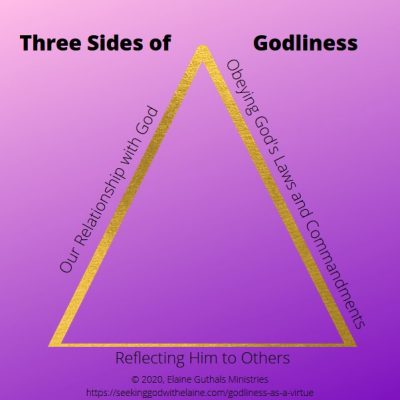
  • Goodness as a Virtue

    Is there a standard we should follow when it comes to goodness? How can we figure out what that standard is? This devotion will attempt to answer those questions.

    Nuggets

    • We are told that goodness comes from God.
    • God was working with us to instill His goodness within us.
    • God’s goodness is shown by His laws and commandments.
    • Every good comes from God.

    Devotions in the Christian Virtues series

    Flowers with title Goodness as a Virtue

    In the last devotion, we said that faith was the foundation of our virtues. Next, Peter described goodness as a virtue.

    Let’s Put It into Context

    “For this very reason, make every effort to supplement your faith with goodness, goodness with knowledge, knowledge with self-control, self-control with endurance, endurance with godliness, godliness with brotherly affection, and brotherly affection with love” (II Pet. 1: 5-7 CSB)

    Merriam-Webster Dictionary defines virtue as a “conformity to a standard of right” or “a particular moral excellence.” It is talking about how we conduct ourselves as we live our lives.

    When we think about a virtue, we think about this being something on which we do not compromise. At times, we look at it as a strength of character.

    But look at that one word in verse 5: supplement. Supplement means, according to the Merriam-Webster Dictionary, “something that completes or makes an addition.”

    Peter wrote this a progression — we have A, add B. Repeat. We can look at these two ways. This is how we

    • Work out our salvation.
    • Go through the process of sanctification.

    Merriam-Webster Dictionary used several words to describe being good. They used commendable, kind, and benevolent.

    Holman Bible Dictionary tells us that goodness comes from God. “In contrast to the Greek view of ‘the good’ as an ideal, the biblical concept focuses on concrete experiences of what God has done and is doing in the lives of God’s people” (Holman Bible Dictionary).

    God’s Goodness

    “You are good and do only good; teach me your decrees” (Ps. 119: 68 NLT)

    If you look at the Bible, we are told that goodness comes from God. The Homilist wrote this goodness refers to being “good in the sense of kindness and in the sense of moral perfection, — the primal Font of all happiness in the universe, and the immutable Standard of all excellence.”

    That means we should follow God’s standard.

    We know that being perfected means being blessed. Blessedness means we have been perfected. For the disciple, perfection is holy, sanctified, and righteous.

    Holy means to be set apart, perfect, and pure. Sanctification is the process where our lives are changed, and we made holy. Righteousness is the result of a solid relationship with God. Blackall said that righteousness is “living a life in sincere and perfect obedience to all the laws of God.”

    Lessey explains that God’s goodness is an extension of His perfection. It is drawn from the fact that His Will does not change.

    We see evidence in the Bible of God’s goodness. Emmons wrote, “The goodness of God must have moved Him to form, before the foundation of the world, the best possible method of doing the greatest possible good. His goodness must have moved Him to employ His wisdom in the best possible manner.”

    God’s Goodness in Us

    “And I am certain that God, who began the good work within you, will continue his work until it is finally finished on the day when Christ Jesus returns” (Phil. 1: 6 NLT).

    Paul was convinced that God was working with us to instill His goodness within us. We were made new creatures, to more resemble Him (II Cor. 5: 17).

    Tuck listed the signs showing this installation is occurring. “What then is the sign? Love to God, Christ, man, showing itself in trust and obedience, and goodness.”

    We exhibit God’s goodness when we imitate God and show His love to others. God is the author of all things good. He possesses the wisdom along with the goodness to cause this work not only to begin but also to be completed.

    We also exhibit God’s goodness when we imitate Christ. When we react in ways that Jesus would react, we are showing others His character.

    When we show our trust and obedience in God, we are also exhibiting God’s goodness. We are changed by trusting and obeying Him — changed to be more like Him, including exhibiting the goodness.

    Yeah, God has a lot of work to do within us. “Help me abandon my shameful ways; for your regulations are good” (Ps. 119: 39 NLT).

    Woman and dog

    God’s Goodness in His Laws and Commands

    “But still, the law itself is holy, and its commands are holy and right and good” (Rom. 7: 12 NLT).

    Yes, God’s goodness is shown by His laws and commandments. We’ve said on several occasions that the law shows us God’s character.

    But it does more than that. It gives us God’s expectations of how we should live our lives — it gives us a right way to live and a wrong way to live. This right way and wrong way promotes goodness.

    It is interesting that one of the definitions the Merriam-Webster Dictionary gave for good was “conforming to a standard.”

    We are to conform to God’s standards because they “… are holy and right and good” (Rom. 7: 12 NLT).

    God’s Goodness to Us

    “Every good and perfect gift is from above, coming down from the Father of the heavenly lights, who does not change like shifting shadows” (Jas. 1: 17 NIV).

    Bottom line, every good comes from God. He gives us

    • Life
    • Forgiveness
    • Salvation
    • Guidance through the Holy Spirit
    • Moral excellence
    • Strength
    • Hope
    • Eternal life

    Making the Connections

    Worldview people think they can be good without God. They don’t realize that their actions are, in reality, empty because they lack God’s perfection. Their efforts extend from their sinful nature.

    Their actions come from the evil in the world today. That is because Satan is controlling this world. If they have not submitted to God, they are controlled by Satan.

    Good cannot come from evil.

    Worldview people today don’t want the boundaries associated with God’s laws and commandments. They want the freedom to do whatever they want.

    What worldview people don’t recognize is that God’s laws and commandments are “… the expression and emanation of the perfect nature and will of God, ‘the law of the Lord is perfect, converting the soul’” (Bayley). They bring the goodness out of us — and give us a peace.

    Making the Connections to Self-Discipline

    We said Second Peter 1: 5-7 was a progression. It is as we are told in Romans 8: 30. “And those he predestined, he also called; and those he called, he also justified; and those he justified, he also glorified” (Rom. 8: 30 CSB).

    We have to be self-disciplined in order to facilitate the growth needed. If we aren’t intentional and dedicated to growing, it doesn’t happen.

    How Do We Apply This?

    First, we have to ABCD. Salvation eliminates evil and replaces it with good.

    The ABCDs of Salvation

    If you have not become a believer in Christ, please read through the
    Plan of Salvation and prayerfully consider what God is asking you to do.A – admit our sins

    B – believe His Son Jesus is our Redeemer

    C – confess God as Sovereign Lord

    If you have not become a believer in Christ, please read through the Plan of Salvation and prayerfully consider what God is asking you to do.


    D – demonstrate that commitment by making any changes needed in our lives to

    live the way in which God has called us

    The Disciple’s Job Description

    If we haven’t ABCDed yet, we need to search for God. If we have, we need to see Him to grow more like Him. We do that the same say.

    We have to be self-disciplined in order to facilitate the growth needed. If we aren’t intentional and dedicated to growing, it doesn’t happen.

    Searching for and Seeking God

    Hearing His Word (Rom. 10: 17).
    Reading His Word (Rev. 1: 3).
    Praying to Him (Heb. 4: 16).
    Studying His Word (Ac. 17: 11).
    Meditating on His Word (Ps. 1: 1-2).
    Memorizing His Word (Ps. 119: 11).

    To read Has God Provided Everything We Need?, click the button below.

    Goodness is a good next step after faith. Faith has to be the foundation. If we don’t have the faith, why do the rest?

    After our conversion, goodness seems like goodness is the logical next step. We are so excited about our new lives; we look at others differently and want them to share what we have found.

    Goodness is a good virtue to have when we are witnessing. It not only might open some doors to facilitate the witnessing, but it also shows who God is.

    As Peter implied, it is a progression. The next devotion will look at knowledge.

    Good, good Father. You are good, and You have given good to us. Help us to show that good to all we come into contact with so that they will want to learn of You. Amen.

    If you have not admitted that your relationship is not right with God,

    have not asked Jesus to be your Lord and Savior,

    and have not confessed your sins,

    please read through the Plan of Salvation and prayerfully consider what God is asking you to do.

    Related Links

    Related Links

    Related Links

    Song

    Related Links

    I have created a worksheet of the questions above. Click on the button below to access it.

    Don’t know what your spiritual gifts are?

    Take this Spiritual Gifts Inventory

    The Disciple’s Job Description

    Complete Job Description

    Individual Description

    It Was Enough
    Vocalist: Elaine Guthals
    Keyboard: Chris Vieth

    What do you think?

    Leave me a comment below (about this or anything else) or head over to my Facebook group for some interactive discussion.

    If you don’t understand something and would like further clarification, please contact me.

    If you have not signed up for the email daily or weekly providing the link to the devotions and the newsletter, do so below.

    If God has used this devotion to speak with you, consider sharing it on social media.