Abraham and His Family
1960 BC — Abram was born (Gen. 25: 7)
1950 BC – Sarai was born (Gen. 17: 17)
1890 BC — Terah, Abram, Sarai, and Lot moved from Ur to Haran (Gen. 11: 31)
1885 BC — Abram called at age 75 (Gen. 12: 1-3)
c. 1880 – 1875 BC — Abram defeated King Chedorkiamer to rescue Lot (Gen. 14)
1875 BC — God promised an 85-year-old Abram that he will have a son (Gen. 15)
1874 BC — Ishmael was born (Gen. 16: 15)
1861 BC — God reestablished His covenant with Abram; and Abraham, Ishmael, and males were circumcised (Gen. 17)
1861 BC — Sodom and Gomorrah were destroyed one year before the birth of Isaac (Gen. 18 – 19)
c. 1861-1860 BC – Abraham and Sara move to Gerar, and Abraham deceives Abimelech
1860 BC — Isaac was born (Gen. 21: 2)
c. 1858 BC — Isaac was weaned (Gen. 21: 8)
c. 1845 – 1830 BC — God tested Abraham, at the age of 115- 130, by commanding he sacrifice his only son Isaac (Gen. 22)
1823 BC – Sarah died (Gen. 23: 1)
c. 1823–1820 BC – Abraham sends Eliezer to Paddan-Aram to find a wife for Isaac (Gen. 24)
1820 BC – Isaac, at age 40, marries Rebekah (Gen. 25: 20)
1785 BC — Abraham died at the age of 175 (Gen. 25: 7 – 8)
Based on Timeline from
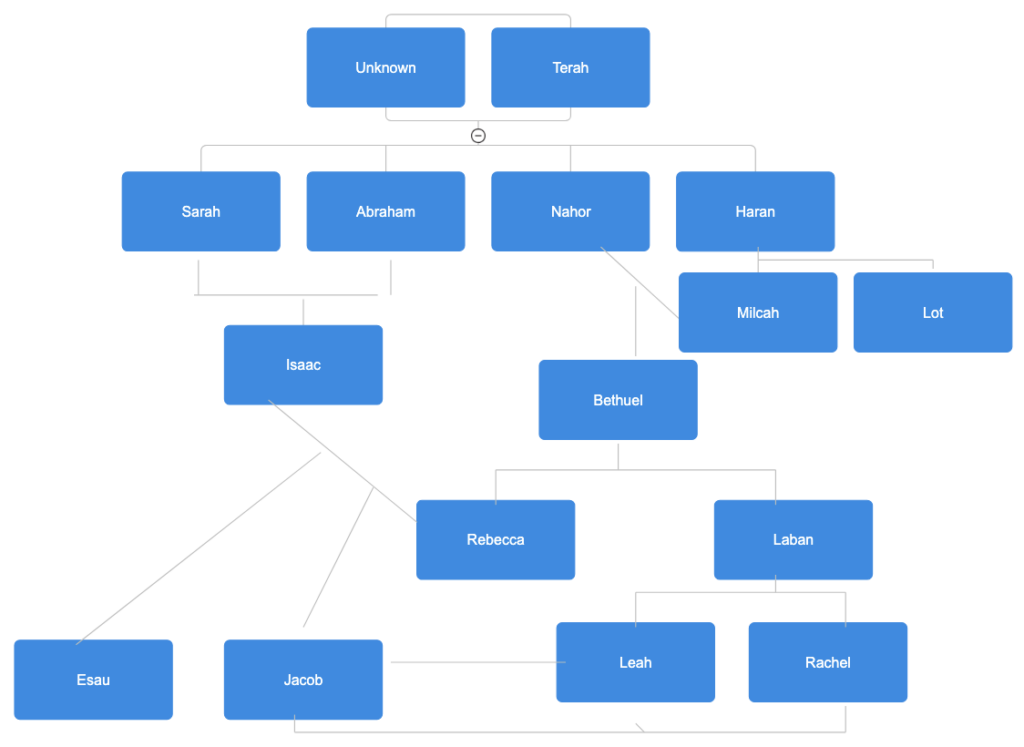
Terah’s Descendants
We are told that Terah lived in Ur of the Chaldeans, possibly from the plain of Shinar where they tried to construct the Tower of Babel. We know he and his sons worshiped false gods (Josh. 24: 2-4 NLT). In fact, Terah may have sold idols, sometimes enlisting Abram as a salesman.
Terah was the one who chose to move to Canaan. However, he never went farther than Haran.
It is believed Nahor was the oldest, and Abraham was the youngest. Once again, God called the son who was not the firstborn in the family.
Think about it. Terah was the father of Abraham, Sarah, Nahor, and Haran. Since Milcah was Haran’s daughter, Nahor kept it in the family also. They did this for continuation of the family line and inheritance purposes.
Way back in Genesis 12, we talked about whether Terah or Abraham was called. If Terah was not, he was still picked to have the chosen family to descend from him.
Haran and Lot
Terah’s middle son Haran, though his wife was not listed, had a son named Lot, who will figure greatly into the Genesis narrative. Haran also had two daughters, Milcah and Iscah (Gen. 11: 29).
Unfortunately, Haran died before the family left Ur.
Some think Mrs. Lot came with them from Ur. However, we aren’t told that for sure.
Nahor and Milcah
Nahor married his brother Haran’s daughter Milcah. They raised a large family.
The most important to Abraham’s future was Bethuel. Bethuel would become the father of Rebecca, Isaac’s future wife, and Laban, Jacob’s father-in-law.
Abraham and His Wives
Abraham died at the age of 175.
The wording of Genesis 25: 8 indicated that Abraham had a good life. They didn’t have any concept of eternity, so living a long life was what was prized.
Abraham’s death happened as it was foretold by Sovereign God as peaceful (Gen. 15: 15).
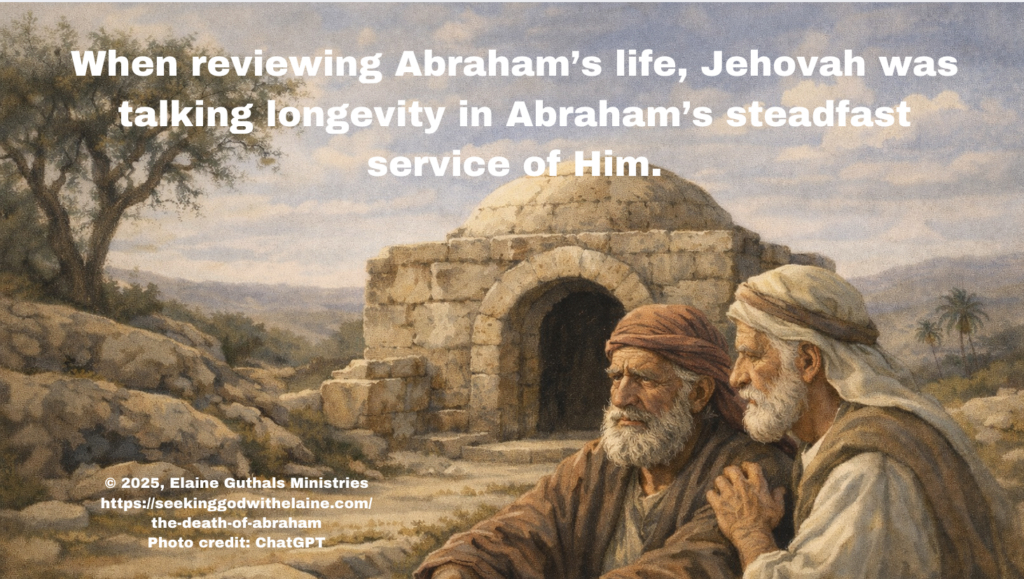
Abraham was being gathered to his people. More importantly, he was being gathered to his Heavenly Father.
Gathered to his people means more than Abraham was buried in the cave alongside Sarah. It meant that Abraham would be reunited with his ancestors who had died before him — Terah, Shem, Noah, and Seth.
Whatever Abraham gave up, he was given more back because of his faithfulness.

Abraham had three wives. Concubines (pilegesh) – while they were generally servants – were secondary wives, typically chosen to bear children when the primary wife was barren.
Women who had the legal status of concubines, though, did not have the full privileges of the primary wife. But they were treated well and held in high regard.
There would have been no betrothal, no marriage ceremony. There would have just been a statement.
Abram and Sarai
Because of his faith, Abraham became the first Hebrew patriarch. That is why he is called “father of the Jews.”
But with Sarai barren, Abram wasn’t becoming the father of anything.
It was very important for women to bear children in those days. The woman’s job was to reproduce and build the family.
Sarah’s barrenness would have been difficult for Abraham because it was his legacy. It would have been an embarrassment to Sarah because she wasn’t fulfilling her purpose.
When Sarah took matters into her own hands to get a son through Hagar, Abraham and Sarah were looking at the promise from their perspective. They thought they needed to understand before it could happen. They were wrong on both counts.
Added to that, they were unwilling to wait on Jehovah for His time.
Sarah devised a plan to hurry Jehovah along in His promise of a child and then didn’t like how it turned out. She could be seen as being mean to Hagar and Ishmael — even though they brought some of that upon themselves.
The thing is, Abraham loved her. Yeah, Abraham did try to pass Sarah off as just his sister – which she was. They had a long, full life together; and in the end, Abraham mourned for Sarah.
Sarah was Abraham’s last link to Ur. She wasn’t just his wife; she was the last family member (sister) — person altogether — to have seen the complete transformation from idol worshiper to child of Jehovah.
Her death may have thrown Abraham for a loop. Sarah was ten years younger than him. Yet she died first.
If we go back to the Hebrew, it says something interesting. Genesis 23: 1 talks about two lives. What does two lives mean? There are a couple of ways this is interpreted.
The first way is that Sarah had a full significant life. In other words, it was a she-had-a-good-life statement.
The other way to interpret it is that there were two distinct phases in Sarah’s life. It is easy to see the dividing line.
She was born Sarai and lived most of her life as that person. In fact, she lived 89 years under this name. She went from a child to an adult, from being single to being a wife.
The second phase, she became Sarah — a mother with a spiritual transformation. She was a princess who became princess, mother of nations.
But this is something Jehovah’s children would understand (II Cor. 5: 17 NLT). We call it changing from a physical life to eternal life.
Sarah lived 127 years. She was 65 when Abraham received the call to go to Canaan. She stayed with him up until now.
This had to have been one of the biggest separations Jehovah required of Abraham.
Abraham had already experienced the death of a loved one – father and brother. But this was Abraham’s mate – the mother of the covenant son.
Abram and Hagar
If Abram had been in Canaan ten years (Gen. 16: 3), Chapter 16 had to happen fairly soon after the events of Genesis 15.
Sarai and Abraham were going to have a baby — together. It was a promise from the Sovereign God.
But seriously! They were 85 and 75 respectively. It was impossible, right?
We can see that Sarai was all in on the plan of her having a child. It probably was natural instinct to do all in her power to get the baby she had probably wanted for years.
Sarai couldn’t see how God was going to keep His promise that she would have a biological son.
The problem was that her desire for a child overshadowed the fact that it was going to be God Who gave it to her. She probably had a little fear in the back of her mind as as to whether or not God could do as He promised.
So, she took matters into her own hands.
Sarai had a slave (shifchah [female slave of the lowers rank]) named Hagar. She performed menial duties.
Hagar was Egyptian. She probably became Sarai’s servant when they were in Egypt (Gen. 12: 14-16).
Jewish tradition — Midrash — believes that Hagar was Pharaoh’s daughter. Instead of allowing her to be a princess in her own country, her father gave her to Abraham in the great payoff (Gen. 12: 16), thinking she would be better off there — even if it was as a slave.
A slave in that culture could be used as a surrogate mother, but that isn’t what Jehovah wanted. He is One to keep clean blood lines.
In the Hebrew in Genesis 16: 2, Hagar was given the title isha (wife), not philegesh (concubine) or a secondary wife with lower legal and social status.
However, Hagar is always referred to as shifchah [female slave of the lowers rank] by Sarai, Abram, and Jehovah in Genesis 16: 5, 6, and 8, respectively.
Sarai’s plan came to fruition – and it didn’t work out the way she wanted. After she became pregnant, Hagar held Sarai in contempt.
Sarai blamed Abram, even though it had been her plan. Instead of taking responsibility for her actions, Sarai tried to shift the blame onto Abram.
Because Sarai was probably mad on a couple of fronts, she mistreated Hagar. She was taking her frustration and hurt out on the person she put in the middle in the first place.
It seems to me that Hagar thought she was better than her mistress. It probably stemmed from the fact that Hagar could provide what Sarai couldn’t – a child.
I get it that Hagar may have thought she was going to get to be primary isha, not philegesh, but she was still a shifchah in everyone’s eyes but her own. She was asked to do one thing – which would have, in her mind, elevated her son to firstborn status and set him for life.
Hagar must have been wandering how things worked out the way it did. But in a way, didn’t she bring it on herself?
No, Hagar probably didn’t have any say in the matter about becoming Abram’s secondary wife. She did have a say about the contempt and disrespect she felt for Sarai.
Hagar’s response was to run away. She jumped ship before the baby was born. She wasn’t going to put up with Sarai’s abuse.
That wasn’t what God wanted, either.
In the New Living Translation, it says God sent an angel to comfort her. If we go back to the Hebrew, the way I read it is it says God came Himself. Yes, Hagar was an Egyptian and, therefore, a Gentile. God still came to her to provide for and comfort her.
God was gracious to her. No, He didn’t elevate her; but He didn’t start accusing her, either. God came to her with pity.
Notice Hagar didn’t answer the angel’s second question. She either didn’t know where she was going or didn’t want to say. She may not have thought it was an option to return, even if the Holy Spirit was prompting her.
God had plans for who Hagar’s baby would be. One of those plans was to be raised by Abram.
God knew He wasn’t going to make Hagar’s son the firstborn even though he was born first. (God has a way of usually doing that.) That privilege was saved for Sarai’s firstborn.
But that didn’t mean God left Hagar high and dry. He came to comfort her.
God wanted Hagar to go back to her station and rank. We have to remember that Hagar was an escaped slave. As much as we may want to cheer for her freedom, she legally was in the wrong.
Still, God came and found Hagar.
God really didn’t cut Hagar any slack. Some would think she was entitled to a pass because of the harsh treatment of Sarai against her. Nope.

It was Hagar’s duty to go back. Yes, that grates on our sensibilities in today’s society, but we cannot judge ancient society.
We need to see what God says about it. He worked Hagar’s plan out just as He did Abram’s and Sarai’s.
God laid out who Ishmael would become.
Hagar, a Gentile, responded to Abram’s God. If she had known anything about Abram’s God, she would have known he had never seen Him. He was always up in Heaven.
But here God was — on earth — talking to Hagar — a Gentile.
Not only does God see us, but He also sees the real us. He knows our thoughts and motives. He knows what our actions will be before we do them.
Most of all, God sees our response to Him. Are we His child or just one of His creation? Does our faith produce obedience and fruit, or do we even believe He is God?

Because God came to Hagar and ministered to her in .her time of need, she obeyed Him and returned to Mamre.

Once the covenant child was born, issues arose between him (Isaac) and Abraham’s firstborn son (Ishmael).
At the celebration of Isaac being weaned, Ishmael and his mother Hagar made fun of Isaac. A 16-year-old was mocking and scoffing a 2- or 3-year-old?
For 16 years — even if he knew about the covenant — Ishmael probably thought there was a chance that he would be Abraham’s heir as he would have qualified as heir without Isaac. We know Ishmael was much loved by Abraham.
It was Sarah’s idea that Ishmael be born in the first place, but now she just wanted him to go away.
After the covenant son was born, any standing Hagar gained in that plan would have gone down. A good-enough heir was no longer needed.
Hagar was Sarah’s slave, not Abraham’s. Sarah was operating legally with regard to Hagar. But Abraham, as Ishmael’s father, had the final determination whether he would be allowed to go with Hagar.
It was Jehovah’s direct command to Abraham that got Hagar and Ishmael cast out. In the end, Sarah was following God’s plan to banish them from the clam.
Here, Jehovah did not want any confusion about who the covenant child was. This is especially true since, for 13 years, Ishmael would have been considered the firstborn.

Isaac was a Hebrew. Ishmael wasn’t. It wasn’t about ancestry. Jacob was a Hebrew. Esau wasn’t.
Abraham knew Ishmael wasn’t the covenant son. Jehovah made that clear. But Jehovah also made it clear that He would bless Ishmael (Gen. 17: 16-18 NLT).
For all parties involved, it was better to cut Ishmael’s dream of an inheritance off right then.
Abraham agreed with Sarah’s request and was obedient to Jehovah’s direction and sent Hagar and Ishmael away.
The Wilderness of Beersheba included wells dug by Abraham. Wouldn’t Hagar and Ishmael have known where those were at — especially if Ishmael helped with the flocks?
But there were some problems with at least one of the wells. It was called the well of oath because Abraham’s men and Abimelech’s men quarreled over it.
Maybe this was why the water wasn’t available to Hagar and Ishmael.
We don’t know how long Hagar and Ishmael wandered in the Wilderness of Beersheba.
Since the water had run out, Hagar and Ishmael were about to die of thirst. She was ready to give up.

The last thing Hagar wanted to do was to see Ishmael die.
Hagar may have thought the Genesis 16 prophecy had already come true. She may not have known about the Genesis 17 prophecy.
Ishmael, so named because Jehovah heard Hagar during the first flight from Sarah, was heard by Jehovah. The last time, Jehovah heard Hagar. This time, He heard Ishmael crying.
Remember Hagar’s first flight away from Sarah’s cruelty? Jehovah Himself came to Hagar (Gen. 16: 7). This has different wording (Gen. 21: 17).
Think about it. This was the second time that Hagar was in the wilderness. And the first time she talked to “… the God who sees me …” (Gen. 16: 13 NLT).
Hagar should have drawn from the faith she established then.
Jehovah in His mercy opened Hagar’s eyes to what she needed. Did the well just miraculously appear? Or did Hagar not see it because she had sand and tears in her eyes?
What we need will always be within arm’s reach. The big question for us is how many times do we not see Jehovah’s well right beside us? He offers us living water from that well.
Jehovah promised Hagar that a nation would come through Ishmael’s line as well as through Isaac’s line.
If we read through those verses, we think that Ishmael got the exact same inheritance that Isaac did. Everything except being the covenant son.
Nowhere in God’s Word was Ishmael ever promised land. He was promised nations — people groups. Isaac, the covenant child, was promised land.
Ishmael grew under Jehovah’s provision. As Ishmael grew, he learned how to defend himself. Eventually, Ishmael became a husband and a father himself.
Abram and Keturah
Abraham took Keturah as a wife, with whom he had several sons.
Remember, concubines had legal status but did not have the full privileges of the primary wife. To me, this is why Keturah could be called an isha in Genesis 25: 1 and a pilegesh in I Chronicles 1: 32. She was a secondary isha because she was a pilegesh.
This is different than how Hagar is described. True, Hagar was given the title isha (wife), not philegesh (concubine) in Genesis 16: 2. After that, she is always referred to as a shifchah [female slave of the lowers rank] (Gen. 16: 5, 8).
But then concubines (pilegesh) generally were slaves/servants.
I had always been under the impression that Abraham married Keturah after Sarah had died. This could have occurred during the 13 years between Ishmael’s birth and Isaac’s birth. They may not have been mentioned before because they did not further the spiritual narrative.
The mention of Ishmael may have been representative of the others. Plus, it may have been more of a story because of the demand of Sarah and the flight of Hagar.
A fun fact is that Abraham’s son Midian was the ancestor of the Midianites, who were spice traders who traveled in caravans. These were the people to whom Moses fled after killing the Egyptian.
Abraham may have had more wives because there were a lot of things about his life that we weren’t told. I would say that he probably didn’t.
We are told that Abraham had concubines, but we aren’t told if two was it or if or how many sons the others had.
Abraham wouldn’t have been lamenting he was childless – meaning in Hebrew destitute of children – if Eliezer was his biological child. “… since I go childless …” (Gen. 15: 2 OJB). (To me, this means he couldn’t have been married to Keturah at this point and had children with her.)
Abraham had no problem with suggesting Ishmael as a substitute. Why wouldn’t he have offered the older, who was more in line with the character Jehovah wanted?
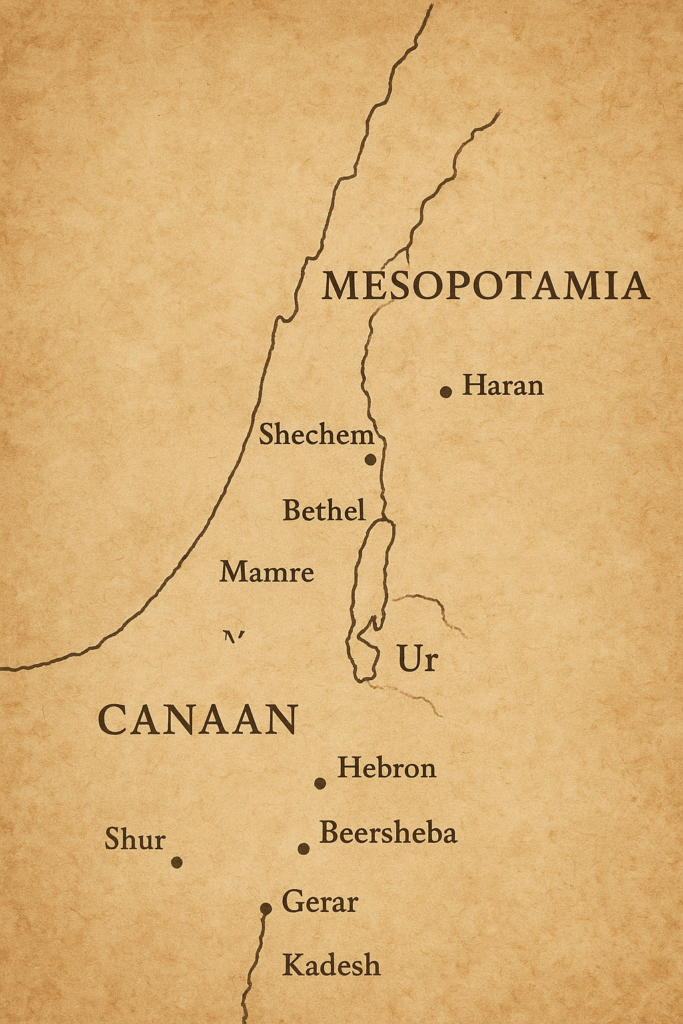
Home
When we were first introduced to Abraham – then Abram – he lived in Ur. In 1890 BC, he and at least part of his family moved to Haran.
In 1885 BC, Abram was called by Jehovah to move to an unnamed country. That country turned out to be Canaan.
Abraham lived several other places in his lifetime. Upon arriving in Canaan, he settled in Shechem (Gen. 12: 6).
Next, Abraham moved between Bethel and Ai (Gen. 12: 9). When a famine came to the region, he and his family lived as foreigners in Egypt (Gen. 12: 10).
When they left Egypt, Abraham moved his family back between Bethel and Ai (Gen. 13: 3). He then moved to a small village named Mamre by Hebron and settled near the oak grove belonging to Mamre (Gen. 13: 13).

To read devotions in the Creating Everything theme, click the button below.
Devotions in the Abraham the Patriarch series