As it was time to begin His ministry, Yeshua was beginning to gather followers. This devotional reading looks at the first two disciples who began to follow Him.
Nuggets
- The event that began this progression was when John was being questioned by Pharisees.
- John’s ministry was all about others.
- From His birth, Yeshua was identified as the Sacrifice needed to restore us from sin.
- The two disciples immediately left John and followed Yeshua.
- We have to seek the Savior for the right reason.
- The disciples had to determine why they were seeking Yeshua.
- Yeshua recognized the importance of the two disciples coming and seeing for themselves.

Yeshua knew that the Plan of Salvation would call first century Jews – and eventually all people – to change their lifestyle to better align with what Jehovah expected. He knew that He would need students to learn about the need for restoration and to learn how to walk with Jehovah.
Those students would then have to tell others.
That meant Yeshua would have to choose the right men for the job. Those who followed Him were called disciples.
Let's Put It into Context
To read devotions in The Battle for the Heart theme
Devotions in the The Early Ministry of the Messiah series
John Again Identified Yeshua
“The following day John was again standing with two of his disciples. As Jesus walked by, John looked at him and declared, ‘Look! There is the Lamb of God!’” (Jn. 1: 35-36 NLT)
The Following Day
The event that began this progression was when John was being questioned by Pharisees.
A lot of things had been happening that were identified by the following day language. It is easy to get lost in the quick day changes.
“John told them, ‘I baptize with water, but right here in the crowd is someone you do not recognize. Though his ministry follows mine, I’m not even worthy to be his slave and untie the straps of his sandal’” (Jn. 1: 26-27 NLT).

John Was Standing with Two Disciples
John’s ministry was all about others.
We have already seen where John the Immerser pointed to Yeshua as the Messiah at His baptism. Once again, John pointed to Him – this time to two of his disciples.
The Hebrew word for disciples is talmidim – תלמידים. It means learners or students. The singular is talmid (תלמיד).
We have to know what kind of learning is being discussed here. It isn’t a straight transfer of information. It could involve learning the teacher’s interpretation, conduct, and way of life.
John could have said, “Hey, these are my disciples. Don’t come poaching. Go find Your own.”
No, John knew his mission – to prepare for the Messiah.
What would have been the point of John’s ministry to prepare for the Messiah if he didn’t want his disciples to follow the Master? The purpose of his ministry wouldn’t have been about the Messiah – it would have been about himself.
John’s message was incomplete – until Yeshua arrived on the scene. But then his mission was completed.
So, John encouraged his two disciples to follow the Messiah.
There Is the Lamb of God
From His birth, Yeshua was identified as the Sacrifice needed to restore us from sin.
When we think of a sheep, most of us probably think about a fluffy animal that, when given a haircut, provides us with yarn to make some warm clothes. Maybe we think about some milk to drink.
That wouldn’t have been what the first-century Jews thought. They would have thought of sacrifice in the Temple.
They wouldn’t have connected that with the Messiah – the One Who was to save them from Roman occupation.
Yeshua’s mission was to be a substitute for sinful humans. He came to take away the sin of the world (Jn. 1: 29).
If He hadn’t been the Lamb Who was slain, we would forever be separated from our Creator. To some, that may be fine since that is all we have ever known.
But come Judgment Day, that isn’t going to be fine. The consequences of that separation will be eternal – and painful.
What Yeshua accomplished that a regular lamb couldn’t was to remove our sins. The lamb’s sacrifice would allow temporary cover for our sins.
Only Yeshua’s blood would allow for the permanent cover of our sins.
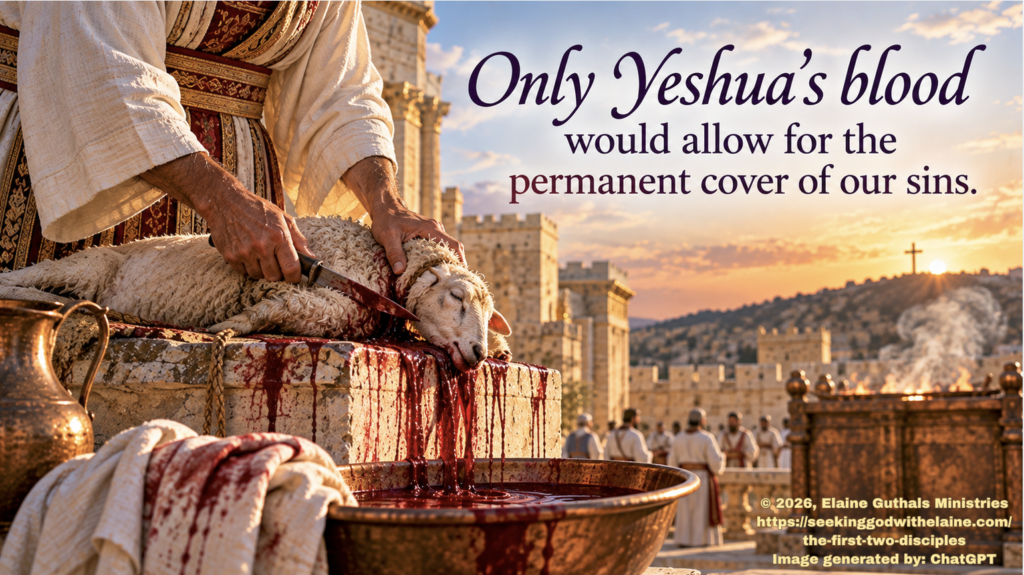
What can we learn from this? Two things. Sin is real, and it is seriously bad. Jehovah loves us so much that He would provide His own Sacrifice – the only Sacrifice – to eliminate its eternal consequences once and for all.
The Disciples React
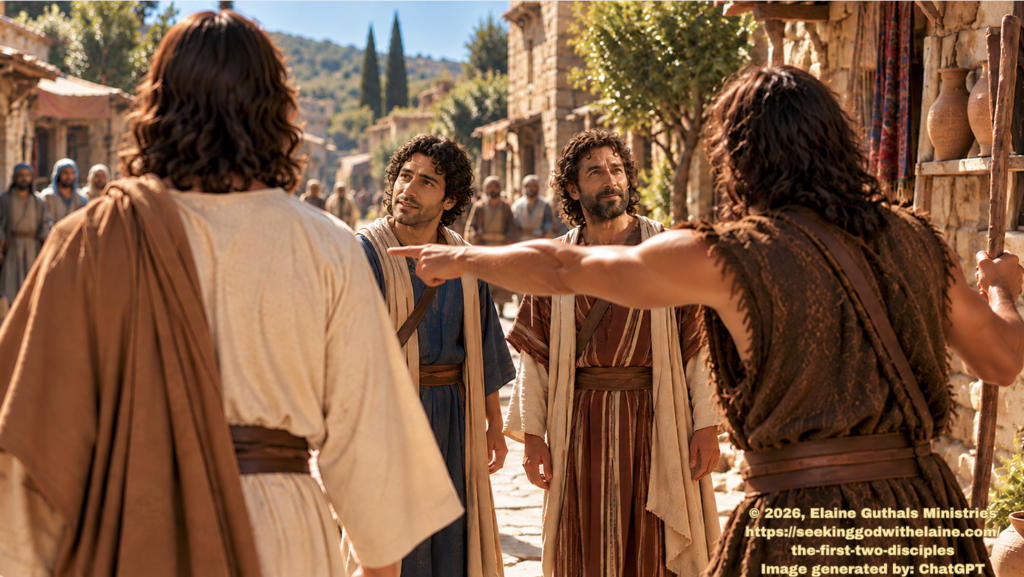
"When John’s two disciples heard this, they followed Jesus. Jesus looked around and saw them following. ‘What do you want?’ he asked them. They replied, ‘Rabbi’ (which means ‘Teacher’), ‘where are you staying?’ ‘Come and see,’ he said. It was about four o’clock in the afternoon when they went with him to the place where he was staying, and they remained with him the rest of the day” (Jn. 1: 37-39 NLT)
They Followed Jesus
The two disciples immediately left John and followed Yeshua.
Once John made his identification of Yeshua, the disciples had a choice to make. Were they going to stay with John – i.e., stay with what they had always known?
Or were they going to pursue a relationship with Yeshua?
No, don’t mistake this for their becoming His followers at that moment. On the other hand, don’t see this as some first-century type of stalking.
They wanted to meet the Lamb.
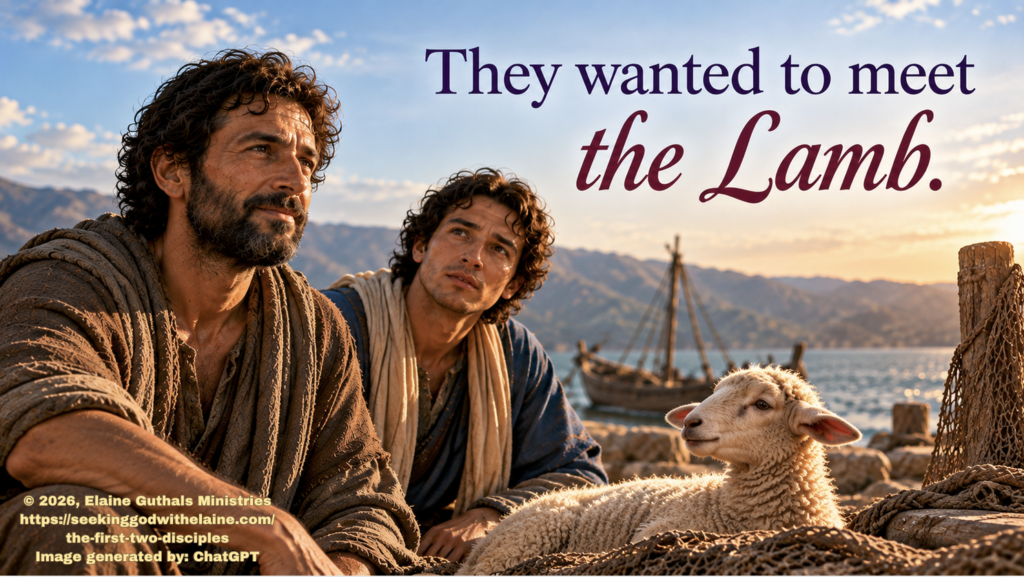
Knowing that we have the need to meet the Savior is the first step into becoming a child of Jehovah. Head knowledge of the Sacrifice has to come first.
But it can’t stop there. Head knowledge does not make Yeshua our Savior.
We have to build a relationship with Him.
What Do You Seek?
We have to seek the Savior for the right reason.
Yeshua asked the disciples a great question. “What do you seek?”
Ooo, baby. Yeshua is still asking us that question today. In fact, that is a foundational discipleship question.
There are a variety of answers that we can give. Some may say they are looking for a better life.
That may be a good answer – but it also may be a wrong answer. If we are looking for an easier life or a more prosperous life, that would be the wrong answer.
If we are seeking Yeshua to be our Savior and Redeemer, that is the right answer. Our motivation for seeking must be to submit our lives and our will to Him.
Where Are You Staying?
The disciples had to determine why they were seeking Yeshua.
I always thought the response of the two disciples to Yeshua’s question was interesting. If John had prepared them for the coming Messiah – and he did – and then he told them this was the One, wouldn’t they have come up with a better answer than “Where do You live?”
Maybe that was a polite way of inviting themselves over. Maybe that showed they wanted a relationship with Him.
Whatever the reason behind structuring the answer in that way, the two disciples showed respect by addressing Him as Rabbi.
Come and See
Yeshua recognized the importance of the two disciples coming and seeing for themselves.
In order to ask Yeshua to be our Savior and Redeemer, we have to have knowledge of Who He is. We have to have personal experience in listening to and following Him.
We have to seek and find Yeshua.
Andrew
“Andrew, Simon Peter’s brother, was one of these men who heard what John said and then followed Jesus” (Jn. 1: 40 NLT)
While Andrew didn’t get as much ink time as his brother Simon Peter, he is also one of the most recognizable disciples.
I have to start out with a disclaimer. We are going to start introducing the Apostles. Scripture tells us very little about them.
Tradition tells us more, but it is only that – tradition. Some traditions may be more reliable than others.
So, long story short, if Scripture itself doesn’t say it, it may be wrong or it may be right.
Andrew is the first disciple we meet. Of the two disciples who followed the Lamb at John the Immerser’s direction, he is the only one explicitly named.
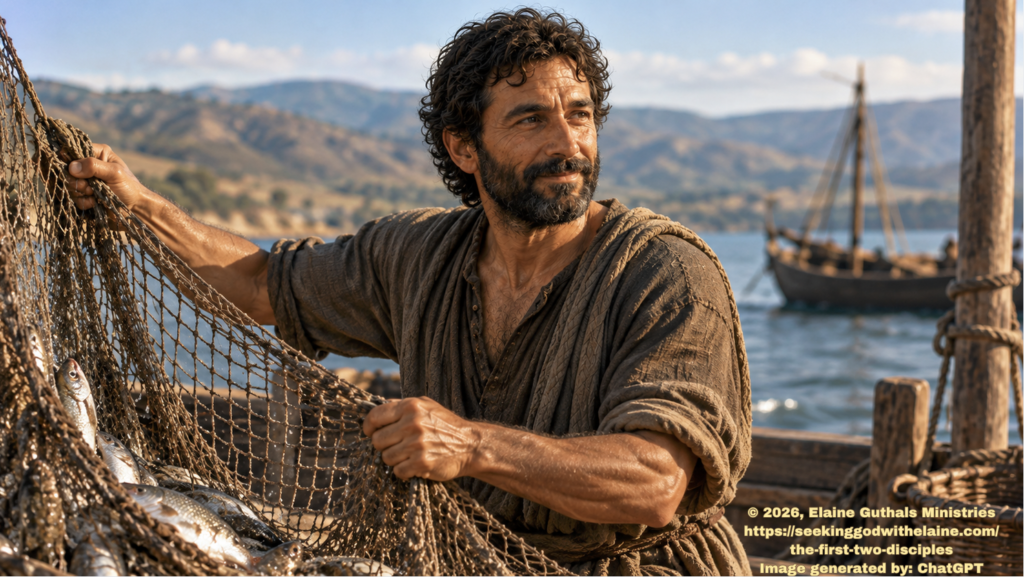
But then the Apostle John, who wrote the Gospel book, identified Andrew as being Simon Peter’s brother. I wonder how often he felt he was in his brother’s shadow?
They fished together, and they were called together (Mt. 4: 18-22). They may have even lived together (Mk. 1: 29).
Still, it is Andrew to whom we are first introduced. By being a disciple of John’s, he showed his earnest pursuit of salvation before ever meeting the Messiah. That leads us to believe he accepted John’s message of the coming One.
Punshon had a great observation about the disconnect between first-century Messianic expectations and the demeanor of the Lamb introduced to Andrew. He wrote,
“He came to Jesus with an openheartedness worthy of imitation. He had his own notions, doubtless, about the grandeur of Israel’s Messiah; but was not offended when the solitary, unattended man was pointed out to him. Some, in the hasty revulsion of feeling, would have turned away in disdain. But Andrew’s faith mastered his prejudice.”
Resource
That tells us that Andrew didn’t just believe what everyone expected the Messiah to be. He made up his own mind, probably in large part due to what John told him – this is the Lamb of God.
Andrew was faithful to the ministry after Yeshua’s death. According to tradition, he spread the Gospel to Asia Minor, Greece, and Scythia. It was in Patras, Greece, that, according to tradition, he was crucified on an x-shaped cross after being severely whipped by seven soldiers. It is said that two days passed before death came.
Making the Connections #1
The other disciple with Andrew that day wasn’t named. But that hasn’t stopped us from trying to figure out who he was.
Most agree on two candidates. It could have been John, but it also could have been Philip.
Most believe the disciple was probably John. He was an important disciple.
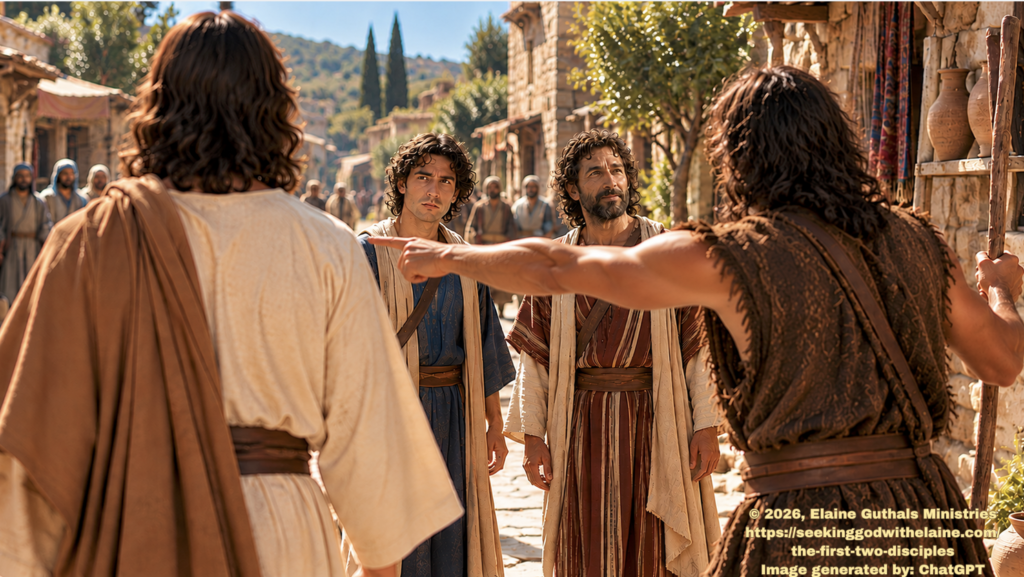
If John did write this Gospel account, I can see why he didn’t identify himself as the disciple. He never really identified himself throughout the book – just as the beloved disciple. This, however, wasn’t verified by any other canonical writer.
We do know that John was the son of Zebedee and the brother of the Apostle James (Mt. 4: 21). Their family operated a fishing business on the Sea of Galilee. It sounds extensive because they did have hired workers (Mk. 1: 20). They appear to have been partners with Simon Peter and Andrew (Lk. 5: 7).
It is tradition that John’s mother Salome was the sister of Mary. If so, James and John would have been cousins of Yeshua.
John is also memorable because he and James got nicknames. Yeshua called them the sons of thunder. This nickname came from their reaction to the Samaritan village (Lk. 9: 51-56).
John wrote other New Testament books besides the Book of John. He may have written the Books of First John, Second John, and Third John and the Book of Revelation.
John’s mission field was Jerusalem and Ephesus.
Many know that John was exiled to the Island of Patmos. What some may not know is that he, according to early church tradition, was boiled in oil before he got there. When he didn’t die from that hideous torture, which was an execution method of the Roman Empire, he was banished (possibly by Domitian) to the prison on the Island of Patmos.
John was eventually freed. He then served as Bishop of Ephesus (modern-day Turkey). He died peacefully – the only one to die of natural causes according to tradition – sometime after AD 98.
Less is known about Philip. John 1: 44 indicates that he was from Bethsaida.
We do know that Philip was a man who asked practical questions (Jn. 14: 8-9). He, like Andrew, was more quiet about his evangelism. Philip’s mission field became Greece, Syria, Phrygia, and Hierapolis (Asia Minor).
Little is known about his life and death. Tradition says that he was the father of daughters. He is believed to have been martyred by either crucifixion or stoning. He is buried in Hierapolis.
The other disciple with Andrew could have been either John or Philip. Or it could have been someone else entirely. The truth is we just aren’t told.
Making the Connections #2
I like what Punshon said. He wrote, “Christianity requires intelligence, reliance, not blind credulity.”
Resource
Anyone who believes Jehovah demands blind submission has profoundly misunderstood Who He is. He wants us to make informed, genuine decisions to deny ourselves, choose Him daily, and follow Him and His ways (Lk. 9: 23).
Heart Check
Think about the battle Yeshua is engaged in for your heart. Ask yourself the following questions.
- Am I seeking Yeshua for an easier life, or am I seeking Him as our Savior and Redeemer?
- Am I content with head knowledge about Yeshua, or am I building a relationship with Him?
- Am I holding on to what we have always known, or am I willing to follow Yeshua where He leads?
- Am I accepting what others tell us about Yeshua without examining it, or am I making informed, genuine decisions to follow Him?
How Do We Apply This?
- Recognizing our need for Yeshua as our Savior and Redeemer
- Moving beyond head knowledge into a personal relationship with Yeshua
- Examining our motives for seeking the Savior
- Submitting our lives and our will to Yeshua
- Seeking and finding Yeshua through personal experience in listening to and following Him
- Making informed, genuine decisions to deny ourselves, choose Jehovah daily, and follow His ways
Father God. You call us to be students of You — Your character, Your history, Your interactions with humans. You call us so that You can use us to expand Your kingdom. Most of all, You call us so You can save us from our sins. Thank You. Amen.
If you don’t understand something and would like further clarification, please contact me.
If you have not signed up for the email providing the link to the devotions and the newsletter, do so below.
If God has used this devotion to speak with you, consider sharing it on social media.