One task Yeshua had was to show us the Father. This devotional reading looks at the grace Yeshua brought from the Father.
Nuggets
- The source of what we receive is not our fullness.
- Yeshua was the Word Jehovah sent to us.
- Yeshua was instrumental in the creation of the universe.
- Jehovah introduced Yeshua as light on Day 1 of creation.
- More than Yeshua being the true light or the false light, it is about Him being genuine – the real deal.
- Yeshua was totally human and totally divine.
- The primary Hebrew word associated with grace is chen (חֵן), meaning favor, grace, acceptance, graciousness, attractiveness, or goodwill.
- Our receiving is the consequence of what John has told us about the Word.
- What we receive is Jehovah’s grace and truth.

Yeshua had a mission here on earth. His ministry was to be the Savior of the world.
The foundation of that ministry was Jehovah’s fullness of grace. Because of His unending and overflowing grace, Jehovah sent Yeshua to be the Sacrifice that we needed.
Let's Put It into Context
To read devotions in The Battle for the Heart theme
Devotions in the The Early Ministry of the Messiah series
Jehovah’s Fullness
“For from his fullness …” (Jn. 1: 16 ESV)
The source of what we receive is not our fullness.
When we think about Jehovah’s fullness, our first thoughts may tend to fall on the fullness of His time. Everything happens according to His plan. Completion.
John may have been considering the overall plan here – the Plan of Salvation. But I think he was focused on something more specific.
The fullness is the fullness of Jehovah’s love and grace.
The Greek word John used is plērōma (πλήρωμα). Derived from the root plēroō (πληρόω), it means to fill, make full, complete, or bring to fullness.
Plērōma, however, doesn’t rely on one Hebrew word to convey the thought. And the concept of fullness is a very Hebrew thought.
Meloʾ (מְלֹא) carries the idea of fullness, that which fills, abundance, or the full measure of something. It is substantial and present.
What if John was meaning the totality of what fills something? It doesn’t mean we stuffed ourselves at our Thanksgiving dinner and are now full.
It means everything – the turkey, gravy, stuffing, green bean casserole, pumpkin pie, and anything else that made it to the menu – belongs to Jehovah.
The concept is that the entirety of what belongs within something belongs to the Creator.
We read that and think, “Everything that constitutes His fullness is overflowing toward us.” But John has already told us what is flowing: grace and truth.
The Word Was God
“In the beginning was the Word, and the Word was with God, and the Word was God” (Jn. 1: 1 ESV).
Yeshua was the Word Jehovah sent to us.
When the creation story began in Genesis 1, we aren’t told who God is – now Jehovah is introducing a new creation.
Genesis 1 doesn’t shed any light on Who Jehovah is. We are told only that He created the heavens and earth.
Matthew organized his Gospel as a new creation story. The setting is the same, but the purpose has changed.
Now, the purpose is to introduce Yeshua – the Word. The Gospels and their message – in fact, the whole message of the entire Scripture – is about the Messiah, the Savior of the world.
With this new purpose comes what seems like new words that must be used to tell the story. They include law, grace, truth, faith, sons, and sin.
True, some of those words existed in the Old Testament – the Tanak. They were an introduction to the fullness to come.
The Word Created Everything
“All things were made through him, and without him was not any thing made that was made” (Jn. 1: 3 ESV).
Yeshua was instrumental in the creation of the universe.
In everything that Jehovah created, Yeshua was right here by His side.
Yeshua not only existed, but Jehovah worked through Him to organize and actively make everything. He didn’t just design the place we live now and the place we will one day inhabit. He designed the pathway that leads us to Jehovah.
Yeshua is the message and Messenger of the Gospel. He is the entire meaning itself, and the Gospel is how He communicates that meaning to us.
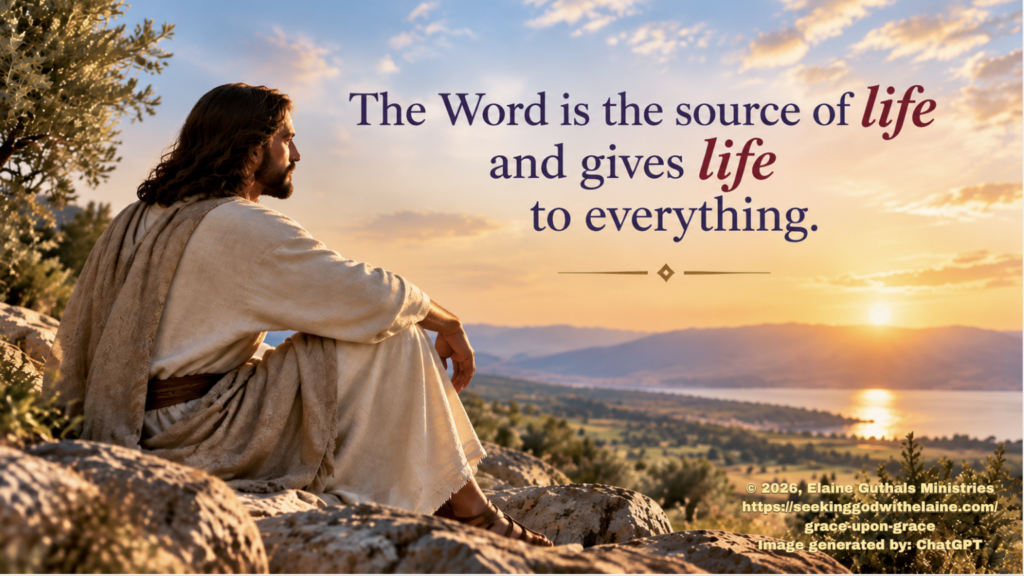
The Word is the source of life and gives life to everything. This is more than merely physical. It is spiritual.
The Light of Humanity
“In him was life, and the life was the light of men” (Jn. 1: 4 ESV).
Jehovah introduced Yeshua as light on Day 1 of creation.
The first thing Jehovah introduced after He created the heavens and earth was light. His exact words were, “Then God said, ‘Let there be light,’ and there was light” (Gen. 1: 3 NLT).
This spiritual light was Yeshua.
• “Again Jesus spoke to them, saying, ‘I am the light of the world …” (Jn. 8: 12 ESV).
• “The light shines in the darkness …” (Jn. 1: 5 ESV).
• “Your word is a lamp to my feet and a light to my path” (Ps. 119: 105 ESV).
• “As long as I am in the world, I am the light of the world” (Jn. 9: 5 ESV).
• “The Lord is my light and my salvation …” (Ps. 27: 1 ESV).
• “The people who walked in darkness have seen a great light ….” (Isa. 9: 2 ESV).
• “… They will need no light of lamp or sun, for the Lord God will be their light …” (Rev. 22: 5 ESV).
Jehovah reveals Himself through Yeshua as the Word and the Light – Yeshua is both.
True Light Came into the World
“The true light, which gives light to everyone, was coming into the world” (Jn. 1: 9 ESV).
More than Yeshua being the true light or the false light, it is about Him being
genuine – the real deal.
No, we don’t all receive the Light in the same way. We are different people. We have different beliefs and experiences – foundations.
Plus, not everyone accepts the Light. John had just told us that. “But to all who did receive him, who believed in his name, he gave the right to become children of God, who were born, not of blood nor of the will of the flesh nor of the will of man, but of God” (Jn. 1: 12-13 NLT).
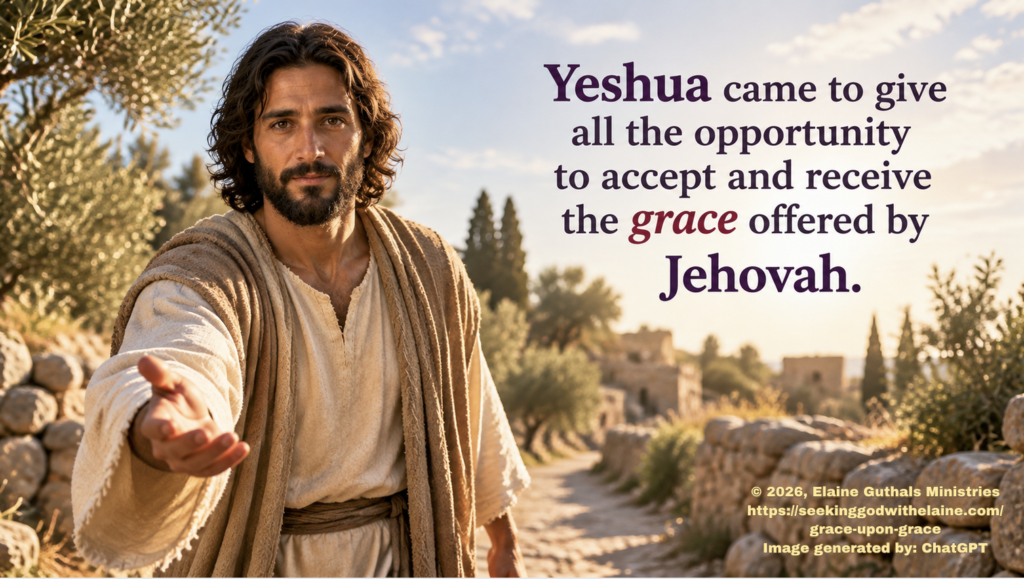
Still, Yeshua came to give all the opportunity to accept and receive the grace offered by Jehovah. The decision is ours.
Look closely at the wording. It didn’t say Yeshua was in the world. It says He came into it.
Yeshua was already the Light – we saw that in Genesis 1: 3. He was coming into the world in a different form – as flesh – a human form.
Yeshua came bearing spiritual liberation from internal corruption.
Yeshua didn’t give up His divinity to come to earth. He couldn’t change Who and what He is.
Instead, Yeshua gave up the privileges of His divinity. “who, though he was in the form of God, did not count equality with God a thing to be grasped, but emptied himself, by taking the form of a servant, being born in the likeness of men.” (Phil. 2: 6-7 NLT).
He Became Flesh
“And the Word became flesh and dwelt among us …” (Jn. 1: 14 ESV).
Yeshua was totally human and totally divine.
Jesus, in His humanity, shared the human nature of those made in the image of God. He got hungry and ate, got tired and slept.’’
So, yes, Yeshua was both human and divine.
- “Christ is the visible image of the invisible God. He existed before anything was created and is supreme over all creation” (Col. 1: 15 NLT).
- “For in Christ lives all the fullness of God in a human body” (Col. 2: 9 NLT).
That was why Yeshua could accomplish the Plan of Salvation.
Full of Grace and Truth
“… and we have seen his glory, glory as of the only Son from the Father, full of grace and truth” (Jn. 1: 14 ESV).
The primary Hebrew word associated with grace is chen (חֵן), meaning favor, grace, acceptance, graciousness, attractiveness, or goodwill.
More importantly, it is finding favor in another’s eyes – namely Jehovah. The Hebrew concept is matza chen b’ene (מָצָא חֵן בְּעֵינֵי).
John doesn’t separate grace from the person of Christ. “So the Word became human and made his home among us. He was full of unfailing love and faithfulness.” (Jn. 1: 14 NLT).
We have to be very careful about its meaning, though. Grace doesn’t mean that Jehovah simply overlooks sin. It means that Jehovah acts toward people from His own gracious character rather than because they have established a claim upon Him.
Grace doesn’t say: “Sin does not matter.” Grace says: “God has acted graciously toward you; therefore, live differently.”
Truth in the Hebrew Scriptures isn’t merely information that happens to be accurate. The primary Hebrew word translated truth is ’emet (אֱמֶת’). It describes something that is dependable, trustworthy, established, and true to reality.
The Hebrew understanding, therefore, joins two ideas that modern English can sometimes separate: truthfulness and faithfulness.
Biblical truth is something upon which a person can stand.
This means that when Scripture speaks about truth, it is not presenting truth as something detached from character.
- Truth is dependable because it is firm.
- Truth is trustworthy because it is faithful.
- Truth can be believed because it is reliable.
Truth is reality according to God.
Receiving Jehovah’s Fullness
“For from his fullness we have all received …” (Jn. 1: 16 ESV)
Our receiving is the consequence of what John has told us about the Word.
We can admire Jehovah’s fullness all we want. If we don’t receive it, it means little to us.
John had clearly shown us that fullness comes from Him. Our receiving has nothing to do with us: not our goodness, our religious efforts, our understanding, or even our ability to receive.
Our receiving comes out of Jehovah’s fullness. It is because of His grace and truth that we can receive the Plan of Salvation.
And we must receive it. We are not entitled to it. We don’t get it without accepting His fullness and agreeing upon the covenant responsibilities.
Southern Baptists like to say salvation is free — and it is because we can’t earn it or buy it. But we do have things we have to do.
Grace is freely given — but receiving the covenant relationship means entering into the relationship Jehovah established — and that relationship carries responsibilities. We have to
- walk with Jehovah.
- take up our cross daily and follow Him.
- seek Him.
- change our lifestyles where appropriate.
- surrender our will to His.
We have to receive all of Jehovah’s fullness – not a partial piece of His fullness. We can’t merely be somewhat committed to Jehovah. We have to surrender our complete lives to
Him.
Grace upon Grace
“For from his fullness we have all received, grace upon grace” (Jn. 1: 16 ESV)
What we receive is Jehovah’s grace and truth.
We don’t merely encounter the fullness of Christ, we receive it when we allow Him to win the battle for our hearts.
The Greek is charin anti charitos (χάριν ἀντὶ χάριτος). Literally, the words can carry the idea of grace in place of grace, or grace corresponding to grace, which is why English translations handle the phrase differently.
Receiving Jehovah’s grace isn’t a one-time shot. It doesn’t only occur at conversion.
We receive grace daily – again and again and again and again. Grace replaces grace. It enhances grace. Grace follows grace.
That means there is an abundance of grace.
Making the Connections #1
We don’t receive grace at conversion and then move on to something more advanced. Neither do we graduate from grace. We continue to receive it.
- Grace for the sinner who first comes to Him.
- Grace for the disciple who fails.
- Grace for the believer who doesn’t understand.
- Grace for the person who has exhausted his own strength.
- Grace for the person who thinks s/he ought to have it all figured out by now.
Making the Connections #2
John put grace and truth together. Grace doesn’t mean that God stops dealing with us truthfully.
Some may think that grace allows us to continue in our sin. It doesn’t work that way.
We must heed John the Immerser’s message. We must repent of our sins and turn back to Jehovah.
Making the Connections #3
There can be times when we feel like we should have used up our supply of Jehovah’s grace.
Not going to happen. Why?
It is Jehovah’s supply – not ours.
We are relying on Jehovah’s fullness, not our own. His fullness never diminishes. It remains constant.

Making the Connections #4
Free grace doesn’t mean costless discipleship. Yehovah Himself told us there was a cost to following Him (Lk. 14: 25-33).
Don’t things mean more when we have to pay for them? When we have to willingly give up one thing to get something better?
I like what Bonhoeffer had to say. He wrote, “Cheap grace means the justification of sin without the justification of the sinner. Grace alone does every thing, they say, and so
everything can remain as it was before.”
Resource
We don’t want to cheapen Jehovah’s grace by not recognizing what it truly is. We definitely don’t want to recognize what it truly is – and reject it in part or in whole.
Justification of sin doesn’t get us salvation. Yeshua came in flesh to gain the justification of the sinner.
Heart Check
Think about the battle Yeshua is engaged in for your heart. Ask yourself the following questions.
- Am I living as though Jehovah’s grace is sufficient for me, or am I trying to earn His favor through my own efforts?
- Have I received His grace while still holding on to sins or habits He is calling me to surrender?
- Am I allowing Jehovah’s truth to change the way I live, or am I using grace as an excuse to remain comfortable?
- What is Jehovah asking me to surrender so that I can follow Him more completely?
- When I fail, do I run from Jehovah because of my failure, or do I return to the One whose fullness never diminishes?
How Do We Apply This?
- Receive Jehovah’s grace.
- Walk in His truth.
- Surrender our sin.
- Seek Jehovah daily.
- Follow Yeshua wherever He leads.
- Take up our cross.
- Trust His fullness.
- Return to Him when we stumble.
Prayer
If you don’t understand something and would like further clarification, please contact me.
If you have not signed up for the email providing the link to the devotions and the newsletter, do so below.
If God has used this devotion to speak with you, consider sharing it on social media.