Joseph was attempting to reconcile with his brothers. This devotion looks at the final test Joseph had for them before he revealed himself to them.
Nuggets
- Joseph gave the steward specific instructions about how to handle the grain for the brothers.
- Joseph had the steward to put a silver cup in Benjamin’s bag.
- Joseph sent the steward to stop the brothers.
- The steward probably blindsided the brothers with his accusation.
- Without knowing the “culprit,” the brothers sentenced the guilty person to death.
- And worse luck — the cup was found in Benjamin’s sack.
- Tore their clothing is a classic way to show sorrow.
- The brothers came back to Joseph’s palace to defend Benjamin.
- Judah answered for the brothers.
- Joseph reiterated that the judgment was only for Benjamin.
- Judah laid it all out for Joseph.
- Judah argued that making Benjamin a slave in Egypt would destroy Jacob completely.
- Judah offered to remain as Joseph’s slave in Benjamin’s place.

We left Joseph and the brothers eating a meal together – sort of – at least in the same room. We don’t know what happened after that.
We pick up the story the next morning. The brothers are getting ready to go back to Canaan. And that is when everything falls apart.
Let's Put It into Context
To read devotions in the Creating Everything theme, click the button below.
Devotions in the Joseph the Savior of Israel series
Setting Up the Ruse
“When his brothers were ready to leave, Joseph gave these instructions to his palace manager: ‘Fill each of their sacks with as much grain as they can carry, and put each man’s money back into his sack. Then put my personal silver cup at the top of the youngest brother’s sack, along with the money for his grain.’ So the manager did as Joseph instructed him” (Gen. 44: 1-2 NLT)
Joseph Gave These Instructions
Joseph gave the steward specific instructions about how to handle the grain for the brothers.
Okay, the steward – who sounds like he had a clue about what was going on – was probably still scratching his head. “Wine them and dine them. Give them back their money. Put a surprise gift in the sack. Accuse them.”
But look at it this way. Even the steward knew who the youngest brother was.
Joseph didn’t hide the fact that his family were there. What does that tell us about his relationship with his servants?
The first thing is that Joseph confided in them. He was the second-most important person in Egypt at that time, and he shared this personal experience with at least one of his servants.
The second thing is how much joy Joseph must have been feeling to see his family again. Yes, they treated him unfairly. They were downright mean to him.
Joseph still loved them.
The third thing is that it showed how much Joseph valued people and relationships. I am sure he got satisfaction from knowing Jehovah used him to save lives.
Joseph would have had to have had an accomplice in the drama he was creating. He wouldn’t have been able to pull this off on his own. I think it would have been very difficult for him to put the money in the sack by himself.
The reason for putting the money in the bags hadn’t changed from the last time. Since Joseph saved the whole country from starvation, surely his family could eat for free. He was going to provide for them.
Personal Silver Cup
Joseph had the steward to put a silver cup in Benjamin’s bag.
The brothers had sold Joseph for 20 pieces of silver (Gen. 37: 28). Now, that sin would be revisited and cut off by Joseph’s orchestrating events to frame Benjamin.
Later, this cup was described in helping Joseph with divination. Divination was an Ancient Near Eastern practice of determining divine will, through objects and ritual techniques. They believed the gods communicated indirectly through signs in nature, including celestial movements, animal organs, unusual, births, dreams, and historical events.
Joseph was propagating the ruse that he used divination. We know that is not correct, but he was strengthening the brothers’ perception that he was an Egyptian.
Going After the Brothers
“The brothers were up at dawn and were sent on their journey with their loaded donkeys. But when they had gone only a short distance and were barely out of the city, Joseph said to his palace manager, ‘Chase after them and stop them. When you catch up with them, ask them, “Why have you repaid my kindness with such evil? Why have you stolen my master’s silver cup, which he uses to predict the future? What a wicked thing you have done!”’” (Gen. 44: 3-5 NLT)
Joseph sent the steward to stop the brothers.
Dawn broke, and the brothers were on their merry way back to Canaan. They would have thought of it as a win: all 11 were riding their donkeys.
The brothers hadn’t gotten very far before Joseph implemented Step 2. They had sold their brother for silver, deceived their father, and abandoned a favorite son. How many of the activities of Genesis 27 could Joseph reproduce?
What does Joseph was doing was building a scenario to determine whether the brothers will sacrifice Benjamin or save themselves. He was doing this through public accusation, apparent betrayal, threat of punishment, and danger centered on Benjamin.
Accusing the Brothers
“When the palace manager caught up with the men, he spoke to them as he had been instructed. ‘What are you talking about?’ the brothers responded. ‘We are your servants and would never do such a thing! Didn’t we return the money we found in our sacks? We brought it back all the way from the land of Canaan. Why would we steal silver or gold from your master’s house? If you find his cup with any one of us, let that man die. And all the rest of us, my lord, will be your slaves.’ ‘That’s fair,’ the man replied. ‘But only the one who stole the cup will be my slave. The rest of you may go free.’ They all quickly took their sacks from the backs of their donkeys and opened them. The palace manager searched the brothers’ sacks, from the oldest to the youngest. And the cup was found in Benjamin’s sack! When the brothers saw this, they tore their clothing in despair. Then they loaded their donkeys again and returned to the city” (Gen. 44: 6-13 NLT)
Caught Up with the Men
The steward probably blindsided the brothers with his accusation.
The brothers had been upfront about the money the first time, and the steward told them, “We are all good.” They thought that should show they were trustworthy.
They make a rash declaration that sounds familiar. “But as for your gods, see if you can find them, and let the person who has taken them die! And if you find anything else that belongs to you, identify it before all these relatives of ours, and I will give it back!” But Jacob did not know that Rachel had stolen the household idols” (Gen. 31: 32 NLT).
If You Find His Cup with Any One of Us
Without knowing the “culprit,” the brothers sentenced the guilty person to death.
That is huge. They were all in on selling Joseph. They would be all in if Benjamin was found to be a thief.
But they also said that the rest of them would become slaves. They were pronouncing judgment on themselves.
The steward softened the sentence. Only the one who committed the crime would be a slave.
The Cup Was Found
And worse luck — the cup was found in Benjamin’s sack.
But ooo, baby. Another of daddy’s favorites was in the figurative pit, but it wasn’t their doing this time. Time to pay the piper.
They were betting death and slavery that they would be shown honest.
Tore Their Clothing
Tore their clothing is a classic way to show sorrow.
We have to put this into context. Clothing, in the Ancient Near East, showed identity, dignity, social standing, stability, and public honor.
Tearing (qāraʿ (קָרַע) — to tear, rend, and rip apart) that clothing symbolized grief, horror, mourning, repentance, outrage, and unbearable emotional collapse.
It is a visible way to say, “I am undone.” It signifies that their world is ripping apart internally, so they rip apart what covers them externally.
This is an obvious demonstration of the brothers’ changed characters. They had sold their brother, watched their father tear his garments, and concealed the truth.
The brothers were suffering together rather than saving themselves.
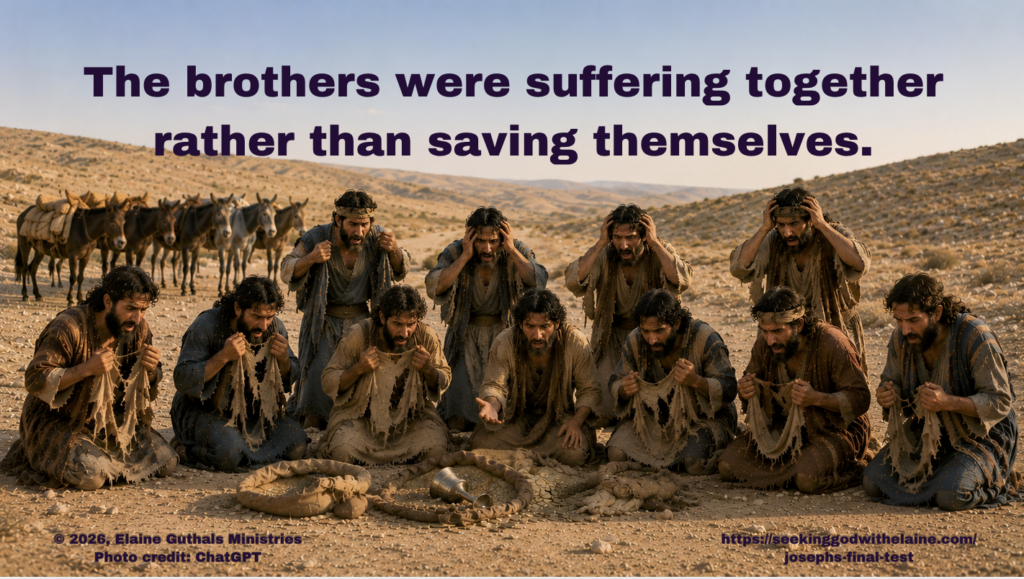
We can’t gloss over the fact that this applied to all brothers. They acted as one.
All repented. Even though we aren’t told their stories in Scripture, they all acted differently.
Joseph Was Waiting for Them
“Joseph was still in his palace when Judah and his brothers arrived, and they fell to the ground before him. ‘What have you done?’ Joseph demanded. ‘Don’t you know that a man like me can predict the future?’ Judah answered, ‘Oh, my lord, what can we say to you? How can we explain this? How can we prove our innocence? God is punishing us for our sins. My lord, we have all returned to be your slaves — all of us, not just our brother who had your cup in his sack.’ ‘No,’ Joseph said. ‘I would never do such a thing! Only the man who stole the cup will be my slave. The rest of you may go back to your father in peace’" (Gen. 44: 14-17 NLT)
Joseph Was Still in his Palace
The brothers came back to Joseph’s palace to defend Benjamin.
Of course, Joseph was waiting for the brothers at the palace. It is fitting that he asks what they have done and can’t he predict the future.
What they had done was betray Joseph. He had predicted their future when Jehovah visited him in a dream to tell him his brothers would bow to him.
Judah Answered
Judah answered for the brothers.
It is interesting to note that Reuben, the firstborn, did not speak up. Judah had already taken over the responsibility of the firstborn after Reuben’s betrayal and Simeon and Levi’s hatred and violence.
Reuben wasn’t the leader. But then, Judah was one of the instigators in selling Joseph (Gen. 37: 26-27).
No, Judah wasn’t the man that he was then. His failure in Genesis 38 had humbled him. He had been restored as a covenant son.
Judah acknowledged the brothers’ guilt — no, not in stealing the cup. They understand this was happening because of their treatment of Joseph.
Jehovah knew the brothers’ guilt (Gen. 44: 16). Hidden guilt will always surface.
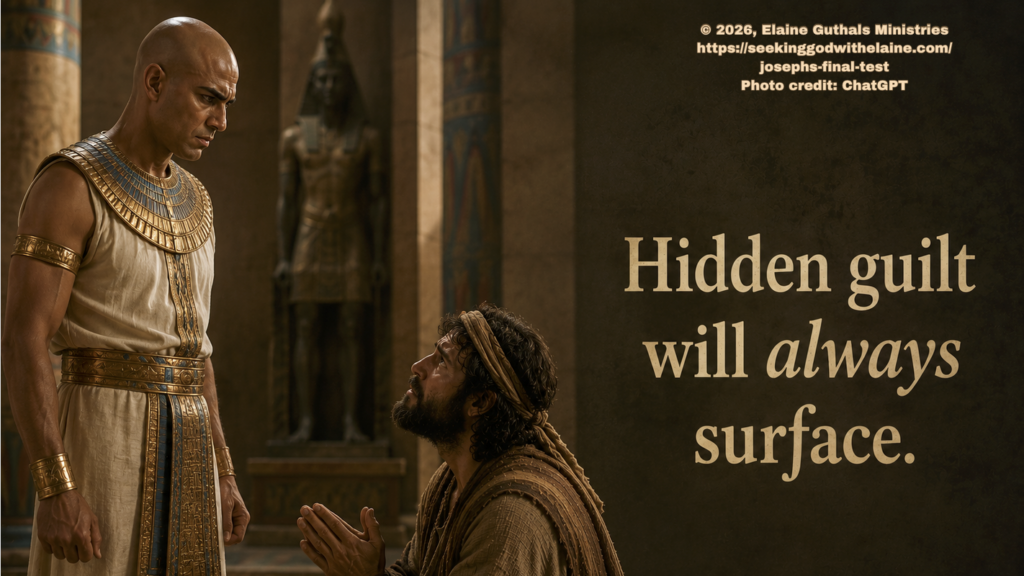
I Would Never Do Such a Thing!
Joseph reiterated that the judgment was only for Benjamin.
This is critical. Joseph had been the last of the baby war. (Benjamin had been born 17 years later so he wasn’t involved.)
During those 17 years, the baby war had morphed into maternal camps. He knew how important that was to them.
So, this was the heart of Joseph’s test. Would they leave Benjamin behind?
Judah’s Speaks for His Brothers
“Then Judah stepped forward and said, ‘Please, my lord, let your servant say just one word to you. Please, do not be angry with me, even though you are as powerful as Pharaoh himself. My lord, previously you asked us, your servants, “Do you have a father or a brother?” And we responded, “Yes, my lord, we have a father who is an old man, and his youngest son is a child of his old age. His full brother is dead, and he alone is left of his mother’s children, and his father loves him very much.” And you said to us, “Bring him here so I can see him with my own eyes.” But we said to you, “My lord, the boy cannot leave his father, for his father would die.” But you told us, “Unless your youngest brother comes with you, you will never see my face again.” So we returned to your servant, our father, and told him what you had said. Later, when he said, “Go back again and buy us more food,” we replied, “We can’t go unless you let our youngest brother go with us. We’ll never get to see the man’s face unless our youngest brother is with us.” Then my father said to us, “As you know, my wife had two sons, and one of them went away and never returned. Doubtless he was torn to pieces by some wild animal. I have never seen him since”’” (Gen. 44: 18-28 NLT)
Judah laid it all out for Joseph.
Judah respectfully approached Joseph.
This was more than justifying why Judah had answered Jacob the way he did in Genesis 43: 3. It was more than just a “he said, we said, we did” account.
The speech is emotional, layered, and sacrificial.
Judah started with information Joseph knew or could figure out. Benjamin became Jacob’s favorite when Joseph was gone.
Then Judah got to the part which would have interested Joseph. It emphasized the father-son bond.
That bond with Joseph was what the brothers had been trying to break when they sold him. Joseph wouldn’t have known how they ignored Jacob’s grief.
Twenty-two years after Rachel’s death, Joseph and Benjamin were still tied to her. Benjamin was the only thing Jacob had left of her.
But Judah knows now what that grief felt like. He two had lost two sons.
Sticking Up for Benjamin
“Now if you take his brother away from me, and any harm comes to him, you will send this grieving, white-haired man to his grave. And now, my lord, I cannot go back to my father without the boy. Our father’s life is bound up in the boy’s life. If he sees that the boy is not with us, our father will die. We, your servants, will indeed be responsible for sending that grieving, white-haired man to his grave. My lord, I guaranteed to my father that I would take care of the boy. I told him, ‘If I don’t bring him back to you, I will bear the blame forever’” (Gen. 44: 29-32 NLT)
Judah argued that making Benjamin a slave in Egypt would destroy Jacob completely.
This is the turning point. Judah acknowledges they cannot leave Benjamin to whatever fate Joseph would have for him — deserved, which they doubted, or undeserved.
But notice. It is no longer about the cup. It is about relationships.
It was about how Jehovah uncovers deeper, hidden guilt.
Judah stated that he had personally guaranteed Benjamin’s safety. He didn’t shift the blame. He didn’t protect himself. He didn’t seek gain.
Judah readily admitted that he was accountable.
The Substitution
“So please, my lord, let me stay here as a slave instead of the boy, and let the boy return with his brothers. For how can I return to my father if the boy is not with me? I couldn’t bear to see the anguish this would cause my father!” (Gen. 44: 33-34 NLT)
Judah offered to remain as Joseph’s slave in Benjamin’s place.
Remember, the cup hadn’t been directly mentioned since the brothers returned to Joseph’s palace in verse 14. Joseph referred to it by saying he did divination, but he didn’t say how.
Judah knew this had grown to something bigger than the cup. So, he said, “Pick me.”
If someone had to stay in Egypt, Judah didn’t want it to be Benjamin. He had promised Jacob he would bring the boy home.
Judah could take responsibility and offer to be the substitute. This is love, sacrifice, and leadership.
Making the Connections #1
Judah’s offer to be the substitute sets up major biblical theology later.
- Substitution
- Sacrificial love
- Intercession
- Bearing the cost himself
- The royal line of Judah.
Judah’s willingness to substitute himself becomes a shadow of a far greater substitution to come.
Making the Connections #2
Why is Judah’s transformation important here? Why did we need to see Judah’s failure, humiliation, taking responsibility, and sacrifice?
Isn’t this about Joseph being the savior of Israel and saving them from the famine?
No. This is a building block for Genesis 49.
This is about Joseph saving Judah so Yeshua could be born.
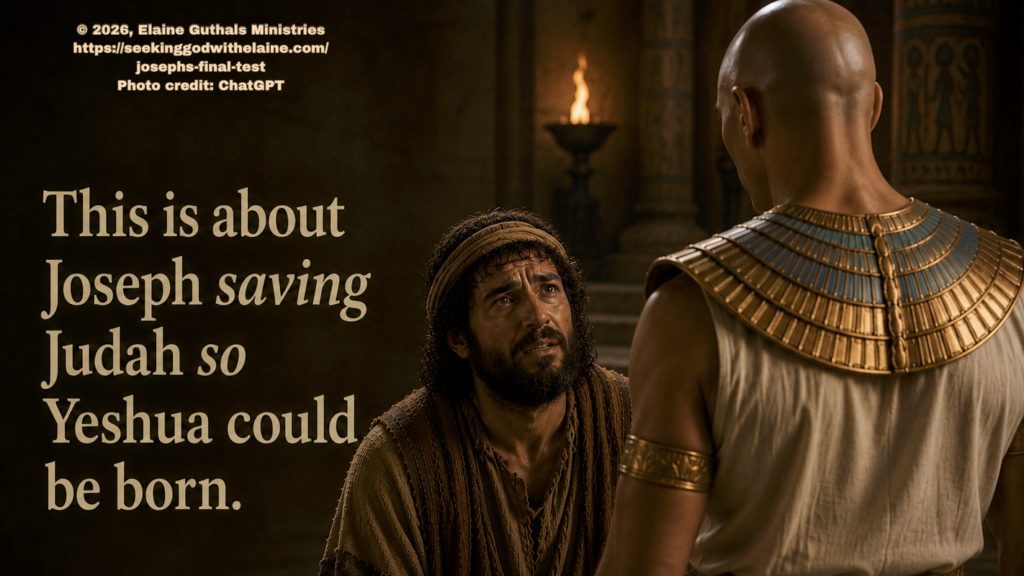
Yeshua is needed as the Savior of the world because of men and women like Judah. People who sin, have their sins exposed, repent of them, are transformed into having Jehovah’s character, and following His call need Yeshua.
Every one of us need Yeshua.
Making the Connections #3
This chapter also marks another turn. Judah and Joseph emerge as leaders of the family.
Jacob was hinting at Joseph being designated firstborn when he gave him the tunic. Judah became a leader through living the path Jehovah had for him. He was being prepared for his role in the covenant.
All Judah needed to do was say, “I was wrong.”
Making the Connections #4
Why did Joseph construct this ruse? He wasn’t doing it out of revenge.
Joseph was trying to determine if there was anything on which true reconciliation could be built.
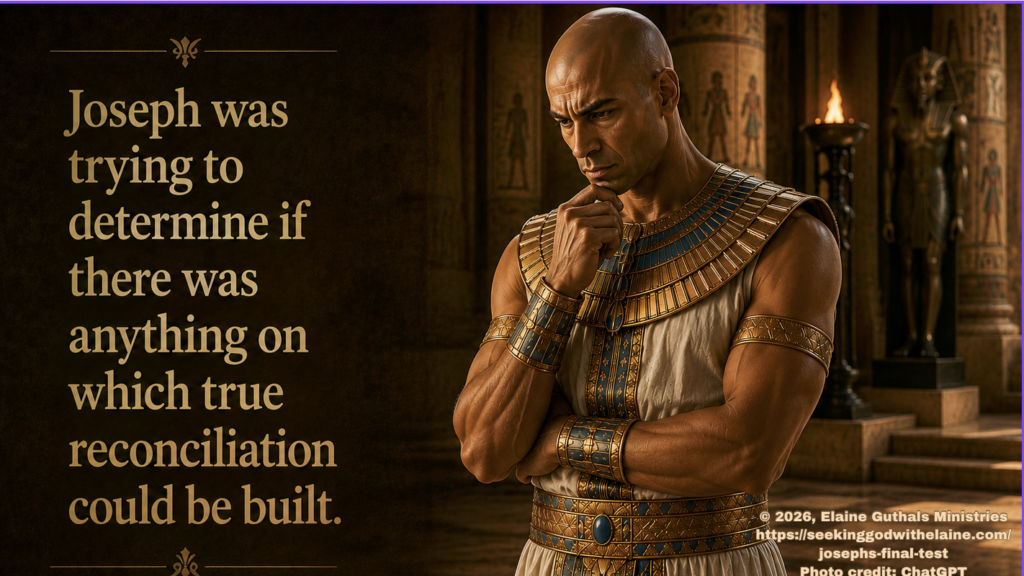
If the brothers were not repentant, I don’t think Joseph would have revealed himself to his brothers.
And I think Joseph would have gotten Benjamin away from them and figured out a way to rescue Jacob.
Here, Joseph was ensuring there was a foundation on which trust could be built.
How Do We Apply This?
- Show repentance by responding differently to the same kind of test.
- Understand that buried sin is not sin removed.
- Realize forgiveness does not require pretending nothing happened.
- Become spiritually mature enough to move from self-preservation to sacrificial love.
- Stop coming up with excuses so you can begin godly leadership.
- Don’t feel disqualified from future covenant usefulness because of past failures if repentance is real.
- Recognize that we need a substitute, not just self-improvement.
Father God. We fail you. You are always ready to forgive our sin when we repent and turn back to You. Thank You for sending Yeshua as a substitute for us so that we can ask Your forgiveness. Amen.
If you don’t understand something and would like further clarification, please contact me.
If you have not signed up for the email providing the link to the devotions and the newsletter, do so below.
If God has used this devotion to speak with you, consider sharing it on social media.