Jacob must have gotten up that morning thinking, “Today is the day.” This devotional reading looks at Jacob and Esau’s meeting after 20 years – and how it didn’t go as planned.
Nuggets
- Morning had arrived and so had Esau.
- Jacob showed that he was cautious and still thought strategically by dividing his family into groups.
- We need to understand the cultural significance of “… he bowed to the ground seven times before him” (Gen. 33: 3 NLT).
- Instead of vengeance, Esau offered Jacob reconciliation.
- Esau saw Jacob’s family as a blessing.
- Esau questioned the gifts from Jacob.
- We may think Jacob’s comment about seeing Esau’s face was “… like seeing the face of God!” (Gen. 33: 10 NLT) equated the two, but it didn’t.
- Jacob was asking Esau to accept this blessing.
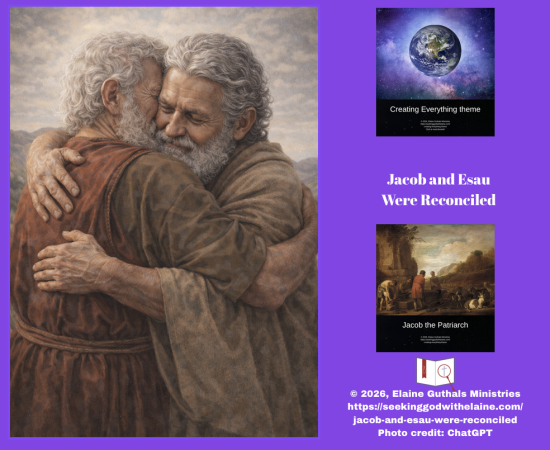
The Jacob/Esau story had been a long time in the making. From Genesis 25 — when Jacob stole the birthright when they were probably age 15 — through stealing the blessing at age 77 all the way up to now at age 97 when Jacob returned with wives and much livestock.
1820 BC – Isaac, at age 40, married Rebekah (Gen. 25: 20)
1800 BC – Jacob and Esau were born (Gen. 25: 24-26)
1785 BC – Esau sold the birth right to Jacob in exchange for lentil stew Jacob was cooking while mourning for Abraham
1723 BC – Jacob cheated Esau (both age 77) out of the birthright blessing given by Isaac (age 137). He flees Canaan to Paddan-aram to Rebekah’s family. He agrees to work seven years to earn the right to marry Rachel (Gen. 29: 1-20)
1716 – Jacob, 84, was tricked into marrying Leah. He agrees to work seven more years for Rachel
1709 BC – Jacob, 91, finished working seven years for Rachel and agreed to continuing working for Laban to build up his personal wealth.
1709 BC – Joseph was born
1703 BC – Jacob, 97, and his family left to return to Canaan (Gen. 31: 3)
Based on Timeline from
Twenty years was a long time, but was Esau able to hold a grudge against Jacob all that time?
How would Esau feel now about Jacob’s deceit?
Let's Put It into Context
To read devotions in the Creating Everything theme, click the button below.
Devotions in the Jacob the Patriarch series
The Meeting Anticipated
“Then Jacob looked up and saw Esau coming with his 400 men. So he divided the children among Leah, Rachel, and his two servant wives. He put the servant wives and their children at the front, Leah and her children next, and Rachel and Joseph last. Then Jacob went on ahead. As he approached his brother, he bowed to the ground seven times before him” (Gen. 33: 1-3 NLT)
Saw Esau Coming
Morning had arrived and so had Esau.
Jacob had spent the night wrestling with Sovereign God. One look at Esau and his 400 men brought the fear crushing back. The number is significant.
We are probably looking at a couple of Ancient Near East practices.
- An Ancient Near Eastern leader would travel with a large entourage to show his strength and ensure the honor he deserved.
- The number conveys a military potential, the size of a clan chief’s war band.
Gray wondered if maybe Esau did initially come to meet Jacob to exact revenge. Maybe Jehovah worked on his heart and flipped it – as He did Laban’s.
Resource
One sermon I read said that Jehovah had, even if it doesn’t tell us, appeased Esau like He had Laban. Well, yes and no. Jehovah may have appeared, but the outcome was different.
Resource
Laban attributed Jehovah’s intervention in everything. He was blessed because of Jacob (Gen. 30: 27). He responded without force when it reads as if he was chomping at the bit to do so (Gen. 31: 29). But Laban left in peace — sort of.
We are never expressly told that Jehovah intervened with Esau. It looks like He providentially softened Esau. The reunion had a much happier ending!
Who knows when the change of heart came. Maybe Esau was just trying to show his power.
Though seeing all the wealth in the gifts of livestock, Esau knew Jacob hadn’t had an easy life.
Divided the Family
Jacob showed that he was still cautious and thought strategically by dividing his family into groups.
Jacob always had his favorites. It looks like does so now as he lines them up from the least favored to the most favored.
But Jacob also uses the family hierarchy. The concubines come before the wives.
The difference is that Leah, as first wife, comes before Rachel, as second wife. That makes Rachel and Joseph the most protected.
Jacob Went on Ahead
Even though Jacob divided his family into groups, he went before them.
This is huge. Jacob was approaching Esau after 20 years. He was not running. He was not scheming. He was not hiding behind deception.
Jacob was limping. He was limping toward the brother he wronged — the one who even now might be fixing to kill him.
One thing is for sure – Jacob was not the strong man who left Beersheba. He now had what many would see in his day as a permanent weakness.
But neither did Jacob now feel the fear that drove him away. (Oh, he was still afraid of Esau, but he put his trust in Jehovah.)
He had learned humility. He was now full of hope and confidence because he had wrestled with Jehovah and prevailed.
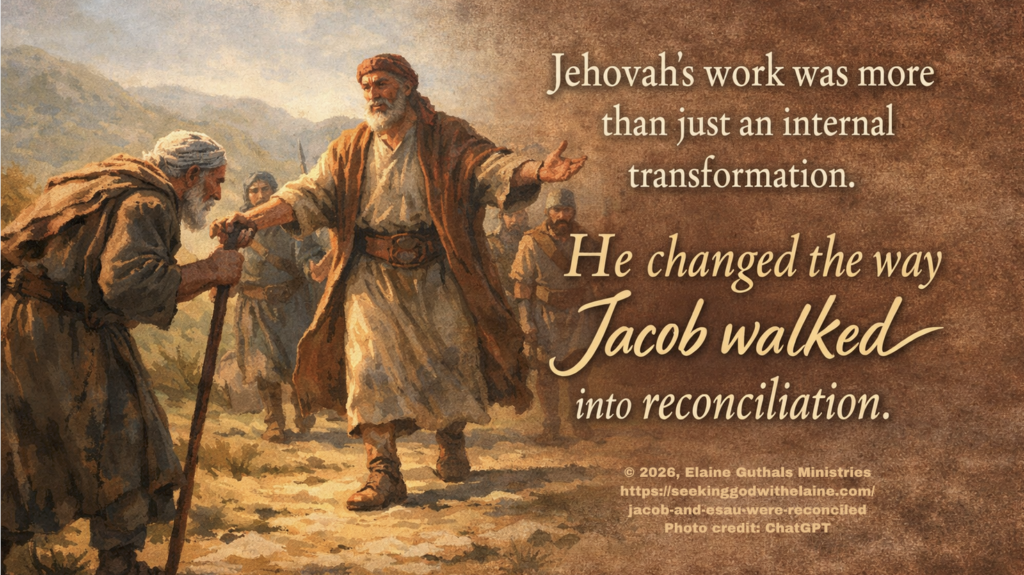
Jehovah’s work was more than just an internal transformation. He changed the way Jacob walked into reconciliation. As Gray said Jacob “… — the prevailer — does not fear to meet the first storm of his brother’s rage.”
Resource
Bowed to the Ground Seven Times
We need to understand the cultural significance of “… he bowed to the ground seven times before him” (Gen. 33: 3 NLT).
As disciples of Christ, we see the number seven and think completion. That isn’t the case here.
When a person in the Ancient Near East bowed seven times, they were showing a formal diplomatic gesture of submission and repentance. Yes, it was an Ancient Near East custom, but it has a huge significance for Jacob.
Twenty year prior, Jacob had stolen the blessing from Esau. Now, he was acting like the younger brother again. He was giving Esau the submission and respect he deserved while acknowledging his authority.
Jacob was righting the social order between him and Esau. He removed the insult that he gave to Esau.
We may think of Jacob’s language of my lord/your servant as something inappropriate between brothers. But it was common dialogue between brothers and relatives.
The Meeting Took Place
“Then Esau ran to meet him and embraced him, threw his arms around his neck, and kissed him. And they both wept. Then Esau looked at the women and children and asked, ‘Who are these people with you?’ These are the children God has graciously given to me, your servant,’ Jacob replied. Then the servant wives came forward with their children and bowed before him. Next came Leah with her children, and they bowed before him. Finally, Joseph and Rachel came forward and bowed before him. ‘And what were all the flocks and herds I met as I came?’ Esau asked. Jacob replied, ‘They are a gift, my lord, to ensure your friendship.’ ‘My brother, I have plenty,’ Esau answered. ‘Keep what you have for yourself.’ But Jacob insisted, ‘No, if I have found favor with you, please accept this gift from me. And what a relief to see your friendly smile. It is like seeing the face of God! Please take this gift I have brought you, for God has been very gracious to me. I have more than enough.’ And because Jacob insisted, Esau finally accepted the gift” (Gen. 33: 4-11 NLT)
Esau Ran to Meet Him
Instead of vengeance, Esau offered Jacob reconciliation.
I guess that Esau didn’t get the memo that Hebrew men do not run. It was undignified as they had to lift up their robes in order to complete the activity. Running was for the young – and face it, the twins weren’t young.
But this is telling me how strong Esau’s emotions were. He was not only willing but also eager to reconcile with his brother.
Ooo, baby. I bet Jacob was surprised to see Esau running toward him. That was not the welcome-home response that ever entered Jacob’s mind.
Neither did Jacob expect the tears. That act — including falling on Jacob’s neck and kissing him — truly showed Esau’s heart and coming from a point of restored kinship.
Esau was exhibiting all the actions of reconciliation. He ran, embraced, kissed, and wept. The deep emotions were clearly evident.
But the meaning behind all of those emotions are precious. We see urgency, initiative, acceptance, reconciliation, and healing.
If Jacob had changed, so had Esau.
How many times do we expect something to go down one way, and it occurs totally the opposite?
We base our determinations on the old Tom or Sally — and the old Elaine. Or we generalize some other experience we have had with experience at hand. Maybe worse, we take what we think we have seen happen to someone else and apply it to our situation.
We need to follow God. God said He was bringing Jacob back. Esau was still there. That meant Jacob and Esau were going to have to live together somehow.
We have to have faith that God will change our Esau’s as he changes us.
Who Are These People
Esau saw Jacob’s family as a blessing.
We may read Esau’s question as a little terse. It wasn’t.
Esau was recognizing Jacob’s family. He knew families were a blessing (Gen. 1: 28).
This allowed Jacob to acknowledge they were a gift from Jehovah. It was further evidence to Esau that Jacob had changed.
Each group came forward and bowed before Esau. This was symbolic restitution. Even though Jacob once stole Esau’s blessing, his entire household now honored Esau.
Flocks and Herds
Esau questioned the gifts from Jacob.
Esau talked about the tribute appeasement that we read about in Genesis 32. (Remember, there were goats, sheep, camels, cattle, and donkeys that Jacob was giving Esau.) Esau would have understood that practice, too.
The purpose of sending the waves of animals as gifts to Esau was to demonstrate submission and soften Esau’s anger. But it was also restoring Esau’s honor and publicly acknowledging the wrong.
Custom said Esau was first supposed to decline the gifts. Then at Jacob’s insistence, he was free to accept them. (We saw it play out this way when Abraham bought the cave to bury Sarah in Genesis 23.)
Part of us says, come on, we know Esau was always materialistic. He didn’t care about birthrights and blessings. He didn’t care about God. All he had cared about was wealth and power. He didn’t want the duties that went with it.
That was part of why Jacob got the covenant promise. It was the most important thing to him. Material wealth was secondary.
God was Jacob’s priority.
But Jacob needed Esau to accept the gifts. Reconciliation wouldn’t occur if he didn’t.
What if it was more than that? What if it was Esau’s statement that he didn’t demand compensation for reconciliation? We really don’t know how successful Jehovah was in softening Esau’s heart.
Think about it. Esau many have not gotten the covenant blessing, but he was still blessed (Gen. 27: 39-40). He was promised material blessing outside Israel.
I think Esau did forgive Jacob, and Jacob did forgive Esau. I like how Guthrie put it. He wrote, “The long estranged brothers have embraced and buried in one grave Esau’s wrongs and Jacob’s crimes — being enemies, they were reconciled.”
Resource
It does seem like reconciliation took place. Esau called Jacob brother in verse 9.
Something else is really huge. Esau said he had enough (Gen. 32: 9 JPS). Jacob said he had plenty (Gen. 32: 11 JPS).
Enough signifies adequate. Plenty — as in Jehovah’s blessings — means we have an abundance.
Like Seeing the Face of God
We may think Jacob’s comment about seeing Esau’s face was “… like seeing the face of God!” (Gen. 33: 10 NLT) equated the two, but it didn’t.
This statement of Jacob’s in verse 10 may be totally unexpected to us, especially after Genesis 32: 30. Jacob actually saw God’s face.
That was a cultural thing, again. A ruler’s face would determine a person’s fate. Seeing anger in the person’s fate would mean punishment was coming. If the ruler’s face showed acceptance, it meant the person was safe.
At Peniel, Jacob saw God’s mercy. Here, he saw Esau’s mercy. Of course, he would connect those in his mind because God answered Jacob’s prayer and did that.
I’d say Jehovah changed both boys’ hearts.
Look at verse 11 again. “‘Please take this gift I have brought you, for God has been very gracious to me. I have more than enough.’…” (Gen. 33: 11 NLT).
Jehovah was enough for Jacob.
Please Accept
Jacob was asking Esau to accept this blessing.
If we don’t go back to the Hebrew, we may miss something important. Yes, Jacob was wanting Esau to accept the gift.
But the Hebrew word used — berakhah — means blessing. Jacob was returning the stolen blessing to Esau.
Resource
Both had learned the meaning of disinterestedness. Disinterestedness means a willingness to give up something for a greater good. Both had finally learned the lesson Abraham had.
Is that contentment only given to disciples? No. Worldview people can be totally content in their lives.
Unfortunately, their contentment doesn’t come from Jehovah’s provision. It comes from reliance upon themselves.
Making the Connections #1
This restoration was more than Jacob hoped would happen. What he feared would happen didn’t.
Grace can appear where judgment is expected.

Did Jacob kick himself for being fearful for 20 years? Did he wish he would have come home sooner?
I guess Jacob could have gotten home, and Esau could have said, “You know, I’m going to wait to see if he has really changed.”
But Esau took Smith’s advice. He wrote,
“Therefore, as the apostle says, Repent, for the kingdom of heaven is at hand, we may say, Forgive, for the kingdom of heaven is at hand. Forgive while forgiveness is worth having; forgive while there remains enough of life for the renewal of kindness; forgive while you have something else to bestow on repentance than lingering looks and faltering words.”
Resource
Forgiveness is for us, not them.
Making the Connections #2
Speaking of grace, doesn’t this whole chapter reveal Jehovah’s character?
Our character includes sinful things. We betray each other — sometimes through violence— causing division.
Jehovah offers reconciliation, preservation, and salvation.
- Ishmael and Esau were reconciled enough to stand together when Abraham died (Gen. 25: 9).
- Jacob and Esau were reconciled.
- Joseph explained to his brothers that Jehovah used his brothers’ evil to save what would become the nation of Israel and preserve the covenant.
Making the Connections #3
Compare this to the Parable if the Prodigal Son.
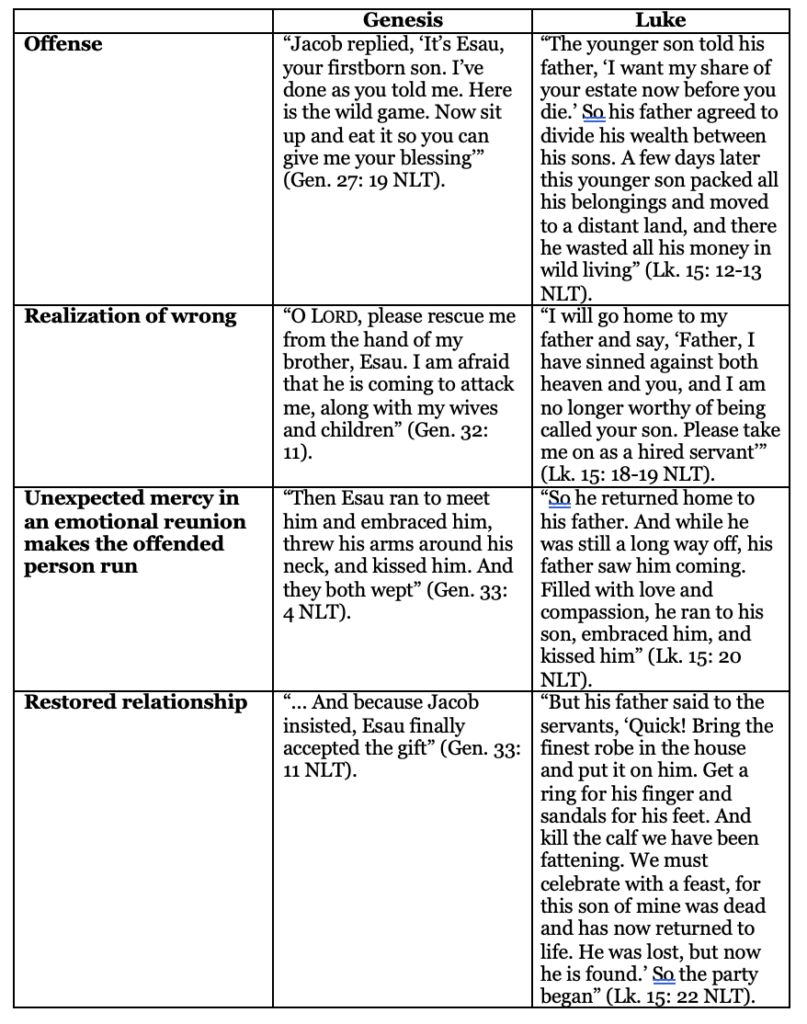
Mercy moves faster than judgment.

Making the Connections #4
Leale made a statement that kind of set me back for a minute. Talking about the differences of character, he wrote, “Esau was generous and forgiving.” On the other hand, he said, “In Jacob there are traces of his old subtlety.”
Resource
Wait! What????
Jacob was the one who gave all the animals. Wasn’t that generous?
Well, no. Not if that was what was expected to appease the other.
We see Jacob’s subtlety as he divides the wives and kids up. He had Plan B in place if Jehovah let Plan A fall apart.
Esau, on the other hand gave unconditional forgiveness.
The worldview would question whether that made Esau a better candidate for covenant son than Jacob. The answer would be no.
The status of being covenant son is based upon keeping the covenant, not performing the Matthew 25 to-do list. It isn’t even based on our being 100 perfect in slaying our sinful nature.
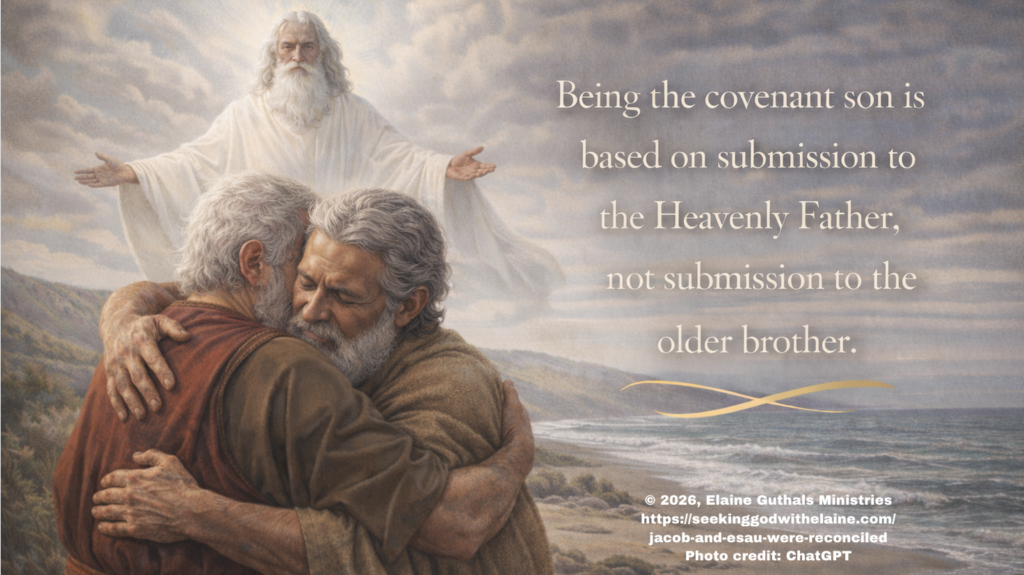
Being the covenant son is based on submission to the Heavenly Father, not submission to the older brother. Jacob showed humility to both.
How Do We Apply This?
- Respect our brothers and our sisters.
- Consider children a gift from Jehovah.
- Practice self-denying submission when we have wronged someone.
Resource
Father God. Thank You that You have a plan for each of our lives. We thank You control how they intersect with others. All that happens is in Your plan. Amen.
If you don’t understand something and would like further clarification, please contact me.
If you have not signed up for the email providing the link to the devotions and the newsletter, do so below.
If God has used this devotion to speak with you, consider sharing it on social media.