We transition from one stage to another in life. This devotional reading looks at Jacob’s transition through the death of Deborah, Rachel, and Isaac.
Nuggets
- The death of Rebekah’s nurse Deborah may have stood in place of Rebekah’s death for Jacob.
- Since childbirth in that day was hard enough, a complicated childbirth was probably almost impossible when traveling.
- Sometimes, it feels like default mode to ask what sin was committed when someone experiences a trial.
- Rachel was not buried in the family tomb at Machpelah.
- Finally, finally, finally, Jacob made it home to Isaac.
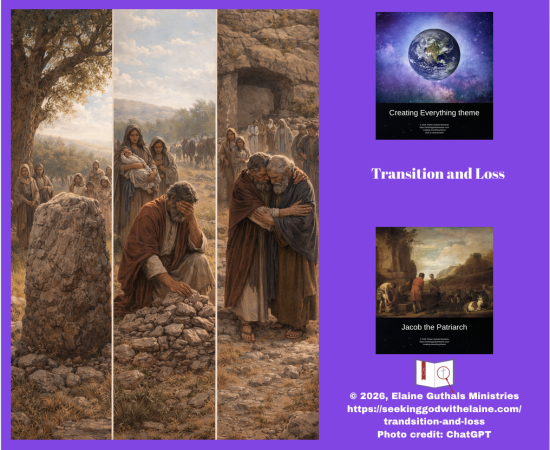
While Jacob was heading home, tragedy struck. Three of his family members lost their lives.
Let's Put It into Context
To read devotions in the Creating Everything theme, click the button below.
Devotions in the Jacob the Patriarch series
Death of Deborah
“Soon after this, Rebekah’s old nurse, Deborah, died. She was buried beneath the oak tree in the valley below Bethel. Ever since, the tree has been called Allon-bacuth (which means “oak of weeping”)” (Gen. 35: 8 NLT)
The death of Rebekah’s nurse Deborah may have stood in place of Rebekah’s death for Jacob.
When we were introduced to Deborah, we weren’t given her name. “So they said good-bye to Rebekah and sent her away with Abraham’s servant and his men. The woman who had been Rebekah’s childhood nurse went along with her” (Gen. 24: 59 NLT).
This is the only other place in Scriptures she is mentioned. Why is it important for us to know who she was?
Bradford thought Deborah’s death represented a dissolving of the tie to Mesopotamia. I can see that. Jacob was the last covenant son to return “home” to Mesopotamia to find a wife.
Resource
I read some resources that said the tie was severed with her passing. I don’t see that. Rachel is still alive at this point as is Leah. They were born in Haran.
Deborah’s death is a link beginning to close that generation.
The name of burial spot – the oak of weeping – implies she was much loved. Her death (symbolizing the death of Rebekah’s household) may have also given Jacob a chance to mourn his mother’s death.
Robertson disagreed with me. He felt Jacob hadn’t felt much for his mother in life let alone in death.
Resource
But why is Deborah there, and how did she get there?
When Jacob left Canaan 30 years before, he left alone. Deborah did not return home with him.
It is widely assumed that Rebekah has passed before these events occurred. The Midrash explained this as Deborah may have been sent to Jacob in Haran to tell him of his mother’s death and stayed with him.
Other tradition describes Rebekah’s burial as intentionally private. Esau was known for his wickedness, and Jacob wasn’t there. The private burial was done to protect Rebekah’s honor.
Another explanation is that not all the deaths of the matriarchs are given. Sarah’s death was recorded in Genesis 23. The next verses we will look at tell us of Rachel’s death. Rebekah’s and Leah’s deaths are not recorded.
What we do know is that Isaac was living at Hebron (formerly called Mamre. Deborah was not living with him if she was buried in Bethel.
But this gives us a sad bit of information. This almost certainly tells us that Rebekah died never having seen Jacob again. She would never meet the wives that she sent Jacob to find. The son she favored and schemed for had been lost to her.
Death of Rachel
Leaving Bethel, Jacob and his clan moved on toward Ephrath. But Rachel went into labor while they were still some distance away. Her labor pains were intense. After a very hard delivery, the midwife finally exclaimed, ‘Don’t be afraid — you have another son!’ Rachel was about to die, but with her last breath she named the baby Ben-oni (which means ‘son of my sorrow’). The baby’s father, however, called him Benjamin (which means “son of my right hand”). So Rachel died and was buried on the way to Ephrath (that is, Bethlehem). Jacob set up a stone monument over Rachel’s grave, and it can be seen there to this day” (Gen. 35: 16-20 NLT).
Rachel Went into Labor
Since childbirth in that day was hard enough, a complicated childbirth was probably almost impossible when traveling.
Remember what Rachel said when Joseph was born? “And she called his name Joseph, saying, ‘May the Lord add to me another son!’” (Gen. 30: 24 ESV).
Childbirth in the Ancient Near East was risky and precarious. This was a dangerous event in Jacob’s culture.
Add to that the stress and struggles of a road trip. It was a recipe for disaster.
I wonder what exactly the midwife meant when she said another son was born. Was she just informing Rachel of the gender of the child? Did she mean Rachel wouldn’t die, or Benjamin wouldn’t die? Or was it a callback to her prophecy when Joseph was born?
Rachel wasn’t content with one child, but she died giving birth to the child for which she prayed. That was why she named him son of my sorrow.
Newton took a stab at determining Rachel’s intent. He wrote, “She was sorry to leave her husband, her family, and her friends; and this feeling of sorrow led her to call his name Ben-oni.”
Resource
I can see why having a name of son of my sorrow might have comforted Ben. He could take it to mean that she was sorrowful that she couldn’t live to get to know him. (That is, if she didn’t selfishly experience the sorrow at her own death.)
But I can see why Jacob changed the name. It was bad enough that Ben was going to grow up without Rachel, but knowing his name was wrapped up in her death could have been crushing.
Jacob renamed the son to have a name that portrays hope. It literally means son of my right hand. Benjamin would have been a great comfort to him.
Fuller surmised that it probably meant that Ben was taking Rachel’s place in Jacob’s heart. I can see that, too.
Resource
Fuller also reminded us to look on this life as temporary.
So Rachel Died
Sometimes, it feels like default mode to ask what sin was committed when someone experiences a trial.
We have to ask. Did Jacob unwittingly bring about Rachel’s death?
Could Jacob have made a vow before Jehovah – or at least pronounced a curse? “But as for your gods, see if you can find them, and let the person who has taken them die! …” (Gen. 31: 32 NLT). At that time, he didn’t know Rachel was the one he was condemning.
Was Rachel’s death just fallout from her taking the teraphim? Was it judgment?
But them some may say Rachel prophesied her own death. “… She pleaded with Jacob, ‘Give me children, or I’ll die!’” (Gen. 30: 1 NLT). Yeah, children plural.
We have to remember that Joseph was almost 17 then. Let’s look at our timeline.
1709 BC – Joseph was born (Rachel)
c. 1692 BC – Rachel died giving birth to Benjamin (Gen. 35: 16-20)
Based on Timeline from
Rachel so wanted children, but she was barren for almost seven years. Then she waited another 17 years to become pregnant with Benjamin.
Leale made a good observation here. He wrote, “Death is here represented, not as the complete extinction of all thought and feeling, but as the separation of soul and body. It is not a sinking into nought, but only a change of state and place.”
Resource
Rachel was not buried in the family tomb at Machpelah.
As Jacob’s household was traveling, Rachel was buried where she passed. Jacob’s erecting a standing stone is an expression of his grief.
In the Complete Jewish Bible, stone pillar and stone monument are the same word — standing stone. So, what are standing stones?
A standing stone was a large stone that was placed to commemorate sacred covenants or important events. They were used in the Bronze and Iron Ages (3150-586 BC).
Oh, this is interesting.
- “Jacob set up a stone pillar to mark the place where God had spoken to him …” (Gen. 35: 14 NLT).
- “Jacob set up a stone monument over Rachel’s grave, and it can be seen there to this day” (Gen. 35: 20 NLT).
The two standing stones were erected for different reasons. The first was erected to worship God. The second one was erected to memorialize a human, albeit the love of his life.
This wasn’t something God instituted. This was an ancient custom.
These were visible reminders for future generations of covenants and the significance of events.
Rachel’s tomb played a role in future generations. “This is what the Lord says: ‘A cry is heard in Ramah — deep anguish and bitter weeping. Rachel weeps for her children, refusing to be comforted — for her children are gone’” (Jer. 31: 15 NLT).
The children Rachel was supposedly mourning were those who had been exiled to Babylon. We know this verse was also used in conjunction with the Massacre of the Innocents in Matthew 2: 16-29.
Death of Isaac
“So Jacob returned to his father, Isaac, in Mamre, which is near Kiriath-arba (now called Hebron), where Abraham and Isaac had both lived as foreigners. Isaac lived for 180 years. Then he breathed his last and died at a ripe old age, joining his ancestors in death. And his sons, Esau and Jacob, buried him” (Gen. 27-29 NLT)
Finally, finally, finally, Jacob made it home to Isaac.
What in the world took Jacob so long to go home to his father? There might be some reasons.
Jacob grew a lot in the way home. Yes, he grew a lot in Haran, but He went through trials and purifications I Genesis 34 and 35. He had to go through development stages.
But that is what we do on our Sanctification Road. Jacob was no different. We don’t get a data dump from Jehovah, but rather a consistent growth.
For better or worse, Jacob settled in Shechem. The whole debacle happened with Hamor and Shechem, but Jacob also worshiped. He built an altar and worshiped.
Jacob and Esau had reconciled; but sometimes, reconciliation has to stabilize. The passage reads like true reconciliation, but Jacob may have it was probably tenuous at best. He may have wanted to stay in the central hull country for safety’s sake.
We have to remember that Jacob wasn’t really a clan until he left Haran. He had always been a part of Laban’s clan. Now, he had to establish himself.
Plus, Jacob had a large household, many animals, and servants and herdsmen. Pastoral migration may have been slow, especially if they experienced drought.
Mainly, the passage reads like Jacob was experiencing spiritual hesitation. He wasn’t quick to fulfill his vow. That is, until he renewed his bow at Bethel.
Jacob finally made it to Isaac. From the timeline, it looks like Isaac and Jacob were given roughly ten years to restore their relationship.
We don’t hear anything about Isaac’s life after Jacob’s return. It seems like his life was always overshadowed by Abraham’s and Jacob’s lives. Yet he lived the longest of the three.
We aren’t told that Abraham, Isaac, and Jacob had any concept of eternal life. So, “… he died and was gathered to his people …” (Gen. 35: 29 ESV) was probably just a way of saying he was buried.
Just as Isaac and Ishmael had stood at Abraham’s grave, Esau and Jacob stood at Isaac’s. The twins had put their differences aside.
Making the Connections #1
I think it was interesting that Deborah was buried at Bethel. This was the place where Jacob first met Jehovah on his way out of Canaan. Now, he was returning with a mature faith.
Jacob was ready to step into his role a patriarch. That meant he was taking over from the old generation, of which Deborah was numbered.
Making the Connections #2
We have to watch the phrase were gathered to his people or ancestors. It may have been a form of ancestor worship, a practice in the Ancient Near East.
Got Questions gave us a good definition of what that was. They said it “… involves religious beliefs and practices consisting of prayers and offerings to the spirits of dead relatives.”
Resource
This was a pagan practice that championed the belief that dead ancestors lived on in spirit to influence the lives of living relatives. They were considered mediators between the living and their Creator.
Taking that a step further, they believed a living ancestor — because of their morality — could act like gods, influencing their descendants.
Disciples know that this is not the case. We know this because God’s Word tells us it is not.
- “Finally, the poor man died and was carried by the angels to sit beside Abraham at the heavenly banquet. The rich man also died and was buried, and he went to the place of the dead” (Lk. 16: 22-23 NLT).
- “So we are always confident, even though we know that as long as we live in these bodies we are not at home with the Lord” (II Cor. 5: 6eb NLT).
- “And just as each person is destined to die once and after that comes judgment” (Heb. 9: 27 NLT).
Yeshua is the only Mediator we have before Jehovah. Dead relatives don’t make our case for us any more than live ones do.
God’ Word is explicitly we are to have no other gods but Jehovah. Honoring our parents — or ancestors — is one thing. Worshiping them is totally forbidden.
Bible Hub told us how we are to treat our ancestors.
- We want to treat them with respect.
- We want to learn from our ancestors and follow their examples.
- We want to be thankful for their testimony.
Resource
We don’t want to cross the line into worship.
How Do We Apply This?
- Remember that our souls do not die.
- Don’t expect a prosperity gospel – at times it will feel like we go from one trial to another.
- Remember, sanctification comes in stages.
Resource
Father God. Lord, we hurch what our family members pass. We know they are in a better place because they are with You in Paradise. Help us as we learn to live without them. Amen.
If you don’t understand something and would like further clarification, please contact me.
If you have not signed up for the email providing the link to the devotions and the newsletter, do so below.
If God has used this devotion to speak with you, consider sharing it on social media.