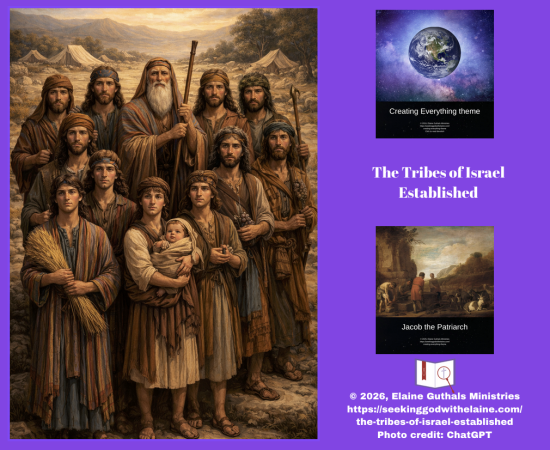
At the end of Genesis 36, the tribes of Israel were established. This devotional reading looks at closing up Jaccob’s story to prepare the way for the tribes to take over the story.
Nuggets
- Jacob was still Jacob, but his family and descendants were now the nation of Israel.
- The Migdal-eder became tied to the history of Israel.
- Reuben’s act was more than just a one-night stand with his father’s concubine.
- Jacob heard about the coup and didn’t do anything about it!?!?!
With the birth of Benjamin, the twelve tribes were complete. - There is one way, in my opinion, that we can look at it to me the statement about Benjamin’s birth being in Paddan-aram.
Genesis 36 is one of those chapters that have a little bit of everything stuck all over. We talked first about Jacob and his family renewing the covenant with Jehovah. Then we started taking verses out of order to look at the three deaths addressed in the chapter: Deborah, Rachel, and Isaac.
Now, we are going to turn to the story of Jacob’s twelve sons. Jehovah had plans for them – which we will start digging in when we get to Genesis 37.
But let’s set it up.
Let's Put It into Context
To read devotions in the Creating Everything theme, click the button below.
Devotions in the Jacob the Patriarch series
The Transfer from Jacob's Story
“Then Jacob traveled on and camped beyond Migdal-eder. While he was living there, Reuben had intercourse with Bilhah, his father’s concubine, and Jacob soon heard about it…” (Gen. 35: 21-22 NLT)
Jacob
Jacob was still Jacob, but his family and descendants were now the nation of Israel.
It is interesting that the New Living Translation called him Jacob. Every other version listed in Bible Hub used the name Israel.
Resource
This, too, was a transition. The focus is not solely on Jacob. It is on the nation.
Isaiah also showed this distinction between the man and the nation. “But now, O Jacob, listen to the Lord who created you. O Israel, the one who formed you says, ‘Do not be afraid, for I have ransomed you. I have called you by name; you are mine’” (Isa. 43: 1 NLT).
This surprised me. I was thinking that nation really didn’t become a nation until they left Egypt.
That tells me the potential was there. They just had to grow it to the level needed.
Migdal-eder
The Migdal-eder became tied to the history of Israel.
The Hebrew Migdal-eder means Tower of Flock. A lot is known about this tower – and some is text. But there is also a lot of tradition and theology surrounding it.
The Migdal-eder has long been a part of Jewish history. We know it was real because it is a landmark in Jacob’s travels shortly after Rachel died. This was the last location marker that we have before we are told that Reuben slept with his father’s concubine.
Its function was to be used as a watchtower for the shepherd near Bethlehem. It would have been placed in an agricultural area to provide visibility to the shepherds and protection from predators – the two-legged and four-legged kind.
Another thing we now is that David tended sheep around Bethlehem. He may or may not have frequented the Migdal-eder.
The pastureland wouldn’t have a fence like Dad put up on the farm. David and first-century shepherds would have had boundaries – but those spaces would be fenced in by customs and tradition instead of fences. They would have been bound by tribal lands. Bethlehem was in the tribe of Benjamin.
That is logical. This was rocky hill country. There would have been seasonal grass sprouting from thin soil. Shepherds would need the flexibility to move their flocks hunting that food and water. Think active management, not passive grazing.
The fiction part may come in with regards to the sheep. They may or may not have been raised for Temple sacrifices. While the proximity would be a vote in favor of believing that, nothing has survived that specifically indicates that.
Reuben
Reuben’s act was more than just a one-night stand with his father’s concubine.
I know. This has an ewww factor. It also was a scandal, not just a one-night stand.
What Reuben was seeing was his mother’s arch-rival was now dead. He didn’t want the rival’s servant to be the one to whom Jacob turned. He especially didn’t want her elevated to legal wife.
Truth be told, though, Reuben was probably mounting a coup. He was probably trying to depose Jacob by asserting leadership as firstborn.
That is how this was usually interpreted in the Ancient Near Eastern culture. It was seen as challenging and claiming patriarchal authority.
Remember, concubines (pilegesh) – while they were generally servants – were secondary wives, typically chosen to bear children when the primary wife was barren. Women who had the legal status of concubines, though, did not have the full privileges of the primary wife. Leah and Rachel were both primary wives, while Bilhah and Zilpah were concubines.
That means Bilhah was in Jacob’s household and under his authority. Reuben ignored Jacob’s marital – and I would say legal – domain.
Think Absalom rebelling against David (II Sam. 16: 21-22). Think Adonijah challenging Solomon (I Kgs. 2: 17).
Jacob Heard about It
Jacob heard about the coup and didn’t do anything about it!?!?!
Well, not immediately. Babington tried to show us Jacob’s reasoning. He wrote, “Surely the reason was this, that we might thereby conceive that the grief was greater than could be expressed, to have his bed defiled by his own son.”
Resource
Eventually, Reuben will lose his birthright privileges. He was no longer considered the firstborn. He lost clan leadership and the double portion that went to the firstborn son.
It is important that it is mentioned here, even if Jacob didn’t get around to doing anything about it until Genesis 49. This chapter includes the first listing of the tribes of Israel.
Look at it this way. As the twelve tribes were about ready to be announced, Reuben lost his rights as firstborn. That prepares us for the coming change.
Keep this power struggle in mind when we start talking about Joseph’s story.
The Tribes of Israel Named for the First Time
“… These are the names of the twelve sons of Jacob: The sons of Leah were Reuben (Jacob’s oldest son), Simeon, Levi, Judah, Issachar, and Zebulun. The sons of Rachel were Joseph and Benjamin. The sons of Bilhah, Rachel’s servant, were Dan and Naphtali. The sons of Zilpah, Leah’s servant, were Gad and Asher. These are the names of the sons who were born to Jacob at Paddan-aram” (Gen. 35: 22-26 NLT)
The Tribes of Israel
“… These are the names of the twelve sons of Jacob: The sons of Leah were Reuben (Jacob’s oldest son), Simeon, Levi, Judah, Issachar, and Zebulun. The sons of Rachel were Joseph and Benjamin. The sons of Bilhah, Rachel’s servant, were Dan and Naphtali. The sons of Zilpah, Leah’s servant, were Gad and Asher. These are the names of the sons who were born to Jacob at Paddan-aram” (Gen. 35: 22-26 NLT)
With the birth of Benjamin, the twelve tribes were complete.
Why is this important? Israel now existed as a full tribal family structure.
We can’t talk about moving forward until we take a peek back. The twelve tribes of Israel can only move forward because the covenant family was purified in verses 2 through 4.
Yes, we know Reuben was no longer purified. He just needed to ask forgiveness to be restored.
Born in Paddan-aram
There is one way, in my opinion, that we can look at it to me the statement about Benjamin’s birth being in Paddan-aram.
Okay. I am confused. Rachel died in childbirth and was buried in Bethlehem. That isn’t Paddan-aram.
That would mean that Benjamin was the only son born in the Promised Land.
Why isn’t that highlighted? It could be that this was not meant as a strict geographic statement. Benjamin belonged to the time of wandering as Jacob had not settled in one spot yet – even though he was in Canaan.
This may also have been considered a summary statement. I don’t know how long they had traveled, but maybe Rachel conceived in Haran.
Some may see it as the end of the child-bearing era. We aren’t told of Jacob fathering any other children.
I personally think that Benjamin was considered to be born in Paddan-aram because we aren’t told that Jacob had seen his father yet.
That was part of the condition Jacob put on God the first time in Bethel. “Then Jacob made this vow: “If God will indeed be with me and protect me on this journey, and if he will provide me with food and clothing, and if I return safely to my father’s home, then the Lord will certainly be my God.” (Gen. 28: 20-21 NLT emphasis added).
So – unless Moses didn’t put things in chronological order or skipped important details – Jacob hadn’t seen Isaac yet..
Let’s look at it another way. All the sons but Benjamin were born under Laban’s authority. I think it is important that the last son – Rachel’s so – wasn’t.
Stay tuned to see the important role Benjamin plays in the subsequent story.
Making the Connections #1
I think it is significant that Jacob returned to Mamre/Hebron. This is where Abraham eventually settled. This was where Sarah and Rebekah were buried. This is where Isaac, Leah, and Jacob himself would be buried.
This was the ancestral home. Jacob was home.
But then, on his way home, Jacob had hit three important locations central to the covenant story.
First, he stopped in Shechem. This was where Abraham first entered the Promised Land (Gen. 12: 6-7). This was where Abraham built his first altar.
Abraham entered into the promise here. Jacob and his whole family were tested — and failed.
Then there was Bethel. Abraham did live here a while before (Gen. 12: 8) and after (Gen. 13: 3) his jaunt into Egypt. We aren’t really told Jacob actually stayed there a significant amount of time.
Finally, there was Mamre, later named Hebron.That is where Abraham settled (Gen. 13: 18), Isaac settled (Gen. 35: 27), and Jacob settled (Gen. 35: 27).
Through these three places, Jehovah has the family enter into the Promised Land; He reveals Himself to them; and He gives them rest and a place to call home across generations.
Making the Connections #2
We can argue that Jacob settled in Haran after going there to find a wife.
We can also say that Jacob wandered for 30 years. He worked as a shepherd. He would have taken the flock wherever pastureland was available. We aren’t told that he settled in one area.
Most importantly, Jacob wandered because he wasn’t living in the Promised Land. That has now changed. He was home.
Jacob was not only home, but he was now the head of the covenant family. But it was more than a family.
The nation was beginning to emerge.
Making the Connections #3
Ooo, baby. A lot happened in Genesis 35.
Jacob finally arrived home and stopped wandering. The covenant was renewed after the atrocity of Shechem. The tribal formation was complete. After we check in with Esau in Genesis 36, we begin the story of Joseph.
We went from the command to worship Jehovah to His establishing the covenant family. We went from removal of idols to the listing of the twelve tribes. We went from travel to settlement.
Genesis 35 isn’t just diary entries. Everything in Genesis 35 moved toward God’s promises and the future of the covenant family.
The covenant is the center of Israel’s story. Everything else is supporting narrative. Everything centers in Jehovah’s promises.

How Do We Apply This?
- Remember, sanctification comes in stages.
Resource
Father God. You have plans for each of us. Some plans take years to work out; some take centuries. Through all, thank You for being our Father. Amen.
If you don’t understand something and would like further clarification, please contact me.
If you have not signed up for the email providing the link to the devotions and the newsletter, do so below.
If God has used this devotion to speak with you, consider sharing it on social media.