Jehovah had answered Eliezer’s prayer to show His choice for Isaac’s wife. This devotional reading looks at the negotiation process for securing Rebekah’s hand in marriage.
Nuggets
- Even with the successful mission he had so far, Eliezer didn’t want to socialize until the mission was completed.
- Laban and Bethuel — as well as Rebekah — chose to follow Jehovah’s direction.
- When his mission was completed, Eliezer wanted to immediately go home.
- Where Laban and Bethuel hadn’t asked Rebekah if she would agree to marry Isaac, they did ask her when she was prepared to leave right away — another sign of maturity.

Eliezer had done everything right in carrying out his mission. He had asked Jehovah to show him who He wanted to be Isaac’s wife.
But Eliezer’s mission wasn’t a success yet. The marriage treaty wasn’t official. He had to talk to the future bride’s family.
Let's Put It into Context
To read devotions in the Creating Everything theme, click the button below.
Devotions in the Abraham the Patriarch series
The Marriage Treaty
“So the man went home with Laban, and Laban unloaded the camels, gave him straw for their bedding, fed them, and provided water for the man and the camel drivers to wash their feet. Then food was served. But Abraham’s servant said, ‘I don’t want to eat until I have told you why I have come.’ ‘All right,’ Laban said, ‘tell us.’ ‘I am Abraham’s servant,’ he explained. ‘And the Lord has greatly blessed my master; he has become a wealthy man. The Lord has given him flocks of sheep and goats, herds of cattle, a fortune in silver and gold, and many male and female servants and camels and donkeys. When Sarah, my master’s wife, was very old, she gave birth to my master’s son, and my master has given him everything he owns. And my master made me take an oath. He said, “Do not allow my son to marry one of these local Canaanite women. Go instead to my father’s house, to my relatives, and find a wife there for my son.” But I said to my master, “What if I can’t find a young woman who is willing to go back with me?” He responded, “The Lord, in whose presence I have lived, will send his angel with you and will make your mission successful. Yes, you must find a wife for my son from among my relatives, from my father’s family. Then you will have fulfilled your obligation. But if you go to my relatives and they refuse to let her go with you, you will be free from my oath.” So today when I came to the spring, I prayed this prayer: “O Lord, God of my master, Abraham, please give me success on this mission. See, I am standing here beside this spring. This is my request. When a young woman comes to draw water, I will say to her, ‘Please give me a little drink of water from your jug. If she says, ‘Yes, have a drink, and I will draw water for your camels, too,” let her be the one you have selected to be the wife of my master’s son.’” Before I had finished praying in my heart, I saw Rebekah coming out with her water jug on her shoulder. She went down to the spring and drew water. So I said to her, ‘Please give me a drink.’ She quickly lowered her jug from her shoulder and said, ‘Yes, have a drink, and I will water your camels, too!’ So I drank, and then she watered the camels. Then I asked, ‘Whose daughter are you?’ She replied, ‘I am the daughter of Bethuel, and my grandparents are Nahor and Milcah.’ So I put the ring on her nose, and the bracelets on her wrists. Then I bowed low and worshiped the Lord. I praised the Lord, the God of my master, Abraham, because he had led me straight to my master’s niece to be his son’s wife. So tell me — will you or won’t you show unfailing love and faithfulness to my master? Please tell me yes or no, and then I’ll know what to do next.’ Then Laban and Bethuel replied, ‘The Lord has obviously brought you here, so there is nothing we can say. Here is Rebekah; take her and go. Yes, let her be the wife of your master’s son, as the Lord has directed.’ When Abraham’s servant heard their answer, he bowed down to the ground and worshiped the Lord. Then he brought out silver and gold jewelry and clothing and presented them to Rebekah. He also gave expensive presents to her brother and mother. Then they ate their meal, and the servant and the men with him stayed there overnight ...” (Gen. 24: 32-54 NLT)
Why I Have Come
Even with the successful mission he had so far, Eliezer didn’t want to socialize until the mission was completed.
Eliezer went to stay with Abraham’s family. Laban did everything a hospitable host would do, including preparing a meal and providing water to wash his feet.
But Eliezer didn’t want the focus taken off the mission. It was a mission from Jehovah, and he didn’t want to mess around.
We, like Eliezer, have to be a trusted servant of Jehovah, giving faithful service. We have to see Him controlling our lives — guiding us to acknowledge Him. “In all your ways acknowledge him, and he will make straight your paths” (Prob. 3: 6 NLT).
Like Eliezer, we have to acknowledge Jehovah’s plans for our lives are bigger than us.

I like how Leale put it. He wrote, “It is the mark of a pious mind when we esteem the commandments of God more than our necessary food.”
Resource
Besides, Eliezer needed to know if the mission would be a success. Even though Jehovah had gotten him to the right house, no commitments had been made yet.
We know Abraham had gotten at least one update on his family (Gen. 22 20-26). It would be easy to assume that he had sent back updates.
In case Abraham hadn’t, or the messenger didn’t get it delivered, Eliezer started from the beginning. They would have known that Abraham, Sarah, and Lot set out on their journey because of Sovereign God’s calling. They may or may not have known the blessings they received for the obedience.
Eliezer stressed the fact that all the blessings had come from Sovereign God — position, wealth, and a son. This son was going to inherit everything.
Rebekah’s parents would have needed to know that, when their daughter went hundred of miles away, she would have a husband who could take care of her.
While he was doing this, Eliezer was showing that his interactions with Rebekah had been appropriate.
Then Eliezer gave Laban and Bethuel (see, he’s alive — but maybe feeble) a basically verbatim account of the mission’s plan and execution. I believe that he wanted Rebekah’s family to know that this was a God-ordained mission.
Barnes had an interesting addition to the Bethuel/Laban conundrum. He wrote, “Bethuel now appears as a concurring party. Laban, as the full brother of Rebekah, has a voice in the disposal of her hand; but the father only has the power to ratify the contract.” The contract would have to be ratified. Candlish called it a treaty rather than a contract.
Resource
While Eliezer was not only showing Abraham’s — as well as Isaac’s — ability to provide for a wife, but he was also showing how Jehovah’s plan had been fulfilled up to this point. He was showing that Sovereign God was in control and rewarded obedience.
Eliezer showed that Jehovah was now calling Rebekah to be a member of the covenant. All that God had promised Abraham would be fulfilled through her.
The Lord Has Obviously Brought You Here
Laban and Bethuel chose to follow Jehovah’s direction.
Moses didn’t straight out say that Bethuel’s family followed Jehovah. We assume he did, or Rebekah wouldn’t have been chosen by Jehovah to be Isaac’s bride.
Laban did do one “praise God.” But that might have been lip service.
What we know they did do was, upon hearing this was Jehovah’s plan, was to say, “Do that then.” They didn’t try to negotiate. They accepted.
No Delay
“... But early the next morning, Abraham’s servant said, ‘Send me back to my master.’ ‘But we want Rebekah to stay with us at least ten days,’ her brother and mother said. ‘Then she can go.’ But he said, ‘Don’t delay me. The Lord has made my mission successful; now send me back so I can return to my master.’ ‘Well,’ they said, ‘we’ll call Rebekah and ask her what she thinks.’ So they called Rebekah. ‘Are you willing to go with this man?’ they asked her. And she replied, ‘Yes, I will go.’ So they said good-bye to Rebekah and sent her away with Abraham’s servant and his men. The woman who had been Rebekah’s childhood nurse went along with her. They gave her this blessing as she parted: ‘Our sister, may you become the mother of many millions! May your descendants be strong and conquer the cities of their enemies.’ Then Rebekah and her servant girls mounted the camels and followed the man. So Abraham’s servant took Rebekah and went on his way” (Gen. 24: 54-61 NLT).
Send Me Back
When his mission was completed, Eliezer wanted to immediately go home.
Eliezer didn’t want any grass to grow under his feet. The next morning, he was up and raring to make the return journey.
I can see Laban and Rebekah’s mom — especially mom — wanting to spend ten days with her before sending her off. What is ten days, anyway?
Just think how jarring it would be to wake up one day with a single daughter with no prospect in sight (at least not that we are told) and wake up the next day to her leaving your life probably to never be seen again.
Gray also noted this verified Rebekah’s character. Also, it may have spoken to her value in the household.
Resource
Oh, I can see mom wanting more time. (It is interesting dad didn’t say one way or the other.) It is hard to let go of close relationships.
Of course, Laban probably thought he might get some more wealth out of Eliezer. But then Laban was probably following along with how Spurgeon said Satan works — delaying instead of opposing the Gospel.
Resource
Satan wants us to put off making a decision to believe in the Savior until it is too late for us. But then we lose out on an eternity with Jehovah.
No, Eliezer wasn’t being thoughtless. He was doing more than thinking of his long journey and the provisions he had. He was thinking to get back to Abraham to relieve his anxiety and, possibly, before something happened to him.
More than that, Eliezer was thinking of Jehovah’s mission. He didn’t want the lay to keep him from fully completing his mission.
I know, he had the girl. Why couldn’t they take ten more days before they left?
Why would Eliezer drag it out when Jehovah had answered his prayer even before he finished talking? Why would he take more time when He worked everything out right away?
Ask Rebekah
Where Laban and Bethuel hadn’t asked Rebekah if she would agree to marry Isaac, they did ask her when she was prepared to leave right away — another sign of maturity.
In their defense, arranged marriages of that time probably frequently did occur without the bride’s wishes being considered. But Rebekah was ready.
Gray looked at it this way. Rebekah had been a faithful daughter. She was ready to be a faithful wife.
Resource
Rebekah may have been stepping out into the unknown, but it was only partially unknown. She would have known about Abraham, even if she had never heard Isaac’s name before.
Rebekah chose Isaac.
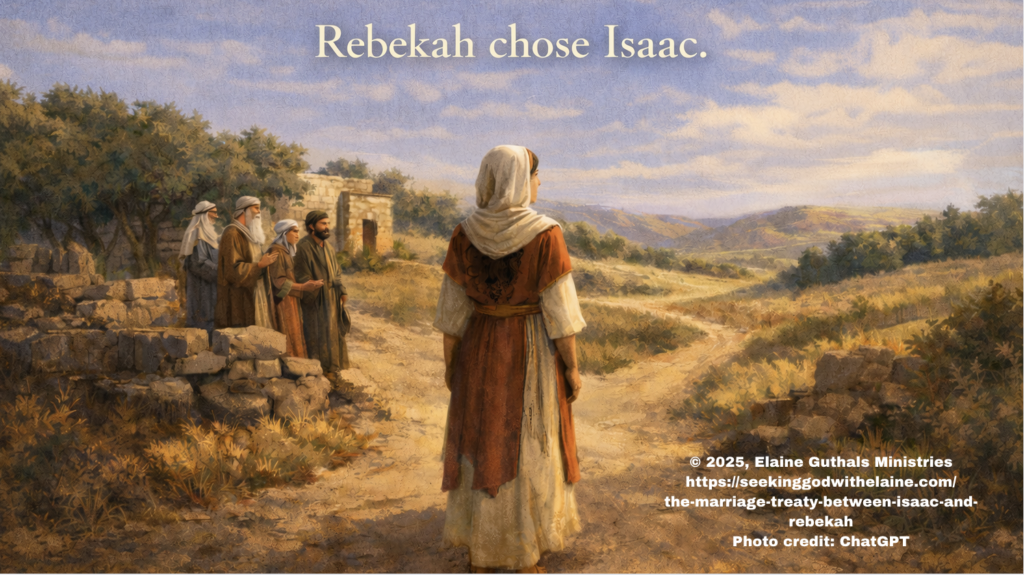
That was what Eliezer wanted to hear. He immediately worshiped Sovereign God.
Also making the journey was Rebekah’s childhood nurse, whom we later learn is named Deborah (Gen. 35: 8). This was probably her wet nurse when she was an infant and toddler. In later years, she would have become Rebekah’s loyal personal attendant and confidant.
More, though, than just Rebekah and Deborah made the trip. Verse 61 says servants — plural.
Bradford was surprised at the blessing pronounced over Rebekah. It held more prophecy than what her family was probably aware.
The wording is interesting to me. “They gave her this blessing as she parted: ‘Our sister, may you become the mother of many millions! May your descendants be strong and conquer the cities of their enemies” (Gen. 24: 60 NLT).
They called Rebekah sister because, even though she be miles away, she would be close in their hearts. She would always be their near kinsman.
Making the Connections #1
Let’s take a look at Eliezer a second. Birch called him an excellent servant.
Let’s get a little backstory. In Exodus 21, it says that Hebrew slaves could only serve their masters for six years. They were to be set free during the seventh year.
If a slave didn’t want to be freed — because of love for his master or the family that the master gave him — they pierced his ear. “If he does this [tells his master he doesn’t want to go free], his master must present him before God. Then his master must take him to the door or doorpost and publicly pierce his ear with an awl. After that, the slave will serve his master for life” (Ex. 21: 6 NLT).
This was a voluntary choice to go through the public ceremony. The piercing represents a permanent bond. It was submission on the slave’s part.
Had Eliezer gone through this ceremony? We don’t know.
Birch applied this to some of our current ordinances. Partakers of the Lord’s supper and those seeking baptism are not saved by these outward ceremonies. We only gain salvation when we truly have an inward transformation.
“O my son, give me your heart. May your eyes take delight in following my ways” (Prov. 23: 26 NLT).
Birch described it this way. He wrote, “The Christian is a servant of the Lord, and, as such, gives up himself, body, spirit, and soul, to do the will of his Heavenly Father. He is a consecrated vessel filled with the Spirit of the Almighty.”
Resource
Yes, we are servants of Jehovah. He is our Master. We are followers.
Making the Connections #2
Gray noted the frankness and the piety with which Eliezer and Rebekah’s family interacted. Both sides showed a respect for Jehovah.
Resource
Jehovah would have been very happy with this interaction.
Making the Connections #3
Davison made a great point that some who feel women are trashed in God’s Word seem to miss. He wrote,
“The importance of strong-minded, strong-hearted, pious mothers in the kingdom of God. The great men of the Bible were all endowed with the greatness of their mothers. They owed to them what was best and brightest in their heart and lives. It was through them they achieved their successes.
Resource
No, Jehovah doesn’t expect women to be submissive to the point they have no choice or freedom on their own.
Making the Connections #4
Leckie said something I like. He wrote, “The meditation of a devout spirit on almost anything will soon run into prayer. … The Hebrew word here rendered ‘meditate’ means also to pray.”
Resource
Let’s look at some verses.
- “But they delight in the law of the Lord, meditating on it day and night” (Ps. 1: 2 NLT).
- “Study this Book of Instruction continually. Meditate on it day and night so you will be sure to obey everything written in it. Only then will you prosper and succeed in all you do” (Josh. 1:8 NLT).
- “Oh, how I love your instructions! I think about them all day long” (Ps. 119: 97 NLT).
- “I will study your commandments and reflect on your ways” (Ps. 119: 15 NLT).
- “I remember the days of old. I ponder all your great works and think about what you have done” (Ps. 143: 5 NLT).
- “They are constantly in my thoughts. I cannot stop thinking about your mighty works” (Ps. 77: 12 NLT).
Let’s look at some verses on prayer.
- “Always be joyful. Never stop praying. Be thankful in all circumstances, for this is God’s will for you who belong to Christ Jesus” (I Thess. 5: 16-18 NLT).
- “Rejoice in our confident hope. Be patient in trouble, and keep on praying” (Rom. 12: 12 NLT).
- “You can pray for anything, and if you have faith, you will receive it” (Mt. 21: 22 NLT).
- “Don’t worry about anything; instead, pray about everything. Tell God what you need, and thank him for all he has done. Then you will experience God’s peace, which exceeds anything we can understand. His peace will guard your hearts and minds as you live in Christ Jesus” (Phil. 4: 6-7 NLT).
Think about it. What does that tell us?
- We are to never stop thinking about Jehovah’s commandments/instructions (Ps. 1: 2) — and never stop praying (I Thess. 5: 17).
- We are to think in order to assure obedience (Josh. 1: 8), and pray to assure obedience in times of trouble (Rom. 12: 12 NLT).
- We must think about what we study (Ps. 119: 15), and pray that the study increases our faith (Mt. 21: 22).
- We are to think about what Jehovah has done for us and others (Ps. 143: 5); so that when circumstances bring anxiety, we will continue to pray to our Father God (Phil. 4: 6-7, I Thess. 5: 17, Rom. 12: 12).
When we meditate, we end up knowing we need to pray to Jehovah for His control of our lives.
How Do We Apply This?
- Pray in everything.
- Listen to Jehovah’s direction — even if we have to wait.
- Praise Sovereign God.
Resource
Father God. We know that You are in control of everything. You allow us to make our own decisions – but You already know what those decisions will be. Thank You for rewarding us when we choose to follow You. Amen.
If you don’t understand something and would like further clarification, please contact me.
If you have not signed up for the email providing the link to the devotions and the newsletter, do so below.
If God has used this devotion to speak with you, consider sharing it on social media.