Esau had sold the birthright to Jacob many years before. This devotional reading looks at setting up the blessing.
Nuggets
- Isaac was going to go against Jehovah’s decree and give the blessing to Esau.
- Isaac gave Esau specific instructions.
- Rebekah stepped up to put things back on the right track, but she went about it the wrong way.
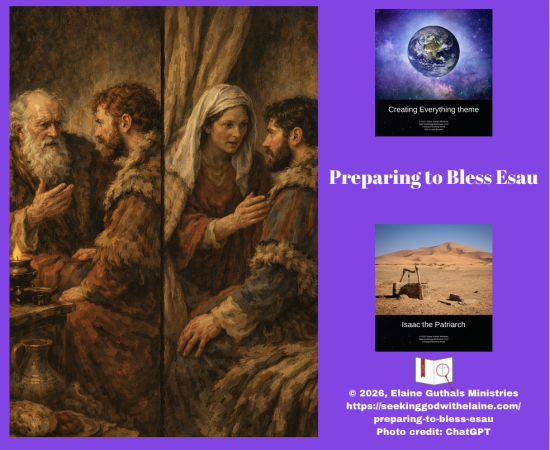
Remember, I think Genesis 26 should have gone before Genesis 25. The last part, though, was current and in the right place.
If we look at the end of Genesis 26, we said that — for what was being discussed in Genesis 26: 34-35 — Esau was then 40, making Isaac 100.
We are only told in Genesis 27 that Isaac was facing some challenges. But if we look at the timeline we have been using, it tells us how much time has transpired.
1860 BC — Isaac was born (Gen. 21: 2)
1800 BC – Jacob and Esau were born (Gen. 25: 24-26)
1785 BC — Abraham died at the age of 175 (Gen. 25: 7 – 8)
1785 BC – Esau sold the birth right to Jacob in exchange for lentil stew Jacob was cooking while mourning for Abraham
1760 BC — Esau at age 40 married Canaanite women (Gen. 26: 34-35), making Isaac 100.
1723 BC – Jacob cheated Esau out of the birthright blessing given by Isaac. He flees Canaan to Paran-Aman to Rebekah’s family. He agrees to work seven years to earn the right to marry Rachel (Gen. 29: 1-20)
1680 BC – Isaac died at the age of 180 (Gen. 35: 28-29)
Resource
Isaac was 137, and Esau and Jacob were 77.
Let's Put It into Context
To read devotions in the Creating Everything theme, click the button below.
Devotions in the Isaac the Patriarch series
Isaac Planned to Give the Blessing to Esau
“One day when Isaac was old and turning blind, he called for Esau, his older son, and said, ‘My son.’ ‘Yes, Father?’ Esau replied. ‘I am an old man now,’ Isaac said, ‘and I don’t know when I may die. Take your bow and a quiver full of arrows, and go out into the open country to hunt some wild game for me. Prepare my favorite dish, and bring it here for me to eat. Then I will pronounce the blessing that belongs to you, my firstborn son, before I die’” (Gen. 27: 1-4 NLT)
Isaac was going to go against Jehovah’s decree and give the blessing to Esau.
Isaac Called for Esau
Wait! What????
I thought this had been settled. I thought oldest was going to serve the youngest.
“And the Lord told her, ‘The sons in your womb will become two nations. From the very beginning, the two nations will be rivals. One nation will be stronger than the other; and your older son will serve your younger son’” (Gen. 25: 23 NLT emphasis added).
True, God told that to Rebekah. But she and Isaac had a great love story going on. He loved her deeply. “And Isaac brought Rebekah into his mother Sarah’s tent, and she became his wife. He loved her deeply, and she was a special comfort to him after the death of his mother (Gen. 24: 62-67 NLT emphasis added).
They would have talked.
Yes, we think this would have gone against the customs of the land. Firstborn rights were par for the course.
But that isn’t necessarily true. Most importantly, if God said differently, why didn’t Isaac obey?
Rebekah would have told Esau and Jacob that the older would serve the younger. She would not let Esau get 77 years old and drop this bombshell on him.
Was it only because Esau was Isaac’s favorite? Our opinions don’t matter to God.

That includes Isaac and Rebekah. They were not consulted before the decision was made.
Everyone had 62 years to get used to the idea that Esau sold away his birthright. He was no longer considered firstborn.
God chooses the one who will be most obedient to Him. That means, Jacob would be the more righteous man.
That is what is important to God — the condition of our soul. He is more concerned about our spiritual condition.
Isaac had to have known. Esau had already had two wives who were local women.
Remember what Moses wrote when he announced to us Esau’s marriages? “But Esau’s wives made life miserable for Isaac and Rebekah” (Gen. 26: 35 NLT).
But here went Isaac, making the decision for himself. “Then I will pronounce the blessing that belongs to you, my firstborn son, before I die” (Gen. 27: 4 NLT emphasis added).
Could Isaac just not stand his favorite not getting what most firstborn would get? Was he thinking Jehovah made the wrong decision? Was he thinking He had to follow His own laws?
“Dedicate to me every firstborn among the Israelites. The first offspring to be born, of both humans and animals, belongs to me” (Ex. 13: 2 NLT).
Bradford identified what Isaac was doing as tempting Jehovah. He quoted Edersheim when he said, “We do so tempt the Lord when, listening to our own inclinations, we put once more to question that which He has already clearly settled. Where God has decided, NEVER let us doubt, nor lag behind.”
Resource
We can’t bite on Isaac too much because we do the same thing. We ignore Jehovah’s decision. We argue that He made the wrong decision. We scream, shout, and tap our foot demanding that He let us have our way — with let not the right word choice.
How many times have we went our own way — even in worship — and figure Jehovah would bless us anyway?
We forget Jehovah is Sovereign God. He is our Creator and our Judge, Jury, and Executioner.
But let’s put this into context – 1700 BC Ancient Near East context.
- Birthright dealt with a double portion of the inheritance and clan leadership, not birth order.
- Blessings were a verbal act of conveying legitimacy, destiny, and status. It has been described as The Last Will and Testament.
- As they were not connected, the two did not have to go to the same son.
- There was no formal ceremony to formally announce the recipient.
- Evidence from that time shows the firstborn does not always get both or either.
We have to remember the main purpose of this practice was ensuing the family line remained stable and intact. (That was one reason we gave as to why Abraham married within his family.)
If the father was not convinced that the firstborn could provide the stability the line needed, a different son could be – and usually was – chosen. Infertility could play a part as well as adoption.
Bradford cautioned that the term double portion sounds like a strict, precise measurement. He wrote, “More often, these portions were approximates; a double portion could have been anything from a little bit more than the others, to practically everything of value.”
Resource
So, the blessing was distributing the wealth.
Prepare My Favorite Dish
Isaac gave Esau specific instructions.
- Go hunting with your bow
- Take lots of arrows
- Go hunting in the open country
- Snag some wild game
- Make it like I like it
- Bring it to me
We know that meals were a big part of covenants. The blessing was a part of the covenant, so it is logical eating would be a part.
Rebekah Foiled Isaac’s Plan
“But Rebekah overheard what Isaac had said to his son Esau. So when Esau left to hunt for the wild game, she said to her son Jacob, ‘Listen. I overheard your father say to Esau, “Bring me some wild game and prepare me a delicious meal. Then I will bless you in the LORD’s presence before I die.” Now, my son, listen to me. Do exactly as I tell you. Go out to the flocks, and bring me two fine young goats. I’ll use them to prepare your father’s favorite dish. Then take the food to your father so he can eat it and bless you before he dies.’ ‘But look,’ Jacob replied to Rebekah, ‘my brother, Esau, is a hairy man, and my skin is smooth. What if my father touches me? He’ll see that I’m trying to trick him, and then he’ll curse me instead of blessing me.’ But his mother replied, ‘Then let the curse fall on me, my son! Just do what I tell you. Go out and get the goats for me!’ So Jacob went out and got the young goats for his mother. Rebekah took them and prepared a delicious meal, just the way Isaac liked it. Then she took Esau’s favorite clothes, which were there in the house, and gave them to her younger son, Jacob. She covered his arms and the smooth part of his neck with the skin of the young goats. Then she gave Jacob the delicious meal, including freshly baked bread” (Gen. 27: 5-17 NLT)
Rebekah stepped up to put things back on the right track, but she went about it the wrong way.
Yes, Rebekah was trying to get back to a the-older-will-serve-the-younger blessing. Did she think God needed help?
Ooo, baby! God does not need our help. He will work His plan His way.
No, I have no clue how that would have looked in this situation. No animals to shoot in the open country? Esau trip and break a bone?? Somebody show up right before he was to leave that stopped him from going????
Who knows. Sovereign God could have used any number of things — even a change of heart on Isaac’s part.
We do know that Jehovah allowed this to happen this way.
Rebekah’s intervention were for the right reasons – and she clearly thought she was in the right. Her husband, the ruler of the house, was refusing what Jehovah had already ordained.
Look at Cooper’s proposed other reason. He wrote, “She knew that he [Jacob] was fittest for receiving it. She knew that he highly valued it, not merely for the sake of any worldly benefit annexed to it, but on account of the spiritual promises contained in it. Esau, on the contrary, had repeatedly shown the greatest contempt for the blessing and its promises.”
Resource
The deception was sinful. She not only didn’t trust God to keep His promises, but she also lied to get her plan accomplished.
The ends do not justify the means. Covenant work should not be completed by actions that break Sovereign God’s laws and commandments.
Just because it ended up with what was supposed to happen happening, it doesn’t mean that there were no consequences. We’ll talk about that later.
Jacob did question Rebekah about her plan. Well, about how to pull it off. Not once does he say – that was recorded – “This plan is wrong. It is deceitful.”
Maybe Jacob thought it was okay since Rebekah was willing to take the blame. “But his mother replied, ‘Then let the curse fall on me, my son! Just do what I tell you …” (Gen. 27: 13 NLT).
Yes, God wants us to take responsibility for our actions. That doesn’t mean Jacob didn’t feel any consequences.
Why was the food important? Every covenant was ratified through a meal.
Making the Connections #1
Why was Isaac so set that the firstborn would get the blessing? Even if he was resigned to Jacob getting the firstborn advantages, he may not have wanted the same thing that happened to him and Ishmael happen to Esau and Jacob.
Making the Connections #2
Pearse made a great observation. Remember, we talked about Isaac being a quiet man.
So, here comes this famine that throws Isaac out of his element. How did he step up? Fearfully with a flat-out lie thrown in.
Pearse addressed this. He wrote, “They who are weakest need most of all the help of God and have most room for it. They who have no other gifts must make the most of this.”
Resource
It appears that Isaac went back to his quiet life. Babies were born; babies grew up. He had finally gotten to where there was room for him to live.
Not only that, but Isaac got a promise from Sovereign God that he would be blessed.
And Isaac returns this with ignoring Jehovah’s proclamation. There are times we just want to shake our heads and ask, “What was that man thinking?”
Making the Connections #3
One of the hardest things to do on our walk with Jehovah is to wait for Him to work things out and keep His promises. It isn’t just the we-want-things-when-we-want-them attitude.
It is seeing things only through our limited perspective and not through the God-of-the-impossible perspective. We don’t have to help Him do what we can’t do ourselves.
It is our thinking that we have to help. Have you ever had a spouse or child that wanted to badly to help you, and you just wanted to scream, “I can do it myself!”
It doesn’t work in this case.
Making the Connections #4
Remember, until Moses came along and got the laws on Mount Sinai, birthright meant that the firstborn was the priest of the family. Do we see Esau in that role? NO!
Making the Connections #5
Cooper had another great nugget and a questionable second nugget. He argued,
“In all cases the Law of God is to be our rule. In no case can we claim the privilege of setting it aside. Rebekah’s sin, however she might excuse it to herself, was sufficient to have ruined her soul; and unquestionably, unless through God’s grace she had afterwards repented and obtained forgiveness, it would have ruined her soul. Such is the case with every sin.”
Resource
I agree with the first two sentences. I don’t know about the last two.
We can’t ignore or even rewrite God’s laws. We are going to break them because we are still sinful people.
At what point do we lose our salvation? That is above my pay grade.
There is only one unpardonable sin. That has to do with rejecting salvation.
Does one unrepented sin strip us of our salvation? Did Rebekah’s choice mean she turned her back on Jehovah?
I don’t think so.
I agree that all sin stems from our disobedience to God and His laws. Still, I think the judgment varies – my own opinion – decide what you believe.
How Do We Apply This?
- Always listen to Jehovah to ensure our actions follow His Will.
- Repent of any sin that we have committed.
Resource
Father God. Lord, we can be so self-involved at times. We want what we want, even if it is the direct opposite of what You want. Other times, we want what You want — but we go about it in a way You don’t want. Forgive us. Help us to always do Your Will. Amen.
If you don’t understand something and would like further clarification, please contact me.
If you have not signed up for the email providing the link to the devotions and the newsletter, do so below.
If God has used this devotion to speak with you, consider sharing it on social media.