If first-century Jews thought fishermen were strange disciples for the Messiah, they really wondered about His calling a tax collector to follow Him. This devotional reading looks at who Matthew was.
Nuggets
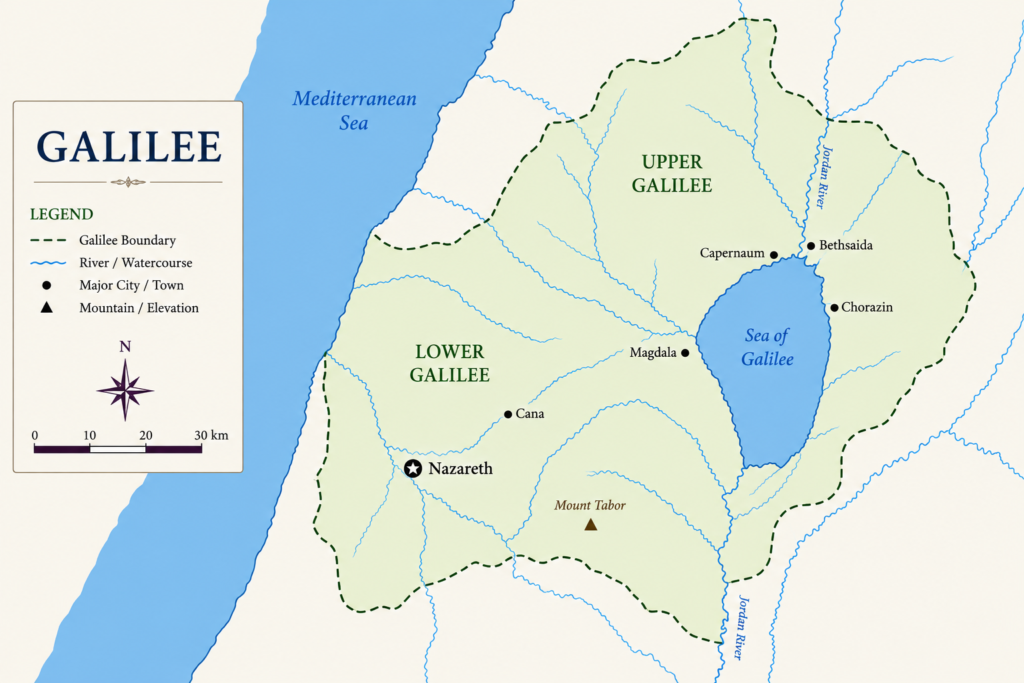
- Yeshua was at the Sea of Galilee outside of Capernaum.
- The man Yeshua called to be a disciple was known by two names.
- Tax collectors as a profession were seen as traitors and unclean.
- Yeshua calls us to follow Him away from who we are.
- Matthew, Mark, and Luke don’t spell out how much time transpired between the “follow Me” and the get-up-and-go.

We are going through and looking at how Yeshua called His Apostles to be His disciples. We aren’t given this information for many of them.
One we do know how he was called is Matthew. That may be because he was a tax collector on the job when he was called.
Three of the four Gospels carry the description. They are mainly similar — but where there is a difference, it is a fairy big one3.
Let's Put It into Context
To read devotions in The Battle for the Heart theme
Devotions in the The Early Ministry of the Messiah series
Finding and Calling Matthew
“As Jesus was walking along, he saw a man named Matthew sitting at his tax collector’s booth. ‘Follow me and be my disciple,’ Jesus said to him. So Matthew got up and followed him” (Mt. 9: 9 NLT)
“Then Jesus went out to the lakeshore again and taught the crowds that were coming to him. As he walked along, he saw Levi son of Alphaeus sitting at his tax collector’s booth. ‘Follow me and be my disciple,’ Jesus said to him. So Levi got up and followed him” (Mk. 2: 13-14 NLT)
“Later, as Jesus left the town, he saw a tax collector named Levi sitting at his tax collector’s booth. ‘Follow me and be my disciple,’ Jesus said to him. So Levi got up, left everything, and followed him” (Lk. 5: 27-28 NLT)
As Jesus Was Walking Along
Yeshua was at the Sea of Galilee outside of Capernaum.
If we go back in Luke a couple of verses, the last reference of location was in an unnamed surrounding village of an unnamed village. “In one of the villages …” (Lk. 5: 12 NLT).
However, all three of the Gospel accounts place this encounter after the man being lowered through the room to be healed (Mt. 9: 1-8; Mk. 2: 1-12; Lk. 5: 17-26). Matthew said that miracle occurred soon after Yeshua had returned to “… his own town” (Mt. 9: 1 NLT). Mark specifically said they had returned to Capernaum (Mk. 2: 1).
We aren’t told the how or why Yeshua went from “Soon the house where he was staying …” (Mk. 2: 2 NLT) to “Later, as Jesus left the town …” (Lk. 5: 27 NLT).
It gets a little more interesting with what Mark said. “Then Jesus went out to the lakeshore again and taught the crowds that were coming to him” (Mk. 2: 13 NLT).
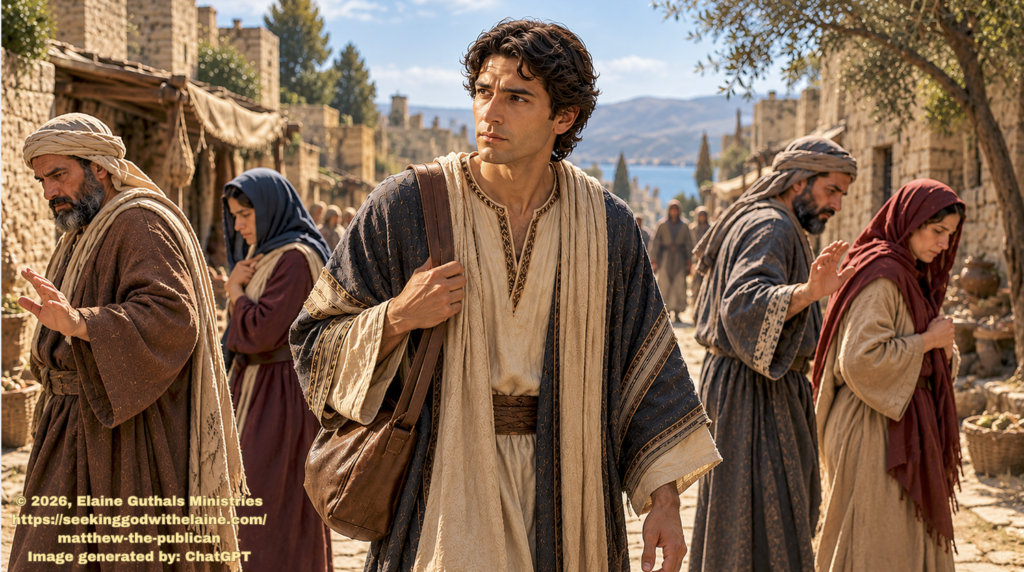
Matthew (Mattityahu)/Levi
The man Yeshua called to be a disciple was known by two names.
As with most of the Apostles, we really don’t know much about Matthew – even what his name really was. The Book of Matthew called him Matthew, but Mark and Luke called him Levi.
Why the difference?
Well, to be honest, we just don’t know because Scripture doesn’t tell us. Biblical scholars have taken a shot at addressing it.
Maybe he was known by both the name Matthew and the name Levi. Jewish people could use more than one name in different settings.
Maybe Levi was given the new name of Matthew. We aren’t told that Yeshua renamed Levi as He did Simon.
But look at this. Luke and Mark call him Levi when he is at his tax collector’s booth (Lk. 5: 27; Mk. 2: 14). However, in the list of the twelve Apostles, both call him Matthew (Lk. 6: 15; Mk. 2: 18).
Could Matthew the tax collector and Matthew the Apostle be two different men? Yes, since Mark calls the tax collector the son of Alphaeus (Levi Ben Chalfai). Neither Mark nor Luke list his father in the list of Apostles.
They do list James in the list as the son of Alphaeus. (Does that make Matthew and James brothers? Who knows!)
In the Orthodox Jewish Bible, both do say Levi (Mattityahu) in Mark 2: 15 and Luke 5: 27.
Does this prove Matthew and Levi were the same men? Maybe. Maybe not.
Sitting at His Tax Collector’s Booth
Tax collectors as a profession were seen as traitors and unclean.
To first-century Jews, any Jew who purchased a job as a hated the tax collector was working for the opposition. Roman citizens themselves usually didn’t serve as tax collectors. This job was outsourced to contractors who paid the empire in advance for the right to collect taxes in a given region.
The region, however, was ruled by Herod Antipas. H could have also been collecting revenue through his own tax system. Matthew may have worked for him.
That wouldn’t have gone over any better with Capernaum’s citizens.
By purchasing their post, tax collectors would have been seen as collaborating with foreign domination. Don’t miss what that means.
Matthew would have paid everyone’s taxes for them and was getting paid back as he collected the taxes from the people.
True, that left tax collectors to charge whatever amount they wanted. I am sure some did charge an exorbitant amount.
Their handling of the Roman coinage would have had religious implications if that made them unclean.
All that taken together would have been seen as covenant betrayal. That was why tax collectors were often groups with sinners, prostitutes, robbers, and other morally suspect individuals. They were often excluded from participation in the synagogue life.
In truth, we can’t say that all of them were traitors. Some may have been ethical and charged only a little over what was required by Rome.
We might call that extra amount earning their wage for the job performed. We might call it interest on the loan.
But it also meant that the system was structurally incentivized overcollection and abuse, contributing to widespread resentment.
But let’s put it into context. There were land taxes, poll taxes, customs duties, fishing tariffs, and transit tolls. Remember, Capernaum was located along trade routes.
Capernaum was located near a territorial boundary. That would accounted for the transit tolls.
The fisherman encountered taxation different jurisdictions governing around the lake. Each jurisdiction would want to tax anything that came through.
Follow me
Yeshua calls us to follow Him away from who we are.
We talked about what Yeshua is calling us to. Let’s look at what He is calling us from.
Yeshua is calling us from our comfort zone. I know. Many of us don’t like change. But He is calling us to more than a new location. He is transforming is from the inside out.
That means Yeshua is calling us away from our sinful lifestyle. More than just our actions has to change. Our mindset – our attitude – has to be like that of Christ’s.
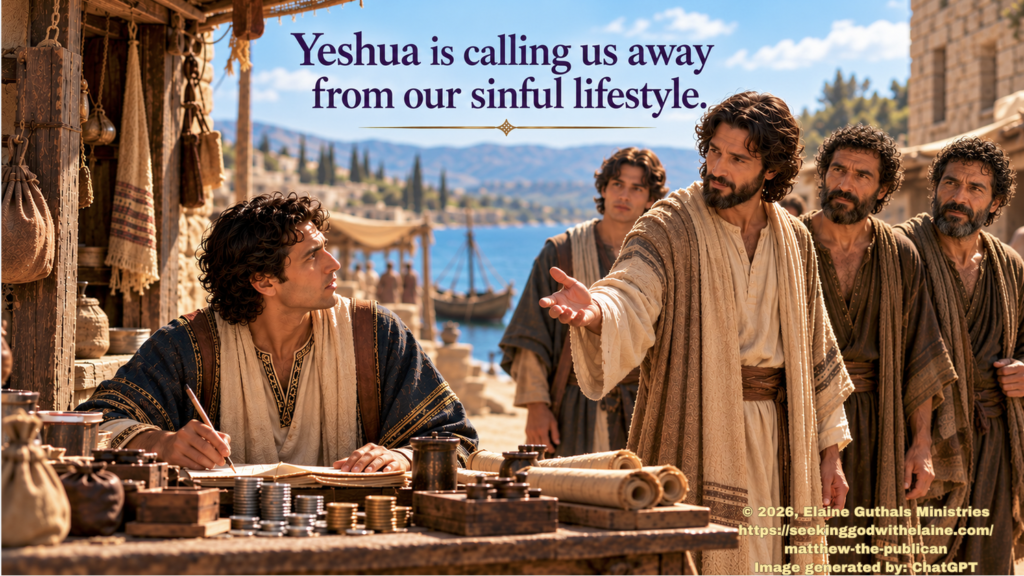
Would Matthew have chosen to follow Yeshua if he hadn’t been called? Maybe. Maybe not. He might have been very comfortable in his lifestyle before Yeshua walked by.
But when Jehovah wants us to make changes, He does raise our level of discontentment with our lives. He makes us want something different by wanting Someone different.
True, we probably don’t have what Matthew had to give up.
Left Everything
Matthew, Mark, and Luke don’t spell out how much time transpired between the “follow Me” and the get-up-and-go.
We usually read it to be immediate. It doesn’t look like it was long. Let’s piece it together.
All three Gospel writers told us that Matthew got up and followed Yeshua. Luke added something important: he left everything.
None of them wrote that Matthew got up immediately. Yes, immediate obedience is important. Is that the only obedience Jehovah will accept?
Of course not. If that were the only way Jehovah would accept our service to Him, I would think there would probably be few people serving Him.
Think about it. Especially on the big decisions like leaving everyone we know and everything we have – wouldn’t Jehovah give us five minutes to think it through?
Jehovah isn’t a dictator. He gives us free will to make our own decisions. Wouldn’t He give us time to make that decision?
To me, that means timing isn’t the focus. The main focus should be on what Luke did tell us – Matthew left everything.
Matthew’s decision – once he made it – was complete. He didn’t put limitations or restrictions on it. He left everything and went.
What did Matthew leave when he came out of his booth when Yeshua called?
Let’s look at the booth as a symbol of his former life. It provided a lucrative job offering financial security. As with any job, it offered an established routine.
But Matthew gave up this material wealth for following his Savior. That meant no established routine and no creature comforts that wealth provided.
In a split second, the transformation was made. One moment we are sinful. We genuinely call to Him to save us, and the next moment we are justified and regenerated.
I like what Gasquoine said. He wrote, “The true servant of Christ will be willing to give up, not only of the fruits of daily work, but daily work itself for Christ.”
Resource
Yes, we were told that Peter, Andrew, James, and John did the same thing. “And when they had brought their boats to land, they left everything and followed him” (Lk. 5: 11 ESV emphasis added).
Would a job fishing be on the same level as a tax collector’s job? Probably not, especially if the tax collectors did charge much over what was required by Rome.
Making the Connections #1
I can see why Matthew, after becoming a disciple, no longer wanted to be labeled as a publican.
I can also see why so many would still see Matthew that way.
Think about how the other Apostles interacted with Matthew. He had been an outcast. Probably in the beginning of his following Yeshua, that is how the other disciples still saw him.
But Yeshua didn’t. He loved Matthew as He did the others.
It is hard to shake labels from our past lives, isn’t it? It is also hard to give up grudges that we hold against those with shameful past lives.
But think about how that occupation prepared Matthew to be a scribe – if the Apostle was the one to pen the Book of Matthew. He was literate. He may have had to know Greek, Latin, Hebrew, and Aramaic.
Matthew was trained in record-keeping. He had to keep track of who paid what and how much they still owed.
I bet there are a lot of details that Matthew would have to wade through.
Jehovah will call the unwanted, unclean, and untrusted people to serve Him.
Making the Connections #2
Yeshua called Matthew while he was in his booth. He said, “Follow Me” — and nothing changed.
Then they heard the scrape of the stool. Matthew stood up.
There it was. Obedience.
No miracle. No promise.
Just trust.
No, it wasn’t just faith — straight belief. It was the obedience that bumps it up to trust.
Heart Check
Think about the battle Yeshua is engaged in for your heart. Ask yourself the following questions.
- Are we allowing the labels from our past to define us, or are we accepting the new life Yeshua offers us?
- Are we holding on to our security and familiar routines, or are we willing to leave them behind when Yeshua calls?
- Are we satisfied with believing Yeshua’s words, or are we demonstrating our trust through obedience?
- Are we judging others by their past failures, or are we seeing them as people Yeshua loves and calls?
- Are we waiting for a miracle or a promise before we obey, or are we willing to follow Yeshua simply because He has called us?
How Do We Apply This?
- Refuse to let the labels from our past define us
- Trust Yeshua with our security and familiar routines
- Demonstrate our faith through obedience
- Release our grudges against people with shameful pasts
- Recognize Jehovah’s call to the unwanted, unclean, and untrusted
- Follow Yeshua without demanding a miracle or a promise first
Father God. Thank You for calling us from a marginalized life into being accepted as Jehovah’s child. Help us to always be obedient to You. Amen.
If you don’t understand something and would like further clarification, please contact me.
If you have not signed up for the email providing the link to the devotions and the newsletter, do so below.
If God has used this devotion to speak with you, consider sharing it on social media.