After Jacob dreams of a ladder reaching to Heaven, he hers God speaking to him This devotional reading looks at his response and how his request for a promise pertains to us today.
Nuggets
- Jacob acknowledged Jehovah’s presence in that place.
- Jacob went to bed fine and woke up afraid.
- Because the God of his fathers was made his God, Jacob responded with action and commitment.
- Jacob awoke and immediately erected a memorial.
- Jacob didn’t realize that all the earth is hallowed ground.
- Jacob responded to Jehovah by making a vow.
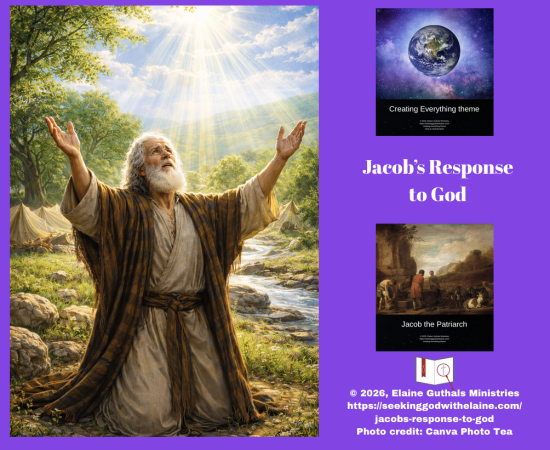
What can we learn from Jacob’s response to God’s presence? One of the sermons I read sort of set the foundation for this post. I agree and disagree with Maclaren’s take on that reaction.
Maclaren’s The Heavenly Pathway and the Earthly Heart
https://www.biblehub.com/sermons/auth/maclaren/the_heavenly_pathway_and_the_earthly_heart.htm
But then I branched off from there.
Let's Put It into Context
To read devotions in the Creating Everything theme, click the button below.
Devotions in the Jacob the Patriarch series
Jacob’s Response
“Then Jacob awoke from his sleep and said, ‘Surely the Lord is in this place, and I wasn’t even aware of it!’ But he was also afraid and said, ‘What an awesome place this is! It is none other than the house of God, the very gateway to heaven!’” (Gen. 28: 16-17 NLT)
This place
Jacob acknowledged Jehovah’s presence in that place.
It must have been a little startling to wake up to the realization that Sovereign God had talked to you. Jacob put that down to the place. He said it was fearsome.
Jacob seemed to have limited understanding of God’s presence. He claimed ignorance of Jehovah being in that place, leading us to believe he bought into the localization of gods. Jacob focused on the spot rather than the spirit.
I’m sure it would be difficult bucking that belief. It would have been a long-held belief held by many — if not most — in that society.
But we would think that Jacob, of all people, would have learned from Abraham’s story that Jehovah isn’t tied to a specific spot. If He were, wouldn’t that spot have been Ur or Haran, not Bethel?
Yet we are not saved because of our parents’ religion. We are only saved through a personal relationship with Jehovah. He reveals Himself to each of us individually.
He Was Afraid
Jacob went to bed fine and woke up afraid.
I don’t think that Jacob was terrified by God. I believe that he meant that the place was awesome because it was the house of God. When we are told to fear God, we are to hold Him in reference, not run from Him in terror.
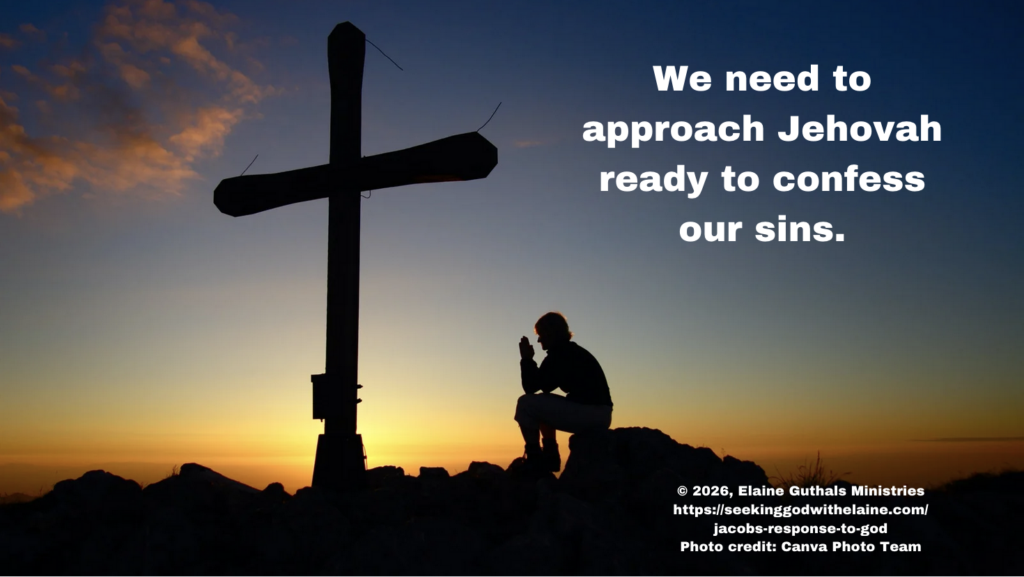
That being said, I think we should approach Jehovah a little unsettled. We aren’t told Jacob was feeling remorse for his deception of Isaac, but he probably was questioning if he was worthy of a divine visit.
We need to approach Jehovah ready to confess our sins.
Maclaren thought that Jacob’s fear stemmed from the fact that he associated Jehovah with Isaac, not himself. Plus, there was also the localized god theory. Ancient near eastern gods didn’t follow people around.
But think about it. To this day, we still wrestle with the concept of omnipresence. How can a God we don’t see be present with us?
Maclaren also thought Jacob was afraid he had defiled the holy ground without even knowing. He wrote,
“He does not draw the conclusion from the vision that all the earth is hallowed by a near God, but only that he has unwittingly stumbled on His house; and he does not learn that from every place there is an open door for the loving heart into the calm depths where God is throned, but only that here he stands at the gate of heaven.”
Resource
Yep. Missed it.
Jacob reacted with fear instead of joy. He was trembling instead of leaping.
But we have to be careful assuming that Jacob’s response equates to low religious feeling. Let’s focus on the fear a second.
Every time — except for Abraham in Genesis 18 — humans reacted with some expression of fear when having a heavenly visit. (And an argument could be made that Abraham did know they were heavenly beings.)
- Moses hid his face at the burning bush (Ex. 3).
- Israel recoiled in terror at Sinai (Ex. 19–20).
- Manoah feared for his life after realizing he has seen the Angel of the LORD (Judg. 13).
- Isaiah cried “Woe is me!” in the temple (Isa. 6).
- Ezekiel fell on his face (Ezek. 1).
- Daniel was left trembling and without strength (Dan. 10).
- Zechariah, Mary, the shepherds, Peter, and even the disciples at the Transfiguration responded with fear when confronted by divine or angelic presence.
- John fell “as though dead” in Revelation 1.
Bottom line, fear is the normal response, not the exception.
We also have to talk about the correct definition of fear. Fear of the Lord means that the person reacted with reverence and awe — very acceptable and the most appropriate of reactions.
That means Jacob’s trembling may have been exactly what he should have done. He may have had a huge realization about Who his Visitor actually was.
Remember, we said this may have been the first encounter Jacob had with Jehovah. This might be the first moment Jacob truly grasped that the God of his fathers is not just a distant family deity, but a living, present, holy Lord.
This visit was also making the God of his fathers his God.
The Next Morning
“The next morning Jacob got up very early. He took the stone he had rested his head against, and he set it upright as a memorial pillar. Then he poured olive oil over it. He named that place Bethel (which means ‘house of God’), although it was previously called Luz” (Gen. 28: 18-19 NLT)
Because God of his fathers was made his God, Jacob responded with action and commitment.
Whatever guilt or remorse Jacob had felt upon leaving Beersheba, he was felt reconciliation with Jehovah. How do we know?
Reconciliation includes that the distance between God and man is lessened.
Whatever fear Jacob felt was gone. If the ladder symbolized love, it eased his fear.
“Such love has no fear, because perfect love expels all fear. If we are afraid, it is for fear of punishment, and this shows that we have not fully experienced his perfect love” (I Jn. 4: 18 NLT)
Jacob’s actions proved his change of heart.
- He set up a stone pillar.
- He named the place Bethel (“House of God”).
- He made a vow, essentially entering into a relationship with God.
The Stone
Jacob awoke and immediately erected a memorial.
How many of us would want to have a stone for our pillow? I know for me, it would be hard to sleep because of the discomfort.
But it has a deeper meaning. Having a stone as a pillow speaks to hardship and isolation. I’m sure Jacob was feeling just that.
Jacob used the stone that had been his pillow as a standing stone. In the Complete Jewish Bible, stone pillar and stone monument are the same word — standing stone. I think that is another instance where modern translators used modern words for our ease.
A standing-stone (or Matstsebah) was an ancient custom where a large stone was placed to commemorate sacred covenants or important events. They were used in the Bronze and Iron Ages (3150-586 BC).
In our vernacular, we would say Jacob erected a memorial.
Bradford said that it was also a type of Zevah or peace offering. It could also have been an early type of altar.
Resource
This memorial is something special. It is a foreshadowing of worship practices to come in Israel.
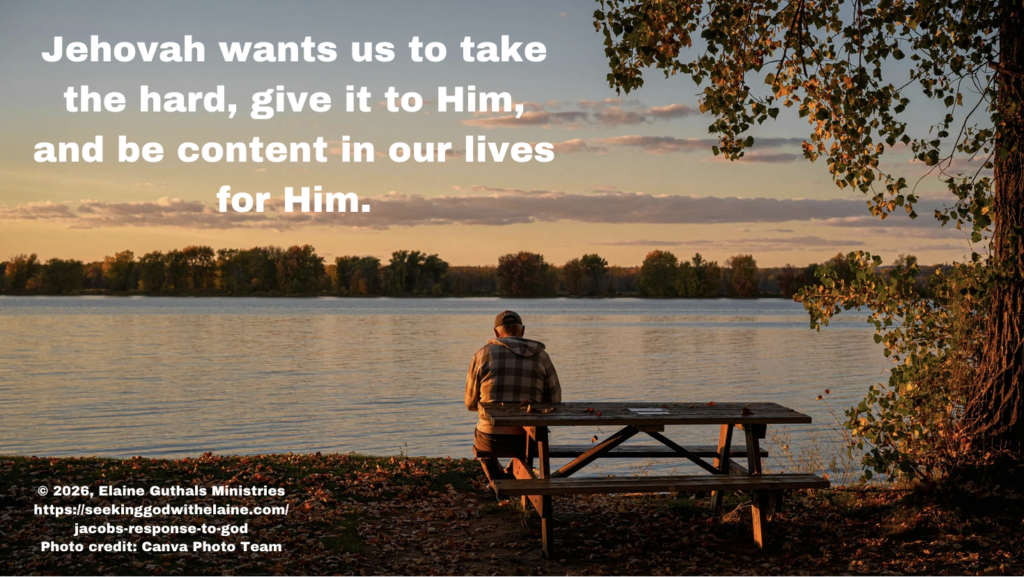
But isn’t that what Jehovah wants? Jehovah wants us to take the hard, give it to Him, and be content in our lives for Him.
Pouring oil on something was a common practice in God’s Word. It was also a command.
House of God
Jacob didn’t realize that all the earth is hallowed ground.
When Jacob woke up and considered the dream, he recognized the sacredness of the place. He saw it as a place where Heaven and earth intersects.
That is what House of God means. It doesn’t mean a physical building where we go to worship Jehovah.
It means it is an access point. Jehovah broke into human space.
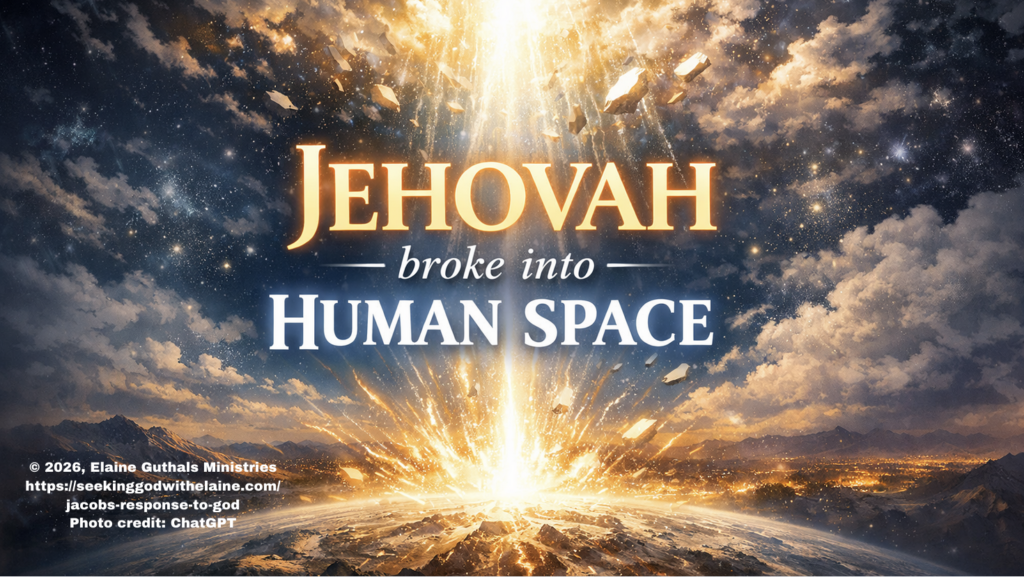
This was the House of God because God was present.
Having a loving Jehovah take up residence in our hearts would be even more foreign. Yeah, part of that is the localized god superstition.
I think Jehovah specifically picked this place. It wasn’t just on the road to Haran.
Bethel was a place where Abraham built an altar (Gen. 12: 8). The covenant was about continuity.
Was that the only gate to Heaven? Maybe. But maybe not.
What is important is that Jehovah met Jacob here, and Jacob responded by renaming the town of Luz to Bethel. He acknowledged the ordinary becomes sacred because of Sovereign God’s presence.
Go back to verse 17 a second. “… ‘… It is none other than the house of God, the very gateway to heaven!’” (Gen. 28: 16-17 NLT)
A gate is the point of access. “Go in through the narrow gate; for the gate that leads to destruction is wide and the road broad, and many travel it; but it is a narrow gate and a hard road that leads to life, and only a few find it” (Mt. 7: 13-14 CJB).
The house is a permanent dwelling place.
Jacob Made a Vow
“Then Jacob made this vow: ‘If God will indeed be with me and protect me on this journey, and if he will provide me with food and clothing, and if I return safely to my father’s home, then the Lord will certainly be my God. And this memorial pillar I have set up will become a place for worshiping God, and I will present to God a tenth of everything he gives me’” (Gen. 28: 20-22 NLT)
Jacob responded to Jehovah by making a vow.
Jehovah had placed the stairway to symbolize the connection between Heaven and earth. The activity of the angels showed that Heaven is actively involved in the affairs of the earth.
The crowning point was when Jehovah Himself spoke directly to Jacob. Even though He is Sovereign God, He initiated the encounter with Jacob.
As a response to the dream, Jacob made a vow. Robinson talked about the reach of vows. He wrote, “The reach of these vows is universal. They cover our possessions — our ways — our hearts — our lives.”
Resource
Jacob promised to return to Jehovah one-tenth of all he would earn or accumulate. But he set several conditions for this to happen.
We have to realize Jacob wasn’t saying that he didn’t accept his covenant responsibilities. Wasn’t Jacob vowing back covenant responsibilities?
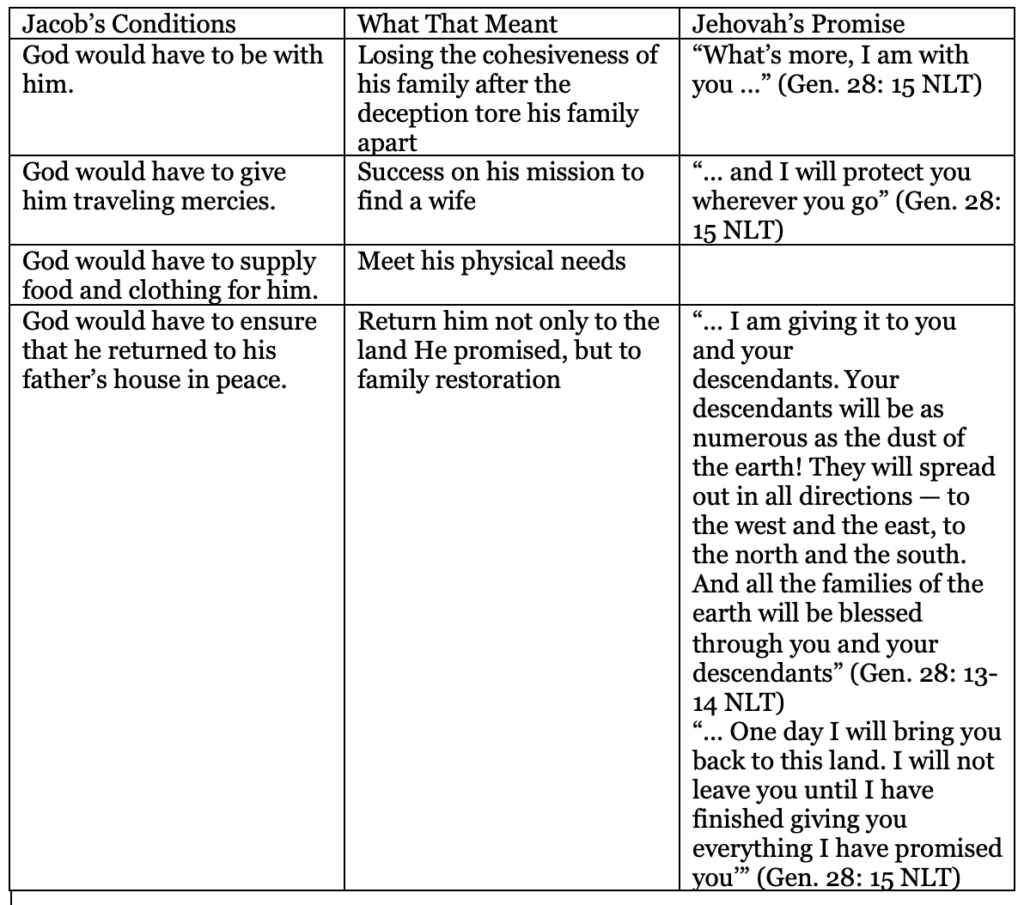
Then, and only then, would Jacob consider God his God.
Should we bite on Jacob for that?
But isn’t that how we approach Jehovah sometimes? We want things to happen our way.
Robertson take on this is one I agree with. He wrote, “A kind of bargain is struck. If religion makes me happy then I will be religious.”
Resource
Robertson’s take on this was that Jacob hadn’t reached the level of disinterestedness, which is a willingness to give up something for a greater good.
But was it really selfishness?
No, Jacob was responding back saying he agreed to every promise from Jehovah.
Craig’s viewpoint was a little different. He thought this showed Jacob’s moderation. He only asked for the necessities of life beyond the covenant blessings.
Resource
Jehovah was taking Jacob where he was at to start him on his Sanctification Road to get him to where He wanted.
We shouldn’t be upset when Jehovah’s promises come with the expectation of a vow from us. Salvation should be accompanied by the vow to live for Him.
Making the Connections #1
Bible Verse
Maclaren said something interesting. The dream didn’t contain a religious vibe.
Resource
As we said, we aren’t told Jacob had any prior communication with Jehovah. That would mean he was just starting out on his Sanctification Road. He was at the conversion point.
This reaffirmation of the covenant didn’t really have any calls for obedience from Jacob. But then, that was already given to Abraham.
- Believe
- Walk with me
- Circumcise your boys
A relationship with us is the most important element to Jehovah. If we prioritize that relationship, all the rest will fall into place.
Making the Connections #2
Think about what Jacob saw.
• Heaven “opened”
• A stairway/ladder connecting heaven and earth
• Angels ascending and descending
• God standing above it, speaking promises of presence and protection
What does that tell us? God is not cut off from the world. There is traffic between heaven and earth, and God can draw near.
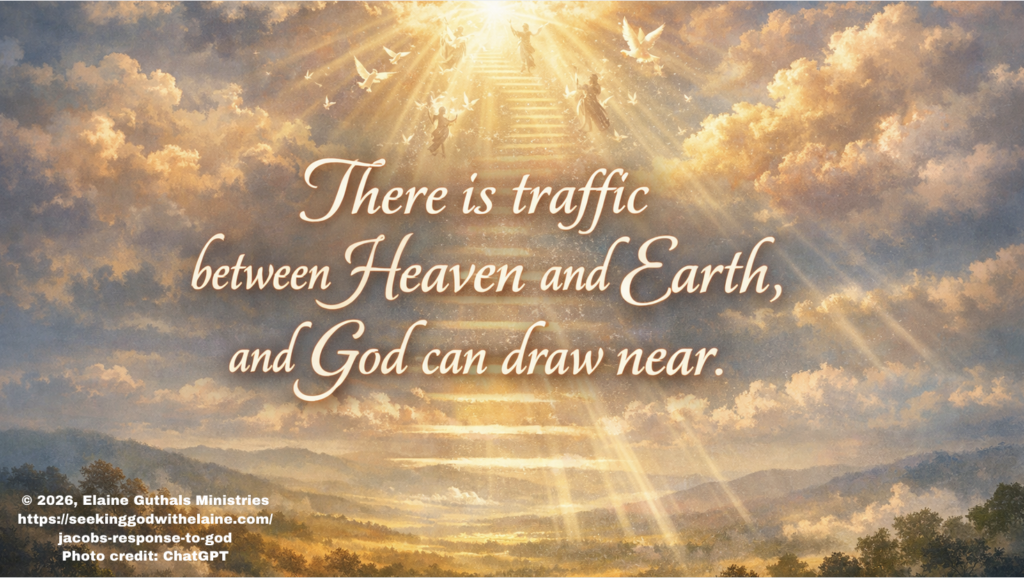
We are called to respond.
Making the Connections #3
Jehovah never asked for a Temple to be built in His name. He did give instructions for a Tabernacle. It was a place where His children could come be in His presence.
But Yeshua turned that on its ear, didn’t He? When talking to Nathaniel, “Then he said, ‘I tell you the truth, you will all see heaven open and the angels of God going up and down on the Son of Man, the one who is the stairway between heaven and earth’” (Jn. 1: 51 NLT).
Jehovah isn’t just a Presence in a place. He is always present in a Person.
Where Yeshua is, Heaven is active.
Making the Connections #4
Think about where Jacob was at on his Sanctification Road. He was probably just beginning. He wasn’t mature enough in his faith to wait on Jehovah.
But Jacob wanted to be the covenant son. If he didn’t want a relationship with Jehovah, he wouldn’t be.
Jehovah wasn’t ready to bring Yeshua on the scene. So, that meant Jacob received what he was meant to see in the only way possible at his point in the story.
Making the Connections #5
I like what Mears said. He wrote, “Gratitude should be the very first fruit of religion.”
Resource
Notice again what was in Jacob’s vow: spiritual blessings and basic necessities.
But Jacob asked for less than the covenant blessings. He said nothing about descendants or land.
Instead, Jacob recognized that all he would gain on this journey came from and through Jehovah.
So, Jacob was starting this journey off on the right foot.
Making the Connections #6
How can we not trust Jehovah’s promises? He is unchangeable after He has made the promise.
We just have to remember Romans 8: 28. “Furthermore, we know that God causes everything to work together for the good of those who love God and are called in accordance with his purpose” (Rom. 8: 28 CJB).
Jehovah will keep the promises that promote good — sanctification — in our lives.

Making the Connections #7
We cannot gloss over the fact that Jehovah presented Himself to Jacob. Jacob didn’t take off one day to go find Him. He came to where Jacob was.
Jehovah comes to us, too. We, as did Jacob, have to respond.
Making the Connections #8
“Then the Lord said to Abram, ‘You can be sure that your descendants will be strangers in a foreign land, where they will be oppressed as slaves for 400 years’” (Gen. 15: 13 NLT)
Did Jacob equate this revelation with Jehovah’s prophecy? “I’ll be with your descendants when they are in a strange land.”
This omnipresence rather than a localized god may have been an unfamiliar concept to Jacob at this point. I wonder if he thought of it when he was in the cart riding to Egypt. Did he take heart to this promise?
Making the Connections #9
Up until now, we haven’t heard the phrase, “And God was with him.” We’ve had some important Hall of Famers — Noah, Abraham — but they didn’t get to hear that phrase.
Jacob asked for Jehovah’s presence for himself. Jehovah answered the request not only for him, but also for his descendants.
- “The LORD was with Joseph, so he succeeded in everything he did as he served in the home of his Egyptian master” (Gen. 39: 2 NLT).
- “David continued to succeed in everything he did, for the LORD was with him” (I Sam. 18: 14 NLT).
- “Look! The virgin will conceive a child! She will give birth to a son, and they will call him Immanuel, which means ‘God is with us” (Mt. 1: 23 NLT).
Not a bad response to prayer. That response includes us.
“The Lord is close to all who call on him, yes, to all who call on him in truth. He grants the desires of those who fear him; he hears their cries for help and rescues them” (Ps. 145: 18-19 NLT).
How Do We Apply This?
- Don’t expect mere religious emotion to be enough to gain salvation.
- Value our church privileges.
- Vow inward transformation as well as outward worship to Jehovah.
- Thoughtfully contribute by plan, not impulse.
- Give cheerfully.
Resources
Father God. Thank You that You come to us Thank You that You stay with us. Amen.
If you don’t understand something and would like further clarification, please contact me.
If you have not signed up for the email providing the link to the devotions and the newsletter, do so below.
If God has used this devotion to speak with you, consider sharing it on social media.