Jacob and Esau had parted company 20 years early with anger and fear. This devotional reading looks at how Jacob tried to curry Esau’s favor.
Nuggets
- Jacob’s gift to Esau wasn’t a casual gift.
- Jacob presented the animals to Esau to secure peace.
- Jacob instructed the men what to say as the gift was from him.
- Jacob atoned for his sins against Esau.
- Pass through the water can have significant meaning.
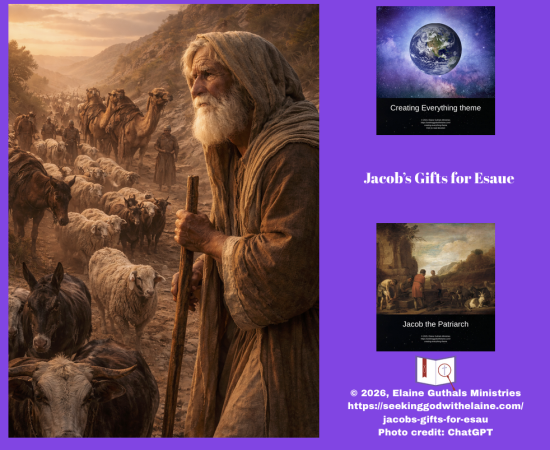
Jacob sent Esau a message in order to give Esau fair warning and not blindside him.
The message was structured according to custom. Jacob used very deferential language in his message to Esau. He called Esau my lord and himself his servant. He declared his wealth to establish a peaceful intent.
How did Esau respond? With an army of 400 soldiers.
In order to soften Esau’s temper, Jacob sent him a really nice gift.
Let's Put It into Context
To read devotions in the Creating Everything theme, click the button below.
Devotions in the Jacob the Patriarch series
The Gift Strategy
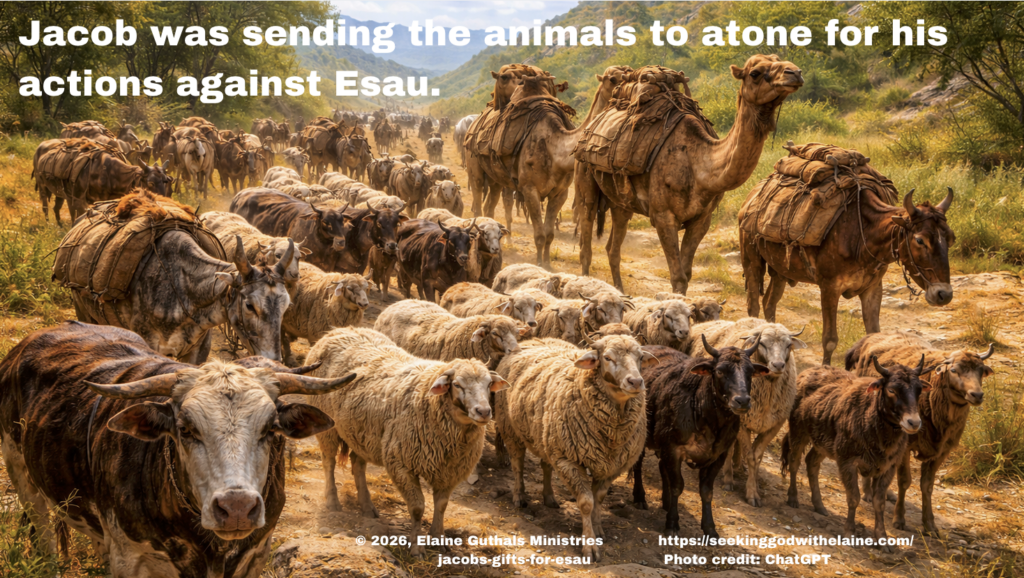
“Jacob stayed where he was for the night. Then he selected these gifts from his possessions to present to his brother, Esau: 200 female goats, 20 male goats, 200 ewes, 20 rams, 30 female camels with their young, 40 cows, 10 bulls, 20 female donkeys, and 10 male donkeys. He divided these animals into herds and assigned each to different servants. Then he told his servants, ‘Go ahead of me with the animals, but keep some distance between the herds.’ He gave these instructions to the men leading the first group: ‘When my brother, Esau, meets you, he will ask, “Whose servants are you? Where are you going? Who owns these animals?” You must reply, “They belong to your servant Jacob, but they are a gift for his master Esau. Look, he is coming right behind us.”’ Jacob gave the same instructions to the second and third herdsmen and to all who followed behind the herds: ‘You must say the same thing to Esau when you meet him. And be sure to say, “Look, your servant Jacob is right behind us.”’ Jacob thought, ‘I will try to appease him by sending gifts ahead of me. When I see him in person, perhaps he will be friendly to me.’ So the gifts were sent on ahead, while Jacob himself spent that night in the camp” (Gen. 32: 13-21 NLT)
These Gifts
Jacob’s gift to Esau wasn’t a casual gift.
We have to think about Jacob’s gift in his time. It was an Ancient Near Eastern custom to have sequential waves of gifts to soften a superior’s anger.
But Ligonier.org thought this was an excessive gift. They argued that Jacob had already returned the stolen blessing (Gen. 25: 23; 27: 27–29) by calling Esau my lord. The author questions Jacob’s sincerity regarding the means he used to obtain the ends. Was he really sorry for how he gained the wealth?
Resource
Yes, Jacob is following the custom of the day – a pagan custom. Is he just trying to buy Esau’s favor and forgiveness?
But that what Jacob is trying to do? I don’t think so.
Several times in this passage, Jacob uses the Hebrew word minchah. The New Living Translation uses the word gifts.
- “… Then he selected these gifts from his possessions to present to his brother, Esau” (Gen. 32: 13 NLT emphasis added).
- “You must reply, ‘They belong to your servant Jacob, but they are a gift for his master Esau. Look, he is coming right behind us’” (Gen. 32: 18 NLT emphasis added).
- “… Jacob thought, ‘I will try to appease him by sending gifts ahead of me …’” (Gen. 32: 20 NLT emphasis added).
- “So the gifts were sent on ahead …” (Gen. 32: 21 NLT emphasis added).
Why is this important? Look at Leviticus 2. In Hebrew, Bradford said the grain offering is called the Minchah. The Englishman’s Concordance used a slightly different spelling – except in the URL.
Resources
It wasn’t a gift or present. It was an offering.
No, Jacob wasn’t trying to make Esau a god. He was atoning to his Sovereign God through restoring his relationship with his brother.
“So if you are presenting a sacrifice at the altar in the Temple and you suddenly remember that someone has something against you, 24leave your sacrifice there at the altar. Go and be reconciled to that person. Then come and offer your sacrifice to God” (Mt. 5: 23-24 NLT).
Can we make an argument that Jacob was combining the sacred and the pagan? Probably.
Did Jacob go too far in trying to make amends with Esau? Maybe.
Did Jehovah have a problem with this? Well, Moses didn’t say one way or the other.
Divided These Animals
Jacob presented the animals to Esau to secure peace.
Jacob just didn’t willy-nilly give Esau the animals. He provided the servants to care for those animals.
In other words, Jacob put some thought into it. This showed his sincerity.
The way that Jacob sent them is waves is also an Ancient Near East custom when a servant was trying to appease a king. The sequential gifts in waves were meant to soften a superior’s anger.
Instructions to the Men
Jacob instructed the men what to say as the gift was from him.
I am sure that Jacob picked men that were not only good livestock handlers but also ones who would carry out his instructions fully.
The message was, “Tell Esau the animals are his, and that I’m coming.”
Jacob Thought
Jacob atoned for his sins against Esau.
The Hebrew in verse 20 says kaphar panav. Kaphar means atone, pacify, or cover. Panav means his face. Taken together, it is talking about atoning for his presence.
Resources
I can see that. Jacob is asking Esau’s forgiveness upon returning (coming into his presence again) by giving him to animals to pacify his anger and atone for his sins.
But the really telling thing is the root part of the word. It is the same root as atonement – kippur.
Jacob’s intent was to have the herds and flocks function as a show of reconciliation. He did all that he could to turn aside his brother’s wrath and curry his favor. He was sending the animals to atone for his actions against Esau.
Wasn’t that what Jehovah wanted? Jacob was the covenant son, not Esau. Rebekah knew that from before they were born (Gen. 25: 23).
I say it again. The ends do not justify the means. Election does not excuse deception.
So, Jacob needed to atone for his sins.
To do this, instead of buying the blessing now, he was trying to repair the breach. That is how much he has grown.
Crossing the Jabbok
“During the night Jacob got up and took his two wives, his two servant wives, and his eleven sons and crossed the Jabbok River with them. After taking them to the other side, he sent over all his possessions” (Gen. 32: 22-23 NLT)
Pass through the water can have significant meaning.
Think about this – I hadn’t before.
Jacob sent everyone ahead. He had to reenter Canaan by himself. He left alone; he had to come back alone.
But it is more than that, isn’t it? Water.
- Jacob, in this instance, is crossing the river.
- Moses and the Israelites crossed the Red Sea (Ex. 14: 21-22).
- Elijah crossed before his ascension (2 Kgs. 2: 8).
Can we see this as a type of baptism? We’re getting to the spot where Jacob will have a new identity.
Even in the Old Testament, Jehovah wanted the Hebrews and then the Israelites to become new creations. “This means that anyone who belongs to Christ has become a new person. The old life is gone; a new life has begun!” (II Cor. 5: 17 NLT).
Making the Connections #1
When Jacob crossed the Jabbok, he needed rescue from Esau. When he limped into the sunrise renamed Israel, he needed belonging – identity.
Both were true within 24 hours.
Who showed up? Angels surrounding Jacob to fulfill their purpose.
We shouldn’t bite ourselves when our Sanctification Road takes swings like that. We have angels guarding us, also.
- “For he will order his angels to protect you wherever you go. They will hold you up with their hands so you won’t even hurt your foot on a stone” (Ps. 91: 11-12 NLT).
- “Therefore, angels are only servants — spirits sent to care for people who will inherit salvation” (Heb. 1: 14 NLT).
- “For the angel of the Lord is a guard; he surrounds and defends all who fear him” (Ps. 34: 7 NLT).
Look what Spurgeon said. He wrote,
“When God means to deliver you, beloved, in the hour of danger, you will find the appointed force ready for your [succor]. God’s messengers are neither behind nor before their time; they will meet us to the inch and to the second in the time of need; therefore let us proceed without fear, like Jacob, going on our way even though an Esau with a band of desperadoes should block up the road.”
Resource
This is but one way Jehovah provides for us. It is but one way that He is always with us.
Making the Connections #2
I like what Ligonier.org said about why Jacob was fearful. We tend to think fear and anxiety should be washed away in the baptismal waters. Wrong.
“Fear remains a factor among God’s chosen. True, fearfulness is not ideal, and some biblical heroes seem to fear nothing (see Dan. 6, for example). Yet until we are glorified, we will battle the flesh (Rom. 6:12–14). ‘Perfect love casts out fear’ (1 John 4:18), but love, faith, and hope (1 Cor. 13:13) will not be perfected in us until that final day (1 John 3:2). Christ destroyed sin’s power (Rom. 8:2), but its presence remains; thus, fear often colors our faith, hope, and love.”
Resource
How many times do verses start out with “Don’t be afraid”? No, it isn’t 365 times. That is a nice thought, but not true.
It is a part of many of our Sanctification Roads that we turn from fear to trust. We van do this as our faith in and love for Jehovah grows.
That is going to be a struggle for us until we are called home.
Listen to this song by John Reddick. It has a good message about not fearing.
Related Links
John Reddick
How Do We Apply This?
- Realize our past sins will come up if we have not repented of and/or confronted them.
- Meet difficulties with prayer.
Resource
Father God. You don’t want us to have conflicts with others, especially our family. But Yeshua knew that would happen (Lk. 12: 51-53; Mt. 10: 34-36). Help us be grounded in our faith in You so that we can witness to our families for You. Amen.
If you don’t understand something and would like further clarification, please contact me.
If you have not signed up for the email providing the link to the devotions and the newsletter, do so below.
If God has used this devotion to speak with you, consider sharing it on social media.