After the heartbreak of Dinah’s defilement, Jacob and his family are called to Bethel to meet God. This devotional reading looks at the purification process to prepare them for that encounter.
Nuggets
- Jacob was finally going to fulfill the vow he made decades earlier at Bethel.
- Before encountering Jehovah, Jacob’s household had to abandon the idols with which they compromised.
- We cannot approach Jehovah when we allow other things to divide our focus on Him.
- We may think it was interesting that Jacob buried the idols, not burned them.
- Jehovah not only required them to rid themselves of idols, but He also required them to purify themselves.
- Purification requires an outward response of change.
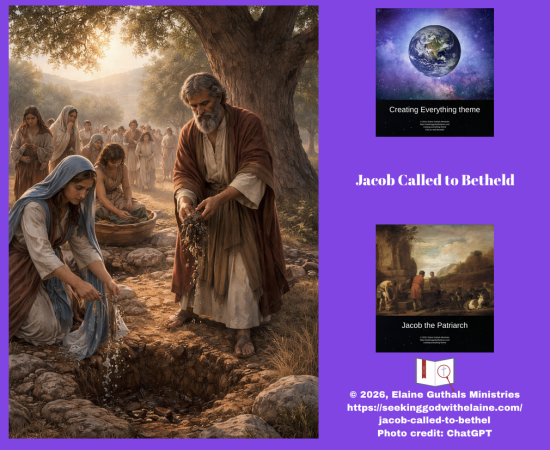
- Those in Jacob’s household voluntarily gave up the idols they had in their possession.
Jacob was still on his way home from Paddan-aram. After being sidetracked in Shechem — and probably for several years — Jacob was finally heading for Bethel.
But a lot of bad things had happened in Shechem. Before they got to Bethel, the whole family had to rededicate their lives to Jehovah.
I’m going to take the verses out of order in the next couple of devotions. We have three very important deaths that I want to address together.
But it isn’t all mourning. Stuck in the middle is the travel explanation and the formation of Israel — which (after Genesis 36) is the focus of the rest of the Book of Genesis.
But first we have to get to Bethel.
Let's Put It into Context
To read devotions in the Creating Everything theme, click the button below.
Devotions in the Jacob the Patriarch series
Renewal after Compromise
“Then God said to Jacob, ‘Get ready and move to Bethel and settle there. Build an altar there to the God who appeared to you when you fled from your brother, Esau” (Gen. 35: 1 NLT)
Jacob was finally going to fulfill the vow he made decades earlier at Bethel.
More importantly, Jacob was going to obey this direct command from Jehovah.
Bethel is well known to us. We have hear heard of it since the time of Abraham.
- “After that, Abram traveled south and set up camp in the hill country, with Bethel to the west and Ai to the east. There he built another altar and dedicated it to the Lord, and he worshiped the Lord” (Gen. 12: 8 NLT).
- “From the Negev, they continued traveling by stages toward Bethel, and they pitched their tents between Bethel and Ai, where they had camped before. This was the same place where Abram had built the altar, and there he worshiped the Lord again” (Gen. 13: 3-4 NLT).
- “The next morning Jacob got up very early. He took the stone he had rested his head against, and he set it upright as a memorial pillar. Then he poured olive oil over it. He named that place Bethel (which means ‘house of God’), although it was previously called Luz” (Gen. 28: 18-19 NLT).
- “I am the God who appeared to you at Bethel, the place where you anointed the pillar of stone and made your vow to me. Now get ready and leave this country and return to the land of your birth” (Gen. 31: 13 NLT).
When Jacob first came to Bethel, Jehovah met with him there at His initiation. The promise was given to Jacob. Unfortunately, Jacob responded imperfectly.
What is really beautiful in Genesis 31: 13 is that Jehovah never forgot the vow Jacob first made at Bethel. He was calling him back to it.
Now, that promise was going to be fulfilled.
God wanted Jacob to worship Him. He gave him specific instructions as to where and how this worship should be.
That is what Bethel was — a place of encounter, worship, return, and covenant reaffirmation.
Robertson had an interesting comment. He wrote,
“The third thing we mark here is the consecration of the place (ver. 1). It is not in reference to God, but for a help to our own feelings that we consecrate certain spots of earth and buildings. There are sacred places, not sacred for their own sake, but sacred to us.”
Resource
I get that. Only Jehovah has the right to designate a place as sacred. We each, though, have our own Bethel where we encounter Jehovah.
Does my Bethel make it sacred for you? No. Does it make it sacred for me? Yes.
We each need our own Bethel.
It is very important that we don’t skip over Who was doing the calling. “… the God who appeared to you when you fled from your brother, Esau” (Gen. 35: 1 NLT).
The God Who had been with Jacob when he left, had been with him for 20 years while he was gone, and had called him home. He was preparing Jacob and his family for the future.
Our worship must be continual. We must always have an attitude of worship.
Purification from Idolatry
“So Jacob told everyone in his household, ‘Get rid of all your pagan idols, purify yourselves, and put on clean clothing. We are now going to Bethel, where I will build an altar to the God who answered my prayers when I was in distress. He has been with me wherever I have gone.’ So they gave Jacob all their pagan idols and earrings, and he buried them under the great tree near Shechem” (Gen. 35: 2-4 NLT)
Before encountering Jehovah, Jacob’s household had to abandon the idols with which they compromised.
Jacob’s family needed to purify themselves so that they could return to Jehovah. They had slid away from Him in varying degrees – and the way from passivity to murder.
It was time to get right with Jehovah.
Get Rid of All Idols
We cannot approach Jehovah when we allow other things to divide our focus on Him.
At this point, Isaac and Jacob and their families may have been the only ones who worshiped Jehovah. Yet Jacob had allowed idols to enter his house.
Idols are anything that take our worship away from Jehovah.
Hmmmmm. I wonder if Rachel had already gotten rid of the teraphim she took from Laban. Remember, when Jacob and crew left Paddan-aram. She took these and hid them her saddlebag on her camel.
But there may have been more idols in the household than the ones Rachel took. They probably took some when they looted Shechem. This could have included idols, cult objects, and jewelry with religious significance.
The first clue was when it says, “So they gave Jacob all their pagan idols and earrings, and he buried them under the great tree near Shechem” (Gen. 35: 4 NLT emphasis added).
We may just see earrings as a fashion accessory. In the Ancient Near East, they also often had religious or magical significance. The all-encompassing term was amulets, an ornament or small piece of jewelry to give protection against evil, danger, or disease.
It wasn’t just earrings. It was also rings, beads, and pendants. They had several purposes.
- ward off evil spirits
- invoke protection from a deity
- bring fertility or good fortune.
In other words, they could be used as protective charms. It was like they had their own personal portable religious objects.
This does just say earrings here.
All in all, there may have been more items buried than the teraphim Rachel took. Jacob was eliminating everything associated with Canaanite religion.
He Buried Them
We may think it was interesting that Jacob buried the idols, not burned them.
Let me tell you. When I first read this, I was like Watkinson. Why didn’t Jacob burn the idols?
Watkinson thought Jacob was up to his old tricks. He was double-dealing and not completely focused on Jehovah.
Resource
Looking into it more, I don’t think so. Part of that has to do with figuring out the culture in which Jacob lived.
First off, we have to note that never one in God’s Word does it say that Jacob worshiped the false idols. They were Laban’s. Rachel took them. The boys looted Shechem.
Nothing put the idols in Jacob’s possession.
A second point of evidence shows Jacob’s immediate obedience to the call to move to Bethel. He immediately starts the purification process.
So, what was the significance of Jacob burying the idols and Canaanite religious objects?
Jacob was performing what we would call a ritual disposal. In the Ancient Near East, burial meant:
- Removing it from circulation
- Putting it “out of reach”
- Treating it as something no longer to be used
This meant a permanent separation.
Jacob was symbolically removing the pagan influence. In essence, he was saying, “We are leaving this behind permanently.
When something dies, we bury it. Idols were not living gods. They were just powerless objects.
Jacob was following Ancient Near Eastern custom. Burial of religious objects were not casually destroyed. Hiding them was a way of decommissioning sacred objects without mishandling them.
At this point, Jehovah had not commanded the idols be burned. He would in the Book of Deuteronomy. That is logical because, at the moment, it wasn’t a known, entrenched threat to believers.
So, Jacob was going more by instinct in this instance than by Jehovah’s command.
We can’t gloss over the fact that Jacob buried the idols at Shechem, where his sons had just murdered people and looted the city. In other words, he was leaving the impurity at Shechem, where it had bloomed.
Purify Yourselves
Jehovah not only required them to rid themselves of idols, but He also required them to purify themselves.
The second action was to purify themselves. Jehovah wanted them to remove everything that was dividing their loyalty to Him.
Repentance isn’t just feeling bad. It is about turning away from what is bad. It is about removing what competes with God and leaving it behind.
Purify describes an inner ritual cleansing to remove contamination. The Hebrew word is tāhar. It means to be clean, to be pure, or to be pronounced clean.
That means we
- Become ritually clean.
- Free from defilement.
- Made pure before Jehovah.
We can’t forget that this is more than removing spiritual contamination. Purification happens after disease and after contact with death.
The internal and spiritual preparation shows itself in outward actions, such as washing.
The goal is purity. Purity means possessing God’s moral character, having eliminated the stain of sin.
But there is something else we usually don’t connect to this. We read about others who were performing the ritual purification act before meeting Jehovah.
“Then the Lord told Moses, ‘Go down and prepare the people for my arrival. Consecrate them today and tomorrow, and have them wash their clothing. Be sure they are ready on the third day, for on that day the Lord will come down on Mount Sinai as all the people watch’” (Ex. 19: 10 NLT).
I know. One says purify, and the other says consecrate. Purification is the preparation. Consecration is the identity. Probably more appropriate, purity is cleaning the vessel. Consecrating is dedicating the vessel.
Jacob’s focus was on getting rid of the sin. Moses’ focus was on setting them apart to enter the covenant law.
But both includes cleaning. We have to get rid of the sin either way.
Put on Clean Clothing
Purification requires an outward response of change.
Look how else they were to prepare for worship. Purify themselves and put on clean clothes.
True, I bet part of the purification process was for them to take a bath. A logical follow up to that would be clean clothes.
But it doesn’t put any other qualifiers on that. It doesn’t say put on your best clothes.
The emphasis is on exchanging and replacing that which is contaminated with that which is pure.
Purity is the goal. Being clean is how we do that. We can’t put on anything unholy.
We have to look at the Ancient Near East culture. Clothing at that time symbolized status, identity, or condition.
Putting on clean clothing shows the inner purification through a changed outward appearance.

We again see that again several times in God’s Word.
- On Mount Sinai in Exodus 19
- In Zechariah 3 when Joshua the High Priest appeared in filthy garments
- Purification in Revelation 7: 14.
It is obvious we need both purifying and changing. We need both the inward focus as well as the outward focus to remove spiritual contamination and displaying the new pure condition.
So They Gave Jacob All Their Idols
Those in Jacob’s household voluntarily gave up the idols they had in their possession.
Jacob didn’t have to search the compound as Laban did. His family willingly gave them up.
This is a family-wide preparation. Jacob was about to return where others had never been: “… Bethel (which means ‘house of God’) …” (Gen. 28: 19 NLT).
Making the Connections #1
So, what do we need to have a pure heart?
- A willing heart
- A life where the things that divide our spiritual focus removed
- A genuine love for Jehovah and His ways
Making the Connections #2
Do we like it when Jehovah brings up our past? Ooo, baby. Huge emphatic NO!!!
We don’t like to be reminded of our failures. But we must remember Jehovah’s provision to us. We have to respond with gratitude.
Making the Connections #3
Part of Jacob’s issue here was that he had made a vow to Jehovah when he was leaving Canaan. He had been back around nine years — and he hadn’t been to Bethel yet.
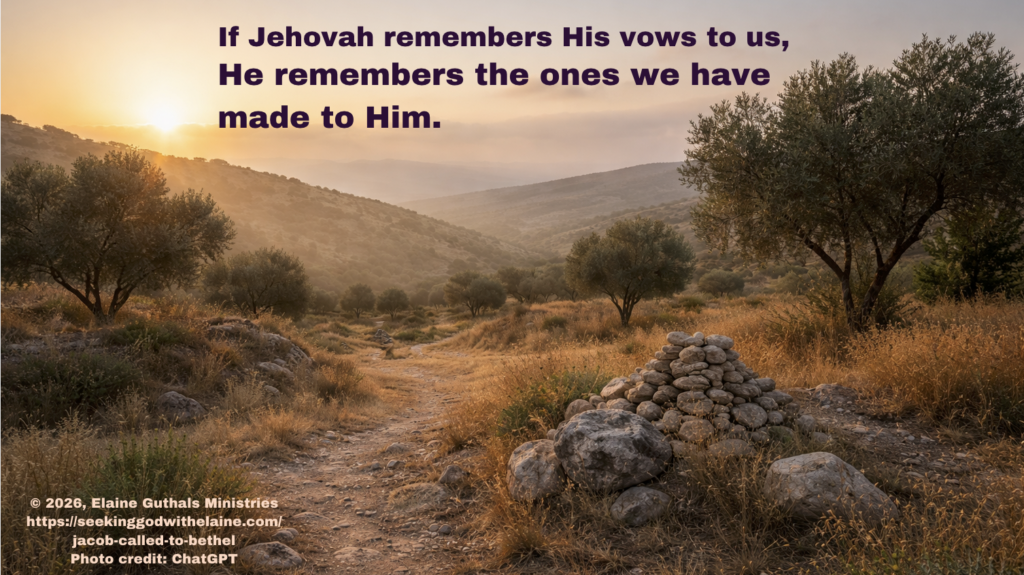
If Jehovah remembers His vows to us, He remembers the ones we have made to Him.
Let’s dig in.
What was Jacob’s vow to Jehovah? “Then Jacob made this vow: ‘If God will indeed be with me and protect me on this journey, and if he will provide me with food and clothing, and if I return safely to my father’s home, then the Lord will certainly be my God. And this memorial pillar I have set up will become a place for worshiping God, and I will present to God a tenth of everything he gives me’” (Gen. 28: 20-22 NLT).
1723 BC – Jacob cheated Esau (both age 77) out of the birthright blessing given by Isaac age 137). He flees Canaan to Paddan-aram to Rebekah’s family. He agrees to work seven years to earn the right to marry Rachel (Gen. 29: 1-20)
~1709 BC — Zebulun born (Leah)
~1709 BC — Dinah born (Leah)
1709 BC – Joseph was born (Rachel)
1709 BC – Jacob, 91, finished working seven years for Rachel and agreed to continuing working for Laban to build up his personal wealth.
1703 BC – Jacob, 97, and his family left to return to Canaan (Gen. 31: 3)
~1694 BC — Dinah was defiled
c. 1692 BC – Rachel died giving birth to Benjamin (Gen. 35: 16-20)
Based on
It was time to go to Bethel, and Jacob was going about it in the correct way.
Making the Connections #4
Craig was so right. He wrote, “The religion of the Gospel, though it is a scheme of mercy, is a system of discipline.”
Resource
Jehovah showed us mercy by not judging us to the full extent He could have. But mercy does not cancel responsibility.
In a covenant, both sides have obligations—and ours must be marked by discipline, purification, and obedience.
Making the Connections #5
How many of us have drifted from our Bethel? We haven’t realized the compromises that we have made at our Shechem. We don’t expect the covenant responsibilities to apply to us.
But we have drifted. We are in need of purifying ourselves and putting on new garments.
We’ve got to bury or even burn our own idols.
How Do We Apply This?
- Be obedient to Jehovah’s call for purification.
- Be thankful for all Jehovah has done for us in the past and all He will do for us in the future.
- Grow in grace to aid in obedience.
- Depart from evil so that we can repent.
- Avoid doing wrong and actively pursue doing right.
Resources
Father God. We want to restore our covenants with You. Purify us and help us to change our garments so that we may be consecrated to You.
If you don’t understand something and would like further clarification, please contact me.
If you have not signed up for the email providing the link to the devotions and the newsletter, do so below.
If God has used this devotion to speak with you, consider sharing it on social media.