Jacob had taken off from Haran to return to Canaan. This devotional reading looks at what happened when Laban went after him – and caught up with him.
Nuggets
- After Laban learned of Jacob’s departure, he and his clansmen pursued him.
- Laban caught up with Jacob and aired his grievances — all the while remembering his hands were tied.
- Jacob had reason to be afraid.

Things had gone downhill between Laban and Jacob. When Jehovah had told Jacob to return to Canaan, he rounded up the flocks and herds, put his wives and children on camels, and set off.
The problem was that Jacob set off in secret without telling Laban. What did Laban think of that?
Let's Put It into Context
To read devotions in the Creating Everything theme, click the button below.
Devotions in the Jacob the Patriarch series
Laban Pursues
“Three days later, Laban was told that Jacob had fled. So he gathered a group of his relatives and set out in hot pursuit. He caught up with Jacob seven days later in the hill country of Gilead. But the previous night God had appeared to Laban the Aramean in a dream and told him, ‘I’m warning you — leave Jacob alone!’” (Gen. 31: 22-24 NLT)
After Laban learned of Jacob’s departure, he and his clansmen pursued him.
Let’s go back a little and talk about Jacob leaving. I wrestled and wrestled with where Jacob was in relation to Laban.
Jacob’s escape wasn’t a midnight panic. It was a carefully staged withdrawal. The flocks were already three days away (Gen. 30: 35-36). What if those flocks and herds were three days to the south – i.e., on the way home?
The Bible Hub pointed out that it would have been easy to send those in stages, led by his four older sons. The Euphrates River, 60 to 70 miles south, could have been a staging point (Gen. 31: 21).
Resource
Then when it was all set, Jacob could have put his family on the camels and left (Gen. 31: 17).
The head start was built into the system. By the time Laban realized what had happened, Jacob was already moving toward the hill country — toward covenant ground.
Laban had gone to shear sheep (Gen. 31: 19). Three days after Jacob left, Laban learned the news. It is logical to think that it would take him three days to get back to Haran. Then he would have to gather his clansmen, which would probably take another day or two.
Did that stealthy exit give Laban the authority to go after them? Well, yes.
Remember, we said that the wedding ceremony was when the guardianship of the bride passed from the father to the husband. That happened about the time that the wedding couple went into the special tent.
But remember also, nothing about Jacob’s stay in Haran had been typical. He didn’t use the bride price – mohar – hadn’t been an upfront payment. Instead, he had worked for seven years.
The second issue was that of establishing an independent household. Jacob doesn’t do that. He is still living on Laban’s land, working within his economic system and Laban’s supervision.
In other words, the sisters were still part of Laban’s clan. Laban still thought of the grandchildren as being part of his clan.
The flocks and herds, while they were Jacob’s wages, were still under Laban’s authority. They were on his land.
Jacob did not choose the normal way to sever the treaty he had with Laban. Yes, his reasoning was very sound but still wrong.
On top of all that, something that we would consider as Laban’s personal possession was taken. And it really was a theft.
Yes, Jehovah will speak to those who do not totally believer in Him, such as Laban. He spoke to Abimelech (Gen. 20: 3) who totally didn’t believe in Him.
Some versions translate verse 24 to read “… Don’t say anything to Jacob, either good or bad” (Gen. 31: 24 NIV, ESV, KJV, NKJV, NASB, CSB). Good News Translation admonished Laban not to threaten Jacob. The Contemporary English Version added don’t make a promise.
The Hebrew translates it as tov (good) and rah (bad, evil, or wicked). It is interested that this is formed in spiritual terms.
But not really. This is the covenant son, not just some standard, run-of-the-mill shepherd.
The Confrontation
“Laban caught up with Jacob as he was camped in the hill country of Gilead, and he set up his camp not far from Jacob’s. ‘What do you mean by deceiving me like this?’ Laban demanded. ‘How dare you drag my daughters away like prisoners of war? Why did you slip away secretly? Why did you deceive me? And why didn’t you say you wanted to leave? I would have given you a farewell feast, with singing and music, accompanied by tambourines and harps. Why didn’t you let me kiss my daughters and grandchildren and tell them good-bye? You have acted very foolishly! I could destroy you, but the God of your father appeared to me last night and warned me, “Leave Jacob alone!” I can understand your feeling that you must go, and your intense longing for your father’s home. But why have you stolen my gods?” (Gen. 31: 25-30 NLT)
Laban caught up with Jacob and aired his grievances — all the while remembering his hands were tied.
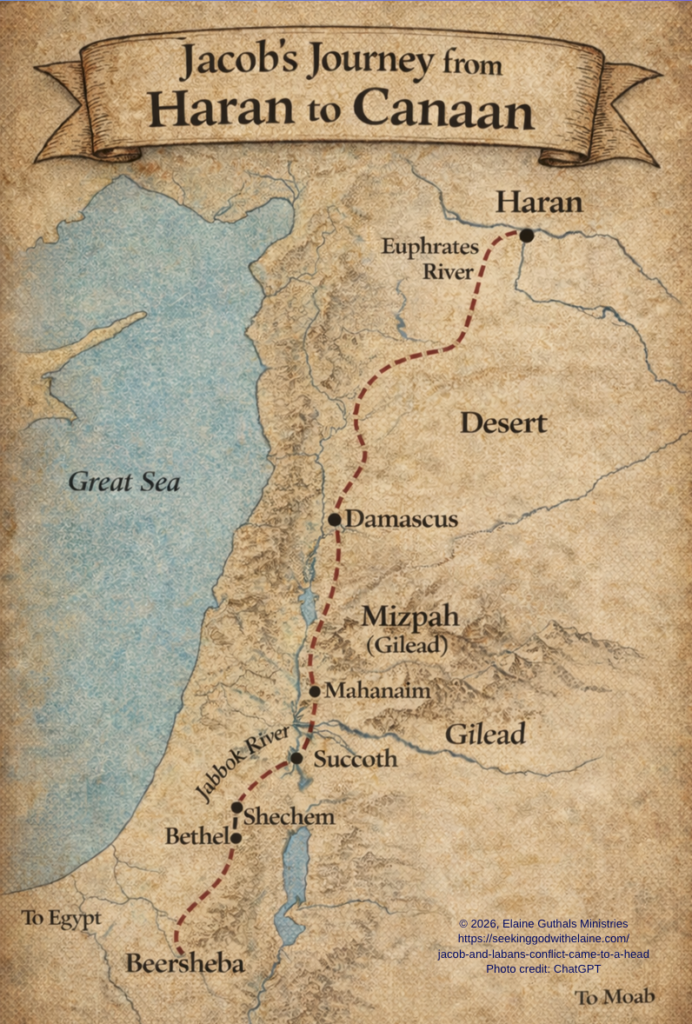
First, we have to deal with travel issues. In my wee little mind, I have trouble making it connect.
- Laban was told on the third day that Jacob had fled.
- He pursued him seven days.
- He overtook him in the hill country of Gilead.
So, I had a new map drawn and formatted differently. This helped.
I know. Part of us is saying why would Laban throw this farewell feast when he refused to let Jacob go six years before.
Go back to verse 2. “And Jacob began to notice a change in Laban’s attitude toward him” (Gen. 31: 2 NLT).
Jacob was no longer the favored son-in-law. Despite all of Laban’s manipulations, Jacob got wealthy off him.
Maybe Laban was no longer seeing his wealth increase because of Jacob (Gen. 30: 27). We said that, when Jehovah is working to prepare us for a change, He uses discontent. I think — especially in this case — the discontent had to have been on both sides.
So, in a way, Laban throwing a party seems out of character. But then, he may have said that because he wouldn’t have wanted to lose face by not giving them the expected send off.
In a way, I am surprised Laban told Jacob that Jehovah told him to cease and desist. But then, that is probably logical, too.
Laban would have had the stronger party. Verse 23 only says that he “… gathered a group of his relatives … (Gen. 31: 23 NLT).
Those weren’t just any relatives. Remember, this was clan business. They would have been battle ready.
We said that Jacob now headed a clan, but it was filled with women and children. On top of that, the children were young.
1716 BC – Jacob, 84, was tricked into marrying Leah. He agreed to work seven more years for Rachel
1715 BC — Reuben born (Leah)
1714 BC — Simeon born (Leah)
1713 BC — Levi born (Leah)
1712 BC — Judah born (Leah)
1712 BC — Dan born (Bilhah)
1711 BC — Naphtali born (Bilhah)
1711 BC — Gad born (Zilpah)
1710 BC — Asher born (Zilpah)
1710 BC — Issachar born (Leah)
1709 BC — Zebulun born (Leah)
1709 BC – Joseph was born (Rachel)
1703 BC – Jacob, 97, and his family left to return to Canaan (Gen. 31: 3)
Based on Timeline from
Reuben would have been 12 the way we figured it. Joseph would have been 6. If only four sons helped as Bible Hub said, I think the years on some are wrong.
They may or may not have added to the fighting numbers.
I’m sure Jacob did have some fight-ready servants. He wouldn’t have gone on that long of a journey without at least some.
Clearly, Laban led the stronger party. And Jehovah neutralized him. This was Him protecting the covenant line —protection only because He interceded.
Roost there a second. This world said that Laban was justified in using whatever force necessary to reclaim his claim. Sovereign God overruled that.
Sovereign God will always overrule this world. Yes, Satan rules it now. Now.

Jacob Responded
“‘I rushed away because I was afraid,’ Jacob answered. ‘I thought you would take your daughters from me by force’” (Gen. 31: 31 NLT)
Jacob had reason to be afraid.
Laban gave this whole big spiel. Jacob answered him in a sentence.
We will never know what Laban would have done had not God restrained him. Considering he was loaded for bear, we probably have a pretty good idea.
Jacob distilled it down to the most important thing. He was afraid Laban would have taken his wives – plural. He did not leave Leah out. We may be surprised that he didn’t include his sons and his fear.
Who is this Jacob not trusting Sovereign God to protect him? I don’t think so.
Jehovah knows the anxiety is going to come. That isn’t a problem.
It is what we do with that fear that is the problem. We could say that Jacob fleeing in secret showed that he did not trust God.
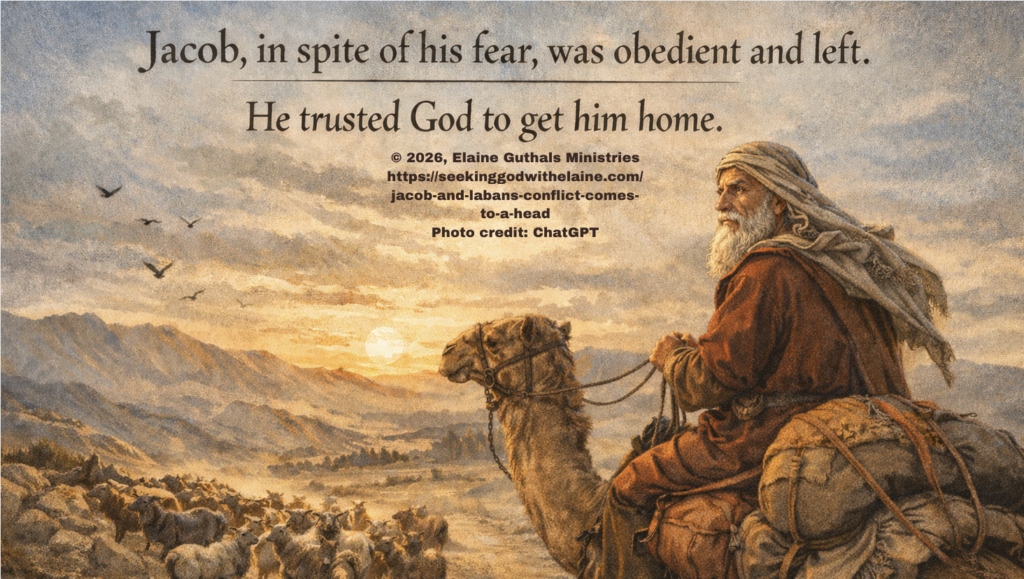
I think the most telling part is that Jacob, in spite of his fear, was obedient and left. He trusted God to get him home.
Making the Connections #1
This just shows how much a big deal clans were. It took this to sever the patriarchal authority that Laban had over Jacob.
Yeah, Jacob’s situation was different because he didn’t have the bride-price.
We can see Laban’s side a little better. No, that doesn’t excuse his behavior toward Jacob – like changing his wages many times.
But Laban was justified in his actions.
Making the Connections #2
Once again, Jehovah stepped in. He did with Abraham and Abimelech. He did with Laban.
I bet Jehovah steps in more times than we know to protect us.
How Do We Apply This?
- Always be obedient to Jehovah, even when we are most fearful.
- Go when he says go.
Father God. We know You always watch over us — especially when we are being faithful. Help. us when we struggle with those of this world. Amen.
If you don’t understand something and would like further clarification, please contact me.
If you have not signed up for the email providing the link to the devotions and the newsletter, do so below.
If God has used this devotion to speak with you, consider sharing it on social media.