Jehovah provided water for Hagar and Ishmael in the wilderness. This devotional reading takes an initial look at what happened to Ishmael.
Nuggets
- Jehovah in His mercy opened Hagar’s eyes to what she needed.
- Even though Ishmael was an outcast, Jehovah was with him.
- Ishmael grew under Jehovah’s provision.
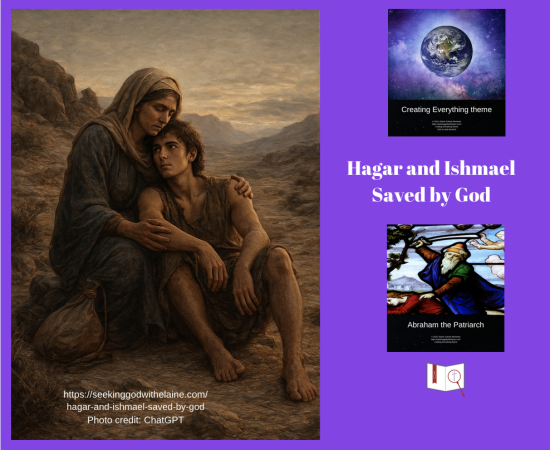
Things had come to a head in Abraham’s house. Hagar and Ishmael, the firstborn, we’re mocking Sarah and Isaac, the covenant son. Sarah was done with it and had demanded Hagar and Ishmael be driven from the household.
The day had come for Hagar and Ishmael to leave. Let’s see what happened.
Let's Put It into Context
To read devotions in the Creating Everything theme, click the button below.
Devotions in the Abraham the Patriarch series
The Means of Salvation
“Then God opened Hagar’s eyes, and she saw a well full of water. She quickly filled her water container and gave the boy a drink” (Gen. 21: 19 NLT)
Jehovah in His mercy opened Hagar’s eyes to what she needed.
Did the well just miraculously appear? Or did Hagar not see it because she had sand and tears in her eyes?
That has to go in our UNR book — understanding not required. It could go either way.
Sometimes, isn’t God’s provision there all along? Haven’t we just needed to be blinded to see it?
But let’s think about the well for a second. Conder said it was dug in order to water flocks, not to provide water for travelers.
Resource
In other words, the well was being used for something that was different than its purpose.
However, Jehovah always knew Hagar and Ishmael would need that well on that day. He made sure the well wasn’t dry.
What we need will always be within arm’s reach. Spurgeon explained it this way. He wrote, “The mercy of God is not a thing to be sought for up yonder among the stars, nor to be discovered in the depths; it is nigh thee, it is even in thy mouth and in thy heart.”
Resource
The big question for us is how many times do we not see Jehovah’s well right beside us? He offers us living water from that well.
It is a well for more than just salvation. Living water includes the gift of the Holy Spirit. “Anyone who believes in me may come and drink! For the Scriptures declare, ‘Rivers of living water will flow from his heart.’ (When he said ‘living water,’ he was speaking of the Spirit, who would be given to everyone believing in him …)” (Jn. 7: 38-39 NLT).
The Results of Salvation
“And God was with the boy as he grew up in the wilderness. He became a skillful archer, and he settled in the wilderness of Paran. His mother arranged for him to marry a woman from the land of Egypt” (Gen. 21: 20-21 NLT)
God Was with the Boy
Even though Ishmael was an outcast, Jehovah was with him.
Abraham — by Jehovah’s command — cast Ishmael out of his home. Still, Jehovah was with Ishmael. He promised Hagar that a nation would come through his line as well as through Isaac’s line.
If we read through those verses, we think that Ishmael got the exact same inheritance that Isaac did. Everything except being the covenant son.
Bradford gave a really important reminder. He wrote, “A promise is made from God that Ishmael will father a great nation. This is really a reminder of a previous commitment to Ishmael, undoubtedly for Hagar’s sake. But, notice that there is NO promise of land; just a nation. And, just to be clear, in Bible terms nations are not about land or territory, they are about people groups.”
Resource
True, while Jehovah told Abraham go to the land He showed Him (Gen. 12: 1-3), the promise of land didn’t come until Genesis 12: 7. Abraham had already arrived in Canaan (Gen. 12: 5), so the land was a blessing for his obedience.
Nowhere in God’s Word was Ishmael ever promised land. He was promised nations — people groups.
Isaac, the covenant child, was promised land.
Remember, the only land Abraham owned when he died was the cave in Mamre where he buried Sarah.
Jehovah blessed Ishmael because Abraham asked Him to do so. “As for Ishmael, I will bless him also, just as you have asked …” (Gen. 17: 20 NLT).
Doesn’t this go along with Jehovah’s pattern? He cast Adam and Eve out of the Garden of Eden after they sinned, and Cain was cast out when he sinned.
Ishmael was not the covenant child, even though he was firstborn. He was cast out.
Jehovah is in the business of separating and dividing. When He divides, He casts out.
“Therefore, the LORD, the God of Israel, says:…. But I will honor those who honor me, and I will despise those who think lightly of me” (I Sam. 2: 30 NLT).
But Jehovah doesn’t cast us out very far. “His purpose was for the nations to seek after God and perhaps feel their way toward him and find him — though he is not far from any one of us” (Ac. 17: 27 NLT).
He Became
Ishmael grew under Jehovah’s provision.
As Ishmael grew, he learned how to defend himself. Eventually, Ishmael became a husband and a father himself.
Wilderness of Paran
Again, you may be asking if it is the Paran Wilderness or the Paran Desert. The answer would be yes.
I found an article that explained this. It said, “The Wilderness of Paran emerges as a pivotal location in biblical narratives, particularly through the story of Hagar and Ishmael. This harsh desert landscape became the backdrop for significant events that shaped the course of biblical history.”
Resource
Like, I said. The answer is yes.
This area is a significant area.
- It would be some known as Midian, more commonly known as the Arabian Peninsula.
- It was where the Wilderness Wanderers would wander for 40 years.
- It was where David hid from King Saul (I Sam. 25: 1).
Making the Connections #1
Talmage talked about how Hagar and Ishmael got into this predicament. He wrote,
“I learn from this Oriental scene, in the first place, what a sad thing it is when people do not know their place, and get too proud for their business. Hagar was an assistant in that household, but she wanted to rule there. She ridiculed and jeered until her son, Ishmael, got the same tricks.”
Resource
It sounds like Hagar didn’t choose to be a slave in Abraham’s country. She still wanted to be a princess.
Did that mean Hagar and Ishmael should have been cast out?
Well, yes. That is what Jehovah commanded. We cannot second-guess Him or tell Him that He made the wrong decision.
Just because Jehovah uses people who have not agreed to His covenant with us doesn’t give them a special pass.
Making the Connections #2
Wilberforce reminded us that good can come out of bad. He wrote, “His casting out, dark as it seemed, was preparing the way for this; and so it is with you. Everything around you is ordered by God for an end. That end is truly your best spiritual happiness.”
Resource
“And we know that God causes everything to work together for the good of those who love God and are called according to his purpose for them” (Rom. 8: 28 NLT).
In fact, God can use the trials to grow us more than when there is sooth sailing.
The Hagar that came out of the wilderness was a totally different Hagar than the one who went into it. She was humbled. She wasn’t laughing at anyone now.
Hagar could no longer provide for herself and her son. She had to depend on Jehovah.
Brown also said her indifference was gone. Ishmael’s survival was more important than her own.
Resource
Jehovah wants that humility and dependence on Him. He requires our surrender to Him.
Was Hagar praying, also? Maybe. Maybe it was just the Holy Spirit praying for her.
Jehovah heard.
Making the Connections #3
Spurgeon made a great observation. He wrote,
“Hagar had a pair of bright beaming eyes, I will be bound to say, and yet she could not see the water; and men may have first-rate understandings, but not understand that simple thing — faith in the Lord Jesus Christ. Simple trust in Jesus has this difficulty in it, that it is not difficult, and therefore the human mind refuses to believe that God can intend to save us by so simple a plan.
Resource
We don’t think faith is enough to save us. Instead, we think we have to have works, too.
No, the cross is sufficient for salvation.
Making the Connections #4
Spurgeon also gave us an example of what blinds our eyes. He wrote,
“For instance, a large proportion of spiritual distresses are occasioned by a forgetfulness or an ignorance of the doctrines of the Bible. Sometimes, holy Scripture has its well near to the troubled heart, not so much in the form of doctrine, as in the form of promise. There was never a trouble yet in human experience among God’s people, but what there was a promise to meet it. At other times the well appears in the form neither of a doctrine nor of a promise, but in the shape of an experience of some one else. Perhaps nothing more effectually comforts, under the blessing of God, than the discovery that some undoubtedly good man has passed through the same state of heart in which we are found. And, beloved, sometimes it pleases the Holy Spirit to open a well of living waters for us in the person, and work, and life, and sympathy, and love, of our Well-beloved, the Lord Jesus Christ. Jesus suffers with thee, O thou child of God, — suffers in thee. Thou art a member of His body, and therefore He endures in thee. Thou art making up that which is behind of the sufferings of Christ for His body’s sake, which is the Church. Besides, once more, our sorrows often arise from our not observing the Holy Spirit.”
Resource
Almost three years ago, Jehovah told Steve that the Church was missing Yeshua. Almost two years ago, He said it was because the Church was ignorant and apathetic.
Forgetfulness. When we don’t think of something for a while, we tend to forget. Worse yet, we start to paraphrase and get the paraphrase wrong.
Ignorance of doctrines. The Jewishness has been taken out of our translation — yes, even the King James Version. In all the translations, things have been misunderstood and translated wrong. We may not know exactly what the true doctrine is.
Remember when we were talking in Genesis 15 about Jehovah coming to Abraham. The translation I am using reads, “Some time later, the LORD spoke to Abram in a vision and said to him, ‘Do not be afraid, Abram, for I will protect you, and your reward will be great’ (Gen. 15: 1 NLT).
In the Orthodox Jewish Bible, it reads, “After these things the Devar Hashem came unto Avram in a vision, saying, Fear not, Avram; I am thy mogen, [shield, buckler, protector, defense] and thy exceeding great sachar (reward)” (Gen. 15: 1 OJB).
God said, “I am they shield and reward.” Not that “… your reward will be great” (Gen. 15: 1 NLT).
Yes, that is very troubling to me. How can we know what we have gotten right and what we have gotten wrong?
But God has a promise for my troubled heart. “Don’t let your hearts be troubled. Trust in God, and trust also in me. There is more than enough room in my Father’s home. If this were not so, would I have told you that I am going to prepare a place for you? When everything is ready, I will come and get you, so that you will always be with me where I am” (Jn. 14: 1-3 NLT).
I don’t have to understand everything. I don’t have to even get it all right. I have to believe Jehovah is Sovereign God, and Yeshua was the sacrifice so that our relationships with Them may be restored.
You may be wandering why all the sudden I have switched from using God to using Jehovah and from Jesus to Yeshua.
We are to call on the name of the Lord. But His name isn’t God. That is His title.
“God said further to Moshe, “Say this to the people of Isra’el: ‘Yud-Heh-Vav-Heh [Adonai], the God of your fathers, the God of Avraham, the God of Yitz’chak and the God of Ya‘akov, has sent me to you.’ This is my name forever; this is how I am to be remembered generation after generation” (Ex. 3: 15 CJB).
His name is Yahweh, what we call Jehovah.
Jehovah’s Son’s name is Yeshua. The problem with that is it is Joshua, not Jesus.
Are names important? Shakespeare didn’t seem to think so. But what if God does?
Whatever our situation, we can depend on Jehovah’s provision. He has promised us to never leave us. Yeshua is the living water — the Holy Spirit — dwelling within us.
Making the Connections #5
In today’s world, it is important to remember that Ishmael was not the covenant child. Isaac was. Yeshua came through the line of Isaac.
“… Blessed is everyone who blesses you, O Israel, and cursed is everyone who curses you” (Num. 24: 9 NLT).
If we stand with Ishmael instead of Isaac, are we really standing with Yeshua?
Don’t be a goat masquerading in sheep’s clothing. Remember Matthew 7: 21-23.
How Do We Apply This?
- Don’t forget that it is darkest before dawn.
- Remember that Jehovah grants us mercies in miseries.
- Understand Jehovah provides it only water but also living water.
- Experience Jehovah’s comfort in our sorrows.
- Restrain from sin because God is near us.
- Let God be the God of the little things — because there are a whole lot more little things than big.
Resources
Father God. You provide for Your creation. You proved that with Hagar and Ishmael. Amen.
If you don’t understand something and would like further clarification, please contact me.
If you have not signed up for the email providing the link to the devotions and the newsletter, do so below.
If God has used this devotion to speak with you, consider sharing it on social media.